mirror of
https://github.com/zebrajr/pytorch.git
synced 2025-12-06 12:20:52 +01:00
 2d8deffc1e
This is a two part PR; I can split it if you really want me to.

The first part is a refactor of the after aot repro/minifier scripts to come with a command line interface. I maintain exact BC with the previous interface (so, e.g., you still get a repro.py and a run_minifier.py that do the same thing as before), but each of these scripts also take command line arguments now which you can use to customize what actually happens. Check `run_repro` for full documentation on the arguments.

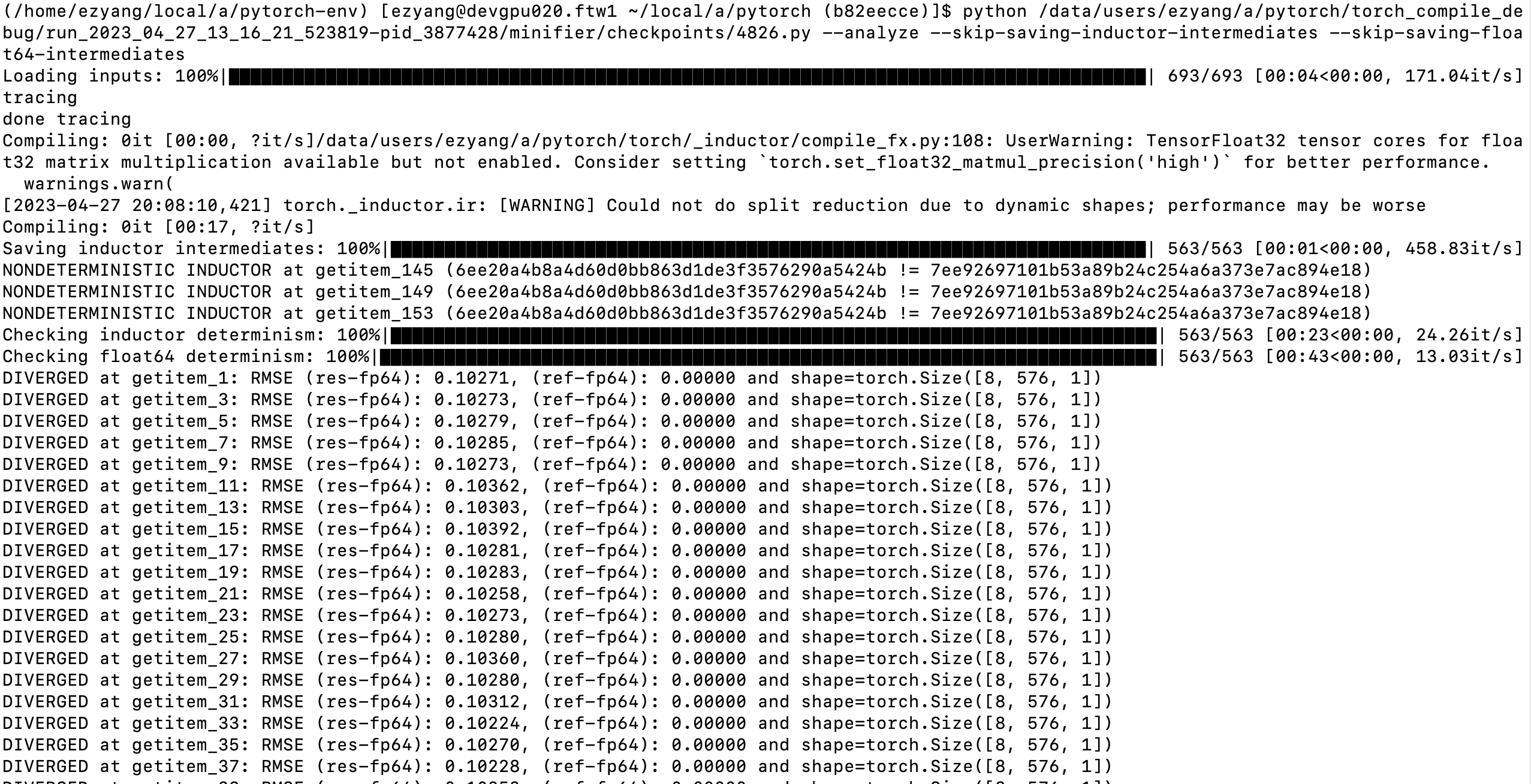
The second part of this is an implementation of `analyze` subcommand on the new CLI for any repro.

<img width="1277" alt="image" src="https://user-images.githubusercontent.com/13564/235045677-8545aab7-5e83-4813-bbec-47783dc60122.png">

This facility is oriented towards accuracy debugging. It does several things:

1. It will run your model twice and check for nondeterminism in inductor/float64, *even* on intermediate inputs (our benchmarking nondeterminism test only checks for nondeterminism on the final output). This makes localizing which operator is nondeterministic easy.
2. It will run your compiled model side-by-side with eager and float64 variants, and then report when things diverge too far from RMSE delta from float64.

Importantly, it does all this without requiring every intermediate to be held in memory (which will cause an OOM on large repros, such as the one I tested this on.)

Some other minor improvements:

* MinifierTestBase now has an easy to comment out spot that you can use to retain the temporary directory; good for debugging
* We print "running minifier" and "running repro" in MinifierTestBase to make it easier to orient where logs are coming from
* same takes a `log_error` optional argument which you can use to reroute the error logs when things mismatch
* counters["inductor"]["intermediate_hooks"] tracks the number of intermediate hooks we've codegen'ed; good for populate the tqdm interface
* torch.fx.interpreter gets an official `boxed_run` interface which uses the boxed arguments calling convention and doesn't retain inputs unnecessarily long
* torch.utils._content_store gets compute_tensor_metadata/read_tensor_metadata helper functions for computing tensor information without serializing it

Signed-off-by: Edward Z. Yang <ezyang@meta.com>

Pull Request resolved: https://github.com/pytorch/pytorch/pull/100226
Approved by: https://github.com/bertmaher, https://github.com/bdhirsh, https://github.com/anijain2305
419 lines
13 KiB
Python
419 lines
13 KiB
Python
import copy
|
|
import functools
|
|
import getpass
|
|
import logging
|
|
import os
|
|
import subprocess
|
|
import tempfile
|
|
import textwrap
|
|
from collections import Counter
|
|
from importlib import import_module
|
|
|
|
import torch
|
|
from torch._prims_common import is_float_dtype
|
|
|
|
from . import config
|
|
from .utils import clone_inputs, get_debug_dir
|
|
|
|
log = logging.getLogger(__name__)
|
|
|
|
|
|
inductor_config = import_module("torch._inductor.config")
|
|
use_buck = inductor_config.is_fbcode()
|
|
|
|
if use_buck:
|
|
import libfb.py.build_info # type: ignore[import]
|
|
|
|
|
|
extra_deps = []
|
|
extra_imports = ""
|
|
if use_buck:
|
|
extra_deps = [
|
|
"//caffe2/torch/fb/sparsenn:sparsenn_operators_gpu",
|
|
"//caffe2/torch/fb/sparsenn:sparsenn_operators",
|
|
"//deeplearning/fbgemm/fbgemm_gpu:sparse_ops_cpu",
|
|
"//deeplearning/fbgemm/fbgemm_gpu:sparse_ops",
|
|
]
|
|
cur_target = libfb.py.build_info.BuildInfo.get_build_rule().replace("fbcode:", "//")
|
|
extra_imports = "\n".join([f'torch.ops.load_library("{x}")' for x in extra_deps])
|
|
|
|
|
|
BUCK_CMD_PREFIX = ["buck2", "run", "@mode/dev-nosan"]
|
|
|
|
|
|
class BuckTargetWriter:
|
|
def __init__(self, filename):
|
|
self.subdir, self.py_file = os.path.split(os.path.abspath(filename))
|
|
self.target = self.py_file.replace(".py", "")
|
|
|
|
# Get main_module path from fbcode
|
|
self.path = f'{self.subdir.replace("/", ".")}.{self.target}'
|
|
self.path = self.path[self.path.find("fbcode.") :]
|
|
self.path = self.path[7:]
|
|
|
|
# Get cmd line path
|
|
tmp = self.subdir
|
|
tmp = tmp[tmp.find("fbcode/") :][7:]
|
|
self.cmd_line_path = f"//{tmp}:{self.target}"
|
|
|
|
def build(self):
|
|
extra_cpp_deps = "\n".join([f' "{x}",' for x in extra_deps])
|
|
return textwrap.dedent(
|
|
f"""
|
|
load("@fbcode_macros//build_defs:python_binary.bzl", "python_binary")
|
|
|
|
python_binary(
|
|
name="{self.target}",
|
|
srcs = ["{self.py_file}"],
|
|
compile = False,
|
|
deps = [
|
|
"//caffe2:torch",
|
|
"//caffe2/functorch:functorch",
|
|
"//triton:triton",
|
|
"{cur_target}",
|
|
],
|
|
cpp_deps = [
|
|
{extra_cpp_deps}
|
|
],
|
|
main_module = "{self.path}",
|
|
)
|
|
"""
|
|
)
|
|
|
|
def write(self, print_msg=True):
|
|
target_file = os.path.join(self.subdir, "TARGETS")
|
|
with open(target_file, "w") as fd:
|
|
fd.write(self.build())
|
|
# log.warning("Wrote isolation TARGETS file at %s", target_file)
|
|
cmd_split = BUCK_CMD_PREFIX + [self.cmd_line_path]
|
|
if print_msg:
|
|
log.warning(
|
|
"Found an example that reproduces the error. Run this cmd to repro - %s",
|
|
" ".join(cmd_split),
|
|
)
|
|
return cmd_split
|
|
|
|
|
|
def minifier_dir():
|
|
path = os.path.join(get_debug_dir(), "minifier")
|
|
if path is None:
|
|
path = f"{tempfile.gettempdir()}/minifier_{getpass.getuser()}"
|
|
if not os.path.exists(path):
|
|
os.makedirs(path, exist_ok=True)
|
|
return path
|
|
|
|
|
|
class NNModuleToString:
|
|
safe_reprs = [
|
|
torch.nn.Linear,
|
|
torch.nn.Conv1d,
|
|
torch.nn.Conv2d,
|
|
torch.nn.Conv3d,
|
|
torch.nn.BatchNorm1d,
|
|
torch.nn.BatchNorm2d,
|
|
torch.nn.BatchNorm3d,
|
|
torch.nn.LayerNorm,
|
|
torch.nn.Dropout,
|
|
torch.nn.Softmax,
|
|
torch.nn.ReLU,
|
|
torch.nn.GELU,
|
|
torch.nn.Identity,
|
|
torch.nn.MaxPool2d,
|
|
torch.nn.Embedding,
|
|
torch.nn.Tanh,
|
|
torch.nn.ConvTranspose1d,
|
|
torch.nn.GLU,
|
|
torch.nn.LSTM,
|
|
torch.nn.Flatten,
|
|
torch.nn.AdaptiveAvgPool2d,
|
|
]
|
|
|
|
@staticmethod
|
|
def can_convert_to_string(gm):
|
|
cant_convert = set()
|
|
for _, module in gm.named_children():
|
|
if type(module) not in NNModuleToString.safe_reprs:
|
|
cant_convert.add(module)
|
|
|
|
if len(cant_convert) > 0:
|
|
log.warning("We have not tested reprs of some modules - %s", cant_convert)
|
|
# TODO - Assuming that all modules can be safely repr'd. Check if that assumption is correct.
|
|
return True
|
|
|
|
@staticmethod
|
|
def convert(gm):
|
|
from torch.nn.modules.module import _addindent
|
|
|
|
tab = " " * 4
|
|
|
|
model_str = textwrap.dedent(
|
|
"""
|
|
from torch.nn import *
|
|
class Repro(torch.nn.Module):
|
|
def __init__(self):
|
|
super().__init__()
|
|
"""
|
|
)
|
|
|
|
for module_name, module in gm.named_children():
|
|
module_str = f"{module.__repr__()}"
|
|
# module should be a core torch.nn.Module, so all parameters
|
|
# should be on the same device.
|
|
example_param = next(module.parameters(), None)
|
|
if example_param is not None and example_param.is_cuda:
|
|
module_str = f"{module_str}.cuda()"
|
|
model_str += f"{tab*2}self.{module_name} = {module_str}\n"
|
|
|
|
for buffer_name, buffer in gm._buffers.items():
|
|
if buffer is None:
|
|
continue
|
|
if torch.is_floating_point(buffer):
|
|
tensor_str = f"torch.randn({list(buffer.shape)}, dtype={buffer.dtype})"
|
|
else:
|
|
tensor_str = (
|
|
f"torch.randint(1, size={list(buffer.shape)}, dtype={buffer.dtype})"
|
|
)
|
|
if buffer.is_cuda:
|
|
tensor_str = f"{tensor_str}.cuda()"
|
|
model_str += f"{tab*2}self.register_buffer('{buffer_name}', {tensor_str})\n"
|
|
|
|
for param_name, param in gm._parameters.items():
|
|
if param is None:
|
|
continue
|
|
tensor_str = f"torch.nn.Parameter(torch.randn({list(param.shape)}, dtype={param.dtype}))"
|
|
if param.is_cuda:
|
|
tensor_str = f"{tensor_str}.cuda()"
|
|
model_str += f"{tab*2}self.{param_name} = {tensor_str}\n"
|
|
|
|
# TODO - Keep this code for now. But, I don't think we will need this.
|
|
# attrs = dir(gm)
|
|
# for attr in attrs:
|
|
# if "_tensor_constant" in attr:
|
|
# val = getattr(gm, attr)
|
|
# model_str += f" {attr} = {val!r}\n"
|
|
|
|
model_str += f"{_addindent(gm.code, 4)}\n"
|
|
return model_str
|
|
|
|
|
|
@functools.lru_cache(None) # subprocess is expensive
|
|
def _cuda_system_info_comment():
|
|
if not torch.cuda.is_available():
|
|
return "# torch.cuda.is_available()==False, no GPU info collected\n"
|
|
|
|
model_str = "# CUDA Info: \n"
|
|
try:
|
|
cuda_version_out = subprocess.run(["nvcc", "--version"], stdout=subprocess.PIPE)
|
|
cuda_version_lines = cuda_version_out.stdout.decode().split("\n")
|
|
comment = "".join([f"# {s} \n" for s in cuda_version_lines if s not in [""]])
|
|
model_str += f"{comment}\n"
|
|
except FileNotFoundError:
|
|
model_str += "# nvcc not found\n"
|
|
|
|
gpu_names = Counter(
|
|
torch.cuda.get_device_name(i) for i in range(torch.cuda.device_count())
|
|
)
|
|
|
|
model_str += "# GPU Hardware Info: \n"
|
|
for name, count in gpu_names.items():
|
|
model_str += f"# {name} : {count} \n"
|
|
model_str += "\n"
|
|
return model_str
|
|
|
|
|
|
def generate_config_string(*, stable_output=False):
|
|
import torch._functorch.config
|
|
import torch._inductor.config
|
|
|
|
if stable_output:
|
|
return "# config omitted due to stable_output=True"
|
|
|
|
return textwrap.dedent(
|
|
f"""\
|
|
import torch._dynamo.config
|
|
import torch._inductor.config
|
|
import torch._functorch.config
|
|
torch._dynamo.config.load_config({repr(torch._dynamo.config.save_config())})
|
|
torch._inductor.config.load_config({repr(torch._inductor.config.save_config())})
|
|
torch._functorch.config.load_config({repr(torch._functorch.config.save_config())})
|
|
"""
|
|
)
|
|
|
|
|
|
TEST_REPLACEABLE_COMMENT = "# REPLACEABLE COMMENT FOR TESTING PURPOSES"
|
|
|
|
|
|
def get_minifier_repro_path():
|
|
return os.path.join(minifier_dir(), "minifier_launcher.py")
|
|
|
|
|
|
def helper_for_dump_minify(contents):
|
|
minified_repro_path = get_minifier_repro_path()
|
|
log.warning("Writing minified repro to %s", minified_repro_path)
|
|
|
|
if use_buck:
|
|
BuckTargetWriter(minified_repro_path).write()
|
|
try:
|
|
with open(minified_repro_path, "w") as fd:
|
|
fd.write(contents)
|
|
|
|
except OSError as e:
|
|
log.exception(e)
|
|
raise NotImplementedError("Could not write to {minified_repro_path}") from e
|
|
|
|
|
|
class AccuracyError(Exception):
|
|
pass
|
|
|
|
|
|
def clone_inputs_retaining_gradness(example_inputs):
|
|
"""
|
|
This clone inputs is different from utils clone_input. In case of minifier,
|
|
all the tensors are leaf tensors while creating a new graph. So, we set the
|
|
requires_grad field w/o checking the leafness of the tensor.
|
|
"""
|
|
cloned_inputs = clone_inputs(example_inputs)
|
|
for idx in range(len(example_inputs)):
|
|
if isinstance(cloned_inputs[idx], torch.Tensor):
|
|
cloned_inputs[idx].requires_grad_(example_inputs[idx].requires_grad)
|
|
return cloned_inputs
|
|
|
|
|
|
def run_fwd_maybe_bwd(gm, args, only_fwd=False):
|
|
"""
|
|
Runs a forward and possibly backward iteration for a given mod and args.
|
|
"""
|
|
from torch._functorch.aot_autograd import make_boxed_func
|
|
|
|
from .testing import collect_results, reduce_to_scalar_loss, requires_bwd_pass
|
|
|
|
gm = copy.deepcopy(gm)
|
|
args = clone_inputs_retaining_gradness(args)
|
|
|
|
if hasattr(gm, "zero_grad"):
|
|
gm.zero_grad(True)
|
|
|
|
# TorchInductor returned callable expects lists. So, boxing the call.
|
|
orig_named_parameters = getattr(gm, "named_parameters", None)
|
|
orig_named_buffers = getattr(gm, "named_buffers", None)
|
|
if not hasattr(gm, "_boxed_call") and (
|
|
orig_named_parameters is not None or orig_named_buffers is not None
|
|
):
|
|
gm = make_boxed_func(gm)
|
|
if orig_named_parameters is not None:
|
|
gm.named_parameters = orig_named_parameters
|
|
if orig_named_buffers is not None:
|
|
gm.named_buffers = orig_named_buffers
|
|
|
|
out = gm(args)
|
|
if only_fwd:
|
|
return out
|
|
if requires_bwd_pass(out):
|
|
loss = reduce_to_scalar_loss(out)
|
|
loss.backward()
|
|
return collect_results(gm, out, None, args)
|
|
|
|
|
|
def same_two_models(gm, opt_gm, example_inputs, only_fwd=False):
|
|
"""
|
|
Check two models have same accuracy.
|
|
"""
|
|
from .eval_frame import OptimizedModule
|
|
from .testing import (
|
|
named_buffers_for_optimized_module,
|
|
named_parameters_for_optimized_module,
|
|
)
|
|
from .utils import same
|
|
|
|
if isinstance(gm, OptimizedModule):
|
|
gm.named_parameters = named_parameters_for_optimized_module(gm)
|
|
gm.named_buffers = named_buffers_for_optimized_module(gm)
|
|
|
|
if isinstance(opt_gm, OptimizedModule):
|
|
opt_gm.named_parameters = named_parameters_for_optimized_module(opt_gm)
|
|
opt_gm.named_buffers = named_buffers_for_optimized_module(opt_gm)
|
|
|
|
ref = run_fwd_maybe_bwd(gm, example_inputs, only_fwd)
|
|
|
|
try:
|
|
fp64_model, fp64_examples = cast_to_fp64(
|
|
copy.deepcopy(gm), clone_inputs_retaining_gradness(example_inputs)
|
|
)
|
|
fp64_ref = run_fwd_maybe_bwd(fp64_model, fp64_examples, only_fwd)
|
|
except Exception:
|
|
log.warning("Could not generate fp64 outputs")
|
|
fp64_ref = None
|
|
|
|
try:
|
|
res = run_fwd_maybe_bwd(opt_gm, example_inputs, only_fwd)
|
|
except Exception as e:
|
|
# This means that the minified graph is bad/exposes a different problem.
|
|
# As we are checking accuracy here, lets log the exception and return True.
|
|
log.exception(
|
|
(
|
|
"While minifying the program in accuracy minification mode, "
|
|
"ran into a runtime exception which is likely an unrelated issue."
|
|
" Skipping this graph."
|
|
)
|
|
)
|
|
return True
|
|
|
|
passing = same(ref, res, fp64_ref, tol=config.repro_tolerance, equal_nan=True)
|
|
return passing
|
|
|
|
|
|
def cast_convert_element_type_to_fp64(model):
|
|
for node in model.graph.nodes:
|
|
if (
|
|
node.op == "call_function"
|
|
and node.target == torch.ops.prims.convert_element_type.default
|
|
):
|
|
assert len(node.args) == 2
|
|
if is_float_dtype(node.args[1]) and node.args[1] != torch.float64:
|
|
node.args = (node.args[0], torch.float64)
|
|
model.graph.lint()
|
|
model.recompile()
|
|
return model
|
|
|
|
|
|
def cast_to(dtype, model, inputs):
|
|
from torch.utils._pytree import tree_map
|
|
|
|
model = model.to(dtype)
|
|
if dtype == torch.float64:
|
|
# If casting to fp64 for accuracy comparison, we need to
|
|
# take care of convert_element_type explicitly
|
|
model = cast_convert_element_type_to_fp64(model)
|
|
|
|
inputs = tree_map(
|
|
lambda x: x.to(dtype)
|
|
if isinstance(x, torch.Tensor) and x.is_floating_point()
|
|
else x,
|
|
inputs,
|
|
)
|
|
return model, inputs
|
|
|
|
|
|
def cast_to_fp64(model, inputs):
|
|
return cast_to(torch.float64, model, inputs)
|
|
|
|
|
|
def backend_accuracy_fails(gm, example_inputs, compiler_fn, only_fwd=False):
|
|
try:
|
|
compiled_gm = compiler_fn(
|
|
copy.deepcopy(gm), clone_inputs_retaining_gradness(example_inputs)
|
|
)
|
|
except Exception as e:
|
|
# This means that the the minified graph is bad/exposes a different problem.
|
|
# As we are checking accuracy here, lets log the exception and return False.
|
|
log.exception(
|
|
(
|
|
"While minifying the program in accuracy minification mode, "
|
|
"ran into a runtime exception which is likely an unrelated issue."
|
|
" Skipping this graph"
|
|
)
|
|
)
|
|
return False
|
|
|
|
return not same_two_models(gm, compiled_gm, example_inputs, only_fwd)
|