This is a two part PR; I can split it if you really want me to.

The first part is a refactor of the after aot repro/minifier scripts to come with a command line interface. I maintain exact BC with the previous interface (so, e.g., you still get a repro.py and a run_minifier.py that do the same thing as before), but each of these scripts also take command line arguments now which you can use to customize what actually happens. Check `run_repro` for full documentation on the arguments.

The second part of this is an implementation of `analyze` subcommand on the new CLI for any repro.

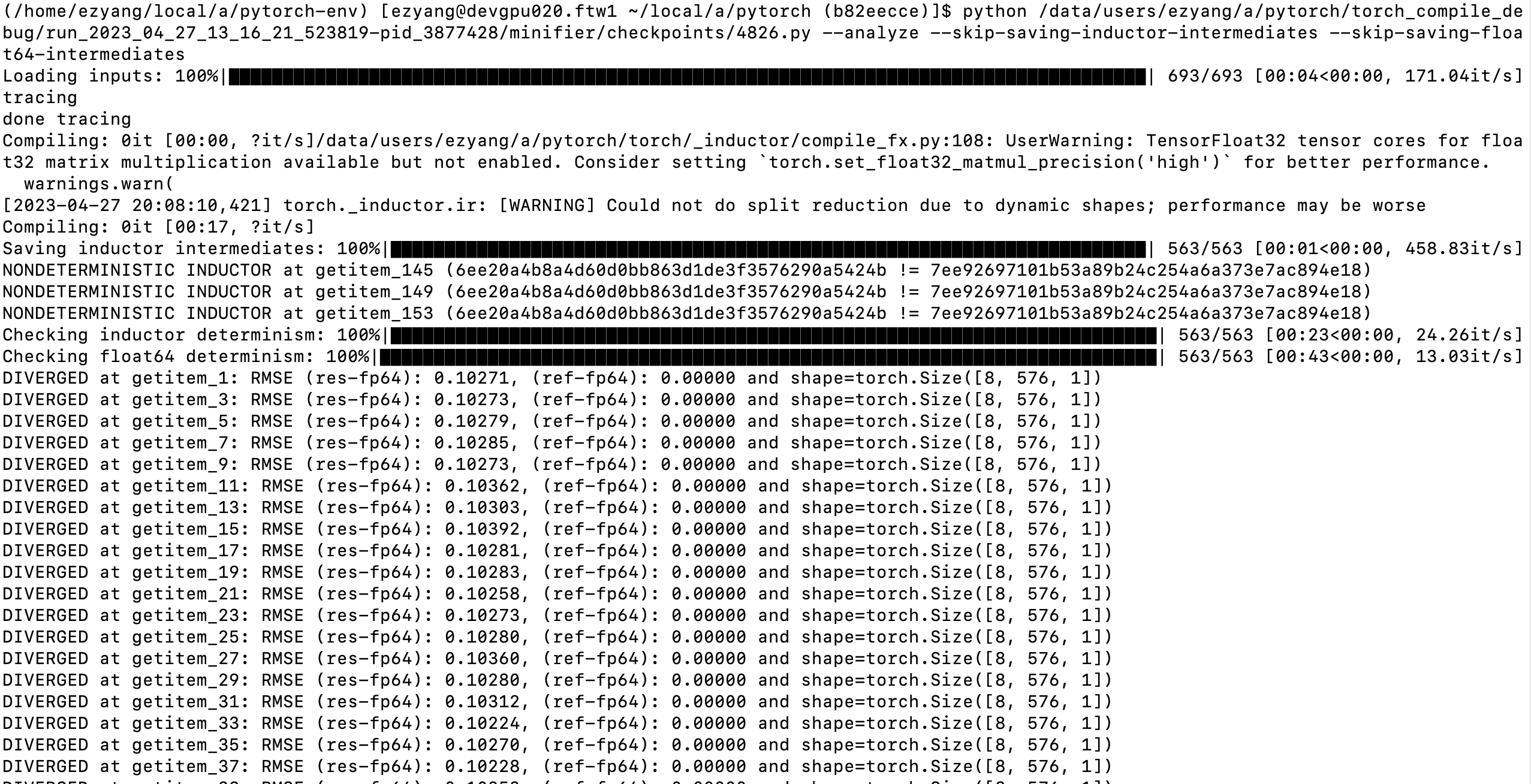
<img width="1277" alt="image" src="https://user-images.githubusercontent.com/13564/235045677-8545aab7-5e83-4813-bbec-47783dc60122.png">

This facility is oriented towards accuracy debugging. It does several things:

1. It will run your model twice and check for nondeterminism in inductor/float64, *even* on intermediate inputs (our benchmarking nondeterminism test only checks for nondeterminism on the final output). This makes localizing which operator is nondeterministic easy.
2. It will run your compiled model side-by-side with eager and float64 variants, and then report when things diverge too far from RMSE delta from float64.

Importantly, it does all this without requiring every intermediate to be held in memory (which will cause an OOM on large repros, such as the one I tested this on.)

Some other minor improvements:

* MinifierTestBase now has an easy to comment out spot that you can use to retain the temporary directory; good for debugging
* We print "running minifier" and "running repro" in MinifierTestBase to make it easier to orient where logs are coming from
* same takes a `log_error` optional argument which you can use to reroute the error logs when things mismatch
* counters["inductor"]["intermediate_hooks"] tracks the number of intermediate hooks we've codegen'ed; good for populate the tqdm interface
* torch.fx.interpreter gets an official `boxed_run` interface which uses the boxed arguments calling convention and doesn't retain inputs unnecessarily long
* torch.utils._content_store gets compute_tensor_metadata/read_tensor_metadata helper functions for computing tensor information without serializing it

Signed-off-by: Edward Z. Yang <ezyang@meta.com>

Pull Request resolved: https://github.com/pytorch/pytorch/pull/100226
Approved by: https://github.com/bertmaher, https://github.com/bdhirsh, https://github.com/anijain2305
There are no code changes but I did take the opportunity to
reorder and group the functions once they were placed in their
respective modules.

Signed-off-by: Edward Z. Yang <ezyang@meta.com>

Pull Request resolved: https://github.com/pytorch/pytorch/pull/99450
Approved by: https://github.com/anijain2305
Months ago, in order to get dynamic shapes working through to Dynamo backends, we changed the calling convention to pass fake tensors rather than real tensors as example inputs to backends. The motivation at the time was, well, backends shouldn't really be peeking at the real tensors when they are doing compilation, and so it would make more sense to hide the real tensors from backends. But there were a bunch of problems:

* This interacted poorly with our accuracy minifier design: accuracy minifier needs access to the real inputs in order to run the model and figure out what happens!
* The TensorRT backend required real inputs and we never figured out how to fix it.
* In practice, all the backends needed to detect if they were passed real tensors, and fakeify them anyway (certainly AOTAutograd does this)
* Parameters and inputs are treated non-uniformly: parameters had to be passed as real tensors, because CUDA graphs requires knowing what the actual tensors are

Furthermore, there were some more problems discovered after the fact:

* Backends may want to optimize on aspects of tensors which you cannot tell without having real tensors; e.g., alignment of the data pointer

So, this PR decides that changing the calling convention was a bad idea, and switches back to passing real tensors. There is a problem though: AOTAutograd will perform fakeification, which means that in practice backends are still going to end up with fake tensors in the end anyway. I want to change this, but this will require some work with bdhirsh's upcoming AOTAutograd export refactor.

Signed-off-by: Edward Z. Yang <ezyang@meta.com>

Pull Request resolved: https://github.com/pytorch/pytorch/pull/99320
Approved by: https://github.com/voznesenskym
Months ago, in order to get dynamic shapes working through to Dynamo backends, we changed the calling convention to pass fake tensors rather than real tensors as example inputs to backends. The motivation at the time was, well, backends shouldn't really be peeking at the real tensors when they are doing compilation, and so it would make more sense to hide the real tensors from backends. But there were a bunch of problems:

* This interacted poorly with our accuracy minifier design: accuracy minifier needs access to the real inputs in order to run the model and figure out what happens!
* The TensorRT backend required real inputs and we never figured out how to fix it.
* In practice, all the backends needed to detect if they were passed real tensors, and fakeify them anyway (certainly AOTAutograd does this)
* Parameters and inputs are treated non-uniformly: parameters had to be passed as real tensors, because CUDA graphs requires knowing what the actual tensors are

Furthermore, there were some more problems discovered after the fact:

* Backends may want to optimize on aspects of tensors which you cannot tell without having real tensors; e.g., alignment of the data pointer

So, this PR decides that changing the calling convention was a bad idea, and switches back to passing real tensors. There is a problem though: AOTAutograd will perform fakeification, which means that in practice backends are still going to end up with fake tensors in the end anyway. I want to change this, but this will require some work with bdhirsh's upcoming AOTAutograd export refactor.

Signed-off-by: Edward Z. Yang <ezyang@meta.com>

Pull Request resolved: https://github.com/pytorch/pytorch/pull/99320
Approved by: https://github.com/voznesenskym
Summary:
    Replace _dynamo.config with an object instead of module

    Current usage patterns of setting and reading fields on config will work
    unchanged.

    Only changes needed going forward:
    1. import torch._dynamo.config will not work. However, just doing
       import torch._dynamo is sufficient to access dynamo config
       as torch._dynamo.config.

    2. Files inside of _dynamo folder need to access config via
       from torch._dynamo.config_util import config instead of
       from torch._dynamo import config. Because _dynamo/__init__.py
       imports some of the files so it would be circular import.

Test Plan:

Reviewers:

Subscribers:

Tasks:

Tags:

Fixes #ISSUE_NUMBER

Pull Request resolved: https://github.com/pytorch/pytorch/pull/96455
Approved by: https://github.com/williamwen42
Summary: Have minifier include the current buck target as a dependency to make sure all deps are included.

Test Plan: TORCH_COMPILE_DEBUG_DIR=”.” buck2 run mode/dev-nosan //caffe2/test/inductor:minifier_smoke

Differential Revision: D44231209

Pull Request resolved: https://github.com/pytorch/pytorch/pull/97183
Approved by: https://github.com/anijain2305
Summary: Makes the debug dir location configurable with TORCH_COMPILE_DEBUG_DIR env var

Test Plan: TORCH_COMPILE_DEBUG_DIR=”.” buck2 run mode/dev-nosan //caffe2/test/inductor:minifier_smoke

Reviewed By: bertmaher

Differential Revision: D43639955

Pull Request resolved: https://github.com/pytorch/pytorch/pull/96089
Approved by: https://github.com/bertmaher
Summary: Fix a fp64 version of model failed-to-run issue when convert_element_type
appears in the model. The failure can cause some numerical difference
recognized as accuracy error since the fp64 baseline result is not
available, and thus distracts Minifier from finding a real culprit for
accuracy error.

See the discussion in https://github.com/pytorch/torchdynamo/issues/1812

Pull Request resolved: https://github.com/pytorch/pytorch/pull/92036
Approved by: https://github.com/ngimel
This will be the last disruptive functorch internals change.

Why are we moving these files?
- As a part of rationalizing functorch we are moving the code in
functorch/_src to torch/_functorch
- This is so that we can offer the functorch APIs as native PyTorch APIs
(coming soon) and resolve some internal build issues.

Why are we moving all of these files at once?
- It's better to break developers all at once rather than many times

Test Plan:
- wait for tests

Pull Request resolved: https://github.com/pytorch/pytorch/pull/90091
Approved by: https://github.com/anijain2305, https://github.com/ezyang
This will be the last disruptive functorch internals change.

Why are we moving these files?
- As a part of rationalizing functorch we are moving the code in
functorch/_src to torch/_functorch
- This is so that we can offer the functorch APIs as native PyTorch APIs
(coming soon) and resolve some internal build issues.

Why are we moving all of these files at once?
- It's better to break developers all at once rather than many times

Test Plan:
- wait for tests

Pull Request resolved: https://github.com/pytorch/pytorch/pull/88756
Approved by: https://github.com/ezyang
During accuracy minification, minifier can create graphs which can cause assertion failures. This PR catches such assertions and let minifier move on, instead of getting stuck in minifying this issue.

It is possible that such graphs point to some real-although-unrelated issue. So, printing an assertion to flag and debug if needed.

Pull Request resolved: https://github.com/pytorch/pytorch/pull/89739
Approved by: https://github.com/mlazos