__What?__
Per discussion at #94634, deprecate `masked_fill` with non-bool masks. Deprecation warnings were previously added by #22261, but not for Apple MPS. I can revert the MPS changes if deprecation warnings are wanted first tho. See also #96112.
Fixes#85063 and #89320.
__Further Development?__
- Fixed the mask dtype checking for the cuda dispatch for `masked_fill` in `aten/src/ATen/native/cuda/Indexing.cu`
Pull Request resolved: https://github.com/pytorch/pytorch/pull/96594
Approved by: https://github.com/malfet, https://github.com/ngimel
Fixes#88940
According to the [doc](https://pytorch.org/docs/stable/generated/torch.index_select.html):
1. "The returned tensor has the same number of dimensions as the original tensor (`input`). "
2. "The `dim`th dimension has the same size as the length of `index`; other dimensions have the same size as in the original tensor."
These two conditions cannot be satisfied at the same time if the `input` is a scalar && `index` has multiple values: because a scalar at most holds one element (according to property 1, the output is a scalar), it is impossible to satisfy "The `dim`th dimension has the same size as the length of `index`" when `index` has multiple values.
However, currently, if we do so we either get:
1. Buffer overflow with ASAN;
2. Or (w/o ASAN) silently returns outputs that is not consistent with the doc (`x.index_select(0, torch.Tensor([0, 0, 0]).int())` returns `x`).
As a result, we should explicitly reject such cases.
Pull Request resolved: https://github.com/pytorch/pytorch/pull/94347
Approved by: https://github.com/malfet
As found in #92709, thanks to @ngimel and @jansel, currently `torch.Tensor.fn` points to `UserDefinedObjectVariable` rather than `TorchVariable`. The root cause is due to https://github.com/pytorch/pytorch/pull/92709#pullrequestreview-1273357406. To prevent this, build `TorchVariable`  of `torch.Tensor.fn` pointing to `torch.ops.aten.fn`.

This issue propagates to `torch.Tensor.fn` causing graph break with `nopython=True`.
```python
import torch
import torch._dynamo as dynamo

#op = torch.ops.aten.abs_ # no graph break
op = torch.Tensor.abs_ # graph break
args = torch.empty(10)

def foo(args):
    return op(args)

opt_foo = dynamo.optimize("inductor", nopython=True)(foo)
y_ = opt_foo(args)

```

Pull Request resolved: https://github.com/pytorch/pytorch/pull/93243
Approved by: https://github.com/jansel
Exponential distribution is continuous. Fixes CPU MKL exponential implementation to exclude integer dtypes.

```python
import torch
dtypes = [torch.uint8, torch.int8, torch.int16, torch.int32, torch.int64]

for dtype in dtypes:
    x = torch.empty(10000, dtype=dtype).exponential_() # should fail !
    print("dtype: ", x.dtype, "sum: ", x.sum())
```

### Additional Context

Related to #92709. This issue propagates to OpInfo of exponential.

```
AssertionError: The supported dtypes for exponential on device type cpu are incorrect!
The following dtypes worked in forward but are not listed by the OpInfo: {torch.int64, torch.uint8, torch.int8, torch.int16, torch.int32}.
```

Pull Request resolved: https://github.com/pytorch/pytorch/pull/92891
Approved by: https://github.com/CaoE, https://github.com/jgong5, https://github.com/ngimel
Fixes#88470
I added the "method" keyword in `aten/src/ATen/native/native_functions.yaml` for the function `where` with Scalar Overload.
This way, you can now use `Tensor.where()` with a scalar parameter the same way `torch.where()` can.
I added a test in `test/test_torch.py` as requested.
It uses the `where()` method on a tensor and then checks it has the same results as the `torch.where()` function.
The test is roughly the same as the one provided by the author of the issue.
PS: this is the second PR I make to resolve this issue, the first one is #92747. I had troubles with commit signatures and is therefore closed.
Pull Request resolved: https://github.com/pytorch/pytorch/pull/92849
Approved by: https://github.com/albanD
Another PR towards solving #89205.
What's in this PR:

* The implementation of forward `logcumsumexp` for complex numbers in CPU & CUDA
* The tests on forward call of `logcumsumexp` for complex numbers
* The implementation of backward `logcumsumexp` for complex numbers

What's missing:

* The test on backward gradient of `logcumsumexp` (it complaints `RuntimeError: logcumsumexp does not support automatic differentiation for outputs with complex dtype.` and I don't know how to solve the error and I don't know where to put the test for the backward computation). If possible, I'd like this to be done in this PR.

It's really tricky to handle the edge cases here (i.e. the ones involving `inf`), but I've tried my best to put some comments explaining the reasonings of my decisions in this PR.

Pull Request resolved: https://github.com/pytorch/pytorch/pull/90847
Approved by: https://github.com/albanD
`TORCH_CHECK_TENSOR_ALL(cond, ...)` is a wrapper around `TORCH_CHECK` which allows the condition argument to be a tensor, batched or unbatched. `cond` can be a boolean tensor of any size. If any element is False, or if `cond.numel() == 0`, then `TORCH_CHECK_TENSOR_ALL` raises an error

Part of #72948
Pull Request resolved: https://github.com/pytorch/pytorch/pull/89097
Approved by: https://github.com/zou3519
### Motivation
When dim is -1 and the slice of source or result is noncontiguous, original `index_add` is slow as it uses add for the sliced tensor, which is serial on index and parallel on sliced tensor to avoid write conflict. Doing parallel on the sliced tensor is not optimal as the size of sliced tensor may be not big enough to parallel and also causes multiple parallelizations.

`scatter_add ` is used to speedup for this case as `scatter_add ` parallels on the outer dimension of input and is serial on the inner dimension to avoid write conflict. `scatter_add ` only need one parallel and the size of outer dimensions is bigger to do parallel.

### Testing

- Single core:

Before:

shape | fp32 / s | bf16 / s
-- | -- | --
[10, 128, 20, 20] | 2.82E-03 | 2.11E-03
[10, 128, 50, 50] | 0.023604 | 0.023794

After:

shape | fp32 / s | bf16 / s
-- | -- | --
[10, 128, 20, 20] | 9.30E-04 | 1.66E-03
[10, 128, 50, 50] | 0.005995 | 0.010003

- Single socket (28 cores):

Before:

shape | fp32 / s | bf16 / s
-- | -- | --
[10, 128, 20, 20] | 2.96E-03 | 2.52E-03
[10, 128, 50, 50] | 0.012208 | 0.012568

After:

shape | fp32 / s | bf16 / s
-- | -- | --
[10, 128, 20, 20] | 7.44E-05 | 1.33E-04
[10, 128, 50, 50] | 0.000333 | 0.000469

Pull Request resolved: https://github.com/pytorch/pytorch/pull/88729
Approved by: https://github.com/mingfeima, https://github.com/jgong5, https://github.com/malfet
### Motivation
When dim is -1 and the slice of source or result is noncontiguous, original `index_add` is slow as it uses add for the sliced tensor, which is serial on index and parallel on sliced tensor to avoid write conflict. Doing parallel on the sliced tensor is not optimal as the size of sliced tensor may be not big enough to parallel and also causes multiple parallelizations.

`scatter_add ` is used to speedup for this case as `scatter_add ` parallels on the outer dimension of input and is serial on the inner dimension to avoid write conflict. `scatter_add ` only need one parallel and the size of outer dimensions is bigger to do parallel.

### Testing

- Single core:

Before:

shape | fp32 / s | bf16 / s
-- | -- | --
[10, 128, 20, 20] | 2.82E-03 | 2.11E-03
[10, 128, 50, 50] | 0.023604 | 0.023794

After:

shape | fp32 / s | bf16 / s
-- | -- | --
[10, 128, 20, 20] | 9.30E-04 | 1.66E-03
[10, 128, 50, 50] | 0.005995 | 0.010003

- Single socket (28 cores):

Before:

shape | fp32 / s | bf16 / s
-- | -- | --
[10, 128, 20, 20] | 2.96E-03 | 2.52E-03
[10, 128, 50, 50] | 0.012208 | 0.012568

After:

shape | fp32 / s | bf16 / s
-- | -- | --
[10, 128, 20, 20] | 7.44E-05 | 1.33E-04
[10, 128, 50, 50] | 0.000333 | 0.000469

Pull Request resolved: https://github.com/pytorch/pytorch/pull/88729
Approved by: https://github.com/mingfeima, https://github.com/jgong5, https://github.com/malfet
### Motivation
When dim is -1 and the slice of source or result is noncontiguous, original `index_add` is slow as it uses add for the sliced tensor, which is serial on index and parallel on sliced tensor to avoid write conflict. Doing parallel on the sliced tensor is not optimal as the size of sliced tensor may be not big enough to parallel and also causes multiple parallelizations.

`scatter_add ` is used to speedup for this case as `scatter_add ` parallels on the outer dimension of input and is serial on the inner dimension to avoid write conflict. `scatter_add ` only need one parallel and the size of outer dimensions is bigger to do parallel.

### Testing

- Single core:

Before:

shape | fp32 / s | bf16 / s
-- | -- | --
[10, 128, 20, 20] | 2.82E-03 | 2.11E-03
[10, 128, 50, 50] | 0.023604 | 0.023794

After:

shape | fp32 / s | bf16 / s
-- | -- | --
[10, 128, 20, 20] | 9.30E-04 | 1.66E-03
[10, 128, 50, 50] | 0.005995 | 0.010003

- Single socket (28 cores):

Before:

shape | fp32 / s | bf16 / s
-- | -- | --
[10, 128, 20, 20] | 2.96E-03 | 2.52E-03
[10, 128, 50, 50] | 0.012208 | 0.012568

After:

shape | fp32 / s | bf16 / s
-- | -- | --
[10, 128, 20, 20] | 7.44E-05 | 1.33E-04
[10, 128, 50, 50] | 0.000333 | 0.000469

Pull Request resolved: https://github.com/pytorch/pytorch/pull/88729
Approved by: https://github.com/mingfeima, https://github.com/jgong5, https://github.com/malfet
# Motivate
We need to add XPU backend to support torch.save and torch.load when parameter _use_new_zipfile_serialization=False.

# Solution
We give a design via wrap data as a tensor:
>1. and use an in-place copy for H2D
>2. directly call a tensor.to() for D2H.

This can help us:
>1. unify the generic code for all backends.
>2. support all the non-CPU device backends.

# Additional Context
No need more UT.
test/test_serialization.py will cover this code change.

Pull Request resolved: https://github.com/pytorch/pytorch/pull/89679
Approved by: https://github.com/ezyang
Avoids
```
$ python foo.py
Traceback (most recent call last):
  File "foo.py", line 3, in <module>
    a = torch.cuda.Stream()
  File "/home/albandes/local/pytorch/3.8_debug_source/torch/cuda/streams.py", line 34, in __new__
    return super(Stream, cls).__new__(cls, priority=priority, **kwargs)
TypeError: object.__new__() takes exactly one argument (the type to instantiate)
```
And now gets
```
$ python foo.py
Traceback (most recent call last):
  File "foo.py", line 3, in <module>
    a = torch.cuda.Stream()
  File "/home/albandes/local/pytorch/3.8_debug_source/torch/cuda/streams.py", line 34, in __new__
    return super(Stream, cls).__new__(cls, priority=priority, **kwargs)
  File "/home/albandes/local/pytorch/3.8_debug_source/torch/cuda/_utils.py", line 44, in err_fn
    raise RuntimeError(
RuntimeError: Tried to instantiate dummy base class Stream

```
Pull Request resolved: https://github.com/pytorch/pytorch/pull/89592
Approved by: https://github.com/soumith
See strategy at PythonOpRegistrationTrampoline.cpp for the
big picture.

Along the way, I made OperatorHandle support == and hashing,
and slightly changed the low level python_dispatch impl API
to disallow empty strings for dispatch key, which had the knock
on effect of requiring us to explicitly make sure we pass in
CompositeImplicitAutograd if we would have passed in "" (I didn't apply
this to the rest of the file because I'm lazy.)

Test strategy is we delete the logic for preventing Python op
registrations in torch from being skipped in a torchdeploy context
and show CI still works.

Signed-off-by: Edward Z. Yang <ezyang@fb.com>
Pull Request resolved: https://github.com/pytorch/pytorch/pull/87162
Approved by: https://github.com/anjali411, https://github.com/bdhirsh
Fixes#83069. Also move all the dlpack tests to a new file., `test_dlpack.py`.
The fix involves always allocating a "strides" int array when converting to dlPack and deleting the strides when the capsule descructor is called. Then the strides are copied from the tensor, and `strides[i]` is set to `1` where `shape[i] < 2`.
Pull Request resolved: https://github.com/pytorch/pytorch/pull/83158
Approved by: https://github.com/ezyang
Make it so that it is valid to set metadata after detach calls, like `x.detach().resize_(...)`.

This technically lifts some restrictions around `.data`. This PR means that you can now technically call `x.data.resize_(...)`, which can now directly resize `x` instead of erroring.

My understanding: Before the tensor-variable merge, when `x` and `x.data` were really different tensors, you could resize `x.data` independently of `x`, and during the merge, this error was added to avoid silent confusing behavior changes.

It was agreed that this error has been around long enough (several years) that it's acceptable to drop.  cc @albanD @ezyang.

(Ed already had a prototype PR [here](https://github.com/pytorch/pytorch/pull/83545) - I ended up making one to try to slog through test failures).

Pull Request resolved: https://github.com/pytorch/pytorch/pull/83590
Approved by: https://github.com/ezyang
### Description
Since the major changes for `_TypedStorage` and `_UntypedStorage` are now complete, they can be renamed to be public.
`TypedStorage._untyped()` is renamed to `TypedStorage.untyped()`.
Documentation for storages is improved as well.
### Issue
Fixes#82436
### Testing
N/A
Pull Request resolved: https://github.com/pytorch/pytorch/pull/82438
Approved by: https://github.com/ezyang
unflatten now has a free function version in torch.flatten in addition to
    the method in torch.Tensor.flatten.

    Updated docs to reflect this and polished them a little.
    For consistency, changed the signature of the int version of unflatten in
    native_functions.yaml.

    Some override tests were failing because unflatten has unusual
    characteristics in terms of the .int and .Dimname versions having
    different number of arguments so this required some changes
    to test/test_override.py

    Removed support for using mix of integer and string arguments
    when specifying dimensions in unflatten.
Pull Request resolved: https://github.com/pytorch/pytorch/pull/81399
Approved by: https://github.com/Lezcano, https://github.com/ngimel
### The problem

This original regex abuses .* in combination with `re.DOTALL` and leads to a catastrophic backtracking perf issue when there is no match. When it happens, test_doc_template will run "forever" and timeout. Here is an example timeout test https://github.com/pytorch/pytorch/runs/7413337595

Another minor issue with this regex is that it won't matches concatenated doc string like `"""FOO""" + """BAR"""`, which is used for some API `_torch_docs.py`

### The fix
* Remove most of the match all .* usage. I have tested to make sure that the test finishes even when there is no match, i.e. it fails successfully
* Update the regex to match all the following cases before and after linting (You can also try it out on https://pythex.org):

BEFORE
```
add_docstr(torch.abs, r"""
abs(input, *, out=None) -> Tensor

Computes the absolute value of each element in :attr:`input`.

.. math::
    \text{out}_{i} = |\text{input}_{i}|
""" + r"""
Args:
    {input}

Keyword args:
    {out}

Example::

    >>> torch.abs(torch.tensor([-1, -2, 3]))
    tensor([ 1,  2,  3])
""".format(**common_args))

add_docstr(torch.absolute,
           r"""
absolute(input, *, out=None) -> Tensor

Alias for :func:`torch.abs`
""")
```

AFTER
```
add_docstr(
    torch.abs,
    r"""
abs(input, *, out=None) -> Tensor

Computes the absolute value of each element in :attr:`input`.

.. math::
    \text{out}_{i} = |\text{input}_{i}|
"""
    + r"""
Args:
    {input}

Keyword args:
    {out}

Example::

    >>> torch.abs(torch.tensor([-1, -2, 3]))
    tensor([ 1,  2,  3])
""".format(
        **common_args
    ),
)

add_docstr(
    torch.absolute,
    r"""
absolute(input, *, out=None) -> Tensor

Alias for :func:`torch.abs`
""",
)
```

This will unblock https://github.com/pytorch/pytorch/pull/81643
Pull Request resolved: https://github.com/pytorch/pytorch/pull/81755
Approved by: https://github.com/atalman
This PR:
- Corrects the forward AD formula of `torch.sgn`.
  - The reason why we can't use `auto_element_wise` for this operations is rather subtle. I left a comment.
  - This, in turn, fixes a problem we had in forward-over-backward for `linalg.svd` and other spectral decompositions (and `norm`, `linalg.norm`, `linalg.matrix_norm`) that were using `torch.abs` (whose derivative is given by `torch.sgn`.
- Implement the formula for a number of missing operations `nansum`, `amax`, `amin`...
- Simplified a few formulas, most notably the forward AD for `div` and the derivative of `norm`, `linalg.norm` and `vector_norm` for `ord=+-inf`.
- Correct the formula for `mean`, `std_mean`, `var_mean` when `dim` is provided and equal to `()` (or `None`)
- A few minor improvements to `sum_backward`, `unsqueeze_multiple` and formulas depending on them
- Fix the derivatives of `std_mean` and `std_var` (complex support,
ASAN, forward AD...)

Fixes: https://github.com/pytorch/pytorch/issues/67539

Pull Request resolved: https://github.com/pytorch/pytorch/pull/80082

Approved by: https://github.com/zou3519
`chalf` is experimental as the op coverage is low.

Following script raises 6 warnings if `set_warn_always(True)` else raises only 1 warning.
```python
import torch
torch.set_warn_always(True)
device='cpu'
t = torch.randn(3, dtype=torch.chalf, device=device)
y = torch.rand(3, dtype=torch.chalf, device=device)
# Allocates new tensor for result
t + y

device='cuda'
t = torch.randn(3, dtype=torch.chalf, device=device)
y = torch.rand(3, dtype=torch.chalf, device=device)

# Allocates new tensor for result
t + y

```
Pull Request resolved: https://github.com/pytorch/pytorch/pull/78245
Approved by: https://github.com/anjali411
Summary:
While running those tests on
- my local windows GPU machine
- a dev server
- an on-demand GPU
I noticed a few test failures and here's some tentative fixes

Test Plan:
Ran tests on:
- my local windows GPU machine
- a linux dev server w/o GPU
- an linux on-demand GPU server

Note that when using CUDA11, the tests crashes (segfaults) on calls to torch.nn.ConvTranspose3d. Fails on master, but works with CUDA10.

Differential Revision: D36377288

Pull Request resolved: https://github.com/pytorch/pytorch/pull/77531
Approved by: https://github.com/ezyang
Fixes#73298
I don't know whether `where` kernel actually supports type promotion, nor am I in the mood to find out, so it's manual type promotion.
Edit: nah, i can't tell TI to "promote to common dtype" because of bool condition, so manual type promotion is our only option.
I'll see what tests start failing and fix.
Uses some parts from #62084
Pull Request resolved: https://github.com/pytorch/pytorch/pull/76691
Approved by: https://github.com/mruberry
crossref is a new strategy for performing tests when you want
to run a normal PyTorch API call, separately run some variation of
the API call (e.g., same thing but all the arguments are meta tensors)
and then cross-reference the results to see that they are consistent.
Any logic you add to CrossRefMode will get run on *every* PyTorch API
call that is called in the course of PyTorch's test suite.  This can
be a good choice for correctness testing if OpInfo testing is not
exhaustive enough.

For now, the crossref test doesn't do anything except verify that
we can validly push a mode onto the torch function mode stack for all
functions.

Signed-off-by: Edward Z. Yang <ezyangfb.com>

Pull Request resolved: https://github.com/pytorch/pytorch/pull/75988

Approved by: https://github.com/seemethere
Summary:
Pull Request resolved: https://github.com/pytorch/pytorch/pull/74226

Update signature of `scatter_reduce_` to match `scatter_/scatter_add_`

`Tensor.scatter_reduce_(int64 dim, Tensor index, Tensor src, str reduce)`

- Add new reduction options in ScatterGatherKernel.cpp and update `scatter_reduce` to call into the cpu kernel for `scatter.reduce`
- `scatter_reduce` now has the same shape constraints as `scatter_` and `scatter_add_`
- Migrate `test/test_torch.py:test_scatter_reduce` to `test/test_scatter_gather_ops.py`

Test Plan: Imported from OSS

Reviewed By: ngimel

Differential Revision: D35222842

Pulled By: mikaylagawarecki

fbshipit-source-id: 84930add2ad30baf872c495251373313cb7428bd
(cherry picked from commit 1b45139482e22eb0dc8b6aec2a7b25a4b58e31df)
Summary:
This PR ports several tests in `test/test_torch.py` over to OpInfo ErrorInputs.

Some tests commented "convert to ErrorInputs" still remain in `test_torch.py`. They fall under two categories:
- Memory overlap tests which specifically test the in-place version of an operator (e.g. [this test](424a054d53/test/test_torch.py (L3788)) for index_add_).
- Tests with non-trivial behavior calling `torch.cuda.synchronize()` after calling the operator being tested (e.g. [this test](424a054d53/test/test_torch.py (L4948)) for torch.multinomial).

Pull Request resolved: https://github.com/pytorch/pytorch/pull/73981

Reviewed By: qihqi

Differential Revision: D35016669

Pulled By: saketh-are

fbshipit-source-id: bc0016d2b2bfb566a9dfef81ecf44e0adb9e4b14
(cherry picked from commit 99bcbdb05f2c10a717a269b0010aa3a3e24fe5c0)
Summary:
Fixes https://github.com/pytorch/pytorch/issues/67919

The compatibility check on `edge_order` in `pre_check_gradient` now looks only at dim argument if it is present, otherwise it checks all dimensions.

Previously, it would check all dimensions regardless of the dim argument and throw unnecessary errors.

Pull Request resolved: https://github.com/pytorch/pytorch/pull/67926

Reviewed By: albanD

Differential Revision: D33760621

Pulled By: mruberry

fbshipit-source-id: d490cd8610c68ff3787e670fc947de3cbf2db062
(cherry picked from commit 45bc56de9e)
Summary:
Pull Request resolved: https://github.com/pytorch/pytorch/pull/65993

This PR attempts to port `index_add` to structured kernels, but does more than that:

* Adds an `out=` variant to `index_add`
* Revises `native_functions.yaml` registrations, to not have multiple entries and instead pass default value to `alpha`.
* Changes in `derivatives.yaml` file for autograd functioning
* Revises error messages, please see: https://github.com/pytorch/pytorch/pull/65993#issuecomment-945441615

Follow-up PRs in near future will attempt to refactor the OpInfo test, and will give another look at tests in `test/test_torch.py` for this function. (hence the use of ghstack for this)

~This is WIP because there are tests failing for `Dimname` variant on mobile/android builds, and I'm working on fixing them.~

Issue tracker: https://github.com/pytorch/pytorch/issues/55070

Test Plan: Imported from OSS

Reviewed By: ejguan

Differential Revision: D32646426

fbshipit-source-id: b035ecf843a9a27d4d1e18b202b035adc2a49ab5
Summary:
Fixes https://github.com/pytorch/pytorch/issues/53647

With this if a test forgets to add `dtypes` while using `dtypesIf`, following error is raised
```
AssertionError: dtypes is mandatory when using dtypesIf however 'test_exponential_no_zero' didn't specify it
```

**Tested Locally**

Pull Request resolved: https://github.com/pytorch/pytorch/pull/68186

Reviewed By: VitalyFedyunin

Differential Revision: D32468581

Pulled By: mruberry

fbshipit-source-id: 805e0855f988b77a5d8d4cd52b31426c04c2200b
Summary:
Fixes https://github.com/pytorch/pytorch/issues/46741
pytorchbot

contributors: nickleus27, yanivsagy, and khanhthien123

SmrutiSikha this is mostly your work.  We just did very minor clean up.

cc mruberry

Pull Request resolved: https://github.com/pytorch/pytorch/pull/67664

Reviewed By: gchanan

Differential Revision: D32311838

Pulled By: mruberry

fbshipit-source-id: 0e5d4d888caeccb0fd7c80e6ff11b1b1fa8e00d6
Summary:
Many thanks to Forest Yang (meowmix) from the forum for reporting it with a minimal reproduction.

Pull Request resolved: https://github.com/pytorch/pytorch/pull/67829

Reviewed By: malfet

Differential Revision: D32184786

Pulled By: albanD

fbshipit-source-id: b63dbd3148b5def2109deb2f4612c08f55f59dfb
Summary:
Partially fixes https://github.com/pytorch/pytorch/issues/66066

This PR:
 - cleans up op-specific testing from test_autograd. test_autograd should be reserved for testing generic autograd functionality
 - tests related to an operator are better colocated
 - see the tracker for details

What to think about when moving tests to their correct test suite:
 - naming, make sure its not too generic
 - how the test is parametrized, sometimes we need to add/remove a device/dtype parameter
 - can this be merged with existing tests

Pull Request resolved: https://github.com/pytorch/pytorch/pull/67413

Reviewed By: jbschlosser, albanD

Differential Revision: D32031480

Pulled By: soulitzer

fbshipit-source-id: 8e13da1e58a38d5cecbfdfd4fe2b4fe6f816897f
Summary:
Adds mixed precision autocasting support between fp32/fp16 to torchscript/JIT. More in depth descriptoin can be found at [torch/csrc/jit/JIT-AUTOCAST.md](https://github.com/pytorch/pytorch/pull/63939/files#diff-1f1772aaa508841c5bb58b74ab98f49a1e577612cd9ea5c386c8714a75db830b)

This PR implemented an autocast optimization pass that inserts casting ops per AMP rule (torch/csrc/jit/passes/autocast.cpp), that mimics the behavior of eager autocast. The pass also takes into consideration the context of `torch.cuda.amp.autocast` and only inserts casting ops within the enabled context manager, giving feature parity as with eager amp autocast.

We currently provide JIT AMP autocast as a prototyping feature, so it is default off and could be turned on via `torch._C._jit_set_autocast_mode(True)`

The JIT support for autocast is subject to different constraints compared to the eager mode implementation (mostly related to the fact that TorchScript is statically typed), restriction on the user facing python code is described in doc torch/csrc/jit/JIT-AUTOCAST.md

This is a prototype, there are also implementation limitation that's necessary to keep this PR small and get something functioning quickly on upstream, so we can iterate on designs.

Few limitation/challenge that is not properly resolved in this PR:
1. Autocast inserts cast operation, which would have impact on scalar type of output tensor feeding downstream operations. We are not currently propagating the updated scalar types, this would give issues/wrong results on operations in promotion rules.

2. Backward for autodiff in JIT misses the casting of dgrad to input scalar type, as what autograd does in eager. This forces us to explicitly mark the casting operation for certain operations (e.g. binary ops), otherwise, we might be feeding dgrad with mismatch scalar type to input. This could potentially break gradient function consuming dgrad. (e.g. gemm backwards, which assumes grad_output to be of same scalar type as input')

3. `torch.autocast` api has an optional argument `dtype` which is not currently supported in the JIT autocast and we require a static value.

Credit goes mostly to:
tlemo
kevinstephano

Pull Request resolved: https://github.com/pytorch/pytorch/pull/63939

Reviewed By: navahgar

Differential Revision: D31093381

Pulled By: eellison

fbshipit-source-id: da6e26c668c38b01e296f304507048d6c1794314
Summary:
CAFFE2 has been deprecated for a while, but still included in every PyTorch build.
We should stop building it by default, although CI should still validate that caffe2 code is buildable.

Build even fewer dependencies when compiling mobile builds without Caffe2
Introduce `TEST_CAFFE2` in torch.common.utils
Skip `TestQuantizedEmbeddingOps` and `TestJit.test_old_models_bc`  is code is compiled without Caffe2
Should be landed after https://github.com/pytorch/builder/pull/864

Pull Request resolved: https://github.com/pytorch/pytorch/pull/66658

Reviewed By: driazati, seemethere, janeyx99

Differential Revision: D31669156

Pulled By: malfet

fbshipit-source-id: 1cc45e2d402daf913a4685eb9f841cc3863e458d
Summary:
Pull Request resolved: https://github.com/pytorch/pytorch/pull/64181

This PR replaces all the calls to:
- `transpose(-2, -1)` or `transpose(-1, -2)` by `mT()` in C++ and `mT` in Python
- `conj().transpose(-2, -1)` or `transpose(-2, -1).conj()` or `conj().transpose(-1, -2)` or `transpose(-1, -2).conj()` by `mH()` in C++ and `mH` in Python.

It also simplifies two pieces of code, and fixes one bug where a pair
of parentheses were missing in the function `make_symmetric_matrices`.

Test Plan: Imported from OSS

Reviewed By: H-Huang

Differential Revision: D31692896

Pulled By: anjali411

fbshipit-source-id: e9112c42343663d442dc5bd53ff2b492094b434a
Summary:
Fixes https://github.com/pytorch/pytorch/issues/64883

Adds a `warn_only` kwarg to `use_deterministic_algorithms`. When enabled, calling an operation that does not have a deterministic implementation will raise a warning, rather than an error.

`torch.testing._internal.common_device_type.expectedAlertNondeterministic` is also refactored and documented in this PR to make it easier to use and understand.

cc mruberry kurtamohler

Pull Request resolved: https://github.com/pytorch/pytorch/pull/66233

Reviewed By: bdhirsh

Differential Revision: D31616481

Pulled By: mruberry

fbshipit-source-id: 059634a82d54407492b1d8df08f059c758d0a420
Summary:
Pull Request resolved: https://github.com/pytorch/pytorch/pull/62030

Remove dtype tracking from Python Storage interface, remove all the different `<type>Storage` classes except for `ByteStorage`, and update serialization accordingly, while maintaining as much FC/BC as possible

Fixes https://github.com/pytorch/pytorch/issues/47442

* **THE SERIALIZATION FORMAT IS FULLY FC/BC.** We worked very hard to make sure this is the case. We will probably want to break FC at some point to make the serialization structure of tensors make more sense, but not today.
* There is now only a single torch.ByteStorage class. Methods like `Tensor.set_` no longer check that the dtype of storage is appropriate.
* As we no longer know what dtype of a storage is, we've **removed** the size method from Storage, replacing it with nbytes. This is to help catch otherwise silent errors where you confuse number of elements with number of bytes.
* `Storage._new_shared` takes a `nbytes` kwarg and will reject previous positional only calls.  `Storage._new_with_file` and `_set_from_file` require explicit element size arguments.
* It's no longer possible to convert storages to different types using the float/double/etc methods. Instead, do the conversion using a tensor.
* It's no longer possible to allocate a typed storage directly using FloatStorage/DoubleStorage/etc constructors. Instead, construct a tensor and extract its storage. The classes still exist but they are used purely for unpickling.
* The preexisting serialization format stores dtype with storage, and in fact this dtype is used to determine the dtype of the tensor overall.
 To accommodate this case, we introduce a new TypedStorage concept that exists only during unpickling time which is used to temporarily store the dtype so we can construct a tensor. **If you overrode the handling of pickling/unpickling, you MUST add handling for TypedStorage** or your serialization code will degrade to standard file-based serialization.

Original pull request: https://github.com/pytorch/pytorch/pull/59671

Reviewed By: soulitzer, ngimel

Differential Revision: D29466819

Pulled By: ezyang

fbshipit-source-id: 4a14e5d3c2b08e06e558683d97f7378a3180b00e
Summary:
Happy to get any feedback on how to make this code cleaner!

This:
- Fix Tensor attribute deepcopy BC-breaking?
- Add a test for Tensor attribute deepcopy
- Fix subclass deepcopy
- Moves the subclass serialization tests into their own class not to interfere with other serialization test logic
- Add a test for subclass deepcopy

cc ezyang gchanan

Pull Request resolved: https://github.com/pytorch/pytorch/pull/65584

Reviewed By: gchanan

Differential Revision: D31206590

Pulled By: albanD

fbshipit-source-id: 74a8f0767f4933b9c941fbea880a8fd1b893ea2f
Summary:
Fixes https://github.com/pytorch/pytorch/issues/62793

This is mostly a quick fix. I think the more correct fix could be updating `unique_dim` to `_unique_dim` which could be BC-breaking for C++ users (� maybe). Maybe something else I am missing.

~~Not sure how to add a test for it.~~ Have tested it locally.

We can add a test like following. Tested this locally, it fails currently but passes with the fix.
```python
        def test_wildcard_import(self):
            exec('from torch import *')

```

Pull Request resolved: https://github.com/pytorch/pytorch/pull/63080

Reviewed By: gchanan

Differential Revision: D30738711

Pulled By: zou3519

fbshipit-source-id: b86d0190e45ba0b49fd2cffdcfd2e3a75cc2a35e
Summary:
Fixes https://github.com/pytorch/pytorch/issues/64813

Raises a TypeError when assigned value to a grad is not a Tensor or
None.

Adds tests.

cc ezyang gchanan

Pull Request resolved: https://github.com/pytorch/pytorch/pull/64876

Reviewed By: anjali411

Differential Revision: D30901678

Pulled By: soulitzer

fbshipit-source-id: dbb3cb5fd0bbac6918e0b2e2f51d340daa43dee0
Summary:
Pull Request resolved: https://github.com/pytorch/pytorch/pull/64746

This extracts the error checking that used to be in the PR above.
We are not going to land the proposed fix there, but I think we want this error checking in right now as these would lead to respectively a memory leak and arbitrary memory read/write.

Test Plan: Imported from OSS

Reviewed By: ngimel

Differential Revision: D30867569

Pulled By: albanD

fbshipit-source-id: bf468033fb8b49fcb26eed423f5fad82b4a46c56
Summary:
Pull Request resolved: https://github.com/pytorch/pytorch/pull/63554

Following https://github.com/pytorch/pytorch/pull/61840#issuecomment-884087809, this deprecates all the dtype getters publicly exposed in the `torch.testing` namespace. The reason for this twofold:

1. If someone is not familiar with the C++ dispatch macros PyTorch uses, the names are misleading. For example `torch.testing.floating_types()` will only give you `float32` and `float64` skipping `float16` and `bfloat16`.
2. The dtype getters provide very minimal functionality that can be easily emulated by downstream libraries.

We thought about [providing an replacement](https://gist.github.com/pmeier/3dfd2e105842ad0de4505068a1a0270a), but ultimately decided against it. The major problem is BC: by keeping it, either the namespace is getting messy again after a new dtype is added or we need to somehow version the return values of the getters.

Test Plan: Imported from OSS

Reviewed By: H-Huang

Differential Revision: D30662206

Pulled By: mruberry

fbshipit-source-id: a2bdb10ab02ae665df1b5b76e8afa9af043bbf56
Summary:
Will add a description once this is ready for review.

cc: ysiraichi ezyang

Pull Request resolved: https://github.com/pytorch/pytorch/pull/63312

Reviewed By: iramazanli

Differential Revision: D30597447

Pulled By: ezyang

fbshipit-source-id: d36e59835c2f4b38e286032dd2a1111a7e16b7e5
Summary:
Pull Request resolved: https://github.com/pytorch/pytorch/pull/63572

Addresses #61906. Issue will be fixed later in the stack when `torch.testing.assert_close` got the same treatment.

cc ezyang gchanan

Test Plan: Imported from OSS

Reviewed By: ezyang

Differential Revision: D30633527

Pulled By: mruberry

fbshipit-source-id: c2002a4998a7a75cb2ab83f87190bde43a9d4f7c
Summary:
This PR implements the necessary hooks/stubs/enums/etc for complete ONNX Runtime (ORT) Eager Mode integration. The actual extension will live out of tree at https://github.com/pytorch/ort.

We have been [working on this at Microsoft](https://github.com/microsoft/onnxruntime-pytorch/tree/eager-ort/torch_onnxruntime) for the last few months, and are finally ready to contribute the PyTorch core changes upstream (nothing major or exciting, just the usual boilerplate for adding new backends).

The ORT backend will allow us to ferry [almost] all torch ops into granular ONNX kernels that ORT will eagerly execute against any devices it supports (therefore, we only need a single ORT backend from a PyTorch perspective).

Pull Request resolved: https://github.com/pytorch/pytorch/pull/58248

Reviewed By: astaff

Differential Revision: D30344992

Pulled By: albanD

fbshipit-source-id: 69082b32121246340d686e16653626114b7714b2
Summary:
This creates `torch.cuda.set_warn_on_synchronization()` function that would warn or error when synchronizing operation is performed. We could wrap it in a context manager for ease of use, but it would be a lie, because it sets global, and not thread-local state. Since it's intended for debugging, maybe that's ok though.
As all `torch.cuda.*` functions, it's going through CPython, not pybind, so the argument is converted to long before being passed to c10 function. I'll make python argument a python enum class, but without pybind it'll still have to go thourgh long conversion.

For a test script
```
import torch
torch.cuda.set_warn_on_synchronization(1)
x=torch.randn(10, device="cuda")
x.nonzero()
y=torch.randn((), device="cuda")

if y:
    print("something")
torch.multinomial(x.abs(), 10, replacement=False)
torch.randperm(20000, device="cuda")
ind = torch.randint(10, (3,), device="cuda")
mask = torch.randint(2, (10,), device="cuda", dtype=torch.bool)
val = torch.randn((), device="cuda")
x[mask]=1.
x[mask] = val
torch.cuda.synchronize()
```
the output is
```
/../playground/sync_warn_test.py:4: UserWarning: called a synchronizing operation (Triggered internally at  ../c10/cuda/CUDAFunctions.cpp:145.)
  x.nonzero()
/../playground/sync_warn_test.py:7: UserWarning: called a synchronizing operation (Triggered internally at  ../c10/cuda/CUDAFunctions.cpp:145.)
  if y:
something
/../playground/sync_warn_test.py:9: UserWarning: called a synchronizing operation (Triggered internally at  ../c10/cuda/CUDAFunctions.cpp:145.)
  torch.multinomial(x.abs(), 10, replacement=False)
/../playground/sync_warn_test.py:15: UserWarning: called a synchronizing operation (Triggered internally at  ../c10/cuda/CUDAFunctions.cpp:145.)
  x[mask] = val
```

Pull Request resolved: https://github.com/pytorch/pytorch/pull/62092

Reviewed By: mruberry

Differential Revision: D29968792

Pulled By: ngimel

fbshipit-source-id: cc6f817212c164727ed99ecf6ab050dc29631b9e
Summary:
Pull Request resolved: https://github.com/pytorch/pytorch/pull/60959

Add TorchVitals for Dataloader, this indicates that the data loader was enabled.

This is a no-op if TORCH_VITALS environment variable is not set.

Test Plan: buck test mode/dbg caffe2/test:torch -- --regex vitals

Reviewed By: VitalyFedyunin

Differential Revision: D29445146

fbshipit-source-id: d5778fff3dafb3c0463fec7a498bff4905597518
Summary:
Based from https://github.com/pytorch/pytorch/pull/50466

Adds the initial implementation of `torch.cov` similar to `numpy.cov`. For simplicity, we removed support for many parameters in `numpy.cov` that are either redundant such as `bias`, or have simple workarounds such as `y` and `rowvar`.

cc PandaBoi

closes https://github.com/pytorch/pytorch/issues/19037

Pull Request resolved: https://github.com/pytorch/pytorch/pull/58311

Reviewed By: jbschlosser

Differential Revision: D29431651

Pulled By: heitorschueroff

fbshipit-source-id: 167dea880f534934b145ba94291a9d634c25b01b
Summary:
Pull Request resolved: https://github.com/pytorch/pytorch/pull/58059

Add CUDA.used vital sign which is true only if CUDA was "used" which technically means the context was created.

Also adds the following features:
- Force vitals to be written even if vitals are disabled, to enable testing when the env variable is not set from the start of execution
- Add a read_vitals call for python to read existing vital signs.

Test Plan: buck test mode/dbg caffe2/test:torch -- --regex basic_vitals

Reviewed By: xuzhao9

Differential Revision: D28357615

fbshipit-source-id: 681bf9ef63cb1458df9f1c241d301a3ddf1e5252
Summary:
Currently foreach `addcmul` and `addcdiv` cast scalar to float so that actual math is done in FP32 when tensor dtype is Float16/BFloat16 while regular `addcmul` and `addcdiv`, not.
### Reproducible steps to see the behavioral difference
```ipython
In [1]: import torch; torch.__version__
Out[1]: '1.9.0'
In [2]: a, b, c = torch.tensor([60000.0], device='cuda', dtype=torch.half), torch.tensor([60000.0], device='cuda', dtype=torch.half), torch.tensor([-1.0], device='cuda', dtype=torch.half)
In [4]: torch.addcmul(a, b, c, value=2)
Out[4]: tensor([-inf], device='cuda:0', dtype=torch.float16)
In [5]: torch._foreach_addcmul([a], [b], [c], value=2)[0]
Out[5]: tensor([-60000.], device='cuda:0', dtype=torch.float16)
```
### How foreach casts?
Foreach addcmul and addcdiv cast scalar to `opmath_t` (almost equivalent to acc_type) here: 42c8439b6e/aten/src/ATen/native/cuda/ForeachPointwiseOp.cu (L30) and cast inputs and results here:
42c8439b6e/aten/src/ATen/native/cuda/ForeachFunctors.cuh (L133-L135)
Related to https://github.com/pytorch/pytorch/issues/58833#60227https://github.com/pytorch/pytorch/issues/60454
cc ptrblck mcarilli ngimel
Pull Request resolved: https://github.com/pytorch/pytorch/pull/60715
Reviewed By: albanD
Differential Revision: D29385715
Pulled By: ngimel
fbshipit-source-id: 8bb2db19ab66fc99d686de056a6ee60f9f71d603
Summary:
Fixes https://github.com/pytorch/pytorch/issues/56036
Fixes https://github.com/pytorch/pytorch/issues/56130

* All the interior points are computed using second order accurate central differences method for gradient operator. However, currently we only have first order method computation for edge points. In this PR we are adding second order methods for edge points as well.

* Currently, there is no detailed description of how gradient operator computed using second order method, and how to use parameters correctly. We add detailed explanation of meaning of each parameter, and return of the gradient operator, meanwhile giving description of the second-order computation.

Pull Request resolved: https://github.com/pytorch/pytorch/pull/58165

Reviewed By: mruberry

Differential Revision: D29305321

Pulled By: iramazanli

fbshipit-source-id: 0e0e418eed801c8510b8babe2ad3d064479fb4d6
Summary:
Fixes https://github.com/pytorch/pytorch/issues/27655

This PR adds a C++ and Python version of ReflectionPad3d with structured kernels. The implementation uses lambdas extensively to better share code from the backward and forward pass.

Pull Request resolved: https://github.com/pytorch/pytorch/pull/59791

Reviewed By: gchanan

Differential Revision: D29242015

Pulled By: jbschlosser

fbshipit-source-id: 18e692d3b49b74082be09f373fc95fb7891e1b56
Summary:
Pull Request resolved: https://github.com/pytorch/pytorch/pull/59014Fixes#48401
`assert_no_overlap` currently has a false-negative where it recognizes
the transpose of a contiguous tensor as fully overlapping. This happens because
the memory regions do fully overlap, but of course the strides are different so
the actual elements don't all overlap.
This goes slightly in the other direction, by requiring strides to exactly
match we get false-positives for some unusual situations, e.g.
```
torch.add(a, a, out=a.view([1, *a.shape]))
```
Or replacing strides of length-1 dimensions, etc. However, I think these are
sufficiently obscure that it's okay to error and the common cases like
inplace operations still work as before.
Test Plan: Imported from OSS
Reviewed By: gchanan
Differential Revision: D29040928
Pulled By: ngimel
fbshipit-source-id: 5a636c67536a3809c83f0d3117d2fdf49c0a45e6
Summary:
Based from https://github.com/pytorch/pytorch/pull/50466
Adds the initial implementation of `torch.cov` similar to `numpy.cov`. For simplicity, we removed support for many parameters in `numpy.cov` that are either redundant such as `bias`, or have simple workarounds such as `y` and `rowvar`.
cc PandaBoi
TODO
- [x] Improve documentation
Pull Request resolved: https://github.com/pytorch/pytorch/pull/58311
Reviewed By: mruberry
Differential Revision: D28994140
Pulled By: heitorschueroff
fbshipit-source-id: 1890166c0a9c01e0a536acd91571cd704d632f44
Summary:
Pull Request resolved: https://github.com/pytorch/pytorch/pull/59596
Parallelize batch matmul across batch dim. This was found to improve perf for
some usecases on mobile.
ghstack-source-id: 130989569
Test Plan: CI unit tests
Reviewed By: albanD
Differential Revision: D26833417
fbshipit-source-id: 9b84d89d29883a6c9d992d993844dd31a25f76b1
Summary:
Implements an idea by ngimel to improve the performance of `torch.flip` via a clever hack into TI to bypass the fact that TI is not designed to work with negative indices.
Something that might be added is vectorisation support on CPU, given how simple the implementation is now.
Some low-hanging fruits that I did not implement:
- Write it as a structured kernel
- Migrate the tests to opinfos
- Have a look at `cumsum_backward` and `cumprod_backward`, as I think that they could be implemented faster with `flip`, now that `flip` is fast.
**Edit**
This operation already has OpInfos and it cannot be migrated to a structured kernel because it implements quantisation
Summary of the PR:
- x1.5-3 performance boost on CPU
- x1.5-2 performance boost on CUDA
- Comparable performance across dimensions, regardless of the strides (thanks TI)
- Simpler code
<details>
<summary>
Test Script
</summary>
```python
from itertools import product
import torch
from torch.utils.benchmark import Compare, Timer
def get_timer(size, dims, num_threads, device):
x = torch.rand(*size, device=device)
timer = Timer(
"torch.flip(x, dims=dims)",
globals={"x": x, "dims": dims},
label=f"Flip {device}",
description=f"dims: {dims}",
sub_label=f"size: {size}",
num_threads=num_threads,
)
return timer.blocked_autorange(min_run_time=5)
def get_params():
sizes = ((1000,)*2, (1000,)*3, (10000,)*2)
for size, device in product(sizes, ("cpu", "cuda")):
threads = (1, 2, 4) if device == "cpu" else (1,)
list_dims = [(0,), (1,), (0, 1)]
if len(size) == 3:
list_dims.append((0, 2))
for num_threads, dims in product(threads, list_dims):
yield size, dims, num_threads, device
def compare():
compare = Compare([get_timer(*params) for params in get_params()])
compare.trim_significant_figures()
compare.colorize()
compare.print()
compare()
```
</details>
<details>
<summary>
Benchmark PR
</summary>
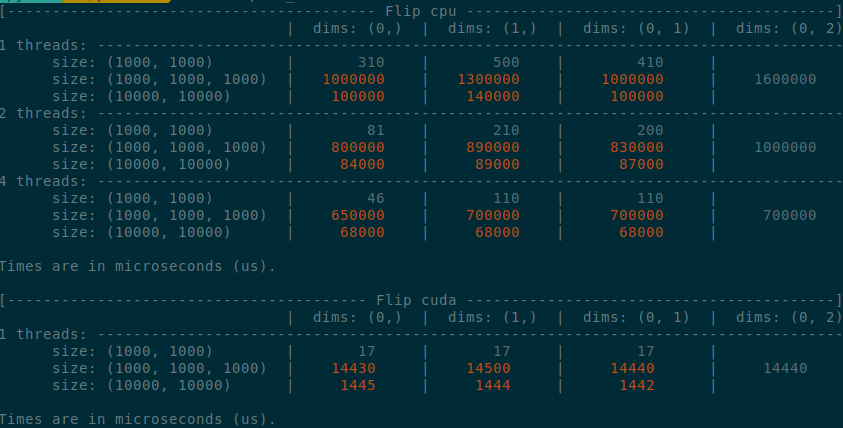
</details>
<details>
<summary>
Benchmark master
</summary>
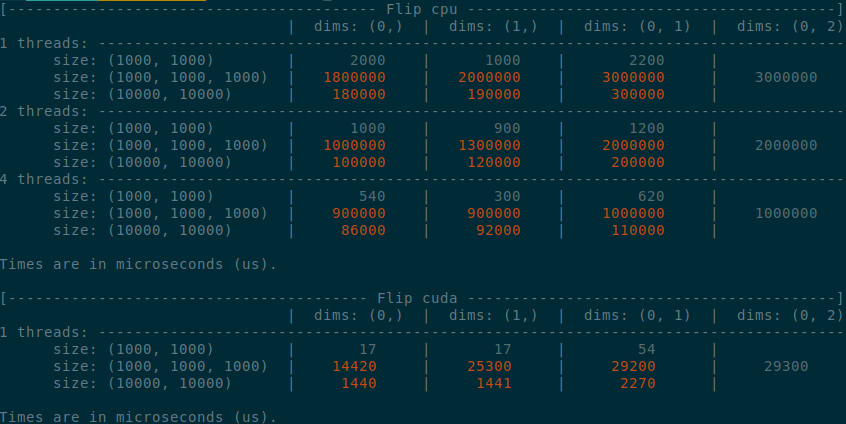
</details>
Pull Request resolved: https://github.com/pytorch/pytorch/pull/58747
Reviewed By: agolynski
Differential Revision: D28877076
Pulled By: ngimel
fbshipit-source-id: 4fa6eb519085950176cb3a9161eeb3b6289ec575
Summary:
Pull Request resolved: https://github.com/pytorch/pytorch/pull/56017Fixes#55686
This patch is seemingly straightforward but some of the changes are very
subtle. For the general algorithmic approach, please first read the
quoted issue. Based on the algorithm, there are some fairly
straightforward changes:
- New boolean on TensorImpl tracking if we own the pyobj or not
- PythonHooks virtual interface for requesting deallocation of pyobj
when TensorImpl is being released and we own its pyobj, and
implementation of the hooks in python_tensor.cpp
- Modification of THPVariable to MaybeOwned its C++ tensor, directly
using swolchok's nice new class
And then, there is python_variable.cpp. Some of the changes follow the
general algorithmic approach:
- THPVariable_NewWithVar is simply adjusted to handle MaybeOwned and
initializes as owend (like before)
- THPVariable_Wrap adds the logic for reverting ownership back to
PyObject when we take out an owning reference to the Python object
- THPVariable_dealloc attempts to resurrect the Python object if
the C++ tensor is live, and otherwise does the same old implementation
as before
- THPVariable_tryResurrect implements the resurrection logic. It is
modeled after CPython code so read the cited logic and see if
it is faithfully replicated
- THPVariable_clear is slightly updated for MaybeOwned and also to
preserve the invariant that if owns_pyobj, then pyobj_ is not null.
This change is slightly dodgy: the previous implementation has a
comment mentioning that the pyobj nulling is required to ensure we
don't try to reuse the dead pyobj. I don't think, in this new world,
this is possible, because the invariant says that the pyobj only
dies if the C++ object is dead too. But I still unset the field
for safety.
And then... there is THPVariableMetaType. colesbury explained in the
issue why this is necessary: when destructing an object in Python, you
start off by running the tp_dealloc of the subclass before moving up
to the parent class (much in the same way C++ destructors work). The
deallocation process for a vanilla Python-defined class does irreparable
harm to the PyObject instance (e.g., the finalizers get run) making it
no longer valid attempt to resurrect later in the tp_dealloc chain.
(BTW, the fact that objects can resurrect but in an invalid state is
one of the reasons why it's so frickin' hard to write correct __del__
implementations). So we need to make sure that we actually override
the tp_dealloc of the bottom most *subclass* of Tensor to make sure
we attempt a resurrection before we start finalizing. To do this,
we need to define a metaclass for Tensor that can override tp_dealloc
whenever we create a new subclass of Tensor. By the way, it was totally
not documented how to create metaclasses in the C++ API, and it took
a good bit of trial error to figure it out (and the answer is now
immortalized in https://stackoverflow.com/q/67077317/23845 -- the things
that I got wrong in earlier versions of the PR included setting
tp_basicsize incorrectly, incorrectly setting Py_TPFLAGS_HAVE_GC on
the metaclass--you want to leave it unset so that it inherits, and
determining that tp_init is what actually gets called when you construct
a class, not tp_call as another not-to-be-named StackOverflow question
suggests).
Aside: Ordinarily, adding a metaclass to a class is a user visible
change, as it means that it is no longer valid to mixin another class
with a different metaclass. However, because _C._TensorBase is a C
extension object, it will typically conflict with most other
metaclasses, so this is not BC breaking.
The desired new behavior of a subclass tp_dealloc is to first test if
we should resurrect, and otherwise do the same old behavior. In an
initial implementation of this patch, I implemented this by saving the
original tp_dealloc (which references subtype_dealloc, the "standard"
dealloc for all Python defined classes) and invoking it. However, this
results in an infinite loop, as it attempts to call the dealloc function
of the base type, but incorrectly chooses subclass type (because it is
not a subtype_dealloc, as we have overridden it; see
b38601d496/Objects/typeobject.c (L1261) )
So, with great reluctance, I must duplicate the behavior of
subtype_dealloc in our implementation. Note that this is not entirely
unheard of in Python binding code; for example, Cython
c25c3ccc4b/Cython/Compiler/ModuleNode.py (L1560)
also does similar things. This logic makes up the bulk of
THPVariable_subclass_dealloc
To review this, you should pull up the CPython copy of subtype_dealloc
b38601d496/Objects/typeobject.c (L1230)
and verify that I have specialized the implementation for our case
appropriately. Among the simplifications I made:
- I assume PyType_IS_GC, because I assume that Tensor subclasses are
only ever done in Python and those classes are always subject to GC.
(BTW, yes! This means I have broken anyone who has extend PyTorch
tensor from C API directly. I'm going to guess no one has actually
done this.)
- I don't bother walking up the type bases to find the parent dealloc;
I know it is always THPVariable_dealloc. Similarly, I can get rid
of some parent type tests based on knowledge of how
THPVariable_dealloc is defined
- The CPython version calls some private APIs which I can't call, so
I use the public PyObject_GC_UnTrack APIs.
- I don't allow the finalizer of a Tensor to change its type (but
more on this shortly)
One alternative I discussed with colesbury was instead of copy pasting
the subtype_dealloc, we could transmute the type of the object that was
dying to turn it into a different object whose tp_dealloc is
subtype_dealloc, so the stock subtype_dealloc would then be applicable.
We decided this would be kind of weird and didn't do it that way.
TODO:
- More code comments
- Figure out how not to increase the size of TensorImpl with the new
bool field
- Add some torture tests for the THPVariable_subclass_dealloc, e.g.,
involving subclasses of Tensors that do strange things with finalizers
- Benchmark the impact of taking the GIL to release C++ side tensors
(e.g., from autograd)
- Benchmark the impact of adding a new metaclass to Tensor (probably
will be done by separating out the metaclass change into its own
change)
- Benchmark the impact of changing THPVariable to conditionally own
Tensor (as opposed to unconditionally owning it, as before)
- Add tests that this actually indeed preserves the Python object
Signed-off-by: Edward Z. Yang <ezyang@fb.com>
Test Plan: Imported from OSS
Reviewed By: albanD
Differential Revision: D27765125
Pulled By: ezyang
fbshipit-source-id: 857f14bdcca2900727412aff4c2e2d7f0af1415a
Summary:
1) remove pushing back to strides vector for 1D tensors, those strides are never used in the loop anyway
2) avoid calling get_data_ptrs unless necessary
3) don't call into assert_no_partial_overlap if tensorImpls are the same (assert_no_partial_overlap has this comparison too, but after a couple of nested function calls)
4) is_non_overlapping_and_dense instead of is_contiguous in memory overlap (which, for some reason, is faster than is_contiguous, though I hoped after is_contiguous is non-virtualized, it should be the same).
Altogether, brings instruction count down from ~110K to 102735 for the following binary inplace benchmark:
```
In [2]: timer = Timer("m1.add_(b);", setup="at::Tensor m1=torch::empty({1}); at::Tensor b = torch::empty({1});", language="c++", timer=timeit.default_timer)
...: stats=timer.collect_callgrind(number=30, repeats=3)
...: print(stats[1].as_standardized().stats(inclusive=False))
```
similar improvements for unary inplace.
Upd: returned stride packing for now, counts is now 104295, so packing is worth ~ 52 instructions, we should think about how to remove it safely.
Pull Request resolved: https://github.com/pytorch/pytorch/pull/58810
Reviewed By: bhosmer
Differential Revision: D28664514
Pulled By: ngimel
fbshipit-source-id: 2e03cf90b37a411d9994a7607402645f1d8f3c93
Summary:
Pull Request resolved: https://github.com/pytorch/pytorch/pull/58881
recently added new parameter to the function with PR: https://github.com/pytorch/pytorch/pull/58417
However, this introduced ambiguity when making call below:
some_tensor.repeat_interleave(some_integer_value)
Making it optional to avoid the issue.
Reviewed By: ezyang, ngimel
Differential Revision: D28653820
fbshipit-source-id: 5bc0b1f326f069ff505554b51e3b24d60e69c843
Summary:
Pull Request resolved: https://github.com/pytorch/pytorch/pull/58417
Same as title.
Test Plan:
Rely on CI signal.
Update unit test to exercise new code path as well.
Reviewed By: ngimel
Differential Revision: D28482927
fbshipit-source-id: 3ec8682810ed5c8547b1e8d3869924480ce63dcd
Summary:
This adds the methods `Tensor.cfloat()` and `Tensor.cdouble()`.
I was not able to find the tests for `.float()` functions. I'd be happy to add similar tests for these functions once someone points me to them.
Fixes https://github.com/pytorch/pytorch/issues/56014
Pull Request resolved: https://github.com/pytorch/pytorch/pull/58137
Reviewed By: ejguan
Differential Revision: D28412288
Pulled By: anjali411
fbshipit-source-id: ff3653cb3516bcb3d26a97b9ec3d314f1f42f83d
Summary:
Pull Request resolved: https://github.com/pytorch/pytorch/pull/58144
reland D28291041 (14badd9929), which was reverted due to a type error from Tuple[torch.Tensor], seems that mypy requires Tuple[torch.Tensor, torch.Tensor, torch.Tensor]
Test Plan:
buck test mode/opt //caffe2/test:torch_cuda -- test_index_copy_deterministic
✓ ListingSuccess: caffe2/test:torch_cuda - main (9.229)
✓ Pass: caffe2/test:torch_cuda - test_index_copy_deterministic_cuda (test_torch.TestTorchDeviceTypeCUDA) (25.750)
✓ Pass: caffe2/test:torch_cuda - main (25.750)
Reviewed By: ngimel
Differential Revision: D28383178
fbshipit-source-id: 38896fd6ddd670cfcce36e079aee7ad52adc2a28
Summary:
Pull Request resolved: https://github.com/pytorch/pytorch/pull/57544
Instead of removing tp_new from the superclass (which causes
super().__new__ to not work), I now still install tp_new on the
superclass, but verify that you are not trying to directly
construct _TensorBase.
Fixes https://github.com/pytorch/pytorch/issues/57421
Signed-off-by: Edward Z. Yang <ezyang@fb.com>
Test Plan: Imported from OSS
Reviewed By: albanD
Differential Revision: D28189475
Pulled By: ezyang
fbshipit-source-id: 9397a3842a77f5428d182dd62244b42425bca827
Summary:
This PR also removes qr and eig tests from test/test_torch.py. They were not skipped if compiled without LAPACK and they are now replaced with OpInfos.
Fixes https://github.com/pytorch/pytorch/issues/55929
Pull Request resolved: https://github.com/pytorch/pytorch/pull/56284
Reviewed By: ejguan
Differential Revision: D27827077
Pulled By: mruberry
fbshipit-source-id: 1dceb955810a9fa34bb6baaccbaf0c8229444d3a
Summary:
Fixes https://github.com/pytorch/pytorch/issues/55090
I included the header directly, but I am not sure if we should add this as a git submodule, what do you guys think?
Also regarding the implementation, in ATen lanes seems not to be supported, but from CuPy complex types are exported with 2 lanes, I am not sure wether this is correct or not. However, in PyTorch this seems to be working properly, so I forgive 2 lanes for complex datatypes.
TODO: add tests for complex and bfloat
Easy test script against cupy
```python
import cupy
import torch
from torch.utils.dlpack import to_dlpack
from torch.utils.dlpack import from_dlpack
# Create a PyTorch tensor.
tx1 = torch.tensor(
[2 + 1j, 3 + 2j, 4 + 3j, 5 + 4j], dtype=torch.complex128
).cuda()
# Convert it into a DLPack tensor.
dx = to_dlpack(tx1)
# Convert it into a CuPy array.
cx = cupy.fromDlpack(dx)
# Convert it back to a PyTorch tensor.
tx2 = from_dlpack(cx.toDlpack())
torch.testing.assert_allclose(tx1, tx2)
```
Thanks to leofang who updated CuPy's dlpack version and his PR served me as the guide for this one.
Pull Request resolved: https://github.com/pytorch/pytorch/pull/55365
Reviewed By: ngimel
Differential Revision: D27724923
Pulled By: mruberry
fbshipit-source-id: 481eadb882ff3dd31e7664e08e8908c60a960f66
Summary:
Pull Request resolved: https://github.com/pytorch/pytorch/pull/56150
See #56017 for full context; the short story is that by making
it illegal to directly construct _TensorBase, we need only
write a *single* tp_dealloc function which will work universally
for all _TensorBase subclasses, rather than having to write two
versions, one for _TensorBase itself, and others for Python subclasses
of _TensorBase. This means simpler code.
The subtlety here is that we only install our custom `tp_new` for direct subclasses of TensorBase. This is important, because overriding the `tp_new` also overrides any user defined constructor. Fortunately class Tensor(_TensorBase) has no nontrivial constructors and doesn't mind, but other subclasses like Parameter definitely mind!
Signed-off-by: Edward Z. Yang <ezyang@fb.com>
Test Plan: Imported from OSS
Reviewed By: H-Huang
Differential Revision: D28028746
Pulled By: ezyang
fbshipit-source-id: 3c03a14666ad1ded1145fe676afb0a7623cdb9bb
Summary:
The test seems to be failing in ROCM 4.1 on CI node. Disabling the same for now. The test will be re-enabled for ROCM when CI transitions to 4.2.
Pull Request resolved: https://github.com/pytorch/pytorch/pull/56951
Reviewed By: zou3519
Differential Revision: D28059808
Pulled By: ezyang
fbshipit-source-id: a9b064b7525ae6dce89c51fe29ff07f37b7ac796
Summary:
Fixes https://github.com/pytorch/pytorch/issues/46702
- fails on probability distribution with odd items
- trying to access an `acc_type` (`float`) in a `scalar_t` (`float16`) aligned memory
- produce unrepeatable result for large input tensor
- parallel cumsum not monotonic at some positions
### Fixes
- computing cumsum on `acc_type` (`float`) instead of using `scalar_t` (`float16`) fixed both issues
- the non-monotonic behavior may happen even using `float`, though
- in these cases, deterministic behavior may be achieved by eliminating the race condition when writing the result, using the atomic function `atomicMax`
Pull Request resolved: https://github.com/pytorch/pytorch/pull/55364
Reviewed By: mruberry
Differential Revision: D28031666
Pulled By: ngimel
fbshipit-source-id: 0fc6289e0b9ea2d31ef3771e7ca370de8f5c02de
Summary:
Pull Request resolved: https://github.com/pytorch/pytorch/pull/55102
To avoid casting a tensor to `.long()`, we introduce support for int32 in `torch.repeat_interleave`.
Reviewed By: ezyang
Differential Revision: D27478235
fbshipit-source-id: 08b4cce65fe94ff10535ddc07e1ba2bacea6a2cf


