Instead of having a separate context variable for SymDispatchMode, we
now simply delegate to the current active proxy tensor mode when we
need to trace a SymInt.  We maintain a separate `__sym_dispatch__` magic
method as the calling convention is different than `__torch_dispatch__`.

Consolidating the modes in this ways means that we can consistently
disable both of these modes in tandem simply by removing the mode
from the proxy mode infra slot.

Signed-off-by: Edward Z. Yang <ezyang@meta.com>

Pull Request resolved: https://github.com/pytorch/pytorch/pull/132674
Approved by: https://github.com/zou3519, https://github.com/bdhirsh
Instead of having a separate context variable for SymDispatchMode, we
now simply delegate to the current active proxy tensor mode when we
need to trace a SymInt.  We maintain a separate `__sym_dispatch__` magic
method as the calling convention is different than `__torch_dispatch__`.

Consolidating the modes in this ways means that we can consistently
disable both of these modes in tandem simply by removing the mode
from the proxy mode infra slot.

Signed-off-by: Edward Z. Yang <ezyang@meta.com>

Pull Request resolved: https://github.com/pytorch/pytorch/pull/132674
Approved by: https://github.com/zou3519, https://github.com/bdhirsh
Fixes https://github.com/pytorch/pytorch/issues/117361

The implementation here slightly diverges from what was proposed in the issue, so I will recap what this PR is doing here. Today, when doing computations involving size-like unbacked SymInts, we assume for all operations that the compile time range of the integer is `[2, inf]`, even though at runtime we also accept zero and one.

This PR removes the carte blanche assumption, and instead does the analysis in a much more limited and controlled fashion: only for guards which we have designated as "size oblivious" are we willing to do the analysis under the assumption that the range of all size-like unbacked SymInts is `[2, inf]`; otherwise, we will faithfully only do analysis with `[0, inf]` (or whatever the user provided) bounds.

The infra pieces of this PR are:

* Remove runtime_var_to_range from torch/fx/experimental/symbolic_shapes.py; modify `_constrain_range_for_size` to refine the range without clamping min to 2, and instead add the symbol to a `size_like` set in the ShapeEnv
* When evaluating an expression, if the expression is requested to be evaluated in a `size_oblivious` way, we attempt to statically compute the value of the expression with the assumption that all symbols in `size_like` are updated to assume that they are `>= 2`.
* Add Python and C++ APIs for guarding on a SymBool in a size-oblivious way. In C++, I also need to add some helpers for performing symbolic comparisons, since the stock comparisons immediately specialize in the "normal" way.

The rest of the changes of the PR are marking various spots in PyTorch framework code as size oblivious, based on what our current test suite exercises.

As you review the places where we have marked things as size oblivious, it may become clear why I ended up not opting for the "designate a branch as the default branch when it's not statically obvious which way to go": for some of the conditions, this answer is rather non-obvious. I think potentially there is another refinement on top of this PR, which is something like "I don't care if you can't figure it out with ValueRange analysis, go down this path anyway if there are unbacked sizes involved." But even if we add this API, I think we are obligated to attempt the ValueRange analysis first, since it can lead to better outcomes sometimes (e.g., we are able to figure out that something is contiguous no matter what the unbacked size is.)

When is it permissible to mark something as size oblivious? Heuristically, it is OK anywhere in framework code if it gets you past a guard on unbacked SymInt problem. It is somewhat difficult to provide a true semantic answer, however. In particular, these annotations don't have any observational equivalence guarantee; for example, if I have `torch.empty(u0, 1).squeeze()`, we will always produce a `[u0]` size tensor, even though if `u0 == 1` PyTorch will actually produce a `[]` size tensor. The argument that I gave to Lezcano is that we are in fact defining an alternate semantics for a "special" size = 0, 1, for which we have these alternate eager mode semantics. In particular, suppose that we have a constant `special1` which semantically denotes 1, but triggers alternate handling rules. We would define `torch.empty(special1, 1).squeeze()` to always produce a `[special1]` size tensor, making its semantics coincide with unbacked SymInt semantics. In this model, the decision to designate guards as size oblivious is simply a user API question: you put them where ever you need some handling for special1! As we conservatively error out whenever it is not obvious what `special1` semantics should be, it is always valid to expand these semantics to cover more cases (although you can always choose the wrong semantics!)

Signed-off-by: Edward Z. Yang <ezyang@meta.com>

Pull Request resolved: https://github.com/pytorch/pytorch/pull/118579
Approved by: https://github.com/eellison, https://github.com/lezcano
This PR:

- Moves TrueDiv, LShift, RShift, IsNonOverlappingAndDenseIndicator to `_sympy.functions.py`
- Moves SymNode to `fx.experimental.sym_node`.
  - This file does not have any SymPy dependencies at import time
  - It installs the magic methods in Sym{Bool,Int,Float}.
  - N.b. With this split, we may be able to move Sym{Bool,Int,Float} to this file, and remove quite a few of the hacks around these classes
- Imports `sym_node` in `torch/__init__.py` rather than the whole `symbolic_shapes.py`.
  This breaks the import-time dependency between torch and SymPy

Pull Request resolved: https://github.com/pytorch/pytorch/pull/112037
Approved by: https://github.com/peterbell10
ghstack dependencies: #112035, #112036
Summary:
We want the matcher to return a name -> node in target graph
so that we can refer to the node by name, this is useful for downstream applications like
quantization.

and also we can use the torch API as source of truth instead of matching aten API directly.

Test Plan:
python test/fx/test_matcher_utils.py

Reviewers:

Subscribers:

Tasks:

Tags:
Pull Request resolved: https://github.com/pytorch/pytorch/pull/110743
Approved by: https://github.com/SherlockNoMad
Add non-package python modules to the public API checks.
The original change is to remove the `ispkg` check in this line
https://github.com/pytorch/pytorch/blob/main/docs/source/conf.py#L518

Everything else is to add the appropriate modules to the rst files, make sure every module we provide can be imported (fixed by either making optional dependencies optional or just deleting files that have been un-importable for 3 years), make API that are both modules and functions (like torch.autograd.gradcheck) properly rendered on the docs website without confusion and add every non-documented API to the allow list (~3k of them).

Next steps will be to try and fix these missing docs
Pull Request resolved: https://github.com/pytorch/pytorch/pull/110568
Approved by: https://github.com/zou3519
Create Z3 types. In particular, dynamic dimensions, dynamic tensor type and tensor types up to size 4. Note that for Z3 decidability reasons, we are using uninterpreted functions for tensor types, which means we must explicitly define tensor constructors with a concrete size (for now, upto size 4).  We defer lifting this requirement to future work.
Pull Request resolved: https://github.com/pytorch/pytorch/pull/80084
Approved by: https://github.com/anijain2305
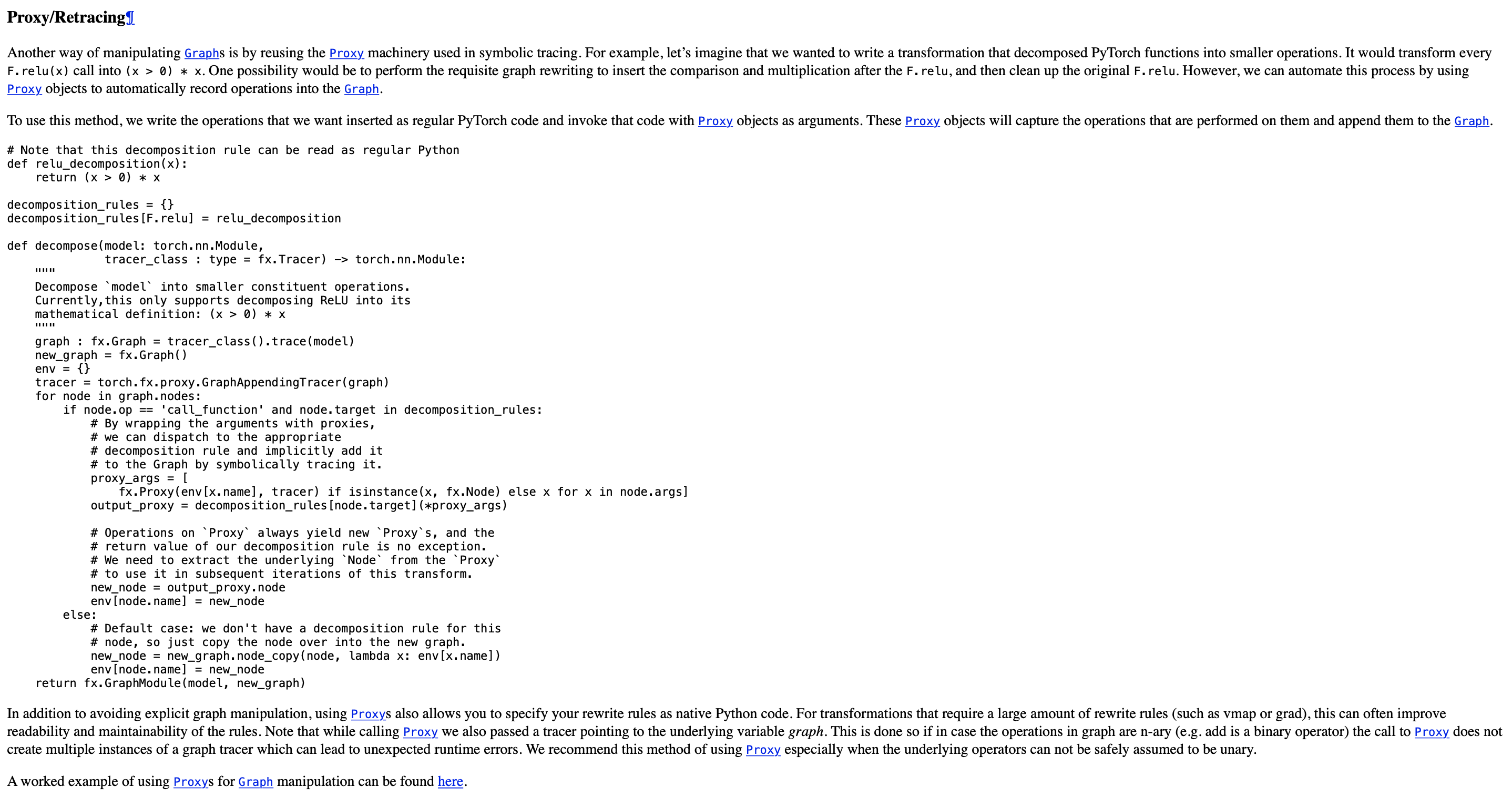
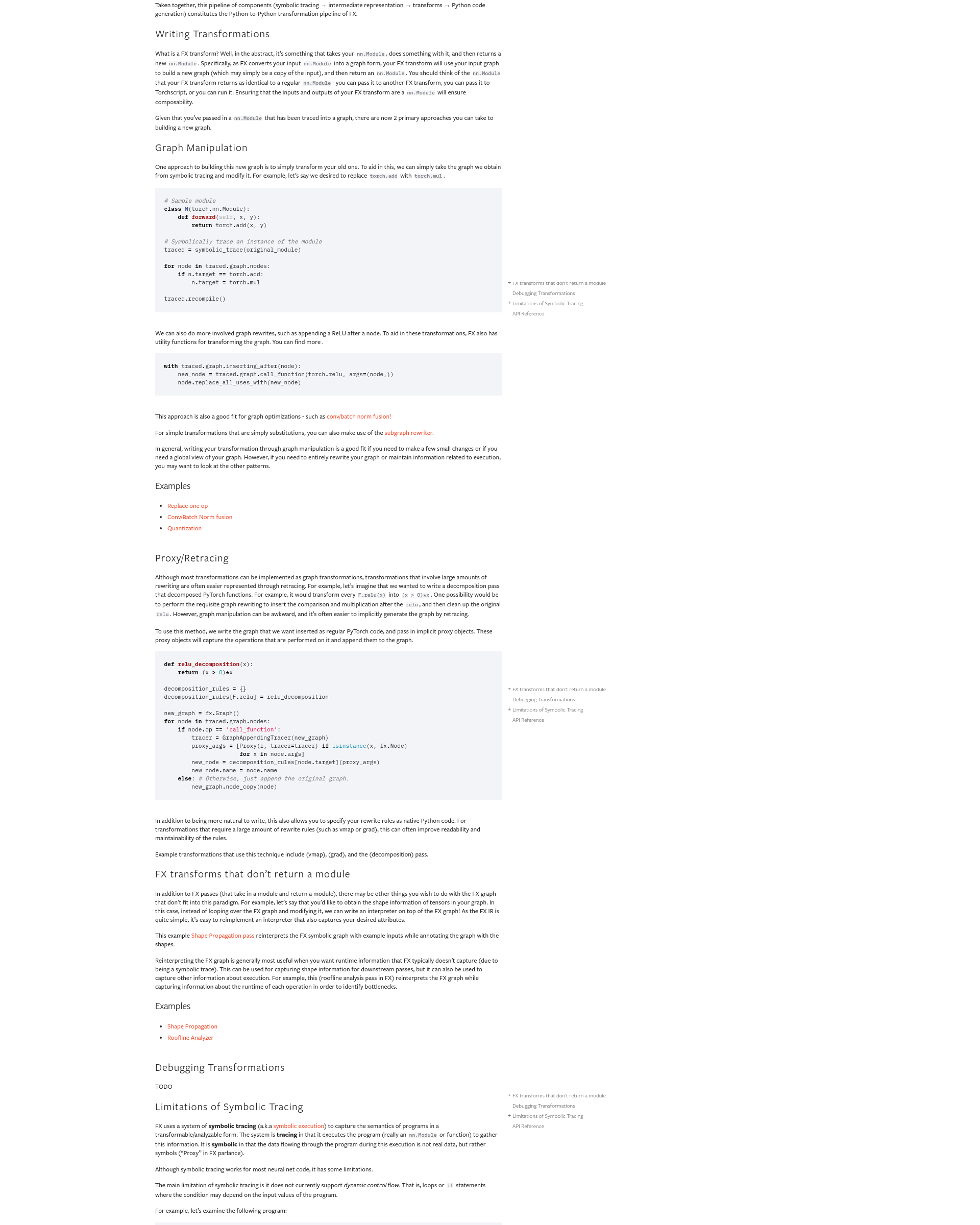
This PR introduces two components.

CapabilityBasedPartitioner for FX graph: given a list of supported operators, this partitioner tries to forms the largest subgraphs that only contain the supported ops.

Fuser utility: given a list of nodes in FX graph, it lifts them as a sub-GraphModule in the original graph.

Pull Request resolved: https://github.com/pytorch/pytorch/pull/79439
Approved by: https://github.com/jjsjann123, https://github.com/davidberard98
Summary:
Working towards https://docs.google.com/document/d/10yx2-4gs0gTMOimVS403MnoAWkqitS8TUHX73PN8EjE/edit?pli=1#

This PR:
- Ensure that all the submodules are listed in a rst file (that ensure they are considered by the coverage tool)
- Remove some long deprecated code that just error out on import
- Remove the allow list altogether to ensure nothing gets added back there

Pull Request resolved: https://github.com/pytorch/pytorch/pull/73983

Reviewed By: anjali411

Differential Revision: D34787908

Pulled By: albanD

fbshipit-source-id: 163ce61e133b12b2f2e1cbe374f979e3d6858db7
(cherry picked from commit c9edfead7a01dc45bfc24eaf7220d2a84ab1f62e)
Summary:
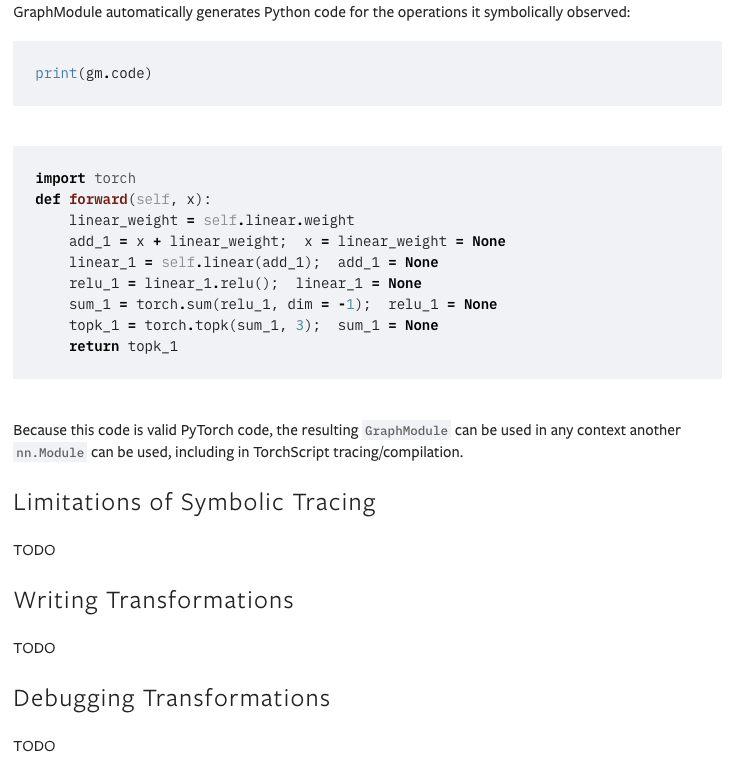
When I run this part of the code on the document with PyTorch version 1.10.0, I found some differences between the output and the document, as follows:

```python
import torch
import torch.fx as fx

class M(torch.nn.Module):
    def forward(self, x, y):
        return x + y

# Create an instance of `M`
m = M()

traced = fx.symbolic_trace(m)
print(traced)
print(traced.graph)
traced.graph.print_tabular()
```

I get the result:

```shell
def forward(self, x, y):
    add = x + y;  x = y = None
    return add

graph():
    %x : [#users=1] = placeholder[target=x]
    %y : [#users=1] = placeholder[target=y]
    %add : [#users=1] = call_function[target=operator.add](args = (%x, %y), kwargs = {})
    return add
opcode         name    target                   args    kwargs
-------------  ------  -----------------------  ------  --------
placeholder    x       x                        ()      {}
placeholder    y       y                        ()      {}
call_function  add     <built-in function add>  (x, y)  {}
output         output  output                   (add,)  {}
```

This pr modified the document。

Pull Request resolved: https://github.com/pytorch/pytorch/pull/68043

Reviewed By: driazati

Differential Revision: D32287178

Pulled By: jamesr66a

fbshipit-source-id: 48ebd0e6c09940be9950cd57ba0c03274a849be5
Summary:
This is a more fundamental example, as we may support some amount of shape specialization in the future.

Pull Request resolved: https://github.com/pytorch/pytorch/pull/53250

Reviewed By: navahgar

Differential Revision: D26841272

Pulled By: Chillee

fbshipit-source-id: 027c719afafc03828a657e40859cbfbf135e05c9