Changes:

1. Bump `ruff` from 0.7.4 to 0.8.4
2. Change `%`-formatted strings to f-string
3. Change arguments with the `__`-prefix to positional-only arguments with the `/` separator in function signature.

Pull Request resolved: https://github.com/pytorch/pytorch/pull/143753
Approved by: https://github.com/Skylion007
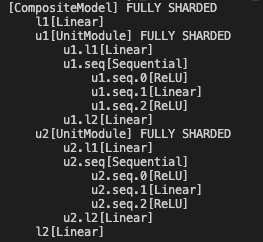
Some toy example:
<img width="998" alt="Screenshot 2024-04-17 at 2 00 05 PM" src="https://github.com/pytorch/pytorch/assets/31054793/b5665a63-beb0-4ca1-92c6-c57a052812fd">

We define `FullyShardedDataParallel._unshard(async_op: bool = False)` that can be used to prefetch all-gathers. The user should make sure:
1. Run lazy init before the first `_unshard` call of training. For example, this can hackily be done via `root_module.check_is_root()` on the root FSDP module `root_module`.
2. Call `root_module._wait_unshard_streams_on_current_stream()` before the first `_unshard` call of the current iteration (just need to call it once after last optimizer step and before first `_unshard` of this iteration).

Differential Revision: [D56262876](https://our.internmc.facebook.com/intern/diff/D56262876)
Pull Request resolved: https://github.com/pytorch/pytorch/pull/124304
Approved by: https://github.com/wanchaol
Summary:
    Minor logging cleanup in distributed library
    1. Don't use "f" formatted strings - address linter issues.
    2. Nits: Make use of unused `e` (error) in a few logs.
    3. Change info->debug as asked in issue #113545
    4. Nit: rename log -> logger in a few files for consistency
    5. Fix a linter error.

    Test Plan:
    1. Local build passes.
    2. Linter is happy.

    Reviewers: wanchaol

Pull Request resolved: https://github.com/pytorch/pytorch/pull/122921
Approved by: https://github.com/wanchaol
Currently, when we have 2D composition, a global variable _extensions controls the 2D deviation we need to take in state_dict calls (See https://github.com/pytorch/pytorch/blob/release/2.1/torch/distributed/fsdp/_fsdp_extensions.py#L66-L68). This is problematic when we have both a 2D model and a plain FSDP model in the same dist environment, as the _extensions will be mistakenly turned on for the plain FSDP model, resulting in state_dict error (RuntimeError: No parent device_mesh is found for FSDP device_mesh.).

This PR binds _fsdp_extension to the FSDP instances to make sure that state_dict calls would not get interfered with each other when mixing both 2D and 1D parallelism.

Pull Request resolved: https://github.com/pytorch/pytorch/pull/113237
Approved by: https://github.com/fduwjj, https://github.com/fegin
Did some easy fixes from enabling TRY200. Most of these seem like oversights instead of intentional. The proper way to silence intentional errors is with `from None` to note that you thought about whether it should contain the cause and decided against it.

Pull Request resolved: https://github.com/pytorch/pytorch/pull/111496
Approved by: https://github.com/malfet
issue resolved: https://github.com/pytorch/pytorch/issues/97791

before this PR, mixed_precision applies to buffers from ignored modules. see ```test_state_dict_with_ignored_modules(mixed_precision=True)``` for reproduce

after, we avoid applying mixed_precision semantics to buffers from ignored modules
* step 1 initialization: state._ignored_buffer_names contains all the buffers from ignored modules
* step 2 lazy init at runtime: skip ignored buffers in ```_get_buffers_and_dtypes_for_computation```
* step 3 skip upcasting in state_dict hook: avoid upcasting for ignored buffers in ```_get_buffers_and_dtypes_for_computation```
Pull Request resolved: https://github.com/pytorch/pytorch/pull/106766
Approved by: https://github.com/awgu
This PR should not make any functional difference. It:
- adds clearer documentation
- clarifies a type
- revises minor typos
- swaps a .keys for a .items call on a dictionary

Pull Request resolved: https://github.com/pytorch/pytorch/pull/106069
Approved by: https://github.com/awgu
### Background: Gradient Pre-Divide
Consider $N$ data parallel workers. Define $g_i$ to be the $i$ th worker's local unsharded gradient. Data parallel gradient reduction computes $\overline g = \frac{1}{N} \sum_{i \in [N]} g_i$.

$\sum_{i \in [N]} g_i$ increases the magnitude by a factor of $N$, which may overflow for fp16. However, if we pre-divide and compute $\sum_{i \in [N]} \frac{g_i}{N}$, then the $\frac{g_i}{N}$ may underflow. The current solution from Myle for FSDP is to pre-divide by $\sqrt{N}$ and post-divide by $\sqrt{N}$:
$$\overline{g} = \frac{1}{\sqrt{N}} \sum_{i \in [N]} \frac{g_i}{\sqrt{N}}.$$

Now, consider HSDP with $N = S \cdot R$ data parallel workers, sharding over $S$ workers and replicating over $R$ workers. Define $g_{i,j}$ to be the $i \cdot S + j$ th worker's local unsharded gradient (so sharding indexes with $i$ and replication indexes with $j$). The existing implementation computes
$$\overline{g} = \frac{1}{\sqrt{R}} \sum_{j \in [R]} \textcolor{red}{ \frac{1}{\sqrt{R}} \frac{1}{\sqrt{S}} } \sum_{i \in [S]} \frac{g_i}{\sqrt{S}},$$
where the $\frac{1}{\sqrt{R}} \frac{1}{\sqrt{S}}$ involves two separate `aten::div_` kernels.

### Revisiting Pre-Divide for HSDP
A minor optimization that we can do is with this intermediate `div_`. There are two options:
1. Compute $\overline{g}$ in the same way as FSDP:
$$\overline{g} = \frac{1}{\sqrt{N}} \sum_{j \in [R]} \sum_{i \in [S]} \frac{g_{i,j}}{\sqrt{N}}.$$
2. Compute $\overline{g}$ still with an intermediate division for rescaling but coalescing the two `divs_` into one:
$$\overline{g} = \frac{1}{\sqrt{R}} \sum_{j \in [R]} \textcolor{red}{ \frac{1}{\sqrt{N}} } \sum_{i \in [S]} \frac{g_i}{\sqrt{S}}$$

This PR goes with the 1st approach prioritizing performance because (1) it matches the existing FSDP behavior and (2) it avoids a memor-bandwidth bound `div_` kernel that blocks all-reduce launch.

### Implementation Details
In order to accommodate this, we need to refactor the communication hook logic that baked the gradient pre/post-division into the default hook.
- We raise an error if registering a communication hook for HSDP since the current implementation would only apply the hook to the reduce-scatter, not the all-reduce, which may be unexpected.
- We change it so that `state._comm_hook is not None` iff a communication hook is registered. This makes the collectives and the pre/post-division in the default no-communication-hook path more visible in the code.

Differential Revision: [D47852459](https://our.internmc.facebook.com/intern/diff/D47852459)
Pull Request resolved: https://github.com/pytorch/pytorch/pull/106034
Approved by: https://github.com/rohan-varma
This moves `fully_shard` to use `_auto_wrap()` just like `FullyShardedDataParallel`. This means that `fully_shard` goes through the `_init_param_handle_from_module()` path (i.e. 1 `fully_shard` per "wrap"), removing the need for `_init_param_handles_from_module()` (which was 1 `fully_shard` for all "wraps" of a given policy). `_auto_wrap()` simply calls `fully_shard` on target submodules.

This includes several important fixes:
- We should register the pre/post-forward hooks on the module regardless of it has managed parameters.
- We can permit `_module_handles` to return `[]` in the composable path (for when the module has no managed parameters).
- We should unify the paths for `_get_buffers_and_dtypes_for_computation()` (previously, composable path was buggy in some cases).
Pull Request resolved: https://github.com/pytorch/pytorch/pull/104408
Approved by: https://github.com/rohan-varma
This PR creates a device_mesh and share it across all FSDP state. The device_mesh will later be used to test out dtensor state_dict (1d device_mesh).
Approved by: https://github.com/awgu

Add device mesh to fsdp state
skip dist.get_world_size(pg) != dist.get_world_size()
address test_fake_pg.py test failure
fix test_fake_py.py failure

Pull Request resolved: https://github.com/pytorch/pytorch/pull/102551
Approved by: https://github.com/fegin
Custom backend implementation based on privateuse1 with semantics identical to CUDA (CUDA is so popular), named for example 'my_device', and registered as the same module name torch.my_device.

This PR aims to satisfy the constraints of such a backend, which can be directly integrated into the current FSDP implementation.

The main issues addressed are:

#### 1. Device decision for FSDP wrapping of Modules without Parameters

Users typically organize FSDP code as follows:
```python
m = Module().to('my_device:0')
fsdp_m = FSDP(m)
```
or like this:
```python
m = Module()
fsdp_m = FSDP(m, device_id=torch.device('my_device', 0))
```
If the model has Parameters, everything works fine because FSDP will prioritize the device where the Parameters are located. However, for Modules without Parameters, the to() call has no side effects, and FSDP will assume the current CUDA device, which prevents the use of devices other than the current CUDA device for Modules without Parameters. Therefore, when FSDP is called with a device_id argument, this configuration takes top priority.

#### 2. Abstraction of a cuda-like device

Now, in addition to compute_device, _FSDPState includes a device_handler member. In fact, this device_handler is now just a reference to either torch.cuda or torch.my_device. From now on, code that works based on _FSDPState should use state.device_handler to operate streams create, wait or sync, just like using torch.cuda previously.
Pull Request resolved: https://github.com/pytorch/pytorch/pull/99024
Approved by: https://github.com/awgu
The default option of `named_parameters` and `named_modules` is to remove the duplicated parameters and modules. However, in FSDP, we need to know what parameters are shared. As a result, setting `remove_duplicate` to False is required in FSDP. Without setting `remove_duplicate` to False, FSDP won't be able to discover shared weights in some cases (e.g., the shared weights are in the same module or there are shared modules).

The previous PR is reverted due to some modules overwriting the signature of `named_parameters()`. This new PR adds a workaround for the case.

Differential Revision: [D45065973](https://our.internmc.facebook.com/intern/diff/D45065973/)
Pull Request resolved: https://github.com/pytorch/pytorch/pull/99448
Approved by: https://github.com/zhaojuanmao
Summary:
This diff is reverting D44897935
D44897935: [FSDP] Include duplicate parameters and modules when calling named_parameters and named_modules (#98912) by fegin has been identified to be causing the following test or build failures:

Tests affected:
- [caffe2/torch/fb/module_factory/sync_sgd/tests:test_pyper_data_parallel_wrapper - caffe2.torch.fb.module_factory.sync_sgd.tests.test_pyper_data_parallel_wrapper.PyPerDataParallelWrapperTest: test_fsdp_submodules_pyper](https://www.internalfb.com/intern/test/562950025957458/)

Here's the Multisect link:
https://www.internalfb.com/multisect/1893714
Here are the tasks that are relevant to this breakage:

We're generating a revert to back out the changes in this diff, please note the backout may land if someone accepts it.

If you believe this diff has been generated in error you may Commandeer and Abandon it.

Test Plan: NA

Reviewed By: fegin

Differential Revision: D45027286

Pull Request resolved: https://github.com/pytorch/pytorch/pull/99353
Approved by: https://github.com/izaitsevfb, https://github.com/fegin
The default option of `named_parameters` and `named_modules` is to remove the duplicated parameters and modules. However, in FSDP, we need to know what parameters are shared. As a result, setting `remove_duplicate` to False is required in FSDP. Without setting `remove_duplicate` to False, FSDP won't be able to discover shared weights in some cases (e.g., the shared weights are in the same module or there are shared modules).

Differential Revision: [D44897935](https://our.internmc.facebook.com/intern/diff/D44897935/)
Pull Request resolved: https://github.com/pytorch/pytorch/pull/98912
Approved by: https://github.com/awgu
- The previous PR addressed one tree traversal in `_root_pre_forward()` but not the main one from `_get_fsdp_handles()` that runs for all settings.
- This PR saves `_all_handles` to cache `_get_fsdp_handles()` and `_all_fsdp_states` to cache `_get_fsdp_states()` (renamed from `_fsdp_states` compared to last PR) on the root state.
- This PR introduces a dummy `_RootFSDPState` class that inherits from `_FSDPState` to be used only for type checking since some attributes are only defined for root states.
    - I found this approach to be better than adding `_p_assert(state.root_only_attr is not None, ...)` upon each usage of `root_only_attr`.
    - This hopefully also helps readers to quickly see which attributes are defined only on root states.
Pull Request resolved: https://github.com/pytorch/pytorch/pull/95465
Approved by: https://github.com/fduwjj
**Overview**
This PR stack will add support for unsharding FSDP's sharded parameters for `fully_shard`. This PR takes the first step by doing some internal refactoring.
- The existing API for wrapper FSDP is the static method `summon_full_params()`, which calls into the helper `_summon_full_params()`.
- This PR refactors:
    - `summon_full_params()` core logic to `_unshard_params()`
    - `_summon_full_params()` to `_unshard_params_recurse()`, which has a `recurse: bool` argument
    - Previous `_unshard_params()` to `_unshard_fsdp_state_params()`, which applies to a single FSDP state

**Details**
- This PR introduces `_get_fsdp_states_with_modules()` and `_get_root_fsdp_states_with_modules()`, which additionally return the modules along with the FSDP states. The modules are needed for handling `FlatParameter` registration.
    - We may be able to remove this if we clean up the `use_orig_params=True` vs. `False` code paths because for `True`, the `FlatParameter` is not registered, meaning that it does not need to be de-registered.
    - Since `fully_shard` requires `use_orig_params=True`, we may not need `_get_fsdp_states_with_modules()` and `_get_root_fsdp_root_modules()`; however, I prefer to make the separation of FSDP state and module explicit for now for clarity.

**Follow-Ups**
- `writeback=True` and `rank0_only=True` raises an error. The previous explanation was:
> is not supported, as model parameter shapes will be different across ranks, and writing to them can lead to inconsistencies across ranks when the context is exited.

I am not exactly sure what the different model parameter shapes refers to. However, I believe that we can support `writeback=True` and `rank0_only=True` by broadcasting the `FlatParameter` from rank 0 in the `finally`, writing back, and freeing. This should not increase the peak memory since rank 0 already holds the unsharded `FlatParameter` in GPU memory before writing back and nonzero ranks do not have any other unsharded `FlatParameter`s in GPU memory.
Pull Request resolved: https://github.com/pytorch/pytorch/pull/92297
Approved by: https://github.com/rohan-varma