Essentially the same change as #67946, except that the default is to disallow reduced precision reductions in `BFloat16` GEMMs (for now). If performance is severely regressed, we can change the default, but this option appears to be necessary to pass some `addmm` `BFloat16` tests on H100.

CC @ptrblck @ngimel
Pull Request resolved: https://github.com/pytorch/pytorch/pull/89172
Approved by: https://github.com/ngimel
This PR sets up torch.func and populates it with the following APIs:
- grad
- grad_and_value
- vjp
- jvp
- jacrev
- jacfwd
- hessian
- functionalize
- vmap

It also renames all instances of `functorch` in the APIs for those docs
to `torch.func`.

We rewrite the `__module__` fields on some of the above APIs so that the
APIs fit PyTorch's public api definition.
- For an API to be public, it must have a `__module__` that points to a
  public PyTorch submodule. However, `torch._functorch.eager_transforms`
  is not public due to the leading underscore.
- The solution is to rewrite `__module__` to point to where the API is
  exposed (torch.func). This is what both Numpy and JAX do for their
  APIs.
- h/t pmeier in
  https://github.com/pytorch/pytorch/issues/90284#issuecomment-1348595246
  for idea and code
- The helper function, `exposed_in`, is confined to
  torch._functorch/utils for now because we're not completely sure if
  this should be the long-term solution.

Implication for functorch.* APIs:
- functorch.grad is the same object as torch.func.grad
- this means that the functorch.grad docstring is actually the
  torch.func.grad docstring and will refer to torch.func instead of
  functorch.
- This isn't really a problem since the plan on record is to deprecate
  functorch in favor of torch.func. We can fix these if we really want,
  but I'm not sure if a solution is worth maintaining.

Test Plan:
- view docs preview

Future:
- vmap should actually just be torch.vmap. This requires an extra step
  where I need to test internal callsites, so, I'm separating it into a
  different PR.
- make_fx should be in torch.func to be consistent with `import
  functorch`. This one is a bit more of a headache to deal with w.r.t.
  public api, so going to deal with it separately.
- beef up func.rst with everything else currently on the functorch
  documention website. func.rst is currently just an empty shell.
Pull Request resolved: https://github.com/pytorch/pytorch/pull/91016
Approved by: https://github.com/samdow
`torch.compile` can be used either as decorator or to optimize model directly, for example:
```
@torch.compile
def foo(x):
  return torch.sin(x) + x.max()
```
or
```
mod = torch.nn.ReLU()
optimized_mod = torch.compile(mod, mode="max-autotune")
```

Pull Request resolved: https://github.com/pytorch/pytorch/pull/89607
Approved by: https://github.com/soumith
Preparation for the next PR in this stack: #89559.

I replaced

- `self.assertTrue(torch.equal(...))` with `self.assertEqual(..., rtol=0, atol=0, exact_device=True)`,
- the same for `self.assertFalse(...)` with `self.assertNotEqual(...)`, and
- `assert torch.equal(...)` with `torch.testing.assert_close(..., rtol=0, atol=0)` (note that we don't need to set `check_device=True` here since that is the default).

There were a few instances where the result of `torch.equal` is used directly. In that cases I've replaced with `(... == ...).all().item()` while sometimes also dropping the `.item()` depending on the context.

Pull Request resolved: https://github.com/pytorch/pytorch/pull/89527
Approved by: https://github.com/mruberry
After our failed attempt to remove `assert_allclose` in #87974, we decided to add it to the documentation after all. Although we drop the expected removal date, the function continues to be deprecated in favor of `assert_close`.

Pull Request resolved: https://github.com/pytorch/pytorch/pull/89526
Approved by: https://github.com/mruberry
Summary: The recommended way to use QConfigMapping is through
`get_default_qconfig_mapping`. However, the docs still references
usages that use `QConfigMapping().set_global(...)`. This doesn't
actually work well in practice when the model has fixed qparams
ops for example. This commit updates these usages.

Reviewers: vkuzo

Subscribers: vkuzo
Pull Request resolved: https://github.com/pytorch/pytorch/pull/87299
Approved by: https://github.com/jerryzh168
Fixes#43144
This uses the Backend system added by [82682](https://github.com/pytorch/pytorch/pull/82682) to change allocators dynamically during the code execution. This will allow us to use RMM, use CUDA managed memory for some portions of the code that do not fit in GPU memory. Write static memory allocators to reduce fragmentation while training models and improve interoperability with external DL compilers/libraries.
For example, we could have the following allocator in c++
```c++
#include <sys/types.h>
#include <cuda_runtime_api.h>
#include <iostream>
extern "C" {
void* my_malloc(ssize_t size, int device, cudaStream_t stream) {
void *ptr;
std::cout<<"alloc "<< size<<std::endl;
cudaMalloc(&ptr, size);
return ptr;
}
void my_free(void* ptr) {
std::cout<<"free "<<std::endl;
cudaFree(ptr);
}
}
```
Compile it as a shared library
```
nvcc allocator.cc -o alloc.so -shared --compiler-options '-fPIC'
```
And use it from PyTorch as follows
```python
import torch
# Init caching
# b = torch.zeros(10, device='cuda')
new_alloc = torch.cuda.memory.CUDAPluggableAllocator('alloc.so', 'my_malloc', 'my_free')
old = torch.cuda.memory.get_current_allocator()
torch.cuda.memory.change_current_allocator(new_alloc)
b = torch.zeros(10, device='cuda')
# This will error since the current allocator was already instantiated
torch.cuda.memory.change_current_allocator(old)
```
Things to discuss
- How to test this, needs compiling external code ...
Pull Request resolved: https://github.com/pytorch/pytorch/pull/86786
Approved by: https://github.com/albanD
# Summary
Creates a callable native function that can determine which implementation of scaled dot product will get called. This allows to bump re-order the runtime dispatch of SDP to enable autograd.
Pull Request resolved: https://github.com/pytorch/pytorch/pull/89029
Approved by: https://github.com/cpuhrsch
Currently all of the distributed errors are thrown from the `TORCH_CHECK` macro which throws a generic `RuntimeError`. This change introduced a new error type `DistBackendError` which derives from `RuntimeError` to signify there was an error with the backend communication library. This allows for better error handling and analysis at higher levels in the stack. Motivation: https://docs.google.com/document/d/1j6VPOkC6znscliFuiDWMuMV1_fH4Abgdq7TCHMcXai4/edit#heading=h.a9rc38misyx8

Changes:
- introduce new error type
- Update `C10D_NCCL_CHECK`

Sample script to demonstrate new error type

```python
# python -m torch.distributed.run --nproc_per_node=2 <script>.py

import torch
import torch.distributed as dist

if __name__ == "__main__":
    dist.init_process_group("nccl")
    dist.broadcast(torch.tensor([1, 2, 3]).cuda(), 0)
```

Differential Revision: [D40998803](https://our.internmc.facebook.com/intern/diff/D40998803)
Pull Request resolved: https://github.com/pytorch/pytorch/pull/88134
Approved by: https://github.com/rohan-varma
Summary:
Improved roundup_power2_divisions knob so it allows better control of rouding in the PyTorch CUDA Caching Allocator.

This new version allows setting the number of divisions per power of two interval starting from 1MB and ending at 64GB and above. An example use case is when rouding is desirable for small allocations but there are also very large allocations which are persistent, thus would not benefit from rounding and take up extra space.

Test Plan: Tested locally

Differential Revision: D40103909

Pull Request resolved: https://github.com/pytorch/pytorch/pull/87290
Approved by: https://github.com/zdevito
- This PR defines a new `api.py` meant to hold the public API for FSDP (minus `FullyShardedDataParallel` itself). This is needed because several of the `_<...>_utils.py` files rely on the public API, and we cannot import from `torch.distributed.fsdp.fully_sharded_data_parallel` without a circular import. Calling the file `api.py` follows the convention used by `ShardedTensor`.
- This PR cleans up the wording in the `BackwardPrefetch`, `ShardingStrategy`, `MixedPrecision`, and `CPUOffload` docstrings.
- This PR adds the aforementioned classes to `fsdp.rst` to have them rendered in public docs.
- To abide by the public bindings contract (`test_public_bindings.py`), the aforementioned classes are removed from `fully_sharded_data_parallel.py`'s `__all__`. This is technically BC breaking if someone uses `from torch.distributed.fsdp.fully_sharded_data_parallel import *`; however, that does not happen in any of our own external or internal code.
Pull Request resolved: https://github.com/pytorch/pytorch/pull/87917
Approved by: https://github.com/mrshenli
# Summary
Add in a torch.backends.cuda flag and update context manager to pic between the three implementations of the scaled_dot_product_attention.

cc @cpuhrsch @jbschlosser @bhosmer @mikaylagawarecki
Pull Request resolved: https://github.com/pytorch/pytorch/pull/87946
Approved by: https://github.com/cpuhrsch
This refactor was prompted by challenges handling mixed int/float
operations in C++.  A previous version of this patch
added overloads for each permutation of int/float and was unwieldy
https://github.com/pytorch/pytorch/pull/87722/  This PR takes a different
approach.

The general outline of the patch is to combine the C++ types SymIntNode
and SymFloatNode into a single type, SymNode.  This is type erased; we
no longer know statically at C++ if we have an int/float and have to test
it with the is_int()/is_float() virtual methods.  This has a number of
knock on effects.

- We no longer have C++ classes to bind to Python.  Instead, we take an
  entirely new approach to our Python API, where we have a SymInt/SymFloat
  class defined entirely in Python, which hold a SymNode (which corresponds
  to the C++ SymNode).  However, SymNode is not pybind11-bound; instead,
  it lives as-is in Python, and is wrapped into C++ SymNode using PythonSymNode
  when it goes into C++.  This implies a userland rename.

  In principle, it is also possible for the canonical implementation of SymNode
  to be written in C++, and then bound to Python with pybind11 (we have
  this code, although it is commented out.)  However, I did not implement
  this as we currently have no C++ implementations of SymNode.

  Because we do return SymInt/SymFloat from C++ bindings, the C++ binding
  code needs to know how to find these classes.  Currently, this is done
  just by manually importing torch and getting the attributes.

- Because SymInt/SymFloat are easy Python wrappers, __sym_dispatch__ now
  takes SymInt/SymFloat, rather than SymNode, bringing it in line with how
  __torch_dispatch__ works.

Some miscellaneous improvements:

- SymInt now has a constructor that takes SymNode.  Note that this
  constructor is ambiguous if you pass in a subclass of SymNode,
  so an explicit downcast is necessary.  This means toSymFloat/toSymInt
  are no more.  This is a mild optimization as it means rvalue reference
  works automatically.

- We uniformly use the caster for c10::SymInt/SymFloat, rather than
  going the long way via the SymIntNode/SymFloatNode.

- Removed some unnecessary toSymInt/toSymFloat calls in normalize_*
  functions, pretty sure this doesn't do anything.

- guard_int is now a free function, since to guard on an int you cannot
  assume the method exists.  A function can handle both int and SymInt
  inputs.

- We clean up the magic method definition code for SymInt/SymFloat/SymNode.
  ONLY the user classes (SymInt/SymFloat) get magic methods; SymNode gets
  plain methods; this is to help avoid confusion between the two types.

Signed-off-by: Edward Z. Yang <ezyang@fb.com>

cc @jansel @mlazos @soumith @voznesenskym @yanboliang @penguinwu @anijain2305
Pull Request resolved: https://github.com/pytorch/pytorch/pull/87817
Approved by: https://github.com/albanD, https://github.com/anjali411
Fixes#83973 (This is a substitute PR for https://github.com/pytorch/pytorch/pull/85024)
First of all, thanks for your invaluable contributions to PyTorch everyone!
Given how extensively `torch.cuda.is_available` is used in the PyTorch ecosystem, IMHO it's worthwhile to provide downstream libraries/frameworks/users the ability to alter the default behavior of `torch.cuda.is_available` in the context of their PyTorch usage.
I'm confident there are many current and future such use cases which could benefit from leveraging a weakened, NVML-based `torch.cuda.is_available` assessment at a downstream framework's explicit direction (thanks @malfet 81da50a972 !). Though one could always patch out the `torch.cuda.is_available` function with another implementation in a downstream library, I think this environmental variable based configuration option is more convenient and the cost to including the option is quite low.
As discussed in https://github.com/pytorch/pytorch/pull/85024#issuecomment-1261542045, this PR gates new non-default NVML-based CUDA behavior with an environmental variable (PYTORCH_NVML_BASED_CUDA_CHK) that allows a user/framework to invoke non-default, NVML-based `is_available()` assessments if desired.
Thanks again for your work everyone!
@ngimel @malfet @awaelchli
Pull Request resolved: https://github.com/pytorch/pytorch/pull/85951
Approved by: https://github.com/ngimel
`Sparsity` as a term doesn't reflect the tools that are developed by the AO. The `torch/ao/sparsity` also has utilities for structured pruning, which internally we always referred to as just "pruning". To avoid any confusion, we renamed `Sparsity` to `Prune`. We will not be introducing the backwards compatibility, as so far this toolset was kept under silent development.

This change will reflect the changes in the documentation as well.

**TODO:**
- [ ] Change the tutorials
- [ ] Confirm no bc-breakages
- [ ] Reflect the changes in the trackers and RFC docs

Fixes #ISSUE_NUMBER

Pull Request resolved: https://github.com/pytorch/pytorch/pull/84867
Approved by: https://github.com/supriyar
This achieves the same things as https://github.com/pytorch/pytorch/pull/85908 but using backends instead of kwargs (which breaks torchscript unfortunately). This also does mean we let go of numpy compatibility BUT the wins here are that users can control what opt einsum they wanna do!

The backend allows for..well you should just read the docs:
```
.. attribute::  torch.backends.opteinsum.enabled

    A :class:`bool` that controls whether opt_einsum is enabled (on by default). If so,
    torch.einsum will use opt_einsum (https://optimized-einsum.readthedocs.io/en/stable/path_finding.html)
    to calculate an optimal path of contraction for faster performance.

.. attribute::  torch.backends.opteinsum.strategy

    A :class:`str` that specifies which strategies to try when `torch.backends.opteinsum.enabled` is True.
    By default, torch.einsum will try the "auto" strategy, but the "greedy" and "optimal" strategies are
    also supported. Note that the "optimal" strategy is factorial on the number of inputs as it tries all
    possible paths. See more details in opt_einsum's docs
    (https://optimized-einsum.readthedocs.io/en/stable/path_finding.html).
```

In trying (and failing) to land 85908, I discovered that jit script does NOT actually pull from python's version of einsum (because it cannot support variadic args nor kwargs). Thus I learned that jitted einsum does not subscribe to the new opt_einsum path calculation. Overall, this is fine since jit script is getting deprecated, but where is the best place to document this?

## Test plan:
- added tests to CI
- locally tested that trying to set the strategy to something invalid will error properly
- locally tested that tests will pass even if you don't have opt-einsum
- locally tested that setting the strategy when opt-einsum is not there will also error properly
Pull Request resolved: https://github.com/pytorch/pytorch/pull/86219
Approved by: https://github.com/soulitzer, https://github.com/malfet
# Summary

- This code creates the runtime dispatch system for choosing a performant fused SDP kernel. The only choice of fused kernel is flash_attention. It also creates python flags and a context manager that can be used to turn off and on behavior for dispatch.
- This also adds support for flash_attention with dense tensors.

Pull Request resolved: https://github.com/pytorch/pytorch/pull/85984
Approved by: https://github.com/cpuhrsch
Summary:
Added an additional roundup knob( ``roundup_bypass_threshold_mb``) to bypass rounding the requested allocation size, for allocation requests larger than the threshold value (in MB). This can help reduce the memory footprint when making large allocations that are expected to be persistent or have a large lifetime.

Differential Revision: D39868104

Pull Request resolved: https://github.com/pytorch/pytorch/pull/85940
Approved by: https://github.com/zdevito
### Deprecation reasons:
- For most users training is on one GPU per process so these APIs are rarely used
- They added one more API dimension
- They can be expressed in a composed manner
- They are not abstracted – specific to GPU
- They caused backend APIs and implementations to have nested `std::vector<std::vector<Tensor>>`, which is hard to read or maintain

Pull Request resolved: https://github.com/pytorch/pytorch/pull/85961
Approved by: https://github.com/XilunWu, https://github.com/H-Huang
As per request from Vision team, adding `collate` function with an extra argument of `collate_fn_map` to dispatch custom collate functions for non-collection objects and specific objects.
If the type of batch element is not present in`collate_fn_map`, it will go through all keys in the insertion order to check if the type is a subclass of the key. If so, it will invoke the corresponding collate functions.

And, `default_collate` will utilize the `collate` function with a few by default collate function for `int`, `float`, `str` and `numpy object`.

Benefit:
- Domain teams can register their own `collate` function to handle their specific type of objects
- Easier for users to extend from the `collate` function.
Pull Request resolved: https://github.com/pytorch/pytorch/pull/85748
Approved by: https://github.com/NivekT, https://github.com/pmeier
Add unit tests and docstrings corresponding to PR https://github.com/pytorch/pytorch/pull/63289
UT:
1. `test_profiler_emit_itt` in `test/test_autograd.py`. This test is merely intended to catch if emit_itt breaks on construction.
2. Test `torch.profiler.itt` functions in `test/test_itt.py`
3. Only testing that emit_itt runs when `record_shapes` option is enabled in `test/test_profiler.py`.

Docstring:
1. add ITT related info into `docs/source/bottleneck.rst`
4. add `torch.profiler.itt` functions to `docs/source/profiler.rst`
5. add docstring to `torch.profiler.itt` functions in `torch/profiler/itt.py`
Pull Request resolved: https://github.com/pytorch/pytorch/pull/84848
Approved by: https://github.com/malfet
### Description
- This PR renames `_all_gather_base` to `all_gather_into_tensor` so that it is clearer in meaning.
- The `all_gather_into_tensor` API differs from the `all_gather` API in the output it accepts -- a single, large tensor instead of a list of tensors.
- This PR also adds deprecation warning to `_all_gather_base`.

### Issue
`_all_gather_base` was implemented in https://github.com/pytorch/pytorch/pull/33924 to avoid unnecessary flattening. There was previous effort (#82639) to merge `_all_gather_base` with the existing `all_gather` API by detecting the parameter type passed in for the output.

There are, however, two "blockers" that make the merge difficult:
(i) The merge leads to backward compatibility break. We would need to change the parameter name `tensor_list` in `all_gather` to a general name `output` that can cover both tensor and tensor list.
(ii) Recently, the `all_gather` API has added uneven tensor support, utilizing the tensor boundaries implied by the list. We are, however, not sure to add such support to the `_all_gather_base` function, because that would require users to pass in additional tensor boundary information.

In view of the above, we decided to productize `_all_gather_base` as a separate function, but with a clearer name.

### Testing
Added tests:
- `test_all_gather_into_cat_tensor_cuda` -- output form as with `torch.cat`. For example:
```
        >>> tensor_in
        tensor([1, 2], device='cuda:0') # Rank 0
        tensor([3, 4], device='cuda:1') # Rank 1
        >>> tensor_out
        tensor([1, 2, 3, 4], device='cuda:0') # Rank 0
        tensor([1, 2, 3, 4], device='cuda:1') # Rank 1
```
- `test_all_gather_into_stack_tensor_cuda` -- output form as with `torch.stack`. For example:
```
        >>> tensor_out2
        tensor([[1, 2],
                [3, 4]], device='cuda:0') # Rank 0
        tensor([[1, 2],
                [3, 4]], device='cuda:1') # Rank 1
```
The output form is determined by the shape of the output tensor passed by the user, no flag used.

Cc @rohan-varma @mrshenli @crcrpar @ptrblck @H-Huang
Pull Request resolved: https://github.com/pytorch/pytorch/pull/85686
Approved by: https://github.com/rohan-varma, https://github.com/crcrpar
Small rework of how the error message is formatted, introduces a distinction between the arguments and the output of kernels. Verified manually on multiple examples that the message is printed as expected.
Pull Request resolved: https://github.com/pytorch/pytorch/pull/85008
Approved by: https://github.com/lw
As per the title. Fixes: #81161

- [x] add ErrorInputs
- ~[ ] dtype argument?~
- ~[ ] casting argument?~

As discussed offline with @kshitij12345, we can currently ignore `dtype` and `casting` arguments.

cc: @kshitij12345!
Pull Request resolved: https://github.com/pytorch/pytorch/pull/82946
Approved by: https://github.com/mruberry
Fixes#83363
This is not a full update yet, but fixes some obvious things: missing modules (torchrec, sparse) and brings a few people from merge_rules.json who are working on the respective modules. There are still discrepancies - e.g. Intel CPU work is split in many categories in merge_rules, but it's better to improve things incrementally.
Pull Request resolved: https://github.com/pytorch/pytorch/pull/84772
Approved by: https://github.com/b0noI, https://github.com/malfet
Summary:
Some more clarifications for the arguments, including linking to object docs (QConfigMapping, BackendConfig) and adding types
in the doc

Test Plan:
```
cd docs
make html
```
and

visual inspection for the generated docs

Reviewers:

Subscribers:

Tasks:

Tags:
Pull Request resolved: https://github.com/pytorch/pytorch/pull/84587
Approved by: https://github.com/vkuzo
Context: In order to avoid the cluttering of the `torch.nn` namespace
the quantized modules namespace is moved to `torch.ao.nn`.

The list of the `nn.quantized` files that are being migrated:

- [X] `torch.nn.quantized` → `torch.ao.nn.quantized`
    - [X] `torch.nn.quantized.functional` → `torch.ao.nn.quantized.functional`
    - [X] `torch.nn.quantized.modules` → `torch.ao.nn.quantized.modules`
    - [X] `torch.nn.quantized.dynamic` → `torch.ao.nn.quantized.dynamic`
    - [X] `torch.nn.quantized._reference` → `torch.ao.nn.quantized._reference`
- [X] `torch.nn.quantizable` → `torch.ao.nn.quantizable`
- [X] [Current PR] `torch.nn.qat` → `torch.ao.nn.qat`
    - [X] `torch.nn.qat.modules` → `torch.ao.nn.qat.modules`
    - [X] `torch.nn.qat.dynamic` → `torch.ao.nn.qat.dynamic`
- [ ] `torch.nn.intrinsic` → `torch.ao.nn.intrinsic`
    - [ ] `torch.nn.intrinsic.modules` → `torch.ao.nn.intrinsic.modules`
    - [ ] `torch.nn.intrinsic.qat` → `torch.ao.nn.intrinsic.qat`
    - [ ] `torch.nn.intrinsic.quantized` → `torch.ao.nn.intrinsic.quantized`
        - [ ] `torch.nn.intrinsic.quantized.modules` → `torch.ao.nn.intrinsic.quantized.modules`
        - [ ] `torch.nn.intrinsic.quantized.dynamic` → `torch.ao.nn.intrinsic.quantized.dynamic`

Majority of the files are just moved to the new location.
However, specific files need to be double checked:

- None

Differential Revision: [D36861197](https://our.internmc.facebook.com/intern/diff/D36861197/)

**NOTE FOR REVIEWERS**: This PR has internal Facebook specific changes or comments, please review them on [Phabricator](https://our.internmc.facebook.com/intern/diff/D36861197/)!

Differential Revision: [D36861197](https://our.internmc.facebook.com/intern/diff/D36861197)
Pull Request resolved: https://github.com/pytorch/pytorch/pull/78716
Approved by: https://github.com/jerryzh168
Context: In order to avoid the cluttering of the `torch.nn` namespace
the quantized modules namespace is moved to `torch.ao.nn`.

The list of the `nn.quantized` files that are being migrated:

- [X] `torch.nn.quantized` → `torch.ao.nn.quantized`
    - [X] `torch.nn.quantized.functional` → `torch.ao.nn.quantized.functional`
    - [X] `torch.nn.quantized.modules` → `torch.ao.nn.quantized.modules`
    - [X] `torch.nn.quantized.dynamic` → `torch.ao.nn.quantized.dynamic`
    - [X] `torch.nn.quantized._reference` → `torch.ao.nn.quantized._reference`
- [X] [Current PR] `torch.nn.quantizable` → `torch.ao.nn.quantizable`
- [ ] `torch.nn.qat` → `torch.ao.nn.qat`
    - [ ] `torch.nn.qat.modules` → `torch.ao.nn.qat.modules`
    - [ ] `torch.nn.qat.dynamic` → `torch.ao.nn.qat.dynamic`
- [ ] `torch.nn.intrinsic` → `torch.ao.nn.intrinsic`
    - [ ] `torch.nn.intrinsic.modules` → `torch.ao.nn.intrinsic.modules`
    - [ ] `torch.nn.intrinsic.qat` → `torch.ao.nn.intrinsic.qat`
    - [ ] `torch.nn.intrinsic.quantized` → `torch.ao.nn.intrinsic.quantized`
        - [ ] `torch.nn.intrinsic.quantized.modules` → `torch.ao.nn.intrinsic.quantized.modules`
        - [ ] `torch.nn.intrinsic.quantized.dynamic` → `torch.ao.nn.intrinsic.quantized.dynamic`

Majority of the files are just moved to the new location.
However, specific files need to be double checked:

- `torch/ao/nn/__init__.py` → Changing the imports to lazy.

Differential Revision: [D36861090](https://our.internmc.facebook.com/intern/diff/D36861090/)

**NOTE FOR REVIEWERS**: This PR has internal Facebook specific changes or comments, please review them on [Phabricator](https://our.internmc.facebook.com/intern/diff/D36861090/)!

Differential Revision: [D36861090](https://our.internmc.facebook.com/intern/diff/D36861090)
Pull Request resolved: https://github.com/pytorch/pytorch/pull/78717
Approved by: https://github.com/jerryzh168
Context: In order to avoid the cluttering of the `torch.nn` namespace
the quantized modules namespace is moved to `torch.ao.nn`.

The list of the `nn.quantized` files that are being migrated:

- [ ] `torch.nn.quantized` → `torch.ao.nn.quantized`
    - [X] `torch.nn.quantized.functional` → `torch.ao.nn.quantized.functional`
    - [X] `torch.nn.quantized.modules` → `torch.ao.nn.quantized.modules`
    - [X] [Current PR] `torch.nn.quantized.dynamic` → `torch.ao.nn.quantized.dynamic`
    - [ ] `torch.nn.quantized._reference` → `torch.ao.nn.quantized._reference`
- [ ] `torch.nn.quantizable` → `torch.ao.nn.quantizable`
- [ ] `torch.nn.qat` → `torch.ao.nn.qat`
    - [ ] `torch.nn.qat.modules` → `torch.ao.nn.qat.modules`
    - [ ] `torch.nn.qat.dynamic` → `torch.ao.nn.qat.dynamic`
- [ ] `torch.nn.intrinsic` → `torch.ao.nn.intrinsic`
    - [ ] `torch.nn.intrinsic.modules` → `torch.ao.nn.intrinsic.modules`
    - [ ] `torch.nn.intrinsic.qat` → `torch.ao.nn.intrinsic.qat`
    - [ ] `torch.nn.intrinsic.quantized` → `torch.ao.nn.intrinsic.quantized`
        - [ ] `torch.nn.intrinsic.quantized.modules` → `torch.ao.nn.intrinsic.quantized.modules`
        - [ ] `torch.nn.intrinsic.quantized.dynamic` → `torch.ao.nn.intrinsic.quantized.dynamic`

Majority of the files are just moved to the new location.
However, specific files need to be double checked:

- [Documentation](docs/source/quantization-support.rst) @vkuzo
- [Public API test list](test/allowlist_for_publicAPI.json) @peterbell10
- [BC test](test/quantization/bc/test_backward_compatibility.py) @vkuzo
- [IR emitter](torch/csrc/jit/frontend/ir_emitter.cpp) @jamesr66a
- [JIT serialization](torch/csrc/jit/serialization/import_source.cpp) @IvanKobzarev @jamesr66a

Differential Revision: [D36860660](https://our.internmc.facebook.com/intern/diff/D36860660/)

**NOTE FOR REVIEWERS**: This PR has internal Facebook specific changes or comments, please review them on [Phabricator](https://our.internmc.facebook.com/intern/diff/D36860660/)!

Differential Revision: [D36860660](https://our.internmc.facebook.com/intern/diff/D36860660)
Pull Request resolved: https://github.com/pytorch/pytorch/pull/78714
Approved by: https://github.com/jerryzh168
Summary:
This diff implements a named pipe based watchdog timer (`FileTimerClient` and `FileTimerServer`). This is similar to the existing `LocalTimerClient` and `LocalTimerServer` (https://fburl.com/code/j4b9pyya).

The motivation is from the need of handling various timeout issues. The training process occasionally get stuck. We need a proper watchdog to monitor the liveness of the training processes. This timer allows the TorchElastic agent (as the watchdog) to monitor the progress of the training processes that it spawned. If a timeout occurred, he TorchElastic agent can take some action to kill the stuck process and creating a core dump for it.

`LocalTimerClient` and `LocalTimerServer` require  a `multiprocessing.Queue()` to work. So they can only be used between `multiprocessing` parent and child processes.

`FileTimerClient` and `FileTimerServer` does not have such limitation.

Test Plan:
### Unit Test
```
buck test mode/opt caffe2/test/distributed/elastic/timer:file_based_timer_test
```
```
RemoteExecution session id: reSessionID-06d70a77-043c-4d9d-b0f2-94c24460740a-tpx
Started reporting to test run: https://www.internalfb.com/intern/testinfra/testrun/844425186732666
    ✓ ListingSuccess: caffe2/test/distributed/elastic/timer:file_based_timer_test : 12 tests discovered (2.177)
    ✓ Pass: caffe2/test/distributed/elastic/timer:file_based_timer_test - test_happy_path (file_based_local_timer_test.FileTimerTest) (2.463)
    ✓ Pass: caffe2/test/distributed/elastic/timer:file_based_timer_test - test_expired_timers (file_based_local_timer_test.FileTimerServerTest) (1.889)
    ✓ Pass: caffe2/test/distributed/elastic/timer:file_based_timer_test - test_send_request_release (file_based_local_timer_test.FileTimerServerTest) (1.700)
    ✓ Pass: caffe2/test/distributed/elastic/timer:file_based_timer_test - test_valid_timers (file_based_local_timer_test.FileTimerServerTest) (1.873)
    ✓ Pass: caffe2/test/distributed/elastic/timer:file_based_timer_test - test_watchdog_call_count (file_based_local_timer_test.FileTimerServerTest) (1.715)
    ✓ Pass: caffe2/test/distributed/elastic/timer:file_based_timer_test - test_watchdog_empty_queue (file_based_local_timer_test.FileTimerServerTest) (1.609)
    ✓ Pass: caffe2/test/distributed/elastic/timer:file_based_timer_test - test_exception_propagation (file_based_local_timer_test.FileTimerTest) (1.633)
    ✓ Pass: caffe2/test/distributed/elastic/timer:file_based_timer_test - test_multiple_clients_interaction (file_based_local_timer_test.FileTimerTest) (2.189)
    ✓ Pass: caffe2/test/distributed/elastic/timer:file_based_timer_test - test_get_timer_recursive (file_based_local_timer_test.FileTimerTest) (2.295)
    ✓ Pass: caffe2/test/distributed/elastic/timer:file_based_timer_test - test_no_client (file_based_local_timer_test.FileTimerTest) (1.753)
    ✓ Pass: caffe2/test/distributed/elastic/timer:file_based_timer_test - test_timer (file_based_local_timer_test.FileTimerTest) (2.151)
    ✓ Pass: caffe2/test/distributed/elastic/timer:file_based_timer_test - test_client_interaction (file_based_local_timer_test.FileTimerTest) (1.895)
Summary
  Pass: 12
  ListingSuccess: 1
Finished test run: https://www.internalfb.com/intern/testinfra/testrun/844425186732666
```

Differential Revision: D38604238

Pull Request resolved: https://github.com/pytorch/pytorch/pull/83695
Approved by: https://github.com/d4l3k
Context: In order to avoid the cluttering of the `torch.nn` namespace
the quantized modules namespace is moved to `torch.ao.nn`.

The list of the `nn.quantized` files that are being migrated:

- [X] `torch.nn.quantized` → `torch.ao.nn.quantized`
    - [X] `torch.nn.quantized.functional` → `torch.ao.nn.quantized.functional`
    - [X] `torch.nn.quantized.modules` → `torch.ao.nn.quantized.modules`
    - [X] `torch.nn.quantized.dynamic` → `torch.ao.nn.quantized.dynamic`
    - [X] `torch.nn.quantized._reference` → `torch.ao.nn.quantized._reference`
- [X] `torch.nn.quantizable` → `torch.ao.nn.quantizable`
- [X] [Current PR] `torch.nn.qat` → `torch.ao.nn.qat`
    - [X] `torch.nn.qat.modules` → `torch.ao.nn.qat.modules`
    - [X] `torch.nn.qat.dynamic` → `torch.ao.nn.qat.dynamic`
- [ ] `torch.nn.intrinsic` → `torch.ao.nn.intrinsic`
    - [ ] `torch.nn.intrinsic.modules` → `torch.ao.nn.intrinsic.modules`
    - [ ] `torch.nn.intrinsic.qat` → `torch.ao.nn.intrinsic.qat`
    - [ ] `torch.nn.intrinsic.quantized` → `torch.ao.nn.intrinsic.quantized`
        - [ ] `torch.nn.intrinsic.quantized.modules` → `torch.ao.nn.intrinsic.quantized.modules`
        - [ ] `torch.nn.intrinsic.quantized.dynamic` → `torch.ao.nn.intrinsic.quantized.dynamic`

Majority of the files are just moved to the new location.
However, specific files need to be double checked:

- None

Differential Revision: [D36861197](https://our.internmc.facebook.com/intern/diff/D36861197/)

**NOTE FOR REVIEWERS**: This PR has internal Facebook specific changes or comments, please review them on [Phabricator](https://our.internmc.facebook.com/intern/diff/D36861197/)!
Pull Request resolved: https://github.com/pytorch/pytorch/pull/78716
Approved by: https://github.com/jerryzh168
Context: In order to avoid the cluttering of the `torch.nn` namespace
the quantized modules namespace is moved to `torch.ao.nn`.

The list of the `nn.quantized` files that are being migrated:

- [X] `torch.nn.quantized` → `torch.ao.nn.quantized`
    - [X] `torch.nn.quantized.functional` → `torch.ao.nn.quantized.functional`
    - [X] `torch.nn.quantized.modules` → `torch.ao.nn.quantized.modules`
    - [X] `torch.nn.quantized.dynamic` → `torch.ao.nn.quantized.dynamic`
    - [X] `torch.nn.quantized._reference` → `torch.ao.nn.quantized._reference`
- [X] [Current PR] `torch.nn.quantizable` → `torch.ao.nn.quantizable`
- [ ] `torch.nn.qat` → `torch.ao.nn.qat`
    - [ ] `torch.nn.qat.modules` → `torch.ao.nn.qat.modules`
    - [ ] `torch.nn.qat.dynamic` → `torch.ao.nn.qat.dynamic`
- [ ] `torch.nn.intrinsic` → `torch.ao.nn.intrinsic`
    - [ ] `torch.nn.intrinsic.modules` → `torch.ao.nn.intrinsic.modules`
    - [ ] `torch.nn.intrinsic.qat` → `torch.ao.nn.intrinsic.qat`
    - [ ] `torch.nn.intrinsic.quantized` → `torch.ao.nn.intrinsic.quantized`
        - [ ] `torch.nn.intrinsic.quantized.modules` → `torch.ao.nn.intrinsic.quantized.modules`
        - [ ] `torch.nn.intrinsic.quantized.dynamic` → `torch.ao.nn.intrinsic.quantized.dynamic`

Majority of the files are just moved to the new location.
However, specific files need to be double checked:

- None

Differential Revision: [D36861090](https://our.internmc.facebook.com/intern/diff/D36861090/)

**NOTE FOR REVIEWERS**: This PR has internal Facebook specific changes or comments, please review them on [Phabricator](https://our.internmc.facebook.com/intern/diff/D36861090/)!
Pull Request resolved: https://github.com/pytorch/pytorch/pull/78717
Approved by: https://github.com/jerryzh168
Context: In order to avoid the cluttering of the `torch.nn` namespace
the quantized modules namespace is moved to `torch.ao.nn`.

The list of the `nn.quantized` files that are being migrated:

- [ ] `torch.nn.quantized` → `torch.ao.nn.quantized`
    - [X] `torch.nn.quantized.functional` → `torch.ao.nn.quantized.functional`
    - [X] `torch.nn.quantized.modules` → `torch.ao.nn.quantized.modules`
    - [X] [Current PR] `torch.nn.quantized.dynamic` → `torch.ao.nn.quantized.dynamic`
    - [ ] `torch.nn.quantized._reference` → `torch.ao.nn.quantized._reference`
- [ ] `torch.nn.quantizable` → `torch.ao.nn.quantizable`
- [ ] `torch.nn.qat` → `torch.ao.nn.qat`
    - [ ] `torch.nn.qat.modules` → `torch.ao.nn.qat.modules`
    - [ ] `torch.nn.qat.dynamic` → `torch.ao.nn.qat.dynamic`
- [ ] `torch.nn.intrinsic` → `torch.ao.nn.intrinsic`
    - [ ] `torch.nn.intrinsic.modules` → `torch.ao.nn.intrinsic.modules`
    - [ ] `torch.nn.intrinsic.qat` → `torch.ao.nn.intrinsic.qat`
    - [ ] `torch.nn.intrinsic.quantized` → `torch.ao.nn.intrinsic.quantized`
        - [ ] `torch.nn.intrinsic.quantized.modules` → `torch.ao.nn.intrinsic.quantized.modules`
        - [ ] `torch.nn.intrinsic.quantized.dynamic` → `torch.ao.nn.intrinsic.quantized.dynamic`

Majority of the files are just moved to the new location.
However, specific files need to be double checked:

- [Documentation](docs/source/quantization-support.rst) @vkuzo
- [Public API test list](test/allowlist_for_publicAPI.json) @peterbell10
- [BC test](test/quantization/bc/test_backward_compatibility.py) @vkuzo
- [IR emitter](torch/csrc/jit/frontend/ir_emitter.cpp) @jamesr66a
- [JIT serialization](torch/csrc/jit/serialization/import_source.cpp) @IvanKobzarev @jamesr66a

Differential Revision: [D36860660](https://our.internmc.facebook.com/intern/diff/D36860660/)

**NOTE FOR REVIEWERS**: This PR has internal Facebook specific changes or comments, please review them on [Phabricator](https://our.internmc.facebook.com/intern/diff/D36860660/)!
Pull Request resolved: https://github.com/pytorch/pytorch/pull/78714
Approved by: https://github.com/jerryzh168
Context: In order to avoid the cluttering of the `torch.nn` namespace
the quantized modules namespace is moved to `torch.ao.nn`.

The list of the `nn.quantized` files that are being migrated:

- [ ] `torch.nn.quantized` → `torch.ao.nn.quantized`
  - [X] [Current PR] `torch.nn.quantized.functional` → `torch.ao.nn.quantized.functional`
  - [ ] `torch.nn.quantized.modules` → `torch.ao.nn.quantized.modules`
  - [ ] `torch.nn.quantized.dynamic` → `torch.ao.nn.quantized.dynamic`
  - [ ] `torch.nn.quantized._reference` → `torch.ao.nn.quantized._reference`
- [ ] `torch.nn.quantizable` → `torch.ao.nn.quantizable`
- [ ] `torch.nn.qat` → `torch.ao.nn.qat`
  - [ ] `torch.nn.qat.modules` → `torch.ao.nn.qat.modules`
  - [ ] `torch.nn.qat.dynamic` → `torch.ao.nn.qat.dynamic`
- [ ] `torch.nn.intrinsic` → `torch.ao.nn.intrinsic`
  - [ ] `torch.nn.intrinsic.modules` → `torch.ao.nn.intrinsic.modules`
  - [ ] `torch.nn.intrinsic.qat` → `torch.ao.nn.intrinsic.qat`
  - [ ] `torch.nn.intrinsic.quantized` → `torch.ao.nn.intrinsic.quantized`
    - [ ] `torch.nn.intrinsic.quantized.modules` → `torch.ao.nn.intrinsic.quantized.modules`
    - [ ] `torch.nn.intrinsic.quantized.dynamic` → `torch.ao.nn.intrinsic.quantized.dynamic`

Majority of the files are just moved to the new location.
However, specific files need to be double checked:

- [Documentation](docs/source/quantization-support.rst) @vkuzo
- [Public API test list](test/allowlist_for_publicAPI.json) @peterbell10

Differential Revision: [D36792967](https://our.internmc.facebook.com/intern/diff/D36792967/)

**NOTE FOR REVIEWERS**: This PR has internal Facebook specific changes or comments, please review them on [Phabricator](https://our.internmc.facebook.com/intern/diff/D36792967/)!
Pull Request resolved: https://github.com/pytorch/pytorch/pull/78712
Approved by: https://github.com/jerryzh168
This is a new version of #15648 based on the latest master branch.

Unlike the previous PR where I fixed a lot of the doctests in addition to integrating xdoctest, I'm going to reduce the scope here. I'm simply going to integrate xdoctest, and then I'm going to mark all of the failing tests as "SKIP". This will let xdoctest run on the dashboards, provide some value, and still let the dashboards pass. I'll leave fixing the doctests themselves to another PR.

In my initial commit, I do the bare minimum to get something running with failing dashboards. The few tests that I marked as skip are causing segfaults. Running xdoctest results in 293 failed, 201 passed tests. The next commits will be to disable those tests. (unfortunately I don't have a tool that will insert the `#xdoctest: +SKIP` directive over every failing test, so I'm going to do this mostly manually.)

Fixes https://github.com/pytorch/pytorch/issues/71105

@ezyang
Pull Request resolved: https://github.com/pytorch/pytorch/pull/82797
Approved by: https://github.com/ezyang
Changes:
* form for topics proposals for Core maintainers review been added
* merge_rules.json file specified as spruce of truth for the list of maintainers (since it is the file that actually defines permissions)
* responsibilities of the module maintainers are added (as per the last core maintainers meeting)
Pull Request resolved: https://github.com/pytorch/pytorch/pull/82736
Approved by: https://github.com/svekars, https://github.com/soumith
Re-land #81953

Add `_type_utils` for handling data type conversion among JIT, torch and ONNX.

- Replace dictionary / list indexing with methods in ScalarType
- Breaking: **Remove ScalarType from `symbolic_helper`** and move it to `_type_utils`
- Deprecated: "cast_pytorch_to_onnx", "pytorch_name_to_type", "scalar_name_to_pytorch", "scalar_type_to_onnx", "scalar_type_to_pytorch_type" in `symbolic_helper`
- Deprecate the type mappings and lists. Remove all internal references
- Move _cast_func_template to opset 9 and remove its reference elsewhere (clean up). Added documentation for easy discovery

Why: List / dictionary indexing and lookup are error-prone and convoluted.
Pull Request resolved: https://github.com/pytorch/pytorch/pull/82995
Approved by: https://github.com/kit1980
Add `_type_utils` for handling data type conversion among JIT, torch and ONNX.

- Replace dictionary / list indexing with methods in ScalarType
- Breaking: **Remove ScalarType from `symbolic_helper`** and move it to `_type_utils`
- Breaking: **Remove "cast_pytorch_to_onnx", "pytorch_name_to_type", "scalar_name_to_pytorch", "scalar_type_to_onnx", "scalar_type_to_pytorch_type"** from `symbolic_helper`
- Deprecate the type mappings and lists. Remove all internal references
- Move _cast_func_template to opset 9 and remove its reference elsewhere (clean up). Added documentation for easy discovery

Why: List / dictionary indexing and lookup are error-prone and convoluted.
Pull Request resolved: https://github.com/pytorch/pytorch/pull/81953
Approved by: https://github.com/AllenTiTaiWang, https://github.com/BowenBao
Add flag (inline_autograd) to enable inline export of model consisting of autograd functions. Currently, this flag should only be used in TrainingMode.EVAL and not for training.

An example:

If a model containing ``autograd.Function`` is as follows
```
                class AutogradFunc(torch.autograd.Function):
                  @staticmethod
                  def forward(ctx, i):
                      result = i.exp()
                      result = result.log()
                      ctx.save_for_backward(result)
                      return result
```
Then the model is exported as
```
                graph(%0 : Float):
                  %1 : Float = ^AutogradFunc(%0)
                  return (%1)
```
If inline_autograd is set to True, this will be exported as
```
                graph(%0 : Float):
                  %1 : Float = onnx::Exp(%0)
                  %2 : Float = onnx::Log(%1)
                  return (%2)
```

If one of the ops within the autograd module is not supported, that particular node is exported as is mirroring ONNX_FALLTHROUGH mode

Fixes: #61813
Pull Request resolved: https://github.com/pytorch/pytorch/pull/74765
Approved by: https://github.com/BowenBao, https://github.com/malfet
### Description
Since the major changes for `_TypedStorage` and `_UntypedStorage` are now complete, they can be renamed to be public.
`TypedStorage._untyped()` is renamed to `TypedStorage.untyped()`.
Documentation for storages is improved as well.
### Issue
Fixes#82436
### Testing
N/A
Pull Request resolved: https://github.com/pytorch/pytorch/pull/82438
Approved by: https://github.com/ezyang
unflatten now has a free function version in torch.flatten in addition to
    the method in torch.Tensor.flatten.

    Updated docs to reflect this and polished them a little.
    For consistency, changed the signature of the int version of unflatten in
    native_functions.yaml.

    Some override tests were failing because unflatten has unusual
    characteristics in terms of the .int and .Dimname versions having
    different number of arguments so this required some changes
    to test/test_override.py

    Removed support for using mix of integer and string arguments
    when specifying dimensions in unflatten.
Pull Request resolved: https://github.com/pytorch/pytorch/pull/81399
Approved by: https://github.com/Lezcano, https://github.com/ngimel
Done via

```
git grep -l 'SymbolicIntNode' | xargs sed -i 's/SymbolicIntNode/SymIntNodeImpl/g'
```

Reasoning for the change:

* Sym is shorter than Symbolic, and consistent with SymInt
* You usually will deal in shared_ptr<...>, so we're going to
  reserve the shorter name (SymIntNode) for the shared pointer.

But I don't want to update the Python name, so afterwards I ran

```
 git grep -l _C.SymIntNodeImpl | xargs sed -i 's/_C.SymIntNodeImpl/_C.SymIntNode/'
```

and manually fixed up the binding code

Signed-off-by: Edward Z. Yang <ezyang@fb.com>
Pull Request resolved: https://github.com/pytorch/pytorch/pull/82350
Approved by: https://github.com/Krovatkin
**RFC:
Problem statement**
Intel oneMKL and oneDNN are used to accelerate performance on Intel platforms. Both these 2 libraries provide verbose functionality to dump detailed operator execution information as well as execution time. These verbose messages are very helpful to performance profiling. However, the verbose functionality works for the entire execution. In many scenarios, though, we only would like to profile partial of the execution process. This feature is to expose PyTorch API functions to control oneDNN and oneMKL verbose functionality in runtime.

**Additional context**
The most used performance profiling steps are shown as the following code snippet:

```
def inference(model, inputs):
    # step0 (optional): jit
    model = torch.jit.trace(model, inputs)

    # step1: warmup
    for _ in range(100):
        model(inputs)

    # step2: performance profiling. We only care the profiling result, as well as oneDNN and oneMKL verbose messages, of this step
    model(inputs)

    # step3 (optional): benchmarking
    t0 = time.time()
    for _ in range(100):
        model(inputs)
    t1 = time.time()
    print(‘dur: {}’.format((t1-t0)/100))
    return model(inputs)
```

Since environment variables MKL_VERBOSE and DNNL_VERBOSE will be effect to the entire progress, we will get a great number of verbose messages for all of 101 iterations (if step3 is not involved). However, we only care about the verbose messages dumped in step2. It is very difficult to filter unnecessary verbose messages out if we are running into a complicated usages scenario. Also, jit trace will also bring more undesired verbose messages.

Furthermore, there are more complicated topologies or usages like cascaded topologies as below:

```
model1 = Model1()
model2 = Model2()
model3 = Model3()
x1 = inference(model1, x)
x2 = inference(model2, x1)
y = inference(model3, x2)
```

There are many cases that it is very hard to split these child topologies out. In this scenario, it is not possible to investigate performance of each individual topology with `DNNL_VERBOSE` and `MKL_VERBOSE`.

To solve this issue, oneDNN and oneMKL provide API functions to make it possible to control verbose functionality in runtime.
```
int mkl_verbose (int enable)
status dnnl::set_verbose(int level)
```

oneDNN and oneMKL print verbose messages to stdout when oneMKL or oneDNN ops are executed.
Sample verbose messages:
```
MKL_VERBOSE SGEMM(t,n,768,2048,3072,0x7fff64115800,0x7fa1aca58040,3072,0x1041f5c0,3072,0x7fff64115820,0x981f0c0,768) 8.52ms CNR:OFF Dyn:1 FastMM:1 TID:0  NThr:44
dnnl_verbose,exec,cpu,inner_product,brgemm:avx512_core,forward_training,src_f32::blocked:ab:f0 wei_f32::blocked:AB16b64a:f0 bia_f32::blocked:a:f0 dst_f32::blocked:ab:f0,,,mb16ic768oc768,0.0839844
```

**Design and implementation**
The design is to make python-interfaced wrap functions to invoke mkl_verbose and dnnl::set_verbose functions.

**Design concern**

- Need to add wrapper C++ functions for mkl_verbose and dnnl::set_verbose functions in torch/csrc and aten/csrc.
- Python API functions will be added to device-specific backends
  - with torch.backends.mkl.verbose(1):
  - with torch.backends.mkldnn.verbose(1):

**Use cases**
```
def inference(model, inputs):
    # step0 (optional): jit
    model = torch.jit.trace(model, inputs)

    # step1: warmup
    for _ in range(100):
        model(inputs)

    # step2: performance profiling
    with torch.backends.mkl.verbose(1), torch.backends.mkldnn.verbose(1):
        model(inputs)

    # step3 (optional): benchmarking
    t0 = time.time()
    for _ in range(100):
        model(inputs)
    t1 = time.time()
    print(‘dur: {}’.format((t1-t0)/100))
    return model(inputs)
```
Pull Request resolved: https://github.com/pytorch/pytorch/pull/63212
Approved by: https://github.com/VitalyFedyunin, https://github.com/malfet
Summary: There is currently per channel quantization support for Conv1d,
however this was not highlighted by the documentation for quantization
when discussion which modules have per channel quantization support.
This adds that there is exisiting support for Conv1d, with evidence
reproducable through the test plan below.

Test Plan:
```
class SingleLayerModel(torch.nn.Module):
    def __init__(self):
        super().__init__()
        self.conv1d = torch.nn.Conv1d(5, 5, 1).to(dtype=torch.float)

    def forward(self, x):
        x = self.conv1d(x)
        return x

    def get_example_inputs(self):
        return (torch.rand(5, 5, 1),)

torch.backends.quantized.engine = "fbgemm"
model = SingleLayerModel()
example_input = model.get_example_inputs()[0]
q_config = q_config_mapping = QConfigMapping()
q_config_mapping.set_global(torch.ao.quantization.get_default_qconfig(torch.backends.quantized.engine))

prepared = quantize_fx.prepare_fx(model, q_config_mapping, example_input)
print(prepared.conv1d.qconfig.weight.p.func)
```
Printing the above lines shows that the Conv1d has a
PerChannelMinMaxObserver. To show that this doesn't work for everything,
if you replace the Conv1d with a ConvTranspose1d, you will see running
the same code above that there is an error thrown about lack of support.

Reviewers:

Subscribers:

Tasks:

Tags:
Pull Request resolved: https://github.com/pytorch/pytorch/pull/81349
Approved by: https://github.com/andrewor14
adding a quick link to nvfuser README.md in jit doc

Note that for 1.12 release, we probably want to have the link pointed to the doc in the release code base. I don't know if we have a tag for 1.12 release candidate yet, so we might want to update that.
Pull Request resolved: https://github.com/pytorch/pytorch/pull/77780
Approved by: https://github.com/davidberard98
Similar to [scipy.sparse.spdiags](https://docs.scipy.org/doc/scipy/reference/generated/scipy.sparse.spdiags.html#scipy-sparse-spdiags)

Part of #70926

In other functions (ie (torch.diagonal)[https://pytorch.org/docs/stable/generated/torch.diagonal.html#torch.diagonal]) diagonals of a tensor are referenced using the offset and the two dimensions that the diagonal is taken with respect to.

Here the reference implementation from scipy is only considering matrix output, so even if we only support 2-d output at first. It may be useful to consider how the dimensions corresponding to each diagonal would be specified for higher dimensional output.

The proposed torch signature implies that all offsets refer to the diagonals with respect to the only two dimensions of the output:

```
torch.sparse.spdiags(Tensor diagonals, IntTensor offsets, int[] shape, Layout? layout=None) -> SparseTensor
```
 Above it is required that: `diagonals.ndimension() == 2`, `offsets.ndimensions() == 1`, `offsets.shape[0] == diagonals.shape[0]` and `len(shape) == 2`.

This would need to be altered for the case where `len(shape)` > 2. One options is:
```
torch.sparse.spdiags(Tensor[] diagonals, IntTensor[] offsets, IntTensor dims, int[] shape, Layout? layout=None) -> SparseTensor
```

Here `offsets` and `diagonals` becomes lists of tensors, and the `IntTensor dims` argument is introduced. This would require that `len(diagonals) == len(offsets) == dims.shape[0]`, `dims.ndimension() == 2` and `dims.shape[1] == 2` also the same restrictions as the 2d case above apply to the elements of `diagonals` and `offsets` pairwise (that is `diagonals[i].ndimension() == 2`, `offsets[i].ndimension() == 1` and `offsets[i].shape[0] == diagonals[i].shape[0]` for all i). This form of the signature would construct the sparse result by placing the values from `diagonals[i][j]` into the diagonal with offset `offset[i][j]` taken with respect to dimensions `dims[i]`. The specialization back to the original signature for the 2d case could be seen as allowing the single row of dims to default to `[0, 1]` when there is only one `diagonals`, `offsets` provided, and shape is `2-d`. This option allows the rows of an input element `diagonals[i]` to have a different length which may be appropriate as the max length of a diagonal along different dimension pairs will be different.

Another option is to specify the dimensions the diagonal is taken with respect to for each offset. This signature would look like:

```
torch.sparse.spdiags(Tensor diagonals, IntTensor offsets, IntTensor dims, int[] shape, Layout? layout=None) -> SparseTensor
```
Here, `diagonals` is still 2-D with dimension 0 matching the length of 1-D `offsets` and the tensor input `dims` is also 2-D with dimension 0 matching the length of 1-D `offsets` and the second dimension being fixed at `2` in this case the sparse result is constructed by placing the elements from `diagonals[i]` into the output diagonal `output.diagonal(offset[i], dim0=dims[i][0], dim1=dims[i][1])` (with some additional consideration that makes it more complicated than simply asigning to that view). The specialization from this back to the 2-D form could be seen as assuming `dims = [[0, 1], [0, 1]... len(offsets) times ]` when `len shape==2`.

In both proposed signatures for the N-D case the specialization back to the 2-D signature is a bit of a stretch for your typical default arguments logic, however I think the first is better choice as it offers more flexibility.

I think some discussion is required about:
- [x] Should the N-D output case be implemented from the outset
- [x] If not, should the future addition of the N-D output case be considered when designing the interface.
- [x] Other thoughts on the signature which includes the `dims` information for the N-D output case.

**Resolution**: Since no one has offered a request for N-D output support, I think is fine to restrict this to sparse matrix generation. Should a request for N-D support come later, an overload accepting the additional `dims` could be added.

Pull Request resolved: https://github.com/pytorch/pytorch/pull/78439
Approved by: https://github.com/nikitaved, https://github.com/cpuhrsch, https://github.com/pearu
Similar to [scipy.sparse.spdiags](https://docs.scipy.org/doc/scipy/reference/generated/scipy.sparse.spdiags.html#scipy-sparse-spdiags)

Part of #70926

In other functions (ie (torch.diagonal)[https://pytorch.org/docs/stable/generated/torch.diagonal.html#torch.diagonal]) diagonals of a tensor are referenced using the offset and the two dimensions that the diagonal is taken with respect to.

Here the reference implementation from scipy is only considering matrix output, so even if we only support 2-d output at first. It may be useful to consider how the dimensions corresponding to each diagonal would be specified for higher dimensional output.

The proposed torch signature implies that all offsets refer to the diagonals with respect to the only two dimensions of the output:

```
torch.sparse.spdiags(Tensor diagonals, IntTensor offsets, int[] shape, Layout? layout=None) -> SparseTensor
```
 Above it is required that: `diagonals.ndimension() == 2`, `offsets.ndimensions() == 1`, `offsets.shape[0] == diagonals.shape[0]` and `len(shape) == 2`.

This would need to be altered for the case where `len(shape)` > 2. One options is:
```
torch.sparse.spdiags(Tensor[] diagonals, IntTensor[] offsets, IntTensor dims, int[] shape, Layout? layout=None) -> SparseTensor
```

Here `offsets` and `diagonals` becomes lists of tensors, and the `IntTensor dims` argument is introduced. This would require that `len(diagonals) == len(offsets) == dims.shape[0]`, `dims.ndimension() == 2` and `dims.shape[1] == 2` also the same restrictions as the 2d case above apply to the elements of `diagonals` and `offsets` pairwise (that is `diagonals[i].ndimension() == 2`, `offsets[i].ndimension() == 1` and `offsets[i].shape[0] == diagonals[i].shape[0]` for all i). This form of the signature would construct the sparse result by placing the values from `diagonals[i][j]` into the diagonal with offset `offset[i][j]` taken with respect to dimensions `dims[i]`. The specialization back to the original signature for the 2d case could be seen as allowing the single row of dims to default to `[0, 1]` when there is only one `diagonals`, `offsets` provided, and shape is `2-d`. This option allows the rows of an input element `diagonals[i]` to have a different length which may be appropriate as the max length of a diagonal along different dimension pairs will be different.

Another option is to specify the dimensions the diagonal is taken with respect to for each offset. This signature would look like:

```
torch.sparse.spdiags(Tensor diagonals, IntTensor offsets, IntTensor dims, int[] shape, Layout? layout=None) -> SparseTensor
```
Here, `diagonals` is still 2-D with dimension 0 matching the length of 1-D `offsets` and the tensor input `dims` is also 2-D with dimension 0 matching the length of 1-D `offsets` and the second dimension being fixed at `2` in this case the sparse result is constructed by placing the elements from `diagonals[i]` into the output diagonal `output.diagonal(offset[i], dim0=dims[i][0], dim1=dims[i][1])` (with some additional consideration that makes it more complicated than simply asigning to that view). The specialization from this back to the 2-D form could be seen as assuming `dims = [[0, 1], [0, 1]... len(offsets) times ]` when `len shape==2`.

In both proposed signatures for the N-D case the specialization back to the 2-D signature is a bit of a stretch for your typical default arguments logic, however I think the first is better choice as it offers more flexibility.

I think some discussion is required about:
- [x] Should the N-D output case be implemented from the outset
- [x] If not, should the future addition of the N-D output case be considered when designing the interface.
- [x] Other thoughts on the signature which includes the `dims` information for the N-D output case.

**Resolution**: Since no one has offered a request for N-D output support, I think is fine to restrict this to sparse matrix generation. Should a request for N-D support come later, an overload accepting the additional `dims` could be added.

Pull Request resolved: https://github.com/pytorch/pytorch/pull/78439
Approved by: https://github.com/nikitaved, https://github.com/cpuhrsch, https://github.com/pearu
Create Z3 types. In particular, dynamic dimensions, dynamic tensor type and tensor types up to size 4. Note that for Z3 decidability reasons, we are using uninterpreted functions for tensor types, which means we must explicitly define tensor constructors with a concrete size (for now, upto size 4).  We defer lifting this requirement to future work.
Pull Request resolved: https://github.com/pytorch/pytorch/pull/80084
Approved by: https://github.com/anijain2305
This PR introduces two components.

CapabilityBasedPartitioner for FX graph: given a list of supported operators, this partitioner tries to forms the largest subgraphs that only contain the supported ops.

Fuser utility: given a list of nodes in FX graph, it lifts them as a sub-GraphModule in the original graph.

Pull Request resolved: https://github.com/pytorch/pytorch/pull/79439
Approved by: https://github.com/jjsjann123, https://github.com/davidberard98
The BaseDataScheduler is the abstract scheduler class specifically for the
BaseDataSparsifier class. This class controls a specific hyperparameter of
the sparsifier class and varies it across the training process (or across time).
Args:
data_sparsifier (instance of BaseDataSparsifier)
Implemented class data sparsifier class wherein the update_mask is implemented
schedule_param (str)
A specific hyperparameter of the passed sparsifier that needs to be scheduled/varied
last_epoch (int, default=-1)
This is specifically is passed when training needs to be resumed from a particular
point.
verbose (bool, default=False)
Verbosity of the BaseDataScheduler
The *get_schedule_param()* function needs to be implemented by the user.
Test Plan:
```python test/test_ao_sparsity.py TestBaseDataScheduler```
Differential Revision: [D37358608](https://our.internmc.facebook.com/intern/diff/D37358608)
Pull Request resolved: https://github.com/pytorch/pytorch/pull/79817
Approved by: https://github.com/jerryzh168, https://github.com/z-a-f
Summary: per https://github.com/pytorch/pytorch/issues/79135 the code
snippets in the docs don't run. This is a recurring problem since
previously there was no unit test to check that these code snippets
actually ran. This PR adds support for such a test, importing the
snippet as a string and evaluating it to make sure that it actually runs
if the code snippet has user defined code, you can pass in dummy
versions using global_inputs. Sometimes the imports of the code snippets
behave oddly but you can pass them in as in test_quantization_doc_custom
where nnq is passed in.
Test Plan: python test/test_quantization.py TestQuantizationDocs
also see https://github.com/pytorch/pytorch/pull/79994 to see what shows up in CI when the docs get broken
Reviewers:
Subscribers:
Tasks:
Tags:
Pull Request resolved: https://github.com/pytorch/pytorch/pull/79923
Approved by: https://github.com/z-a-f, https://github.com/vspenubarthi
This PR addresses issue address #75666.
Stateful communication hook now can be saved and reloaded to resume training.
Current PR adds the functionality for PowerSGD communication hook and tests that communication hook can be properly saved and restored.
PowerSGD implementation uses ``__slots__``, as a result introduced __getstate__ and __setstate__ methods are implemented to work with `__slots__` and not` __dict__`.
`__getstate__ `
Returns:
A dictionary that represents a ``PowerSGDState`` which will be pickled and saved.
``process_group`` is non-serializable and excluded from a returned state.
`__setstate__`
Takes a provided ``state`` and retrieves ``PowerSGDState``.
``process_group`` is set to default with a proper warning issued to a user.
Unit test
A hook-independent `_test_hook_pickling` is added with this PR, as well as `test_ddp_hook_pickling_powerSGD`, which tests `powerSGD`’s ability to be saved and reloaded.
Currently, the test creates a ddp model with a provided hook, trains it for 10 epochs and saves model’s state and hook’s state.
During reloading, unit test makes sure that a warning was logged (only one warning and the proper one). It then proceeds to check that reloaded hook and original hook are the same. Finally, it checks that a hook’s state was properly initialized:
- it compares slot values (all, but 2: `process_group` and `rng`) for original and reloaded state
- it checks that process group was set to a default group
- it checks that a random state was restored properly with np.testing.assert_array_equal, because `rng` is an instance of `np.random.RandomState`, represented by a tuple. One of entries is of `ndarray dtype[uint32]` type and `np.testing.assert_array_equal` is used for assertion.
Future To-Do:
- Implement similar __getstate__ and __setstate__ for other stateful communication hooks
- Add appropriate tests
Pull Request resolved: https://github.com/pytorch/pytorch/pull/79334
Approved by: https://github.com/rohan-varma, https://github.com/awgu
Base Data Sparsifier class for all Data sparsifiers.
The abstract class accepts raw torch tensors / embedding / embedding bags (refer to SUPPORTED_TYPES above)
to prepare for sparsification.
In this case, mask (and parametrizations) is owned by the class and not by the user.
Specifically, the container object inside the class maintains the mask and parametrizations of the input data
Test Plan:
```python test/test_ao_sparsity.py TestBaseDataSparsifier```
Pull Request resolved: https://github.com/pytorch/pytorch/pull/79251
Approved by: https://github.com/z-a-f, https://github.com/HDCharles
This PR adds support for `SymInt`s in python. Namely,
* `THPVariable_size` now returns `sym_sizes()`
* python arg parser is modified to parse PyObjects into ints and `SymbolicIntNode`s
* pybind11 bindings for `SymbolicIntNode` are added, so size expressions can be traced
* a large number of tests added to demonstrate how to implement python symints.
Pull Request resolved: https://github.com/pytorch/pytorch/pull/78135
Approved by: https://github.com/ezyang
adding a link to github 1.12 release branch nvfuser README.md in jit doc
Note that this PR is intended to be cherry-picked by 1.12 release, we'll have a follow up PR to update the link once this PR is merged.
Pull Request resolved: https://github.com/pytorch/pytorch/pull/78160
Approved by: https://github.com/davidberard98
This PR adds `linalg.lu_solve`. While doing so, I found a bug in MAGMA
when calling the batched MAGMA backend with trans=True. We work around
that by solving the system solving two triangular systems.
We also update the heuristics for this function, as they were fairly
updated. We found that cuSolver is king, so luckily we do not need to
rely on the buggy backend from magma for this function.
We added tests testing this function left and right. We also added tests
for the different backends. We also activated the tests for AMD, as
those should work as well.
Fixes https://github.com/pytorch/pytorch/issues/61657
Pull Request resolved: https://github.com/pytorch/pytorch/pull/77634
Approved by: https://github.com/malfet
Summary: https://github.com/pytorch/pytorch/pull/78452 replaced
qconfig_dict with QConfigMapping as the default API for prepare_fx,
prepare_qat_fx, and convert_fx. We should update the docs to reflect
this change as well.
Test Plan:
```
cd docs
make html
cd build/html
python -m server.http
```
Reviewers: jerryzh168, vkuzo
Subscribers: jerryzh168, vkuzo
Pull Request resolved: https://github.com/pytorch/pytorch/pull/78533
Approved by: https://github.com/vkuzo
Euler beta function:
```Python
torch.special.beta(input, other, *, out=None) → Tensor
```
`reentrant_gamma` and `reentrant_ln_gamma` implementations (using Stirling’s approximation) are provided. I started working on this before I realized we were missing a gamma implementation (despite providing incomplete gamma implementations). Uses the coefficients computed by Steve Moshier to replicate SciPy’s implementation. Likewise, it mimics SciPy’s behavior (instead of the behavior in Cephes).
Pull Request resolved: https://github.com/pytorch/pytorch/pull/78031
Approved by: https://github.com/mruberry
(reopening due to botched merge)
The cuDNN V8 API (main support merged in https://github.com/pytorch/pytorch/pull/60755) potentially exposes many more kernels with benchmark=True. While these additional kernels can improve performance, it is often unnecessary to run every kernel returned by the heuristic and doing so may degrade the user experience by causing the first model iteration to be very slow. To alleviate this issue, this PR introduces torch.backends.cudnn.benchmark_limit. benchmark_limit specifies the maximum number of working cuDNN kernels to try for a given workload, with the default being 10 (similar to what TensorFlow does). benchmark_limit = 0 yields the current behavior of trying every kernel returned by the heuristic.
CC @ptrblck @ngimel @xwang233
Pull Request resolved: https://github.com/pytorch/pytorch/pull/77002
Approved by: https://github.com/ngimel
Resubmit of https://github.com/pytorch/pytorch/pull/77673, which was reverted due to Windows test failures: https://github.com/pytorch/pytorch/pull/77673#issuecomment-1130425845.
I suspect these failures happened because I don't explicitly set a side stream for graph capture in the new test.
Not setting a side stream explicitly is alright on Linux because cuda tests implicitly use a side stream.
I think Windows cuda tests implicitly use the default stream, breaking capture and leaving the backend in a bad state.
Other graphs tests explicitly set side streams and don't error in Windows builds, so i'm 95% sure doing the same for the new test will work.
Pull Request resolved: https://github.com/pytorch/pytorch/pull/77789
Approved by: https://github.com/ezyang
In preparation of adopting future rocblas library options, it is necessary to track when the backward pass of training is executing. The scope-based helper class `BackwardPassGuard` is provided to toggle state.
Pull Request resolved: https://github.com/pytorch/pytorch/pull/71881
Approved by: https://github.com/albanD
Summary:
This improves the documentation page for backend_config_dict to render
the configurations in a human readable format, such as
```
{
'pattern': torch.nn.modules.pooling.AdaptiveAvgPool1d,
'dtype_configs': [
{
'input_dtype': torch.quint8,
'output_dtype': torch.quint8,
},
{
'input_dtype': torch.float16,
'weight_dtype': torch.float16,
'bias_dtype': torch.float16,
'output_dtype': torch.float16,
},
],
'observation_type': ObservationType.OUTPUT_SHARE_OBSERVER_WITH_INPUT,
},
```
The results are also now sorted alphabetically by the normalized name of
the root op in the pattern.
A couple of utility functions are created to help with this. If in the future
we convert backend_config_dict to use typed objects, we can move this logic
to the objects at that time.
Test plan:
```
cd docs
make html
cd build
python -m server.http
// renders correctly, example: https://gist.github.com/vkuzo/76adfc7c89e119c59813a733fa2cd56f
```
Pull Request resolved: https://github.com/pytorch/pytorch/pull/77535
Approved by: https://github.com/andrewor14
We don't have any coverage for meta tensor correctness for backwards
because torch function mode can only allow us to interpose on
Python torch API calls, but backwards invocations happen from C++.
To make this possible, I add torch_dispatch_meta test which runs the
tests with __torch_dispatch__
While doing this, I needed to generate fresh expected failure / skip
lists for the new test suite, and I discovered that my original
scaffolding for this purpose was woefully insufficient. So I rewrote
how the test framework worked, and at the same time rewrote the
__torch_function__ code to also use the new logic. Here's whats
new:
- Expected failure / skip is now done on a per function call basis,
rather than the entire test. This means that separate OpInfo
samples for a function don't affect each other.
- There are now only two lists: expect failure list (where the test
consistently fails on all runs) and skip list (where the test
sometimes passes and fails.
- We explicitly notate the dtype that failed. I considered detecting
when something failed on all dtypes, but this was complicated and
listing everything out seemed to be nice and simple. To keep the
dtypes short, I introduce a shorthand notation for dtypes.
- Conversion to meta tensors is factored into its own class
MetaConverter
- To regenerate the expected failure / skip lists, just run with
PYTORCH_COLLECT_EXPECT and filter on a specific test type
(test_meta or test_dispatch_meta) for whichever you want to update.
Other misc fixes:
- Fix max_pool1d to work with BFloat16 in all circumstances, by making
it dispatch and then fixing a minor compile error (constexpr doesn't
work with BFloat16)
- Add resolve_name for turning random torch API functions into string
names
- Add push classmethod to the Mode classes, so that you can more easily
push a mode onto the mode stack
- Add some more skips for missing LAPACK
- Added an API to let you query if there's already a registration for
a function, added a test to check that we register_meta for all
decompositions (except detach, that decomp is wrong lol), and then
update all the necessary sites to make the test pass.
Signed-off-by: Edward Z. Yang <ezyangfb.com>
Pull Request resolved: https://github.com/pytorch/pytorch/pull/77477
Approved by: https://github.com/zou3519
Summary:
This PR creates a best practices guideline for debugging quantization
accuracy. The content here comes from https://fburl.com/gdoc/nzlzxeaf,
with experimental and Meta-only parts left out.
For now, a lot of the debugging is manual, with the Numeric Suite the
only tool we have to help the user find root causes of quantization
inaccuracies. As we build additional tools for equalization detection,
outlier detection, etc, we will add them to this page
Test plan:
```
cd docs
make html
cd build/html
python -m server.http
// result renders well in browser
```
Pull Request resolved: https://github.com/pytorch/pytorch/pull/77536
Approved by: https://github.com/hx89
There seems to be a typo in the main quantization docs.
In the table comparing "Eager Mode Quantization" against "FX Graph Mode Quantization", in the row named "Quantization Mode Support" both modes say they are "Quantiztion aware" instead of "Quantization aware"
Pull Request resolved: https://github.com/pytorch/pytorch/pull/77300
Approved by: https://github.com/H-Huang
This PR allows user to author a CUDA kernel in python.
```
from torch.cuda.jiterator import create_jit_fn
code_string = "template <typename T> T my_kernel(T x, T y, T alpha) { return -x * y + x - y + alpha; }"
jitted_fn = create_jit_fn(code_string, alpha=0)
a = torch.rand(3, device='cuda')
b = torch.rand(3, device='cuda')
result = jitted_fn(a, b, alpha=1.0)
```
Limitations:
- Only supports elementwise kernel
- 1~8 tensor inputs (empty input, e.g. factory methods, is not supported)
- inputs tensors must live in cuda device
- cpu Scalar is not supported
- kwargs must be pre-declared when calling create_jit_fn
- kwargs must be convertible to at::Scalar, one of float64, int64_t, bool. (complex not support for now)
TODOs:
- [x] consolidate union and c10::variant implementation
- [x] plug into existing op testing framework
- [ ] rename files, place files in the right folder
- [ ] place util functions in the right file
- [x] enforce assumptions in python interface e.g <8 inputs, kwargs types
- [x] Add user-facing documentation
Pull Request resolved: https://github.com/pytorch/pytorch/pull/76394
Approved by: https://github.com/mruberry
This PR adds `linalg.vander`, the linalg version of `torch.vander`.
We add autograd support and support for batched inputs.
We also take this chance to improve the docs (TODO: Check that they
render correctly!) and add an OpInfo.
**Discussion**: The current default for the `increasing` kwargs is extremely
odd as it is the opposite of the classical definition (see
[wiki](https://en.wikipedia.org/wiki/Vandermonde_matrix)). This is
reflected in the docs, where I explicit both the odd defaults that we
use and the classical definition. See also [this stackoverflow
post](https://stackoverflow.com/a/71758047/5280578), which shows how
people are confused by this defaults.
My take on this would be to correct the default to be `increasing=True`
and document the divergence with NumPy (as we do for other `linalg`
functions) as:
- It is what people expect
- It gives the correct determinant called "the Vandermonde determinant" rather than (-1)^{n-1} times the Vandermonde det (ugh).
- [Minor] It is more efficient (no `flip` needed)
- Since it's under `linalg.vander`, it's strictly not a drop-in replacement for `np.vander`.
We will deprecate `torch.vander` in a PR after this one in this stack
(once we settle on what's the correct default).
Thoughts? mruberry
cc kgryte rgommers as they might have some context for the defaults of
NumPy.
Fixes https://github.com/pytorch/pytorch/issues/60197
Pull Request resolved: https://github.com/pytorch/pytorch/pull/76303
Approved by: https://github.com/albanD, https://github.com/mruberry
This PR adds `linalg.lu_solve`. While doing so, I found a bug in MAGMA
when calling the batched MAGMA backend with trans=True. We work around
that by solving the system solving two triangular systems.
We also update the heuristics for this function, as they were fairly
updated. We found that cuSolver is king, so luckily we do not need to
rely on the buggy backend from magma for this function.
We added tests testing this function left and right. We also added tests
for the different backends. We also activated the tests for AMD, as
those should work as well.
Fixes https://github.com/pytorch/pytorch/issues/61657
Pull Request resolved: https://github.com/pytorch/pytorch/pull/72935
Approved by: https://github.com/IvanYashchuk, https://github.com/mruberry
Re-landing #68111/#74596
## Description
v0.5 PR of this [RFC](https://github.com/pytorch/pytorch/issues/49444).
On the basis of #50256, the below improvements are included:
* The [v0.5 release branch](https://github.com/oneapi-src/oneDNN/releases/tag/graph-v0.5) of the oneDNN Graph API is used
* The fuser now works with the profiling graph executor. We have inserted type check nodes to guard the profiled tensor properties.
### User API:
The optimization pass is disabled by default. Users could enable it by:
```
torch.jit.enable_onednn_fusion(True)
```
`torch.jit.freeze` should be used after tracing (recommended) or scripting a model.
### Performance:
[pytorch/benchmark](https://github.com/pytorch/benchmark) tool is used to compare the performance:
* SkyLake 8180 (1 socket of 28 cores):
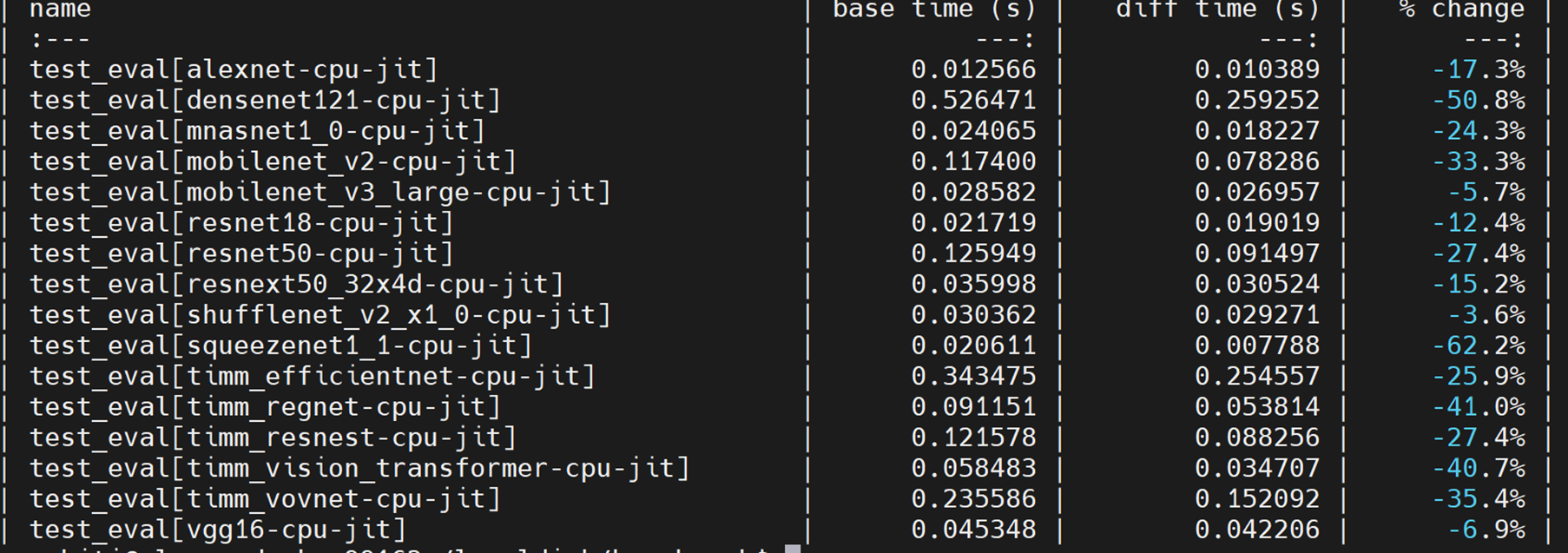
* SkyLake 8180 (single thread):
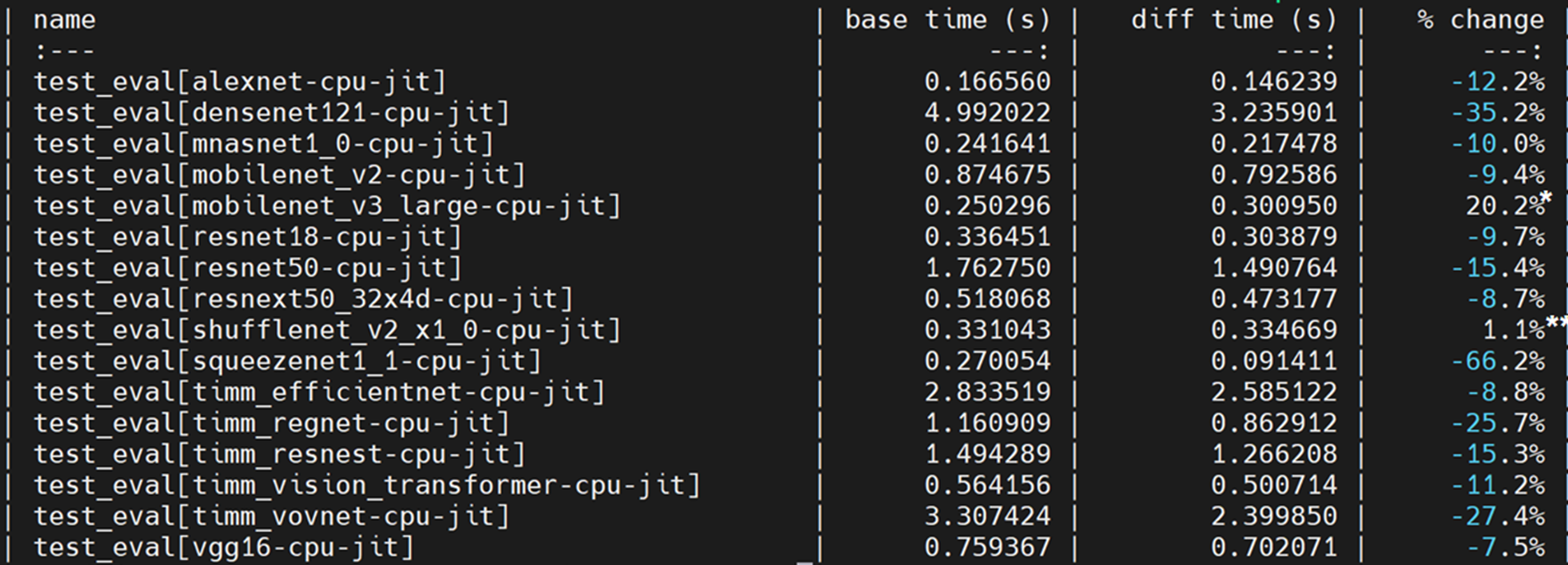
* By mapping hardswish to oneDNN Graph, it’s 8% faster than PyTorch JIT (NNC + OFI)
** We expect performance gain after mapping transpose, contiguous & view to oneDNN graph ops
### Directory structure of the integration code
Fuser-related code is placed under:
```
torch/csrc/jit/codegen/onednn/
```
Optimization pass registration is done in:
```
torch/csrc/jit/passes/onednn_graph_fuser.h
```
CMake for the integration code is in:
```
caffe2/CMakeLists.txt
cmake/public/mkldnn.cmake
cmake/Modules/FindMKLDNN.cmake
```
## Limitations
* In this PR, we only support Pytorch-oneDNN-Graph integration on Linux platform. Support on Windows and MacOS will be enabled as a next step.
* We have only optimized the inference use-case.
Pull Request resolved: https://github.com/pytorch/pytorch/pull/76622
Approved by: https://github.com/eellison
This PR modifies `lu_unpack` by:
- Using less memory when unpacking `L` and `U`
- Fuse the subtraction by `-1` with `unpack_pivots_stub`
- Define tensors of the correct types to avoid copies
- Port `lu_unpack` to be a strucutred kernel so that its `_out` version
does not incur on extra copies
Then we implement `linalg.lu` as a structured kernel, as we want to
compute its derivative manually. We do so because composing the
derivatives of `torch.lu_factor` and `torch.lu_unpack` would be less efficient.
This new function and `lu_unpack` comes with all the things it can come:
forward and backward ad, decent docs, correctness tests, OpInfo, complex support,
support for metatensors and support for vmap and vmap over the gradients.
I really hope we don't continue adding more features.
This PR also avoids saving some of the tensors that were previously
saved unnecessarily for the backward in `lu_factor_ex_backward` and
`lu_backward` and does some other general improvements here and there
to the forward and backward AD formulae of other related functions.
Pull Request resolved: https://github.com/pytorch/pytorch/pull/67833
Approved by: https://github.com/IvanYashchuk, https://github.com/nikitaved, https://github.com/mruberry
Summary:
Pull Request resolved: https://github.com/pytorch/pytorch/pull/76538
when running the example from the docs, I found that these steps were not working.
These are the updates necessary to get the example working.
Test Plan: n/a
Reviewed By: PaliC
Differential Revision: D35998155
fbshipit-source-id: d78bb2886f94889abae5a3af5239fcd306cd5e09
(cherry picked from commit 6893812efe7443b437ccafb7b1ff6bc7bd2e6670)
This PR adds `linalg.vander`, the linalg version of `torch.vander`.
We add autograd support and support for batched inputs.
We also take this chance to improve the docs (TODO: Check that they
render correctly!) and add an OpInfo.
**Discussion**: The current default for the `increasing` kwargs is extremely
odd as it is the opposite of the classical definition (see
[wiki](https://en.wikipedia.org/wiki/Vandermonde_matrix)). This is
reflected in the docs, where I explicit both the odd defaults that we
use and the classical definition. See also [this stackoverflow
post](https://stackoverflow.com/a/71758047/5280578), which shows how
people are confused by this defaults.
My take on this would be to correct the default to be `increasing=True`
and document the divergence with NumPy (as we do for other `linalg`
functions) as:
- It is what people expect
- It gives the correct determinant called "the Vandermonde determinant" rather than (-1)^{n-1} times the Vandermonde det (ugh).
- [Minor] It is more efficient (no `flip` needed)
- Since it's under `linalg.vander`, it's strictly not a drop-in replacement for `np.vander`.
We will deprecate `torch.vander` in a PR after this one in this stack
(once we settle on what's the correct default).
Thoughts? mruberry
cc kgryte rgommers as they might have some context for the defaults of
NumPy.
Fixes https://github.com/pytorch/pytorch/issues/60197
Pull Request resolved: https://github.com/pytorch/pytorch/pull/76303
Approved by: https://github.com/albanD
This PR adds a function for computing the LDL decomposition and a function that can solve systems of linear equations using this decomposition. The result of `torch.linalg.ldl_factor_ex` is in a compact form and it's required to use it only through `torch.linalg.ldl_solve`. In the future, we could provide `ldl_unpack` function that transforms the compact representation into explicit matrices.
Fixes https://github.com/pytorch/pytorch/issues/54847.
cc @jianyuh @nikitaved @pearu @mruberry @walterddr @IvanYashchuk @xwang233 @Lezcano
Pull Request resolved: https://github.com/pytorch/pytorch/pull/69828
Approved by: https://github.com/Lezcano, https://github.com/mruberry, https://github.com/albanD
Summary:
Pull Request resolved: https://github.com/pytorch/pytorch/pull/76223
Small formatting fixes that was missed because I didn't check the generated doc last time
Test Plan:
visual inspection of the generated docs for this PR
Imported from OSS
Reviewed By: HDCharles
Differential Revision: D35853174
fbshipit-source-id: 4454a4bf5d0c998d866bbae1d6b5286827082033
(cherry picked from commit 125f60356ccc9cd6888c515889bd27ff9860ec74)
Fixes https://github.com/pytorch/pytorch/issues/75464 Adds a context manager that will throw if the ops in the context are not fused.
API is :
```
with torch.jit.strict_fusion():
...
```
A few TODOs:
[+] Compose/figure out how to do with autodiff - right now it will run on autodiff as well
[+] Support all of the nvfuser operators that are added in guarding
[+] Figure out what to do with control flow that isn't taken (right now it will just error). this is probably a source of the original issue :/ - will just error
[+] (After those are figured out) add to docs
Pull Request resolved: https://github.com/pytorch/pytorch/pull/75777
Approved by: https://github.com/davidberard98
Summary:
Pull Request resolved: https://github.com/pytorch/pytorch/pull/75998
Add more details to user facing docs quantization.rst, which will be displayed in the official quantization doc page: https://pytorch.org/docs/stable/quantization.html
This includes:
* docs for quantization stack (quantized tensor, quantized operator and modules, observer, fake_quantize, QConfig, quantization flow)
* Added support table for quantization mode, quantization flow mode and backend, (also moved around operator support table)
* restructured eager mode and fx mode docs as well
Test Plan:
inspect the doc that's built by github ci
Imported from OSS
Reviewed By: dzdang
Differential Revision: D35739111
fbshipit-source-id: 3762d387479bdd37472cb17d5c49da2f520effbb
(cherry picked from commit db5e6411c52c08dd9c45f841ab86713d36a75d51)
Summary:
Following https://github.com/pytorch/rfcs/blob/master/RFC-0019-Extending-PyTorch-Quantization-to-Custom-Backends.md we implemented
the backend configuration for fbgemm/qnnpack backend, currently it was under fx folder, but we'd like to use this for all different
workflows, including eager, fx graph and define by run quantization, this PR moves it to torch.ao.quantization namespace so that
it can be shared by different workflows
Also moves some utility functions specific to fx to fx/backend_config_utils.py and some files are kept in fx folder (quantize_handler.py and fuse_handler.py)
Test Plan:
python test/teset_quantization.py TestQuantizeFx
python test/teset_quantization.py TestQuantizeFxOps
python test/teset_quantization.py TestQuantizeFxModels
python test/test_quantization.py TestAOMigrationQuantization
python test/test_quantization.py TestAOMigrationQuantizationFx
Reviewers:
Subscribers:
Tasks:
Tags:
Pull Request resolved: https://github.com/pytorch/pytorch/pull/75823
Approved by: https://github.com/vkuzo