`dynamo.explain()` was updated to return a structure but the docs weren't updated to match.
- Update the docs to use the new API
- Remove some dead code left when `explain` was updated.
- Drive-by: Fix some `nopython` uses that I noticed
- Drive-by: I noticed an ignored error coming from CleanupHook on shutdown - make it check the global before setting it.
Fixes#122573
Pull Request resolved: https://github.com/pytorch/pytorch/pull/122745
Approved by: https://github.com/jansel
List of changes:
- Replace JVP_NESTING by torch._C._functorch.maybe_current_level()
- Remove all increment nesting functions from wrap_fx_proxy_cls
- fwAD.make_dual receives the dual_level as keyword argument
- Add jvp_increment_nesting, set_fwd_grad_enabled and dual_level context managers to dynamo

Pull Request resolved: https://github.com/pytorch/pytorch/pull/119926
Approved by: https://github.com/zou3519
`unimplemented` is a function that raises an error, so
`raise unimplemented(...)` never reaches the `raise`.
Another related issue is that `raise unimplemented(...) from e`
doesn't attach the exception cause correctly. I fix this by adding
a `from_exc` argument to `unimplemented`.

Pull Request resolved: https://github.com/pytorch/pytorch/pull/122136
Approved by: https://github.com/lezcano
List of changes:
- Replace JVP_NESTING by torch._C._functorch.maybe_current_level()
- Remove all increment nesting functions from wrap_fx_proxy_cls
- fwAD.make_dual receives the dual_level as keyword argument
- Add jvp_increment_nesting, set_fwd_grad_enabled and dual_level context managers to dynamo

Pull Request resolved: https://github.com/pytorch/pytorch/pull/119926
Approved by: https://github.com/zou3519
List of changes:
- Replace JVP_NESTING by torch._C._functorch.maybe_current_level()
- Remove all increment nesting functions from wrap_fx_proxy_cls
- fwAD.make_dual receives the dual_level as keyword argument
- Add jvp_increment_nesting, set_fwd_grad_enabled and dual_level context managers to dynamo

Pull Request resolved: https://github.com/pytorch/pytorch/pull/119926
Approved by: https://github.com/zou3519
Putting this PR as an RFC since I have resorted to some horrible hacks in order to make this work.
```
(Pdb) p triton.language.float32
triton.language.fp32
(Pdb) p str(triton.language.float32)
'fp32'
(Pdb) p repr(triton.language.float32)
'triton.language.fp32'
```
This means that we need to "rewrite" them for fx graph and inductor execution.

This PR allows Mamba2 to work with `torch.compile`.

Pull Request resolved: https://github.com/pytorch/pytorch/pull/121690
Approved by: https://github.com/Skylion007
Add these log to debug the regress of accuracy test for dm_nfnet_f0 model for training.

With these extra log when the accuracy check fail, we can verify if it's close to succeed or not. If yes that indicates there is no real issue but just flaky and we probably can tune the tolerance to fix.

Pull Request resolved: https://github.com/pytorch/pytorch/pull/121656
Approved by: https://github.com/jansel, https://github.com/Skylion007
Reduces the torch.compile(backend="eager") for this code by 1-2 seconds.

~~~
def fn(x):
    for _ in range(10000):
        # x = torch.sin(x)
        x = torch.ops.aten.sin(x)
        # x = sin(x)

    return x
~~~

Pull Request resolved: https://github.com/pytorch/pytorch/pull/121052
Approved by: https://github.com/jansel
ghstack dependencies: #121053
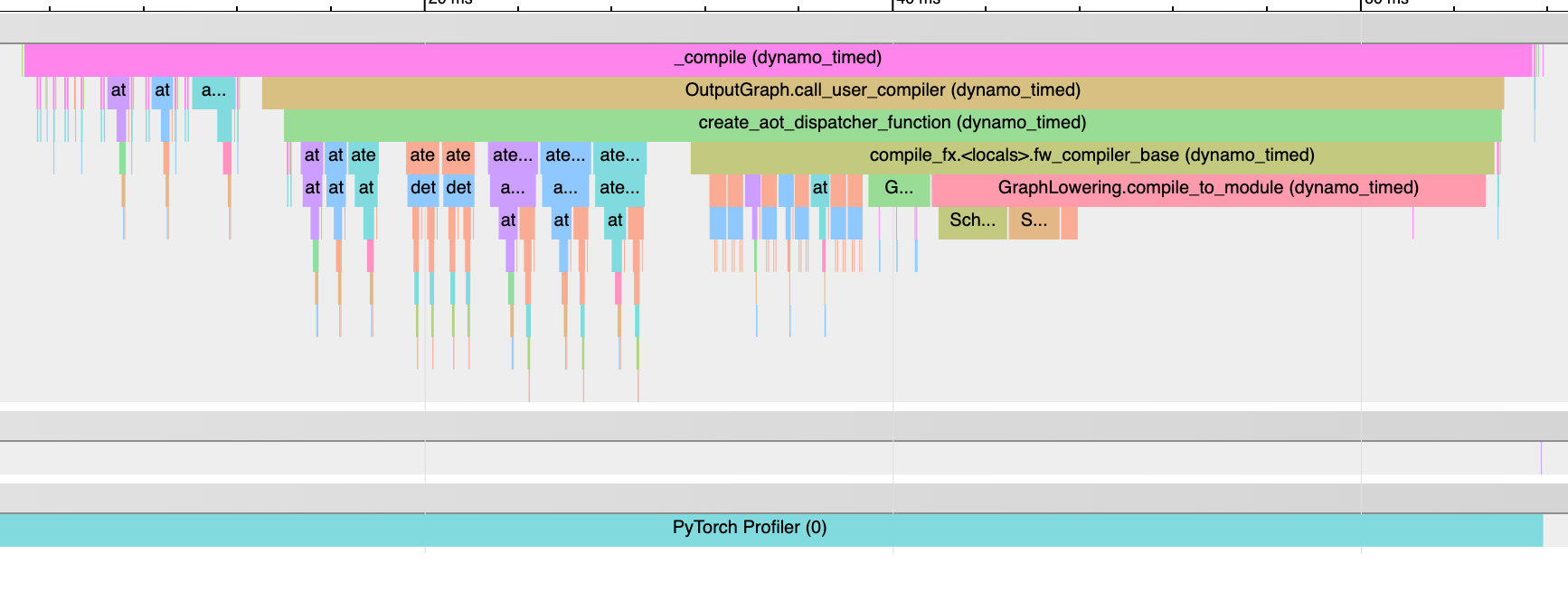
1. right now we double increment the profile counter. The PR avoid that so we don't end up with profile_0, profile_2, profile_4 ...
2. log the latency to run the passed in function with profiling on so we can easily skip those _compile call which returns quickly.

Pull Request resolved: https://github.com/pytorch/pytorch/pull/120100
Approved by: https://github.com/eellison
Fix: https://github.com/pytorch/pytorch/issues/119779 by properly graph breaking  a proper fix is to handle quantized tensors for full complete solution.

if when generating  a fake tensor, UnsupportedFakeTensorException is thrown, then its handled and converted into a
Unimplemented in inside wrap_fake_exception which is then translated to a graph break.

However run_node used to convert  UnsupportedFakeTensorException into a runtime error, creating runtime
errors instead of graph breaks whenever generating a fake tensor for a quantized tensor fails.

Pull Request resolved: https://github.com/pytorch/pytorch/pull/120026
Approved by: https://github.com/jansel
partially address https://github.com/pytorch/pytorch/issues/118785
This diff fixes three things:
1. add get_function to FunctoolsPartialVariable note that it will be available only if all args constant otherwise,
it would throw unimplemented in the call to asPythonConstant.

2. NamedTupleVariable takes args dispatched not as list ex: NamedTuple(a, b, c) vs NamedTuple([a, b, c]),
 hence fix that by specializing asProxy.

3. A call to create_arg from within create_proxy, changes a python NamedTuple to a function call node without
associating an example value! Updated get_fake_values_from_nodes to handle such case.

Pull Request resolved: https://github.com/pytorch/pytorch/pull/119435
Approved by: https://github.com/jansel, https://github.com/anijain2305
ghstack dependencies: #119314
Finally we have this PR to merge allow_in_graph/inline/skip trace rules into ```trace_rules.lookup_inner```, where we can define and lookup trace rules at both function level and file level. Going forward, this is the central place that we define and consulte Dynamo trace rule for any function.
* ```trace_rules.looup``` is the API can return allow_in_graph, inline or skip.
* ```skipfiles.check``` is the API can return inline or skip, since we have multiple places that only do inline/skip check.
  *  I'll move ```skipfiles.check``` to ```trace_rules.check``` as one of the follow-ups.
* Both functions consulte ```trace_rules.lookup_inner``` to get the tracing rule.

To avoid a single big PR, I left a few items as the follow-ups:
* Remove ```skipfiles.py``` and merge the code into ```trace_rules.py```.
* We do double check in ```symbolic_convert.check_inlineable```, will refactor and simplify it. We should only do inline/skip check before generating ```SkipFilesVariable``` and ```UserFunctionVariable```.
* Rename ```SkipFilesVariable``` as ```SkipFunctionVariable```, since we only handle functions.
* The inline/skip reasons are not logged for some cases, since the new lookup framework doesn't always return inline/skip reasons. I'll refactor loggings to record the inline/skip reason in next step.

Pull Request resolved: https://github.com/pytorch/pytorch/pull/118971
Approved by: https://github.com/jansel
I was just playing around with improving the typing of symbolic_shapes. The PR is not "complete" but I in particular wanted to get feedback on whether or not people liked making ValueRanges Generic; it seems that distinguishing if you have an Expr ValueRange or a SympyBoolean ValueRange is a lot of trouble for downstream. Using TypeGuard, we can perform refinements on the generic parameter inside methods, although we still have to cast back to ValueRange[T] due to https://github.com/python/mypy/issues/14425#issuecomment-1914852707

Signed-off-by: Edward Z. Yang <ezyang@meta.com>

Pull Request resolved: https://github.com/pytorch/pytorch/pull/118529
Approved by: https://github.com/Skylion007
I was just playing around with improving the typing of symbolic_shapes. The PR is not "complete" but I in particular wanted to get feedback on whether or not people liked making ValueRanges Generic; it seems that distinguishing if you have an Expr ValueRange or a SympyBoolean ValueRange is a lot of trouble for downstream. Using TypeGuard, we can perform refinements on the generic parameter inside methods, although we still have to cast back to ValueRange[T] due to https://github.com/python/mypy/issues/14425#issuecomment-1914852707

Signed-off-by: Edward Z. Yang <ezyang@meta.com>

Pull Request resolved: https://github.com/pytorch/pytorch/pull/118529
Approved by: https://github.com/Skylion007
Fixes https://github.com/pytorch/pytorch/issues/118129

Suppressions automatically added with

```
import re

with open("error_file.txt", "r") as f:
    errors = f.readlines()

error_lines = {}
for error in errors:
    match = re.match(r"(.*):(\d+):\d+: error:.*\[(.*)\]", error)
    if match:
        file_path, line_number, error_type = match.groups()
        if file_path not in error_lines:
            error_lines[file_path] = {}
        error_lines[file_path][int(line_number)] = error_type

for file_path, lines in error_lines.items():
    with open(file_path, "r") as f:
        code = f.readlines()
    for line_number, error_type in sorted(lines.items(), key=lambda x: x[0], reverse=True):
        code[line_number - 1] = code[line_number - 1].rstrip() + f"  # type: ignore[{error_type}]\n"
    with open(file_path, "w") as f:
        f.writelines(code)
```

Signed-off-by: Edward Z. Yang <ezyang@meta.com>

Co-authored-by: Catherine Lee <csl@fb.com>
Pull Request resolved: https://github.com/pytorch/pytorch/pull/118533
Approved by: https://github.com/Skylion007, https://github.com/zou3519
Fixes https://github.com/pytorch/pytorch/issues/118129

Suppressions automatically added with

```
import re

with open("error_file.txt", "r") as f:
    errors = f.readlines()

error_lines = {}
for error in errors:
    match = re.match(r"(.*):(\d+):\d+: error:.*\[(.*)\]", error)
    if match:
        file_path, line_number, error_type = match.groups()
        if file_path not in error_lines:
            error_lines[file_path] = {}
        error_lines[file_path][int(line_number)] = error_type

for file_path, lines in error_lines.items():
    with open(file_path, "r") as f:
        code = f.readlines()
    for line_number, error_type in sorted(lines.items(), key=lambda x: x[0], reverse=True):
        code[line_number - 1] = code[line_number - 1].rstrip() + f"  # type: ignore[{error_type}]\n"
    with open(file_path, "w") as f:
        f.writelines(code)
```

Signed-off-by: Edward Z. Yang <ezyang@meta.com>

Pull Request resolved: https://github.com/pytorch/pytorch/pull/118533
Approved by: https://github.com/Skylion007, https://github.com/zou3519
We split install_global_once into two APIs:
- `install_global_by_id(prefix, value) -> name`: installs a global if it hasn't
been installed yet
- `install_global(prefix, value) -> name`: always installs the global (and
  generates a unique name for it)

Then, we refactor most callsites of `install_global_unsafe` to one of
the previous. Some callsites cannot be refactored because we create the
global name first, do a lot of stuff with it, and then install it.

This fixes more test flakiness.

Test Plan:
- Existing tests; I can't reliably repro the flakiness
Pull Request resolved: https://github.com/pytorch/pytorch/pull/118100
Approved by: https://github.com/ezyang, https://github.com/mlazos
Previously, if someone wrote a python abstract impl but didn't import
the module it is in, then we would raise an error message suggesting
that the user needs to add an abstract impl for the operator.

In addition to this, we suggest that the user try importing the module
associated with the operator in the pystub (it's not guaranteed that
an abstract impl does exist) to avoid confusion.

Test Plan:
- new test

Pull Request resolved: https://github.com/pytorch/pytorch/pull/117770
Approved by: https://github.com/ydwu4, https://github.com/williamwen42
Adds `--compile-autograd` flag to benchmark suite to run accuracy and performance tests. Also adds autograd_captures and autograd_compiles to dynamo stats

e.g. accuracy_inductor.csv
```
dev,name,batch_size,accuracy,calls_captured,unique_graphs,graph_breaks,unique_graph_breaks,autograd_captures,autograd_compiles
cuda,BERT_pytorch,4,pass,2655,2,8,7,1,1
cuda,Background_Matting,4,pass_due_to_skip,0,0,0,0,0,0
cuda,DALLE2_pytorch,0,eager_fail_to_run,0,0,0,0,0,0
cuda,LearningToPaint,4,pass,639,2,8,7,1,1
...
```

e.g. speedup_inductor.csv
```
dev,name,batch_size,speedup,abs_latency,compilation_latency,compression_ratio,eager_peak_mem,dynamo_peak_mem,calls_captured,unique_graphs,graph_breaks,unique_graph_breaks,autograd_captures,autograd_compiles
cuda,hf_T5,8,1.214311,136.236793,88.350570,0.751322,18.754706,24.962275,3298,2,8,8,1,1
cuda,hf_T5,8,1.226645,135.431856,52.461461,1.040973,18.754706,18.016508,795,1,7,7,0,0
...
```

Pull Request resolved: https://github.com/pytorch/pytorch/pull/117196
Approved by: https://github.com/jansel
This prepares the PR where we implement sets in terms of dicts.
To do so, rather than storing internally a dictionary that maps literals
to VariableTrackers, it stores (pretty much) a dictionary from VTs to VTs.
To do so, keys are wrapped in an opaque internal class _Hashable.
The Hashable class is opaque on purpose so that it fails hard if
if it inadvertently leaks back into user code.
We also found and fixed a number of latent bugs and inconsistencies
in the way dynamo checked what can be a dict key. More generally, we
make much clearer what are the things that need to be modified to add
a new supported key type to Dicts.

Fixes [#107595](https://www.internalfb.com/tasks?t=107595)
Fixes [#111603](https://www.internalfb.com/tasks?t=111603)

Re-PR of https://github.com/pytorch/pytorch/pull/111196 sadly due to reverts, we could not reuse @lezcano's original PR.

Pull Request resolved: https://github.com/pytorch/pytorch/pull/116785
Approved by: https://github.com/mlazos
After this refactor:
* ```TorchVariable``` definition and all references are removed.
* All ```is_allowed``` references except one are removed.
  - The only left one is in ```torch/_dynamo/decorators:_disallow_in_graph_helper```. It was called when users put ```disallow_in_graph``` decorator on a function. Since we use the lists in ```trace_rules``` to decide the function's trace rule, so the decorator would only be used as customer function rather than torch functions. I'll defer this to a separate decorator refactor PR.

Pull Request resolved: https://github.com/pytorch/pytorch/pull/116312
Approved by: https://github.com/jansel
After this refactor:
* ```TorchVariable``` definition and all references are removed.
* All ```is_allowed``` references except one are removed.
  - The only left one is in ```torch/_dynamo/decorators:_disallow_in_graph_helper```. It was called when users put ```disallow_in_graph``` decorator on a function. Since we use the lists in ```trace_rules``` to decide the function's trace rule, so the decorator would only be used as customer function rather than torch functions. I'll defer this to a separate decorator refactor PR.

Pull Request resolved: https://github.com/pytorch/pytorch/pull/116312
Approved by: https://github.com/jansel
Recent 2 triton PRs (https://github.com/openai/triton/pull/2701, https://github.com/openai/triton/pull/2756) change the interface for triton.compile, this PR added the necessary change on inductor side to work with both old and new compile API.

Also there is some simplification between compilation call in subprocess and the one in main process
- previously we pass warm_cache_only=True if the compilation happens in subprocess. But triton never use that argument in the currently used pin. So I removed that
- previously we only pass compute_capability if compilation happens in subprocess. The PR change that to always passing compute_capability to triton.compile no matter if the compilation happens in main or sub process.

Updated:
There are more interface change from triton side. E.g.
- tl.math.{min, max} now requires a propagate_nan argument
- JITFunction.run now requires a warmup argument. This affect the benchmarking phase of matmul max-autotune; on the other hand, JITFunction.run forbids stream argument now. Simply removing passing this in when benchmarking matmul triton kernel will work for both old and new version of triton.
- triton Autotuner change attribute name from 'warmup' to 'num_warmup' and from 'rep' to 'num_rep'. This cause dynamo failed to handle triton Autotuner object since dynamo TritonKernelVariable makes assumption about attribute names. It's used in some test cases that a model call triton Autotuner directly.

Pull Request resolved: https://github.com/pytorch/pytorch/pull/115878
Approved by: https://github.com/jansel
Make ```SkipFilesVariable``` only handle function type, and route skipped classes to ```UserDefinedClassVariable```. The reasons behind this are:
* We'd like to remove ```is_allowed```, so the allowed/disallowed torch classes should have a proper place to handle. We can put them in either ```SkipFilesVariable``` and ```UserDefinedClassVariable``` under the current architecture, but it's  confusing to have two places do one thing.
   - Going forward, let's make ```SkipFilesVariable``` only handle functions, and probably I'll rename it to ```SkippedFunctionVariable``` in the following PRs.
   - Let's do dispatch by value's type, all torch classes stuff would go to ```UserDefinedClassVariable``` in the next PR.
* We'd merge in_graph/skip/inline trace decision into the same API ```trace_rule.lookup```, so probably we have to limit the input to only function for better organizing ```VariableBuilder._wrap``` logics.
   - Next step, I'll merge ```skipfiles.check``` into ```trace_rules.lookup```, and do the skipfile check before wrapping them into correct variable tracker.
   - Though the ```TorchCtxManagerClassVariable``` is decided by ```trace_rules.lookup```, I'll refactor it out in the following PRs.

Pull Request resolved: https://github.com/pytorch/pytorch/pull/115963
Approved by: https://github.com/jansel
Recent 2 triton PRs (https://github.com/openai/triton/pull/2701, https://github.com/openai/triton/pull/2756) change the interface for triton.compile, this PR added the necessary change on inductor side to work with both old and new compile API.

Also there is some simplification between compilation call in subprocess and the one in main process
- previously we pass warm_cache_only=True if the compilation happens in subprocess. But triton never use that argument in the currently used pin. So I removed that
- previously we only pass compute_capability if compilation happens in subprocess. The PR change that to always passing compute_capability to triton.compile no matter if the compilation happens in main or sub process.

Updated:
There are more interface change from triton side. E.g.
- tl.math.{min, max} now requires a propagate_nan argument
- JITFunction.run now requires a warmup argument. This affect the benchmarking phase of matmul max-autotune; on the other hand, JITFunction.run forbids stream argument now. Simply removing passing this in when benchmarking matmul triton kernel will work for both old and new version of triton.
- triton Autotuner change attribute name from 'warmup' to 'num_warmup' and from 'rep' to 'num_rep'. This cause dynamo failed to handle triton Autotuner object since dynamo TritonKernelVariable makes assumption about attribute names. It's used in some test cases that a model call triton Autotuner directly.

Pull Request resolved: https://github.com/pytorch/pytorch/pull/115878
Approved by: https://github.com/jansel
Make ```SkipFilesVariable``` only handle function type, and route skipped classes to ```UserDefinedClassVariable```. The reasons behind this are:
* We'd like to remove ```is_allowed```, so the allowed/disallowed torch classes should have a proper place to handle. We can put them in either ```SkipFilesVariable``` and ```UserDefinedClassVariable``` under the current architecture, but it's  confusing to have two places do one thing.
   - Going forward, let's make ```SkipFilesVariable``` only handle functions, and probably I'll rename it to ```SkippedFunctionVariable``` in the following PRs.
   - Let's do dispatch by value's type, all torch classes stuff would go to ```UserDefinedClassVariable``` in the next PR.
* We'd merge in_graph/skip/inline trace decision into the same API ```trace_rule.lookup```, so probably we have to limit the input to only function for better organizing ```VariableBuilder._wrap``` logics.
   - Next step, I'll merge ```skipfiles.check``` into ```trace_rules.lookup```, and do the skipfile check before wrapping them into correct variable tracker.
   - Though the ```TorchCtxManagerClassVariable``` is decided by ```trace_rules.lookup```, I'll refactor it out in the following PRs.

Pull Request resolved: https://github.com/pytorch/pytorch/pull/115963
Approved by: https://github.com/jansel
Motivation: it would be nice to be able to test using the metrics in log_compilation_event; currently dumps logs (or logs to a database in fbcode) - these are hard to use in unit tests.

This change:
* always record the information in torch._dynamo.utils.record_compilation_metrics; here, log into a limited-size deque to prevent the list of metrics from getting too long
* if config.log_compilation_metrics, then call back into the original log_compilation_event function

Pull Request resolved: https://github.com/pytorch/pytorch/pull/115788
Approved by: https://github.com/yanboliang
1.  Removes calls to `replace_all` and `clone` and makes VTs mutable.
2. Properly handles Tuple Iterator mutation. Previously TupleIterator variables would only be properly reconstructed if they were advanced at least once in a frame. On calls to `next`, the source information would be lost (due to constructing a new iterator without using builder), which would ensure that during codegen the variable would be reconstructed from scratch. Now that VTs are mutated, the source is never lost, so we need to properly track mutation and handle it by replaying calls to `next` at the end of the modified bytecode.
3. Added test for checking iadd side effects, this was missing in our unit test coverage.
4. Fixed two incorrect sources, DelayGraphBreakVariable, and UserMethodVariable both relied on setting the source to AttrSource(parent, name) at the callsite of `var_getattr`.
5. Fixed a bug in inplace adding for lists, it would set the resulting VariableTracker's source to `None` which would utilize a different reconstruct path in codegen. Now this is handled explicitly by reconstructing vars when allow_cache=`False`, so that during side effect replay, the mutated var is correctly updated.

In subsequent PRs:
* Refactoring side effect tracking to be significantly simpler (I think we only need an `is_modified` flag)
* Refactor `next_variables` iterator to match the signature of `next`
* Remove all references to `options` in the code
* Refactor VTs representing mutable collections to implement their own mutation update handling
* Remove clone and/or make it specific to lists for creating slices
* Add mutation tracking/replay for sets
* Add mutation tracking/replay for iter.py
* Removing setting source in builder (it's set at the top level after a var is returned)

Pull Request resolved: https://github.com/pytorch/pytorch/pull/113725
Approved by: https://github.com/jansel
Summary:

The primary problem we are setting out to solve here is fake tensor freshness. Before this PR, fake tensors after dynamo represented fake tensors *at the end* of trace, so subsequent retraces like aot_autograd would start off with fake tensors in the wrong (end result) state, rather than their expected fresh state. The solution here is to start a fresh fake mode, and re-fakify the tensors. The nuance comes from ensuring that symbols are uniformly created for the symbolic sizes and strides of the tensor.

This PR is the result of *a lot* of back and forth with ezyang and eellison. Initially, the first pass at this was not super different from what we have in the PR - the broad strokes were the same:

1) We cache source->symbol in shape_env
2) We pass policy objects around, stored at dynamo fakificaiton time, and reused for later fakification
3) We create a new fake mode for backends
(from https://github.com/pytorch/pytorch/pull/113605/files)

This is ugly, and has some layering violations. We detoured our decision making through a few other alternatives. Immutable/mutable fake tensor mode was the most interesting alternative, https://github.com/pytorch/pytorch/pull/113653, and was struck down on concerns of complexity in fake mode combined with it not covering all edge cases. We also detoured on what to do about tensor memoization returning back potentially different tensors than requested, and if that was an anti pattern (it is) we want to hack in with the symbol cache (we don't).

We went back to the drawing board here, but with a few concessions:
1) the cache for source->symbol must live outside of shape_env, for both lifecycle, and layering reasons
2) A good amount of work needs to be done to pipe policy around fake_mode and meta_utils correctly, to cover all the cases (ezyang did this)

cc penguinwu EikanWang jgong5 Guobing-Chen XiaobingSuper zhuhaozhe blzheng wenzhe-nrv jiayisunx chenyang78 aakhundov kadeng

imported-using-ghimport

Test Plan: Imported from OSS

Reviewed By: huydhn, Chillee

Differential Revision: D51566250

Pulled By: voznesenskym

Pull Request resolved: https://github.com/pytorch/pytorch/pull/114526
Approved by: https://github.com/Chillee, https://github.com/huydhn
The primary problem we are setting out to solve here is fake tensor freshness. Before this PR, fake tensors after dynamo represented fake tensors *at the end* of trace, so subsequent retraces like aot_autograd would start off with fake tensors in the wrong (end result) state, rather than their expected fresh state. The solution here is to start a fresh fake mode, and re-fakify the tensors. The nuance comes from ensuring that symbols are uniformly created for the symbolic sizes and strides of the tensor.

This PR is the result of *a lot* of back and forth with @ezyang and @eellison. Initially, the first pass at this was not super different from what we have in the PR - the broad strokes were the same:

1) We cache source->symbol in shape_env
2) We pass policy objects around, stored at dynamo fakificaiton time, and reused for later fakification
3) We create a new fake mode for backends
(from https://github.com/pytorch/pytorch/pull/113605/files)

This is ugly, and has some layering violations. We detoured our decision making through a few other alternatives. Immutable/mutable fake tensor mode was the most interesting alternative, https://github.com/pytorch/pytorch/pull/113653, and was struck down on concerns of complexity in fake mode combined with it not covering all edge cases. We also detoured on what to do about tensor memoization returning back potentially different tensors than requested, and if that was an anti pattern (it is) we want to hack in with the symbol cache (we don't).

We went back to the drawing board here, but with a few concessions:
1) the cache for source->symbol must live outside of shape_env, for both lifecycle, and layering reasons
2) A good amount of work needs to be done to pipe policy around fake_mode and meta_utils correctly, to cover all the cases (@ezyang did this)

Pull Request resolved: https://github.com/pytorch/pytorch/pull/113926
Approved by: https://github.com/ezyang, https://github.com/eellison
Skipping importing some packages for now to make this change more
tractable.

For some reason, lintrunner on CI raises errors in all imported `.pyi` files,
even though it doesn't on my local machine. The errors are all from missing
generic types, as the MYPYINDUCTOR config has `disallow_any_generics`
set. I have thus added `disable-error-code` comments to the relevant files,
though I fixed a few that were easy enough.

Pull Request resolved: https://github.com/pytorch/pytorch/pull/113830
Approved by: https://github.com/Skylion007
ghstack dependencies: #113722, #113721
Followup to https://github.com/pytorch/pytorch/pull/110325 - re-add the `report_all_guard_failures config` as a logging artifact `recompiles_verbose` with the following changes:
- evaluating the check must be wrapped with exception handling because subsequent code parts following the first failure may result in errors if evaluated (e.g. if a guard checks first for size, then tries to index - a guard failure due to insufficient size would result in an index error for the latter check).
- Adding a test for this case

Sample:
```python
import torch

def fn(x):
    return torch.rand(x[-1], len(x))

opt_fn = torch.compile(fn)
opt_fn([4, 5, 6])
opt_fn([7, 8])
opt_fn([9])
```

Output (with `TORCH_LOGS="recompiles_verbose"`):
```bash
[2023-11-15 16:13:26,741] torch._dynamo.guards.__recompiles_verbose: [DEBUG] Recompiling function fn in /data/users/williamwen/pytorch/playground5.py:15
[2023-11-15 16:13:26,741] torch._dynamo.guards.__recompiles_verbose: [DEBUG]     triggered by the following guard failure(s):
[2023-11-15 16:13:26,741] torch._dynamo.guards.__recompiles_verbose: [DEBUG]     guard 0 failures:
[2023-11-15 16:13:26,741] torch._dynamo.guards.__recompiles_verbose: [DEBUG]     - len(L['x']) == 3
[2023-11-15 16:13:26,741] torch._dynamo.guards.__recompiles_verbose: [DEBUG]     - L['x'][0] == 4
[2023-11-15 16:13:26,741] torch._dynamo.guards.__recompiles_verbose: [DEBUG]     - L['x'][1] == 5
[2023-11-15 16:13:26,970] torch._dynamo.guards.__recompiles_verbose: [DEBUG] Recompiling function fn in /data/users/williamwen/pytorch/playground5.py:15
[2023-11-15 16:13:26,970] torch._dynamo.guards.__recompiles_verbose: [DEBUG]     triggered by the following guard failure(s):
[2023-11-15 16:13:26,970] torch._dynamo.guards.__recompiles_verbose: [DEBUG]     guard 0 failures:
[2023-11-15 16:13:26,970] torch._dynamo.guards.__recompiles_verbose: [DEBUG]     - len(L['x']) == 2
[2023-11-15 16:13:26,970] torch._dynamo.guards.__recompiles_verbose: [DEBUG]
[2023-11-15 16:13:26,970] torch._dynamo.guards.__recompiles_verbose: [DEBUG]     guard 1 failures:
[2023-11-15 16:13:26,970] torch._dynamo.guards.__recompiles_verbose: [DEBUG]     - len(L['x']) == 3
[2023-11-15 16:13:26,970] torch._dynamo.guards.__recompiles_verbose: [DEBUG]     - L['x'][0] == 4
```

Pull Request resolved: https://github.com/pytorch/pytorch/pull/113585
Approved by: https://github.com/jon-chuang, https://github.com/ezyang
Applies PLW0108 which removes useless lambda calls in Python, the rule is in preview so it is not ready to be enabled by default just yet. These are the autofixes from the rule.

Pull Request resolved: https://github.com/pytorch/pytorch/pull/113602
Approved by: https://github.com/albanD
This prepares the PR where we implement sets in terms of dicts.
To do so, rather than storing internally a dictionary that maps literals
to VariableTrackers, it stores (pretty much) a dictionary from VTs to VTs.
To do so, keys are wrapped in an opaque internal class `_Hashable`.
The Hashable class is opaque on purpose so that it fails hard if
if it inadvertently leaks back into user code.

We also found and fixed a number of latent bugs and inconsistencies
in the way dynamo checked what can be a dict key. More generally, we
make much clearer what are the things that need to be modified to add
a new supported key type to Dicts.

Fixes https://github.com/pytorch/pytorch/issues/107595
Fixes https://github.com/pytorch/pytorch/issues/111603
Pull Request resolved: https://github.com/pytorch/pytorch/pull/111196
Approved by: https://github.com/jansel
Notes:

* `debug_insert_nops` in testing.py was passing `None` to the compiler_fn
parameter of `OutputGraph`, hence the modifications there.
* I added `disable-error-code="method-assign"` to debug_utils.py as it
does several such assignments. I guess mypy doesn't like it because it
makes code near-impossible to safely typecheck.

Pull Request resolved: https://github.com/pytorch/pytorch/pull/113519
Approved by: https://github.com/Skylion007
ghstack dependencies: #113413, #113518
Attempt number 2 at https://github.com/pytorch/pytorch/issues/108950.

Improves debugging for guard failures/recompilations by:
- only running guard fail reason generation during recompilation, instead of when a guard fails during dynamo cache lookup (so generating guard failure reasons is not on the critical path)
- ~~always reporting all guard failures~~ Reports the first-failing guard failure for each cache entry.

We don't expect a performance hit since the guard fail reasons are only generated at recompile time rather than runtime. Perf benchmark to check this (https://hud.pytorch.org/benchmark/torchbench/inductor_with_cudagraphs?startTime=Fri,%2027%20Oct%202023%2017:42:43%20GMT&stopTime=Fri,%2003%20Nov%202023%2017:42:43%20GMT&granularity=hour&mode=training&dtype=amp&lBranch=gh/williamwen42/62/head&lCommit=f4724f5ffc6d17ceae513a42fc18627be7b85482&rBranch=main&rCommit=29f3d392bf230072e3bffae37b078e770cae1956). We may also need to verify this on benchmarks where guard fails are common.

Sample script:
```python
import torch
def generate_data(b):
    return (
        torch.randn(b, 3, 32, 32).to(torch.float32).cuda(),
        torch.randint(1000, (b,)).cuda(),
    )

from torchvision.models import resnet18
def init_model():
    return resnet18().to(torch.float32).cuda()

model = init_model()
model_opt = torch.compile(model, dynamic=False)

for b in range(16, 32):
    data = generate_data(b)
    model_opt(data[0])
```

Sample logs:
```bash
(/data/users/williamwen/py310-env) [williamwen@devgpu020.odn1 /data/users/williamwen/pytorch (wwen/log-all-guards)]$ python playground5.py
/data/users/williamwen/pytorch/torch/_inductor/compile_fx.py:141: UserWarning: TensorFloat32 tensor cores for float32 matrix multiplication available but not enabled. Consider setting `torch.set_float32_matmul_precision('high')` for better performance.
  warnings.warn(
[2023-11-06 14:50:47,605] torch._dynamo.convert_frame: [WARNING] torch._dynamo hit config.cache_size_limit (8)
[2023-11-06 14:50:47,605] torch._dynamo.convert_frame: [WARNING]    function: 'forward' (/data/users/williamwen/torchvision/torchvision/models/resnet.py:284)
[2023-11-06 14:50:47,605] torch._dynamo.convert_frame: [WARNING]    last reason: tensor 'L['x']' size mismatch at index 0. expected 16, actual 24
[2023-11-06 14:50:47,605] torch._dynamo.convert_frame: [WARNING] To log all recompilation reasons, use TORCH_LOGS="recompiles".
[2023-11-06 14:50:47,605] torch._dynamo.convert_frame: [WARNING] To diagnose recompilation issues, see https://pytorch.org/docs/master/compile/troubleshooting.html.
(/data/users/williamwen/py310-env) [williamwen@devgpu020.odn1 /data/users/williamwen/pytorch (wwen/log-all-guards)]$ TORCH_LOGS="recompiles" python playground5.py
/data/users/williamwen/pytorch/torch/_inductor/compile_fx.py:141: UserWarning: TensorFloat32 tensor cores for float32 matrix multiplication available but not enabled. Consider setting `torch.set_float32_matmul_precision('high')` for better performance.
  warnings.warn(
[2023-11-06 14:53:31,591] torch._dynamo.guards.__recompiles: [DEBUG] Recompiling function forward in /data/users/williamwen/torchvision/torchvision/models/resnet.py:284
[2023-11-06 14:53:31,591] torch._dynamo.guards.__recompiles: [DEBUG]     triggered by the following guard failure(s):
[2023-11-06 14:53:31,591] torch._dynamo.guards.__recompiles: [DEBUG]     - tensor 'L['x']' size mismatch at index 0. expected 16, actual 17
[2023-11-06 14:53:41,333] torch._dynamo.guards.__recompiles: [DEBUG] Recompiling function forward in /data/users/williamwen/torchvision/torchvision/models/resnet.py:284
[2023-11-06 14:53:41,333] torch._dynamo.guards.__recompiles: [DEBUG]     triggered by the following guard failure(s):
[2023-11-06 14:53:41,333] torch._dynamo.guards.__recompiles: [DEBUG]     - tensor 'L['x']' size mismatch at index 0. expected 17, actual 18
[2023-11-06 14:53:41,333] torch._dynamo.guards.__recompiles: [DEBUG]     - tensor 'L['x']' size mismatch at index 0. expected 16, actual 18
[2023-11-06 14:53:50,463] torch._dynamo.guards.__recompiles: [DEBUG] Recompiling function forward in /data/users/williamwen/torchvision/torchvision/models/resnet.py:284
[2023-11-06 14:53:50,463] torch._dynamo.guards.__recompiles: [DEBUG]     triggered by the following guard failure(s):
[2023-11-06 14:53:50,463] torch._dynamo.guards.__recompiles: [DEBUG]     - tensor 'L['x']' size mismatch at index 0. expected 18, actual 19
[2023-11-06 14:53:50,463] torch._dynamo.guards.__recompiles: [DEBUG]     - tensor 'L['x']' size mismatch at index 0. expected 17, actual 19
[2023-11-06 14:53:50,463] torch._dynamo.guards.__recompiles: [DEBUG]     - tensor 'L['x']' size mismatch at index 0. expected 16, actual 19
[2023-11-06 14:53:59,848] torch._dynamo.guards.__recompiles: [DEBUG] Recompiling function forward in /data/users/williamwen/torchvision/torchvision/models/resnet.py:284
[2023-11-06 14:53:59,848] torch._dynamo.guards.__recompiles: [DEBUG]     triggered by the following guard failure(s):
[2023-11-06 14:53:59,848] torch._dynamo.guards.__recompiles: [DEBUG]     - tensor 'L['x']' size mismatch at index 0. expected 19, actual 20
[2023-11-06 14:53:59,848] torch._dynamo.guards.__recompiles: [DEBUG]     - tensor 'L['x']' size mismatch at index 0. expected 18, actual 20
[2023-11-06 14:53:59,848] torch._dynamo.guards.__recompiles: [DEBUG]     - tensor 'L['x']' size mismatch at index 0. expected 17, actual 20
[2023-11-06 14:53:59,848] torch._dynamo.guards.__recompiles: [DEBUG]     - tensor 'L['x']' size mismatch at index 0. expected 16, actual 20
[2023-11-06 14:54:08,549] torch._dynamo.guards.__recompiles: [DEBUG] Recompiling function forward in /data/users/williamwen/torchvision/torchvision/models/resnet.py:284
[2023-11-06 14:54:08,549] torch._dynamo.guards.__recompiles: [DEBUG]     triggered by the following guard failure(s):
[2023-11-06 14:54:08,549] torch._dynamo.guards.__recompiles: [DEBUG]     - tensor 'L['x']' size mismatch at index 0. expected 20, actual 21
[2023-11-06 14:54:08,549] torch._dynamo.guards.__recompiles: [DEBUG]     - tensor 'L['x']' size mismatch at index 0. expected 19, actual 21
[2023-11-06 14:54:08,549] torch._dynamo.guards.__recompiles: [DEBUG]     - tensor 'L['x']' size mismatch at index 0. expected 18, actual 21
[2023-11-06 14:54:08,549] torch._dynamo.guards.__recompiles: [DEBUG]     - tensor 'L['x']' size mismatch at index 0. expected 17, actual 21
[2023-11-06 14:54:08,549] torch._dynamo.guards.__recompiles: [DEBUG]     - tensor 'L['x']' size mismatch at index 0. expected 16, actual 21
[2023-11-06 14:54:17,795] torch._dynamo.guards.__recompiles: [DEBUG] Recompiling function forward in /data/users/williamwen/torchvision/torchvision/models/resnet.py:284
[2023-11-06 14:54:17,795] torch._dynamo.guards.__recompiles: [DEBUG]     triggered by the following guard failure(s):
[2023-11-06 14:54:17,795] torch._dynamo.guards.__recompiles: [DEBUG]     - tensor 'L['x']' size mismatch at index 0. expected 21, actual 22
[2023-11-06 14:54:17,795] torch._dynamo.guards.__recompiles: [DEBUG]     - tensor 'L['x']' size mismatch at index 0. expected 20, actual 22
[2023-11-06 14:54:17,795] torch._dynamo.guards.__recompiles: [DEBUG]     - tensor 'L['x']' size mismatch at index 0. expected 19, actual 22
[2023-11-06 14:54:17,795] torch._dynamo.guards.__recompiles: [DEBUG]     - tensor 'L['x']' size mismatch at index 0. expected 18, actual 22
[2023-11-06 14:54:17,795] torch._dynamo.guards.__recompiles: [DEBUG]     - tensor 'L['x']' size mismatch at index 0. expected 17, actual 22
[2023-11-06 14:54:17,795] torch._dynamo.guards.__recompiles: [DEBUG]     - tensor 'L['x']' size mismatch at index 0. expected 16, actual 22
[2023-11-06 14:54:27,430] torch._dynamo.guards.__recompiles: [DEBUG] Recompiling function forward in /data/users/williamwen/torchvision/torchvision/models/resnet.py:284
[2023-11-06 14:54:27,430] torch._dynamo.guards.__recompiles: [DEBUG]     triggered by the following guard failure(s):
[2023-11-06 14:54:27,430] torch._dynamo.guards.__recompiles: [DEBUG]     - tensor 'L['x']' size mismatch at index 0. expected 22, actual 23
[2023-11-06 14:54:27,430] torch._dynamo.guards.__recompiles: [DEBUG]     - tensor 'L['x']' size mismatch at index 0. expected 21, actual 23
[2023-11-06 14:54:27,430] torch._dynamo.guards.__recompiles: [DEBUG]     - tensor 'L['x']' size mismatch at index 0. expected 20, actual 23
[2023-11-06 14:54:27,430] torch._dynamo.guards.__recompiles: [DEBUG]     - tensor 'L['x']' size mismatch at index 0. expected 19, actual 23
[2023-11-06 14:54:27,430] torch._dynamo.guards.__recompiles: [DEBUG]     - tensor 'L['x']' size mismatch at index 0. expected 18, actual 23
[2023-11-06 14:54:27,430] torch._dynamo.guards.__recompiles: [DEBUG]     - tensor 'L['x']' size mismatch at index 0. expected 17, actual 23
[2023-11-06 14:54:27,430] torch._dynamo.guards.__recompiles: [DEBUG]     - tensor 'L['x']' size mismatch at index 0. expected 16, actual 23
[2023-11-06 14:54:36,744] torch._dynamo.guards.__recompiles: [DEBUG] Recompiling function forward in /data/users/williamwen/torchvision/torchvision/models/resnet.py:284
[2023-11-06 14:54:36,744] torch._dynamo.guards.__recompiles: [DEBUG]     triggered by the following guard failure(s):
[2023-11-06 14:54:36,744] torch._dynamo.guards.__recompiles: [DEBUG]     - tensor 'L['x']' size mismatch at index 0. expected 23, actual 24
[2023-11-06 14:54:36,744] torch._dynamo.guards.__recompiles: [DEBUG]     - tensor 'L['x']' size mismatch at index 0. expected 22, actual 24
[2023-11-06 14:54:36,744] torch._dynamo.guards.__recompiles: [DEBUG]     - tensor 'L['x']' size mismatch at index 0. expected 21, actual 24
[2023-11-06 14:54:36,744] torch._dynamo.guards.__recompiles: [DEBUG]     - tensor 'L['x']' size mismatch at index 0. expected 20, actual 24
[2023-11-06 14:54:36,744] torch._dynamo.guards.__recompiles: [DEBUG]     - tensor 'L['x']' size mismatch at index 0. expected 19, actual 24
[2023-11-06 14:54:36,744] torch._dynamo.guards.__recompiles: [DEBUG]     - tensor 'L['x']' size mismatch at index 0. expected 18, actual 24
[2023-11-06 14:54:36,744] torch._dynamo.guards.__recompiles: [DEBUG]     - tensor 'L['x']' size mismatch at index 0. expected 17, actual 24
[2023-11-06 14:54:36,744] torch._dynamo.guards.__recompiles: [DEBUG]     - tensor 'L['x']' size mismatch at index 0. expected 16, actual 24
[2023-11-06 14:54:36,744] torch._dynamo.convert_frame: [WARNING] torch._dynamo hit config.cache_size_limit (8)
[2023-11-06 14:54:36,744] torch._dynamo.convert_frame: [WARNING]    function: 'forward' (/data/users/williamwen/torchvision/torchvision/models/resnet.py:284)
[2023-11-06 14:54:36,744] torch._dynamo.convert_frame: [WARNING]    last reason: tensor 'L['x']' size mismatch at index 0. expected 16, actual 24
[2023-11-06 14:54:36,744] torch._dynamo.convert_frame: [WARNING] To log all recompilation reasons, use TORCH_LOGS="recompiles".
[2023-11-06 14:54:36,744] torch._dynamo.convert_frame: [WARNING] To diagnose recompilation issues, see https://pytorch.org/docs/master/compile/troubleshooting.html.
[2023-11-06 14:54:45,922] torch._dynamo.guards.__recompiles: [DEBUG] Recompiling function _forward_impl in /data/users/williamwen/torchvision/torchvision/models/resnet.py:266
[2023-11-06 14:54:45,922] torch._dynamo.guards.__recompiles: [DEBUG]     triggered by the following guard failure(s):
[2023-11-06 14:54:45,922] torch._dynamo.guards.__recompiles: [DEBUG]     - tensor 'L['x']' size mismatch at index 0. expected 24, actual 25
[2023-11-06 14:54:54,691] torch._dynamo.guards.__recompiles: [DEBUG] Recompiling function _forward_impl in /data/users/williamwen/torchvision/torchvision/models/resnet.py:266
[2023-11-06 14:54:54,691] torch._dynamo.guards.__recompiles: [DEBUG]     triggered by the following guard failure(s):
[2023-11-06 14:54:54,691] torch._dynamo.guards.__recompiles: [DEBUG]     - tensor 'L['x']' size mismatch at index 0. expected 25, actual 26
[2023-11-06 14:54:54,691] torch._dynamo.guards.__recompiles: [DEBUG]     - tensor 'L['x']' size mismatch at index 0. expected 24, actual 26
[2023-11-06 14:55:03,591] torch._dynamo.guards.__recompiles: [DEBUG] Recompiling function _forward_impl in /data/users/williamwen/torchvision/torchvision/models/resnet.py:266
[2023-11-06 14:55:03,591] torch._dynamo.guards.__recompiles: [DEBUG]     triggered by the following guard failure(s):
[2023-11-06 14:55:03,591] torch._dynamo.guards.__recompiles: [DEBUG]     - tensor 'L['x']' size mismatch at index 0. expected 26, actual 27
[2023-11-06 14:55:03,591] torch._dynamo.guards.__recompiles: [DEBUG]     - tensor 'L['x']' size mismatch at index 0. expected 25, actual 27
[2023-11-06 14:55:03,591] torch._dynamo.guards.__recompiles: [DEBUG]     - tensor 'L['x']' size mismatch at index 0. expected 24, actual 27
[2023-11-06 14:55:12,384] torch._dynamo.guards.__recompiles: [DEBUG] Recompiling function _forward_impl in /data/users/williamwen/torchvision/torchvision/models/resnet.py:266
[2023-11-06 14:55:12,384] torch._dynamo.guards.__recompiles: [DEBUG]     triggered by the following guard failure(s):
[2023-11-06 14:55:12,384] torch._dynamo.guards.__recompiles: [DEBUG]     - tensor 'L['x']' size mismatch at index 0. expected 27, actual 28
[2023-11-06 14:55:12,384] torch._dynamo.guards.__recompiles: [DEBUG]     - tensor 'L['x']' size mismatch at index 0. expected 26, actual 28
[2023-11-06 14:55:12,384] torch._dynamo.guards.__recompiles: [DEBUG]     - tensor 'L['x']' size mismatch at index 0. expected 25, actual 28
[2023-11-06 14:55:12,384] torch._dynamo.guards.__recompiles: [DEBUG]     - tensor 'L['x']' size mismatch at index 0. expected 24, actual 28
[2023-11-06 14:55:21,442] torch._dynamo.guards.__recompiles: [DEBUG] Recompiling function _forward_impl in /data/users/williamwen/torchvision/torchvision/models/resnet.py:266
[2023-11-06 14:55:21,442] torch._dynamo.guards.__recompiles: [DEBUG]     triggered by the following guard failure(s):
[2023-11-06 14:55:21,442] torch._dynamo.guards.__recompiles: [DEBUG]     - tensor 'L['x']' size mismatch at index 0. expected 28, actual 29
[2023-11-06 14:55:21,442] torch._dynamo.guards.__recompiles: [DEBUG]     - tensor 'L['x']' size mismatch at index 0. expected 27, actual 29
[2023-11-06 14:55:21,442] torch._dynamo.guards.__recompiles: [DEBUG]     - tensor 'L['x']' size mismatch at index 0. expected 26, actual 29
[2023-11-06 14:55:21,442] torch._dynamo.guards.__recompiles: [DEBUG]     - tensor 'L['x']' size mismatch at index 0. expected 25, actual 29
[2023-11-06 14:55:21,442] torch._dynamo.guards.__recompiles: [DEBUG]     - tensor 'L['x']' size mismatch at index 0. expected 24, actual 29
[2023-11-06 14:55:30,315] torch._dynamo.guards.__recompiles: [DEBUG] Recompiling function _forward_impl in /data/users/williamwen/torchvision/torchvision/models/resnet.py:266
[2023-11-06 14:55:30,315] torch._dynamo.guards.__recompiles: [DEBUG]     triggered by the following guard failure(s):
[2023-11-06 14:55:30,315] torch._dynamo.guards.__recompiles: [DEBUG]     - tensor 'L['x']' size mismatch at index 0. expected 29, actual 30
[2023-11-06 14:55:30,315] torch._dynamo.guards.__recompiles: [DEBUG]     - tensor 'L['x']' size mismatch at index 0. expected 28, actual 30
[2023-11-06 14:55:30,315] torch._dynamo.guards.__recompiles: [DEBUG]     - tensor 'L['x']' size mismatch at index 0. expected 27, actual 30
[2023-11-06 14:55:30,315] torch._dynamo.guards.__recompiles: [DEBUG]     - tensor 'L['x']' size mismatch at index 0. expected 26, actual 30
[2023-11-06 14:55:30,315] torch._dynamo.guards.__recompiles: [DEBUG]     - tensor 'L['x']' size mismatch at index 0. expected 25, actual 30
[2023-11-06 14:55:30,315] torch._dynamo.guards.__recompiles: [DEBUG]     - tensor 'L['x']' size mismatch at index 0. expected 24, actual 30
[2023-11-06 14:55:39,839] torch._dynamo.guards.__recompiles: [DEBUG] Recompiling function _forward_impl in /data/users/williamwen/torchvision/torchvision/models/resnet.py:266
[2023-11-06 14:55:39,839] torch._dynamo.guards.__recompiles: [DEBUG]     triggered by the following guard failure(s):
[2023-11-06 14:55:39,839] torch._dynamo.guards.__recompiles: [DEBUG]     - tensor 'L['x']' size mismatch at index 0. expected 30, actual 31
[2023-11-06 14:55:39,839] torch._dynamo.guards.__recompiles: [DEBUG]     - tensor 'L['x']' size mismatch at index 0. expected 29, actual 31
[2023-11-06 14:55:39,839] torch._dynamo.guards.__recompiles: [DEBUG]     - tensor 'L['x']' size mismatch at index 0. expected 28, actual 31
[2023-11-06 14:55:39,839] torch._dynamo.guards.__recompiles: [DEBUG]     - tensor 'L['x']' size mismatch at index 0. expected 27, actual 31
[2023-11-06 14:55:39,839] torch._dynamo.guards.__recompiles: [DEBUG]     - tensor 'L['x']' size mismatch at index 0. expected 26, actual 31
[2023-11-06 14:55:39,839] torch._dynamo.guards.__recompiles: [DEBUG]     - tensor 'L['x']' size mismatch at index 0. expected 25, actual 31
[2023-11-06 14:55:39,839] torch._dynamo.guards.__recompiles: [DEBUG]     - tensor 'L['x']' size mismatch at index 0. expected 24, actual 31
```

Pull Request resolved: https://github.com/pytorch/pytorch/pull/110325
Approved by: https://github.com/ezyang, https://github.com/jon-chuang
Summary:
See internal diff for more changes. Whenever we encounter a non-compliant op,
we add it to a set on the OutputGraph. When a compilation event happens, we log
the contents of this set.

I'm planning on flipping the `only_allow_pt2_compliant_ops` config from False
to True after the logging determines that existing models do not use
non-compliant ops.

Test Plan: - Tested the logging internally locally

Differential Revision: D50884828

Pull Request resolved: https://github.com/pytorch/pytorch/pull/112581
Approved by: https://github.com/yanboliang
Previously, under config.only_allow_pt2_compliant_ops, Dynamo graph
breaks when it see an OpOverloadPacket where any overloads are not
PT2 compliant. This is potentially brittle: if someone (unlikely) adds
a new overload for a custom operator, then this would cause a
previously non-graph-breaking call to the OpOverloadPacket to graph break.

In this PR:
- When Dynamo is about to write a call to an operator to the FX graph,
we check if it is PT2 compliant.
- For OpOverload, we check to see if the tag is on it
- For OpOverloadPacket, we do overload resolution and check to see if
  the tag is on the OpOverload that it resolves to.

Test Plan:
- new tests, existing tests

Pull Request resolved: https://github.com/pytorch/pytorch/pull/112200
Approved by: https://github.com/bdhirsh
Major change in this PR is to make torch context manager class a separate ```TorchCtxManagerClassVariable```, since we have dynamo implementation for these ctx managers.

I was thinking to wrap them as ```UserDefinedClassVariable``` and do dispatch at ```USCVariable.call_function```, but it seems almost the same amount of work and this way is more clear.

This is on the way of moving ```TorchVariable``` to ```TorchFunctionVariable``` which will only handle the functions who would be allowed in graph (e.g, ```torch.sin```) and constant folded (e.g, ```torch.is_floating_point```). All other torch functions would be go through skip/inline rules, and would be wrapped as ```UserFunctionVariable``` (for inlined) and ```SkipFilesVariable``` (for skipped).
The next steps:
* Wrap torch modules, classes, objects as regular ```PythonModuleVariable```, ```UserDefinedClassVariable``` and ```UserDefinedObjectVariable```.
* Generate the allow in graph torch functions list and wrap them as ```TorchFunctionVariable```.
* Finally merge ```skipfiles.check``` and ```is_allowed``` into one function ```allow_skip.check(fn)``` which would return a Enum of allow, skip and inline.

Pull Request resolved: https://github.com/pytorch/pytorch/pull/111622
Approved by: https://github.com/jansel
Triggers `__torch_function__` tracing on attribute/method/property access matching the eager behavior for non-overridden attributes/methods/properties that are present on `torch.Tensor`.

Some caveats:
1. for methods there doesn't seem to be a way to check if the original implementation of a method is overridden via monkey patching or not. For example:
```
class LocalSubclass(torch.Tensor):
    @classmethod
    def __torch_function__(cls, func, types, args=(), kwargs=None):
        if kwargs is None:
            kwargs = {}
        return super().__torch_function__(func, types, args, kwargs)

x = torch.ones(2, 2).as_subclass(LocalSubclass)

> x.sigmoid
<built-in method sigmoid of LocalSubclass object at 0x7f8d305bb5e0>
```
There isn't a way to verify that this built-in method is equivalent to the base `torch.Tensor` implementation as each instance will have a different built-in method object that can't be traced back to the original `torch.Tensor` impl. You can check that the class itself has the original implementation via
```
> inspect.getattr_static(LocalSubclass, "sigmoid")
<method 'sigmoid' of 'torch._C.TensorBase' objects>
```
But we can't detect if the user dynamically patches an object with a built-in method called sigmoid which does something completely different.

2. If a user overrides a method but calls the original implementation we will still graph break. This will require modifying `SuperVariable` (and any other way to get the original impl) to handle tensor subclasses.

Pull Request resolved: https://github.com/pytorch/pytorch/pull/111737
Approved by: https://github.com/jansel, https://github.com/ezyang
Did some easy fixes from enabling TRY200. Most of these seem like oversights instead of intentional. The proper way to silence intentional errors is with `from None` to note that you thought about whether it should contain the cause and decided against it.

Pull Request resolved: https://github.com/pytorch/pytorch/pull/111496
Approved by: https://github.com/malfet
We want to get to a point where most UserErrors link to exportdb examples. This PR makes passing case names non-optional to make this intent clearer and encourage developers who raise UserErrors to make or point to examples that make fixing such errors more obvious for users.

In addition, sometimes there are multiple examples that are relevant to an error. Thus this PR also enables passing multiple case names.

Retry of #110733 which was reverted due to a landrace.

Differential Revision: [D50087148](https://our.internmc.facebook.com/intern/diff/D50087148/)

Pull Request resolved: https://github.com/pytorch/pytorch/pull/110878
Approved by: https://github.com/gmagogsfm, https://github.com/tugsbayasgalan
We want to get to a point where most `UserError`s link to `exportdb` examples. This PR makes passing case names non-optional to make this intent clearer and encourage developers who raise `UserError`s to make or point to examples that make fixing such errors more obvious for users.

In addition, sometimes there are multiple examples that are relevant to an error. Thus this PR also enables passing multiple case names.

Differential Revision: [D50020465](https://our.internmc.facebook.com/intern/diff/D50020465/)

Pull Request resolved: https://github.com/pytorch/pytorch/pull/110733
Approved by: https://github.com/zhxchen17
Ideally all `_dynamo.exc.UserError`s should have "case names", i.e., link to examples in `exportdb`.

This PR adds case names to several instances of `_dynamo.exc.UserError`. In particular, looking at coverage based on `UserErrorType`:
* `DYNAMIC_CONTROL_FLOW`, `ANTI_PATTERN`, and `STANDARD_LIBRARY` are fully covered.
* `CONSTRAINT_VIOLATION` and `DYNAMIC_DIM` have no coverage. We don't seem to have any dedicated examples of specifying dynamic shapes in `exportdb` (although they are used in some other examples without explanation, to avoid some specialization that would make such examples moot).
* `INVALID_INPUT` is only partly covered. Frankly this is tedious to cover via examples.

Differential Revision: [D49928518](https://our.internmc.facebook.com/intern/diff/D49928518/)

Pull Request resolved: https://github.com/pytorch/pytorch/pull/110555
Approved by: https://github.com/angelayi, https://github.com/ydwu4
Triplet Margin Loss takes in a Callable `distance_function` parameter which is not supported as an argument on the fx graph. See previous error:

> File "/scratch/eellison/work/pytorch/torch/_dynamo/symbolic_convert.py", line 562, in call_function
self.push(fn.call_function(self, args, kwargs))
File "/scratch/eellison/work/pytorch/torch/_dynamo/variables/torch.py", line 723, in call_function
*proxy_args_kwargs(args, kwargs),
File "/scratch/eellison/work/pytorch/torch/_dynamo/utils.py", line 504, in proxy_args_kwargs
f"call_function args: {typestr(*args)} {typestr(*list(kwargs.values()))}"
File "/scratch/eellison/work/pytorch/torch/_dynamo/exc.py", line 143, in unimplemented
raise Unsupported(msg)
torch._dynamo.exc.Unsupported: call_function args: TensorVariable() TensorVariable() TensorVariable() ConstantVariable(float) NNModuleVariable()

This is fixable by just inlining into `triplet_margin_loss` and continuing to compile it. This required support for `has_torch_function_variadic`.

Pull Request resolved: https://github.com/pytorch/pytorch/pull/110302
Approved by: https://github.com/mlazos
This PR fix the `is_typing` function: checks whether a value is an instance of a class
from the `typing` package.

This reverts commit b09c09f7bb3adb6a5b8a107a5b96757b569daa8d.

Pull Request resolved: https://github.com/pytorch/pytorch/pull/109201
Approved by: https://github.com/ezyang
This PR introduces binary search for finding smaller validation errors, when they occur.

We do that by bisecting the sequence of `torch._assert` FX nodes recorded as the source
expression of the translation validator (TV) by `ShapeEnv.evaluate_expr` calls. Then, we
raise the error caused by the earliest node.

In summary, the changes are:
- Call `bisect` on `ValidationError` @ _torch/_dynamo/convert_frame.py_
- Implement the binary search @ _torch/fx/experimental/symbolic_shapes.py_

Edit: moved `ShapeEnv` replay-recording to #107989

Pull Request resolved: https://github.com/pytorch/pytorch/pull/107493
Approved by: https://github.com/ezyang
ghstack dependencies: #107989
Summary:
Original commit changeset: e11cddf1fecc

Original Phabricator Diff: D49064185

Test Plan:
Comparing PT1 and PT2 performance on the IG Feed Model with this diff backed out: N4274204

Comparing the PT1 and PT2 performance on IG Feed with this diff committed: N4271093

Reviewed By: zou3519

Differential Revision: D49230047

Pull Request resolved: https://github.com/pytorch/pytorch/pull/109199
Approved by: https://github.com/zou3519, https://github.com/xw285cornell
Fixes#106893
There are two main changes:
- Before this PR, the function returned by once_differentiable was
included in skipfiles (because its .co_code is
torch/autograd/function.py). This PR adds a mechanism to tell Dynamo
to inline a function, no matter if it is included in skipfiles.
- A bugfix: when we are introspecting the backward, we need to turn the
grad mode off. This is to accurately model the eager-mode semantics:
In eager-mode PyTorch, if second-order gradients were not requested, then
the grad mode is off. torch.compile does not work with higher-order
gradients and just assumes we do first-order gradients, so this is OK.
Test Plan:
- new test
Differential Revision: [D49064185](https://our.internmc.facebook.com/intern/diff/D49064185)
Pull Request resolved: https://github.com/pytorch/pytorch/pull/108686
Approved by: https://github.com/voznesenskym
Fixes inference accuracy for `doctr_reco_predictor` and `pyhpc_turbulent_kinetic_energy`.

For the `same(float, float)` comparison we weren't going through the more rigorous tensor comparison path which takes into account the fp64 base results.

Also return True when fp64 base result are not well formed (nan).

I debugged these models and the source of divergence were innocuous:
`doctr_reco_predictor` - can be fixed by turning off layout optimization, decomp for batch norm

`pyhpc_turbulent_kinetic_energy` - divergence caused because fused kernel keeps precision in fp32 instead of casting back and forth from/to fp32/bf16. Fused kernel is better precision, anyway.

Pull Request resolved: https://github.com/pytorch/pytorch/pull/108202
Approved by: https://github.com/jansel
There is already some support for plumbing `__torch_dispatch__` tensor subclasses through dynamo, but this PR beefs it up a bit and adds a test. In particular:

(1) Fakeifying tensor subclasses didn't properly set autograd metadata (requires_grad, is_leaf) on the newly fakeified wrapper subclass. I don't actually have a test for this in this PR, but it's tested pretty heavily later in my aot autograd tests

(2) Fakeifying tensor subclasses didn't properly track source information for dynamic shapes on the inner tensors. I added a new `WrapperSubclassFieldSource` subclass, that represents a source coming from a tensor field on a wrapper subclass, which I use in the fakeifying logic, and again in symbolic_shapes.py to generate proper guards.

(3) `_make_wrapper_subclass()` marginally updated this code to work better with dynamic shapes. One thing that's a bit weird about `_make_wrapper_subclass`: it has two overloads, and the first explicitly does not support dynamic shapes (and the second.. does not support kwargs). I think that later we probably want to consolidate / at least make the first overload work with dynamic shapes, but I didn't want to handle that in this PR (so these smaller changes seemed like a strict improvement).

Pull Request resolved: https://github.com/pytorch/pytorch/pull/107415
Approved by: https://github.com/ezyang
This adds some utilities for conveniently working with fast combined CapturedTraceback from Python. The main goal of these utilities is to make it easier for people to use CapturedTraceback as a drop-in replacement for `traceback.extract_stack`, which is 20x slower than CapturedTraceback.

I port symbolic shapes to use the new CapturedTraceback code, to validate that the APIs work and are useful.

Signed-off-by: Edward Z. Yang <ezyang@meta.com>

Pull Request resolved: https://github.com/pytorch/pytorch/pull/107358
Approved by: https://github.com/zdevito, https://github.com/albanD
ghstack dependencies: #107438
Adds API to mark tensor as a static input -
To make this trigger recompiles properly, I'll need to update tensor match checks to also check for this new attribute

Additional concern is memory - the tensors will be kept alive, but this is the current behavior for nn modules and parameters.

Pull Request resolved: https://github.com/pytorch/pytorch/pull/107154
Approved by: https://github.com/eellison
RFC: https://github.com/pytorch/rfcs/pull/54
First commit is the contents of https://github.com/Quansight-Labs/numpy_pytorch_interop/

We have already been using this in core for the last few months as a external dependency. This PR pulls all these into core.

In the next commits, I do a number of things in this order
- Fix a few small issues
- Make the tests that this PR adds pass
- Bend backwards until lintrunner passes
- Remove the optional dependency on `torch_np` and simply rely on the upstreamed code
- Fix a number dynamo tests that were passing before (they were not tasting anything I think) and are not passing now.

Missing from this PR (but not blocking):
- Have a flag that deactivates tracing NumPy functions and simply breaks. There used to be one but after the merge stopped working and I removed it. @lezcano to investigate.
- https://github.com/pytorch/pytorch/pull/106431#issuecomment-1667079543. @voznesenskym to submit a fix after we merge.

All the tests in `tests/torch_np` take about 75s to run.

This was a work by @ev-br, @rgommers @honno and I. I did not create this PR via ghstack (which would have been convenient) as this is a collaboration, and ghstack doesn't allow for shared contributions.

Pull Request resolved: https://github.com/pytorch/pytorch/pull/106211
Approved by: https://github.com/ezyang
This PR adds a new configuration that enables shapes of torch.nn.Parameter to be treated as dynamic in order to avoid extensive recompilation when Paramters are used instead of Tensor.

This features addresses part of issue #105279

Pull Request resolved: https://github.com/pytorch/pytorch/pull/105855
Approved by: https://github.com/ezyang
Since Python 3.11 bytecode contains endline and column information, for each bytecode, we attribute the source code corresponding to the bytecode in a more accurate way. For example, we can highlight a function call in a series of nested function calls, or highlight a function call spanning multiple lines.

Sample:
```python
import torch
import torch._dynamo
from functorch.experimental.control_flow import cond

def h(x):
    return x * 5

def true_fn(x):
    return x * 2

def false_fn(x):
    return x * 3

def f(pred, x):
    x = h(
        h(h(x))
    )
    x = x[1:][:2]
    torch._dynamo.graph_break()
    x = cond(pred, true_fn, false_fn, [x])

opt_f = torch.compile(f, backend="eager")
opt_f(torch.tensor(True), torch.randn(3, 3, 3, 3))
```

Output:
```
$ TORCH_LOGS="trace_call" python playground9.py
TRACE inlined call h from f /scratch/williamwen/work/pytorch/playground9.py:16
        h(h(x))
          ~^^^
TRACE FX call mul from h /scratch/williamwen/work/pytorch/playground9.py:6 (inline depth: 1)
    return x * 5
           ~~^~~
TRACE inlined call h from f /scratch/williamwen/work/pytorch/playground9.py:16
        h(h(x))
        ~^^^^^^
TRACE FX call mul_1 from h /scratch/williamwen/work/pytorch/playground9.py:6 (inline depth: 1)
    return x * 5
           ~~^~~
TRACE inlined call h from f /scratch/williamwen/work/pytorch/playground9.py:15
    x = h(
        ~^
        h(h(x))
        ^^^^^^^
    )
    ^
TRACE FX call mul_2 from h /scratch/williamwen/work/pytorch/playground9.py:6 (inline depth: 1)
    return x * 5
           ~~^~~
TRACE FX call getitem from f /scratch/williamwen/work/pytorch/playground9.py:18
    x = x[1:][:2]
        ~^^^^
TRACE FX call getitem_1 from f /scratch/williamwen/work/pytorch/playground9.py:18
    x = x[1:][:2]
        ~~~~~^^^^
TRACE inlined call true_fn from <resume in f> /scratch/williamwen/work/pytorch/playground9.py:20
    x = cond(pred, true_fn, false_fn, [x])
        ~~~~^^^^^^^^^^^^^^^^^^^^^^^^^^^^^^
TRACE FX call mul from true_fn /scratch/williamwen/work/pytorch/playground9.py:9 (inline depth: 1)
    return x * 2
           ~~^~~
TRACE inlined call false_fn from <resume in f> /scratch/williamwen/work/pytorch/playground9.py:20
    x = cond(pred, true_fn, false_fn, [x])
        ~~~~^^^^^^^^^^^^^^^^^^^^^^^^^^^^^^
TRACE FX call mul from false_fn /scratch/williamwen/work/pytorch/playground9.py:12 (inline depth: 1)
    return x * 3
           ~~^~~
TRACE FX call cond from <resume in f> /scratch/williamwen/work/pytorch/playground9.py:20
    x = cond(pred, true_fn, false_fn, [x])
        ~~~~^^^^^^^^^^^^^^^^^^^^^^^^^^^^^^
```

Pull Request resolved: https://github.com/pytorch/pytorch/pull/104676
Approved by: https://github.com/ezyang
This PR adds necessary plumbing through torchdynamo to allow tensor
subclasses with certain contract (i.e. with `__tensor_flatten__` and
`__tensor_unflatten__`) to goes through the dynamo fakification pass by
fakifying the tensor subclass internal components.

Some of the tensor subclass contract logic mostly borrowed from
https://github.com/pytorch/pytorch/pull/97540

Added some tests to verify simply passing through a tensor subclass
(i.e. DTensor) through dynamo eager works as expected.

Pull Request resolved: https://github.com/pytorch/pytorch/pull/105308
Approved by: https://github.com/ezyang
Add similar semantics for creating a buffer object similar to creating a parameter. This is done by introducing a new `Buffer` class that can be used for type disambiguation. The underlying functionality of registering a buffer remains the same as the `register_buffer` method has not been changed. The `persistent` parameter in the `Buffer` type is to indicate whether a buffer object should be persistent or not. Other non-test changes have to do with getting the new `Buffer` type recognized by inductor and dynamo. Remaining changes are test changes to make sure that the `Buffer` type can be used as a drop in replacement for `register_buffer` as it just leads to `register_buffer` being called. The addition of this new functionality still allows for normal tensors to be used as buffers so these changes are intended to be backwards compatible.
Fixes#35735
Pull Request resolved: https://github.com/pytorch/pytorch/pull/104069
Approved by: https://github.com/mikaylagawarecki
Fixes#95900
Using the following repro as guide:
```python
import torch
import torch._dynamo
from torch._subclasses import fake_tensor
from torch.fx.experimental.symbolic_shapes import ShapeEnv
from torch._dynamo.output_graph import config
class Model(torch.nn.Module):
def __init__(self) -> None:
super().__init__()
self.linear = torch.nn.Linear(2, 2)
self.linear2 = torch.nn.Linear(2, 2)
def forward(self, x):
out = self.linear(x)
out = self.linear2(out)
return out
fake_mode = fake_tensor.FakeTensorMode(allow_non_fake_inputs=False,
allow_fallback_kernels=True,
shape_env=ShapeEnv(
allow_scalar_outputs=config.capture_scalar_outputs,
allow_dynamic_output_shape_ops=config.capture_dynamic_output_shape_ops,
frame_id=0
),
)
# Fakefying input/model before calling torch._dynamo.export
with fake_mode:
fake_x = torch.rand(5, 2, 2)
model = Model()
# Calling torch._dynamo.export without active fake mode
graph_module, guards = torch._dynamo.export(
model,
fake_x,
aten_graph=True,
fake_mode=fake_mode
)
graph_module.print_readable()
graph_module.graph.print_tabular()
```
Summary of changes:
* Plumb fake_mode through torch.export API. When specified, it
replaces the creation of a new FaketendorMode at InstructionTranslator on behalf of OutputGraph
Hacks FakeTensor.__new__ to prevent a
torch.tensor._make_subclass call for inputs that are already fakefied by
user. This probably need to be fixed in a nicer way. Any idea?
* Removed a few asserts that didn't want faked tensors coming
from user script
* Added torch._subclasses.fake_tensor.FakeTensor to type list on a few
asserts check to allow fake inputs
The changes above allowed symbolic tracing with both static and dynamic shapes.
Pull Request resolved: https://github.com/pytorch/pytorch/pull/100017
Approved by: https://github.com/ezyang
These are the numbers with this PR

There are 3 main followups
* A naive partitioner gives better memory footprint than min-cut partitioner here. Currently, we are using min-cut partitioner. Waiting for @Chillee to discuss this further to either modify min-cut or add a naive partitioner.
* aot_eager is < 1x memory footprint. This is true even for non AC models. This could hide some inefficiency somewhere.
* inductor is giving very different memory numbers between AOT-traced-AC (duplicate early) vs this implementation. This leads to some inefficiency in inductor that we need to resolve.
Pull Request resolved: https://github.com/pytorch/pytorch/pull/102935
Approved by: https://github.com/jansel
This PR adds universal support for ndarray methods. After #100839 each `NumpyNdarrayVariable` should wrap a `torch.Tensor`. This PR adds a `numpy_method_wrapper` which converts the `torch.Tensor` to `torch_np.ndarray` and then call the numpy ndarray method. Then we also try to return a `torch.Tensor` (return as-is if the value is not ndarray-like)

Pull Request resolved: https://github.com/pytorch/pytorch/pull/97537
Approved by: https://github.com/ezyang
On calls to `_init_group` rather than tracing through it, extract python values from the arguments, and call the initialization. This avoids having to trace this function which is very slow with large parameters, and also avoids graph breaking on it. This is sound in this case because the state is only initialized once in the eager case. Guards on the state and params are generated explicitly rather than via tracing the initialization.

Caveats:
`_init_group` also gathers various state tensors into lists via mutating list arguments to pass to the functional optimizer implementation. These state tensors exist on the optimizer itself, but we don't know exactly how the gathering is done and which tensors correspond to which attributes of the optimizer module (each optimizer has different states). To rectify this, we keep weak_ptrs to all of the tensors collected in the lists in globals (similar to how parameter keys are stored for dictionaries). These pointers are guaranteed to be alive as long as the optimizer object is alive if the internal state is not interfered with and they are guarded with weakref guards

Pull Request resolved: https://github.com/pytorch/pytorch/pull/102640
Approved by: https://github.com/jansel
Issue: #93684
In previous PRs #95849#99560 we redirect `numpy.*`, `<tensor>.numpy()` calls to `torch_np.*` methods and attributes, by creating `NumpyNdarrayVariable` for those calls.
We need to handle `NumpyNdarrayVariable` when graph break happens.
This PR did 2 things:
1. In `codegen.py` we made sure we can reconstruct the value wrapped by `NumpyNdarrayVariable`, to be `torch_np.ndarray` in the stack whenerver we recompiles the subgraph.
2. In `builder.py` we can wrap the value to be `NumpyNdarrayVariable` and save it as graph input.
-----
Starting from commit 6:
## A new design for supporting numpy in dynamo
In short the core concept doesn't change: we still convert `numpy` API calls to `torch_np` API calls. However, instead of wrapping a `torch_np.ndarray` in `NumpyNdarrayVariable`, the new design wraps a `torch.Tensor`.
The reason for doing this change is because we need to keep `torch.Tensor` everywhere in the captured graph, so that it works well with the backend of dynamo. See discussions in https://github.com/Quansight-Labs/numpy_pytorch_interop/issues/142 for details.
### Flow
This is an example showing how do we think about dynamo working on a simple function:
```python
def f(x: torch.Tensor, y: torch.Tensor):
a, b = x.numpy(), y.numpy()
c = np.add(x, y)
return torch.from_numpy(c)
```
```
+------------+ +------------+
torch.Tensor | |numpy.ndarray| |
-------------- .numpy() --------------| |
| | | | +------------------+
+------------+ | numpy.add |numpy.ndarray| |torch.Tensor
+------------+ | --------------| torch.from_numpy --------------
torch.Tensor | |numpy.ndarray| | | |
-------------- .numpy() --------------| | +------------------+
| | | |
+------------+ +------------+
+------------+ +----------------+
torch.Tensor | |torch.Tensor | |
-------------- .detach() --------------| |
| | | | +----------------+ +------------+
+------------+ | |torch_np.ndarray| |torch.Tensor| |torch.Tensor
| torch_np.add -----------------| util.to_tensor -------------| .detach() --------------
+------------+ | | | | | |
torch.Tensor | |torch.Tensor | | +----------------+ +------------+
-------------- .detach() --------------| |
| | | |
+------------+ | +----------------+ |
| wrapper on torch_np.add |
+--------------------------------------------------------+
```
### Approach
`torch_np` APIs can take both `torch_np.ndarray` as well as `torch.Tensor`. What we need to do is to have a wrapper for these APIs to convert the return value back to `torch.Tensor`. This way only the wrapper is showing up in the captured graph, with `torch.Tensor`s as input and `torch.Tensor` as output.
If we have a graph break or we've traced to the end of the program, we need to inspect all the `NumpyNdarrayVariable` in the stack and convert them back to `numpy.ndarray`, to make sure the compiled version is still behaving the same as the eager version.
### Examples
Here's an example of the graph generated:
```python
def fn(x: np.ndarray, y: np.ndarray):
a = x.real
b = y.real
torch._dynamo.graph_break()
return np.add(a, 1), np.add(b, 1)
```
Graph generated:
```
[2023-05-16 10:31:48,737] torch._dynamo.output_graph.__graph: [DEBUG] TRACED GRAPH
__compiled_fn_0 <eval_with_key>.0 opcode name target args kwargs
------------- -------------- ---------------------------------------------------------- ---------------------- --------
placeholder l_x_ L_x_ () {}
placeholder l_y_ L_y_ () {}
call_function from_numpy <built-in method from_numpy of type object at 0x12b1fdc80> (l_x_,) {}
call_function from_numpy_1 <built-in method from_numpy of type object at 0x12b1fdc80> (l_y_,) {}
call_function attr_wrapper <function attr_wrapper at 0x12e8693a0> (from_numpy, 'real') {}
call_function attr_wrapper_1 <function attr_wrapper at 0x12e8693a0> (from_numpy_1, 'real') {}
output output output ((),) {}
[2023-05-16 10:31:48,908] torch._dynamo.output_graph.__graph: [DEBUG] TRACED GRAPH
__compiled_fn_2 <eval_with_key>.1 opcode name target args kwargs
------------- ------------- ---------------------------------------------------------- ------------------------------- --------
placeholder l_a_ L_a_ () {}
placeholder l_b_ L_b_ () {}
call_function from_numpy <built-in method from_numpy of type object at 0x12b1fdc80> (l_a_,) {}
call_function from_numpy_1 <built-in method from_numpy of type object at 0x12b1fdc80> (l_b_,) {}
call_function wrapped_add <Wrapped function <original add>> (from_numpy, 1) {}
call_function wrapped_add_1 <Wrapped function <original add>> (from_numpy_1, 1) {}
output output output ((wrapped_add, wrapped_add_1),) {}
```
### Changes
* `codegen.py`: reconstruct `numpy.ndarray` from `NumpyNdarrayVariable` by adding bytecode to call `utils.to_numpy_helper()`.
* `output_graph.py`: getting rid of legacy code that does exactly what `codegen.py` does, which only handling return case but not graph break case.
* `utils.py`: added helpers to convert `numpy.ndarray` to `torch.Tensor` and vice versa. Also adding a wrapper class that takes in a function. In `__call__` it calls the function and converts its out to `torch.Tensor` (or a list of it).
* `builder.py`: add method to wrap `numpy.ndarray` graph inputs into `NumpyNdarrayVariable`, by calling `torch.numpy` in the proxy.
* `misc.py`: `numpy` API calls goes into `NumpyVariable` and we find the function with the same name in `torch_np` module, then wrap it with the wrapper defined in `utils.py`.
* `tensor.py`, `torch.py`: proxy `tensor.numpy()` to be `torch.detach()` but wrap it with `NumpyNdarrayVariable`. Similarly, `torch.from_numpy()` -> `torch.detach()` but wrap it with `TensorVariable`. In `NumpyNdarrayVariable`, do the similar `torch_np.ndarray` to `torch.Tensor` wrapping for attributes.
Pull Request resolved: https://github.com/pytorch/pytorch/pull/100839
Approved by: https://github.com/ezyang
Summary:
This PR adds support for folding bn weights into conv for QAT flow, this is equivalent
to the QAT branch of `from_float` in eager mode quantized conv module: https://github.com/pytorch/pytorch/blob/main/torch/ao/nn/quantized/modules/conv.py#L223

Items that needs followup:
* there are some workaround I did because quantize_per_tensor is using float/int args and dynamo does not support these args, need to fix after we change the quantized model representation and also change these args to Tensor

Test Plan: buck2 test @//mode/opt //caffe2/test:quantization_pt2e -- --exact 'caffe2/test:quantization_pt2e - test_convert_qat_conv_bn_fusion (quantization.pt2e.test_quantize_pt2e.TestQuantizePT2E)'

Reviewed By: andrewor14

Differential Revision: D45344281

Pull Request resolved: https://github.com/pytorch/pytorch/pull/100442
Approved by: https://github.com/kimishpatel
This adds a new operator debugprims::load_storage which does the unusual thing of loading a tensor from disk (via ContentStoreReader). This will be used in a later PR to implement delta debugging in the minifier, even when the repro is too big to fit into memory. The way it works is that you specify a name of the tensor you want to load, as well as enough metadata to reconstruct the tensor, if the store isn't available. If there is an active content store, we read and return the tensor from that store; otherwise we use `rand_strided` to create it.
I needed some infra improvements to do this:
* `custom_op` now supports factory functions. Factory functions have to be registered specially via `impl_factory`
* I modified `clone_input` to also support dtype conversion, which I use to change the dtype of a loaded tensor if necessary.
* ContentStore needs to work with a device argument, so we torch.load directly to the correct device. This is for fake tensor support.
Signed-off-by: Edward Z. Yang <ezyang@meta.com>
Pull Request resolved: https://github.com/pytorch/pytorch/pull/100519
Approved by: https://github.com/zou3519, https://github.com/anijain2305
The changes:
* Add config knob `same_two_models_use_fp64` for toggling whether or not to use fp64
* Add a test showing that RMSE is superior to atol/rtol
* Add `--strict-accuracy` options, which allows for testing against integral/boolean accuracy. Regular accuracy by default now ONLY. There's a test which exercises this, it's a little delicate but I had trouble thinking of a good test otherwise.
Signed-off-by: Edward Z. Yang <ezyang@meta.com>
Pull Request resolved: https://github.com/pytorch/pytorch/pull/100447
Approved by: https://github.com/voznesenskym
This PR splits OutputGraph into two classes:
- SubgraphTracer (handles FX-tracing)
- OutputGraph (handles Dynamo-specific output graph logic, like
tracking graph inputs, compiling the graph, and executing it).
The motivation behind this is in the next PR up in the stack.
TL;DR is: in order to do higher-order operators, we need nested
SubgraphTracer, one for each level of nesting of the higher-order
operators.
I'm happy to flatten the stack into a single PR, but this separate made
it easier for me to test. Lmk if you want the stack flattened.
Test Plan:
- existing tests
Pull Request resolved: https://github.com/pytorch/pytorch/pull/99987
Approved by: https://github.com/anijain2305, https://github.com/voznesenskym
This is a two part PR; I can split it if you really want me to.
The first part is a refactor of the after aot repro/minifier scripts to come with a command line interface. I maintain exact BC with the previous interface (so, e.g., you still get a repro.py and a run_minifier.py that do the same thing as before), but each of these scripts also take command line arguments now which you can use to customize what actually happens. Check `run_repro` for full documentation on the arguments.
The second part of this is an implementation of `analyze` subcommand on the new CLI for any repro.
<img width="1277" alt="image" src="https://user-images.githubusercontent.com/13564/235045677-8545aab7-5e83-4813-bbec-47783dc60122.png">
This facility is oriented towards accuracy debugging. It does several things:
1. It will run your model twice and check for nondeterminism in inductor/float64, *even* on intermediate inputs (our benchmarking nondeterminism test only checks for nondeterminism on the final output). This makes localizing which operator is nondeterministic easy.
2. It will run your compiled model side-by-side with eager and float64 variants, and then report when things diverge too far from RMSE delta from float64.
Importantly, it does all this without requiring every intermediate to be held in memory (which will cause an OOM on large repros, such as the one I tested this on.)
Some other minor improvements:
* MinifierTestBase now has an easy to comment out spot that you can use to retain the temporary directory; good for debugging
* We print "running minifier" and "running repro" in MinifierTestBase to make it easier to orient where logs are coming from
* same takes a `log_error` optional argument which you can use to reroute the error logs when things mismatch
* counters["inductor"]["intermediate_hooks"] tracks the number of intermediate hooks we've codegen'ed; good for populate the tqdm interface
* torch.fx.interpreter gets an official `boxed_run` interface which uses the boxed arguments calling convention and doesn't retain inputs unnecessarily long
* torch.utils._content_store gets compute_tensor_metadata/read_tensor_metadata helper functions for computing tensor information without serializing it
Signed-off-by: Edward Z. Yang <ezyang@meta.com>
Pull Request resolved: https://github.com/pytorch/pytorch/pull/100226
Approved by: https://github.com/bertmaher, https://github.com/bdhirsh, https://github.com/anijain2305
On top of #95849 this PR is trying to handle the special case when dealing with numpy.
Consider the following example:
```
def f(x: torch.Tensor) -> np.ndarray:
a = x.numpy()
return a.T
```
In previous PR this will error out because we translate `a.T` to be a method call on `torch_np.ndarray.T` which is also a `torch_np.ndarray`.
This PR handles this case, by conditionally converting a `torch_np.ndarray` to `np.ndarray` before returning, to match the original behavior.
The compiled version will be:
```
def f(x):
___tmp_0 = __compiled_fn_0(x)
if isinstance(___tmp_0, torch_np.ndarray):
return ___tmp_0.tensor.numpy()
else:
return ___tmp_0
```
Pull Request resolved: https://github.com/pytorch/pytorch/pull/99560
Approved by: https://github.com/jansel, https://github.com/yanboliang
Issue: #93684
# Problem
Reduce graph breaks when dynamo compiles python functions containing numpy functions and ndarray operations.
# Design (as I know it)
* Use torch_np.ndarray(a wrapper of tensor) to back a `VariableTracker`: `NumpyTensorVariable`.
* Translate all attributes and methods calls, on ndarray, to torch_np.ndarray equivalent.
This PR adds `NumpyTensorVariable` and supports:
1. tensor to ndarray, ndarray to tensor
2. numpy functions such as numpy.meshgrid()
3. ndarray attributes such as `itemsize`, `stride`
Next PR will handle returning `np.ndarray` and add support for ndarray methods
Pull Request resolved: https://github.com/pytorch/pytorch/pull/95849
Approved by: https://github.com/ezyang
Before this PR, if users call ```Conv2d(x)```, dynamo handles it well(no graph break) and puts a ```call_module``` op in the FX graph. However, if users explicitly call ```Conv2d.forward(x)``` in another ```forward``` function, the inlining would be failed(caused graph break). This PR fixed this issue by translating the explicit ```Conv2d.forward(x)``` to ```Conv2d(x)```.
Pull Request resolved: https://github.com/pytorch/pytorch/pull/99015
Approved by: https://github.com/jansel, https://github.com/wconstab
Wrapper for users to insert constraints into model code.
The constraints will not be maintained in the graph after tracing through make_fx so retracing with dynamo/make_fx will not work. This will be supported after torch._assert supported is implemented. Then we can convert the constrain_range calls to torch._asserts.
Pull Request resolved: https://github.com/pytorch/pytorch/pull/98433
Approved by: https://github.com/avikchaudhuri, https://github.com/tugsbayasgalan
Wrapper for users to insert constraints into model code.
The constraints will not be maintained in the graph after tracing through make_fx so retracing with dynamo/make_fx will not work. This will be supported after torch._assert supported is implemented. Then we can convert the constrain_range calls to torch._asserts.
Pull Request resolved: https://github.com/pytorch/pytorch/pull/98433
Approved by: https://github.com/avikchaudhuri, https://github.com/tugsbayasgalan
Summary:
Replace _dynamo.config with an object instead of module
Current usage patterns of setting and reading fields on config will work
unchanged.
Only changes needed going forward:
1. import torch._dynamo.config will not work. However, just doing
import torch._dynamo is sufficient to access dynamo config
as torch._dynamo.config.
2. Files inside of _dynamo folder need to access config via
from torch._dynamo.config_util import config instead of
from torch._dynamo import config. Because _dynamo/__init__.py
imports some of the files so it would be circular import.
Test Plan:
Reviewers:
Subscribers:
Tasks:
Tags:
Fixes #ISSUE_NUMBER
Pull Request resolved: https://github.com/pytorch/pytorch/pull/96455
Approved by: https://github.com/williamwen42
This PR makes basic nnmodule forward hooks work by default, without any overhead. But it leaves silent correctness issues if users modify/remove their hooks later, thus also emits a warning.
- the usual case is to not use hooks, so avoid guard overhead here
- registering any hook before compile will trigger a warning about hook support
- registering a hook later (or removing one) requires user knowledge and opting in,
currently this isn't warnable (but maybe we can observe compiled nnmodules to make it
warnable).
Why skip hook guards by default instead of not tracing __call__/hooks by default?
- avoid having a mode flag that alters dynamo tracing behavior (harder to test both codepaths
in CI with full coverage)
- the most basic hook usecase (registering a hook before compile, and never removing it)
will work by default with this PR, while it would require enablement and incur overhead
in the 'not tracing __call__' proposal.
Pull Request resolved: https://github.com/pytorch/pytorch/pull/98371
Approved by: https://github.com/jansel
This replaces fake_mode_from_tensors but it preferentially looks for
fake_mode in TracingContext and also if there is an active fake mode
on the dispatch stack, before groveling in tensors to find it.
This advances PegasusForCausalLM, which was previously failing because
we generated a graph that had a parameter (non-fake) and a SymInt,
and thus previously we failed to detect the correct fake mode.
Signed-off-by: Edward Z. Yang <ezyang@meta.com>
Pull Request resolved: https://github.com/pytorch/pytorch/pull/98321
Approved by: https://github.com/voznesenskym
**Summary**: profiler.record_function inserts an event into the chrome trace generated by the pytorch profiler. This PR adds record_function everywhere that @dynamo_timed is annotated.
dynamo_timed and the CLI viewer torch._dynamo.utils.compile_times() are already useful on their own; but for identifying _when_ these get called, it's nice to be able to view in the profiler chrome trace.
Why not just turn on python stack traces in the profiler to get this information? Dynamo compilation is implemented in python and therefore produces a huge amount of events when it records compilation steps. The resulting trace files are often too large to load in chrome://tracing, and they take a long time to generate. Additionally, the stack traces are deep enough that they are often hard to read. This approach produces much more readable traces with lower overhead.
**Tests**:
- Added in test/dynamo/test_profiler.py. Verified in https://github.com/pytorch/pytorch/actions/runs/4559322864/jobs/8043307798?pr=96495 that the tests are actually running.
- Performance run with `ciflow/inductor-perf-compare` shows no noticeable change in compilation time or speedup numbers. Geomean speedup changes from 1.275 -> 1.277. Geomean compilation times change from 54.2s -> 53.8s. That's likely just due to noise. All individual benchmark numbers regressed by no more than 5% between the two runs; and we see improvements of around the same magnitude, suggesting this is, again, just noise. For meta employees, you can see the results in a google sheets here: https://docs.google.com/spreadsheets/d/1Ki69XvcgxcA3ZnqC5n_jav5KiD4u7Wojlad3VTnIdlk/edit?usp=sharing
**Example**:
Run this:
```python
import torch
def gn(x):
return x.sin().cos()
def fn(x, y):
return x.sin() * y.cos()
x, y = [torch.rand((2, 2), device='cuda') for _ in range(2)]
# just to clear out any lazy initialization
with torch.profiler.profile() as prof:
torch.compile(gn)(x)
with torch.profiler.profile() as prof:
torch.compile(fn)(x, y)
prof.export_chrome_trace("./dynamo_timed_profile.json")
```
and we can see that the resulting trace shows important dynamo steps, even when python tracing is turned off.
<img width="867" alt="Screenshot 2023-03-29 at 7 26 15 PM" src="https://user-images.githubusercontent.com/5067123/228712263-8ae67ab9-1a52-4765-a9c2-7c5cf0abe2f5.png">
Pull Request resolved: https://github.com/pytorch/pytorch/pull/96495
Approved by: https://github.com/ngimel, https://github.com/mlazos
Summary:
Adds NNC-like logging that is configured through an env var `TORCH_COMPILE_LOGS`
Examples:
`TORCH_LOGS="dynamo,guards" python script.py` - prints dynamo logs at level INFO with guards of all functions that are compiled
`TORCH_LOGS="+dynamo,guards,graph" python script.py` - prints dynamo logs at level DEBUG with guards and graphs (in tabular) format of all graphs that are compiled
[More examples with full output](https://gist.github.com/mlazos/b17f474457308ce15e88c91721ac1cce)
Implementation:
The implementation parses the log settings from the environment, finds any components (aot, dynamo, inductor) or other loggable objects (guards, graph, etc.) and generates a log_state object. This object contains all of the enabled artifacts, and a qualified log name -> level mapping. _init_logs then adds handlers to the highest level logs (the registered logs), and sets any artifact loggers to level DEBUG if the artifact is enabled.
Note: set_logs is an alternative for manipulating the log_state, but if the environment contains TORCH_LOGS, the environment settings will be prioritized.
Adding a new log:
To add a new log, a dev should add their log name to torch._logging._registrations (there are examples there already).
Adding a new artifact:
To add a new artifact, a dev should add their artifact name to torch._logging._registrations as well.
Additionally, wherever the artifact is logged, `torch._logging.getArtifactLogger(__name__, <artifact_name>)` should be used instead of the standard logging implementation.
[design doc](https://docs.google.com/document/d/1ZRfTWKa8eaPq1AxaiHrq4ASTPouzzlPiuquSBEJYwS8/edit#)
Pull Request resolved: https://github.com/pytorch/pytorch/pull/94858
Approved by: https://github.com/ezyang
OK, so this PR used to be about reducing the number of constants we specialize on, but it turns out that unspecialization was ~essentially never used (because we still constant specialized way too aggressively) and I ended up having to fix a bunch of issues to actually get tests to pass. So this PR is now "make int unspecialization actually work". As part of this, I have to turn off unspecialization by default, as there are still latent bugs in inductor.
The general strategy is that an unspecialized int is represented as a SymInt. Representing it as a 0d tensor (which is what the code used to do) is untenable: (1) we often need unspecialized ints to participate in size computations, but we have no way of propagating sympy expressions through tensor compute, and (2) a lot of APIs work when passed SymInt, but not when passed a Tensor. However, I continue to represent Numpy scalars as Tensors, as they are rarely used for size computation and they have an explicit dtype, so they are more accurately modeled as 0d tensors.
* I folded in the changes from https://github.com/pytorch/pytorch/pull/95099 as I cannot represent unspecialized ints as SymInts without also turning on dynamic shapes. This also eliminates the necessity for test_unspec.py, as toggling specialization without dynamic shapes doesn't do anything. As dynamic shapes defaults to unspecializing, I just deleted this entirely; for the specialization case, I rely on regular static shape tests to catch it. (Hypothetically, we could also rerun all the tests with dynamic shapes, but WITH int/float specialization, but this seems... not that useful? I mean, I guess export wants it, but I'd kind of like our Source heuristic to improve enough that export doesn't have to toggle this either.)
* Only 0/1 integers get specialized by default now
* A hodgepodge of fixes. I'll comment on the PR about them.
Fixes https://github.com/pytorch/pytorch/issues/95469
Signed-off-by: Edward Z. Yang <ezyang@meta.com>
Pull Request resolved: https://github.com/pytorch/pytorch/pull/95621
Approved by: https://github.com/jansel, https://github.com/Chillee
This PR allows us to reuse the static per tensor decision making we make at fake tensorification time. We can use this to avoid setting up dynamic dim guards later if the tensor was never a candidate.
Pull Request resolved: https://github.com/pytorch/pytorch/pull/95566
Approved by: https://github.com/ezyang
**Summary**: torch.nn.Module implementations previously did not support custom implementations of `__getattr__`; if a torch.nn.Module subclass implemented `__getattr__` and we tried to access an attribute that was expected to be present in `__getattr__`, dynamo would not check `__getattr__` and would error out with an AttributeError. This PR copies the functionality from UserDefinedObjectVariable into torch.nn.Module so that it also supports `__getattr__`
Example of a module which previously would fail:
```python
class MyMod(torch.nn.Module):
def __init__(self):
super().__init__()
self.custom_dict = {"queue": [torch.rand((2, 2)) for _ in range(3)]}
self.other_attr = torch.rand((2, 2))
def __getattr__(self, name):
custom_dict = self.custom_dict
if name in custom_dict:
return custom_dict[name]
return super().__getattr__(name)
def forward(self, x):
return x @ self.other_attr + self.queue[-1]
```
Pull Request resolved: https://github.com/pytorch/pytorch/pull/94658
Approved by: https://github.com/yanboliang, https://github.com/jansel