mirror of
https://github.com/zebrajr/pytorch.git
synced 2025-12-07 00:21:07 +01:00
 2d8deffc1e
This is a two part PR; I can split it if you really want me to.

The first part is a refactor of the after aot repro/minifier scripts to come with a command line interface. I maintain exact BC with the previous interface (so, e.g., you still get a repro.py and a run_minifier.py that do the same thing as before), but each of these scripts also take command line arguments now which you can use to customize what actually happens. Check `run_repro` for full documentation on the arguments.

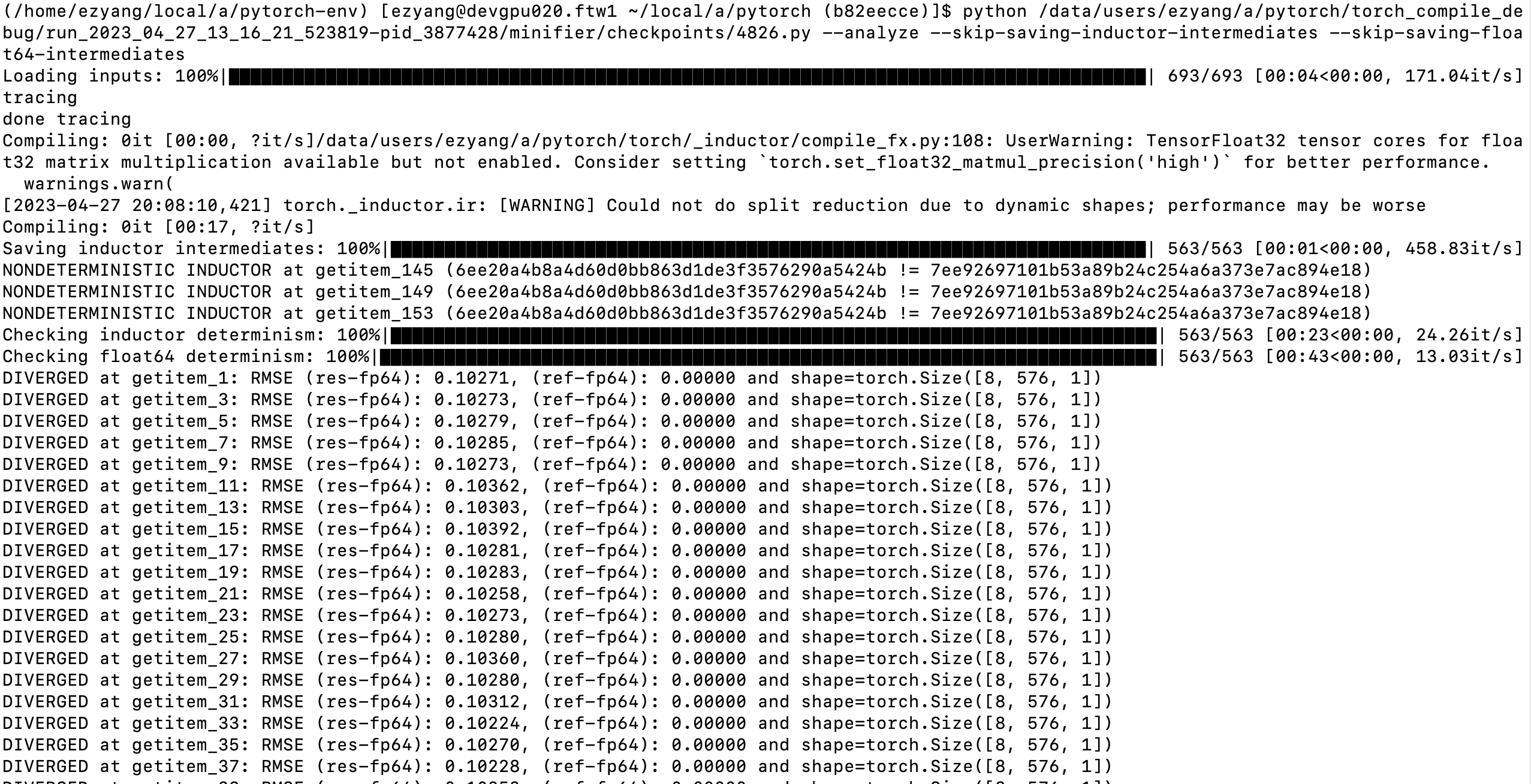
The second part of this is an implementation of `analyze` subcommand on the new CLI for any repro.

<img width="1277" alt="image" src="https://user-images.githubusercontent.com/13564/235045677-8545aab7-5e83-4813-bbec-47783dc60122.png">

This facility is oriented towards accuracy debugging. It does several things:

1. It will run your model twice and check for nondeterminism in inductor/float64, *even* on intermediate inputs (our benchmarking nondeterminism test only checks for nondeterminism on the final output). This makes localizing which operator is nondeterministic easy.
2. It will run your compiled model side-by-side with eager and float64 variants, and then report when things diverge too far from RMSE delta from float64.

Importantly, it does all this without requiring every intermediate to be held in memory (which will cause an OOM on large repros, such as the one I tested this on.)

Some other minor improvements:

* MinifierTestBase now has an easy to comment out spot that you can use to retain the temporary directory; good for debugging
* We print "running minifier" and "running repro" in MinifierTestBase to make it easier to orient where logs are coming from
* same takes a `log_error` optional argument which you can use to reroute the error logs when things mismatch
* counters["inductor"]["intermediate_hooks"] tracks the number of intermediate hooks we've codegen'ed; good for populate the tqdm interface
* torch.fx.interpreter gets an official `boxed_run` interface which uses the boxed arguments calling convention and doesn't retain inputs unnecessarily long
* torch.utils._content_store gets compute_tensor_metadata/read_tensor_metadata helper functions for computing tensor information without serializing it

Signed-off-by: Edward Z. Yang <ezyang@meta.com>

Pull Request resolved: https://github.com/pytorch/pytorch/pull/100226
Approved by: https://github.com/bertmaher, https://github.com/bdhirsh, https://github.com/anijain2305
1561 lines
46 KiB
Python
1561 lines
46 KiB
Python
import collections
|
|
import contextlib
|
|
import copy
|
|
import cProfile
|
|
import dataclasses
|
|
import datetime
|
|
import dis
|
|
import enum
|
|
import functools
|
|
import gc
|
|
import inspect
|
|
import itertools
|
|
import logging
|
|
import math
|
|
import operator
|
|
import os
|
|
import pstats
|
|
import sys
|
|
import textwrap
|
|
import time
|
|
import types
|
|
import typing
|
|
import weakref
|
|
from contextlib import contextmanager
|
|
from functools import lru_cache, wraps
|
|
from typing import Any, Dict, Tuple, Union
|
|
|
|
import torch._logging
|
|
from torch._guards import detect_fake_mode # noqa: F401
|
|
from . import config
|
|
|
|
try:
|
|
import numpy as np
|
|
|
|
HAS_NUMPY = True
|
|
except ModuleNotFoundError:
|
|
np = None # type: ignore[assignment]
|
|
HAS_NUMPY = False
|
|
|
|
try:
|
|
import torch_np
|
|
|
|
HAS_NUMPY_TORCH_INTEROP = True
|
|
except ModuleNotFoundError:
|
|
torch_np = None
|
|
HAS_NUMPY_TORCH_INTEROP = False
|
|
|
|
import importlib
|
|
|
|
import torch
|
|
import torch.fx.experimental.symbolic_shapes
|
|
from torch import fx
|
|
from torch._dispatch.python import enable_python_dispatcher
|
|
from torch._subclasses.fake_tensor import FakeTensor
|
|
from torch.nn.modules.lazy import LazyModuleMixin
|
|
from torch.utils._pytree import tree_map
|
|
|
|
counters = collections.defaultdict(collections.Counter)
|
|
troubleshooting_url = "https://pytorch.org/docs/master/compile/troubleshooting.html"
|
|
nnmodule_doc_url = "https://pytorch.org/docs/master/compile/nn-module.html"
|
|
nnmodule_doc_url_msg = f"See {nnmodule_doc_url} for more information and limitations."
|
|
|
|
log = logging.getLogger(__name__)
|
|
|
|
# profiling compilation time
|
|
compilation_metrics = collections.OrderedDict()
|
|
|
|
timer_counter = itertools.count()
|
|
|
|
|
|
def tabulate(rows, headers):
|
|
try:
|
|
import tabulate
|
|
|
|
return tabulate.tabulate(rows, headers=headers)
|
|
except ImportError:
|
|
return "\n".join(
|
|
", ".join(map(str, row)) for row in itertools.chain([headers], rows)
|
|
)
|
|
|
|
|
|
def dynamo_profiled(func):
|
|
@wraps(func)
|
|
def profile_wrapper(*args, **kwargs):
|
|
global timer_counter
|
|
datafn = (
|
|
func.__name__ + f"{next(timer_counter)}.profile"
|
|
) # Name the data file sensibly
|
|
prof = cProfile.Profile()
|
|
prof.enable()
|
|
retval = prof.runcall(func, *args, **kwargs)
|
|
prof.disable()
|
|
print(f"### Cprofile for {func.__name__} iter {next(timer_counter)} ###")
|
|
ps = pstats.Stats(prof)
|
|
ps.sort_stats(pstats.SortKey.TIME).print_stats(20)
|
|
ps.sort_stats(pstats.SortKey.CUMULATIVE).print_stats(20)
|
|
prof.dump_stats(datafn)
|
|
return retval
|
|
|
|
return profile_wrapper
|
|
|
|
|
|
frame_phase_timing = collections.OrderedDict()
|
|
|
|
curr_frame = 0
|
|
|
|
|
|
# Note: Called for you by dynamo - you almost never ever want to invoke this yourself.
|
|
def increment_frame():
|
|
global curr_frame
|
|
curr_frame = curr_frame + 1
|
|
|
|
|
|
# Note: Called for you by dynamo - you almost never ever want to invoke this yourself.
|
|
def reset_frame_count():
|
|
global curr_frame
|
|
frame_phase_timing.clear()
|
|
curr_frame = 0
|
|
|
|
|
|
op_count = 0
|
|
|
|
|
|
def increment_op_count(cnt):
|
|
global op_count
|
|
op_count += cnt
|
|
|
|
|
|
# Print a report of time spent so far
|
|
# Ex:
|
|
# TIMING:
|
|
# entire_frame_compile:8.574629999999999
|
|
# backend_compile:5.26806
|
|
def print_time_report():
|
|
total = 0
|
|
total_by_key = {}
|
|
for frame, timings in frame_phase_timing.items():
|
|
for key, timing in timings.items():
|
|
total += timing
|
|
if key not in total_by_key:
|
|
total_by_key[key] = timing
|
|
else:
|
|
total_by_key[key] += timing
|
|
|
|
out = "TIMING:"
|
|
for key, value in total_by_key.items():
|
|
out = f"{out} {key}:{round(value, 5)}"
|
|
|
|
print(out)
|
|
|
|
|
|
# dynamo_timed API works as a function decorator
|
|
# By wrapping a function in dynamo_timed, we can store a record in compilation_metrics
|
|
# where the key is the functions name.
|
|
# For example:
|
|
#
|
|
# @dynamo_timed
|
|
# def _foo(...):
|
|
#
|
|
# Would show up as an entry in our timing dict:
|
|
# OrderedDict([('bar.<locals>._foo', [0.083690, 0.23949, 3.1425e-05])])
|
|
# This is extremely useful for granular debugging.
|
|
#
|
|
# For a higher-level mode, pass a phase_name into dynamo_timed
|
|
# phase_names record an extra record into a separate compilation timing structure,
|
|
# one keyed on frame+name rather than function.
|
|
# The frame is incremented outside of this function, in def increment_frame() above.
|
|
def dynamo_timed(original_function=None, phase_name=None):
|
|
def dynamo_timed_inner(func):
|
|
@wraps(func)
|
|
def time_wrapper(*args, **kwargs):
|
|
key = func.__qualname__
|
|
if key not in compilation_metrics:
|
|
compilation_metrics[key] = []
|
|
with torch.profiler.record_function(f"{key} (dynamo_timed)"):
|
|
t0 = time.time()
|
|
r = func(*args, **kwargs)
|
|
time_spent = time.time() - t0
|
|
# print(f"Dynamo timer: key={key}, latency={latency:.2f} sec")
|
|
compilation_metrics[key].append(time_spent)
|
|
if phase_name:
|
|
frame_key = str(curr_frame)
|
|
if frame_key not in frame_phase_timing:
|
|
frame_phase_timing[frame_key] = {}
|
|
assert (
|
|
phase_name not in frame_phase_timing[frame_key]
|
|
), f"Duplicate phase name {phase_name} for frame {frame_key}"
|
|
frame_phase_timing[frame_key][phase_name] = time_spent
|
|
return r
|
|
|
|
return time_wrapper
|
|
|
|
if original_function:
|
|
return dynamo_timed_inner(original_function)
|
|
return dynamo_timed_inner
|
|
|
|
|
|
def compile_times(repr="str", aggregate=False):
|
|
"""
|
|
Get metrics about torchdynamo frontend/backend compilation times.
|
|
|
|
Accumulates information from functions tagged with `@dynamo_timed`.
|
|
|
|
repr='str' returns a printable string for user interaction, and 'csv'
|
|
returns headers, rows which can be logged for output
|
|
|
|
aggregate causes values from multiple compilations (e.g. split graphs)
|
|
to be accumulated into one value. If false, expect more than one value
|
|
per metric.
|
|
"""
|
|
|
|
def fmt_fn(values, item_fn=lambda x: x):
|
|
if aggregate:
|
|
return item_fn(sum(values))
|
|
return ", ".join(map(item_fn, values))
|
|
|
|
if repr == "str":
|
|
rows = [
|
|
(k, fmt_fn(compilation_metrics[k], item_fn=lambda x: f"{x:.4f}"))
|
|
for k in compilation_metrics
|
|
]
|
|
out = "TorchDynamo compilation metrics:\n"
|
|
out += tabulate(rows, headers=("Function", "Runtimes (s)"))
|
|
return out
|
|
elif repr == "csv":
|
|
values = [
|
|
fmt_fn(v, item_fn=lambda x: f"{x:.6f}")
|
|
for v in compilation_metrics.values()
|
|
]
|
|
headers = list(compilation_metrics.keys())
|
|
return headers, values
|
|
|
|
|
|
tensortype_to_dtype = {
|
|
torch.FloatTensor: (torch.float32, torch.float),
|
|
torch.DoubleTensor: (torch.float64, torch.double),
|
|
torch.HalfTensor: (torch.float16, torch.half),
|
|
torch.BFloat16Tensor: (torch.bfloat16,),
|
|
torch.ByteTensor: (torch.uint8,),
|
|
torch.CharTensor: (torch.int8,),
|
|
torch.LongTensor: (torch.int64, torch.long),
|
|
torch.IntTensor: (torch.int32, torch.int),
|
|
torch.ShortTensor: (torch.int16, torch.short),
|
|
torch.BoolTensor: (torch.bool,),
|
|
}
|
|
|
|
|
|
class DuplicateWarningChecker:
|
|
def __init__(self, maxsize=4096):
|
|
self.maxsize = maxsize
|
|
self.reset()
|
|
|
|
def reset(self):
|
|
self.set = collections.OrderedDict()
|
|
|
|
def add(self, key):
|
|
if key in self.set:
|
|
self.set.move_to_end(key, last=True)
|
|
if not config.verbose:
|
|
return False
|
|
else:
|
|
self.set[key] = None
|
|
while len(self.set) > self.maxsize:
|
|
self.set.popitem(last=False)
|
|
return True
|
|
|
|
|
|
graph_break_dup_warning_checker = DuplicateWarningChecker()
|
|
|
|
|
|
def setup_compile_debug():
|
|
compile_debug = bool(os.environ.get("TORCH_COMPILE_DEBUG", False))
|
|
|
|
if compile_debug:
|
|
torch._logging.set_logs(
|
|
dynamo=logging.DEBUG,
|
|
aot=logging.DEBUG,
|
|
inductor=logging.DEBUG,
|
|
output_code=True, # this is off by default
|
|
)
|
|
return add_file_handler()
|
|
|
|
return contextlib.ExitStack()
|
|
|
|
|
|
def reset_graph_break_dup_checker():
|
|
graph_break_dup_warning_checker.reset()
|
|
|
|
|
|
def add_file_handler():
|
|
log_path = os.path.join(get_debug_dir(), "torchdynamo")
|
|
if not os.path.exists(log_path):
|
|
os.makedirs(log_path)
|
|
|
|
log_file_handler = logging.FileHandler(os.path.join(log_path, "debug.log"))
|
|
logger = logging.getLogger("torch._dynamo")
|
|
logger.addHandler(log_file_handler)
|
|
|
|
exitstack = contextlib.ExitStack()
|
|
exitstack.callback(lambda: logger.removeHandler(log_file_handler))
|
|
return exitstack
|
|
|
|
|
|
def setup_log_file():
|
|
exitstack = contextlib.ExitStack()
|
|
if config.log_file_name is not None:
|
|
log_file_handler = logging.FileHandler(config.log_file_name)
|
|
for logger in logging.get_loggers():
|
|
logger.addHandler(log_file_handler)
|
|
exitstack.callback(lambda: logger.removeHandler(log_file_handler))
|
|
return exitstack
|
|
|
|
return exitstack
|
|
|
|
|
|
def gen_record_file_name(exc, code):
|
|
return f"{get_debug_dir()}/error_recordings/\
|
|
{code.co_name}_{type(exc).__name__}_{code.co_firstlineno}.rec"
|
|
|
|
|
|
def write_record_to_file(filename, exec_record):
|
|
try:
|
|
if os.path.exists(filename):
|
|
log.warning(
|
|
"Unable to write execution record %s; file already exists.", filename
|
|
)
|
|
else:
|
|
os.makedirs(os.path.dirname(filename), exist_ok=True)
|
|
with open(filename, "wb") as f:
|
|
exec_record.dump(f)
|
|
except Exception:
|
|
log.error("Unable to write execution record %s", filename, exc_info=1)
|
|
|
|
|
|
def count_calls(g: fx.Graph):
|
|
c = 0
|
|
for n in g.nodes:
|
|
if "call" in n.op:
|
|
c += 1
|
|
return c
|
|
|
|
|
|
def identity(x):
|
|
return x
|
|
|
|
|
|
def nothing(*args, **kwargs):
|
|
pass
|
|
|
|
|
|
class ExactWeakKeyDictionary:
|
|
"""Similar to weakref.WeakKeyDictionary, but use `is`/`id` rather than `==` to compare equality"""
|
|
|
|
def __init__(self):
|
|
self.values = dict()
|
|
self.refs = dict()
|
|
|
|
def __getitem__(self, key):
|
|
return self.values[id(key)]
|
|
|
|
def get(self, key, default=None):
|
|
return self.values.get(id(key), default)
|
|
|
|
def __contains__(self, key):
|
|
return id(key) in self.values
|
|
|
|
def __setitem__(self, key, value):
|
|
idx = id(key)
|
|
if idx not in self.refs:
|
|
self.refs[idx] = weakref.ref(key, lambda ref: self._remove_id(idx))
|
|
self.values[idx] = value
|
|
|
|
def _remove_id(self, idx):
|
|
if idx in self.values:
|
|
del self.values[idx]
|
|
if idx in self.refs:
|
|
del self.refs[idx]
|
|
|
|
def clear(self):
|
|
self.refs.clear()
|
|
self.values.clear()
|
|
|
|
|
|
def istype(obj, allowed_types):
|
|
"""isinstance() without subclasses"""
|
|
if isinstance(allowed_types, (tuple, list, set)):
|
|
return type(obj) in allowed_types
|
|
return type(obj) is allowed_types
|
|
|
|
|
|
def is_typing(value):
|
|
if sys.version_info < (3, 9):
|
|
return isinstance(value, typing._GenericAlias)
|
|
else:
|
|
return isinstance(
|
|
value, (typing._SpecialGenericAlias, typing._UnionGenericAlias)
|
|
)
|
|
|
|
|
|
def is_numpy_int_type(value):
|
|
if HAS_NUMPY:
|
|
return istype(
|
|
value,
|
|
(
|
|
np.int8,
|
|
np.int16,
|
|
np.int32,
|
|
np.int64,
|
|
np.uint8,
|
|
np.uint16,
|
|
np.uint32,
|
|
np.uint64,
|
|
),
|
|
)
|
|
else:
|
|
return False
|
|
|
|
|
|
def is_numpy_float_type(value):
|
|
if HAS_NUMPY:
|
|
return istype(
|
|
value,
|
|
(
|
|
np.float16,
|
|
np.float32,
|
|
np.float64,
|
|
),
|
|
)
|
|
else:
|
|
return False
|
|
|
|
|
|
def is_numpy_ndarray(value):
|
|
if HAS_NUMPY:
|
|
return istype(value, np.ndarray)
|
|
else:
|
|
return False
|
|
|
|
|
|
def istensor(obj):
|
|
"""Check of obj is a tensor"""
|
|
tensor_list = (
|
|
torch.Tensor,
|
|
torch.nn.Parameter,
|
|
*config.traceable_tensor_subclasses,
|
|
)
|
|
tensor_list = tensor_list + (torch._subclasses.FakeTensor,)
|
|
return istype(obj, tensor_list)
|
|
|
|
|
|
def is_lazy_module(mod):
|
|
return isinstance(mod, LazyModuleMixin)
|
|
|
|
|
|
@functools.lru_cache(4096)
|
|
def print_once(*args):
|
|
print(*args)
|
|
|
|
|
|
def make_cell(val=None):
|
|
"""Some black magic to create a cell object that usually only exists in a closure"""
|
|
x = val
|
|
|
|
def f():
|
|
return x
|
|
|
|
assert len(f.__closure__) == 1
|
|
return f.__closure__[0]
|
|
|
|
|
|
def proxy_args_kwargs(args, kwargs):
|
|
try:
|
|
proxy_args = tuple(arg.as_proxy() for arg in args)
|
|
proxy_kwargs = {key: arg.as_proxy() for key, arg in kwargs.items()}
|
|
return proxy_args, proxy_kwargs
|
|
except NotImplementedError as e:
|
|
from .exc import unimplemented
|
|
from .variables.base import typestr
|
|
|
|
raise unimplemented(
|
|
f"call_function args: {typestr(*args)} {typestr(*list(kwargs.values()))}"
|
|
) from e
|
|
|
|
|
|
@dataclasses.dataclass
|
|
class CleanupHook:
|
|
"""Remove a global variable when hook is called"""
|
|
|
|
scope: Dict[str, Any]
|
|
name: str
|
|
|
|
def __call__(self, *args):
|
|
CleanupManager.count -= 1
|
|
del self.scope[self.name]
|
|
|
|
@staticmethod
|
|
def create(scope, name, val):
|
|
assert name not in scope
|
|
CleanupManager.count += 1
|
|
scope[name] = val
|
|
return CleanupHook(scope, name)
|
|
|
|
|
|
class CleanupManager(ExactWeakKeyDictionary):
|
|
count = 0
|
|
|
|
def _remove_id(self, idx):
|
|
for hook in self.values[idx]:
|
|
hook()
|
|
super()._remove_id(idx)
|
|
|
|
|
|
CleanupManager.instance = CleanupManager()
|
|
|
|
|
|
def clone_tensor(x):
|
|
"""Clone the tensor and its gradient"""
|
|
y = x.clone().requires_grad_(x.requires_grad)
|
|
if x.is_leaf and x.grad is not None:
|
|
y.grad = x.grad.clone()
|
|
return y
|
|
|
|
|
|
def clone_input(x):
|
|
"""copy while preserving strides"""
|
|
# TODO: this is questionable
|
|
if isinstance(x, torch._subclasses.FakeTensor):
|
|
# this func fails on fake tensors in __torch_dispatch__
|
|
return x
|
|
|
|
def torch_clone(x):
|
|
y = torch.clone(x)
|
|
if x.is_leaf:
|
|
y.requires_grad_(x.requires_grad)
|
|
if x.is_leaf and x.grad is not None:
|
|
y.grad = clone_input(x.grad)
|
|
if hasattr(x, "_dynamo_dynamic_indices"):
|
|
y._dynamo_dynamic_indices = x._dynamo_dynamic_indices.copy()
|
|
return y
|
|
|
|
with torch.no_grad():
|
|
if x.device.type == "xla":
|
|
# Access data_ptr() for a xla tensor will cause crash
|
|
return torch_clone(x)
|
|
|
|
needed_size = sum(
|
|
(shape - 1) * stride for shape, stride in zip(x.size(), x.stride())
|
|
)
|
|
if x.is_quantized:
|
|
result = torch.empty_quantized((needed_size + 32,), x)
|
|
else:
|
|
result = torch.empty(needed_size + 32, dtype=x.dtype, device=x.device)
|
|
cache_line_offset = (
|
|
(x.data_ptr() - result.data_ptr()) % 32
|
|
) // x.element_size()
|
|
result.as_strided_(x.size(), x.stride(), cache_line_offset)
|
|
try:
|
|
result.copy_(x.clone())
|
|
if x.is_leaf:
|
|
result.requires_grad_(x.requires_grad)
|
|
if x.is_leaf and x.grad is not None:
|
|
result.grad = clone_input(x.grad)
|
|
except RuntimeError:
|
|
# RuntimeError: unsupported operation: more than one element of the written-to
|
|
# tensor refers to a single memory location. Please clone() the tensor before
|
|
# performing the operation.
|
|
return torch_clone(x)
|
|
if hasattr(x, "_dynamo_dynamic_indices"):
|
|
result._dynamo_dynamic_indices = x._dynamo_dynamic_indices.copy()
|
|
return result
|
|
|
|
|
|
def clone_inputs(example_inputs):
|
|
if type(example_inputs) is dict:
|
|
res = dict(example_inputs)
|
|
for key, value in res.items():
|
|
assert isinstance(value, torch.Tensor)
|
|
res[key] = clone_input(value)
|
|
return res
|
|
|
|
res = list(example_inputs)
|
|
for i in range(len(res)):
|
|
if isinstance(res[i], torch.Tensor):
|
|
res[i] = clone_input(res[i])
|
|
return res
|
|
|
|
|
|
@contextmanager
|
|
def preserve_rng_state():
|
|
rng = torch.clone(torch.random.get_rng_state())
|
|
if torch.cuda.is_available():
|
|
cuda_rng = torch.clone(torch.cuda.get_rng_state())
|
|
try:
|
|
yield
|
|
finally:
|
|
torch.random.set_rng_state(rng)
|
|
if torch.cuda.is_available():
|
|
torch.cuda.set_rng_state(cuda_rng)
|
|
|
|
|
|
def is_jit_model(model0):
|
|
return isinstance(
|
|
model0,
|
|
(
|
|
torch.jit._trace.TopLevelTracedModule,
|
|
torch.jit._script.RecursiveScriptModule,
|
|
torch.jit.ScriptFunction,
|
|
torch.jit.ScriptModule,
|
|
),
|
|
)
|
|
|
|
|
|
def torchscript(model, example_inputs, verbose=False):
|
|
if is_jit_model(model):
|
|
# already done?
|
|
return model
|
|
|
|
try:
|
|
return torch.jit.trace(model, example_inputs)
|
|
except Exception:
|
|
try:
|
|
return torch.jit.script(model)
|
|
except Exception:
|
|
if verbose:
|
|
log.exception("jit error")
|
|
else:
|
|
log.error("Both torch.jit.trace and torch.jit.script failed")
|
|
return None
|
|
|
|
|
|
def getfile(obj):
|
|
try:
|
|
return inspect.getfile(obj)
|
|
except TypeError:
|
|
return None
|
|
|
|
|
|
def is_namedtuple(obj):
|
|
"""Test if an object is a namedtuple or a torch.return_types.* quasi-namedtuple"""
|
|
return is_namedtuple_cls(type(obj))
|
|
|
|
|
|
def is_namedtuple_cls(cls):
|
|
"""Test if an object is a namedtuple or a torch.return_types.* quasi-namedtuple"""
|
|
try:
|
|
if issubclass(cls, tuple):
|
|
bases = getattr(cls, "__bases__", []) or [None]
|
|
module = getattr(cls, "__module__", None)
|
|
return module == "torch.return_types" or (
|
|
bases[0] is tuple and hasattr(cls, "_make") and hasattr(cls, "_fields")
|
|
)
|
|
except TypeError:
|
|
pass
|
|
return False
|
|
|
|
|
|
@functools.lru_cache(1)
|
|
def namedtuple_fields(cls):
|
|
"""Get the fields of a namedtuple or a torch.return_types.* quasi-namedtuple"""
|
|
if cls is slice:
|
|
return ["start", "stop", "step"]
|
|
|
|
assert issubclass(cls, tuple)
|
|
if hasattr(cls, "_fields"):
|
|
# normal namedtuples
|
|
return cls._fields
|
|
|
|
@dataclasses.dataclass
|
|
class Marker:
|
|
index: int
|
|
|
|
# frustrating ones e.g. torch.return_types.max
|
|
assert cls.__module__ == "torch.return_types"
|
|
obj = cls(map(Marker, range(cls.n_fields)))
|
|
fields = [None] * cls.n_fields
|
|
for name in dir(obj):
|
|
if name[0] != "_" and isinstance(getattr(obj, name), Marker):
|
|
fields[getattr(obj, name).index] = name
|
|
return fields
|
|
|
|
|
|
def checkpoint_params(gm):
|
|
with torch.no_grad():
|
|
rng_state = torch.clone(torch.random.get_rng_state())
|
|
if torch.cuda.is_available():
|
|
cuda_rng_state = torch.clone(torch.cuda.get_rng_state())
|
|
saved_state = []
|
|
for param in itertools.chain(gm.parameters(), gm.buffers()):
|
|
saved_state.append((param, param._version, torch.clone(param)))
|
|
|
|
def restore():
|
|
with torch.no_grad():
|
|
torch.random.set_rng_state(rng_state)
|
|
if torch.cuda.is_available():
|
|
torch.cuda.set_rng_state(cuda_rng_state)
|
|
for param, version, original_value in saved_state:
|
|
if param._version != version:
|
|
param.copy_(original_value)
|
|
|
|
return restore
|
|
|
|
|
|
def timed(model, example_inputs, times=1):
|
|
if torch.cuda.is_available():
|
|
synchronize = torch.cuda.synchronize
|
|
else:
|
|
synchronize = nothing
|
|
|
|
synchronize()
|
|
gc.collect()
|
|
torch.manual_seed(1337)
|
|
t0 = time.perf_counter()
|
|
for _ in range(times):
|
|
result = model(*example_inputs)
|
|
synchronize()
|
|
t1 = time.perf_counter()
|
|
return result, t1 - t0
|
|
|
|
|
|
def check_is_cuda(gm, example_inputs):
|
|
return all(x.is_cuda for x in itertools.chain(example_inputs, gm.parameters(True)))
|
|
|
|
|
|
@lru_cache(32)
|
|
def rot_n_helper(n):
|
|
assert n > 1
|
|
vars = [f"v{i}" for i in range(n)]
|
|
rotated = reversed(vars[-1:] + vars[:-1])
|
|
fn = eval(f"lambda {','.join(vars)}: ({','.join(rotated)})")
|
|
fn.__name__ = f"rot_{n}_helper"
|
|
return fn
|
|
|
|
|
|
def is_safe_constant(v):
|
|
if istype(v, (tuple, frozenset)):
|
|
return all(map(is_safe_constant, v))
|
|
return isinstance(v, (enum.Enum, type)) or istype(
|
|
v,
|
|
(
|
|
types.CodeType,
|
|
int,
|
|
float,
|
|
bool,
|
|
str,
|
|
bytes,
|
|
type(None),
|
|
slice,
|
|
type(type),
|
|
torch.device,
|
|
torch.dtype,
|
|
),
|
|
)
|
|
|
|
|
|
def check_constant_args(args, kwargs):
|
|
return all(x.is_python_constant() for x in itertools.chain(args, kwargs.values()))
|
|
|
|
|
|
def check_unspec_python_args(args, kwargs):
|
|
from .variables.constant import ConstantVariable
|
|
from .variables.tensor import UnspecializedPythonVariable
|
|
|
|
unspec_count = 0
|
|
for x in itertools.chain(args, kwargs.values()):
|
|
if isinstance(x, UnspecializedPythonVariable):
|
|
unspec_count += 1
|
|
elif not isinstance(x, (UnspecializedPythonVariable, ConstantVariable)):
|
|
return False
|
|
else:
|
|
pass
|
|
|
|
return unspec_count > 0
|
|
|
|
|
|
def specialize_args_kwargs(tx, args, kwargs):
|
|
specialized_args = []
|
|
specialized_kwargs = {}
|
|
for x in args:
|
|
specialized_args.append(x.as_specialized(tx))
|
|
for k, v in kwargs.items():
|
|
specialized_kwargs.update({k: v.as_specialized(tx)})
|
|
return specialized_args, specialized_kwargs
|
|
|
|
|
|
dict_values = type(dict().values())
|
|
odict_values = type(collections.OrderedDict().values())
|
|
tuple_iterator = type(iter(tuple()))
|
|
tuple_iterator_len = tuple_iterator.__length_hint__
|
|
object_new = object.__new__
|
|
|
|
|
|
def nn_module_new(cls):
|
|
obj = object_new(cls)
|
|
torch.nn.Module.__init__(obj)
|
|
return obj
|
|
|
|
|
|
def product(it):
|
|
return functools.reduce(operator.mul, it, 1)
|
|
|
|
|
|
def tuple_iterator_getitem(it, index):
|
|
_, (obj,), start = it.__reduce__()
|
|
return obj[start + index]
|
|
|
|
|
|
def enum_repr(value, local):
|
|
enum_name = str(value)
|
|
|
|
name, val = enum_name.split(".")
|
|
scope = "L" if local else "G"
|
|
local_name = f'{scope}["{name}"].{val}'
|
|
return local_name
|
|
|
|
|
|
def dict_param_key_ids(value):
|
|
return {id(k) for k in value.keys() if isinstance(k, torch.nn.Parameter)}
|
|
|
|
|
|
def dict_const_keys(value):
|
|
return {k for k in value.keys() if not isinstance(k, torch.nn.Parameter)}
|
|
|
|
|
|
def dict_const_keys_repr(const_keys, *, local):
|
|
if any(isinstance(k, enum.Enum) for k in const_keys):
|
|
# To workaround repr(Enum) returning invalid global reference before python 3.11
|
|
# by calling enum_repr and removing quotes to render enum in guard code.
|
|
const_keys_str = f"{ {enum_repr(k, local=local) if isinstance(k, enum.Enum) else repr(k) for k in const_keys} }".replace(
|
|
"'", ""
|
|
)
|
|
else:
|
|
const_keys_str = f"{const_keys!r}"
|
|
return const_keys_str
|
|
|
|
|
|
def global_key_name(key):
|
|
return f"__dict_key_{id(key)}"
|
|
|
|
|
|
from torch._subclasses import ( # noqa: F401
|
|
FakeTensorMode,
|
|
UnsupportedFakeTensorException,
|
|
)
|
|
|
|
|
|
def wrap_fake_exception(fn):
|
|
try:
|
|
return fn()
|
|
except UnsupportedFakeTensorException as e:
|
|
from .exc import unimplemented
|
|
|
|
msg = f"Unsupported: {e.reason} with fake tensor propagation."
|
|
log.warning(msg)
|
|
raise unimplemented(msg) from e
|
|
|
|
|
|
def deepcopy_to_fake_tensor(obj, fake_mode):
|
|
with torch._subclasses.fake_tensor.FakeCopyMode(fake_mode):
|
|
return wrap_fake_exception(lambda: copy.deepcopy(obj))
|
|
|
|
|
|
def rmse(ref, res):
|
|
"""
|
|
Calculate root mean squared error
|
|
"""
|
|
return torch.sqrt(torch.mean(torch.square(ref - res)))
|
|
|
|
|
|
def same(
|
|
ref,
|
|
res,
|
|
fp64_ref=None,
|
|
cos_similarity=False,
|
|
tol=1e-4,
|
|
equal_nan=False,
|
|
exact_dtype=True,
|
|
relax_numpy_equality=False,
|
|
log_error=log.error,
|
|
):
|
|
"""Check correctness to see if ref and res match"""
|
|
if fp64_ref is None:
|
|
fp64_ref = ref
|
|
if isinstance(ref, (list, tuple, torch.nn.ParameterList, torch.Size)):
|
|
assert isinstance(res, (list, tuple)), f"type mismatch {type(ref)} {type(res)}"
|
|
return len(ref) == len(res) and all(
|
|
same(
|
|
ai,
|
|
bi,
|
|
fp64_refi,
|
|
cos_similarity,
|
|
tol,
|
|
equal_nan,
|
|
exact_dtype,
|
|
relax_numpy_equality,
|
|
log_error=log_error,
|
|
)
|
|
for ai, bi, fp64_refi in zip(ref, res, fp64_ref)
|
|
)
|
|
elif isinstance(ref, dict):
|
|
assert isinstance(res, dict)
|
|
assert set(ref.keys()) == set(
|
|
res.keys()
|
|
), f"keys mismatch {set(ref.keys())} == {set(res.keys())}"
|
|
for k in sorted(ref.keys()):
|
|
if not (
|
|
same(
|
|
ref[k],
|
|
res[k],
|
|
fp64_ref[k],
|
|
cos_similarity=cos_similarity,
|
|
tol=tol,
|
|
equal_nan=equal_nan,
|
|
exact_dtype=exact_dtype,
|
|
relax_numpy_equality=relax_numpy_equality,
|
|
log_error=log_error,
|
|
)
|
|
):
|
|
log_error("Accuracy failed for key name %s", k)
|
|
return False
|
|
return True
|
|
elif isinstance(ref, torch.Tensor):
|
|
assert not isinstance(ref, torch._subclasses.FakeTensor)
|
|
assert not isinstance(res, torch._subclasses.FakeTensor)
|
|
|
|
if ref.is_sparse:
|
|
assert res.is_sparse
|
|
ref = ref.to_dense()
|
|
res = res.to_dense()
|
|
assert isinstance(res, torch.Tensor), f"type mismatch {type(ref)} {type(res)}"
|
|
if exact_dtype:
|
|
if ref.dtype != res.dtype:
|
|
log_error("dtype mismatch %s, %s", ref.dtype, res.dtype)
|
|
return False
|
|
if ref.dtype == torch.bool:
|
|
# triton stores bool as int8, so add this for more accurate checking
|
|
r = torch.allclose(
|
|
ref.to(dtype=torch.uint8),
|
|
res.to(dtype=torch.uint8),
|
|
atol=tol,
|
|
rtol=tol,
|
|
equal_nan=equal_nan,
|
|
)
|
|
if not r:
|
|
log_error("Accuracy failed: uint8 tensor did not match")
|
|
return r
|
|
if cos_similarity:
|
|
ref = ref.flatten().to(torch.float32)
|
|
res = res.flatten().to(torch.float32)
|
|
if torch.allclose(ref, res, atol=tol, rtol=tol, equal_nan=True):
|
|
# early exit that handles zero/nan better
|
|
# cosine_similarity(zeros(10), zeros(10), dim=0) is 0
|
|
return True
|
|
score = torch.nn.functional.cosine_similarity(ref, res, dim=0, eps=1e-6)
|
|
if score < 0.99:
|
|
log.warning("Similarity score=%s", score.cpu().detach().item())
|
|
return score >= 0.99
|
|
else:
|
|
if not exact_dtype:
|
|
ref = ref.to(res.dtype)
|
|
|
|
# First try usual allclose
|
|
if torch.allclose(ref, res, atol=tol, rtol=tol, equal_nan=equal_nan):
|
|
return True
|
|
|
|
# Check error from fp64 version
|
|
if fp64_ref.dtype == torch.float64:
|
|
ref_error = rmse(fp64_ref, ref).item()
|
|
res_error = rmse(fp64_ref, res).item()
|
|
multiplier = 2.0
|
|
|
|
if (
|
|
fp64_ref.numel() < 1000
|
|
or (ref.ndim == 4 and ref.shape[-1] == ref.shape[-2] == 1)
|
|
# large tol means a benchmark has been specified as REQUIRE_HIGHER_TOLERANCE
|
|
or tol >= 2 * 1e-2
|
|
):
|
|
# In the presence of noise, noise might dominate our error
|
|
# metric for smaller tensors.
|
|
# Similary, for 1x1 kernels, there seems to be high noise with amp.
|
|
multiplier = 3.0
|
|
|
|
passes_test = res_error <= (multiplier * ref_error + tol / 10.0)
|
|
if not passes_test:
|
|
log_error(
|
|
"RMSE (res-fp64): %.5f, (ref-fp64): %.5f and shape=%s",
|
|
res_error,
|
|
ref_error,
|
|
res.size(),
|
|
)
|
|
# import pdb; pdb.set_trace()
|
|
return passes_test
|
|
|
|
log_error("Accuracy failed: allclose not within tol=%s", tol)
|
|
return False
|
|
elif isinstance(ref, (str, int, type(None), bool, torch.device)):
|
|
r = ref == res
|
|
if not r:
|
|
log_error("Accuracy failed (%s): %s != %s", type(ref), ref, res)
|
|
return r
|
|
elif isinstance(ref, float):
|
|
r = math.isclose(ref, res, rel_tol=tol, abs_tol=tol)
|
|
if not r:
|
|
log_error(
|
|
"Accuracy failed (float): %s != %s (within tol=%s)", ref, res, tol
|
|
)
|
|
return r
|
|
elif is_numpy_int_type(ref) or is_numpy_float_type(ref):
|
|
if relax_numpy_equality and not (
|
|
is_numpy_int_type(res) or is_numpy_float_type(res)
|
|
):
|
|
ref = ref.item()
|
|
r = (type(ref) is type(res)) and (ref == res)
|
|
if not r:
|
|
log_error("Accuracy failed (numpy): %s != %s", ref, res)
|
|
return r
|
|
elif is_numpy_ndarray(ref):
|
|
return (type(ref) is type(res)) and (ref == res).all()
|
|
elif type(ref).__name__ in (
|
|
"MaskedLMOutput",
|
|
"Seq2SeqLMOutput",
|
|
"CausalLMOutputWithCrossAttentions",
|
|
"LongformerMaskedLMOutput",
|
|
"Instances",
|
|
"SquashedNormal",
|
|
"Boxes",
|
|
"Normal",
|
|
"TanhTransform",
|
|
"Foo",
|
|
"Variable",
|
|
):
|
|
assert type(ref) is type(res)
|
|
return all(
|
|
same(
|
|
getattr(ref, key),
|
|
getattr(res, key),
|
|
getattr(fp64_ref, key),
|
|
cos_similarity=cos_similarity,
|
|
tol=tol,
|
|
equal_nan=equal_nan,
|
|
exact_dtype=exact_dtype,
|
|
relax_numpy_equality=relax_numpy_equality,
|
|
log_error=log_error,
|
|
)
|
|
for key in ref.__dict__.keys()
|
|
)
|
|
else:
|
|
raise RuntimeError(f"unsupported type: {type(ref).__name__}")
|
|
|
|
|
|
def format_func_info(code):
|
|
short_filename = code.co_filename.split("/")[-1]
|
|
return f"'{code.co_name}' ({short_filename}:{code.co_firstlineno})"
|
|
|
|
|
|
@contextlib.contextmanager
|
|
def disable_cache_limit():
|
|
prior = config.cache_size_limit
|
|
config.cache_size_limit = sys.maxsize
|
|
|
|
try:
|
|
yield
|
|
finally:
|
|
config.cache_size_limit = prior
|
|
|
|
|
|
# map from transformed code back to original user code
|
|
orig_code_map = ExactWeakKeyDictionary()
|
|
|
|
# keep a record of code_obj -> list of guard failure reasons for logging
|
|
guard_failures = collections.defaultdict(list)
|
|
|
|
# keep record of compiled code, if we are in "error if recompile"
|
|
# to track code that dynamo has compiled previously
|
|
seen_code_map = ExactWeakKeyDictionary()
|
|
|
|
|
|
class CompileProfiler:
|
|
"""Utility for profiling how and what dynamo would compile.
|
|
|
|
Can be used for
|
|
* diagnosing recompilation issues
|
|
* determining an appropriate compile cache limit
|
|
* (TODO)confirming which functions got compiled/skipped
|
|
"""
|
|
|
|
def __init__(self):
|
|
self.frame_count = 0
|
|
self.op_count = 0
|
|
self.backend_ctx_ctor = lambda: disable_cache_limit()
|
|
|
|
def __call__(self, gm: torch.fx.GraphModule, example_inputs):
|
|
self.frame_count += 1
|
|
for node in gm.graph.nodes:
|
|
if "call" in node.op:
|
|
self.op_count += 1
|
|
return gm.forward
|
|
|
|
def get_metrics(self):
|
|
return {"guard_failures": guard_failures}
|
|
|
|
def report(self):
|
|
metrics = self.get_metrics()
|
|
gf = metrics["guard_failures"]
|
|
|
|
def num_recompiles(code):
|
|
return len(gf[code])
|
|
|
|
def recompile_reasons(code):
|
|
return "\n".join([str(x) for x in gf[code]])
|
|
|
|
summarized_gf = [
|
|
[format_func_info(code), num_recompiles(code), recompile_reasons(code)]
|
|
for code in gf
|
|
]
|
|
|
|
def graph_break_report():
|
|
if "graph_break" in counters:
|
|
graph_breaks = counters["graph_break"]
|
|
return tabulate(
|
|
[[msg, graph_breaks[msg]] for msg in graph_breaks],
|
|
headers=["Graph Break Reason", "Count"],
|
|
)
|
|
|
|
def recompilation_report():
|
|
if len(gf):
|
|
max_recompiles = max([num_recompiles(code) for code in gf])
|
|
recomp_table = tabulate(
|
|
summarized_gf,
|
|
headers=["Function", "Recompiles", "Recompile Reasons"],
|
|
)
|
|
return recomp_table + textwrap.dedent(
|
|
f"""
|
|
|
|
Set torch._dynamo.config.cache_size_limit to {max_recompiles} to avoid being cache limited.
|
|
"""
|
|
)
|
|
|
|
report = textwrap.dedent(
|
|
"""
|
|
Torchdynamo Profiler Report
|
|
===========================
|
|
|
|
Graph Breaks
|
|
------------
|
|
Graph breaks happen when torchdynamo encounters code it can't safely trace.
|
|
If you want to find out why breaks are happening, check below for each break reason
|
|
You may gain additional insight by passing `fullgraph=True` to torch.compile,
|
|
to stop at the first break.
|
|
|
|
"""
|
|
)
|
|
report += graph_break_report() or "No graph breaks detected."
|
|
report += textwrap.dedent(
|
|
"""
|
|
|
|
Recompilation
|
|
-------------
|
|
These subgraphs were recompiled more than once due to guard failures
|
|
Guard failures indicate some condition assumed to be static by the tracer changed,
|
|
making it unsafe to reuse the compiled program.
|
|
|
|
"""
|
|
)
|
|
report += recompilation_report() or "No recompilation detected.\n"
|
|
return report
|
|
|
|
|
|
# return same dir unless user changes config between calls
|
|
@functools.lru_cache(None)
|
|
def _get_debug_dir(root_dir):
|
|
dir_name = (
|
|
"run_"
|
|
+ datetime.datetime.now().strftime("%Y_%m_%d_%H_%M_%S_%f")
|
|
# use pid to avoid conflicts among ranks
|
|
+ "-pid_"
|
|
+ str(os.getpid())
|
|
)
|
|
return os.path.join(root_dir, dir_name)
|
|
|
|
|
|
def get_debug_dir():
|
|
debug_root = config.debug_dir_root
|
|
return _get_debug_dir(debug_root)
|
|
|
|
|
|
def get_fake_value(node, tx):
|
|
"""
|
|
Run the computation represented by `node` using fake tensors and return the result.
|
|
"""
|
|
from .exc import (
|
|
TorchRuntimeError,
|
|
unimplemented,
|
|
Unsupported,
|
|
UserError,
|
|
UserErrorType,
|
|
)
|
|
|
|
op = node.op
|
|
|
|
def fake_wrapper(e):
|
|
if isinstance(e, torch.Tensor):
|
|
assert isinstance(e, FakeTensor)
|
|
return e
|
|
|
|
def visit(n: torch.fx.Node):
|
|
return n.meta["example_value"]
|
|
|
|
args, kwargs = torch.fx.node.map_arg((node.args, node.kwargs), visit)
|
|
args = tree_map(fake_wrapper, args)
|
|
kwargs = tree_map(fake_wrapper, kwargs)
|
|
|
|
nnmodule = None
|
|
if op == "call_method" and len(args) > 0 and isinstance(args[0], torch.nn.Module):
|
|
# If the first argument is nn.Module, should copy to fake mode.
|
|
args = (deepcopy_to_fake_tensor(args[0], tx.fake_mode),) + tuple(args[1:])
|
|
|
|
if op == "call_module":
|
|
nnmodule = tx.output.nn_modules[node.target]
|
|
|
|
if is_lazy_module(nnmodule) and hasattr(nnmodule, "_initialize_hook"):
|
|
# In the case of a lazy module, we want to run
|
|
# the pre-hooks which initialize it.
|
|
# Afterwards, lazy module deletes its pre-hooks
|
|
# to avoid treating it as lazy on subsequent recompile.
|
|
nnmodule._infer_parameters(nnmodule, args)
|
|
|
|
# no matter it's lazy module or not, we should copy to fake mode.
|
|
nnmodule = deepcopy_to_fake_tensor(nnmodule, tx.fake_mode)
|
|
|
|
try:
|
|
with tx.fake_mode, enable_python_dispatcher():
|
|
return wrap_fake_exception(
|
|
lambda: run_node(tx.output, node, args, kwargs, nnmodule)
|
|
)
|
|
except Unsupported:
|
|
raise
|
|
except RuntimeError as e:
|
|
cause = e
|
|
if e.__cause__ is not None:
|
|
cause = e.__cause__
|
|
if isinstance(
|
|
cause, torch._subclasses.fake_tensor.DataDependentOutputException
|
|
):
|
|
unimplemented(f"data dependent operator: {cause.func}")
|
|
elif isinstance(
|
|
cause, torch._subclasses.fake_tensor.DynamicOutputShapeException
|
|
):
|
|
unimplemented(f"dynamic shape operator: {cause.func}")
|
|
elif isinstance(
|
|
cause, torch._subclasses.fake_tensor.UnsupportedOperatorException
|
|
):
|
|
unimplemented(
|
|
f"unsupported operator: {cause.func} (see "
|
|
"https://docs.google.com/document/d/1GgvOe7C8_NVOMLOCwDaYV1mXXyHMXY7ExoewHqooxrs/edit#heading=h.64r4npvq0w0"
|
|
" for how to fix)"
|
|
)
|
|
elif isinstance(
|
|
cause, torch.fx.experimental.symbolic_shapes.GuardOnDataDependentSymNode
|
|
):
|
|
unimplemented("guard on data-dependent symbolic int/float")
|
|
elif isinstance(cause, torch.utils._sympy.value_ranges.ValueRangeError):
|
|
raise UserError(UserErrorType.CONSTRAIN_VIOLATION, e.args[0]) from e
|
|
raise TorchRuntimeError() from e
|
|
|
|
|
|
def run_node(output_graph, node, args, kwargs, nnmodule):
|
|
"""
|
|
Runs a given node, with the given args and kwargs.
|
|
|
|
Behavior is dicatated by a node's op.
|
|
|
|
run_node is useful for extracting real values out of nodes.
|
|
See get_real_value for more info on common usage.
|
|
|
|
Note: The output_graph arg is only used for 'get_attr' ops
|
|
Note: The nnmodule arg is only used for 'call_module' ops
|
|
|
|
Nodes that are not call_function, call_method, call_module, or get_attr will
|
|
raise an AssertionError.
|
|
"""
|
|
op = node.op
|
|
try:
|
|
if op == "call_function":
|
|
return node.target(*args, **kwargs)
|
|
elif op == "call_method":
|
|
return getattr(args[0], node.target)(*args[1:], **kwargs)
|
|
elif op == "call_module":
|
|
assert nnmodule is not None
|
|
return nnmodule(*args, **kwargs)
|
|
elif op == "get_attr":
|
|
return output_graph.get_submodule(node.target)
|
|
elif op == "placeholder":
|
|
assert "example_value" in node.meta
|
|
return node.meta["example_value"]
|
|
except Exception as e:
|
|
raise RuntimeError(
|
|
f"Failed running {op} {node.target}(*{args}, **{kwargs}):\n{e}\n(scroll up for backtrace)"
|
|
) from e
|
|
raise AssertionError(op)
|
|
|
|
|
|
def get_real_value(node, output_graph):
|
|
"""
|
|
Run the actual computation represented by `node` and return the result.
|
|
This will execute any dependent nodes in the graph as well.
|
|
"""
|
|
cache = output_graph.real_value_cache
|
|
if node in cache:
|
|
return cache[node]
|
|
|
|
op = node.op
|
|
args, kwargs = torch.fx.node.map_arg(
|
|
(node.args, node.kwargs),
|
|
lambda n: get_real_value(n, output_graph),
|
|
)
|
|
|
|
if op == "call_module":
|
|
nn_module = output_graph.nn_modules[node.target]
|
|
if not is_lazy_module(nn_module):
|
|
nn_module = copy.deepcopy(nn_module)
|
|
else:
|
|
# In the case of a lazy module, we want to run
|
|
# the pre-hooks which initialize it
|
|
nn_module(*args, **kwargs)
|
|
else:
|
|
nn_module = None
|
|
|
|
try:
|
|
real_value = run_node(output_graph, node, args, kwargs, nn_module)
|
|
cache[node] = real_value
|
|
except RuntimeError as e:
|
|
raise TorchRuntimeError() from e
|
|
return real_value
|
|
|
|
|
|
def assert_no_fake_params_or_buffers(gm):
|
|
from torch._subclasses.fake_tensor import FakeTensorConfig
|
|
|
|
def stack_or_hint(t):
|
|
if FakeTensorConfig.debug:
|
|
import traceback
|
|
|
|
return f"FAKE TENSOR CREATION TRACEBACK: \n {traceback.format_list(t._debug_trace)}"
|
|
else:
|
|
return "Enable TORCH_FAKE_TENSOR_DEBUG=1 to get creation stack traces on fake tensors."
|
|
|
|
for name, buffer in gm.named_buffers():
|
|
assert not isinstance(
|
|
buffer, torch._subclasses.FakeTensor
|
|
), f"Unexpected fake buffer {name} {stack_or_hint(buffer)}"
|
|
for name, param in gm.named_parameters():
|
|
assert not isinstance(
|
|
param, torch._subclasses.FakeTensor
|
|
), f"Unexpected fake param {name} {stack_or_hint(param)}"
|
|
|
|
|
|
def fqn(obj: Any):
|
|
"""
|
|
Returns the fully qualified name of the object.
|
|
"""
|
|
return f"{obj.__module__}.{obj.__qualname__}"
|
|
|
|
|
|
def ifdyn(count1, count2):
|
|
if torch._dynamo.config.dynamic_shapes:
|
|
return count1
|
|
else:
|
|
return count2
|
|
|
|
|
|
def ifunspec(count1, count2):
|
|
if torch._dynamo.config.dynamic_shapes and not torch._dynamo.config.specialize_int:
|
|
return count1
|
|
else:
|
|
return count2
|
|
|
|
|
|
def import_submodule(mod: types.ModuleType):
|
|
"""
|
|
Ensure all the files in a given submodule are imported
|
|
"""
|
|
for filename in sorted(os.listdir(os.path.dirname(mod.__file__))):
|
|
if filename.endswith(".py") and filename[0] != "_":
|
|
importlib.import_module(f"{mod.__name__}.{filename[:-3]}")
|
|
|
|
|
|
def object_has_getattribute(value: Any):
|
|
try:
|
|
if isinstance(
|
|
inspect.getattr_static(type(value), "__getattribute__"),
|
|
types.FunctionType,
|
|
):
|
|
return True
|
|
except AttributeError:
|
|
pass
|
|
return False
|
|
|
|
|
|
def get_custom_getattr(value: Any):
|
|
try:
|
|
getattr_fn = inspect.getattr_static(type(value), "__getattr__")
|
|
except AttributeError:
|
|
getattr_fn = None
|
|
if getattr_fn is torch.nn.Module.__getattr__:
|
|
# ignore this case of getattr
|
|
getattr_fn = None
|
|
return getattr_fn
|
|
|
|
|
|
class TensorStaticReason(enum.Enum):
|
|
PARAMETER = 2
|
|
CONFIG_NOT_DYN = 3
|
|
NOT_TENSOR = 4
|
|
NN_MODULE_PROPERTY = 5
|
|
|
|
|
|
def tensor_static_reason_to_message(reason: TensorStaticReason):
|
|
if reason == TensorStaticReason.PARAMETER:
|
|
return "mark_dynamic on parameter, parameters are always static today."
|
|
if reason == TensorStaticReason.CONFIG_NOT_DYN:
|
|
return "mark_dynamic usage with dynamic_shapes=False is not yet supported"
|
|
if reason == TensorStaticReason.NOT_TENSOR:
|
|
return "mark_dynamic on a non tensor, how did this happen?"
|
|
if reason == TensorStaticReason.NN_MODULE_PROPERTY:
|
|
return "tensor is static because it is nn module associated."
|
|
raise AssertionError(f"Illegal reason {reason}")
|
|
|
|
|
|
def tensor_always_has_static_shape(
|
|
tensor: Union[torch.Tensor, Any], is_tensor: bool, guard_source: "GuardSource"
|
|
) -> Tuple[bool, TensorStaticReason]:
|
|
"""
|
|
Given a tensor, source, and is_tensor flag, determine if a shape should be static.
|
|
|
|
Args:
|
|
tensor - the real tensor to evaluate, parameters force a static shape.
|
|
is_tensor - internal dynamo check, esentially "is_tensor": target_cls is TensorVariable,
|
|
tensors not in a TensorVariable for whatever reason are forced static.
|
|
|
|
Returns a tuple, where the first element is the bool of whether or not this tensor should have a static shape.
|
|
The second element is a TensorStaticReason, useful for passing to tensor_static_reason_to_message if needed.
|
|
"""
|
|
if type(tensor) is torch.nn.Parameter:
|
|
return True, TensorStaticReason.PARAMETER
|
|
if config.dynamic_shapes is False:
|
|
return True, TensorStaticReason.CONFIG_NOT_DYN
|
|
if not is_tensor:
|
|
return True, TensorStaticReason.NOT_TENSOR
|
|
if guard_source.is_nn_module():
|
|
return True, TensorStaticReason.NN_MODULE_PROPERTY
|
|
return False, None
|
|
|
|
|
|
class LazyString:
|
|
def __init__(self, func, *args, **kwargs):
|
|
self.func = func
|
|
self.args = args
|
|
self.kwargs = kwargs
|
|
|
|
def __str__(self):
|
|
return self.func(*self.args, **self.kwargs)
|
|
|
|
|
|
def lazy_format_graph_code(name, gm, maybe_id=None):
|
|
def format_name():
|
|
if maybe_id is not None:
|
|
return f"{name} {maybe_id}"
|
|
else:
|
|
return name
|
|
|
|
return LazyString(
|
|
lambda: _format_graph_code(
|
|
f"===== {format_name()} =====\n",
|
|
gm.forward.__code__.co_filename,
|
|
gm.print_readable(print_output=False),
|
|
)
|
|
)
|
|
|
|
|
|
def _format_graph_code(name, filename, graph_str):
|
|
return f"TRACED GRAPH\n {name} {filename} {graph_str}\n"
|
|
|
|
|
|
def lazy_format_graph_tabular(fn_name, gm):
|
|
def inner():
|
|
try:
|
|
from tabulate import tabulate # TODO: Check that this is installed
|
|
except ImportError:
|
|
return (
|
|
"Tabulate module missing, please install tabulate to log the graph in tabular format, logging code instead:\n"
|
|
+ format_graph_code(fn_name, gm)
|
|
)
|
|
|
|
node_specs = [
|
|
[n.op, n.name, n.target, n.args, n.kwargs] for n in gm.graph.nodes
|
|
]
|
|
graph_str = tabulate(
|
|
node_specs, headers=["opcode", "name", "target", "args", "kwargs"]
|
|
)
|
|
return _format_graph_code(fn_name, gm.forward.__code__.co_filename, graph_str)
|
|
|
|
return LazyString(inner)
|
|
|
|
|
|
def format_bytecode(prefix, name, filename, line_no, code):
|
|
return f"{prefix} {name} {filename} line {line_no} \n{dis.Bytecode(code).dis()}\n"
|
|
|
|
|
|
def nnmodule_has_hooks(
|
|
mod,
|
|
check_forward_hooks=False,
|
|
check_backward_hooks=False,
|
|
check_state_dict_hooks=False,
|
|
):
|
|
"""
|
|
Sometimes its useful to differentiate between types of hooks such as forward/backward/pre
|
|
hooks executed during module.__call__, and state_dict hooks which are executed separately.
|
|
"""
|
|
hook_dicts_to_check = []
|
|
check_all_hooks = (
|
|
not check_forward_hooks
|
|
and not check_backward_hooks
|
|
and not check_state_dict_hooks
|
|
)
|
|
if check_forward_hooks or check_all_hooks:
|
|
hook_dicts_to_check.extend(
|
|
[
|
|
"_forward_pre_hooks",
|
|
"_forward_hooks",
|
|
]
|
|
)
|
|
if check_backward_hooks or check_all_hooks:
|
|
hook_dicts_to_check.extend(
|
|
[
|
|
"_backward_pre_hooks",
|
|
"_backward_hooks",
|
|
]
|
|
)
|
|
if check_state_dict_hooks:
|
|
hook_dicts_to_check.extend(
|
|
[
|
|
"_state_dict_pre_hooks",
|
|
"_state_dict_hooks",
|
|
"_load_state_dict_pre_hooks",
|
|
"_load_state_dict_post_hooks",
|
|
]
|
|
)
|
|
return any(len(getattr(mod, x)) > 0 for x in hook_dicts_to_check if hasattr(mod, x))
|
|
|
|
|
|
def to_numpy_helper(___tmp_0):
|
|
def convert(obj):
|
|
if isinstance(obj, torch_np.ndarray):
|
|
return obj.tensor.numpy()
|
|
else:
|
|
return obj
|
|
|
|
if isinstance(___tmp_0, tuple):
|
|
return tuple([convert(obj) for obj in ___tmp_0])
|
|
return convert(___tmp_0)
|