mirror of
https://github.com/zebrajr/pytorch.git
synced 2025-12-07 12:21:27 +01:00
 e86476f736
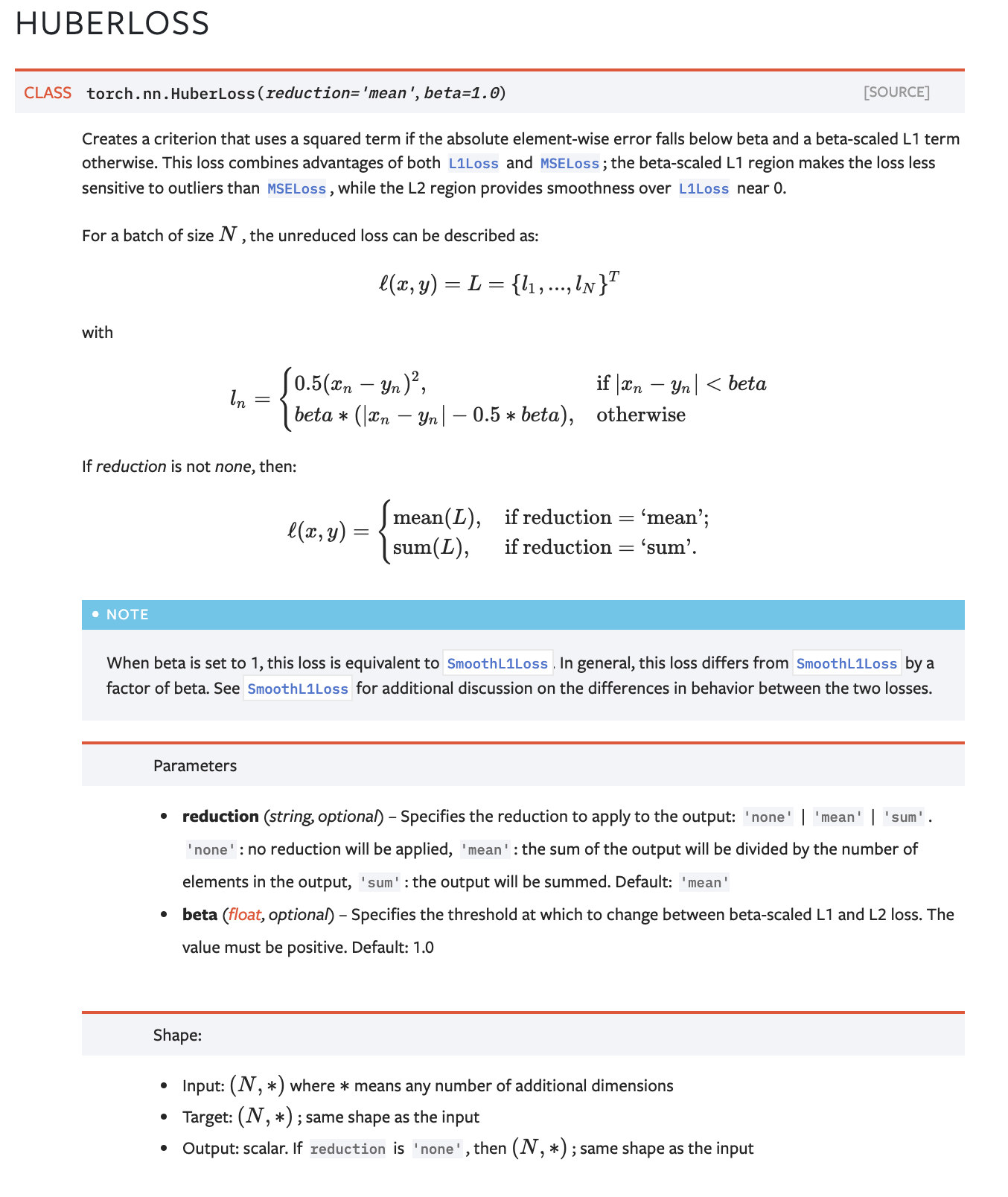
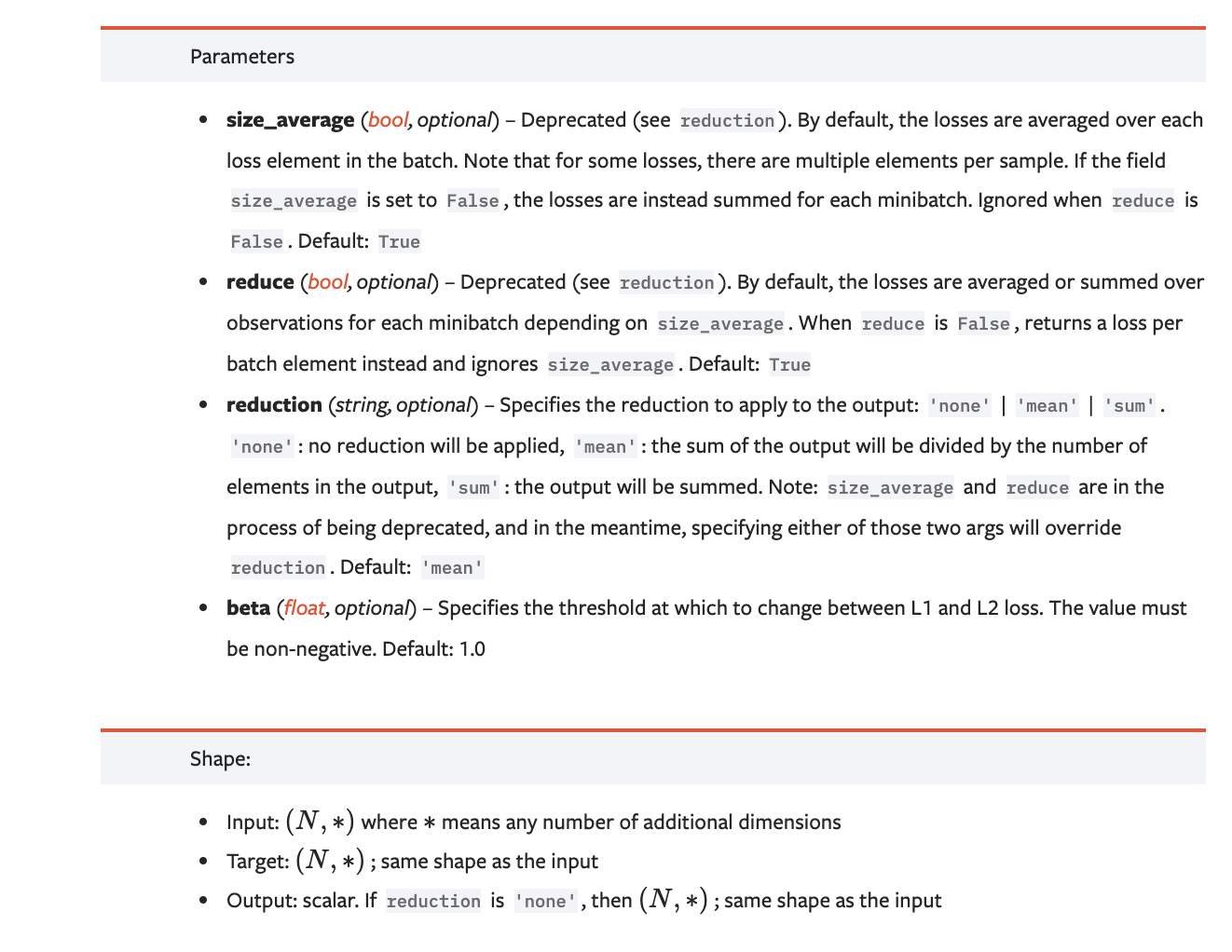
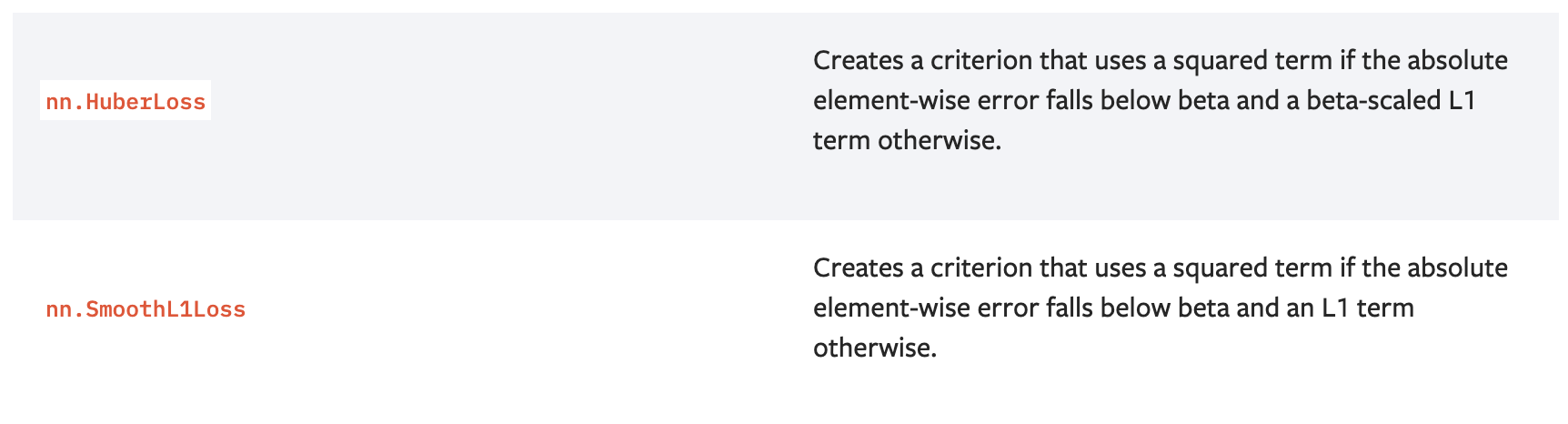
Summary: Fixes https://github.com/pytorch/pytorch/issues/48595. ## Background This PR implements HuberLoss, which differs from SmoothL1Loss by a factor of beta. The current implementation does not share logic between the two. Feedback is welcome for the optimal way to minimize code duplication while remaining performant. I've done some early [benchmarking](https://pytorch.org/tutorials/recipes/recipes/benchmark.html#collecting-instruction-counts-with-callgrind) with Huber calling in to the Smooth L1 kernel and scaling afterwards; for the simple test case I used, instruction counts are as follows: ``` Huber loss calls dedicated Huber kernel: 2,795,300 Huber loss calls Smooth L1 kernel and scales afterwards: 4,523,612 ``` With these numbers, instruction counts are ~62% higher when using the pre-existing Smooth L1 kernel. Pull Request resolved: https://github.com/pytorch/pytorch/pull/50553 Test Plan: ``` python test/test_nn.py TestNN.test_HuberLoss python test/test_nn.py TestNN.test_HuberLoss_delta python test/test_nn.py TestNN.test_huber_loss_invalid_delta python test/test_nn.py TestNNDeviceTypeCPU.test_smooth_l1_loss_vs_huber_loss_cpu python test/test_nn.py TestNNDeviceTypeCUDA.test_smooth_l1_loss_vs_huber_loss_cuda python test/test_nn.py TestNNDeviceTypeCPU.test_invalid_reduction_strings_cpu python test/test_nn.py TestNNDeviceTypeCUDA.test_invalid_reduction_strings_cuda python test/test_nn.py TestNN.test_loss_equal_input_target_shape python test/test_nn.py TestNN.test_pointwise_loss_broadcast python test/test_overrides.py python test/test_jit.py TestJitGeneratedFunctional.test_nn_huber_loss python test/test_type_hints.py python test/test_cpp_api_parity.py build/bin/test_api ``` ## Documentation <img width="677" alt="Screen Shot 2021-01-14 at 4 25 08 PM" src="https://user-images.githubusercontent.com/75754324/104651224-5a445980-5685-11eb-884b-14ea517958c2.png"> <img width="677" alt="Screen Shot 2021-01-14 at 4 24 35 PM" src="https://user-images.githubusercontent.com/75754324/104651190-4e589780-5685-11eb-974d-8c63a89c050e.png"> <img width="661" alt="Screen Shot 2021-01-14 at 4 24 45 PM" src="https://user-images.githubusercontent.com/75754324/104651198-50225b00-5685-11eb-958e-136b36f6f8a8.png"> <img width="869" alt="Screen Shot 2021-01-14 at 4 25 27 PM" src="https://user-images.githubusercontent.com/75754324/104651208-53b5e200-5685-11eb-9fe4-5ff433aa13c5.png"> <img width="862" alt="Screen Shot 2021-01-14 at 4 25 48 PM" src="https://user-images.githubusercontent.com/75754324/104651209-53b5e200-5685-11eb-8051-b0cfddcb07d3.png"> Reviewed By: H-Huang Differential Revision: D26734071 Pulled By: jbschlosser fbshipit-source-id: c98c1b5f32a16f7a2a4e04bdce678080eceed5d5


15025 lines
674 KiB
Python
15025 lines
674 KiB
Python
|
|
import math
|
|
import random
|
|
import string
|
|
import unittest
|
|
import io
|
|
import unittest.mock as mock
|
|
import itertools
|
|
import warnings
|
|
import pickle
|
|
from copy import deepcopy
|
|
from itertools import repeat, product
|
|
from functools import reduce
|
|
from operator import mul
|
|
from collections import OrderedDict
|
|
|
|
import torch
|
|
|
|
# TODO: remove this global setting
|
|
# NN tests use double as the default dtype
|
|
torch.set_default_dtype(torch.double)
|
|
|
|
from torch._six import inf, nan
|
|
import torch.backends.cudnn as cudnn
|
|
import torch.nn as nn
|
|
import torch.nn.functional as F
|
|
import torch.nn.init as init
|
|
import torch.nn.utils.rnn as rnn_utils
|
|
from torch.nn.utils import clip_grad_norm_, clip_grad_value_
|
|
import torch.nn.utils.prune as prune
|
|
from torch.nn.utils import parameters_to_vector, vector_to_parameters
|
|
from torch.nn import Parameter
|
|
from torch.nn.parameter import UninitializedParameter, UninitializedBuffer
|
|
from torch.nn.parallel._functions import Broadcast
|
|
from torch.testing import get_all_fp_dtypes
|
|
from torch.testing._internal.common_utils import freeze_rng_state, run_tests, TestCase, skipIfNoLapack, skipIfRocm, \
|
|
TEST_NUMPY, TEST_SCIPY, TEST_WITH_ROCM, download_file, \
|
|
get_function_arglist, load_tests, repeat_test_for_types, ALL_TENSORTYPES, \
|
|
ALL_TENSORTYPES2, suppress_warnings, TemporaryFileName, TEST_WITH_UBSAN, IS_PPC
|
|
from torch.testing._internal.common_cuda import TEST_CUDA, TEST_MULTIGPU, TEST_CUDNN, TEST_CUDNN_VERSION
|
|
from torch.testing._internal.common_nn import NNTestCase, NewModuleTest, CriterionTest, \
|
|
module_tests, criterion_tests, loss_reference_fns, \
|
|
ctcloss_reference, new_module_tests
|
|
from torch.testing._internal.common_device_type import instantiate_device_type_tests, dtypes, \
|
|
dtypesIfCUDA, precisionOverride, skipCUDAIfNoCudnn, skipCUDAIfCudnnVersionLessThan, onlyCUDA, onlyCPU, \
|
|
skipCUDAIfRocm, skipCUDAIf, skipCUDAIfNotRocm, onlyOnCPUAndCUDA, \
|
|
deviceCountAtLeast, expectedAlertNondeterministic, largeTensorTest
|
|
from torch.nn import MultiheadAttention
|
|
|
|
from hypothesis import given
|
|
import torch.testing._internal.hypothesis_utils as hu
|
|
from torch.testing._internal.common_utils import _assertGradAndGradgradChecks, gradcheck, gradgradcheck
|
|
from torch.testing._internal.common_utils import dtype2prec_DONTUSE
|
|
from torch.testing._internal.common_cuda import tf32_on_and_off, tf32_is_not_fp32, tf32_off, tf32_on
|
|
from torch.types import _TensorOrTensors
|
|
|
|
|
|
AMPERE_OR_ROCM = TEST_WITH_ROCM or tf32_is_not_fp32()
|
|
|
|
# load_tests from common_utils is used to automatically filter tests for
|
|
# sharding on sandcastle. This line silences flake warnings
|
|
load_tests = load_tests
|
|
|
|
if TEST_SCIPY:
|
|
from scipy import stats
|
|
import scipy.ndimage
|
|
|
|
if TEST_NUMPY:
|
|
import numpy as np
|
|
|
|
DOUBLE_TENSORTYPES = [torch.double]
|
|
|
|
|
|
# WARNING: If you add a new top-level test case to this file, you MUST
|
|
# update test/run_test.py to list it, otherwise it will NOT be run in
|
|
# CI.
|
|
|
|
|
|
class PackedSequenceTest(TestCase):
|
|
|
|
_type_by_name = {
|
|
'torch.DoubleTensor': (torch.DoubleTensor, 'double'),
|
|
'torch.FloatTensor': (torch.FloatTensor, 'float'),
|
|
# We leave out `'torch.HalfTensor': (torch.HalfTensor, 'half'),`
|
|
# because of an error in `pad_packed_sequence`
|
|
# > AttributeError: 'torch.HalfTensor' object has no attribute 'fill_'
|
|
'torch.LongTensor': (torch.LongTensor, 'long'),
|
|
'torch.IntTensor': (torch.IntTensor, 'int'),
|
|
'torch.ShortTensor': (torch.ShortTensor, 'short'),
|
|
'torch.CharTensor': (torch.CharTensor, 'char'),
|
|
'torch.ByteTensor': (torch.ByteTensor, 'byte'),
|
|
}
|
|
|
|
def __init__(self, *args, **kwargs):
|
|
super(PackedSequenceTest, self).__init__(*args, **kwargs)
|
|
self.batch_size = 5
|
|
self.max_length = 6
|
|
|
|
def _ordered_sequence(self, tensor_type):
|
|
"""Create ordered list of random sequences"""
|
|
seqs = [tensor_type(random.randint(1, self.max_length))
|
|
for _ in range(self.batch_size)]
|
|
if tensor_type == torch.ByteTensor:
|
|
seqs = [s.random_(0, 256) for s in seqs]
|
|
else:
|
|
seqs = [s.random_(-128, 128) for s in seqs]
|
|
ordered = sorted(seqs, key=len, reverse=True)
|
|
return ordered
|
|
|
|
def _padded_sequence(self, tensor_type):
|
|
"""Create Tensor of random padded sequences"""
|
|
ordered = self._ordered_sequence(tensor_type)
|
|
lengths = [len(i) for i in ordered]
|
|
padded_tensor = rnn_utils.pad_sequence(ordered)
|
|
return padded_tensor, lengths
|
|
|
|
def test_type_casts(self):
|
|
"""Test type casting of `PackedSequence` against type casting of tensor"""
|
|
for _, (input_type, _) in self._type_by_name.items():
|
|
for expected_type_str, (_, cast_str) in self._type_by_name.items():
|
|
for enforce_sorted in [True, False]:
|
|
padded, lengths = self._padded_sequence(input_type)
|
|
packed = rnn_utils.pack_padded_sequence(
|
|
padded, lengths, enforce_sorted=enforce_sorted)
|
|
# Apply cast to `PackedSequence` instance and unpack
|
|
masked = getattr(packed, cast_str)()
|
|
unpacked, lengths_out = rnn_utils.pad_packed_sequence(masked)
|
|
self.assertEqual(unpacked.type(), expected_type_str)
|
|
|
|
def test_wrong_order(self):
|
|
a = torch.ones(25, 300)
|
|
b = torch.ones(22, 300)
|
|
b_a = rnn_utils.pad_sequence([b, a])
|
|
self.assertRaises(
|
|
RuntimeError,
|
|
lambda: rnn_utils.pack_padded_sequence(b_a, [22, 25], enforce_sorted=True))
|
|
|
|
def test_total_length(self):
|
|
padded, lengths = self._padded_sequence(torch.FloatTensor)
|
|
max_length = max(lengths)
|
|
packed = rnn_utils.pack_padded_sequence(padded, lengths)
|
|
# test ValueError if total_length < max_length
|
|
for total_length in (-1, 0, max_length - 1):
|
|
for batch_first in (True, False):
|
|
def err_fn():
|
|
rnn_utils.pad_packed_sequence(packed, batch_first=batch_first,
|
|
total_length=total_length)
|
|
self.assertRaisesRegex(ValueError,
|
|
r'Expected total_length to be at least the '
|
|
r'length of the longest sequence in input',
|
|
err_fn)
|
|
# test that pad_packed_sequence returns results of correct length
|
|
for batch_first in (True, False):
|
|
no_extra_pad, _ = rnn_utils.pad_packed_sequence(packed, batch_first=batch_first)
|
|
for total_length_delta in (0, 1, 8):
|
|
total_length = max_length + total_length_delta
|
|
unpacked, lengths_out = rnn_utils.pad_packed_sequence(packed, batch_first=batch_first,
|
|
total_length=total_length)
|
|
self.assertEqual(lengths, lengths_out)
|
|
self.assertEqual(unpacked.size(1 if batch_first else 0), total_length)
|
|
if total_length_delta == 0:
|
|
ref_output = no_extra_pad
|
|
elif batch_first:
|
|
extra_pad = no_extra_pad.new_zeros(self.batch_size, total_length_delta)
|
|
ref_output = torch.cat([no_extra_pad, extra_pad], 1)
|
|
else:
|
|
extra_pad = no_extra_pad.new_zeros(total_length_delta, self.batch_size)
|
|
ref_output = torch.cat([no_extra_pad, extra_pad], 0)
|
|
self.assertEqual(unpacked, ref_output)
|
|
|
|
def test_to(self):
|
|
for enforce_sorted in (True, False):
|
|
padded, lengths = self._padded_sequence(torch.IntTensor)
|
|
a = rnn_utils.pack_padded_sequence(
|
|
padded, lengths, enforce_sorted=enforce_sorted).cpu()
|
|
|
|
self.assertIs(a, a.to('cpu'))
|
|
self.assertIs(a, a.cpu())
|
|
self.assertIs(a, a.to('cpu', dtype=torch.int32))
|
|
self.assertEqual(a.long(), a.to(torch.int64))
|
|
|
|
if torch.cuda.is_available():
|
|
for cuda in ['cuda', 'cuda:0' if torch.cuda.device_count() == 1 else 'cuda:1']:
|
|
b = a.cuda(device=cuda)
|
|
self.assertIs(b, b.to(cuda))
|
|
self.assertIs(b, b.cuda())
|
|
self.assertEqual(a, b.to('cpu'))
|
|
self.assertEqual(b, a.to(cuda))
|
|
self.assertEqual(a, b.to('cpu', dtype=torch.int32))
|
|
self.assertIs(b, b.to(dtype=torch.int32))
|
|
self.assertEqual(b.long(), b.to(dtype=torch.int64))
|
|
|
|
def test_to_memory_format(self):
|
|
m = torch.nn.Conv2d(in_channels=16, out_channels=32, kernel_size=2, bias=True)
|
|
m = m.to(memory_format=torch.channels_last)
|
|
for param in m.parameters():
|
|
if param.dim() == 4:
|
|
self.assertTrue(param.is_contiguous(memory_format=torch.channels_last))
|
|
|
|
class TestAvgPool(TestCase):
|
|
def _sum_pool2d(self, x, kernel_size):
|
|
windows = torch.nn.functional.unfold(x, kernel_size=kernel_size, stride=kernel_size)
|
|
return torch.sum(windows, dim=1)
|
|
|
|
def _sum_pool3d(self, x, kernel_size):
|
|
# Because unfold does not support 3D sliding window we will split tensor to multiple tensors and calculate sum
|
|
h = kernel_size[0]
|
|
splited_x = [t.sum(0) for t in x.split(h) if t.size(0) == h]
|
|
# sum_pool2d assumes tensor in (1, 1, n, m) view, so unsqueeze two times
|
|
splited_x = [self._sum_pool2d(t.unsqueeze(0).unsqueeze(0), kernel_size[1:]) for t in splited_x]
|
|
joined_x = torch.cat(splited_x)
|
|
return joined_x.view(1, joined_x.numel())
|
|
|
|
def _avg_pool2d(self, x, kernel_size):
|
|
size = reduce((lambda x, y: x * y), kernel_size)
|
|
return self._sum_pool2d(x, kernel_size) / size
|
|
|
|
def _avg_pool3d(self, x, kernel_size):
|
|
size = reduce((lambda x, y: x * y), kernel_size)
|
|
return self._sum_pool3d(x, kernel_size) / size
|
|
|
|
def test_doubletensor_avg_pool2d(self):
|
|
n, m = 5, 8
|
|
input = torch.rand(1, 1, n, m)
|
|
for i in range(1, n + 1):
|
|
for j in range(1, m + 1):
|
|
actual = torch.nn.functional.avg_pool2d(input[0], (i, j))
|
|
actual = actual.view(1, actual.numel())
|
|
expected = self._avg_pool2d(input, (i, j))
|
|
self.assertTrue(torch.allclose(actual, expected, rtol=0, atol=1e-5))
|
|
|
|
def test_avg_pool2d_with_zero_divisor(self):
|
|
self.assertRaisesRegex(RuntimeError, "divisor must be not zero",
|
|
lambda: F.avg_pool2d(torch.zeros(3, 3, 3), (2, 2), divisor_override=0))
|
|
|
|
def test_doubletensor_avg_pool2d_with_divisor(self):
|
|
n, m = 3, 3
|
|
input = torch.rand(1, 1, n, m)
|
|
for i in range(1, n + 1):
|
|
for j in range(1, m + 1):
|
|
for divisor in [1, 7, i * j]:
|
|
actual = F.avg_pool2d(input[0], (i, j), divisor_override=divisor)
|
|
actual = actual.view(1, actual.numel())
|
|
expected = self._sum_pool2d(input, (i, j)) / divisor
|
|
self.assertTrue(torch.allclose(actual, expected, rtol=0, atol=1e-5))
|
|
|
|
def test_doubletensor_avg_pool3d(self):
|
|
h, w, d = 5, 6, 7
|
|
input = torch.rand(h, w, d)
|
|
for i in range(1, h + 1):
|
|
for j in range(1, w + 1):
|
|
for k in range(1, d + 1):
|
|
actual = torch.nn.functional.avg_pool3d(input.unsqueeze(0), (i, j, k))
|
|
actual = actual.view(1, actual.numel())
|
|
expected = self._avg_pool3d(input, (i, j, k))
|
|
self.assertTrue(torch.allclose(actual, expected, rtol=0, atol=1e-5))
|
|
|
|
def test_doubletensor_avg_pool3d_with_divisor(self):
|
|
h, w, d = 6, 5, 7
|
|
input = torch.rand(h, w, d)
|
|
for i in range(1, h + 1):
|
|
for j in range(1, w + 1):
|
|
for k in range(1, d + 1):
|
|
for divisor in [1, 7, i * j]:
|
|
actual = torch.nn.functional.avg_pool3d(input.unsqueeze(0), (i, j, k), divisor_override=divisor)
|
|
actual = actual.view(1, actual.numel())
|
|
expected = self._sum_pool3d(input, (i, j, k)) / divisor
|
|
self.assertTrue(torch.allclose(actual, expected, rtol=0, atol=1e-5))
|
|
|
|
def test_avg_pool3d_with_zero_divisor(self):
|
|
self.assertRaisesRegex(RuntimeError, "divisor must be not zero",
|
|
lambda: F.avg_pool3d(torch.zeros(3, 3, 3, 3), (2, 2, 2), divisor_override=0))
|
|
|
|
def test_avg_pool1d_ceil_mode(self):
|
|
# Regression test for gh-36977
|
|
x = 10 * torch.randn((1, 16, 4))
|
|
y = torch.nn.functional.avg_pool1d(
|
|
x, ceil_mode=True, count_include_pad=True, kernel_size=1, stride=2)
|
|
self.assertTrue(not torch.isnan(y).any())
|
|
|
|
if TEST_CUDA:
|
|
y = torch.nn.functional.avg_pool1d(
|
|
x.to('cuda'), ceil_mode=True, count_include_pad=True, kernel_size=1, stride=2)
|
|
self.assertTrue(not torch.isnan(y).any())
|
|
|
|
|
|
def test_avg_pool2d_ceil_mode(self):
|
|
# Regression test for gh-36977
|
|
x = 10 * torch.randn((1, 16, 4, 4))
|
|
y = torch.nn.functional.avg_pool2d(
|
|
x, ceil_mode=True, count_include_pad=True, kernel_size=(1, 2),
|
|
padding=(0, 1), stride=2)
|
|
self.assertTrue(not torch.isnan(y).any())
|
|
|
|
if TEST_CUDA:
|
|
y = torch.nn.functional.avg_pool2d(
|
|
x.to('cuda'), ceil_mode=True, count_include_pad=True, kernel_size=(1, 2),
|
|
padding=(0, 1), stride=2)
|
|
self.assertTrue(not torch.isnan(y).any())
|
|
|
|
|
|
def test_avg_pool3d_ceil_mode(self):
|
|
# Regression test for gh-36977
|
|
x = 10 * torch.randn((1, 16, 4, 4, 4))
|
|
y = torch.nn.functional.avg_pool3d(
|
|
x, ceil_mode=True, count_include_pad=True, kernel_size=(1, 2, 3), stride=2)
|
|
self.assertTrue(not torch.isnan(y).any())
|
|
|
|
if TEST_CUDA:
|
|
y = torch.nn.functional.avg_pool3d(
|
|
x.to('cuda'), ceil_mode=True, count_include_pad=True, kernel_size=(1, 2, 3), stride=2)
|
|
self.assertTrue(not torch.isnan(y).any())
|
|
|
|
|
|
class TestNN(NNTestCase):
|
|
_do_cuda_memory_leak_check = True
|
|
_do_cuda_non_default_stream = True
|
|
|
|
def _forward(self, module, input: _TensorOrTensors):
|
|
with freeze_rng_state():
|
|
if isinstance(input, tuple):
|
|
return module(*input)
|
|
else:
|
|
return module(input)
|
|
|
|
def _backward(self, module, input: _TensorOrTensors, output, grad_output, create_graph=False):
|
|
output.backward(grad_output, retain_graph=True, create_graph=create_graph)
|
|
if isinstance(input, tuple):
|
|
return tuple(i.grad.data if i.grad is not None else None for i in input)
|
|
else:
|
|
return input.grad.data if input.grad is not None else None
|
|
|
|
def _forward_criterion(self, criterion, input, target, extra_args=None):
|
|
if extra_args is None:
|
|
extra_args = tuple()
|
|
if isinstance(input, tuple):
|
|
args = input + (target,) + extra_args
|
|
output = criterion(*args)
|
|
else:
|
|
output = criterion(input, target, *extra_args)
|
|
return output
|
|
|
|
def _backward_criterion(self, criterion, input, output, target, gradOutput=None, extra_args=None):
|
|
if extra_args is None:
|
|
extra_args = tuple()
|
|
input_tuple = input if isinstance(input, tuple) else (input,)
|
|
output_tuple = output if isinstance(output, tuple) else (output,)
|
|
for i in input_tuple:
|
|
if i.grad is not None:
|
|
i.grad.data.zero_()
|
|
args = input_tuple + (target,) + extra_args
|
|
if gradOutput is None:
|
|
gradOutput = torch.ones(())
|
|
criterion(*args).backward(gradOutput.to(output_tuple[0]))
|
|
if isinstance(input, tuple):
|
|
return tuple(i.grad.data for i in input)
|
|
else:
|
|
return input.grad.data
|
|
|
|
def _zero_grad_parameters(self, module):
|
|
for p in module.parameters():
|
|
if p.grad is not None:
|
|
with torch.no_grad():
|
|
p.grad.zero_()
|
|
p.grad.detach_()
|
|
|
|
def _get_parameters(self, module):
|
|
params = []
|
|
d_params = []
|
|
for p in module.parameters():
|
|
params.append(p)
|
|
d_params.append(p.grad)
|
|
return params, d_params
|
|
|
|
def _create_basic_net(self):
|
|
class Layer(nn.Module):
|
|
def __init__(self):
|
|
super(Layer, self).__init__()
|
|
self.layer_dummy_param = Parameter(torch.Tensor(3, 5))
|
|
self.register_buffer('layer_dummy_buf', torch.zeros(1, 3, 3, 7))
|
|
|
|
class Net(nn.Module):
|
|
def __init__(self):
|
|
super(Net, self).__init__()
|
|
self.l1 = Layer()
|
|
self.dummy_param = Parameter(torch.Tensor(3, 5))
|
|
self.register_buffer('dummy_buf', torch.zeros(7, 3, 3, 1))
|
|
|
|
l = Layer()
|
|
n = Net()
|
|
s = nn.Sequential(n, n)
|
|
|
|
return l, n, s
|
|
|
|
def test_requires_grad_(self):
|
|
m = self._create_basic_net()[-1]
|
|
assert len(list(m.buffers())) > 0, 'invalid test'
|
|
assert all(not b.requires_grad for b in m.buffers()) > 0, 'invalid test'
|
|
assert len(list(m.parameters())) > 0, 'invalid test'
|
|
assert all(p.requires_grad for p in m.parameters()) > 0, 'invalid test'
|
|
for requires_grad in (False, True):
|
|
self.assertIs(m.requires_grad_(requires_grad), m)
|
|
for p in m.parameters():
|
|
self.assertEqual(p.requires_grad, requires_grad)
|
|
for b in m.buffers():
|
|
self.assertFalse(b.requires_grad)
|
|
|
|
def test_module_backcompat(self):
|
|
from torch.serialization import SourceChangeWarning
|
|
path = download_file('https://download.pytorch.org/test_data/linear.pt')
|
|
with warnings.catch_warnings():
|
|
warnings.simplefilter('ignore', SourceChangeWarning)
|
|
m = torch.load(path)
|
|
input = torch.randn(2, 3, dtype=torch.float)
|
|
self.assertEqual(m(input).size(), (2, 5))
|
|
|
|
def test_conv_backcompat(self):
|
|
from torch.serialization import SourceChangeWarning
|
|
# This file was generated by running on PyTorch 1.0.1 on Python 2:
|
|
#
|
|
# import torch
|
|
# from torch import nn
|
|
# m = nn.Conv2d(1, 1, 1)
|
|
# torch.save(m, 'legacy_conv2d.pt')
|
|
#
|
|
# NB: This Pickle also contains some Unicode data!
|
|
path = download_file('https://download.pytorch.org/test_data/legacy_conv2d.pt')
|
|
with warnings.catch_warnings():
|
|
warnings.simplefilter('ignore', SourceChangeWarning)
|
|
m = torch.load(path, encoding='utf-8')
|
|
input = torch.randn((1, 1, 1, 1), dtype=torch.float)
|
|
self.assertEqual(m(input).size(), (1, 1, 1, 1))
|
|
|
|
def test_share_memory(self):
|
|
class Net(nn.Module):
|
|
def __init__(self):
|
|
super(Net, self).__init__()
|
|
self.p = nn.Parameter(torch.eye(5))
|
|
self.par = nn.ParameterList()
|
|
self.par.append(nn.Parameter(torch.randn(10)))
|
|
|
|
def forward(self, inp):
|
|
# NB: dead code
|
|
return inp.clone()
|
|
|
|
net = Net()
|
|
for p in net.parameters():
|
|
self.assertFalse(p.storage().is_shared())
|
|
for b in net.buffers():
|
|
self.assertFalse(b.storage().is_shared())
|
|
net.share_memory()
|
|
for p in net.parameters():
|
|
self.assertTrue(p.storage().is_shared())
|
|
for b in net.buffers():
|
|
self.assertTrue(b.storage().is_shared())
|
|
|
|
def _test_hooks(self, backward_register_fn):
|
|
module = nn.Sigmoid()
|
|
input = torch.ones(5, 5, requires_grad=True)
|
|
|
|
counter = {
|
|
'forwards': 0,
|
|
'backwards': 0
|
|
}
|
|
|
|
def fw_hook(inc, h_module, input, output):
|
|
self.assertIsInstance(input, tuple)
|
|
self.assertTrue(isinstance(output, torch.Tensor))
|
|
self.assertTrue(h_module is module)
|
|
self.assertEqual(input[0], torch.ones(5, 5))
|
|
self.assertEqual(output, torch.Tensor(5, 5).fill_(1 / (1 + 1 / math.e)))
|
|
counter['forwards'] += inc
|
|
|
|
def bw_hook(inc, h_module, grad_input, grad_output):
|
|
self.assertIsInstance(grad_input, tuple)
|
|
self.assertIsInstance(grad_output, tuple)
|
|
self.assertTrue(h_module is module)
|
|
self.assertEqual(grad_output[0], torch.ones(5, 5) * 2)
|
|
counter['backwards'] += inc
|
|
|
|
test_fwd = module.register_forward_hook(lambda *args: fw_hook(1, *args))
|
|
|
|
module(input)
|
|
module(input)
|
|
self.assertEqual(counter['forwards'], 2)
|
|
self.assertEqual(counter['backwards'], 0)
|
|
|
|
test_bwd = getattr(module, backward_register_fn)(
|
|
lambda *args: bw_hook(1, *args))
|
|
|
|
output = module(input)
|
|
self.assertEqual(counter['forwards'], 3)
|
|
self.assertEqual(counter['backwards'], 0)
|
|
|
|
output.backward(torch.ones(5, 5) * 2, retain_graph=True)
|
|
self.assertEqual(counter['forwards'], 3)
|
|
self.assertEqual(counter['backwards'], 1)
|
|
|
|
output.backward(torch.ones(5, 5) * 2, retain_graph=True)
|
|
self.assertEqual(counter['forwards'], 3)
|
|
self.assertEqual(counter['backwards'], 2)
|
|
|
|
test2_fwd = module.register_forward_hook(lambda *args: fw_hook(2, *args))
|
|
|
|
output = module(input)
|
|
self.assertEqual(counter['forwards'], 6)
|
|
self.assertEqual(counter['backwards'], 2)
|
|
|
|
test2_bwd = getattr(module, backward_register_fn)(lambda *args: bw_hook(2, *args))
|
|
|
|
module(input).backward(torch.ones(5, 5) * 2)
|
|
self.assertEqual(counter['forwards'], 9)
|
|
self.assertEqual(counter['backwards'], 5)
|
|
|
|
test2_bwd.remove()
|
|
|
|
module(input).backward(torch.ones(5, 5) * 2)
|
|
self.assertEqual(counter['forwards'], 12)
|
|
self.assertEqual(counter['backwards'], 6)
|
|
|
|
test2_fwd.remove()
|
|
|
|
module(input).backward(torch.ones(5, 5) * 2)
|
|
self.assertEqual(counter['forwards'], 13)
|
|
self.assertEqual(counter['backwards'], 7)
|
|
|
|
test_fwd.remove()
|
|
test_bwd.remove()
|
|
|
|
def test_hooks(self):
|
|
self._test_hooks("register_backward_hook")
|
|
self._test_hooks("register_full_backward_hook")
|
|
|
|
def test_hook_cpp(self):
|
|
bn = nn.BatchNorm1d(5)
|
|
|
|
def hook(module, grad_inputs, grad_outputs):
|
|
self.assertEqual(len(grad_inputs), 1)
|
|
self.assertEqual(len(grad_outputs), 1)
|
|
self.assertEqual(module, bn)
|
|
|
|
bn.register_full_backward_hook(hook)
|
|
output = bn(torch.randn(5, 5, requires_grad=True))
|
|
output.sum().backward()
|
|
|
|
def test_hook_invalid_outputs(self):
|
|
module = nn.Sigmoid()
|
|
input = torch.randn(5, 5, requires_grad=True)
|
|
|
|
def bw_fail1(self, grad_input, grad_output):
|
|
return grad_input[:-1]
|
|
|
|
def bw_fail2(self, grad_input, grad_output):
|
|
return grad_input + (torch.randn(2, 2),)
|
|
|
|
with module.register_backward_hook(bw_fail1):
|
|
with self.assertRaisesRegex(RuntimeError, 'got 0, but expected 1'):
|
|
module(input).sum().backward()
|
|
|
|
with module.register_backward_hook(bw_fail2):
|
|
with self.assertRaisesRegex(RuntimeError, 'got 2, but expected 1'):
|
|
module(input).sum().backward()
|
|
|
|
def test_hook_requires_grad(self):
|
|
test_self = self
|
|
|
|
class MyModule(nn.Module):
|
|
def forward(self, arg1, arg2, arg3):
|
|
test_self.assertTrue(arg1.requires_grad)
|
|
test_self.assertFalse(arg2.requires_grad)
|
|
test_self.assertTrue(arg3.requires_grad)
|
|
return arg1.sum() + arg2.sum() + arg3.sum()
|
|
|
|
inp = torch.rand(2, requires_grad=True)
|
|
mod = MyModule()
|
|
|
|
mod(inp, inp.detach(), inp)
|
|
# Ensure that requires grad is properly propagated
|
|
mod.register_full_backward_hook(lambda mod, gI, gO: None)
|
|
mod(inp, inp.detach(), inp)
|
|
|
|
def test_hook_extra_input(self):
|
|
class MyModule(nn.Module):
|
|
def forward(self, non_tensor, tensor):
|
|
return tensor.clone(), non_tensor
|
|
|
|
inp = torch.rand(2, requires_grad=True)
|
|
mod = MyModule()
|
|
|
|
def hook(mod, grad_input, grad_output):
|
|
self.assertIsNone(grad_input[0])
|
|
self.assertIsInstance(grad_input[1], torch.Tensor)
|
|
|
|
self.assertIsInstance(grad_output[0], torch.Tensor)
|
|
self.assertIsNone(grad_output[1])
|
|
|
|
mod.register_full_backward_hook(hook)
|
|
out, _ = mod(True, inp)
|
|
out.sum().backward()
|
|
|
|
def test_hook_inplace(self):
|
|
class MyModule(nn.Module):
|
|
def forward(self, inp, do_inplace):
|
|
self.inp = inp
|
|
if do_inplace:
|
|
inp += 1
|
|
return inp.clone()
|
|
|
|
hook_called = [0]
|
|
|
|
def hook(mod, grad_input, grad_output):
|
|
hook_called[0] += 1
|
|
|
|
inp = torch.rand(10, requires_grad=True)
|
|
mod = MyModule()
|
|
mod.register_full_backward_hook(hook)
|
|
|
|
# No inplace should work
|
|
mod(inp, False).sum().backward()
|
|
self.assertEqual(hook_called[0], 1)
|
|
|
|
# Input inplace error should throw an error (warning during deprecation cycle)
|
|
with self.assertWarnsRegex(UserWarning, "Output 0 of BackwardHookFunctionBackward is "
|
|
"a view and is being modified inplace."):
|
|
mod(inp.clone(), True)
|
|
|
|
# Input inplace error should throw an error if we try to re-use the view after they have
|
|
# been modified (warning during deprecation cycle)
|
|
local_inp = inp.clone()
|
|
out = mod(local_inp, False)
|
|
local_inp[0] *= 1
|
|
with self.assertWarnsRegex(UserWarning, "Output 0 of BackwardHookFunctionBackward is "
|
|
"a view and its base or another view"):
|
|
# Any operation involving the view will fail here
|
|
mod.inp + 2
|
|
|
|
# Output inplace error should throw an error (warning during deprecation cycle)
|
|
with self.assertWarnsRegex(UserWarning, "BackwardHookFunctionBackward is a view "
|
|
"and is being modified inplace."):
|
|
# This error won't happen once the warning above is a proper error
|
|
with self.assertRaisesRegex(RuntimeError, "Module backward hook for grad_input is "
|
|
"called before the grad_output one."):
|
|
out = mod(inp, False)
|
|
out += 1
|
|
out.sum().backward()
|
|
|
|
def test_hook_non_full_warning(self):
|
|
def noop(*args):
|
|
pass
|
|
|
|
a = torch.rand(2, requires_grad=True)
|
|
b = torch.rand(2, requires_grad=True)
|
|
|
|
# Check invalid input container
|
|
class MyModule(nn.Module):
|
|
def forward(self, l):
|
|
return l[0].clone(), l[1].clone()
|
|
|
|
m = MyModule()
|
|
m.register_backward_hook(noop)
|
|
|
|
with self.assertWarnsRegex(UserWarning, "does not take as input a single Tensor or a tuple of Tensors"):
|
|
m([a, b])
|
|
|
|
# Check invalid output container
|
|
class MyModule(nn.Module):
|
|
def forward(self, a, b):
|
|
return [a.clone(), b.clone()]
|
|
|
|
m = MyModule()
|
|
m.register_backward_hook(noop)
|
|
|
|
with self.assertWarnsRegex(UserWarning, "does not return a single Tensor or a tuple of Tensors"):
|
|
m(a, b)
|
|
|
|
# Check invalid output from different Nodes
|
|
class MyModule(nn.Module):
|
|
def forward(self, a, b):
|
|
return a.clone(), b.clone()
|
|
|
|
m = MyModule()
|
|
m.register_backward_hook(noop)
|
|
|
|
with self.assertWarnsRegex(UserWarning, "outputs are generated by different autograd Nodes"):
|
|
m(a, b)
|
|
|
|
# Check invalid forward with multiple Nodes
|
|
class MyModule(nn.Module):
|
|
def forward(self, a):
|
|
return a.clone().clone()
|
|
|
|
m = MyModule()
|
|
m.register_backward_hook(noop)
|
|
|
|
with self.assertWarnsRegex(UserWarning, "the forward contains multiple autograd Nodes"):
|
|
m(a)
|
|
|
|
def test_hook_backward_size(self):
|
|
# Make module with multiple operations in forward
|
|
# And different size for input and outputs
|
|
class MyModule(nn.Module):
|
|
def forward(self, arg1, arg2):
|
|
tmp = arg1.sum() * arg2
|
|
tmp = tmp + arg2.sum() * arg1.sum()
|
|
tmp = tmp.sum().view(1)
|
|
tmp = tmp.expand(8).contiguous()
|
|
return tmp
|
|
|
|
module = MyModule()
|
|
inp1 = torch.randn(5, 5, requires_grad=True)
|
|
inp2 = torch.randn(10, 10, requires_grad=True)
|
|
|
|
def bw_hook(module, grad_input, grad_output):
|
|
self.assertEqual(len(grad_input), 2)
|
|
self.assertEqual(grad_input[0].size(), torch.Size([5, 5]))
|
|
self.assertEqual(grad_input[1].size(), torch.Size([10, 10]))
|
|
self.assertEqual(len(grad_output), 1)
|
|
self.assertEqual(grad_output[0].size(), torch.Size([8]))
|
|
|
|
with module.register_full_backward_hook(bw_hook):
|
|
module(inp1, inp2).sum().backward()
|
|
|
|
def test_hook_backward_writeable(self):
|
|
module = nn.Sigmoid()
|
|
input = torch.randn(5, 5, requires_grad=True)
|
|
sig_x = torch.nn.functional.sigmoid(input)
|
|
|
|
def bw_hook(module, grad_input, grad_output):
|
|
for grad in grad_input:
|
|
self.assertTrue(isinstance(grad, torch.Tensor))
|
|
for grad in grad_output:
|
|
self.assertTrue(isinstance(grad, torch.Tensor))
|
|
return tuple(gi * 2 for gi in grad_input)
|
|
|
|
module.register_backward_hook(bw_hook)
|
|
module(input).backward(torch.ones(5, 5))
|
|
expected_grad = sig_x * (1 - sig_x) * 2
|
|
self.assertEqual(input.grad, expected_grad)
|
|
|
|
def test_hook_forward_preforward_writable(self):
|
|
module = nn.Sigmoid()
|
|
input = torch.randn(5, 5, requires_grad=True)
|
|
sig_x = torch.nn.functional.sigmoid(input)
|
|
|
|
def forward_pre_hook(m, input):
|
|
return torch.nn.functional.relu(input[0])
|
|
|
|
def forward_hook(m, input, output):
|
|
return -output
|
|
|
|
module.register_forward_pre_hook(forward_pre_hook)
|
|
module.register_forward_hook(forward_hook)
|
|
output = module(input)
|
|
expected_res = -torch.nn.functional.sigmoid(torch.nn.functional.relu(input))
|
|
self.assertEqual(output, expected_res)
|
|
output.backward(torch.ones(5, 5) * 2, retain_graph=True)
|
|
mask = (input > 0).double()
|
|
expected_grad = -sig_x * (1 - sig_x) * 2 * mask
|
|
self.assertEqual(input.grad, expected_grad)
|
|
|
|
def test_to(self):
|
|
m = nn.Linear(3, 5)
|
|
self.assertIs(m, m.to('cpu'))
|
|
self.assertIs(m, m.to('cpu', dtype=torch.float32))
|
|
self.assertEqual(m.double(), m.to(torch.float64))
|
|
self.assertRaises(RuntimeError, lambda: m.to('cpu', copy=True))
|
|
|
|
if torch.cuda.is_available():
|
|
for cuda in ['cuda', 'cuda:0' if torch.cuda.device_count() == 1 else 'cuda:1']:
|
|
m2 = m.cuda(device=cuda)
|
|
self.assertIs(m2, m2.to(cuda))
|
|
self.assertEqual(m, m2.to('cpu'))
|
|
self.assertEqual(m2, m.to(cuda))
|
|
self.assertIs(m2, m2.to(dtype=torch.float32))
|
|
self.assertEqual(m2.double(), m2.to(dtype=torch.float64))
|
|
|
|
def test_zero_grad(self):
|
|
i = torch.randn(2, 5, requires_grad=True)
|
|
module = nn.Linear(5, 5)
|
|
for p in module.parameters():
|
|
p.requires_grad = False
|
|
module.zero_grad()
|
|
|
|
module.weight.requires_grad = True
|
|
module.zero_grad()
|
|
self.assertIsNone(module.weight.grad) # uninitialized grad
|
|
|
|
module(i).sum().backward()
|
|
self.assertIsNotNone(module.weight.grad)
|
|
self.assertGreater(module.weight.grad.data.abs().sum(), 0)
|
|
module.zero_grad()
|
|
self.assertEqual(module.weight.grad.data, module.weight.data.clone().zero_())
|
|
|
|
module.bias.requires_grad = True
|
|
module.zero_grad()
|
|
self.assertIsNotNone(module.weight.grad)
|
|
self.assertIsNone(module.bias.grad)
|
|
module(i).sum().backward()
|
|
self.assertIsNotNone(module.weight.grad)
|
|
self.assertIsNotNone(module.bias.grad)
|
|
self.assertGreater(module.weight.grad.data.abs().sum(), 0)
|
|
self.assertGreater(module.bias.grad.data.abs().sum(), 0)
|
|
module.zero_grad()
|
|
self.assertEqual(module.weight.grad.data, module.weight.data.clone().zero_())
|
|
self.assertEqual(module.bias.grad.data, module.bias.data.clone().zero_())
|
|
|
|
# Force set to None.
|
|
module.zero_grad(set_to_none=True)
|
|
self.assertIsNone(module.weight.grad)
|
|
|
|
|
|
def test_no_grad(self):
|
|
for dtype in [torch.bfloat16, torch.float, torch.double]:
|
|
module = nn.Conv2d(2, 5, kernel_size=3, padding=1).to(dtype)
|
|
input = torch.randn(1, 2, 10, 10).to(dtype)
|
|
x = input
|
|
y = input.clone()
|
|
|
|
output = module(x)
|
|
self.assertTrue(output.requires_grad)
|
|
output.backward(torch.ones(1, 5, 10, 10))
|
|
|
|
with torch.no_grad():
|
|
output2 = module(y)
|
|
self.assertFalse(output2.requires_grad)
|
|
self.assertRaises(RuntimeError, lambda: output2.backward(torch.ones(1, 5, 10, 10)))
|
|
|
|
def test_invalid_conv1d(self):
|
|
for dtype in [torch.bfloat16, torch.float, torch.double]:
|
|
module = nn.Conv1d(in_channels=3, out_channels=33, kernel_size=10, stride=1, bias=True).to(dtype)
|
|
input = torch.randn(1, 3, 4).to(dtype)
|
|
with self.assertRaisesRegex(RuntimeError,
|
|
r'Calculated padded input size per channel: \(4\). ' +
|
|
r'Kernel size: \(10\). Kernel size can\'t be greater than actual input size'):
|
|
module(input)
|
|
|
|
# Negative stride check
|
|
module = nn.Conv1d(in_channels=3, out_channels=6, kernel_size=3, stride=-1, bias=True).to(dtype)
|
|
input = torch.randn(1, 3, 4).to(dtype)
|
|
with self.assertRaisesRegex(RuntimeError, 'non-positive stride is not supported'):
|
|
module(input)
|
|
|
|
def test_mismatch_shape_conv2d(self):
|
|
x = torch.randn(1, 10, 1, 28, 28)
|
|
w = torch.randn(6, 1, 5, 5)
|
|
|
|
with self.assertRaisesRegex(RuntimeError,
|
|
r'Expected 4-dimensional input for 4-dimensional weight \[6, 1, 5, 5\],' +
|
|
r' but got 5-dimensional input of size \[1, 10, 1, 28, 28\] instead'):
|
|
|
|
F.conv2d(x, w)
|
|
|
|
def test_invalid_conv2d(self):
|
|
for dtype in [torch.bfloat16, torch.float, torch.double]:
|
|
module = torch.nn.Conv2d(1, 1, kernel_size=3, dilation=2, stride=2).to(dtype)
|
|
input = torch.empty(1, 1, 4, 4).to(dtype)
|
|
self.assertRaises(RuntimeError, lambda: module(input))
|
|
|
|
module = nn.Conv2d(in_channels=3, out_channels=33, kernel_size=10, stride=1, bias=True)
|
|
input = torch.randn(1, 3, 1, 1)
|
|
with self.assertRaisesRegex(RuntimeError,
|
|
r'Calculated padded input size per channel: \(1 x 1\). ' +
|
|
r'Kernel size: \(10 x 10\). Kernel size can\'t be greater than actual input size'):
|
|
module(input)
|
|
|
|
# Negative stride check
|
|
module = nn.Conv2d(in_channels=3, out_channels=6, kernel_size=4, stride=-1, bias=True).to(dtype)
|
|
input = torch.randn(1, 3, 4, 4).to(dtype)
|
|
with self.assertRaisesRegex(RuntimeError, 'non-positive stride is not supported'):
|
|
module(input)
|
|
|
|
# Zero stride check
|
|
module = nn.Conv2d(in_channels=3, out_channels=6, kernel_size=4, stride=0, bias=True).to(dtype)
|
|
input = torch.randn(1, 3, 4, 4).to(dtype)
|
|
with self.assertRaisesRegex(RuntimeError, 'non-positive stride is not supported'):
|
|
module(input)
|
|
|
|
def test_invalid_conv3d(self):
|
|
for dtype in [torch.bfloat16, torch.float, torch.double]:
|
|
module = torch.nn.Conv3d(1, 1, kernel_size=3, dilation=2, stride=2).to(dtype)
|
|
input = torch.empty(1, 1, 4, 4, 4).to(dtype)
|
|
self.assertRaises(RuntimeError, lambda: module(input))
|
|
|
|
# Negative stride check
|
|
module = torch.nn.Conv3d(1, 1, kernel_size=3, stride=-2)
|
|
input = torch.empty(1, 1, 4, 4, 4)
|
|
with self.assertRaisesRegex(RuntimeError, 'non-positive stride is not supported'):
|
|
module(input)
|
|
|
|
def _test_alpha_dropout(self, cls, input):
|
|
mean = input.mean()
|
|
std = input.std()
|
|
|
|
for p in [0.2, 0.5, 0.8]:
|
|
module = cls(p)
|
|
input_var = input.detach().clone().requires_grad_()
|
|
output = module(input_var)
|
|
# output mean should be close to input mean
|
|
self.assertLess(abs(output.data.mean() - mean), 0.1)
|
|
# output std should be close to input std
|
|
self.assertLess(abs(output.data.std() - std), 0.1)
|
|
output.backward(input)
|
|
|
|
def test_parameters_and_named_parameters(self):
|
|
def names(named_parameters):
|
|
return [k for k, _ in named_parameters]
|
|
|
|
l, n, s = self._create_basic_net()
|
|
|
|
self.assertEqual(len(list(l.parameters())), 1)
|
|
self.assertEqual(
|
|
names(l.named_parameters()),
|
|
['layer_dummy_param'])
|
|
|
|
self.assertEqual(len(list(n.parameters())), 2)
|
|
self.assertEqual(
|
|
names(n.named_parameters()),
|
|
['dummy_param', 'l1.layer_dummy_param'])
|
|
|
|
self.assertEqual(len(list(n.parameters(recurse=False))), 1)
|
|
self.assertEqual(
|
|
names(n.named_parameters(recurse=False)),
|
|
['dummy_param'])
|
|
|
|
self.assertEqual(len(list(s.parameters())), 2)
|
|
self.assertEqual(
|
|
names(s.named_parameters()),
|
|
['0.dummy_param', '0.l1.layer_dummy_param'])
|
|
|
|
def test_buffers_and_named_buffers(self):
|
|
def names(named_buffers):
|
|
return [k for k, _ in named_buffers]
|
|
|
|
l, n, s = self._create_basic_net()
|
|
|
|
self.assertEqual(len(list(l.buffers())), 1)
|
|
self.assertEqual(
|
|
names(l.named_buffers()),
|
|
['layer_dummy_buf'])
|
|
|
|
self.assertEqual(len(list(n.buffers())), 2)
|
|
self.assertEqual(
|
|
names(n.named_buffers()),
|
|
['dummy_buf', 'l1.layer_dummy_buf'])
|
|
|
|
self.assertEqual(len(list(n.buffers(recurse=False))), 1)
|
|
self.assertEqual(
|
|
names(n.named_buffers(recurse=False)),
|
|
['dummy_buf'])
|
|
|
|
self.assertEqual(len(list(s.buffers())), 2)
|
|
self.assertEqual(
|
|
names(s.named_buffers()),
|
|
['0.dummy_buf', '0.l1.layer_dummy_buf'])
|
|
|
|
def test_call_supports_python_dict_output(self):
|
|
class Net(nn.Module):
|
|
def __init__(self):
|
|
super(Net, self).__init__()
|
|
self.l1 = nn.Linear(10, 20)
|
|
self.register_backward_hook(self.hook)
|
|
self.check_backward_hook_flag = False
|
|
|
|
def hook(self, module, grad_out, grad_in):
|
|
self.check_backward_hook_flag = True
|
|
|
|
def forward(self, inputs):
|
|
return {"output": self.l1(inputs).sum()}
|
|
|
|
net = Net()
|
|
model_output = net(torch.randn([5, 10]))
|
|
model_output["output"].backward()
|
|
self.assertTrue(net.check_backward_hook_flag)
|
|
|
|
def test_children(self):
|
|
l1 = nn.Linear(2, 2)
|
|
l2 = nn.Linear(2, 2)
|
|
l3 = nn.Linear(2, 2)
|
|
l4 = nn.Linear(2, 2)
|
|
subnet = nn.Sequential(l3, l4)
|
|
s = nn.Sequential(l1, l2, l1, l2, subnet)
|
|
self.assertEqual(list(s.children()), [l1, l2, subnet])
|
|
|
|
def test_dir(self):
|
|
linear = nn.Linear(2, 2)
|
|
linear._test_submodule = nn.Linear(2, 2)
|
|
linear._test_parameter = Parameter(torch.Tensor(2, 2))
|
|
linear.register_buffer('_test_buffer', torch.Tensor(2, 2))
|
|
keys = dir(linear)
|
|
self.assertIn('_test_submodule', keys)
|
|
self.assertIn('_test_parameter', keys)
|
|
self.assertIn('_test_buffer', keys)
|
|
|
|
for key in keys:
|
|
self.assertTrue(hasattr(linear, key))
|
|
|
|
def test_repr(self):
|
|
# no extra information or sub-modules
|
|
empty_sequential = nn.Sequential()
|
|
expected_repr_empty = 'Sequential()'
|
|
self.assertEqual(repr(empty_sequential), expected_repr_empty)
|
|
|
|
# one liner extra information
|
|
linear = nn.Linear(1, 1)
|
|
expected_repr_linear = 'Linear(in_features=1, out_features=1, bias=True)'
|
|
self.assertEqual(repr(linear), expected_repr_linear)
|
|
|
|
# sub-modules repr
|
|
sequential = nn.Sequential(linear)
|
|
expected_repr_sequential = 'Sequential(\n' \
|
|
' (0): Linear(in_features=1, out_features=1, bias=True)\n' \
|
|
')'
|
|
self.assertEqual(repr(sequential), expected_repr_sequential)
|
|
|
|
def test_dir_digit(self):
|
|
model = nn.Sequential(nn.Linear(2, 2))
|
|
keys = dir(model)
|
|
self.assertNotIn('0', keys)
|
|
|
|
def test_named_children(self):
|
|
l1 = nn.Linear(2, 2)
|
|
l2 = nn.Linear(2, 2)
|
|
l3 = nn.Linear(2, 2)
|
|
l4 = nn.Linear(2, 2)
|
|
subnet = nn.Sequential(l3, l4)
|
|
s = nn.Sequential()
|
|
with self.assertRaises(KeyError):
|
|
s.add_module('', l1)
|
|
with self.assertRaises(KeyError):
|
|
s.add_module('name.with.dot', l1)
|
|
s.add_module('layer1', l1)
|
|
s.add_module('layer2', l2)
|
|
s.add_module('layer3', l1)
|
|
s.add_module('layer4', l2)
|
|
s.add_module('subnet', subnet)
|
|
self.assertEqual(list(s.named_children()), [('layer1', l1), ('layer2', l2), ('subnet', subnet)])
|
|
|
|
def test_modules(self):
|
|
class Net(nn.Module):
|
|
def __init__(self):
|
|
super(Net, self).__init__()
|
|
self.l1 = l
|
|
self.l2 = l
|
|
self.param = torch.empty(3, 5)
|
|
|
|
l = nn.Linear(10, 20)
|
|
n = Net()
|
|
s = nn.Sequential(n, n, n, n)
|
|
self.assertEqual(list(s.modules()), [s, n, l])
|
|
|
|
def test_named_modules(self):
|
|
class Net(nn.Module):
|
|
def __init__(self):
|
|
super(Net, self).__init__()
|
|
self.l1 = l
|
|
self.l2 = l
|
|
self.param = torch.empty(3, 5)
|
|
self.block = block
|
|
l = nn.Linear(10, 20)
|
|
l1 = nn.Linear(10, 20)
|
|
l2 = nn.Linear(10, 20)
|
|
block = nn.Sequential()
|
|
block.add_module('linear1', l1)
|
|
block.add_module('linear2', l2)
|
|
n = Net()
|
|
s = nn.Sequential(n, n, n, n)
|
|
self.assertEqual(list(s.named_modules()), [('', s), ('0', n), ('0.l1', l),
|
|
('0.block', block), ('0.block.linear1', l1),
|
|
('0.block.linear2', l2)])
|
|
|
|
def test_register_buffer_raises_error_if_name_is_not_string(self):
|
|
m = nn.Module()
|
|
expected_error = 'buffer name should be a string. Got '
|
|
with self.assertRaisesRegex(TypeError, expected_error + 'int'):
|
|
m.register_buffer(1, torch.rand(5))
|
|
with self.assertRaisesRegex(TypeError, expected_error + 'NoneType'):
|
|
m.register_buffer(None, torch.rand(5))
|
|
|
|
def test_register_buffer_raises_error_if_attr_exists(self):
|
|
m = nn.Module()
|
|
m.attribute_name = 5
|
|
with self.assertRaises(KeyError):
|
|
m.register_buffer('attribute_name', torch.rand(5))
|
|
|
|
del m.attribute_name
|
|
m.register_parameter('attribute_name', nn.Parameter())
|
|
with self.assertRaises(KeyError):
|
|
m.register_buffer('attribute_name', torch.rand(5))
|
|
|
|
del m.attribute_name
|
|
m.add_module('attribute_name', nn.Module())
|
|
with self.assertRaises(KeyError):
|
|
m.register_buffer('attribute_name', torch.rand(5))
|
|
|
|
def test_register_buffer_raises_error_if_not_tensor(self):
|
|
m = nn.Module()
|
|
with self.assertRaises(TypeError):
|
|
m.register_buffer('attribute_name', 5)
|
|
|
|
def test_register_buffer_allows_overwriting_with_same_name(self):
|
|
m = nn.Module()
|
|
buffer1 = torch.rand(5)
|
|
buffer2 = buffer1 + 5
|
|
buffer3 = None
|
|
m.register_buffer('buffer_name', buffer1)
|
|
self.assertEqual(m.buffer_name, buffer1)
|
|
m.register_buffer('buffer_name', buffer2)
|
|
self.assertEqual(m.buffer_name, buffer2)
|
|
m.register_buffer('buffer_name', buffer3)
|
|
self.assertEqual(m.buffer_name, buffer3)
|
|
|
|
def test_buffer_not_persistent(self):
|
|
m = nn.Module()
|
|
m.register_buffer('buf', torch.rand(5), persistent=False)
|
|
self.assertTrue(len(list(m.buffers())) == 1)
|
|
self.assertTrue(len(m.state_dict()) == 0)
|
|
|
|
def test_buffer_not_persistent_del(self):
|
|
m = nn.Module()
|
|
m.register_buffer('buf', torch.rand(5), persistent=False)
|
|
del m.buf
|
|
self.assertTrue(len(list(m.buffers())) == 0)
|
|
|
|
def test_buffer_not_persistent_overwrite(self):
|
|
m = nn.Module()
|
|
m.register_buffer('buf', torch.rand(5), persistent=False)
|
|
m.register_buffer('buf', torch.rand(5))
|
|
|
|
# can we overwrite a non-persistent buffer with a persistent one?
|
|
self.assertTrue(len(list(m.buffers())) == 1)
|
|
self.assertTrue(len(m.state_dict()) == 1)
|
|
|
|
# can we overwrite a persistent buffer with a non-persistent one?
|
|
m.register_buffer('buf', torch.rand(5), persistent=False)
|
|
self.assertTrue(len(list(m.buffers())) == 1)
|
|
self.assertTrue(len(m.state_dict()) == 0)
|
|
|
|
def test_buffer_not_persistent_assign(self):
|
|
m = nn.Module()
|
|
m.register_buffer('buf', torch.rand(5), persistent=False)
|
|
|
|
# Assigning None removes the buffer but if we then assign a new Tensor
|
|
# to the same property, it should still be marked as a buffer.
|
|
m.buf = None
|
|
self.assertTrue(len(list(m.buffers())) == 0)
|
|
self.assertTrue(len(m.state_dict()) == 0)
|
|
m.buf = torch.rand(5)
|
|
self.assertTrue(len(list(m.buffers())) == 1)
|
|
self.assertTrue(len(m.state_dict()) == 0)
|
|
|
|
# Assigning a Parameter removes the buffer.
|
|
m.buf = nn.Parameter(torch.rand(5))
|
|
self.assertTrue(len(list(m.buffers())) == 0)
|
|
self.assertTrue(len(m.state_dict()) == 1)
|
|
|
|
def test_buffer_not_persistent_load(self):
|
|
m = nn.Module()
|
|
m.register_buffer('buf', torch.rand(5), persistent=False)
|
|
m.load_state_dict({})
|
|
|
|
def test_register_parameter_raises_error_if_name_is_not_string(self):
|
|
m = nn.Module()
|
|
expected_error = 'parameter name should be a string. Got '
|
|
with self.assertRaisesRegex(TypeError, expected_error + 'int'):
|
|
m.register_parameter(1, nn.Parameter())
|
|
with self.assertRaisesRegex(TypeError, expected_error + 'NoneType'):
|
|
m.register_parameter(None, nn.Parameter())
|
|
|
|
def test_register_parameter_raises_error_if_attr_exists(self):
|
|
m = nn.Module()
|
|
m.attribute_name = 5
|
|
with self.assertRaises(KeyError):
|
|
m.register_parameter('attribute_name', nn.Parameter())
|
|
|
|
del m.attribute_name
|
|
m.register_buffer('attribute_name', torch.rand(5))
|
|
with self.assertRaises(KeyError):
|
|
m.register_parameter('attribute_name', nn.Parameter())
|
|
|
|
del m.attribute_name
|
|
m.add_module('attribute_name', nn.Module())
|
|
with self.assertRaises(KeyError):
|
|
m.register_parameter('attribute_name', nn.Parameter())
|
|
|
|
def test_register_parameter_allows_overwriting_with_same_name(self):
|
|
m = nn.Module()
|
|
param1 = nn.Parameter(torch.rand(5))
|
|
param2 = nn.Parameter(param1.data + 5)
|
|
param3 = None
|
|
m.register_parameter('param_name', param1)
|
|
self.assertEqual(m.param_name, param1)
|
|
m.register_parameter('param_name', param2)
|
|
self.assertEqual(m.param_name, param2)
|
|
m.register_parameter('param_name', param3)
|
|
self.assertEqual(m.param_name, param3)
|
|
|
|
def test_add_module_raises_error_if_attr_exists(self):
|
|
m = nn.Module()
|
|
m.attribute_name = 5
|
|
with self.assertRaises(KeyError):
|
|
m.add_module('attribute_name', nn.Module())
|
|
|
|
del m.attribute_name
|
|
m.register_buffer('attribute_name', torch.rand(5))
|
|
with self.assertRaises(KeyError):
|
|
m.add_module('attribute_name', nn.Module())
|
|
|
|
del m.attribute_name
|
|
m.register_parameter('attribute_name', nn.Parameter())
|
|
with self.assertRaises(KeyError):
|
|
m.add_module('attribute_name', nn.Module())
|
|
|
|
@unittest.expectedFailure
|
|
def test_getattr_with_property(self):
|
|
class Model(nn.Module):
|
|
@property
|
|
def some_property(self):
|
|
return self.something_that_doesnt_exist
|
|
|
|
model = Model()
|
|
|
|
with self.assertRaisesRegex(
|
|
AttributeError,
|
|
r"'Model' object has no attribute 'something_that_doesnt_exist'"):
|
|
model.some_property
|
|
|
|
def test_Sequential_getitem(self):
|
|
l1 = nn.Linear(10, 20)
|
|
l2 = nn.Linear(20, 30)
|
|
l3 = nn.Linear(30, 40)
|
|
l4 = nn.Linear(40, 50)
|
|
n = nn.Sequential(l1, l2, l3, l4)
|
|
self.assertIs(n[0], l1)
|
|
self.assertIs(n[1], l2)
|
|
self.assertIs(n[2], l3)
|
|
self.assertIs(n[3], l4)
|
|
self.assertIs(n[torch.tensor(3, dtype=torch.int64)], l4)
|
|
self.assertEqual(n[1:], nn.Sequential(l2, l3, l4))
|
|
self.assertEqual(n[3:], nn.Sequential(l4))
|
|
self.assertEqual(n[:-1], nn.Sequential(l1, l2, l3))
|
|
self.assertEqual(n[:-3], nn.Sequential(l1))
|
|
self.assertEqual(n[::-1], nn.Sequential(l4, l3, l2, l1))
|
|
|
|
def test_Sequential_setitem(self):
|
|
l1 = nn.Linear(10, 20)
|
|
l2 = nn.Linear(20, 30)
|
|
l3 = nn.Linear(30, 40)
|
|
l4 = nn.Linear(40, 50)
|
|
n = nn.Sequential(l1, l2, l3)
|
|
n[0] = l4
|
|
n[-1] = l4
|
|
n[torch.tensor(1, dtype=torch.int16)] = l1
|
|
self.assertIs(n[0], l4)
|
|
self.assertIs(n[1], l1)
|
|
self.assertIs(n[2], l4)
|
|
|
|
def test_Sequential_setitem_named(self):
|
|
l1 = nn.Linear(10, 20)
|
|
l2 = nn.Linear(20, 30)
|
|
l3 = nn.Linear(30, 40)
|
|
l4 = nn.Linear(40, 50)
|
|
n = nn.Sequential(OrderedDict([
|
|
('linear1', l1),
|
|
('linear2', l2),
|
|
('linear3', l3),
|
|
]))
|
|
|
|
n[0] = l4
|
|
n[-1] = l4
|
|
self.assertEqual(n.linear1, l4)
|
|
self.assertEqual(n.linear3, l4)
|
|
|
|
def test_Sequential_delitem(self):
|
|
l1 = nn.Linear(10, 20)
|
|
l2 = nn.Linear(20, 30)
|
|
l3 = nn.Linear(30, 40)
|
|
l4 = nn.Linear(40, 50)
|
|
n = nn.Sequential(l1, l2, l3, l4)
|
|
del n[-1]
|
|
self.assertEqual(n, nn.Sequential(l1, l2, l3))
|
|
del n[1::2]
|
|
self.assertEqual(n, nn.Sequential(l1, l3))
|
|
|
|
def test_ModuleList(self):
|
|
modules = [nn.ReLU(), nn.Linear(5, 5)]
|
|
module_list = nn.ModuleList(modules)
|
|
|
|
def check():
|
|
self.assertEqual(len(module_list), len(modules))
|
|
for m1, m2 in zip(modules, module_list):
|
|
self.assertIs(m1, m2)
|
|
for m1, m2 in zip(modules, module_list.children()):
|
|
self.assertIs(m1, m2)
|
|
for i in range(len(modules)):
|
|
self.assertIs(module_list[i], modules[i])
|
|
|
|
check()
|
|
modules += [nn.Conv2d(3, 4, 3)]
|
|
module_list += [modules[-1]]
|
|
check()
|
|
modules.insert(1, nn.Linear(3, 2))
|
|
module_list.insert(1, modules[1])
|
|
check()
|
|
modules.append(nn.Tanh())
|
|
module_list.append(modules[-1])
|
|
check()
|
|
next_modules = [nn.Linear(5, 5), nn.Sigmoid()]
|
|
modules.extend(next_modules)
|
|
module_list.extend(next_modules)
|
|
check()
|
|
modules[2] = nn.Conv2d(5, 3, 2)
|
|
module_list[2] = modules[2]
|
|
check()
|
|
modules[-1] = nn.Conv2d(5, 2, 1)
|
|
module_list[-1] = modules[-1]
|
|
check()
|
|
idx = torch.tensor(2, dtype=torch.int32)
|
|
modules[2] = nn.Conv2d(5, 3, 2)
|
|
module_list[idx] = modules[2]
|
|
self.assertIs(module_list[idx], modules[2])
|
|
check()
|
|
self.assertEqual(module_list[1:], nn.ModuleList(modules[1:]))
|
|
self.assertEqual(module_list[3:], nn.ModuleList(modules[3:]))
|
|
self.assertEqual(module_list[:-1], nn.ModuleList(modules[:-1]))
|
|
self.assertEqual(module_list[:-3], nn.ModuleList(modules[:-3]))
|
|
self.assertEqual(module_list[::-1], nn.ModuleList(modules[::-1]))
|
|
del module_list[-1]
|
|
self.assertEqual(module_list, nn.ModuleList(modules[:-1]))
|
|
del module_list[1::2]
|
|
self.assertEqual(module_list, nn.ModuleList(modules[:-1][0::2]))
|
|
|
|
with self.assertRaises(TypeError):
|
|
module_list += nn.ReLU()
|
|
with self.assertRaises(TypeError):
|
|
module_list.extend(nn.ReLU())
|
|
|
|
l1 = nn.Linear(1, 2)
|
|
l2 = nn.Linear(2, 3)
|
|
l3 = nn.Linear(3, 2)
|
|
l4 = nn.Linear(2, 3)
|
|
subnet = nn.Sequential(l3, l4)
|
|
s = nn.Sequential(
|
|
OrderedDict([
|
|
("layer1", l1),
|
|
("layer2", l2),
|
|
("layer3", l3),
|
|
("layer4", l4),
|
|
("subnet_layer", subnet)
|
|
])
|
|
)
|
|
modules = list(s.modules())
|
|
module_list = nn.ModuleList()
|
|
module_list.extend(s.modules())
|
|
check()
|
|
|
|
def test_ModuleDict(self):
|
|
modules = OrderedDict([
|
|
('act', nn.ReLU()),
|
|
('conv', nn.Conv2d(10, 10, 5)),
|
|
('fc', nn.Linear(5, 5)),
|
|
])
|
|
|
|
module_dict = nn.ModuleDict(modules)
|
|
|
|
def check():
|
|
self.assertEqual(len(module_dict), len(modules))
|
|
for k1, m2 in zip(modules, module_dict.children()):
|
|
self.assertIs(modules[k1], m2)
|
|
for k1, k2 in zip(modules, module_dict):
|
|
self.assertIs(modules[k1], module_dict[k2])
|
|
for k in module_dict:
|
|
self.assertIs(module_dict[k], modules[k])
|
|
for k in module_dict.keys():
|
|
self.assertIs(module_dict[k], modules[k])
|
|
for k, v in module_dict.items():
|
|
self.assertIs(modules[k], v)
|
|
for k1, m2 in zip(modules, module_dict.values()):
|
|
self.assertIs(modules[k1], m2)
|
|
for k in modules.keys():
|
|
self.assertTrue(k in module_dict)
|
|
check()
|
|
|
|
modules['conv'] = nn.Conv2d(3, 4, 3)
|
|
module_dict['conv'] = modules['conv']
|
|
check()
|
|
|
|
next_modules = [
|
|
('fc2', nn.Linear(5, 5)),
|
|
('act', nn.Sigmoid()),
|
|
]
|
|
modules.update(next_modules)
|
|
module_dict.update(next_modules)
|
|
check()
|
|
|
|
next_modules = OrderedDict([
|
|
('fc3', nn.Linear(5, 5)),
|
|
('act2', nn.Sigmoid()),
|
|
])
|
|
modules.update(next_modules)
|
|
module_dict.update(next_modules)
|
|
check()
|
|
|
|
next_modules = {
|
|
'fc4': nn.Linear(5, 5),
|
|
'act3': nn.Sigmoid()
|
|
}
|
|
modules.update(next_modules.items())
|
|
module_dict.update(next_modules)
|
|
check()
|
|
|
|
next_modules = nn.ModuleDict([
|
|
('fc5', nn.Linear(5, 5)),
|
|
('act4', nn.Sigmoid()),
|
|
])
|
|
modules.update(next_modules)
|
|
module_dict.update(next_modules)
|
|
check()
|
|
|
|
del module_dict['fc']
|
|
del modules['fc']
|
|
check()
|
|
|
|
with self.assertRaises(TypeError):
|
|
module_dict.update(nn.ReLU())
|
|
|
|
with self.assertRaises(TypeError):
|
|
module_dict.update([nn.ReLU()])
|
|
|
|
with self.assertRaises(ValueError):
|
|
module_dict.update([[nn.ReLU()]])
|
|
|
|
with self.assertRaises(TypeError):
|
|
module_dict[1] = nn.ReLU()
|
|
|
|
s = nn.Sequential(modules)
|
|
module_dict = nn.ModuleDict(s.named_children())
|
|
check()
|
|
|
|
c = module_dict.pop('conv')
|
|
self.assertIs(c, modules['conv'])
|
|
modules.pop('conv')
|
|
check()
|
|
|
|
module_dict.clear()
|
|
self.assertEqual(len(module_dict), 0)
|
|
modules.clear()
|
|
check()
|
|
|
|
def test_ParameterList(self):
|
|
def make_param():
|
|
return Parameter(torch.randn(10, 10))
|
|
parameters = [make_param(), make_param()]
|
|
param_list = nn.ParameterList(parameters)
|
|
|
|
def check():
|
|
self.assertEqual(len(parameters), len(param_list))
|
|
for p1, p2 in zip(parameters, param_list):
|
|
self.assertIs(p1, p2)
|
|
for p1, p2 in zip(parameters, param_list.parameters()):
|
|
self.assertIs(p1, p2)
|
|
for i in range(len(parameters)):
|
|
self.assertIs(parameters[i], param_list[i])
|
|
|
|
check()
|
|
parameters += [make_param()]
|
|
param_list += [parameters[-1]]
|
|
check()
|
|
parameters.append(make_param())
|
|
param_list.append(parameters[-1])
|
|
check()
|
|
next_params = [make_param(), make_param()]
|
|
parameters.extend(next_params)
|
|
param_list.extend(next_params)
|
|
check()
|
|
parameters[2] = make_param()
|
|
param_list[2] = parameters[2]
|
|
check()
|
|
parameters[-1] = make_param()
|
|
param_list[-1] = parameters[-1]
|
|
check()
|
|
idx = torch.tensor(2, dtype=torch.int32)
|
|
parameters[2] = make_param()
|
|
param_list[idx] = parameters[2]
|
|
self.assertIs(param_list[idx], parameters[2])
|
|
check()
|
|
self.assertEqual(param_list[1:], nn.ParameterList(parameters[1:]))
|
|
self.assertEqual(param_list[3:], nn.ParameterList(parameters[3:]))
|
|
self.assertEqual(param_list[:-1], nn.ParameterList(parameters[:-1]))
|
|
self.assertEqual(param_list[:-3], nn.ParameterList(parameters[:-3]))
|
|
self.assertEqual(param_list[::-1], nn.ParameterList(parameters[::-1]))
|
|
|
|
with self.assertRaises(TypeError):
|
|
param_list += make_param()
|
|
with self.assertRaises(TypeError):
|
|
param_list.extend(make_param())
|
|
|
|
l1 = nn.Linear(1, 2)
|
|
l2 = nn.Linear(2, 3)
|
|
l3 = nn.Linear(3, 2)
|
|
l4 = nn.Linear(2, 3)
|
|
subnet = nn.Sequential(l3, l4)
|
|
s = nn.Sequential(
|
|
OrderedDict([
|
|
("layer1", l1),
|
|
("layer2", l2),
|
|
("layer3", l3),
|
|
("layer4", l4),
|
|
("subnet_layer", subnet)
|
|
])
|
|
)
|
|
parameters = list(s.parameters())
|
|
param_list = nn.ParameterList()
|
|
param_list.extend(s.parameters())
|
|
check()
|
|
|
|
def test_ParameterDict(self):
|
|
parameters = OrderedDict([
|
|
('p1', Parameter(torch.randn(10, 10))),
|
|
('p2', Parameter(torch.randn(10, 10))),
|
|
('p3', Parameter(torch.randn(10, 10))),
|
|
])
|
|
|
|
parameter_dict = nn.ParameterDict(parameters)
|
|
|
|
def check():
|
|
self.assertEqual(len(parameter_dict), len(parameters))
|
|
for k1, m2 in zip(parameters, parameter_dict.parameters()):
|
|
self.assertIs(parameters[k1], m2)
|
|
for k1, k2 in zip(parameters, parameter_dict):
|
|
self.assertIs(parameters[k1], parameter_dict[k2])
|
|
for k in parameter_dict:
|
|
self.assertIs(parameter_dict[k], parameters[k])
|
|
for k in parameter_dict.keys():
|
|
self.assertIs(parameter_dict[k], parameters[k])
|
|
for k, v in parameter_dict.items():
|
|
self.assertIs(v, parameters[k])
|
|
for k1, m2 in zip(parameters, parameter_dict.values()):
|
|
self.assertIs(parameters[k1], m2)
|
|
for k in parameters.keys():
|
|
self.assertTrue(k in parameter_dict)
|
|
|
|
check()
|
|
|
|
parameters['p4'] = Parameter(torch.randn(10, 10))
|
|
parameter_dict['p4'] = parameters['p4']
|
|
check()
|
|
|
|
next_parameters = [
|
|
('p5', Parameter(torch.randn(10, 10))),
|
|
('p2', Parameter(torch.randn(10, 10))),
|
|
]
|
|
parameters.update(next_parameters)
|
|
parameter_dict.update(next_parameters)
|
|
check()
|
|
|
|
next_parameters = OrderedDict([
|
|
('p6', Parameter(torch.randn(10, 10))),
|
|
('p5', Parameter(torch.randn(10, 10))),
|
|
])
|
|
parameters.update(next_parameters)
|
|
parameter_dict.update(next_parameters)
|
|
check()
|
|
|
|
next_parameters = {
|
|
'p8': Parameter(torch.randn(10, 10)),
|
|
'p7': Parameter(torch.randn(10, 10))
|
|
}
|
|
parameters.update(sorted(next_parameters.items()))
|
|
parameter_dict.update(next_parameters)
|
|
check()
|
|
|
|
next_parameters = nn.ParameterDict([
|
|
('p10', Parameter(torch.randn(10, 10))),
|
|
('p9', Parameter(torch.randn(10, 10))),
|
|
])
|
|
parameters.update(next_parameters)
|
|
parameter_dict.update(next_parameters)
|
|
check()
|
|
|
|
del parameter_dict['p3']
|
|
del parameters['p3']
|
|
check()
|
|
|
|
with self.assertRaises(TypeError):
|
|
parameter_dict.update(1)
|
|
|
|
with self.assertRaises(TypeError):
|
|
parameter_dict.update([1])
|
|
|
|
with self.assertRaises(ValueError):
|
|
parameter_dict.update(Parameter(torch.randn(10, 10)))
|
|
|
|
with self.assertRaises(TypeError):
|
|
parameter_dict[1] = Parameter(torch.randn(10, 10))
|
|
|
|
p_pop = parameter_dict.pop('p4')
|
|
self.assertIs(p_pop, parameters['p4'])
|
|
parameters.pop('p4')
|
|
check()
|
|
|
|
parameter_dict.clear()
|
|
self.assertEqual(len(parameter_dict), 0)
|
|
parameters.clear()
|
|
check()
|
|
|
|
def test_add_module(self):
|
|
l = nn.Linear(10, 20)
|
|
net = nn.Module()
|
|
net.l = l
|
|
net.l2 = l
|
|
net.add_module('empty', None)
|
|
self.assertEqual(net.l, l)
|
|
self.assertEqual(net.l2, l)
|
|
self.assertEqual(net.empty, None)
|
|
net.add_module('l3', l)
|
|
self.assertEqual(net.l3, l)
|
|
l3 = nn.Linear(20, 10)
|
|
net.add_module('l', l3)
|
|
self.assertEqual(net.l, l3)
|
|
self.assertRaises(TypeError, lambda: net.add_module('x', 'non-module'))
|
|
self.assertRaisesRegex(TypeError, 'module name should be a string. Got int',
|
|
lambda: net.add_module(1, l))
|
|
self.assertRaisesRegex(TypeError, 'module name should be a string. Got NoneType',
|
|
lambda: net.add_module(None, l))
|
|
|
|
def test_module_to_argparse(self):
|
|
net = nn.Sequential(nn.Linear(3, 3))
|
|
cpu = torch.device('cpu')
|
|
with self.assertRaises(TypeError):
|
|
net.to(cpu, True)
|
|
with self.assertRaises(TypeError):
|
|
net.to(torch.long)
|
|
with self.assertRaises(TypeError):
|
|
net.to(None, True)
|
|
with self.assertRaises(TypeError):
|
|
net.to(cpu, torch.long, True)
|
|
with self.assertRaises(TypeError):
|
|
net.to(cpu, dtype=torch.long, non_blocking=True)
|
|
with self.assertRaises(TypeError):
|
|
net.to([])
|
|
with self.assertRaises(TypeError):
|
|
net.to({}, non_blocking=True)
|
|
with self.assertRaises(TypeError):
|
|
net.to(torch.tensor(3, dtype=torch.long), non_blocking=True)
|
|
with self.assertRaises(TypeError):
|
|
net.to(cpu, torch.tensor(3, dtype=torch.long), non_blocking=True)
|
|
|
|
def test_RNN_nonlinearity(self):
|
|
rnn = torch.nn.RNN(1, 10)
|
|
self.assertEqual(rnn.nonlinearity, 'tanh')
|
|
|
|
rnn = torch.nn.RNN(1, 10, nonlinearity='relu')
|
|
self.assertEqual(rnn.nonlinearity, 'relu')
|
|
|
|
with self.assertRaisesRegex(ValueError, 'Unknown nonlinearity'):
|
|
rnn = torch.nn.RNN(1, 10, nonlinearity='garbage')
|
|
|
|
def test_module_apply_inplace_op(self):
|
|
def add_one_inplace(t):
|
|
return t.add_(1.0)
|
|
|
|
# Test that applying an in-place operation to a module would bump
|
|
# the module's parameters' version counter.
|
|
m = nn.Linear(20, 10)
|
|
pvm = m.weight.mul(m.weight)
|
|
m_weight_version_saved = m.weight._version
|
|
m = m._apply(add_one_inplace)
|
|
self.assertGreater(m.weight._version, m_weight_version_saved)
|
|
with self.assertRaisesRegex(RuntimeError, "modified by an inplace operation"):
|
|
pvm.backward(torch.randn(10, 20))
|
|
|
|
# Test that applying an in-place operation to a module would bump
|
|
# the module's parameters' gradients' version counter.
|
|
m = nn.Linear(20, 10)
|
|
m.weight.grad = torch.randn(10, 20).requires_grad_()
|
|
pgm = m.weight.grad.mul(m.weight.grad)
|
|
m_weight_grad_version_saved = m.weight.grad._version
|
|
m = m._apply(add_one_inplace)
|
|
self.assertGreater(m.weight.grad._version, m_weight_grad_version_saved)
|
|
with self.assertRaisesRegex(RuntimeError, "modified by an inplace operation"):
|
|
pgm.backward(torch.randn(10, 20))
|
|
|
|
def test_overwrite_module_params_on_conversion(self):
|
|
# Test that if the conversion function passed to `module._apply()`
|
|
# changes the TensorImpl type of `module`'s parameters, the `module`'s
|
|
# parameters are always overwritten, regardless of the value of
|
|
# `torch.__future__.get_overwrite_module_params_on_conversion()`.
|
|
m = nn.Linear(20, 10)
|
|
m.weight.grad = torch.randn(10, 20)
|
|
weight_ref = m.weight
|
|
weight_grad_ref = m.weight.grad
|
|
m = m._apply(lambda t: torch.sparse_coo_tensor(torch.zeros([2, 1]), torch.ones([1]), torch.Size([10, 20])))
|
|
self.assertNotEqual(weight_ref.layout, m.weight.layout)
|
|
self.assertNotEqual(weight_grad_ref.layout, m.weight.grad.layout)
|
|
|
|
# Test that under the current default settings
|
|
# (`torch.__future__.get_overwrite_module_params_on_conversion() == False`),
|
|
# a view to a module's parameters is not pointing to the same storage as
|
|
# its base variable after converting the module to a different dtype.
|
|
m = nn.Linear(20, 10).float()
|
|
mw = m.weight[:]
|
|
m.double()
|
|
with torch.no_grad():
|
|
mw[0][0] = 5
|
|
self.assertTrue(mw[0][0].dtype == torch.float)
|
|
self.assertTrue(mw._base[0][0].dtype == torch.double)
|
|
|
|
try:
|
|
torch.__future__.set_overwrite_module_params_on_conversion(True)
|
|
|
|
# Test that if `torch.__future__.get_overwrite_module_params_on_conversion() == True`,
|
|
# a view to a module's parameters is still pointing to the same storage as
|
|
# its base variable after converting the module to a different dtype.
|
|
m = nn.Linear(20, 10).float()
|
|
mw = m.weight[:]
|
|
m.double()
|
|
with torch.no_grad():
|
|
mw[0][0] = 5
|
|
self.assertTrue(mw[0][0] == mw._base[0][0])
|
|
|
|
# Test that if `torch.__future__.get_overwrite_module_params_on_conversion() == True`,
|
|
# `float_module.double()` doesn't preserve previous references to
|
|
# `float_module`'s parameters or gradients.
|
|
m = nn.Linear(20, 10).float()
|
|
m.weight.grad = torch.randn(10, 20).float()
|
|
weight_ref = m.weight
|
|
weight_grad_ref = m.weight.grad
|
|
m.double()
|
|
self.assertNotEqual(weight_ref.dtype, m.weight.dtype)
|
|
self.assertNotEqual(weight_grad_ref.dtype, m.weight.grad.dtype)
|
|
|
|
def add_one_inplace(t):
|
|
return t.add_(1.0)
|
|
|
|
# Test that if `torch.__future__.get_overwrite_module_params_on_conversion() == True`,
|
|
# applying an in-place operation to a module would bump the module's
|
|
# original parameters' version counter.
|
|
m = nn.Linear(20, 10)
|
|
pvm = m.weight.mul(m.weight)
|
|
weight_ref = m.weight
|
|
m_weight_version_saved = weight_ref._version
|
|
m = m._apply(add_one_inplace)
|
|
# Test that the in-place operation bumps the original parameter's version counter
|
|
self.assertGreater(weight_ref._version, m_weight_version_saved)
|
|
with self.assertRaisesRegex(RuntimeError, "modified by an inplace operation"):
|
|
pvm.backward(torch.randn(10, 20))
|
|
|
|
# Test that if `torch.__future__.get_overwrite_module_params_on_conversion() == True`,
|
|
# applying an in-place operation to a module would bump the module's
|
|
# original parameters' gradients' version counter.
|
|
m = nn.Linear(20, 10)
|
|
m.weight.grad = torch.randn(10, 20).requires_grad_()
|
|
pgm = m.weight.grad.mul(m.weight.grad)
|
|
weight_grad_ref = m.weight.grad
|
|
m_weight_grad_version_saved = weight_grad_ref._version
|
|
m = m._apply(add_one_inplace)
|
|
self.assertGreater(weight_grad_ref._version, m_weight_grad_version_saved)
|
|
with self.assertRaisesRegex(RuntimeError, "modified by an inplace operation"):
|
|
pgm.backward(torch.randn(10, 20))
|
|
|
|
# Test that if `torch.__future__.get_overwrite_module_params_on_conversion() == True`,
|
|
# applying an out-of-place operation to a module doesn't bump
|
|
# the module's original parameters' version counter.
|
|
m = nn.Linear(20, 10)
|
|
weight_ref = m.weight
|
|
m_weight_version_saved = weight_ref._version
|
|
m = m._apply(lambda t: torch.randn(t.shape))
|
|
self.assertEqual(weight_ref._version, m_weight_version_saved)
|
|
|
|
# Test that if `torch.__future__.get_overwrite_module_params_on_conversion() == True`,
|
|
# applying an out-of-place operation to a module doesn't bump
|
|
# the module's original parameters' gradients' version counter.
|
|
m = nn.Linear(20, 10)
|
|
m.weight.grad = torch.randn(10, 20).requires_grad_()
|
|
weight_grad_ref = m.weight.grad
|
|
m_weight_grad_version_saved = weight_grad_ref._version
|
|
m = m._apply(lambda t: torch.randn(t.shape))
|
|
self.assertEqual(weight_grad_ref._version, m_weight_grad_version_saved)
|
|
finally:
|
|
torch.__future__.set_overwrite_module_params_on_conversion(False)
|
|
|
|
def test_type(self):
|
|
l = nn.Linear(10, 20)
|
|
net = nn.Module()
|
|
net.l = l
|
|
net.l2 = l
|
|
net.add_module('empty', None)
|
|
net.register_buffer('indices', torch.LongTensor(1))
|
|
net.float()
|
|
self.assertIsInstance(l.weight.data, torch.FloatTensor)
|
|
self.assertIsInstance(l.bias.data, torch.FloatTensor)
|
|
self.assertIsInstance(net.indices, torch.LongTensor)
|
|
net.double()
|
|
self.assertIsInstance(l.weight.data, torch.DoubleTensor)
|
|
self.assertIsInstance(l.bias.data, torch.DoubleTensor)
|
|
self.assertIsInstance(net.indices, torch.LongTensor)
|
|
net.to(torch.half)
|
|
self.assertIsInstance(l.weight.data, torch.HalfTensor)
|
|
self.assertIsInstance(l.bias.data, torch.HalfTensor)
|
|
self.assertIsInstance(net.indices, torch.LongTensor)
|
|
if TEST_CUDA:
|
|
net.float().cuda()
|
|
self.assertIsInstance(l.weight.data, torch.cuda.FloatTensor)
|
|
self.assertIsInstance(l.bias.data, torch.cuda.FloatTensor)
|
|
self.assertIsInstance(net.indices, torch.cuda.LongTensor)
|
|
net.cpu()
|
|
self.assertIsInstance(l.weight.data, torch.FloatTensor)
|
|
self.assertIsInstance(l.bias.data, torch.FloatTensor)
|
|
self.assertIsInstance(net.indices, torch.LongTensor)
|
|
net.to("cuda", torch.double, True)
|
|
self.assertIsInstance(l.weight.data, torch.cuda.DoubleTensor)
|
|
self.assertIsInstance(l.bias.data, torch.cuda.DoubleTensor)
|
|
self.assertIsInstance(net.indices, torch.cuda.LongTensor)
|
|
net.to(torch.empty(1, device="cuda:0", dtype=torch.half))
|
|
self.assertIsInstance(l.weight.data, torch.cuda.HalfTensor)
|
|
self.assertIsInstance(l.bias.data, torch.cuda.HalfTensor)
|
|
self.assertIsInstance(net.indices, torch.cuda.LongTensor)
|
|
net.to(torch.device("cpu"), non_blocking=True)
|
|
self.assertIsInstance(l.weight.data, torch.HalfTensor)
|
|
self.assertIsInstance(l.bias.data, torch.HalfTensor)
|
|
self.assertIsInstance(net.indices, torch.LongTensor)
|
|
net.to(torch.float)
|
|
self.assertIsInstance(l.weight.data, torch.FloatTensor)
|
|
self.assertIsInstance(l.bias.data, torch.FloatTensor)
|
|
net.to(torch.DoubleTensor(1))
|
|
self.assertIsInstance(l.weight.data, torch.DoubleTensor)
|
|
self.assertIsInstance(l.bias.data, torch.DoubleTensor)
|
|
if TEST_CUDA:
|
|
net.to(device='cuda', dtype=torch.float)
|
|
self.assertIsInstance(l.weight.data, torch.cuda.FloatTensor)
|
|
self.assertIsInstance(l.bias.data, torch.cuda.FloatTensor)
|
|
|
|
def test_non_leaf_parameters(self):
|
|
l1 = nn.Linear(10, 10)
|
|
l2 = nn.Linear(10, 10)
|
|
|
|
def assign_weight():
|
|
l2.weight = l1.weight + 2
|
|
|
|
self.assertRaises(TypeError, assign_weight)
|
|
# This should work though
|
|
l2.weight = Parameter(torch.randn(10, 10))
|
|
|
|
def test_clip_grad_norm(self):
|
|
l = nn.Linear(10, 10)
|
|
max_norm = 2
|
|
|
|
def compute_norm(norm_type):
|
|
norm_type = float(norm_type)
|
|
if norm_type != inf:
|
|
total_norm = 0
|
|
for p in l.parameters():
|
|
total_norm += p.grad.data.abs().pow(norm_type).sum()
|
|
return pow(total_norm, 1. / norm_type)
|
|
else:
|
|
return max(p.grad.data.abs().max() for p in l.parameters())
|
|
|
|
def compare_scaling(grads):
|
|
p_scale = [p.grad.data.div(g).view(-1) for p, g in zip(l.parameters(), grads)]
|
|
scale = torch.cat(p_scale)
|
|
self.assertEqual(scale.std(), 0)
|
|
return scale[0]
|
|
|
|
grads = torch.arange(1., 101).view(10, 10), torch.ones(10).div(1000)
|
|
for norm_type in [0.5, 1.5, 2, 4, 'inf']:
|
|
for p, g in zip(l.parameters(), grads):
|
|
p._grad = g.clone().view_as(p.data)
|
|
norm_before = compute_norm(norm_type)
|
|
norm = clip_grad_norm_(l.parameters(), max_norm, norm_type=norm_type)
|
|
norm_after = compute_norm(norm_type)
|
|
self.assertEqual(norm, norm_before)
|
|
self.assertEqual(norm_after, max_norm)
|
|
self.assertLessEqual(norm_after, norm_before)
|
|
compare_scaling(grads)
|
|
|
|
# Small gradients should be left unchanged
|
|
grads = torch.rand(10, 10).div(10000), torch.ones(10).div(500)
|
|
for norm_type in [0.5, 1.5, 2, 4, 'inf']:
|
|
for p, g in zip(l.parameters(), grads):
|
|
p.grad.data.copy_(g)
|
|
norm_before = compute_norm(norm_type)
|
|
norm = clip_grad_norm_(l.parameters(), max_norm, norm_type=norm_type)
|
|
norm_after = compute_norm(norm_type)
|
|
self.assertEqual(norm, norm_before)
|
|
self.assertEqual(norm_before, norm_after)
|
|
self.assertLessEqual(norm_after, max_norm)
|
|
scale = compare_scaling(grads)
|
|
self.assertEqual(scale, 1)
|
|
|
|
# Should accept a single Tensor as input
|
|
p1, p2 = torch.randn(10, 10), torch.randn(10, 10)
|
|
g = torch.arange(1., 101).view(10, 10)
|
|
p1._grad = g.clone()
|
|
p2._grad = g.clone()
|
|
for norm_type in [0.5, 1.5, 2, 4, 'inf']:
|
|
clip_grad_norm_(p1, max_norm, norm_type=norm_type)
|
|
clip_grad_norm_([p2], max_norm, norm_type=norm_type)
|
|
self.assertEqual(p1.grad, p2.grad)
|
|
|
|
def test_clip_grad_value(self):
|
|
l = nn.Linear(10, 10)
|
|
clip_value = 2.5
|
|
|
|
grad_w, grad_b = torch.arange(-50., 50).view(10, 10).div_(5), torch.ones(10).mul_(2)
|
|
for grad_list in [[grad_w, grad_b], [grad_w, None]]:
|
|
for p, g in zip(l.parameters(), grad_list):
|
|
p._grad = g.clone().view_as(p.data) if g is not None else g
|
|
|
|
clip_grad_value_(l.parameters(), clip_value)
|
|
for p in filter(lambda p: p.grad is not None, l.parameters()):
|
|
self.assertLessEqual(p.grad.data.max(), clip_value)
|
|
self.assertGreaterEqual(p.grad.data.min(), -clip_value)
|
|
|
|
# Should accept a single Tensor as input
|
|
p1, p2 = torch.randn(10, 10), torch.randn(10, 10)
|
|
g = torch.arange(-50., 50).view(10, 10).div_(5)
|
|
p1._grad = g.clone()
|
|
p2._grad = g.clone()
|
|
clip_grad_value_(p1, clip_value)
|
|
clip_grad_value_([p2], clip_value)
|
|
self.assertEqual(p1.grad, p2.grad)
|
|
|
|
def test_parameters_to_vector(self):
|
|
conv1 = nn.Conv2d(3, 10, 5)
|
|
fc1 = nn.Linear(10, 20)
|
|
model = nn.Sequential(conv1, fc1)
|
|
|
|
vec = parameters_to_vector(model.parameters())
|
|
self.assertEqual(vec.size(0), 980)
|
|
|
|
def test_vector_to_parameters(self):
|
|
conv1 = nn.Conv2d(3, 10, 5)
|
|
fc1 = nn.Linear(10, 20)
|
|
model = nn.Sequential(conv1, fc1)
|
|
|
|
vec = torch.arange(0., 980)
|
|
vector_to_parameters(vec, model.parameters())
|
|
|
|
sample = next(model.parameters())[0, 0, 0]
|
|
self.assertTrue(torch.equal(sample.data, vec.data[:5]))
|
|
|
|
# torch/nn/utils/prune.py
|
|
@unittest.skipIf(not TEST_NUMPY, "numpy not found")
|
|
def test_validate_pruning_amount_init(self):
|
|
r"""Test the first util function that validates the pruning
|
|
amount requested by the user the moment the pruning method
|
|
is initialized. This test checks that the expected errors are
|
|
raised whenever the amount is invalid.
|
|
The original function runs basic type checking + value range checks.
|
|
It doesn't check the validity of the pruning amount with
|
|
respect to the size of the tensor to prune. That's left to
|
|
`_validate_pruning_amount`, tested below.
|
|
"""
|
|
# neither float not int should raise TypeError
|
|
with self.assertRaises(TypeError):
|
|
prune._validate_pruning_amount_init(amount="I'm a string")
|
|
|
|
# float not in [0, 1] should raise ValueError
|
|
with self.assertRaises(ValueError):
|
|
prune._validate_pruning_amount_init(amount=1.1)
|
|
with self.assertRaises(ValueError):
|
|
prune._validate_pruning_amount_init(amount=20.)
|
|
|
|
# negative int should raise ValueError
|
|
with self.assertRaises(ValueError):
|
|
prune._validate_pruning_amount_init(amount=-10)
|
|
|
|
# all these should pass without errors because they're valid amounts
|
|
prune._validate_pruning_amount_init(amount=0.34)
|
|
prune._validate_pruning_amount_init(amount=1500)
|
|
prune._validate_pruning_amount_init(amount=0)
|
|
prune._validate_pruning_amount_init(amount=0.)
|
|
prune._validate_pruning_amount_init(amount=1)
|
|
prune._validate_pruning_amount_init(amount=1.)
|
|
self.assertTrue(True)
|
|
|
|
@unittest.skipIf(not TEST_NUMPY, "numpy not found")
|
|
def test_validate_pruning_amount(self):
|
|
r"""Tests the second util function that validates the pruning
|
|
amount requested by the user, this time with respect to the size
|
|
of the tensor to prune. The rationale is that if the pruning amount,
|
|
converted to absolute value of units to prune, is larger than
|
|
the number of units in the tensor, then we expect the util function
|
|
to raise a value error.
|
|
"""
|
|
# if amount is int and amount > tensor_size, raise ValueError
|
|
with self.assertRaises(ValueError):
|
|
prune._validate_pruning_amount(amount=20, tensor_size=19)
|
|
|
|
# amount is a float so this should not raise an error
|
|
prune._validate_pruning_amount(amount=0.3, tensor_size=0)
|
|
|
|
# this is okay
|
|
prune._validate_pruning_amount(amount=19, tensor_size=20)
|
|
prune._validate_pruning_amount(amount=0, tensor_size=0)
|
|
prune._validate_pruning_amount(amount=1, tensor_size=1)
|
|
self.assertTrue(True)
|
|
|
|
@unittest.skipIf(not TEST_NUMPY, "numpy not found")
|
|
def test_compute_nparams_to_prune(self):
|
|
r"""Test that requested pruning `amount` gets translated into the
|
|
correct absolute number of units to prune.
|
|
"""
|
|
self.assertEqual(
|
|
prune._compute_nparams_toprune(amount=0, tensor_size=15),
|
|
0
|
|
)
|
|
self.assertEqual(
|
|
prune._compute_nparams_toprune(amount=10, tensor_size=15),
|
|
10
|
|
)
|
|
# if 1 is int, means 1 unit
|
|
self.assertEqual(
|
|
prune._compute_nparams_toprune(amount=1, tensor_size=15),
|
|
1
|
|
)
|
|
# if 1. is float, means 100% of units
|
|
self.assertEqual(
|
|
prune._compute_nparams_toprune(amount=1., tensor_size=15),
|
|
15
|
|
)
|
|
self.assertEqual(
|
|
prune._compute_nparams_toprune(amount=0.4, tensor_size=17),
|
|
7
|
|
)
|
|
|
|
def test_random_pruning_sizes(self):
|
|
r"""Test that the new parameters and buffers created by the pruning
|
|
method have the same size as the input tensor to prune. These, in
|
|
fact, correspond to the pruned version of the tensor itself, its
|
|
mask, and its original copy, so the size must match.
|
|
"""
|
|
# fixturize test
|
|
# TODO: add other modules
|
|
modules = [nn.Linear(5, 7), nn.Conv3d(2, 2, 2)]
|
|
names = ['weight', 'bias']
|
|
|
|
for m in modules:
|
|
for name in names:
|
|
with self.subTest(m=m, name=name):
|
|
original_tensor = getattr(m, name)
|
|
|
|
prune.random_unstructured(m, name=name, amount=0.1)
|
|
# mask has the same size as tensor being pruned
|
|
self.assertEqual(
|
|
original_tensor.size(),
|
|
getattr(m, name + '_mask').size()
|
|
)
|
|
# 'orig' tensor has the same size as the original tensor
|
|
self.assertEqual(
|
|
original_tensor.size(),
|
|
getattr(m, name + '_orig').size()
|
|
)
|
|
# new tensor has the same size as the original tensor
|
|
self.assertEqual(
|
|
original_tensor.size(),
|
|
getattr(m, name).size()
|
|
)
|
|
|
|
def test_random_pruning_orig(self):
|
|
r"""Test that original tensor is correctly stored in 'orig'
|
|
after pruning is applied. Important to make sure we don't
|
|
lose info about the original unpruned parameter.
|
|
"""
|
|
# fixturize test
|
|
# TODO: add other modules
|
|
modules = [nn.Linear(5, 7), nn.Conv3d(2, 2, 2)]
|
|
names = ['weight', 'bias']
|
|
|
|
for m in modules:
|
|
for name in names:
|
|
with self.subTest(m=m, name=name):
|
|
|
|
# tensor prior to pruning
|
|
original_tensor = getattr(m, name)
|
|
prune.random_unstructured(m, name=name, amount=0.1)
|
|
self.assertEqual(
|
|
original_tensor,
|
|
getattr(m, name + '_orig')
|
|
)
|
|
|
|
def test_random_pruning_new_weight(self):
|
|
r"""Test that module.name now contains a pruned version of
|
|
the original tensor obtained from multiplying it by the mask.
|
|
"""
|
|
# fixturize test
|
|
# TODO: add other modules
|
|
modules = [nn.Linear(5, 7), nn.Conv3d(2, 2, 2)]
|
|
names = ['weight', 'bias']
|
|
|
|
for m in modules:
|
|
for name in names:
|
|
with self.subTest(m=m, name=name):
|
|
# tensor prior to pruning
|
|
original_tensor = getattr(m, name)
|
|
prune.random_unstructured(m, name=name, amount=0.1)
|
|
# weight = weight_orig * weight_mask
|
|
self.assertEqual(
|
|
getattr(m, name),
|
|
getattr(m, name + '_orig')
|
|
* getattr(m, name + '_mask').to(
|
|
dtype=original_tensor.dtype
|
|
),
|
|
)
|
|
|
|
def test_identity_pruning(self):
|
|
r"""Test that a mask of 1s does not change forward or backward.
|
|
"""
|
|
input_ = torch.ones(1, 5)
|
|
m = nn.Linear(5, 2)
|
|
y_prepruning = m(input_) # output prior to pruning
|
|
|
|
# compute grad pre-pruning and check it's equal to all ones
|
|
y_prepruning.sum().backward()
|
|
old_grad_weight = m.weight.grad.clone() # don't grab pointer!
|
|
self.assertEqual(old_grad_weight, torch.ones_like(m.weight))
|
|
old_grad_bias = m.bias.grad.clone()
|
|
self.assertEqual(old_grad_bias, torch.ones_like(m.bias))
|
|
|
|
# remove grads
|
|
m.zero_grad()
|
|
|
|
# force the mask to be made of all 1s
|
|
prune.identity(m, name="weight")
|
|
|
|
# with mask of 1s, output should be identical to no mask
|
|
y_postpruning = m(input_)
|
|
self.assertEqual(y_prepruning, y_postpruning)
|
|
|
|
# with mask of 1s, grad should be identical to no mask
|
|
y_postpruning.sum().backward()
|
|
self.assertEqual(old_grad_weight, m.weight_orig.grad)
|
|
self.assertEqual(old_grad_bias, m.bias.grad)
|
|
|
|
# calling forward twice in a row shouldn't change output
|
|
y1 = m(input_)
|
|
y2 = m(input_)
|
|
self.assertEqual(y1, y2)
|
|
|
|
def test_random_pruning_0perc(self):
|
|
r"""Test that a mask of 1s does not change forward or backward.
|
|
"""
|
|
input_ = torch.ones(1, 5)
|
|
m = nn.Linear(5, 2)
|
|
y_prepruning = m(input_) # output prior to pruning
|
|
|
|
# compute grad pre-pruning and check it's equal to all ones
|
|
y_prepruning.sum().backward()
|
|
old_grad_weight = m.weight.grad.clone() # don't grab pointer!
|
|
self.assertEqual(old_grad_weight, torch.ones_like(m.weight))
|
|
old_grad_bias = m.bias.grad.clone()
|
|
self.assertEqual(old_grad_bias, torch.ones_like(m.bias))
|
|
|
|
# remove grads
|
|
m.zero_grad()
|
|
|
|
# force the mask to be made of all 1s
|
|
with mock.patch(
|
|
"torch.nn.utils.prune.RandomUnstructured.compute_mask"
|
|
) as compute_mask:
|
|
compute_mask.return_value = torch.ones_like(m.weight)
|
|
prune.random_unstructured(m, name='weight', amount=0.9) # amount won't count
|
|
|
|
# with mask of 1s, output should be identical to no mask
|
|
y_postpruning = m(input_)
|
|
self.assertEqual(y_prepruning, y_postpruning)
|
|
|
|
# with mask of 1s, grad should be identical to no mask
|
|
y_postpruning.sum().backward()
|
|
self.assertEqual(old_grad_weight, m.weight_orig.grad)
|
|
self.assertEqual(old_grad_bias, m.bias.grad)
|
|
|
|
# calling forward twice in a row shouldn't change output
|
|
y1 = m(input_)
|
|
y2 = m(input_)
|
|
self.assertEqual(y1, y2)
|
|
|
|
def test_random_pruning(self):
|
|
input_ = torch.ones(1, 5)
|
|
m = nn.Linear(5, 2)
|
|
|
|
# define custom mask to assign with mock
|
|
mask = torch.ones_like(m.weight)
|
|
mask[1, 0] = 0
|
|
mask[0, 3] = 0
|
|
|
|
# check grad is zero for masked weights
|
|
with mock.patch(
|
|
"torch.nn.utils.prune.RandomUnstructured.compute_mask"
|
|
) as compute_mask:
|
|
compute_mask.return_value = mask
|
|
prune.random_unstructured(m, name='weight', amount=0.9)
|
|
|
|
y_postpruning = m(input_)
|
|
y_postpruning.sum().backward()
|
|
# weight_orig is the parameter, so it's the tensor that will accumulate the grad
|
|
self.assertEqual(m.weight_orig.grad, mask) # all 1s, except for masked units
|
|
self.assertEqual(m.bias.grad, torch.ones_like(m.bias))
|
|
|
|
# make sure that weight_orig update doesn't modify [1, 0] and [0, 3]
|
|
old_weight_orig = m.weight_orig.clone()
|
|
# update weights
|
|
learning_rate = 1.
|
|
for p in m.parameters():
|
|
p.data.sub_(p.grad.data * learning_rate)
|
|
# since these are pruned, they should not be updated
|
|
self.assertEqual(old_weight_orig[1, 0], m.weight_orig[1, 0])
|
|
self.assertEqual(old_weight_orig[0, 3], m.weight_orig[0, 3])
|
|
|
|
def test_random_pruning_forward(self):
|
|
r"""check forward with mask (by hand).
|
|
"""
|
|
input_ = torch.ones(1, 5)
|
|
m = nn.Linear(5, 2)
|
|
|
|
# define custom mask to assign with mock
|
|
mask = torch.zeros_like(m.weight)
|
|
mask[1, 0] = 1
|
|
mask[0, 3] = 1
|
|
|
|
with mock.patch(
|
|
"torch.nn.utils.prune.RandomUnstructured.compute_mask"
|
|
) as compute_mask:
|
|
compute_mask.return_value = mask
|
|
prune.random_unstructured(m, name='weight', amount=0.9)
|
|
|
|
yhat = m(input_)
|
|
self.assertEqual(yhat[0, 0], m.weight_orig[0, 3] + m.bias[0])
|
|
self.assertEqual(yhat[0, 1], m.weight_orig[1, 0] + m.bias[1])
|
|
|
|
def test_remove_pruning_forward(self):
|
|
r"""Remove pruning and check forward is unchanged from previous
|
|
pruned state.
|
|
"""
|
|
input_ = torch.ones(1, 5)
|
|
m = nn.Linear(5, 2)
|
|
|
|
# define custom mask to assign with mock
|
|
mask = torch.ones_like(m.weight)
|
|
mask[1, 0] = 0
|
|
mask[0, 3] = 0
|
|
|
|
# check grad is zero for masked weights
|
|
with mock.patch(
|
|
"torch.nn.utils.prune.RandomUnstructured.compute_mask"
|
|
) as compute_mask:
|
|
compute_mask.return_value = mask
|
|
prune.random_unstructured(m, name='weight', amount=0.9)
|
|
|
|
y_postpruning = m(input_)
|
|
|
|
prune.remove(m, 'weight')
|
|
|
|
y_postremoval = m(input_)
|
|
self.assertEqual(y_postpruning, y_postremoval)
|
|
|
|
def test_pruning_id_consistency(self):
|
|
r"""Test that pruning doesn't change the id of the parameters, which
|
|
would otherwise introduce issues with pre-existing optimizers that
|
|
point to old parameters.
|
|
"""
|
|
m = nn.Linear(5, 2, bias=False)
|
|
|
|
tensor_id = id(list(m.parameters())[0])
|
|
|
|
prune.random_unstructured(m, name="weight", amount=0.9)
|
|
self.assertEqual(tensor_id, id(list(m.parameters())[0]))
|
|
|
|
prune.remove(m, "weight")
|
|
self.assertEqual(tensor_id, id(list(m.parameters())[0]))
|
|
|
|
def test_random_pruning_pickle(self):
|
|
modules = [nn.Linear(5, 7), nn.Conv3d(2, 2, 2)]
|
|
names = ['weight', 'bias']
|
|
|
|
for m in modules:
|
|
for name in names:
|
|
with self.subTest(m=m, name=name):
|
|
prune.random_unstructured(m, name=name, amount=0.1)
|
|
m_new = pickle.loads(pickle.dumps(m))
|
|
self.assertIsInstance(m_new, type(m))
|
|
|
|
def test_multiple_pruning_calls(self):
|
|
# if you call pruning twice, the hook becomes a PruningContainer
|
|
m = nn.Conv3d(2, 2, 2)
|
|
prune.l1_unstructured(m, name='weight', amount=0.1)
|
|
weight_mask0 = m.weight_mask # save it for later sanity check
|
|
|
|
# prune again
|
|
prune.ln_structured(m, name='weight', amount=0.3, n=2, dim=0)
|
|
hook = next(iter(m._forward_pre_hooks.values()))
|
|
self.assertIsInstance(
|
|
hook,
|
|
torch.nn.utils.prune.PruningContainer
|
|
)
|
|
# check that container._tensor_name is correctly set no matter how
|
|
# many pruning methods are in the container
|
|
self.assertEqual(hook._tensor_name, 'weight')
|
|
|
|
# check that the pruning container has the right length
|
|
# equal to the number of pruning iters
|
|
self.assertEqual(len(hook), 2) # m.weight has been pruned twice
|
|
|
|
# check that the entries of the pruning container are of the expected
|
|
# type and in the expected order
|
|
self.assertIsInstance(hook[0], torch.nn.utils.prune.L1Unstructured)
|
|
self.assertIsInstance(hook[1], torch.nn.utils.prune.LnStructured)
|
|
|
|
# check that all entries that are 0 in the 1st mask are 0 in the
|
|
# 2nd mask too
|
|
self.assertTrue(torch.all(m.weight_mask[weight_mask0 == 0] == 0))
|
|
|
|
# prune again
|
|
prune.ln_structured(m, name='weight', amount=0.1, n=float('inf'), dim=1)
|
|
# check that container._tensor_name is correctly set no matter how
|
|
# many pruning methods are in the container
|
|
hook = next(iter(m._forward_pre_hooks.values()))
|
|
self.assertEqual(hook._tensor_name, 'weight')
|
|
|
|
def test_pruning_container(self):
|
|
# create an empty container
|
|
container = prune.PruningContainer()
|
|
container._tensor_name = 'test'
|
|
self.assertEqual(len(container), 0)
|
|
|
|
p = prune.L1Unstructured(amount=2)
|
|
p._tensor_name = 'test'
|
|
|
|
# test adding a pruning method to a container
|
|
container.add_pruning_method(p)
|
|
|
|
# test error raised if tensor name is different
|
|
q = prune.L1Unstructured(amount=2)
|
|
q._tensor_name = 'another_test'
|
|
with self.assertRaises(ValueError):
|
|
container.add_pruning_method(q)
|
|
|
|
# test that adding a non-pruning method object to a pruning container
|
|
# raises a TypeError
|
|
with self.assertRaises(TypeError):
|
|
container.add_pruning_method(10)
|
|
with self.assertRaises(TypeError):
|
|
container.add_pruning_method('ugh')
|
|
|
|
def test_pruning_container_compute_mask(self):
|
|
r"""Test `compute_mask` of pruning container with a known `t` and
|
|
`default_mask`. Indirectly checks that Ln structured pruning is
|
|
acting on the right axis.
|
|
"""
|
|
# create an empty container
|
|
container = prune.PruningContainer()
|
|
container._tensor_name = 'test'
|
|
|
|
# 1) test unstructured pruning
|
|
# create a new pruning method
|
|
p = prune.L1Unstructured(amount=2)
|
|
p._tensor_name = 'test'
|
|
# add the pruning method to the container
|
|
container.add_pruning_method(p)
|
|
|
|
# create tensor to be pruned
|
|
t = torch.tensor([[1, 2, 3, 4], [5, 6, 7, 8]]).to(dtype=torch.float32)
|
|
# create prior mask by hand
|
|
default_mask = torch.tensor([[1, 1, 1, 0], [1, 1, 0, 1]])
|
|
# since we are pruning the two lowest magnitude units, the outcome of
|
|
# the calculation should be this:
|
|
expected_mask = torch.tensor([[0, 0, 1, 0], [1, 1, 0, 1]])
|
|
computed_mask = container.compute_mask(t, default_mask)
|
|
# TODO(#38095): Replace assertEqualIgnoreType. See issue #38095
|
|
self.assertEqualIgnoreType(expected_mask, computed_mask)
|
|
|
|
# 2) test structured pruning
|
|
q = prune.LnStructured(amount=1, n=2, dim=0)
|
|
q._tensor_name = 'test'
|
|
container.add_pruning_method(q)
|
|
# since we are pruning the lowest magnitude one of the two rows, the
|
|
# outcome of the calculation should be this:
|
|
expected_mask = torch.tensor([[0, 0, 0, 0], [1, 1, 0, 1]])
|
|
computed_mask = container.compute_mask(t, default_mask)
|
|
# TODO(#38095): Replace assertEqualIgnoreType. See issue #38095
|
|
self.assertEqualIgnoreType(expected_mask, computed_mask)
|
|
|
|
# 2) test structured pruning, along another axis
|
|
r = prune.LnStructured(amount=1, n=2, dim=1)
|
|
r._tensor_name = 'test'
|
|
container.add_pruning_method(r)
|
|
# since we are pruning the lowest magnitude of the four columns, the
|
|
# outcome of the calculation should be this:
|
|
expected_mask = torch.tensor([[0, 1, 1, 0], [0, 1, 0, 1]])
|
|
computed_mask = container.compute_mask(t, default_mask)
|
|
# TODO(#38095): Replace assertEqualIgnoreType. See issue #38095
|
|
self.assertEqualIgnoreType(expected_mask, computed_mask)
|
|
|
|
def test_l1_unstructured_pruning(self):
|
|
r"""Test that l1 unstructured pruning actually removes the lowest
|
|
entries by l1 norm (by hand). It also checks that applying l1
|
|
unstructured pruning more than once respects the previous mask.
|
|
"""
|
|
m = nn.Linear(4, 2)
|
|
# modify its weight matrix by hand
|
|
m.weight = torch.nn.Parameter(
|
|
torch.tensor(
|
|
[[1, 2, 3, 4], [-4, -3, -2, -1]], dtype=torch.float32
|
|
)
|
|
)
|
|
|
|
prune.l1_unstructured(m, 'weight', amount=2)
|
|
expected_weight = torch.tensor([[0, 2, 3, 4], [-4, -3, -2, 0]])
|
|
# TODO(#38095): Replace assertEqualIgnoreType. See issue #38095
|
|
self.assertEqualIgnoreType(expected_weight, m.weight)
|
|
|
|
# check that pruning again removes the next two smallest entries
|
|
prune.l1_unstructured(m, 'weight', amount=2)
|
|
expected_weight = torch.tensor([[0, 0, 3, 4], [-4, -3, 0, 0]])
|
|
# TODO(#38095): Replace assertEqualIgnoreType. See issue #38095
|
|
self.assertEqualIgnoreType(expected_weight, m.weight)
|
|
|
|
def test_l1_unstructured_pruning_with_importance_scores(self):
|
|
r"""Test that l1 unstructured pruning actually removes the lowest
|
|
entries of importance scores and not the parameter by l1 norm (by hand).
|
|
It also checks that applying l1 unstructured pruning more than once
|
|
respects the previous mask.
|
|
"""
|
|
m = nn.Linear(4, 2)
|
|
# modify its weight matrix by hand
|
|
m.weight = torch.nn.Parameter(
|
|
torch.tensor(
|
|
[[1, 2, 3, 4], [-4, -3, -2, -1]], dtype=torch.float32
|
|
)
|
|
)
|
|
importance_scores = torch.tensor(
|
|
[[4, 2, 1, 3], [-3, -1, -2, -4]], dtype=torch.float32
|
|
)
|
|
|
|
prune.l1_unstructured(m, 'weight', amount=2, importance_scores=importance_scores)
|
|
expected_weight = torch.tensor([[1, 2, 0, 4], [-4, 0, -2, -1]])
|
|
# TODO(#38095): Replace assertEqualIgnoreType. See issue #38095
|
|
self.assertEqualIgnoreType(expected_weight, m.weight)
|
|
|
|
# check that pruning again removes two entries of m.weight that are colocated with
|
|
# the next two smallest absolute values of importance scores.
|
|
prune.l1_unstructured(m, 'weight', amount=2, importance_scores=importance_scores)
|
|
expected_weight = torch.tensor([[1, 0, 0, 4], [-4, 0, 0, -1]])
|
|
# TODO(#38095): Replace assertEqualIgnoreType. See issue #38095
|
|
self.assertEqualIgnoreType(expected_weight, m.weight)
|
|
|
|
def test_unstructured_pruning_same_magnitude(self):
|
|
r"""Since it may happen that the tensor to prune has entries with the
|
|
same exact magnitude, it is important to check that pruning happens
|
|
consistenly based on the bottom % of weights, and not by threshold,
|
|
which would instead kill off *all* units with magnitude = threshold.
|
|
"""
|
|
AMOUNT = 0.2
|
|
p = prune.L1Unstructured(amount=AMOUNT)
|
|
# create a random tensors with entries in {-2, 0, 2}
|
|
t = 2 * torch.randint(low=-1, high=2, size=(10, 7))
|
|
nparams_toprune = prune._compute_nparams_toprune(AMOUNT, t.nelement())
|
|
|
|
computed_mask = p.compute_mask(t, default_mask=torch.ones_like(t))
|
|
nparams_pruned = torch.sum(computed_mask == 0)
|
|
self.assertEqual(nparams_toprune, nparams_pruned)
|
|
|
|
def test_random_structured_pruning_amount(self):
|
|
AMOUNT = 0.6
|
|
AXIS = 2
|
|
p = prune.RandomStructured(amount=AMOUNT, dim=AXIS)
|
|
t = 2 * torch.randint(low=-1, high=2, size=(5, 4, 2)).to(
|
|
dtype=torch.float32
|
|
)
|
|
nparams_toprune = prune._compute_nparams_toprune(AMOUNT, t.shape[AXIS])
|
|
|
|
computed_mask = p.compute_mask(t, default_mask=torch.ones_like(t))
|
|
# check that 1 column is fully prune, the others are left untouched
|
|
remaining_axes = [_ for _ in range(len(t.shape)) if _ != AXIS]
|
|
per_column_sums = sorted(
|
|
torch.sum(computed_mask == 0, axis=remaining_axes)
|
|
)
|
|
assert per_column_sums == [0, 20]
|
|
|
|
def test_ln_structured_pruning(self):
|
|
r"""Check Ln structured pruning by hand.
|
|
"""
|
|
m = nn.Conv2d(3, 1, 2)
|
|
m.weight.data = torch.Tensor(
|
|
[[[[1., 2.], [1., 2.5]],
|
|
[[0.5, 1.], [0.1, 0.1]],
|
|
[[-3., -5.], [0.1, -1.]]]]
|
|
)
|
|
# expected effect of pruning 1 of the 3 channels by L2-norm
|
|
expected_mask_axis1 = torch.ones_like(m.weight)
|
|
expected_mask_axis1[:, 1] = 0.
|
|
|
|
prune.ln_structured(m, 'weight', amount=1, n=2, dim=1)
|
|
self.assertEqual(expected_mask_axis1, m.weight_mask)
|
|
|
|
# expected effect of pruning 1 of the 2 columns along axis -1 by L1-norm
|
|
expected_mask_axis3 = expected_mask_axis1
|
|
expected_mask_axis3[:, :, :, 0] = 0.
|
|
|
|
prune.ln_structured(m, 'weight', amount=1, n=1, dim=-1)
|
|
self.assertEqual(expected_mask_axis3, m.weight_mask)
|
|
|
|
def test_ln_structured_pruning_importance_scores(self):
|
|
r"""Check Ln structured pruning by hand.
|
|
"""
|
|
m = nn.Conv2d(3, 1, 2)
|
|
m.weight.data = torch.Tensor(
|
|
[[[[1., 2.], [1., 2.5]],
|
|
[[0.5, 1.], [0.1, 0.1]],
|
|
[[-3., -5.], [0.1, -1.]]]]
|
|
)
|
|
importance_scores = torch.Tensor(
|
|
[[[[10., 1.], [10., 1.]],
|
|
[[30., 3.], [30., 3.]],
|
|
[[-20., -2.], [-20., -2.]]]]
|
|
)
|
|
# expected effect of pruning 1 of the 3 channels by L2-norm
|
|
expected_mask_axis1 = torch.ones_like(m.weight)
|
|
expected_mask_axis1[:, 0] = 0.
|
|
|
|
prune.ln_structured(m, 'weight', amount=1, n=2, dim=1, importance_scores=importance_scores)
|
|
self.assertEqual(expected_mask_axis1, m.weight_mask)
|
|
|
|
# expected effect of pruning 1 of the 2 columns along axis -1 by L1-norm
|
|
expected_mask_axis3 = expected_mask_axis1
|
|
expected_mask_axis3[:, :, :, 1] = 0.
|
|
|
|
prune.ln_structured(m, 'weight', amount=1, n=1, dim=-1, importance_scores=importance_scores)
|
|
self.assertEqual(expected_mask_axis3, m.weight_mask)
|
|
|
|
def test_remove_pruning(self):
|
|
r"""`prune.remove` removes the hook and the reparametrization
|
|
and makes the pruning final in the original parameter.
|
|
"""
|
|
modules = [nn.Linear(5, 7), nn.Conv3d(2, 2, 2)]
|
|
names = ['weight', 'bias']
|
|
|
|
for m in modules:
|
|
for name in names:
|
|
with self.subTest(m=m, name=name):
|
|
# first prune
|
|
prune.random_unstructured(m, name, amount=0.5)
|
|
self.assertIn(name + "_orig", dict(m.named_parameters()))
|
|
self.assertIn(name + "_mask", dict(m.named_buffers()))
|
|
self.assertNotIn(name, dict(m.named_parameters()))
|
|
self.assertTrue(hasattr(m, name))
|
|
pruned_t = getattr(m, name)
|
|
|
|
# then remove pruning
|
|
prune.remove(m, name)
|
|
self.assertIn(name, dict(m.named_parameters()))
|
|
self.assertNotIn(name + "_orig", dict(m.named_parameters()))
|
|
self.assertNotIn(name + "_mask", dict(m.named_buffers()))
|
|
final_t = getattr(m, name)
|
|
|
|
self.assertEqual(pruned_t, final_t)
|
|
|
|
def test_remove_pruning_exception(self):
|
|
r"""Removing from an unpruned tensor throws an assertion error
|
|
"""
|
|
modules = [nn.Linear(5, 7), nn.Conv3d(2, 2, 2)]
|
|
names = ['weight', 'bias']
|
|
|
|
for m in modules:
|
|
for name in names:
|
|
with self.subTest(m=m, name=name):
|
|
# check that the module isn't pruned
|
|
self.assertFalse(prune.is_pruned(m))
|
|
# since it isn't pruned, pruning can't be removed from it
|
|
with self.assertRaises(ValueError):
|
|
prune.remove(m, name)
|
|
|
|
|
|
def test_global_pruning(self):
|
|
r"""Test that global l1 unstructured pruning over 2 parameters removes
|
|
the `amount=4` smallest global weights across the 2 parameters.
|
|
"""
|
|
m = nn.Linear(4, 2)
|
|
n = nn.Linear(3, 1)
|
|
# modify the weight matrices by hand
|
|
m.weight = torch.nn.Parameter(
|
|
torch.tensor([[1, 2, 3, 4], [-4, -3, -2, -1]]).to(
|
|
dtype=torch.float32)
|
|
)
|
|
n.weight = torch.nn.Parameter(
|
|
torch.tensor([[0, 0.1, -2]]).to(
|
|
dtype=torch.float32)
|
|
)
|
|
|
|
params_to_prune = (
|
|
(m, 'weight'),
|
|
(n, 'weight'),
|
|
)
|
|
|
|
# prune the 4 smallest weights globally by L1 magnitude
|
|
prune.global_unstructured(
|
|
params_to_prune,
|
|
pruning_method=prune.L1Unstructured,
|
|
amount=4
|
|
)
|
|
|
|
expected_mweight = torch.tensor([[0, 2, 3, 4], [-4, -3, -2, 0]])
|
|
# TODO(#38095): Replace assertEqualIgnoreType. See issue #38095
|
|
self.assertEqualIgnoreType(expected_mweight, m.weight)
|
|
|
|
expected_nweight = torch.tensor([[0, 0, -2]]).to(dtype=n.weight.dtype)
|
|
self.assertEqual(expected_nweight, n.weight)
|
|
|
|
def test_global_pruning_importance_scores(self):
|
|
r"""Test that global l1 unstructured pruning over 2 parameters removes
|
|
the `amount=4` smallest global weights across the 2 parameters.
|
|
"""
|
|
m = nn.Linear(4, 2)
|
|
n = nn.Linear(3, 1)
|
|
# modify the weight matrices by hand
|
|
m.weight = torch.nn.Parameter(
|
|
torch.tensor([[1, 2, 3, 4], [-4, -3, -2, -1]]).to(
|
|
dtype=torch.float32)
|
|
)
|
|
m_importance_scores = torch.tensor(
|
|
[[4, 2, 1, 3], [-3, -1, -2, -4]], dtype=torch.float32
|
|
)
|
|
n.weight = torch.nn.Parameter(
|
|
torch.tensor([[0, 0.1, -2]]).to(
|
|
dtype=torch.float32)
|
|
)
|
|
n_importance_scores = torch.tensor([[0, 10., -0.2]]).to(dtype=torch.float32)
|
|
|
|
params_to_prune = (
|
|
(m, 'weight'),
|
|
(n, 'weight'),
|
|
)
|
|
importance_scores = {
|
|
(m, 'weight'): m_importance_scores,
|
|
(n, 'weight'): n_importance_scores,
|
|
}
|
|
|
|
# prune the 4 smallest weights globally by L1 magnitude
|
|
prune.global_unstructured(
|
|
params_to_prune,
|
|
pruning_method=prune.L1Unstructured,
|
|
amount=4,
|
|
importance_scores=importance_scores,
|
|
)
|
|
|
|
expected_m_weight = torch.tensor([[1, 2, 0, 4], [-4, 0, -2, -1]])
|
|
# TODO(#38095): Replace assertEqualIgnoreType. See issue #38095
|
|
self.assertEqualIgnoreType(expected_m_weight, m.weight)
|
|
|
|
expected_n_weight = torch.tensor([[0, 0.1, 0]]).to(dtype=n.weight.dtype)
|
|
self.assertEqual(expected_n_weight, n.weight)
|
|
|
|
def test_custom_from_mask_pruning(self):
|
|
r"""Test that the CustomFromMask is capable of receiving
|
|
as input at instantiation time a custom mask, and combining it with
|
|
the previous default mask to generate the correct final mask.
|
|
"""
|
|
# new mask
|
|
mask = torch.tensor([[0, 1, 1, 0], [0, 0, 1, 1]])
|
|
# old mask
|
|
default_mask = torch.tensor([[0, 0, 0, 0], [1, 1, 1, 1]])
|
|
|
|
# some tensor (not actually used)
|
|
t = torch.rand_like(mask.to(dtype=torch.float32))
|
|
|
|
p = prune.CustomFromMask(mask=mask)
|
|
|
|
computed_mask = p.compute_mask(t, default_mask)
|
|
expected_mask = torch.tensor([[0, 0, 0, 0], [0, 0, 1, 1]]).to(
|
|
dtype=t.dtype
|
|
)
|
|
|
|
# TODO(#38095): Replace assertEqualIgnoreType. See issue #38095
|
|
self.assertEqualIgnoreType(computed_mask, expected_mask)
|
|
|
|
def test_pruning_rollback(self):
|
|
r"""Test that if something fails when the we try to compute the mask,
|
|
then the model isn't left in some intermediate half-pruned state.
|
|
The try/except statement in `apply` should handle rolling back
|
|
to the previous state before pruning began.
|
|
"""
|
|
modules = [nn.Linear(5, 7), nn.Conv3d(2, 2, 2)]
|
|
names = ['weight', 'bias']
|
|
|
|
for m in modules:
|
|
for name in names:
|
|
with self.subTest(m=m, name=name):
|
|
|
|
with mock.patch(
|
|
"torch.nn.utils.prune.L1Unstructured.compute_mask"
|
|
) as compute_mask:
|
|
compute_mask.side_effect = Exception('HA!')
|
|
with self.assertRaises(Exception):
|
|
prune.l1_unstructured(m, name=name, amount=0.9)
|
|
|
|
self.assertTrue(
|
|
name in dict(m.named_parameters())
|
|
)
|
|
self.assertFalse(
|
|
name + '_mask' in dict(m.named_buffers())
|
|
)
|
|
self.assertFalse(
|
|
name + '_orig' in dict(m.named_parameters())
|
|
)
|
|
|
|
def test_pruning_serialization_model(self):
|
|
# create a model
|
|
model = torch.nn.Sequential(
|
|
torch.nn.Linear(10, 10),
|
|
torch.nn.ReLU(),
|
|
torch.nn.Linear(10, 1),
|
|
)
|
|
# check that everything looks normal before pruning
|
|
self.assertNotIn('0.weight_orig', model.state_dict())
|
|
self.assertNotIn('0.weight_mask', model.state_dict())
|
|
self.assertIn('0.weight', model.state_dict())
|
|
|
|
# prune one of its parameters
|
|
prune.l1_unstructured(module=model[0], name='weight', amount=0.9)
|
|
|
|
# check that the original weight and the new mask are present
|
|
self.assertIn('0.weight_orig', model.state_dict())
|
|
self.assertIn('0.weight_mask', model.state_dict())
|
|
self.assertNotIn('0.weight', model.state_dict())
|
|
self.assertTrue(hasattr(model[0], 'weight'))
|
|
|
|
pruned_weight = model[0].weight
|
|
|
|
with TemporaryFileName() as fname:
|
|
torch.save(model, fname)
|
|
new_model = torch.load(fname)
|
|
|
|
# check that the original weight and the new mask are present
|
|
self.assertIn('0.weight_orig', new_model.state_dict())
|
|
self.assertIn('0.weight_mask', new_model.state_dict())
|
|
self.assertNotIn('0.weight', new_model.state_dict())
|
|
self.assertTrue(hasattr(new_model[0], 'weight'))
|
|
|
|
self.assertEqual(pruned_weight, new_model[0].weight)
|
|
|
|
def test_pruning_serialization_state_dict(self):
|
|
# create a model
|
|
model = torch.nn.Sequential(
|
|
torch.nn.Linear(10, 10),
|
|
torch.nn.ReLU(),
|
|
torch.nn.Linear(10, 1),
|
|
)
|
|
# check that everything looks normal before pruning
|
|
self.assertNotIn('0.weight_orig', model.state_dict())
|
|
self.assertNotIn('0.weight_mask', model.state_dict())
|
|
self.assertIn('0.weight', model.state_dict())
|
|
|
|
# prune one of its parameters
|
|
prune.l1_unstructured(module=model[0], name='weight', amount=0.9)
|
|
|
|
# check that the original weight and the new mask are present
|
|
self.assertIn('0.weight_orig', model.state_dict())
|
|
self.assertIn('0.weight_mask', model.state_dict())
|
|
self.assertNotIn('0.weight', model.state_dict())
|
|
self.assertTrue(hasattr(model[0], 'weight'))
|
|
|
|
pruned_weight = model[0].weight
|
|
|
|
# make pruning permanent and restore parameter names as in base
|
|
# architecture
|
|
prune.remove(module=model[0], name='weight')
|
|
|
|
# check that the original weight and the new mask are no longer present
|
|
self.assertNotIn('0.weight_orig', model.state_dict())
|
|
self.assertNotIn('0.weight_mask', model.state_dict())
|
|
self.assertIn('0.weight', model.state_dict())
|
|
|
|
# save the state dict of model and reload it into new_model
|
|
new_model = torch.nn.Sequential(
|
|
torch.nn.Linear(10, 10),
|
|
torch.nn.ReLU(),
|
|
torch.nn.Linear(10, 1),
|
|
)
|
|
with TemporaryFileName() as fname:
|
|
torch.save(model.state_dict(), fname)
|
|
new_model.load_state_dict(torch.load(fname))
|
|
|
|
# check that the original weight and the new mask are not present in
|
|
# new_model either.
|
|
self.assertNotIn('0.weight_orig', new_model.state_dict())
|
|
self.assertNotIn('0.weight_mask', new_model.state_dict())
|
|
self.assertIn('0.weight', new_model.state_dict())
|
|
|
|
self.assertEqual(pruned_weight, new_model[0].weight)
|
|
|
|
def test_prune(self):
|
|
# create a new pruning method
|
|
p = prune.L1Unstructured(amount=2)
|
|
# create tensor to be pruned
|
|
t = torch.tensor([[1, 2, 3, 4], [5, 6, 7, 8]]).to(dtype=torch.float32)
|
|
# create prior mask by hand
|
|
default_mask = torch.tensor([[1, 1, 1, 0], [1, 1, 0, 1]])
|
|
# since we are pruning the two lowest magnitude units, the outcome of
|
|
# the calculation should be this:
|
|
expected_mask = torch.tensor([[0, 0, 1, 0], [1, 1, 0, 1]])
|
|
pruned_tensor = p.prune(t, default_mask)
|
|
self.assertEqual(t * expected_mask, pruned_tensor)
|
|
|
|
def test_prune_importance_scores(self):
|
|
# create a new pruning method
|
|
p = prune.L1Unstructured(amount=2)
|
|
# create tensor to be pruned
|
|
t = torch.tensor([[1, 2, 3, 4], [5, 6, 7, 8]]).to(dtype=torch.float32)
|
|
importance_scores = torch.tensor(
|
|
[[1, 2, 3, 4], [1.5, 1.6, 1.7, 1.8]]
|
|
).to(dtype=torch.float32)
|
|
# create prior mask by hand
|
|
default_mask = torch.tensor([[1, 1, 1, 0], [1, 1, 0, 1]])
|
|
# since we are pruning the two lowest magnitude units, the outcome of
|
|
# the calculation should be this:
|
|
expected_mask = torch.tensor([[0, 1, 1, 0], [0, 1, 0, 1]])
|
|
pruned_tensor = p.prune(t, default_mask, importance_scores=importance_scores)
|
|
self.assertEqual(t * expected_mask, pruned_tensor)
|
|
|
|
def test_prune_importance_scores_mimic_default(self):
|
|
# create a new pruning method
|
|
p = prune.L1Unstructured(amount=2)
|
|
# create tensor to be pruned
|
|
t = torch.tensor([[1, 2, 3, 4], [5, 6, 7, 8]]).to(dtype=torch.float32)
|
|
# create prior mask by hand
|
|
default_mask = torch.tensor([[1, 1, 1, 0], [1, 1, 0, 1]])
|
|
# since we are pruning the two lowest magnitude units, the outcome of
|
|
# the calculation should be this:
|
|
expected_mask = torch.tensor([[0, 0, 1, 0], [1, 1, 0, 1]])
|
|
pruned_tensor_without_importance_scores = p.prune(t, default_mask)
|
|
pruned_tensor_with_importance_scores = p.prune(t, default_mask, importance_scores=t)
|
|
self.assertEqual(pruned_tensor_without_importance_scores, pruned_tensor_with_importance_scores)
|
|
self.assertEqual(t * expected_mask, pruned_tensor_without_importance_scores)
|
|
|
|
def test_rnn_pruning(self):
|
|
l = torch.nn.LSTM(32, 32)
|
|
# This Module has 4 parameters called:
|
|
# 'weight_ih_l0', 'weight_hh_l0', 'bias_ih_l0', 'bias_hh_l0'
|
|
|
|
# Pruning one of them causes one of the weights to become a tensor
|
|
prune.l1_unstructured(l, 'weight_ih_l0', 0.5)
|
|
assert (
|
|
sum([isinstance(p, torch.nn.Parameter) for p in l._flat_weights])
|
|
== 3
|
|
)
|
|
|
|
# Removing the pruning reparametrization restores the Parameter
|
|
prune.remove(l, 'weight_ih_l0')
|
|
assert (
|
|
sum([isinstance(p, torch.nn.Parameter) for p in l._flat_weights])
|
|
== 4
|
|
)
|
|
|
|
# Make sure that, upon removal of the reparametrization, the
|
|
# `._parameters` and `.named_parameters` contain the right params.
|
|
# Specifically, the original weight ('weight_ih_l0') should be placed
|
|
# back in the parameters, while the reparametrization component
|
|
# ('weight_ih_l0_orig') should be removed.
|
|
assert 'weight_ih_l0' in l._parameters
|
|
assert l._parameters['weight_ih_l0'] is not None
|
|
assert 'weight_ih_l0_orig' not in l._parameters
|
|
assert 'weight_ih_l0' in dict(l.named_parameters())
|
|
assert dict(l.named_parameters())['weight_ih_l0'] is not None
|
|
assert 'weight_ih_l0_orig' not in dict(l.named_parameters())
|
|
|
|
|
|
def test_rnn_weight_norm(self):
|
|
def check_weight_norm(l, name, num_params):
|
|
# This Module has 4 or 5 parameters called:
|
|
# 'weight_ih_l0', 'weight_hh_l0', 'bias_ih_l0', 'bias_hh_l0', weight_hr_l0
|
|
|
|
# Applying weight norm on one of them causes it to become a tensor
|
|
l = torch.nn.utils.weight_norm(l, name=name)
|
|
self.assertEqual(
|
|
sum([isinstance(p, torch.nn.Parameter) for p in l._flat_weights]),
|
|
num_params - 1,
|
|
)
|
|
|
|
# Removing the weight norm reparametrization restores the Parameter
|
|
l = torch.nn.utils.remove_weight_norm(l, name=name)
|
|
self.assertEqual(
|
|
sum([isinstance(p, torch.nn.Parameter) for p in l._flat_weights]),
|
|
num_params,
|
|
)
|
|
|
|
# Make sure that, upon removal of the reparametrization, the
|
|
# `._parameters` and `.named_parameters` contain the right params.
|
|
# Specifically, the original weight ('weight_ih_l0') should be placed
|
|
# back in the parameters, while the reparametrization components
|
|
# ('weight_ih_l0_v' and 'weight_ih_l0_g') should be removed.
|
|
self.assertTrue(name in l._parameters)
|
|
self.assertIsNotNone(l._parameters[name])
|
|
self.assertTrue(name + '_v' not in l._parameters)
|
|
self.assertTrue(name + '_g' not in l._parameters)
|
|
self.assertTrue(name in dict(l.named_parameters()))
|
|
self.assertIsNotNone(dict(l.named_parameters())[name])
|
|
self.assertTrue(name + '_v' not in dict(l.named_parameters()))
|
|
self.assertTrue(name + '_g' not in dict(l.named_parameters()))
|
|
|
|
check_weight_norm(torch.nn.LSTM(32, 32), 'weight_ih_l0', 4)
|
|
check_weight_norm(torch.nn.LSTM(32, 32, proj_size=16), 'weight_hr_l0', 5)
|
|
|
|
|
|
def test_weight_norm(self):
|
|
input = torch.randn(3, 5)
|
|
m = nn.Linear(5, 7)
|
|
expected_output = m(input)
|
|
|
|
# add weight normalization
|
|
m = torch.nn.utils.weight_norm(m)
|
|
self.assertEqual(m.weight_v.size(), m.weight.size())
|
|
self.assertEqual(m.weight_g.size(), (7, 1))
|
|
self.assertEqual(m(input), expected_output)
|
|
|
|
# remove weight norm
|
|
m = torch.nn.utils.remove_weight_norm(m)
|
|
self.assertFalse(hasattr(m, 'weight_g'))
|
|
self.assertFalse(hasattr(m, 'weight_v'))
|
|
self.assertEqual(m(input), expected_output)
|
|
|
|
# test with dim=1
|
|
m = torch.nn.utils.weight_norm(m, dim=1)
|
|
self.assertEqual(m.weight_v.size(), m.weight.size())
|
|
self.assertEqual(m.weight_g.size(), (1, 5))
|
|
self.assertEqual(m(input), expected_output)
|
|
|
|
# test with dim=None
|
|
m = nn.Linear(5, 7)
|
|
expected_output = m(input)
|
|
m = torch.nn.utils.weight_norm(m, dim=None)
|
|
self.assertEqual(m(input), expected_output)
|
|
|
|
with self.assertRaisesRegex(RuntimeError, 'register two weight_norm hooks'):
|
|
m = torch.nn.utils.weight_norm(m)
|
|
m = torch.nn.utils.weight_norm(m)
|
|
|
|
def test_parameterlistdict_setting_attributes(self):
|
|
with warnings.catch_warnings(record=True) as w:
|
|
mod = nn.ParameterList(map(nn.Parameter, [torch.rand(2), torch.rand(2)]))
|
|
self.assertTrue(len(w) == 0)
|
|
|
|
with warnings.catch_warnings(record=True) as w:
|
|
mod.train()
|
|
mod.eval()
|
|
self.assertTrue(len(w) == 0)
|
|
|
|
with self.assertWarnsRegex(UserWarning,
|
|
r"Setting attributes on ParameterList is not supported"):
|
|
torch.nn.utils.weight_norm(mod, "0")
|
|
|
|
with warnings.catch_warnings(record=True) as w:
|
|
mod = nn.ParameterDict({"a": nn.Parameter(torch.rand(2)), "b": nn.Parameter(torch.rand(2))})
|
|
self.assertTrue(len(w) == 0)
|
|
|
|
with warnings.catch_warnings(record=True) as w:
|
|
mod.train()
|
|
mod.eval()
|
|
self.assertTrue(len(w) == 0)
|
|
|
|
with self.assertWarnsRegex(UserWarning,
|
|
r"Setting attributes on ParameterDict is not supported"):
|
|
torch.nn.utils.weight_norm(mod, "b")
|
|
|
|
def test_parameterlistdict_pickle(self):
|
|
m = nn.ParameterList(map(nn.Parameter, [torch.rand(2), torch.rand(2)]))
|
|
with warnings.catch_warnings(record=True) as w:
|
|
m = pickle.loads(pickle.dumps(m))
|
|
self.assertTrue(len(w) == 0)
|
|
|
|
m = nn.ParameterList(map(nn.Parameter, [torch.rand(2), torch.rand(2)]))
|
|
del m._initialized
|
|
with warnings.catch_warnings(record=True) as w:
|
|
m = pickle.loads(pickle.dumps(m))
|
|
self.assertTrue(len(w) == 0)
|
|
|
|
# Test whether loading from older checkpoints works without triggering warnings
|
|
m = nn.ParameterList(map(nn.Parameter, [torch.rand(2), torch.rand(2)]))
|
|
del m._forward_pre_hooks, m._state_dict_hooks, m._load_state_dict_pre_hooks, m._non_persistent_buffers_set
|
|
with warnings.catch_warnings(record=True) as w:
|
|
m = pickle.loads(pickle.dumps(m))
|
|
self.assertTrue(len(w) == 0)
|
|
|
|
m = nn.ParameterDict({"a": nn.Parameter(torch.rand(2)), "b": nn.Parameter(torch.rand(2))})
|
|
with warnings.catch_warnings(record=True) as w:
|
|
m = pickle.loads(pickle.dumps(m))
|
|
self.assertTrue(len(w) == 0)
|
|
|
|
m = nn.ParameterDict({"a": nn.Parameter(torch.rand(2)), "b": nn.Parameter(torch.rand(2))})
|
|
del m._initialized
|
|
with warnings.catch_warnings(record=True) as w:
|
|
m = pickle.loads(pickle.dumps(m))
|
|
self.assertTrue(len(w) == 0)
|
|
|
|
# Test whether loading from older checkpoints works without triggering warnings
|
|
m = nn.ParameterDict({"a": nn.Parameter(torch.rand(2)), "b": nn.Parameter(torch.rand(2))})
|
|
del m._forward_pre_hooks, m._state_dict_hooks, m._load_state_dict_pre_hooks, m._non_persistent_buffers_set
|
|
with warnings.catch_warnings(record=True) as w:
|
|
m = pickle.loads(pickle.dumps(m))
|
|
self.assertTrue(len(w) == 0)
|
|
|
|
def test_weight_norm_pickle(self):
|
|
m = torch.nn.utils.weight_norm(nn.Linear(5, 7))
|
|
m = pickle.loads(pickle.dumps(m))
|
|
self.assertIsInstance(m, nn.Linear)
|
|
|
|
def test_spectral_norm(self):
|
|
input = torch.randn(3, 5)
|
|
m = nn.Linear(5, 7)
|
|
m = torch.nn.utils.spectral_norm(m)
|
|
|
|
self.assertEqual(m.weight_u.size(), torch.Size([m.weight.size(0)]))
|
|
# weight_orig should be trainable
|
|
self.assertTrue(hasattr(m, 'weight_orig'))
|
|
self.assertTrue('weight_orig' in m._parameters)
|
|
# weight_u should be just a reused buffer
|
|
self.assertTrue(hasattr(m, 'weight_u'))
|
|
self.assertTrue('weight_u' in m._buffers)
|
|
self.assertTrue('weight_v' in m._buffers)
|
|
# weight should be a plain attribute, not counted as a buffer or a param
|
|
self.assertFalse('weight' in m._buffers)
|
|
self.assertFalse('weight' in m._parameters)
|
|
# it should also be sharing storage as `weight_orig`
|
|
self.assertEqual(m.weight_orig.storage(), m.weight.storage())
|
|
self.assertEqual(m.weight_orig.size(), m.weight.size())
|
|
self.assertEqual(m.weight_orig.stride(), m.weight.stride())
|
|
|
|
m = torch.nn.utils.remove_spectral_norm(m)
|
|
self.assertFalse(hasattr(m, 'weight_orig'))
|
|
self.assertFalse(hasattr(m, 'weight_u'))
|
|
# weight should be converted back as a parameter
|
|
self.assertTrue(hasattr(m, 'weight'))
|
|
self.assertTrue('weight' in m._parameters)
|
|
|
|
with self.assertRaisesRegex(RuntimeError, 'register two spectral_norm hooks'):
|
|
m = torch.nn.utils.spectral_norm(m)
|
|
m = torch.nn.utils.spectral_norm(m)
|
|
|
|
# test correctness in training/eval modes and cpu/multi-gpu settings
|
|
for apply_dp in (True, False):
|
|
if apply_dp:
|
|
if not TEST_MULTIGPU:
|
|
continue
|
|
device = torch.device('cuda:0')
|
|
|
|
def maybe_wrap(m):
|
|
return torch.nn.DataParallel(m, [0, 1])
|
|
else:
|
|
device = torch.device('cpu')
|
|
|
|
def maybe_wrap(m):
|
|
return m
|
|
|
|
for requires_grad in (True, False):
|
|
m = nn.Linear(3, 4).to(device)
|
|
m.weight.requires_grad_(requires_grad)
|
|
m = torch.nn.utils.spectral_norm(m)
|
|
wrapped_m = maybe_wrap(m)
|
|
self.assertTrue(hasattr(m, 'weight_u'))
|
|
u0 = m.weight_u.clone()
|
|
v0 = m.weight_v.clone()
|
|
|
|
# TEST TRAINING BEHAVIOR
|
|
|
|
# assert that u and v are updated
|
|
input = torch.randn(2, 3, device=device)
|
|
out = wrapped_m(input)
|
|
self.assertNotEqual(u0, m.weight_u)
|
|
self.assertNotEqual(v0, m.weight_v)
|
|
|
|
# assert that backprop reaches weight_orig
|
|
# can't use gradcheck because the function changes as we
|
|
# activate through it in training mode
|
|
if requires_grad:
|
|
torch.autograd.grad(out.sum(), m.weight_orig)
|
|
|
|
# test backward works with multiple forwards
|
|
# it uses training mode so we need to reset `u` and `v` vectors
|
|
# to same value at beginning for finite difference test to pass
|
|
saved_u = m.weight_u.clone()
|
|
saved_v = m.weight_v.clone()
|
|
|
|
def fn(input):
|
|
m.weight_u.data.copy_(saved_u)
|
|
m.weight_v.data.copy_(saved_v)
|
|
out0 = wrapped_m(input)
|
|
out1 = wrapped_m(input)
|
|
return out0 + out1
|
|
|
|
gradcheck(fn, (input.clone().requires_grad_(),), check_batched_grad=False)
|
|
|
|
# test removing
|
|
pre_remove_out = wrapped_m(input)
|
|
m = torch.nn.utils.remove_spectral_norm(m)
|
|
self.assertEqual(wrapped_m(input), pre_remove_out)
|
|
|
|
m = torch.nn.utils.spectral_norm(m)
|
|
for _ in range(3):
|
|
pre_remove_out = wrapped_m(input)
|
|
m = torch.nn.utils.remove_spectral_norm(m)
|
|
self.assertEqual(wrapped_m(input), pre_remove_out)
|
|
|
|
# TEST EVAL BEHAVIOR
|
|
|
|
m = torch.nn.utils.spectral_norm(m)
|
|
wrapped_m(input)
|
|
last_train_out = wrapped_m(input)
|
|
last_train_u = m.weight_u.clone()
|
|
last_train_v = m.weight_v.clone()
|
|
wrapped_m.zero_grad()
|
|
wrapped_m.eval()
|
|
|
|
eval_out0 = wrapped_m(input)
|
|
# assert eval gives same result as last training iteration
|
|
self.assertEqual(eval_out0, last_train_out)
|
|
# assert doing more iteartion in eval don't change things
|
|
self.assertEqual(eval_out0, wrapped_m(input))
|
|
self.assertEqual(last_train_u, m.weight_u)
|
|
self.assertEqual(last_train_v, m.weight_v)
|
|
|
|
# FIXME: the code below is flaky when executed with DataParallel
|
|
# see https://github.com/pytorch/pytorch/issues/13818
|
|
if apply_dp:
|
|
continue
|
|
|
|
# test backward works with multiple forwards in mixed training
|
|
# and eval modes
|
|
# it uses training mode so we need to reset `u` and `v` vectors
|
|
# to same value at beginning for finite difference test to pass
|
|
saved_u = m.weight_u.clone()
|
|
saved_v = m.weight_v.clone()
|
|
|
|
def fn(input):
|
|
m.weight_u.data.copy_(saved_u)
|
|
m.weight_v.data.copy_(saved_v)
|
|
wrapped_m.train()
|
|
out0 = wrapped_m(input)
|
|
wrapped_m.eval()
|
|
out1 = wrapped_m(input)
|
|
wrapped_m.train()
|
|
out2 = wrapped_m(input)
|
|
wrapped_m.eval()
|
|
out3 = wrapped_m(input)
|
|
return out0 + out1 + out2 + out3
|
|
|
|
gradcheck(fn, (input.clone().requires_grad_(),))
|
|
|
|
# assert that backprop reaches weight_orig in eval
|
|
if requires_grad:
|
|
def fn(weight):
|
|
return wrapped_m(input)
|
|
|
|
gradcheck(fn, (m.weight_orig,))
|
|
|
|
@skipIfNoLapack
|
|
def test_spectral_norm_load_state_dict(self):
|
|
inp = torch.randn(2, 3)
|
|
for activate_times in (0, 3):
|
|
# Test backward compatibility
|
|
# At version None -> 1: weight becomes not a buffer and v vector becomes a buffer
|
|
m = nn.Linear(3, 5)
|
|
snm = torch.nn.utils.spectral_norm(m)
|
|
snm.train()
|
|
for _ in range(activate_times):
|
|
snm(inp)
|
|
|
|
version_latest_ref_state_dict = deepcopy(snm.state_dict())
|
|
self.assertEqual({'weight_orig', 'bias', 'weight_u', 'weight_v'}, set(version_latest_ref_state_dict.keys()))
|
|
|
|
# test that non-strict loading works
|
|
non_strict_state_dict = deepcopy(version_latest_ref_state_dict)
|
|
non_strict_state_dict['nonsense'] = 'nonsense'
|
|
with self.assertRaisesRegex(RuntimeError, r'Unexpected key\(s\) in state_dict: "nonsense"'):
|
|
snm.load_state_dict(non_strict_state_dict, strict=True)
|
|
snm.load_state_dict(non_strict_state_dict, strict=False)
|
|
del non_strict_state_dict['weight_orig']
|
|
snm.load_state_dict(non_strict_state_dict, strict=False)
|
|
del non_strict_state_dict['weight_u']
|
|
snm.load_state_dict(non_strict_state_dict, strict=False)
|
|
del non_strict_state_dict['weight_v']
|
|
snm.load_state_dict(non_strict_state_dict, strict=False)
|
|
non_strict_state_dict['weight'] = snm.weight.detach().clone() # set W as a buffer
|
|
snm.load_state_dict(non_strict_state_dict, strict=False)
|
|
del non_strict_state_dict._metadata['']['spectral_norm'] # remove metadata info
|
|
snm.load_state_dict(non_strict_state_dict, strict=False)
|
|
del non_strict_state_dict['weight'] # remove W buffer
|
|
snm.load_state_dict(non_strict_state_dict, strict=False)
|
|
del non_strict_state_dict['bias']
|
|
snm.load_state_dict(non_strict_state_dict, strict=False)
|
|
|
|
# craft a version None state_dict
|
|
version_none_state_dict = deepcopy(version_latest_ref_state_dict)
|
|
self.assertIn('spectral_norm', version_none_state_dict._metadata[''])
|
|
del version_none_state_dict._metadata['']['spectral_norm'] # remove metadata info
|
|
del version_none_state_dict['weight_v'] # remove v vector
|
|
version_none_state_dict['weight'] = snm.weight.detach().clone() # set W as a buffer
|
|
|
|
# normal state_dict
|
|
for version_latest_with_metadata in [True, False]:
|
|
version_latest_state_dict = deepcopy(version_latest_ref_state_dict)
|
|
|
|
if not version_latest_with_metadata:
|
|
# We want to still load a user-crafted state_dict, one without metadata
|
|
del version_latest_state_dict._metadata['']['spectral_norm']
|
|
|
|
# test that re-wrapping does not matter
|
|
m = torch.nn.utils.remove_spectral_norm(snm)
|
|
snm = torch.nn.utils.spectral_norm(m)
|
|
|
|
snm.load_state_dict(version_latest_ref_state_dict)
|
|
with torch.no_grad():
|
|
snm.eval()
|
|
out0_eval = snm(inp)
|
|
snm.train()
|
|
out1_train = snm(inp)
|
|
out2_train = snm(inp)
|
|
snm.eval()
|
|
out3_eval = snm(inp)
|
|
|
|
# test that re-wrapping does not matter
|
|
m = torch.nn.utils.remove_spectral_norm(snm)
|
|
snm = torch.nn.utils.spectral_norm(m)
|
|
|
|
snm.load_state_dict(version_none_state_dict)
|
|
if activate_times > 0:
|
|
# since in loading version None state dict, we assume that the
|
|
# values in the state dict have gone through at lease one
|
|
# forward, we only test for equivalence when activate_times > 0.
|
|
with torch.no_grad():
|
|
snm.eval()
|
|
self.assertEqual(out0_eval, snm(inp))
|
|
snm.train()
|
|
self.assertEqual(out1_train, snm(inp))
|
|
self.assertEqual(out2_train, snm(inp))
|
|
snm.eval()
|
|
self.assertEqual(out3_eval, snm(inp))
|
|
|
|
# test that re-wrapping does not matter
|
|
m = torch.nn.utils.remove_spectral_norm(snm)
|
|
snm = torch.nn.utils.spectral_norm(m)
|
|
|
|
# Test normal loading
|
|
snm.load_state_dict(version_latest_state_dict)
|
|
with torch.no_grad():
|
|
snm.eval()
|
|
self.assertEqual(out0_eval, snm(inp))
|
|
snm.train()
|
|
self.assertEqual(out1_train, snm(inp))
|
|
self.assertEqual(out2_train, snm(inp))
|
|
snm.eval()
|
|
self.assertEqual(out3_eval, snm(inp))
|
|
|
|
def test_spectral_norm_dim(self):
|
|
inp = torch.randn(2, 3, 10, 12)
|
|
m = nn.ConvTranspose2d(3, 4, (5, 6))
|
|
m = torch.nn.utils.spectral_norm(m)
|
|
# this should not run into incompatible shapes
|
|
x = m(inp)
|
|
# check that u refers to the same dimension
|
|
self.assertEqual(m.weight_u.shape, m.weight_orig[0, :, 0, 0].shape)
|
|
|
|
def test_spectral_norm_forward(self):
|
|
input = torch.randn(3, 5)
|
|
m = nn.Linear(5, 7)
|
|
m = torch.nn.utils.spectral_norm(m)
|
|
# naive forward
|
|
_weight, _bias, _u = m.weight_orig, m.bias, m.weight_u
|
|
_weight_mat = _weight.view(_weight.size(0), -1)
|
|
_v = torch.mv(_weight_mat.t(), _u)
|
|
_v = F.normalize(_v, dim=0, eps=1e-12)
|
|
_u = torch.mv(_weight_mat, _v)
|
|
_u = F.normalize(_u, dim=0, eps=1e-12)
|
|
_weight.data /= torch.dot(_u, torch.matmul(_weight_mat, _v))
|
|
out_hat = torch.nn.functional.linear(input, _weight, _bias)
|
|
expect_out = m(input)
|
|
self.assertEqual(expect_out, out_hat)
|
|
|
|
def test_spectral_norm_pickle(self):
|
|
m = torch.nn.utils.spectral_norm(nn.Linear(5, 7))
|
|
m = pickle.loads(pickle.dumps(m))
|
|
self.assertIsInstance(m, nn.Linear)
|
|
|
|
def test_threshold_int(self):
|
|
x = torch.tensor([-3, -2, -1, 0, 1, 2, 3])
|
|
expected = torch.tensor([99, 99, 99, 99, 1, 2, 3])
|
|
self.assertEqual(F.threshold(x, 0, 99), expected)
|
|
|
|
@unittest.skipIf(not TEST_CUDA, "CUDA unavailable")
|
|
def test_embedding_max_norm_unsorted_repeating_indices(self):
|
|
def create_embedding(device):
|
|
# Seed RNG so we get the same Embedding each time
|
|
torch.manual_seed(0)
|
|
return torch.nn.Embedding(
|
|
num_embeddings=20,
|
|
embedding_dim=64,
|
|
max_norm=1.0).to(device)
|
|
|
|
ix = torch.arange(2, device='cpu', dtype=torch.long).repeat(2000)
|
|
out_cpu = create_embedding('cpu')(ix)
|
|
|
|
ix = ix.to('cuda')
|
|
out = create_embedding('cuda')(ix)
|
|
self.assertEqual(out.cpu(), out_cpu)
|
|
|
|
def test_embedding_sparse_basic(self):
|
|
embedding = nn.Embedding(10, 20, sparse=True)
|
|
input = torch.tensor([[0, 2, 4, 5], [4, 3, 0, 9]], dtype=torch.long)
|
|
embedding(input).sum().backward()
|
|
self.assertTrue(embedding.weight.grad.is_sparse)
|
|
self.assertEqual(embedding.weight.grad.shape, embedding.weight.shape)
|
|
|
|
def test_embedding_sparse_empty_tensor(self):
|
|
embedding = nn.Embedding(0, 0, sparse=True)
|
|
input = torch.tensor([], dtype=torch.int64)
|
|
embedding(input).sum().backward()
|
|
self.assertTrue(embedding.weight.grad.is_sparse)
|
|
self.assertEqual(embedding.weight.grad.shape, embedding.weight.shape)
|
|
|
|
embedding = nn.Embedding(10, 0, sparse=True)
|
|
input = torch.LongTensor([[0, 2, 4, 5], [4, 3, 0, 9]])
|
|
embedding(input).sum().backward()
|
|
self.assertTrue(embedding.weight.grad.is_sparse)
|
|
self.assertEqual(embedding.weight.grad.shape, embedding.weight.shape)
|
|
|
|
def test_move_sparse_half_embedding(self):
|
|
embedding = nn.Embedding(10, 3, sparse=True)
|
|
self.assertEqual(embedding.weight.device.type, 'cpu')
|
|
self.assertEqual(embedding.weight.dtype, torch.float64)
|
|
embedding.to(torch.float16)
|
|
self.assertEqual(embedding.weight.dtype, torch.float16)
|
|
self.assertEqual(embedding.embedding_dim, 3)
|
|
self.assertEqual(embedding.num_embeddings, 10)
|
|
|
|
if torch.cuda.is_available():
|
|
embedding.to('cuda')
|
|
self.assertEqual(embedding.weight.device.type, 'cuda')
|
|
embedding.to('cpu')
|
|
self.assertEqual(embedding.weight.device.type, 'cpu')
|
|
|
|
def test_embedding_max_norm(self):
|
|
embedding = nn.Embedding(22, 5, max_norm=1.0)
|
|
input = torch.tensor([2, 8, 8, 6], dtype=torch.long)
|
|
output = embedding(input)
|
|
self.assertEqual(output[1], output[2])
|
|
self.assertTrue(output.data.norm(p=2, dim=1).le(1).all())
|
|
|
|
def test_embedding_from_pretrained(self):
|
|
a = torch.Tensor([[1, 2, 3], [4, 5, 6]])
|
|
embedding = nn.Embedding.from_pretrained(a)
|
|
self.assertEqual(a, embedding.weight.data)
|
|
|
|
input = torch.LongTensor([0, 1])
|
|
output = embedding(input)
|
|
self.assertEqual(a, output)
|
|
|
|
def test_embedding_from_pretrained_padding_idx(self):
|
|
padding_idx = 2
|
|
embeddings = torch.rand(4, 3, requires_grad=True)
|
|
embedding_nn = nn.Embedding.from_pretrained(embeddings, padding_idx=padding_idx)
|
|
self.assertEqual(embedding_nn.weight[padding_idx].sum(), 0)
|
|
|
|
def test_embedding_from_pretrained_options(self):
|
|
a = torch.Tensor([[1, 2, 3], [4, 5, 6]])
|
|
opts = {
|
|
"max_norm": 2.,
|
|
"norm_type": .5,
|
|
"scale_grad_by_freq": False,
|
|
"sparse": True
|
|
}
|
|
embedding = nn.Embedding.from_pretrained(a, **opts)
|
|
input = torch.LongTensor([0, 1])
|
|
output = embedding(input)
|
|
# test output and that weight matrix was renormalized
|
|
self.assertEqual(a, output)
|
|
self.assertTrue(a.ne(torch.arange(1, 7, dtype=a.dtype).view(2, 3)).all())
|
|
self.assertTrue(output.data.norm(p=opts["norm_type"], dim=1).le(opts["max_norm"]).all())
|
|
|
|
def test_embedding_functional(self):
|
|
a = torch.tensor([
|
|
[1, 3, 2],
|
|
[0, 2, 1]
|
|
], dtype=torch.long)
|
|
embeddings = torch.rand(4, 3, requires_grad=True)
|
|
|
|
embed_old = torch.nn.Embedding(4, 3)
|
|
embed_old.weight.data = embeddings.data
|
|
res_old = embed_old(a)
|
|
|
|
res_F = F.embedding(a, embeddings)
|
|
self.assertEqual(res_old, res_F)
|
|
|
|
embed_old = torch.nn.Embedding(4, 3)
|
|
embed_old = embed_old.from_pretrained(embeddings, padding_idx=2)
|
|
res_old = embed_old(a)
|
|
res_F = F.embedding(a, embeddings, padding_idx=2)
|
|
|
|
self.assertEqual(res_old, res_F)
|
|
|
|
@unittest.skipUnless('fbgemm' in torch.backends.quantized.supported_engines,
|
|
'Linear_FP16_weight requires FBGEMM. FBGEMM is only optimized for CPUs'
|
|
' with instruction set support avx2 or newer.')
|
|
def test_fb_fc_packed(self):
|
|
X = np.random.rand(16, 16).astype(np.float32) - 0.5
|
|
W = np.random.rand(16, 16).astype(np.float32) - 0.5
|
|
b = np.random.rand(16).astype(np.float32) - 0.5
|
|
|
|
def fc_op(X, W, b):
|
|
return np.dot(X, W.T) + b
|
|
|
|
x_tensor = torch.tensor(X)
|
|
w_tensor = torch.tensor(W)
|
|
b_tensor = torch.tensor(b)
|
|
packed_w_tensor = torch.fbgemm_pack_gemm_matrix_fp16(w_tensor)
|
|
actual_output = torch.fbgemm_linear_fp16_weight(x_tensor, packed_w_tensor, b_tensor)
|
|
expected_output = fc_op(X, W, b)
|
|
torch.testing.assert_allclose(expected_output, actual_output.cpu(), atol=1e-3, rtol=1e-3)
|
|
|
|
def test_embeddingbag_from_pretrained(self):
|
|
a = torch.Tensor([[1, 2, 3], [4, 5, 6]])
|
|
embeddingbag = nn.EmbeddingBag.from_pretrained(a)
|
|
self.assertEqual(a, embeddingbag.weight.data)
|
|
|
|
input = torch.LongTensor([[0, 1]])
|
|
output = embeddingbag(input)
|
|
self.assertEqual(a.mean(0, keepdim=True), output)
|
|
|
|
def test_embeddingbag_from_pretrained_options(self):
|
|
a = torch.Tensor([[1, 2, 3], [4, 5, 6]])
|
|
opts = {
|
|
"max_norm": 2.,
|
|
"norm_type": .5,
|
|
"scale_grad_by_freq": False,
|
|
"mode": "max",
|
|
"sparse": False
|
|
}
|
|
embeddingbag = nn.EmbeddingBag.from_pretrained(a, **opts)
|
|
|
|
input = torch.LongTensor([[0, 1]])
|
|
output = embeddingbag(input)
|
|
self.assertEqual(a.max(0, keepdim=True)[0], output)
|
|
self.assertTrue(a.ne(torch.arange(1, 7, dtype=a.dtype).view(2, 3)).all())
|
|
self.assertTrue(a.norm(p=opts["norm_type"], dim=1).le(opts["max_norm"]).all())
|
|
|
|
def test_AlphaDropout(self):
|
|
# generate random tensor with zero mean and unit std
|
|
input = torch.randn(5000)
|
|
self._test_alpha_dropout(nn.AlphaDropout, input)
|
|
|
|
def test_FeatureAlphaDropout(self):
|
|
b = random.randint(1, 5)
|
|
w = random.randint(1, 5)
|
|
h = random.randint(1, 5)
|
|
d = random.randint(1, 2)
|
|
num_features = 1000
|
|
input = torch.randn(num_features, b, d, w, h)
|
|
self._test_alpha_dropout(nn.FeatureAlphaDropout, input)
|
|
|
|
def test_pad_scalar_error(self):
|
|
inputs = torch.tensor(0., requires_grad=True)
|
|
self.assertRaises(AssertionError, lambda: F.pad(inputs, (1, 1)))
|
|
self.assertRaises(AssertionError, lambda: F.pad(inputs, (1,)))
|
|
|
|
@unittest.skipIf(not TEST_NUMPY, "numpy not found")
|
|
def test_multihead_attention(self):
|
|
def _scaled_dot_attn_ref(Q, K, V, dims, unseen_mask=None, key_padding_mask=None):
|
|
""" Numpy-based reference implementation of scaled dot attention
|
|
for testing"""
|
|
|
|
QKT = _batchmatmul(
|
|
Q,
|
|
np.transpose(K, axes=[0, 1, 3, 2])
|
|
/ np.sqrt(dims[3], dtype=np.float32), # divide by sqrt(d_head)
|
|
)
|
|
b1, b2, s1, s2 = QKT.shape
|
|
if unseen_mask is not None or key_padding_mask is not None:
|
|
# assert s1 == s2
|
|
for i in range(b1):
|
|
for j in range(b2):
|
|
for m in range(s1):
|
|
for n in range(s2):
|
|
if unseen_mask is not None and unseen_mask[m][n] == 0:
|
|
QKT[i, j, m, n] = -np.inf
|
|
if key_padding_mask is not None and key_padding_mask[i][n]:
|
|
QKT[i, j, m, n] = -np.inf
|
|
|
|
reference = _softmax(QKT)
|
|
ref_attn_weight = reference
|
|
ref_attn_weight = np.sum(ref_attn_weight, axis=1) / b2
|
|
reference = _batchmatmul(reference, V)
|
|
return reference, ref_attn_weight
|
|
|
|
def _batchmatmul(a, b): # batchmatmul over 4 dim matrix
|
|
""" Numpy-based batch matrix multiply over 4 dim matrix"""
|
|
assert a.shape[0] == b.shape[0]
|
|
assert a.shape[1] == b.shape[1]
|
|
retval = np.zeros(
|
|
(a.shape[0], a.shape[1], a.shape[2], b.shape[3]), dtype=np.float32
|
|
)
|
|
for i in range(a.shape[0]):
|
|
for j in range(a.shape[1]):
|
|
retval[i, j, :, :] = np.matmul(a[i, j, :, :], b[i, j, :, :])
|
|
return retval
|
|
|
|
def _softmax(x): # softmax over 4 dim matrix
|
|
""" Numpy-based reference softmax over 4 dim matrix"""
|
|
np.seterr(invalid='ignore')
|
|
output = np.zeros(x.shape, dtype=np.float64)
|
|
for i in range(x.shape[0]):
|
|
for j in range(x.shape[1]):
|
|
for k in range(x.shape[2]):
|
|
x_curr = x[i, j, k, :]
|
|
e_x = np.exp(x_curr - np.amax(x_curr))
|
|
output[i, j, k, :] = e_x / np.sum(e_x)
|
|
return output
|
|
|
|
def _split_heads_ref(X, dims, nheads, d_head):
|
|
X_split = np.reshape(X, dims[:2] + [nheads, d_head])
|
|
X_split_transposed = np.transpose(X_split, [0, 2, 1, 3])
|
|
reference = np.reshape(X_split_transposed, [dims[0], nheads, dims[1], d_head])
|
|
return reference
|
|
|
|
def _combine_heads_ref(X, dims, nheads, d_head):
|
|
X_transposed = np.transpose(X, [0, 2, 1, 3])
|
|
reference = np.reshape(X_transposed, dims[:2] + [nheads * d_head])
|
|
return reference
|
|
|
|
def _fc(X, X_weight, X_bias):
|
|
X_fc_b = X_bias.detach().numpy()
|
|
X_fc_w = X_weight.detach().numpy()
|
|
return np.matmul(X, np.transpose(X_fc_w)) + X_fc_b
|
|
|
|
def _create_src_lengths_mask(batch_size, src_lengths):
|
|
"""
|
|
Generate boolean mask to prevent attention beyond the end of source
|
|
Inputs:
|
|
batch_size : int
|
|
src_lengths : [batch_size] of sentence lengths
|
|
Outputs:
|
|
[batch_size, max_src_len]
|
|
"""
|
|
max_srclen = src_lengths.max()
|
|
src_indices = torch.arange(0, max_srclen).unsqueeze(0).to(src_lengths)
|
|
src_indices = src_indices.expand(batch_size, max_srclen)
|
|
src_lengths = src_lengths.unsqueeze(dim=1).expand(batch_size, max_srclen)
|
|
# returns [batch_size, max_seq_len]
|
|
return (src_indices < src_lengths).int().detach()
|
|
|
|
def _multihead_attn_test_helper(add_key_padding_mask=False, add_bias_kv=False, add_zero_attn=False,
|
|
saved_kv=False, same_embed_dim=False, byte_mask=False):
|
|
for _ in range(100):
|
|
batch_sz, seq_len = [random.randint(2, 10) for r in range(2)]
|
|
d_head = random.randint(3, 10)
|
|
nheads = random.randint(3, 10)
|
|
d_model = d_head * nheads
|
|
if same_embed_dim:
|
|
kv_dim = d_model
|
|
else:
|
|
kv_dim = random.randint(5, 20)
|
|
dims = [batch_sz, seq_len, kv_dim]
|
|
|
|
saved_k = None
|
|
saved_k_tensor = None
|
|
saved_v = None
|
|
saved_v_tensor = None
|
|
if saved_kv:
|
|
saved_k = np.random.rand(batch_sz * nheads, seq_len, d_head)
|
|
saved_k_tensor = torch.from_numpy(saved_k).to(torch.get_default_dtype())
|
|
saved_v = np.random.rand(batch_sz * nheads, seq_len, d_head)
|
|
saved_v_tensor = torch.from_numpy(saved_v).to(torch.get_default_dtype())
|
|
|
|
key_padding_mask = None
|
|
key_padding_mask_tensor = None
|
|
if add_key_padding_mask:
|
|
seq_mask = np.random.randint(0, 2, (1, seq_len))
|
|
key_padding_mask = (np.repeat(seq_mask, batch_sz, axis=0) == 1)
|
|
key_padding_mask_tensor = torch.from_numpy(key_padding_mask)
|
|
if byte_mask:
|
|
key_padding_mask_tensor = key_padding_mask_tensor.byte()
|
|
decoder_state = np.random.rand(batch_sz, d_model)
|
|
K = np.random.rand(*dims)
|
|
V = K
|
|
Q = np.expand_dims(decoder_state, 1)
|
|
attn_mask = np.random.randint(0 , 2, size=(1, seq_len))
|
|
attn_mask_tensor = torch.from_numpy(attn_mask).float()
|
|
if byte_mask:
|
|
attn_mask_tensor = (attn_mask_tensor == 0).byte()
|
|
else:
|
|
attn_mask_tensor.masked_fill_(attn_mask_tensor == 0, float('-inf'))
|
|
attn_mask_tensor.masked_fill_(attn_mask_tensor > 0, float('0.0'))
|
|
attn_mask_tensor = attn_mask_tensor.double()
|
|
|
|
decoder_state_tensor = torch.from_numpy(decoder_state).to(torch.get_default_dtype())
|
|
source_hid_tensor = torch.from_numpy(K).to(torch.get_default_dtype()).transpose(0, 1)
|
|
|
|
multihead_attn_module = MultiheadAttention(d_model, nheads,
|
|
add_bias_kv=add_bias_kv,
|
|
add_zero_attn=add_zero_attn,
|
|
kdim=kv_dim, vdim=kv_dim)
|
|
|
|
if add_bias_kv:
|
|
bias_k = multihead_attn_module.bias_k.detach().numpy()
|
|
bias_v = multihead_attn_module.bias_v.detach().numpy()
|
|
else:
|
|
bias_k = None
|
|
bias_v = None
|
|
|
|
_Q = decoder_state_tensor.unsqueeze(1).transpose(0, 1)
|
|
_V = source_hid_tensor
|
|
_K = source_hid_tensor
|
|
|
|
if multihead_attn_module._qkv_same_embed_dim:
|
|
result, result_weight = torch.nn.functional.multi_head_attention_forward(
|
|
_Q, _K, _V,
|
|
d_model, nheads,
|
|
multihead_attn_module.in_proj_weight, multihead_attn_module.in_proj_bias,
|
|
multihead_attn_module.bias_k, multihead_attn_module.bias_v,
|
|
multihead_attn_module.add_zero_attn, multihead_attn_module.dropout,
|
|
multihead_attn_module.out_proj.weight, multihead_attn_module.out_proj.bias,
|
|
multihead_attn_module.training, key_padding_mask_tensor, True, attn_mask_tensor,
|
|
static_k=saved_k_tensor, static_v=saved_v_tensor)
|
|
else:
|
|
result, result_weight = torch.nn.functional.multi_head_attention_forward(
|
|
_Q, _K, _V,
|
|
d_model, nheads,
|
|
None, multihead_attn_module.in_proj_bias,
|
|
multihead_attn_module.bias_k, multihead_attn_module.bias_v,
|
|
multihead_attn_module.add_zero_attn, multihead_attn_module.dropout,
|
|
multihead_attn_module.out_proj.weight, multihead_attn_module.out_proj.bias,
|
|
multihead_attn_module.training, key_padding_mask_tensor, True, attn_mask_tensor,
|
|
True, multihead_attn_module.q_proj_weight,
|
|
multihead_attn_module.k_proj_weight, multihead_attn_module.v_proj_weight,
|
|
static_k=saved_k_tensor, static_v=saved_v_tensor)
|
|
|
|
result = result.squeeze(0).detach().numpy()
|
|
|
|
if multihead_attn_module._qkv_same_embed_dim:
|
|
q_proj_weight = multihead_attn_module.in_proj_weight[:d_model]
|
|
k_proj_weight = multihead_attn_module.in_proj_weight[d_model:(d_model * 2)]
|
|
v_proj_weight = multihead_attn_module.in_proj_weight[(d_model * 2):]
|
|
else:
|
|
q_proj_weight = multihead_attn_module.q_proj_weight
|
|
k_proj_weight = multihead_attn_module.k_proj_weight
|
|
v_proj_weight = multihead_attn_module.v_proj_weight
|
|
|
|
Q_fc = _fc(Q, q_proj_weight, multihead_attn_module.in_proj_bias[:d_model])
|
|
K_fc = _fc(K, k_proj_weight, multihead_attn_module.in_proj_bias[d_model:(d_model * 2)])
|
|
V_fc = _fc(V, v_proj_weight, multihead_attn_module.in_proj_bias[(d_model * 2):])
|
|
|
|
if add_bias_kv:
|
|
K_fc = np.concatenate((K_fc, np.repeat(bias_k, K_fc.shape[0], axis=0)), axis=1)
|
|
V_fc = np.concatenate((V_fc, np.repeat(bias_v, V_fc.shape[0], axis=0)), axis=1)
|
|
if attn_mask is not None:
|
|
attn_mask = np.concatenate((attn_mask, np.ones([1, 1])), axis=1)
|
|
if key_padding_mask is not None:
|
|
key_padding_mask = np.concatenate((key_padding_mask, np.full((batch_sz, 1), False, dtype=bool)), axis=1)
|
|
dims[1] += 1
|
|
Q_split = _split_heads_ref(
|
|
Q_fc, [batch_sz, 1, d_model], nheads, d_head
|
|
)
|
|
|
|
if saved_k is not None:
|
|
K_split = np.reshape(saved_k, [dims[0], nheads, dims[1], d_head])
|
|
else:
|
|
K_split = _split_heads_ref(K_fc, dims, nheads, d_head)
|
|
|
|
if saved_v is not None:
|
|
V_split = np.reshape(saved_v, [dims[0], nheads, dims[1], d_head])
|
|
else:
|
|
V_split = _split_heads_ref(V_fc, dims, nheads, d_head)
|
|
|
|
if add_zero_attn:
|
|
dims[1] += 1
|
|
K_split = np.concatenate((K_split, np.zeros([K_split.shape[0], K_split.shape[1], 1, K_split.shape[3]])), axis=2)
|
|
V_split = np.concatenate((V_split, np.zeros([V_split.shape[0], V_split.shape[1], 1, V_split.shape[3]])), axis=2)
|
|
|
|
if attn_mask is not None:
|
|
attn_mask = np.concatenate((attn_mask, np.ones([1, 1])), axis=1)
|
|
|
|
if key_padding_mask is not None:
|
|
key_padding_mask = np.concatenate((key_padding_mask, np.full((batch_sz, 1), False, dtype=bool)), axis=1)
|
|
attn_heads, ref_attn_weight = _scaled_dot_attn_ref(
|
|
Q=Q_split,
|
|
K=K_split,
|
|
V=V_split,
|
|
dims=Q_split.shape,
|
|
unseen_mask=attn_mask,
|
|
key_padding_mask=key_padding_mask
|
|
)
|
|
combined_attn_heads = _combine_heads_ref(
|
|
X=attn_heads, dims=[batch_sz, 1], nheads=nheads, d_head=d_head
|
|
)
|
|
|
|
reference = _fc(combined_attn_heads, multihead_attn_module.out_proj.weight, multihead_attn_module.out_proj.bias)
|
|
reference = np.squeeze(reference, axis=1)
|
|
|
|
# result = reference
|
|
self.assertEqual(tuple(result.shape), (batch_sz, d_model))
|
|
np.testing.assert_allclose(result, reference, atol=1e-5)
|
|
|
|
# result_weight = ref_attn_weight
|
|
result_weight = result_weight.detach().numpy()
|
|
self.assertEqual(tuple(result_weight.shape), tuple(ref_attn_weight.shape))
|
|
np.testing.assert_allclose(result_weight, ref_attn_weight, atol=1e-5)
|
|
|
|
def test_multihead_attn_add_bias_kv():
|
|
_multihead_attn_test_helper(add_bias_kv=True)
|
|
|
|
def test_multihead_attn_add_zero_attn():
|
|
_multihead_attn_test_helper(add_zero_attn=True)
|
|
|
|
def test_multihead_attn_no_masking():
|
|
_multihead_attn_test_helper()
|
|
|
|
def test_multihead_attn_key_padding_mask():
|
|
_multihead_attn_test_helper(add_key_padding_mask=True)
|
|
|
|
def test_multihead_attn_saved_kv():
|
|
_multihead_attn_test_helper(saved_kv=True)
|
|
|
|
def test_multihead_attn_add_bias_kv_zero_attn():
|
|
_multihead_attn_test_helper(add_key_padding_mask=True, add_bias_kv=True,
|
|
add_zero_attn=True)
|
|
|
|
def test_multihead_attn_all_arguments1():
|
|
_multihead_attn_test_helper(add_key_padding_mask=True, add_zero_attn=True, saved_kv=True)
|
|
|
|
def test_multihead_attn_all_arguments2():
|
|
_multihead_attn_test_helper(add_key_padding_mask=True, add_bias_kv=True,
|
|
add_zero_attn=True, saved_kv=True)
|
|
|
|
def test_multihead_attn_all_arguments3():
|
|
_multihead_attn_test_helper(add_key_padding_mask=True, add_zero_attn=True,
|
|
saved_kv=True, same_embed_dim=True)
|
|
|
|
def test_multihead_attn_all_arguments4():
|
|
_multihead_attn_test_helper(add_key_padding_mask=True, add_zero_attn=True,
|
|
saved_kv=True, same_embed_dim=True, byte_mask=True)
|
|
|
|
test_multihead_attn_add_zero_attn() # Test MultiheadAttention with add_zero_attn
|
|
test_multihead_attn_add_bias_kv() # Test MultiheadAttention with add_bias_kv
|
|
test_multihead_attn_no_masking() # Test MultiheadAttention without masking
|
|
test_multihead_attn_key_padding_mask() # Test MultiheadAttention with src lengths
|
|
test_multihead_attn_saved_kv() # Test MultiheadAttention with static kv.
|
|
test_multihead_attn_add_bias_kv_zero_attn() # Test MultiheadAttention with bias_kv and zero_attn.
|
|
test_multihead_attn_all_arguments1() # Test MultiheadAttention with all the argument.
|
|
with self.assertRaisesRegex(AssertionError, "bias cannot be added to static key."):
|
|
test_multihead_attn_all_arguments2() # Test MultiheadAttention with all the argument.
|
|
test_multihead_attn_all_arguments3() # Test MultiheadAttention with all the argument.
|
|
test_multihead_attn_all_arguments4() # Test MultiheadAttention with all the argument.
|
|
|
|
def test_multihead_attn_3d_attn_mask(self):
|
|
embed_dim = 8
|
|
num_heads = 4
|
|
batch_size = 8
|
|
src_len = 3
|
|
tgt_len = 2
|
|
|
|
query = torch.rand(batch_size, tgt_len, embed_dim) # [N, T, D]
|
|
key = torch.rand(batch_size, src_len, embed_dim) # [N, S, D]
|
|
value = key # [N, S, D]
|
|
attn_mask = torch.randint(0, 2, (batch_size, tgt_len, src_len)).float() # [N, T, S]
|
|
attn_mask = attn_mask.masked_fill(attn_mask == 0, float('-inf')).masked_fill(attn_mask == 1, float(0.0))
|
|
|
|
mta_model = torch.nn.MultiheadAttention(embed_dim, num_heads)
|
|
|
|
# Generate 3D results
|
|
attn_mask_3d = torch.repeat_interleave(attn_mask, num_heads, dim=0) # [N * H, T, S]
|
|
output_3d = mta_model(query.transpose(0, 1), key.transpose(0, 1), value.transpose(0, 1), attn_mask=attn_mask_3d)[0]
|
|
output_3d = output_3d.transpose(0, 1) # [N, T, D]
|
|
|
|
for i in range(0, batch_size):
|
|
output_2d = mta_model(query[i].unsqueeze(0).transpose(0, 1),
|
|
key[i].unsqueeze(0).transpose(0, 1),
|
|
value[i].unsqueeze(0).transpose(0, 1),
|
|
attn_mask=attn_mask[i])[0]
|
|
|
|
# output_2d in shape of [T, 1, D]
|
|
self.assertEqual(output_3d[i].unsqueeze(0).transpose(0, 1), output_2d)
|
|
|
|
def test_multihead_attn_no_bias(self):
|
|
embed_dim = 8
|
|
num_heads = 4
|
|
mha = torch.nn.MultiheadAttention(embed_dim, num_heads, bias=False)
|
|
|
|
# Verify that bias=False applies to both in and out projection layers.
|
|
self.assertIsNone(mha.in_proj_bias)
|
|
self.assertIsNone(mha.out_proj.bias)
|
|
|
|
def test_normalize(self):
|
|
inputs = torch.randn(1, 3, 4, 4, requires_grad=True)
|
|
self.assertTrue(gradcheck(lambda x: F.normalize(x, p=1, dim=-1), (inputs,)))
|
|
self.assertTrue(gradcheck(lambda x: F.normalize(x, p=2, dim=-2), (inputs,)))
|
|
|
|
inputs = torch.randn((), requires_grad=True)
|
|
self.assertTrue(gradcheck(lambda x: F.normalize(x, p=1, dim=-1), (inputs,)))
|
|
|
|
def test_adaptive_pooling_input_size(self):
|
|
for numel in (2, 3):
|
|
for pool_type in ('Max', 'Avg'):
|
|
cls_name = 'Adaptive{}Pool{}d'.format(pool_type, numel)
|
|
module_cls = getattr(nn, cls_name)
|
|
output_size = (2,) * numel
|
|
module = module_cls(output_size)
|
|
|
|
input = torch.randn(output_size)
|
|
self.assertRaises(ValueError, lambda: module(input))
|
|
|
|
def test_adaptive_pooling_size_none(self):
|
|
for numel in (2, 3):
|
|
for pool_type in ('Max', 'Avg'):
|
|
cls_name = 'Adaptive{}Pool{}d'.format(pool_type, numel)
|
|
module_cls = getattr(nn, cls_name)
|
|
output_size = (2,) * (numel - 1) + (None,)
|
|
module = module_cls(output_size)
|
|
|
|
input = torch.randn((4,) * (numel + 1))
|
|
output = module(input)
|
|
self.assertEqual(output.size(), (4,) + (2,) * (numel - 1) + (4,))
|
|
|
|
@unittest.skipIf(TEST_WITH_UBSAN, "signed integer overflow error with UBSAN")
|
|
def test_adaptive_pooling_size_overflow(self):
|
|
# 0x0x3fffffffffffffff * 2 * 2 = 0xfffffffffffffffc = -4 as int64_t
|
|
# Tensor::numel() return int64_t, so following check that negative allocs are correctly handled
|
|
self.assertRaises(
|
|
RuntimeError,
|
|
lambda: torch.nn.AdaptiveMaxPool1d(0x3fffffffffffffff)(torch.empty([2, 2, 2])))
|
|
|
|
def test_adaptive_pooling_avg_nhwc(self):
|
|
device_list = ['cpu']
|
|
if TEST_CUDA:
|
|
device_list.append('cuda')
|
|
|
|
for device in device_list:
|
|
input = torch.randint(1, 10, (4, 8, 8, 8), dtype=torch.float32).to(device)
|
|
input = input.contiguous(memory_format=torch.channels_last).requires_grad_()
|
|
grad = torch.randint(1, 10, (4, 8, 7, 7), dtype=torch.float32).to(device)
|
|
pool = torch.nn.AdaptiveAvgPool2d((7, 7)).to(device)
|
|
|
|
ref_input = input.detach().clone().contiguous().requires_grad_(True)
|
|
ref_grad = grad.detach().clone().contiguous()
|
|
ref_pool = torch.nn.AdaptiveAvgPool2d((7, 7)).to(device)
|
|
|
|
out = pool(input)
|
|
out.backward(grad)
|
|
ref_out = ref_pool(ref_input)
|
|
ref_out.backward(ref_grad)
|
|
|
|
self.assertTrue(out.is_contiguous(memory_format=torch.channels_last))
|
|
self.assertTrue(ref_out.is_contiguous())
|
|
self.assertEqual(out, ref_out)
|
|
self.assertEqual(input.grad, ref_input.grad)
|
|
|
|
def test_adaptive_pooling_avg_nhwc_non_contiguous(self):
|
|
device_list = ['cpu']
|
|
if TEST_CUDA:
|
|
device_list.append('cuda')
|
|
|
|
for device in device_list:
|
|
input = torch.randint(1, 10, (4, 8, 8, 8), dtype=torch.float32).to(device)
|
|
input = input.contiguous(memory_format=torch.channels_last)
|
|
input = input[:, ::2, :, :].requires_grad_()
|
|
grad = torch.randint(1, 10, (4, 8, 7, 7), dtype=torch.float32).to(device)
|
|
grad = grad[:, ::2, :, :]
|
|
pool = torch.nn.AdaptiveAvgPool2d((7, 7)).to(device)
|
|
|
|
ref_input = input.detach().clone().contiguous().requires_grad_(True)
|
|
ref_grad = grad.detach().clone().contiguous()
|
|
ref_pool = torch.nn.AdaptiveAvgPool2d((7, 7)).to(device)
|
|
|
|
out = pool(input)
|
|
out.backward(grad)
|
|
ref_out = ref_pool(ref_input)
|
|
ref_out.backward(ref_grad)
|
|
|
|
self.assertTrue(out.is_contiguous(memory_format=torch.channels_last))
|
|
self.assertTrue(ref_out.is_contiguous())
|
|
self.assertEqual(out, ref_out)
|
|
self.assertEqual(input.grad, ref_input.grad)
|
|
|
|
@unittest.skipIf(not TEST_CUDA, "CUDA unavailable")
|
|
@largeTensorTest('12GB', device='cuda')
|
|
def test_adaptive_pooling_avg_nhwc_launch_config_backward(self):
|
|
input = torch.randint(1, 10, (1, 32, 2 ** 17 + 1, 32), dtype=torch.float32, device="cuda")
|
|
input = input.contiguous(memory_format=torch.channels_last).requires_grad_()
|
|
grad = torch.randint(1, 10, (1, 32, 10, 32), dtype=torch.float32, device="cuda")
|
|
|
|
pool = torch.nn.AdaptiveAvgPool2d((10, 32)).cuda()
|
|
|
|
ref_input = input.detach().clone().contiguous().requires_grad_(True)
|
|
ref_grad = grad.detach().clone().contiguous()
|
|
ref_pool = torch.nn.AdaptiveAvgPool2d((10, 32)).cuda()
|
|
|
|
out = pool(input)
|
|
out.backward(grad)
|
|
ref_out = ref_pool(ref_input)
|
|
ref_out.backward(ref_grad)
|
|
|
|
self.assertTrue(out.is_contiguous(memory_format=torch.channels_last))
|
|
self.assertTrue(ref_out.is_contiguous())
|
|
self.assertEqual(out, ref_out)
|
|
self.assertEqual(input.grad, ref_input.grad)
|
|
|
|
@unittest.skipIf(not TEST_CUDA, "CUDA unavailable")
|
|
@largeTensorTest('12GB', device='cuda')
|
|
def test_adaptive_pooling_avg_nhwc_launch_config_forward(self):
|
|
input = torch.randint(1, 10, (1, 32, 16, 16), dtype=torch.float32, device="cuda")
|
|
input = input.contiguous(memory_format=torch.channels_last).requires_grad_()
|
|
pool = torch.nn.AdaptiveAvgPool2d((2 ** 17 + 1, 32)).cuda()
|
|
|
|
ref_input = input.detach().clone().contiguous().requires_grad_(True)
|
|
ref_pool = torch.nn.AdaptiveAvgPool2d((2 ** 17 + 1, 32)).cuda()
|
|
|
|
out = pool(input)
|
|
ref_out = ref_pool(ref_input)
|
|
|
|
self.assertTrue(out.is_contiguous(memory_format=torch.channels_last))
|
|
self.assertTrue(ref_out.is_contiguous())
|
|
self.assertEqual(out, ref_out)
|
|
|
|
@unittest.skipIf(not TEST_MULTIGPU, "multi-GPU not supported")
|
|
def test_broadcast_double_backwards_gpu(self):
|
|
tensors = (torch.randn(4, 4, device='cuda', requires_grad=True),
|
|
torch.randn(4, 4, device='cuda', requires_grad=True),
|
|
torch.randn(4, 4, device='cuda', requires_grad=True))
|
|
# TODO(#50743): the following segfaults with check_batched_grad=True
|
|
_assertGradAndGradgradChecks(self, lambda *i: Broadcast.apply((0, 1), *i), tensors,
|
|
check_batched_grad=False)
|
|
|
|
@unittest.skipIf(not TEST_MULTIGPU, "multi-GPU not supported")
|
|
def test_broadcast_not_requiring_grad(self):
|
|
variables = [
|
|
torch.randn(1, 2, device='cuda', requires_grad=True),
|
|
torch.randn(1, 2, device='cuda', requires_grad=False),
|
|
torch.randn(1, 2, device='cuda', requires_grad=False),
|
|
torch.randn(1, 2, device='cuda', requires_grad=True),
|
|
torch.randn(1, 2, device='cuda', requires_grad=True),
|
|
]
|
|
broadcasted_variables = Broadcast.apply((0, 1), *variables)
|
|
for output_idx, broadcasted_var in enumerate(broadcasted_variables):
|
|
input_var = variables[output_idx % len(variables)]
|
|
self.assertEqual(input_var.requires_grad, broadcasted_var.requires_grad)
|
|
|
|
@unittest.skipIf(not TEST_MULTIGPU, "multi-GPU not supported")
|
|
def test_broadcast_no_grad(self):
|
|
x = torch.randn(1, 2, dtype=torch.float32, requires_grad=True, device='cuda')
|
|
with torch.no_grad():
|
|
broadcasted = Broadcast.apply((0, 1), x)
|
|
self.assertTrue(x.requires_grad)
|
|
for output in broadcasted:
|
|
self.assertFalse(output.requires_grad)
|
|
|
|
def test_state_dict(self):
|
|
l = nn.Linear(5, 5)
|
|
block = nn.Module()
|
|
block.conv = nn.Conv2d(3, 3, 3, bias=False)
|
|
net = nn.Module()
|
|
net.linear1 = l
|
|
net.linear2 = l
|
|
net.bn = nn.BatchNorm2d(2)
|
|
net.block = block
|
|
net.add_module('empty', None)
|
|
|
|
state_dict = net.state_dict()
|
|
self.assertEqual(len(state_dict), 10)
|
|
self.assertEqual(len(state_dict._metadata), 6)
|
|
self.assertIn('', state_dict._metadata)
|
|
self.assertIn('linear1', state_dict._metadata)
|
|
self.assertIn('linear1.weight', state_dict)
|
|
self.assertIn('linear1.bias', state_dict)
|
|
self.assertIn('linear2', state_dict._metadata)
|
|
self.assertIn('linear2.weight', state_dict)
|
|
self.assertIn('linear2.bias', state_dict)
|
|
self.assertIn('block', state_dict._metadata)
|
|
self.assertIn('block.conv', state_dict._metadata)
|
|
self.assertIn('block.conv.weight', state_dict)
|
|
self.assertIn('block.conv.weight', state_dict)
|
|
self.assertNotIn('block.conv.bias', state_dict)
|
|
self.assertIn('bn', state_dict._metadata)
|
|
self.assertIn('bn.weight', state_dict)
|
|
self.assertIn('bn.bias', state_dict)
|
|
self.assertIn('bn.running_var', state_dict)
|
|
self.assertIn('bn.running_mean', state_dict)
|
|
self.assertIn('bn.num_batches_tracked', state_dict)
|
|
self.assertFalse(any(k.startswith('empty') for k in state_dict.keys()))
|
|
for k, v in state_dict.items():
|
|
param = net
|
|
for component in k.split('.'):
|
|
param = getattr(param, component)
|
|
if isinstance(param, Parameter):
|
|
param = param.data
|
|
self.assertEqual(v.data_ptr(), param.data_ptr())
|
|
|
|
l = nn.Linear(5, 5)
|
|
state_dict = l.state_dict()
|
|
self.assertEqual(len(state_dict), 2)
|
|
self.assertEqual(len(state_dict._metadata), 1)
|
|
self.assertIn('', state_dict._metadata)
|
|
self.assertTrue(state_dict._metadata['']['version'] >= 0)
|
|
self.assertEqual(state_dict['weight'].data_ptr(), l.weight.data_ptr())
|
|
self.assertEqual(state_dict['bias'].data_ptr(), l.bias.data_ptr())
|
|
|
|
def test_load_state_dict(self):
|
|
l = nn.Linear(5, 5)
|
|
block = nn.Module()
|
|
block.conv1 = nn.Conv2d(3, 3, 3, bias=True)
|
|
block.conv2 = nn.Conv2d(3, 3, 3, bias=False)
|
|
net = nn.Module()
|
|
net.linear1 = l
|
|
net.linear2 = l
|
|
net.bn = nn.BatchNorm2d(2)
|
|
net.block = block
|
|
net.add_module('empty', None)
|
|
|
|
state_dict = net.state_dict()
|
|
state_dict.update({
|
|
'linear1.weight': torch.ones(5, 5),
|
|
'block.conv1.bias': torch.arange(1, 4),
|
|
'bn.running_mean': torch.randn(2),
|
|
})
|
|
incompatible_keys = net.load_state_dict(state_dict)
|
|
self.assertEqual(len(incompatible_keys.missing_keys), 0)
|
|
self.assertEqual(len(incompatible_keys.unexpected_keys), 0)
|
|
self.assertNotIn('Incompatible', str(incompatible_keys))
|
|
self.assertNotIn('Incompatible', repr(incompatible_keys))
|
|
self.assertEqual(net.linear1.weight.data, state_dict['linear1.weight'])
|
|
# TODO(#38095): Replace assertEqualIgnoreType. See issue #38095
|
|
self.assertEqualIgnoreType(net.block.conv1.bias.data, state_dict['block.conv1.bias'])
|
|
self.assertEqual(net.bn.running_mean, state_dict['bn.running_mean'])
|
|
|
|
state_dict = net.state_dict()
|
|
state_dict.update({'extra': torch.ones(5)})
|
|
self.assertRaises(RuntimeError, lambda: net.load_state_dict(state_dict))
|
|
incompatible_keys = net.load_state_dict(state_dict, strict=False)
|
|
self.assertEqual(len(incompatible_keys.missing_keys), 0)
|
|
self.assertEqual(len(incompatible_keys.unexpected_keys), 1)
|
|
self.assertIn('extra', incompatible_keys.unexpected_keys)
|
|
self.assertIn('Incompatible', str(incompatible_keys))
|
|
self.assertIn('Incompatible', repr(incompatible_keys))
|
|
|
|
state_dict = net.state_dict()
|
|
state_dict.update({'extra.param': torch.ones(5)})
|
|
self.assertRaises(RuntimeError, lambda: net.load_state_dict(state_dict))
|
|
incompatible_keys = net.load_state_dict(state_dict, strict=False)
|
|
self.assertEqual(len(incompatible_keys.missing_keys), 0)
|
|
self.assertEqual(len(incompatible_keys.unexpected_keys), 1)
|
|
self.assertIn('extra.param', incompatible_keys.unexpected_keys)
|
|
|
|
state_dict = net.state_dict()
|
|
del state_dict['linear1.weight']
|
|
self.assertRaises(RuntimeError, lambda: net.load_state_dict(state_dict))
|
|
incompatible_keys = net.load_state_dict(state_dict, strict=False)
|
|
self.assertEqual(len(incompatible_keys.missing_keys), 1)
|
|
self.assertEqual(len(incompatible_keys.unexpected_keys), 0)
|
|
self.assertIn('linear1.weight', incompatible_keys.missing_keys)
|
|
state_dict.update({'extra.param': torch.ones(5)})
|
|
self.assertRaises(RuntimeError, lambda: net.load_state_dict(state_dict))
|
|
incompatible_keys = net.load_state_dict(state_dict, strict=False)
|
|
self.assertEqual(len(incompatible_keys.missing_keys), 1)
|
|
self.assertEqual(len(incompatible_keys.unexpected_keys), 1)
|
|
self.assertIn('linear1.weight', incompatible_keys.missing_keys)
|
|
self.assertIn('extra.param', incompatible_keys.unexpected_keys)
|
|
|
|
state_dict = net.state_dict()
|
|
state_dict.update({'bn.running_mean': torch.rand(14, 4)}) # wrong size
|
|
self.assertRaises(RuntimeError, lambda: net.load_state_dict(state_dict))
|
|
self.assertRaises(RuntimeError, lambda: net.load_state_dict(state_dict, strict=False))
|
|
|
|
state_dict = net.state_dict()
|
|
old_state_dict = deepcopy(state_dict)
|
|
state_dict = {
|
|
'linear1.weight': torch.ones(5, 5),
|
|
'block.conv1.bias': torch.arange(1, 4),
|
|
'bn.running_mean': torch.randn(2),
|
|
'nonexistent_key': torch.rand(3)
|
|
}
|
|
net.load_state_dict(state_dict, strict=False)
|
|
self.assertEqual(net.linear1.weight.data, state_dict['linear1.weight'])
|
|
# TODO(#38095): Replace assertEqualIgnoreType. See issue #38095
|
|
self.assertEqualIgnoreType(net.block.conv1.bias.data, state_dict['block.conv1.bias'])
|
|
self.assertEqual(net.bn.running_mean, state_dict['bn.running_mean'])
|
|
new_state_dict = net.state_dict()
|
|
del old_state_dict['linear1.weight']
|
|
del old_state_dict['block.conv1.bias']
|
|
del old_state_dict['bn.running_mean']
|
|
for k, v, in old_state_dict.items():
|
|
self.assertTrue(v.equal(new_state_dict[k]))
|
|
|
|
def test_load_state_dict_BC(self):
|
|
# BatchNormNd
|
|
# Added num_batches_tracked buffer at version 2. For state dict with
|
|
# earlier versions or no versions, it should provide default value of 0.
|
|
bn = nn.BatchNorm2d(3)
|
|
state_dict = bn.state_dict()
|
|
del state_dict['num_batches_tracked']
|
|
state_dict._metadata['']['version'] = 1 # version 1
|
|
bn.load_state_dict(state_dict)
|
|
self.assertEqual(bn.num_batches_tracked.dtype, torch.long)
|
|
self.assertEqual(bn.num_batches_tracked.item(), 0)
|
|
del state_dict._metadata['']['version'] # no version
|
|
bn.load_state_dict(state_dict)
|
|
self.assertEqual(bn.num_batches_tracked.dtype, torch.long)
|
|
self.assertEqual(bn.num_batches_tracked.item(), 0)
|
|
|
|
def test_load_state_dict_ref_cycle(self):
|
|
# load_state_dict shouldn't cause a reference cycle involving Tensors
|
|
import gc
|
|
|
|
m = torch.nn.LSTM(16, 16, bidirectional=True)
|
|
|
|
gc.collect()
|
|
m.load_state_dict(deepcopy(m).state_dict())
|
|
refcycles = gc.collect()
|
|
|
|
self.assertEqual(refcycles, 0)
|
|
|
|
def test_load_state_dict_custom(self):
|
|
|
|
class CustomState(nn.Module):
|
|
def __init__(self):
|
|
super(CustomState, self).__init__()
|
|
self.param = torch.nn.Parameter(torch.ones(1))
|
|
self.sub = torch.nn.Linear(5, 5)
|
|
|
|
def _save_to_state_dict(self, destination, prefix, keep_vars):
|
|
destination[prefix + "serialized"] = self.param.data + 1
|
|
|
|
def _load_from_state_dict(self, state_dict, prefix, local_metadata,
|
|
strict, missing_keys, unexpected_keys,
|
|
error_msgs):
|
|
# skip some of the error handling
|
|
self.param.data.copy_(state_dict[prefix + "serialized"] - 1)
|
|
|
|
# use sequential to verify nesting
|
|
m = nn.Sequential(CustomState())
|
|
with torch.no_grad():
|
|
m[0].param[0] = 10
|
|
m[0].sub.weight[0, 0] = 555
|
|
state_dict = m.state_dict()
|
|
self.assertEqual(state_dict["0.serialized"].item(), 11)
|
|
self.assertIn("0.sub.weight", state_dict)
|
|
self.assertNotIn("0.param", state_dict)
|
|
del m
|
|
mm = nn.Sequential(CustomState())
|
|
self.assertEqual(mm[0].param[0].item(), 1)
|
|
mm.load_state_dict(state_dict)
|
|
self.assertEqual(mm[0].param[0].item(), 10)
|
|
self.assertEqual(mm[0].sub.weight[0, 0].item(), 555)
|
|
|
|
def test_parameter_assignment(self):
|
|
l = nn.Linear(5, 5)
|
|
|
|
def num_params():
|
|
return len(list(l.parameters()))
|
|
|
|
self.assertEqual(num_params(), 2)
|
|
|
|
new_param = Parameter(torch.randn(5, 5))
|
|
l.param_name = new_param
|
|
self.assertEqual(num_params(), 3)
|
|
self.assertObjectIn(new_param, l.parameters())
|
|
|
|
var = torch.randn(5, 5)
|
|
l.var_name = var
|
|
self.assertEqual(num_params(), 3)
|
|
self.assertNotIn(id(var), map(id, l.parameters()))
|
|
|
|
# Make sure Variables are not saved as parameters
|
|
l.variable_attr = torch.empty(5, 5)
|
|
self.assertEqual(num_params(), 3)
|
|
l.param_attr = Parameter(torch.empty(5, 5))
|
|
self.assertEqual(num_params(), 4)
|
|
|
|
# It shouldn't be possible to replace a parameter with a Variable
|
|
def assign_var():
|
|
l.param_attr = torch.empty(5, 5)
|
|
|
|
self.assertRaises(TypeError, assign_var)
|
|
# But replacing it with None should be fine
|
|
l.param_attr = None
|
|
self.assertEqual(num_params(), 3)
|
|
|
|
def test_assignment(self):
|
|
l = nn.Module()
|
|
a = nn.Parameter(torch.randn(2))
|
|
b = nn.Parameter(torch.randn(3))
|
|
c = nn.Parameter(torch.randn(4))
|
|
q = nn.Linear(4, 4)
|
|
r = nn.Linear(5, 5)
|
|
w = nn.Linear(6, 6)
|
|
|
|
def test_assignments(get_list, a, b, c):
|
|
# Check that None can be shadowed
|
|
l.a = None
|
|
self.assertIsNone(l.a)
|
|
self.assertIn('a', l.__dict__)
|
|
l.a = a
|
|
self.assertIs(l.a, a)
|
|
self.assertEqual(get_list(), [a])
|
|
self.assertNotIn('a', l.__dict__)
|
|
|
|
# Assign second object
|
|
l.b = None
|
|
self.assertIsNone(l.b)
|
|
self.assertIn('b', l.__dict__)
|
|
l.b = b
|
|
self.assertIs(l.b, b)
|
|
self.assertEqual(get_list(), [a, b])
|
|
self.assertNotIn('b', l.__dict__)
|
|
|
|
# Remove and add the object back. Order should be unchanged.
|
|
l.a = None
|
|
self.assertIsNone(l.a)
|
|
self.assertEqual(get_list(), [b])
|
|
l.a = a
|
|
self.assertIs(l.a, a)
|
|
self.assertEqual(get_list(), [a, b])
|
|
|
|
# Replace object with another one. Order should be unchanged.
|
|
l.a = c
|
|
self.assertIs(l.a, c)
|
|
self.assertEqual(get_list(), [c, b])
|
|
|
|
# Remove and reassign an attribute. It should appear at the end of the list now.
|
|
del l.a
|
|
self.assertFalse(hasattr(l, 'a'))
|
|
l.a = a
|
|
self.assertIs(l.a, a)
|
|
self.assertEqual(get_list(), [b, a])
|
|
|
|
test_assignments(lambda: list(l.parameters()), a, b, c)
|
|
del l.a, l.b
|
|
self.assertEqual(list(l.parameters()), [])
|
|
|
|
test_assignments(lambda: list(l.children()), q, r, w)
|
|
del l.a, l.b
|
|
self.assertEqual(list(l.children()), [])
|
|
|
|
buf = torch.randn(10)
|
|
l.register_buffer('buf', buf)
|
|
self.assertIs(l.buf, buf)
|
|
l.buf = None
|
|
self.assertIs(l.buf, None)
|
|
self.assertNotIn('buf', l.__dict__) # should be stored in l._buffers
|
|
l.buf = buf
|
|
self.assertIn('buf', l.state_dict())
|
|
self.assertEqual(l.state_dict()['buf'], buf)
|
|
|
|
def test_Conv2d_inconsistent_types(self):
|
|
inputs = torch.randn(4, 1, 7, 7, dtype=torch.float)
|
|
weights = torch.randn(1, 1, 3, 3, dtype=torch.double)
|
|
# inconsistent types should raise an exception
|
|
self.assertRaises(RuntimeError, lambda: nn.functional.conv2d(inputs, weights))
|
|
# but it should work with the same type
|
|
nn.functional.conv2d(inputs.float(), weights.float())
|
|
|
|
@unittest.skipIf(not TEST_CUDA, 'CUDA not available')
|
|
def test_Conv2d_inconsistent_types_on_GPU_without_cudnn(self):
|
|
inputs = torch.randn(4, 1, 7, 7, dtype=torch.float, device="cuda")
|
|
weights = torch.randn(1, 1, 3, 3, dtype=torch.double, device="cuda")
|
|
bias = torch.randn(1, dtype=torch.double, device="cuda")
|
|
|
|
with torch.backends.cudnn.flags(enabled=False):
|
|
# inconsistent types should raise an exception
|
|
self.assertRaises(RuntimeError, lambda: nn.functional.conv2d(inputs, weights))
|
|
self.assertRaises(RuntimeError, lambda: nn.functional.conv2d(inputs, weights.float(), bias))
|
|
|
|
# but it should work with the same type
|
|
nn.functional.conv2d(inputs.float(), weights.float(), bias.float())
|
|
|
|
def test_Conv2d_1x1(self):
|
|
in_channels = 2
|
|
out_channels = 2
|
|
mod = torch.nn.Conv2d(2, 2, 1, bias=False).to(dtype=torch.double)
|
|
input = torch.randn(1, in_channels, 5, 5, requires_grad=True, dtype=torch.double)
|
|
for enabled in (False, True):
|
|
with torch.backends.mkldnn.flags(enabled=enabled):
|
|
gradcheck(F.conv2d, (input, mod.weight))
|
|
|
|
def test_Conv2d_OneDNN(self):
|
|
def run_once():
|
|
group_val = 24
|
|
ifm = torch.ones([1, group_val, 6, 6], dtype=torch.float32)
|
|
weights = torch.ones([group_val, 1, 3, 3], dtype=torch.float32)
|
|
op = torch.nn.Conv2d(
|
|
in_channels=group_val,
|
|
out_channels=group_val,
|
|
kernel_size=[3, 3],
|
|
stride=[2, 2],
|
|
padding=[1, 1],
|
|
dilation=[1, 1],
|
|
groups=group_val,
|
|
bias=False,
|
|
padding_mode='zeros'
|
|
)
|
|
|
|
op.weight.data = weights
|
|
res = op(ifm)
|
|
grad_in = torch.ones(res.shape, dtype=torch.float32)
|
|
res.backward(grad_in)
|
|
return op.weight.grad
|
|
|
|
with torch.backends.mkldnn.flags(enabled=False):
|
|
without_onednn = run_once()
|
|
|
|
with torch.backends.mkldnn.flags(enabled=True):
|
|
with_onednn = run_once()
|
|
|
|
self.assertEqual(without_onednn, with_onednn)
|
|
|
|
@unittest.skipIf(not TEST_CUDA, 'CUDA not available')
|
|
@unittest.skipIf(not TEST_CUDNN, 'CUDNN not available')
|
|
def test_cudnn_non_contiguous(self):
|
|
x = torch.randn(192, 16, 50).cuda()
|
|
x = x.permute(0, 2, 1).contiguous().permute(0, 2, 1)
|
|
m = torch.nn.Conv1d(
|
|
in_channels=16,
|
|
out_channels=32,
|
|
kernel_size=2,
|
|
bias=True).cuda()
|
|
result = m(x)
|
|
|
|
@unittest.skipIf(not TEST_CUDA, 'CUDA not available')
|
|
@unittest.skipIf(not TEST_CUDNN, 'CUDNN not available')
|
|
def test_Conv2d_inconsistent_types_on_GPU_with_cudnn(self):
|
|
inputs = torch.randn(4, 1, 7, 7, dtype=torch.float, device="cuda")
|
|
weights = torch.randn(1, 1, 3, 3, dtype=torch.double, device="cuda")
|
|
bias = torch.randn(1, dtype=torch.double, device="cuda")
|
|
|
|
with torch.backends.cudnn.flags(enabled=True):
|
|
# inconsistent types should raise an exception
|
|
self.assertRaises(RuntimeError, lambda: nn.functional.conv2d(inputs, weights))
|
|
self.assertRaises(RuntimeError, lambda: nn.functional.conv2d(inputs, weights.float(), bias))
|
|
|
|
# but it should work with the same type
|
|
nn.functional.conv2d(inputs.float(), weights.float(), bias.float())
|
|
|
|
@unittest.skipIf(not TEST_CUDA, 'CUDA not available')
|
|
@unittest.skipIf(not TEST_CUDNN, 'CUDNN not available')
|
|
@repeat_test_for_types(get_all_fp_dtypes(include_bfloat16=AMPERE_OR_ROCM))
|
|
def test_Conv2d_deterministic_cudnn(self, dtype=torch.float):
|
|
inputs = torch.randn(2, 3, 5, 5, device="cuda", dtype=dtype, requires_grad=True)
|
|
with cudnn.flags(enabled=True, benchmark=True, deterministic=True):
|
|
conv1 = torch.nn.Conv2d(3, 3, 3).to("cuda", dtype)
|
|
conv2 = torch.nn.Conv2d(3, 3, 3).to("cuda", dtype)
|
|
conv2.bias.data.copy_(conv1.bias.data)
|
|
conv2.weight.data.copy_(conv1.weight.data)
|
|
out1 = conv1(inputs)
|
|
out2 = conv2(inputs)
|
|
self.assertEqual(out1, out2, atol=0.0, rtol=0)
|
|
y = torch.randn(out1.size(), device="cuda", dtype=dtype)
|
|
out1.backward(y)
|
|
out2.backward(y)
|
|
self.assertEqual(conv1.bias.grad.data, conv2.bias.grad.data, atol=0.0, rtol=0)
|
|
self.assertEqual(conv1.weight.grad.data, conv2.weight.grad.data, atol=0.0, rtol=0)
|
|
|
|
def test_Conv2d_missing_argument(self):
|
|
c = nn.Conv2d(3, 3, 3)
|
|
self.assertRaises(TypeError, lambda: c(None))
|
|
|
|
def test_Conv2d_backward_twice(self):
|
|
input = torch.randn(2, 3, 5, 5)
|
|
c = nn.Conv2d(3, 3, 3)
|
|
o1 = c(input)
|
|
o1.sum().backward()
|
|
self.assertRaisesRegex(RuntimeError, 'Specify retain_graph=True',
|
|
lambda: o1.sum().backward())
|
|
|
|
@unittest.skipIf(not TEST_CUDA, 'CUDA not available')
|
|
@repeat_test_for_types(get_all_fp_dtypes(include_bfloat16=AMPERE_OR_ROCM))
|
|
def test_Conv2d_large_workspace(self, dtype=torch.float):
|
|
# These sizes require huge cuDNN workspaces. Make sure we choose a
|
|
# reasonable algorithm that does not run out of memory
|
|
sizes = [
|
|
(1, 256, 109, 175),
|
|
(1, 256, 80, 128),
|
|
(1, 256, 120, 192),
|
|
]
|
|
|
|
def run_test(benchmark):
|
|
with torch.backends.cudnn.flags(benchmark=benchmark):
|
|
conv = torch.nn.Conv2d(256, 256, kernel_size=3, padding=1).to("cuda", dtype)
|
|
for size in sizes:
|
|
x = torch.randn(size, device="cuda", dtype=dtype)
|
|
out = conv(x.detach().clone().requires_grad_())
|
|
out.backward(torch.ones_like(out))
|
|
|
|
run_test(benchmark=False)
|
|
run_test(benchmark=True)
|
|
|
|
def test_conv_modules_raise_error_on_incorrect_input_size(self):
|
|
for dtype in [torch.bfloat16, torch.double, torch.float]:
|
|
modules = [nn.Conv1d(3, 8, 3).to(dtype), nn.ConvTranspose1d(3, 8, 3).to(dtype),
|
|
nn.Conv2d(3, 8, 3).to(dtype), nn.ConvTranspose2d(3, 8, 3).to(dtype),
|
|
nn.Conv3d(3, 8, 3).to(dtype), nn.ConvTranspose3d(3, 8, 3).to(dtype)]
|
|
|
|
invalid_input_dims = [(2, 4), (2, 4),
|
|
(3, 5), (3, 5),
|
|
(4, 6), (4, 6)]
|
|
|
|
for invalid_dims, module in zip(invalid_input_dims, modules):
|
|
for dims in invalid_dims:
|
|
input = torch.empty(torch.Size((3, ) * dims))
|
|
self.assertRaises(RuntimeError, lambda: module(input))
|
|
|
|
def test_conv_shapecheck(self):
|
|
def test(should_raise, module, input_size, dtype):
|
|
input = torch.empty(3, *input_size).to(dtype)
|
|
if should_raise:
|
|
self.assertRaises(RuntimeError, lambda: module(input))
|
|
else:
|
|
# just run it to ensure no exception raised.
|
|
module(input)
|
|
|
|
for dtype in [torch.bfloat16, torch.float, torch.double]:
|
|
# Conv1d
|
|
test(True, nn.Conv1d(1, 1, 3).to(dtype), (1, 2), dtype)
|
|
test(True, nn.Conv1d(1, 1, 3, stride=2).to(dtype), (1, 2), dtype)
|
|
test(False, nn.Conv1d(1, 1, 2).to(dtype), (1, 2), dtype)
|
|
test(False, nn.Conv1d(1, 1, 2, stride=2).to(dtype), (1, 2), dtype)
|
|
test(False, nn.Conv1d(1, 1, 3, stride=2, padding=1).to(dtype), (1, 2), dtype)
|
|
|
|
# Conv2d
|
|
test(True, nn.Conv2d(1, 1, (3, 3)).to(dtype), (1, 2, 2), dtype)
|
|
test(False, nn.Conv2d(1, 1, (3, 3)).to(dtype), (1, 3, 3), dtype)
|
|
test(False, nn.Conv2d(1, 1, (3, 3), padding=1).to(dtype), (1, 2, 2), dtype)
|
|
|
|
# Conv3D
|
|
test(True, nn.Conv3d(1, 1, (3, 3, 3)).to(dtype), (1, 2, 2, 2), dtype)
|
|
test(False, nn.Conv3d(1, 1, (3, 3, 3)).to(dtype), (1, 3, 3, 3), dtype)
|
|
test(False, nn.Conv3d(1, 1, (3, 3, 3), padding=1).to(dtype), (1, 2, 2, 2), dtype)
|
|
|
|
def test_ConvTranspose2d_output_size(self):
|
|
m = nn.ConvTranspose2d(3, 4, 3, 3, 0, 2)
|
|
i = torch.randn(2, 3, 6, 6)
|
|
for h in range(15, 22):
|
|
for w in range(15, 22):
|
|
if 18 <= h <= 20 and 18 <= w <= 20:
|
|
output = m(i, output_size=(h, w))
|
|
self.assertEqual(output.size()[2:], (h, w))
|
|
else:
|
|
self.assertRaises(ValueError, lambda: m(i, (h, w)))
|
|
|
|
def test_ConvTranspose2d_output_size_downsample_upsample(self):
|
|
b, c, hid_c = 2, 3, 2
|
|
for h in range(13, 24):
|
|
for w in range(13, 17):
|
|
for k in range(2, 5):
|
|
for d in range(1, 5):
|
|
for s in range(1, 4):
|
|
for p in range(3):
|
|
conv = nn.Conv2d(
|
|
in_channels=c,
|
|
out_channels=hid_c,
|
|
kernel_size=k,
|
|
stride=s,
|
|
padding=p,
|
|
dilation=d,
|
|
)
|
|
|
|
t_conv = nn.ConvTranspose2d(
|
|
in_channels=hid_c,
|
|
out_channels=c,
|
|
kernel_size=k,
|
|
stride=s,
|
|
padding=p,
|
|
dilation=d,
|
|
)
|
|
|
|
i = torch.randn(b, c, h, w)
|
|
|
|
out = t_conv(conv(i), output_size=i.shape)
|
|
|
|
self.assertEqual(out.size()[2:], i.size()[2:])
|
|
|
|
def test_ConvTranspose3d_correct_output_size(self):
|
|
# Check that ConvTranspose3d can take a 5d output_size.
|
|
m = nn.ConvTranspose3d(2, 2, 2)
|
|
i = torch.rand(1, 2, 1, 1, 1)
|
|
out = m(i, output_size=(1, 2, 2, 2, 2))
|
|
|
|
@unittest.skipIf(not TEST_CUDA, 'CUDA not available')
|
|
def test_ConvTranspose2d_half_cublas_gemm(self):
|
|
with torch.backends.cudnn.flags(enabled=False):
|
|
inputs = torch.randn(1, 1, 16, 16, device='cuda', dtype=torch.half)
|
|
deconv = nn.ConvTranspose2d(
|
|
1, 1, 3, stride=2, padding=1, output_padding=1).cuda().half()
|
|
output = deconv(inputs)
|
|
output.mean().backward()
|
|
|
|
@unittest.skipIf(not TEST_CUDA, 'CUDA not available')
|
|
@repeat_test_for_types([torch.half, torch.float])
|
|
def test_ConvTranspose2d_large_output_padding(self, dtype=torch.half):
|
|
net1 = torch.nn.ConvTranspose2d(128, 64, kernel_size=3, stride=2, padding=1, output_padding=1)\
|
|
.to(device='cuda', dtype=dtype)
|
|
net2 = torch.nn.ConvTranspose2d(64, 32, kernel_size=3, stride=2, padding=1, output_padding=1)\
|
|
.to(device='cuda', dtype=dtype)
|
|
net3 = torch.nn.ConvTranspose2d(32, 3, kernel_size=3, stride=2, padding=1, output_padding=1)\
|
|
.to(device='cuda', dtype=dtype)
|
|
x = torch.rand(1, 128, 6, 6, device='cuda', dtype=dtype, requires_grad=True)
|
|
x = net1(x)
|
|
x = net2(x)
|
|
x = net3(x)
|
|
x.backward(torch.randn_like(x))
|
|
torch.cuda.synchronize()
|
|
|
|
# For https://github.com/pytorch/pytorch/pull/1273
|
|
# Almost identical to the above `test_Conv2d_naive_groups`
|
|
def test_Conv2d_groups_nobias(self):
|
|
dev_dtypes = [("cpu", torch.float)]
|
|
if TEST_CUDA:
|
|
dev_dtypes += [("cuda", torch.float), ("cuda", torch.half)]
|
|
if AMPERE_OR_ROCM:
|
|
dev_dtypes += [("cuda", torch.bfloat16)]
|
|
for device, dtype in dev_dtypes:
|
|
m = nn.Conv2d(4, 4, kernel_size=3, groups=2, bias=False).to(device, dtype)
|
|
i = torch.randn(2, 4, 6, 6, device=device, dtype=dtype, requires_grad=True)
|
|
output = m(i)
|
|
grad_output = torch.randn(2, 4, 4, 4, device=device, dtype=dtype)
|
|
output.backward(grad_output)
|
|
|
|
m1 = nn.Conv2d(2, 2, kernel_size=3, bias=False).to(device, dtype)
|
|
m1.weight.data.copy_(m.weight.data[:2])
|
|
i1 = i.data[:, :2].contiguous().requires_grad_(True)
|
|
output1 = m1(i1)
|
|
output1.backward(grad_output[:, :2].contiguous())
|
|
|
|
m2 = nn.Conv2d(2, 2, kernel_size=3, bias=False).to(device, dtype)
|
|
m2.weight.data.copy_(m.weight.data[2:])
|
|
i2 = i.data[:, 2:].contiguous().requires_grad_(True)
|
|
output2 = m2(i2)
|
|
output2.backward(grad_output[:, 2:].contiguous())
|
|
|
|
self.assertEqual(output, torch.cat([output1, output2], 1))
|
|
self.assertEqual(i.grad.data,
|
|
torch.cat([i1.grad.data, i2.grad.data], 1),
|
|
atol=dtype2prec_DONTUSE[dtype], rtol=0)
|
|
self.assertEqual(m.weight.grad.data,
|
|
torch.cat([m1.weight.grad.data, m2.weight.grad.data], 0),
|
|
atol=1e-1 if dtype == torch.half else dtype2prec_DONTUSE[dtype], rtol=0)
|
|
|
|
# Almost identical to the above `test_Conv2d_naive_groups`
|
|
# Covering special case when group > 1, input-channel / group < 16 and output-channel is multiple of 16
|
|
# See also https://github.com/pytorch/pytorch/pull/18463#issuecomment-476563686
|
|
# and https://github.com/pytorch/pytorch/pull/18463#issuecomment-477001024
|
|
def test_Conv2d_groups_nobias_v2(self):
|
|
torch.manual_seed(123)
|
|
dev_dtypes = [("cpu", torch.float)]
|
|
if TEST_CUDA:
|
|
dev_dtypes += [("cuda", torch.float), ("cuda", torch.half)]
|
|
if AMPERE_OR_ROCM:
|
|
dev_dtypes += [("cuda", torch.bfloat16)]
|
|
for device, dtype in dev_dtypes:
|
|
m = nn.Conv2d(4, 16, kernel_size=3, groups=2, bias=False).to(device, dtype)
|
|
i = torch.randn(2, 4, 6, 6, device=device, dtype=dtype, requires_grad=True)
|
|
output = m(i)
|
|
grad_output = torch.randn(2, 16, 4, 4, device=device, dtype=dtype)
|
|
output.backward(grad_output)
|
|
|
|
m1 = nn.Conv2d(2, 8, kernel_size=3, bias=False).to(device, dtype)
|
|
m1.weight.data.copy_(m.weight.data[:8])
|
|
i1 = i.data[:, :2].contiguous().requires_grad_(True)
|
|
output1 = m1(i1)
|
|
output1.backward(grad_output[:, :8].contiguous())
|
|
|
|
m2 = nn.Conv2d(2, 8, kernel_size=3, bias=False).to(device, dtype)
|
|
m2.weight.data.copy_(m.weight.data[8:])
|
|
i2 = i.data[:, 2:].contiguous().requires_grad_(True)
|
|
output2 = m2(i2)
|
|
output2.backward(grad_output[:, 8:].contiguous())
|
|
|
|
self.assertEqual(output, torch.cat([output1, output2], 1))
|
|
self.assertEqual(i.grad.data,
|
|
torch.cat([i1.grad.data, i2.grad.data], 1),
|
|
atol=dtype2prec_DONTUSE[dtype], rtol=0)
|
|
self.assertEqual(m.weight.grad.data,
|
|
torch.cat([m1.weight.grad.data, m2.weight.grad.data], 0),
|
|
atol=1e-1 if dtype == torch.half else dtype2prec_DONTUSE[dtype], rtol=0)
|
|
|
|
# CPU-only test for group conv3d fast implementation using bmm
|
|
# See: https://github.com/pytorch/pytorch/pull/36355
|
|
def test_Conv3d_groups_nobias(self):
|
|
torch.manual_seed(123)
|
|
m = nn.Conv3d(4, 16, kernel_size=3, groups=2, bias=False).to("cpu", torch.float)
|
|
i = torch.randn(2, 4, 6, 6, 6, device="cpu", dtype=torch.float, requires_grad=True)
|
|
output = m(i)
|
|
grad_output = torch.randn(2, 16, 4, 4, 4, device="cpu", dtype=torch.float)
|
|
output.backward(grad_output)
|
|
|
|
m1 = nn.Conv3d(2, 8, kernel_size=3, bias=False).to("cpu", torch.float)
|
|
m1.weight.data.copy_(m.weight.data[:8])
|
|
i1 = i.data[:, :2].contiguous().requires_grad_(True)
|
|
output1 = m1(i1)
|
|
output1.backward(grad_output[:, :8].contiguous())
|
|
|
|
m2 = nn.Conv3d(2, 8, kernel_size=3, bias=False).to("cpu", torch.float)
|
|
m2.weight.data.copy_(m.weight.data[8:])
|
|
i2 = i.data[:, 2:].contiguous().requires_grad_(True)
|
|
output2 = m2(i2)
|
|
output2.backward(grad_output[:, 8:].contiguous())
|
|
|
|
self.assertEqual(output, torch.cat([output1, output2], 1))
|
|
self.assertEqual(i.grad.data,
|
|
torch.cat([i1.grad.data, i2.grad.data], 1),
|
|
atol=dtype2prec_DONTUSE[torch.float], rtol=0)
|
|
self.assertEqual(m.weight.grad.data,
|
|
torch.cat([m1.weight.grad.data, m2.weight.grad.data], 0),
|
|
atol=dtype2prec_DONTUSE[torch.float], rtol=dtype2prec_DONTUSE[torch.float])
|
|
|
|
def test_Conv3d_groups_wbias(self):
|
|
torch.manual_seed(123)
|
|
m = nn.Conv3d(4, 16, kernel_size=3, groups=2, bias=True).to("cpu", torch.float)
|
|
i = torch.randn(2, 4, 6, 6, 6, device="cpu", dtype=torch.float, requires_grad=True)
|
|
output = m(i)
|
|
grad_output = torch.randn(2, 16, 4, 4, 4, device="cpu", dtype=torch.float)
|
|
output.backward(grad_output)
|
|
|
|
m1 = nn.Conv3d(2, 8, kernel_size=3, bias=True).to("cpu", torch.float)
|
|
m1.weight.data.copy_(m.weight.data[:8])
|
|
m1.bias.data.copy_(m.bias.data[:8])
|
|
i1 = i.data[:, :2].contiguous().requires_grad_(True)
|
|
output1 = m1(i1)
|
|
output1.backward(grad_output[:, :8].contiguous())
|
|
|
|
m2 = nn.Conv3d(2, 8, kernel_size=3, bias=True).to("cpu", torch.float)
|
|
m2.weight.data.copy_(m.weight.data[8:])
|
|
m2.bias.data.copy_(m.bias.data[8:])
|
|
i2 = i.data[:, 2:].contiguous().requires_grad_(True)
|
|
output2 = m2(i2)
|
|
output2.backward(grad_output[:, 8:].contiguous())
|
|
|
|
self.assertEqual(output, torch.cat([output1, output2], 1))
|
|
self.assertEqual(i.grad.data,
|
|
torch.cat([i1.grad.data, i2.grad.data], 1),
|
|
atol=dtype2prec_DONTUSE[torch.float],
|
|
rtol=dtype2prec_DONTUSE[torch.float])
|
|
self.assertEqual(m.weight.grad.data,
|
|
torch.cat([m1.weight.grad.data, m2.weight.grad.data], 0),
|
|
atol=dtype2prec_DONTUSE[torch.float],
|
|
rtol=dtype2prec_DONTUSE[torch.float])
|
|
self.assertEqual(m.bias.grad.data,
|
|
torch.cat([m1.bias.grad.data, m2.bias.grad.data], 0),
|
|
atol=dtype2prec_DONTUSE[torch.float], rtol=dtype2prec_DONTUSE[torch.float])
|
|
|
|
# Very similar to test_Conv2d_naive_groups but with special care to handle
|
|
# the number of groups == number of input channels
|
|
@unittest.skipIf(not TEST_CUDA, 'CUDA not available')
|
|
@repeat_test_for_types(ALL_TENSORTYPES)
|
|
def test_Conv2d_depthwise_naive_groups_cuda(self, dtype=torch.float):
|
|
for depth_multiplier in [1, 2]:
|
|
m = nn.Conv2d(2, 2 * depth_multiplier, kernel_size=3, groups=2).to("cuda", dtype)
|
|
i = torch.randn(2, 2, 6, 6, device="cuda", dtype=dtype).div_(2).requires_grad_()
|
|
output = m(i)
|
|
grad_output = torch.randn(2, 2 * depth_multiplier, 4, 4, device="cuda", dtype=dtype) / 2
|
|
output.backward(grad_output)
|
|
|
|
offset = 1 * depth_multiplier
|
|
|
|
m1 = nn.Conv2d(1, 1 * depth_multiplier, kernel_size=3).to("cuda", dtype)
|
|
m1.weight.data = m.weight.data[:offset].clone()
|
|
m1.bias.data = m.bias.data[:offset].clone()
|
|
i1 = i.detach()[:, :1].clone().requires_grad_()
|
|
output1 = m1(i1)
|
|
output1.backward(grad_output[:, :offset].contiguous())
|
|
|
|
m2 = nn.Conv2d(1, 1 * depth_multiplier, kernel_size=3).to("cuda", dtype)
|
|
m2.weight.data.copy_(m.weight.data[offset:])
|
|
m2.bias.data.copy_(m.bias.data[offset:])
|
|
i2 = i.detach()[:, 1:].clone().requires_grad_()
|
|
output2 = m2(i2)
|
|
output2.backward(grad_output[:, offset:].contiguous())
|
|
|
|
self.assertEqual(output, torch.cat([output1, output2], 1),
|
|
atol=dtype2prec_DONTUSE[dtype], rtol=0)
|
|
self.assertEqual(i.grad.data,
|
|
torch.cat([i1.grad.data, i2.grad.data], 1),
|
|
atol=dtype2prec_DONTUSE[dtype], rtol=0)
|
|
self.assertEqual(m.bias.grad.data,
|
|
torch.cat([m1.bias.grad.data,
|
|
m2.bias.grad.data], 0),
|
|
atol=dtype2prec_DONTUSE[dtype], rtol=0)
|
|
self.assertEqual(m.weight.grad.data,
|
|
torch.cat([m1.weight.grad.data,
|
|
m2.weight.grad.data], 0),
|
|
atol=dtype2prec_DONTUSE[dtype], rtol=0)
|
|
|
|
@unittest.skipIf(not TEST_CUDA, 'CUDA not available')
|
|
@repeat_test_for_types(ALL_TENSORTYPES)
|
|
def test_Conv3d_depthwise_naive_groups_cuda(self, dtype=torch.float):
|
|
for depth_multiplier in [1, 2]:
|
|
m = nn.Conv3d(2, 2 * depth_multiplier, kernel_size=3, groups=2).to("cuda", dtype)
|
|
i = torch.randn(2, 2, 6, 6, 6, device="cuda", dtype=dtype).div_(2).requires_grad_()
|
|
output = m(i)
|
|
grad_output = torch.randn(2, 2 * depth_multiplier, 4, 4, 4, device="cuda", dtype=dtype) / 2
|
|
output.backward(grad_output)
|
|
|
|
offset = 1 * depth_multiplier
|
|
|
|
m1 = nn.Conv3d(1, 1 * depth_multiplier, kernel_size=3).to("cuda", dtype)
|
|
m1.weight.data = m.weight.data[:offset].clone()
|
|
m1.bias.data = m.bias.data[:offset].clone()
|
|
i1 = i.detach()[:, :1].clone().requires_grad_()
|
|
output1 = m1(i1)
|
|
output1.backward(grad_output[:, :offset].contiguous())
|
|
|
|
m2 = nn.Conv3d(1, 1 * depth_multiplier, kernel_size=3).to("cuda", dtype)
|
|
m2.weight.data.copy_(m.weight.data[offset:])
|
|
m2.bias.data.copy_(m.bias.data[offset:])
|
|
i2 = i.detach()[:, 1:].clone().requires_grad_()
|
|
output2 = m2(i2)
|
|
output2.backward(grad_output[:, offset:].contiguous())
|
|
|
|
self.assertEqual(output, torch.cat([output1, output2], 1),
|
|
atol=dtype2prec_DONTUSE[dtype], rtol=0)
|
|
self.assertEqual(i.grad.data,
|
|
torch.cat([i1.grad.data, i2.grad.data], 1),
|
|
atol=dtype2prec_DONTUSE[dtype], rtol=0)
|
|
self.assertEqual(m.bias.grad.data,
|
|
torch.cat([m1.bias.grad.data,
|
|
m2.bias.grad.data], 0),
|
|
atol=dtype2prec_DONTUSE[dtype], rtol=0)
|
|
self.assertEqual(m.weight.grad.data,
|
|
torch.cat([m1.weight.grad.data,
|
|
m2.weight.grad.data], 0),
|
|
atol=dtype2prec_DONTUSE[dtype], rtol=0)
|
|
|
|
def test_MaxUnpool2d_output_size(self):
|
|
m = nn.MaxPool2d(3, stride=2, return_indices=True)
|
|
mu = nn.MaxUnpool2d(3, stride=2)
|
|
big_t = torch.rand(1, 1, 6, 6)
|
|
big_t[0][0][4][4] = 100
|
|
output_big, indices_big = m(big_t)
|
|
self.assertRaises(RuntimeError, lambda: mu(output_big, indices_big))
|
|
|
|
small_t = torch.rand(1, 1, 5, 5)
|
|
for i in range(0, 4, 2):
|
|
for j in range(0, 4, 2):
|
|
small_t[:, :, i, j] = 100
|
|
output_small, indices_small = m(small_t)
|
|
for h in range(3, 10):
|
|
for w in range(3, 10):
|
|
if 4 <= h <= 6 and 4 <= w <= 6:
|
|
size = (h, w)
|
|
if h == 6:
|
|
size = (1, 1) + size
|
|
|
|
mu(output_small, indices_small, output_size=size)
|
|
else:
|
|
self.assertRaises(ValueError, lambda: mu(output_small, indices_small, (h, w)))
|
|
|
|
def test_container_copy(self):
|
|
class Model(nn.Module):
|
|
def __init__(self):
|
|
super(Model, self).__init__()
|
|
self.linear = nn.Linear(4, 5)
|
|
|
|
def forward(self, input):
|
|
return self.linear(input)
|
|
|
|
input = torch.randn(2, 4)
|
|
|
|
model = Model()
|
|
model_cp = deepcopy(model)
|
|
self.assertEqual(model(input).data, model_cp(input).data)
|
|
|
|
model_cp.linear.weight.data[:] = 2
|
|
self.assertNotEqual(model(input).data, model_cp(input).data)
|
|
|
|
def test_RNN_cell(self):
|
|
# this is just a smoke test; these modules are implemented through
|
|
# autograd so no Jacobian test is needed
|
|
for module in (nn.RNNCell, nn.GRUCell):
|
|
for bias in (True, False):
|
|
input = torch.randn(3, 10)
|
|
hx = torch.randn(3, 20)
|
|
cell = module(10, 20, bias=bias)
|
|
for _ in range(6):
|
|
hx = cell(input, hx)
|
|
|
|
hx.sum().backward()
|
|
|
|
def _test_loss_equal_input_target_shape(self, cast):
|
|
# Tests losses whose inputs should have the same size.
|
|
losses = {
|
|
'mse_loss': lambda x, y: F.mse_loss(x, y),
|
|
'l1_loss': lambda x, y: F.l1_loss(x, y),
|
|
'smooth_l1_loss': lambda x, y: F.smooth_l1_loss(x, y),
|
|
'huber_loss': lambda x, y: F.huber_loss(x, y),
|
|
'kl_div': lambda x, y: F.kl_div(x, y),
|
|
'poisson_nll_loss': lambda x, y: F.poisson_nll_loss(x, y),
|
|
}
|
|
|
|
input = cast(torch.randn(3, 5))
|
|
target = cast(torch.randn(5, 3))
|
|
for _name, fn in losses.items():
|
|
self.assertRaises(Exception, lambda: fn(input, target))
|
|
|
|
def test_loss_equal_input_target_shape(self):
|
|
self._test_loss_equal_input_target_shape(lambda x: x)
|
|
|
|
def test_mse_loss_size_warning(self):
|
|
i = torch.randn((10, 1), requires_grad=True)
|
|
t = torch.randn((10,))
|
|
with warnings.catch_warnings(record=True) as w:
|
|
# Ensure warnings are being shown
|
|
warnings.simplefilter("always")
|
|
# Trigger Warning
|
|
F.mse_loss(i, t)
|
|
# Check warning occurs
|
|
self.assertEqual(len(w), 1)
|
|
self.assertIn('Please ensure they have the same size.', str(w[0]))
|
|
|
|
def test_poisson_nll_loss_reduction_modes(self):
|
|
input = torch.tensor([0.5, 1.5, 2.5])
|
|
target = torch.tensor([1., 2., 3.])
|
|
component_wise_loss = torch.exp(input) - target * input
|
|
self.assertEqual(component_wise_loss,
|
|
F.poisson_nll_loss(input, target, reduction='none'))
|
|
self.assertEqual(torch.sum(component_wise_loss),
|
|
F.poisson_nll_loss(input, target, reduction='sum'))
|
|
self.assertEqual(torch.mean(component_wise_loss),
|
|
F.poisson_nll_loss(input, target, reduction='mean'))
|
|
with self.assertRaisesRegex(ValueError, 'is not valid'):
|
|
F.poisson_nll_loss(input, target, reduction='total')
|
|
|
|
def test_gaussian_nll_loss_reduction_modes(self):
|
|
input = torch.tensor([[0.5, 1.5, 2.5], [2., 4., 6.]])
|
|
target = torch.tensor([[1., 2., 3.], [4., 5., 6.]])
|
|
var = torch.tensor([[0.5, 1., 1.5], [1., 1.5, 2.]])
|
|
component_wise_loss = 0.5 * (torch.sum(torch.log(var) + (input - target)**2 / var, dim=1))
|
|
self.assertEqual(component_wise_loss,
|
|
F.gaussian_nll_loss(input, target, var, reduction='none'))
|
|
self.assertEqual(torch.sum(component_wise_loss),
|
|
F.gaussian_nll_loss(input, target, var, reduction='sum'))
|
|
self.assertEqual(torch.mean(component_wise_loss),
|
|
F.gaussian_nll_loss(input, target, var, reduction='mean'))
|
|
with self.assertRaisesRegex(ValueError, 'is not valid'):
|
|
F.gaussian_nll_loss(input, target, var, reduction='total')
|
|
|
|
def test_gaussian_nll_loss_args(self):
|
|
input = torch.randn(3, 5)
|
|
with self.assertRaisesRegex(ValueError, 'input and target must have same size'):
|
|
target = torch.randn(3, 6)
|
|
var = torch.ones(3, 5)
|
|
torch.nn.functional.gaussian_nll_loss(input, target, var)
|
|
with self.assertRaisesRegex(ValueError, 'var is of incorrect size'):
|
|
target = torch.randn(3, 5)
|
|
var = torch.ones(3, 3)
|
|
torch.nn.functional.gaussian_nll_loss(input, target, var)
|
|
with self.assertRaisesRegex(ValueError, 'var has negative entry/entries'):
|
|
var = -1 * torch.ones(3, 5)
|
|
torch.nn.functional.gaussian_nll_loss(input, target, var)
|
|
|
|
def test_KLDivLoss_batch_mean(self):
|
|
input_shape = (2, 5)
|
|
log_prob1 = F.log_softmax(torch.randn(input_shape), 1)
|
|
prob2 = F.softmax(torch.randn(input_shape), 1)
|
|
|
|
loss = nn.KLDivLoss(reduction='batchmean')
|
|
l = loss(log_prob1, prob2)
|
|
|
|
loss_none_reduce = nn.KLDivLoss(reduction='sum')(log_prob1, prob2)
|
|
expected = loss_none_reduce / input_shape[0]
|
|
|
|
self.assertEqual(l, expected)
|
|
|
|
def test_KLDivLoss_batch_mean_log_target(self):
|
|
input_shape = (2, 5)
|
|
log_prob1 = F.log_softmax(torch.randn(input_shape), 1)
|
|
log_prob2 = F.log_softmax(torch.randn(input_shape), 1)
|
|
|
|
loss = nn.KLDivLoss(reduction='batchmean', log_target=True)
|
|
l = loss(log_prob1, log_prob2)
|
|
|
|
loss_none_reduce = nn.KLDivLoss(reduction='sum', log_target=True)(log_prob1, log_prob2)
|
|
expected = loss_none_reduce / input_shape[0]
|
|
|
|
self.assertEqual(l, expected)
|
|
|
|
def test_CTCLoss_typechecks(self):
|
|
target_lengths = torch.tensor([30, 25, 20])
|
|
input_lengths = torch.tensor([50, 50, 50])
|
|
targets = torch.randint(1, 15, (sum(target_lengths),), dtype=torch.int)
|
|
log_probs = torch.randn(50, 3, 15, dtype=torch.float).log_softmax(2)
|
|
with self.assertRaises(RuntimeError):
|
|
_input_lengths = input_lengths.to(dtype=torch.float)
|
|
torch.nn.functional.ctc_loss(log_probs, targets, _input_lengths, target_lengths)
|
|
with self.assertRaises(RuntimeError):
|
|
target_lengths = target_lengths.to(dtype=torch.float)
|
|
torch.nn.functional.ctc_loss(log_probs, targets, input_lengths, target_lengths)
|
|
|
|
@unittest.skipIf(not TEST_CUDA, 'CUDA not available')
|
|
def test_CTCLoss_lengthchecks_cuda(self):
|
|
target_lengths = [30, 25, 20]
|
|
input_lengths = [50, 50, 50]
|
|
targets = torch.randint(1, 15, (3, 29), dtype=torch.long, device='cuda')
|
|
log_probs = torch.randn(50, 3, 15, dtype=torch.float, device='cuda').log_softmax(2)
|
|
with self.assertRaises(RuntimeError):
|
|
torch.nn.functional.ctc_loss(log_probs, targets, input_lengths, target_lengths)
|
|
|
|
def test_CTCLoss_lengthchecks_cpu(self):
|
|
target_lengths = [30, 25, 20]
|
|
input_lengths = [50, 50, 50]
|
|
targets = torch.randint(1, 15, (3, 29), dtype=torch.int)
|
|
log_probs = torch.randn(50, 3, 15, dtype=torch.float).log_softmax(2)
|
|
with self.assertRaises(RuntimeError):
|
|
torch.nn.functional.ctc_loss(log_probs, targets, input_lengths, target_lengths)
|
|
|
|
@unittest.skipIf(not TEST_CUDA, 'CUDA not available')
|
|
def test_CTCLoss_long_targets(self):
|
|
input_length = 4000
|
|
vocab_size = 3
|
|
batch_size = 4
|
|
target_length = 1200
|
|
|
|
log_probs = torch.randn(input_length, batch_size, vocab_size).log_softmax(2).requires_grad_()
|
|
targets = torch.randint(low=1, high=vocab_size - 1, size=(batch_size, target_length), dtype=torch.long)
|
|
input_lengths = batch_size * [input_length]
|
|
target_lengths = batch_size * [target_length]
|
|
|
|
res_cpu = torch.nn.functional.ctc_loss(log_probs, targets, input_lengths, target_lengths,
|
|
reduction='sum', zero_infinity=True)
|
|
grad_out = torch.randn_like(res_cpu)
|
|
grad_cpu, = torch.autograd.grad(res_cpu, log_probs, grad_out)
|
|
|
|
with torch.backends.cudnn.flags(enabled=False):
|
|
res_gpu = torch.nn.functional.ctc_loss(log_probs.cuda(), targets.cuda(), input_lengths, target_lengths,
|
|
reduction='sum', zero_infinity=True)
|
|
grad_gpu, = torch.autograd.grad(res_gpu, log_probs, grad_out.cuda())
|
|
self.assertEqual(res_cpu, res_gpu, atol=1e-4, rtol=0)
|
|
self.assertEqual(grad_cpu, grad_gpu, atol=1e-4, rtol=0)
|
|
|
|
@unittest.skipIf(not TEST_CUDA, 'CUDA not available')
|
|
def test_CTCLoss_zero_infinity(self):
|
|
target_lengths = [60, 25, 20]
|
|
input_lengths = [50, 50, 50]
|
|
targets = torch.randint(1, 15, (sum(target_lengths),), dtype=torch.int, device='cuda')
|
|
log_probs = torch.randn(50, 3, 15, dtype=torch.float, device='cuda').log_softmax(2).requires_grad_()
|
|
res = torch.nn.functional.ctc_loss(log_probs, targets, input_lengths, target_lengths,
|
|
reduction='sum', zero_infinity=True)
|
|
with torch.backends.cudnn.flags(enabled=False):
|
|
res2 = torch.nn.functional.ctc_loss(log_probs, targets.cuda().long(), input_lengths, target_lengths,
|
|
reduction='sum', zero_infinity=True)
|
|
res_cpu = torch.nn.functional.ctc_loss(log_probs.cpu(), targets.cpu(), input_lengths, target_lengths,
|
|
reduction='sum', zero_infinity=True)
|
|
|
|
self.assertEqual(res2, res, atol=1e-4, rtol=0)
|
|
self.assertEqual(res_cpu, res.cpu(), atol=1e-4, rtol=0)
|
|
g1, = torch.autograd.grad(res, log_probs)
|
|
g2, = torch.autograd.grad(res2, log_probs)
|
|
g3, = torch.autograd.grad(res_cpu, log_probs)
|
|
self.assertEqual(g2, g3, atol=1e-4, rtol=0)
|
|
self.assertEqual(g1, g2, atol=1e-4, rtol=0)
|
|
self.assertTrue((g1 == g1).all().item()) # check that we don't have NaN
|
|
|
|
def test_RNN_cell_no_broadcasting(self):
|
|
def test(cell_module, input, hx, input_size, hidden_size):
|
|
cell = cell_module(input_size, hidden_size)
|
|
self.assertRaises(RuntimeError, lambda: cell(input, hx))
|
|
|
|
def test_all(hidden_size, bad_hx, good_hx, input_size, input):
|
|
test(nn.RNNCell, input, bad_hx, input_size, hidden_size)
|
|
test(nn.GRUCell, input, bad_hx, input_size, hidden_size)
|
|
test(nn.LSTMCell, input, (bad_hx, good_hx), input_size, hidden_size)
|
|
test(nn.LSTMCell, input, (good_hx, bad_hx), input_size, hidden_size)
|
|
|
|
hidden_size = 20
|
|
input_size = 10
|
|
input = torch.randn(3, input_size)
|
|
bad_hx = torch.randn(1, hidden_size)
|
|
good_hx = torch.randn(3, hidden_size)
|
|
|
|
# Test hidden/input batch size broadcasting
|
|
test_all(hidden_size, bad_hx, good_hx, input_size, input)
|
|
|
|
# Test hx's hidden_size vs module's hidden_size broadcasting
|
|
bad_hx = torch.randn(3, 1)
|
|
test_all(hidden_size, bad_hx, good_hx, input_size, input)
|
|
|
|
# Test input's input_size vs module's input_size broadcasting
|
|
bad_input = torch.randn(3, 1)
|
|
test_all(hidden_size, good_hx, good_hx, input_size, bad_input)
|
|
|
|
def test_invalid_dropout_p(self):
|
|
v = torch.ones(1)
|
|
self.assertRaises(ValueError, lambda: nn.Dropout(-0.1))
|
|
self.assertRaises(ValueError, lambda: nn.Dropout(1.1))
|
|
self.assertRaises(ValueError, lambda: nn.Dropout2d(-0.1))
|
|
self.assertRaises(ValueError, lambda: nn.Dropout2d(1.1))
|
|
self.assertRaises(ValueError, lambda: nn.Dropout3d(-0.1))
|
|
self.assertRaises(ValueError, lambda: nn.Dropout3d(1.1))
|
|
self.assertRaises(ValueError, lambda: F.dropout(v, -0.1))
|
|
self.assertRaises(ValueError, lambda: F.dropout(v, 1.1))
|
|
|
|
def test_pad_sequence(self):
|
|
def pad(tensor, length):
|
|
return torch.cat(
|
|
[tensor.data, tensor.data.new(
|
|
length - tensor.size(0), *tensor.size()[1:]).zero_()])
|
|
|
|
# single dimensional
|
|
a = torch.tensor([1, 2, 3])
|
|
b = torch.tensor([4, 5])
|
|
c = torch.tensor([6])
|
|
|
|
# batch_first = true
|
|
expected = torch.tensor([[4, 5, 0], [1, 2, 3], [6, 0, 0]])
|
|
padded = rnn_utils.pad_sequence([b, a, c], True)
|
|
self.assertEqual(padded, expected)
|
|
|
|
# batch_first = false
|
|
padded = rnn_utils.pad_sequence([b, a, c])
|
|
self.assertEqual(padded, expected.transpose(0, 1))
|
|
|
|
# pad with non-zero value
|
|
expected = torch.tensor([[4, 5, 1], [1, 2, 3], [6, 1, 1]])
|
|
padded = rnn_utils.pad_sequence([b, a, c], True, 1)
|
|
self.assertEqual(padded, expected)
|
|
|
|
# Test pad sorted sequence
|
|
expected = torch.tensor([[1, 2, 3], [4, 5, 0], [6, 0, 0]])
|
|
padded = rnn_utils.pad_sequence([a, b, c], True)
|
|
self.assertEqual(padded, expected)
|
|
|
|
# more dimensions
|
|
maxlen = 9
|
|
for num_dim in (0, 1, 2, 3):
|
|
sequences = []
|
|
trailing_dims = [4] * num_dim
|
|
for i in range(1, maxlen + 1):
|
|
seq_len = i * i
|
|
sequences.append(torch.rand(seq_len, 5, *trailing_dims))
|
|
random.shuffle(sequences)
|
|
expected = []
|
|
for seq in sequences:
|
|
expected.append(pad(seq, maxlen * maxlen))
|
|
# batch first = true
|
|
expected = torch.stack(expected)
|
|
padded = rnn_utils.pad_sequence(sequences, True)
|
|
self.assertEqual(padded, expected)
|
|
|
|
# batch first = false
|
|
padded = rnn_utils.pad_sequence(sequences)
|
|
self.assertEqual(padded, expected.transpose(0, 1))
|
|
|
|
def test_pack_sequence(self):
|
|
def _compatibility_test(sequences, lengths, batch_first, enforce_sorted=False):
|
|
padded = rnn_utils.pad_sequence(sequences, batch_first)
|
|
packed = rnn_utils.pack_sequence(sequences, enforce_sorted)
|
|
unpacked = rnn_utils.pad_packed_sequence(packed, batch_first)
|
|
self.assertEqual(padded, unpacked[0])
|
|
pack_padded = rnn_utils.pack_padded_sequence(
|
|
padded, lengths, batch_first, enforce_sorted)
|
|
self.assertEqual(packed, pack_padded)
|
|
|
|
# single dimensional
|
|
a = torch.tensor([1, 2, 3])
|
|
b = torch.tensor([4, 5])
|
|
c = torch.tensor([6])
|
|
packed = rnn_utils.pack_sequence([a, b, c], enforce_sorted=False)
|
|
expected = torch.tensor([1, 4, 6, 2, 5, 3])
|
|
self.assertEqual(packed.batch_sizes, [3, 2, 1])
|
|
self.assertEqual(packed.data.data, expected)
|
|
self.assertEqual(packed.sorted_indices, [0, 1, 2])
|
|
self.assertEqual(packed.unsorted_indices, [0, 1, 2])
|
|
|
|
packed_unsorted = rnn_utils.pack_sequence([b, c, a], enforce_sorted=False)
|
|
self.assertEqual(packed_unsorted.batch_sizes, [3, 2, 1])
|
|
self.assertEqual(packed_unsorted.data.data, expected)
|
|
self.assertEqual(packed_unsorted.sorted_indices, [2, 0, 1])
|
|
self.assertEqual(packed_unsorted.unsorted_indices, [1, 2, 0])
|
|
|
|
# single dimensional, enforce_sorted = True
|
|
packed_enforce_sorted = rnn_utils.pack_sequence([a, b, c], enforce_sorted=True)
|
|
self.assertEqual(packed_enforce_sorted.batch_sizes, [3, 2, 1])
|
|
self.assertEqual(packed_enforce_sorted.data.data, expected)
|
|
self.assertTrue(packed_enforce_sorted.sorted_indices is None)
|
|
self.assertTrue(packed_enforce_sorted.unsorted_indices is None)
|
|
|
|
with self.assertRaisesRegex(RuntimeError, 'must be sorted in decreasing order'):
|
|
rnn_utils.pack_sequence([b, c, a], enforce_sorted=True)
|
|
|
|
with self.assertRaisesRegex(RuntimeError, 'You can pass `enforce_sorted=False`'):
|
|
rnn_utils.pack_sequence([b, c, a], enforce_sorted=True)
|
|
|
|
# more dimensions
|
|
maxlen = 9
|
|
for num_dim in (0, 1, 2, 3):
|
|
sequences = []
|
|
lengths = []
|
|
trailing_dims = [4] * num_dim
|
|
for i in range(maxlen, 0, -1):
|
|
seq_len = i * i
|
|
lengths.append(seq_len)
|
|
sequences.append(torch.rand(seq_len, 5, *trailing_dims))
|
|
unsorted_sequences = [s.clone() for s in sequences]
|
|
random.shuffle(unsorted_sequences)
|
|
unsorted_sequences_lengths = [t.size(0) for t in unsorted_sequences]
|
|
|
|
# compatibility with other utilities
|
|
for batch_first in (True, False):
|
|
for enforce_sorted in (True, False):
|
|
_compatibility_test(sequences, lengths, batch_first, enforce_sorted)
|
|
_compatibility_test(unsorted_sequences, unsorted_sequences_lengths,
|
|
batch_first)
|
|
|
|
def test_pack_padded_sequence(self):
|
|
def generate_test_case(sorted_lengths, should_shuffle):
|
|
def pad(tensor, length):
|
|
return torch.cat([tensor, tensor.new(length - tensor.size(0), *tensor.size()[1:]).zero_()])
|
|
|
|
max_length = sorted_lengths[0]
|
|
batch_sizes = [sum(map(bool, filter(lambda x: x >= i, sorted_lengths)))
|
|
for i in range(1, max_length + 1)]
|
|
offset = 0
|
|
padded = torch.cat([pad(i * 100 + torch.arange(1., 5 * l + 1).view(l, 1, 5), max_length)
|
|
for i, l in enumerate(sorted_lengths, 1)], 1)
|
|
expected_data = [[torch.arange(1., 6) + (i + 1) * 100 + 5 * n for i in range(batch_size)]
|
|
for n, batch_size in enumerate(batch_sizes)]
|
|
expected_data = list(itertools.chain.from_iterable(expected_data))
|
|
expected_data = torch.stack(expected_data, dim=0)
|
|
|
|
if should_shuffle:
|
|
# Shuffle the padded sequence to create an unsorted sequence
|
|
permutation = list(range(len(sorted_lengths)))
|
|
random.shuffle(permutation)
|
|
|
|
unsorted_indices = torch.tensor(permutation)
|
|
padded = padded.index_select(1, unsorted_indices)
|
|
lengths = torch.tensor(sorted_lengths).index_select(0, unsorted_indices)
|
|
else:
|
|
unsorted_indices = None
|
|
lengths = sorted_lengths
|
|
|
|
return padded.requires_grad_(), lengths, expected_data, batch_sizes, unsorted_indices
|
|
|
|
test_cases = [
|
|
# sorted_lengths, should_shuffle
|
|
[[10, 8, 4, 2, 2, 2, 1], False],
|
|
[[11, 10, 8, 6, 4, 3, 1], False],
|
|
[[11, 10, 8, 6, 4, 3, 1], True],
|
|
]
|
|
|
|
for test_case, batch_first in itertools.product(test_cases, (True, False)):
|
|
sorted_lengths, should_shuffle = test_case
|
|
padded, lengths, expected_data, batch_sizes, unsorted_indices = generate_test_case(
|
|
sorted_lengths, should_shuffle)
|
|
|
|
src = padded
|
|
if batch_first:
|
|
src = src.transpose(0, 1)
|
|
|
|
# check output
|
|
packed = rnn_utils.pack_padded_sequence(src, lengths, batch_first=batch_first,
|
|
enforce_sorted=not should_shuffle)
|
|
self.assertEqual(packed.data.data, expected_data)
|
|
self.assertEqual(packed.batch_sizes, batch_sizes)
|
|
self.assertEqual(packed.unsorted_indices, unsorted_indices)
|
|
|
|
# test inverse
|
|
unpacked, unpacked_len = rnn_utils.pad_packed_sequence(packed, batch_first=batch_first)
|
|
self.assertEqual(unpacked, src)
|
|
self.assertEqual(unpacked_len, lengths)
|
|
|
|
# check grad
|
|
if padded.grad is not None:
|
|
padded.grad.data.zero_()
|
|
grad_output = unpacked.data.clone().normal_()
|
|
unpacked.backward(grad_output)
|
|
if batch_first:
|
|
grad_output.transpose_(0, 1)
|
|
for i, l in enumerate(lengths):
|
|
self.assertEqual(padded.grad.data[:l, i], grad_output[:l, i])
|
|
if l < 10:
|
|
self.assertEqual(padded.grad.data[l:, i].abs().sum(), 0)
|
|
|
|
# test error messages
|
|
with self.assertRaisesRegex(RuntimeError, 'You can pass `enforce_sorted=False`'):
|
|
packed = rnn_utils.pack_padded_sequence(torch.randn(3, 3), [1, 3, 2])
|
|
with self.assertRaisesRegex(RuntimeError, 'empty tensor'):
|
|
packed = rnn_utils.pack_padded_sequence(torch.randn(0, 0), [])
|
|
|
|
def test_LSTM_cell(self):
|
|
# this is just a smoke test; these modules are implemented through
|
|
# autograd so no Jacobian test is needed
|
|
for bias in (True, False):
|
|
input = torch.randn(3, 10)
|
|
hx = torch.randn(3, 20)
|
|
cx = torch.randn(3, 20)
|
|
lstm = nn.LSTMCell(10, 20, bias=bias)
|
|
for _ in range(6):
|
|
hx, cx = lstm(input, (hx, cx))
|
|
|
|
(hx + cx).sum().backward()
|
|
|
|
@unittest.skipIf(not TEST_CUDA, 'CUDA not available')
|
|
def test_pack_sequence_batch_sizes_throw(self):
|
|
with self.assertRaisesRegex(ValueError, r"batch_sizes should always be on CPU"):
|
|
m = nn.LSTM(3, 4, bidirectional=True, num_layers=2).to('cuda')
|
|
a = torch.rand(5, 3, device='cuda')
|
|
b = torch.tensor([1, 1, 1, 1, 1], device='cuda')
|
|
input = nn.utils.rnn.PackedSequence(a, b)
|
|
|
|
def test_Transformer_cell(self):
|
|
# this is just a smoke test; these modules are implemented through
|
|
# autograd so no Jacobian test is needed
|
|
d_model = 512
|
|
nhead = 16
|
|
num_encoder_layers = 4
|
|
num_decoder_layers = 3
|
|
dim_feedforward = 256
|
|
dropout = 0.3
|
|
bsz = 8
|
|
seq_length = 35
|
|
tgt_length = 15
|
|
|
|
transformer = nn.Transformer(d_model, nhead, num_encoder_layers, num_decoder_layers,
|
|
dim_feedforward, dropout)
|
|
src = torch.randn(seq_length, bsz, d_model)
|
|
src_mask = transformer.generate_square_subsequent_mask(seq_length).double()
|
|
tgt = torch.randn(tgt_length, bsz, d_model)
|
|
tgt_mask = transformer.generate_square_subsequent_mask(tgt_length).double()
|
|
memory_mask = torch.randn(tgt_length, seq_length).double()
|
|
src_key_padding_mask = torch.rand(bsz, seq_length) >= 0.5
|
|
tgt_key_padding_mask = torch.rand(bsz, tgt_length) >= 0.5
|
|
memory_key_padding_mask = torch.rand(bsz, seq_length) >= 0.5
|
|
|
|
output = transformer(src, tgt,
|
|
src_mask=src_mask,
|
|
tgt_mask=tgt_mask,
|
|
memory_mask=memory_mask,
|
|
src_key_padding_mask=src_key_padding_mask,
|
|
tgt_key_padding_mask=tgt_key_padding_mask,
|
|
memory_key_padding_mask=memory_key_padding_mask)
|
|
output.sum().backward()
|
|
|
|
def test_transformerencoderlayer(self):
|
|
# this is a deterministic test for TransformerEncoderLayer
|
|
d_model = 4
|
|
nhead = 2
|
|
dim_feedforward = 16
|
|
dropout = 0.0
|
|
bsz = 2
|
|
|
|
model = nn.TransformerEncoderLayer(d_model, nhead, dim_feedforward, dropout)
|
|
|
|
# set constant weights of the model
|
|
for idx, p in enumerate(model.parameters()):
|
|
x = p.data
|
|
sz = x.view(-1).size(0)
|
|
shape = x.shape
|
|
x = torch.cos(torch.arange(0, sz).float().view(shape))
|
|
p.data.copy_(x)
|
|
|
|
# deterministic input
|
|
encoder_input = torch.Tensor([[[20, 30, 40, 50]]])
|
|
result = model(encoder_input)
|
|
ref_output = torch.Tensor([[[2.258703, 0.127985, -0.697881, 0.170862]]])
|
|
result = result.detach().numpy()
|
|
ref_output = ref_output.detach().numpy()
|
|
self.assertEqual(tuple(result.shape), tuple(ref_output.shape))
|
|
np.testing.assert_allclose(result, ref_output, atol=1e-5)
|
|
# 0 values are NOT masked. This shouldn't mask anything.
|
|
mask = torch.Tensor([[0]]) == 1
|
|
result = model(encoder_input, src_key_padding_mask=mask)
|
|
result = result.detach().numpy()
|
|
self.assertEqual(tuple(result.shape), tuple(ref_output.shape))
|
|
np.testing.assert_allclose(result, ref_output, atol=1e-5)
|
|
# 1 values are masked. Since there is only 1 input embedding this
|
|
# will result in nan.
|
|
mask = torch.Tensor([[1]]) == 1
|
|
result = model(encoder_input, src_key_padding_mask=mask)
|
|
result = result.detach().numpy()
|
|
self.assertTrue(np.isnan(result).all())
|
|
|
|
# deterministic input
|
|
encoder_input = torch.Tensor([[[1, 2, 3, 4]],
|
|
[[5, 6, 7, 8]]])
|
|
result = model(encoder_input)
|
|
ref_output = torch.Tensor([[[2.272644, 0.119035, -0.691669, 0.153486]],
|
|
[[2.272644, 0.119035, -0.691669, 0.153486]]])
|
|
result = result.detach().numpy()
|
|
ref_output = ref_output.detach().numpy()
|
|
self.assertEqual(tuple(result.shape), tuple(ref_output.shape))
|
|
np.testing.assert_allclose(result, ref_output, atol=1e-5)
|
|
# all 0 which is no masking
|
|
mask = torch.Tensor([[0, 0]]) == 1
|
|
result = model(encoder_input, src_key_padding_mask=mask)
|
|
result = result.detach().numpy()
|
|
self.assertEqual(tuple(result.shape), tuple(ref_output.shape))
|
|
np.testing.assert_allclose(result, ref_output, atol=1e-5)
|
|
mask = torch.Tensor([[1, 0]]) == 1
|
|
result = model(encoder_input, src_key_padding_mask=mask)
|
|
ref_output = torch.Tensor([[[2.301516, 0.092249, -0.679101, 0.103088]],
|
|
[[2.301516, 0.092249, -0.679101, 0.103088]]])
|
|
result = result.detach().numpy()
|
|
ref_output = ref_output.detach().numpy()
|
|
self.assertEqual(tuple(result.shape), tuple(ref_output.shape))
|
|
np.testing.assert_allclose(result, ref_output, atol=1e-5)
|
|
|
|
# deterministic input
|
|
encoder_input = torch.Tensor([[[0.7462, 0.6653, 0.5679, 0.4891],
|
|
[0.5387, 0.1655, 0.3565, 0.0471]],
|
|
[[0.8335, 0.2799, 0.5031, 0.2947],
|
|
[0.1402, 0.0318, 0.7636, 0.1346]],
|
|
[[0.6333, 0.9344, 0.1376, 0.9938],
|
|
[0.8924, 0.2872, 0.6692, 0.2944]],
|
|
[[0.9897, 0.6915, 0.3154, 0.1733],
|
|
[0.8645, 0.3513, 0.3064, 0.0767]],
|
|
[[0.8117, 0.2366, 0.4838, 0.7881],
|
|
[0.3718, 0.4945, 0.9511, 0.0864]]])
|
|
result = model(encoder_input)
|
|
ref_output = torch.Tensor([[[2.428589, 0.020835, -0.602055, -0.085249],
|
|
[2.427987, 0.021213, -0.602496, -0.084103]],
|
|
[[2.424689, 0.019155, -0.604793, -0.085672],
|
|
[2.413863, 0.022211, -0.612486, -0.072490]],
|
|
[[2.433774, 0.021598, -0.598343, -0.087548],
|
|
[2.425104, 0.019748, -0.604515, -0.084839]],
|
|
[[2.436185, 0.022682, -0.596625, -0.087261],
|
|
[2.433556, 0.021891, -0.598509, -0.086832]],
|
|
[[2.416246, 0.017512, -0.610712, -0.082961],
|
|
[2.422901, 0.024187, -0.606178, -0.074929]]])
|
|
result = result.detach().numpy()
|
|
ref_output = ref_output.detach().numpy()
|
|
self.assertEqual(tuple(result.shape), tuple(ref_output.shape))
|
|
np.testing.assert_allclose(result, ref_output, atol=1e-5)
|
|
# all 0
|
|
mask = torch.zeros([2, 5]) == 1
|
|
result = model(encoder_input, src_key_padding_mask=mask)
|
|
result = result.detach().numpy()
|
|
self.assertEqual(tuple(result.shape), tuple(ref_output.shape))
|
|
np.testing.assert_allclose(result, ref_output, atol=1e-5)
|
|
mask[0, 1] = 1
|
|
mask[1, 3] = 1
|
|
mask[1, 4] = 1
|
|
result = model(encoder_input, src_key_padding_mask=mask)
|
|
ref_output = torch.Tensor([[[2.429026, 0.020793, -0.601741, -0.085642],
|
|
[2.428811, 0.021445, -0.601912, -0.084252]],
|
|
[[2.425009, 0.019155, -0.604566, -0.085899],
|
|
[2.415408, 0.02249 , -0.611415, -0.073]],
|
|
[[2.434199, 0.021682, -0.598039, -0.087699],
|
|
[2.42598, 0.019941, -0.603896, -0.085091]],
|
|
[[2.436457, 0.022736, -0.59643 , -0.08736],
|
|
[2.434021, 0.022093, -0.598179, -0.08679]],
|
|
[[2.416531, 0.017498, -0.610513, -0.083181],
|
|
[2.4242, 0.024653, -0.605266, -0.074959]]])
|
|
result = result.detach().numpy()
|
|
ref_output = ref_output.detach().numpy()
|
|
self.assertEqual(tuple(result.shape), tuple(ref_output.shape))
|
|
np.testing.assert_allclose(result, ref_output, atol=1e-5)
|
|
|
|
def test_transformerencoderlayer_gelu(self):
|
|
# this is a deterministic test for TransformerEncoderLayer with gelu activation
|
|
d_model = 4
|
|
nhead = 2
|
|
dim_feedforward = 16
|
|
dropout = 0.0
|
|
bsz = 2
|
|
activation = "gelu"
|
|
|
|
model = nn.TransformerEncoderLayer(d_model, nhead, dim_feedforward, dropout, activation)
|
|
|
|
# set constant weights of the model
|
|
for idx, p in enumerate(model.parameters()):
|
|
x = p.data
|
|
sz = x.view(-1).size(0)
|
|
shape = x.shape
|
|
x = torch.cos(torch.arange(0, sz).float().view(shape))
|
|
p.data.copy_(x)
|
|
|
|
# deterministic input
|
|
encoder_input = torch.Tensor([[[20, 30, 40, 50]]])
|
|
result = model(encoder_input)
|
|
ref_output = torch.Tensor([[[2.249815, 0.131006, -0.702199, 0.177868]]])
|
|
self.assertEqual(tuple(result.shape), tuple(ref_output.shape))
|
|
torch.testing.assert_allclose(result, ref_output)
|
|
|
|
# deterministic input
|
|
encoder_input = torch.Tensor([[[1, 2, 3, 4]],
|
|
[[5, 6, 7, 8]]])
|
|
result = model(encoder_input)
|
|
ref_output = torch.Tensor([[[2.264103, 0.121417, -0.696012, 0.159724]],
|
|
[[2.264103, 0.121417, -0.696012, 0.159724]]])
|
|
self.assertEqual(tuple(result.shape), tuple(ref_output.shape))
|
|
torch.testing.assert_allclose(result, ref_output)
|
|
|
|
# deterministic input
|
|
encoder_input = torch.Tensor([[[0.7462, 0.6653, 0.5679, 0.4891],
|
|
[0.5387, 0.1655, 0.3565, 0.0471]],
|
|
[[0.8335, 0.2799, 0.5031, 0.2947],
|
|
[0.1402, 0.0318, 0.7636, 0.1346]],
|
|
[[0.6333, 0.9344, 0.1376, 0.9938],
|
|
[0.8924, 0.2872, 0.6692, 0.2944]],
|
|
[[0.9897, 0.6915, 0.3154, 0.1733],
|
|
[0.8645, 0.3513, 0.3064, 0.0767]],
|
|
[[0.8117, 0.2366, 0.4838, 0.7881],
|
|
[0.3718, 0.4945, 0.9511, 0.0864]]])
|
|
result = model(encoder_input)
|
|
ref_output = torch.Tensor([[[2.42163188, 0.03227153, -0.60714219, -0.05908082],
|
|
[2.42151276, 0.03302179, -0.60722523, -0.05762651]],
|
|
[[2.41926761, 0.02974034, -0.60879519, -0.0621269],
|
|
[2.41626395, 0.03539356, -0.61087842, -0.04978623]],
|
|
[[2.42382808, 0.03218872, -0.6055963, -0.06073591],
|
|
[2.41983477, 0.03085259, -0.60840145, -0.06046414]],
|
|
[[2.42500749, 0.03328855, -0.60476388, -0.0595334],
|
|
[2.4237977, 0.03290575, -0.60561789, -0.05940082]],
|
|
[[2.41383916, 0.02686345, -0.61256377, -0.06380707],
|
|
[2.42000277, 0.03800944, -0.60824798, -0.04754947]]])
|
|
self.assertEqual(tuple(result.shape), tuple(ref_output.shape))
|
|
torch.testing.assert_allclose(result, ref_output)
|
|
|
|
def test_transformerdecoderlayer(self):
|
|
# this is a deterministic test for TransformerDecoderLayer
|
|
d_model = 4
|
|
nhead = 2
|
|
dim_feedforward = 16
|
|
dropout = 0.0
|
|
bsz = 2
|
|
seq_length = 5
|
|
tgt_length = 3
|
|
|
|
model = nn.TransformerDecoderLayer(d_model, nhead, dim_feedforward, dropout)
|
|
|
|
# set constant weights of the model
|
|
for idx, p in enumerate(model.parameters()):
|
|
x = p.data
|
|
sz = x.view(-1).size(0)
|
|
shape = x.shape
|
|
x = torch.cos(torch.arange(0, sz).float().view(shape))
|
|
p.data.copy_(x)
|
|
|
|
# deterministic input
|
|
decoder_input = torch.Tensor([[[20, 30, 40, 50]]])
|
|
memory_input = torch.Tensor([[[60, 70, 80, 90]]])
|
|
result = model(decoder_input, memory_input)
|
|
ref_output = torch.Tensor([[[2.314351, 0.094805, -0.671322, 0.101977]]])
|
|
result = result.detach().numpy()
|
|
ref_output = ref_output.detach().numpy()
|
|
self.assertEqual(tuple(result.shape), tuple(ref_output.shape))
|
|
np.testing.assert_allclose(result, ref_output, atol=1e-5)
|
|
|
|
# deterministic input
|
|
decoder_input = torch.Tensor([[[9, 10, 11, 12]],
|
|
[[11, 12, 13, 14]]])
|
|
memory_input = torch.Tensor([[[1, 2, 3, 4]]])
|
|
result = model(decoder_input, memory_input)
|
|
result = result.detach().numpy()
|
|
ref_output = torch.Tensor([[[2.422245, 0.051716, -0.606338, -0.024756]],
|
|
[[2.422245, 0.051716, -0.606338, -0.024756]]])
|
|
ref_output = ref_output.detach().numpy()
|
|
self.assertEqual(tuple(result.shape), tuple(ref_output.shape))
|
|
np.testing.assert_allclose(result, ref_output, atol=1e-5)
|
|
|
|
# deterministic input
|
|
decoder_input = torch.Tensor([[[1, 2, 3, 4]],
|
|
[[5, 6, 7, 8]]])
|
|
memory_input = torch.Tensor([[[9, 10, 11, 12]],
|
|
[[11, 12, 13, 14]]])
|
|
result = model(decoder_input, memory_input)
|
|
ref_output = torch.Tensor([[[2.343536, 0.085561, -0.654954, 0.074991]],
|
|
[[2.343536, 0.085561, -0.654954, 0.074991]]])
|
|
result = result.detach().numpy()
|
|
ref_output = ref_output.detach().numpy()
|
|
self.assertEqual(tuple(result.shape), tuple(ref_output.shape))
|
|
np.testing.assert_allclose(result, ref_output, atol=1e-5)
|
|
|
|
# deterministic input
|
|
decoder_input = torch.Tensor([[[0.4517, 0.6793, 0.5313, 0.0034],
|
|
[0.2678, 0.3677, 0.4459, 0.7166]],
|
|
[[0.8100, 0.3716, 0.4096, 0.1976],
|
|
[0.6958, 0.8844, 0.6081, 0.8315]],
|
|
[[0.0494, 0.9343, 0.5955, 0.3830],
|
|
[0.5404, 0.3464, 0.9378, 0.6200]]])
|
|
memory_input = torch.Tensor([[[0.7462, 0.6653, 0.5679, 0.4891],
|
|
[0.5387, 0.1655, 0.3565, 0.0471]],
|
|
[[0.8335, 0.2799, 0.5031, 0.2947],
|
|
[0.1402, 0.0318, 0.7636, 0.1346]],
|
|
[[0.6333, 0.9344, 0.1376, 0.9938],
|
|
[0.8924, 0.2872, 0.6692, 0.2944]],
|
|
[[0.9897, 0.6915, 0.3154, 0.1733],
|
|
[0.8645, 0.3513, 0.3064, 0.0767]],
|
|
[[0.8117, 0.2366, 0.4838, 0.7881],
|
|
[0.3718, 0.4945, 0.9511, 0.0864]]])
|
|
result = model(decoder_input, memory_input)
|
|
ref_output = torch.Tensor([[[2.430065, 0.027862, -0.601136, -0.073096],
|
|
[2.431935, 0.028907, -0.599809, -0.072488]],
|
|
[[2.428457, 0.027053, -0.602275, -0.073462],
|
|
[2.431970, 0.029387, -0.599789, -0.071621]],
|
|
[[2.431934, 0.028196, -0.599802, -0.073809],
|
|
[2.432306, 0.028858, -0.599542, -0.072846]]])
|
|
result = result.detach().numpy()
|
|
ref_output = ref_output.detach().numpy()
|
|
self.assertEqual(tuple(result.shape), tuple(ref_output.shape))
|
|
np.testing.assert_allclose(result, ref_output, atol=1e-5)
|
|
|
|
# key_padding_mask
|
|
key_padding_mask = torch.zeros(2, 3) == 1
|
|
result = model(decoder_input, memory_input, tgt_key_padding_mask=key_padding_mask)
|
|
ref_output = torch.Tensor([[[2.430065, 0.027862, -0.601136, -0.073096],
|
|
[2.431935, 0.028907, -0.599809, -0.072488]],
|
|
[[2.428457, 0.027053, -0.602275, -0.073462],
|
|
[2.431970, 0.029387, -0.599789, -0.071621]],
|
|
[[2.431934, 0.028196, -0.599802, -0.073809],
|
|
[2.432306, 0.028858, -0.599542, -0.072846]]])
|
|
result = result.detach().numpy()
|
|
ref_output = ref_output.detach().numpy()
|
|
self.assertEqual(tuple(result.shape), tuple(ref_output.shape))
|
|
np.testing.assert_allclose(result, ref_output, atol=1e-5)
|
|
|
|
# key_padding_mask
|
|
key_padding_mask[0, 2] = 1
|
|
key_padding_mask[1, 1] = 1
|
|
key_padding_mask[1, 2] = 1
|
|
result = model(decoder_input, memory_input, tgt_key_padding_mask=key_padding_mask)
|
|
ref_output = torch.Tensor([[[2.430025, 0.027643, -0.601164, -0.073476],
|
|
[2.4323, 0.029375, -0.599553, -0.071881]],
|
|
[[2.428523, 0.026838, -0.602226, -0.07391],
|
|
[2.432634, 0.029842, -0.599318, -0.071253]],
|
|
[[2.432278, 0.028152, -0.599555, -0.074139],
|
|
[2.432659, 0.029244, -0.599294, -0.072382]]])
|
|
result = result.detach().numpy()
|
|
ref_output = ref_output.detach().numpy()
|
|
self.assertEqual(tuple(result.shape), tuple(ref_output.shape))
|
|
np.testing.assert_allclose(result, ref_output, atol=1e-5)
|
|
|
|
# memory_key_padding_mask
|
|
key_padding_mask = torch.zeros(2, 5) == 1
|
|
result = model(decoder_input, memory_input, memory_key_padding_mask=key_padding_mask)
|
|
ref_output = torch.Tensor([[[2.430065, 0.027862, -0.601136, -0.073096],
|
|
[2.431935, 0.028907, -0.599809, -0.072488]],
|
|
[[2.428457, 0.027053, -0.602275, -0.073462],
|
|
[2.431970, 0.029387, -0.599789, -0.071621]],
|
|
[[2.431934, 0.028196, -0.599802, -0.073809],
|
|
[2.432306, 0.028858, -0.599542, -0.072846]]])
|
|
result = result.detach().numpy()
|
|
ref_output = ref_output.detach().numpy()
|
|
self.assertEqual(tuple(result.shape), tuple(ref_output.shape))
|
|
np.testing.assert_allclose(result, ref_output, atol=1e-5)
|
|
|
|
# memory_key_padding_mask
|
|
key_padding_mask[0, 4] = 1
|
|
key_padding_mask[1, 3] = 1
|
|
key_padding_mask[1, 4] = 1
|
|
result = model(decoder_input, memory_input, memory_key_padding_mask=key_padding_mask)
|
|
ref_output = torch.Tensor([[[2.429757, 0.027358, -0.601351, -0.073816],
|
|
[2.432692, 0.028583, -0.599263, -0.073634]],
|
|
[[2.428247, 0.02662, -0.602419, -0.074123],
|
|
[2.432657, 0.029055, -0.599293, -0.072732]],
|
|
[[2.431515, 0.027687, -0.600096, -0.074459],
|
|
[2.433075, 0.028543, -0.598987, -0.073985]]])
|
|
result = result.detach().numpy()
|
|
ref_output = ref_output.detach().numpy()
|
|
self.assertEqual(tuple(result.shape), tuple(ref_output.shape))
|
|
np.testing.assert_allclose(result, ref_output, atol=1e-5)
|
|
|
|
def test_transformerdecoderlayer_gelu(self):
|
|
# this is a deterministic test for TransformerDecoderLayer with gelu activation
|
|
d_model = 4
|
|
nhead = 2
|
|
dim_feedforward = 16
|
|
dropout = 0.0
|
|
bsz = 2
|
|
seq_length = 5
|
|
tgt_length = 3
|
|
activation = "gelu"
|
|
|
|
model = nn.TransformerDecoderLayer(d_model, nhead, dim_feedforward, dropout, activation)
|
|
|
|
# set constant weights of the model
|
|
for idx, p in enumerate(model.parameters()):
|
|
x = p.data
|
|
sz = x.view(-1).size(0)
|
|
shape = x.shape
|
|
x = torch.cos(torch.arange(0, sz).float().view(shape))
|
|
p.data.copy_(x)
|
|
|
|
# deterministic input
|
|
decoder_input = torch.Tensor([[[20, 30, 40, 50]]])
|
|
memory_input = torch.Tensor([[[60, 70, 80, 90]]])
|
|
result = model(decoder_input, memory_input)
|
|
ref_output = torch.Tensor([[[2.306435, 0.095946, -0.675796, 0.10687]]])
|
|
self.assertEqual(tuple(result.shape), tuple(ref_output.shape))
|
|
torch.testing.assert_allclose(result, ref_output)
|
|
|
|
# deterministic input
|
|
decoder_input = torch.Tensor([[[9, 10, 11, 12]],
|
|
[[11, 12, 13, 14]]])
|
|
memory_input = torch.Tensor([[[1, 2, 3, 4]]])
|
|
result = model(decoder_input, memory_input)
|
|
ref_output = torch.Tensor([[[2.415448, 0.054389, -0.610932, -0.0156613]],
|
|
[[2.415448, 0.054389, -0.610932, -0.0156613]]])
|
|
self.assertEqual(tuple(result.shape), tuple(ref_output.shape))
|
|
torch.testing.assert_allclose(result, ref_output)
|
|
|
|
# deterministic input
|
|
decoder_input = torch.Tensor([[[1, 2, 3, 4]],
|
|
[[5, 6, 7, 8]]])
|
|
memory_input = torch.Tensor([[[9, 10, 11, 12]],
|
|
[[11, 12, 13, 14]]])
|
|
result = model(decoder_input, memory_input)
|
|
ref_output = torch.Tensor([[[2.338531, 0.087709, -0.65776, 0.080646]],
|
|
[[2.338531, 0.087709, -0.65776, 0.080646]]])
|
|
self.assertEqual(tuple(result.shape), tuple(ref_output.shape))
|
|
torch.testing.assert_allclose(result, ref_output)
|
|
|
|
# deterministic input
|
|
decoder_input = torch.Tensor([[[0.4517, 0.6793, 0.5313, 0.0034],
|
|
[0.2678, 0.3677, 0.4459, 0.7166]],
|
|
[[0.8100, 0.3716, 0.4096, 0.1976],
|
|
[0.6958, 0.8844, 0.6081, 0.8315]],
|
|
[[0.0494, 0.9343, 0.5955, 0.3830],
|
|
[0.5404, 0.3464, 0.9378, 0.6200]]])
|
|
memory_input = torch.Tensor([[[0.7462, 0.6653, 0.5679, 0.4891],
|
|
[0.5387, 0.1655, 0.3565, 0.0471]],
|
|
[[0.8335, 0.2799, 0.5031, 0.2947],
|
|
[0.1402, 0.0318, 0.7636, 0.1346]],
|
|
[[0.6333, 0.9344, 0.1376, 0.9938],
|
|
[0.8924, 0.2872, 0.6692, 0.2944]],
|
|
[[0.9897, 0.6915, 0.3154, 0.1733],
|
|
[0.8645, 0.3513, 0.3064, 0.0767]],
|
|
[[0.8117, 0.2366, 0.4838, 0.7881],
|
|
[0.3718, 0.4945, 0.9511, 0.0864]]])
|
|
result = model(decoder_input, memory_input)
|
|
ref_output = torch.Tensor([[[2.42049104, 0.03443088, -0.60793706, -0.05436271],
|
|
[2.42210631, 0.03546578, -0.60679895, -0.05357488]],
|
|
[[2.41907674, 0.0336104, -0.60892977, -0.05490462],
|
|
[2.42216881, 0.03586554, -0.6067524, -0.05289126]],
|
|
[[2.42205716, 0.03488046, -0.60683681, -0.05460596],
|
|
[2.42240309, 0.0354595, -0.60659063, -0.05378816]]])
|
|
self.assertEqual(tuple(result.shape), tuple(ref_output.shape))
|
|
torch.testing.assert_allclose(result, ref_output)
|
|
|
|
def test_transformerencoder(self):
|
|
def get_a_test_layer(use_cuda, activation):
|
|
d_model = 4
|
|
nhead = 2
|
|
dim_feedforward = 16
|
|
dropout = 0.0
|
|
device = torch.device("cuda" if use_cuda else "cpu")
|
|
|
|
layer = nn.TransformerEncoderLayer(
|
|
d_model,
|
|
nhead,
|
|
dim_feedforward=dim_feedforward,
|
|
dropout=dropout,
|
|
activation=activation).to(device)
|
|
|
|
with torch.no_grad():
|
|
# set constant weights of the model
|
|
for idx, p in enumerate(layer.parameters()):
|
|
x = p.data
|
|
sz = x.view(-1).size(0)
|
|
shape = x.shape
|
|
x = torch.cos(torch.arange(0, sz).float().view(shape))
|
|
p.data.copy_(x)
|
|
|
|
return layer
|
|
|
|
# this is a deterministic test for TransformerEncoder
|
|
activation = "relu"
|
|
use_cuda = torch.cuda.is_available()
|
|
device = torch.device("cuda" if use_cuda else "cpu")
|
|
|
|
encoder_layer = get_a_test_layer(use_cuda=use_cuda, activation=activation)
|
|
|
|
model = nn.TransformerEncoder(encoder_layer, 1).to(device)
|
|
|
|
# deterministic input
|
|
encoder_input = torch.Tensor([[[0.7462, 0.6653, 0.5679, 0.4891],
|
|
[0.5387, 0.1655, 0.3565, 0.0471]],
|
|
[[0.8335, 0.2799, 0.5031, 0.2947],
|
|
[0.1402, 0.0318, 0.7636, 0.1346]],
|
|
[[0.6333, 0.9344, 0.1376, 0.9938],
|
|
[0.8924, 0.2872, 0.6692, 0.2944]],
|
|
[[0.9897, 0.6915, 0.3154, 0.1733],
|
|
[0.8645, 0.3513, 0.3064, 0.0767]],
|
|
[[0.8117, 0.2366, 0.4838, 0.7881],
|
|
[0.3718, 0.4945, 0.9511, 0.0864]]]
|
|
).to(device)
|
|
result = model(encoder_input)
|
|
ref_output = torch.Tensor([[[2.428589, 0.020835, -0.602055, -0.085249],
|
|
[2.427987, 0.021213, -0.602496, -0.084103]],
|
|
[[2.424689, 0.019155, -0.604793, -0.085672],
|
|
[2.413863, 0.022211, -0.612486, -0.072490]],
|
|
[[2.433774, 0.021598, -0.598343, -0.087548],
|
|
[2.425104, 0.019748, -0.604515, -0.084839]],
|
|
[[2.436185, 0.022682, -0.596625, -0.087261],
|
|
[2.433556, 0.021891, -0.598509, -0.086832]],
|
|
[[2.416246, 0.017512, -0.610712, -0.082961],
|
|
[2.422901, 0.024187, -0.606178, -0.074929]]]
|
|
).to(device)
|
|
self.assertEqual(tuple(result.shape), tuple(ref_output.shape))
|
|
torch.testing.assert_allclose(result, ref_output, rtol=1e-7, atol=1e-5)
|
|
|
|
# all 0
|
|
mask = torch.zeros([2, 5]).to(device) == 1
|
|
result = model(encoder_input, src_key_padding_mask=mask)
|
|
self.assertEqual(tuple(result.shape), tuple(ref_output.shape))
|
|
torch.testing.assert_allclose(result, ref_output, rtol=1e-7, atol=1e-5)
|
|
mask[0, 1] = 1
|
|
mask[1, 3] = 1
|
|
mask[1, 4] = 1
|
|
result = model(encoder_input, src_key_padding_mask=mask)
|
|
ref_output = torch.Tensor([[[2.429026, 0.020793, -0.601741, -0.085642],
|
|
[2.428811, 0.021445, -0.601912, -0.084252]],
|
|
[[2.425009, 0.019155, -0.604566, -0.085899],
|
|
[2.415408, 0.02249, -0.611415, -0.073]],
|
|
[[2.434199, 0.021682, -0.598039, -0.087699],
|
|
[2.42598, 0.019941, -0.603896, -0.085091]],
|
|
[[2.436457, 0.022736, -0.59643, -0.08736],
|
|
[2.434021, 0.022093, -0.598179, -0.08679]],
|
|
[[2.416531, 0.017498, -0.610513, -0.083181],
|
|
[2.4242, 0.024653, -0.605266, -0.074959]]]
|
|
).to(device)
|
|
self.assertEqual(tuple(result.shape), tuple(ref_output.shape))
|
|
torch.testing.assert_allclose(result, ref_output, rtol=1e-7, atol=1e-5)
|
|
|
|
# test case 2, multiple layers no norm
|
|
model = nn.TransformerEncoder(encoder_layer, 2).to(device)
|
|
result = model(encoder_input, src_key_padding_mask=mask)
|
|
ref_output = torch.Tensor(
|
|
[[[2.419051, 0.017446, -0.608738, -0.085003],
|
|
[2.419102, 0.017452, -0.608703, -0.085026]],
|
|
[[2.419043, 0.017445, -0.608744, -0.084999],
|
|
[2.419052, 0.017446, -0.608738, -0.085004]],
|
|
[[2.419067, 0.017448, -0.608727, -0.085010],
|
|
[2.419098, 0.017452, -0.608706, -0.085024]],
|
|
[[2.419072, 0.017449, -0.608724, -0.085012],
|
|
[2.419119, 0.017455, -0.608691, -0.085034]],
|
|
[[2.419019, 0.017442, -0.608761, -0.084989],
|
|
[2.419075, 0.017449, -0.608722, -0.085014]]]
|
|
).to(device)
|
|
self.assertEqual(tuple(result.shape), tuple(ref_output.shape))
|
|
torch.testing.assert_allclose(result, ref_output, rtol=1e-7, atol=1e-5)
|
|
|
|
model = nn.TransformerEncoder(encoder_layer, 6).to(device)
|
|
result = model(encoder_input, src_key_padding_mask=mask)
|
|
ref_output = torch.Tensor(
|
|
[[[2.419101, 0.017453, -0.608703, -0.085025],
|
|
[2.419101, 0.017453, -0.608704, -0.085025]],
|
|
[[2.419101, 0.017453, -0.608703, -0.085025],
|
|
[2.419101, 0.017453, -0.608704, -0.085025]],
|
|
[[2.419101, 0.017453, -0.608703, -0.085025],
|
|
[2.419101, 0.017453, -0.608704, -0.085025]],
|
|
[[2.419101, 0.017453, -0.608703, -0.085025],
|
|
[2.419101, 0.017453, -0.608704, -0.085025]],
|
|
[[2.419101, 0.017453, -0.608703, -0.085025],
|
|
[2.419101, 0.017453, -0.608704, -0.085025]]]
|
|
).to(device)
|
|
self.assertEqual(tuple(result.shape), tuple(ref_output.shape))
|
|
torch.testing.assert_allclose(result, ref_output, rtol=1e-7, atol=1e-5)
|
|
|
|
# test case 3, multiple layers with norm
|
|
# d_model = 4
|
|
norm = nn.LayerNorm(4)
|
|
model = nn.TransformerEncoder(encoder_layer, 2, norm=norm).to(device)
|
|
result = model(encoder_input, src_key_padding_mask=mask)
|
|
ref_output = torch.Tensor(
|
|
[[[1.695949, -0.357635, -0.893077, -0.445238],
|
|
[1.695955, -0.357639, -0.893050, -0.445266]],
|
|
[[1.695948, -0.357634, -0.893082, -0.445233],
|
|
[1.695950, -0.357635, -0.893077, -0.445238]],
|
|
[[1.695951, -0.357636, -0.893069, -0.445246],
|
|
[1.695955, -0.357639, -0.893052, -0.445264]],
|
|
[[1.695952, -0.357636, -0.893066, -0.445249],
|
|
[1.695957, -0.357641, -0.893041, -0.445276]],
|
|
[[1.695946, -0.357632, -0.893095, -0.445220],
|
|
[1.695952, -0.357637, -0.893065, -0.445251]]]
|
|
).to(device)
|
|
self.assertEqual(tuple(result.shape), tuple(ref_output.shape))
|
|
torch.testing.assert_allclose(result, ref_output, rtol=1e-7, atol=1e-5)
|
|
|
|
model = nn.TransformerEncoder(encoder_layer, 6, norm=norm).to(device)
|
|
result = model(encoder_input, src_key_padding_mask=mask)
|
|
ref_output = torch.Tensor(
|
|
[[[1.695955, -0.357639, -0.893051, -0.445265],
|
|
[1.695955, -0.357639, -0.893051, -0.445265]],
|
|
[[1.695955, -0.357639, -0.893051, -0.445265],
|
|
[1.695955, -0.357639, -0.893051, -0.445265]],
|
|
[[1.695955, -0.357639, -0.893051, -0.445265],
|
|
[1.695955, -0.357639, -0.893051, -0.445265]],
|
|
[[1.695955, -0.357639, -0.893051, -0.445265],
|
|
[1.695955, -0.357639, -0.893051, -0.445265]],
|
|
[[1.695955, -0.357639, -0.893051, -0.445265],
|
|
[1.695955, -0.357639, -0.893051, -0.445265]]]
|
|
).to(device)
|
|
self.assertEqual(tuple(result.shape), tuple(ref_output.shape))
|
|
torch.testing.assert_allclose(result, ref_output, rtol=1e-7, atol=1e-5)
|
|
|
|
|
|
def test_transformerdecoder(self):
|
|
def get_a_test_layer(use_cuda, activation):
|
|
d_model = 4
|
|
nhead = 2
|
|
dim_feedforward = 16
|
|
dropout = 0.0
|
|
device = torch.device("cuda" if use_cuda else "cpu")
|
|
|
|
layer = nn.TransformerDecoderLayer(
|
|
d_model,
|
|
nhead,
|
|
dim_feedforward=dim_feedforward,
|
|
dropout=dropout,
|
|
activation=activation).to(device)
|
|
|
|
with torch.no_grad():
|
|
# set constant weights of the model
|
|
for idx, p in enumerate(layer.parameters()):
|
|
x = p.data
|
|
sz = x.view(-1).size(0)
|
|
shape = x.shape
|
|
x = torch.cos(torch.arange(0, sz).float().view(shape))
|
|
p.data.copy_(x)
|
|
|
|
return layer
|
|
|
|
# this is a deterministic test for TransformerDecoder
|
|
activation = "relu"
|
|
use_cuda = torch.cuda.is_available()
|
|
device = torch.device("cuda" if use_cuda else "cpu")
|
|
|
|
decoder_layer = get_a_test_layer(use_cuda=use_cuda, activation=activation)
|
|
|
|
model = nn.TransformerDecoder(decoder_layer, 1).to(device)
|
|
|
|
# deterministic input
|
|
decoder_input = torch.Tensor([[[20, 30, 40, 50]]]).to(device)
|
|
memory_input = torch.Tensor([[[60, 70, 80, 90]]]).to(device)
|
|
result = model(decoder_input, memory_input)
|
|
ref_output = torch.Tensor(
|
|
[[[2.314351, 0.094805, -0.671322, 0.101977]]]).to(device)
|
|
self.assertEqual(tuple(result.shape), tuple(ref_output.shape))
|
|
torch.testing.assert_allclose(result, ref_output, rtol=1e-7, atol=1e-5)
|
|
|
|
# deterministic input
|
|
decoder_input = torch.Tensor([[[9, 10, 11, 12]],
|
|
[[11, 12, 13, 14]]]).to(device)
|
|
memory_input = torch.Tensor([[[1, 2, 3, 4]]]).to(device)
|
|
result = model(decoder_input, memory_input)
|
|
ref_output = torch.Tensor(
|
|
[[[2.422245, 0.051716, -0.606338, -0.024756]],
|
|
[[2.422245, 0.051716, -0.606338, -0.024756]]]
|
|
).to(device)
|
|
self.assertEqual(tuple(result.shape), tuple(ref_output.shape))
|
|
torch.testing.assert_allclose(result, ref_output, rtol=1e-7, atol=1e-5)
|
|
|
|
# deterministic input
|
|
decoder_input = torch.Tensor([[[1, 2, 3, 4]],
|
|
[[5, 6, 7, 8]]]).to(device)
|
|
memory_input = torch.Tensor([[[9, 10, 11, 12]],
|
|
[[11, 12, 13, 14]]]).to(device)
|
|
result = model(decoder_input, memory_input)
|
|
ref_output = torch.Tensor(
|
|
[[[2.343536, 0.085561, -0.654954, 0.074991]],
|
|
[[2.343536, 0.085561, -0.654954, 0.074991]]]
|
|
).to(device)
|
|
self.assertEqual(tuple(result.shape), tuple(ref_output.shape))
|
|
torch.testing.assert_allclose(result, ref_output, rtol=1e-7, atol=1e-5)
|
|
|
|
# deterministic input
|
|
decoder_input = torch.Tensor([[[0.4517, 0.6793, 0.5313, 0.0034],
|
|
[0.2678, 0.3677, 0.4459, 0.7166]],
|
|
[[0.8100, 0.3716, 0.4096, 0.1976],
|
|
[0.6958, 0.8844, 0.6081, 0.8315]],
|
|
[[0.0494, 0.9343, 0.5955, 0.3830],
|
|
[0.5404, 0.3464, 0.9378, 0.6200]]]
|
|
).to(device)
|
|
memory_input = torch.Tensor([[[0.7462, 0.6653, 0.5679, 0.4891],
|
|
[0.5387, 0.1655, 0.3565, 0.0471]],
|
|
[[0.8335, 0.2799, 0.5031, 0.2947],
|
|
[0.1402, 0.0318, 0.7636, 0.1346]],
|
|
[[0.6333, 0.9344, 0.1376, 0.9938],
|
|
[0.8924, 0.2872, 0.6692, 0.2944]],
|
|
[[0.9897, 0.6915, 0.3154, 0.1733],
|
|
[0.8645, 0.3513, 0.3064, 0.0767]],
|
|
[[0.8117, 0.2366, 0.4838, 0.7881],
|
|
[0.3718, 0.4945, 0.9511, 0.0864]]]
|
|
).to(device)
|
|
result = model(decoder_input, memory_input)
|
|
ref_output = torch.Tensor([[[2.430065, 0.027862, -0.601136, -0.073096],
|
|
[2.431935, 0.028907, -0.599809, -0.072488]],
|
|
[[2.428457, 0.027053, -0.602275, -0.073462],
|
|
[2.431970, 0.029387, -0.599789, -0.071621]],
|
|
[[2.431934, 0.028196, -0.599802, -0.073809],
|
|
[2.432306, 0.028858, -0.599542, -0.072846]]]
|
|
).to(device)
|
|
self.assertEqual(tuple(result.shape), tuple(ref_output.shape))
|
|
torch.testing.assert_allclose(result, ref_output, rtol=1e-7, atol=1e-5)
|
|
|
|
# key_padding_mask
|
|
key_padding_mask = torch.zeros(2, 3).to(device) == 1
|
|
result = model(decoder_input,
|
|
memory_input,
|
|
tgt_key_padding_mask=key_padding_mask)
|
|
ref_output = torch.Tensor([[[2.430065, 0.027862, -0.601136, -0.073096],
|
|
[2.431935, 0.028907, -0.599809, -0.072488]],
|
|
[[2.428457, 0.027053, -0.602275, -0.073462],
|
|
[2.431970, 0.029387, -0.599789, -0.071621]],
|
|
[[2.431934, 0.028196, -0.599802, -0.073809],
|
|
[2.432306, 0.028858, -0.599542, -0.072846]]]
|
|
).to(device)
|
|
self.assertEqual(tuple(result.shape), tuple(ref_output.shape))
|
|
torch.testing.assert_allclose(result, ref_output, rtol=1e-7, atol=1e-5)
|
|
|
|
# key_padding_mask
|
|
key_padding_mask[0, 2] = 1
|
|
key_padding_mask[1, 1] = 1
|
|
key_padding_mask[1, 2] = 1
|
|
result = model(decoder_input,
|
|
memory_input,
|
|
tgt_key_padding_mask=key_padding_mask)
|
|
ref_output = torch.Tensor([[[2.430025, 0.027643, -0.601164, -0.073476],
|
|
[2.4323, 0.029375, -0.599553, -0.071881]],
|
|
[[2.428523, 0.026838, -0.602226, -0.07391],
|
|
[2.432634, 0.029842, -0.599318, -0.071253]],
|
|
[[2.432278, 0.028152, -0.599555, -0.074139],
|
|
[2.432659, 0.029244, -0.599294, -0.072382]]]
|
|
).to(device)
|
|
self.assertEqual(tuple(result.shape), tuple(ref_output.shape))
|
|
torch.testing.assert_allclose(result, ref_output, rtol=1e-7, atol=1e-5)
|
|
|
|
# memory_key_padding_mask
|
|
key_padding_mask = torch.zeros(2, 5).to(device) == 1
|
|
result = model(decoder_input,
|
|
memory_input,
|
|
memory_key_padding_mask=key_padding_mask)
|
|
ref_output = torch.Tensor([[[2.430065, 0.027862, -0.601136, -0.073096],
|
|
[2.431935, 0.028907, -0.599809, -0.072488]],
|
|
[[2.428457, 0.027053, -0.602275, -0.073462],
|
|
[2.431970, 0.029387, -0.599789, -0.071621]],
|
|
[[2.431934, 0.028196, -0.599802, -0.073809],
|
|
[2.432306, 0.028858, -0.599542, -0.072846]]]
|
|
).to(device)
|
|
self.assertEqual(tuple(result.shape), tuple(ref_output.shape))
|
|
torch.testing.assert_allclose(result, ref_output, rtol=1e-7, atol=1e-5)
|
|
|
|
# memory_key_padding_mask
|
|
key_padding_mask[0, 4] = 1
|
|
key_padding_mask[1, 3] = 1
|
|
key_padding_mask[1, 4] = 1
|
|
result = model(decoder_input,
|
|
memory_input,
|
|
memory_key_padding_mask=key_padding_mask)
|
|
ref_output = torch.Tensor([[[2.429757, 0.027358, -0.601351, -0.073816],
|
|
[2.432692, 0.028583, -0.599263, -0.073634]],
|
|
[[2.428247, 0.02662, -0.602419, -0.074123],
|
|
[2.432657, 0.029055, -0.599293, -0.072732]],
|
|
[[2.431515, 0.027687, -0.600096, -0.074459],
|
|
[2.433075, 0.028543, -0.598987, -0.073985]]]
|
|
).to(device)
|
|
self.assertEqual(tuple(result.shape), tuple(ref_output.shape))
|
|
torch.testing.assert_allclose(result, ref_output, rtol=1e-7, atol=1e-5)
|
|
|
|
# multiple layers no norm
|
|
model = nn.TransformerDecoder(decoder_layer, 2).to(device)
|
|
|
|
# deterministic input
|
|
decoder_input = torch.Tensor([[[20, 30, 40, 50]]]).to(device)
|
|
memory_input = torch.Tensor([[[60, 70, 80, 90]]]).to(device)
|
|
result = model(decoder_input, memory_input)
|
|
ref_output = torch.Tensor(
|
|
[[[2.31316, 0.0950293, -0.671995, 0.102802]]]).to(device)
|
|
self.assertEqual(tuple(result.shape), tuple(ref_output.shape))
|
|
torch.testing.assert_allclose(result, ref_output, rtol=1e-7, atol=1e-5)
|
|
|
|
# multiple layers no norm
|
|
model = nn.TransformerDecoder(decoder_layer, 6).to(device)
|
|
|
|
# deterministic input
|
|
decoder_input = torch.Tensor([[[0.4517, 0.6793, 0.5313, 0.0034],
|
|
[0.2678, 0.3677, 0.4459, 0.7166]],
|
|
[[0.8100, 0.3716, 0.4096, 0.1976],
|
|
[0.6958, 0.8844, 0.6081, 0.8315]],
|
|
[[0.0494, 0.9343, 0.5955, 0.3830],
|
|
[0.5404, 0.3464, 0.9378, 0.6200]]]
|
|
).to(device)
|
|
memory_input = torch.Tensor([[[0.7462, 0.6653, 0.5679, 0.4891],
|
|
[0.5387, 0.1655, 0.3565, 0.0471]],
|
|
[[0.8335, 0.2799, 0.5031, 0.2947],
|
|
[0.1402, 0.0318, 0.7636, 0.1346]],
|
|
[[0.6333, 0.9344, 0.1376, 0.9938],
|
|
[0.8924, 0.2872, 0.6692, 0.2944]],
|
|
[[0.9897, 0.6915, 0.3154, 0.1733],
|
|
[0.8645, 0.3513, 0.3064, 0.0767]],
|
|
[[0.8117, 0.2366, 0.4838, 0.7881],
|
|
[0.3718, 0.4945, 0.9511, 0.0864]]]
|
|
).to(device)
|
|
result = model(decoder_input, memory_input)
|
|
ref_output = torch.Tensor(
|
|
[[[2.42794, 0.026164, -0.60263, -0.0747591],
|
|
[2.43113, 0.0279516, -0.600376, -0.0736896]],
|
|
[[2.42794, 0.026164, -0.60263, -0.0747591],
|
|
[2.43113, 0.0279516, -0.600376, -0.0736896]],
|
|
[[2.42794, 0.026164, -0.60263, -0.0747591],
|
|
[2.43113, 0.0279516, -0.600376, -0.0736896]]]
|
|
).to(device)
|
|
self.assertEqual(tuple(result.shape), tuple(ref_output.shape))
|
|
torch.testing.assert_allclose(result, ref_output, rtol=1e-7, atol=1e-5)
|
|
|
|
# multiple layers with norm
|
|
# d_model = 4
|
|
norm = nn.LayerNorm(4)
|
|
model = nn.TransformerDecoder(decoder_layer, 2, norm=norm).to(device)
|
|
|
|
# deterministic input
|
|
decoder_input = torch.Tensor([[[20, 30, 40, 50]]]).to(device)
|
|
memory_input = torch.Tensor([[[60, 70, 80, 90]]]).to(device)
|
|
result = model(decoder_input, memory_input)
|
|
ref_output = torch.Tensor(
|
|
[[[1.66166, -0.326986, -1.01466, -0.320017]]]).to(device)
|
|
self.assertEqual(tuple(result.shape), tuple(ref_output.shape))
|
|
torch.testing.assert_allclose(result, ref_output, rtol=1e-7, atol=1e-5)
|
|
|
|
# multiple layers with norm
|
|
model = nn.TransformerDecoder(decoder_layer, 6, norm=norm).to(device)
|
|
|
|
# deterministic input
|
|
decoder_input = torch.Tensor([[[0.4517, 0.6793, 0.5313, 0.0034],
|
|
[0.2678, 0.3677, 0.4459, 0.7166]],
|
|
[[0.8100, 0.3716, 0.4096, 0.1976],
|
|
[0.6958, 0.8844, 0.6081, 0.8315]],
|
|
[[0.0494, 0.9343, 0.5955, 0.3830],
|
|
[0.5404, 0.3464, 0.9378, 0.6200]]]
|
|
).to(device)
|
|
memory_input = torch.Tensor([[[0.7462, 0.6653, 0.5679, 0.4891],
|
|
[0.5387, 0.1655, 0.3565, 0.0471]],
|
|
[[0.8335, 0.2799, 0.5031, 0.2947],
|
|
[0.1402, 0.0318, 0.7636, 0.1346]],
|
|
[[0.6333, 0.9344, 0.1376, 0.9938],
|
|
[0.8924, 0.2872, 0.6692, 0.2944]],
|
|
[[0.9897, 0.6915, 0.3154, 0.1733],
|
|
[0.8645, 0.3513, 0.3064, 0.0767]],
|
|
[[0.8117, 0.2366, 0.4838, 0.7881],
|
|
[0.3718, 0.4945, 0.9511, 0.0864]]]
|
|
).to(device)
|
|
result = model(decoder_input, memory_input)
|
|
ref_output = torch.Tensor(
|
|
[[[1.69559, -0.357291, -0.894741, -0.443553],
|
|
[1.69571, -0.357363, -0.894154, -0.444196]],
|
|
[[1.69559, -0.357291, -0.894741, -0.443553],
|
|
[1.69571, -0.357363, -0.894154, -0.444196]],
|
|
[[1.69559, -0.357291, -0.894741, -0.443553],
|
|
[1.69571, -0.357363, -0.894154, -0.444196]]]
|
|
).to(device)
|
|
self.assertEqual(tuple(result.shape), tuple(ref_output.shape))
|
|
torch.testing.assert_allclose(result, ref_output, rtol=1e-7, atol=1e-5)
|
|
|
|
# gelu activation test cases
|
|
activation = "gelu"
|
|
use_cuda = torch.cuda.is_available()
|
|
device = torch.device("cuda" if use_cuda else "cpu")
|
|
|
|
decoder_layer = get_a_test_layer(use_cuda=use_cuda, activation=activation)
|
|
|
|
model = nn.TransformerDecoder(decoder_layer, 1).to(device)
|
|
|
|
# deterministic input
|
|
decoder_input = torch.Tensor([[[20, 30, 40, 50]]]).to(device)
|
|
memory_input = torch.Tensor([[[60, 70, 80, 90]]]).to(device)
|
|
result = model(decoder_input, memory_input)
|
|
ref_output = torch.Tensor([[[2.306435, 0.095946, -0.675796, 0.10687]]]
|
|
).to(device)
|
|
self.assertEqual(tuple(result.shape), tuple(ref_output.shape))
|
|
torch.testing.assert_allclose(result, ref_output)
|
|
|
|
# deterministic input
|
|
decoder_input = torch.Tensor([[[9, 10, 11, 12]],
|
|
[[11, 12, 13, 14]]]).to(device)
|
|
memory_input = torch.Tensor([[[1, 2, 3, 4]]]).to(device)
|
|
result = model(decoder_input, memory_input)
|
|
ref_output = torch.Tensor(
|
|
[[[2.415448, 0.054389, -0.610932, -0.0156613]],
|
|
[[2.415448, 0.054389, -0.610932, -0.0156613]]]).to(device)
|
|
self.assertEqual(tuple(result.shape), tuple(ref_output.shape))
|
|
torch.testing.assert_allclose(result, ref_output)
|
|
|
|
# deterministic input
|
|
decoder_input = torch.Tensor([[[1, 2, 3, 4]],
|
|
[[5, 6, 7, 8]]]).to(device)
|
|
memory_input = torch.Tensor([[[9, 10, 11, 12]],
|
|
[[11, 12, 13, 14]]]).to(device)
|
|
result = model(decoder_input, memory_input)
|
|
ref_output = torch.Tensor(
|
|
[[[2.338531, 0.087709, -0.65776, 0.080646]],
|
|
[[2.338531, 0.087709, -0.65776, 0.080646]]]).to(device)
|
|
self.assertEqual(tuple(result.shape), tuple(ref_output.shape))
|
|
torch.testing.assert_allclose(result, ref_output)
|
|
|
|
# deterministic input
|
|
decoder_input = torch.Tensor([[[0.4517, 0.6793, 0.5313, 0.0034],
|
|
[0.2678, 0.3677, 0.4459, 0.7166]],
|
|
[[0.8100, 0.3716, 0.4096, 0.1976],
|
|
[0.6958, 0.8844, 0.6081, 0.8315]],
|
|
[[0.0494, 0.9343, 0.5955, 0.3830],
|
|
[0.5404, 0.3464, 0.9378, 0.6200]]]
|
|
).to(device)
|
|
memory_input = torch.Tensor([[[0.7462, 0.6653, 0.5679, 0.4891],
|
|
[0.5387, 0.1655, 0.3565, 0.0471]],
|
|
[[0.8335, 0.2799, 0.5031, 0.2947],
|
|
[0.1402, 0.0318, 0.7636, 0.1346]],
|
|
[[0.6333, 0.9344, 0.1376, 0.9938],
|
|
[0.8924, 0.2872, 0.6692, 0.2944]],
|
|
[[0.9897, 0.6915, 0.3154, 0.1733],
|
|
[0.8645, 0.3513, 0.3064, 0.0767]],
|
|
[[0.8117, 0.2366, 0.4838, 0.7881],
|
|
[0.3718, 0.4945, 0.9511, 0.0864]]]
|
|
).to(device)
|
|
result = model(decoder_input, memory_input)
|
|
ref_output = torch.Tensor(
|
|
[[[2.42049104, 0.03443088, -0.60793706, -0.05436271],
|
|
[2.42210631, 0.03546578, -0.60679895, -0.05357488]],
|
|
[[2.41907674, 0.0336104, -0.60892977, -0.05490462],
|
|
[2.42216881, 0.03586554, -0.6067524, -0.05289126]],
|
|
[[2.42205716, 0.03488046, -0.60683681, -0.05460596],
|
|
[2.42240309, 0.0354595, -0.60659063, -0.05378816]]]).to(device)
|
|
self.assertEqual(tuple(result.shape), tuple(ref_output.shape))
|
|
torch.testing.assert_allclose(result, ref_output)
|
|
|
|
|
|
@unittest.skipIf(not (TEST_CUDNN and TEST_MULTIGPU), 'CUDNN or multi-gpu not available')
|
|
def test_cudnn_rnn_dropout_states_device(self):
|
|
rnn = nn.RNN(10, 20, num_layers=2, dropout=.5)
|
|
device = 1
|
|
input = torch.randn(5, 4, 10).cuda(device)
|
|
rnn.cuda(device)
|
|
hx = torch.randn(2, 4, 20).cuda(device)
|
|
output = rnn(input, hx)
|
|
|
|
@unittest.skipIf(not TEST_CUDNN, 'CUDNN not available')
|
|
@skipIfRocm
|
|
def test_cudnn_weight_format(self):
|
|
rnns = [
|
|
nn.LSTM(10, 20, batch_first=True),
|
|
nn.LSTM(10, 20, batch_first=True, proj_size=10),
|
|
nn.GRU(10, 20, batch_first=True),
|
|
nn.RNN(10, 20, batch_first=True)
|
|
]
|
|
first_warn = True
|
|
for rnn in rnns:
|
|
rnn.cuda()
|
|
input = torch.randn(5, 4, 10, requires_grad=True, device="cuda")
|
|
hx = torch.randn(1, 5, 20, requires_grad=True, device="cuda")
|
|
all_vars = [input, hx] + list(rnn.parameters())
|
|
if isinstance(rnn, nn.LSTM):
|
|
# LSTM with projections has different hx size
|
|
if rnn.proj_size > 0:
|
|
hx = torch.randn(1, 5, 10, requires_grad=True, device="cuda")
|
|
all_vars[1] = hx
|
|
cx = torch.randn(1, 5, 20, requires_grad=True, device="cuda")
|
|
all_vars[2:2] = [cx]
|
|
hx = (hx, cx)
|
|
|
|
output = rnn(input, hx)
|
|
output[0].sum().backward()
|
|
grads = [v.grad.data.clone() for v in all_vars]
|
|
for v in all_vars:
|
|
v.grad.data.zero_()
|
|
|
|
# Weights will no longer view onto the same chunk of memory
|
|
weight = all_vars[4]
|
|
weight_data = weight.data.clone()
|
|
with torch.no_grad():
|
|
weight.set_(weight_data)
|
|
|
|
for _ in range(2):
|
|
with warnings.catch_warnings(record=True) as w:
|
|
output_noncontig = rnn(input, hx)
|
|
if first_warn:
|
|
self.assertEqual(len(w), 1)
|
|
self.assertIn('weights are not part of single contiguous chunk of memory', w[0].message.args[0])
|
|
first_warn = False
|
|
warnings.resetwarnings()
|
|
output_noncontig[0].sum().backward()
|
|
grads_noncontig = [v.grad.data.clone() for v in all_vars]
|
|
for v in all_vars:
|
|
v.grad.data.zero_()
|
|
self.assertEqual(output, output_noncontig)
|
|
self.assertEqual(grads_noncontig, grads)
|
|
|
|
# Make sure these still share storage
|
|
weight_data[:] = 4
|
|
self.assertEqual(weight_data, all_vars[4].data)
|
|
|
|
@unittest.skipIf(not TEST_CUDNN, 'CUDNN not available')
|
|
def test_cudnn_weight_tying(self):
|
|
rnns = [
|
|
nn.LSTM(10, 20, batch_first=True, bidirectional=True),
|
|
nn.LSTM(10, 20, batch_first=True, bidirectional=True, proj_size=10),
|
|
nn.GRU(10, 20, batch_first=True, bidirectional=True),
|
|
nn.RNN(10, 20, batch_first=True, bidirectional=True)
|
|
]
|
|
for rnn in rnns:
|
|
rnn.bias_ih_l0_reverse = rnn.bias_ih_l0
|
|
rnn.cuda()
|
|
input = torch.randn(5, 4, 10, requires_grad=True, device="cuda")
|
|
hx = torch.randn(2, 5, 20, requires_grad=True, device="cuda")
|
|
all_vars = [input, hx] + list(rnn.parameters())
|
|
opt = torch.optim.SGD(rnn.parameters(), lr=0.1)
|
|
opt.zero_grad()
|
|
if isinstance(rnn, nn.LSTM):
|
|
# LSTM with projections has different hx size
|
|
if rnn.proj_size > 0:
|
|
hx = torch.randn(2, 5, 10, requires_grad=True, device="cuda")
|
|
all_vars[1] = hx
|
|
cx = torch.randn(2, 5, 20, requires_grad=True, device="cuda")
|
|
all_vars[2:2] = [cx]
|
|
hx = (hx, cx)
|
|
|
|
with warnings.catch_warnings(record=True) as w:
|
|
output = rnn(input, hx)
|
|
output[0].sum().backward()
|
|
|
|
opt.step()
|
|
with warnings.catch_warnings(record=True) as w:
|
|
output_cuda = rnn(input, hx)
|
|
rnn.cpu()
|
|
hx = (hx[0].cpu(), hx[1].cpu()) if isinstance(rnn, nn.LSTM) else hx.cpu()
|
|
output_cpu = rnn(input.cpu(), hx)
|
|
self.assertEqual(output_cuda, output_cpu)
|
|
|
|
def test_transformer_args_check(self):
|
|
model_name = 'Transformer'
|
|
d_model = 128
|
|
nhead = 4
|
|
num_encoder_layers = 2
|
|
num_decoder_layers = 3
|
|
dim_feedforward = 65
|
|
dropout = 0.3
|
|
bsz = 3
|
|
seq_len = 35
|
|
tgt_len = 15
|
|
activations = ["relu", "gelu"]
|
|
|
|
wrong_bsz = 7
|
|
wrong_d_model = 63
|
|
wrong_nhead = 5
|
|
wrong_activation = "abc"
|
|
|
|
def test(encoder_input_shape, decoder_input_shape,
|
|
src_mask_len=None, tgt_mask_len=None, memory_mask_size=None,
|
|
src_key_padding_mask_size=None, tgt_key_padding_mask_size=None,
|
|
memory_key_padding_mask_size=None):
|
|
encoder_input = torch.randn(encoder_input_shape)
|
|
decoder_input = torch.randn(decoder_input_shape)
|
|
model = getattr(nn, model_name)(d_model, nhead, num_encoder_layers,
|
|
num_decoder_layers, dim_feedforward, dropout)
|
|
|
|
if src_mask_len is not None:
|
|
src_mask = model.generate_square_subsequent_mask(src_mask_len)
|
|
else:
|
|
src_mask = None
|
|
|
|
if tgt_mask_len is not None:
|
|
tgt_mask = model.generate_square_subsequent_mask(tgt_mask_len)
|
|
else:
|
|
tgt_mask = None
|
|
|
|
if memory_mask_size is not None:
|
|
memory_task = torch.rand(memory_mask_size)
|
|
else:
|
|
memory_task = None
|
|
|
|
if src_key_padding_mask_size is not None:
|
|
src_key_padding_mask = torch.rand(src_key_padding_mask_size) >= 0.5
|
|
else:
|
|
src_key_padding_mask = None
|
|
|
|
if tgt_key_padding_mask_size is not None:
|
|
tgt_key_padding_mask = torch.rand(tgt_key_padding_mask_size) >= 0.5
|
|
else:
|
|
tgt_key_padding_mask = None
|
|
|
|
if memory_key_padding_mask_size is not None:
|
|
memory_key_padding_mask = torch.rand(memory_key_padding_mask_size) >= 0.5
|
|
else:
|
|
memory_key_padding_mask = None
|
|
|
|
with self.assertRaises(RuntimeError):
|
|
model(encoder_input, decoder_input,
|
|
src_mask=src_mask,
|
|
tgt_mask=tgt_mask,
|
|
memory_mask=memory_task,
|
|
src_key_padding_mask=src_key_padding_mask,
|
|
tgt_key_padding_mask=tgt_key_padding_mask,
|
|
memory_key_padding_mask=memory_key_padding_mask)
|
|
|
|
|
|
correct_encoder_input_shape = (seq_len, bsz, d_model)
|
|
correct_decoder_input_shape = (tgt_len, bsz, d_model)
|
|
|
|
def update_shape(shape, dim, new_dim_size):
|
|
new_shape = list(shape)
|
|
new_shape[dim] = new_dim_size
|
|
return tuple(new_shape)
|
|
|
|
# Incorrect encoder_input batch size
|
|
encoder_input_shape = update_shape(correct_encoder_input_shape, 1, wrong_bsz)
|
|
decoder_input_shape = correct_decoder_input_shape
|
|
test(encoder_input_shape, decoder_input_shape)
|
|
|
|
# Incorrect decoder_input batch size
|
|
encoder_input_shape = correct_encoder_input_shape
|
|
decoder_input_shape = update_shape(correct_decoder_input_shape, 1, wrong_bsz)
|
|
test(encoder_input_shape, decoder_input_shape)
|
|
|
|
# Incorrect encoder_input input size
|
|
encoder_input_shape = update_shape(correct_encoder_input_shape, 2, wrong_d_model)
|
|
decoder_input_shape = correct_decoder_input_shape
|
|
test(encoder_input_shape, decoder_input_shape)
|
|
|
|
# Incorrect decoder_input input size
|
|
encoder_input_shape = correct_encoder_input_shape
|
|
decoder_input_shape = update_shape(correct_decoder_input_shape, 2, wrong_d_model)
|
|
test(encoder_input_shape, decoder_input_shape)
|
|
|
|
# Incorrect nhead
|
|
encoder_input_shape = correct_encoder_input_shape
|
|
decoder_input_shape = correct_decoder_input_shape
|
|
with self.assertRaises(AssertionError):
|
|
model = getattr(nn, model_name)(d_model, wrong_nhead, num_encoder_layers,
|
|
num_decoder_layers, dim_feedforward, dropout)
|
|
|
|
# Incorrect src_mask
|
|
encoder_input_shape = correct_encoder_input_shape
|
|
decoder_input_shape = correct_decoder_input_shape
|
|
wrong_src_mask_size = seq_len + 1
|
|
test(encoder_input_shape, decoder_input_shape, src_mask_len=wrong_src_mask_size)
|
|
|
|
# Incorrect tgt_mask
|
|
encoder_input_shape = correct_encoder_input_shape
|
|
decoder_input_shape = correct_decoder_input_shape
|
|
wrong_tgt_mask_size = tgt_len + 1
|
|
test(encoder_input_shape, decoder_input_shape, tgt_mask_len=wrong_tgt_mask_size)
|
|
|
|
# Incorrect memory_mask
|
|
encoder_input_shape = correct_encoder_input_shape
|
|
decoder_input_shape = correct_decoder_input_shape
|
|
wrong_tgt_mask_size = tgt_len + 1
|
|
test(encoder_input_shape, decoder_input_shape,
|
|
memory_mask_size=(wrong_tgt_mask_size, wrong_src_mask_size))
|
|
|
|
# Incorrect src_key_padding_mask
|
|
encoder_input_shape = correct_encoder_input_shape
|
|
decoder_input_shape = correct_decoder_input_shape
|
|
with self.assertRaises(AssertionError):
|
|
test(encoder_input_shape, decoder_input_shape,
|
|
src_key_padding_mask_size=(wrong_bsz, wrong_src_mask_size))
|
|
|
|
# Incorrect tgt_key_padding_mask
|
|
encoder_input_shape = correct_encoder_input_shape
|
|
decoder_input_shape = correct_decoder_input_shape
|
|
with self.assertRaises(AssertionError):
|
|
test(encoder_input_shape, decoder_input_shape,
|
|
tgt_key_padding_mask_size=(wrong_bsz, wrong_tgt_mask_size))
|
|
|
|
# Incorrect memory_key_padding_mask
|
|
encoder_input_shape = correct_encoder_input_shape
|
|
decoder_input_shape = correct_decoder_input_shape
|
|
with self.assertRaises(AssertionError):
|
|
test(encoder_input_shape, decoder_input_shape,
|
|
memory_key_padding_mask_size=(wrong_bsz, wrong_src_mask_size))
|
|
|
|
# Correct activations
|
|
for activation in activations:
|
|
model = getattr(nn, model_name)(d_model, nhead, num_encoder_layers, num_decoder_layers,
|
|
dim_feedforward, dropout, activation)
|
|
# Incorrect activation
|
|
with self.assertRaises(RuntimeError):
|
|
model = getattr(nn, model_name)(d_model, nhead, num_encoder_layers, num_decoder_layers,
|
|
dim_feedforward, dropout, wrong_activation)
|
|
|
|
def test_transformer_layer_args_check(self):
|
|
model_names = ['TransformerEncoderLayer', 'TransformerDecoderLayer']
|
|
d_model = 128
|
|
nhead = 4
|
|
dim_feedforward = 65
|
|
dropout = 0.3
|
|
bsz = 3
|
|
seq_len = 35
|
|
tgt_len = 15
|
|
activations = ["relu", "gelu"]
|
|
|
|
wrong_activation = "abc"
|
|
|
|
encoder_input_shape = (seq_len, bsz, d_model)
|
|
decoder_input_shape = (tgt_len, bsz, d_model)
|
|
|
|
encoder_input = torch.randn(encoder_input_shape)
|
|
decoder_input = torch.randn(decoder_input_shape)
|
|
|
|
for model_name in model_names:
|
|
for activation in activations:
|
|
model = getattr(nn, model_name)(d_model, nhead, dim_feedforward,
|
|
dropout, activation)
|
|
# Incorrect activation
|
|
for model_name in model_names:
|
|
with self.assertRaises(RuntimeError):
|
|
model = getattr(nn, model_name)(d_model, nhead, dim_feedforward,
|
|
dropout, wrong_activation)
|
|
|
|
def test_rnn_args_check(self):
|
|
input_size = 3
|
|
hidden_size = 5
|
|
num_layers = 2
|
|
batch_size = 4
|
|
seq_len = 6
|
|
num_directions = 1
|
|
bad_size = 7 # prime number so that no size can divide it.
|
|
|
|
def test(input_shape, hidden_shape, mode):
|
|
for input, hidden in get_inputs(input_shape, hidden_shape, mode):
|
|
model = getattr(nn, mode)(input_size, hidden_size, num_layers)
|
|
self.assertRaises(RuntimeError, lambda: model(input, hidden))
|
|
|
|
correct_input_shape = (seq_len, batch_size, input_size)
|
|
correct_hidden_shape = (num_layers * num_directions, batch_size, hidden_size)
|
|
|
|
def update_shape(shape, dim, new_dim_size):
|
|
new_shape = list(shape)
|
|
new_shape[dim] = new_dim_size
|
|
return tuple(new_shape)
|
|
|
|
def get_inputs(input_shape, hidden_shape, mode):
|
|
'''returns list( tuple(input, hidden) )
|
|
where input, hidden are inputs to a model'''
|
|
input = torch.randn(input_shape)
|
|
hidden = torch.randn(hidden_shape)
|
|
if mode != 'LSTM':
|
|
return [(input, hidden)]
|
|
if hidden_shape == correct_hidden_shape:
|
|
return [(input, (hidden, hidden))]
|
|
good_hidden = torch.randn(correct_hidden_shape)
|
|
return [
|
|
(input, (hidden, good_hidden)),
|
|
(input, (good_hidden, hidden)),
|
|
]
|
|
|
|
rnn_modes = ['RNN', 'GRU', 'LSTM']
|
|
for mode in rnn_modes:
|
|
# Incorrect input batch size
|
|
input_shape = update_shape(correct_input_shape, 1, bad_size)
|
|
hidden_shape = correct_hidden_shape
|
|
test(input_shape, hidden_shape, mode)
|
|
|
|
# Incorrect hidden batch size
|
|
input_shape = correct_input_shape
|
|
hidden_shape = update_shape(correct_hidden_shape, 1, bad_size)
|
|
test(input_shape, hidden_shape, mode)
|
|
|
|
# Incorrect input size
|
|
input_shape = update_shape(correct_input_shape, 2, bad_size)
|
|
hidden_shape = correct_hidden_shape
|
|
test(input_shape, hidden_shape, mode)
|
|
|
|
# Incorrect hidden size
|
|
input_shape = correct_input_shape
|
|
hidden_shape = update_shape(correct_hidden_shape, 2, bad_size)
|
|
test(input_shape, hidden_shape, mode)
|
|
|
|
# Incorrect hidden[0]
|
|
input_shape = correct_input_shape
|
|
hidden_shape = update_shape(correct_hidden_shape, 0, bad_size)
|
|
test(input_shape, hidden_shape, mode)
|
|
|
|
def test_projections_lstm_args_check(self):
|
|
input_size = 3
|
|
hidden_size = 5
|
|
proj_size = 2
|
|
num_layers = 2
|
|
batch_size = 4
|
|
seq_len = 6
|
|
num_directions = 1
|
|
bad_size = 7 # prime number so that no size can divide it.
|
|
|
|
def test(input_shape, hidden_h_shape, hidden_c_shape):
|
|
for input, hidden in get_inputs(input_shape, hidden_h_shape, hidden_c_shape):
|
|
model = nn.LSTM(input_size, hidden_size, num_layers, proj_size=proj_size)
|
|
self.assertRaises(RuntimeError, lambda: model(input, hidden))
|
|
|
|
correct_input_shape = (seq_len, batch_size, input_size)
|
|
correct_hidden_h_shape = (num_layers * num_directions, batch_size, proj_size)
|
|
correct_hidden_c_shape = (num_layers * num_directions, batch_size, hidden_size)
|
|
|
|
def update_shape(shape, dim, new_dim_size):
|
|
new_shape = list(shape)
|
|
new_shape[dim] = new_dim_size
|
|
return tuple(new_shape)
|
|
|
|
def get_inputs(input_shape, hidden_h_shape, hidden_c_shape):
|
|
'''returns list( tuple(input, hidden) )
|
|
where input, hidden are inputs to a model'''
|
|
input = torch.randn(input_shape)
|
|
hidden_h = torch.randn(hidden_h_shape)
|
|
hidden_c = torch.randn(hidden_c_shape)
|
|
return [(input, (hidden_h, hidden_c))]
|
|
|
|
# Incorrect input batch size
|
|
input_shape = update_shape(correct_input_shape, 1, bad_size)
|
|
test(input_shape, correct_hidden_h_shape, correct_hidden_c_shape)
|
|
|
|
# Incorrect hidden batch size
|
|
input_shape = correct_input_shape
|
|
hidden_h_shape = update_shape(correct_hidden_h_shape, 1, bad_size)
|
|
hidden_c_shape = update_shape(correct_hidden_c_shape, 1, bad_size)
|
|
test(input_shape, hidden_h_shape, hidden_c_shape)
|
|
|
|
# Incorrect input size
|
|
input_shape = update_shape(correct_input_shape, 2, bad_size)
|
|
test(input_shape, correct_hidden_h_shape, correct_hidden_c_shape)
|
|
|
|
# Incorrect hidden size
|
|
input_shape = correct_input_shape
|
|
hidden_h_shape = update_shape(correct_hidden_h_shape, 2, bad_size)
|
|
hidden_c_shape = update_shape(correct_hidden_c_shape, 2, bad_size)
|
|
test(input_shape, hidden_h_shape, hidden_c_shape)
|
|
|
|
# Incorrect hidden[0]
|
|
input_shape = correct_input_shape
|
|
hidden_h_shape = update_shape(correct_hidden_h_shape, 0, bad_size)
|
|
hidden_c_shape = update_shape(correct_hidden_c_shape, 0, bad_size)
|
|
test(input_shape, hidden_h_shape, hidden_c_shape)
|
|
|
|
# Incorrect proj size = hidden size
|
|
input_shape = correct_input_shape
|
|
hidden_h_shape = update_shape(correct_hidden_h_shape, 0, hidden_size)
|
|
hidden_c_shape = correct_hidden_c_shape
|
|
test(input_shape, hidden_h_shape, hidden_c_shape)
|
|
|
|
# Incorrect proj size != hidden size
|
|
input_shape = correct_input_shape
|
|
hidden_h_shape = update_shape(correct_hidden_h_shape, 0, bad_size)
|
|
hidden_c_shape = correct_hidden_c_shape
|
|
test(input_shape, hidden_h_shape, hidden_c_shape)
|
|
|
|
# Incorrect cell size != hidden size
|
|
input_shape = correct_input_shape
|
|
hidden_h_shape = correct_hidden_h_shape
|
|
hidden_c_shape = update_shape(correct_hidden_c_shape, 0, bad_size)
|
|
test(input_shape, hidden_h_shape, hidden_c_shape)
|
|
|
|
@unittest.skipIf(not TEST_MULTIGPU, "multi-GPU not supported")
|
|
def test_rnn_check_device(self):
|
|
input_size = 3
|
|
hidden_size = 5
|
|
num_layers = 2
|
|
batch_size = 4
|
|
seq_len = 6
|
|
num_directions = 1
|
|
|
|
correct_input_shape = (seq_len, batch_size, input_size)
|
|
correct_hidden_shape = (num_layers * num_directions, batch_size, hidden_size)
|
|
rnn_modes = ['RNN', 'GRU', 'LSTM']
|
|
|
|
for mode in rnn_modes:
|
|
model = getattr(nn, mode)(input_size, hidden_size, num_layers)
|
|
input = torch.randn(correct_input_shape)
|
|
hidden = torch.randn(correct_hidden_shape)
|
|
|
|
# input and weights are not at the same device
|
|
with self.assertRaisesRegex(RuntimeError,
|
|
"Input and parameter tensors are not at the same device"):
|
|
model(input.to('cuda:0'))
|
|
|
|
# input and hiddens are not at the same device
|
|
with self.assertRaisesRegex(RuntimeError,
|
|
r"Input and hidden tensors are not at the same device"):
|
|
if mode == 'LSTM':
|
|
model(input, (hidden.to('cuda:0'), hidden.to('cuda:0')))
|
|
else:
|
|
model(input, (hidden.to('cuda:0')))
|
|
|
|
# hidden tensors are not at the same CUDA device
|
|
if mode == 'LSTM':
|
|
with self.assertRaisesRegex(RuntimeError,
|
|
"Input and hidden tensors are not at the same device"):
|
|
model(input.to('cuda:0'), (hidden.to('cuda:0'), hidden.to('cuda:1')))
|
|
|
|
@unittest.skipIf(not TEST_MULTIGPU, "multi-GPU not supported")
|
|
def test_projections_lstm_check_device(self):
|
|
input_size = 3
|
|
hidden_size = 5
|
|
proj_size = 2
|
|
num_layers = 2
|
|
batch_size = 4
|
|
seq_len = 6
|
|
num_directions = 1
|
|
|
|
correct_input_shape = (seq_len, batch_size, input_size)
|
|
correct_hidden_h_shape = (num_layers * num_directions, batch_size, proj_size)
|
|
correct_hidden_c_shape = (num_layers * num_directions, batch_size, hidden_size)
|
|
|
|
model = nn.LSTM(input_size, hidden_size, num_layers, proj_size=proj_size)
|
|
input = torch.randn(correct_input_shape)
|
|
hidden_h = torch.randn(correct_hidden_h_shape)
|
|
hidden_c = torch.randn(correct_hidden_c_shape)
|
|
|
|
# input and weights are not at the same device
|
|
with self.assertRaisesRegex(RuntimeError,
|
|
"Input and parameter tensors are not at the same device"):
|
|
model(input.to('cuda:0'))
|
|
|
|
# input and hiddens are not at the same device
|
|
with self.assertRaisesRegex(RuntimeError,
|
|
r"Input and hidden tensors are not at the same device"):
|
|
model(input, (hidden_h.to('cuda:0'), hidden_c.to('cuda:0')))
|
|
|
|
# hidden tensors are not at the same CUDA device
|
|
with self.assertRaisesRegex(RuntimeError,
|
|
"Input and hidden tensors are not at the same device"):
|
|
model(input.to('cuda:0'), (hidden_h.to('cuda:0'), hidden_c.to('cuda:1')))
|
|
|
|
def test_rnn_initial_hidden_state(self):
|
|
rnn_modes = ['RNN', 'GRU', 'LSTM']
|
|
for mode in rnn_modes:
|
|
rnn = getattr(nn, mode)(30, 20, 2)
|
|
input = torch.randn(10, 32, 30)
|
|
hidden = torch.zeros(2, 32, 20)
|
|
|
|
if mode == 'LSTM':
|
|
hidden = (hidden, hidden)
|
|
output1, hidden1 = rnn(input, hidden)
|
|
output2, hidden2 = rnn(input)
|
|
self.assertEqual(output1, output2)
|
|
self.assertEqual(hidden1, hidden2)
|
|
|
|
def test_projections_lstm_initial_hidden_state(self):
|
|
for bidir in [False, True]:
|
|
rnn = nn.LSTM(30, 20, 2, bidirectional=bidir, proj_size=10)
|
|
num_dirs = 2 if bidir else 1
|
|
input = torch.randn(10, 32, 30)
|
|
hidden_h = torch.zeros(2 * num_dirs, 32, 10)
|
|
hidden_c = torch.zeros(2 * num_dirs, 32, 20)
|
|
hidden = (hidden_h, hidden_c)
|
|
output1, hidden1 = rnn(input, hidden)
|
|
output2, hidden2 = rnn(input)
|
|
self.assertEqual(output1, output2)
|
|
self.assertEqual(hidden1, hidden2)
|
|
|
|
def test_projections_errors_on_gru_and_rnn(self):
|
|
error_msg = "proj_size argument is only supported for LSTM, not RNN or GRU"
|
|
for mode in ['RNN', 'GRU']:
|
|
with self.assertRaisesRegex(ValueError, error_msg):
|
|
rnn = getattr(nn, mode)(30, 20, 2, proj_size=10)
|
|
|
|
def _test_RNN_cpu_vs_cudnn(self, dropout, dtype=torch.double):
|
|
|
|
def forward_backward(cuda, rnn, input_val, grad_output, weights_val, hx_val, grad_hy,
|
|
cx_val=None, grad_cy=None):
|
|
is_lstm = isinstance(rnn, nn.LSTM)
|
|
|
|
for x_layer, y_layer in zip(rnn.all_weights, weights_val):
|
|
for x, y in zip(x_layer, y_layer):
|
|
x.data.copy_(y.data)
|
|
|
|
if isinstance(input_val, rnn_utils.PackedSequence):
|
|
input = rnn_utils.PackedSequence(
|
|
input_val.data.data.requires_grad_(True), input_val.batch_sizes)
|
|
input_var = input.data
|
|
else:
|
|
input = input_val.clone().requires_grad_(True)
|
|
input_var = input
|
|
if is_lstm:
|
|
if cx_val is None:
|
|
hx = (hx_val.clone().requires_grad_(True),
|
|
hx_val.add(1).requires_grad_(True))
|
|
else:
|
|
hx = (hx_val.clone().requires_grad_(True),
|
|
cx_val.add(1).requires_grad_(True))
|
|
else:
|
|
hx = hx_val.clone().requires_grad_(True)
|
|
|
|
if cuda:
|
|
rnn.cuda()
|
|
input_var.data = input_var.data.cuda()
|
|
if is_lstm:
|
|
hx[0].data = hx[0].data.cuda()
|
|
hx[1].data = hx[1].data.cuda()
|
|
else:
|
|
hx.data = hx.data.cuda()
|
|
grad_hy = grad_hy.cuda()
|
|
if grad_cy is not None:
|
|
grad_cy = grad_cy.cuda()
|
|
grad_output = grad_output.cuda()
|
|
|
|
output, hy = rnn(input, hx)
|
|
|
|
if isinstance(output, rnn_utils.PackedSequence):
|
|
output = output.data
|
|
|
|
if is_lstm:
|
|
if grad_cy is None:
|
|
torch.autograd.backward([output, hy[0], hy[1]], [grad_output, grad_hy, grad_hy + 1])
|
|
else:
|
|
torch.autograd.backward([output, hy[0], hy[1]], [grad_output, grad_hy, grad_cy + 1])
|
|
else:
|
|
torch.autograd.backward([output, hy], [grad_output, grad_hy])
|
|
|
|
return {'output': output.data,
|
|
'hy': hy[0].data if is_lstm else hy.data,
|
|
'weights': rnn.all_weights,
|
|
'grad_input': input_var.grad.data,
|
|
'grad_hx': hx[0].grad.data if is_lstm else hx.grad.data,
|
|
'cy': hy[1].data if is_lstm else None,
|
|
'grad_cx': hx[1].grad.data if is_lstm else None}
|
|
|
|
input_size = 10
|
|
hidden_size = 6
|
|
proj_size = 3
|
|
num_layers = 2
|
|
seq_length = 7
|
|
batch = 6
|
|
|
|
def make_noncontig(tensor):
|
|
ndim = tensor.dim()
|
|
return torch.stack([tensor.clone().zero_(), tensor], ndim).select(ndim, 1)
|
|
|
|
def compare_cpu_gpu(outputs_cpu, outputs_gpu):
|
|
self.assertEqual(list(outputs_cpu.keys()), list(outputs_gpu.keys()))
|
|
for key in outputs_cpu.keys():
|
|
if key != 'weights':
|
|
self.assertEqual(outputs_cpu[key], outputs_gpu[key], atol=5e-5, rtol=0, msg=key)
|
|
|
|
# check grad weights separately, as nested dict
|
|
for cpu_layer_weight, gpu_layer_weight in zip(outputs_cpu['weights'], outputs_gpu['weights']):
|
|
for (cpu_weight, gpu_weight) in zip(cpu_layer_weight, gpu_layer_weight):
|
|
self.assertEqual(cpu_weight.grad.data, gpu_weight.grad.data, atol=5e-5, rtol=0)
|
|
|
|
for module in (nn.RNN, nn.LSTM, nn.GRU):
|
|
for bias, bidirectional, batch_first, contig, variable_len, lens_as_tensor \
|
|
in product((True, False), repeat=6):
|
|
|
|
num_directions = 2 if bidirectional else 1
|
|
if batch_first:
|
|
input_val = torch.randn(batch, seq_length, input_size, dtype=dtype)
|
|
grad_output = torch.randn(batch, seq_length, hidden_size * num_directions, dtype=dtype)
|
|
else:
|
|
input_val = torch.randn(seq_length, batch, input_size, dtype=dtype)
|
|
grad_output = torch.randn(seq_length, batch, hidden_size * num_directions, dtype=dtype)
|
|
|
|
hx_val = torch.randn(num_layers * num_directions, batch, hidden_size, dtype=dtype)
|
|
grad_hy = torch.randn(num_layers * num_directions, batch, hidden_size, dtype=dtype)
|
|
|
|
if not contig:
|
|
grad_output = make_noncontig(grad_output)
|
|
grad_hy = make_noncontig(grad_hy)
|
|
input_var = make_noncontig(input_val)
|
|
hx_val = make_noncontig(hx_val)
|
|
|
|
if variable_len:
|
|
lengths = [7, 5, 5, 2, 1, 1]
|
|
if lens_as_tensor:
|
|
lengths = torch.tensor(lengths, dtype=torch.long)
|
|
input_val = rnn_utils.pack_padded_sequence(input_val, lengths, batch_first=batch_first)
|
|
grad_output = rnn_utils.pack_padded_sequence(grad_output, lengths, batch_first=batch_first).data
|
|
|
|
rnn = module(input_size,
|
|
hidden_size,
|
|
num_layers,
|
|
bias=bias,
|
|
dropout=dropout,
|
|
bidirectional=bidirectional,
|
|
batch_first=batch_first).to(dtype)
|
|
|
|
outputs_cpu = forward_backward(
|
|
False, rnn, input_val, grad_output, rnn.all_weights, hx_val, grad_hy)
|
|
|
|
rnn_gpu = module(input_size,
|
|
hidden_size,
|
|
num_layers,
|
|
bias=bias,
|
|
dropout=dropout,
|
|
bidirectional=bidirectional,
|
|
batch_first=batch_first).to(dtype)
|
|
|
|
outputs_gpu = forward_backward(
|
|
True, rnn_gpu, input_val, grad_output, rnn.all_weights, hx_val, grad_hy)
|
|
|
|
compare_cpu_gpu(outputs_cpu, outputs_gpu)
|
|
|
|
for nonlinearity in ('tanh', 'relu'):
|
|
hx_val = torch.randn(num_layers, batch, hidden_size, dtype=dtype)
|
|
input_val = torch.randn(seq_length, batch, input_size, dtype=dtype)
|
|
grad_output = torch.randn(
|
|
seq_length, batch, hidden_size * num_directions, dtype=dtype)
|
|
grad_hy = torch.randn(
|
|
num_layers * num_directions, batch, hidden_size, dtype=dtype)
|
|
|
|
rnn = nn.RNN(input_size, hidden_size, num_layers, bias=bias, nonlinearity=nonlinearity).to(dtype)
|
|
outputs_cpu = forward_backward(False, rnn, input_val, grad_output, rnn.all_weights, hx_val, grad_hy)
|
|
|
|
rnn_gpu = nn.RNN(input_size, hidden_size, num_layers, bias=bias, nonlinearity=nonlinearity).to(dtype)
|
|
outputs_gpu = forward_backward(True, rnn_gpu, input_val, grad_output, rnn.all_weights, hx_val, grad_hy)
|
|
|
|
compare_cpu_gpu(outputs_cpu, outputs_gpu)
|
|
|
|
# checking LSTM with projections
|
|
for bias, bidirectional, batch_first, contig, variable_len, lens_as_tensor \
|
|
in product((True, False), repeat=6):
|
|
num_directions = 2 if bidirectional else 1
|
|
if batch_first:
|
|
input_val = torch.randn(batch, seq_length, input_size, dtype=dtype)
|
|
grad_output = torch.randn(batch, seq_length, proj_size * num_directions, dtype=dtype)
|
|
else:
|
|
input_val = torch.randn(seq_length, batch, input_size, dtype=dtype)
|
|
grad_output = torch.randn(seq_length, batch, proj_size * num_directions, dtype=dtype)
|
|
|
|
hx_val = torch.randn(num_layers * num_directions, batch, proj_size, dtype=dtype)
|
|
cx_val = torch.randn(num_layers * num_directions, batch, hidden_size, dtype=dtype)
|
|
grad_hy = torch.randn(num_layers * num_directions, batch, proj_size, dtype=dtype)
|
|
grad_cy = torch.randn(num_layers * num_directions, batch, hidden_size, dtype=dtype)
|
|
|
|
if not contig:
|
|
grad_output = make_noncontig(grad_output)
|
|
grad_hy = make_noncontig(grad_hy)
|
|
grad_cy = make_noncontig(grad_cy)
|
|
input_var = make_noncontig(input_val)
|
|
hx_val = make_noncontig(hx_val)
|
|
cx_val = make_noncontig(cx_val)
|
|
|
|
if variable_len:
|
|
lengths = [7, 5, 5, 2, 1, 1]
|
|
if lens_as_tensor:
|
|
lengths = torch.tensor(lengths, dtype=torch.long)
|
|
input_val = rnn_utils.pack_padded_sequence(input_val, lengths, batch_first=batch_first)
|
|
grad_output = rnn_utils.pack_padded_sequence(grad_output, lengths, batch_first=batch_first).data
|
|
|
|
rnn = nn.LSTM(input_size,
|
|
hidden_size,
|
|
num_layers,
|
|
bias=bias,
|
|
dropout=dropout,
|
|
bidirectional=bidirectional,
|
|
batch_first=batch_first,
|
|
proj_size=proj_size).to(dtype)
|
|
|
|
outputs_cpu = forward_backward(
|
|
False, rnn, input_val, grad_output, rnn.all_weights,
|
|
hx_val, grad_hy, cx_val, grad_cy)
|
|
|
|
rnn_gpu = nn.LSTM(input_size,
|
|
hidden_size,
|
|
num_layers,
|
|
bias=bias,
|
|
dropout=dropout,
|
|
bidirectional=bidirectional,
|
|
batch_first=batch_first,
|
|
proj_size=proj_size).to(dtype)
|
|
# LSTM with projections is not supported with MIOpen
|
|
if TEST_WITH_ROCM and dtype == torch.float:
|
|
with self.assertRaisesRegex(RuntimeError,
|
|
"LSTM with projections is not supported with MIOpen"):
|
|
outputs_gpu = forward_backward(
|
|
True, rnn_gpu, input_val, grad_output, rnn.all_weights,
|
|
hx_val, grad_hy, cx_val, grad_cy)
|
|
else:
|
|
outputs_gpu = forward_backward(
|
|
True, rnn_gpu, input_val, grad_output, rnn.all_weights,
|
|
hx_val, grad_hy, cx_val, grad_cy)
|
|
compare_cpu_gpu(outputs_cpu, outputs_gpu)
|
|
|
|
@unittest.skipIf(not TEST_CUDNN, "needs cudnn")
|
|
def test_RNN_cpu_vs_cudnn_no_dropout(self):
|
|
dtype = torch.double
|
|
self._test_RNN_cpu_vs_cudnn(0, dtype)
|
|
|
|
@unittest.skipIf(not (TEST_CUDNN and (TEST_CUDNN_VERSION if TEST_CUDNN_VERSION else 0) >= 5103), "needs cudnn >= 5.1")
|
|
def test_RNN_cpu_vs_cudnn_with_dropout(self):
|
|
# Because of dropout randomness, can only compare dropout=0 and dropout=1
|
|
self._test_RNN_cpu_vs_cudnn(1)
|
|
|
|
@unittest.skipIf(not TEST_CUDNN, "needs cudnn")
|
|
def test_RNN_cudnn_weight_norm(self):
|
|
input_size = 10
|
|
hidden_size = 6
|
|
num_layers = 2
|
|
seq_length = 7
|
|
batch = 6
|
|
|
|
# runs on CPU to acquire expected output
|
|
def check_weight_norm(m, name):
|
|
input = torch.randn(seq_length, batch, input_size)
|
|
expected_output = m(input)
|
|
|
|
# adds weight normalization
|
|
m = torch.nn.utils.weight_norm(m, name=name)
|
|
|
|
# moves to CUDA
|
|
m = m.cuda()
|
|
input = input.cuda()
|
|
|
|
# otherwise, subsequent warnings will be hidden, and further tests rely on them
|
|
warnings.simplefilter("always")
|
|
self.assertEqual(m(input), expected_output)
|
|
|
|
# remove weight norm
|
|
m = torch.nn.utils.remove_weight_norm(m, name=name)
|
|
self.assertEqual(m(input), expected_output)
|
|
|
|
check_weight_norm(nn.LSTM(input_size, hidden_size, num_layers), 'weight_hh_l0')
|
|
check_weight_norm(nn.LSTM(input_size, hidden_size, num_layers, proj_size=3), 'weight_hr_l0')
|
|
|
|
@unittest.skipIf(not TEST_CUDA, 'CUDA not available')
|
|
def test_partial_flat_weights(self):
|
|
input_size = 10
|
|
hidden_size = 6
|
|
num_layers = 2
|
|
|
|
m = nn.LSTM(input_size, hidden_size, num_layers)
|
|
inp = torch.randn(3, 2, 10)
|
|
out_expected = m(inp)
|
|
# deletes an attribute of original LSTM
|
|
weight_orig = m.weight_hh_l0
|
|
del m.weight_hh_l0
|
|
self.assertFalse(hasattr(m, "weight_hh_l0"))
|
|
# verifies that moving to CUDA with only some attributes defined
|
|
# does not throw an error
|
|
m.cuda()
|
|
# recompute the weight and make sure that module can be used
|
|
m.weight_hh_l0 = weight_orig.cuda()
|
|
inp = inp.cuda()
|
|
# otherwise, subsequent warnings will be hidden, and further tests rely on them
|
|
warnings.simplefilter("always")
|
|
self.assertEqual(m(inp)[0].cpu(), out_expected[0])
|
|
|
|
|
|
@unittest.skipIf(not (TEST_CUDNN and (TEST_CUDNN_VERSION if TEST_CUDNN_VERSION else 0) >= 5103), "needs cudnn >= 5.1")
|
|
def test_RNN_dropout(self):
|
|
# checking the assumption that cuDNN sticks dropout in between
|
|
# RNN layers
|
|
for p in (0, 0.276, 0.731, 1):
|
|
for train in (True, False):
|
|
for cuda in (True, False):
|
|
rnn = nn.RNN(10, 1000, 2, bias=False, dropout=p, nonlinearity='relu')
|
|
if cuda:
|
|
rnn.cuda()
|
|
|
|
if train:
|
|
rnn.train()
|
|
else:
|
|
rnn.eval()
|
|
rnn.weight_ih_l0.data.fill_(1)
|
|
rnn.weight_hh_l0.data.fill_(1)
|
|
rnn.weight_ih_l1.data.fill_(1)
|
|
rnn.weight_hh_l1.data.fill_(1)
|
|
input = torch.ones(1, 1, 10)
|
|
hx = torch.zeros(2, 1, 1000)
|
|
if cuda:
|
|
input = input.cuda()
|
|
hx = hx.cuda()
|
|
|
|
output, hy = rnn(input, hx)
|
|
self.assertEqual(output.data.min(), output.data.max())
|
|
output_val = output.data[0][0][0]
|
|
if p == 0 or not train:
|
|
self.assertEqual(output_val, 10000)
|
|
elif p == 1:
|
|
self.assertEqual(output_val, 0)
|
|
else:
|
|
self.assertGreater(output_val, 8000)
|
|
self.assertLess(output_val, 12000)
|
|
denorm_mod = (output_val * (1 - p)) % 10
|
|
self.assertLess(min(denorm_mod, 10 - denorm_mod), 1e-2)
|
|
|
|
self.assertEqual(hy[0].data.min(), hy[0].data.max())
|
|
self.assertEqual(hy[1].data.min(), hy[1].data.max())
|
|
self.assertEqual(hy.data[0][0][0], 10)
|
|
self.assertEqual(hy.data[1][0][0], output_val)
|
|
|
|
@unittest.skipIf(not (TEST_CUDNN and (TEST_CUDNN_VERSION if TEST_CUDNN_VERSION else 0) >= 5103), "needs cudnn >= 5.1")
|
|
def test_RNN_dropout_state(self):
|
|
for p in (0, 0.1234):
|
|
for train in (True, False):
|
|
for cuda in (True, False):
|
|
rnn = nn.RNN(100, 100, 2, bias=False, dropout=p, nonlinearity='relu')
|
|
if cuda:
|
|
rnn.cuda()
|
|
|
|
if train:
|
|
rnn.train()
|
|
else:
|
|
rnn.eval()
|
|
input = torch.rand(1, 1, 100)
|
|
hx = torch.rand(2, 1, 100)
|
|
if cuda:
|
|
input = input.cuda()
|
|
hx = hx.cuda()
|
|
|
|
output1, hy1 = rnn(input, hx)
|
|
output2, hy2 = rnn(input, hx)
|
|
|
|
buf = io.BytesIO()
|
|
rnn_pickle = torch.save(rnn, buf)
|
|
buf.seek(0)
|
|
rnn2 = torch.load(buf)
|
|
rnn2.flatten_parameters()
|
|
output3, hy3 = rnn2(input, hx)
|
|
|
|
if p == 0 or not train:
|
|
self.assertEqual(output1, output2)
|
|
self.assertEqual(output1, output3)
|
|
self.assertEqual(hy1, hy2)
|
|
self.assertEqual(hy1, hy3)
|
|
else:
|
|
self.assertNotEqual(output1, output2)
|
|
self.assertNotEqual(output1, output3)
|
|
self.assertNotEqual(hy1, hy2)
|
|
self.assertNotEqual(hy1, hy3)
|
|
|
|
@unittest.skipIf(not (TEST_CUDNN and (TEST_CUDNN_VERSION if TEST_CUDNN_VERSION else 0) >= 5103), "needs cudnn >= 5.1")
|
|
def test_RNN_change_dropout(self):
|
|
for train, cuda in product((True, False), repeat=2):
|
|
rnn = nn.RNN(100, 100, 2, dropout=0, nonlinearity='relu')
|
|
input = torch.rand(3, 2, 100)
|
|
if cuda:
|
|
input.data = input.data.cuda()
|
|
rnn.cuda()
|
|
|
|
if train:
|
|
rnn.train()
|
|
else:
|
|
rnn.eval()
|
|
|
|
prev_output = None
|
|
for p in (0, 0.5, 0, 0.7, 0.2, 1, 0.2, 0):
|
|
rnn.dropout = p
|
|
output1, hy1 = rnn(input)
|
|
output2, hy2 = rnn(input)
|
|
|
|
if p == 0 or p == 1 or not train:
|
|
self.assertEqual(output1, output2)
|
|
self.assertEqual(hy1, hy2)
|
|
else:
|
|
self.assertNotEqual(output1, output2)
|
|
self.assertNotEqual(hy1, hy2)
|
|
|
|
if prev_output is not None:
|
|
if not train:
|
|
self.assertEqual(output1.data, prev_output)
|
|
self.assertEqual(output2.data, prev_output)
|
|
else:
|
|
self.assertNotEqual(output1.data, prev_output)
|
|
self.assertNotEqual(output2.data, prev_output)
|
|
prev_output = output1.data
|
|
|
|
def test_inplace_thnn(self):
|
|
modules = [nn.ReLU, nn.ELU, nn.SELU, nn.CELU, nn.RReLU]
|
|
for mod in modules:
|
|
r = mod(inplace=True)
|
|
input = torch.randn(5, 5, requires_grad=True)
|
|
output = r(input + 0)
|
|
grad_output = torch.randn(5, 5)
|
|
grad_output_clone = grad_output.clone()
|
|
output.backward(grad_output)
|
|
self.assertEqual(grad_output, grad_output_clone)
|
|
|
|
@unittest.skipIf(not TEST_CUDA, 'CUDA not available')
|
|
@repeat_test_for_types(get_all_fp_dtypes(include_bfloat16=AMPERE_OR_ROCM))
|
|
def test_noncontig_conv_grad_cuda(self, dtype=torch.float):
|
|
# FIXME: remove after adding non-contiguous grad tests for all modules
|
|
module = nn.Conv2d(3, 5, kernel_size=3, padding=1).to("cuda", dtype)
|
|
input = torch.randn(2, 3, 10, 10, dtype=dtype, device="cuda", requires_grad=True)
|
|
output = module(input)
|
|
|
|
grad = torch.randn(2, 2, 5, 10, 10, dtype=dtype, device="cuda")[:, 1]
|
|
assert not grad.is_contiguous()
|
|
output.backward(grad, retain_graph=True)
|
|
self.assertIsNotNone(input.grad)
|
|
result = input.grad.data.clone()
|
|
input.grad.data.zero_()
|
|
|
|
output.backward(grad.contiguous())
|
|
self.assertEqual(result, input.grad.data, atol=dtype2prec_DONTUSE[dtype], rtol=0)
|
|
|
|
def test_pixel_shuffle_unshuffle(self):
|
|
def _test_pixel_shuffle_unshuffle_helper(num_input_dims, valid_channels_dim=True,
|
|
upscale_factor=None):
|
|
# Function to imperatively ensure pixels are shuffled to the correct locations.
|
|
# Used to validate the batch operations in pixel_shuffle.
|
|
def _verify_pixel_shuffle(input, output, upscale_factor):
|
|
for c in range(output.size(-3)):
|
|
for h in range(output.size(-2)):
|
|
for w in range(output.size(-1)):
|
|
height_idx = h // upscale_factor
|
|
weight_idx = w // upscale_factor
|
|
channel_idx = (upscale_factor * (h % upscale_factor)) + (w % upscale_factor) + \
|
|
(c * upscale_factor ** 2)
|
|
self.assertEqual(output[..., c, h, w], input[..., channel_idx, height_idx, weight_idx])
|
|
|
|
upscale_factor = random.randint(2, 5) if upscale_factor is None else upscale_factor
|
|
# If valid_channels_dim=False, add 1 to make channels dim indivisible by upscale_factor ** 2.
|
|
channels = random.randint(1, 4) * upscale_factor ** 2 + (0 if valid_channels_dim else 1)
|
|
height = random.randint(5, 10)
|
|
width = random.randint(5, 10)
|
|
|
|
if num_input_dims == 1:
|
|
input = torch.rand(channels, requires_grad=True)
|
|
elif num_input_dims == 2:
|
|
input = torch.rand(height, width, requires_grad=True)
|
|
else:
|
|
batch_sizes = [random.randint(1, 3) for _ in range(num_input_dims - 3)]
|
|
input = torch.rand(*batch_sizes, channels, height, width, requires_grad=True)
|
|
ps = nn.PixelShuffle(upscale_factor)
|
|
pus = nn.PixelUnshuffle(downscale_factor=upscale_factor)
|
|
|
|
if num_input_dims >= 3 and valid_channels_dim and upscale_factor > 0:
|
|
output = ps(input)
|
|
_verify_pixel_shuffle(input, output, upscale_factor)
|
|
output.backward(output.data)
|
|
self.assertEqual(input.data, input.grad.data)
|
|
|
|
# Ensure unshuffle properly inverts shuffle.
|
|
unshuffle_output = pus(output)
|
|
self.assertEqual(input, unshuffle_output)
|
|
else:
|
|
self.assertRaises(RuntimeError, lambda: ps(input))
|
|
|
|
def _test_pixel_unshuffle_error_case_helper(num_input_dims, valid_height_dim=True, valid_width_dim=True,
|
|
downscale_factor=None):
|
|
downscale_factor = random.randint(2, 5) if downscale_factor is None else downscale_factor
|
|
channels = random.randint(1, 4)
|
|
# If valid_height_dim=False, add 1 to make height dim indivisible by downscale_factor.
|
|
height = random.randint(3, 5) * abs(downscale_factor) + (0 if valid_height_dim else 1)
|
|
# If valid_width_dim=False, add 1 to make width dim indivisible by downscale_factor.
|
|
width = random.randint(3, 5) * abs(downscale_factor) + (0 if valid_width_dim else 1)
|
|
|
|
if num_input_dims == 1:
|
|
input = torch.rand(channels, requires_grad=True)
|
|
elif num_input_dims == 2:
|
|
input = torch.rand(height, width, requires_grad=True)
|
|
else:
|
|
batch_sizes = [random.randint(1, 3) for _ in range(num_input_dims - 3)]
|
|
input = torch.rand(*batch_sizes, channels, height, width, requires_grad=True)
|
|
|
|
pus = nn.PixelUnshuffle(downscale_factor)
|
|
self.assertRaises(RuntimeError, lambda: pus(input))
|
|
|
|
def _test_pixel_shuffle_unshuffle_for_input_dims(num_input_dims):
|
|
# For 1D - 2D, this is an error case.
|
|
# For 3D - 5D, this is a success case for pixel_shuffle + pixel_unshuffle.
|
|
_test_pixel_shuffle_unshuffle_helper(num_input_dims=num_input_dims)
|
|
|
|
# Error cases for pixel_shuffle.
|
|
_test_pixel_shuffle_unshuffle_helper(num_input_dims=num_input_dims, valid_channels_dim=False)
|
|
_test_pixel_shuffle_unshuffle_helper(num_input_dims=num_input_dims, upscale_factor=0)
|
|
_test_pixel_shuffle_unshuffle_helper(num_input_dims=num_input_dims, upscale_factor=-2)
|
|
|
|
# Error cases for pixel_unshuffle.
|
|
_test_pixel_unshuffle_error_case_helper(num_input_dims=num_input_dims, valid_height_dim=False)
|
|
_test_pixel_unshuffle_error_case_helper(num_input_dims=num_input_dims, valid_width_dim=False)
|
|
_test_pixel_unshuffle_error_case_helper(num_input_dims=num_input_dims, downscale_factor=0)
|
|
_test_pixel_unshuffle_error_case_helper(num_input_dims=num_input_dims, downscale_factor=-2)
|
|
|
|
def test_pixel_shuffle_unshuffle_1D():
|
|
_test_pixel_shuffle_unshuffle_for_input_dims(num_input_dims=1)
|
|
|
|
def test_pixel_shuffle_unshuffle_2D():
|
|
_test_pixel_shuffle_unshuffle_for_input_dims(num_input_dims=2)
|
|
|
|
def test_pixel_shuffle_unshuffle_3D():
|
|
_test_pixel_shuffle_unshuffle_for_input_dims(num_input_dims=3)
|
|
|
|
def test_pixel_shuffle_unshuffle_4D():
|
|
_test_pixel_shuffle_unshuffle_for_input_dims(num_input_dims=4)
|
|
|
|
def test_pixel_shuffle_unshuffle_5D():
|
|
_test_pixel_shuffle_unshuffle_for_input_dims(num_input_dims=5)
|
|
|
|
test_pixel_shuffle_unshuffle_1D()
|
|
test_pixel_shuffle_unshuffle_2D()
|
|
test_pixel_shuffle_unshuffle_3D()
|
|
test_pixel_shuffle_unshuffle_4D()
|
|
test_pixel_shuffle_unshuffle_5D()
|
|
|
|
def test_elu_inplace_view(self):
|
|
v = torch.tensor([1.0, -1.0, 1.0, -1.0], requires_grad=True)
|
|
|
|
def func(root):
|
|
x = root.clone()
|
|
view = x.narrow(0, 1, 2)
|
|
res = F.elu(view, inplace=True)
|
|
self.assertIs(res, view)
|
|
return x
|
|
|
|
gradcheck(func, [v])
|
|
gradgradcheck(func, [v])
|
|
|
|
def test_relu_inplace_view(self):
|
|
v = torch.tensor([1.0, -1.0, 1.0, -1.0], requires_grad=True)
|
|
|
|
def func(root):
|
|
x = root.clone()
|
|
view = x.narrow(0, 1, 2)
|
|
res = F.relu(view, inplace=True)
|
|
self.assertIs(res, view)
|
|
return x
|
|
|
|
gradcheck(func, [v])
|
|
gradgradcheck(func, [v])
|
|
|
|
@unittest.skipIf(not TEST_CUDA, 'CUDA not available')
|
|
def test_PReLU_backward_requires_grad_false(self):
|
|
m = nn.PReLU().to('cuda')
|
|
x = torch.randn(2, 3, 4, 5, requires_grad=False, device='cuda')
|
|
y = m(x)
|
|
y.mean().backward()
|
|
self.assertEqual(x.grad, None)
|
|
|
|
@unittest.skipIf(
|
|
not TEST_NUMPY or not TEST_SCIPY, "Numpy or Scipy not found")
|
|
def test_gelu(self):
|
|
def _test_gelu(n, m, dtype, contiguous, atol=None, rtol=None):
|
|
numpy_dtype = {
|
|
torch.bfloat16: torch.float, torch.float: torch.float, torch.double: torch.double
|
|
}[dtype]
|
|
devices = ['cpu'] if dtype != torch.bfloat16 else [] + \
|
|
['cuda'] if TEST_CUDA else []
|
|
|
|
def _gelu_ref(X):
|
|
return X * stats.norm.cdf(X)
|
|
|
|
for d in devices:
|
|
if contiguous:
|
|
X = torch.rand(n, m, dtype=dtype, requires_grad=True, device=d)
|
|
else:
|
|
X = torch.rand(n, m, dtype=dtype, requires_grad=True, device=d)[:, ::2]
|
|
res = F.gelu(X)
|
|
ref = _gelu_ref(X.to(numpy_dtype).cpu().detach().numpy())
|
|
self.assertEqual(res, ref, rtol=rtol, atol=atol)
|
|
if dtype != torch.bfloat16:
|
|
gradcheck(F.gelu, [X], eps=1e-4)
|
|
|
|
for n in range(1, 10):
|
|
for m in range(1, 10):
|
|
_test_gelu(n, m, torch.bfloat16, True, 1e-2, 0)
|
|
_test_gelu(n, m, torch.bfloat16, False, 1e-2, 0)
|
|
_test_gelu(n, m, torch.float32, True)
|
|
_test_gelu(n, m, torch.float32, False)
|
|
_test_gelu(n, m, torch.float64, True)
|
|
_test_gelu(n, m, torch.float64, False)
|
|
|
|
|
|
def test_bce_loss_always_nonnegative(self):
|
|
target = torch.ones(5)
|
|
input = torch.ones(5)
|
|
self.assertEqual((nn.BCELoss()(input, target) < 0).sum(), 0)
|
|
|
|
target = torch.zeros(5)
|
|
input = torch.zeros(5)
|
|
self.assertEqual((nn.BCELoss()(input, target) < 0).sum(), 0)
|
|
|
|
def test_bce_with_logits_raises_if_target_and_input_are_different_size(self):
|
|
target = torch.rand(5)
|
|
input = torch.rand(5, 1)
|
|
with self.assertRaises(ValueError):
|
|
nn.BCEWithLogitsLoss()(input, target)
|
|
|
|
target = torch.rand(5, 1)
|
|
input = torch.rand(5)
|
|
with self.assertRaises(ValueError):
|
|
nn.BCEWithLogitsLoss()(input, target)
|
|
|
|
def test_bce_with_logits_gives_same_result_as_sigmoid_and_bce_loss(self):
|
|
sigmoid = nn.Sigmoid()
|
|
|
|
target = torch.rand(64, 4)
|
|
output = torch.rand(64, 4) - 0.5
|
|
|
|
self.assertEqual(nn.BCEWithLogitsLoss()(output, target), nn.BCELoss()(sigmoid(output), target))
|
|
|
|
weight = torch.rand(4)
|
|
self.assertEqual(nn.BCEWithLogitsLoss(weight)(output, target), nn.BCELoss(weight)(sigmoid(output), target))
|
|
|
|
target = torch.zeros(4, 1, dtype=torch.float)
|
|
output = torch.empty(4, 1, dtype=torch.float).fill_(-100)
|
|
|
|
self.assertEqual(nn.BCEWithLogitsLoss()(output, target), nn.BCELoss()(sigmoid(output), target))
|
|
|
|
self.assertEqual(nn.BCEWithLogitsLoss(reduction='none')(output, target),
|
|
nn.BCELoss(reduction='none')(sigmoid(output), target))
|
|
|
|
weight = torch.rand(1, dtype=torch.float)
|
|
self.assertEqual(nn.BCEWithLogitsLoss(weight)(output, target), nn.BCELoss(weight)(sigmoid(output), target))
|
|
|
|
def test_bce_loss_input_range(self):
|
|
bceloss = nn.BCELoss()
|
|
|
|
target = torch.rand(25, 25)
|
|
output_valid = torch.rand(25, 25)
|
|
output_too_negative = output_valid - 1.0
|
|
output_too_positive = output_valid + 1.0
|
|
|
|
loss_valid = bceloss(output_valid, target)
|
|
with self.assertRaisesRegex(RuntimeError, 'between 0 and 1'):
|
|
loss_too_negative = bceloss(output_too_negative, target)
|
|
with self.assertRaisesRegex(RuntimeError, 'between 0 and 1'):
|
|
loss_too_positive = bceloss(output_too_positive, target)
|
|
|
|
def test_bce_loss_size_mismatch(self):
|
|
bceloss = nn.BCELoss()
|
|
a = torch.rand(25)
|
|
b = torch.rand(25, 1)
|
|
with self.assertRaisesRegex(ValueError, r'Using a target size \('):
|
|
bceloss(a, b)
|
|
|
|
def test_bce_with_logits_gives_same_result_as_sigmoid_and_bce_loss_large_tensors_with_grad(self):
|
|
x_size = 1024
|
|
y_size = 256
|
|
target = torch.rand(x_size, y_size)
|
|
|
|
for reduction in ['none', 'mean', 'sum']:
|
|
output_sig = torch.rand(x_size, y_size) - 0.5
|
|
output_logits = output_sig.clone().detach()
|
|
|
|
output_sig.requires_grad = True
|
|
output_logits.requires_grad = True
|
|
weight = torch.rand(y_size)
|
|
|
|
loss_sig = nn.BCELoss(weight, reduction=reduction)(
|
|
torch.sigmoid(output_sig), target
|
|
)
|
|
loss_logits = nn.BCEWithLogitsLoss(weight, reduction=reduction)(
|
|
output_logits, target
|
|
)
|
|
|
|
self.assertEqual(loss_logits, loss_sig)
|
|
|
|
if reduction == 'none':
|
|
grad = torch.rand(x_size, y_size)
|
|
loss_sig.backward(grad)
|
|
loss_logits.backward(grad)
|
|
else:
|
|
loss_sig.backward()
|
|
loss_logits.backward()
|
|
|
|
self.assertEqual(output_sig.grad, output_logits.grad)
|
|
|
|
def test_bce_with_logits_has_correct_grad_at_zero(self):
|
|
output = torch.zeros(3, 1, requires_grad=True)
|
|
target = torch.zeros(3, 1)
|
|
nn.BCEWithLogitsLoss(reduction='sum')(output, target).backward()
|
|
expected_grad = torch.empty(3, 1).fill_(0.5)
|
|
self.assertEqual(output.grad, expected_grad)
|
|
|
|
def test_bce_with_logits_broadcasts_weights(self):
|
|
target = torch.rand(16, 4)
|
|
output = torch.rand(16, 4) - 0.5
|
|
|
|
weight = torch.rand(4)
|
|
out1 = nn.BCEWithLogitsLoss(weight)(output, target)
|
|
|
|
weight = weight.expand(16, 4).contiguous()
|
|
out2 = nn.BCEWithLogitsLoss(weight)(output, target)
|
|
|
|
self.assertEqual(out1, out2)
|
|
|
|
weight = torch.rand(16, 1)
|
|
out1 = nn.BCEWithLogitsLoss(weight)(output, target)
|
|
|
|
weight = weight.expand(16, 4).contiguous()
|
|
out2 = nn.BCEWithLogitsLoss(weight)(output, target)
|
|
|
|
self.assertEqual(out1, out2)
|
|
|
|
def test_bce_with_logits_ones_in_pos_weights_are_the_same_as_none(self):
|
|
target = torch.rand(64, 4)
|
|
output = torch.rand(64, 4) - 0.5
|
|
pos_weight = torch.ones(64, 4)
|
|
|
|
self.assertEqual(nn.BCEWithLogitsLoss()(output, target),
|
|
nn.BCEWithLogitsLoss(pos_weight=pos_weight)(output, target))
|
|
|
|
def test_bce_with_logits_broadcasts_pos_weights(self):
|
|
target = torch.rand(64, 4)
|
|
output = torch.rand(64, 4) - 0.5
|
|
pos_weight = torch.rand(4)
|
|
out1 = nn.BCEWithLogitsLoss(pos_weight=pos_weight)(output, target)
|
|
|
|
pos_weight1 = pos_weight.expand(1, 4)
|
|
out2 = nn.BCEWithLogitsLoss(pos_weight=pos_weight1)(output, target)
|
|
|
|
pos_weight2 = pos_weight.expand(64, 4)
|
|
out3 = nn.BCEWithLogitsLoss(pos_weight=pos_weight2)(output, target)
|
|
|
|
self.assertEqual(out1, out2)
|
|
self.assertEqual(out1, out3)
|
|
|
|
def test_bce_with_logits_with_pos_weight_has_correct_grad_at_zero(self):
|
|
output = torch.zeros(3, 1, requires_grad=True)
|
|
target = torch.zeros(3, 1)
|
|
pos_weight = torch.ones(3, 1)
|
|
nn.BCEWithLogitsLoss(pos_weight=pos_weight, reduction='sum')(output, target).backward()
|
|
expected_grad = torch.empty(3, 1).fill_(0.5)
|
|
grad = output.grad
|
|
self.assertEqual(grad, expected_grad)
|
|
|
|
def test_bce_with_logits_stability(self):
|
|
output = torch.tensor([0., -120.])
|
|
target = torch.tensor([0., 1.])
|
|
pos_weight = torch.tensor([1., 1.])
|
|
|
|
out1 = nn.BCEWithLogitsLoss()(output, target)
|
|
self.assertTrue(torch.isfinite(out1).all().item())
|
|
|
|
out2 = nn.BCEWithLogitsLoss(pos_weight=pos_weight)(output, target)
|
|
self.assertTrue(torch.isfinite(out2).all().item())
|
|
|
|
def test_bce_loss_broadcasts_weights(self):
|
|
sigmoid = nn.Sigmoid()
|
|
target = torch.rand(16, 4)
|
|
output = torch.rand(16, 4) - 0.5
|
|
|
|
weight = torch.rand(4)
|
|
out1 = nn.BCELoss(weight)(sigmoid(output), target)
|
|
|
|
weight = weight.expand(16, 4).contiguous()
|
|
out2 = nn.BCELoss(weight)(sigmoid(output), target)
|
|
|
|
self.assertEqual(out1, out2)
|
|
|
|
weight = torch.rand(16, 1)
|
|
out1 = nn.BCELoss(weight)(sigmoid(output), target)
|
|
|
|
weight = weight.expand(16, 4).contiguous()
|
|
out2 = nn.BCELoss(weight)(sigmoid(output), target)
|
|
|
|
self.assertEqual(out1, out2)
|
|
|
|
def test_elu_inplace_gradgrad(self):
|
|
v = torch.randn(8, requires_grad=True)
|
|
|
|
def func(root):
|
|
x = root.clone()
|
|
return F.elu(x, inplace=True)
|
|
|
|
gradcheck(func, [v])
|
|
gradgradcheck(func, [v])
|
|
|
|
def test_hardtanh_inplace_gradgrad(self):
|
|
v = torch.randn(8, requires_grad=True)
|
|
|
|
def func(root):
|
|
x = root.clone()
|
|
return F.hardtanh(x, inplace=True)
|
|
|
|
gradcheck(func, [v])
|
|
gradgradcheck(func, [v])
|
|
|
|
# test hardtanh backward froo large tensor
|
|
def test_hardtanh_backward(self):
|
|
x = torch.randn(128, 10000, requires_grad=True)
|
|
grad = torch.randn(128, 10000)
|
|
z = torch.zeros(128, 10000)
|
|
y = F.hardtanh(x)
|
|
y.backward(grad)
|
|
# ref backward path for hardtanh
|
|
mask = (x > -1) & (x < 1)
|
|
x_grad_ref = torch.where(mask, grad, z)
|
|
self.assertEqual(x.grad, x_grad_ref)
|
|
|
|
@unittest.skipIf(not TEST_CUDA, "CUDA unavailable")
|
|
@unittest.skipIf(not TEST_CUDNN, "needs cudnn")
|
|
@skipIfRocm
|
|
def test_batchnorm_cudnn_nhwc(self):
|
|
def run_test(input, grad_output):
|
|
c = input.size(1)
|
|
mod = nn.BatchNorm2d(c).cuda().float()
|
|
mod.weight.data.uniform_()
|
|
mod.bias.data.uniform_()
|
|
ref_input = input.detach().clone().contiguous().requires_grad_(True)
|
|
ref_grad = grad.detach().clone().contiguous()
|
|
ref_mod = nn.BatchNorm2d(c).cuda().float()
|
|
ref_mod.load_state_dict(mod.state_dict())
|
|
out = mod(input)
|
|
out.backward(grad_output)
|
|
ref_out = ref_mod(ref_input)
|
|
ref_out.backward(ref_grad)
|
|
self.assertTrue(out.is_contiguous(memory_format=torch.channels_last))
|
|
self.assertTrue(ref_out.is_contiguous())
|
|
self.assertEqual(out, ref_out)
|
|
self.assertEqual(mod.weight.grad, ref_mod.weight.grad)
|
|
self.assertEqual(mod.bias.grad, ref_mod.bias.grad)
|
|
self.assertEqual(input.grad, ref_input.grad)
|
|
|
|
input = torch.randint(1, 10, (4, 8, 2, 2), dtype=torch.float32, device="cuda")
|
|
input = input.contiguous(memory_format=torch.channels_last).detach().requires_grad_()
|
|
|
|
grad = torch.randint(1, 10, (4, 8, 2, 2), dtype=torch.float32, device="cuda")
|
|
grad = grad.contiguous(memory_format=torch.channels_last)
|
|
run_test(input, grad)
|
|
# see #42588, grad is channels_last contiguous, but grad.suggest_memory_format (rightly) return "contiguous"
|
|
# not channels_last
|
|
input = torch.randint(1, 10, (2, 8, 8, 1), dtype=torch.float32, device="cuda")
|
|
input = input.contiguous(memory_format=torch.channels_last).detach().requires_grad_()
|
|
grad = torch.randint(1, 10, (2, 8, 8, 1), dtype=torch.float32, device="cuda")
|
|
grad = grad.permute(0, 2, 1, 3)
|
|
run_test(input, grad)
|
|
|
|
@unittest.skipIf(not TEST_CUDA, "CUDA unavailable")
|
|
def test_batchnorm_cudnn_half(self):
|
|
# THNN
|
|
input = torch.randint(1, 10, (2, 3, 2, 2), dtype=torch.half, device="cuda", requires_grad=True)
|
|
m = nn.BatchNorm2d(3).half().cuda()
|
|
thnn_output = m(input)
|
|
thnn_output.sum().backward()
|
|
thnn_input_grad = input.grad.data.clone()
|
|
self.assertEqualTypeString(thnn_output, input)
|
|
# cuDNN
|
|
if TEST_CUDNN:
|
|
input.grad = None
|
|
m = m.float()
|
|
cudnn_output = m(input)
|
|
cudnn_output.sum().backward()
|
|
cudnn_input_grad = input.grad.data.clone()
|
|
self.assertEqualTypeString(cudnn_output, input)
|
|
self.assertEqual(cudnn_output, thnn_output)
|
|
self.assertEqual(cudnn_input_grad, thnn_input_grad, atol=1e-3, rtol=0)
|
|
|
|
@unittest.skipIf(not TEST_CUDA, "CUDA unavailable")
|
|
def test_batchnorm_nonaffine_cuda_half_input(self):
|
|
input = torch.randn(16, 3, 24, 24, dtype=torch.half, device="cuda")
|
|
m = nn.BatchNorm2d(3, affine=False).cuda().float() # keep running stats in FP32
|
|
output = m(input)
|
|
self.assertEqualTypeString(output, input)
|
|
m.eval()
|
|
output = m(input)
|
|
self.assertEqualTypeString(output, input)
|
|
|
|
@unittest.skipIf(not TEST_CUDA, "CUDA unavailable")
|
|
@repeat_test_for_types([torch.float, torch.half])
|
|
def test_batchnorm_large_batch(self, dtype=torch.float):
|
|
bn = nn.BatchNorm2d(1).to('cuda', dtype)
|
|
data = torch.rand(880801, 1, 1, 1, device="cuda", dtype=dtype)
|
|
out = bn(data).sum().backward()
|
|
|
|
def test_batchnorm_raises_error_if_less_than_one_value_per_channel(self):
|
|
x = torch.rand(10)[None, :, None]
|
|
with self.assertRaises(ValueError):
|
|
torch.nn.BatchNorm1d(10)(x)
|
|
|
|
def test_batchnorm_raises_error_if_running_mean_is_not_same_size_as_input(self):
|
|
input = torch.rand(2, 10)
|
|
running_var = torch.rand(10)
|
|
wrong_sizes = [9, 11]
|
|
for size in wrong_sizes:
|
|
with self.assertRaises(RuntimeError):
|
|
F.batch_norm(input, torch.rand(size), running_var)
|
|
|
|
def test_batchnorm_raises_error_if_running_var_is_not_same_size_as_input(self):
|
|
input = torch.rand(2, 10)
|
|
running_mean = torch.rand(10)
|
|
wrong_sizes = [9, 11]
|
|
for size in wrong_sizes:
|
|
with self.assertRaises(RuntimeError):
|
|
F.batch_norm(input, running_mean, torch.rand(size))
|
|
|
|
def test_batchnorm_raises_error_if_weight_is_not_same_size_as_input(self):
|
|
input = torch.rand(2, 10)
|
|
running_mean = torch.rand(10)
|
|
running_var = torch.rand(10)
|
|
wrong_sizes = [9, 11]
|
|
for size in wrong_sizes:
|
|
with self.assertRaises(RuntimeError):
|
|
F.batch_norm(input, running_mean, running_var, weight=Parameter(torch.rand(size)))
|
|
|
|
def test_batchnorm_raises_error_if_bias_is_not_same_size_as_input(self):
|
|
input = torch.rand(2, 10)
|
|
running_mean = torch.rand(10)
|
|
running_var = torch.rand(10)
|
|
wrong_sizes = [9, 11]
|
|
for size in wrong_sizes:
|
|
with self.assertRaises(RuntimeError):
|
|
F.batch_norm(input, running_mean, running_var, bias=Parameter(torch.rand(size)))
|
|
|
|
def test_batchnorm_buffer_update_when_stats_are_not_tracked(self):
|
|
input_size = (32, 4)
|
|
# Instantiate BN with buffers that are not None
|
|
bn = nn.BatchNorm1d(input_size[1], track_running_stats=True)
|
|
# Use buffers for normalization but don't update them
|
|
bn.track_running_stats = False
|
|
# Store initial values
|
|
num_batches = bn.num_batches_tracked.clone()
|
|
running_mean = bn.running_mean.clone()
|
|
running_var = bn.running_var.clone()
|
|
# Forward random tensor
|
|
_ = bn(torch.rand(input_size))
|
|
# Ensure none of the buffers has been updated
|
|
self.assertTrue(torch.equal(num_batches, bn.num_batches_tracked))
|
|
self.assertTrue(torch.equal(running_mean, bn.running_mean))
|
|
self.assertTrue(torch.equal(running_var, bn.running_var))
|
|
|
|
def test_pairwise_distance(self):
|
|
input1 = torch.randn(4, 4, requires_grad=True)
|
|
input2 = torch.randn(4, 4, requires_grad=True)
|
|
self.assertTrue(gradcheck(lambda x, y: F.pairwise_distance(x, y), (input1, input2)))
|
|
|
|
def test_pdist(self):
|
|
for device, trans in itertools.product(device_(), [False, True]):
|
|
inp = torch.randn(4, 5, dtype=torch.double, device=device, requires_grad=True)
|
|
if trans:
|
|
inp = inp.transpose(0, 1)
|
|
for p in [0, 1, 2, 0.5, 1.5, 2.5, float('inf')]:
|
|
self.assertTrue(gradcheck(lambda x: F.pdist(x, p), (inp,)))
|
|
|
|
def test_pdist_zeros(self):
|
|
"""Test that grad is still valid when dist is 0"""
|
|
for device in device_():
|
|
inp = torch.randn(1, 3, dtype=torch.double, device=device, requires_grad=True).repeat([2, 1])
|
|
for p in [0, 1, 2, 0.5, 1.5, 2.5, float('inf')]:
|
|
self.assertTrue(gradcheck(lambda x: F.pdist(x, p), (inp,)))
|
|
|
|
def test_pdist_empty_row(self):
|
|
for device in device_():
|
|
inp = torch.randn(1, 3, dtype=torch.double, device=device, requires_grad=True)
|
|
self.assertTrue(gradcheck(F.pdist, (inp,)))
|
|
|
|
def test_pdist_empty_col(self):
|
|
for device in device_():
|
|
inp = torch.randn(4, 0, dtype=torch.double, device=device, requires_grad=True)
|
|
self.assertTrue(gradcheck(F.pdist, (inp,)))
|
|
|
|
@unittest.expectedFailure
|
|
def test_pdist_cpu_gradgrad_unimplemented(self):
|
|
inp = torch.randn(4, 5, requires_grad=True)
|
|
gradgradcheck(F.pdist, (inp,))
|
|
|
|
@unittest.expectedFailure
|
|
def test_pdist_cuda_gradgrad_unimplemented(self):
|
|
inp = torch.randn(4, 5, device='cuda', requires_grad=True)
|
|
gradgradcheck(F.pdist, (inp,))
|
|
|
|
def test_cosine_embedding_loss_with_diff_type(self):
|
|
for device in device_():
|
|
input1 = torch.tensor([[2, 3, 4], [6, 2, 4]], dtype=torch.double, device=device)
|
|
input2 = torch.tensor([[2, 3, 5], [3, 2, 1]], dtype=torch.double, device=device)
|
|
target = torch.tensor([1, -1], dtype=torch.int, device=device)
|
|
expected = torch.nn.functional.cosine_embedding_loss(input1, input2, target)
|
|
for dt1 in torch.testing.get_all_math_dtypes(device):
|
|
for dt2 in torch.testing.get_all_math_dtypes(device):
|
|
for dt3 in torch.testing.get_all_math_dtypes(device):
|
|
# dt3 is used as dtype for target = [1, -1], so let's skip unsigned type
|
|
if dt3 == torch.uint8:
|
|
continue
|
|
if dt1.is_complex or dt2.is_complex or dt3.is_complex:
|
|
continue
|
|
input1 = input1.to(dt1)
|
|
input2 = input2.to(dt2)
|
|
target = target.to(dt3)
|
|
result = torch.nn.functional.cosine_embedding_loss(input1, input2, target)
|
|
self.assertEqual(result.item(), expected.item(), atol=0.001, rtol=0)
|
|
|
|
def test_kl_div_with_diff_type(self):
|
|
for device in device_():
|
|
input = torch.tensor([[2, 3, 5], [3, 2, 1]], dtype=torch.double, device=device)
|
|
target = torch.tensor([[1, 2, 3], [4, 5, 6]], dtype=torch.double, device=device)
|
|
expected = torch.nn.functional.kl_div(input, target)
|
|
for input_dtype in torch.testing.get_all_math_dtypes(device):
|
|
if input_dtype.is_complex:
|
|
continue
|
|
for target_dtype in [torch.float32, torch.float64, torch.float16]:
|
|
if (torch.device(device).type == 'cpu' and target_dtype == torch.float16):
|
|
continue
|
|
input = input.to(input_dtype)
|
|
target = target.to(target_dtype)
|
|
result = torch.nn.functional.kl_div(input, target)
|
|
self.assertEqual(result.item(), expected.item(), atol=0.001, rtol=0)
|
|
|
|
def test_kl_div_with_diff_type_log_target(self):
|
|
for device in device_():
|
|
input = torch.tensor([[2, 3, 5], [3, 2, 1]], dtype=torch.double, device=device)
|
|
target = torch.tensor([[1, 2, 3], [4, 5, 6]], dtype=torch.double, device=device).log()
|
|
expected = torch.nn.functional.kl_div(input, target, log_target=True)
|
|
for input_dtype in torch.testing.get_all_math_dtypes(device):
|
|
if input_dtype.is_complex:
|
|
continue
|
|
for target_dtype in [torch.float32, torch.float64, torch.float16]:
|
|
if (torch.device(device).type == 'cpu' and target_dtype == torch.float16):
|
|
continue
|
|
input = input.to(input_dtype)
|
|
target = target.to(target_dtype)
|
|
result = torch.nn.functional.kl_div(input, target, log_target=True)
|
|
self.assertEqual(result.item(), expected.item(), atol=0.001, rtol=0)
|
|
|
|
def test_kl_div_log_softmax_target(self):
|
|
for device in device_():
|
|
a = torch.tensor([[1.0, 2, 3], [5.0, 5, 5]], device=device)
|
|
b = torch.tensor([[1.0, 2, 3], [5.0, 5, 5]], device=device)
|
|
self.assertEqual(
|
|
F.kl_div(F.log_softmax(a, 1), F.log_softmax(b, 1), reduction='none', log_target=True),
|
|
torch.zeros_like(a)
|
|
)
|
|
|
|
def test_cosine_embedding_loss_no_reduce(self):
|
|
input1 = torch.randn(15, 10, requires_grad=True)
|
|
input2 = torch.randn(15, 10, requires_grad=True)
|
|
target = torch.randn(15).sign()
|
|
self.assertTrue(gradcheck(lambda x, y, z: F.cosine_embedding_loss(
|
|
x, y, z, reduction='none'), (input1, input2, target)))
|
|
self.assertEqual(F.cosine_embedding_loss(input1, input2, target, reduction='none'),
|
|
loss_reference_fns['CosineEmbeddingLoss'](input1, input2, target, reduction='none'))
|
|
|
|
def test_cosine_embedding_loss_margin_no_reduce(self):
|
|
input1 = torch.randn(15, 10, requires_grad=True)
|
|
input2 = torch.randn(15, 10, requires_grad=True)
|
|
target = torch.randn(15).sign()
|
|
self.assertTrue(gradcheck(lambda x, y, z: F.cosine_embedding_loss(
|
|
x, y, z, margin=0.5, reduction='none'), (input1, input2, target)))
|
|
self.assertEqual(F.cosine_embedding_loss(input1, input2, target, margin=0.5, reduction='none'),
|
|
loss_reference_fns['CosineEmbeddingLoss'](input1, input2, target,
|
|
margin=0.5, reduction='none'))
|
|
|
|
def test_cosine_embedding_loss_invalid_target_shape(self):
|
|
input1 = torch.randn(15, 10)
|
|
input2 = torch.randn(15, 10)
|
|
target = torch.randn(15, 1).sign()
|
|
|
|
with self.assertRaisesRegex(RuntimeError, "1D target tensor expected"):
|
|
F.cosine_embedding_loss(input1, input2, target)
|
|
|
|
def test_margin_ranking_loss_no_reduce(self):
|
|
input1 = torch.randn(15).mul_(10).requires_grad_()
|
|
input2 = torch.randn(15).mul_(10).requires_grad_()
|
|
target = torch.randn(15).sign()
|
|
self.assertTrue(gradcheck(lambda x, y, z: F.margin_ranking_loss(
|
|
x, y, z, reduction='none'), (input1, input2, target)))
|
|
self.assertEqual(F.margin_ranking_loss(input1, input2, target, reduction='none'),
|
|
loss_reference_fns['MarginRankingLoss'](input1, input2, target, reduction='none'))
|
|
|
|
def test_margin_ranking_loss_margin_no_reduce(self):
|
|
input1 = torch.randn(15).mul_(10).requires_grad_()
|
|
input2 = torch.randn(15).mul_(10).requires_grad_()
|
|
target = torch.randn(15).sign()
|
|
self.assertTrue(gradcheck(lambda x, y, z: F.margin_ranking_loss(
|
|
x, y, z, margin=0.5, reduction='none'), (input1, input2, target)))
|
|
self.assertEqual(F.margin_ranking_loss(input1, input2, target, margin=0.5, reduction='none'),
|
|
loss_reference_fns['MarginRankingLoss'](input1, input2, target, margin=0.5, reduction='none'))
|
|
|
|
def test_triplet_margin_loss(self):
|
|
input1 = torch.randn(5, 10, requires_grad=True)
|
|
input2 = torch.randn(5, 10, requires_grad=True)
|
|
input3 = torch.randn(5, 10, requires_grad=True)
|
|
self.assertTrue(gradcheck(lambda x1, x2, x3: F.triplet_margin_loss(
|
|
x1, x2, x3), (input1, input2, input3)))
|
|
self.assertEqual(F.triplet_margin_loss(input1, input2, input3),
|
|
loss_reference_fns['TripletMarginLoss'](input1, input2, input3))
|
|
|
|
def test_triplet_margin_loss_swap(self):
|
|
input1 = torch.randn(5, 10, requires_grad=True)
|
|
input2 = torch.randn(5, 10, requires_grad=True)
|
|
input3 = torch.randn(5, 10, requires_grad=True)
|
|
self.assertTrue(gradcheck(lambda x1, x2, x3: F.triplet_margin_loss(
|
|
x1, x2, x3, swap=True), (input1, input2, input3)))
|
|
self.assertEqual(F.triplet_margin_loss(input1, input2, input3, swap=True),
|
|
loss_reference_fns['TripletMarginLoss'](input1, input2, input3, swap=True))
|
|
|
|
def test_triplet_margin_loss_no_reduce(self):
|
|
input1 = torch.randn(5, 10, requires_grad=True)
|
|
input2 = torch.randn(5, 10, requires_grad=True)
|
|
input3 = torch.randn(5, 10, requires_grad=True)
|
|
self.assertTrue(gradcheck(lambda x1, x2, x3: F.triplet_margin_loss(
|
|
x1, x2, x3, reduction='none'), (input1, input2, input3)))
|
|
self.assertEqual(F.triplet_margin_loss(input1, input2, input3, reduction='none'),
|
|
loss_reference_fns['TripletMarginLoss'](input1, input2, input3, reduction='none'))
|
|
|
|
def test_triplet_margin_loss_swap_no_reduce(self):
|
|
input1 = torch.randn(5, 10, requires_grad=True)
|
|
input2 = torch.randn(5, 10, requires_grad=True)
|
|
input3 = torch.randn(5, 10, requires_grad=True)
|
|
self.assertTrue(gradcheck(lambda x1, x2, x3: F.triplet_margin_loss(
|
|
x1, x2, x3, swap=True, reduction='none'), (input1, input2, input3)))
|
|
self.assertEqual(F.triplet_margin_loss(input1, input2, input3, swap=True, reduction='none'),
|
|
loss_reference_fns['TripletMarginLoss'](input1, input2, input3, swap=True, reduction='none'))
|
|
|
|
def test_pointwise_loss_target_grad_none_reduction(self):
|
|
i = torch.randn(5, 10)
|
|
t = torch.randn(5, 10, requires_grad=True)
|
|
self.assertEqual(F.mse_loss(i, t, reduction='none').size(), t.size())
|
|
self.assertEqual(F.l1_loss(i, t, reduction='none').size(), t.size())
|
|
|
|
def test_pointwise_loss_broadcast(self):
|
|
losses = {
|
|
'mse_loss': lambda x, y, r: F.mse_loss(x, y, reduction=r),
|
|
'l1_loss': lambda x, y, r: F.l1_loss(x, y, reduction=r),
|
|
'smooth_l1_loss': lambda x, y, r: F.smooth_l1_loss(x, y, reduction=r),
|
|
'huber_loss': lambda x, y, r: F.huber_loss(x, y, reduction=r),
|
|
}
|
|
|
|
input = torch.randn(2, 1, requires_grad=True)
|
|
for _name, fn in losses.items():
|
|
for requires_grad in [True, False]:
|
|
# When target.requires_grad=True, its impl is in Python, while the other is in TH.
|
|
target = torch.randn(2, 10, requires_grad=requires_grad)
|
|
for reduction in ['none', 'mean', 'sum']:
|
|
l = fn(input, target, reduction)
|
|
if reduction == 'none':
|
|
self.assertEqual(l.size(), target.size())
|
|
self.assertTrue(gradcheck(fn, (input, target, reduction)))
|
|
|
|
# https://github.com/pytorch/pytorch/issues/27692 reports
|
|
# that l1_loss get a wrong result for big batch size
|
|
def test_l1_loss_correct(self):
|
|
for dtype in [torch.float, torch.cfloat]:
|
|
for N in range(1, 50, 10):
|
|
input = torch.rand(N, 3, 1024, 1024, dtype=dtype)
|
|
self.assertEqual(
|
|
torch.nn.L1Loss()(input, torch.zeros_like(input)),
|
|
input.abs().mean())
|
|
|
|
def test_smoothl1loss_negative_beta_not_supported(self):
|
|
with self.assertRaises(RuntimeError):
|
|
F.smooth_l1_loss(torch.randn(2, 2), torch.randn(2, 2), beta=-1.0)
|
|
|
|
def test_huber_loss_invalid_delta(self):
|
|
def _test_huber_loss_delta_error_helper(delta):
|
|
input, target = torch.randn(2, 2), torch.randn(2, 2)
|
|
loss = torch.nn.HuberLoss(delta=delta)
|
|
with self.assertRaises(RuntimeError):
|
|
loss(input, target)
|
|
|
|
def test_huber_loss_negative_delta():
|
|
_test_huber_loss_delta_error_helper(delta=-0.5)
|
|
|
|
def test_huber_loss_zero_delta():
|
|
_test_huber_loss_delta_error_helper(delta=0.0)
|
|
|
|
test_huber_loss_negative_delta()
|
|
test_huber_loss_zero_delta()
|
|
|
|
def test_cosine_similarity(self):
|
|
input1 = torch.randn(4, 4, requires_grad=True)
|
|
input2 = torch.randn(4, 4, requires_grad=True)
|
|
self.assertTrue(gradcheck(lambda x, y: F.cosine_similarity(x, y), (input1, input2)))
|
|
|
|
input1 = torch.randn(4, 5, 6, requires_grad=True)
|
|
input2 = torch.randn(4, 5, 6, requires_grad=True)
|
|
self.assertTrue(gradcheck(lambda x, y: F.cosine_similarity(x, y, dim=0), (input1, input2)))
|
|
self.assertTrue(gradcheck(lambda x, y: F.cosine_similarity(x, y, dim=-1), (input1, input2)))
|
|
|
|
input1 = torch.randn((), requires_grad=True)
|
|
input2 = torch.randn((), requires_grad=True)
|
|
self.assertTrue(gradcheck(lambda x, y: F.cosine_similarity(x, y, dim=0), (input1, input2)))
|
|
self.assertTrue(gradcheck(lambda x, y: F.cosine_similarity(x, y, dim=-1), (input1, input2)))
|
|
|
|
# Check cosine_similarity input/output shapes
|
|
input_size = (1, 3, 2, 1)
|
|
expected_size = (1, 2, 1)
|
|
input1 = torch.randn(input_size, requires_grad=True)
|
|
input2 = torch.randn(input_size, requires_grad=True)
|
|
self.assertEqual(F.cosine_similarity(input1, input2, dim=1).size(), expected_size)
|
|
|
|
# Check numerical precision, issue #18057
|
|
vv1 = torch.tensor(list([float(i) for i in range(84)])).unsqueeze(0)
|
|
vv2 = torch.tensor(list([float(i) for i in range(84)])).unsqueeze(0)
|
|
out = F.cosine_similarity(vv1, vv2)
|
|
self.assertLessEqual(out, 1.0)
|
|
|
|
# Check dividing by 0.
|
|
input1 = torch.randn(10).requires_grad_()
|
|
input2 = torch.zeros_like(input1).requires_grad_()
|
|
torch.cosine_similarity(input1, input2, 0).sum().backward()
|
|
self.assertEqual(input1.grad, torch.zeros_like(input1))
|
|
self.assertEqual(input2.grad, input1 * 1e8)
|
|
|
|
def test_grid_sample_error_checking(self):
|
|
input = torch.empty(1, 1, 2, 2)
|
|
grid = torch.empty(1, 1, 1, 2)
|
|
|
|
# assert no error
|
|
F.grid_sample(input, grid, align_corners=False)
|
|
|
|
with self.assertRaisesRegex(ValueError, "but got: 'garbage'"):
|
|
F.grid_sample(input, grid, mode='garbage', align_corners=False)
|
|
|
|
with self.assertRaisesRegex(ValueError, "but got: 'garbage'"):
|
|
F.grid_sample(input, grid, padding_mode='garbage', align_corners=False)
|
|
|
|
with self.assertRaisesRegex(RuntimeError, "expected input and grid to have same dtype"):
|
|
F.grid_sample(input.float(), grid.double(), align_corners=False)
|
|
|
|
with self.assertRaisesRegex(RuntimeError, "expected 4D or 5D input"):
|
|
F.grid_sample(input[0], grid, align_corners=False)
|
|
|
|
with self.assertRaisesRegex(RuntimeError, "grid with same number of dimensions"):
|
|
F.grid_sample(input, torch.empty(1, 1, 1, 1, 3), align_corners=False)
|
|
|
|
with self.assertRaisesRegex(RuntimeError, "expected grid and input to have same batch size"):
|
|
F.grid_sample(input, torch.empty(2, 1, 1, 2), align_corners=False)
|
|
|
|
with self.assertRaisesRegex(RuntimeError, "expected grid to have size 2 in last dimension"):
|
|
F.grid_sample(input, torch.empty(1, 1, 1, 3), align_corners=False)
|
|
|
|
with self.assertRaisesRegex(RuntimeError, "expected input to have non-empty spatial dimensions"):
|
|
F.grid_sample(torch.empty(1, 1, 0, 2), grid, align_corners=False)
|
|
|
|
with self.assertRaisesRegex(RuntimeError, "bicubic interpolation only supports 4D input"):
|
|
F.grid_sample(torch.empty(1, 1, 2, 2, 2), torch.empty(1, 1, 1, 1, 3), mode='bicubic')
|
|
|
|
if TEST_CUDA:
|
|
with self.assertRaisesRegex(RuntimeError, "expected input and grid to be on same device"):
|
|
F.grid_sample(input.cuda(), grid, align_corners=False)
|
|
|
|
def test_affine_grid_error_checking(self):
|
|
# 2D affine
|
|
theta = torch.empty(1, 2, 3, dtype=torch.double)
|
|
size = torch.Size([1, 1, 2, 2])
|
|
|
|
# assert no error
|
|
F.affine_grid(theta, size, align_corners=False)
|
|
|
|
# check for warning for empty span along dimension
|
|
with warnings.catch_warnings(record=True) as w:
|
|
# Ensure warnings are being shown
|
|
warnings.simplefilter("always")
|
|
# Should not trigger warning
|
|
F.affine_grid(theta, torch.Size([1, 1, 2, 1]), align_corners=False)
|
|
# Check no warning occurs
|
|
self.assertNotIn('See the documentation of affine_grid for details.', ' '.join(map(str, w)))
|
|
# Should trigger warning
|
|
F.affine_grid(theta, torch.Size([1, 1, 2, 1]), align_corners=True)
|
|
# Check warning occurs
|
|
self.assertIn('See the documentation of affine_grid for details.', ' '.join(map(str, w)))
|
|
|
|
with self.assertRaisesRegex(ValueError, "Expected theta to have floating point type"):
|
|
F.affine_grid(theta.int(), size, align_corners=False)
|
|
|
|
with self.assertRaisesRegex(ValueError, "Expected a batch of 2D affine matrices of shape Nx2x3"):
|
|
F.affine_grid(theta[0], size, align_corners=False)
|
|
|
|
with self.assertRaisesRegex(ValueError, "Expected a batch of 2D affine matrices of shape Nx2x3"):
|
|
F.affine_grid(theta.unsqueeze(0), size, align_corners=False)
|
|
|
|
with self.assertRaisesRegex(ValueError, "Expected a batch of 2D affine matrices of shape Nx2x3"):
|
|
F.affine_grid(theta.repeat(1, 2, 1), size, align_corners=False)
|
|
|
|
with self.assertRaisesRegex(ValueError, "Expected a batch of 2D affine matrices of shape Nx2x3"):
|
|
F.affine_grid(theta.repeat(1, 1, 2), size, align_corners=False)
|
|
|
|
# 3D affine
|
|
theta = torch.empty(1, 3, 4, dtype=torch.double)
|
|
size = torch.Size([1, 1, 2, 2, 2])
|
|
|
|
# assert no error
|
|
F.affine_grid(theta, size, align_corners=False)
|
|
|
|
# check for warning for empty span along dimension
|
|
with warnings.catch_warnings(record=True) as w:
|
|
# Ensure warnings are being shown
|
|
warnings.simplefilter("always")
|
|
# Should not trigger warning
|
|
F.affine_grid(theta, torch.Size([1, 1, 3, 2, 1]), align_corners=False)
|
|
# Check no warning occurs
|
|
self.assertNotIn('See the documentation of affine_grid for details.', ' '.join(map(str, w)))
|
|
# Should trigger warning
|
|
F.affine_grid(theta, torch.Size([1, 1, 3, 2, 1]), align_corners=True)
|
|
# Check warning occurs
|
|
self.assertIn('See the documentation of affine_grid for details.', ' '.join(map(str, w)))
|
|
|
|
with self.assertRaisesRegex(ValueError, "Expected a batch of 3D affine matrices of shape Nx3x4"):
|
|
F.affine_grid(theta[0], size, align_corners=False)
|
|
|
|
with self.assertRaisesRegex(ValueError, "Expected a batch of 3D affine matrices of shape Nx3x4"):
|
|
F.affine_grid(theta.unsqueeze(0), size, align_corners=False)
|
|
|
|
with self.assertRaisesRegex(ValueError, "Expected a batch of 3D affine matrices of shape Nx3x4"):
|
|
F.affine_grid(theta.repeat(1, 2, 1), size, align_corners=False)
|
|
|
|
with self.assertRaisesRegex(ValueError, "Expected a batch of 3D affine matrices of shape Nx3x4"):
|
|
F.affine_grid(theta.repeat(1, 1, 2), size, align_corners=False)
|
|
|
|
with self.assertRaisesRegex(NotImplementedError, "affine_grid only supports 4D and 5D sizes"):
|
|
F.affine_grid(theta, torch.Size([1, 2, 2]), align_corners=False)
|
|
|
|
with self.assertRaisesRegex(NotImplementedError, "affine_grid only supports 4D and 5D sizes"):
|
|
F.affine_grid(theta, torch.Size([1, 1, 2, 2, 2, 2]), align_corners=False)
|
|
|
|
def test_grid_sample(self):
|
|
def test(N, C, H, W, mode, padding_mode, align_corners):
|
|
def test_shape(N, C, IH, IW, H, W, mode, padding_mode, align_corners):
|
|
for grid_dim_contig_order in [(0, 1, 2, 3), (0, 3, 1, 2), (3, 0, 1, 2), (0, 2, 1, 3)]:
|
|
# grid_dim_contig_order specifies the dimension order that can
|
|
# make grid to be contiguous.
|
|
# i.e., grid.permute(grid_dim_contig_order) is contiguous.
|
|
# e.g., with grid_dim_contig_order=[0, 3, 1, 2], grid should be
|
|
# initialized with contiguous tensor of shape [N, 2, H, W]
|
|
# and permuted to [N, H, W, 2] afterwards.
|
|
grid_shape = [N, H, W, 2]
|
|
grid_init_shape = [grid_shape[d] for d in grid_dim_contig_order]
|
|
grid_fwd_permute = [None, None, None, None]
|
|
for i, d in enumerate(grid_dim_contig_order):
|
|
grid_fwd_permute[d] = i
|
|
|
|
def get_grid(device='cpu', data=None):
|
|
if data is not None:
|
|
assert list(data.shape) == grid_shape
|
|
data = data.permute(grid_dim_contig_order).to(device)
|
|
else:
|
|
data = torch.randn(grid_init_shape, device=device)
|
|
grid = data.permute(grid_fwd_permute)
|
|
assert grid.permute(grid_dim_contig_order).is_contiguous()
|
|
return grid
|
|
|
|
input_cpu = torch.randn(C, N, IH, IW).transpose(0, 1).requires_grad_()
|
|
grid_cpu = get_grid().requires_grad_()
|
|
out_cpu = F.grid_sample(input_cpu, grid_cpu, mode=mode, padding_mode=padding_mode,
|
|
align_corners=align_corners)
|
|
self.assertTrue(out_cpu.size() == torch.Size([N, C, H, W]))
|
|
|
|
gradients = torch.randn_like(out_cpu)
|
|
out_cpu.backward(gradients)
|
|
|
|
|
|
# Compare against unvectorized CPU fallback
|
|
|
|
# NOTE [ grid_sample CPU fallback ]
|
|
# grid_sample uses AVX for 2d images, but that requires 32-bit indexing for
|
|
# 32-bit floats. So we also have a fallback that is used only for float tensors
|
|
# requiring 64-bit indexing. That requires too much memory to run on CI, so we
|
|
# also export the fallback and test it here to ensure feature parity with
|
|
# the vectorized version.
|
|
input_fallback = input_cpu.float().detach_().requires_grad_()
|
|
grid_fallback = grid_cpu.float().detach_().requires_grad_()
|
|
out_fallback = torch._grid_sampler_2d_cpu_fallback(
|
|
input_fallback, grid_fallback,
|
|
F.GRID_SAMPLE_INTERPOLATION_MODES[mode],
|
|
F.GRID_SAMPLE_PADDING_MODES[padding_mode],
|
|
align_corners)
|
|
self.assertEqual(out_fallback, out_cpu.float(), atol=1e-5, rtol=5e-5)
|
|
|
|
out_fallback.backward(gradients.float())
|
|
self.assertEqual(input_fallback.grad, input_cpu.grad.float(), atol=1e-4, rtol=5e-5)
|
|
self.assertEqual(grid_fallback.grad, grid_cpu.grad.float(), atol=1e-4, rtol=5e-5)
|
|
|
|
if TEST_CUDA:
|
|
input_cuda = input_cpu.detach().transpose(0, 1).cuda().transpose(0, 1).requires_grad_()
|
|
grid_cuda = get_grid('cuda', grid_cpu.detach()).requires_grad_()
|
|
out_cuda = F.grid_sample(input_cuda, grid_cuda, mode=mode, padding_mode=padding_mode,
|
|
align_corners=align_corners)
|
|
self.assertEqual(out_cpu, out_cuda)
|
|
|
|
out_cuda.backward(gradients.cuda())
|
|
self.assertEqual(input_cpu.grad, input_cuda.grad)
|
|
self.assertEqual(grid_cpu.grad, grid_cuda.grad, atol=5e-5, rtol=0)
|
|
|
|
# check that zero-dimensional input strides don't error out
|
|
base_input = torch.randn(N, C, 1, IW)
|
|
input_cpu = base_input.expand_as(input_cuda).requires_grad_()
|
|
out_cpu = F.grid_sample(input_cpu, grid_cpu, mode=mode, padding_mode=padding_mode,
|
|
align_corners=align_corners)
|
|
|
|
input_cuda = base_input.cuda().expand_as(input_cuda).requires_grad_()
|
|
out_cuda = F.grid_sample(input_cuda, grid_cuda, mode=mode, padding_mode=padding_mode,
|
|
align_corners=align_corners)
|
|
self.assertEqual(out_cpu, out_cuda)
|
|
|
|
# test same size output
|
|
test_shape(N, C, H, W, H, W, mode, padding_mode, align_corners)
|
|
|
|
# test larger output
|
|
N = random.randint(2, 8)
|
|
C = random.randint(2, 8)
|
|
IH = random.randint(2, 8)
|
|
IW = random.randint(2, 8)
|
|
H = random.randint(IH + 1, 12)
|
|
W = random.randint(IW + 1, 12)
|
|
test_shape(N, C, IH, IW, H, W, mode, padding_mode, align_corners)
|
|
|
|
# test smaller output
|
|
N = random.randint(2, 8)
|
|
C = random.randint(2, 8)
|
|
IH = random.randint(2, 8)
|
|
IW = random.randint(2, 8)
|
|
H = random.randint(2, IH)
|
|
W = random.randint(2, IW)
|
|
test_shape(N, C, IH, IW, H, W, mode, padding_mode, align_corners)
|
|
|
|
# test 1x1 inpput
|
|
N = random.randint(2, 8)
|
|
C = random.randint(2, 8)
|
|
IH = 1
|
|
IW = 1
|
|
H = random.randint(2, 5)
|
|
W = random.randint(2, 5)
|
|
test_shape(N, C, IH, IW, H, W, mode, padding_mode, align_corners)
|
|
|
|
# testing empty grid
|
|
N = random.randint(2, 8)
|
|
C = random.randint(2, 8)
|
|
IH = random.randint(2, 8)
|
|
IW = random.randint(2, 8)
|
|
W = random.randint(3, IW + 2)
|
|
test_shape(N, C, IH, IW, 0, W, mode, padding_mode, align_corners)
|
|
|
|
# testing empty channel
|
|
N = random.randint(2, 8)
|
|
IH = random.randint(2, 8)
|
|
IW = random.randint(2, 8)
|
|
H = random.randint(3, IH + 2)
|
|
W = random.randint(3, IW + 2)
|
|
test_shape(N, 0, IH, IW, H, W, mode, padding_mode, align_corners)
|
|
|
|
# testing empty batch
|
|
C = random.randint(2, 8)
|
|
IH = random.randint(2, 8)
|
|
IW = random.randint(2, 8)
|
|
H = random.randint(3, IH + 2)
|
|
W = random.randint(3, IW + 2)
|
|
test_shape(0, C, IH, IW, H, W, mode, padding_mode, align_corners)
|
|
|
|
for mode in ('bilinear', 'nearest', 'bicubic'):
|
|
for padding_mode in ('zeros', 'border', 'reflection'):
|
|
for align_corners in (True, False):
|
|
# test known input on CPU
|
|
input = torch.arange(1., 11).view(1, 1, 2, 5)
|
|
grid = torch.tensor(
|
|
[[[-0.9, -4.1], [0, 0.2000], [1, -1], [-0.333, 1e-6], [0.5, 1.0]],
|
|
[[-1.0, -0.5], [0, 0.3333], [1, -1], [-0.200, 1e-6], [1.5, 0.5]]]).view(1, 2, 5, 2)
|
|
if mode == 'bilinear':
|
|
if padding_mode == 'zeros':
|
|
if align_corners:
|
|
groundtruth = torch.tensor(
|
|
[[0.0000, 6.0000000000, 5.0000, 4.8340, 9.0000],
|
|
[2.2500, 6.3332500450, 5.0000, 5.1000, 0.0000]]).view(1, 1, 2, 5)
|
|
else:
|
|
groundtruth = torch.tensor(
|
|
[[0.0000, 6.5000000000, 1.2500, 4.6675000191, 4.6250],
|
|
[0.5000, 7.1665000916, 1.2500, 5.0000000000, 0.0000]]).view(1, 1, 2, 5)
|
|
elif padding_mode == 'border':
|
|
if align_corners:
|
|
groundtruth = torch.tensor(
|
|
[[1.2000, 6.0000000000, 5.0000, 4.8340, 9.0000],
|
|
[2.2500, 6.3332500450, 5.0000, 5.1000, 8.7500]]).view(1, 1, 2, 5)
|
|
else:
|
|
groundtruth = torch.tensor(
|
|
[[1.0000, 6.5000000000, 5.0000, 4.6675000191, 9.2500],
|
|
[1.0000, 7.1665000916, 5.0000, 5.0000000000, 10.0000]]).view(1, 1, 2, 5)
|
|
elif padding_mode == 'reflection':
|
|
if align_corners:
|
|
groundtruth = torch.tensor(
|
|
[[3.4500, 6.0000000000, 5.0000, 4.8340, 9.0000],
|
|
[2.2500, 6.3332500450, 5.0000, 5.1000, 7.7500]]).view(1, 1, 2, 5)
|
|
else:
|
|
groundtruth = torch.tensor(
|
|
[[3.0000004768, 6.5000000000, 5.0000, 4.6675000191, 9.2500],
|
|
[1.0000000000, 7.1665000916, 5.0000, 5.0000000000, 9.2500]]).view(1, 1, 2, 5)
|
|
else:
|
|
raise AssertionError("missing groundtruth test for padding mode '{}'".format(padding_mode))
|
|
elif mode == 'nearest':
|
|
if padding_mode == 'zeros':
|
|
if align_corners:
|
|
groundtruth = torch.tensor(
|
|
[[0., 8., 5., 7., 9.],
|
|
[1., 8., 5., 8., 0.]]).view(1, 1, 2, 5)
|
|
else:
|
|
groundtruth = torch.tensor(
|
|
[[0., 8., 5., 7., 0.],
|
|
[1., 8., 5., 8., 0.]]).view(1, 1, 2, 5)
|
|
elif padding_mode == 'border':
|
|
if align_corners:
|
|
groundtruth = torch.tensor(
|
|
[[1., 8., 5., 7., 9.],
|
|
[1., 8., 5., 8., 10.]]).view(1, 1, 2, 5)
|
|
else:
|
|
groundtruth = torch.tensor(
|
|
[[1., 8., 5., 7., 9.],
|
|
[1., 8., 5., 8., 10.]]).view(1, 1, 2, 5)
|
|
elif padding_mode == 'reflection':
|
|
if align_corners:
|
|
groundtruth = torch.tensor(
|
|
[[1., 8., 5., 7., 9.],
|
|
[1., 8., 5., 8., 9.]]).view(1, 1, 2, 5)
|
|
else:
|
|
groundtruth = torch.tensor(
|
|
[[1., 8., 5., 7., 9.],
|
|
[1., 8., 5., 8., 9.]]).view(1, 1, 2, 5)
|
|
else:
|
|
raise AssertionError("missing groundtruth test for padding mode '{}'".format(padding_mode))
|
|
elif mode == 'bicubic':
|
|
if padding_mode == 'zeros':
|
|
if align_corners:
|
|
groundtruth = torch.tensor(
|
|
[[-0.10424726, 7.1400003, 5.0000, 5.7842274, 9.0000],
|
|
[2.4492188, 7.4814040, 5.0000, 6.0277520, 0.0000]]).view(1, 1, 2, 5)
|
|
else:
|
|
groundtruth = torch.tensor(
|
|
[[0.00000, 7.6287503, 1.0625, 5.5977230, 5.3270264],
|
|
[0.40625, 8.0288770, 1.0625, 5.9375067, -0.3515625]]).view(1, 1, 2, 5)
|
|
elif padding_mode == 'border':
|
|
if align_corners:
|
|
groundtruth = torch.tensor(
|
|
[[1.1520010, 6.0599990, 5.0000, 4.870930, 9.0000000],
|
|
[2.1328125, 6.4258375, 5.0000, 5.076003, 8.8671875]]).view(1, 1, 2, 5)
|
|
else:
|
|
groundtruth = torch.tensor(
|
|
[[0.894531, 6.6050020, 4.625, 4.7138715, 9.800781],
|
|
[0.906250, 7.2822485, 4.625, 5.0000052, 10.00000]]).view(1, 1, 2, 5)
|
|
elif padding_mode == 'reflection':
|
|
if align_corners:
|
|
groundtruth = torch.tensor(
|
|
[[3.1822524, 6.239998, 5.0000, 4.8709273, 9.00000],
|
|
[1.7812500, 6.703594, 5.0000, 5.0760007, 8.21875]]).view(1, 1, 2, 5)
|
|
else:
|
|
groundtruth = torch.tensor(
|
|
[[2.7993753, 6.6050020, 4.25, 4.7138715, 10.269531],
|
|
[0.8125000, 7.2822485, 4.25, 5.0000052, 9.332031]]).view(1, 1, 2, 5)
|
|
else:
|
|
raise AssertionError("missing groundtruth test for padding mode '{}'".format(padding_mode))
|
|
|
|
else:
|
|
raise AssertionError("missing groundtruth test for interpolation mode '{}'".format(mode))
|
|
output = F.grid_sample(input, grid, mode=mode, padding_mode=padding_mode,
|
|
align_corners=align_corners)
|
|
self.assertEqual(output, groundtruth, atol=1e-5, rtol=0,
|
|
msg="groundtruth comparison failed for mode={}, "
|
|
"padding_mode={}".format(mode, padding_mode))
|
|
|
|
# See NOTE [ grid_sample CPU fallback ]
|
|
output = torch._grid_sampler_2d_cpu_fallback(
|
|
input.float(), grid.float(),
|
|
F.GRID_SAMPLE_INTERPOLATION_MODES[mode],
|
|
F.GRID_SAMPLE_PADDING_MODES[padding_mode],
|
|
align_corners)
|
|
self.assertEqual(output, groundtruth.float(), atol=1e-5, rtol=0)
|
|
|
|
# explicit check for gradient edge cases
|
|
input = torch.arange(0., 5).expand((1, 1, 5, 5)).requires_grad_()
|
|
grid = torch.tensor(
|
|
[[[1.0, 1.0], [1.0, -1.0], [0.8, 0.8], [0.8, -0.8]],
|
|
[[-1.0, -1.0], [-1.0, 1.0], [-0.8, -0.8], [-0.8, 0.8]]]).view(1, 2, 4, 2).requires_grad_()
|
|
if mode == 'bilinear':
|
|
if padding_mode == 'zeros':
|
|
if align_corners:
|
|
groundtruth = torch.tensor(
|
|
[[[[-8., -8.], [-8., 0.], [2., 0.], [2., 0.]],
|
|
[[2., 0.], [2., 0.], [2., 0.], [2., 0.]]]]).view(1, 2, 4, 2)
|
|
else:
|
|
groundtruth = torch.tensor(
|
|
[[[[-5., -5.], [-5., 5.], [-10., -10.], [-10., 10.]],
|
|
[[0., 0.], [0., 0.], [0., 0.], [0., 0.]]]]).view(1, 2, 4, 2)
|
|
elif padding_mode == 'border':
|
|
if align_corners:
|
|
groundtruth = torch.tensor(
|
|
[[[[-0., -0.], [-0., 0.], [2., 0.], [2., 0.]],
|
|
[[0., 0.], [0., 0.], [2., 0.], [2., 0.]]]]).view(1, 2, 4, 2)
|
|
else:
|
|
groundtruth = torch.tensor(
|
|
[[[[-0., -0.], [-0., 0.], [-0., -0.], [-0., 0.]],
|
|
[[0., 0.], [0., 0.], [0., 0.], [0., 0.]]]]).view(1, 2, 4, 2)
|
|
elif padding_mode == 'reflection':
|
|
if align_corners:
|
|
groundtruth = torch.tensor(
|
|
[[[[-0., -0.], [-0., 0.], [2., 0.], [2., 0.]],
|
|
[[0., 0.], [0., 0.], [2., 0.], [2., 0.]]]]).view(1, 2, 4, 2)
|
|
else:
|
|
groundtruth = torch.tensor(
|
|
[[[[-0., -0.], [-0., 0.], [-0., -0.], [-0., 0.]],
|
|
[[0., 0.], [0., 0.], [0., 0.], [0., 0.]]]]).view(1, 2, 4, 2)
|
|
else:
|
|
raise AssertionError("missing gradient groundtruth test for padding mode '{}'".format(padding_mode))
|
|
elif mode == 'nearest':
|
|
groundtruth = torch.tensor(
|
|
[[[[-0., -0.], [-0., 0.], [-0., -0.], [-0., 0.]],
|
|
[[0., 0.], [0., 0.], [0., 0.], [0., 0.]]]]).view(1, 2, 4, 2)
|
|
elif mode == 'bicubic':
|
|
if padding_mode == 'zeros':
|
|
if align_corners:
|
|
groundtruth = torch.tensor(
|
|
[[[[-4.5, -6.], [-4.5, 6.], [2.725679, 0.740878], [2.725679, -0.740878]],
|
|
[[1.5, 0.], [1.5, 0.], [1.927921, -0.05688], [1.927921, 0.05688]]]]).view(1, 2, 4, 2)
|
|
else:
|
|
groundtruth = torch.tensor(
|
|
[[[[-5.859375, -5.888672], [-5.859375, 5.888672], [-5.6250, -7.5000], [-5.6250, 7.5000]],
|
|
[[-0.234375, -0.263672], [-0.234375, 0.263672], [1.8750, 0.], [1.8750, 0.]]]]
|
|
).view(1, 2, 4, 2)
|
|
elif padding_mode == 'border':
|
|
if align_corners:
|
|
groundtruth = torch.tensor(
|
|
[[[[1.5, 0.], [1.5, 0.], [1.74, 0.], [1.74, 0.]],
|
|
[[1.5, 0.], [1.5, 0.], [1.74, 0.], [1.74, 0.]]]]).view(1, 2, 4, 2)
|
|
else:
|
|
groundtruth = torch.tensor(
|
|
[[[[-0.46875, 0.], [-0.46875, 0.], [1.8750, 0.], [1.8750, 0.]],
|
|
[[-0.46875, 0.], [-0.46875, 0.], [1.8750, 0.], [1.8750, 0.]]]]).view(1, 2, 4, 2)
|
|
elif padding_mode == 'reflection':
|
|
if align_corners:
|
|
groundtruth = torch.tensor(
|
|
[[[[0., 0.], [0., 0.], [1.92, 0.], [1.92, 0.]],
|
|
[[0., 0.], [0., 0.], [1.92, 0.], [1.92, 0.]]]]).view(1, 2, 4, 2)
|
|
else:
|
|
groundtruth = torch.tensor(
|
|
[[[[0., 0.], [0., 0.], [1.875, 0.], [1.875, 0.]],
|
|
[[0., 0.], [0., 0.], [1.875, 0.], [1.875, 0.]]]]).view(1, 2, 4, 2)
|
|
else:
|
|
raise AssertionError("missing gradient groundtruth test for padding mode '{}'".format(padding_mode))
|
|
else:
|
|
raise AssertionError("missing gradient groundtruth test for interpolation mode '{}'".format(mode))
|
|
F.grid_sample(input, grid, mode=mode, padding_mode=padding_mode,
|
|
align_corners=align_corners).sum().backward()
|
|
self.assertEqual(grid.grad, groundtruth, atol=1e-5, rtol=0,
|
|
msg="gradient groundtruth comparison failed for mode={}, "
|
|
"padding_mode={}".format(mode, padding_mode))
|
|
|
|
# See NOTE [ grid_sample CPU fallback ]
|
|
grid.grad.zero_()
|
|
torch._grid_sampler_2d_cpu_fallback(
|
|
input.float(), grid.float(),
|
|
F.GRID_SAMPLE_INTERPOLATION_MODES[mode],
|
|
F.GRID_SAMPLE_PADDING_MODES[padding_mode],
|
|
align_corners).sum().backward()
|
|
self.assertEqual(grid.grad, groundtruth, atol=1e-5, rtol=0)
|
|
|
|
# do gradcheck
|
|
N = random.randint(2, 8)
|
|
C = random.randint(2, 6)
|
|
H = random.randint(2, 8)
|
|
W = random.randint(2, 8)
|
|
input = torch.randn(N, C, H, W, requires_grad=True)
|
|
grid = torch.randn(N, H, W, 2, requires_grad=True)
|
|
self.assertTrue(gradcheck(
|
|
lambda inp, grid: F.grid_sample(inp, grid, mode=mode, padding_mode=padding_mode,
|
|
align_corners=align_corners),
|
|
(input, grid)))
|
|
|
|
test(N, C, H, W, mode, padding_mode, align_corners=align_corners)
|
|
if TEST_CUDNN:
|
|
with cudnn.flags(enabled=False):
|
|
test(N, C, H, W, mode, padding_mode, align_corners=align_corners)
|
|
|
|
def test_grid_sample_3d(self):
|
|
def test(N, C, D, H, W, mode, padding_mode, align_corners):
|
|
def test_shape(N, C, ID, IH, IW, D, H, W, mode, padding_mode, align_corners):
|
|
input_cpu = torch.randn(C, N, ID, IH, IW).transpose(0, 1).requires_grad_()
|
|
grid_cpu = torch.randn(D, N, H, W, 3).transpose(0, 1).requires_grad_()
|
|
out_cpu = F.grid_sample(input_cpu, grid_cpu, mode=mode, padding_mode=padding_mode,
|
|
align_corners=align_corners)
|
|
self.assertTrue(out_cpu.size() == torch.Size([N, C, D, H, W]))
|
|
|
|
gradients = torch.randn_like(out_cpu)
|
|
out_cpu.backward(gradients)
|
|
|
|
if TEST_CUDA:
|
|
input_cuda = input_cpu.detach().transpose(0, 1).cuda().transpose(0, 1).requires_grad_()
|
|
grid_cuda = grid_cpu.detach().transpose(0, 1).cuda().transpose(0, 1).requires_grad_()
|
|
out_cuda = F.grid_sample(input_cuda, grid_cuda, mode=mode, padding_mode=padding_mode,
|
|
align_corners=align_corners)
|
|
self.assertEqual(out_cpu, out_cuda)
|
|
|
|
out_cuda.backward(gradients.cuda())
|
|
self.assertEqual(input_cpu.grad, input_cuda.grad)
|
|
self.assertEqual(grid_cpu.grad, grid_cuda.grad, atol=5e-5, rtol=0)
|
|
|
|
# check that zero-dimensional input strides don't error out
|
|
base_input = torch.randn(N, C, 1, IH, IW)
|
|
input_cpu = base_input.expand_as(input_cuda).requires_grad_()
|
|
grid_cpu = torch.randn(N, D, H, W, 3, requires_grad=True)
|
|
out_cpu = F.grid_sample(input_cpu, grid_cpu, mode=mode, padding_mode=padding_mode,
|
|
align_corners=align_corners)
|
|
|
|
input_cuda = base_input.cuda().expand_as(input_cuda).requires_grad_()
|
|
grid_cuda = grid_cpu.detach().cuda().requires_grad_()
|
|
out_cuda = F.grid_sample(input_cuda, grid_cuda, mode=mode, padding_mode=padding_mode,
|
|
align_corners=align_corners)
|
|
self.assertEqual(out_cpu, out_cuda)
|
|
|
|
# test same size output
|
|
test_shape(N, C, D, H, W, D, H, W, mode, padding_mode, align_corners)
|
|
|
|
# test larger output
|
|
N = random.randint(2, 7)
|
|
C = random.randint(2, 5)
|
|
ID = random.randint(2, 7)
|
|
IH = random.randint(2, 7)
|
|
IW = random.randint(2, 7)
|
|
D = random.randint(ID + 1, 10)
|
|
H = random.randint(IH + 1, 10)
|
|
W = random.randint(IW + 1, 10)
|
|
test_shape(N, C, ID, IH, IW, D, H, W, mode, padding_mode, align_corners)
|
|
|
|
# test smaller output
|
|
N = random.randint(2, 7)
|
|
C = random.randint(2, 5)
|
|
ID = random.randint(2, 7)
|
|
IH = random.randint(2, 7)
|
|
IW = random.randint(2, 7)
|
|
D = random.randint(2, ID)
|
|
H = random.randint(2, IH)
|
|
W = random.randint(2, IW)
|
|
test_shape(N, C, ID, IH, IW, D, H, W, mode, padding_mode, align_corners)
|
|
|
|
# test 1x1 inpput
|
|
N = random.randint(2, 7)
|
|
C = random.randint(2, 7)
|
|
ID = 1
|
|
IH = 1
|
|
IW = 1
|
|
H = random.randint(2, 5)
|
|
W = random.randint(2, 5)
|
|
test_shape(N, C, ID, IH, IW, D, H, W, mode, padding_mode, align_corners)
|
|
|
|
# testing empty grid
|
|
N = random.randint(2, 7)
|
|
C = random.randint(2, 5)
|
|
ID = random.randint(2, 7)
|
|
IH = random.randint(2, 7)
|
|
IW = random.randint(2, 7)
|
|
D = random.randint(3, ID + 2)
|
|
W = random.randint(3, IW + 2)
|
|
test_shape(N, C, ID, IH, IW, D, 0, W, mode, padding_mode, align_corners)
|
|
|
|
# testing empty channel
|
|
N = random.randint(2, 7)
|
|
ID = random.randint(2, 5)
|
|
IH = random.randint(2, 7)
|
|
IW = random.randint(2, 7)
|
|
D = random.randint(3, ID + 2)
|
|
H = random.randint(3, IH + 2)
|
|
W = random.randint(3, IW + 2)
|
|
test_shape(N, 0, ID, IH, IW, D, H, W, mode, padding_mode, align_corners)
|
|
|
|
# testing empty batch
|
|
C = random.randint(2, 5)
|
|
ID = random.randint(2, 7)
|
|
IH = random.randint(2, 7)
|
|
IW = random.randint(2, 7)
|
|
D = random.randint(3, ID + 2)
|
|
H = random.randint(3, IH + 2)
|
|
W = random.randint(3, IW + 2)
|
|
test_shape(0, C, ID, IH, IW, D, H, W, mode, padding_mode, align_corners)
|
|
|
|
for mode in ('bilinear', 'nearest'):
|
|
for padding_mode in ('zeros', 'border', 'reflection'):
|
|
for align_corners in (True, False):
|
|
# do gradcheck
|
|
N = random.randint(2, 5)
|
|
C = random.randint(2, 4)
|
|
D = random.randint(2, 5)
|
|
H = random.randint(2, 5)
|
|
W = random.randint(2, 5)
|
|
input = torch.randn(N, C, D, H, W, requires_grad=True)
|
|
grid = torch.randn(N, D, H, W, 3, requires_grad=True)
|
|
self.assertTrue(gradcheck(
|
|
lambda inp, grid: F.grid_sample(inp, grid, mode=mode, padding_mode=padding_mode,
|
|
align_corners=align_corners),
|
|
(input, grid)))
|
|
|
|
test(N, C, D, H, W, mode, padding_mode, align_corners)
|
|
|
|
def test_affine_grid(self):
|
|
# test known input on CPU
|
|
input = torch.arange(1., 7).view(1, 2, 3)
|
|
output = F.affine_grid(input, torch.Size([1, 1, 2, 2]), align_corners=True)
|
|
groundtruth = torch.Tensor(
|
|
[[[0, -3], [2, 5]], [[4, 7], [6, 15]]]).view(1, 2, 2, 2)
|
|
self.assertEqual(output, groundtruth)
|
|
output = F.affine_grid(input, torch.Size([1, 1, 2, 2]), align_corners=False)
|
|
groundtruth = torch.Tensor(
|
|
[[[1.5, 1.5], [2.5, 5.5]], [[3.5, 6.5], [4.5, 10.5]]]).view(1, 2, 2, 2)
|
|
self.assertEqual(output, groundtruth)
|
|
|
|
for align_corners in (True, False):
|
|
# do gradcheck
|
|
N = random.randint(1, 8)
|
|
C = random.randint(1, 8)
|
|
H = random.randint(1, 8)
|
|
W = random.randint(1, 8)
|
|
sz = torch.Size([N, C, H, W])
|
|
inp = torch.randn(N, 2, 3, requires_grad=True)
|
|
with warnings.catch_warnings(record=True):
|
|
warnings.simplefilter("always") # python2 requires this so other tests can trigger
|
|
self.assertTrue(gradcheck(
|
|
lambda inp: F.affine_grid(inp, sz, align_corners=align_corners),
|
|
(inp,)))
|
|
|
|
# test CPU against CUDA
|
|
if TEST_CUDA:
|
|
N = random.randint(1, 8)
|
|
C = random.randint(1, 8)
|
|
H = random.randint(1, 8)
|
|
W = random.randint(1, 8)
|
|
sz = torch.Size([N, C, H, W])
|
|
for align_corners in (True, False):
|
|
input_cpu = torch.randn(N, 2, 3, requires_grad=True)
|
|
with warnings.catch_warnings(record=True):
|
|
warnings.simplefilter("always") # python2 requires this so other tests can trigger
|
|
out_cpu = F.affine_grid(input_cpu, sz, align_corners=align_corners)
|
|
gradients = torch.randn(out_cpu.size())
|
|
out_cpu.backward(gradients)
|
|
input_gpu = input_cpu.detach().cuda().requires_grad_()
|
|
with warnings.catch_warnings(record=True):
|
|
warnings.simplefilter("always") # python2 requires this so other tests can trigger
|
|
out_cuda = F.affine_grid(input_gpu, sz, align_corners=align_corners)
|
|
out_cuda.backward(gradients.cuda())
|
|
self.assertEqual(out_cpu, out_cuda)
|
|
self.assertEqual(input_cpu.grad, input_gpu.grad)
|
|
|
|
def test_affine_grid_3d(self):
|
|
# test known input on CPU
|
|
input = torch.arange(1., 13).view(1, 3, 4)
|
|
output = F.affine_grid(input, torch.Size([1, 1, 2, 2, 2]), align_corners=True)
|
|
groundtruth = torch.Tensor(
|
|
[[[[[-2, -10, -18], [0, 0, 0]], [[2, 2, 2], [4, 12, 20]]],
|
|
[[[4, 4, 4], [6, 14, 22]], [[8, 16, 24], [10, 26, 42]]]]]).view(1, 2, 2, 2, 3)
|
|
self.assertEqual(output, groundtruth)
|
|
output = F.affine_grid(input, torch.Size([1, 1, 2, 2, 2]), align_corners=False)
|
|
groundtruth = torch.Tensor(
|
|
[[[[[1, -1, -3], [2, 4, 6]], [[3, 5, 7], [4, 10, 16]]],
|
|
[[[4, 6, 8], [5, 11, 17]], [[6, 12, 18], [7, 17, 27]]]]]).view(1, 2, 2, 2, 3)
|
|
self.assertEqual(output, groundtruth)
|
|
|
|
for align_corners in (True, False):
|
|
# do gradcheck
|
|
N = random.randint(1, 8)
|
|
C = random.randint(1, 8)
|
|
D = random.randint(1, 8)
|
|
H = random.randint(1, 8)
|
|
W = random.randint(1, 8)
|
|
sz = torch.Size([N, C, D, H, W])
|
|
inp = torch.randn(N, 3, 4, requires_grad=True)
|
|
with warnings.catch_warnings(record=True):
|
|
warnings.simplefilter("always") # python2 requires this so other tests can trigger
|
|
self.assertTrue(gradcheck(
|
|
lambda inp: F.affine_grid(inp, sz, align_corners=align_corners),
|
|
(inp,)))
|
|
|
|
# test CPU against CUDA
|
|
if TEST_CUDA:
|
|
N = random.randint(1, 8)
|
|
C = random.randint(1, 8)
|
|
D = random.randint(1, 8)
|
|
H = random.randint(1, 8)
|
|
W = random.randint(1, 8)
|
|
sz = torch.Size([N, C, D, H, W])
|
|
for align_corners in (True, False):
|
|
input_cpu = torch.randn(N, 3, 4, requires_grad=True)
|
|
with warnings.catch_warnings(record=True):
|
|
warnings.simplefilter("always") # python2 requires this so other tests can trigger
|
|
out_cpu = F.affine_grid(input_cpu, sz, align_corners=align_corners)
|
|
gradients = torch.randn(out_cpu.size())
|
|
out_cpu.backward(gradients)
|
|
input_gpu = input_cpu.detach().cuda().requires_grad_()
|
|
with warnings.catch_warnings(record=True):
|
|
warnings.simplefilter("always") # python2 requires this so other tests can trigger
|
|
out_cuda = F.affine_grid(input_gpu, sz, align_corners=align_corners)
|
|
out_cuda.backward(gradients.cuda())
|
|
self.assertEqual(out_cpu, out_cuda)
|
|
self.assertEqual(input_cpu.grad, input_gpu.grad)
|
|
|
|
def test_channel_shuffle(self):
|
|
# 3D tensor
|
|
x = torch.tensor(
|
|
[[[1, 2],
|
|
[5, 6],
|
|
[9, 10],
|
|
[13, 14],
|
|
]]
|
|
)
|
|
y_ref = torch.tensor(
|
|
[[[1, 2],
|
|
[9, 10],
|
|
[5, 6],
|
|
[13, 14],
|
|
]]
|
|
)
|
|
# ChannelsFirst
|
|
y = F.channel_shuffle(x, 2)
|
|
self.assertEqual(y, y_ref)
|
|
# ChannelsLast not supported for 3dim
|
|
|
|
# 4D tensor
|
|
x = torch.tensor(
|
|
[[[[1, 2],
|
|
[3, 4]],
|
|
[[5, 6],
|
|
[7, 8]],
|
|
[[9, 10],
|
|
[11, 12]],
|
|
[[13, 14],
|
|
[15, 16]],
|
|
]]
|
|
)
|
|
y_ref = torch.tensor(
|
|
[[[[1, 2],
|
|
[3, 4]],
|
|
[[9, 10],
|
|
[11, 12]],
|
|
[[5, 6],
|
|
[7, 8]],
|
|
[[13, 14],
|
|
[15, 16]],
|
|
]]
|
|
)
|
|
# ChannelsFirst NCHW
|
|
y = F.channel_shuffle(x, 2)
|
|
self.assertEqual(y, y_ref)
|
|
# ChannelsLast NHWC
|
|
y = F.channel_shuffle(x.contiguous(memory_format=torch.channels_last), 2)
|
|
y = y.contiguous(memory_format=torch.contiguous_format)
|
|
self.assertEqual(y, y_ref)
|
|
|
|
# 5D tensor
|
|
x = torch.tensor(
|
|
[[[[[1, 2],
|
|
[3, 4]]],
|
|
[[[5, 6],
|
|
[7, 8]]],
|
|
[[[9, 10],
|
|
[11, 12]]],
|
|
[[[13, 14],
|
|
[15, 16]]],
|
|
]]
|
|
)
|
|
y_ref = torch.tensor(
|
|
[[[[[1, 2],
|
|
[3, 4]]],
|
|
[[[9, 10],
|
|
[11, 12]]],
|
|
[[[5, 6],
|
|
[7, 8]]],
|
|
[[[13, 14],
|
|
[15, 16]]],
|
|
]]
|
|
)
|
|
# ChannelsFirst NCHW
|
|
y = F.channel_shuffle(x, 2)
|
|
self.assertEqual(y, y_ref)
|
|
# ChannelsLast NHWC
|
|
y = F.channel_shuffle(x.contiguous(memory_format=torch.channels_last_3d), 2)
|
|
y = y.contiguous(memory_format=torch.contiguous_format)
|
|
self.assertEqual(y, y_ref)
|
|
|
|
def test_upsamplingNearest1d(self):
|
|
m = nn.Upsample(size=4, mode='nearest')
|
|
in_t = torch.ones(1, 1, 2)
|
|
in_uint8_t = torch.ones(1, 1, 2, dtype=torch.uint8)
|
|
with warnings.catch_warnings(record=True) as w:
|
|
out_t = m(in_t)
|
|
out_uint8_t = m(in_t)
|
|
self.assertEqual(torch.ones(1, 1, 4), out_t.data)
|
|
# TODO(#38095): Replace assertEqualIgnoreType. See issue #38095
|
|
self.assertEqualIgnoreType(torch.ones(1, 1, 4, dtype=torch.uint8), out_uint8_t.data)
|
|
|
|
input = torch.randn(1, 1, 2, requires_grad=True)
|
|
gradcheck(lambda x: F.interpolate(x, 4, mode='nearest'), [input])
|
|
|
|
def test_upsamplingLinear1d(self):
|
|
for align_corners in [True, False]:
|
|
kwargs = dict(mode='linear', align_corners=align_corners)
|
|
|
|
# test float scale factor up & downsampling
|
|
for scale_factor in [0.5, 1.5, 2]:
|
|
m = nn.Upsample(scale_factor=scale_factor, **kwargs)
|
|
in_t = torch.ones(1, 1, 2)
|
|
out_size = int(math.floor(in_t.shape[-1] * scale_factor))
|
|
with warnings.catch_warnings(record=True) as w:
|
|
out_t = m(in_t)
|
|
self.assertEqual(torch.ones(1, 1, out_size), out_t.data)
|
|
|
|
input = torch.randn(1, 1, 2, requires_grad=True)
|
|
gradcheck(lambda x: F.interpolate(x, out_size, **kwargs), (input,))
|
|
|
|
def test_upsamplingLinear1d_spatial_invariance(self):
|
|
m = nn.Upsample(scale_factor=3, mode='linear', align_corners=False)
|
|
in_t_9 = torch.zeros(1, 1, 9)
|
|
in_t_9[:, :, :4].normal_()
|
|
with warnings.catch_warnings(record=True) as w:
|
|
out_t_9 = m(in_t_9)
|
|
out_t_5 = m(in_t_9[:, :, :5])
|
|
self.assertEqual(out_t_9[:, :, :15], out_t_5)
|
|
|
|
def test_upsamplingNearest2d(self):
|
|
for memory_format in [torch.contiguous_format, torch.channels_last]:
|
|
m = nn.Upsample(size=4, mode='nearest')
|
|
in_t = torch.ones(1, 1, 2, 2).contiguous(memory_format=memory_format)
|
|
in_uint8_t = torch.ones(1, 1, 2, 2, dtype=torch.uint8).contiguous(memory_format=memory_format)
|
|
with warnings.catch_warnings(record=True) as w:
|
|
out_t = m(in_t)
|
|
out_uint8_t = m(in_uint8_t)
|
|
self.assertEqual(torch.ones(1, 1, 4, 4).contiguous(memory_format=memory_format), out_t.data)
|
|
self.assertEqual(torch.ones(1, 1, 4, 4, dtype=torch.uint8).contiguous(memory_format=memory_format), out_uint8_t.data)
|
|
|
|
# test forward when input's height is not same as width
|
|
m = nn.Upsample(size=(4, 2), mode='nearest')
|
|
in_t = torch.ones(1, 1, 2, 1).contiguous(memory_format=memory_format)
|
|
with warnings.catch_warnings(record=True) as w:
|
|
out_t = m(in_t)
|
|
self.assertEqual(torch.ones(1, 1, 4, 2).contiguous(memory_format=memory_format), out_t.data)
|
|
|
|
# test backward when input's height is not same as width
|
|
input = torch.ones(1, 1, 2, 1, requires_grad=True).contiguous(memory_format=memory_format)
|
|
gradcheck(lambda x: F.interpolate(x, size=(4, 2), mode='nearest'), [input])
|
|
gradgradcheck(lambda x: F.interpolate(x, size=(4, 2), mode='nearest'), [input])
|
|
|
|
input = torch.randn(1, 1, 2, 2, requires_grad=True).contiguous(memory_format=memory_format)
|
|
self.assertEqual(
|
|
F.interpolate(input, 4, mode='nearest'),
|
|
F.interpolate(input, scale_factor=2, mode='nearest'))
|
|
gradcheck(lambda x: F.interpolate(x, 4, mode='nearest'), [input])
|
|
gradgradcheck(lambda x: F.interpolate(x, 4, mode='nearest'), [input])
|
|
|
|
def test_upsamplingBilinear2d(self):
|
|
for align_corners in [True, False]:
|
|
kwargs = dict(mode='bilinear', align_corners=align_corners)
|
|
|
|
# test float scale factor up & downsampling
|
|
for scale_factor in [0.5, 1.5, 2]:
|
|
m = nn.Upsample(scale_factor=scale_factor, **kwargs)
|
|
in_t = torch.ones(1, 1, 2, 2)
|
|
out_size = int(math.floor(in_t.shape[-1] * scale_factor))
|
|
with warnings.catch_warnings(record=True) as w:
|
|
out_t = m(in_t)
|
|
self.assertEqual(torch.ones(1, 1, out_size, out_size), out_t.data)
|
|
|
|
input = torch.randn(1, 1, 2, 2, requires_grad=True)
|
|
gradcheck(lambda x: F.interpolate(x, out_size, **kwargs), [input])
|
|
|
|
def test_upsamplingBicubic2d(self):
|
|
# test output against known input: align_corners=False result must match opencv
|
|
in_t = torch.arange(8.).view(1, 2, 2, 2)
|
|
expected_out_t = torch.Tensor(
|
|
[[[[-0.31641, 0.01562, 0.56250, 0.89453],
|
|
[0.34766, 0.67969, 1.22656, 1.55859],
|
|
[1.44141, 1.77344, 2.32031, 2.65234],
|
|
[2.10547, 2.43750, 2.98438, 3.31641]],
|
|
|
|
[[3.68359, 4.01562, 4.56250, 4.89453],
|
|
[4.34766, 4.67969, 5.22656, 5.55859],
|
|
[5.44141, 5.77344, 6.32031, 6.65234],
|
|
[6.10547, 6.43750, 6.98438, 7.31641]]]])
|
|
out_t = F.interpolate(in_t, scale_factor=2, mode='bicubic', align_corners=False)
|
|
torch.set_printoptions(precision=5)
|
|
# TODO(#38095): Replace assertEqualIgnoreType. See issue #38095
|
|
self.assertEqualIgnoreType(out_t, expected_out_t, atol=1e-5, rtol=0)
|
|
|
|
|
|
device_list = ['cpu']
|
|
if TEST_CUDA:
|
|
device_list.append('cuda')
|
|
|
|
for align_corners in [True, False]:
|
|
kwargs = dict(mode='bicubic', align_corners=align_corners)
|
|
# test float scale factor up & downsampling
|
|
for device in device_list:
|
|
for scale_factor in [0.5, 1, 1.5, 2]:
|
|
in_t = torch.ones(2, 2, 2, 2).to(device)
|
|
out_t = F.interpolate(in_t, scale_factor=scale_factor, **kwargs)
|
|
out_size = int(math.floor(in_t.shape[-1] * scale_factor))
|
|
self.assertEqual(torch.ones(2, 2, out_size, out_size), out_t.data,
|
|
atol=1e-5, rtol=0)
|
|
|
|
input = torch.randn(2, 2, 2, 2, requires_grad=True)
|
|
gradcheck(lambda x: F.interpolate(x, out_size, **kwargs), [input])
|
|
|
|
def test_upsampling_not_recompute_scale_factor(self):
|
|
# test output against known input: result must match opencv
|
|
in_t = torch.arange(8.).view(1, 2, 2, 2)
|
|
expected_out_t = torch.Tensor(
|
|
[[[[-0.32725, -0.08843, 0.37933, 0.79744],
|
|
[0.15039, 0.38921, 0.85697, 1.27508],
|
|
[1.08591, 1.32473, 1.79249, 2.21060],
|
|
[1.92213, 2.16095, 2.62871, 3.04682]],
|
|
|
|
[[3.67275, 3.91157, 4.37933, 4.79744],
|
|
[4.15039, 4.38921, 4.85697, 5.27508],
|
|
[5.08591, 5.32473, 5.79249, 6.21060],
|
|
[5.92213, 6.16095, 6.62871, 7.04682]]]])
|
|
if IS_PPC:
|
|
# Both OpenCV and PyTorch give a slightly different result on PPC
|
|
expected_out_t = torch.Tensor(
|
|
[[[[-0.32725, -0.08843, 0.37933, 0.79744],
|
|
[0.15039, 0.38921, 0.85697, 1.27508],
|
|
[1.08591, 1.32473, 1.79249, 2.21060],
|
|
[1.92212, 2.16094, 2.62870, 3.04681]],
|
|
|
|
[[3.67275, 3.91157, 4.37933, 4.79743],
|
|
[4.15039, 4.38921, 4.85697, 5.27508],
|
|
[5.08591, 5.32473, 5.79249, 6.21059],
|
|
[5.92212, 6.16094, 6.62870, 7.04680]]]])
|
|
out_t = F.interpolate(in_t, scale_factor=2.3, mode='bicubic', align_corners=False, recompute_scale_factor=False)
|
|
torch.set_printoptions(precision=5)
|
|
# TODO(#38095): Replace assertEqualIgnoreType. See issue #38095
|
|
self.assertEqualIgnoreType(out_t, expected_out_t, atol=1e-4, rtol=0)
|
|
|
|
device_list = ['cpu']
|
|
if TEST_CUDA:
|
|
device_list.append('cuda')
|
|
|
|
for align_corners in [True, False]:
|
|
kwargs = dict(mode='bicubic', align_corners=align_corners)
|
|
# test float scale factor up & downsampling
|
|
for device in device_list:
|
|
for scale_factor in [0.6, 1.6, 2.3]:
|
|
in_t = torch.ones(2, 2, 2, 2).to(device)
|
|
out_t = F.interpolate(in_t, scale_factor=scale_factor, **kwargs)
|
|
out_size = int(math.floor(in_t.shape[-1] * scale_factor))
|
|
self.assertEqual(torch.ones(2, 2, out_size, out_size), out_t.data, atol=1e-5, rtol=0)
|
|
|
|
input = torch.randn(2, 2, 2, 2, requires_grad=True)
|
|
gradcheck(lambda x: F.interpolate(x, out_size, **kwargs), [input])
|
|
|
|
def test_upsamplingBilinear2d_spatial_invariance(self):
|
|
m = nn.Upsample(scale_factor=3, mode='bilinear', align_corners=False)
|
|
in_t_9 = torch.zeros(1, 1, 9, 9)
|
|
in_t_9[:, :, :4, :4].normal_()
|
|
with warnings.catch_warnings(record=True) as w:
|
|
out_t_9 = m(in_t_9)
|
|
out_t_5 = m(in_t_9[:, :, :5, :5])
|
|
self.assertEqual(out_t_9[:, :, :15, :15], out_t_5)
|
|
|
|
def test_upsamplingNearest3d(self):
|
|
for memory_format in [torch.contiguous_format, torch.channels_last_3d]:
|
|
m = nn.Upsample(size=4, mode='nearest')
|
|
in_t = torch.ones(1, 1, 2, 2, 2).contiguous(memory_format=memory_format)
|
|
in_uint8_t = torch.ones(1, 1, 2, 2, 2, dtype=torch.uint8).contiguous(memory_format=memory_format)
|
|
with warnings.catch_warnings(record=True) as w:
|
|
out_t = m(in_t)
|
|
out_uint8_t = m(in_uint8_t)
|
|
self.assertEqual(torch.ones(1, 1, 4, 4, 4).contiguous(memory_format=memory_format), out_t.data)
|
|
self.assertEqual(torch.ones(1, 1, 4, 4, 4, dtype=torch.uint8).contiguous(memory_format=memory_format), out_uint8_t.data)
|
|
|
|
input = torch.randn(1, 1, 2, 2, 2, requires_grad=True).contiguous(memory_format=memory_format)
|
|
gradcheck(lambda x: F.interpolate(x, 4, mode='nearest'), [input])
|
|
|
|
def test_upsamplingTrilinear3d(self):
|
|
for align_corners in [True, False]:
|
|
kwargs = dict(mode='trilinear', align_corners=align_corners)
|
|
|
|
# test float scale factor up & downsampling
|
|
for scale_factor in [0.5, 1.5, 2]:
|
|
m = nn.Upsample(scale_factor=scale_factor, **kwargs)
|
|
in_t = torch.ones(1, 1, 2, 2, 2)
|
|
out_size = int(math.floor(in_t.shape[-1] * scale_factor))
|
|
with warnings.catch_warnings(record=True) as w:
|
|
out_t = m(in_t)
|
|
self.assertEqual(torch.ones(1, 1, out_size, out_size, out_size), out_t.data)
|
|
|
|
input = torch.randn(1, 1, 2, 2, 2, requires_grad=True)
|
|
self.assertEqual(
|
|
F.interpolate(input, (out_size, out_size, out_size), **kwargs),
|
|
F.interpolate(input, scale_factor=scale_factor, **kwargs))
|
|
gradcheck(lambda x: F.interpolate(x, out_size, **kwargs), [input])
|
|
gradgradcheck(lambda x: F.interpolate(x, out_size, **kwargs), [input])
|
|
|
|
def test_upsamplingTrilinear3d_spatial_invariance(self):
|
|
m = nn.Upsample(scale_factor=3, mode='trilinear', align_corners=False)
|
|
in_t_9 = torch.zeros(1, 1, 9, 9, 9)
|
|
in_t_9[:, :, :4, :4, :4].normal_()
|
|
with warnings.catch_warnings(record=True) as w:
|
|
out_t_9 = m(in_t_9)
|
|
out_t_5 = m(in_t_9[:, :, :5, :5, :5])
|
|
self.assertEqual(out_t_9[:, :, :15, :15, :15], out_t_5)
|
|
|
|
@unittest.skipIf(not TEST_CUDA, "CUDA unavailable")
|
|
def test_interpolate_illegal_memory_access(self):
|
|
in_s = 45
|
|
out_s = 14
|
|
|
|
input = torch.ones((1, 1, in_s), device='cuda', requires_grad=True)
|
|
# note we allocated grad_output to be larger so out of bound access
|
|
# woudl be visible in grad_input
|
|
grad = torch.ones((1, 1, out_s * 2), device='cuda', requires_grad=True)
|
|
grad = grad[:, :, :out_s]
|
|
|
|
input_ref = input.detach().cpu().requires_grad_()
|
|
grad_ref = grad.cpu()
|
|
|
|
out = F.interpolate(input, size=(out_s,), mode='nearest')
|
|
out.backward(grad)
|
|
|
|
out_ref = F.interpolate(input_ref, size=(out_s,), mode='nearest')
|
|
out_ref.backward(grad_ref)
|
|
|
|
self.assertEqual(out_ref, out)
|
|
self.assertEqual(input_ref.grad, input.grad)
|
|
|
|
def test_interpolate(self):
|
|
def _test_interpolate_helper(in_t, scale_factor, layer):
|
|
out_size = int(math.floor(in_t.shape[-1] * scale_factor))
|
|
dim = len(in_t.shape) - 2
|
|
out_shape = [1, 1] + [out_size] * dim
|
|
with warnings.catch_warnings(record=True) as w:
|
|
out_t = layer(in_t)
|
|
self.assertEqual(torch.ones(out_shape), out_t)
|
|
|
|
self.assertEqual(
|
|
F.interpolate(in_t, (out_size,) * dim, **kwargs),
|
|
F.interpolate(in_t, scale_factor=scale_factor, **kwargs))
|
|
gradcheck(lambda x: F.interpolate(x, out_size, **kwargs), [in_t])
|
|
gradgradcheck(lambda x: F.interpolate(x, out_size, **kwargs), [in_t])
|
|
|
|
def _make_input(dim, device):
|
|
size = [1, 1]
|
|
size += [2] * dim
|
|
return torch.ones(size, requires_grad=True, device=device)
|
|
|
|
device_list = ['cpu']
|
|
if TEST_CUDA:
|
|
device_list.append('cuda')
|
|
|
|
for device in device_list:
|
|
for scale_factor in [0.5, 1.5, 2]:
|
|
for mode in ['nearest', 'area']:
|
|
kwargs = dict(mode=mode)
|
|
m = nn.Upsample(scale_factor=scale_factor, **kwargs).to(device)
|
|
for input in [_make_input(1, device), _make_input(2, device), _make_input(3, device)]:
|
|
_test_interpolate_helper(input, scale_factor, m)
|
|
|
|
for align_corners in [True, False]:
|
|
kwargs = dict(mode='linear', align_corners=align_corners)
|
|
m = nn.Upsample(scale_factor=scale_factor, **kwargs).to(device)
|
|
_test_interpolate_helper(_make_input(1, device), scale_factor, m)
|
|
|
|
kwargs = dict(mode='bilinear', align_corners=align_corners)
|
|
m = nn.Upsample(scale_factor=scale_factor, **kwargs).to(device)
|
|
_test_interpolate_helper(_make_input(2, device), scale_factor, m)
|
|
|
|
kwargs = dict(mode='bicubic', align_corners=align_corners)
|
|
|
|
def m(t):
|
|
return F.interpolate(t, scale_factor=scale_factor, **kwargs).to(device)
|
|
_test_interpolate_helper(_make_input(2, device), scale_factor, m)
|
|
|
|
kwargs = dict(mode='trilinear', align_corners=align_corners)
|
|
m = nn.Upsample(scale_factor=scale_factor, **kwargs).to(device)
|
|
_test_interpolate_helper(_make_input(3, device), scale_factor, m)
|
|
|
|
def test_linear_broadcasting(self):
|
|
m = nn.Linear(5, 8)
|
|
inp = torch.randn(2, 3, 5)
|
|
expected = m(inp.view(6, 5)).view(2, 3, 8)
|
|
self.assertEqual(expected, m(inp))
|
|
|
|
def test_bilinear(self):
|
|
module = nn.Bilinear(10, 10, 8)
|
|
input1 = torch.randn(4, 10, requires_grad=True)
|
|
input2 = torch.randn(4, 10, requires_grad=True)
|
|
grad_output = torch.randn(4, 8)
|
|
|
|
res = module(input1, input2)
|
|
expected = (torch.einsum("bi,kij,bj->bk", input1, module.weight, input2) +
|
|
module.bias)
|
|
self.assertEqual(res, expected)
|
|
grads = torch.autograd.grad(res, [module.weight, module.bias, input1, input2], grad_output)
|
|
grads_expected = torch.autograd.grad(expected, [module.weight, module.bias, input1, input2], grad_output)
|
|
for g, ge in zip(grads, grads_expected):
|
|
self.assertEqual(g, ge)
|
|
|
|
def test_bilinear_no_bias(self):
|
|
module = nn.Bilinear(10, 10, 8)
|
|
module_no_bias = nn.Bilinear(10, 10, 8, False)
|
|
|
|
module.bias.data.zero_()
|
|
module.weight.data.copy_(module_no_bias.weight)
|
|
|
|
input1 = torch.randn(4, 10, requires_grad=True)
|
|
input2 = torch.randn(4, 10, requires_grad=True)
|
|
grad_output = torch.randn(4, 8)
|
|
|
|
def run(net):
|
|
input1.grad = input2.grad = None
|
|
output = net(input1, input2)
|
|
output.backward(grad_output)
|
|
|
|
return output.data, input1.grad.data, input2.grad.data
|
|
|
|
out, g1, g2 = run(module)
|
|
out_nb, g1_nb, g2_nb = run(module_no_bias)
|
|
|
|
self.assertEqual(out, out_nb)
|
|
self.assertEqual(g1, g1_nb)
|
|
self.assertEqual(g2, g2_nb)
|
|
|
|
_assertGradAndGradgradChecks(self,
|
|
lambda x1, x2: F.bilinear(x1, x2, module_no_bias.weight, module_no_bias.bias),
|
|
(input1, input2))
|
|
|
|
def test_bilinear_broadcasting(self):
|
|
m = nn.Bilinear(5, 6, 8)
|
|
input1 = torch.randn(2, 3, 5)
|
|
input2 = torch.randn(2, 3, 6)
|
|
expected = m(input1.view(6, 5), input2.view(6, 6)).view(2, 3, 8)
|
|
self.assertEqual(expected, m(input1, input2))
|
|
|
|
def test_conv_tbc(self):
|
|
inp = torch.randn(9, 4, 5, requires_grad=True)
|
|
weight = torch.randn(3, 5, 6, requires_grad=True)
|
|
bias = torch.randn(6, requires_grad=True)
|
|
|
|
gradcheck(lambda i, w, b, pad: F.conv_tbc(i, w, b, pad), (inp, weight, bias, 3))
|
|
|
|
def run_conv_double_back_test(self, kern, stride, padding, chan_in, chan_out, batch_size,
|
|
inp_size, dilation, no_weight, groups=1, use_cuda=False,
|
|
use_bias=True, dtype=torch.double):
|
|
if use_cuda:
|
|
device = torch.device("cuda")
|
|
else:
|
|
device = torch.device("cpu")
|
|
|
|
x = torch.randn(batch_size, chan_in, inp_size, inp_size, device=device,
|
|
dtype=dtype, requires_grad=True)
|
|
weight = torch.randn(chan_out, chan_in // groups, kern, kern, device=device,
|
|
dtype=dtype, requires_grad=not no_weight)
|
|
if use_bias:
|
|
bias = torch.randn(chan_out, device=device, dtype=dtype, requires_grad=True)
|
|
else:
|
|
bias = None
|
|
|
|
def func(*inputs):
|
|
if use_bias:
|
|
lx, lweight, lbias = inputs
|
|
else:
|
|
lx, lweight = inputs
|
|
lbias = None
|
|
# We disable cudnn during forward to avoid finite difference imprecision issues
|
|
with cudnn.flags(enabled=False):
|
|
out = F.conv2d(lx, lweight, lbias, stride, padding, dilation, groups)
|
|
return out
|
|
|
|
if use_bias:
|
|
inputs = x, weight, bias
|
|
else:
|
|
inputs = x, weight
|
|
|
|
dummy_out = func(*inputs)
|
|
grad_y = torch.randn_like(dummy_out, device=device, dtype=dtype, requires_grad=True)
|
|
|
|
# Issue #15353: test mkldnn double backward, don't run gradgradcheck due
|
|
# to imprecision issues
|
|
if dtype == torch.float:
|
|
g, = torch.autograd.grad(dummy_out.sum(), x, create_graph=True)
|
|
return g.requires_grad
|
|
|
|
return gradgradcheck(func, inputs, (grad_y,))
|
|
|
|
@unittest.skipIf(not TEST_CUDA, "CUDA unavailable")
|
|
@unittest.skipIf(not TEST_CUDNN, "needs cudnn")
|
|
@skipIfRocm
|
|
def test_grouped_conv_cudnn_nhwc_support(self):
|
|
# in order to catch the hols in grouped convolution in nhwc support for earlier cudnn version
|
|
input = torch.randn((16, 16, 8, 8), dtype=torch.float16, device="cuda").to(memory_format=torch.channels_last)
|
|
weight = torch.randn((8, 4, 3, 3), dtype=torch.float16, device="cuda").to(memory_format=torch.channels_last)
|
|
out = torch.cudnn_convolution(input, weight, None, (1, 1), (1, 1), (1, 1), 4, False, False)
|
|
input = torch.randn((16, 8, 8, 8), dtype=torch.float16, device="cuda").to(memory_format=torch.channels_last)
|
|
out = torch.cudnn_convolution_transpose(input, weight, None, (1, 1), (0, 0), (1, 1), (1, 1), 4, False, False)
|
|
|
|
@unittest.expectedFailure
|
|
@unittest.skipIf(not TEST_CUDA, "CUDA unavailable")
|
|
@unittest.skipIf(not TEST_CUDNN, "needs cudnn")
|
|
def test_conv_cudnn_memory_layout_dominance(self):
|
|
# desired behavior here is to have the memory_layout of conv.weight to
|
|
# dominante the layout of output.
|
|
# which is not the same as current behavior, we'll fix this in
|
|
# following up PRs and remove the `expectedFailure` tag
|
|
input = torch.randint(1, 10, (2, 8, 4, 4), dtype=torch.float32, device="cuda", requires_grad=True)
|
|
conv = nn.Conv2d(8, 4, 3).cuda().float()
|
|
|
|
out = conv(input)
|
|
self.assertTrue(out.is_contiguous())
|
|
|
|
input = input.contiguous(memory_format=torch.channels_last)
|
|
out = conv(input)
|
|
self.assertTrue(out.is_contiguous())
|
|
|
|
conv.weight.data = conv.weight.contiguous(memory_format=torch.channels_last)
|
|
out = conv(input)
|
|
self.assertTrue(out.is_contiguous(memory_format=torch.channels_last))
|
|
|
|
input = input.contiguous()
|
|
out = conv(input)
|
|
self.assertTrue(out.is_contiguous(memory_format=torch.channels_last))
|
|
|
|
def test_conv_double_backward(self):
|
|
batch_size = 2
|
|
for kern, inp_size, dilations in [(3, 6, [1, 2]), (3, 7, [1]), (4, 9, [1])]:
|
|
for stride, padding, chan_in, chan_out, dilation in \
|
|
product([1, 2], [0, 1, 2], [2], [3], dilations):
|
|
for no_weight in (True, False):
|
|
for dtype in (torch.float, torch.double):
|
|
result = self.run_conv_double_back_test(kern, stride,
|
|
padding, chan_in, chan_out,
|
|
batch_size, inp_size, dilation,
|
|
no_weight, dtype=dtype)
|
|
self.assertTrue(result,
|
|
"Conv double backward test failed with parameters:" +
|
|
"\nkern: " + str(kern) +
|
|
"\nstride: " + str(stride) +
|
|
"\npadding: " + str(padding) +
|
|
"\nchan_in: " + str(chan_in) +
|
|
"\nchan_out: " + str(chan_out) +
|
|
"\nbatch_size: " + str(batch_size) +
|
|
"\ninp_size: " + str(inp_size) +
|
|
"\ndilation: " + str(dilation) +
|
|
"\ndtype: " + str(dtype))
|
|
|
|
def test_conv_double_backward_no_bias(self):
|
|
kern = 3
|
|
stride = 2
|
|
chan_in, chan_out = 2, 4
|
|
batch_size = 2
|
|
inp_size = 5
|
|
padding = 1
|
|
dilation = 1
|
|
no_weight = False
|
|
use_bias = True
|
|
result = self.run_conv_double_back_test(kern, stride,
|
|
padding, chan_in, chan_out,
|
|
batch_size, inp_size, dilation,
|
|
no_weight, use_bias=use_bias)
|
|
self.assertTrue(result,
|
|
"Conv double backward test failed with parameters:" +
|
|
"\nkern: " + str(kern) +
|
|
"\nstride: " + str(stride) +
|
|
"\npadding: " + str(padding) +
|
|
"\nchan_in: " + str(chan_in) +
|
|
"\nchan_out: " + str(chan_out) +
|
|
"\nbatch_size: " + str(batch_size) +
|
|
"\ninp_size: " + str(inp_size) +
|
|
"\ndilation: " + str(dilation))
|
|
|
|
def test_conv_double_backward_groups(self):
|
|
kern = 3
|
|
stride = 1
|
|
padding = 2
|
|
chan_in, chan_out = 2, 4
|
|
batch_size = 2
|
|
inp_size = 6
|
|
dilation = 1
|
|
no_weight = False
|
|
groups = 2
|
|
result = self.run_conv_double_back_test(kern, stride,
|
|
padding, chan_in * groups, chan_out * groups,
|
|
batch_size, inp_size, dilation,
|
|
no_weight, groups=groups)
|
|
self.assertTrue(result,
|
|
"Conv double backward test failed with parameters:" +
|
|
"\nkern: " + str(kern) +
|
|
"\nstride: " + str(stride) +
|
|
"\npadding: " + str(padding) +
|
|
"\nchan_in: " + str(chan_in) +
|
|
"\nchan_out: " + str(chan_out) +
|
|
"\nbatch_size: " + str(batch_size) +
|
|
"\ninp_size: " + str(inp_size) +
|
|
"\ndilation: " + str(dilation) +
|
|
"\ngroups: " + str(groups))
|
|
|
|
def test_conv_double_backward_stride(self):
|
|
batch_size = 2
|
|
|
|
# Cannot provide ggW when stride is > 1
|
|
for kern, inp_size, dilations in [(3, 5, [1, 2]), (3, 7, [1])]:
|
|
for stride, padding, chan_in, chan_out, dilation in product([2], [0, 1], [1], [2], dilations):
|
|
no_weight = False
|
|
self.run_conv_double_back_test(kern, stride,
|
|
padding, chan_in, chan_out,
|
|
batch_size, inp_size, dilation,
|
|
no_weight)
|
|
|
|
@unittest.skipIf(not TEST_CUDA, "CUDA unavailable")
|
|
def test_cudnn_noncontiguous_weight(self):
|
|
# Noncontiguous weights must be contiguous() before being
|
|
# passed to cuDNN
|
|
input = torch.tensor([1, 1, 1], dtype=torch.double, device="cuda").view(1, 1, 3)
|
|
weights1 = torch.tensor([1], dtype=torch.double, device="cuda").expand(1, 1, 2)
|
|
weights2 = torch.tensor([1], dtype=torch.double, device="cuda").expand(1, 1, 2).contiguous()
|
|
self.assertEqual(F.conv1d(input, weights1, bias=None, stride=2, dilation=2),
|
|
F.conv1d(input, weights2, bias=None, stride=2, dilation=2))
|
|
|
|
@unittest.skipIf(not TEST_CUDA, "CUDA unavailable")
|
|
@repeat_test_for_types(DOUBLE_TENSORTYPES)
|
|
def test_conv_double_backward_cuda(self, dtype=torch.double):
|
|
# Double backward only runs with DoubleTensor due to precison reason
|
|
batch_size = 1
|
|
for kern, inp_size, dilations in [(3, 5, [1, 2]), (4, 9, [1])]:
|
|
for stride, padding, chan_in, chan_out, dilation in product([1], [2], [2], [3], dilations):
|
|
no_weight = stride == 2
|
|
result = self.run_conv_double_back_test(kern, stride,
|
|
padding, chan_in, chan_out,
|
|
batch_size, inp_size, dilation,
|
|
no_weight, use_cuda=True, dtype=dtype)
|
|
self.assertTrue(result,
|
|
"Conv double backward test failed with parameters:" +
|
|
"\nkern: " + str(kern) +
|
|
"\nstride: " + str(stride) +
|
|
"\npadding: " + str(padding) +
|
|
"\nchan_in: " + str(chan_in) +
|
|
"\nchan_out: " + str(chan_out) +
|
|
"\nbatch_size: " + str(batch_size) +
|
|
"\ninp_size: " + str(inp_size) +
|
|
"\ndilation: " + str(dilation))
|
|
|
|
def run_grad_conv_test(self, func_forward, func_backward, dim=1, gradient='input'):
|
|
for kern, inp_size in [(3, 6), (3, 7), (4, 9)]:
|
|
for batch, stride, padding, chan_in, chan_out, dilation in \
|
|
product([1, 2], [1, 2], [0, 1, 2], [2], [3], [1]):
|
|
|
|
for has_bias in [True, False]:
|
|
input_shape = [batch, chan_in]
|
|
weight_shape = [chan_out, chan_in]
|
|
for _ in range(dim):
|
|
input_shape.append(inp_size)
|
|
weight_shape.append(kern)
|
|
|
|
input = torch.randn(input_shape, requires_grad=True)
|
|
weight = torch.randn(weight_shape, requires_grad=True)
|
|
if has_bias:
|
|
bias = torch.randn([chan_out], requires_grad=True)
|
|
output = func_forward(input, weight, stride=stride, padding=padding, dilation=dilation, bias=bias)
|
|
|
|
gradient_o = torch.randn(output.shape)
|
|
gradient_w = torch.autograd.grad(output, input if (gradient == 'input') else weight, gradient_o)
|
|
|
|
self.assertEqual(gradient_w[0],
|
|
func_backward(
|
|
input_shape if (gradient == 'input') else input,
|
|
weight_shape if (gradient == 'weight') else weight,
|
|
gradient_o,
|
|
stride=stride,
|
|
padding=padding,
|
|
dilation=dilation))
|
|
|
|
def test_grad_conv1d_input(self):
|
|
self.run_grad_conv_test(F.conv1d, F.grad.conv1d_input, 1, 'input')
|
|
|
|
def test_grad_conv1d_weight(self):
|
|
self.run_grad_conv_test(F.conv1d, F.grad.conv1d_weight, 1, 'weight')
|
|
|
|
def test_grad_conv2d_input(self):
|
|
self.run_grad_conv_test(F.conv2d, F.grad.conv2d_input, 2, 'input')
|
|
|
|
def test_grad_conv2d_weight(self):
|
|
self.run_grad_conv_test(F.conv2d, F.grad.conv2d_weight, 2, 'weight')
|
|
|
|
def test_grad_conv3d_input(self):
|
|
self.run_grad_conv_test(F.conv3d, F.grad.conv3d_input, 3, 'input')
|
|
|
|
def test_grad_conv3d_weight(self):
|
|
self.run_grad_conv_test(F.conv3d, F.grad.conv3d_weight, 3, 'weight')
|
|
|
|
@unittest.skipIf(not torch._nnpack_available(), "NNPACK unavailable")
|
|
def test_nnpack_conv(self):
|
|
for kern, inp_size in [(3, 6), (3, 7), (4, 9)]:
|
|
for batch, stride, padding, chan_in, chan_out in \
|
|
product([1, 2, 3, 4], [1, 2], [0, 1, 2], [2], [3]):
|
|
|
|
for has_bias in [True, False]:
|
|
input_shape = [batch, chan_in]
|
|
weight_shape = [chan_out, chan_in]
|
|
for _ in range(2):
|
|
input_shape.append(inp_size)
|
|
weight_shape.append(kern)
|
|
|
|
input = torch.randn(input_shape, requires_grad=True, dtype=torch.float)
|
|
weight = torch.randn(weight_shape, requires_grad=True, dtype=torch.float)
|
|
if has_bias:
|
|
bias = torch.randn([chan_out], requires_grad=True, dtype=torch.float)
|
|
output = torch._nnpack_spatial_convolution(input, weight, stride=stride, padding=padding, bias=bias)
|
|
output_expected = torch.nn.functional.conv2d(input, weight, stride=stride, padding=padding, bias=bias)
|
|
self.assertEqual(output, output_expected, atol=3e-4, rtol=0)
|
|
|
|
gradient_o = torch.randn(output.shape, dtype=torch.float)
|
|
|
|
grads = torch.autograd.grad(output, [input, weight], gradient_o)
|
|
grads_expected = torch.autograd.grad(output_expected, [input, weight], gradient_o)
|
|
for gr, gr_expected in zip(grads, grads_expected):
|
|
self.assertEqual(gr, gr_expected, atol=3e-4, rtol=0)
|
|
|
|
def test_fold_invalid_arg(self):
|
|
# input wrong dimension
|
|
|
|
fold = nn.Fold(output_size=(4, 5), kernel_size=(2, 3))
|
|
with self.assertRaisesRegex(NotImplementedError, r"Only 3D input Tensors are supported"):
|
|
fold(torch.randn(1, 5))
|
|
|
|
# input.size(1) not divisible by \prod(kernel_size)
|
|
|
|
fold = nn.Fold(output_size=(4, 5), kernel_size=(2, 3))
|
|
with self.assertRaisesRegex(RuntimeError, r"be divisible by the product of kernel_size"):
|
|
fold(torch.randn(1, 5, 9))
|
|
|
|
with self.assertRaisesRegex(RuntimeError, r"be divisible by the product of kernel_size"):
|
|
fold(torch.randn(1, 19, 9))
|
|
|
|
# input.size(2) not matching the total number of sliding blocks
|
|
|
|
with self.assertRaisesRegex(RuntimeError, r"match the calculated number of sliding blocks"):
|
|
fold = nn.Fold(output_size=(4, 5), kernel_size=(2, 3))
|
|
fold(torch.randn(1, 6, 10))
|
|
|
|
with self.assertRaisesRegex(RuntimeError, r"match the calculated number of sliding blocks"):
|
|
fold = nn.Fold(output_size=(4, 5), kernel_size=(2, 3), stride=(2, 2))
|
|
fold(torch.randn(1, 6, 5))
|
|
|
|
with self.assertRaisesRegex(RuntimeError, r"match the calculated number of sliding blocks"):
|
|
fold = nn.Fold(output_size=(4, 5), kernel_size=(2, 3), stride=(2, 2), dilation=(1, 2), padding=(2, 0))
|
|
fold(torch.randn(1, 6, 5)) # should be 4 * 1 = 4 sliding blocks
|
|
|
|
def test_unfold_invalid_arg(self):
|
|
# input wrong dimension
|
|
|
|
unfold = nn.Unfold(kernel_size=(2, 3))
|
|
with self.assertRaisesRegex(NotImplementedError, r"Only 4D input Tensors are supported"):
|
|
unfold(torch.randn(1, 5, 2))
|
|
|
|
# calculated output shape is too small
|
|
|
|
with self.assertRaisesRegex(RuntimeError, r"too small \(non-positive\)"):
|
|
unfold = nn.Unfold(kernel_size=(2, 3))
|
|
unfold(torch.randn(1, 2, 2, 2))
|
|
|
|
with self.assertRaisesRegex(RuntimeError, r"too small \(non-positive\)"):
|
|
unfold = nn.Unfold(kernel_size=(5, 3), padding=(1, 1))
|
|
unfold(torch.randn(1, 2, 2, 3))
|
|
|
|
with self.assertRaisesRegex(RuntimeError, r"too small \(non-positive\)"):
|
|
unfold = nn.Unfold(kernel_size=(1, 3), padding=(1, 1), dilation=(1, 2))
|
|
unfold(torch.randn(1, 2, 2, 2))
|
|
|
|
def test_conv_padding_mode(self):
|
|
with self.assertRaisesRegex(ValueError, "padding_mode must be one of"):
|
|
nn.Conv2d(3, 3, 3, padding_mode="xyz")
|
|
|
|
with self.assertRaisesRegex(ValueError, "padding_mode must be one of"):
|
|
nn.Conv2d(3, 3, 3, padding_mode=3)
|
|
|
|
with self.assertRaisesRegex(ValueError, "Only \"zeros\" "):
|
|
nn.ConvTranspose2d(3, 3, 3, padding_mode="reflect")
|
|
|
|
def test_softmin(self):
|
|
x = torch.randn(2, 16)
|
|
self.assertEqual(F.softmin(x, 1), F.softmax(-x, 1))
|
|
self.assertEqual(F.softmin(x, 0), F.softmax(-x, 0))
|
|
|
|
def test_log_softmax_cpu(self, dtype=torch.bfloat16):
|
|
inputf = torch.rand(32, 100, device="cpu", dtype=torch.float, requires_grad=True)
|
|
input = inputf.to(dtype).detach().requires_grad_(True)
|
|
outf = F.log_softmax(inputf, dim=-1)
|
|
out = F.log_softmax(input, dim=-1)
|
|
self.assertEqual(out.dtype, dtype)
|
|
# TODO(#38095): Replace assertEqualIgnoreType. See issue #38095
|
|
self.assertEqualIgnoreType(out, outf, atol=0.1, rtol=0)
|
|
|
|
out.sum().backward()
|
|
outf.sum().backward()
|
|
self.assertEqual(input.grad.dtype, dtype)
|
|
self.assertEqual(input.grad, inputf.grad.to(dtype), atol=0.1, rtol=0)
|
|
|
|
def test_adaptive_log_softmax(self):
|
|
# args validation
|
|
with self.assertRaises(ValueError):
|
|
_ = nn.AdaptiveLogSoftmaxWithLoss(16, 20, [5, 15, 15], div_value=2.)
|
|
|
|
with self.assertRaises(ValueError):
|
|
_ = nn.AdaptiveLogSoftmaxWithLoss(16, 20, [5, 15, 10], div_value=2.)
|
|
|
|
with self.assertRaises(ValueError):
|
|
_ = nn.AdaptiveLogSoftmaxWithLoss(16, 20, [5, 10, 25], div_value=2.)
|
|
|
|
with self.assertRaisesRegex(ValueError, "cutoffs should be a sequence of unique,"):
|
|
_ = nn.AdaptiveLogSoftmaxWithLoss(16, 20, [5, 10, 20], div_value=2.)
|
|
|
|
# not raise
|
|
_ = nn.AdaptiveLogSoftmaxWithLoss(16, 20, [5, 10, 19], div_value=2.)
|
|
|
|
# input shapes
|
|
with self.assertRaisesRegex(RuntimeError, r"Input and target should have the same size"):
|
|
asfm = nn.AdaptiveLogSoftmaxWithLoss(16, 20, [5, 10, 15], div_value=2.)
|
|
x = torch.randn(2, 16)
|
|
y = torch.tensor([0, 5, 10])
|
|
asfm(x, y)
|
|
|
|
# out-of-bound targets
|
|
with self.assertRaisesRegex(RuntimeError, r"Target values should be in"):
|
|
asfm = nn.AdaptiveLogSoftmaxWithLoss(16, 20, [5, 10, 15], div_value=2.)
|
|
x = torch.randn(2, 16)
|
|
y = torch.tensor([0, 20])
|
|
asfm(x, y)
|
|
|
|
# cluster sizes
|
|
asfm = nn.AdaptiveLogSoftmaxWithLoss(16, 20, [5, 10, 15], div_value=2.)
|
|
x = torch.randn(2, 16)
|
|
y = torch.tensor([0, 17])
|
|
|
|
self.assertEqual(asfm.head.weight.size(), (5 + 3, 16)) # 5 targets in head, 3 clusters, dimensionality 16
|
|
self.assertEqual(asfm.tail[0][1].weight.size(), (5, 8)) # 5 targets in this cluster, dimensionality 8
|
|
self.assertEqual(asfm.tail[1][1].weight.size(), (5, 4))
|
|
self.assertEqual(asfm.tail[2][1].weight.size(), (5, 2))
|
|
|
|
self.assertEqual(asfm(x, y).output.size(), (2, ))
|
|
|
|
# log_probs actually returns log_proba
|
|
asfm = nn.AdaptiveLogSoftmaxWithLoss(8, 4, [2], div_value=2.)
|
|
x = torch.randn(4, 8)
|
|
logprob_out = asfm.log_prob(x)
|
|
|
|
self.assertEqual(torch.exp(logprob_out).data.sum(1), torch.ones(4))
|
|
|
|
# forward returns the same thing as log_probs
|
|
for v in [0, 1, 2, 3]:
|
|
y = torch.full((4,), v, dtype=torch.long)
|
|
out, loss = asfm(x, y)
|
|
|
|
self.assertEqual(out, logprob_out.gather(1, y.unsqueeze(1)).squeeze())
|
|
self.assertEqual(loss, F.nll_loss(logprob_out, y))
|
|
|
|
# predict
|
|
x = torch.randn(64, 8).abs_()
|
|
|
|
# argmax in shortlist
|
|
asfm = nn.AdaptiveLogSoftmaxWithLoss(8, 10, [4, 8], div_value=2., head_bias=True)
|
|
asfm.head.weight.data.abs_()
|
|
asfm.head.bias.data.abs_()
|
|
asfm.head.weight.data[asfm.shortlist_size:, :].zero_()
|
|
|
|
out = asfm.predict(x)
|
|
self.assertEqual(out, asfm.log_prob(x).argmax(dim=1))
|
|
|
|
# argmax outside of shortlist
|
|
asfm = nn.AdaptiveLogSoftmaxWithLoss(8, 10, [4, 8], div_value=2., head_bias=True)
|
|
asfm.head.weight.data.abs_()
|
|
asfm.head.bias.data.abs_()
|
|
asfm.head.weight.data[:asfm.shortlist_size, :].zero_()
|
|
|
|
out = asfm.predict(x)
|
|
self.assertEqual(out, asfm.log_prob(x).argmax(dim=1))
|
|
|
|
# half of the argmax in shortlist, half in clusters
|
|
asfm = nn.AdaptiveLogSoftmaxWithLoss(8, 10, [4, 8], div_value=2., head_bias=True)
|
|
asfm.head.weight.data.abs_()
|
|
asfm.head.bias.data.abs_()
|
|
|
|
x[:32, :asfm.shortlist_size].zero_()
|
|
x[32:, asfm.shortlist_size:].zero_()
|
|
|
|
asfm.head.weight.data[:asfm.shortlist_size, asfm.shortlist_size:].zero_()
|
|
asfm.head.weight.data[asfm.shortlist_size:, :asfm.shortlist_size].zero_()
|
|
|
|
out = asfm.predict(x)
|
|
self.assertEqual(out, asfm.log_prob(x).argmax(dim=1))
|
|
|
|
def test_cross_entropy_loss(self, dtype=torch.bfloat16):
|
|
loss_cpu = nn.CrossEntropyLoss().cpu()
|
|
inputf = torch.randn(15, 10, device="cpu", dtype=torch.float, requires_grad=True)
|
|
input = inputf.to(dtype).detach().requires_grad_(True)
|
|
target = torch.empty(15, dtype=torch.long).random_(10)
|
|
|
|
outf = loss_cpu(inputf, target)
|
|
out = loss_cpu(input, target)
|
|
self.assertEqual(out.dtype, dtype)
|
|
# TODO(#38095): Replace assertEqualIgnoreType. See issue #38095
|
|
self.assertEqualIgnoreType(out, outf, atol=1e-1, rtol=0)
|
|
|
|
outf.backward()
|
|
out.backward()
|
|
self.assertEqual(input.grad.dtype, dtype)
|
|
# TODO(#38095): Replace assertEqualIgnoreType. See issue #38095
|
|
self.assertEqualIgnoreType(input.grad, inputf.grad, atol=1e-1, rtol=0)
|
|
|
|
@unittest.skipIf(not torch.cuda.is_available(), "CUDA not available")
|
|
def test_convert_sync_batchnorm(self):
|
|
module = torch.nn.Sequential(
|
|
torch.nn.BatchNorm1d(100),
|
|
torch.nn.InstanceNorm1d(100)
|
|
).cuda()
|
|
|
|
# necessary to have an anchor point for comparison, in case the
|
|
# convert_sync_batchnorm updates in place
|
|
comp_module = torch.nn.Sequential(
|
|
torch.nn.BatchNorm1d(100),
|
|
torch.nn.InstanceNorm1d(100)
|
|
).cuda()
|
|
comp_module.load_state_dict(module.state_dict())
|
|
|
|
sync_bn_module = torch.nn.SyncBatchNorm.convert_sync_batchnorm(module)
|
|
children = list(sync_bn_module.children())
|
|
self.assertEqual(children[0].__class__, torch.nn.SyncBatchNorm)
|
|
self.assertEqual(children[1].__class__, torch.nn.InstanceNorm1d)
|
|
|
|
for layer, converted_layer in zip(comp_module.children(), sync_bn_module.children()):
|
|
for key in layer.state_dict().keys():
|
|
self.assertEqual(layer.state_dict()[key].device, converted_layer.state_dict()[key].device)
|
|
self.assertEqual(layer.state_dict()[key], converted_layer.state_dict()[key])
|
|
|
|
def test_functional_grad_conv(self):
|
|
# Conv 1D
|
|
input = torch.randn(1, 1, 5, requires_grad=True)
|
|
weight = torch.randn(1, 1, 3, requires_grad=True)
|
|
output = F.conv1d(input, weight, dilation=2)
|
|
grad_output = torch.randn(output.shape)
|
|
|
|
grad_input_autograd = torch.autograd.grad(output, input, grad_output)[0]
|
|
grad_input_functional = torch.nn.grad.conv1d_input(input.shape, weight, grad_output, dilation=2)
|
|
self.assertEqual(grad_input_functional, grad_input_autograd)
|
|
|
|
# Conv 2D
|
|
input = torch.randn(1, 1, 5, 5, requires_grad=True)
|
|
weight = torch.randn(1, 1, 3, 3, requires_grad=True)
|
|
output = F.conv2d(input, weight, dilation=2)
|
|
grad_output = torch.randn(output.shape)
|
|
|
|
grad_input_autograd = torch.autograd.grad(output, input, grad_output)[0]
|
|
grad_input_functional = torch.nn.grad.conv2d_input(input.shape, weight, grad_output, dilation=2)
|
|
self.assertEqual(grad_input_functional, grad_input_autograd)
|
|
|
|
# Conv 3D
|
|
input = torch.randn(1, 1, 5, 5, 5, requires_grad=True)
|
|
weight = torch.randn(1, 1, 3, 3, 3, requires_grad=True)
|
|
output = F.conv3d(input, weight, dilation=2)
|
|
grad_output = torch.randn(output.shape)
|
|
|
|
grad_input_autograd = torch.autograd.grad(output, input, grad_output)[0]
|
|
grad_input_functional = torch.nn.grad.conv3d_input(input.shape, weight, grad_output, dilation=2)
|
|
self.assertEqual(grad_input_functional, grad_input_autograd)
|
|
|
|
# Warning for _grad_input_padding
|
|
with warnings.catch_warnings(record=True) as w:
|
|
torch.nn.grad._grad_input_padding(torch.rand(1, 2, 3), [1, 2, 5], (1,), (0,), (3,))
|
|
self.assertEqual(len(w), 1)
|
|
|
|
def test_flatten(self):
|
|
tensor_input = torch.randn(2, 1, 2, 3)
|
|
|
|
# Flatten Tensor
|
|
|
|
flatten = nn.Flatten(start_dim=1, end_dim=-1)
|
|
tensor_output = flatten(tensor_input)
|
|
self.assertEqual(tensor_output.size(), torch.Size([2, 6]))
|
|
|
|
def test_unflatten(self):
|
|
tensor_input = torch.randn(2, 50)
|
|
|
|
# Unflatten Tensor (unflattened_size as a tuple of ints and list of ints)
|
|
|
|
for us in ((2, 5, 5), [2, 5, 5]):
|
|
unflatten = nn.Unflatten(dim=1, unflattened_size=us)
|
|
tensor_output = unflatten(tensor_input)
|
|
self.assertEqual(tensor_output.size(), torch.Size([2, 2, 5, 5]))
|
|
|
|
# Unflatten NamedTensor
|
|
|
|
unflatten = nn.Unflatten(dim='features', unflattened_size=(('C', 2), ('H', 5), ('W', 5)))
|
|
named_tensor_input = tensor_input.refine_names('N', 'features')
|
|
named_tensor_output = unflatten(named_tensor_input)
|
|
self.assertEqual(named_tensor_output.size(), torch.Size([2, 2, 5, 5]))
|
|
|
|
def test_unflatten_invalid_arg(self):
|
|
# Wrong type for unflattened_size (tuple of floats)
|
|
|
|
with self.assertRaisesRegex(
|
|
TypeError,
|
|
r"unflattened_size must be tuple of ints, but found element of type float at pos 2"):
|
|
nn.Unflatten(dim=1, unflattened_size=(2, 5, 5.0))
|
|
|
|
# Wrong type for unflattened_size (list of lists and list of tuples)
|
|
for us in ([['C', 2], ['W', 5], ['H', 5]], [('C', 2), ('W', 5), ('H', 5)]):
|
|
with self.assertRaisesRegex(
|
|
TypeError,
|
|
r"unflattened_size must be a tuple of tuples, but found type list"):
|
|
nn.Unflatten(dim='features', unflattened_size=us)
|
|
|
|
# Wrong type for unflattened_size (tuple of lists)
|
|
|
|
with self.assertRaisesRegex(
|
|
TypeError,
|
|
r"unflattened_size must be tuple of tuples, but found element of type list at pos 0"):
|
|
nn.Unflatten(dim='features', unflattened_size=(['C', 2], ['W', 5], ['H', 5]))
|
|
|
|
# Wrong type for unflattened_size (tuple of dicts)
|
|
|
|
with self.assertRaisesRegex(
|
|
TypeError,
|
|
r"unflattened_size must be tuple of tuples, but found element of type dict at pos 0"):
|
|
nn.Unflatten(dim='features', unflattened_size=({'C': 2}, {'W': 5}, {'H': 5}))
|
|
|
|
def test_layer_norm_grads_with_create_graph_flag(self):
|
|
atol = 1e-5
|
|
rtol = 1e-3
|
|
|
|
x = torch.randn((4, 4, 16), requires_grad=True)
|
|
layer_norm = nn.LayerNorm((16,), 1e-5, True)
|
|
with torch.no_grad():
|
|
layer_norm.weight = torch.nn.Parameter(0.1 * torch.ones_like(layer_norm.weight))
|
|
|
|
grads1 = torch.autograd.grad(layer_norm(x).sum(), x, create_graph=False)[0]
|
|
grads2 = torch.autograd.grad(layer_norm(x).sum(), x, create_graph=True)[0]
|
|
|
|
self.assertTrue(torch.allclose(grads1, grads2, rtol, atol))
|
|
|
|
if TEST_CUDA:
|
|
x = x.to('cuda')
|
|
layer_norm = layer_norm.to('cuda')
|
|
|
|
grads1 = torch.autograd.grad(layer_norm(x).sum(), x, create_graph=False)[0]
|
|
grads2 = torch.autograd.grad(layer_norm(x).sum(), x, create_graph=True)[0]
|
|
|
|
self.assertTrue(torch.allclose(grads1, grads2, rtol, atol))
|
|
|
|
|
|
class TestNNInit(TestCase):
|
|
def setUp(self):
|
|
super(TestNNInit, self).setUp()
|
|
random.seed(123)
|
|
|
|
def _is_normal(self, tensor, mean, std):
|
|
samples = tensor.view(-1).tolist()
|
|
p_value = stats.kstest(samples, 'norm', args=(mean, std))[1]
|
|
return p_value > 0.0001
|
|
|
|
def _is_trunc_normal(self, tensor, mean, std, a, b):
|
|
# scipy's trunc norm is suited for data drawn from N(0, 1),
|
|
# so we need to transform our data to test it using scipy.
|
|
z_samples = (tensor.view(-1) - mean) / std
|
|
z_samples = z_samples.tolist()
|
|
a0 = (a - mean) / std
|
|
b0 = (b - mean) / std
|
|
p_value = stats.kstest(z_samples, 'truncnorm', args=(a0, b0))[1]
|
|
return p_value > 0.0001
|
|
|
|
def _is_uniform(self, tensor, a, b):
|
|
samples = tensor.view(-1).tolist()
|
|
p_value = stats.kstest(samples, 'uniform', args=(a, (b - a)))[1]
|
|
return p_value > 0.0001
|
|
|
|
def _create_random_nd_tensor(self, dims, size_min, size_max):
|
|
size = [random.randint(size_min, size_max) for _ in range(dims)]
|
|
tensor = torch.zeros(size)
|
|
return tensor
|
|
|
|
def _random_float(self, a, b):
|
|
return (b - a) * random.random() + a
|
|
|
|
def test_calculate_gain_linear(self):
|
|
for fn in ['linear', 'conv1d', 'conv2d', 'conv3d', 'conv_transpose2d', 'conv_transpose2d', 'conv_transpose3d']:
|
|
gain = init.calculate_gain(fn)
|
|
self.assertEqual(gain, 1)
|
|
|
|
def test_calculate_gain_nonlinear(self):
|
|
for fn in ['sigmoid', 'tanh', 'relu', 'leaky_relu']:
|
|
gain = init.calculate_gain(fn)
|
|
if fn == 'sigmoid':
|
|
self.assertEqual(gain, 1)
|
|
elif fn == 'tanh': # 5 / 3
|
|
self.assertEqual(gain, 1.6666666666666667)
|
|
elif fn == 'relu': # sqrt(2)
|
|
self.assertEqual(gain, 1.4142135623730951)
|
|
elif fn == 'leaky_relu': # sqrt(2 / 1 + slope^2))
|
|
self.assertEqual(gain, 1.4141428569978354)
|
|
elif fn == 'selu':
|
|
self.assertEqual(gain, 0.75)
|
|
|
|
def test_calculate_gain_leaky_relu(self):
|
|
for param in [None, 0, 0.01, 10]:
|
|
gain = init.calculate_gain('leaky_relu', param)
|
|
if param is None: # Default slope is 0.01
|
|
self.assertEqual(gain, 1.4141428569978354)
|
|
elif param == 0: # No slope = same gain as normal ReLU
|
|
self.assertEqual(gain, 1.4142135623730951)
|
|
elif param == 0.01:
|
|
self.assertEqual(gain, 1.4141428569978354)
|
|
elif param == 10:
|
|
self.assertEqual(gain, 0.14071950894605836)
|
|
|
|
def test_calculate_gain_leaky_relu_only_accepts_numbers(self):
|
|
for param in [True, [1], {'a': 'b'}]:
|
|
with self.assertRaises(ValueError):
|
|
init.calculate_gain('leaky_relu', param)
|
|
|
|
def test_calculate_gain_only_accepts_valid_nonlinearities(self):
|
|
for n in [2, 5, 25]:
|
|
# Generate random strings of lengths that definitely aren't supported
|
|
random_string = ''.join([random.choice(string.ascii_lowercase) for i in range(n)])
|
|
with self.assertRaises(ValueError):
|
|
init.calculate_gain(random_string)
|
|
|
|
@unittest.skipIf(not TEST_SCIPY, "Scipy not found.")
|
|
def test_uniform(self):
|
|
for dims in [1, 2, 4]:
|
|
input_tensor = self._create_random_nd_tensor(dims, size_min=30, size_max=50)
|
|
a = self._random_float(-3, 3)
|
|
b = a + self._random_float(1, 5)
|
|
init.uniform_(input_tensor, a=a, b=b)
|
|
assert self._is_uniform(input_tensor, a, b)
|
|
|
|
@unittest.skipIf(not TEST_SCIPY, "Scipy not found.")
|
|
def test_normal(self):
|
|
for dims in [1, 2, 4]:
|
|
input_tensor = self._create_random_nd_tensor(dims, size_min=30, size_max=50)
|
|
mean = self._random_float(-3, 3)
|
|
std = self._random_float(1, 5)
|
|
init.normal_(input_tensor, mean=mean, std=std)
|
|
|
|
assert self._is_normal(input_tensor, mean, std)
|
|
|
|
@unittest.skipIf(not TEST_SCIPY, "Scipy not found.")
|
|
def test_trunc_normal(self):
|
|
for dims in [1, 2, 4]:
|
|
input_tensor = self._create_random_nd_tensor(dims, size_min=30, size_max=50)
|
|
mean = self._random_float(-3, 3)
|
|
std = self._random_float(.01, 1)
|
|
a = self._random_float(mean - 2 * std, mean)
|
|
b = self._random_float(mean, mean + 2 * std)
|
|
init.trunc_normal_(input_tensor, mean=mean, std=std, a=a, b=b)
|
|
|
|
assert self._is_trunc_normal(input_tensor, mean, std, a, b)
|
|
|
|
def test_constant(self):
|
|
for dims in [1, 2, 4]:
|
|
input_tensor = self._create_random_nd_tensor(dims, size_min=1, size_max=5)
|
|
val = self._random_float(1, 10)
|
|
init.constant_(input_tensor, val)
|
|
|
|
self.assertEqual(input_tensor, input_tensor.clone().fill_(val))
|
|
|
|
def test_ones_and_zeros(self):
|
|
for init_fn_, val in zip([init.ones_, init.zeros_], [1, 0]):
|
|
for dims in [1, 2, 4]:
|
|
input_tensor = self._create_random_nd_tensor(dims, size_min=1, size_max=5)
|
|
init_fn_(input_tensor)
|
|
|
|
self.assertEqual(input_tensor, input_tensor.clone().fill_(val))
|
|
|
|
def test_eye(self):
|
|
input_tensor = self._create_random_nd_tensor(2, size_min=1, size_max=5)
|
|
init.eye_(input_tensor)
|
|
|
|
# Check every single element
|
|
for i in range(input_tensor.size(0)):
|
|
for j in range(input_tensor.size(1)):
|
|
if i == j:
|
|
assert input_tensor[i][j] == 1
|
|
else:
|
|
assert input_tensor[i][j] == 0
|
|
|
|
def test_eye_only_works_on_2d_inputs(self):
|
|
for dims in [1, 3]:
|
|
with self.assertRaises(ValueError):
|
|
tensor = self._create_random_nd_tensor(dims, size_min=1, size_max=3)
|
|
init.eye_(tensor)
|
|
|
|
def test_max_unpool(self):
|
|
# Test 1D
|
|
output, indices = F.max_pool1d(torch.randn([1, 1, 4]), 2, stride=2, return_indices=True)
|
|
self.assertEqual(F.max_unpool1d(output, indices, 2), F.max_unpool1d(output, indices, 2, stride=2))
|
|
|
|
# Test list / tuple passed as argument to max_unpool1d
|
|
input = torch.randn([1, 1, 5])
|
|
output, indices = F.max_pool1d(input, 2, stride=2, return_indices=True)
|
|
self.assertEqual(F.max_unpool1d(output, indices, 2, stride=2, output_size=input.shape),
|
|
F.max_unpool1d(output, indices, 2, stride=2, output_size=input.size()))
|
|
|
|
# Test 2D
|
|
output, indices = F.max_pool2d(torch.randn([1, 1, 4, 4]), 2, stride=2, return_indices=True)
|
|
self.assertEqual(F.max_unpool2d(output, indices, 2), F.max_unpool2d(output, indices, 2, stride=2))
|
|
|
|
# Test 3D
|
|
output, indices = F.max_pool3d(torch.randn([4, 4, 4, 4, 4]), 2, stride=2, return_indices=True)
|
|
self.assertEqual(F.max_unpool3d(output, indices, 2), F.max_unpool3d(output, indices, 2, stride=2))
|
|
|
|
def test_dirac_properties(self):
|
|
for dims in [3, 4, 5]:
|
|
for groups in [1, 2, 3]:
|
|
# prepare random tensor with random sizes, but fits groups
|
|
a, c, d, e = (random.randint(1, 5) for _ in range(4))
|
|
b = random.randint(1, 5 * groups) # same range as a*groups but all range allowed
|
|
# make sure first dim divides by groups
|
|
input_tensor = torch.randn((a * groups, b, c, d, e)[:dims])
|
|
|
|
init.dirac_(input_tensor, groups)
|
|
|
|
c_out, c_in = input_tensor.size(0) // groups, input_tensor.size(1)
|
|
min_d = min(c_out, c_in)
|
|
# Check number of nonzeros is equivalent to smallest dim (for each group)
|
|
assert torch.nonzero(input_tensor).size(0) == min_d * groups
|
|
# Check sum of values (can have precision issues, hence assertEqual) is also equivalent
|
|
self.assertEqual(input_tensor.sum(), min_d * groups)
|
|
|
|
|
|
def test_dirac_identity(self):
|
|
for groups in [1, 3]:
|
|
batch, in_c, out_c, size, kernel_size = 8, 3, 9, 5, 3 # in_c, out_c must divide by groups
|
|
eff_out_c = out_c // groups
|
|
|
|
# Test 1D
|
|
input_var = torch.randn(batch, in_c, size)
|
|
filter_var = torch.zeros(eff_out_c, in_c, kernel_size)
|
|
filter_var = torch.cat([filter_var] * groups)
|
|
init.dirac_(filter_var, groups)
|
|
output_var = F.conv1d(input_var, filter_var)
|
|
input_tensor, output_tensor = input_var.data, output_var.data # Variables do not support nonzero
|
|
for g in range(groups):
|
|
# Assert in_c outputs are preserved (per each group)
|
|
self.assertEqual(input_tensor[:, :, 1:-1],
|
|
output_tensor[:, eff_out_c * g:eff_out_c * g + in_c, :])
|
|
# Assert extra outputs are 0
|
|
assert torch.nonzero(output_tensor[:, eff_out_c * g + in_c:eff_out_c * (g + 1), :]).numel() == 0
|
|
|
|
# Test 2D
|
|
input_var = torch.randn(batch, in_c, size, size)
|
|
filter_var = torch.zeros(eff_out_c, in_c, kernel_size, kernel_size)
|
|
filter_var = torch.cat([filter_var] * groups)
|
|
init.dirac_(filter_var, groups)
|
|
output_var = F.conv2d(input_var, filter_var)
|
|
input_tensor, output_tensor = input_var.data, output_var.data # Variables do not support nonzero
|
|
for g in range(groups):
|
|
# Assert in_c outputs are preserved (per each group)
|
|
self.assertEqual(input_tensor[:, :, 1:-1, 1:-1],
|
|
output_tensor[:, eff_out_c * g:eff_out_c * g + in_c, :, :])
|
|
# Assert extra outputs are 0
|
|
assert torch.nonzero(output_tensor[:, eff_out_c * g + in_c:eff_out_c * (g + 1), :, :]).numel() == 0
|
|
|
|
# Test 3D
|
|
input_var = torch.randn(batch, in_c, size, size, size)
|
|
filter_var = torch.zeros(eff_out_c, in_c, kernel_size, kernel_size, kernel_size)
|
|
filter_var = torch.cat([filter_var] * groups)
|
|
init.dirac_(filter_var, groups)
|
|
output_var = F.conv3d(input_var, filter_var)
|
|
input_tensor, output_tensor = input_var.data, output_var.data
|
|
for g in range(groups):
|
|
# Assert in_c outputs are preserved (per each group)
|
|
self.assertEqual(input_tensor[:, :, 1:-1, 1:-1, 1:-1],
|
|
output_tensor[:, eff_out_c * g:eff_out_c * g + in_c, :, :, :])
|
|
# Assert extra outputs are 0
|
|
assert torch.nonzero(output_tensor[:, eff_out_c * g + in_c:eff_out_c * (g + 1), :, :, :]).numel() == 0
|
|
|
|
def test_dirac_only_works_on_3_4_5d_inputs(self):
|
|
for dims in [1, 2, 6]:
|
|
with self.assertRaises(ValueError):
|
|
tensor = self._create_random_nd_tensor(dims, size_min=1, size_max=3)
|
|
init.dirac_(tensor)
|
|
|
|
def test_xavier_uniform_errors_on_inputs_smaller_than_2d(self):
|
|
for dims in [0, 1]:
|
|
tensor = self._create_random_nd_tensor(dims, size_min=1, size_max=1)
|
|
with self.assertRaises(ValueError):
|
|
init.xavier_uniform_(tensor)
|
|
|
|
def test_xavier_normal_errors_on_inputs_smaller_than_2d(self):
|
|
for dims in [0, 1]:
|
|
tensor = self._create_random_nd_tensor(dims, size_min=1, size_max=1)
|
|
with self.assertRaises(ValueError):
|
|
init.xavier_normal_(tensor)
|
|
|
|
@unittest.skipIf(not TEST_SCIPY, "Scipy not found.")
|
|
def test_xavier_uniform(self):
|
|
for use_gain in [True, False]:
|
|
for dims in [2, 4]:
|
|
input_tensor = self._create_random_nd_tensor(dims, size_min=20, size_max=25)
|
|
gain = 1
|
|
|
|
if use_gain:
|
|
gain = self._random_float(0.1, 2)
|
|
init.xavier_uniform_(input_tensor, gain=gain)
|
|
else:
|
|
init.xavier_uniform_(input_tensor)
|
|
|
|
fan_in = input_tensor.size(1)
|
|
fan_out = input_tensor.size(0)
|
|
if input_tensor.dim() > 2:
|
|
fan_in *= input_tensor[0, 0].numel()
|
|
fan_out *= input_tensor[0, 0].numel()
|
|
|
|
expected_std = gain * math.sqrt(2.0 / (fan_in + fan_out))
|
|
bounds = expected_std * math.sqrt(3)
|
|
assert self._is_uniform(input_tensor, -bounds, bounds)
|
|
|
|
@unittest.skipIf(not TEST_SCIPY, "Scipy not found.")
|
|
def test_xavier_normal(self):
|
|
for use_gain in [True, False]:
|
|
for dims in [2, 4]:
|
|
input_tensor = self._create_random_nd_tensor(dims, size_min=20, size_max=25)
|
|
gain = 1
|
|
|
|
if use_gain:
|
|
gain = self._random_float(0.1, 2)
|
|
init.xavier_normal_(input_tensor, gain=gain)
|
|
else:
|
|
init.xavier_normal_(input_tensor)
|
|
|
|
fan_in = input_tensor.size(1)
|
|
fan_out = input_tensor.size(0)
|
|
if input_tensor.dim() > 2:
|
|
fan_in *= input_tensor[0, 0].numel()
|
|
fan_out *= input_tensor[0, 0].numel()
|
|
|
|
expected_std = gain * math.sqrt(2.0 / (fan_in + fan_out))
|
|
assert self._is_normal(input_tensor, 0, expected_std)
|
|
|
|
def test_kaiming_uniform_errors_on_inputs_smaller_than_2d(self):
|
|
for dims in [0, 1]:
|
|
with self.assertRaises(ValueError):
|
|
tensor = self._create_random_nd_tensor(dims, size_min=1, size_max=1)
|
|
init.kaiming_uniform_(tensor)
|
|
|
|
def test_kaiming_normal_errors_on_inputs_smaller_than_2d(self):
|
|
for dims in [0, 1]:
|
|
with self.assertRaises(ValueError):
|
|
tensor = self._create_random_nd_tensor(dims, size_min=1, size_max=1)
|
|
init.kaiming_normal_(tensor)
|
|
|
|
@unittest.skipIf(not TEST_SCIPY, "Scipy not found.")
|
|
def test_kaiming_uniform(self):
|
|
for use_a in [True, False]:
|
|
for dims in [2, 4]:
|
|
for mode in ['fan_in', 'fan_out']:
|
|
input_tensor = self._create_random_nd_tensor(dims, size_min=20, size_max=25)
|
|
if use_a:
|
|
a = self._random_float(0.1, 2)
|
|
init.kaiming_uniform_(input_tensor, a=a, mode=mode)
|
|
else:
|
|
a = 0
|
|
init.kaiming_uniform_(input_tensor, mode=mode)
|
|
|
|
fan_in = input_tensor.size(1)
|
|
fan_out = input_tensor.size(0)
|
|
if input_tensor.dim() > 2:
|
|
fan_in *= input_tensor[0, 0].numel()
|
|
fan_out *= input_tensor[0, 0].numel()
|
|
|
|
if mode == 'fan_in':
|
|
n = fan_in
|
|
else:
|
|
n = fan_out
|
|
|
|
expected_std = math.sqrt(2.0 / ((1 + a**2) * n))
|
|
bounds = expected_std * math.sqrt(3.0)
|
|
assert self._is_uniform(input_tensor, -bounds, bounds)
|
|
|
|
@unittest.skipIf(not TEST_SCIPY, "Scipy not found.")
|
|
def test_kaiming_normal(self):
|
|
for use_a in [True, False]:
|
|
for dims in [2, 4]:
|
|
for mode in ['fan_in', 'fan_out']:
|
|
input_tensor = self._create_random_nd_tensor(dims, size_min=20, size_max=25)
|
|
if use_a:
|
|
a = self._random_float(0.1, 2)
|
|
init.kaiming_normal_(input_tensor, a=a, mode=mode)
|
|
else:
|
|
a = 0
|
|
init.kaiming_normal_(input_tensor, mode=mode)
|
|
|
|
fan_in = input_tensor.size(1)
|
|
fan_out = input_tensor.size(0)
|
|
if input_tensor.dim() > 2:
|
|
fan_in *= input_tensor[0, 0].numel()
|
|
fan_out *= input_tensor[0, 0].numel()
|
|
|
|
if mode == 'fan_in':
|
|
n = fan_in
|
|
else:
|
|
n = fan_out
|
|
|
|
expected_std = math.sqrt(2.0 / ((1 + a**2) * n))
|
|
assert self._is_normal(input_tensor, 0, expected_std)
|
|
|
|
def test_sparse_only_works_on_2d_inputs(self):
|
|
for dims in [1, 3]:
|
|
with self.assertRaises(ValueError):
|
|
sparsity = self._random_float(0.1, 0.9)
|
|
tensor = self._create_random_nd_tensor(dims, size_min=1, size_max=3)
|
|
init.sparse_(tensor, sparsity)
|
|
|
|
@unittest.skipIf(not TEST_SCIPY, "Scipy not found.")
|
|
def test_sparse_default_std(self):
|
|
for use_random_std in [True, False]:
|
|
input_tensor = self._create_random_nd_tensor(2, size_min=30, size_max=35)
|
|
rows, cols = input_tensor.size(0), input_tensor.size(1)
|
|
sparsity = self._random_float(0.1, 0.2)
|
|
|
|
std = 0.01 # default std
|
|
if use_random_std:
|
|
std = self._random_float(0.01, 0.2)
|
|
init.sparse_(input_tensor, sparsity=sparsity, std=std)
|
|
else:
|
|
init.sparse_(input_tensor, sparsity=sparsity)
|
|
|
|
for col_idx in range(input_tensor.size(1)):
|
|
column = input_tensor[:, col_idx]
|
|
assert column[column == 0].nelement() >= math.ceil(sparsity * rows)
|
|
|
|
assert self._is_normal(input_tensor[input_tensor != 0], 0, std)
|
|
|
|
@skipIfNoLapack
|
|
def test_orthogonal(self):
|
|
for use_gain in [True, False]:
|
|
for tensor_size in [[3, 4], [4, 3], [20, 2, 3, 4], [2, 3, 4, 5]]:
|
|
input_tensor = torch.zeros(tensor_size)
|
|
gain = 1.0
|
|
|
|
if use_gain:
|
|
gain = self._random_float(0.1, 2)
|
|
init.orthogonal_(input_tensor, gain=gain)
|
|
else:
|
|
init.orthogonal_(input_tensor)
|
|
|
|
rows, cols = tensor_size[0], reduce(mul, tensor_size[1:])
|
|
flattened_tensor = input_tensor.view(rows, cols)
|
|
if rows > cols:
|
|
self.assertEqual(torch.mm(flattened_tensor.t(), flattened_tensor),
|
|
torch.eye(cols) * gain ** 2, atol=1e-6, rtol=0)
|
|
else:
|
|
self.assertEqual(torch.mm(flattened_tensor, flattened_tensor.t()),
|
|
torch.eye(rows) * gain ** 2, atol=1e-6, rtol=0)
|
|
|
|
def test_deprecation(self):
|
|
x = torch.randn(3, 3)
|
|
|
|
def fn():
|
|
init.normal(x)
|
|
|
|
with self.assertWarnsRegex(UserWarning, 'deprecated', msg='methods not suffixed with underscore should be deprecated'):
|
|
fn()
|
|
|
|
class TestFusionEval(TestCase):
|
|
@given(X=hu.tensor(shapes=((5, 3, 5, 5),)),
|
|
running_mean=hu.tensor(shapes=(6,)),
|
|
running_var=hu.tensor(shapes=(6,)))
|
|
def test_fuse_module_eval_numerics(self, X, running_mean, running_var):
|
|
inputs, _ = X
|
|
|
|
iC, oC = inputs.shape[1], len(running_mean[0])
|
|
inputs = torch.from_numpy(inputs).to(torch.double)
|
|
kernel_size = (3, 3)
|
|
|
|
conv_ref = torch.nn.Conv2d(iC, oC, bias=True, kernel_size=kernel_size)
|
|
bn_ref = torch.nn.BatchNorm2d(oC)
|
|
bn_ref.running_mean = torch.from_numpy(running_mean[0]).to(torch.double)
|
|
bn_ref.running_var = torch.from_numpy(running_var[0]).to(torch.double)
|
|
|
|
conv_ref.eval()
|
|
bn_ref.eval()
|
|
|
|
Y_ref = bn_ref(conv_ref(inputs))
|
|
conv_bn_fused = torch.nn.utils.fusion.fuse_conv_bn_eval(conv_ref,
|
|
bn_ref)
|
|
Y_hat = conv_bn_fused(inputs)
|
|
|
|
self.assertEqual(Y_ref, Y_hat, msg="Conv+BN fusion results are off")
|
|
|
|
na_bn_ref = torch.nn.BatchNorm2d(oC, affine=False)
|
|
na_bn_ref.running_mean = torch.from_numpy(running_mean[0]).to(torch.double)
|
|
na_bn_ref.running_var = torch.from_numpy(running_var[0]).to(torch.double)
|
|
na_bn_ref.eval()
|
|
|
|
Y_ref = na_bn_ref(conv_ref(inputs))
|
|
conv_na_bn_fused = torch.nn.utils.fusion.fuse_conv_bn_eval(conv_ref,
|
|
na_bn_ref)
|
|
Y_hat = conv_na_bn_fused(inputs)
|
|
|
|
self.assertEqual(Y_ref, Y_hat, msg="Conv+BN(non-affine) fusion results are off")
|
|
|
|
|
|
class TestConstantPadNd(TestCase):
|
|
def test_constant_pad_nd(self):
|
|
a = torch.tensor([[1, 2], [3, 4]])
|
|
res = torch.constant_pad_nd(a, [1, 2, 1, 0], 9)
|
|
expected = torch.tensor([
|
|
[9, 9, 9, 9, 9],
|
|
[9, 1, 2, 9, 9],
|
|
[9, 3, 4, 9, 9]
|
|
])
|
|
self.assertEqual(res, expected)
|
|
|
|
def test_preserves_memory_format(self):
|
|
nchw_tensor = torch.rand((1, 2, 5, 3))
|
|
nchw_padded = torch.constant_pad_nd(nchw_tensor, [1, 2], 0.5)
|
|
self.assertTrue(nchw_padded.is_contiguous(memory_format=torch.contiguous_format))
|
|
|
|
nhwc_tensor = nchw_tensor.contiguous(memory_format=torch.channels_last)
|
|
nhwc_padded = torch.constant_pad_nd(nhwc_tensor, [1, 2], 0.5)
|
|
self.assertTrue(nhwc_padded.is_contiguous(memory_format=torch.channels_last))
|
|
|
|
|
|
class TestAddRelu(TestCase):
|
|
def test_add_relu(self):
|
|
a = torch.rand((7, 11))
|
|
b = torch.rand((7, 11))
|
|
a = a.float()
|
|
b = b.float()
|
|
a = a * -10
|
|
a = a + 5
|
|
add_res = a + b
|
|
relu_res = torch.relu(add_res)
|
|
add_relu_res = torch._VF._add_relu(a, b)
|
|
|
|
self.assertTrue(torch.allclose(add_relu_res, relu_res))
|
|
|
|
|
|
def add_test(test, decorator=None):
|
|
def add(test_name, fn):
|
|
if hasattr(TestNN, test_name):
|
|
raise RuntimeError('Found two tests with the same name: ' + test_name)
|
|
if decorator is not None:
|
|
fn = decorator(fn)
|
|
setattr(TestNN, test_name, fn)
|
|
|
|
test_name = test.get_name()
|
|
if not hasattr(test, 'test_cpu') or test.test_cpu:
|
|
add(test_name, lambda self, test=test: test(self))
|
|
cuda_test_name = test_name + '_cuda'
|
|
# With dtype enable, it's good enough to test against three floating types
|
|
kwargs = {}
|
|
if 'extra_args' in get_function_arglist(test.test_cuda):
|
|
kwargs['extra_args'] = test.extra_args
|
|
|
|
if 'dtype' in get_function_arglist(test.test_cuda):
|
|
if tf32_is_not_fp32() and test.with_tf32:
|
|
|
|
def with_tf32_off(self, test=test, kwargs=kwargs):
|
|
with tf32_off():
|
|
test.test_cuda(self, dtype=torch.float, **kwargs)
|
|
|
|
add(cuda_test_name + '_fp32', with_tf32_off)
|
|
|
|
def with_tf32_on(self, test=test, kwargs=kwargs):
|
|
with tf32_on(self, test.tf32_precision):
|
|
test.test_cuda(self, dtype=torch.float, **kwargs)
|
|
|
|
add(cuda_test_name + '_tf32', with_tf32_on)
|
|
else:
|
|
add(cuda_test_name + '_float', lambda self,
|
|
test=test, kwargs=kwargs: test.test_cuda(self, dtype=torch.float, **kwargs))
|
|
add(cuda_test_name + '_double', lambda self,
|
|
test=test, kwargs=kwargs: test.test_cuda(self, dtype=torch.double, **kwargs))
|
|
|
|
def test_half(self, test=test, kwargs=kwargs):
|
|
test.test_cuda(self, dtype=torch.half, **kwargs)
|
|
if getattr(test, 'check_half', True):
|
|
add(cuda_test_name + '_half', test_half)
|
|
|
|
def test_bfloat16(self, test=test, kwargs=kwargs):
|
|
test.test_cuda(self, dtype=torch.bfloat16, **kwargs)
|
|
if getattr(test, 'check_bfloat16', True):
|
|
add(cuda_test_name + '_bfloat16', test_bfloat16)
|
|
|
|
def test_cfloat(self, test=test, kwargs=kwargs):
|
|
test.test_cuda(self, dtype=torch.cfloat, **kwargs)
|
|
|
|
def test_cdouble(self, test=test, kwargs=kwargs):
|
|
test.test_cuda(self, dtype=torch.cdouble, **kwargs)
|
|
if getattr(test, 'check_complex', False):
|
|
add(cuda_test_name + '_cfloat', test_cfloat)
|
|
add(cuda_test_name + '_cdouble', test_cdouble)
|
|
|
|
else:
|
|
if tf32_is_not_fp32() and test.with_tf32:
|
|
|
|
def with_tf32_off(self, test=test, kwargs=kwargs):
|
|
with tf32_off():
|
|
test.test_cuda(self, **kwargs)
|
|
|
|
add(cuda_test_name + '_fp32', with_tf32_off)
|
|
|
|
def with_tf32_on(self, test=test, kwargs=kwargs):
|
|
with tf32_on(self, test.tf32_precision):
|
|
test.test_cuda(self, **kwargs)
|
|
|
|
add(cuda_test_name + '_tf32', with_tf32_on)
|
|
else:
|
|
add(cuda_test_name, lambda self, test=test, kwargs=kwargs: test.test_cuda(self, **kwargs))
|
|
|
|
for test_params in module_tests + new_module_tests:
|
|
# TODO: CUDA is not implemented yet
|
|
if 'constructor' not in test_params:
|
|
name = test_params.pop('module_name')
|
|
test_params['constructor'] = getattr(nn, name)
|
|
decorator = test_params.pop('decorator', None)
|
|
test = NewModuleTest(**test_params)
|
|
add_test(test, decorator)
|
|
if 'check_eval' in test_params:
|
|
# create a new test that is identical but that sets module.training to False
|
|
desc = test_params.get('desc', None)
|
|
test_params['desc'] = 'eval' if desc is None else desc + '_eval'
|
|
|
|
def gen_eval_constructor(constructor):
|
|
def eval_constructor(*args, **kwargs):
|
|
cons = constructor(*args, **kwargs)
|
|
cons.training = False
|
|
return cons
|
|
eval_constructor.__name__ = constructor.__name__
|
|
return eval_constructor
|
|
|
|
test_params['constructor'] = gen_eval_constructor(test_params['constructor'])
|
|
test = NewModuleTest(**test_params)
|
|
add_test(test, decorator)
|
|
if 'check_with_long_tensor' in test_params:
|
|
fullname = test_params.get('fullname', None)
|
|
if fullname:
|
|
test_params['fullname'] = fullname + '_with_long_tensor'
|
|
else:
|
|
desc = test_params.get('desc', None)
|
|
test_params['desc'] = 'with_long_tensor' if desc is None else desc + '_with_long_tensor'
|
|
|
|
def double_equivalent_of_long_tensor(size):
|
|
return torch.randint(-1000, 1000, size=size).double()
|
|
|
|
def apply_to_cons(t):
|
|
if t.is_floating_point():
|
|
if isinstance(t, Parameter):
|
|
return Parameter(double_equivalent_of_long_tensor(t.size()))
|
|
elif isinstance(t, torch.Tensor):
|
|
return double_equivalent_of_long_tensor(t.size())
|
|
else:
|
|
return t
|
|
|
|
def gen_long_tensor_constructor(constructor):
|
|
def long_tensor_constructor(*args, **kwargs):
|
|
cons = constructor(*args, **kwargs)
|
|
cons._apply(apply_to_cons)
|
|
return cons
|
|
long_tensor_constructor.__name__ = constructor.__name__
|
|
return long_tensor_constructor
|
|
|
|
def gen_long_tensor_input(input_size):
|
|
def input_func():
|
|
return double_equivalent_of_long_tensor(input_size)
|
|
return input_func
|
|
|
|
def reference_fn(i, p, m):
|
|
# For bad reasons this would create LongTensors that requires gradients
|
|
# Remove requires_grad to avoid this
|
|
for p in m.parameters():
|
|
p.requires_grad_(False)
|
|
m._apply(lambda t: t.long())
|
|
input = i.long()
|
|
out = m.forward(input)
|
|
return out
|
|
|
|
test_params['constructor'] = gen_long_tensor_constructor(test_params['constructor'])
|
|
test_params['input_fn'] = gen_long_tensor_input(test_params['input_size'])
|
|
test_params['reference_fn'] = reference_fn
|
|
test_params['check_forward_only'] = True
|
|
# Currently we don't support conv2d/conv3d for LongTensor in CUDA
|
|
test_params['test_cuda'] = False
|
|
test = NewModuleTest(**test_params)
|
|
|
|
add_test(test, decorator)
|
|
|
|
for test_params in criterion_tests:
|
|
name = test_params.pop('module_name')
|
|
test_params['constructor'] = getattr(nn, name)
|
|
test = CriterionTest(**test_params)
|
|
decorator = test_params.pop('decorator', None)
|
|
add_test(test, decorator)
|
|
if 'check_sum_reduction' in test_params:
|
|
desc = test_params.get('desc', None)
|
|
test_params['desc'] = 'sum_reduction' if desc is None else desc + '_sum_reduction'
|
|
|
|
def gen_sum_reduction_constructor(constructor):
|
|
def sum_reduction_constructor(*args, **kwargs):
|
|
cons = constructor(*args, reduction='sum', **kwargs)
|
|
return cons
|
|
sum_reduction_constructor.__name__ = constructor.__name__
|
|
return sum_reduction_constructor
|
|
|
|
test_params['constructor'] = gen_sum_reduction_constructor(test_params['constructor'])
|
|
test = CriterionTest(**test_params)
|
|
add_test(test, decorator)
|
|
|
|
|
|
class UnpoolingNet(nn.Module):
|
|
def __init__(self, pool, unpool):
|
|
super(UnpoolingNet, self).__init__()
|
|
self.pool = pool
|
|
self.unpool = unpool
|
|
|
|
def forward(self, input):
|
|
return self.unpool(*self.pool(input))
|
|
|
|
|
|
add_test(NewModuleTest(
|
|
constructor=lambda: UnpoolingNet(
|
|
nn.MaxPool1d(2, return_indices=True),
|
|
nn.MaxUnpool1d(2)),
|
|
input_size=(1, 1, 4),
|
|
fullname='MaxUnpool1d_net',))
|
|
add_test(NewModuleTest(
|
|
constructor=lambda: UnpoolingNet(
|
|
nn.MaxPool2d(2, return_indices=True),
|
|
nn.MaxUnpool2d(2)),
|
|
input_size=(1, 1, 2, 4),
|
|
fullname='MaxUnpool2d_net',))
|
|
add_test(NewModuleTest(
|
|
constructor=lambda: UnpoolingNet(
|
|
nn.MaxPool3d(2, return_indices=True),
|
|
nn.MaxUnpool3d(2)),
|
|
input_size=(1, 1, 2, 4, 6),
|
|
fullname='MaxUnpool3d_net',
|
|
check_gradgrad=False,))
|
|
|
|
|
|
class _AdaptiveLogSoftmaxWithLoss(nn.AdaptiveLogSoftmaxWithLoss):
|
|
def __call__(self, input):
|
|
t = torch.tensor([0, 1, 4, 8]).to(input.device)
|
|
return nn.AdaptiveLogSoftmaxWithLoss.__call__(self, input, t).output
|
|
|
|
add_test(NewModuleTest(
|
|
constructor=lambda: _AdaptiveLogSoftmaxWithLoss(16, 10, [2, 6]),
|
|
input_size=(4, 16),
|
|
fullname='AdaptiveLogSoftmax',
|
|
with_tf32=True,
|
|
tf32_precision=0.005))
|
|
|
|
|
|
# The following are helpers for TestNN.test_affine_*
|
|
if torch.cuda.is_available():
|
|
def device_():
|
|
return ['cpu', 'cuda']
|
|
else:
|
|
def device_():
|
|
return ['cpu']
|
|
|
|
|
|
def angle_rad_():
|
|
return [r * math.pi * 2 for r in [0.0, 0.5, 0.25, 0.125, random.random()]]
|
|
|
|
|
|
def axis_vector_():
|
|
t = (random.random(), random.random(), random.random())
|
|
l = sum(x ** 2 for x in t) ** 0.5
|
|
|
|
return [(1.0, 0.0, 0.0), (0.0, 1.0, 0.0), (0.0, 0.0, 1.0), tuple(x / l for x in t)]
|
|
|
|
|
|
def input_size2d_():
|
|
return [[1, 1, 3, 5], [1, 1, 3, 3], [1, 1, 4, 4], [1, 1, 3, 4]]
|
|
|
|
|
|
def output_size2d_():
|
|
return [[1, 1, 5, 3], [1, 1, 3, 5], [1, 1, 4, 3], [1, 1, 5, 5], [1, 1, 6, 6]]
|
|
|
|
|
|
def input_size2dsq_():
|
|
return [[1, 1, 2, 2], [1, 1, 3, 3], [1, 1, 4, 4], [1, 1, 6, 6]]
|
|
|
|
|
|
def output_size2dsq_():
|
|
return [[1, 1, 2, 2], [1, 1, 3, 3], [1, 1, 4, 4], [1, 1, 5, 5], [1, 1, 6, 6]]
|
|
|
|
|
|
def input_size3d_():
|
|
return [[1, 1, 2, 2, 2], [1, 1, 2, 3, 4], [1, 1, 3, 3, 3], [1, 1, 4, 4, 4], [1, 1, 3, 4, 5]]
|
|
|
|
|
|
def input_size3dsq_():
|
|
return [[1, 1, 2, 2, 2], [1, 1, 3, 3, 3], [1, 1, 4, 4, 4], [1, 1, 6, 6, 6]]
|
|
|
|
|
|
def output_size3dsq_():
|
|
return [[1, 1, 2, 2, 2], [1, 1, 3, 3, 3], [1, 1, 4, 4, 4], [1, 1, 5, 5, 5], [1, 1, 6, 6, 6]]
|
|
|
|
|
|
def output_size3d_():
|
|
return [[1, 1, 2, 2, 2], [1, 1, 3, 3, 3], [1, 1, 3, 4, 5], [1, 1, 4, 3, 2], [1, 1, 5, 5, 5], [1, 1, 6, 6, 6]]
|
|
|
|
|
|
def _buildEquivalentAffineTransforms2d(device, input_size, output_size, angle_rad):
|
|
input_center = [(x - 1) / 2.0 for x in input_size]
|
|
output_center = [(x - 1) / 2.0 for x in output_size]
|
|
|
|
s = math.sin(angle_rad)
|
|
c = math.cos(angle_rad)
|
|
|
|
intrans_ary = np.array([
|
|
[1, 0, input_center[2]],
|
|
[0, 1, input_center[3]],
|
|
[0, 0, 1],
|
|
], dtype=np.float64)
|
|
|
|
inscale_ary = np.array([
|
|
[input_center[2], 0, 0],
|
|
[0, input_center[3], 0],
|
|
[0, 0, 1],
|
|
], dtype=np.float64)
|
|
|
|
rotation_ary = np.array([
|
|
[c, -s, 0],
|
|
[s, c, 0],
|
|
[0, 0, 1],
|
|
], dtype=np.float64)
|
|
|
|
outscale_ary = np.array([
|
|
[1.0 / output_center[2], 0, 0],
|
|
[0, 1.0 / output_center[3], 0],
|
|
[0, 0, 1],
|
|
], dtype=np.float64)
|
|
|
|
outtrans_ary = np.array([
|
|
[1, 0, -output_center[2]],
|
|
[0, 1, -output_center[3]],
|
|
[0, 0, 1],
|
|
], dtype=np.float64)
|
|
|
|
reorder_ary = np.array([
|
|
[0, 1, 0],
|
|
[1, 0, 0],
|
|
[0, 0, 1],
|
|
], dtype=np.float64)
|
|
|
|
transform_ary = np.dot(np.dot(np.dot(np.dot(
|
|
intrans_ary,
|
|
inscale_ary),
|
|
rotation_ary.T),
|
|
outscale_ary),
|
|
outtrans_ary)
|
|
grid_ary = np.dot(np.dot(np.dot(reorder_ary, rotation_ary.T), outscale_ary), outtrans_ary)
|
|
|
|
transform_tensor = torch.from_numpy((rotation_ary)).to(device, torch.float32)
|
|
transform_tensor = transform_tensor[:2].unsqueeze(0)
|
|
|
|
return transform_tensor, transform_ary, grid_ary
|
|
|
|
|
|
def _buildEquivalentAffineTransforms3d(device, input_size, output_size, angle_rad, axis_vector):
|
|
input_center = [(x - 1) / 2.0 for x in input_size]
|
|
output_center = [(x - 1) / 2.0 for x in output_size]
|
|
|
|
s = math.sin(angle_rad)
|
|
c = math.cos(angle_rad)
|
|
c1 = 1 - c
|
|
|
|
intrans_ary = np.array([
|
|
[1, 0, 0, input_center[2]],
|
|
[0, 1, 0, input_center[3]],
|
|
[0, 0, 1, input_center[4]],
|
|
[0, 0, 0, 1],
|
|
], dtype=np.float64)
|
|
|
|
inscale_ary = np.array([
|
|
[input_center[2], 0, 0, 0],
|
|
[0, input_center[3], 0, 0],
|
|
[0, 0, input_center[4], 0],
|
|
[0, 0, 0, 1],
|
|
], dtype=np.float64)
|
|
|
|
l, m, n = axis_vector
|
|
scipyRotation_ary = np.array([
|
|
[l * l * c1 + c, m * l * c1 - n * s, n * l * c1 + m * s, 0],
|
|
[l * m * c1 + n * s, m * m * c1 + c, n * m * c1 - l * s, 0],
|
|
[l * n * c1 - m * s, m * n * c1 + l * s, n * n * c1 + c, 0],
|
|
[0, 0, 0, 1],
|
|
], dtype=np.float64)
|
|
|
|
z, y, x = axis_vector
|
|
torchRotation_ary = np.array([
|
|
[x * x * c1 + c, y * x * c1 - z * s, z * x * c1 + y * s, 0],
|
|
[x * y * c1 + z * s, y * y * c1 + c, z * y * c1 - x * s, 0],
|
|
[x * z * c1 - y * s, y * z * c1 + x * s, z * z * c1 + c, 0],
|
|
[0, 0, 0, 1],
|
|
], dtype=np.float64)
|
|
|
|
outscale_ary = np.array([
|
|
[1.0 / output_center[2], 0, 0, 0],
|
|
[0, 1.0 / output_center[3], 0, 0],
|
|
[0, 0, 1.0 / output_center[4], 0],
|
|
[0, 0, 0, 1],
|
|
], dtype=np.float64)
|
|
|
|
outtrans_ary = np.array([
|
|
[1, 0, 0, -output_center[2]],
|
|
[0, 1, 0, -output_center[3]],
|
|
[0, 0, 1, -output_center[4]],
|
|
[0, 0, 0, 1],
|
|
], dtype=np.float64)
|
|
|
|
reorder_ary = np.array([
|
|
[0, 0, 1, 0],
|
|
[0, 1, 0, 0],
|
|
[1, 0, 0, 0],
|
|
[0, 0, 0, 1],
|
|
], dtype=np.float64)
|
|
|
|
transform_ary = np.dot(np.dot(np.dot(np.dot(
|
|
intrans_ary,
|
|
inscale_ary),
|
|
np.linalg.inv(scipyRotation_ary)),
|
|
outscale_ary),
|
|
outtrans_ary)
|
|
grid_ary = np.dot(np.dot(np.dot(reorder_ary, np.linalg.inv(scipyRotation_ary)), outscale_ary), outtrans_ary)
|
|
|
|
transform_tensor = torch.from_numpy((torchRotation_ary)).to(device, torch.float32)
|
|
transform_tensor = transform_tensor[:3].unsqueeze(0)
|
|
|
|
return transform_tensor, transform_ary, grid_ary
|
|
# end TestNN.test_affine_* helpers
|
|
|
|
|
|
class TestNNDeviceType(NNTestCase):
|
|
def _test_dropout(self, cls, device, input, memory_format=torch.contiguous_format):
|
|
p = 0.2
|
|
input = input.to(device).fill_(1 - p)
|
|
|
|
module = cls(p)
|
|
input_var = input.clone(memory_format=memory_format).requires_grad_()
|
|
output = module(input_var)
|
|
self.assertTrue(output.is_contiguous(memory_format=memory_format))
|
|
self.assertLess(abs(output.data.mean() - (1 - p)), 0.05)
|
|
output.backward(input)
|
|
self.assertTrue(input_var.grad.is_contiguous(memory_format=memory_format))
|
|
self.assertLess(abs(input_var.grad.data.mean() - (1 - p)), 0.05)
|
|
|
|
module = cls(p, True)
|
|
input_var = input.clone(memory_format=memory_format).requires_grad_()
|
|
output = module(input_var + 0)
|
|
self.assertTrue(output.is_contiguous(memory_format=memory_format))
|
|
self.assertLess(abs(output.data.mean() - (1 - p)), 0.05)
|
|
output.backward(input)
|
|
self.assertTrue(input_var.grad.is_contiguous(memory_format=memory_format))
|
|
self.assertLess(abs(input_var.grad.data.mean() - (1 - p)), 0.05)
|
|
|
|
# check eval mode doesn't change anything
|
|
for inplace in [True, False]:
|
|
module = cls(p, inplace).eval()
|
|
self.assertEqual(input, module(input))
|
|
|
|
# Check that these don't raise errors
|
|
module.__repr__()
|
|
str(module)
|
|
|
|
def _test_dropout_discontiguous(self, cls, device, memory_format=torch.contiguous_format):
|
|
# In this test, we verify that dropout preserves the layout and data for different memory formats.
|
|
# We check whether, we get same values for the output of dropout, when the probability
|
|
# of dropout is 0 or very close to 0.
|
|
# Reference: https://github.com/pytorch/pytorch/issues/47176
|
|
close_to_zero_p = 1e-10 # Should be almost zero but not zero, as for p=0 different path is taken
|
|
for p in [0, close_to_zero_p]:
|
|
inp = torch.ones(2, 3, 3, 3, device=device)
|
|
inp_discontiguous = torch.empty(2, 3, 3, 6, device=device, memory_format=memory_format)[..., ::2]
|
|
inp_discontiguous.copy_(inp)
|
|
mod = cls(p=p)
|
|
out = mod(inp_discontiguous)
|
|
if p != 0: # Zero will keep strides as is based on input.
|
|
# When prob == 0, input stride (54, 18, 6, 2) -> output stride (54, 18, 6, 2)
|
|
# When prob != 0, input stride (54, 18, 6, 2) -> output stride (27, 9, 3, 1)
|
|
self.assertTrue(out.is_contiguous(memory_format=memory_format))
|
|
self.assertEqual(inp_discontiguous, out)
|
|
|
|
def _test_dropout_stride_mean_preserve(self, cls, device):
|
|
def invert_perm(p):
|
|
d = {x: i for i, x in enumerate(p)}
|
|
return (d[0], d[1], d[2], d[3])
|
|
|
|
inp = torch.ones(2, 3, 4, 5, device=device)
|
|
shifts = [(0, 0), (1, 0), (0, 1), (1, 1)]
|
|
for perm in itertools.permutations((0, 1, 2, 3), r=4):
|
|
for shift in shifts:
|
|
for p in [1e-10, 0.3, 0.5, 0.7]:
|
|
mod = cls(p=p)
|
|
permuted_inp = inp.permute(perm).contiguous().permute(invert_perm(perm))
|
|
permuted_inp = permuted_inp[shift[0]:, shift[1]:, :, :]
|
|
out = mod(permuted_inp)
|
|
|
|
self.assertTrue(out.permute(perm).is_contiguous())
|
|
self.assertEqual(inp.mean(), out.mean(), rtol=0.5, atol=0.5)
|
|
if p == 1e-10:
|
|
self.assertEqual(permuted_inp, out)
|
|
else:
|
|
self.assertNotEqual(permuted_inp, out)
|
|
|
|
def _test_InstanceNorm_general(self, cls, input, device, dtype=torch.float):
|
|
# default case track_running_stats=False
|
|
b, c = input.size(0), input.size(1)
|
|
input_var = input.to(device=device, dtype=dtype).requires_grad_()
|
|
|
|
IN = cls(c, eps=0).to(device, dtype)
|
|
|
|
output = IN(input_var)
|
|
out_reshaped = output.view(b * c, -1)
|
|
|
|
mean = out_reshaped.mean(1)
|
|
var = out_reshaped.var(1, unbiased=False)
|
|
|
|
self.assertEqual(torch.abs(mean.data).mean(), 0, atol=1e-5, rtol=0)
|
|
self.assertEqual(torch.abs(var.data).mean(), 1, atol=1e-5, rtol=0)
|
|
|
|
# check that eval mode doesn't change behavior
|
|
grad_out = torch.randn_like(output)
|
|
res1 = output.data.clone()
|
|
output.backward(grad_out)
|
|
grad1 = input_var.grad.data.clone()
|
|
|
|
IN.eval()
|
|
output = IN(input_var)
|
|
input_var.grad = None
|
|
output.backward(grad_out)
|
|
res2 = output.data
|
|
grad2 = input_var.grad.data
|
|
self.assertEqual(res1, res2)
|
|
self.assertEqual(grad1, grad2)
|
|
|
|
# If track_running_stats=True and momentum=1, running_mean/var should be
|
|
# equal to mean/var of the input (with unbias correction)
|
|
IN = cls(c, momentum=1, eps=0, track_running_stats=True).to(device, dtype)
|
|
|
|
output = IN(input_var)
|
|
|
|
input_reshaped = input_var.transpose(1, 0).reshape(c, -1)
|
|
mean = input_reshaped.mean(1)
|
|
|
|
input_reshaped = input_var.transpose(1, 0).reshape(c, b, -1)
|
|
var = input_reshaped.var(2, unbiased=True)[:, :]
|
|
|
|
self.assertEqual(torch.abs(mean.data - IN.running_mean).mean(), 0, atol=1e-5, rtol=0)
|
|
self.assertEqual(torch.abs(var.data.mean(1) - IN.running_var).mean(), 0, atol=1e-5, rtol=0)
|
|
|
|
# in eval mode, adding X * std to a channel in input should make the
|
|
# corresponding channel in output have mean X
|
|
IN.eval()
|
|
delta = IN.running_var.sqrt() * torch.arange(c, device=device, dtype=dtype)
|
|
delta = delta.view(-1, *[1 for _ in range(2, input.dim())])
|
|
output = IN(input_var + delta)
|
|
# TODO(#38095): Replace assertEqualIgnoreType. See issue #38095
|
|
self.assertEqualIgnoreType(output.transpose(0, 1).reshape(c, -1).mean(1), torch.arange(c))
|
|
|
|
def _test_InstanceNorm_cuda_half(self, cls, input, device):
|
|
# THNN
|
|
input = input.to(device=device, dtype=torch.half).random_(1, 10).requires_grad_(True)
|
|
m = cls(input.size(1), affine=True, track_running_stats=True).to(device, torch.half)
|
|
thnn_output = m(input)
|
|
thnn_output.sum().backward()
|
|
thnn_input_grad = input.grad.data.clone()
|
|
self.assertEqualTypeString(thnn_output, input)
|
|
# cuDNN
|
|
if TEST_CUDNN:
|
|
input.grad = None
|
|
m = m.float()
|
|
cudnn_output = m(input)
|
|
cudnn_output.sum().backward()
|
|
cudnn_input_grad = input.grad.data.clone()
|
|
self.assertEqualTypeString(cudnn_output, input)
|
|
self.assertEqual(cudnn_output, thnn_output, atol=1e-4, rtol=0)
|
|
self.assertEqual(cudnn_input_grad, thnn_input_grad, atol=1e-3, rtol=0)
|
|
|
|
def _test_LayerNorm_general(self, device, dtype=torch.float):
|
|
for i in range(2, 6):
|
|
shape = torch.randint(3, 6, (i,), dtype=torch.long).tolist()
|
|
x = torch.empty(*shape, device=device, dtype=dtype).uniform_(0, 10)
|
|
normalized_ndim = random.randint(1, i - 1) # inclusive
|
|
normalized_shape = shape[-normalized_ndim:]
|
|
unnormalized_shape = shape[:-normalized_ndim]
|
|
|
|
# test that LN normalizes to mean 0 and stddev 1
|
|
ln = nn.LayerNorm(normalized_shape, eps=0).to(device, dtype)
|
|
ln.weight.data.fill_(1)
|
|
ln.bias.data.fill_(0)
|
|
output = ln(x)
|
|
out_reshaped = output.view(*(unnormalized_shape + [-1]))
|
|
mean = out_reshaped.mean(-1)
|
|
var = out_reshaped.var(-1, unbiased=False)
|
|
|
|
delta = 1e-1 if dtype == torch.bfloat16 else 1e-5
|
|
self.assertEqual(torch.abs(mean.data).mean(), 0, atol=delta, rtol=0)
|
|
self.assertEqual(torch.abs(var.data).mean(), 1, atol=delta, rtol=0)
|
|
|
|
# test that LN applies weight and bias correctly
|
|
scale, bias = torch.empty(2).uniform_(0.2, 2).tolist()
|
|
ln.weight.data.fill_(scale)
|
|
ln.bias.data.fill_(bias)
|
|
output = ln(x)
|
|
out_reshaped = output.view(*(unnormalized_shape + [-1]))
|
|
mean = out_reshaped.mean(-1)
|
|
var = out_reshaped.var(-1, unbiased=False)
|
|
self.assertEqual(torch.abs(mean.data).mean(), bias, atol=delta, rtol=0)
|
|
self.assertEqual(torch.abs(var.data).mean(), scale ** 2, atol=delta, rtol=0)
|
|
|
|
bad_norm_shape_input_shape = {
|
|
(): (),
|
|
(2, 3): (3,),
|
|
(2,): (1, 2, 3),
|
|
(10,): (2, 3),
|
|
10: (2, 3),
|
|
}
|
|
for norm_shape, input_shape in bad_norm_shape_input_shape.items():
|
|
ln = nn.LayerNorm(norm_shape)
|
|
input = torch.empty(input_shape, device=device, dtype=dtype).uniform_(0, 10)
|
|
self.assertRaises(RuntimeError, lambda: ln(input))
|
|
|
|
def _test_LayerNorm_cuda_half(self, device):
|
|
input = torch.empty(2, 3, 3, 2, device=device, dtype=torch.half).random_(1, 10).requires_grad_(True)
|
|
m = nn.LayerNorm([3, 2]).to(device, torch.half)
|
|
output = m(input)
|
|
output.sum().backward()
|
|
self.assertEqualTypeString(output, input)
|
|
|
|
def _test_GroupNorm_general(self, device, dtype=torch.float):
|
|
good_shape_g = {
|
|
(1, 2, 3, 4): 2,
|
|
(2, 3, 10): 3,
|
|
(3, 1, 1, 1, 2): 1,
|
|
(2, 6, 4, 2, 2): 3,
|
|
(1, 256, 1, 1): 32,
|
|
}
|
|
for shape_g, grad in product(good_shape_g.items(), [True, False]):
|
|
shape, g = shape_g
|
|
x = torch.empty(*shape, device=device, dtype=dtype).uniform_(0, 10)
|
|
x.requires_grad_(grad)
|
|
b = shape[0]
|
|
c = shape[1]
|
|
|
|
# test that GN normalizes to mean 0 and stddev 1
|
|
gn = nn.GroupNorm(g, c, eps=0).to(device, dtype)
|
|
gn.weight.data.fill_(1)
|
|
gn.bias.data.fill_(0)
|
|
output = gn(x)
|
|
out_reshaped = output.view(b, g, -1)
|
|
mean = out_reshaped.mean(-1)
|
|
var = out_reshaped.var(-1, unbiased=False)
|
|
# TODO: fix numerical issue. See #44863
|
|
self.assertEqual(torch.abs(mean).mean(), 0, atol=1e-3, rtol=1e-3)
|
|
self.assertEqual(torch.abs(var).mean(), 1, atol=1e-3, rtol=1e-3)
|
|
|
|
output.backward(torch.randn_like(output))
|
|
if output.is_cuda:
|
|
torch.cuda.synchronize()
|
|
|
|
# test that GN applies weight and bias correctly
|
|
scale = torch.empty(c, device=device, dtype=dtype).uniform_(0.2, 2)
|
|
bias = torch.empty(c, device=device, dtype=dtype).uniform_(0.2, 2)
|
|
gn.weight.data.copy_(scale)
|
|
gn.bias.data.copy_(bias)
|
|
output = gn(x)
|
|
out_reshaped = output.view(b, c, -1)
|
|
out_normed = (out_reshaped - bias.view(c, 1)) / scale.view(c, 1)
|
|
out_normed_reshaped = out_normed.view(b, g, -1)
|
|
mean = out_normed_reshaped.mean(-1)
|
|
var = out_normed_reshaped.var(-1, unbiased=False)
|
|
# TODO: fix numerical issue. See #44863
|
|
self.assertEqual(torch.abs(mean).mean(), 0, atol=1e-3, rtol=1e-3)
|
|
self.assertEqual(torch.abs(var).mean(), 1, atol=1e-3, rtol=1e-3)
|
|
|
|
bad_shape_g = {
|
|
(1, 2, 3, 4): 3,
|
|
(2, 3, 10): 2,
|
|
(3, 1, 1, 1, 2): 10,
|
|
(2, 6, 4, 2, 2): 4,
|
|
}
|
|
for shape, g in bad_shape_g.items():
|
|
gn = nn.GroupNorm(g, shape[1])
|
|
input = torch.empty(*shape, device=device, dtype=dtype).uniform_(0, 10)
|
|
self.assertRaises(RuntimeError, lambda: gn(input))
|
|
|
|
def _test_GroupNorm_cuda_half(self):
|
|
input = torch.zeros(2, 4, 3, 2, requires_grad=True).cuda().half().random_(1, 10)
|
|
m = nn.GroupNorm(2, 4).to("cuda", torch.half)
|
|
output = m(input)
|
|
output.sum().backward()
|
|
self.assertEqualTypeString(output, input)
|
|
|
|
def _test_module_empty_input(self, module, inp, check_size=True):
|
|
inp.requires_grad_(True)
|
|
out = module(inp)
|
|
gO = torch.rand_like(out)
|
|
out.backward(gO)
|
|
if check_size:
|
|
self.assertEqual(out.size(), inp.size())
|
|
for p in module.parameters():
|
|
if p.requires_grad:
|
|
self.assertEqual(p.grad, torch.zeros_like(p.grad))
|
|
self.assertEqual(inp.grad, torch.zeros_like(inp))
|
|
|
|
@unittest.skipIf((not TEST_NUMPY) or (not TEST_SCIPY) or (scipy.__version__ < '1.0.0'),
|
|
"Scipy v1.0 and/or numpy not found")
|
|
@tf32_on_and_off()
|
|
def test_affine_2d_rotate0(self, device):
|
|
# scipy before 1.0.0 do not support homogeneous coordinate
|
|
# scipy.ndimage.affine_transform, so we need to skip.
|
|
input_size = [1, 1, 3, 3]
|
|
input_ary = np.array(np.random.random(input_size), dtype=np.float32)
|
|
output_size = [1, 1, 5, 5]
|
|
angle_rad = 0.
|
|
|
|
transform_tensor, transform_ary, offset = \
|
|
_buildEquivalentAffineTransforms2d(device, input_size, output_size, angle_rad)
|
|
|
|
scipy_ary = torch.from_numpy(scipy.ndimage.affine_transform(
|
|
input_ary[0, 0],
|
|
transform_ary,
|
|
offset=offset,
|
|
output_shape=output_size[2:],
|
|
order=1,
|
|
mode='nearest',
|
|
prefilter=False))
|
|
|
|
affine_tensor = torch.nn.functional.affine_grid(
|
|
transform_tensor,
|
|
torch.Size(output_size),
|
|
align_corners=True
|
|
)
|
|
|
|
gridsample_ary = torch.nn.functional.grid_sample(
|
|
torch.tensor(input_ary, device=device).to(device),
|
|
affine_tensor,
|
|
padding_mode='border',
|
|
align_corners=True
|
|
).to('cpu')
|
|
|
|
self.assertEqual(scipy_ary.mean(), gridsample_ary.mean())
|
|
self.assertEqual(scipy_ary, gridsample_ary.reshape_as(scipy_ary))
|
|
|
|
@unittest.skipIf((not TEST_NUMPY) or (not TEST_SCIPY) or (scipy.__version__ < '1.0.0'),
|
|
"Scipy v1.0 and/or numpy not found")
|
|
@tf32_on_and_off(0.001)
|
|
def test_affine_2d_rotate90(self, device):
|
|
# scipy before 1.0.0 do not support homogeneous coordinate
|
|
# scipy.ndimage.affine_transform, so we need to skip.
|
|
for input_size2dsq, output_size2dsq in \
|
|
itertools.product(input_size2dsq_(), output_size2dsq_()):
|
|
input_size = input_size2dsq
|
|
input_ary = np.array(np.random.random(input_size), dtype=np.float32)
|
|
output_size = output_size2dsq
|
|
angle_rad = 0.25 * math.pi * 2
|
|
|
|
transform_tensor, transform_ary, offset = \
|
|
_buildEquivalentAffineTransforms2d(device, input_size, output_size, angle_rad)
|
|
|
|
scipy_ary = torch.from_numpy(scipy.ndimage.affine_transform(
|
|
input_ary[0, 0],
|
|
transform_ary,
|
|
offset=offset,
|
|
output_shape=output_size[2:],
|
|
order=1,
|
|
mode='nearest',
|
|
prefilter=True))
|
|
|
|
if input_size2dsq == output_size2dsq:
|
|
self.assertEqual(scipy_ary.mean(), input_ary.mean())
|
|
self.assertEqual(scipy_ary[0, 0], input_ary[0, 0, 0, -1])
|
|
self.assertEqual(scipy_ary[0, -1], input_ary[0, 0, -1, -1])
|
|
self.assertEqual(scipy_ary[-1, -1], input_ary[0, 0, -1, 0])
|
|
self.assertEqual(scipy_ary[-1, 0], input_ary[0, 0, 0, 0])
|
|
|
|
affine_tensor = torch.nn.functional.affine_grid(
|
|
transform_tensor,
|
|
torch.Size(output_size),
|
|
align_corners=True
|
|
)
|
|
|
|
gridsample_ary = torch.nn.functional.grid_sample(
|
|
torch.tensor(input_ary, device=device).to(device),
|
|
affine_tensor,
|
|
padding_mode='border',
|
|
align_corners=True
|
|
).to('cpu')
|
|
|
|
self.assertEqual(scipy_ary.mean(), gridsample_ary.mean())
|
|
self.assertEqual(scipy_ary, gridsample_ary.reshape_as(scipy_ary))
|
|
|
|
@unittest.skipIf((not TEST_NUMPY) or (not TEST_SCIPY) or (scipy.__version__ < '1.0.0'),
|
|
"Scipy v1.0 and/or numpy not found")
|
|
@tf32_on_and_off(0.005)
|
|
def test_affine_2d_rotate45(self, device):
|
|
# scipy before 1.0.0 do not support homogeneous coordinate
|
|
# scipy.ndimage.affine_transform, so we need to skip.
|
|
input_size = [1, 1, 3, 3]
|
|
input_ary = np.array(np.zeros(input_size), dtype=np.float32)
|
|
input_ary[0, 0, 0, :] = 0.5
|
|
input_ary[0, 0, 2, 2] = 1.0
|
|
output_size = [1, 1, 3, 3]
|
|
angle_rad = 0.125 * math.pi * 2
|
|
|
|
transform_tensor, transform_ary, offset = \
|
|
_buildEquivalentAffineTransforms2d(device, input_size, output_size, angle_rad)
|
|
|
|
scipy_ary = torch.from_numpy(scipy.ndimage.affine_transform(
|
|
input_ary[0, 0],
|
|
transform_ary,
|
|
offset=offset,
|
|
output_shape=output_size[2:],
|
|
order=1,
|
|
mode='nearest',
|
|
prefilter=False))
|
|
|
|
affine_tensor = torch.nn.functional.affine_grid(
|
|
transform_tensor,
|
|
torch.Size(output_size),
|
|
align_corners=True
|
|
)
|
|
|
|
gridsample_ary = torch.nn.functional.grid_sample(
|
|
torch.tensor(input_ary, device=device).to(device),
|
|
affine_tensor,
|
|
padding_mode='border',
|
|
align_corners=True
|
|
).to('cpu')
|
|
|
|
self.assertEqual(scipy_ary, gridsample_ary.reshape_as(scipy_ary))
|
|
|
|
@unittest.skipIf((not TEST_NUMPY) or (not TEST_SCIPY) or (scipy.__version__ < '1.0.0'),
|
|
"Scipy v1.0 and/or numpy not found")
|
|
@tf32_on_and_off(0.005)
|
|
def test_affine_2d_rotateRandom(self, device):
|
|
# scipy before 1.0.0 do not support homogeneous coordinate
|
|
# scipy.ndimage.affine_transform, so we need to skip.
|
|
for angle_rad, input_size2d, output_size2d in \
|
|
itertools.product(angle_rad_(), input_size2d_(), output_size2d_()):
|
|
|
|
input_size = input_size2d
|
|
input_ary = np.array(np.random.random(input_size), dtype=np.float32).round(3)
|
|
output_size = output_size2d
|
|
|
|
input_ary[0, 0, 0, 0] = 2
|
|
input_ary[0, 0, 0, -1] = 4
|
|
input_ary[0, 0, -1, 0] = 6
|
|
input_ary[0, 0, -1, -1] = 8
|
|
|
|
transform_tensor, transform_ary, grid_ary = \
|
|
_buildEquivalentAffineTransforms2d(device, input_size, output_size, angle_rad)
|
|
|
|
scipy_ary = torch.from_numpy(scipy.ndimage.affine_transform(
|
|
input_ary[0, 0],
|
|
transform_ary,
|
|
output_shape=output_size[2:],
|
|
order=1,
|
|
mode='nearest',
|
|
prefilter=False))
|
|
|
|
affine_tensor = torch.nn.functional.affine_grid(
|
|
transform_tensor,
|
|
torch.Size(output_size),
|
|
align_corners=True
|
|
)
|
|
|
|
gridsample_ary = torch.nn.functional.grid_sample(
|
|
torch.tensor(input_ary, device=device).to(device),
|
|
affine_tensor,
|
|
padding_mode='border',
|
|
align_corners=True
|
|
).to('cpu')
|
|
|
|
affine_tensor = affine_tensor.to('cpu')
|
|
|
|
for r in range(affine_tensor.size(1)):
|
|
for c in range(affine_tensor.size(2)):
|
|
grid_out = np.dot(grid_ary, [r, c, 1])
|
|
self.assertEqual(affine_tensor[0, r, c], grid_out[:2])
|
|
|
|
self.assertEqual(scipy_ary, gridsample_ary.reshape_as(scipy_ary))
|
|
|
|
@unittest.skipIf((not TEST_NUMPY) or (not TEST_SCIPY) or (scipy.__version__ < '1.0.0'),
|
|
"Scipy v1.0 and/or numpy not found")
|
|
@tf32_on_and_off(0.005)
|
|
def test_affine_3d_rotateRandom(self, device):
|
|
# scipy before 1.0.0 do not support homogeneous coordinate
|
|
# scipy.ndimage.affine_transform, so we need to skip.
|
|
for angle_rad, axis_vector, input_size3d, output_size3d in \
|
|
itertools.product(angle_rad_(), axis_vector_(), input_size3d_(), output_size3d_()):
|
|
input_size = input_size3d
|
|
input_ary = np.array(np.random.random(input_size), dtype=np.float32)
|
|
output_size = output_size3d
|
|
|
|
input_ary[0, 0, 0, 0, 0] = 2
|
|
input_ary[0, 0, 0, 0, -1] = 3
|
|
input_ary[0, 0, 0, -1, 0] = 4
|
|
input_ary[0, 0, 0, -1, -1] = 5
|
|
input_ary[0, 0, -1, 0, 0] = 6
|
|
input_ary[0, 0, -1, 0, -1] = 7
|
|
input_ary[0, 0, -1, -1, 0] = 8
|
|
input_ary[0, 0, -1, -1, -1] = 9
|
|
|
|
transform_tensor, transform_ary, grid_ary = \
|
|
_buildEquivalentAffineTransforms3d(device, input_size, output_size, angle_rad, axis_vector)
|
|
|
|
scipy_ary = torch.from_numpy(scipy.ndimage.affine_transform(
|
|
input_ary[0, 0],
|
|
transform_ary,
|
|
output_shape=output_size[2:],
|
|
order=1,
|
|
mode='nearest',
|
|
prefilter=False))
|
|
|
|
affine_tensor = torch.nn.functional.affine_grid(
|
|
transform_tensor,
|
|
torch.Size(output_size),
|
|
align_corners=True
|
|
)
|
|
|
|
gridsample_ary = torch.nn.functional.grid_sample(
|
|
torch.tensor(input_ary, device=device).to(device),
|
|
affine_tensor,
|
|
padding_mode='border',
|
|
align_corners=True
|
|
).to('cpu')
|
|
|
|
affine_tensor = affine_tensor.to('cpu')
|
|
|
|
for i in range(affine_tensor.size(1)):
|
|
for r in range(affine_tensor.size(2)):
|
|
for c in range(affine_tensor.size(3)):
|
|
grid_out = np.dot(grid_ary, [i, r, c, 1])
|
|
self.assertEqual(affine_tensor[0, i, r, c], grid_out[:3])
|
|
|
|
self.assertEqual(scipy_ary, gridsample_ary.reshape_as(scipy_ary))
|
|
|
|
def test_Dropout(self, device):
|
|
input = torch.empty(1000)
|
|
self._test_dropout(nn.Dropout, device, input)
|
|
|
|
self._test_dropout_discontiguous(nn.Dropout, device)
|
|
self._test_dropout_discontiguous(nn.Dropout, device, memory_format=torch.channels_last)
|
|
|
|
self._test_dropout_stride_mean_preserve(nn.Dropout, device)
|
|
|
|
if self.device_type == 'cuda':
|
|
input = input.bfloat16()
|
|
self._test_dropout(nn.Dropout, device, input)
|
|
|
|
def test_Dropout2d(self, device):
|
|
b = random.randint(1, 5)
|
|
w = random.randint(1, 5)
|
|
h = random.randint(1, 5)
|
|
num_features = 1000
|
|
input = torch.empty(num_features, b, w, h)
|
|
self._test_dropout(nn.Dropout2d, device, input)
|
|
self._test_dropout(nn.Dropout2d, device, input, memory_format=torch.channels_last)
|
|
|
|
self._test_dropout_discontiguous(nn.Dropout2d, device)
|
|
self._test_dropout_discontiguous(nn.Dropout2d, device, memory_format=torch.channels_last)
|
|
|
|
def test_Dropout3d(self, device):
|
|
b = random.randint(1, 5)
|
|
w = random.randint(1, 5)
|
|
h = random.randint(1, 5)
|
|
d = random.randint(1, 2)
|
|
num_features = 1000
|
|
input = torch.empty(num_features, b, d, w, h)
|
|
self._test_dropout(nn.Dropout3d, device, input)
|
|
|
|
self._test_dropout_discontiguous(nn.Dropout3d, device)
|
|
self._test_dropout_discontiguous(nn.Dropout3d, device, memory_format=torch.channels_last)
|
|
|
|
def test_InstanceNorm1d_general(self, device):
|
|
b = random.randint(3, 5)
|
|
c = random.randint(3, 5)
|
|
d = random.randint(8, 10)
|
|
|
|
input = torch.rand(b, c, d)
|
|
self._test_InstanceNorm_general(nn.InstanceNorm1d, input, device)
|
|
|
|
if self.device_type == 'cuda':
|
|
self._test_InstanceNorm_cuda_half(nn.InstanceNorm1d, input, device)
|
|
|
|
def test_InstanceNorm2d_general(self, device):
|
|
b = random.randint(3, 5)
|
|
c = random.randint(3, 5)
|
|
w = random.randint(3, 6)
|
|
h = random.randint(6, 8)
|
|
|
|
input = torch.rand(b, c, h, w)
|
|
self._test_InstanceNorm_general(nn.InstanceNorm2d, input, device)
|
|
|
|
if self.device_type == 'cuda':
|
|
self._test_InstanceNorm_cuda_half(nn.InstanceNorm2d, input, device)
|
|
|
|
def test_InstanceNorm3d_general(self, device):
|
|
b = random.randint(3, 5)
|
|
c = random.randint(3, 5)
|
|
w = random.randint(2, 5)
|
|
h = random.randint(2, 5)
|
|
d = random.randint(2, 5)
|
|
|
|
input = torch.rand(b, c, h, w, d)
|
|
self._test_InstanceNorm_general(nn.InstanceNorm3d, input, device)
|
|
|
|
if self.device_type == 'cuda':
|
|
self._test_InstanceNorm_cuda_half(nn.InstanceNorm3d, input, device)
|
|
|
|
def test_instancenorm_raises_error_if_less_than_one_value_per_channel(self, device):
|
|
x = torch.rand(10)[None, :, None]
|
|
with self.assertRaises(ValueError):
|
|
torch.nn.InstanceNorm1d(10)(x).to(device)
|
|
|
|
def test_LayerNorm_general(self, device):
|
|
self._test_LayerNorm_general(device)
|
|
|
|
if self.device_type == 'cuda':
|
|
self._test_LayerNorm_general(device, dtype=torch.bfloat16)
|
|
|
|
if self.device_type == 'cuda':
|
|
self._test_LayerNorm_cuda_half(device)
|
|
|
|
@onlyOnCPUAndCUDA
|
|
def test_GroupNorm_general(self, device):
|
|
self._test_GroupNorm_general(device)
|
|
|
|
if self.device_type == 'cuda':
|
|
self._test_GroupNorm_cuda_half()
|
|
|
|
def test_GroupNorm_raises_error_if_one_value_per_group(self, device):
|
|
x = torch.rand(10)[None, :, None]
|
|
with self.assertRaises(ValueError):
|
|
torch.nn.GroupNorm(10, 10)(x).to(device)
|
|
|
|
def test_GroupNorm_empty(self, device):
|
|
mod = torch.nn.GroupNorm(2, 4).to(device)
|
|
inp = torch.randn(0, 4, 2, 2, device=device)
|
|
self._test_module_empty_input(mod, inp)
|
|
if self.device_type == 'cuda' and self.has_cudnn():
|
|
with torch.backends.cudnn.flags(enabled=False):
|
|
self._test_module_empty_input(mod, inp)
|
|
|
|
@onlyOnCPUAndCUDA
|
|
@dtypes(torch.float64, torch.complex128)
|
|
def test_pad(self, device, dtype):
|
|
inputs = torch.randn(1, 3, 4, 4, device=device, dtype=dtype, requires_grad=True)
|
|
_assertGradAndGradgradChecks(self, lambda x: F.pad(x, (1, 1, 1, 1)), (inputs,))
|
|
_assertGradAndGradgradChecks(self, lambda x: F.pad(x, (-1, 1, -2, 1)), (inputs,))
|
|
_assertGradAndGradgradChecks(self, lambda x: F.pad(x, (-1, 1, -2, 1), value=2), (inputs,))
|
|
self.assertTrue(gradcheck(lambda x: F.pad(x, (-1, 1, -2, 1), mode='replicate'), (inputs,)))
|
|
self.assertTrue(gradcheck(lambda x: F.pad(x, (-1, 1, -2, 1), mode='reflect'), (inputs,)))
|
|
self.assertTrue(gradcheck(lambda x: F.pad(x, (-1, 1, -2, 1), mode='circular'), (inputs,)))
|
|
|
|
inputs = torch.randn(1, 2, 3, 4, 4, device=device, dtype=dtype, requires_grad=True)
|
|
self.assertTrue(gradcheck(lambda x: F.pad(x, (1, 1, 1, 1, 1, 1), mode='replicate'), (inputs,)))
|
|
|
|
# Assert assertion errors are raised for invalid circular padding values
|
|
inputs = torch.randn(1, 1, 4, device=device, dtype=dtype, requires_grad=True)
|
|
# Should raise error when trying to wrap around more than once
|
|
self.assertRaises(AssertionError, lambda: F.pad(inputs, (5, 4), mode='circular'))
|
|
self.assertRaises(AssertionError, lambda: F.pad(inputs, (3, 6), mode='circular'))
|
|
# Should raise error when negative padding results in negative output shape
|
|
self.assertRaises(AssertionError, lambda: F.pad(inputs, (-3, -2), mode='circular'))
|
|
|
|
# assert that relfection padding errors when pad >= input size
|
|
expected_err_msg = r"Padding size should be less than the corresponding input dimension"
|
|
inputs = torch.randn(1, 1, 2, 3, device=device, dtype=dtype)
|
|
self.assertRaisesRegex(RuntimeError, expected_err_msg,
|
|
lambda: F.pad(inputs, (1, 1, 3, 0), mode='reflect'))
|
|
inputs = torch.randn(1, 1, 2, device=device, dtype=dtype)
|
|
self.assertRaisesRegex(RuntimeError, expected_err_msg,
|
|
lambda: F.pad(inputs, (2, 1), mode='reflect'))
|
|
|
|
inputs = torch.rand(1, 3, 4, 4, device=device, dtype=dtype)
|
|
# assert that pad doesn't return a view into the input tensor
|
|
for mode in 'constant', 'reflect', 'replicate', 'circular':
|
|
out = F.pad(inputs, (0, 0, 0, 0), mode=mode)
|
|
out.fill_(4)
|
|
self.assertTrue(torch.all(torch.abs(inputs) < 2))
|
|
|
|
out = F.pad(inputs, (0, 0, -1, -1), mode=mode)
|
|
out.fill_(4)
|
|
self.assertTrue(torch.all(torch.abs(inputs) < 2))
|
|
|
|
@onlyOnCPUAndCUDA
|
|
@dtypes(torch.float64, torch.complex128)
|
|
def test_ReplicationPad_empty(self, device, dtype):
|
|
for mod, inp in [
|
|
(torch.nn.ReplicationPad1d(3), torch.randn(0, 3, 10, device=device, dtype=dtype)),
|
|
(torch.nn.ReplicationPad2d(3), torch.randn(0, 3, 10, 10, device=device, dtype=dtype)),
|
|
(torch.nn.ReplicationPad3d(3), torch.randn(0, 3, 10, 10, 10, device=device, dtype=dtype))]:
|
|
self._test_module_empty_input(mod, inp, check_size=False)
|
|
|
|
with self.assertRaisesRegex(NotImplementedError, 'Only 3D'):
|
|
mod = torch.nn.ReplicationPad1d(2)
|
|
inp = torch.randn(3, 10, device=device, dtype=dtype)
|
|
mod(inp)
|
|
|
|
with self.assertRaisesRegex(RuntimeError, 'Expected 2D or 3D'):
|
|
mod = torch.nn.ReplicationPad1d(2)
|
|
inp = torch.randn(3, 0, 10, device=device, dtype=dtype)
|
|
mod(inp)
|
|
|
|
with self.assertRaisesRegex(RuntimeError, 'Expected 3D or 4D'):
|
|
mod = torch.nn.ReplicationPad2d((2, 2, 2, 2))
|
|
inp = torch.randn(43, 0, 10, 10, device=device, dtype=dtype)
|
|
mod(inp)
|
|
|
|
with self.assertRaisesRegex(RuntimeError, 'Expected 4D or 5D'):
|
|
mod = torch.nn.ReplicationPad3d((2, 2, 2, 2, 2, 2))
|
|
inp = torch.randn(3, 0, 10, 10, 10, device=device, dtype=dtype)
|
|
mod(inp)
|
|
|
|
def test_ReplicationPad1d_large(self, device):
|
|
shapes = ([2, 65736, 4], [65736, 2, 4])
|
|
pl, pr = 3, 4
|
|
for shape in shapes:
|
|
x = torch.randn(shape, device=device, requires_grad=True)
|
|
model = torch.nn.ReplicationPad1d((pl, pr))
|
|
|
|
# forward
|
|
out = model(x)
|
|
self.assertEqual(out[:, :, pl : -pr], x)
|
|
|
|
left_padding = out[:, :, : pl]
|
|
self.assertEqual(left_padding, x[:, :, :1].expand_as(left_padding))
|
|
right_padding = out[:, :, -pr :]
|
|
self.assertEqual(right_padding, x[:, :, -1:].expand_as(right_padding))
|
|
|
|
# backward
|
|
g = torch.randn_like(out)
|
|
out.backward(g)
|
|
self.assertEqual(x.grad[:, :, 1 : -1], g[:, :, pl + 1 : -pr - 1])
|
|
|
|
self.assertEqual(x.grad[:, :, 0], g[:, :, : pl + 1].sum(-1))
|
|
self.assertEqual(x.grad[:, :, -1], g[:, :, -pr - 1:].sum(-1))
|
|
|
|
def test_ReplicationPad2d_large(self, device):
|
|
shapes = ([2, 65736, 4, 4], [65736, 2, 4, 4])
|
|
pl, pr, pt, pb = 3, 4, 5, 6
|
|
for shape in shapes:
|
|
x = torch.randn(shape, device=device, requires_grad=True)
|
|
model = torch.nn.ReplicationPad2d((pl, pr, pt, pb))
|
|
|
|
# forward center, edge
|
|
out = model(x)
|
|
self.assertEqual(out[:, :, pt : -pb, pl : -pr], x)
|
|
|
|
left_padding = out[:, :, pt : -pb, : pl]
|
|
self.assertEqual(left_padding, x[:, :, :, :1].expand_as(left_padding))
|
|
right_padding = out[:, :, pt : -pb, -pr :]
|
|
self.assertEqual(right_padding, x[:, :, :, -1:].expand_as(right_padding))
|
|
top_padding = out[:, :, : pt, pl : -pr]
|
|
self.assertEqual(top_padding, x[:, :, :1, :].expand_as(top_padding))
|
|
bottom_padding = out[:, :, -pb : , pl : -pr]
|
|
self.assertEqual(bottom_padding, x[:, :, -1:, :].expand_as(bottom_padding))
|
|
|
|
# forward corner
|
|
tl_padding = out[:, :, : pt + 1, : pl + 1]
|
|
self.assertEqual(tl_padding, x[:, :, :1, :1].expand_as(tl_padding))
|
|
tr_padding = out[:, :, : pt + 1, -pr - 1:]
|
|
self.assertEqual(tr_padding, x[:, :, :1, -1:].expand_as(tr_padding))
|
|
bl_padding = out[:, :, -pb - 1:, : pl + 1]
|
|
self.assertEqual(bl_padding, x[:, :, -1:, :1].expand_as(bl_padding))
|
|
br_padding = out[:, :, -pb - 1:, -pr - 1:]
|
|
self.assertEqual(br_padding, x[:, :, -1:, -1:].expand_as(br_padding))
|
|
|
|
# backward center, edge
|
|
g = torch.randn_like(out)
|
|
out.backward(g)
|
|
self.assertEqual(x.grad[:, :, 1:-1, 1:-1], g[:, :, pt + 1 : -pb - 1, pl + 1 : -pr - 1])
|
|
|
|
self.assertEqual(x.grad[:, :, 1:-1, 0], g[:, :, pt + 1 : -pb - 1, : pl + 1].sum(-1))
|
|
self.assertEqual(x.grad[:, :, 1:-1, -1], g[:, :, pt + 1 : -pb - 1, -pr - 1 :].sum(-1))
|
|
self.assertEqual(x.grad[:, :, 0, 1:-1], g[:, :, : pt + 1, pl + 1 : -pr - 1].sum(-2))
|
|
self.assertEqual(x.grad[:, :, -1, 1:-1], g[:, :, -pb - 1 :, pl + 1 : -pr - 1].sum(-2))
|
|
|
|
# backward corner
|
|
self.assertEqual(x.grad[:, :, 0, 0], g[:, :, : pt + 1, : pl + 1].sum((-2, -1)))
|
|
self.assertEqual(x.grad[:, :, 0, -1], g[:, :, : pt + 1, -pr - 1 :].sum((-2, -1)))
|
|
self.assertEqual(x.grad[:, :, -1, 0], g[:, :, -pb - 1 :, : pl + 1].sum((-2, -1)))
|
|
self.assertEqual(x.grad[:, :, -1, -1], g[:, :, -pb - 1 :, -pr - 1 :].sum((-2, -1)))
|
|
|
|
@largeTensorTest("6GB")
|
|
def test_ReplicationPad3d_large(self, device):
|
|
shapes = ([1, 65736, 2, 2, 2], [65736, 1, 2, 2, 2])
|
|
pl, pr, pt, pbt, pf, pbk = 3, 4, 5, 6, 7, 8
|
|
|
|
for shape in shapes:
|
|
x = torch.randn(shape, device=device, requires_grad=True)
|
|
model = torch.nn.ReplicationPad3d((pl, pr, pt, pbt, pf, pbk))
|
|
|
|
# forward center
|
|
out = model(x)
|
|
self.assertEqual(out[:, :, pf : -pbk, pt : -pbt, pl : -pr], x)
|
|
|
|
# backward center
|
|
g = torch.randn_like(out)
|
|
out.backward(g)
|
|
self.assertEqual(x.grad[:, :, 1:-1, 1:-1, 1:-1], g[:, :, pf + 1 : -pbk - 1, pt + 1 : -pbt - 1, pl + 1 : -pr - 1])
|
|
|
|
@onlyOnCPUAndCUDA
|
|
@dtypes(torch.float32, torch.complex64)
|
|
def test_ReflectionPad_empty(self, device, dtype):
|
|
for mod, inp in [
|
|
(torch.nn.ReflectionPad1d(2), torch.randn(0, 3, 10, device=device, dtype=dtype)),
|
|
(torch.nn.ReflectionPad2d(2), torch.randn(0, 3, 10, 10, device=device, dtype=dtype))]:
|
|
self._test_module_empty_input(mod, inp, check_size=False)
|
|
|
|
with self.assertRaisesRegex(RuntimeError, '2D or 3D'):
|
|
mod = torch.nn.ReflectionPad1d(2)
|
|
inp = torch.randn(3, 0, 10, device=device, dtype=dtype)
|
|
mod(inp)
|
|
|
|
with self.assertRaisesRegex(RuntimeError, '3D or 4D'):
|
|
mod = torch.nn.ReflectionPad2d(2)
|
|
inp = torch.randn(3, 0, 10, 10, device=device, dtype=dtype)
|
|
mod(inp)
|
|
|
|
|
|
@onlyOnCPUAndCUDA
|
|
@dtypes(torch.float, torch.double)
|
|
def test_MarginLoss_empty(self, device, dtype):
|
|
for mod, x, y in [
|
|
(torch.nn.MultiMarginLoss().to(device),
|
|
torch.randn(0, 10, requires_grad=True, device=device, dtype=dtype),
|
|
torch.ones(0, device=device).type(torch.long)),
|
|
(torch.nn.MultiLabelMarginLoss().to(device),
|
|
torch.randn(0, 10, requires_grad=True, device=device, dtype=dtype),
|
|
torch.ones(0, 10, device=device).type(torch.long))]:
|
|
|
|
out = mod(x, y)
|
|
out.sum().backward()
|
|
|
|
self.assertEqual(x, torch.zeros_like(x))
|
|
self.assertEqual(x.grad, torch.zeros_like(x))
|
|
|
|
with self.assertRaisesRegex(RuntimeError, 'Expected'):
|
|
x = torch.randn(0, requires_grad=True, device=device, dtype=dtype)
|
|
y = torch.ones(10, device=device).type(torch.long)
|
|
mod(x, y)
|
|
|
|
with self.assertRaisesRegex(RuntimeError, 'Expected'):
|
|
x = torch.randn(10, 0, requires_grad=True, device=device, dtype=dtype)
|
|
y = torch.ones(10, 0, device=device).type(torch.long)
|
|
mod(x, y)
|
|
|
|
|
|
@onlyOnCPUAndCUDA
|
|
def test_Unfold_empty(self, device):
|
|
inp = torch.randn(0, 3, 3, 4, device=device)
|
|
unfold = torch.nn.Unfold(kernel_size=(2, 3)).to(device)
|
|
self._test_module_empty_input(unfold, inp, check_size=False)
|
|
|
|
with self.assertRaisesRegex(RuntimeError, 'Expected 3D or 4D'):
|
|
inp = torch.randn(3, 0, 3, 4, device=device)
|
|
unfold = torch.nn.Unfold(kernel_size=(2, 3)).to(device)
|
|
unfold(inp)
|
|
|
|
@onlyCUDA
|
|
@dtypes(torch.float, torch.double)
|
|
@tf32_on_and_off(0.005)
|
|
def test_rnn_fused(self, device, dtype):
|
|
|
|
def copy_rnn(rnn1, rnn2):
|
|
for x_layer, y_layer in zip(rnn1.all_weights, rnn2.all_weights):
|
|
for x, y in zip(x_layer, y_layer):
|
|
x.data.copy_(y.data)
|
|
|
|
def check_rnn_grads(rnn1, rnn2):
|
|
for x_layer, y_layer in zip(rnn1.all_weights, rnn2.all_weights):
|
|
for x, y in zip(x_layer, y_layer):
|
|
self.assertEqual(x.grad, y.grad, atol=5e-5, rtol=0)
|
|
|
|
input_size = 10
|
|
hidden_size = 6
|
|
num_layers = 2
|
|
seq_length = 7
|
|
batch = 6
|
|
input_val = torch.randn(seq_length, batch, input_size, dtype=dtype)
|
|
grad_output = torch.randn(seq_length, batch, hidden_size, dtype=dtype)
|
|
hx_val = torch.randn(num_layers, batch, hidden_size, dtype=dtype)
|
|
grad_hy = torch.randn(num_layers, batch, hidden_size, dtype=dtype)
|
|
with torch.backends.cudnn.flags(enabled=False, allow_tf32=None):
|
|
for module in (nn.GRU, nn.LSTM):
|
|
for bias in (True, False):
|
|
rnn = module(input_size, hidden_size, num_layers, bias=bias).to(dtype)
|
|
rnn_device = module(input_size, hidden_size, num_layers, bias=bias).to(device, dtype)
|
|
copy_rnn(rnn, rnn_device)
|
|
|
|
is_lstm = isinstance(rnn, nn.LSTM)
|
|
if is_lstm:
|
|
hx = (hx_val.clone().requires_grad_(True),
|
|
hx_val.clone().add(1).requires_grad_(True))
|
|
hx_device = (hx_val.clone().to(device).requires_grad_(True),
|
|
hx_val.clone().to(device).add(1).requires_grad_(True))
|
|
else:
|
|
hx = hx_val.clone().requires_grad_(True)
|
|
hx_device = hx_val.clone().to(device).requires_grad_(True)
|
|
|
|
inp = input_val.clone().requires_grad_(True)
|
|
inp_cu = input_val.clone().to(device).requires_grad_(True)
|
|
output1, hy1 = rnn(inp, hx)
|
|
output2, hy2 = rnn_device(inp_cu, hx_device)
|
|
if is_lstm:
|
|
torch.autograd.backward(
|
|
[output1, hy1[0], hy1[1]], [grad_output, grad_hy, grad_hy + 1]
|
|
)
|
|
torch.autograd.backward(
|
|
[output2, hy2[0], hy2[1]],
|
|
[grad_output.to(device), grad_hy.to(device), (grad_hy + 1).to(device)]
|
|
)
|
|
else:
|
|
torch.autograd.backward([output1, hy1], [grad_output, grad_hy])
|
|
torch.autograd.backward([output2, hy2], [grad_output.to(device), grad_hy.to(device)])
|
|
|
|
self.assertEqual(output1, output2)
|
|
self.assertEqual(hy1, hy2)
|
|
|
|
check_rnn_grads(rnn, rnn_device)
|
|
self.assertEqual(inp.grad, inp_cu.grad)
|
|
if is_lstm:
|
|
self.assertEqual(hx[0].grad, hx_device[0].grad)
|
|
self.assertEqual(hx[1].grad, hx_device[1].grad)
|
|
else:
|
|
self.assertEqual(hx.grad, hx_device.grad)
|
|
|
|
def test_BatchNorm_empty(self, device):
|
|
mod = torch.nn.BatchNorm2d(3).to(device)
|
|
inp = torch.randn(0, 3, 2, 2, device=device)
|
|
self._test_module_empty_input(mod, inp)
|
|
if self.device_type == 'cuda' and self.has_cudnn():
|
|
with torch.backends.cudnn.flags(enabled=False):
|
|
self._test_module_empty_input(mod, inp)
|
|
|
|
self.assertEqual(mod.running_mean, torch.tensor([0., 0, 0], device=device))
|
|
self.assertEqual(mod.running_var, torch.tensor([1., 1, 1], device=device))
|
|
self.assertEqual(mod.weight.grad, torch.tensor([0., 0, 0], device=device))
|
|
self.assertEqual(mod.bias.grad, torch.tensor([0., 0, 0], device=device))
|
|
|
|
def test_group_conv_empty(self, device):
|
|
mod = torch.nn.Conv2d(4, 4, stride=2, kernel_size=3, padding=1, groups=4).to(device)
|
|
inp = torch.randn(0, 4, 4, 4, device=device)
|
|
self._test_module_empty_input(mod, inp, check_size=False)
|
|
if self.device_type == 'cuda' and self.has_cudnn():
|
|
with torch.backends.cudnn.flags(enabled=False):
|
|
self._test_module_empty_input(mod, inp, check_size=False)
|
|
|
|
def test_group_convTranspose_empty(self, device):
|
|
mod = torch.nn.ConvTranspose2d(4, 4, stride=2, kernel_size=3, padding=1, groups=4).to(device)
|
|
inp = torch.randn(0, 4, 4, 4, device=device)
|
|
self._test_module_empty_input(mod, inp, check_size=False)
|
|
if self.device_type == 'cuda' and self.has_cudnn():
|
|
with torch.backends.cudnn.flags(enabled=False):
|
|
self._test_module_empty_input(mod, inp, check_size=False)
|
|
|
|
def test_convTranspose_empty(self, device):
|
|
mod = torch.nn.ConvTranspose2d(4, 4, stride=2, kernel_size=3, padding=1).to(device)
|
|
inp = torch.randn(0, 4, 4, 4, device=device)
|
|
self._test_module_empty_input(mod, inp, check_size=False)
|
|
if self.device_type == 'cuda' and self.has_cudnn():
|
|
with torch.backends.cudnn.flags(enabled=False):
|
|
self._test_module_empty_input(mod, inp, check_size=False)
|
|
|
|
@onlyOnCPUAndCUDA
|
|
def test_AvgPool2d_empty(self, device):
|
|
avgpool = torch.nn.AvgPool2d(3, stride=2).to(device)
|
|
inp = torch.randn(0, 16, 20, 32, device=device)
|
|
self._test_module_empty_input(avgpool, inp, check_size=False)
|
|
|
|
clast_inp = torch.randn(0, 16, 20, 32, device=device).contiguous(memory_format=torch.channels_last)
|
|
self._test_module_empty_input(avgpool, clast_inp, check_size=False)
|
|
|
|
# test with empty non-batch input
|
|
with self.assertRaisesRegex(RuntimeError, '3D or 4D'):
|
|
inp = torch.randn(16, 0, 20, 32, device=device)
|
|
avgpool(inp)
|
|
|
|
@onlyCUDA
|
|
@largeTensorTest('16GB')
|
|
def test_prelu_backward_32bit_indexing(self, device):
|
|
m = torch.nn.PReLU().cuda().half()
|
|
input_ = torch.ones((1024, 1024, 1024, 2), dtype=torch.half, device=device)
|
|
output = m(input_)
|
|
output.backward(input_)
|
|
|
|
def test_linear_empty(self, device):
|
|
mod = torch.nn.Linear(7, 7).to(device)
|
|
inp = torch.randn(0, 7, device=device)
|
|
self._test_module_empty_input(mod, inp)
|
|
|
|
def test_one_hot(self, device):
|
|
with self.assertRaises(RuntimeError):
|
|
torch.nn.functional.one_hot(torch.tensor([3, 4, -1, 0], device=device), -1)
|
|
|
|
with self.assertRaises(RuntimeError):
|
|
torch.nn.functional.one_hot(torch.tensor([3, 4, 1, 0], device=device), 3)
|
|
|
|
t = torch.nn.functional.one_hot(torch.tensor([3, 4, 1, 0], device=device))
|
|
expected = torch.tensor([[0, 0, 0, 1, 0],
|
|
[0, 0, 0, 0, 1],
|
|
[0, 1, 0, 0, 0],
|
|
[1, 0, 0, 0, 0]], device=device)
|
|
self.assertEqual(t, expected)
|
|
|
|
t = torch.nn.functional.one_hot(torch.tensor([3, 4, 1, 0], device=device), -1)
|
|
expected = torch.tensor([[0, 0, 0, 1, 0],
|
|
[0, 0, 0, 0, 1],
|
|
[0, 1, 0, 0, 0],
|
|
[1, 0, 0, 0, 0]], device=device)
|
|
self.assertEqual(t, expected)
|
|
|
|
t = torch.nn.functional.one_hot(torch.tensor([3, 4, 1, 0], device=device), 6)
|
|
expected = torch.tensor([[0, 0, 0, 1, 0, 0],
|
|
[0, 0, 0, 0, 1, 0],
|
|
[0, 1, 0, 0, 0, 0],
|
|
[1, 0, 0, 0, 0, 0]], device=device)
|
|
self.assertEqual(t, expected)
|
|
|
|
t = torch.nn.functional.one_hot(torch.tensor([[3, 4], [1, 0]], device=device))
|
|
expected = torch.tensor([[[0, 0, 0, 1, 0],
|
|
[0, 0, 0, 0, 1]],
|
|
[[0, 1, 0, 0, 0],
|
|
[1, 0, 0, 0, 0]]], device=device)
|
|
self.assertEqual(t, expected)
|
|
|
|
t = torch.nn.functional.one_hot(torch.tensor(4, device=device))
|
|
expected = torch.tensor([0, 0, 0, 0, 1], device=device)
|
|
self.assertEqual(t, expected)
|
|
|
|
t = torch.nn.functional.one_hot(torch.empty([4, 0], dtype=torch.long, device=device), 100)
|
|
expected = torch.empty([4, 0, 100])
|
|
# TODO(#38095): Replace assertEqualIgnoreType. See issue #38095
|
|
self.assertEqualIgnoreType(t, expected)
|
|
|
|
with self.assertRaises(RuntimeError):
|
|
torch.nn.functional.one_hot(torch.empty([4, 0], dtype=torch.long, device=device))
|
|
|
|
with self.assertRaises(RuntimeError):
|
|
torch.nn.functional.one_hot(torch.tensor([3, 4, 1, 0], device=device), -2)
|
|
|
|
def test_nn_scalars(self, device):
|
|
# One off tests to ensure scalars from nn.yaml are properly applied
|
|
def verify_scalars(input, output):
|
|
if input.dim() == 0:
|
|
self.assertEqual((), output.shape)
|
|
else:
|
|
self.assertNotEqual((), output.shape)
|
|
output.sum().backward()
|
|
self.assertEqual(input.shape, input.grad.shape)
|
|
|
|
for input_shape in [(5, 6), ()]:
|
|
for module in [torch.nn.ELU, torch.nn.Hardtanh, torch.nn.LeakyReLU, torch.nn.LogSigmoid,
|
|
torch.nn.RReLU, torch.nn.Softshrink, torch.nn.Softplus, torch.nn.Sigmoid,
|
|
torch.nn.Tanh]:
|
|
input = torch.randn(input_shape, device=device, requires_grad=True)
|
|
m = module()
|
|
output = m(input)
|
|
verify_scalars(input, output)
|
|
|
|
def test_nn_scalars_reductions(self, device):
|
|
# One off tests to ensure scalars from nn.yaml are properly applied
|
|
def verify_reduction_scalars(input, reduction, output):
|
|
if reduction != 'none' or input.dim() == 0:
|
|
self.assertEqual((), output.shape)
|
|
else:
|
|
self.assertNotEqual((), output.shape)
|
|
output.sum().backward()
|
|
self.assertEqual(input.shape, input.grad.shape)
|
|
|
|
for input_shape in [(5, 6), ()]:
|
|
for reduction in ['none', 'mean', 'sum']:
|
|
for module in [torch.nn.BCELoss, torch.nn.L1Loss, torch.nn.MSELoss,
|
|
torch.nn.SmoothL1Loss, torch.nn.SoftMarginLoss]:
|
|
input = torch.randn(input_shape, device=device, requires_grad=True)
|
|
target = torch.empty(input_shape, device=device).random_(2)
|
|
sigmoid = nn.Sigmoid()
|
|
|
|
input = torch.randn(input_shape, device=device, requires_grad=True)
|
|
m = module(reduction=reduction)
|
|
output = m(sigmoid(input), target)
|
|
verify_reduction_scalars(input, reduction, output)
|
|
|
|
# verify that bogus reduction strings are errors
|
|
@onlyOnCPUAndCUDA
|
|
def test_invalid_reduction_strings(self, device):
|
|
input = torch.randn(3, 5, requires_grad=True, device=device)
|
|
cinput = torch.randn(3, 5, requires_grad=True, device=device, dtype=torch.cfloat)
|
|
target = torch.tensor([1, 0, 4], device=device)
|
|
var = torch.ones(size=input.size(), requires_grad=True, device=device)
|
|
|
|
for reduction in ['none', 'invalid']:
|
|
def v(fn):
|
|
if reduction == 'invalid':
|
|
self.assertRaises(ValueError, lambda: fn())
|
|
else:
|
|
fn()
|
|
|
|
v(lambda: F.nll_loss(input, target, reduction=reduction))
|
|
v(lambda: F.cross_entropy(input, target, reduction=reduction))
|
|
v(lambda: F.multi_margin_loss(input, target, reduction=reduction))
|
|
|
|
v(lambda: F.kl_div(input, input, reduction=reduction))
|
|
v(lambda: F.huber_loss(input, input, reduction=reduction))
|
|
v(lambda: F.smooth_l1_loss(input, input, reduction=reduction))
|
|
v(lambda: F.l1_loss(input, input, reduction=reduction))
|
|
v(lambda: F.l1_loss(cinput, cinput, reduction=reduction))
|
|
v(lambda: F.mse_loss(input, input, reduction=reduction))
|
|
v(lambda: F.hinge_embedding_loss(input, input, reduction=reduction))
|
|
v(lambda: F.poisson_nll_loss(input, input, reduction=reduction))
|
|
v(lambda: F.gaussian_nll_loss(input, input, var, reduction=reduction))
|
|
v(lambda: F.binary_cross_entropy_with_logits(input, input, reduction=reduction))
|
|
|
|
zeros = torch.zeros_like(input).to(torch.int64)
|
|
v(lambda: F.multilabel_soft_margin_loss(input, zeros, reduction=reduction))
|
|
v(lambda: F.multilabel_margin_loss(input, zeros, reduction=reduction))
|
|
|
|
v(lambda: F.triplet_margin_loss(input, input, input, reduction=reduction))
|
|
v(lambda: F.triplet_margin_with_distance_loss(input, input, input, reduction=reduction))
|
|
v(lambda: F.margin_ranking_loss(input, input, input.sign(), reduction=reduction))
|
|
v(lambda: F.cosine_embedding_loss(input, input, input[:, 0].sign(), reduction=reduction))
|
|
|
|
log_probs = torch.randn(50, 16, 20, requires_grad=True, device=device).log_softmax(2)
|
|
targets = torch.randint(1, 20, (16, 30), dtype=torch.long, device=device)
|
|
input_lengths = torch.full((16,), 50, dtype=torch.long, device=device)
|
|
target_lengths = torch.randint(10, 30, (16,), dtype=torch.long, device=device)
|
|
v(lambda: F.ctc_loss(log_probs, targets, input_lengths, target_lengths, reduction=reduction))
|
|
|
|
# FIXME: should we allow derivatives on these?
|
|
v(lambda: F.binary_cross_entropy(torch.sigmoid(input), input.detach(), reduction=reduction))
|
|
v(lambda: F.soft_margin_loss(input, input.sign().detach(), reduction=reduction))
|
|
|
|
@onlyOnCPUAndCUDA
|
|
def test_smooth_l1_loss_vs_huber_loss(self, device):
|
|
def _make_test_tensor(shape, contiguous=True):
|
|
if contiguous:
|
|
test_tensor = torch.randn(shape, device=device)
|
|
else:
|
|
# Select every other element in the innermost dimension to
|
|
# make it non-contiguous.
|
|
doubled_shape = list(shape)
|
|
doubled_shape[-1] *= 2
|
|
test_tensor = torch.randn(doubled_shape, device=device)
|
|
test_tensor = test_tensor[..., ::2]
|
|
return test_tensor
|
|
|
|
def _test_smooth_l1_loss_vs_huber_loss_helper(input, target, beta, require_equal):
|
|
for reduction in ['mean', 'sum', 'none']:
|
|
smooth_l1 = torch.nn.SmoothL1Loss(beta=beta, reduction=reduction)
|
|
# beta hyper-parameter is called delta for Huber
|
|
huber = torch.nn.HuberLoss(delta=beta, reduction=reduction)
|
|
smooth_l1_loss = smooth_l1(input, target)
|
|
huber_loss = huber(input, target)
|
|
|
|
if require_equal:
|
|
self.assertEqual(smooth_l1_loss, huber_loss)
|
|
else:
|
|
# Huber loss should be larger than smooth L1 loss by a factor of beta.
|
|
self.assertEqual(smooth_l1_loss * beta, huber_loss)
|
|
|
|
def _test_smooth_l1_loss_vs_huber_loss_multi_input_helper(beta, require_equal):
|
|
# Test the non-vectorized case.
|
|
shape = (2, 2)
|
|
_test_smooth_l1_loss_vs_huber_loss_helper(input=_make_test_tensor(shape),
|
|
target=_make_test_tensor(shape),
|
|
beta=beta,
|
|
require_equal=require_equal)
|
|
|
|
# Test the vectorized case (innermost dim > 32).
|
|
shape = (64, 64)
|
|
_test_smooth_l1_loss_vs_huber_loss_helper(input=_make_test_tensor(shape),
|
|
target=_make_test_tensor(shape),
|
|
beta=beta,
|
|
require_equal=require_equal)
|
|
|
|
# Test the non-contiguous case.
|
|
_test_smooth_l1_loss_vs_huber_loss_helper(input=_make_test_tensor(shape, contiguous=False),
|
|
target=_make_test_tensor(shape, contiguous=False),
|
|
beta=beta,
|
|
require_equal=require_equal)
|
|
|
|
def test_equal_when_beta_is_one():
|
|
_test_smooth_l1_loss_vs_huber_loss_multi_input_helper(beta=1.0, require_equal=True)
|
|
|
|
def test_unequal_when_beta_is_less_than_one():
|
|
_test_smooth_l1_loss_vs_huber_loss_multi_input_helper(beta=0.5, require_equal=False)
|
|
|
|
def test_unequal_when_beta_is_greater_than_one():
|
|
_test_smooth_l1_loss_vs_huber_loss_multi_input_helper(beta=1.5, require_equal=False)
|
|
|
|
test_equal_when_beta_is_one()
|
|
test_unequal_when_beta_is_less_than_one()
|
|
test_unequal_when_beta_is_greater_than_one()
|
|
|
|
# We don't want to make propagating NaN a hard requirement on ops, but for
|
|
# these easy ones, we should make them do so.
|
|
def test_nonlinearity_propagate_nan(self, device):
|
|
def test(nonlinearity, *args, **kwargs):
|
|
x = torch.tensor([nan], device=device)
|
|
fn = getattr(F, nonlinearity)
|
|
try:
|
|
self.assertTrue(math.isnan(fn(x, *args, **kwargs).item()))
|
|
except Exception as e:
|
|
if 'not implemented' not in str(e):
|
|
raise
|
|
|
|
test('relu')
|
|
test('relu', inplace=True)
|
|
test('relu6')
|
|
test('elu')
|
|
test('selu')
|
|
test('celu')
|
|
test('rrelu')
|
|
test('rrelu', inplace=True)
|
|
test('hardtanh')
|
|
test('tanh')
|
|
test('sigmoid')
|
|
test('logsigmoid')
|
|
test('hardshrink')
|
|
test('tanhshrink')
|
|
test('softsign')
|
|
test('softmin', 0)
|
|
test('softmax', 0)
|
|
test('log_softmax', 0)
|
|
test('leaky_relu', 0.2)
|
|
test('threshold', 3, 2)
|
|
test('threshold', 3, 2, inplace=True)
|
|
|
|
def test_pooling_shape(self, device):
|
|
''' Test the output shape calculation for pooling functions '''
|
|
|
|
# Checks output shape against expected for 1D, 2D and 3D
|
|
def check(expected_out_shape, sizes, *args, **kwargs):
|
|
for kernel in ['max', 'avg']:
|
|
for i in [1, 2, 3]:
|
|
if hasattr(torch.nn.functional, f'{kernel}_pool{i}d'):
|
|
op = getattr(torch.nn.functional, f'{kernel}_pool{i}d')
|
|
t = torch.randn(sizes[:i + 2], device=device)
|
|
self.assertEqual(op(t, *args, **kwargs).shape, expected_out_shape[:i + 2])
|
|
|
|
check((1, 1, 3, 3, 4), (1, 1, 5, 6, 7), kernel_size=1, stride=2, padding=0, ceil_mode=True)
|
|
check((1, 1, 2, 3, 3), (1, 1, 3, 4, 5), kernel_size=2, stride=2, padding=1, ceil_mode=False)
|
|
check((1, 1, 2, 3, 3), (1, 1, 3, 4, 5), kernel_size=2, stride=2, padding=1, ceil_mode=True)
|
|
|
|
# Test case from issue https://github.com/pytorch/pytorch/issues/45357
|
|
x = torch.randn(1, 1, 6, 7, device=device)
|
|
y = torch.nn.functional.max_pool2d(x, 1, stride=(2, 2), padding=0, ceil_mode=True)
|
|
self.assertEqual(y.size(), (1, 1, 3, 4))
|
|
|
|
@onlyOnCPUAndCUDA # TODO: fix on XLA
|
|
def test_adaptive_avg_pool2d_output_size_one(self, device):
|
|
def helper(size, memory_format):
|
|
x = torch.randint(1, 10, size, dtype=torch.float, device=device, requires_grad=True)
|
|
if memory_format == 'non_contiguous':
|
|
x = x[::2, ::2, ::2, ::2]
|
|
else:
|
|
x = x.to(memory_format=memory_format)
|
|
|
|
net = torch.nn.AdaptiveAvgPool2d((1, 1))
|
|
out = net(x)
|
|
ref_out = x.contiguous().mean((-1, -2)).view((x.size(0), x.size(1), 1, 1))
|
|
|
|
out.sum().backward() # make sure it doesn't crash
|
|
|
|
self.assertEqual(out, ref_out)
|
|
if memory_format == torch.channels_last:
|
|
self.assertTrue(out.is_contiguous(memory_format=torch.channels_last))
|
|
c = out.size(1)
|
|
self.assertEqual(out.stride(), [c, 1, c, c])
|
|
else:
|
|
self.assertTrue(out.is_contiguous())
|
|
c = out.size(1)
|
|
self.assertEqual(out.stride(), [c, 1, 1, 1])
|
|
|
|
for mf in (torch.contiguous_format, torch.channels_last, 'non_contiguous'):
|
|
helper((2, 3, 6, 6), mf)
|
|
|
|
@onlyOnCPUAndCUDA
|
|
@dtypes(torch.uint8, torch.int8, torch.short, torch.int, torch.long)
|
|
def test_adaptive_pooling_no_suppot_input(self, device, dtype):
|
|
for numel in (2, 3):
|
|
for pool_type in ('Max', 'Avg'):
|
|
cls_name = 'Adaptive{}Pool{}d'.format(pool_type, numel)
|
|
module_cls = getattr(nn, cls_name)
|
|
output_size = (2,) * numel
|
|
module = module_cls(output_size)
|
|
input = torch.randn((4,) * (numel + 1), device=device).to(dtype)
|
|
with self.assertRaisesRegex(RuntimeError, "not implemented"):
|
|
output = module(input)
|
|
|
|
@onlyCUDA
|
|
@dtypesIfCUDA(torch.half, torch.float, torch.double)
|
|
def test_avg_pool2d_nhwc(self, device, dtype):
|
|
def helper(n, c, h, w, kernel_size, stride=None,
|
|
count_include_pad=True, divisor_override=None, padding=0):
|
|
if stride is None:
|
|
stride = kernel_size
|
|
input = torch.randn(n, c, h, w, dtype=dtype, device=device)
|
|
input = input.contiguous(memory_format=torch.channels_last).requires_grad_()
|
|
grad = torch.randn(n, c, (h - kernel_size) // stride + 1, (w - kernel_size) // stride + 1,
|
|
dtype=dtype, device=device)
|
|
pool = torch.nn.AvgPool2d(kernel_size, stride=stride, count_include_pad=count_include_pad,
|
|
divisor_override=divisor_override).to(device)
|
|
|
|
ref_input = input.detach().clone().contiguous().requires_grad_(True)
|
|
ref_grad = grad.detach().clone().contiguous()
|
|
ref_pool = torch.nn.AvgPool2d(kernel_size, stride=stride, count_include_pad=count_include_pad,
|
|
divisor_override=divisor_override).to(device)
|
|
|
|
out = pool(input)
|
|
out.backward(grad)
|
|
ref_out = ref_pool(ref_input)
|
|
ref_out.backward(ref_grad)
|
|
|
|
self.assertTrue(out.is_contiguous(memory_format=torch.channels_last))
|
|
self.assertTrue(ref_out.is_contiguous())
|
|
self.assertTrue(torch.allclose(out, ref_out))
|
|
self.assertTrue(torch.allclose(input.grad, ref_input.grad))
|
|
|
|
helper(4, 8, 8, 8, 3)
|
|
helper(4, 8, 8, 8, 3, count_include_pad=False, padding=1)
|
|
helper(4, 8, 8, 8, 3, count_include_pad=False, padding=2, stride=2)
|
|
helper(4, 8, 8, 8, 3, divisor_override=42)
|
|
helper(4, 8, 8, 8, 7)
|
|
helper(200, 512, 28, 28, 2)
|
|
helper(4, 8, 7, 7, 3, stride=1)
|
|
helper(4, 8, 7, 7, 3, padding=2, stride=1)
|
|
helper(10, 512, 31, 31, 3, stride=2)
|
|
helper(1, 129, 8, 8, 3, stride=2)
|
|
|
|
@onlyCPU
|
|
@dtypes(torch.float)
|
|
def test_max_pool1d_errors(self, device, dtype):
|
|
def check(x, args, message):
|
|
model = torch.nn.MaxPool1d(*args)
|
|
with self.assertRaisesRegex(RuntimeError, r'max_pool1d\(\) ' + message):
|
|
model(torch.tensor(x, device=device, dtype=dtype))
|
|
|
|
# Pooling args: (kernel_size, stride, padding, dilation, return_indices, ceil_mode)
|
|
check(0, (1,), "input tensor must have 2 or 3 dimensions but got 0")
|
|
check([], (1,), "input tensor must have 2 or 3 dimensions but got 1")
|
|
check([[]], (1, 0), "stride must be greater than zero, but got 0")
|
|
check([[]], (1, 1, -1), "padding must be non-negative, but got -1")
|
|
check([[]], (1, 1, 2), "padding should be at most half of kernel size, but got padding=2 and kernel_size=1")
|
|
check([[]], (1, 1, 0, 0), "dilation must be greater than zero, but got 0")
|
|
check([[]], (5, 1, 0, 1), "Invalid computed output size: -4")
|
|
|
|
@onlyCPU
|
|
@dtypes(torch.float, torch.double)
|
|
def test_max_pool1d_corner_cases(self, device, dtype):
|
|
def check(x, args, expected):
|
|
model = torch.nn.MaxPool1d(*args)
|
|
if isinstance(x, list):
|
|
x = torch.tensor(x, device=device, dtype=dtype)
|
|
expected = torch.tensor(expected, device=device, dtype=dtype)
|
|
self.assertEqual(model(x), expected)
|
|
|
|
# Pooling args: (kernel_size, stride, padding, dilation, return_indices, ceil_mode)
|
|
check([[]], (1, None, 0, 1, False, False), [[]])
|
|
check([[[]]], (1, None, 0, 1, False, False), [[[]]])
|
|
check([[[]]], (2, 1, 1, 2, False, True), [[[]]])
|
|
check([[1]], (1, None, 0, 1, False, False), [[1]])
|
|
check([[1]], (2, None, 1, 2, False, False), [[float('-inf')]])
|
|
check([[1], [1]], (2, None, 1, 2, False, False), [[float('-inf')], [float('-inf')]])
|
|
check([[1, 2]], (2, 1, 1, 2, False, False), [[2, 1]])
|
|
check([[1, 2]], (2, 2, 1, 2, False, True), [[2, 2]])
|
|
|
|
empty_tensor = torch.empty((2, 0, 1), device=device, dtype=dtype)
|
|
check(empty_tensor, (1, None, 0, 1, False, False), empty_tensor)
|
|
|
|
@onlyCPU
|
|
@dtypes(torch.float, torch.double)
|
|
def test_max_pool1d(self, device, dtype):
|
|
# FIXME For now compare against max_pool1d with indices
|
|
def check(x, *args, **kwargs):
|
|
model = torch.nn.MaxPool1d(*args, **kwargs)
|
|
ref_model = torch.nn.MaxPool1d(*args, **kwargs, return_indices=True)
|
|
self.assertEqual(model(x), ref_model(x)[0])
|
|
|
|
sizes = [random.sample(range(8, 128), 3) for _ in range(3)]
|
|
kernel_sizes = random.sample(range(1, 5), 3)
|
|
strides = random.sample(range(1, 5), 3)
|
|
dilations = random.sample(range(1, 5), 3)
|
|
ceil_modes = [True, False]
|
|
|
|
for size, kernel_size, stride, dilation, ceil_mode in \
|
|
itertools.product(sizes, kernel_sizes, strides, dilations, ceil_modes):
|
|
padding = random.sample(range(0, math.floor(kernel_size / 2) + 1), 1)
|
|
check(torch.randn(size, device=device, dtype=dtype),
|
|
kernel_size, stride, padding, dilation, ceil_mode=ceil_mode)
|
|
|
|
# Non-contiguous test
|
|
tensor = torch.randn(5, 151, 33, device=device, dtype=dtype)[::2, ::3, ::2]
|
|
check(tensor, 3, 2, 1, 2, ceil_mode=True)
|
|
check(tensor.transpose(1, 2), 3, 2, 1, 2, ceil_mode=True)
|
|
|
|
@onlyCUDA
|
|
def test_max_pool2d(self, device):
|
|
def helper(n, c, h, w, ks):
|
|
x = torch.randn(n, c, h, w, device='cuda', dtype=torch.float, requires_grad=True)
|
|
ref_x = x.detach().clone().cpu().requires_grad_()
|
|
|
|
pool = torch.nn.MaxPool2d(kernel_size=ks)
|
|
|
|
y = pool(x)
|
|
ref_y = pool(ref_x)
|
|
|
|
y.sum().backward()
|
|
ref_y.sum().backward()
|
|
|
|
self.assertEqual(y, ref_y)
|
|
self.assertEqual(x.grad, ref_x.grad)
|
|
|
|
helper(2, 8, 4, 4, ks=2)
|
|
helper(1, 100000, 32, 32, ks=4)
|
|
helper(1, 100000, 1, 4, ks=(1, 4)) # test for max_pool1d
|
|
|
|
@onlyCUDA
|
|
@dtypesIfCUDA(torch.half, torch.float, torch.double)
|
|
def test_max_pool2d_nhwc(self, device, dtype):
|
|
def helper(n, c, h, w, kernel_size, stride=None):
|
|
if stride is None:
|
|
stride = kernel_size
|
|
input = torch.randn(n, c, h, w, dtype=dtype, device=device)
|
|
input = input.contiguous(memory_format=torch.channels_last).requires_grad_()
|
|
grad = torch.randn(n, c, (h - kernel_size) // stride + 1, (w - kernel_size) // stride + 1,
|
|
dtype=dtype, device=device)
|
|
pool = torch.nn.MaxPool2d(kernel_size, stride).to(device)
|
|
|
|
ref_input = input.detach().clone().contiguous().requires_grad_(True)
|
|
ref_grad = grad.detach().clone().contiguous()
|
|
ref_pool = torch.nn.MaxPool2d(kernel_size, stride).to(device)
|
|
|
|
out = pool(input)
|
|
out.backward(grad)
|
|
ref_out = ref_pool(ref_input)
|
|
ref_out.backward(ref_grad)
|
|
|
|
self.assertTrue(out.is_contiguous(memory_format=torch.channels_last))
|
|
self.assertTrue(ref_out.is_contiguous())
|
|
self.assertTrue(torch.allclose(out, ref_out))
|
|
self.assertTrue(torch.allclose(input.grad, ref_input.grad))
|
|
|
|
helper(4, 8, 8, 8, 7)
|
|
helper(200, 512, 28, 28, 2)
|
|
helper(4, 8, 7, 7, 3, stride=1)
|
|
helper(10, 512, 31, 31, 3, stride=2)
|
|
helper(1, 129, 8, 8, 3, stride=2)
|
|
|
|
@onlyCUDA
|
|
def test_max_pool2d_indices(self, device):
|
|
def helper(n, c, h, w, ks):
|
|
if n is None:
|
|
x = torch.randn(c, h, w, device='cuda', dtype=torch.float, requires_grad=True)
|
|
else:
|
|
x = torch.randn(n, c, h, w, device='cuda', dtype=torch.float, requires_grad=True)
|
|
|
|
ref_x = x.detach().clone().cpu().requires_grad_()
|
|
|
|
pool = torch.nn.MaxPool2d(kernel_size=ks, return_indices=True)
|
|
|
|
y, idx = pool(x)
|
|
ref_y, ref_idx = pool(ref_x)
|
|
|
|
y.sum().backward()
|
|
ref_y.sum().backward()
|
|
|
|
self.assertEqual(y, ref_y)
|
|
self.assertEqual(idx, ref_idx) # assertEqual implicitly compares shape for tensors
|
|
self.assertEqual(x.grad, ref_x.grad)
|
|
|
|
helper(2, 8, 4, 4, ks=2)
|
|
helper(None, 3, 50, 50, ks=5)
|
|
|
|
def test_embedding_dense_grad(self, device):
|
|
embd = nn.Embedding(20, 20).to(device)
|
|
weight = embd.weight
|
|
|
|
def fn_wrapper(device):
|
|
def fn(weight):
|
|
inp = torch.tensor([[0, 1, 1, 2], [3, 5, 7, 11]], dtype=torch.long).to(device)
|
|
return torch.nn.functional.embedding(inp, weight)
|
|
return fn
|
|
|
|
fn = fn_wrapper(device)
|
|
_assertGradAndGradgradChecks(self, fn, (weight, ))
|
|
|
|
def fn_wrapper(device):
|
|
def padding_fn(weight):
|
|
inp = torch.tensor([[0, 1, 1, 2], [1, 1, 0, 2]], dtype=torch.long).to(device)
|
|
return torch.nn.functional.embedding(inp, weight, padding_idx=1)
|
|
return padding_fn
|
|
|
|
fn = fn_wrapper(device)
|
|
_assertGradAndGradgradChecks(self, fn, (weight, ))
|
|
|
|
def test_embedding_scalar_weight_error(self, device):
|
|
indices = torch.rand(2, 2, device=device).long()
|
|
weight = torch.tensor(1.0, device=device)
|
|
with self.assertRaisesRegex(RuntimeError, "'weight' must be at least 1-D"):
|
|
torch.nn.functional.embedding(indices, weight)
|
|
|
|
@dtypesIfCUDA(torch.float16, torch.float64)
|
|
@dtypes(torch.float64)
|
|
def test_embedding_backward(self, device, dtype):
|
|
embedding = nn.Embedding(10, 3, sparse=True)
|
|
tensor = torch.tensor([[7, 1, 3]])
|
|
ones = torch.tensor(1.).expand(3, 3)
|
|
tensorTwice = tensor.repeat(1, 2)
|
|
onesTwice = torch.cat((ones, ones))
|
|
|
|
embedding = embedding.to(dtype=dtype).to(device)
|
|
tensor = tensor.to(device)
|
|
ones = ones.to(device)
|
|
tensorTwice = tensorTwice.to(device)
|
|
onesTwice = onesTwice.to(device)
|
|
|
|
embedding.zero_grad()
|
|
embedding(tensor[0]).sum().backward()
|
|
self.assertEqual(embedding.weight.grad._indices(), tensor)
|
|
# TODO(#38095): Replace assertEqualIgnoreType. See issue #38095
|
|
self.assertEqualIgnoreType(embedding.weight.grad._values(), ones)
|
|
|
|
embedding.zero_grad()
|
|
embedding(tensor[0]).sum().backward()
|
|
embedding(tensor[0]).sum().backward()
|
|
self.assertEqual(embedding.weight.grad._indices(), tensorTwice)
|
|
# TODO(#38095): Replace assertEqualIgnoreType. See issue #38095
|
|
self.assertEqualIgnoreType(embedding.weight.grad._values(), onesTwice)
|
|
|
|
embedding.zero_grad()
|
|
embedding(tensor[0]).sum().backward()
|
|
tensor[0, 0] = 8
|
|
embedding(tensor[0]).sum().backward()
|
|
tensorTwice[0, 3] = 8
|
|
self.assertEqual(embedding.weight.grad._indices(), tensorTwice)
|
|
# TODO(#38095): Replace assertEqualIgnoreType. See issue #38095
|
|
self.assertEqualIgnoreType(embedding.weight.grad._values(), onesTwice)
|
|
|
|
@dtypesIfCUDA(*ALL_TENSORTYPES2)
|
|
@dtypes(torch.float32)
|
|
def test_embedding_padding_idx(self, device, dtype):
|
|
embedding = nn.Embedding(10, 20, padding_idx=0).to(device, dtype)
|
|
input = torch.tensor([[0, 2, 4, 5], [4, 3, 0, 9]], dtype=torch.long).to(device)
|
|
output = embedding(input)
|
|
self.assertEqual(output[0][0].sum(), 0)
|
|
self.assertEqual(output[1][2].sum(), 0)
|
|
|
|
embedding = nn.Embedding(10, 20, padding_idx=0, sparse=True).to(device, dtype)
|
|
input = torch.tensor([[0, 2, 4, 5], [4, 3, 0, 9]], dtype=torch.long).to(device)
|
|
output = embedding(input)
|
|
self.assertEqual(output[0][0].sum(), 0)
|
|
self.assertEqual(output[1][2].sum(), 0)
|
|
|
|
# negative indexing check for padding_idx
|
|
# padding_idx=-2, num_embeddings=10 ==> index 8 padded
|
|
embedding = nn.Embedding(10, 20, padding_idx=-2).to(device, dtype)
|
|
input = torch.tensor([[0, 2, 8, 5], [4, 8, 0, 9]], dtype=torch.long).to(device)
|
|
output = embedding(input)
|
|
self.assertEqual(output[0][2].sum(), 0)
|
|
self.assertEqual(output[1][1].sum(), 0)
|
|
|
|
embedding = nn.Embedding(10, 20, padding_idx=-2, sparse=True).to(device, dtype)
|
|
input = torch.tensor([[0, 2, 8, 5], [4, 8, 0, 9]], dtype=torch.long).to(device)
|
|
output = embedding(input)
|
|
self.assertEqual(output[0][2].sum(), 0)
|
|
self.assertEqual(output[1][1].sum(), 0)
|
|
|
|
# out of bounds check for padding_idx
|
|
self.assertRaises(AssertionError, nn.Embedding, num_embeddings=10, embedding_dim=20, padding_idx=25)
|
|
self.assertRaises(AssertionError, nn.Embedding, num_embeddings=10, embedding_dim=20, padding_idx=-25)
|
|
|
|
padding_idx = 0
|
|
embedding = nn.Embedding(5, 2, padding_idx=padding_idx).to(device, dtype)
|
|
for n in (1, 2, 1000): # Need large N to trigger all the methods we have implemented
|
|
for other_indices in ([], [1, 3], [2]):
|
|
indices = torch.tensor(other_indices + [padding_idx] * n, dtype=torch.long).to(device)
|
|
pre = embedding.weight[padding_idx].clone()
|
|
embedding(indices).sum().backward()
|
|
after = (embedding.weight + embedding.weight.grad)[padding_idx]
|
|
embedding.zero_grad()
|
|
self.assertEqual(after, pre)
|
|
|
|
# test double backward
|
|
emb_sum = embedding(indices).sum()
|
|
emb_grad = torch.autograd.grad(outputs=emb_sum, inputs=list(embedding.parameters()), retain_graph=True)
|
|
scalar = emb_grad[0].sum() + emb_sum
|
|
scalar.backward()
|
|
after = (embedding.weight + embedding.weight.grad)[padding_idx]
|
|
embedding.zero_grad()
|
|
self.assertEqual(after, pre)
|
|
|
|
# Test fails on Vg20
|
|
@skipCUDAIfRocm
|
|
@dtypesIfCUDA(torch.half, torch.float)
|
|
@dtypes(torch.float)
|
|
def test_softmax_results(self, device, dtype):
|
|
# Non-even sizes and non-zero shifts test fallback paths in vectorized kernel
|
|
# Note: dim1 > 1024 is needed to exercise the vectorized (non-persistent) path, (16, 30576) is BERT-esque
|
|
sizes = [(0, 10), (32, 20), (10, 0), (31, 20), (32, 21), (31, 23), (32, 1536), (31, 2048), (33, 2049), (16, 30576)]
|
|
shifts = [(0, 0), (1, 0), (0, 1), (1, 1)]
|
|
for fn in [F.softmax, F.log_softmax]:
|
|
for size in sizes:
|
|
for shift in shifts:
|
|
input = torch.rand(size, device=device, dtype=dtype)
|
|
# Note: With the largest tests we can hit upper limit of fp16 when we
|
|
# sum, so scale the input down to stay in a nicer range.
|
|
if dtype == torch.float16:
|
|
input = input / 100.
|
|
input = input[shift[0]:, shift[1]:]
|
|
# Note; Don't want to bprop back through slice op
|
|
input = input.detach().requires_grad_(True)
|
|
ref_input = input.clone().cpu().detach().requires_grad_(True)
|
|
for dim in [0, 1]:
|
|
ref_output = fn(ref_input, dtype=torch.float, dim=dim)
|
|
output = fn(input, dtype=torch.float, dim=dim)
|
|
grad_output = torch.rand_like(output)
|
|
ref_grad_output = grad_output.clone().cpu().detach()
|
|
grad_input, = torch.autograd.grad(output, input, grad_outputs=(grad_output), create_graph=True)
|
|
ref_grad_input, = torch.autograd.grad(ref_output, ref_input,
|
|
grad_outputs=(ref_grad_output), create_graph=True)
|
|
grad_input.sum().backward()
|
|
ref_grad_input.sum().backward()
|
|
|
|
self.assertEqual(output, ref_output)
|
|
self.assertEqual(grad_input, ref_grad_input)
|
|
self.assertEqual(input.grad, ref_input.grad)
|
|
|
|
@onlyCUDA
|
|
@dtypesIfCUDA(torch.float, torch.half)
|
|
@largeTensorTest("20GB")
|
|
@precisionOverride({torch.half: 0.001})
|
|
def test_softmax_64bit_indexing(self, device, dtype):
|
|
def run_test(*shape):
|
|
x = torch.randn(shape, device="cuda", dtype=torch.float16, requires_grad=True)
|
|
y = F.log_softmax(x, dim=-1, dtype=dtype)
|
|
y.backward(y)
|
|
with torch.no_grad():
|
|
xx = x.cpu().requires_grad_()
|
|
yy = F.log_softmax(xx.float(), dim=-1).to(dtype)
|
|
yy.backward(yy)
|
|
self.assertEqual(y, yy)
|
|
self.assertEqual(x.grad, xx.grad)
|
|
|
|
run_test(1100000000, 2) # Illegal memory access https://github.com/pytorch/pytorch/issues/52715
|
|
run_test(2200000000, 1) # invalid configuration argument https://github.com/pytorch/pytorch/issues/52716
|
|
|
|
@dtypes(torch.float)
|
|
@dtypesIfCUDA(torch.float, torch.half)
|
|
def test_log_softmax_big(self, device, dtype):
|
|
def _test_helper(shape):
|
|
# generate a tensor with big numbers that are exactly representable in dtype
|
|
# and are at a constant offset from tensor with small numbers
|
|
# the logsoftmax of a small and big tensors should be equal
|
|
x_small = torch.randint(100, shape, dtype=dtype, device=device)
|
|
offset = 1.5e3 if dtype == torch.half else 1e7
|
|
x_big = x_small + offset
|
|
self.assertEqual(F.log_softmax(x_small, -1), F.log_softmax(x_big, -1))
|
|
_test_helper((16, 4))
|
|
if self.device_type == 'cuda':
|
|
# test non-persistent softmax kernel
|
|
_test_helper((4, 1536))
|
|
|
|
@onlyCUDA
|
|
@largeTensorTest('12GB')
|
|
def test_conv_large_nosplit(self, device):
|
|
# Here we just test the convolution correctly route to the fallback implementation
|
|
# that is, it does not crash. The correctness of fallback implementation should be
|
|
# covered in other tests
|
|
dtype = torch.half if self.device_type == 'cuda' else torch.float
|
|
conv1 = nn.Conv2d(2, 2, 8, 8).to(device).to(dtype)
|
|
input_large = torch.randn(1, 2, 1024, 1024 * 1024, dtype=dtype, device=device)
|
|
conv1(input_large)
|
|
conv2 = torch.nn.Conv2d(1, 1024, 1, 1).to(device).to(dtype)
|
|
input_large = torch.randn(1, 1, 2048, 1024 , dtype=dtype, device=device)
|
|
conv2(input_large)
|
|
|
|
def test_conv_noncontig_weights(self, device):
|
|
for dim in (1, 2, 3):
|
|
for grouped in (False, True):
|
|
nc = 3
|
|
groups = 3 if grouped else 1
|
|
w = torch.randn([3] * dim, device=device)
|
|
w = w.expand([nc, int(nc / groups)] + list(w.shape))
|
|
w = w.detach().requires_grad_()
|
|
x = torch.randn([1, nc] + ([5] * dim), device=device, requires_grad=True)
|
|
y = getattr(F, 'conv{}d'.format(dim))(x, w, groups=groups)
|
|
y.sum().backward()
|
|
y = getattr(F, 'conv_transpose{}d'.format(dim))(x, w, groups=groups)
|
|
y.sum().backward()
|
|
|
|
def test_conv_noncontig_weights_and_bias(self, device):
|
|
# need floats to exercise https://github.com/pytorch/pytorch/issues/16018
|
|
for bias in [True, False]:
|
|
conv1 = nn.Conv2d(3, 64, kernel_size=7, stride=2, padding=3,
|
|
bias=bias).to(device, torch.float)
|
|
|
|
input_nc = torch.randn((1, 3, 224, 224, 2), device=device, dtype=torch.float)[:, :, :, :, 1]
|
|
input_c = input_nc.contiguous()
|
|
|
|
weight_nc = torch.randn((64, 3, 7, 7, 2), device=device, dtype=torch.float)[:, :, :, :, 1]
|
|
conv1.weight = nn.Parameter(weight_nc)
|
|
weight_c = conv1.weight.contiguous()
|
|
|
|
if bias:
|
|
bias_nc = torch.randn((64, 2), device=device, dtype=torch.float)[:, 1]
|
|
conv1.bias = nn.Parameter(bias_nc)
|
|
bias_c = conv1.bias.contiguous()
|
|
|
|
out1 = conv1(input_nc)
|
|
conv1.weight = nn.Parameter(weight_c)
|
|
if bias:
|
|
conv1.bias = nn.Parameter(bias_c)
|
|
out2 = conv1(input_c)
|
|
self.assertEqual(out1, out2)
|
|
|
|
@onlyCUDA
|
|
@tf32_on_and_off(0.005)
|
|
def test_grid_sample_large(self, device):
|
|
def issue_35202():
|
|
input_tensor = torch.rand(1, 1, 480, 640, dtype=torch.float, device=device, requires_grad=True)
|
|
coords = torch.tensor([[-10059144, 67680944], [67680944, 67680944]], dtype=torch.float, device=device)
|
|
coords = coords.unsqueeze(0).unsqueeze(0).repeat(1, 1, 1, 1)
|
|
result = torch.nn.functional.grid_sample(input_tensor, coords)
|
|
self.assertEqual(result, torch.tensor([[[[0., 0.]]]], dtype=torch.float, device=device))
|
|
result.backward(torch.ones_like(result))
|
|
torch.cuda.synchronize()
|
|
issue_35202()
|
|
|
|
def issue_24823_1(dtype):
|
|
image = torch.arange(27, 0, -1, dtype=dtype, device=device).view(1, 1, 3, 3, 3)
|
|
image.requires_grad_()
|
|
grid = torch.nn.functional.affine_grid(
|
|
torch.tensor([[[1, 0, 0, 0], [0, 1, 0, 0], [0, 0, 1, 0]]], dtype=dtype, device=device),
|
|
(1, 1, 3, 3, 3))
|
|
grid[:, 1, 1, 1, 0] = float('inf')
|
|
result = torch.nn.functional.grid_sample(image, grid, padding_mode='zeros')
|
|
self.assertEqual(result, torch.tensor([[[[[27., 26., 25.], [24., 23., 22.], [21., 20., 19.]],
|
|
[[18., 17., 16.], [15., 0., 13.], [12., 11., 10.]],
|
|
[[9., 8., 7.], [6., 5., 4.], [3., 2., 1.]]]]],
|
|
device=device, dtype=dtype))
|
|
result.backward(torch.ones_like(result))
|
|
expected_grad = torch.ones_like(image)
|
|
expected_grad[0, 0, 1, 1, 1] = 0
|
|
self.assertEqual(image.grad, expected_grad, atol=0.005, rtol=0)
|
|
issue_24823_1(torch.half)
|
|
issue_24823_1(torch.float)
|
|
issue_24823_1(torch.double)
|
|
|
|
def issue_24823_2():
|
|
param = torch.tensor([[[-1.0e+20, 0.0, 0.0], [0.0, -1.0e+20, 0.0]]], dtype=torch.float, device=device)
|
|
img = torch.zeros((1, 1, 4, 4), dtype=torch.float, device=device, requires_grad=True)
|
|
grid = torch.nn.functional.affine_grid(param, img.size())
|
|
result = torch.nn.functional.grid_sample(img, grid)
|
|
self.assertEqual(result, torch.zeros(1, 1, 4, 4, device=device, dtype=torch.float))
|
|
result.backward(torch.ones_like(result))
|
|
torch.cuda.synchronize()
|
|
issue_24823_2()
|
|
|
|
@onlyCUDA
|
|
@expectedAlertNondeterministic('grid_sampler_2d_backward_cuda', fn_has_device_arg=False)
|
|
def test_grid_sample_2d_alert_nondeterministic(self, device):
|
|
input = torch.empty(1, 1, 2, 2, device=device)
|
|
grid = torch.empty(1, 1, 1, 2, device=device)
|
|
input.requires_grad = True
|
|
output = F.grid_sample(input, grid, align_corners=False)
|
|
output.sum().backward()
|
|
|
|
@onlyCUDA
|
|
@expectedAlertNondeterministic('grid_sampler_3d_backward_cuda', fn_has_device_arg=False)
|
|
def test_grid_sample_3d_alert_nondeterministic(self, device):
|
|
input = torch.empty(1, 1, 2, 2, 2, device=device)
|
|
grid = torch.empty(1, 1, 1, 2, 3, device=device)
|
|
input.requires_grad = True
|
|
output = F.grid_sample(input, grid, align_corners=False)
|
|
output.sum().backward()
|
|
|
|
@dtypes(torch.float, torch.double)
|
|
@largeTensorTest(lambda self, device, dtype:
|
|
# Compute sum of the large tensor sizes:
|
|
# (im.numel() + small_image.numel() + small_image.grad.numel() +
|
|
# large_view.grad.numel()) * sizeof(dtype)
|
|
32769 * (65536 + 3 * 65536 / 128) *
|
|
torch.tensor([], dtype=dtype).element_size())
|
|
def test_grid_sample_large_index_2d(self, device, dtype):
|
|
# Test 64-bit indexing with grid_sample (gh-41656)
|
|
# Try accessing the corners, there should be no segfault
|
|
coords = torch.tensor([[[-1., -1.],
|
|
[+1., -1.]],
|
|
|
|
[[-1., +1.],
|
|
[+1., +1.]]], device=device, dtype=dtype)
|
|
coords = coords.expand(1, 2, 2, 2)
|
|
im = torch.zeros([1, 1, 32769, 65536], device=device, dtype=dtype)
|
|
|
|
# Compare sampling with large strides to the same op on a contiguous tensor
|
|
coords = torch.rand(1, 4, 4, 2, device=device, dtype=dtype)
|
|
large_view = im[..., 127::128]
|
|
small_image = torch.rand_like(large_view)
|
|
large_view[...] = small_image
|
|
large_view.requires_grad, small_image.requires_grad = True, True
|
|
self.assertTrue(
|
|
sum(i * s for i, s in zip(large_view.size(), large_view.stride())) >= 2 ** 31,
|
|
msg="View must use 64-bit indexing")
|
|
for mode, padding_mode, align_corners in itertools.product(
|
|
('nearest', 'bilinear', 'bicubic'), ('zeros', 'border', 'reflection'), (True, False)):
|
|
a = F.grid_sample(
|
|
small_image, coords, mode=mode,
|
|
padding_mode=padding_mode, align_corners=align_corners)
|
|
a.sum().backward()
|
|
|
|
b = F.grid_sample(
|
|
large_view, coords, mode=mode,
|
|
padding_mode=padding_mode, align_corners=align_corners)
|
|
b.sum().backward()
|
|
|
|
self.assertEqual(a, b)
|
|
self.assertEqual(small_image.grad, large_view.grad)
|
|
|
|
small_image.grad.zero_()
|
|
large_view.grad.zero_()
|
|
|
|
@dtypes(torch.float, torch.double)
|
|
@largeTensorTest(lambda self, device, dtype:
|
|
# Compute sum of the large tensor sizes:
|
|
# (im.numel() + small_image.numel() + small_image.grad.numel() +
|
|
# large_view.grad.numel()) * sizeof(dtype)
|
|
2 * 32769 * (32768 + 3 * 32768 / 128) *
|
|
torch.tensor([], dtype=dtype).element_size())
|
|
def test_grid_sample_large_index_3d(self, device, dtype):
|
|
# Test 64-bit indexing with grid_sample (gh-41656)
|
|
# Try accessing the corners, there should be no segfault
|
|
coords = torch.full((1, 2, 2, 2, 3), 1., device=device, dtype=dtype)
|
|
im = torch.zeros([1, 1, 2, 32769, 32768], device=device, dtype=dtype)
|
|
|
|
result = F.grid_sample(im, coords, align_corners=False)
|
|
self.assertEqual(result, torch.zeros((1, 1, 2, 2, 2), device=device, dtype=dtype))
|
|
|
|
# Compare sampling with large strides to the same op on a contiguous tensor
|
|
coords = torch.rand(1, 1, 4, 4, 3, device=device, dtype=dtype)
|
|
large_view = im[..., 127::128]
|
|
small_image = torch.rand_like(large_view)
|
|
large_view[...] = small_image
|
|
small_image.requires_grad, large_view.requires_grad = True, True
|
|
self.assertTrue(
|
|
sum(i * s for i, s in zip(large_view.size(), large_view.stride())) >= 2 ** 31,
|
|
msg="View must use 64-bit indexing")
|
|
for mode, padding_mode, align_corners in itertools.product(
|
|
('nearest', 'bilinear'), ('zeros', 'border', 'reflection'), (True, False)):
|
|
a = F.grid_sample(
|
|
small_image, coords, mode=mode,
|
|
padding_mode=padding_mode, align_corners=align_corners)
|
|
a.sum().backward()
|
|
|
|
b = F.grid_sample(
|
|
large_view, coords, mode=mode,
|
|
padding_mode=padding_mode, align_corners=align_corners)
|
|
b.sum().backward()
|
|
|
|
self.assertEqual(a, b)
|
|
self.assertEqual(small_image.grad, large_view.grad)
|
|
|
|
small_image.grad.zero_()
|
|
large_view.grad.zero_()
|
|
|
|
@onlyCUDA
|
|
@largeTensorTest('12GB')
|
|
def test_conv_transposed_large(self, device):
|
|
dtype = torch.half if self.device_type == 'cuda' else torch.float
|
|
conv = nn.ConvTranspose2d(1, 1, 1, 1, bias=False).to(device).to(dtype)
|
|
input_large = torch.randn(4096, 1, 512, 1024, dtype=dtype, device=device)
|
|
# forward
|
|
ret = conv(input_large)
|
|
maxdiff0 = (ret.narrow(0, 0, 1024) - conv(input_large.narrow(0, 0, 1024))).abs_().max().item()
|
|
maxdiff1 = (ret.narrow(0, 1024, 1024) - conv(input_large.narrow(0, 1024, 1024))).abs_().max().item()
|
|
maxdiff2 = (ret.narrow(0, 2048, 1024) - conv(input_large.narrow(0, 2048, 1024))).abs_().max().item()
|
|
maxdiff3 = (ret.narrow(0, 3072, 1024) - conv(input_large.narrow(0, 3072, 1024))).abs_().max().item()
|
|
self.assertEqual(maxdiff0, 0)
|
|
self.assertEqual(maxdiff1, 0)
|
|
self.assertEqual(maxdiff2, 0)
|
|
self.assertEqual(maxdiff3, 0)
|
|
|
|
@onlyCUDA
|
|
@skipCUDAIfRocm
|
|
@largeTensorTest('12GB')
|
|
def test_conv_large(self, device):
|
|
dtype = torch.half if self.device_type == 'cuda' else torch.float
|
|
conv = nn.Conv2d(2, 2, 8, 8, bias=False).to(device).to(dtype)
|
|
input_large = torch.randn(4097, 2, 512, 512, dtype=dtype, device=device)
|
|
# forward
|
|
ret = conv(input_large)
|
|
self.assertEqual(ret[:2048], conv(input_large[:2048]))
|
|
self.assertEqual(ret[2048:4096], conv(input_large[2048:4096]))
|
|
self.assertEqual(ret[4096:], conv(input_large[4096:]))
|
|
|
|
# backward
|
|
conv.zero_grad()
|
|
# When computing the backward, we are using the `max(dim=1)`` to create
|
|
# some sparsity. Without this sparsity, the rounding error would be
|
|
# too large (as large as 1e-5) to satisfy the creterion (1e-6) of `assertEqual`
|
|
ret.view(4097, -1).max(dim=1).values.sum().backward()
|
|
del ret
|
|
grad1 = conv.weight.grad.detach().clone()
|
|
conv.zero_grad()
|
|
conv(input_large[:2048]).view(2048, -1).max(dim=1).values.sum().backward()
|
|
conv(input_large[2048:4096]).view(2048, -1).max(dim=1).values.sum().backward()
|
|
conv(input_large[4096:]).view(1, -1).max(dim=1).values.sum().backward()
|
|
grad2 = conv.weight.grad.detach().clone()
|
|
# gradients are at the order of hundreds, we need to scale it to
|
|
# the order of one so that we can compare
|
|
scale = 1 / grad1.abs().mean()
|
|
grad1 = grad1 * scale
|
|
grad2 = grad2 * scale
|
|
self.assertEqual(grad1, grad2)
|
|
|
|
def _test_gumbel_softmax_st_shapes(self, device, dtype, shape, dim, count_expected):
|
|
logits = torch.randn(shape, dtype=torch.float, device=device)
|
|
logits = logits.to(dtype)
|
|
|
|
y_draw = F.gumbel_softmax(logits, hard=True, dim=dim)
|
|
|
|
# All values positive
|
|
self.assertGreaterEqual(y_draw.min(), 0)
|
|
# Shape unchanged
|
|
self.assertTrue(y_draw.shape == logits.shape)
|
|
# One choice per draw
|
|
self.assertEqual(y_draw.sum(), count_expected, atol=torch.finfo(y_draw.dtype).eps, rtol=0)
|
|
|
|
def _test_gumbel_softmax_straight_through(self, device, dtype):
|
|
num_draws = 100
|
|
|
|
logits = torch.tensor([[0.2, 0.8, 0.1]], device=device)
|
|
logits = logits.reshape([1, 3])
|
|
logits = logits.to(dtype).requires_grad_()
|
|
probs = logits.softmax(dim=-1)
|
|
|
|
counts = torch.zeros_like(logits)
|
|
for _ in range(num_draws):
|
|
y_draw = F.gumbel_softmax(logits, hard=True)
|
|
counts = counts + y_draw
|
|
|
|
# All values positive
|
|
self.assertGreaterEqual(y_draw.min(), 0)
|
|
# Each experiment should result in 1 draw.
|
|
self.assertEqual(counts.sum(), num_draws, atol=torch.finfo(counts.dtype).eps, rtol=0)
|
|
|
|
# check results is asymptotically as expected.
|
|
expected = probs * num_draws
|
|
# ~z is approximately N(0,1) for unbiased count
|
|
z = (counts - expected) / (expected * (1 - probs)).sqrt()
|
|
# A (lazy) approximate 99% two-sided test:
|
|
# occurs with prob alpha~>=0.01 if unbiased
|
|
self.assertLess(z.abs().max().item(), 2.58)
|
|
|
|
def _test_gumbel_softmax_grad(self, device, dtype):
|
|
# "hard" and "not hard" should propagate same gradient.
|
|
logits_soft = torch.zeros(10, 10, dtype=dtype, device=device, requires_grad=True)
|
|
logits_hard = torch.zeros(10, 10, dtype=dtype, device=device, requires_grad=True)
|
|
|
|
seed = torch.random.get_rng_state()
|
|
y_soft = F.gumbel_softmax(logits_soft, hard=False)
|
|
torch.random.set_rng_state(seed)
|
|
y_hard = F.gumbel_softmax(logits_hard, hard=True)
|
|
|
|
y_soft.sum().backward()
|
|
y_hard.sum().backward()
|
|
|
|
# 2eps = 1x addition + 1x subtraction.
|
|
tol = 2 * torch.finfo(dtype).eps
|
|
self.assertEqual(logits_soft.grad, logits_hard.grad, atol=tol, rtol=0)
|
|
|
|
@dtypesIfCUDA(torch.half, torch.float, torch.double)
|
|
@dtypes(torch.float, torch.double)
|
|
def test_gumbel_softmax(self, device, dtype):
|
|
self._test_gumbel_softmax_st_shapes(device, dtype, shape=[5], dim=0, count_expected=1)
|
|
self._test_gumbel_softmax_st_shapes(device, dtype, shape=[5], dim=-1, count_expected=1)
|
|
self._test_gumbel_softmax_st_shapes(device, dtype, shape=[5, 4], dim=1, count_expected=5)
|
|
self._test_gumbel_softmax_st_shapes(device, dtype, shape=[5, 4, 3], dim=1, count_expected=5 * 3)
|
|
self._test_gumbel_softmax_st_shapes(device, dtype, shape=[5, 4, 3], dim=-1, count_expected=5 * 4)
|
|
self._test_gumbel_softmax_straight_through(device, dtype)
|
|
self._test_gumbel_softmax_grad(device, dtype)
|
|
|
|
def _test_rnn_retain_variables(self, device, dtype):
|
|
rnns = [nn.LSTM(10, 20, num_layers=2).to(device, dtype),
|
|
nn.GRU(10, 20, num_layers=2).to(device, dtype),
|
|
nn.RNN(10, 20, num_layers=2).to(device, dtype)]
|
|
for rnn in rnns:
|
|
input = torch.randn(5, 6, 10, device=device, dtype=dtype, requires_grad=True)
|
|
output = rnn(input)
|
|
output[0].sum().backward(retain_graph=True)
|
|
grads = [input.grad.data.clone()] + [p.grad.data.clone() for p in rnn.parameters()]
|
|
for _ in range(4):
|
|
rnn.zero_grad()
|
|
input.grad.data.zero_()
|
|
output[0].sum().backward(retain_graph=True)
|
|
grads2 = [input.grad.data] + [p.grad.data for p in rnn.parameters()]
|
|
self.assertEqual(grads, grads2)
|
|
|
|
@dtypesIfCUDA(torch.half, torch.float, torch.double)
|
|
@dtypes(torch.double)
|
|
def test_rnn_retain_variables(self, device, dtype):
|
|
self._test_rnn_retain_variables(device, dtype)
|
|
|
|
if self.device_type == 'cuda' and self.has_cudnn():
|
|
with torch.backends.cudnn.flags(enabled=False):
|
|
self._test_rnn_retain_variables(device, dtype)
|
|
|
|
@onlyCUDA
|
|
def test_upsamplingNearest1d_launch_config(self, device):
|
|
m = nn.Upsample(scale_factor=2)
|
|
inp = torch.rand(2**25, 1, 1, device=device)
|
|
out = m(inp)
|
|
inp_ref = inp.cpu()
|
|
out_ref = m(inp_ref)
|
|
self.assertEqual(out_ref, out)
|
|
|
|
@onlyCUDA
|
|
def test_upsamplingNearest2d_launch_config(self, device):
|
|
m = nn.Upsample(scale_factor=2)
|
|
inp = torch.rand(2**25, 1, 1, 1, device=device)
|
|
out = m(inp)
|
|
inp_ref = inp.cpu()
|
|
out_ref = m(inp_ref)
|
|
self.assertEqual(out_ref, out)
|
|
|
|
@onlyCUDA
|
|
def test_upsamplingNearest3d_launch_config(self, device):
|
|
m = nn.Upsample(scale_factor=2)
|
|
inp = torch.rand(2**25, 1, 1, 1, 1, device=device)
|
|
out = m(inp)
|
|
inp_ref = inp.cpu()
|
|
out_ref = m(inp_ref)
|
|
self.assertEqual(out_ref, out)
|
|
|
|
@unittest.expectedFailure
|
|
@skipIfRocm
|
|
@onlyCUDA
|
|
def test_upsamplingNearest2d_launch_fail(self, device):
|
|
m = nn.Upsample(scale_factor=2)
|
|
# launch grid_y == 2**16 (larger than maximum y-dimension limit 65535)
|
|
inp = torch.rand(1, 1, 2**15, 2**8, device=device)
|
|
out = m(inp)
|
|
|
|
@onlyCUDA
|
|
@skipCUDAIfNotRocm
|
|
def test_upsamplingNearest2d_launch_rocm(self, device):
|
|
# test_upsamplingNearest2d_launch_fail should run OK on ROCm
|
|
m = nn.Upsample(scale_factor=2)
|
|
inp = torch.rand(1, 1, 2**15, 2**8, device=device)
|
|
out = m(inp)
|
|
|
|
@onlyCUDA
|
|
@skipCUDAIfCudnnVersionLessThan(7600)
|
|
def test_CTCLoss_cudnn(self, device):
|
|
target_lengths = [30, 25, 20]
|
|
input_lengths = [50, 50, 50]
|
|
targets = torch.randint(1, 15, (sum(target_lengths),), dtype=torch.int)
|
|
log_probs = torch.randn(50, 3, 15, dtype=torch.float, device=device).log_softmax(2)
|
|
res = torch.nn.functional.ctc_loss(log_probs, targets, input_lengths, target_lengths)
|
|
expected = ctcloss_reference(log_probs, targets.cuda(), input_lengths, target_lengths).float()
|
|
with torch.backends.cudnn.flags(enabled=False):
|
|
res2 = torch.nn.functional.ctc_loss(log_probs, targets.cuda().long(), input_lengths, target_lengths)
|
|
self.assertEqual(res, expected)
|
|
self.assertEqual(res2, res)
|
|
|
|
@onlyCUDA
|
|
@skipCUDAIfNoCudnn
|
|
def test_contig_wrong_stride_cudnn(self, device):
|
|
# x has to have batch_size 1 to test contiguous checks
|
|
x = torch.randn(1, 16, 5, 5, device=device)
|
|
stride = list(x.stride())
|
|
stride[0] = 20
|
|
# change the stride in dimension 0. the tensor is still contiguous because size[0] is 1
|
|
x.set_(x.storage(), 0, x.size(), stride)
|
|
self.assertTrue(x.is_contiguous())
|
|
F.conv_transpose2d(x, torch.randn(16, 1, 1, 1, device=device))
|
|
F.conv2d(x, torch.randn(1, 16, 1, 1, device=device))
|
|
|
|
@onlyCUDA
|
|
def test_Conv2d_size_1_kernel(self, device):
|
|
x_cpu = torch.randn(2, 3, 5, 5)
|
|
conv_cpu = torch.nn.Conv2d(3, 3, kernel_size=1)
|
|
y_cpu = conv_cpu(x_cpu)
|
|
y = torch.rand_like(y_cpu)
|
|
y_cpu.backward(y)
|
|
|
|
with cudnn.flags(enabled=False):
|
|
conv_cuda = torch.nn.Conv2d(3, 3, kernel_size=1).to(device)
|
|
conv_cuda.bias.data.copy_(conv_cpu.bias.data)
|
|
conv_cuda.weight.data.copy_(conv_cpu.weight.data)
|
|
y_cuda = conv_cuda(x_cpu.to(device))
|
|
y_cuda.backward(y.to(device))
|
|
|
|
self.assertEqual(y_cpu, y_cuda, atol=1e-5, rtol=0, exact_device=False)
|
|
self.assertEqual(conv_cpu.bias.grad.data, conv_cuda.bias.grad.data, atol=1e-5, rtol=0, exact_device=False)
|
|
self.assertEqual(conv_cpu.weight.grad.data, conv_cuda.weight.grad.data, atol=1e-5, rtol=0, exact_device=False)
|
|
|
|
@onlyCUDA
|
|
def test_ConvTranspose2d_size_1_kernel(self, device):
|
|
x_cpu = torch.randn(2, 3, 5, 5)
|
|
conv_cpu = torch.nn.ConvTranspose2d(3, 3, kernel_size=1)
|
|
y_cpu = conv_cpu(x_cpu)
|
|
y = torch.rand_like(y_cpu)
|
|
y_cpu.backward(y)
|
|
|
|
with cudnn.flags(enabled=False):
|
|
conv_cuda = torch.nn.ConvTranspose2d(3, 3, kernel_size=1).to(device)
|
|
conv_cuda.bias.data.copy_(conv_cpu.bias.data)
|
|
conv_cuda.weight.data.copy_(conv_cpu.weight.data)
|
|
y_cuda = conv_cuda(x_cpu.to(device))
|
|
y_cuda.backward(y.to(device))
|
|
|
|
self.assertEqual(y_cpu, y_cuda, atol=1e-5, rtol=0, exact_device=False)
|
|
self.assertEqual(conv_cpu.bias.grad.data, conv_cuda.bias.grad.data, atol=1e-5, rtol=0, exact_device=False)
|
|
self.assertEqual(conv_cpu.weight.grad.data, conv_cuda.weight.grad.data, atol=1e-5, rtol=0, exact_device=False)
|
|
|
|
@onlyCUDA
|
|
def test_ConvTranspose3d_size_1_kernel(self, device):
|
|
x_cpu = torch.randn(2, 3, 3, 5, 5)
|
|
conv_cpu = torch.nn.ConvTranspose3d(3, 3, kernel_size=1)
|
|
y_cpu = conv_cpu(x_cpu)
|
|
y = torch.rand_like(y_cpu)
|
|
y_cpu.backward(y)
|
|
|
|
with cudnn.flags(enabled=False):
|
|
conv_cuda = torch.nn.ConvTranspose3d(3, 3, kernel_size=1).to(device)
|
|
conv_cuda.bias.data.copy_(conv_cpu.bias.data)
|
|
conv_cuda.weight.data.copy_(conv_cpu.weight.data)
|
|
y_cuda = conv_cuda(x_cpu.to(device))
|
|
y_cuda.backward(y.to(device))
|
|
|
|
self.assertEqual(y_cpu, y_cuda, atol=1e-5, rtol=0, exact_device=False)
|
|
self.assertEqual(conv_cpu.bias.grad.data, conv_cuda.bias.grad.data, atol=1e-5, rtol=0, exact_device=False)
|
|
self.assertEqual(conv_cpu.weight.grad.data, conv_cuda.weight.grad.data, atol=1e-5, rtol=0, exact_device=False)
|
|
|
|
def _ordered_sequence(self, device, dtype):
|
|
"""Create ordered list of random sequences"""
|
|
seqs = [torch.empty(random.randint(1, 6), device=device, dtype=dtype)
|
|
for _ in range(5)]
|
|
seqs = [s.random_(-128, 128) for s in seqs]
|
|
ordered = sorted(seqs, key=len, reverse=True)
|
|
return ordered
|
|
|
|
def _padded_sequence(self, device, dtype):
|
|
"""Create Tensor of random padded sequences"""
|
|
ordered = self._ordered_sequence(device, dtype)
|
|
lengths = [len(i) for i in ordered]
|
|
padded_tensor = rnn_utils.pad_sequence(ordered)
|
|
return padded_tensor, lengths
|
|
|
|
@onlyCUDA
|
|
def test_device_mask(self, device):
|
|
for enforce_sorted in [True, False]:
|
|
padded, lengths = self._padded_sequence('cpu', torch.float)
|
|
packed = rnn_utils.pack_padded_sequence(
|
|
padded, lengths, enforce_sorted=enforce_sorted)
|
|
self.assertFalse(packed.is_cuda)
|
|
packed = packed.to(device)
|
|
self.assertTrue(packed.is_cuda)
|
|
unpacked, _ = rnn_utils.pad_packed_sequence(packed)
|
|
self.assertTrue(unpacked.is_cuda)
|
|
self.assertEqual(unpacked.dtype, torch.float)
|
|
|
|
@onlyCUDA
|
|
def test_overwrite_module_params_on_conversion_cpu_device(self, device):
|
|
# Test that under the current default settings
|
|
# (`torch.__future__.get_overwrite_module_params_on_conversion() == False`),
|
|
# a view to a module's parameters is not pointing to the same storage as
|
|
# its base variable after converting the module to a different device.
|
|
m = nn.Linear(20, 10)
|
|
mw = m.weight[:]
|
|
m.to(device)
|
|
with torch.no_grad():
|
|
# Without using `torch.no_grad()`, this will leak CUDA memory.
|
|
# (Issue is filed at https://github.com/pytorch/pytorch/issues/21875)
|
|
mw[0][0] = 5
|
|
self.assertTrue(mw[0][0].device.type == "cpu")
|
|
self.assertTrue(mw._base[0][0].device.type == "cuda")
|
|
|
|
try:
|
|
torch.__future__.set_overwrite_module_params_on_conversion(True)
|
|
|
|
# Test that if `torch.__future__.get_overwrite_module_params_on_conversion() == True`,
|
|
# a view to a module's parameters is still pointing to the same storage as
|
|
# its base variable after converting the module to a different device.
|
|
m = nn.Linear(20, 10)
|
|
mw = m.weight[:]
|
|
m.to(device)
|
|
with torch.no_grad():
|
|
mw[0][0] = 5
|
|
self.assertTrue(mw[0][0] == mw._base[0][0])
|
|
|
|
# Test that if `torch.__future__.get_overwrite_module_params_on_conversion() == True`,
|
|
# `cpu_module.to("cuda")` doesn't preserve previous references to
|
|
# `cpu_module`'s parameters or gradients.
|
|
m = nn.Linear(20, 10)
|
|
m.weight.grad = torch.randn(10, 20)
|
|
weight_ref = m.weight
|
|
weight_grad_ref = m.weight.grad
|
|
m.to(device)
|
|
self.assertNotEqual(weight_ref.device, m.weight.device)
|
|
self.assertNotEqual(weight_grad_ref.device, m.weight.grad.device)
|
|
finally:
|
|
torch.__future__.set_overwrite_module_params_on_conversion(False)
|
|
|
|
@onlyCUDA
|
|
@dtypes(*ALL_TENSORTYPES2)
|
|
def test_embedding_max_norm_device(self, device, dtype):
|
|
embedding = nn.Embedding(22, 5, max_norm=1.0).to(device, dtype=dtype)
|
|
# nn.Embedding only takes LongTensor as input
|
|
input = torch.tensor([2, 8, 8, 6], device=device, dtype=torch.long)
|
|
output = embedding(input)
|
|
self.assertEqual(output[1], output[2])
|
|
self.assertTrue(output.data.norm(p=2, dim=1).le(1).all())
|
|
|
|
# Test fails on Vg20
|
|
@skipCUDAIfRocm
|
|
@onlyCUDA
|
|
@dtypes(torch.half, torch.float)
|
|
def test_softmax(self, device, dtype):
|
|
input = torch.rand(32, 100, device=device, dtype=dtype, requires_grad=True)
|
|
inputf = input.to(torch.float).detach().requires_grad_(True)
|
|
out = F.softmax(input, dim=-1, dtype=torch.float)
|
|
outf = F.softmax(inputf, dim=-1)
|
|
# should be bitwise equal
|
|
self.assertEqual(out, outf, atol=0, rtol=0)
|
|
gO = torch.empty_like(outf).uniform_()
|
|
out.backward(gO)
|
|
outf.backward(gO)
|
|
# should be bitwise equal
|
|
self.assertEqual(input.grad, inputf.grad.to(dtype), atol=0, rtol=0)
|
|
|
|
@onlyCUDA
|
|
def test_pool3d_size_one_feature_dim(self, device):
|
|
# Tests crazy strides for feature dim of size 1
|
|
x = torch.randn(7, 1, 5, 3, 2, device=device)
|
|
strange_strides = [30, 1234, 6, 2, 1]
|
|
y = x.as_strided(x.size(), strange_strides)
|
|
x = x.cpu().as_strided(x.size(), strange_strides)
|
|
|
|
to_test = {
|
|
'max_pool3d': lambda t: F.max_pool3d(t, (5, 1, 1), stride=(5, 1, 1)),
|
|
'avg_pool3d': lambda t: F.avg_pool3d(t, (5, 1, 1), stride=(5, 1, 1)),
|
|
}
|
|
|
|
for test, fn in to_test.items():
|
|
# Should not crash
|
|
out_y = fn(y)
|
|
out_x = fn(x)
|
|
self.assertEqual(out_y, out_x.to(device), msg=test)
|
|
|
|
@onlyCUDA
|
|
def test_AvgPool3d_backward_after_cat_dim1_device(self, device):
|
|
# x has to have batch_size 1 to test contiguous checks
|
|
x = torch.randn(1, 3, 4, 4, 4, device=device, requires_grad=True)
|
|
y = F.avg_pool3d(x, kernel_size=3, padding=1, stride=2)
|
|
|
|
grad = torch.randn(y.size(), device=device)
|
|
# increase the stride in dimension 0. the tensor is still contiguous because size[0] is 1
|
|
stride = list(grad.stride())
|
|
stride[0] = stride[0] * 2
|
|
grad.set_(grad.storage(), 0, grad.size(), stride)
|
|
assert grad.is_contiguous()
|
|
|
|
y.backward(grad)
|
|
|
|
def test_pooling_size_empty(self, device):
|
|
t = torch.rand([1, 2, 3, 4], device=device)
|
|
self.assertRaises(RuntimeError, lambda: F.adaptive_avg_pool1d(t, []))
|
|
self.assertRaises(RuntimeError, lambda: F.adaptive_avg_pool2d(t, []))
|
|
self.assertRaises(RuntimeError, lambda: F.adaptive_avg_pool3d(t, []))
|
|
self.assertRaises(RuntimeError, lambda: F.adaptive_max_pool1d(t, []))
|
|
self.assertRaises(RuntimeError, lambda: F.adaptive_max_pool2d(t, []))
|
|
self.assertRaises(RuntimeError, lambda: F.adaptive_max_pool3d(t, []))
|
|
|
|
@dtypes(torch.int, torch.long)
|
|
def test_embedding_bag_empty_input(self, device, dtype):
|
|
m = 4
|
|
n = 3
|
|
x = torch.tensor([], device=device, dtype=dtype)
|
|
for sparse in [True, False]:
|
|
Embed = torch.nn.EmbeddingBag(m, n, sparse=sparse)
|
|
Embed.to(device)
|
|
|
|
output = Embed(input=x, offsets=torch.tensor([0], device=device, dtype=dtype))
|
|
self.assertEqual(output, torch.zeros_like(output))
|
|
|
|
output = Embed(input=x, offsets=torch.tensor([0, 0], device=device, dtype=dtype))
|
|
self.assertEqual(output, torch.zeros_like(output))
|
|
|
|
@dtypes(torch.int, torch.long)
|
|
def test_EmbeddingBag_per_sample_weights_failures(self, device, dtype):
|
|
# Failure 1: mismatched embeddings / per_sample_weights dtype
|
|
es = nn.EmbeddingBag(5, 2, mode='sum').to(dtype=torch.float, device=device)
|
|
input = torch.tensor([3, 1, 1, 1, 4, 0], dtype=dtype, device=device)
|
|
offsets = torch.tensor([0, 0, 3, 3, 6], dtype=dtype, device=device)
|
|
per_sample_weights = torch.randn_like(input, dtype=torch.double, device=device)
|
|
if device == 'cpu':
|
|
with self.assertRaisesRegex(RuntimeError, 'have the same type as'):
|
|
es(input, offsets, per_sample_weights)
|
|
else:
|
|
with self.assertRaisesRegex(RuntimeError, 'expected scalar type'):
|
|
es(input, offsets, per_sample_weights)
|
|
|
|
# Failure 2.1: input/per_sample_weights have different sizes (1d input)
|
|
input = torch.tensor([3, 1, 1, 1, 4, 0], dtype=dtype, device=device)
|
|
offsets = torch.tensor([0, 0, 3, 3, 6], dtype=dtype, device=device)
|
|
per_sample_weights = torch.randn(5, dtype=torch.float, device=device)
|
|
with self.assertRaisesRegex(ValueError, 'same shape as the input'):
|
|
es(input, offsets, per_sample_weights)
|
|
|
|
# Failure 2.2: input/per_sample_weights have different sizes (2d input)
|
|
input = torch.randint(5, (7, 3), dtype=dtype, device=device)
|
|
offsets = None
|
|
per_sample_weights = torch.randn(7 * 3, dtype=torch.float, device=device)
|
|
with self.assertRaisesRegex(ValueError, 'same shape as the input'):
|
|
es(input, offsets, per_sample_weights)
|
|
|
|
# Failure 3: Unsupported per_sample_weights and mode=('max', 'mean')
|
|
for unsupported_mode in ('max', 'mean'):
|
|
es = nn.EmbeddingBag(5, 2, mode=unsupported_mode).to(
|
|
dtype=torch.float, device=device)
|
|
input = torch.randint(5, (7, 3), dtype=dtype, device=device)
|
|
offsets = None
|
|
per_sample_weights = torch.randn(7, 3, dtype=torch.float, device=device)
|
|
with self.assertRaisesRegex(NotImplementedError,
|
|
"only supported for mode='sum'"):
|
|
es(input, offsets, per_sample_weights)
|
|
|
|
def _embedding_bag_reference_impl(self, input, weight, offsets=None, mode='sum',
|
|
per_sample_weights=None, include_last_offset=False):
|
|
assert mode == 'sum' or per_sample_weights is None
|
|
assert offsets is not None
|
|
if per_sample_weights is None:
|
|
per_sample_weights = torch.ones(input.size()).to(
|
|
dtype=weight.dtype, device=weight.device
|
|
)
|
|
assert input.numel() == per_sample_weights.numel()
|
|
|
|
bags = []
|
|
long_input = input.to(torch.long)
|
|
embeddings = weight.index_select(0, long_input) * per_sample_weights.unsqueeze(1)
|
|
if include_last_offset:
|
|
for index in range(len(offsets) - 1):
|
|
offset = offsets[index]
|
|
next_offset = offsets[index + 1]
|
|
length = next_offset - offset
|
|
if length == 0:
|
|
bags.append(
|
|
torch.Tensor([0] * weight.size(1)).to(
|
|
dtype=embeddings.dtype, device=embeddings.device
|
|
)
|
|
)
|
|
else:
|
|
if mode == 'sum':
|
|
bags.append(embeddings.narrow(0, offset, length).sum(0))
|
|
elif mode == 'mean':
|
|
bags.append(embeddings.narrow(0, offset, length).sum(0).div(length))
|
|
else:
|
|
assert mode == 'max'
|
|
bags.append(embeddings.narrow(0, offset, length).max(0)[0])
|
|
else:
|
|
for index, offset in enumerate(offsets):
|
|
if index + 1 < len(offsets):
|
|
next_offset = offsets[index + 1]
|
|
else:
|
|
next_offset = len(long_input)
|
|
length = next_offset - offset
|
|
if length == 0:
|
|
bags.append(
|
|
torch.Tensor([0] * weight.size(1)).to(
|
|
dtype=embeddings.dtype, device=embeddings.device
|
|
)
|
|
)
|
|
else:
|
|
if mode == 'sum':
|
|
bags.append(embeddings.narrow(0, offset, length).sum(0))
|
|
elif mode == 'mean':
|
|
bags.append(embeddings.narrow(0, offset, length).sum(0).div(length))
|
|
else:
|
|
assert mode == 'max'
|
|
bags.append(embeddings.narrow(0, offset, length).max(0)[0])
|
|
return torch.stack(bags)
|
|
|
|
@dtypesIfCUDA(*itertools.product((torch.int, torch.long), (torch.float, torch.double, torch.half)))
|
|
@dtypes(*itertools.product((torch.int, torch.long), (torch.float, torch.double)))
|
|
def test_EmbeddingBag_empty_per_sample_weights_and_offsets(self, device, dtypes):
|
|
# Test empty input and per sample weight, and backward pass. There was a CUDA
|
|
# invalid configuration bug (more context in #46572)
|
|
def test_per_sample_weights(mode, trainable_scale):
|
|
es = nn.EmbeddingBag(5, 2, mode=mode).to(dtype=dtypes[1], device=device)
|
|
es.weight.data.copy_(
|
|
torch.arange(1, 11, device=device, dtype=dtypes[1]).view_as(es.weight))
|
|
input = torch.tensor([], device=device, dtype=dtypes[0])
|
|
offsets = torch.tensor([0, 0, 0, 0, 0], device=device, dtype=dtypes[0])
|
|
per_sample_weights = torch.randn_like(input, dtype=dtypes[1]) \
|
|
.requires_grad_(trainable_scale)
|
|
ref_per_sample_weights = \
|
|
per_sample_weights.detach().requires_grad_(trainable_scale)
|
|
reference_weights = es.weight.detach().requires_grad_()
|
|
|
|
expected = self._embedding_bag_reference_impl(
|
|
input, reference_weights, offsets, mode, ref_per_sample_weights)
|
|
result = es(input, offsets, per_sample_weights)
|
|
self.assertEqual(result, expected, atol=dtype2prec_DONTUSE[dtypes[1]], rtol=0)
|
|
|
|
grad = torch.randn_like(expected)
|
|
result.backward(grad)
|
|
# the reference impl doesn't have grad fn for empty input; but the grad should
|
|
# simply be a zero tensor
|
|
ref_weights_grad = torch.zeros_like(es.weight)
|
|
self.assertEqual(es.weight.grad, ref_weights_grad,
|
|
atol=dtype2prec_DONTUSE[dtypes[1]], rtol=0)
|
|
if trainable_scale:
|
|
ref_per_sample_weights_grad = torch.empty_like(per_sample_weights)
|
|
self.assertEqual(per_sample_weights.grad, ref_per_sample_weights_grad,
|
|
atol=dtype2prec_DONTUSE[dtypes[1]], rtol=0)
|
|
|
|
modes = ('sum',)
|
|
trainable_scale = (True, False)
|
|
for mode, trainable in itertools.product(modes, trainable_scale):
|
|
test_per_sample_weights(mode, trainable)
|
|
|
|
@dtypesIfCUDA(*itertools.product((torch.int, torch.long), (torch.float, torch.double, torch.half)))
|
|
@dtypes(*itertools.product((torch.int, torch.long), (torch.float, torch.double)))
|
|
def test_EmbeddingBag_per_sample_weights_and_offsets(self, device, dtypes):
|
|
def test_per_sample_weights(mode, trainable_scale):
|
|
es = nn.EmbeddingBag(5, 2, mode=mode).to(dtype=dtypes[1], device=device)
|
|
es.weight.data.copy_(
|
|
torch.arange(1, 11, device=device, dtype=dtypes[1]).view_as(es.weight))
|
|
input = torch.tensor([3, 1, 1, 1, 4, 0], device=device, dtype=dtypes[0])
|
|
offsets = torch.tensor([0, 0, 3, 3, 6], device=device, dtype=dtypes[0])
|
|
per_sample_weights = torch.randn_like(input, dtype=dtypes[1]) \
|
|
.requires_grad_(trainable_scale)
|
|
ref_per_sample_weights = \
|
|
per_sample_weights.detach().requires_grad_(trainable_scale)
|
|
reference_weights = es.weight.detach().requires_grad_()
|
|
|
|
expected = self._embedding_bag_reference_impl(
|
|
input, reference_weights, offsets, mode, ref_per_sample_weights)
|
|
result = es(input, offsets, per_sample_weights)
|
|
self.assertEqual(result, expected, atol=dtype2prec_DONTUSE[dtypes[1]], rtol=0)
|
|
|
|
grad = torch.randn_like(expected)
|
|
result.backward(grad)
|
|
expected.backward(grad)
|
|
self.assertEqual(es.weight.grad, reference_weights.grad,
|
|
atol=dtype2prec_DONTUSE[dtypes[1]], rtol=0)
|
|
if trainable_scale:
|
|
self.assertEqual(per_sample_weights.grad, ref_per_sample_weights.grad,
|
|
atol=dtype2prec_DONTUSE[dtypes[1]], rtol=0)
|
|
|
|
modes = ('sum',)
|
|
trainable_scale = (True, False)
|
|
for mode, trainable in itertools.product(modes, trainable_scale):
|
|
test_per_sample_weights(mode, trainable)
|
|
|
|
@dtypesIfCUDA(*itertools.product((torch.int, torch.long), (torch.float, torch.double, torch.half)))
|
|
@dtypes(*itertools.product((torch.int, torch.long), (torch.float, torch.double)))
|
|
def test_EmbeddingBag_per_sample_weights_and_new_offsets(self, device, dtypes):
|
|
def test_per_sample_weights_new_offsets(mode, trainable_scale, include_last_offset, has_weight=True):
|
|
es = nn.EmbeddingBag(5, 2, mode=mode, include_last_offset=include_last_offset).to(dtype=dtypes[1], device=device)
|
|
es.weight.data.copy_(
|
|
torch.arange(1, 11, device=device, dtype=dtypes[1]).view_as(es.weight))
|
|
input = torch.tensor([3, 1, 1, 1, 4, 0], device=device, dtype=dtypes[0])
|
|
offsets = torch.tensor([0, 0, 3, 3, 6], device=device, dtype=dtypes[0])
|
|
|
|
if include_last_offset:
|
|
offsets = torch.cat((offsets, torch.tensor([input.size(0)], device=device, dtype=dtypes[0])), 0)
|
|
|
|
if has_weight:
|
|
per_sample_weights = torch.randn_like(input, device=device, dtype=dtypes[1]) \
|
|
.requires_grad_(trainable_scale)
|
|
ref_per_sample_weights = \
|
|
per_sample_weights.detach().requires_grad_(trainable_scale)
|
|
else:
|
|
per_sample_weights = None
|
|
ref_per_sample_weights = None
|
|
|
|
reference_weights = es.weight.detach().requires_grad_()
|
|
|
|
expected = self._embedding_bag_reference_impl(
|
|
input, reference_weights, offsets, mode, ref_per_sample_weights, include_last_offset)
|
|
result = es(input, offsets, per_sample_weights)
|
|
self.assertEqual(result, expected, atol=dtype2prec_DONTUSE[dtypes[1]], rtol=0)
|
|
|
|
grad = torch.randn_like(expected)
|
|
result.backward(grad)
|
|
expected.backward(grad)
|
|
self.assertEqual(es.weight.grad, reference_weights.grad,
|
|
atol=dtype2prec_DONTUSE[dtypes[1]], rtol=0)
|
|
if has_weight and trainable_scale:
|
|
self.assertEqual(per_sample_weights.grad, ref_per_sample_weights.grad,
|
|
atol=dtype2prec_DONTUSE[dtypes[1]], rtol=0)
|
|
|
|
trainable_scale = (True, False)
|
|
include_last_offset = (True, False)
|
|
modes = (('sum', False), ('sum', True), ('max', False), ('mean', False))
|
|
for (mode, has_weight), trainable, include_last_offset in itertools.product(
|
|
modes, trainable_scale, include_last_offset
|
|
):
|
|
test_per_sample_weights_new_offsets(
|
|
mode, trainable, include_last_offset, has_weight
|
|
)
|
|
|
|
def _test_EmbeddingBag_vs_Embedding(self, N, D, B, L, max_norm=None,
|
|
mode='mean',
|
|
device='cpu',
|
|
wdtype=torch.float,
|
|
dtype=torch.long,
|
|
test_per_sample_weights=False,
|
|
trainable_per_sample_weights=False,
|
|
sparse=False,
|
|
test_backward=True,
|
|
backward_prec=None):
|
|
es = nn.EmbeddingBag(N, D, mode=mode, sparse=sparse, max_norm=max_norm).to(device, wdtype)
|
|
e = nn.Embedding(N, D, max_norm=max_norm).to(device, wdtype)
|
|
e.weight.data.copy_(es.weight)
|
|
input = torch.randint(N, (B, L), device=device, dtype=dtype)
|
|
offsets = torch.arange(0, B, device=device, dtype=dtype).mul_(L)
|
|
grad_output = torch.rand(B, D, device=device, dtype=wdtype)
|
|
|
|
if test_per_sample_weights:
|
|
# To prevent large gradients, weights should sum to 1 for each bag
|
|
per_sample_weights = \
|
|
torch.randn(B, L, device=device, dtype=wdtype).softmax(dim=-1)
|
|
per_sample_weights_reference = \
|
|
per_sample_weights.clone().requires_grad_(trainable_per_sample_weights)
|
|
per_sample_weights.requires_grad_(trainable_per_sample_weights)
|
|
output = es(input.view(-1), offsets, per_sample_weights.view(-1))
|
|
else:
|
|
output = es(input.view(-1), offsets)
|
|
per_sample_weights = None
|
|
per_sample_weights_reference = None
|
|
|
|
if mode == 'sum':
|
|
if test_per_sample_weights:
|
|
ref_output = (e(input) * per_sample_weights_reference.unsqueeze(-1)).sum(1)
|
|
else:
|
|
ref_output = e(input).sum(1)
|
|
elif mode == 'mean':
|
|
assert not test_per_sample_weights
|
|
ref_output = e(input).mean(1)
|
|
elif mode == 'max':
|
|
assert not test_per_sample_weights
|
|
ref_output = e(input).max(1)[0]
|
|
|
|
self.assertEqual(output, ref_output, atol=dtype2prec_DONTUSE[wdtype], rtol=0)
|
|
|
|
if not test_backward:
|
|
return
|
|
|
|
output.backward(grad_output)
|
|
ref_output.backward(grad_output)
|
|
es_weight_grad = es.weight.grad.data
|
|
if sparse:
|
|
es_weight_grad = es.weight.grad.data.to_dense()
|
|
|
|
# We have more floating point error here because we are dealing with larger numbers
|
|
if backward_prec is None:
|
|
needed_prec = dtype2prec_DONTUSE[wdtype] * 3
|
|
else:
|
|
needed_prec = backward_prec
|
|
|
|
self.assertEqual(es_weight_grad, e.weight.grad, atol=needed_prec, rtol=0)
|
|
|
|
if test_per_sample_weights and trainable_per_sample_weights:
|
|
self.assertEqual(per_sample_weights.grad, per_sample_weights_reference.grad,
|
|
atol=dtype2prec_DONTUSE[wdtype], rtol=0)
|
|
|
|
@skipCUDAIf(True, "Temporarily disabled. See t54369166")
|
|
@dtypesIfCUDA(*itertools.product((torch.int, torch.long), (torch.half, torch.float, torch.double)))
|
|
@dtypes(*itertools.product((torch.int, torch.long), (torch.float, torch.double)))
|
|
def test_EmbeddingBag_per_sample_weights_and_no_offsets(self, device, dtypes):
|
|
def run_tests(mode, sparse, trainable_per_sample_weights):
|
|
kwargs = dict(test_per_sample_weights=True, device=device,
|
|
mode=mode, wdtype=dtypes[1], dtype=dtypes[0], sparse=sparse,
|
|
trainable_per_sample_weights=trainable_per_sample_weights)
|
|
|
|
# Simple case
|
|
self._test_EmbeddingBag_vs_Embedding(2, 3, 5, 7, **kwargs)
|
|
|
|
# B * L > 1000
|
|
self._test_EmbeddingBag_vs_Embedding(2, 5, 53, 23, **kwargs)
|
|
|
|
# Large num_embedding
|
|
self._test_EmbeddingBag_vs_Embedding(101, 5, 3, 7, **kwargs)
|
|
|
|
# Large embedding_dim
|
|
self._test_EmbeddingBag_vs_Embedding(2, 101, 3, 7, **kwargs)
|
|
|
|
modes = ('sum',)
|
|
sparsity = (True, False)
|
|
trainable_scale = (True, False)
|
|
for mode, sparse, trainable_per_sample_weights in \
|
|
itertools.product(modes, sparsity, trainable_scale):
|
|
run_tests(mode, sparse, trainable_per_sample_weights)
|
|
|
|
# Test CUDA Dense on half precision
|
|
if device == 'cuda':
|
|
modes = ('sum',)
|
|
sparsity = (False,)
|
|
trainable_scale = (True, False)
|
|
for mode, sparse, trainable_per_sample_weights in \
|
|
itertools.product(modes, sparsity, trainable_scale):
|
|
run_tests(mode, sparse, trainable_per_sample_weights)
|
|
|
|
def _test_EmbeddingBag(self, device, mode, sparse, wdtype=torch.double, dtype=torch.long, test_backward=True):
|
|
# check a known test example
|
|
es = nn.EmbeddingBag(5, 2, mode=mode, sparse=sparse).to(device, wdtype)
|
|
es.weight.data.copy_(torch.arange(1, 11, device=device, dtype=wdtype).view_as(es.weight))
|
|
input = torch.tensor([3, 1, 1, 1, 4, 0], device=device, dtype=dtype)
|
|
offsets = torch.tensor([0, 0, 3, 3, 6], device=device, dtype=dtype)
|
|
|
|
grad_output = torch.tensor(
|
|
[1, 2,
|
|
3, 4], device=device, dtype=wdtype).view(2, 2)
|
|
grad_output_with_empty = torch.tensor(
|
|
[99, 99,
|
|
1, 2,
|
|
99, 99,
|
|
3, 4,
|
|
99, 99], device=device, dtype=wdtype).view(5, 2)
|
|
|
|
if mode == "sum" or mode == "mean":
|
|
denominator = 1 if mode == "sum" else 3
|
|
expected_output = torch.tensor(
|
|
[[13, 16],
|
|
[13, 16]], device=device, dtype=wdtype) / denominator
|
|
|
|
expected_output_with_empty = torch.tensor(
|
|
[[0, 0],
|
|
[13, 16],
|
|
[0, 0],
|
|
[13, 16],
|
|
[0, 0]], device=device, dtype=wdtype) / denominator
|
|
|
|
expected_grad_weight = torch.tensor(
|
|
[[3, 4],
|
|
[5, 8],
|
|
[0, 0],
|
|
[1, 2],
|
|
[3, 4]], device=device, dtype=wdtype) / denominator
|
|
elif mode == "max":
|
|
expected_output = torch.tensor(
|
|
[[7, 8],
|
|
[9, 10]], device=device, dtype=wdtype)
|
|
|
|
expected_output_with_empty = torch.tensor(
|
|
[[0, 0],
|
|
[7, 8],
|
|
[0, 0],
|
|
[9, 10],
|
|
[0, 0]], device=device, dtype=wdtype)
|
|
|
|
expected_grad_weight = torch.tensor(
|
|
[[0, 0],
|
|
[0, 0],
|
|
[0, 0],
|
|
[1, 2],
|
|
[3, 4]], device=device, dtype=wdtype)
|
|
output = es(input, offsets)
|
|
output.backward(grad_output_with_empty)
|
|
|
|
es_weight_grad = es.weight.grad.data
|
|
if sparse:
|
|
es_weight_grad = es.weight.grad.to_dense()
|
|
self.assertEqual(output, expected_output_with_empty)
|
|
self.assertEqual(es_weight_grad, expected_grad_weight, atol=dtype2prec_DONTUSE[wdtype], rtol=0)
|
|
|
|
# check same example except as 2D (2 x 3)
|
|
input = input.view(2, -1)
|
|
es.zero_grad()
|
|
output = es(input)
|
|
output.backward(grad_output)
|
|
|
|
es_weight_grad = es.weight.grad
|
|
if sparse:
|
|
es_weight_grad = es.weight.grad.to_dense()
|
|
self.assertEqual(output, expected_output)
|
|
self.assertEqual(es_weight_grad, expected_grad_weight, atol=dtype2prec_DONTUSE[wdtype], rtol=0)
|
|
|
|
# test all empty bags
|
|
es.zero_grad()
|
|
inputs = torch.tensor([], dtype=dtype, device=device)
|
|
offsets = torch.tensor([0, 0, 0, 0], dtype=dtype, device=device)
|
|
es(inputs, offsets).sum().backward()
|
|
dense_grad = es.weight.grad
|
|
if dense_grad.is_sparse:
|
|
dense_grad = dense_grad.to_dense()
|
|
self.assertEqual(dense_grad, torch.zeros_like(es.weight))
|
|
|
|
# now compare EmbeddingBag vs Embedding + Sum/Mean, for constant bag length
|
|
N, D, B, L = random.randint(1, 100), random.randint(1, 100), random.randint(1, 50), random.randint(1, 50)
|
|
kwargs = dict(mode=mode, sparse=sparse, device=device, wdtype=wdtype, dtype=dtype, test_backward=test_backward)
|
|
self._test_EmbeddingBag_vs_Embedding(N, D, B, L, **kwargs)
|
|
for max_norm in (None, 3):
|
|
for p in itertools.product([1, 2], repeat=4):
|
|
self._test_EmbeddingBag_vs_Embedding(*p, max_norm=max_norm, **kwargs)
|
|
|
|
# check that giving illegal input combos raises error
|
|
es = nn.EmbeddingBag(10, 20, mode=mode, sparse=sparse)
|
|
input = torch.ones(3, 4, dtype=dtype)
|
|
offset = torch.arange(0, 3, dtype=dtype)
|
|
self.assertRaises(ValueError, lambda: es(input, offset))
|
|
self.assertRaises(ValueError, lambda: es(input.view(-1)))
|
|
offset[0] = 1
|
|
if self.device_type == "cpu":
|
|
self.assertRaises(RuntimeError, lambda: es(input.view(-1), offset))
|
|
offset[0] = 0
|
|
offset[-1] = 100
|
|
self.assertRaises(RuntimeError, lambda: es(input.view(-1), offset))
|
|
|
|
@dtypesIfCUDA(*itertools.product((torch.int, torch.long), (torch.float, torch.double, torch.half)))
|
|
@dtypes(*itertools.product((torch.int, torch.long), (torch.float, torch.double)))
|
|
def test_embedding_bag_device(self, device, dtypes):
|
|
self._test_EmbeddingBag(device, 'sum', False, wdtype=dtypes[1], dtype=dtypes[0])
|
|
self._test_EmbeddingBag(device, 'mean', False, wdtype=dtypes[1], dtype=dtypes[0])
|
|
self._test_EmbeddingBag(device, 'max', False, wdtype=dtypes[1], dtype=dtypes[0])
|
|
|
|
test_backward = False
|
|
if self.device_type == 'cuda':
|
|
# see 'todo' in test_embedding_bag.
|
|
test_backward = dtypes[1] is not torch.float16
|
|
elif self.device_type == 'cpu':
|
|
# TODO: figure out why precision on sparse embeddings isn't the
|
|
# same as for dense.
|
|
test_backward = dtypes[1] is not torch.float
|
|
|
|
self._test_EmbeddingBag(device, 'sum', True, wdtype=dtypes[1], dtype=dtypes[0], test_backward=test_backward)
|
|
self._test_EmbeddingBag(device, 'mean', True, wdtype=dtypes[1], dtype=dtypes[0], test_backward=test_backward)
|
|
|
|
@dtypesIfCUDA(*itertools.product((torch.int, torch.long), (torch.float, torch.double, torch.half)))
|
|
@dtypes(*itertools.product((torch.int, torch.long), (torch.float, torch.double)))
|
|
def test_embedding_bag_non_contiguous_weight(self, device, dtypes):
|
|
weight_tensor = torch.randn(3, 4, dtype=dtypes[1], device=device)
|
|
|
|
weight_tensor_non_contig = weight_tensor[:, :3] # This is non-contiguous strided.
|
|
weight_tensor_contig = weight_tensor_non_contig.clone().contiguous() # Contig-strided.
|
|
|
|
index = torch.tensor([0, 1, 2], dtype=dtypes[0], device=device)
|
|
offsets = torch.tensor([0, 2], dtype=dtypes[0], device=device)
|
|
for mode in ['sum', 'mean', 'max']:
|
|
output_non_contig = F.embedding_bag(
|
|
input=index,
|
|
weight=weight_tensor_non_contig,
|
|
offsets=offsets,
|
|
mode=mode,
|
|
)
|
|
output_contig = F.embedding_bag(
|
|
input=index,
|
|
weight=weight_tensor_contig,
|
|
offsets=offsets,
|
|
mode=mode,
|
|
)
|
|
self.assertEqual(output_non_contig, output_contig)
|
|
|
|
|
|
@onlyCUDA
|
|
@dtypes(torch.int, torch.long)
|
|
def test_embedding_bag_bfloat16(self, device, dtype):
|
|
self._test_EmbeddingBag(device, 'sum', True, wdtype=torch.bfloat16, dtype=dtype, test_backward=True)
|
|
self._test_EmbeddingBag(device, 'mean', True, wdtype=torch.bfloat16, dtype=dtype, test_backward=True)
|
|
|
|
|
|
@onlyCUDA
|
|
@dtypes(torch.half, torch.float, torch.double)
|
|
def test_multihead_attention_dtype(self, device, dtype):
|
|
embed_dim = 128
|
|
num_heads = 8
|
|
sl = 10
|
|
bs = 8
|
|
model = nn.MultiheadAttention(embed_dim, num_heads).cuda().to(dtype)
|
|
q = torch.randn(sl, bs, embed_dim, device=device, dtype=dtype)
|
|
k = torch.randn(sl, bs, embed_dim, device=device, dtype=dtype)
|
|
v = torch.randn(sl, bs, embed_dim, device=device, dtype=dtype)
|
|
out = model(q, k, v)
|
|
self.assertEqual(q.size(), out[0].size())
|
|
self.assertEqual(dtype, out[0].dtype)
|
|
|
|
@dtypesIfCUDA(*get_all_fp_dtypes(include_bfloat16=AMPERE_OR_ROCM))
|
|
@dtypes(torch.float)
|
|
def test_Conv2d_naive_groups(self, device, dtype):
|
|
# Check that grouped convolutions matches two half convolutions
|
|
m = nn.Conv2d(4, 4, kernel_size=3, groups=2).to(device, dtype)
|
|
i = torch.randn(2, 4, 6, 6, device=device, dtype=dtype, requires_grad=True)
|
|
output = m(i)
|
|
grad_output = torch.randn(2, 4, 4, 4, device=device, dtype=dtype)
|
|
output.backward(grad_output)
|
|
|
|
m1 = nn.Conv2d(2, 2, kernel_size=3).to(device, dtype)
|
|
m1.weight.data.copy_(m.weight.data[:2])
|
|
m1.bias.data.copy_(m.bias.data[:2])
|
|
i1 = i.data[:, :2].contiguous().requires_grad_(True)
|
|
output1 = m1(i1)
|
|
output1.backward(grad_output[:, :2].contiguous())
|
|
|
|
m2 = nn.Conv2d(2, 2, kernel_size=3).to(device, dtype)
|
|
m2.weight.data.copy_(m.weight.data[2:])
|
|
m2.bias.data.copy_(m.bias.data[2:])
|
|
i2 = i.data[:, 2:].contiguous().requires_grad_(True)
|
|
output2 = m2(i2)
|
|
output2.backward(grad_output[:, 2:].contiguous())
|
|
|
|
self.assertEqual(output, torch.cat([output1, output2], 1))
|
|
self.assertEqual(i.grad.data,
|
|
torch.cat([i1.grad.data, i2.grad.data], 1),
|
|
atol=dtype2prec_DONTUSE[dtype], rtol=0)
|
|
self.assertEqual(m.bias.grad.data,
|
|
torch.cat([m1.bias.grad.data, m2.bias.grad.data], 0),
|
|
atol=dtype2prec_DONTUSE[dtype], rtol=0)
|
|
self.assertEqual(m.weight.grad.data,
|
|
torch.cat([m1.weight.grad.data, m2.weight.grad.data], 0),
|
|
atol=dtype2prec_DONTUSE[dtype], rtol=0)
|
|
|
|
def _test_batchnorm_grad(self, device, dtype=torch.double):
|
|
bs, n_feat, size_feat = 4, 5, 6
|
|
input = torch.arange(bs * n_feat * size_feat, device=device,
|
|
requires_grad=True, dtype=dtype).view(bs, n_feat, size_feat)
|
|
weight = torch.arange(1, n_feat + 1, device=device, requires_grad=True, dtype=dtype)
|
|
bias = torch.arange(n_feat, device=device, requires_grad=True, dtype=dtype)
|
|
running_mean = 1 - torch.arange(n_feat, device=device, dtype=dtype)
|
|
running_var = 2 * torch.arange(n_feat, device=device, dtype=dtype)
|
|
for training in [False, True]:
|
|
_assertGradAndGradgradChecks(self, F.batch_norm, (input, running_mean, running_var, weight, bias,
|
|
training, 0.1, 0.0001))
|
|
|
|
def test_batchnorm_grad(self, device):
|
|
self._test_batchnorm_grad(device)
|
|
|
|
if self.device_type == 'cuda' and self.has_cudnn():
|
|
with torch.backends.cudnn.flags(enabled=False):
|
|
self._test_batchnorm_grad(device)
|
|
|
|
|
|
def test_hardsigmoid_grad(self, device):
|
|
inputs = (torch.randn(4, 16, 16, device=device) - 0.5) * 10
|
|
inputs.requires_grad = True
|
|
self.assertTrue(gradcheck(F.hardsigmoid, (inputs,)))
|
|
|
|
# currently fails on XLA
|
|
@onlyOnCPUAndCUDA
|
|
def test_hardswish_grad(self, device):
|
|
inputs = (torch.randn(4, 16, 16, device=device) - 0.5) * 10
|
|
inputs.requires_grad = True
|
|
self.assertTrue(gradcheck(F.hardswish, (inputs,)))
|
|
|
|
|
|
def _test_batchnorm_eval(self, device, dtype=torch.float):
|
|
module = nn.BatchNorm1d(3).to(device, dtype)
|
|
module.eval()
|
|
|
|
data = torch.rand(4, 3, device=device, dtype=dtype, requires_grad=True)
|
|
grad = torch.rand(4, 3, device=device, dtype=dtype)
|
|
|
|
# 1st pass
|
|
res1 = module(data)
|
|
res1.backward(grad)
|
|
grad1 = data.grad.clone()
|
|
|
|
# 2nd pass
|
|
if data.grad is not None:
|
|
data.grad.data.zero_()
|
|
|
|
res2 = module(data)
|
|
res2.backward(grad)
|
|
grad2 = data.grad.clone()
|
|
self.assertEqual(res1, res2)
|
|
self.assertEqual(grad1, grad2)
|
|
|
|
# track_running_stats=False
|
|
module = nn.BatchNorm1d(3, track_running_stats=False).to(device, dtype)
|
|
|
|
data = torch.rand(4, 3, device=device, dtype=dtype, requires_grad=True)
|
|
grad = torch.rand(4, 3, device=device, dtype=dtype)
|
|
|
|
# 1st pass
|
|
res1 = module(data)
|
|
res1.backward(grad)
|
|
grad1 = data.grad.clone()
|
|
|
|
# set eval
|
|
module.eval()
|
|
|
|
# 2nd pass
|
|
if data.grad is not None:
|
|
data.grad.data.zero_()
|
|
|
|
res2 = module(data)
|
|
res2.backward(grad)
|
|
grad2 = data.grad.clone()
|
|
self.assertEqual(res1, res2)
|
|
self.assertEqual(grad1, grad2)
|
|
|
|
def test_batchnorm_eval(self, device):
|
|
self._test_batchnorm_eval(device)
|
|
|
|
if self.device_type == 'cuda' and self.has_cudnn():
|
|
with torch.backends.cudnn.flags(enabled=False):
|
|
self._test_batchnorm_eval(device)
|
|
|
|
@onlyCUDA
|
|
def test_batchnorm_eval_bfloat16(self, device):
|
|
self._test_batchnorm_eval(device, torch.bfloat16)
|
|
|
|
def _test_batchnorm_simple_average(self, device, dtype):
|
|
module = nn.BatchNorm1d(3, momentum=None).to(dtype=dtype, device=device)
|
|
zeros = torch.zeros(3, dtype=dtype, device=device)
|
|
ones = torch.ones(3, dtype=dtype, device=device)
|
|
self.assertEqual(module.running_mean, zeros)
|
|
self.assertEqual(module.running_var, ones)
|
|
|
|
data1 = torch.rand(4, 3, dtype=dtype, device=device)
|
|
data2 = torch.rand(4, 3, dtype=dtype, device=device)
|
|
|
|
# 1st pass
|
|
res1 = module(data1)
|
|
running_mean1 = module.running_mean.clone()
|
|
running_var1 = module.running_var.clone()
|
|
self.assertNotEqual(running_mean1, zeros)
|
|
self.assertNotEqual(running_var1, ones)
|
|
|
|
# reset stats
|
|
module.reset_running_stats()
|
|
self.assertEqual(module.running_mean, zeros)
|
|
self.assertEqual(module.running_var, ones)
|
|
|
|
# 2nd pass
|
|
res2 = module(data2)
|
|
running_mean2 = module.running_mean.clone()
|
|
running_var2 = module.running_var.clone()
|
|
self.assertNotEqual(running_mean2, zeros)
|
|
self.assertNotEqual(running_var2, ones)
|
|
|
|
# reset stats
|
|
module.reset_running_stats()
|
|
self.assertEqual(module.running_mean, zeros)
|
|
self.assertEqual(module.running_var, ones)
|
|
|
|
# 3rd (combined) pass
|
|
res3 = module(data1)
|
|
res4 = module(data2)
|
|
self.assertEqual(res3, res1)
|
|
self.assertEqual(res4, res2)
|
|
self.assertEqual(module.running_mean, (running_mean1 + running_mean2) / 2)
|
|
self.assertEqual(module.running_var, (running_var1 + running_var2) / 2)
|
|
|
|
@dtypes(torch.float)
|
|
def test_batchnorm_simple_average(self, device, dtype):
|
|
self._test_batchnorm_simple_average(device, dtype)
|
|
|
|
if self.device_type == 'cuda' and self.has_cudnn():
|
|
with torch.backends.cudnn.flags(enabled=False):
|
|
self._test_batchnorm_simple_average(device, dtype)
|
|
|
|
def _test_maxpool_indices(self, num_dim, adaptive=False, device="cpu", dtype=torch.float):
|
|
def expected_indices(dim):
|
|
if dim == 1:
|
|
return torch.tensor([1, 3], dtype=torch.double).repeat(2, 2, 1)
|
|
if dim == 2:
|
|
return torch.tensor([[5, 7], [13, 15]], dtype=torch.double).repeat(2, 2, 1, 1)
|
|
|
|
def expected_grad(dim):
|
|
if dim == 1:
|
|
return torch.tensor([0, 1, 0, 1], dtype=torch.double).repeat(2, 2, 1)
|
|
grad = expected_grad(dim - 1)
|
|
zero = torch.zeros(grad.size())
|
|
return torch.stack((zero, grad, zero, grad), 2)
|
|
|
|
def expected_output(dim):
|
|
if dim == 1:
|
|
return torch.arange(2, 17, 2).view(2, 2, 2)
|
|
if dim == 2:
|
|
col = torch.arange(6, 63, 8)
|
|
return torch.stack([col, col + 2], 1).view(2, 2, 2, 2)
|
|
|
|
if adaptive:
|
|
cls_name = 'AdaptiveMaxPool{}d'.format(num_dim)
|
|
else:
|
|
cls_name = 'MaxPool{}d'.format(num_dim)
|
|
module_cls = getattr(nn, cls_name)
|
|
module = module_cls(2, return_indices=True).to(device, dtype=dtype)
|
|
numel = 4 ** (num_dim + 1)
|
|
input = torch.arange(1, numel + 1).view(2, 2, *repeat(4, num_dim)).to(device, dtype=dtype)
|
|
input_var = input.clone().detach().requires_grad_()
|
|
|
|
# Check forward
|
|
output, indices = module(input_var)
|
|
if num_dim != 3:
|
|
expected_indices = expected_indices(num_dim)
|
|
expected_output = expected_output(num_dim)
|
|
self.assertEqual(indices.dim(), input.dim())
|
|
# TODO(#38095): Replace assertEqualIgnoreType. See issue #38095
|
|
self.assertEqualIgnoreType(indices.data.squeeze(), expected_indices)
|
|
# TODO(#38095): Replace assertEqualIgnoreType. See issue #38095
|
|
self.assertEqualIgnoreType(output.data.squeeze(), expected_output)
|
|
self.assertTrue(output.requires_grad)
|
|
self.assertFalse(indices.requires_grad)
|
|
|
|
# Make sure backward works
|
|
grad_output = torch.ones(output.size(), device=device, dtype=dtype)
|
|
output.backward(grad_output, retain_graph=True)
|
|
expected_grad = expected_grad(num_dim)
|
|
# TODO(#38095): Replace assertEqualIgnoreType. See issue #38095
|
|
self.assertEqualIgnoreType(input_var.grad.data, expected_grad.view_as(input))
|
|
|
|
# Make sure backward after changing indices will result in an error
|
|
indices.add_(1)
|
|
self.assertRaises(RuntimeError, lambda: output.backward(grad_output))
|
|
|
|
# Make sure -Infinity is handled correctly
|
|
t = torch.tensor([[[float("-inf")]]])
|
|
m = nn.MaxPool1d(kernel_size=1, return_indices=True)
|
|
output, indices = m(t)
|
|
self.assertEqual(output[0, 0, 0], float("-inf"))
|
|
self.assertEqual(indices[0, 0, 0], 0)
|
|
|
|
t = torch.tensor([[[float("-inf")]]])
|
|
m = nn.MaxPool2d(kernel_size=1, return_indices=True)
|
|
output, indices = m(t)
|
|
self.assertEqual(output[0, 0, 0], float("-inf"))
|
|
self.assertEqual(indices[0, 0, 0], 0)
|
|
|
|
t = torch.tensor([[[[float("-inf")]]]])
|
|
m = nn.MaxPool3d(kernel_size=1, return_indices=True)
|
|
output, indices = m(t)
|
|
self.assertEqual(output[0, 0, 0, 0], float("-inf"))
|
|
self.assertEqual(indices[0, 0, 0, 0], 0)
|
|
|
|
@dtypesIfCUDA(*get_all_fp_dtypes())
|
|
@dtypes(torch.float)
|
|
def test_MaxPool1d_indices(self, device, dtype):
|
|
self._test_maxpool_indices(1, device=device, dtype=dtype)
|
|
|
|
@dtypesIfCUDA(*get_all_fp_dtypes())
|
|
@dtypes(torch.float)
|
|
def test_MaxPool2d_indices(self, device, dtype):
|
|
self._test_maxpool_indices(2, device=device, dtype=dtype)
|
|
|
|
@dtypesIfCUDA(*get_all_fp_dtypes())
|
|
@dtypes(torch.float)
|
|
def test_MaxPool3d_indices(self, device, dtype):
|
|
self._test_maxpool_indices(3, device=device, dtype=dtype)
|
|
|
|
@dtypesIfCUDA(*get_all_fp_dtypes())
|
|
@dtypes(torch.float)
|
|
def test_AdaptiveMaxPool1d_indices(self, device, dtype):
|
|
self._test_maxpool_indices(1, adaptive=True, device=device, dtype=dtype)
|
|
|
|
@dtypesIfCUDA(*get_all_fp_dtypes())
|
|
@dtypes(torch.float)
|
|
def test_AdaptiveMaxPool2d_indices(self, device, dtype):
|
|
self._test_maxpool_indices(2, adaptive=True, device=device, dtype=dtype)
|
|
|
|
@dtypesIfCUDA(*get_all_fp_dtypes())
|
|
@dtypes(torch.float)
|
|
def test_AdaptiveMaxPool3d_indices(self, device, dtype):
|
|
self._test_maxpool_indices(3, adaptive=True, device=device, dtype=dtype)
|
|
|
|
@dtypesIfCUDA(torch.half, torch.float, torch.double)
|
|
@dtypes(torch.float)
|
|
@onlyOnCPUAndCUDA # TODO: Fails on XLA
|
|
def test_max_pool_nan_inf(self, device, dtype):
|
|
for adaptive in ['', 'adaptive_']:
|
|
for num_dim in [1, 2, 3]:
|
|
fn_name = '{}max_pool{}d'.format(adaptive, num_dim)
|
|
fn = getattr(F, fn_name)
|
|
|
|
x = torch.full([1, 1] + num_dim * [3], nan, device=device, dtype=dtype, requires_grad=True)
|
|
res = fn(x, 1 if adaptive else 3)
|
|
res.backward(torch.randn_like(res))
|
|
self.assertTrue(math.isnan(res.item()))
|
|
x.requires_grad_(False)
|
|
res = fn(x, 1 if adaptive else 3)
|
|
self.assertTrue(math.isnan(res.item()))
|
|
|
|
x2 = torch.full([1, 1] + num_dim * [3], -inf, device=device, dtype=dtype, requires_grad=True)
|
|
res2 = fn(x2, 1 if adaptive else 3)
|
|
res2.backward(torch.randn_like(res2))
|
|
self.assertTrue(math.isinf(res2.item()))
|
|
x2.requires_grad_(False)
|
|
res2 = fn(x2, 1 if adaptive else 3)
|
|
self.assertTrue(math.isinf(res2.item()))
|
|
|
|
@onlyOnCPUAndCUDA
|
|
@dtypes(torch.float, torch.double)
|
|
def test_grid_sample_nan_inf(self, device, dtype):
|
|
input = torch.zeros([1, 1, 3, 3], device=device, dtype=dtype)
|
|
grid = torch.tensor([[[[nan, 0], [0, inf]]]], device=device, dtype=dtype)
|
|
for padding_mode in ('reflection', 'border', 'zeros'):
|
|
sample = torch.nn.functional.grid_sample(input=input, grid=grid, mode='nearest',
|
|
padding_mode=padding_mode, align_corners=False)
|
|
self.assertEqual(sample, torch.zeros([1, 1, 1, 2], device=device, dtype=dtype))
|
|
|
|
@onlyOnCPUAndCUDA
|
|
def test_fractional_max_pool2d(self, device):
|
|
x = torch.randn(1, 2, 7, 7, requires_grad=True, device=device)
|
|
samples = x.new(1, 2, 2).uniform_()
|
|
|
|
def func(x):
|
|
return F.fractional_max_pool2d(
|
|
x, (2, 2), output_size=(3, 3), _random_samples=samples)
|
|
|
|
self.assertEqual(func(x).shape, (1, 2, 3, 3))
|
|
gradcheck(func, [x])
|
|
gradgradcheck(func, [x])
|
|
|
|
x = torch.randn(2, 7, 7, requires_grad=True, device=device)
|
|
self.assertEqual(func(x).shape, (2, 3, 3))
|
|
if self.device_type != 'cuda':
|
|
# Reference: https://github.com/pytorch/pytorch/issues/52427
|
|
# Raises -> RuntimeError: TensorAccessor expected 4 dims but tensor has 3
|
|
# on CUDA in gradcheck
|
|
gradcheck(func, [x])
|
|
gradgradcheck(func, [x])
|
|
|
|
for kernel_size in [(), (1,)]:
|
|
with self.assertRaisesRegex(RuntimeError, "kernel_size must either"):
|
|
# Incorrect kernel_size
|
|
F.fractional_max_pool2d(x, kernel_size=kernel_size, output_size=(3, 3), _random_samples=samples)
|
|
|
|
err_large_msg = "too large relative to input "
|
|
err_out_size_msg = "output_size must either"
|
|
for output_size, msg in [((9, 3), err_large_msg + "height"),
|
|
((3, 9), err_large_msg + "width"),
|
|
((3,), err_out_size_msg),
|
|
((), err_out_size_msg)]:
|
|
with self.assertRaisesRegex(RuntimeError, msg):
|
|
# Incorrect output_size
|
|
F.fractional_max_pool2d(x, (2, 2), output_size=output_size, _random_samples=samples)
|
|
|
|
@onlyOnCPUAndCUDA
|
|
def test_fractional_max_pool3d(self, device):
|
|
x = torch.randn(1, 2, 7, 7, 7, requires_grad=True, device=device)
|
|
samples = x.new(1, 2, 3).uniform_()
|
|
|
|
def func(x):
|
|
return F.fractional_max_pool3d(
|
|
x, (2, 2, 2), output_size=(3, 3, 3), _random_samples=samples)
|
|
|
|
self.assertEqual(func(x).shape, (1, 2, 3, 3, 3))
|
|
gradcheck(func, [x])
|
|
gradgradcheck(func, [x])
|
|
|
|
x = torch.randn(2, 7, 7, 7, requires_grad=True, device=device)
|
|
self.assertEqual(func(x).shape, (2, 3, 3, 3))
|
|
gradcheck(func, [x])
|
|
gradgradcheck(func, [x])
|
|
|
|
for kernel_size in [(), (1,), (1, 1)]:
|
|
with self.assertRaisesRegex(RuntimeError, "kernel_size must either"):
|
|
# Incorrect kernel_size
|
|
F.fractional_max_pool3d(x, kernel_size=kernel_size, output_size=(3, 3, 3), _random_samples=samples)
|
|
|
|
err_large_msg = "too large relative to input "
|
|
err_out_size_msg = "output_size must either"
|
|
for output_size, msg in [((9, 3, 3), err_large_msg + "time"),
|
|
((3, 9, 3), err_large_msg + "height"),
|
|
((3, 3, 9), err_large_msg + "width"),
|
|
((3, 3), err_out_size_msg),
|
|
((3,), err_out_size_msg),
|
|
((), err_out_size_msg)]:
|
|
with self.assertRaisesRegex(RuntimeError, msg):
|
|
# Incorrect output_size
|
|
F.fractional_max_pool3d(x, (2, 2, 2), output_size=output_size, _random_samples=samples)
|
|
|
|
@dtypesIfCUDA(torch.half, torch.float, torch.double)
|
|
@dtypes(torch.float)
|
|
@onlyOnCPUAndCUDA # TODO: Fails on XLA
|
|
def test_fractional_max_pool_nan_inf(self, device, dtype):
|
|
for num_dim in [2, 3]:
|
|
fn_name = 'FractionalMaxPool{}d'.format(num_dim)
|
|
fn = getattr(nn, fn_name)(kernel_size=2, output_size=1)
|
|
x = torch.full([1, 1] + num_dim * [3], nan, device=device, dtype=dtype, requires_grad=True)
|
|
res = fn(x)
|
|
res.backward(torch.randn_like(res))
|
|
self.assertTrue(math.isnan(res.item()))
|
|
|
|
x2 = torch.full([1, 1] + num_dim * [3], -inf, device=device, dtype=dtype, requires_grad=True)
|
|
res2 = fn(x2)
|
|
res2.backward(torch.randn_like(res2))
|
|
self.assertTrue(math.isinf(res2.item()))
|
|
|
|
@onlyOnCPUAndCUDA # TODO: RuntimeError message different on XLA
|
|
def test_pooling_zero_stride(self, device):
|
|
for op in ('max', 'avg'):
|
|
for num_dim in [1, 2, 3]:
|
|
fn_name = '{}_pool{}d'.format(op, num_dim)
|
|
fn = getattr(F, fn_name)
|
|
x = torch.ones([1, 2] + num_dim * [4], device=device, dtype=torch.float)
|
|
self.assertRaisesRegex(RuntimeError, r"stride should not be zero|stride must be greater than zero",
|
|
lambda: fn(x, kernel_size=2, stride=0))
|
|
|
|
fn_module_name = '{}Pool{}d'.format(op.title(), num_dim)
|
|
fn_module = getattr(nn, fn_module_name)(kernel_size=2, stride=0)
|
|
self.assertRaisesRegex(RuntimeError, r"stride should not be zero|stride must be greater than zero",
|
|
lambda: fn_module(x))
|
|
|
|
@dtypesIfCUDA(*get_all_fp_dtypes())
|
|
@dtypes(torch.float)
|
|
def test_pool_large_size(self, device, dtype):
|
|
for op in ('max', 'avg'):
|
|
for num_dim in [1, 2, 3]:
|
|
fn_name = '{}_pool{}d'.format(op, num_dim)
|
|
fn = getattr(F, fn_name)
|
|
# 16777217 is the smallest integer not expressible in float32
|
|
x = torch.ones([1, 1, 16777217] + (num_dim - 1) * [1],
|
|
device=device, dtype=dtype)
|
|
res = fn(x, 1, stride=1, padding=0)
|
|
# check if the output shape was still computed correctly
|
|
self.assertEqual(x.shape[2], res.shape[2])
|
|
|
|
@dtypesIfCUDA(*get_all_fp_dtypes())
|
|
@dtypes(torch.float)
|
|
def test_pool_invalid_size(self, device, dtype):
|
|
for op in ('max', 'avg'):
|
|
for num_dim in [1, 2, 3]:
|
|
fn_name = '{}_pool{}d'.format(op, num_dim)
|
|
if op == 'max':
|
|
# New implementation without indices supports empty tensors
|
|
# TODO(Heitor) change once with_indices code is updated
|
|
fn_name += '_with_indices'
|
|
fn = getattr(F, fn_name)
|
|
# use a configuration that gives zero outputs only
|
|
# when doing a correct floor division by the stride
|
|
x = torch.ones([1, 1] + num_dim * [4],
|
|
device=device, dtype=dtype)
|
|
with self.assertRaisesRegex(RuntimeError, r"too small|smaller than"):
|
|
try:
|
|
res = fn(x, 3, stride=2, padding=0, dilation=2)
|
|
except TypeError:
|
|
# some implementations do not support dilation
|
|
res = fn(x, 6, stride=2, padding=0)
|
|
|
|
def test_CTCLoss_empty_target(self, device):
|
|
target_lengths = [0, 0, 0]
|
|
input_lengths = [50, 50, 50]
|
|
targets = torch.randint(1, 15, (0,), dtype=torch.long, device=device)
|
|
log_probs = torch.randn(50, 3, 15, dtype=torch.double, device=device).log_softmax(2)
|
|
loss = torch.nn.functional.ctc_loss(log_probs, targets, input_lengths, target_lengths, reduction='none')
|
|
self.assertTrue((loss >= 0).all().item())
|
|
self.assertEqual(-log_probs.sum(0)[:, 0], loss)
|
|
|
|
target_lengths = [0, 9, 0]
|
|
input_lengths = [50, 50, 50]
|
|
targets = torch.randint(1, 15, (9,), dtype=torch.long, device=device)
|
|
log_probs = torch.randn(50, 3, 15, dtype=torch.double, device=device).log_softmax(2)
|
|
loss = torch.nn.functional.ctc_loss(log_probs, targets, input_lengths, target_lengths, reduction='none')
|
|
self.assertTrue((loss >= 0).all().item())
|
|
self.assertEqual(-log_probs.sum(0)[[0, 2], 0], loss[[0, 2]])
|
|
|
|
def test_empty_dropout(self, device):
|
|
x = torch.Tensor([]).to(device)
|
|
out = torch.nn.functional.dropout(x)
|
|
self.assertEqual(out.size(), x.size())
|
|
|
|
@dtypesIfCUDA(torch.half, torch.float, torch.double)
|
|
@dtypes(torch.float)
|
|
@tf32_on_and_off(0.005)
|
|
def test_variable_sequence(self, device, dtype):
|
|
def pad(var, length):
|
|
if var.size(0) == length:
|
|
return var
|
|
return torch.cat([var, var.new_zeros(length - var.size(0), *var.size()[1:])])
|
|
|
|
def maybe_index_tuple(maybe_tuple_of_tensors, index):
|
|
if maybe_tuple_of_tensors is None:
|
|
return None
|
|
return tuple(maybe_tuple_of_tensors[j][:, index:index + 1, :].contiguous()
|
|
for j in range(2))
|
|
|
|
def check_lengths(lengths, enforce_sorted, use_default_hiddens, proj_size):
|
|
input_size = 3
|
|
hidden_size = 4
|
|
num_layers = 2
|
|
bidirectional = True
|
|
|
|
max_length = max(lengths)
|
|
x_leaf = torch.randn(max_length, len(lengths), input_size, device=device,
|
|
dtype=dtype, requires_grad=True)
|
|
num_directions = 2 if bidirectional else 1
|
|
lstm = nn.LSTM(input_size, hidden_size, bidirectional=bidirectional,
|
|
num_layers=num_layers, proj_size=proj_size).to(device, dtype)
|
|
lstm2 = deepcopy(lstm).to(device, dtype)
|
|
x = x_leaf
|
|
|
|
hidden0 = None
|
|
if not use_default_hiddens:
|
|
real_hidden_size = hidden_size if proj_size == 0 else proj_size
|
|
hidden0 = (torch.randn(num_directions * num_layers, len(lengths), real_hidden_size,
|
|
device=device, dtype=dtype),
|
|
torch.randn(num_directions * num_layers, len(lengths), hidden_size,
|
|
device=device, dtype=dtype))
|
|
|
|
# Compute sequences separately
|
|
seq_outs = []
|
|
seq_hiddens = []
|
|
for i, l in enumerate(lengths):
|
|
hidden_i = maybe_index_tuple(hidden0, i)
|
|
out, hid = lstm2(x[:l, i:i + 1], hidden_i)
|
|
out_pad = pad(out, max_length)
|
|
seq_outs.append(out_pad)
|
|
seq_hiddens.append(hid)
|
|
seq_out = torch.cat(seq_outs, 1)
|
|
seq_hidden = tuple(torch.cat(hids, 1) for hids in zip(*seq_hiddens))
|
|
|
|
# Use packed format
|
|
packed = rnn_utils.pack_padded_sequence(x, lengths, enforce_sorted=enforce_sorted)
|
|
packed_out, packed_hidden = lstm(packed, hidden0)
|
|
unpacked, unpacked_len = rnn_utils.pad_packed_sequence(packed_out)
|
|
|
|
# Check forward
|
|
prec = dtype2prec_DONTUSE[dtype]
|
|
self.assertEqual(packed_hidden, seq_hidden, atol=prec, rtol=0)
|
|
self.assertEqual(unpacked, seq_out, atol=prec, rtol=0)
|
|
self.assertEqual(unpacked_len, lengths, atol=prec, rtol=0)
|
|
|
|
# Check backward
|
|
seq_out.sum().backward()
|
|
grad_x = x_leaf.grad.data.clone()
|
|
x_leaf.grad.data.zero_()
|
|
unpacked.sum().backward()
|
|
|
|
self.assertEqual(x_leaf.grad, grad_x, atol=dtype2prec_DONTUSE[dtype], rtol=0)
|
|
for p1, p2 in zip(lstm.parameters(), lstm2.parameters()):
|
|
prec = dtype2prec_DONTUSE[dtype]
|
|
if dtype == torch.float16:
|
|
prec = 4e-2
|
|
self.assertEqual(p1.grad, p2.grad, atol=prec, rtol=0)
|
|
|
|
tests = [
|
|
# enforce_sorted, lengths
|
|
[True, [5]],
|
|
[False, [5]],
|
|
[True, [10, 10, 6, 2, 2, 1, 1]],
|
|
[False, [10, 10, 6, 2, 2, 1, 1]],
|
|
[False, [2, 1, 3, 2, 10, 5, 3]],
|
|
]
|
|
|
|
rocm_error_msg = "LSTM with projections is not supported with MIOpen"
|
|
for enforce_sorted, seq_lens, in tests:
|
|
for use_default_hiddens in (True, False):
|
|
for proj_size in [0, 2]:
|
|
# LSTM with projections is not supported with MIOpen
|
|
if device != 'cpu' and dtype == torch.float32 and TEST_WITH_ROCM and proj_size > 0:
|
|
with self.assertRaisesRegex(RuntimeError, rocm_error_msg):
|
|
check_lengths(seq_lens, enforce_sorted, use_default_hiddens, proj_size)
|
|
else:
|
|
check_lengths(seq_lens, enforce_sorted, use_default_hiddens, proj_size)
|
|
|
|
def _test_batchnorm_update_stats(self, device, dtype=torch.float):
|
|
module = nn.BatchNorm1d(3).to(device, dtype)
|
|
|
|
data = torch.rand(4, 3, device=device, dtype=dtype)
|
|
|
|
# training pass
|
|
old_running_mean = module.running_mean.clone()
|
|
old_running_var = module.running_var.clone()
|
|
old_num_batches_tracked = module.num_batches_tracked.clone()
|
|
module(data)
|
|
self.assertNotEqual(old_running_mean, module.running_mean)
|
|
self.assertNotEqual(old_running_var, module.running_var)
|
|
self.assertEqual(old_num_batches_tracked + 1, module.num_batches_tracked)
|
|
|
|
# eval pass
|
|
module.eval()
|
|
old_running_mean = module.running_mean.clone()
|
|
old_running_var = module.running_var.clone()
|
|
old_num_batches_tracked = module.num_batches_tracked.clone()
|
|
module(data)
|
|
self.assertEqual(old_running_mean, module.running_mean)
|
|
self.assertEqual(old_running_var, module.running_var)
|
|
self.assertEqual(old_num_batches_tracked, module.num_batches_tracked)
|
|
|
|
def test_batchnorm_update_stats(self, device):
|
|
self._test_batchnorm_update_stats(device)
|
|
|
|
if self.device_type == 'cuda' and self.has_cudnn():
|
|
with torch.backends.cudnn.flags(enabled=False):
|
|
self._test_batchnorm_update_stats(device)
|
|
|
|
def test_multi_margin_loss_errors(self, device):
|
|
self.assertRaises(RuntimeError,
|
|
lambda: nn.functional.multi_margin_loss(torch.randn(5, device=device),
|
|
torch.zeros(3, device=device)))
|
|
|
|
def _test_bfloat16_ops(self, op, device, inp_dims=(), prec=1e-2):
|
|
# fp32 compute
|
|
input1 = torch.randn(inp_dims, dtype=torch.float32, device=device, requires_grad=True)
|
|
out1 = op(input1)
|
|
grad_input1 = torch.randn_like(out1, device=device)
|
|
out1.backward(grad_input1)
|
|
|
|
# bfloat16 compute
|
|
op_bfp16 = op.bfloat16()
|
|
input2 = input1.detach().bfloat16().requires_grad_()
|
|
grad_input2 = grad_input1.bfloat16()
|
|
out2 = op_bfp16(input2)
|
|
out2.backward(grad_input2)
|
|
|
|
self.assertEqual(out1, out2, atol=prec, rtol=0, exact_dtype=False)
|
|
self.assertEqual(input1.grad.data, input2.grad.data, atol=prec, rtol=0, exact_dtype=False)
|
|
|
|
@onlyCUDA
|
|
def test_activations_bfloat16(self, device):
|
|
self._test_bfloat16_ops(torch.nn.ReLU(), device, inp_dims=(5), prec=1e-2)
|
|
self._test_bfloat16_ops(torch.nn.Threshold(0.1, 20), device, inp_dims=(5), prec=1e-2)
|
|
self._test_bfloat16_ops(torch.nn.ELU(), device, inp_dims=(5), prec=1e-2)
|
|
self._test_bfloat16_ops(torch.nn.Softplus(), device, inp_dims=(5), prec=1e-2)
|
|
self._test_bfloat16_ops(torch.nn.Hardshrink(), device, inp_dims=(5), prec=1e-2)
|
|
self._test_bfloat16_ops(torch.nn.Softshrink(), device, inp_dims=(5), prec=1e-2)
|
|
self._test_bfloat16_ops(torch.nn.LeakyReLU(), device, inp_dims=(5), prec=1e-2)
|
|
|
|
@onlyCUDA
|
|
def test_pooling_bfloat16(self, device):
|
|
self._test_bfloat16_ops(torch.nn.AvgPool1d(3, stride=2), device, inp_dims=(8, 4, 16), prec=0.05)
|
|
self._test_bfloat16_ops(torch.nn.AvgPool2d(3, stride=2), device, inp_dims=(8, 4, 16, 16), prec=0.05)
|
|
self._test_bfloat16_ops(torch.nn.AvgPool3d(3, stride=2), device, inp_dims=(8, 4, 16, 16, 16), prec=0.05)
|
|
self._test_bfloat16_ops(torch.nn.AdaptiveAvgPool1d(3), device, inp_dims=(8, 4, 16), prec=0.05)
|
|
self._test_bfloat16_ops(torch.nn.AdaptiveAvgPool2d((3, 5)), device, inp_dims=(8, 4, 16, 16), prec=0.05)
|
|
self._test_bfloat16_ops(torch.nn.AdaptiveAvgPool3d((3, 5, 7)), device, inp_dims=(8, 4, 16, 16, 16), prec=0.05)
|
|
|
|
@onlyCUDA
|
|
def test_softmax_bfloat16(self, device):
|
|
self._test_bfloat16_ops(torch.nn.Softmax(dim=1), device, inp_dims=(16, 32), prec=1e-2)
|
|
|
|
@onlyCUDA
|
|
@skipCUDAIfRocm
|
|
@skipCUDAIfCudnnVersionLessThan(7603)
|
|
@dtypes(torch.half, torch.float)
|
|
def test_conv_cudnn_nhwc(self, device, dtype):
|
|
def helper(n, c, h, w, out_channels, kernel_size, groups):
|
|
input = torch.randint(-3, 3, (n, c, h, w), dtype=dtype, device=device)\
|
|
.to(memory_format=torch.channels_last)
|
|
input.requires_grad_()
|
|
conv = nn.Conv2d(c, out_channels, kernel_size, groups=groups)\
|
|
.to(device='cuda', dtype=dtype, memory_format=torch.channels_last)
|
|
for p in conv.parameters():
|
|
p.data = torch.randint_like(p, -3, 3)
|
|
|
|
# use FP64 channels-first conv as reference
|
|
ref_input = input.detach().clone().contiguous().double().requires_grad_()
|
|
ref_conv = nn.Conv2d(c, out_channels, kernel_size, groups=groups)
|
|
# load_state_dict will restore the stride & memory_layout on ref_conv.weight.
|
|
ref_conv.load_state_dict(conv.state_dict())
|
|
ref_conv = ref_conv.to(device='cuda', dtype=torch.double, memory_format=torch.contiguous_format)
|
|
|
|
out = conv(input)
|
|
ref_out = ref_conv(ref_input)
|
|
|
|
grad = torch.randint_like(out, -3, 3)
|
|
ref_grad = grad.detach().clone().double().contiguous()
|
|
|
|
out.backward(grad)
|
|
ref_out.backward(ref_grad)
|
|
|
|
self.assertTrue(out.is_contiguous(memory_format=torch.channels_last))
|
|
self.assertTrue(ref_out.is_contiguous())
|
|
self.assertEqual(out, ref_out, exact_dtype=False)
|
|
self.assertEqual(conv.weight.grad, ref_conv.weight.grad, exact_dtype=False)
|
|
self.assertEqual(conv.bias.grad, ref_conv.bias.grad, exact_dtype=False)
|
|
self.assertEqual(input.grad, ref_input.grad, exact_dtype=False)
|
|
|
|
helper(2, 8, 4, 4, out_channels=4, kernel_size=3, groups=1)
|
|
helper(2, 8, 4, 4, out_channels=8, kernel_size=3, groups=8)
|
|
helper(1, 16, 56, 56, out_channels=16, kernel_size=3, groups=1)
|
|
helper(1, 16, 56, 56, out_channels=16, kernel_size=3, groups=16)
|
|
|
|
def _run_conv(self, layer, device, inp, grad, ref_conv, ref_input, ref_out,
|
|
input_format, weight_format, grad_format, output_format):
|
|
conv = layer(inp.size(1), grad.size(1),
|
|
ref_conv.weight.size(2)).float().to(device)
|
|
# load_state_dict will restore the stride & memory_layout on ref_conv.weight.
|
|
conv.load_state_dict(ref_conv.state_dict())
|
|
weight_data = conv.weight.detach().clone().contiguous(memory_format=weight_format)
|
|
conv.weight.data = weight_data.resize_(weight_data.size(), memory_format=weight_format)
|
|
input = inp.clone().contiguous(memory_format=input_format)
|
|
input.resize_(input.size(), memory_format=input_format)
|
|
input = input.requires_grad_()
|
|
grad = grad.contiguous(memory_format=grad_format)
|
|
grad.resize_(grad.size(), memory_format=grad_format)
|
|
out = conv(input)
|
|
out.backward(grad)
|
|
self.assertTrue(out.is_contiguous(memory_format=output_format))
|
|
self.assertEqual(out, ref_out)
|
|
self.assertEqual(conv.weight.grad, ref_conv.weight.grad)
|
|
self.assertEqual(conv.bias.grad, ref_conv.bias.grad)
|
|
self.assertEqual(input.grad, ref_input.grad)
|
|
|
|
def _test_conv_cudnn_nhwc_nchw(self, layer, n, c, h, w, k, filter_size, device):
|
|
data = torch.randint(1, 10, (n, c, h, w), dtype=torch.float32, device=device)
|
|
ref_input = data.clone().contiguous().requires_grad_(True)
|
|
ref_conv = layer(c, k, filter_size).float().to(device)
|
|
ref_out = ref_conv(ref_input)
|
|
grad = torch.randint(1, 10, ref_out.size(), dtype=torch.float32, device="cuda")
|
|
ref_out.backward(grad)
|
|
|
|
for w_f in [torch.contiguous_format, torch.channels_last]:
|
|
for g_f in [torch.contiguous_format, torch.channels_last]:
|
|
for input_format in [torch.contiguous_format, torch.channels_last]:
|
|
output_format = torch.contiguous_format
|
|
# Older versions of CudNN have Channels Last support disabled
|
|
if torch.backends.cudnn.version() >= 7603:
|
|
if input_format == torch.channels_last:
|
|
output_format = torch.channels_last
|
|
# This is because we have N111 weight that cannot handle
|
|
# the ambiguous memory_format
|
|
if w_f == torch.channels_last:
|
|
if layer == nn.Conv2d and filter_size * c != 1:
|
|
output_format = torch.channels_last
|
|
if layer == nn.ConvTranspose2d and filter_size * k != 1:
|
|
output_format = torch.channels_last
|
|
self._run_conv(layer, device, data, grad, ref_conv, ref_input,
|
|
ref_out, input_format, w_f, g_f, output_format)
|
|
|
|
@onlyCUDA
|
|
@skipCUDAIfRocm
|
|
@skipCUDAIfCudnnVersionLessThan(7603)
|
|
@tf32_on_and_off(0.05)
|
|
def test_conv_cudnn_mismatch_memory_format(self, device):
|
|
configs = [
|
|
[4, 2, 8, 8, 4, 2],
|
|
[4, 1, 8, 8, 4, 2],
|
|
[1, 1, 8, 8, 4, 2],
|
|
[4, 2, 2, 8, 4, 1],
|
|
[4, 2, 1, 8, 4, 1],
|
|
[4, 2, 8, 8, 4, 1],
|
|
[4, 1, 8, 8, 4, 1],
|
|
]
|
|
for n, c, h, w, k, filter_size in configs:
|
|
self._test_conv_cudnn_nhwc_nchw(nn.Conv2d, n, c, h, w, k, filter_size, device)
|
|
self._test_conv_cudnn_nhwc_nchw(nn.ConvTranspose2d, n, c, h, w, k, filter_size, device)
|
|
|
|
# torch.half is erroring out on Windows with CUDA 10.1 + cuDNN 7.6.4
|
|
# returning CUDNN_STATUS_BAD_PARAM
|
|
# Disabling that specific test for now [see issue # 33918]
|
|
@onlyCUDA
|
|
@skipCUDAIfNoCudnn
|
|
@dtypes(torch.float, torch.double)
|
|
def test_conv_cudnn_nhwc_support(self, device, dtype):
|
|
input = torch.randn((1, 16, 1, 1), dtype=dtype, device="cuda", requires_grad=True)
|
|
weight = torch.randn((8, 16, 3, 3), dtype=dtype, device="cuda", requires_grad=True)
|
|
weight = weight.to(memory_format=torch.channels_last)
|
|
o = torch.conv2d(input, weight, None, (2, 1), (1, 1), (1, 1), 1)
|
|
self.assertTrue(o.is_contiguous(memory_format=torch.channels_last))
|
|
o.sum().backward()
|
|
|
|
|
|
@onlyCUDA
|
|
@skipCUDAIfRocm
|
|
@skipCUDAIfCudnnVersionLessThan(7603)
|
|
def test_convert_conv2d_weight_memory_format(self, device):
|
|
input = torch.randint(1, 10, (2, 8, 4, 4), dtype=torch.float32, device=device)
|
|
model = nn.Sequential(
|
|
nn.Conv2d(8, 4, 3),
|
|
nn.BatchNorm2d(4)).to(device).float()
|
|
for memory_format in [torch.channels_last, torch.contiguous_format]:
|
|
model = nn.utils.convert_conv2d_weight_memory_format(model, memory_format)
|
|
out = model(input)
|
|
self.assertTrue(out.is_contiguous(memory_format=memory_format))
|
|
|
|
model = nn.Sequential(
|
|
nn.ConvTranspose2d(8, 4, 3),
|
|
nn.BatchNorm2d(4)).to(device).float()
|
|
for memory_format in [torch.channels_last, torch.contiguous_format]:
|
|
model = nn.utils.convert_conv2d_weight_memory_format(model, memory_format)
|
|
out = model(input)
|
|
self.assertTrue(out.is_contiguous(memory_format=memory_format))
|
|
|
|
def test_nll_loss_mismatched_batch(self, device):
|
|
x = torch.randn((10, 3), requires_grad=True, device=device)
|
|
# t should have size (10,)
|
|
t = torch.zeros((3,), dtype=torch.int64, device=device)
|
|
with self.assertRaisesRegex(ValueError, 'Expected.*batch_size'):
|
|
F.nll_loss(x, t)
|
|
|
|
def test_nll_loss_out_of_bounds_ignore_index(self, device):
|
|
x = torch.randn(6, 3, requires_grad=True, device=device)
|
|
t = torch.tensor([0, 1, 255, 0, 1, 2], dtype=torch.int64, device=device)
|
|
for reduction in ['mean', 'none']:
|
|
F.nll_loss(x, t, ignore_index=255, reduction=reduction).sum().backward()
|
|
|
|
def _nll_loss_helper(self, input_size, reduction, expected, device):
|
|
input = torch.rand(input_size, requires_grad=True, device=device)
|
|
num_channels = input_size[1]
|
|
target_size = (input_size[0], ) + tuple(input_size[2:])
|
|
target = torch.randint(num_channels, target_size, device=device)
|
|
|
|
output = F.nll_loss(input, target, reduction=reduction)
|
|
# TODO(#38095): Replace assertEqualIgnoreType. See issue #38095
|
|
self.assertEqualIgnoreType(output, expected)
|
|
|
|
output.sum().backward()
|
|
self.assertEqual(input.grad.size(), input.size())
|
|
|
|
def test_nll_loss_empty_tensor_reduction_none(self, device):
|
|
self._nll_loss_helper([0, 3], "none", torch.empty([0], device=device), device)
|
|
self._nll_loss_helper([0, 3, 5, 7], "none", torch.empty([0, 5, 7], device=device), device)
|
|
self._nll_loss_helper([2, 3, 0, 7], "none", torch.empty([2, 0, 7], device=device), device)
|
|
self._nll_loss_helper([2, 3, 5, 0], "none", torch.empty([2, 5, 0], device=device), device)
|
|
self._nll_loss_helper([2, 3, 5, 7, 0], "none", torch.empty([2, 5, 7, 0], device=device), device)
|
|
|
|
@unittest.skipIf(TEST_WITH_UBSAN, "division-by-zero error with UBSAN")
|
|
def test_nll_loss_empty_tensor_reduction_mean(self, device):
|
|
nan = torch.tensor(float('nan'), device=device)
|
|
self._nll_loss_helper([0, 3], "mean", nan, device)
|
|
self._nll_loss_helper([0, 3, 5, 7], "mean", nan, device)
|
|
self._nll_loss_helper([2, 3, 0, 7], "mean", nan, device)
|
|
self._nll_loss_helper([2, 3, 5, 0], "mean", nan, device)
|
|
self._nll_loss_helper([2, 3, 5, 7, 0], "mean", nan, device)
|
|
|
|
def test_nll_loss_empty_tensor_reduction_sum(self, device):
|
|
zero = torch.tensor(0, device=device)
|
|
self._nll_loss_helper([0, 3], "sum", zero, device)
|
|
self._nll_loss_helper([0, 3, 5, 7], "sum", zero, device)
|
|
self._nll_loss_helper([2, 3, 0, 7], "sum", zero, device)
|
|
self._nll_loss_helper([2, 3, 5, 0], "sum", zero, device)
|
|
self._nll_loss_helper([2, 3, 5, 7, 0], "sum", zero, device)
|
|
|
|
def test_nll_loss_total_weight_is_zero(self, device):
|
|
|
|
def helper(input_size):
|
|
input = torch.ones(input_size, requires_grad=True, device=device)
|
|
num_channels = input_size[1]
|
|
target_size = (input_size[0], ) + tuple(input_size[2:])
|
|
target = torch.zeros(target_size, dtype=torch.long, device=device)
|
|
weight = torch.zeros([num_channels], device=device)
|
|
self.assertEqual(F.nll_loss(input, target, weight).item(), 0)
|
|
|
|
helper([2, 3])
|
|
helper([2, 3, 5, 7])
|
|
helper([2, 3, 5, 7, 9])
|
|
|
|
def test_softshrink_negative(self, device):
|
|
input = torch.randn(5, device=device, requires_grad=True)
|
|
m = torch.nn.Softshrink(-1)
|
|
with self.assertRaisesRegex(RuntimeError,
|
|
r'lambda must be greater or equal to 0, but found to be -1\.'):
|
|
m(input)
|
|
|
|
def test_unfold(self, device):
|
|
def func(x):
|
|
return F.unfold(x, kernel_size=(3, 3))
|
|
seeds = (13, 256, 811, 43, 7)
|
|
for sd in seeds:
|
|
torch.manual_seed(sd)
|
|
x = torch.randn(1, 1, 5, 5, device=device, requires_grad=True)
|
|
gradcheck(func, [x])
|
|
gradgradcheck(func, [x])
|
|
|
|
def test_fold(self, device):
|
|
def func(x):
|
|
return F.fold(x, output_size=(4, 5), kernel_size=(2, 2))
|
|
seeds = (44, 83, 71, 25, 999)
|
|
for sd in seeds:
|
|
torch.manual_seed(sd)
|
|
x = torch.randn(1, 12, 12, device=device, requires_grad=True)
|
|
gradcheck(func, [x])
|
|
gradgradcheck(func, [x])
|
|
|
|
def test_logsigmoid_out(self, device):
|
|
# this isn't actually documented, but was broken previously:
|
|
# https://github.com/pytorch/pytorch/issues/36499
|
|
x = torch.randn(2, 3, device=device).t()
|
|
empty_out = torch.randn(0, device=device)
|
|
self.assertEqual(F.logsigmoid(x), F.logsigmoid(x, out=empty_out))
|
|
|
|
noncontig_out = torch.randn(2, 3, device=device).t()
|
|
self.assertEqual(F.logsigmoid(x), F.logsigmoid(x, out=noncontig_out))
|
|
|
|
def test_maxpool3d_non_square_backward(self, device):
|
|
# previous CUDA routine of this backward calculates kernel launch grid size
|
|
# with last two dimensions interchanged, so the tailing along the longer dim
|
|
# get ignored. Here we test whether every position gets gradient.
|
|
for dim in (2, 3, 4):
|
|
shape = tuple(32 if i != dim else 256 for i in range(4))
|
|
x = torch.randn(shape, device=device, requires_grad=True)
|
|
F.max_pool3d(x, kernel_size=(1, 1, 1)).sum().backward()
|
|
self.assertTrue(torch.allclose(x.grad, torch.ones_like(x.grad)))
|
|
|
|
@onlyCUDA
|
|
@deviceCountAtLeast(2)
|
|
def test_clip_grad_norm_multi_device(self, devices):
|
|
class TestModel(nn.Module):
|
|
def __init__(self):
|
|
super(TestModel, self).__init__()
|
|
self.layer1 = nn.Linear(10, 10)
|
|
self.layer2 = nn.Linear(10, 10)
|
|
|
|
test_model = TestModel()
|
|
test_model.layer1.to(devices[0])
|
|
test_model.layer2.to(devices[1])
|
|
ref_model = TestModel().to(devices[0])
|
|
for norm_type in [2., math.inf]:
|
|
for p in test_model.parameters():
|
|
p.grad = torch.ones_like(p)
|
|
for p in ref_model.parameters():
|
|
p.grad = torch.ones_like(p)
|
|
norm = clip_grad_norm_(test_model.parameters(), 0.5, norm_type=norm_type)
|
|
expected = clip_grad_norm_(ref_model.parameters(), 0.5, norm_type=norm_type)
|
|
self.assertEqual(norm, expected)
|
|
for p, pe in zip(test_model.parameters(), ref_model.parameters()):
|
|
self.assertEqual(p.grad.to(devices[0]), pe.grad)
|
|
|
|
def test_elu_inplace_overlap(self, device):
|
|
x = torch.randn((1, 6), device=device).expand((6, 6))
|
|
with self.assertRaisesRegex(RuntimeError, 'unsupported operation'):
|
|
F.elu(x, inplace=True)
|
|
with self.assertRaisesRegex(RuntimeError, 'unsupported operation'):
|
|
F.elu_(x)
|
|
|
|
def test_hardswish_inplace_overlap(self, device):
|
|
x = torch.randn((1, 6), device=device).expand((6, 6))
|
|
with self.assertRaisesRegex(RuntimeError, 'unsupported operation'):
|
|
F.hardswish(x, inplace=True)
|
|
|
|
def test_silu_inplace_overlap(self, device):
|
|
x = torch.randn((1, 6), device=device).expand((6, 6))
|
|
with self.assertRaisesRegex(RuntimeError, 'unsupported operation'):
|
|
F.silu(x, inplace=True)
|
|
|
|
def test_softplus_inplace_overlap(self, device):
|
|
x = torch.randn((1, 6), device=device).expand((6, 6))
|
|
with self.assertRaisesRegex(RuntimeError, 'unsupported operation'):
|
|
F.softplus(x, out=x)
|
|
|
|
def test_softshrink_inplace_overlap(self, device):
|
|
x = torch.randn((1, 6), device=device).expand((6, 6))
|
|
with self.assertRaisesRegex(RuntimeError, 'unsupported operation'):
|
|
F.softshrink(x, out=x)
|
|
|
|
def test_leaky_relu_inplace_overlap(self, device):
|
|
x = torch.randn((1, 6), device=device).expand((6, 6))
|
|
with self.assertRaisesRegex(RuntimeError, 'unsupported operation'):
|
|
F.leaky_relu(x, inplace=True)
|
|
with self.assertRaisesRegex(RuntimeError, 'unsupported operation'):
|
|
F.leaky_relu_(x)
|
|
|
|
def test_threshold_inplace_overlap(self, device):
|
|
# Inplace threshold is okay, because it is idempotent
|
|
x = torch.randn((1, 6), device=device).expand((6, 6))
|
|
F.threshold(x, 0.5, 0.5, inplace=True)
|
|
F.threshold_(x, 0.5, 0.5)
|
|
|
|
@onlyOnCPUAndCUDA
|
|
def test_triplet_margin_with_distance_loss_default_parity(self, device):
|
|
# Test for `nn.TripletMarginWithDistanceLoss` and
|
|
# `F.triplet_margin_with_distance_loss`. Checks
|
|
# for parity against the respective non-distance-agnostic
|
|
# implementations of triplet margin loss (``nn.TripletMarginLoss`
|
|
# and `F.triplet_margin_loss`) under *default args*.
|
|
|
|
for extra_args in \
|
|
itertools.product((0.5, 1, 1.5), (True, False), ('none', 'mean', 'sum')):
|
|
kwargs = {'margin': extra_args[0], 'swap': extra_args[1], 'reduction': extra_args[2]}
|
|
|
|
anchor = torch.randn(5, 10, device=device, requires_grad=True)
|
|
positive = torch.randn(5, 10, device=device, requires_grad=True)
|
|
negative = torch.randn(5, 10, device=device, requires_grad=True)
|
|
|
|
# Test forward, functional
|
|
expected = F.triplet_margin_loss(anchor, positive, negative, **kwargs)
|
|
actual = F.triplet_margin_with_distance_loss(anchor, positive, negative, **kwargs)
|
|
self.assertEqual(actual, expected, rtol=1e-6, atol=1e-6)
|
|
|
|
# Test forward, module
|
|
loss_ref = nn.TripletMarginLoss(**kwargs)
|
|
loss_op = nn.TripletMarginWithDistanceLoss(**kwargs)
|
|
self.assertEqual(loss_op(anchor, positive, negative),
|
|
loss_ref(anchor, positive, negative),
|
|
rtol=1e-6, atol=1e-6)
|
|
|
|
# Test backward
|
|
self.assertTrue(gradcheck(lambda a, p, n: F.triplet_margin_with_distance_loss(
|
|
a, p, n, **kwargs), (anchor, positive, negative)))
|
|
self.assertTrue(gradcheck(lambda a, p, n: loss_op(a, p, n),
|
|
(anchor, positive, negative)))
|
|
|
|
@onlyOnCPUAndCUDA
|
|
def test_triplet_margin_with_distance_loss(self, device):
|
|
# Test for parity between `nn.TripletMarginWithDistanceLoss` and
|
|
# `F.triplet_margin_with_distance_loss`.
|
|
|
|
pairwise_distance = nn.PairwiseDistance()
|
|
|
|
def cosine_distance(x, y):
|
|
return 1.0 - F.cosine_similarity(x, y)
|
|
|
|
distance_functions = (pairwise_distance, cosine_distance,
|
|
lambda x, y: 1.0 - F.cosine_similarity(x, y))
|
|
|
|
reductions = ('mean', 'none', 'sum')
|
|
margins = (1.0, 1.5, 0.5)
|
|
swaps = (True, False)
|
|
|
|
for distance_fn, reduction, margin, swap \
|
|
in itertools.product(distance_functions, reductions, margins, swaps):
|
|
anchor = torch.randn(5, 10, device=device, requires_grad=True)
|
|
positive = torch.randn(5, 10, device=device, requires_grad=True)
|
|
negative = torch.randn(5, 10, device=device, requires_grad=True)
|
|
|
|
# Test backward
|
|
self.assertTrue(gradcheck(lambda a, p, n: F.triplet_margin_with_distance_loss(
|
|
a, p, n, distance_function=distance_fn, reduction=reduction, margin=margin, swap=swap),
|
|
(anchor, positive, negative)))
|
|
loss_op = nn.TripletMarginWithDistanceLoss(distance_function=distance_fn,
|
|
reduction=reduction, margin=margin, swap=swap)
|
|
self.assertTrue(gradcheck(lambda a, p, n: loss_op(
|
|
a, p, n), (anchor, positive, negative)))
|
|
traced_loss_op = torch.jit.trace(loss_op, (anchor, positive, negative))
|
|
self.assertTrue(gradcheck(lambda a, p, n: traced_loss_op(
|
|
a, p, n), (anchor, positive, negative)))
|
|
|
|
# Test forward parity
|
|
functional = F.triplet_margin_with_distance_loss(anchor, positive, negative,
|
|
distance_function=distance_fn,
|
|
reduction=reduction, margin=margin, swap=swap)
|
|
modular = loss_op(anchor, positive, negative)
|
|
traced = traced_loss_op(anchor, positive, negative)
|
|
self.assertEqual(functional, modular, atol=1e-6, rtol=1e-6)
|
|
self.assertEqual(traced, modular, atol=1e-6, rtol=1e-6)
|
|
|
|
def test_to_complex(self, device):
|
|
m = nn.Linear(3, 5).to(device)
|
|
self.assertIs(m, m.to(device))
|
|
m.to(torch.cfloat)
|
|
self.assertIs(m.weight.dtype, torch.cfloat)
|
|
m.to(torch.cdouble)
|
|
self.assertIs(m.weight.dtype, torch.cdouble)
|
|
m.to(torch.float)
|
|
self.assertIs(m.weight.dtype, torch.float)
|
|
with warnings.catch_warnings(record=True) as w:
|
|
# Trigger warning
|
|
m.to(torch.cfloat)
|
|
# Check warning occurs
|
|
self.assertEqual(len(w), 1)
|
|
self.assertTrue("Complex modules are a new feature" in str(w[-1].message))
|
|
|
|
|
|
class TestModuleGlobalHooks(TestCase):
|
|
|
|
def tearDown(self):
|
|
nn.modules.module._global_backward_hooks = OrderedDict()
|
|
nn.modules.module._global_forward_hooks = OrderedDict()
|
|
nn.modules.module._global_forward_pre_hooks = OrderedDict()
|
|
|
|
def test_module_global_hooks(self):
|
|
module = nn.Sigmoid
|
|
|
|
module_1 = module()
|
|
module_2 = module()
|
|
module_3 = module()
|
|
|
|
input = torch.ones(5, 5, requires_grad=True)
|
|
|
|
counter = {
|
|
'forwards': 0,
|
|
'backwards': 0
|
|
}
|
|
|
|
def fw_hook(inc, h_module, input, output):
|
|
self.assertIsInstance(input, tuple)
|
|
self.assertTrue(isinstance(output, torch.Tensor))
|
|
self.assertTrue(isinstance(h_module, module))
|
|
self.assertEqual(input[0], torch.ones(5, 5))
|
|
self.assertEqual(output, torch.Tensor(5, 5).fill_(1 / (1 + 1 / math.e)))
|
|
counter['forwards'] += inc
|
|
|
|
def bw_hook(inc, h_module, grad_input, grad_output):
|
|
self.assertIsInstance(grad_input, tuple)
|
|
self.assertIsInstance(grad_output, tuple)
|
|
self.assertTrue(isinstance(h_module, module))
|
|
self.assertEqual(grad_output[0], torch.ones(5, 5) * 2)
|
|
counter['backwards'] += inc
|
|
|
|
test_fwd = nn.modules.module.register_module_forward_hook(lambda *args: fw_hook(1, *args))
|
|
|
|
module_1(input)
|
|
module_2(input)
|
|
module_3(input)
|
|
self.assertEqual(counter['forwards'], 3)
|
|
self.assertEqual(counter['backwards'], 0)
|
|
|
|
test_bwd = nn.modules.module.register_module_backward_hook(
|
|
lambda *args: bw_hook(1, *args))
|
|
|
|
output_1 = module_1(input)
|
|
output_2 = module_2(input)
|
|
output_3 = module_3(input)
|
|
self.assertEqual(counter['forwards'], 6)
|
|
self.assertEqual(counter['backwards'], 0)
|
|
|
|
output_1.backward(torch.ones(5, 5) * 2, retain_graph=True)
|
|
output_2.backward(torch.ones(5, 5) * 2, retain_graph=False)
|
|
output_3.backward(torch.ones(5, 5) * 2, retain_graph=False)
|
|
self.assertEqual(counter['forwards'], 6)
|
|
self.assertEqual(counter['backwards'], 3)
|
|
|
|
output_1.backward(torch.ones(5, 5) * 2, retain_graph=True)
|
|
self.assertEqual(counter['forwards'], 6)
|
|
self.assertEqual(counter['backwards'], 4)
|
|
|
|
test2_fwd = nn.modules.module.register_module_forward_hook(lambda *args: fw_hook(2, *args))
|
|
|
|
output = module_1(input)
|
|
output = module_2(input)
|
|
output = module_3(input)
|
|
self.assertEqual(counter['forwards'], 15)
|
|
self.assertEqual(counter['backwards'], 4)
|
|
|
|
test2_bwd = nn.modules.module.register_module_backward_hook(lambda *args: bw_hook(2, *args))
|
|
|
|
module_1(input).backward(torch.ones(5, 5) * 2)
|
|
self.assertEqual(counter['forwards'], 18)
|
|
self.assertEqual(counter['backwards'], 7)
|
|
|
|
test2_bwd.remove()
|
|
|
|
module_2(input).backward(torch.ones(5, 5) * 2)
|
|
self.assertEqual(counter['forwards'], 21)
|
|
self.assertEqual(counter['backwards'], 8)
|
|
|
|
test2_fwd.remove()
|
|
|
|
module_3(input).backward(torch.ones(5, 5) * 2)
|
|
self.assertEqual(counter['forwards'], 22)
|
|
self.assertEqual(counter['backwards'], 9)
|
|
|
|
test_fwd.remove()
|
|
test_bwd.remove()
|
|
|
|
def test_module_global_hook_invalid_outputs(self):
|
|
module = nn.Sigmoid()
|
|
input = torch.randn(5, 5, requires_grad=True)
|
|
|
|
def bw_fail1(self, grad_input, grad_output):
|
|
return grad_input[:-1]
|
|
|
|
def bw_fail2(self, grad_input, grad_output):
|
|
return grad_input + (torch.randn(2, 2),)
|
|
|
|
with nn.modules.module.register_module_backward_hook(bw_fail1):
|
|
with self.assertRaisesRegex(RuntimeError, 'got 0, but expected 1'):
|
|
module(input).sum().backward()
|
|
|
|
with nn.modules.module.register_module_backward_hook(bw_fail2):
|
|
with self.assertRaisesRegex(RuntimeError, 'got 2, but expected 1'):
|
|
module(input).sum().backward()
|
|
|
|
def test_module_backward_global_hook_writeable(self):
|
|
module = nn.Sigmoid()
|
|
input = torch.randn(5, 5, requires_grad=True)
|
|
sig_x = torch.sigmoid(input)
|
|
|
|
def bw_hook(module, grad_input, grad_output):
|
|
for grad in grad_input:
|
|
self.assertTrue(isinstance(grad, torch.Tensor))
|
|
for grad in grad_output:
|
|
self.assertTrue(isinstance(grad, torch.Tensor))
|
|
return tuple(gi * 2 for gi in grad_input)
|
|
|
|
nn.modules.module.register_module_backward_hook(bw_hook)
|
|
module(input).backward(torch.ones(5, 5))
|
|
expected_grad = sig_x * (1 - sig_x) * 2
|
|
self.assertEqual(input.grad, expected_grad)
|
|
|
|
def test_module_global_forward_preforward_hook_writeable(self):
|
|
module = nn.Sigmoid()
|
|
input = torch.randn(5, 5, requires_grad=True)
|
|
sig_x = torch.sigmoid(input)
|
|
|
|
def forward_pre_hook(m, input):
|
|
return torch.nn.functional.relu(input[0])
|
|
|
|
def forward_hook(m, input, output):
|
|
return -output
|
|
|
|
nn.modules.module.register_module_forward_pre_hook(forward_pre_hook)
|
|
nn.modules.module.register_module_forward_hook(forward_hook)
|
|
output = module(input)
|
|
expected_res = -torch.sigmoid(torch.nn.functional.relu(input))
|
|
self.assertEqual(output, expected_res)
|
|
output.backward(torch.ones(5, 5) * 2, retain_graph=True)
|
|
mask = (input > 0).double()
|
|
expected_grad = -sig_x * (1 - sig_x) * 2 * mask
|
|
self.assertEqual(input.grad, expected_grad)
|
|
|
|
def test_global_and_local_hooks_order(self):
|
|
module = nn.Sigmoid()
|
|
|
|
global_forward_pre_called = False
|
|
local_forward_pre_called = False
|
|
global_forward_called = False
|
|
local_forward_called = False
|
|
global_backward_called = False
|
|
local_backward_called = False
|
|
|
|
def global_forward_pre_hook(m, input):
|
|
nonlocal global_forward_pre_called
|
|
self.assertTrue(not local_forward_pre_called)
|
|
global_forward_pre_called = True
|
|
return input
|
|
|
|
def local_forward_pre_hook(m, input):
|
|
nonlocal local_forward_pre_called
|
|
self.assertTrue(global_forward_pre_called)
|
|
local_forward_pre_called = True
|
|
return input
|
|
|
|
def global_forward_hook(m, input, output):
|
|
nonlocal global_forward_called
|
|
self.assertTrue(not local_forward_called)
|
|
global_forward_called = True
|
|
return output
|
|
|
|
def local_forward_hook(m, input, output):
|
|
nonlocal local_forward_called
|
|
self.assertTrue(global_forward_called)
|
|
local_forward_called = True
|
|
return output
|
|
|
|
def global_backward_hook(m, input, output):
|
|
nonlocal global_backward_called
|
|
self.assertTrue(not local_backward_called)
|
|
global_backward_called = True
|
|
return input
|
|
|
|
def local_backward_hook(m, input, output):
|
|
nonlocal local_backward_called
|
|
self.assertTrue(global_backward_called)
|
|
local_backward_called = True
|
|
return input
|
|
|
|
input = torch.randn(5, 5, requires_grad=True)
|
|
nn.modules.module.register_module_forward_pre_hook(global_forward_pre_hook)
|
|
module.register_forward_pre_hook(local_forward_pre_hook)
|
|
nn.modules.module.register_module_forward_hook(global_forward_hook)
|
|
module.register_forward_hook(local_forward_hook)
|
|
nn.modules.module.register_module_backward_hook(global_backward_hook)
|
|
module.register_backward_hook(local_backward_hook)
|
|
|
|
output = module(input)
|
|
self.assertTrue(local_forward_called and local_forward_pre_called and global_forward_called and global_forward_pre_called)
|
|
|
|
output.backward(torch.ones(5, 5), retain_graph=True)
|
|
self.assertTrue(local_backward_called and global_backward_called)
|
|
|
|
|
|
class LazyModule(torch.nn.modules.lazy.LazyModuleMixin, torch.nn.Module):
|
|
pass
|
|
|
|
|
|
class TestLazyModules(TestCase):
|
|
|
|
@suppress_warnings
|
|
def test_lazy_module_parameter(self):
|
|
module = LazyModule()
|
|
module.register_parameter('test_param', UninitializedParameter())
|
|
self.assertTrue(module.has_uninitialized_params())
|
|
state_dict = module.state_dict()
|
|
self.assertIsInstance(state_dict['test_param'], UninitializedParameter)
|
|
new_module = LazyModule()
|
|
# An error is raised when there is an attempt to replace an existing parameter
|
|
# with an uninitialized one
|
|
new_module.register_parameter('test_param', nn.Parameter(torch.ones(5, 5)))
|
|
with self.assertRaisesRegex(RuntimeError, 'shape of an uninitialized'):
|
|
new_module.load_state_dict(state_dict)
|
|
# Uninitialized parameters are overriden when the state dict to be loaded contains a valid one
|
|
new_module = LazyModule()
|
|
new_module.register_parameter('test_param', nn.Parameter(torch.ones(5, 5)))
|
|
module.load_state_dict(new_module.state_dict())
|
|
self.assertEqual(module.test_param, torch.ones((5, 5)))
|
|
|
|
# Uninitialized parameters are left unchanged
|
|
module = LazyModule()
|
|
module.register_parameter('test_param', UninitializedParameter())
|
|
self.assertTrue(module.has_uninitialized_params())
|
|
|
|
new_module = LazyModule()
|
|
new_module.register_parameter('test_param', UninitializedParameter())
|
|
module.load_state_dict(new_module.state_dict())
|
|
self.assertTrue(module.has_uninitialized_params())
|
|
|
|
@suppress_warnings
|
|
def test_lazy_module_buffer(self):
|
|
module = LazyModule()
|
|
module.register_buffer('test_buffer', UninitializedBuffer())
|
|
self.assertTrue(module.has_uninitialized_params())
|
|
state_dict = module.state_dict()
|
|
self.assertIsInstance(state_dict['test_buffer'], UninitializedBuffer)
|
|
new_module = LazyModule()
|
|
# An error is raised when there is an attempt to replace an existing parameter
|
|
# with an uninitialized one
|
|
new_module.register_buffer('test_buffer', torch.ones(5, 5))
|
|
with self.assertRaisesRegex(RuntimeError, 'shape of an uninitialized'):
|
|
new_module.load_state_dict(state_dict)
|
|
# Uninitialized parameters are overriden when the state dict to be loaded contains a valid one
|
|
new_module = LazyModule()
|
|
new_module.register_buffer('test_buffer', torch.ones(5, 5))
|
|
module.load_state_dict(new_module.state_dict())
|
|
self.assertEqual(module.test_buffer, torch.ones((5, 5)))
|
|
|
|
# Uninitialized parameters are left unchanged
|
|
module = LazyModule()
|
|
module.register_buffer('test_buffer', UninitializedBuffer())
|
|
self.assertTrue(module.has_uninitialized_params())
|
|
|
|
new_module = LazyModule()
|
|
new_module.register_buffer('test_buffer', UninitializedBuffer())
|
|
module.load_state_dict(new_module.state_dict())
|
|
module.load_state_dict(new_module.state_dict())
|
|
self.assertTrue(module.has_uninitialized_params())
|
|
|
|
@suppress_warnings
|
|
def test_lazy_module_jit_param(self):
|
|
module = LazyModule()
|
|
module.register_parameter('test_param', UninitializedParameter())
|
|
self.assertTrue(module.has_uninitialized_params())
|
|
with self.assertRaisesRegex(RuntimeError, 'run a forward pass'):
|
|
torch.jit.script(module)
|
|
|
|
@suppress_warnings
|
|
def test_lazy_module_jit_buffer(self):
|
|
module = LazyModule()
|
|
module.register_buffer('test_buffer', UninitializedBuffer())
|
|
self.assertTrue(module.has_uninitialized_params())
|
|
with self.assertRaisesRegex(RuntimeError, 'run a forward pass'):
|
|
torch.jit.script(module)
|
|
|
|
@suppress_warnings
|
|
def test_lazy_share_memory_param(self):
|
|
module = LazyModule()
|
|
module.register_parameter('test_param', UninitializedParameter())
|
|
self.assertTrue(module.has_uninitialized_params())
|
|
with self.assertRaisesRegex(RuntimeError, 'share memory on an uninitialized'):
|
|
module.share_memory()
|
|
|
|
@suppress_warnings
|
|
def test_lazy_share_memory_buffer(self):
|
|
module = LazyModule()
|
|
module.register_buffer('test_buffer', UninitializedBuffer())
|
|
self.assertTrue(module.has_uninitialized_params())
|
|
with self.assertRaisesRegex(RuntimeError, 'share memory on an uninitialized'):
|
|
module.share_memory()
|
|
|
|
@suppress_warnings
|
|
def test_linear(self):
|
|
module = nn.LazyLinear(10)
|
|
self.assertIsInstance(module.weight, UninitializedParameter)
|
|
self.assertIsInstance(module.bias, UninitializedParameter)
|
|
input = torch.ones(5, 5)
|
|
module(input)
|
|
self.assertIsInstance(module, nn.Linear)
|
|
self.assertNotIsInstance(module, nn.LazyLinear)
|
|
self.assertTrue(module.weight.shape == (10, 5))
|
|
self.assertTrue(module.bias.shape == (10,))
|
|
y = module(input)
|
|
self.assertTrue(torch.equal(torch.nn.functional.linear(input, module.weight, module.bias), y))
|
|
|
|
@suppress_warnings
|
|
def test_lazy_linear_pickle(self):
|
|
module = nn.LazyLinear(10)
|
|
self.assertIsInstance(module.weight, UninitializedParameter)
|
|
self.assertIsInstance(module.bias, UninitializedParameter)
|
|
module = pickle.loads(pickle.dumps(module))
|
|
self.assertIsInstance(module, nn.LazyLinear)
|
|
self.assertIsInstance(module.weight, UninitializedParameter)
|
|
self.assertIsInstance(module.bias, UninitializedParameter)
|
|
input = torch.ones(5, 5)
|
|
module(input) # fully materialized
|
|
new_module = pickle.loads(pickle.dumps(module))
|
|
self.assertIsInstance(new_module, nn.Linear)
|
|
self.assertNotIsInstance(new_module, nn.LazyLinear)
|
|
self.assertTrue(new_module.weight.shape == (10, 5))
|
|
self.assertNotIsInstance(new_module.weight, UninitializedParameter)
|
|
self.assertTrue(new_module.bias.shape == (10,))
|
|
self.assertNotIsInstance(new_module.bias, UninitializedParameter)
|
|
|
|
@suppress_warnings
|
|
def test_linear_state(self):
|
|
module = nn.Linear(5, 10)
|
|
lazy_module = nn.LazyLinear(10)
|
|
lazy_module.load_state_dict(module.state_dict())
|
|
# Parameters have been initialized but the module won't become a full
|
|
# Linear one until the first iteration. This is due to
|
|
# limitations on the state_dict loading logic
|
|
self.assertFalse(lazy_module.has_uninitialized_params())
|
|
self.assertTrue(lazy_module.weight.shape == (10, 5))
|
|
self.assertTrue(lazy_module.bias.shape == (10,))
|
|
|
|
module = nn.Linear(5, 10)
|
|
lazy_module = nn.LazyLinear(10)
|
|
with self.assertRaisesRegex(RuntimeError, 'shape of an uninitialized'):
|
|
module.load_state_dict(lazy_module.state_dict())
|
|
|
|
def _check_lazy_conv(self, cls, lazy_cls, func, init_args, input_shape,
|
|
expected_weight_shape, expected_bias_shape):
|
|
module = lazy_cls(*init_args)
|
|
self.assertIsInstance(module.weight, UninitializedParameter)
|
|
if module.bias is not None:
|
|
self.assertIsInstance(module.bias, UninitializedParameter)
|
|
input = torch.ones(*input_shape)
|
|
module(input)
|
|
self.assertIsInstance(module, cls)
|
|
self.assertNotIsInstance(module, lazy_cls)
|
|
self.assertEqual(module.weight.shape, expected_weight_shape)
|
|
if module.bias is not None:
|
|
self.assertEqual(module.bias.shape, expected_bias_shape)
|
|
y = module(input)
|
|
self.assertTrue(torch.equal(func(input, module.weight, module.bias), y))
|
|
|
|
def _check_lazy_conv_pickle(self, cls, lazy_cls, init_args, input_shape,
|
|
expected_weight_shape, expected_bias_shape):
|
|
module = lazy_cls(*init_args)
|
|
self.assertIsInstance(module.weight, UninitializedParameter)
|
|
if module.bias is not None:
|
|
self.assertIsInstance(module.bias, UninitializedParameter)
|
|
module = pickle.loads(pickle.dumps(module))
|
|
self.assertIsInstance(module, lazy_cls)
|
|
self.assertIsInstance(module.weight, UninitializedParameter)
|
|
if module.bias is not None:
|
|
self.assertIsInstance(module.bias, UninitializedParameter)
|
|
input = torch.ones(*input_shape)
|
|
module(input) # fully materialized
|
|
new_module = pickle.loads(pickle.dumps(module))
|
|
self.assertIsInstance(new_module, cls)
|
|
self.assertNotIsInstance(new_module, lazy_cls)
|
|
self.assertEqual(new_module.weight.shape, expected_weight_shape)
|
|
self.assertNotIsInstance(new_module.weight, UninitializedParameter)
|
|
if new_module.bias is not None:
|
|
self.assertEqual(new_module.bias.shape, expected_bias_shape)
|
|
self.assertNotIsInstance(new_module.bias, UninitializedParameter)
|
|
|
|
def _check_lazy_conv_state(self, gen_module, gen_lazy_module,
|
|
expected_weight_shape, expected_bias_shape):
|
|
module = gen_module()
|
|
lazy_module = gen_lazy_module()
|
|
lazy_module.load_state_dict(module.state_dict())
|
|
# Parameters have been initialized but the module won't become a full
|
|
# Conv one until the first iteration. This is due to
|
|
# limitations on the state_dict loading logic
|
|
self.assertFalse(lazy_module.has_uninitialized_params())
|
|
self.assertEqual(lazy_module.weight.shape, expected_weight_shape)
|
|
if lazy_module.bias is not None:
|
|
self.assertEqual(lazy_module.bias.shape, expected_bias_shape)
|
|
|
|
module = gen_module()
|
|
lazy_module = gen_lazy_module()
|
|
with self.assertRaisesRegex(RuntimeError, 'shape of an uninitialized'):
|
|
module.load_state_dict(lazy_module.state_dict())
|
|
|
|
@suppress_warnings
|
|
def test_lazy_conv1d(self):
|
|
self._check_lazy_conv(nn.Conv1d, nn.LazyConv1d, torch.nn.functional.conv1d,
|
|
(32, 2), (192, 16, 50), (32, 16, 2), (32,))
|
|
|
|
@suppress_warnings
|
|
def test_lazy_conv1d_pickle(self):
|
|
self._check_lazy_conv_pickle(nn.Conv1d, nn.LazyConv1d, (32, 2), (192, 16, 50),
|
|
(32, 16, 2), (32,))
|
|
|
|
@suppress_warnings
|
|
def test_lazy_conv1d_state(self):
|
|
self._check_lazy_conv_state(lambda: nn.Conv1d(16, 32, 2),
|
|
lambda: nn.LazyConv1d(32, 2),
|
|
(32, 16, 2), (32,))
|
|
|
|
@suppress_warnings
|
|
def test_lazy_conv2d(self):
|
|
self._check_lazy_conv(nn.Conv2d, nn.LazyConv2d, torch.nn.functional.conv2d,
|
|
(32, 2), (192, 16, 8, 6), (32, 16, 2, 2), (32,))
|
|
|
|
@suppress_warnings
|
|
def test_lazy_conv2d_pickle(self):
|
|
self._check_lazy_conv_pickle(nn.Conv2d, nn.LazyConv2d, (32, 2), (192, 16, 8, 6),
|
|
(32, 16, 2, 2), (32,))
|
|
|
|
@suppress_warnings
|
|
def test_lazy_conv2d_state(self):
|
|
self._check_lazy_conv_state(lambda: nn.Conv2d(16, 32, 2),
|
|
lambda: nn.LazyConv2d(32, 2),
|
|
(32, 16, 2, 2), (32,))
|
|
|
|
@suppress_warnings
|
|
def test_lazy_conv3d(self):
|
|
self._check_lazy_conv(nn.Conv3d, nn.LazyConv3d, torch.nn.functional.conv3d,
|
|
(32, 2), (192, 16, 8, 7, 6), (32, 16, 2, 2, 2), (32,))
|
|
|
|
@suppress_warnings
|
|
def test_lazy_conv3d_pickle(self):
|
|
self._check_lazy_conv_pickle(nn.Conv3d, nn.LazyConv3d, (32, 2), (192, 16, 8, 7, 6),
|
|
(32, 16, 2, 2, 2), (32,))
|
|
|
|
@suppress_warnings
|
|
def test_lazy_conv3d_state(self):
|
|
self._check_lazy_conv_state(lambda: nn.Conv3d(16, 32, 2),
|
|
lambda: nn.LazyConv3d(32, 2),
|
|
(32, 16, 2, 2, 2), (32,))
|
|
|
|
@suppress_warnings
|
|
def test_lazy_conv_transposed1d(self):
|
|
self._check_lazy_conv(nn.ConvTranspose1d, nn.LazyConvTranspose1d, torch.nn.functional.conv_transpose1d,
|
|
(32, 2), (192, 16, 50), (16, 32, 2), (32,))
|
|
|
|
@suppress_warnings
|
|
def test_lazy_conv_transpose1d_pickle(self):
|
|
self._check_lazy_conv_pickle(nn.ConvTranspose1d, nn.LazyConvTranspose1d, (32, 2),
|
|
(192, 16, 50), (16, 32, 2), (32,))
|
|
|
|
@suppress_warnings
|
|
def test_lazy_conv_transpose1d_state(self):
|
|
self._check_lazy_conv_state(lambda: nn.ConvTranspose1d(16, 32, 2),
|
|
lambda: nn.LazyConvTranspose1d(32, 2),
|
|
(16, 32, 2), (32,))
|
|
|
|
@suppress_warnings
|
|
def test_lazy_conv_transpose2d(self):
|
|
self._check_lazy_conv(nn.ConvTranspose2d, nn.LazyConvTranspose2d, torch.nn.functional.conv_transpose2d,
|
|
(32, 2), (192, 16, 8, 6), (16, 32, 2, 2), (32,))
|
|
|
|
@suppress_warnings
|
|
def test_lazy_conv_transpose2d_pickle(self):
|
|
self._check_lazy_conv_pickle(nn.ConvTranspose2d, nn.LazyConvTranspose2d, (32, 2),
|
|
(192, 16, 8, 6), (16, 32, 2, 2), (32,))
|
|
|
|
@suppress_warnings
|
|
def test_lazy_conv_transpose2d_state(self):
|
|
self._check_lazy_conv_state(lambda: nn.ConvTranspose2d(16, 32, 2),
|
|
lambda: nn.LazyConvTranspose2d(32, 2),
|
|
(16, 32, 2, 2), (32,))
|
|
|
|
@suppress_warnings
|
|
def test_lazy_conv_transpose3d(self):
|
|
self._check_lazy_conv(nn.ConvTranspose3d, nn.LazyConvTranspose3d, torch.nn.functional.conv_transpose3d,
|
|
(32, 2), (192, 16, 8, 7, 6), (16, 32, 2, 2, 2), (32,))
|
|
|
|
@suppress_warnings
|
|
def test_lazy_conv_transpose3d_pickle(self):
|
|
self._check_lazy_conv_pickle(nn.ConvTranspose3d, nn.LazyConvTranspose3d, (32, 2),
|
|
(192, 16, 8, 7, 6), (16, 32, 2, 2, 2), (32,))
|
|
|
|
@suppress_warnings
|
|
def test_lazy_conv_transpose3d_state(self):
|
|
self._check_lazy_conv_state(lambda: nn.ConvTranspose3d(16, 32, 2),
|
|
lambda: nn.LazyConvTranspose3d(32, 2),
|
|
(16, 32, 2, 2, 2), (32,))
|
|
|
|
def _check_lazy_batchnorm(self, cls, lazy_cls, input_shape):
|
|
for affine in [False, True]:
|
|
for track_running_stats in [False, True]:
|
|
lazy_module = lazy_cls(affine=affine, track_running_stats=track_running_stats)
|
|
|
|
if affine:
|
|
self.assertIsInstance(lazy_module.weight, UninitializedParameter)
|
|
self.assertIsInstance(lazy_module.bias, UninitializedParameter)
|
|
if track_running_stats:
|
|
self.assertIsInstance(lazy_module.running_mean, UninitializedBuffer)
|
|
self.assertIsInstance(lazy_module.running_var, UninitializedBuffer)
|
|
|
|
input = torch.ones(*input_shape)
|
|
y = lazy_module(input)
|
|
self.assertIsInstance(lazy_module, cls)
|
|
self.assertNotIsInstance(lazy_module, lazy_cls)
|
|
|
|
num_features = input_shape[1]
|
|
module = cls(num_features, affine=affine, track_running_stats=track_running_stats)
|
|
expected = module(input)
|
|
|
|
if module.weight is not None:
|
|
self.assertEqual(lazy_module.weight.shape, module.weight.shape)
|
|
self.assertEqual(lazy_module.weight, module.weight)
|
|
if module.bias is not None:
|
|
self.assertEqual(lazy_module.bias.shape, module.bias.shape)
|
|
self.assertEqual(lazy_module.bias, module.bias)
|
|
if module.running_mean is not None:
|
|
self.assertEqual(lazy_module.running_mean.shape, module.running_mean.shape)
|
|
self.assertEqual(lazy_module.running_mean, module.running_mean)
|
|
if module.running_var is not None:
|
|
self.assertEqual(lazy_module.running_var.shape, module.running_var.shape)
|
|
self.assertEqual(lazy_module.running_var, module.running_var)
|
|
if module.num_batches_tracked is not None:
|
|
self.assertEqual(lazy_module.num_batches_tracked.shape, module.num_batches_tracked.shape)
|
|
self.assertEqual(lazy_module.num_batches_tracked, module.num_batches_tracked)
|
|
|
|
def _check_lazy_batchnorm_pickle(self, cls, lazy_cls, input_shape):
|
|
for affine in [False, True]:
|
|
for track_running_stats in [False, True]:
|
|
module = lazy_cls(affine=affine, track_running_stats=track_running_stats)
|
|
module = pickle.loads(pickle.dumps(module))
|
|
|
|
self.assertIsInstance(module, lazy_cls)
|
|
if affine:
|
|
self.assertIsInstance(module.weight, UninitializedParameter)
|
|
self.assertIsInstance(module.bias, UninitializedParameter)
|
|
if track_running_stats:
|
|
self.assertIsInstance(module.running_mean, UninitializedBuffer)
|
|
self.assertIsInstance(module.running_var, UninitializedBuffer)
|
|
|
|
input = torch.ones(*input_shape)
|
|
module(input) # fully materialized
|
|
module = pickle.loads(pickle.dumps(module))
|
|
|
|
self.assertNotIsInstance(module, lazy_cls)
|
|
self.assertIsInstance(module, cls)
|
|
if affine:
|
|
self.assertNotIsInstance(module.weight, UninitializedParameter)
|
|
self.assertNotIsInstance(module.bias, UninitializedParameter)
|
|
if track_running_stats:
|
|
self.assertNotIsInstance(module.running_mean, UninitializedBuffer)
|
|
self.assertNotIsInstance(module.running_var, UninitializedBuffer)
|
|
|
|
def _check_lazy_batchnorm_state(self, cls, lazy_cls):
|
|
module = cls(10)
|
|
lazy_module = lazy_cls(affine=True, track_running_stats=True)
|
|
lazy_module.load_state_dict(module.state_dict())
|
|
# Parameters have been initialized but the module won't become a full
|
|
# Conv one until the first iteration. This is due to
|
|
# limitations on the state_dict loading logic
|
|
self.assertFalse(lazy_module.has_uninitialized_params())
|
|
self.assertEqual(lazy_module.weight.shape, (10,))
|
|
self.assertEqual(lazy_module.bias.shape, (10,))
|
|
self.assertEqual(lazy_module.running_mean.shape, (10,))
|
|
self.assertEqual(lazy_module.running_var.shape, (10,))
|
|
|
|
module = cls(10)
|
|
lazy_module = lazy_cls()
|
|
with self.assertRaisesRegex(RuntimeError, 'shape of an uninitialized'):
|
|
module.load_state_dict(lazy_module.state_dict())
|
|
|
|
def test_lazy_batchnorm1d(self):
|
|
self._check_lazy_batchnorm(nn.BatchNorm1d, nn.LazyBatchNorm1d, (16, 3, 6))
|
|
self._check_lazy_batchnorm(nn.BatchNorm1d, nn.LazyBatchNorm1d, (16, 6))
|
|
|
|
def test_lazy_batchnorm1d_pickle(self):
|
|
self._check_lazy_batchnorm_pickle(nn.BatchNorm1d, nn.LazyBatchNorm1d, (16, 3, 6))
|
|
self._check_lazy_batchnorm_pickle(nn.BatchNorm1d, nn.LazyBatchNorm1d, (16, 6))
|
|
|
|
def test_lazy_batchnorm1d_state(self):
|
|
self._check_lazy_batchnorm_state(nn.BatchNorm1d, nn.LazyBatchNorm1d)
|
|
self._check_lazy_batchnorm_state(nn.BatchNorm1d, nn.LazyBatchNorm1d)
|
|
|
|
def test_lazy_batchnorm2d(self):
|
|
self._check_lazy_batchnorm(nn.BatchNorm2d, nn.LazyBatchNorm2d, (16, 3, 6, 7))
|
|
|
|
def test_lazy_batchnorm2d_pickle(self):
|
|
self._check_lazy_batchnorm_pickle(nn.BatchNorm2d, nn.LazyBatchNorm2d, (16, 3, 6, 7))
|
|
|
|
def test_lazy_batchnorm2d_state(self):
|
|
self._check_lazy_batchnorm_state(nn.BatchNorm2d, nn.LazyBatchNorm2d)
|
|
self._check_lazy_batchnorm_state(nn.BatchNorm2d, nn.LazyBatchNorm2d)
|
|
|
|
def test_lazy_batchnorm3d(self):
|
|
self._check_lazy_batchnorm(nn.BatchNorm3d, nn.LazyBatchNorm3d, (16, 3, 6, 7, 8))
|
|
|
|
def test_lazy_batchnorm3d_pickle(self):
|
|
self._check_lazy_batchnorm_pickle(nn.BatchNorm3d, nn.LazyBatchNorm3d, (16, 3, 6, 7, 8))
|
|
|
|
def test_lazy_batchnorm3d_state(self):
|
|
self._check_lazy_batchnorm_state(nn.BatchNorm3d, nn.LazyBatchNorm3d)
|
|
self._check_lazy_batchnorm_state(nn.BatchNorm3d, nn.LazyBatchNorm3d)
|
|
|
|
@suppress_warnings
|
|
def test_materialize_dtype(self):
|
|
module = LazyModule()
|
|
module.register_parameter('test_param', UninitializedParameter())
|
|
module.test_param.materialize(10)
|
|
self.assertTrue(module.test_param.dtype == torch.float64)
|
|
module = LazyModule()
|
|
module.register_parameter('test_param', UninitializedParameter())
|
|
module.half()
|
|
module.test_param.materialize(10)
|
|
self.assertTrue(module.test_param.dtype == torch.float16)
|
|
|
|
@unittest.skipIf(not TEST_CUDA, 'CUDA not available')
|
|
@suppress_warnings
|
|
def test_materialize_device(self):
|
|
module = LazyModule()
|
|
module.register_parameter('test_param', UninitializedParameter())
|
|
module.test_param.materialize(10)
|
|
self.assertTrue(module.test_param.device.type == 'cpu')
|
|
module = LazyModule()
|
|
module.register_parameter('test_param', UninitializedParameter())
|
|
module.cuda()
|
|
module.test_param.materialize(10)
|
|
self.assertTrue(module.test_param.device.type == 'cuda')
|
|
|
|
@suppress_warnings
|
|
def test_chained_initialization(self):
|
|
class MyNetwork(torch.nn.Module):
|
|
def __init__(self):
|
|
super(MyNetwork, self).__init__()
|
|
self.linear_1 = torch.nn.LazyLinear(15)
|
|
self.linear_2 = torch.nn.LazyLinear(10)
|
|
|
|
def forward(self, x):
|
|
y = self.linear_1(x)
|
|
return self.linear_2(y)
|
|
|
|
net = MyNetwork()
|
|
net(torch.ones(5, 10))
|
|
self.assertTrue(net.linear_1.weight.shape == (15, 10))
|
|
self.assertTrue(net.linear_1.bias.shape == (15,))
|
|
self.assertTrue(net.linear_2.weight.shape == (10, 15))
|
|
self.assertTrue(net.linear_2.bias.shape == (10,))
|
|
|
|
@suppress_warnings
|
|
def test_optimizer_pass(self):
|
|
optimizers = [torch.optim.Adadelta, torch.optim.Adagrad, torch.optim.Adam,
|
|
torch.optim.AdamW, torch.optim.Adamax,
|
|
torch.optim.ASGD, torch.optim.SGD, torch.optim.Rprop,
|
|
torch.optim.RMSprop, torch.optim.LBFGS]
|
|
|
|
def run_step(module, optim):
|
|
self.assertIsInstance(optim.param_groups[0]['params'][0], UninitializedParameter)
|
|
module.test_param.materialize(10)
|
|
self.assertIsInstance(optim.param_groups[0]['params'][0], Parameter)
|
|
self.assertNotIsInstance(optim.param_groups[0]['params'][0], UninitializedParameter)
|
|
for p in module.parameters():
|
|
p.grad = torch.rand_like(p)
|
|
if isinstance(optim, torch.optim.LBFGS):
|
|
optim.step(lambda: 1.0)
|
|
else:
|
|
optim.step()
|
|
|
|
for optim_cls in optimizers:
|
|
module = LazyModule()
|
|
module.register_parameter('test_param', UninitializedParameter())
|
|
if optim_cls is torch.optim.SGD:
|
|
optim = optim_cls(module.parameters(), lr=0.0)
|
|
elif optim_cls is torch.optim.Adagrad:
|
|
with self.assertRaisesRegex(ValueError, 'uninitialized parameter'):
|
|
optim = optim_cls(module.parameters())
|
|
continue
|
|
else:
|
|
optim = optim_cls(module.parameters())
|
|
run_step(module, optim)
|
|
|
|
@suppress_warnings
|
|
def test_weight_norm(self):
|
|
m = nn.LazyLinear(7)
|
|
with self.assertRaisesRegex(ValueError, 'have uninitialized parameters.'):
|
|
m = torch.nn.utils.weight_norm(m)
|
|
|
|
@suppress_warnings
|
|
def test_spectral_norm(self):
|
|
m = nn.LazyLinear(7)
|
|
with self.assertRaisesRegex(ValueError, 'have uninitialized parameters.'):
|
|
m = torch.nn.utils.spectral_norm(m)
|
|
|
|
@suppress_warnings
|
|
def test_invalid_functions(self):
|
|
param = torch.nn.parameter.UninitializedParameter()
|
|
with self.assertRaisesRegex(ValueError, 'uninitialized parameter'):
|
|
torch.empty_like(param)
|
|
|
|
with self.assertRaisesRegex(ValueError, 'uninitialized parameter'):
|
|
torch.add(param, param)
|
|
|
|
with self.assertRaisesRegex(ValueError, 'uninitialized parameter'):
|
|
param + param
|
|
|
|
class TestFunctionalPickle(TestCase):
|
|
|
|
# issue gh-38137
|
|
def test_pickle_softsign(self):
|
|
# Make sure it does not throw an exception
|
|
s = pickle.dumps(F.softsign)
|
|
|
|
|
|
instantiate_device_type_tests(TestNNDeviceType, globals())
|
|
|
|
if __name__ == '__main__':
|
|
run_tests()
|