mirror of
https://github.com/zebrajr/pytorch.git
synced 2025-12-06 12:20:52 +01:00
 60e2baf5e0
Summary: Related: https://github.com/pytorch/pytorch/issues/35661 Preview 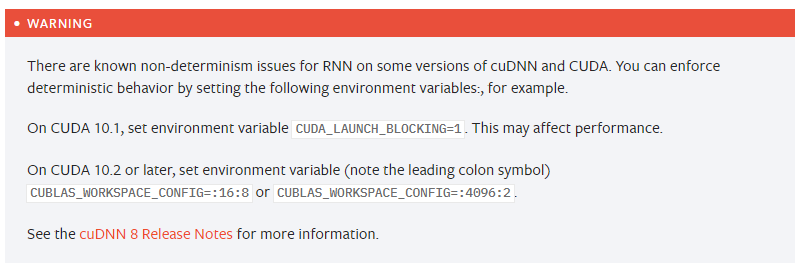 Pull Request resolved: https://github.com/pytorch/pytorch/pull/40893 Reviewed By: vincentqb Differential Revision: D22535418 Pulled By: ngimel fbshipit-source-id: f194ddaff8ec6d03a3616c87466e2cbbe7e429a9

77 lines
3.2 KiB
ReStructuredText
77 lines
3.2 KiB
ReStructuredText
Reproducibility
|
|
===============
|
|
|
|
Completely reproducible results are not guaranteed across PyTorch releases,
|
|
individual commits or different platforms. Furthermore, results need not be
|
|
reproducible between CPU and GPU executions, even when using identical seeds.
|
|
|
|
However, in order to make computations deterministic on your specific problem on
|
|
one specific platform and PyTorch release, there are a couple of steps to take.
|
|
|
|
There are two pseudorandom number generators involved in PyTorch, which you will
|
|
need to seed manually to make runs reproducible. Furthermore, you should ensure
|
|
that all other libraries your code relies on and which use random numbers also
|
|
use a fixed seed.
|
|
|
|
PyTorch
|
|
.......
|
|
You can use :meth:`torch.manual_seed()` to seed the RNG for all devices (both
|
|
CPU and CUDA)::
|
|
|
|
import torch
|
|
torch.manual_seed(0)
|
|
|
|
|
|
There are some PyTorch functions that use CUDA functions that can be a source
|
|
of nondeterminism. One class of such CUDA functions are atomic operations,
|
|
in particular :attr:`atomicAdd`, which can lead to the order of additions being
|
|
nondetermnistic. Because floating-point addition is not perfectly associative
|
|
for floating-point operands, :attr:`atomicAdd` with floating-point operands can
|
|
introduce different floating-point rounding errors on each evaluation, which
|
|
introduces a source of nondeterministic variance (aka noise) in the result.
|
|
|
|
PyTorch functions that use :attr:`atomicAdd` in the forward kernels include
|
|
:meth:`torch.Tensor.index_add_`, :meth:`torch.Tensor.scatter_add_`,
|
|
:meth:`torch.bincount`.
|
|
|
|
A number of operations have backwards kernels that use :attr:`atomicAdd`,
|
|
including :meth:`torch.nn.functional.embedding_bag`,
|
|
:meth:`torch.nn.functional.ctc_loss`, :meth:`torch.nn.functional.interpolate`,
|
|
and many forms of pooling, padding, and sampling.
|
|
|
|
There is currently no simple way of avoiding nondeterminism in these functions.
|
|
|
|
Additionally, the backward path for :meth:`repeat_interleave` operates
|
|
nondeterministically on the CUDA backend because :meth:`repeat_interleave`
|
|
is implemented using :meth:`index_select`, the backward path for
|
|
which is implemented using :meth:`index_add_`, which is known to operate
|
|
nondeterministically (in the forward direction) on the CUDA backend (see above).
|
|
|
|
cuDNN
|
|
.....
|
|
When running on the cuDNN backend, two further options must be set::
|
|
|
|
torch.backends.cudnn.deterministic = True
|
|
torch.backends.cudnn.benchmark = False
|
|
|
|
On some versions of cuDNN and CUDA, RNN and LSTM may have non-deterministic behavior.
|
|
See :meth:`torch.nn.RNN` and :meth:`torch.nn.LSTM` for details and workarounds.
|
|
|
|
.. warning::
|
|
|
|
Deterministic operation may have a negative single-run performance impact,
|
|
depending on the composition of your model. Due to different underlying
|
|
operations, which may be slower, the processing speed (e.g. the number of
|
|
batches trained per second) may be lower than when the model functions
|
|
nondeterministically. However, even though single-run speed may be
|
|
slower, depending on your application determinism may save time by
|
|
facilitating experimentation, debugging, and regression testing.
|
|
|
|
Numpy
|
|
.....
|
|
If you or any of the libraries you are using rely on Numpy, you should seed the
|
|
Numpy RNG as well. This can be done with::
|
|
|
|
import numpy as np
|
|
np.random.seed(0)
|