 14f7bf0629
Summary: Pull Request resolved: https://github.com/pytorch/pytorch/pull/51419 ## Summary 1. Add an option `BUILD_LITE_INTERPRETER` in `caffe2/CMakeLists.txt` and set `OFF` as default. 2. Update 'build_android.sh' with an argument to swtich `BUILD_LITE_INTERPRETER`, 'OFF' as default. 3. Add a mini demo app `lite_interpreter_demo` linked with `libtorch` library, which can be used for quick test. ## Test Plan Built lite interpreter version of libtorch and test with Image Segmentation demo app ([android version](https://github.com/pytorch/android-demo-app/tree/master/ImageSegmentation)/[ios version](https://github.com/pytorch/ios-demo-app/tree/master/ImageSegmentation)) ### Android 1. **Prepare model**: Prepare the lite interpreter version of model by run the script below to generate the scripted model `deeplabv3_scripted.pt` and `deeplabv3_scripted.ptl` ``` import torch model = torch.hub.load('pytorch/vision:v0.7.0', 'deeplabv3_resnet50', pretrained=True) model.eval() scripted_module = torch.jit.script(model) # Export full jit version model (not compatible lite interpreter), leave it here for comparison scripted_module.save("deeplabv3_scripted.pt") # Export lite interpreter version model (compatible with lite interpreter) scripted_module._save_for_lite_interpreter("deeplabv3_scripted.ptl") ``` 2. **Build libtorch lite for android**: Build libtorch for android for all 4 android abis (armeabi-v7a, arm64-v8a, x86, x86_64) `BUILD_LITE_INTERPRETER=1 ./scripts/build_pytorch_android.sh`. This pr is tested on Pixel 4 emulator with x86, so use cmd `BUILD_LITE_INTERPRETER=1 ./scripts/build_pytorch_android.sh x86` to specify abi to save built time. After the build finish, it will show the library path: ``` ... BUILD SUCCESSFUL in 55s 134 actionable tasks: 22 executed, 112 up-to-date + find /Users/chenlai/pytorch/android -type f -name '*aar' + xargs ls -lah -rw-r--r-- 1 chenlai staff 13M Feb 11 11:48 /Users/chenlai/pytorch/android/pytorch_android/build/outputs/aar/pytorch_android-release.aar -rw-r--r-- 1 chenlai staff 36K Feb 9 16:45 /Users/chenlai/pytorch/android/pytorch_android_torchvision/build/outputs/aar/pytorch_android_torchvision-release.aar ``` 3. **Use the PyTorch Android libraries built from source in the ImageSegmentation app**: Create a folder 'libs' in the path, the path from repository root will be `ImageSegmentation/app/libs`. Copy `pytorch_android-release` to the path `ImageSegmentation/app/libs/pytorch_android-release.aar`. Copy 'pytorch_android_torchvision` (downloaded from [here](https://oss.sonatype.org/#nexus-search;quick~torchvision_android)) to the path `ImageSegmentation/app/libs/pytorch_android_torchvision.aar` Update the `dependencies` part of `ImageSegmentation/app/build.gradle` to ``` dependencies { implementation 'androidx.appcompat:appcompat:1.2.0' implementation 'androidx.constraintlayout:constraintlayout:2.0.2' testImplementation 'junit:junit:4.12' androidTestImplementation 'androidx.test.ext:junit:1.1.2' androidTestImplementation 'androidx.test.espresso:espresso-core:3.3.0' implementation(name:'pytorch_android-release', ext:'aar') implementation(name:'pytorch_android_torchvision', ext:'aar') implementation 'com.android.support:appcompat-v7:28.0.0' implementation 'com.facebook.fbjni:fbjni-java-only:0.0.3' } ``` Update `allprojects` part in `ImageSegmentation/build.gradle` to ``` allprojects { repositories { google() jcenter() flatDir { dirs 'libs' } } } ``` 4. **Update model loader api**: Update `ImageSegmentation/app/src/main/java/org/pytorch/imagesegmentation/MainActivity.java` by 4.1 Add new import: `import org.pytorch.LiteModuleLoader;` 4.2 Replace the way to load pytorch lite model ``` // mModule = Module.load(MainActivity.assetFilePath(getApplicationContext(), "deeplabv3_scripted.pt")); mModule = LiteModuleLoader.load(MainActivity.assetFilePath(getApplicationContext(), "deeplabv3_scripted.ptl")); ``` 5. **Test app**: Build and run the ImageSegmentation app in Android Studio, 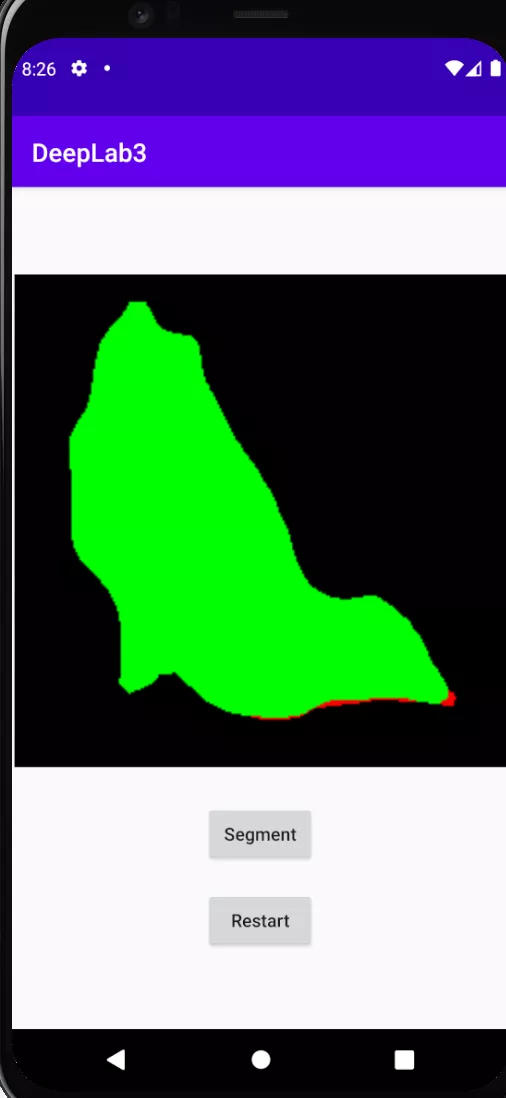 ### iOS 1. **Prepare model**: Same as Android. 2. **Build libtorch lite for ios** `BUILD_PYTORCH_MOBILE=1 IOS_PLATFORM=SIMULATOR BUILD_LITE_INTERPRETER=1 ./scripts/build_ios.sh` 3. **Remove Cocoapods from the project**: run `pod deintegrate` 4. **Link ImageSegmentation demo app with the custom built library**: Open your project in XCode, go to your project Target’s **Build Phases - Link Binaries With Libraries**, click the **+** sign and add all the library files located in `build_ios/install/lib`. Navigate to the project **Build Settings**, set the value **Header Search Paths** to `build_ios/install/include` and **Library Search Paths** to `build_ios/install/lib`. In the build settings, search for **other linker flags**. Add a custom linker flag below ``` -all_load ``` Finally, disable bitcode for your target by selecting the Build Settings, searching for Enable Bitcode, and set the value to No. ** 5. Update library and api** 5.1 Update `TorchModule.mm`` To use the custom built libraries the project, replace `#import <LibTorch/LibTorch.h>` (in `TorchModule.mm`) which is needed when using LibTorch via Cocoapods with the code below: ``` //#import <LibTorch/LibTorch.h> #include "ATen/ATen.h" #include "caffe2/core/timer.h" #include "caffe2/utils/string_utils.h" #include "torch/csrc/autograd/grad_mode.h" #include "torch/script.h" #include <torch/csrc/jit/mobile/function.h> #include <torch/csrc/jit/mobile/import.h> #include <torch/csrc/jit/mobile/interpreter.h> #include <torch/csrc/jit/mobile/module.h> #include <torch/csrc/jit/mobile/observer.h> ``` 5.2 Update `ViewController.swift` ``` // if let filePath = Bundle.main.path(forResource: // "deeplabv3_scripted", ofType: "pt"), // let module = TorchModule(fileAtPath: filePath) { // return module // } else { // fatalError("Can't find the model file!") // } if let filePath = Bundle.main.path(forResource: "deeplabv3_scripted", ofType: "ptl"), let module = TorchModule(fileAtPath: filePath) { return module } else { fatalError("Can't find the model file!") } ``` ### Unit test Add `test/cpp/lite_interpreter`, with one unit test `test_cores.cpp` and a light model `sequence.ptl` to test `_load_for_mobile()`, `bc.find_method()` and `bc.forward()` functions. ### Size: **With the change:** Android: x86: `pytorch_android-release.aar` (**13.8 MB**) IOS: `pytorch/build_ios/install/lib` (lib: **66 MB**): ``` (base) chenlai@chenlai-mp lib % ls -lh total 135016 -rw-r--r-- 1 chenlai staff 3.3M Feb 15 20:45 libXNNPACK.a -rw-r--r-- 1 chenlai staff 965K Feb 15 20:45 libc10.a -rw-r--r-- 1 chenlai staff 4.6K Feb 15 20:45 libclog.a -rw-r--r-- 1 chenlai staff 42K Feb 15 20:45 libcpuinfo.a -rw-r--r-- 1 chenlai staff 39K Feb 15 20:45 libcpuinfo_internals.a -rw-r--r-- 1 chenlai staff 1.5M Feb 15 20:45 libeigen_blas.a -rw-r--r-- 1 chenlai staff 148K Feb 15 20:45 libfmt.a -rw-r--r-- 1 chenlai staff 44K Feb 15 20:45 libpthreadpool.a -rw-r--r-- 1 chenlai staff 166K Feb 15 20:45 libpytorch_qnnpack.a -rw-r--r-- 1 chenlai staff 384B Feb 15 21:19 libtorch.a -rw-r--r-- 1 chenlai staff **60M** Feb 15 20:47 libtorch_cpu.a ``` `pytorch/build_ios/install`: ``` (base) chenlai@chenlai-mp install % du -sh * 14M include 66M lib 2.8M share ``` **Master (baseline):** Android: x86: `pytorch_android-release.aar` (**16.2 MB**) IOS: `pytorch/build_ios/install/lib` (lib: **84 MB**): ``` (base) chenlai@chenlai-mp lib % ls -lh total 172032 -rw-r--r-- 1 chenlai staff 3.3M Feb 17 22:18 libXNNPACK.a -rw-r--r-- 1 chenlai staff 969K Feb 17 22:18 libc10.a -rw-r--r-- 1 chenlai staff 4.6K Feb 17 22:18 libclog.a -rw-r--r-- 1 chenlai staff 42K Feb 17 22:18 libcpuinfo.a -rw-r--r-- 1 chenlai staff 1.5M Feb 17 22:18 libeigen_blas.a -rw-r--r-- 1 chenlai staff 44K Feb 17 22:18 libpthreadpool.a -rw-r--r-- 1 chenlai staff 166K Feb 17 22:18 libpytorch_qnnpack.a -rw-r--r-- 1 chenlai staff 384B Feb 17 22:19 libtorch.a -rw-r--r-- 1 chenlai staff 78M Feb 17 22:19 libtorch_cpu.a ``` `pytorch/build_ios/install`: ``` (base) chenlai@chenlai-mp install % du -sh * 14M include 84M lib 2.8M share ``` Test Plan: Imported from OSS Reviewed By: iseeyuan Differential Revision: D26518778 Pulled By: cccclai fbshipit-source-id: 4503ffa1f150ecc309ed39fb0549e8bd046a3f9c |
||
|---|---|---|
| .. | ||
| gradle | ||
| libs | ||
| pytorch_android | ||
| pytorch_android_torchvision | ||
| test_app | ||
| .gitignore | ||
| build_test_app_custom.sh | ||
| build_test_app.sh | ||
| build.gradle | ||
| common.sh | ||
| gradle.properties | ||
| gradlew | ||
| gradlew.bat | ||
| README.md | ||
| run_tests.sh | ||
| settings.gradle | ||

Android
Demo applications and tutorials
Demo applications with code walk-through can be find in this github repo.
Publishing
Release
Release artifacts are published to jcenter:
repositories {
    jcenter()
}

dependencies {
    implementation 'org.pytorch:pytorch_android:1.6.0'
    implementation 'org.pytorch:pytorch_android_torchvision:1.6.0'
}
Nightly
Nightly(snapshots) builds are published every night from master branch to nexus sonatype snapshots repository
To use them repository must be specified explicitly:
repositories {
    maven {
        url "https://oss.sonatype.org/content/repositories/snapshots"
    }
}

dependencies {
    ...
    implementation 'org.pytorch:pytorch_android:1.9.0-SNAPSHOT'
    implementation 'org.pytorch:pytorch_android_torchvision:1.9.0-SNAPSHOT'
    ...
}
The current nightly(snapshots) version is the value of VERSION_NAME in gradle.properties in current folder, at this moment it is 1.8.0-SNAPSHOT.
Building PyTorch Android from Source
In some cases you might want to use a local build of pytorch android, for example you may build custom libtorch binary with another set of operators or to make local changes.
For this you can use ./scripts/build_pytorch_android.sh script.
git clone https://github.com/pytorch/pytorch.git
cd pytorch
git submodule update --init --recursive
sh ./scripts/build_pytorch_android.sh
The workflow contains several steps:
1. Build libtorch for android for all 4 android abis (armeabi-v7a, arm64-v8a, x86, x86_64)
2. Create symbolic links to the results of those builds:
android/pytorch_android/src/main/jniLibs/${abi} to the directory with output libraries
android/pytorch_android/src/main/cpp/libtorch_include/${abi} to the directory with headers. These directories are used to build libpytorch.so library that will be loaded on android device.
3. And finally run gradle in android/pytorch_android directory with task assembleRelease
Script requires that Android SDK, Android NDK and gradle are installed. They are specified as environment variables:
ANDROID_HOME - path to Android SDK
ANDROID_NDK - path to Android NDK
GRADLE_HOME - path to gradle
After successful build you should see the result as aar file:
$ find pytorch_android/build/ -type f -name *aar
pytorch_android/build/outputs/aar/pytorch_android.aar
pytorch_android_torchvision/build/outputs/aar/pytorch_android.aar
It can be used directly in android projects, as a gradle dependency:
allprojects {
    repositories {
        flatDir {
            dirs 'libs'
        }
    }
}

dependencies {
    implementation(name:'pytorch_android', ext:'aar')
    implementation(name:'pytorch_android_torchvision', ext:'aar')
    ...
    implementation 'com.android.support:appcompat-v7:28.0.0'
    implementation 'com.facebook.soloader:nativeloader:0.8.0'
    implementation 'com.facebook.fbjni:fbjni-java-only:0.0.3'
}
We also have to add all transitive dependencies of our aars.
As pytorch_android depends on 'com.android.support:appcompat-v7:28.0.0', 'com.facebook.soloader:nativeloader:0.8.0' and 'com.facebook.fbjni:fbjni-java-only:0.0.3', we need to add them.
(In case of using maven dependencies they are added automatically from pom.xml).
You can check out test app example that uses aars directly.
Linking to prebuilt libtorch library from gradle dependency
In some cases, you may want to use libtorch from your android native build. You can do it without building libtorch android, using native libraries from PyTorch android gradle dependency. For that, you will need to add the next lines to your gradle build.
android {
...
    configurations {
       extractForNativeBuild
    }
...
    compileOptions {
        externalNativeBuild {
            cmake {
                arguments "-DANDROID_STL=c++_shared"
            }
        }
    }
...
    externalNativeBuild {
        cmake {
            path "CMakeLists.txt"
        }
    }
}

dependencies {
    extractForNativeBuild('org.pytorch:pytorch_android:1.6.0')
}

task extractAARForNativeBuild {
    doLast {
        configurations.extractForNativeBuild.files.each {
            def file = it.absoluteFile
            copy {
                from zipTree(file)
                into "$buildDir/$file.name"
                include "headers/**"
                include "jni/**"
            }
        }
    }
}

tasks.whenTaskAdded { task ->
  if (task.name.contains('externalNativeBuild')) {
    task.dependsOn(extractAARForNativeBuild)
  }
}
pytorch_android aar contains headers to link in headers folder and native libraries in jni/$ANDROID_ABI/.
As PyTorch native libraries use ANDROID_STL - we should use ANDROID_STL=c++_shared to have only one loaded binary of STL.
The added task will unpack them to gradle build directory.
In your native build you can link to them adding these lines to your CMakeLists.txt:
# Relative path of gradle build directory to CMakeLists.txt
set(build_DIR ${CMAKE_SOURCE_DIR}/build)

file(GLOB PYTORCH_INCLUDE_DIRS "${build_DIR}/pytorch_android*.aar/headers")
file(GLOB PYTORCH_LINK_DIRS "${build_DIR}/pytorch_android*.aar/jni/${ANDROID_ABI}")

set(BUILD_SUBDIR ${ANDROID_ABI})
target_include_directories(${PROJECT_NAME} PRIVATE
  ${PYTORCH_INCLUDE_DIRS}
)

find_library(PYTORCH_LIBRARY pytorch_jni
  PATHS ${PYTORCH_LINK_DIRS}
  NO_CMAKE_FIND_ROOT_PATH)

find_library(FBJNI_LIBRARY fbjni
  PATHS ${PYTORCH_LINK_DIRS}
  NO_CMAKE_FIND_ROOT_PATH)

target_link_libraries(${PROJECT_NAME}
  ${PYTORCH_LIBRARY})
  ${FBJNI_LIBRARY})
If your CMakeLists.txt file is located in the same directory as your build.gradle, set(build_DIR ${CMAKE_SOURCE_DIR}/build) should work for you. But if you have another location of it, you may need to change it.
After that, you can use libtorch C++ API from your native code.
#include <string>
#include <ATen/NativeFunctions.h>
#include <torch/script.h>
namespace pytorch_testapp_jni {
namespace {
    struct JITCallGuard {
      torch::autograd::AutoGradMode no_autograd_guard{false};
      torch::AutoNonVariableTypeMode non_var_guard{true};
      torch::jit::GraphOptimizerEnabledGuard no_optimizer_guard{false};
    };
}

void loadAndForwardModel(const std::string& modelPath) {
  JITCallGuard guard;
  torch::jit::Module module = torch::jit::load(modelPath);
  module.eval();
  torch::Tensor t = torch::randn({1, 3, 224, 224});
  c10::IValue t_out = module.forward({t});
}
}
To load torchscript model for mobile we need some special setup which is placed in struct JITCallGuard in this example. It may change in future, you can track the latest changes keeping an eye in our pytorch android jni code
Example of linking to libtorch from aar
PyTorch Android API Javadoc
You can find more details about the PyTorch Android API in the Javadoc.