Summary:
The approach is to simply reuse `torch.repeat` but adding one more functionality to tile, which is to prepend 1's to reps arrays if there are more dimensions to the tensors than the reps given in input. Thus for a tensor of shape (64, 3, 24, 24) and reps of (2, 2) will become (1, 1, 2, 2), which is what NumPy does.

I've encountered some instability with the test on my end, where I could get a random failure of the test (due to, sometimes, random value of `self.dim()`, and sometimes, segfaults). I'd appreciate any feedback on the test or an explanation for this instability so I can this.

Pull Request resolved: https://github.com/pytorch/pytorch/pull/47974

Reviewed By: ngimel

Differential Revision: D25148963

Pulled By: mruberry

fbshipit-source-id: bf63b72c6fe3d3998a682822e669666f7cc97c58
Summary:
This PR adds `torch.linalg.eigh`, and `torch.linalg.eigvalsh` for NumPy compatibility.
The current `torch.symeig` uses (on CPU) a different LAPACK routine than NumPy (`syev` vs `syevd`). Even though it shouldn't matter in practice, `torch.linalg.eigh` uses `syevd` (as NumPy does).

Ref https://github.com/pytorch/pytorch/issues/42666

Pull Request resolved: https://github.com/pytorch/pytorch/pull/45526

Reviewed By: gchanan

Differential Revision: D25022659

Pulled By: mruberry

fbshipit-source-id: 3676b77a121c4b5abdb712ad06702ac4944e900a
Summary:
Adds ldexp operator for https://github.com/pytorch/pytorch/issues/38349

I'm not entirely sure the changes to `NamedRegistrations.cpp` were needed but I saw other operators in there so I added it.

Normally the ldexp operator is used along with the frexp to construct and deconstruct floating point values. This is useful for performing operations on either the mantissa and exponent portions of floating point values.

Sleef, std math.h, and cuda support both ldexp and frexp but not for all data types. I wasn't able to figure out how to get the iterators to play nicely with a vectorized kernel so I have left this with just the normal CPU kernel for now.

This is the first operator I'm adding so please review with an eye for errors.

Pull Request resolved: https://github.com/pytorch/pytorch/pull/45370

Reviewed By: mruberry

Differential Revision: D24333516

Pulled By: ranman

fbshipit-source-id: 2df78088f00aa9789aae1124eda399771e120d3f
Summary:
xref gh-46927 to the 1.7 release branch

This backports a fix to the script to push docs to pytorch/pytorch.github.io. Specifically, it pushes to the correct directory when a tag is created here. This issue became apparent in the 1.7 release cycle and should be backported to here.

Along the way, fix the canonical link to the pytorch/audio documentation now that they use subdirectories for the versions, xref pytorch/audio#992. This saves a redirect.

Pull Request resolved: https://github.com/pytorch/pytorch/pull/47349

Reviewed By: zhangguanheng66

Differential Revision: D25073752

Pulled By: seemethere

fbshipit-source-id: c778c94a05f1c3e916217bb184f69107e7d2c098
Summary:
Reference https://github.com/pytorch/pytorch/issues/38349

Delegates to `torch.transpose` (not sure what is the best way to alias)

TODO:
* [x] Add test
* [x] Add documentation

Pull Request resolved: https://github.com/pytorch/pytorch/pull/46041

Reviewed By: gchanan

Differential Revision: D25022816

Pulled By: mruberry

fbshipit-source-id: c80223d081cef84f523ef9b23fbedeb2f8c1efc5
Summary:
Pull Request resolved: https://github.com/pytorch/pytorch/pull/48038

nn.ReLU works for both float and quantized input, we don't want to define an nn.quantized.ReLU
that does the same thing as nn.ReLU, similarly for nn.quantized.functional.relu

this also removes the numerical inconsistency for models quantizes nn.ReLU independently in qat mode

Test Plan:
Imported from OSS

Imported from OSS

Reviewed By: vkuzo

Differential Revision: D25000462

fbshipit-source-id: e3609a3ae4a3476a42f61276619033054194a0d2
Summary:
Pull Request resolved: https://github.com/pytorch/pytorch/pull/47415

nn.ReLU works for both float and quantized input, we don't want to define an nn.quantized.ReLU
that does the same thing as nn.ReLU, similarly for nn.quantized.functional.relu

this also removes the numerical inconsistency for models quantizes nn.ReLU independently in qat mode

Test Plan: Imported from OSS

Reviewed By: z-a-f

Differential Revision: D24747035

fbshipit-source-id: b8fdf13e513a0d5f0c4c6c9835635bdf9fdc2769
Summary:
For tracing successfully, we need write pytorch model in torch way. So we add instructions with examples here.

Pull Request resolved: https://github.com/pytorch/pytorch/pull/46961

Reviewed By: ailzhang

Differential Revision: D24900040

Pulled By: bzinodev

fbshipit-source-id: b375b533396b11dbc9656fa61e84a3f92f352e4b
Summary:
I have been asked several times how to toggle this flag on libtorch. I think it would be good to mention it in the docs.

Pull Request resolved: https://github.com/pytorch/pytorch/pull/47331

Reviewed By: glaringlee

Differential Revision: D24777576

Pulled By: mruberry

fbshipit-source-id: cc2a338c477bb57e0bb74b8960c47fde99665e41
Summary:
freeze was temporarily renamed to _freeze in a reorg, and then removed from doc [here](https://github.com/pytorch/pytorch/pull/43473). add it back to docs.

Pull Request resolved: https://github.com/pytorch/pytorch/pull/47120

Reviewed By: suo

Differential Revision: D24650712

Pulled By: eellison

fbshipit-source-id: 399e31586b8093de66937ba1266007ee291f509e
Summary:
This PR adds a function for calculating the Kronecker product of tensors.
The implementation is based on `at::tensordot` with permutations and reshape.
Tests pass.

TODO:

- [x] Add more test cases
- [x] Write documentation
- [x] Add entry `common_methods_invokations.py`

Ref. https://github.com/pytorch/pytorch/issues/42666

Pull Request resolved: https://github.com/pytorch/pytorch/pull/45358

Reviewed By: mrshenli

Differential Revision: D24680755

Pulled By: mruberry

fbshipit-source-id: b1f8694589349986c3abfda3dc1971584932b3fa
Summary:
CC: gchanan jspisak seemethere

I previewed the docs and they look reasonable. Let me know if I missed anything.

Pull Request resolved: https://github.com/pytorch/pytorch/pull/46880

Reviewed By: seemethere, izdeby

Differential Revision: D24551503

Pulled By: robieta

fbshipit-source-id: 627f73d3dd4d8f089777bca8653702735632b9fc
Summary:
Related https://github.com/pytorch/pytorch/issues/38349

This PR implements `column_stack` as the composite ops of `torch.reshape` and `torch.hstack`, and makes `row_stack` as the alias of `torch.vstack`.

Todo

- [x] docs
- [x] alias pattern for `row_stack`

Pull Request resolved: https://github.com/pytorch/pytorch/pull/46313

Reviewed By: ngimel

Differential Revision: D24585471

Pulled By: mruberry

fbshipit-source-id: 62fc0ffd43d051dc3ecf386a3e9c0b89086c1d1c
Summary:
Retake on https://github.com/pytorch/pytorch/issues/40493 after all the feedback from albanD

This PR implements the generic Lazy mechanism and a sample `LazyLinear` layer with the `UninitializedParameter`.

The main differences with the previous PR are two;
Now `torch.nn.Module` remains untouched.
We don't require an explicit initialization or a dummy forward pass before starting the training or inference of the actual module. Making this much simpler to use from the user side.

As we discussed offline, there was the suggestion of not using a mixin, but changing the `__class__` attribute of `LazyLinear` to become `Linear` once it's completely initialized. While this can be useful, by the time being we need `LazyLinear` to be a `torch.nn.Module` subclass since there are many checks that rely on the modules being instances of `torch.nn.Module`.
This can cause problems when we create complex modules such as
```
class MyNetwork(torch.nn.Module):
    def __init__(self):
        super(MyNetwork, self).__init__()
        self.conv = torch.nn.Conv2d(20, 4, 2)
        self.linear = torch.nn.LazyLinear(10)
    def forward(self, x):
        y = self.conv(x).clamp(min=0)
        return self.linear(y)
```
Here, when the __setattr__ function is called at the time LazyLinear is registered, it won't be added to the child modules of `MyNetwork`, so we have to manually do it later, but currently there is no way to do such thing as we can't access the parent module from LazyLinear once it becomes the Linear module. (We can add a workaround to this if needed).

TODO:

Add convolutions once the design is OK
Fix docstrings

Pull Request resolved: https://github.com/pytorch/pytorch/pull/44538

Reviewed By: ngimel

Differential Revision: D24162854

Pulled By: albanD

fbshipit-source-id: 6d58dfe5d43bfb05b6ee506e266db3cf4b885f0c
Summary:
Pull Request resolved: https://github.com/pytorch/pytorch/pull/45164

This PR implements `fft2`, `ifft2`, `rfft2` and `irfft2`. These are the last functions required for `torch.fft` to match `numpy.fft`. If you look at either NumPy or SciPy you'll see that the 2-dimensional variants are identical to `*fftn` in every way, except for the default value of `axes`. In fact you can even use `fft2` to do general n-dimensional transforms.

Test Plan: Imported from OSS

Reviewed By: ngimel

Differential Revision: D24363639

Pulled By: mruberry

fbshipit-source-id: 95191b51a0f0b8e8e301b2c20672ed4304d02a57
Summary:
The `i` variable in `Line 272` may cause ambiguity in understanding. I think it should be named as `epoch` variable.

Fixes #{issue number}

Pull Request resolved: https://github.com/pytorch/pytorch/pull/45944

Reviewed By: agolynski

Differential Revision: D24219486

Pulled By: vincentqb

fbshipit-source-id: 2af0408594613e82a1a1b63971650cabde2b576e
Summary:
Pull Request resolved: https://github.com/pytorch/pytorch/pull/46075

Removes these from public docs for now as we are still
iterating/formalizing these APIs. Will add them back once they are part of a
PyTorch release.
ghstack-source-id: 113928700

Test Plan: CI

Reviewed By: mrshenli

Differential Revision: D24211510

fbshipit-source-id: 3e36ff6990cf8e6ef72b6e524322ae06f9097aa2
Summary:
Pull Request resolved: https://github.com/pytorch/pytorch/pull/45847

Original PR here https://github.com/pytorch/pytorch/pull/45084. Created this one because I was having problems with ghstack.

Test Plan: Imported from OSS

Reviewed By: mruberry

Differential Revision: D24136629

Pulled By: heitorschueroff

fbshipit-source-id: dd7c7540a33f6a19e1ad70ba2479d5de44abbdf9
Summary:
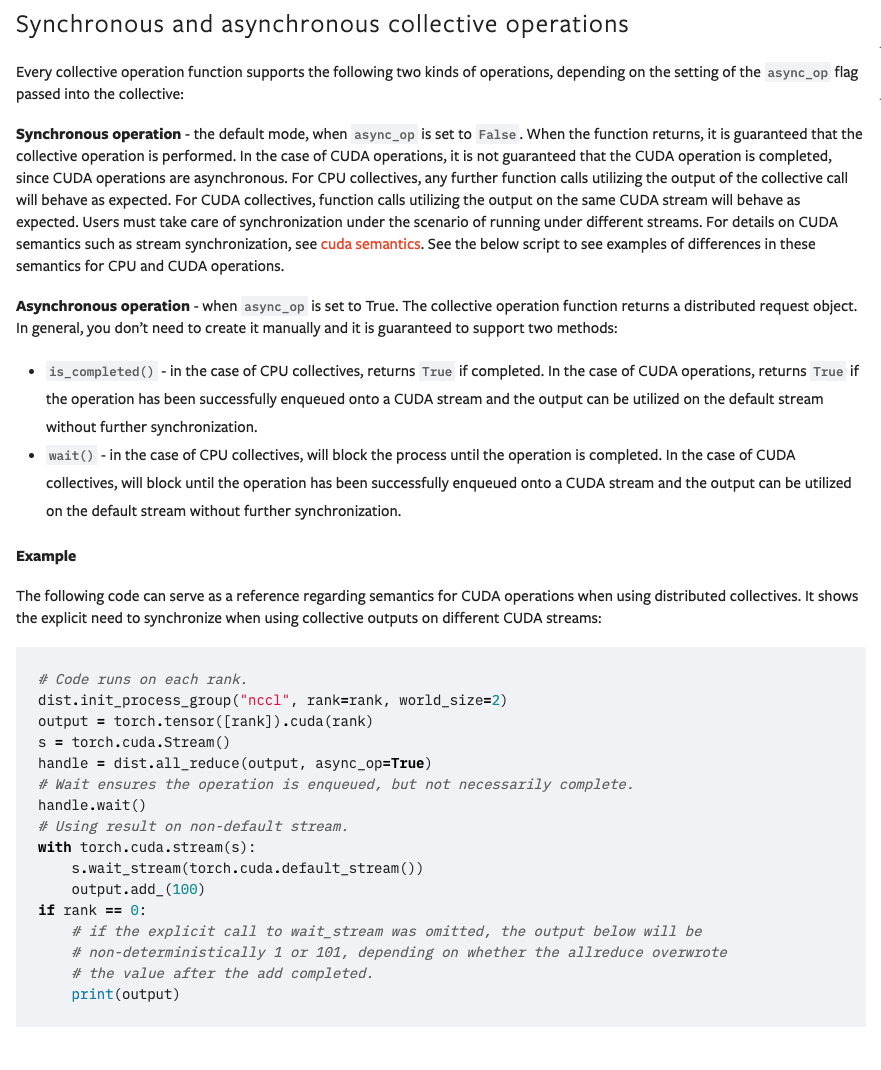
Currently, a GraphRoot instance doesn't have an associated stream.  Streaming backward synchronization logic assumes the instance ran on the default stream, and tells consumer ops to sync with the default stream.  If the gradient the GraphRoot instance passes to consumer backward ops was populated on a non-default stream, we have a race condition.

The race condition can exist even if the user doesn't give a manually populated gradient:
```python
with torch.cuda.stream(side_stream):
    # loss.backward() implicitly synthesizes a one-element 1.0 tensor on side_stream
    # GraphRoot passes it to consumers, but consumers first sync on default stream, not side_stream.
    loss.backward()

    # Internally to backward(), streaming-backward logic takes over, stuff executes on the same stream it ran on in forward,
    # and the side_stream context is irrelevant.  GraphRoot's interaction with its first consumer(s) is the spot where
    # the side_stream context causes a problem.
```

This PR fixes the race condition by associating a GraphRoot instance, at construction time, with the current stream(s) on the device(s) of the grads it will pass to consumers. (i think this relies on GraphRoot executing in the main thread, before backward thread(s) fork, because the grads were populated on the main thread.)

The test demonstrates the race condition. It fails reliably without the PR's GraphRoot diffs and passes with the GraphRoot diffs.

With the GraphRoot diffs, manually populating an incoming-gradient arg for `backward` (or `torch.autograd.grad`) and the actual call to `autograd.backward` will have the same stream-semantics relationship as any other pair of ops:
```python
# implicit population is safe
with torch.cuda.stream(side_stream):
    loss.backward()

# explicit population in side stream then backward in side stream is safe
with torch.cuda.stream(side_stream):
    kickoff_grad = torch.ones_like(loss)
    loss.backward(gradient=kickoff_grad)

# explicit population in one stream then backward kickoff in another stream
# is NOT safe, even with this PR's diffs, but that unsafety is consistent with
# stream-semantics relationship of any pair of ops
kickoff_grad = torch.ones_like(loss)
with torch.cuda.stream(side_stream):
    loss.backward(gradient=kickoff_grad)

# Safe, as you'd expect for any pair of ops
kickoff_grad = torch.ones_like(loss)
side_stream.wait_stream(torch.cuda.current_stream())
with torch.cuda.stream(side_stream):
    loss.backward(gradient=kickoff_grad)
```
This PR also adds the last three examples above to cuda docs and references them from autograd docstrings.

Pull Request resolved: https://github.com/pytorch/pytorch/pull/45787

Reviewed By: nairbv

Differential Revision: D24138376

Pulled By: albanD

fbshipit-source-id: bc4cd9390f9f0358633db530b1b09f9c1080d2a3