Adds the `differentiable` argument, a method for updating parameters in an existing optimizer, and a template for testing the differentiability of multiple optimizers.

This is all based in discussions with @albanD & @jbschlosser
Pull Request resolved: https://github.com/pytorch/pytorch/pull/80938
Approved by: https://github.com/albanD
What was happening is that when we have multiple learning rate schedulers, the order in which they are being initialized is not being taken into account. This is a problem if they were being initialized in sequential order (as one might intuitively do).

Each scheduler calls `step()` on initialization and sets the `lr` in its optimizer's `params_groups`. However, this means that step 0 will be using the `lr` that was set by the very last scheduler (in the case of initializing schedulers sequentially) instead of the first scheduler.

The fix in this PR, addresses the above bug by performing a call to the appropriate scheduler on initialization after decrementing the `last_epoch` values in order to keep them the same post-step. This will ensure that the correct scheduler is the one setting the `lr` values for the optimizer's `param_groups`
Pull Request resolved: https://github.com/pytorch/pytorch/pull/72856
Approved by: https://github.com/jbschlosser
Fixes#60265
The initial LR for this scheduler is not consistent when a new instance is created with `last_epoch != -1`
Maybe we can refactor the testing code to test `last_epoch != -1` in schedulers that can recreate their state from the current epoch?
Pull Request resolved: https://github.com/pytorch/pytorch/pull/60339
Approved by: https://github.com/albanD
Summary:
Pull Request resolved: https://github.com/pytorch/pytorch/pull/69980

- Merged `torch/optim/adadelta.py` and `torch/optim/_multitensor/adadelta.py` into `torch/optim/adadelta.py`
- Moved adadelta functional forms from `torch/optim/_functional.py` and `torch/optim/_multi_tensor/_functional.py` to `torch/optim/adadelta.py`
- `torch/optim/_functional.py` just imports from `torch/optim/adadelta.py`
- Added a test `test_optimizers_foreach_flag` which replicates `test_multi_tensor_optimizers` in `test/test_optim.py`
- Add a test `test_adadelta_new` that replicates the behavior of `test_adadelta` but with `foreach` flag instead of using the multitensor adadleta class. If we delete `_multitensor/` we could replace `test_adadelta` with this

Remaining TODO:

- [ ] single_tensor adadelta supports complex but multitensor does not, need to integrate the singletensor logic in multitensor and switch the `test_adadelta_complex` to test for foreach in [True, False]

Test Plan: Imported from OSS

Reviewed By: VitalyFedyunin, albanD

Differential Revision: D33413059

Pulled By: mikaylagawarecki

fbshipit-source-id: 92a9fa98705762bb6bd464261671e49aef40070e
(cherry picked from commit a008227d22)
Summary:
Pull Request resolved: https://github.com/pytorch/pytorch/pull/71333

Updated
- Adagrad
- Adamax
- Adam
- AdamW
- RAdam
make multi_tensor functionals take `state_steps: List[Tensor]` instead of taking `states: List[Dict]`
make `state_steps: List[int]s -> state_steps:List[Tensor]` where each is a Singleton tensor so step can be updated within the functional

(NAdam and ASGD) were updated in separate diffs to fold their handling of state into the functionals

Test Plan: Imported from OSS

Reviewed By: anjali411

Differential Revision: D33767872

Pulled By: mikaylagawarecki

fbshipit-source-id: 9baa7cafb6375eab839917df9287c65a437891f2
(cherry picked from commit 831c02b3d0)
Summary:
In `TestLRScheduler._test()`, an unused variable `optimizers` is created. This PR is a minor refactoring that removes the variable and the loop block that populates the set.

Pull Request resolved: https://github.com/pytorch/pytorch/pull/70668

Reviewed By: wenleix

Differential Revision: D33586236

Pulled By: albanD

fbshipit-source-id: cabf870a8221f144df9d3e2f2b564cdc5c255f5a
Summary:
Solves the next most important use case in https://github.com/pytorch/pytorch/issues/68052.

I have kept the style as close to that in SGD as seemed reasonable, given the slight differences in their internal implementations.

All feedback welcome!

cc pietern mrshenli pritamdamania87 zhaojuanmao satgera rohan-varma gqchen aazzolini osalpekar jiayisuse SciPioneer H-Huang

Pull Request resolved: https://github.com/pytorch/pytorch/pull/68164

Reviewed By: VitalyFedyunin

Differential Revision: D32994129

Pulled By: albanD

fbshipit-source-id: 65c57c3f3dbbd3e3e5338d51def54482503e8850
Summary:
Fixes https://github.com/pytorch/pytorch/issues/67601.

As simple a fix as I could make it. I even managed to delete some testing code!

I checked calling `super()` and, as I had feared, it doesn't work out the box, so perhaps that ought to be revisited later.

As it stands,  https://github.com/pytorch/pytorch/issues/20124, still applies to the chained scheduler, but I think this change is still an improvement.

Pull Request resolved: https://github.com/pytorch/pytorch/pull/68010

Reviewed By: zou3519

Differential Revision: D32278139

Pulled By: albanD

fbshipit-source-id: 4c6f9f1b2822affdf63a6d22ddfdbcb1c6afd579
Summary:
Fixes https://github.com/pytorch/pytorch/issues/46480 -- for SGD.

## Notes:
- I have modified the existing tests to take a new `constructor_accepts_maximize` flag. When this is set to true, the ` _test_basic_cases_template` function will test both maximizing and minimizing the sample function.
- This was the clearest way I could think of testing the changes -- I would appreciate feedback on this strategy.

## Work to be done:
[] I need to update the docs.

Pull Request resolved: https://github.com/pytorch/pytorch/pull/67847

Reviewed By: H-Huang

Differential Revision: D32252631

Pulled By: albanD

fbshipit-source-id: 27915a3cc2d18b7e4d17bfc2d666fe7d2cfdf9a4
Summary:
Catches deprecation warnings when we call `scheduler.step(epoch)`
in tests.

Removes duplicate parameters to optimizers unless we are specifically
testing for that

Fixes https://github.com/pytorch/pytorch/issues/67696

There is one warning remaining when I run this locally -- however that is due to the implementation of the `SequentialLR` Scheduler. I will open a new issue relating to that.

Pull Request resolved: https://github.com/pytorch/pytorch/pull/67954

Reviewed By: H-Huang

Differential Revision: D32244056

Pulled By: albanD

fbshipit-source-id: 2ab3086a58e10c8d29809ccbaab80606a1ec61d8
Summary:
Fixes part of https://github.com/pytorch/pytorch/issues/67696 by adding calls to `optimizer.step()` in various places.

## Notes for reviewers:
- It is not entirely clear which is the right optimizer to step in each case. I have favoured the more explicit approach of creating a set of optimizers and calling step on each of them.
- At the time of writing, the only Scheduler without an `optimizer` instance variable is `ChainedScheduler` which I need to deal with once. I use `hasattr` to do this check. Let me know if this ought to be changed.
- I am opening this PR for review when it only solve part of the issue, as I'd rather get feedback sooner. I think it is fine to fix the issue in several PRs too.

Pull Request resolved: https://github.com/pytorch/pytorch/pull/67756

Reviewed By: jbschlosser

Differential Revision: D32187864

Pulled By: albanD

fbshipit-source-id: fd0d133bcaa3a24588e5a997ad198fdf5879ff5a
Summary:
Pull Request resolved: https://github.com/pytorch/pytorch/pull/66587

Made some changes in the step function of the non-vectorized Adadelta optimizer to handle complex numbers as two real numbers as per 65711 on github
ghstack-source-id: 141484731

Test Plan:
buck test mode/dev caffe2/test:optim -- 'test_adadelta_complex'

https://pxl.cl/1R7kJ

Reviewed By: albanD

Differential Revision: D31630069

fbshipit-source-id: 2741177b837960538ce39772897af36bbce7b7d8
Summary:
Pull Request resolved: https://github.com/pytorch/pytorch/pull/66671

Made changes in the step function of the vectorized and non-vectorized adagrad optimizers to handle complex numbers as two real numbers as per 65711 on github
ghstack-source-id: 141442350

Test Plan:
buck test mode/dev caffe2/test:optim -- 'test_adagrad_complex'
https://pxl.cl/1Rd44

Reviewed By: albanD

Differential Revision: D31673503

fbshipit-source-id: 90a0d0c69b556716e2d17c59ce80f09c750fc464
Summary:
Pull Request resolved: https://github.com/pytorch/pytorch/pull/66501

Add testing for the Adagrad optimizer to ensure that it behaves as if complex numbers are two real numbers in R^2 as per issue 65711 on github
ghstack-source-id: 140414042

Test Plan:
buck test mode/dev caffe2/test:optim -- 'test_adagrad_complex'

https://pxl.cl/1R27M

Reviewed By: albanD

Differential Revision: D31584240

fbshipit-source-id: 5c9938084566b8ea49cc8ff002789731f62fe87e
Summary: Adding test to ensure non-Vanilla SGD behaves as if complex numbers are two real numbers in R^2 as per issue 65711 on github

Test Plan:
```buck test mode/dev caffe2/test:optim -- 'test_sgd_complex'```

https://pxl.cl/1QLxw

Reviewed By: albanD

Differential Revision: D31477212

fbshipit-source-id: 500678e561a05ac96759223b4c87a37cab26c6a6
Summary:
Pull Request resolved: https://github.com/pytorch/pytorch/pull/66230

Adding test to ensure Vanilla SGD behaves as if complex numbers are two real numbers in R^2 as per issue 65711 on github
https://github.com/pytorch/pytorch/issues/65711
ghstack-source-id: 139918862

Test Plan:
```buck test mode/dev caffe2/test:optim -- 'test_sgd_complex'```

https://pxl.cl/1QHvX

Reviewed By: albanD

Differential Revision: D31449289

fbshipit-source-id: da8b00421085796a23b643e73f96b19b5b560a32
Summary:
Partially resolves https://github.com/pytorch/vision/issues/4281

In this PR we are proposing a new scheduler --SequentialLR-- which enables list of different schedulers called in different periods of the training process.

The main motivation of this scheduler is recently gained popularity of warming up phase in the training time. It has been shown that having a small steps in initial stages of training can help convergence procedure get faster.

With the help of SequentialLR we mainly enable to call a small constant (or linearly increasing) learning rate followed by actual target learning rate scheduler.

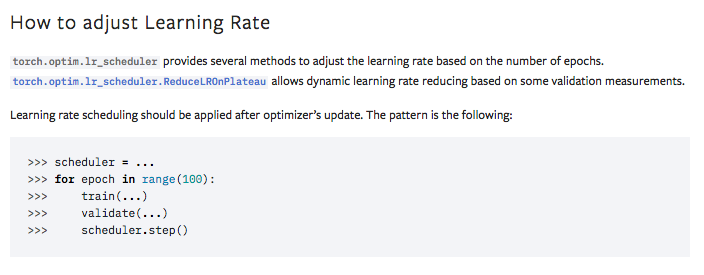
```PyThon
scheduler1 = ConstantLR(optimizer, factor=0.1, total_iters=2)
scheduler2 = ExponentialLR(optimizer, gamma=0.9)
scheduler = SequentialLR(optimizer, schedulers=[scheduler1, scheduler2], milestones=[5])

for epoch in range(100):
    train(...)
    validate(...)
    scheduler.step()
```

which this code snippet will call `ConstantLR` in the first 5 epochs and will follow up with `ExponentialLR` in the following epochs.

This scheduler could be used to provide call of any group of schedulers next to each other. The main consideration we should make is every time we switch to a new scheduler we assume that new scheduler starts from the beginning- zeroth epoch.

We also add Chained Scheduler to `optim.rst` and `lr_scheduler.pyi` files here.

Pull Request resolved: https://github.com/pytorch/pytorch/pull/64037

Reviewed By: albanD

Differential Revision: D30841099

Pulled By: iramazanli

fbshipit-source-id: 94f7d352066ee108eef8cda5f0dcb07f4d371751
Summary:
Partially unblocks https://github.com/pytorch/vision/issues/4281

Previously we have added WarmUp Schedulers to PyTorch Core in the PR : https://github.com/pytorch/pytorch/pull/60836 which had two mode of execution - linear and constant depending on warming up function.

In this PR we are changing this interface to more direct form, as separating linear and constant modes to separate Schedulers. In particular

```Python
scheduler1 = WarmUpLR(optimizer, warmup_factor=0.1, warmup_iters=5, warmup_method="constant")
scheduler2 = WarmUpLR(optimizer, warmup_factor=0.1, warmup_iters=5, warmup_method="linear")
```

will look like

```Python
scheduler1 = ConstantLR(optimizer, warmup_factor=0.1, warmup_iters=5)
scheduler2 = LinearLR(optimizer, warmup_factor=0.1, warmup_iters=5)
```

correspondingly.

Pull Request resolved: https://github.com/pytorch/pytorch/pull/64395

Reviewed By: datumbox

Differential Revision: D30753688

Pulled By: iramazanli

fbshipit-source-id: e47f86d12033f80982ddf1faf5b46873adb4f324
Summary:
In this PR we are introducing ChainedScheduler which initially proposed in the discussion https://github.com/pytorch/pytorch/pull/26423#discussion_r329976246 .

The idea is to provide a user friendly chaining method for schedulers, especially for the cases many of them are involved and we want to have a clean and easy to read interface for schedulers. This method will be even more crucial once CompositeSchedulers and Schedulers for different type of parameters are involved.

The immediate application of Chained Scheduler is expected to happen in TorchVision Library to combine WarmUpLR and  MultiStepLR https://github.com/pytorch/vision/blob/master/references/video_classification/scheduler.py#L5 . However, it can be expected that in many other use cases also this method could be applied.

### Example
The usage is as simple as below:

```python
sched=ChainedScheduler([ExponentialLR(self.opt, gamma=0.9),
                        WarmUpLR(self.opt, warmup_factor=0.2, warmup_iters=4, warmup_method="constant"),
                        StepLR(self.opt, gamma=0.1, step_size=3)])
```

Then calling
```python
sched.step()
```
would trigger step function for all three schedulers consecutively

Partially resolves https://github.com/pytorch/vision/issues/4281

Pull Request resolved: https://github.com/pytorch/pytorch/pull/63491

Reviewed By: datumbox, mruberry

Differential Revision: D30576180

Pulled By: iramazanli

fbshipit-source-id: b43f0749f55faab25079641b7d91c21a891a87e4
Summary:
It has been discussed in the https://github.com/pytorch/pytorch/pull/60836#issuecomment-899084092 that we have observed an obstacle to chain some type of learning rate schedulers. In particular we observed

* some of the learning rate schedulers returns initial learning rates at epoch 0 as
```
       return self.base_lrs`
```

* This can be a problem when two schedulers called as chained as

```
     scheduler1.step()
     scheduler2.step()
```

in particular, we completely ignore the effect of scheduler1 at epoch 0.  This could not be an issue if at epoch 0, scheduler1 was ineffective as in many schedulers, however for schedulers as WarmUp Schedulers, where at epoch 0 schedulers multiplicative value is smaller than 1 this could lead to undesired behaviors.

The following code snippet illustrates the problem better

## Reproducing the bug

```python
import torch
from torch.nn import Parameter
from torch.optim import SGD
from torch.optim.lr_scheduler import WarmUpLR, ExponentialLR

model = [Parameter(torch.randn(2, 2, requires_grad=True))]
optimizer = SGD(model, 1.0)
scheduler1 = WarmUpLR(optimizer, warmup_factor=0.1, warmup_iters=5, warmup_method="constant")
scheduler2 = ExponentialLR(optimizer, gamma=0.9)

for epoch in range(10):
     print(epoch, scheduler2.get_last_lr()[0])
     optimizer.step()
     scheduler1.step()
     scheduler2.step()
```

### Current Result

```
0 1.0
1 0.9
2 0.81
3 0.7290000000000001
4 0.6561000000000001
5 5.904900000000001
6 5.314410000000001
7 4.782969000000001
8 4.304672100000001
9 3.874204890000001
```

### Expected Result

```
0 1.0
1 0.9
2 0.81
3 0.7290000000000001
4 0.6561000000000001
5 0.5904900000000001
6 0.5314410000000001
7 0.4782969000000001
8 0.4304672100000001
9 0.3874204890000001
```

Pull Request resolved: https://github.com/pytorch/pytorch/pull/63457

Reviewed By: datumbox

Differential Revision: D30424160

Pulled By: iramazanli

fbshipit-source-id: 3e15af8d278c872cd6f53406b55f4d3ce5002867
Summary:
Warm up of learning rate scheduling has initially been discussed  by Priya et. al. in the paper: https://arxiv.org/pdf/1706.02677.pdf .

In the section 2.2 of the paper they discussed and proposed idea of warming up learning schedulers in order to prevent big variance / noise in the learning rate. Then idea has been further discussed in the following papers:
  * Akilesh Gotmare et al. https://arxiv.org/abs/1810.13243
  * Bernstein et al  http://proceedings.mlr.press/v80/bernstein18a/bernstein18a.pdf
  * Liyuan Liu et al: https://arxiv.org/pdf/1908.03265.pdf

There are two type of popularly used learning rate warm up ideas
  * Constant warmup  (start with very small constant learning rate)
  * Linear Warmup        ( start with small learning rate and gradually increase)

In this PR we are adding warm up as learning rate scheduler. Note that learning rates are chainable, which means that we can merge warmup scheduler with any other learning rate scheduler to make more sophisticated learning rate scheduler.

## Linear Warmup

Linear Warmup is multiplying learning rate with pre-defined constant - warmup_factor in the first epoch (epoch 0). Then targeting to increase this multiplication constant to one in warmup_iters many epochs. Hence we can derive the formula at i-th step to have multiplication constant equal to:

                    warmup_factor + (1-warmup_factor) * i /  warmup_iters

Moreover, the fraction of this quantity at point i to point i-1 will give us

           1 + (1.0 - warmup_factor) / [warmup_iters*warmup_factor+(i-1)*(1-warmup_factor)]

which is used in get_lr() method in our implementation. Below we provide an example how to use linear warmup scheduler and to give an example to show how does it works.

```python
import torch
from torch.nn import Parameter
from torch.optim import SGD
from torch.optim.lr_scheduler import WarmUpLR

model = [Parameter(torch.randn(2, 2, requires_grad=True))]
optimizer = SGD(model, 0.1)
scheduler = WarmUpLR(optimizer, warmup_factor=0.1, warmup_iters=10, warmup_method="linear")

for epoch in range(15):

    print(epoch, scheduler.get_last_lr()[0])

    optimizer.step()
    scheduler.step()
```

```
0 0.010000000000000002
1 0.019000000000000003
2 0.028000000000000008
3 0.03700000000000001
4 0.04600000000000001
5 0.055000000000000014
6 0.06400000000000002
7 0.07300000000000002
8 0.08200000000000003
9 0.09100000000000004
10 0.10000000000000005
11 0.10000000000000005
12 0.10000000000000005
13 0.10000000000000005
14 0.10000000000000005
```

## Constant Warmup

Constant warmup has straightforward idea, to multiply learning rate by warmup_factor until we reach to epoch warmup_factor, then do nothing for following epochs

```python
import torch
from torch.nn import Parameter
from torch.optim import SGD
from torch.optim.lr_scheduler import WarmUpLR

model = [Parameter(torch.randn(2, 2, requires_grad=True))]
optimizer = SGD(model, 0.1)
scheduler = WarmUpLR(optimizer, warmup_factor=0.1, warmup_iters=5, warmup_method="constant")

for epoch in range(10):

    print(epoch, scheduler.get_last_lr()[0])

    optimizer.step()
    scheduler.step()
```

```
0 0.010000000000000002
1 0.010000000000000002
2 0.010000000000000002
3 0.010000000000000002
4 0.010000000000000002
5 0.10000000000000002
6 0.10000000000000002
7 0.10000000000000002
8 0.10000000000000002
9 0.10000000000000002
```

Pull Request resolved: https://github.com/pytorch/pytorch/pull/60836

Reviewed By: saketh-are

Differential Revision: D29537615

Pulled By: iramazanli

fbshipit-source-id: d910946027acc52663b301f9c56ade686e62cb69
Summary:
Fixes https://github.com/pytorch/pytorch/issues/59998

It has been discussed in the issue that the variance term of Adam optimizer currently doesn't compute correctly for complex domain.  As it has been stated in the Generalization to Complex numbers section  in https://en.wikipedia.org/wiki/Variance variance is computed as E[(X - mu)(X-mu)*] (where mu = E[X] and * stands for conjugate) for complex random variable X.

However, currently the computation method in implementation of Adam is via E[(X - mu)(X-mu)] which doesn't return right variance value, in particular it returns complex number. Variance is defined to be real number even though underlying random variable is complex.

We fix this issue here, and testing that resulting variance is indeed real number.

Pull Request resolved: https://github.com/pytorch/pytorch/pull/62946

Reviewed By: albanD

Differential Revision: D30196038

Pulled By: iramazanli

fbshipit-source-id: ab0a6f31658aeb56bdcb211ff86eaa29f3f0d718
Summary:
Previously in the PR: https://github.com/pytorch/pytorch/issues/58968 we added RAdam to Optimizers. Here in this PR we are proposing multi-tensor version of RAdam for PyTorch.

Radam has been proposed in the paper https://arxiv.org/pdf/1908.03265.pdf Liyuan Liu et al.

It has been one of the most used algorithm in Deep Learning community.

Differing from the paper, we selected variance tractability cut-off as 5 instead of 4 as it is the common practice.

Pull Request resolved: https://github.com/pytorch/pytorch/pull/59161

Reviewed By: vincentqb

Differential Revision: D29360576

Pulled By: iramazanli

fbshipit-source-id: 7ccdbf12b1ee7f12e66f7d7992123a70cc818b6b
Summary:
Fixes : https://github.com/pytorch/pytorch/issues/24892
In the paper : https://arxiv.org/pdf/1908.03265.pdf Liyuan Liu et al. suggested a new optimization algorithm with an essence of similar to Adam Algorithm.
It has been discussed in the paper that, without warmup heuristic, in the early stage of adaptive optimization / learning algorithms sometimes we can get undesirable large variance which can slow overall convergence process.
Authors proposed the idea of rectification of variance of adaptive learning rate when it is expected to be high.
Differing from the paper, we selected variance tractability cut-off as 5 instead of 4. This adjustment is common practice, and could be found in the code-repository and also tensorflow swift optim library as well :
2f03dd1970/radam/radam.py (L156)f51ee4618d/Sources/TensorFlow/Optimizers/MomentumBased.swift (L638)
Pull Request resolved: https://github.com/pytorch/pytorch/pull/58968
Reviewed By: vincentqb
Differential Revision: D29310601
Pulled By: iramazanli
fbshipit-source-id: b7bd487f72f1074f266687fd9c0c6be264a748a9
Summary:
Fixes : https://github.com/pytorch/pytorch/issues/5804

In the paper : https://openreview.net/forum?id=OM0jvwB8jIp57ZJjtNEZ  Timothy Dozat suggested a new optimization algorithm with an essence of combination of NAG and Adam algorithms.

It is known that the idea of momentum can be improved with the Nesterov acceleration in optimization algorithms, and Dozat is investigating to apply this idea to momentum component of Adam algorithm. Author provided experiment evidence in their work to show excellence of the idea.

In this PR we are implementing the proposed algorithm NAdam in the mentioned paper. Author has a preliminary work http://cs229.stanford.edu/proj2015/054_report.pdf  where he shows the decay base constant should be taken as 0.96 which we also followed the same phenomenon here in this implementation similar to Keras. Moreover, implementation / coding practice have been followed similar to Keras in some other places as well:

f9d3868495/tensorflow/python/keras/optimizer_v2/nadam.py

Pull Request resolved: https://github.com/pytorch/pytorch/pull/59009

Reviewed By: gchanan, vincentqb

Differential Revision: D29220375

Pulled By: iramazanli

fbshipit-source-id: 4b4bb4b15f7e16f7527f368bbf4207ed345751aa
Summary:
Fixes : https://github.com/pytorch/pytorch/issues/24892
In the paper : https://arxiv.org/pdf/1908.03265.pdf Liyuan Liu et al. suggested a new optimization algorithm with an essence of similar to Adam Algorithm.
It has been discussed in the paper that, without warmup heuristic, in the early stage of adaptive optimization / learning algorithms sometimes we can get undesirable large variance which can slow overall convergence process.
Authors proposed the idea of rectification of variance of adaptive learning rate when it is expected to be high.
Differing from the paper, we selected variance tractability cut-off as 5 instead of 4. This adjustment is common practice, and could be found in the code-repository and also tensorflow swift optim library as well :
2f03dd1970/radam/radam.py (L156)f51ee4618d/Sources/TensorFlow/Optimizers/MomentumBased.swift (L638)
Pull Request resolved: https://github.com/pytorch/pytorch/pull/58968
Reviewed By: gchanan
Differential Revision: D29241736
Pulled By: iramazanli
fbshipit-source-id: 288b9b1f3125fdc6c7a7bb23fde1ea5c201c0448
Summary:
Enable test in test_linalg.py, test_optim.py, and test_vmap.py for ROCm because they are passing.

Signed-off-by: Kyle Chen <kylechen@amd.com>

Pull Request resolved: https://github.com/pytorch/pytorch/pull/52818

Reviewed By: H-Huang

Differential Revision: D26694091

Pulled By: mruberry

fbshipit-source-id: 285d17aa7f271f4d94b5fa9d9f6620de8a70847b
Summary:
Pull Request resolved: https://github.com/pytorch/pytorch/pull/52944

This fix the bug introduced during refactoring optimizers https://github.com/pytorch/pytorch/pull/50411. When all parameters have no grads, we should still allows `beta` like hyper params to be defined.

Reviewed By: ngimel

Differential Revision: D26699827

fbshipit-source-id: 8a7074127704c7a4a1fbc17d48a81e23a649f280
Summary:
This PR adds functionality to skip a test based on CUDA version.

This way, we can be more specific when skipping a test, such as when the test only fails for a particular CUDA version.

This allows us to add back the skipped tests for CUDA 11.2 for other CUDA versions, such as 10.1 and 11.1.

I tested this locally (by using 11.0 instead of 11.2), but will run all the CI to make sure it works.

Pull Request resolved: https://github.com/pytorch/pytorch/pull/52359

Reviewed By: walterddr

Differential Revision: D26487951

Pulled By: janeyx99

fbshipit-source-id: 45c71cc6105ffd9985054880009cf68ea5ef3f6a
Summary:
Adding 11.2 to CI with BUILD_SPLIT_CUDA enabled.

Disabled the following tests as they were failing in test_optim.py:
test_adadelta
test_adam
test_adamw
test_multi_tensor_optimizers
test_rmsprop

(Issue tracking that is here: https://github.com/pytorch/pytorch/issues/51992)

Pull Request resolved: https://github.com/pytorch/pytorch/pull/51905

Reviewed By: VitalyFedyunin

Differential Revision: D26368575

Pulled By: janeyx99

fbshipit-source-id: 31612c7d04d51afb3f18956e43dc7f7db8a91749
Summary:
Fixes https://github.com/pytorch/pytorch/issues/40362

The new `three_phase` option provides a way of constructing schedules according to the scheme recommended in [Super-Convergence: Very Fast Training of Neural Networks Using Large Learning Rates](https://arxiv.org/abs/1708.07120).

Note that this change maintains backwards compatibility, and as a result the default behaviour of OneCycleLR remains quite counter-intuitive.

vincentqb

Pull Request resolved: https://github.com/pytorch/pytorch/pull/42715

Reviewed By: heitorschueroff

Differential Revision: D24289744

Pulled By: vincentqb

fbshipit-source-id: e4aad87880716bb14613c0aa8631e43b04a93e5c
Summary:
This PR fixes an issue in https://github.com/pytorch/pytorch/issues/40967 where duplicate parameters across different parameter groups are not allowed, but duplicates inside the same parameter group are accepted. After this PR, both cases are treated equally and raise `ValueError`.

Pull Request resolved: https://github.com/pytorch/pytorch/pull/41597

Reviewed By: zou3519

Differential Revision: D22608019

Pulled By: vincentqb

fbshipit-source-id: 6df41dac62b80db042cfefa6e53fb021b49f4399
Summary:
This test function is confusing since our `assertEqual` behavior allows for tolerance to be specified, and this is a redundant mechanism.

Pull Request resolved: https://github.com/pytorch/pytorch/pull/41514

Reviewed By: ngimel

Differential Revision: D22569348

Pulled By: mruberry

fbshipit-source-id: 2b2ff8aaa9625a51207941dfee8e07786181fe9f
Summary:
Fixes https://github.com/pytorch/pytorch/issues/36831.

Instead of using `id()`, an arbitrary yet consistent order-based index is used instead. This results in a deterministic output between runs.

I am not the biggest fan of using `nonlocal` (it appears to be used sparingly in the codebase) to get `start_index` between calls to `pack_group()`, but the alternatives had larger issues:
- Using the last value added to `param_mappings` would be ideal, but that only works if `dict` iteration order is consistent, and PyTorch currently supports Python <3.7.
- Using the maximum value added to `param_mappings` wouldn't have that issue but would not be constant time.

For testing, I confirmed that `test_optim.py` works before and after these changes. Randomizing the indices in `param_mappings` causes the tests to fail, which is further evidence these changes work. I'm not 100% if these tests are sufficient, but they're a start.
Pull Request resolved: https://github.com/pytorch/pytorch/pull/37347

Differential Revision: D21353820

Pulled By: vincentqb

fbshipit-source-id: e549f1f154833a461b1f4df6d07ad509aab34ea1
Summary:
This updates assertEqual and assertEqual-like functions to either require both or neither of atol and rtol be specified. This should improve clarity around handling precision in the test suite, and it allows us to remove the legacy positional atol argument from assertEqual. In addition, the "message" kwarg is replace with a kwarg-only "msg" argument whose name is consistent with unittest's assertEqual argument.

In the future we could make "msg" an optional third positional argument to be more consistent with unittest's assertEqual, but requiring it be specified should be clear, and we can easily update the signature to make "msg" an optional positional argument in the future, too.
Pull Request resolved: https://github.com/pytorch/pytorch/pull/38872

Differential Revision: D21740237

Pulled By: mruberry

fbshipit-source-id: acbc027aa1d7877a49664d94db9a5fff91a07042
Summary:
This updates assertEqual and assertEqual-like functions to either require both or neither of atol and rtol be specified. This should improve clarity around handling precision in the test suite, and it allows us to remove the legacy positional atol argument from assertEqual. In addition, the "message" kwarg is replace with a kwarg-only "msg" argument whose name is consistent with unittest's assertEqual argument.

In the future we could make "msg" an optional third positional argument to be more consistent with unittest's assertEqual, but requiring it be specified should be clear, and we can easily update the signature to make "msg" an optional positional argument in the future, too.
Pull Request resolved: https://github.com/pytorch/pytorch/pull/38872

Differential Revision: D21717199

Pulled By: mruberry

fbshipit-source-id: 9feb856f94eee911b44f6c7140a1d07c1b026d3a
Summary:
Edit: this has been updated to reflect the PR's current status, which has changed after review.

This PR updates the behavior of the assertEqual, assertNotEqual, and assert_allclose to be consistent with each other and torch.isclose. It corrects several additional bugs in the current implementations and adds extensive testing and comments, too.

These updates follow from changes to assertEqual like https://github.com/pytorch/pytorch/pull/34258 and https://github.com/pytorch/pytorch/pull/37069, and from our discussion of torch.isclose for complex tensors (see https://github.com/pytorch/pytorch/issues/36462), where we decided to implement a NumPy-compatible mathematical notion of "closeness" for complex tensors that is not a great fit for our testing framework.

The detailed changelist is:

- New test framework functions for comparing tensors and scalars
  - Tensors are compared using isclose; the real and imaginary parts of complex tensors are compared independently
  - Scalars are compared using the same algorithm
  - assertEqual and assert_allclose now use this common comparison function, instead of each implementing their own with divergent behavior
  - assertEqual-like debug messages are now available for all tensor and scalar comparisons, with additional context when comparing the components of sparse, quantized, and complex tensors
- Extensive testing of the comparison behavior and debug messages
- Small Updates
  - assertEqual now takes an "exact_device" argument, analogous to "exact_dtype", which should be useful in multidevice tests
  - assertEqual now takes an "equal_nan" argument for argument consistency with torch.isclose
  - assertEqual no longer takes the "allow_inf" keyword, which misleadingly only applied to scalar comparisons, was only ever set (rarely) to true, and is not supported by torch.isclose
- Bug fixes:
  - the exact_dtype attribute has been removed (no longer needed after https://github.com/pytorch/pytorch/pull/38103)
  - message arguments passed to assertEqual are now handled correctly
  - bool x other dtype comparisons are now supported
  - uint8 and int8 tensor comparisons now function properly
  - rtol for integer comparisons is now supported (default is zero)
  - rtol and atol for scalar comparisons are now supported
  - complex scalar comparisons are now supported, analogous to complex tensor comparisons
  - assertNotEqual is now equivalent to the logical negation of assertEqual
Pull Request resolved: https://github.com/pytorch/pytorch/pull/37294

Differential Revision: D21596830

Pulled By: mruberry

fbshipit-source-id: f2576669f7113a06f82581fc71883e6b772de19b
Summary:
This PR is based on the issue https://github.com/pytorch/pytorch/issues/29994#issue-524418771 and the discussion in the previous version of the PR https://github.com/pytorch/pytorch/pull/30559. Specifically, I followed the interface outlined in this [comment](https://github.com/pytorch/pytorch/pull/30559#issuecomment-574864768).

## Structure
- `torch/optim/swa_utils.py` contains the implementation of  `AveragedModel` class, `SWALR` learning rate scheduler and `update_bn` utility
- `test/test_optim.py` contains unit tests for the three components of SWA
- `torch/optim/swa_utils.pyi` describes the interface of `torch/optim/swa_utils.py`

The new implementation consists of
- `AveragedModel` class; this class creates a copy of a given model and allows to compute running averages of the parameters.
- `SWALR` learning rate scheduler; after a certain number of epochs switches to a constant learning rate; this scheduler is supposed to be chained with other schedulers.
- `update_bn` utility; updates the Batch Normalization activation statistics for a given model and dataloader; this utility is meant to be applied to `AveragedModel` instances.

For `update_bn` I simplified the implementation compared to the [original PR](https://github.com/pytorch/pytorch/pull/30559) according to the sugestions by vadimkantorov.

## Example
```python
loader, optimizer, model = ...
swa_model = torch.optim.swa_utils.AveragedModel(model)
# You can use custom averaging functions with `avg_fun` parameter
ema_avg = lambda p_avg, p, n_avg: 0.1 * p_avg + 0.9 * p
ema_model = torch.optim.swa_utils.AveragedModel(model,
                                    avg_function=ema_avg)
scheduler = torch.optim.lr_scheduler.CosineAnnealingLR(optimizer,
                                    T_max=300)
swa_start = 160
swa_scheduler = SWALR(optimizer, start_epoch=swa_start, swa_lr=0.05)

for i in range(300):
     for input, target in loader:
         optimizer.zero_grad()
         loss_fn(model(input), target).backward()
         optimizer.step()
         scheduler.step()
         swa_scheduler.step()

     if i > swa_start:
         swa_model.update_parameters(model)

# Update bn statistics for the swa_model at the end
torch.optim.swa_utils.update_bn(loader, swa_model)
```

UPDATED:
```python3
loader, optimizer, model, loss_fn = ...
swa_model = torch.optim.swa_utils.AveragedModel(model)
scheduler = torch.optim.lr_scheduler.CosineAnnealingLR(optimizer, T_max=300)
swa_start = 160
swa_scheduler = SWALR(optimizer, swa_lr=0.05)
for i in range(300):
     for input, target in loader:
         optimizer.zero_grad()
         loss_fn(model(input), target).backward()
         optimizer.step()
     if i > swa_start:
         swa_model.update_parameters(model)
         swa_scheduler.step()
     else:
         scheduler.step()

# Update bn statistics for the swa_model at the end
torch.optim.swa_utils.update_bn(loader, swa_model)
```

Fixes https://github.com/pytorch/pytorch/issues/29994
cc soumith vincentqb andrewgordonwilson vadimkantorov
Pull Request resolved: https://github.com/pytorch/pytorch/pull/35032

Differential Revision: D21079606

Pulled By: vincentqb

fbshipit-source-id: e07f5e821f72ada63789814c2dcbdc31f0160c37
Summary:
Pull Request resolved: https://github.com/pytorch/pytorch/pull/36411

This PR remove pytorch specific defined assertwarns and use the unit
test one, also format some tests

Test Plan: Imported from OSS

Differential Revision: D20998159

Pulled By: wanchaol

fbshipit-source-id: 1280ecff2dd293b95a639d13cc7417fc819c2201
Summary:
Adam and AdamW are missing parameter validation for weight_decay. Other optimisers have this check present.
Pull Request resolved: https://github.com/pytorch/pytorch/pull/33126

Differential Revision: D19860366

Pulled By: vincentqb

fbshipit-source-id: 286d7dc90e2f4ccf6540638286d2fe17939648fc
Summary:
When an error is raised and `__exit__` in a context manager returns `True`, the error is suppressed; otherwise the error is raised. No return value should be given to maintain the default behavior of context manager.

Fixes https://github.com/pytorch/pytorch/issues/32639. The `get_lr` function was overridden with a function taking an epoch parameter, which is not allowed. However, the relevant error was not being raised.

```python
In [1]: import torch
   ...:
   ...: class MultiStepLR(torch.optim.lr_scheduler._LRScheduler):
   ...:     def __init__(self, optimizer, gamma, milestones, last_epoch = -1):
   ...:         self.init_lr = [group['lr'] for group in optimizer.param_groups]
   ...:         self.gamma = gamma
   ...:         self.milestones = milestones
   ...:         super().__init__(optimizer, last_epoch)
   ...:
   ...:     def get_lr(self, step):
   ...:         global_step = self.last_epoch #iteration number in pytorch
   ...:         gamma_power = ([0] + [i + 1 for i, m in enumerate(self.milestones) if global_step >= m])[-1]
   ...:         return [init_lr * (self.gamma ** gamma_power) for init_lr in self.init_lr]
   ...:
   ...: optimizer = torch.optim.SGD([torch.rand(1)], lr = 1)
   ...: scheduler = MultiStepLR(optimizer, gamma = 1, milestones = [10, 20])
```
```
---------------------------------------------------------------------------
TypeError                                 Traceback (most recent call last)
<ipython-input-1-7fad6ba050b0> in <module>
     14
     15 optimizer = torch.optim.SGD([torch.rand(1)], lr = 1)
---> 16 scheduler = MultiStepLR(optimizer, gamma = 1, milestones = [10, 20])

<ipython-input-1-7fad6ba050b0> in __init__(self, optimizer, gamma, milestones, last_epoch)
      6         self.gamma = gamma
      7         self.milestones = milestones
----> 8         super().__init__(optimizer, last_epoch)
      9
     10     def get_lr(self, step):

~/anaconda3/envs/pytorch/lib/python3.7/site-packages/torch/optim/lr_scheduler.py in __init__(self, optimizer, last_epoch)
     75         self._step_count = 0
     76
---> 77         self.step()
     78
     79     def state_dict(self):

~/anaconda3/envs/pytorch/lib/python3.7/site-packages/torch/optim/lr_scheduler.py in step(self, epoch)
    141                 print("1a")
    142                 # try:
--> 143                 values = self.get_lr()
    144                 # except TypeError:
    145                     # raise RuntimeError

TypeError: get_lr() missing 1 required positional argument: 'step'
```

May be related to https://github.com/pytorch/pytorch/issues/32898.
Pull Request resolved: https://github.com/pytorch/pytorch/pull/32997

Differential Revision: D19737731

Pulled By: vincentqb

fbshipit-source-id: 5cf84beada69b91f91e36b20c3278e9920343655
Summary:
Pull Request resolved: https://github.com/pytorch/pytorch/pull/30445

Create distributed and rpc directories under caffe/test for better management
of unit tests.

Differential Revision: D18702786

fbshipit-source-id: e9daeed0cfb846ef68806f6decfcb57c0e0e3606
Summary:
Pull Request resolved: https://github.com/pytorch/pytorch/pull/27254

`MultiplicativeLR` consumes a function providing the multiplicative factor at each epoch. It mimics `LambdaLR` in its syntax.

Test Plan: Imported from OSS

Differential Revision: D17728088

Pulled By: vincentqb

fbshipit-source-id: 1c4a8e19a4f24c87b5efccda01630c8a970dc5c9
Summary:
This PR stop common_utils.py from setting the default tensor type when it's imported. See issue https://github.com/pytorch/pytorch/issues/27355. This is a frequent source of confusion for test writers.

Many tests relied on this setting (whether they knew it or not), and this PR also updates the test suite to pass without common_utils.py setting the default tensor type. Some larger test files now set the default floating dtype themselves, however. These test files are:

- test_autograd.py
- test_distributions.py
- test_jit.py
- test_nn.py

This is still a significant improvement from today, however. First, these files set the default floating dtype much more clearly than importing it from common_utils. Second, the rest of the test suite no longer sets this globally. Third, this PR is a springboard to updating those tests, too. In particular, as tests are made generic they can be moved aways from relying on this global setting.

Notable technical changes in this PR are:

- Significant updates to test_torch.py to make it pass without setting the default floating dtype globally.
- The default_floating_dtype decorator is now defined in common_utils, a couple versions of this operator were defined in test files previously.
- test_torch-specific parts of common_utils were refactored into test_torch.
- tensor creation methods in common_utils were updated to accept an optional dtype and device.
Pull Request resolved: https://github.com/pytorch/pytorch/pull/27444

Differential Revision: D17795235

Pulled By: mruberry

fbshipit-source-id: 7f77271c0c836e69f183ad9057a2c4b29f09d2e1
Summary:
Pull Request resolved: https://github.com/pytorch/pytorch/pull/26423

Enable chainable schedulers as requested in #13022 by implementing the changes mentioned below from [comment](https://github.com/pytorch/pytorch/pull/21800#issuecomment-513370208).

* Changing the behavior of schedulers to the chainable formula when available
* Using the closed form whenever epoch is different from None until the next release with a deprecation warning
* Making `get_computed_values` the supported way of obtaining the last computed learning rate by the scheduler (see [comment](https://github.com/pytorch/pytorch/pull/21800#issuecomment-513940729) for new syntax)
* Returning a deprecation warning when invoking the undocumented get_lr function (see [comment](https://github.com/pytorch/pytorch/pull/21800#discussion_r294305485)) referring to `get_computed_values`, and deprecating it in the next release.
* `CosineAnnealingWarmRestart` still takes an epoch parameter as it is the only one with a mechanic relying on fractional epoch
* `MultiplicativeLR` is consumes a function providing the multiplicative factor at each epoch. It mimics `LambdaLR` in its syntax.

# #20527

### Before

The user calls scheduler with a constant epoch either across loops or in the same loop.
```
import torch.optim as optim
from torch import nn

conv = nn.Conv2d(3,3,3)
optimizer = optim.Adam(conv.parameters())
lr_scheduler = optim.lr_scheduler.StepLR(optimizer, 2)

# Scheduler with sometimes-constant epoch number
for epoch in [0, 0, 1, 1, 2, 2, 3, 3]:
  lr_scheduler.step(epoch)
  print(optimizer.param_groups[0]['lr'])
```

### After

If the user wants to step
```
import torch.optim as optim
from torch import nn

conv = nn.Conv2d(3,3,3)
optimizer = optim.Adam(conv.parameters())
lr_scheduler = optim.lr_scheduler.StepLR(optimizer, 2)

last_epoch = -1
for epoch in [0, 0, 1, 1, 2, 2, 3, 3]:

  # Check if epoch number has changed manually
  if epoch-last_epoch > 0:
    lr_scheduler.step()
  last_epoch = epoch

  print(epoch, scheduler.get_computed_values())
```

# #22107

### Before

```
import torch
from torchvision.models import resnet18
net = resnet18()

optimizer = torch.optim.SGD(net.parameters(), 0.1)
scheduler = torch.optim.lr_scheduler.MultiStepLR(optimizer, milestones=[3, 6, 9], gamma=0.1)
scheduler = torch.optim.lr_scheduler.StepLR(optimizer, 3, gamma=0.1)

for i in range(10):
  # Scheduler computes and returns new learning rate, leading to unexpected behavior
  print(i, scheduler.get_lr())
  scheduler.step()
```

### After

```
import torch
from torchvision.models import resnet18

net = resnet18()
optimizer = torch.optim.SGD(net.parameters(), 0.1)
lr_scheduler = torch.optim.lr_scheduler.MultiStepLR(optimizer, milestones=[3, 6, 9], gamma=0.1)
lr_scheduler = torch.optim.lr_scheduler.StepLR(optimizer, 3, gamma=0.1)

for i in range(10):
    # Returns last computed learning rate by scheduler
    print(i, lr_scheduler.get_computed_values())
    lr_scheduler.step()
```

# ghstack

This contains the changes from #24352. Opening again since they were reverted.

This reverts commit 1c477b7e1f.

Test Plan: Imported from OSS

Differential Revision: D17460427

Pulled By: vincentqb

fbshipit-source-id: 8c10f4e7246d6756ac91df734e8bed65bdef63c9
Summary:
Pull Request resolved: https://github.com/pytorch/pytorch/pull/24352

Enable chainable schedulers as requested in #13022 by implementing the changes mentioned below from [comment](https://github.com/pytorch/pytorch/pull/21800#issuecomment-513370208).

* Changing the behavior of schedulers to the chainable formula when available
* Using the closed form whenever epoch is different from None until the next release with a deprecation warning
* Making `get_computed_values` the supported way of obtaining the last computed learning rate by the scheduler (see [comment](https://github.com/pytorch/pytorch/pull/21800#issuecomment-513940729) for new syntax)
* Returning a deprecation warning when invoking the undocumented get_lr function (see [comment](https://github.com/pytorch/pytorch/pull/21800#discussion_r294305485)) referring to `get_computed_values`, and deprecating it in the next release.
* `CosineAnnealingWarmRestart` still takes an epoch parameter as it is the only one with a mechanic relying on fractional epoch
* `MultiplicativeLR` is consumes a function providing the multiplicative factor at each epoch. It mimics `LambdaLR` in its syntax.

# #20527

### Before

The user calls scheduler with a constant epoch either across loops or in the same loop.
```
import torch.optim as optim
from torch import nn

conv = nn.Conv2d(3,3,3)
optimizer = optim.Adam(conv.parameters())
lr_scheduler = optim.lr_scheduler.StepLR(optimizer, 2)

# Scheduler with sometimes-constant epoch number
for epoch in [0, 0, 1, 1, 2, 2, 3, 3]:
  lr_scheduler.step(epoch)
  print(optimizer.param_groups[0]['lr'])
```

### After

If the user wants to step
```
import torch.optim as optim
from torch import nn

conv = nn.Conv2d(3,3,3)
optimizer = optim.Adam(conv.parameters())
lr_scheduler = optim.lr_scheduler.StepLR(optimizer, 2)

last_epoch = -1
for epoch in [0, 0, 1, 1, 2, 2, 3, 3]:

  # Check if epoch number has changed manually
  if epoch-last_epoch > 0:
    lr_scheduler.step()
  last_epoch = epoch

  print(epoch, scheduler.get_computed_values())
```

# #22107

### Before

```
import torch
from torchvision.models import resnet18
net = resnet18()

optimizer = torch.optim.SGD(net.parameters(), 0.1)
scheduler = torch.optim.lr_scheduler.MultiStepLR(optimizer, milestones=[3, 6, 9], gamma=0.1)
scheduler = torch.optim.lr_scheduler.StepLR(optimizer, 3, gamma=0.1)

for i in range(10):
  # Scheduler computes and returns new learning rate, leading to unexpected behavior
  print(i, scheduler.get_lr())
  scheduler.step()
```

### After

```
import torch
from torchvision.models import resnet18

net = resnet18()
optimizer = torch.optim.SGD(net.parameters(), 0.1)
lr_scheduler = torch.optim.lr_scheduler.MultiStepLR(optimizer, milestones=[3, 6, 9], gamma=0.1)
lr_scheduler = torch.optim.lr_scheduler.StepLR(optimizer, 3, gamma=0.1)

for i in range(10):
    # Returns last computed learning rate by scheduler
    print(i, lr_scheduler.get_computed_values())
    lr_scheduler.step()
```

Test Plan: Imported from OSS

Differential Revision: D17349760

Pulled By: vincentqb

fbshipit-source-id: 0a6ac01e2a6b45000bc6f9df732033dd81f0d89f
Summary:
These unit tests pass after landing all the warp size awareness patches.
Pull Request resolved: https://github.com/pytorch/pytorch/pull/25963

Differential Revision: D17319124

Pulled By: bddppq

fbshipit-source-id: 22f5d5f1ca9c67e66a7ccf983b2d2f889a74e729
Summary:
# What is this?
This is an implementation of the AdamW optimizer as implemented in [the fastai library](803894051b/fastai/callback.py) and as initially introduced in the paper [Decoupled Weight Decay Regularization](https://arxiv.org/abs/1711.05101). It decouples the weight decay regularization step from the optimization step during training.

There have already been several abortive attempts to push this into pytorch in some form or fashion: https://github.com/pytorch/pytorch/pull/17468, https://github.com/pytorch/pytorch/pull/10866, https://github.com/pytorch/pytorch/pull/3740, https://github.com/pytorch/pytorch/pull/4429. Hopefully this one goes through.
# Why is this important?
Via a simple reparameterization, it can be shown that L2 regularization has a weight decay effect in the case of SGD optimization. Because of this, L2 regularization became synonymous with the concept of weight decay. However, it can be shown that the equivalence of L2 regularization and weight decay breaks down for more complex adaptive optimization schemes. It was shown in the paper [Decoupled Weight Decay Regularization](https://arxiv.org/abs/1711.05101) that this is the reason why models trained with SGD achieve better generalization than those trained with Adam. Weight decay is a very effective regularizer. L2 regularization, in and of itself, is much less effective. By explicitly decaying the weights, we can achieve state-of-the-art results while also taking advantage of the quick convergence properties that adaptive optimization schemes have.
# How was this tested?
There were test cases added to `test_optim.py` and I also ran a [little experiment](https://gist.github.com/mjacar/0c9809b96513daff84fe3d9938f08638) to validate that this implementation is equivalent to the fastai implementation.
Pull Request resolved: https://github.com/pytorch/pytorch/pull/21250

Differential Revision: D16060339

Pulled By: vincentqb

fbshipit-source-id: ded7cc9cfd3fde81f655b9ffb3e3d6b3543a4709
Summary:
Resolves issue https://github.com/pytorch/pytorch/issues/19003

The author of this issue also asked that `cycle_momentum` default to `False` if the optimizer does not have a momentum parameter, but I'm not sure what the best way to do this would be. Silently changing the value based on the optimizer may confuse the user in some cases (say the user explicitly set `cycle_momentum=True` but doesn't know that the Adam optimizer doesn't use momentum).

Maybe printing a warning when switching this argument's value would suffice?
Pull Request resolved: https://github.com/pytorch/pytorch/pull/20401

Differential Revision: D15765463

Pulled By: ezyang

fbshipit-source-id: 88ddabd9e960c46f3471f37ea46013e6b4137eaf
Summary:
This PR addresses the problem described in the comment: https://github.com/pytorch/pytorch/pull/20203#issuecomment-499231276
and previously coded bad behaviour:
- a warning was raised all the times when lr schedulling is initialized

Now the code checks that:
- on the second call of `lr_scheduler.step`, ensure that `optimizer.step` has been already called, otherwise raise a warning (as it was done in #20203 )
- if optimizer's step is overridden -> raise once another warning to aware user about the new pattern:
`opt.step()` -> `lrs.step()` as we can not check this .

Now tests check that
- at initialization (`lrs = StepLR(...)`)there is no warnings
- if we replace `optimizer.step` by something else (similarly to the [code of nvidia/apex](https://github.com/NVIDIA/apex/blob/master/apex/amp/_process_optimizer.py#L287)) there is another warning raised.

cc ezyang

PS. honestly I would say that there is a lot of overhead introduced for simple warnings. I hope all these checks will be removed in future `1.2.0` or other versions...
Pull Request resolved: https://github.com/pytorch/pytorch/pull/21460

Differential Revision: D15701776

Pulled By: ezyang

fbshipit-source-id: eac5712b9146d9d3392a30f6339cd33d90c497c7
Summary:
As part of the Variable/Tensor merge work: https://github.com/pytorch/pytorch/issues/13638, we make the following changes in this PR:
1. Remove the `Variable::Impl` class and the `DifferentiableViewImpl` class
2. Change all `Variable.data()` call sites to either use `Variable` directly, or use `Variable.tensor_data()`
3. Remove `Variable.data()` API
3. Add `Variable.variable_data()` that matches `tensor.data` in Python API, which creates a new `Variable` that shares the same storage and tensor metadata with the original `Variable`, but with a completely new autograd history.

After this PR, Variable doesn't wrap a Tensor internally anymore, and both Variable and Tensor use the same TensorImpl class as its `impl_`. The only difference is that Variable always has AutogradMeta in its TensorImpl, but Tensor doesn't.

**Note that this PR is BC-breaking in the following use cases:**

**Use Case 1:**
Previously, `x.data = y` works even if `x` and `y` are of different TensorImpl type (e.g. `x` is a CPU dense tensor whose impl is of type TensorImpl, while `y` is a CPU sparse tensor whose impl is of type SparseTensorImpl). However, after this PR, `x.data = y` doesn't work anymore if `x` and `y` are of different TensorImpl type, because the underlying implementation `variable.set_data(tensor)` no longer works if `variable` and `tensor` have different TensorImpl type.

**Use Case 2:**
If a tensor `x`'s `grad` is sparse, accumulating dense gradients to `x` will change the tensor that `x.grad` is pointing to. This is better illustrated with the following example:
```python
params = torch.tensor([1.5, 1.5]).requires_grad_()
with torch.no_grad():
    # Change gradient to a sparse tensor
    params.grad = torch.sparse_coo_tensor(torch.tensor([[1, 1]]).long(), torch.tensor([1., 1.]))

grad_saved = params.grad
params.backward(torch.tensor([1.5, 1.5]))
assert id(grad_saved) == id(params.grad)  # This will fail after this PR
```
The assertion in the last line will fail after this PR, because adding dense gradients to sparse gradients will change the `params.grad` tensor reference.
Pull Request resolved: https://github.com/pytorch/pytorch/pull/17072

Differential Revision: D14075257

Pulled By: yf225

fbshipit-source-id: 0e681df641270dea586042dd26db59f2e76b5957
Summary:
Because of merge error with master in #15042, open a new PR for ezyang.
Pull Request resolved: https://github.com/pytorch/pytorch/pull/17226

Differential Revision: D14418145

Pulled By: mrshenli

fbshipit-source-id: 099ba225b28e6aba71760b81b2153ad1c40fbaae
Summary:
The current code initialize the `state` in `__init__` method, but the initialization process is not invoked in `add_parameter_group`.

I followed the same approach in other Optimizers to init the `state`.

```python
import torch

emb = torch.nn.Embedding(10,10)
emb2 = torch.nn.Embedding(10,10)

optim = torch.optim.Adagrad(emb.parameters())
print(optim.state[emb.weight])  # already initialized

optim.add_param_group({'params': emb2.parameters()})
print(optim.state[emb2.weight])  # empty dict

loss = emb2.weight.sum() + emb.weight.sum()
loss.backward()
optim.step()  # raised KeyError
```
Pull Request resolved: https://github.com/pytorch/pytorch/pull/17679

Differential Revision: D14577575

Pulled By: ezyang

fbshipit-source-id: 12440079ac964b9eedad48e393d47f558babe300
Summary:
Added the formula for the corner case. Updated unit tests.
Fixes#17913
Pull Request resolved: https://github.com/pytorch/pytorch/pull/19180
Differential Revision: D14942023
Pulled By: ezyang
fbshipit-source-id: 167c109b97a7830d5b24541dc91e4788d531feec
Summary:
Hello everyone :) !!

I've found that lr_scheduler was initialized with last_epoch as -1.
This causes that even after the first step (not the one in init but explicit step of scheduler),
learning rate of scheduler's optimizer remains as the previous.
```python
>>> import torch
>>> cc = torch.nn.Conv2d(10,10,3)
>>> myinitial_lr = 0.1
>>> myoptimizer = torch.optim.Adam(cc.parameters(), lr=myinitial_lr)
>>> mylrdecay = 0.5
>>> myscheduler = torch.optim.lr_scheduler.ExponentialLR(myoptimizer,mylrdecay)

>>> myscheduler.get_lr()
[0.2]    # this is because of  get_lr calculates lr by 0.1 * 0.5^-1
>>> myscheduler.optimizer.param_groups[0]["lr"]
0.1    # this is not consistent with get_lr value
>>> myscheduler.last_epoch
-1

>>> myscheduler.step()
>>> myscheduler.get_lr()
[0.1]    # this should be the value right after the init, not after first step
>>> myscheduler.optimizer.param_groups[0]["lr"]
0.1    # since this is after first step, it should have been decayed as 0.05
>>> myscheduler.last_epoch
0

>>> myscheduler.step()
>>> myscheduler.last_epoch
1
>>> myscheduler.get_lr()
[0.05]
>>> myscheduler.optimizer.param_groups[0]["lr"]
0.05
>>> myscheduler.last_epoch
1
```

First problem is, even after the init of lr_scheduler, you get the inconsistent parameter values.

The second problem is, you are stuck with same learning rate in the first 2 epochs if the step function of lr_scheduler is not called in the beginning of the epoch loop.
Of course, you can avoid this by calling lr_scheduler's step in the beginning,
but I don't think this is proper use since, incase of optimizer, step is called in the end of the iteration loop.

I've simply avoided all above issues by setting last_epoch as 0 after the initialization.

This also makes sense when you init with some value of last_epoch which is not -1.
For example, if you want to init with last epoch 10,
lr should not be set with decayed 1 step further. Which is
last_epoch gets +1 in the previous code.
base_lr * self.gamma ** self.last_epoch

Instead, it should be set with step 10 exact value.

I hope this fix find it's way with all your help :)
I'm really looking forward & excited to become a contributor for pytorch!
Pytorch Rocks!!
Pull Request resolved: https://github.com/pytorch/pytorch/pull/7889

Differential Revision: D15012769

Pulled By: ezyang

fbshipit-source-id: 258fc3009ea7b7390a3cf2e8a3682eafb506b08b
Summary:
Add the defaults field to the copied object.
Prior to this patch, optimizer.__getattr__ has excluded the defaults
attribute of optimizer source object, required by some LR schedulers. (e.g. CyclicLR with momentum)
Pull Request resolved: https://github.com/pytorch/pytorch/pull/19308

Differential Revision: D15012801

Pulled By: soumith

fbshipit-source-id: 95801b269f6f9d78d531d4fed95c973b280cc96f
Summary:
This implements a cyclical learning rate (CLR) schedule with an optional inverse cyclical momentum. More info about CLR: https://github.com/bckenstler/CLR
This is finishing what #2016 started. Resolves#1909.
Pull Request resolved: https://github.com/pytorch/pytorch/pull/18001
Differential Revision: D14451845
Pulled By: sampepose
fbshipit-source-id: 8f682e0c3dee3a73bd2b14cc93fcf5f0e836b8c9
Summary:
Pull Request resolved: https://github.com/pytorch/pytorch/pull/18291
ghimport-source-id: d6e95e899bd320407967df41435801e54864ba62

Stack from [ghstack](https://github.com/ezyang/ghstack):
* #18292 Add test for #17271 (torch.exp incorrect for 2**31 size tensor)
* **#18291 Correctly call superclass setUp in TestCase subclasses.**

This makes PYTORCH_TEST_SKIP_FAST work correctly for more
tests, reducing the wasted testing effort on our slow_test job.

Signed-off-by: Edward Z. Yang <ezyang@fb.com>

Differential Revision: D14567643

fbshipit-source-id: 40cf1d6556e0dd0a0550ff3d9ffed8b6000f8191
Summary:
This is the first round of enabling unit tests that work on ROCm 2.1 in my tests.
Pull Request resolved: https://github.com/pytorch/pytorch/pull/16871

Differential Revision: D13997662

Pulled By: bddppq

fbshipit-source-id: d909a3f7dd5fc8f85f126bf0613751c8e4ef949f
Summary:
Modified step_lr for StepLR, MultiStepLR, ExponentialLR and CosineAnnealingLR. In this way, multiple schedulers can be used simultaneously to modify the learning rates.

Related issue: https://github.com/pytorch/pytorch/issues/13022

Added unit tests combining multiple schedulers.
Pull Request resolved: https://github.com/pytorch/pytorch/pull/14010

Reviewed By: ezyang

Differential Revision: D13494941

Pulled By: chandlerzuo

fbshipit-source-id: 7561270245639ba1f2c00748f8e4a5f7dec7160c
Summary:
Pull Request resolved: https://github.com/pytorch/pytorch/pull/12794

common.py is used in base_module for almost all tests in test/. The
name of this file is so common that can easily conflict with other dependencies
if they happen to have another common.py in the base module. Rename the file to
avoid conflict.

Reviewed By: orionr

Differential Revision: D10438204

fbshipit-source-id: 6a996c14980722330be0a9fd3a54c20af4b3d380
Summary:
* first integration of MIOpen for batch norm and conv on ROCm
* workaround a ROCm compiler bug exposed by elementwise_kernel through explicit capture of variables in the densest packing
* workaround a ROCm compiler bug exposed by having `extern "C" __host__` as a definition and just `__host__` in the implementation through the hipify script
* use fabs() in accordance with C++11 for double absolute, not ::abs() which is integer-only on ROCm
* enable test_sparse set on CI, skip tests that don't work currently on ROCm
* enable more tests in test_optim after the elementwise_bug got fixed
* enable more tests in test_dataloader
* improvements to hipification and ROCm build

With this, resnet18 on CIFAR data trains without hang or crash in our tests.
Pull Request resolved: https://github.com/pytorch/pytorch/pull/10612

Reviewed By: bddppq

Differential Revision: D9423872

Pulled By: ezyang

fbshipit-source-id: 22c0c985217d65c593f35762b3eb16969ad96bdd
Summary:
* some small leftovers from the last PR review
* enable more unit test sets for CI
* replace use of hcRNG w/ rocRAND (docker image was already updated w/ newer rocRAND)
* use rocBLAS instead of hipBLAS to allow convergence w/ Caffe2
* use strided_batched gemm interface also from the batched internal interface
* re-enable Dropout.cu as we now have philox w/ rocRAND
Pull Request resolved: https://github.com/pytorch/pytorch/pull/10406

Reviewed By: Jorghi12

Differential Revision: D9277093

Pulled By: ezyang

fbshipit-source-id: 7ef2f6fe4ead77e501ed7aea5c3743afe2466ca2
Summary:
In this changeset:
* improvements to `hipify-python.py`
* marking unit tests broken for ROCm
* reducing the number of jobs for the built to avoid out of memory issues
* switch to Thrust/cub-hip master for the CI
Pull Request resolved: https://github.com/pytorch/pytorch/pull/9653

Differential Revision: D9117791

Pulled By: ezyang

fbshipit-source-id: a6c3c7b81f2bda9825974bf9bf89a97767244352
Summary:
I opened an issue explaining some of my frustrations with the current state of schedulers.
While most points that I raised in [that issue](https://github.com/pytorch/pytorch/issues/8741#issuecomment-404449697) need to be discussed more thoroughly before being implemented, there are some that are not so difficult to fix.

This PR changes the way the LambdaLR scheduler gets serialized:
> The lr_lambda functions are only saved if the are callable objects (which can be stateful).
> There is no point in saving functions/lambdas as you need their definition before unpickling and they are stateless.

This has the big advantage that the scheduler is serializable, even if you use lambda functions or locally defined functions (aka a function in a function).

Does this functionality need any unit tests?
Pull Request resolved: https://github.com/pytorch/pytorch/pull/9927

Differential Revision: D9055505

Pulled By: soumith

fbshipit-source-id: 6c1cec588beedd098ec7d2bce6a9add27f29e48f
* Make return uniform in lbfgs step

This ensures that we are returning results of the same type
in LBFGS step.

* Adding test case to exercise different exit points

Sets the tolerance_grad to negative infinity and positive
infinity to deterministically excercise the early exit branch

* Fixing lint error
This replaces the torch.Tensor constructors with factories that produce
Variables. Similarly, functions on the torch module (e.g. torch.randn)
now return Variables.

To keep the PR to a reasonable size, I've left most of the unused tensor
code. Subsequent PRs will remove the dead code, clean-up calls to
torch.autograd.Variable, and rename Variable to Tensor everywhere.

There are some breaking changes because Variable and Tensors had
slightly different semantics. There's a list of those changes here:

 https://github.com/pytorch/pytorch/wiki/Breaking-Changes-from-Variable-and-Tensor-merge
When I use the named_parametes to modify the lr and weight decay, I will face a bug. Because the value of the named_parameters return is torch.nn.paramter.Parameter, not a generator of the Parameter.
* Make sparseMask error if mask is uncoalesced.
Fixes#1447.
Signed-off-by: Edward Z. Yang <ezyang@fb.com>
* Add test for sparse adagrad.
Previously, the sparse codepath was not exercised at all; this commit
adds a very simple test case "sparse Rosenbrock"; the idea is to do
Rosenbrock but then knock out one of the dimensions so that the
tensor is sparse.
Signed-off-by: Edward Z. Yang <ezyang@fb.com>
Here's the command I used to invoke autopep8 (in parallel!):

    git ls-files | grep '\.py$' | xargs -n1 -P`nproc` autopep8 -i

Several rules are ignored in setup.cfg. The goal is to let autopep8
handle everything which it can handle safely, and to disable any rules
which are tricky or controversial to address. We may want to come back
and re-enable some of these rules later, but I'm trying to make this
patch as safe as possible.

Also configures flake8 to match pep8's behavior.

Also configures TravisCI to check the whole project for lint.
* Fix error in ELU backward

* Add --seed flag for testst st

* Add test for BatchNorm eval

* Fix autograd.backward docs

* Support cc flags in cuDNN search

* Fix IndexSelect backward formula