Instead of inferring shape mappings from a bunch of data structures that were plumbed in InstructionTranslator, we instead work out mappings by just iterating over the GraphArgs and mapping symbols to arguments as they show up. If multiple argument sizes/strides/offset map to the same symbol, this means they are duck sized, so we also generate extra equality tests that they must be equal. Finally, we generate 0/1 specialization guards. The resulting code is much shorter, and I think also easier to understand.

TODO: Delete all the tensor ref tracking code, it's unnecessary

Signed-off-by: Edward Z. Yang <ezyang@fb.com>

Pull Request resolved: https://github.com/pytorch/pytorch/pull/90528
Approved by: https://github.com/voznesenskym
Wow, I had to sweat so much to get this PR out lol.

This PR enforces the invariant that whenever we allocate SymInts as part of fakeification, the SymInt is associated with a Source, and in fact we store the string source name on SymbolWithSourceName. We use 'sname' as the shorthand for source name, as 'name' is already used by sympy to name symbols.

In order to store source names, we have to plumb source names from Dynamo to PyTorch. This made doing this PR a bit bone crushing, because there are many points in the Dynamo codebase where we are improperly converting intermediate tensors into fake tensors, where there is no source (and there cannot be, because it's a frickin' intermediate tensor). I've fixed all of the really awful cases in earlier PRs in the stack. This PR is just plumbing in source names from places where we do have it.

Signed-off-by: Edward Z. Yang <ezyang@fb.com>

Pull Request resolved: https://github.com/pytorch/pytorch/pull/90295
Approved by: https://github.com/voznesenskym
Rewrite inplace addcdiv to a div, mul and inplace add to avoid graph break
Rewrite inplace add to a mul and inplace add to avoid graph break

Needed to close optimizer graph breaks

Pull Request resolved: https://github.com/pytorch/pytorch/pull/90330
Approved by: https://github.com/jansel
Happy to split this PR more if it helps.

This PR adds functorch.grad support for autograd.Function. There's a lot
going on; here is the high level picture and there are more details as
comments in the code.

Mechanism (PyOperator)
- Somehow, autograd.Function needs to dispatch with functorch. This is
necessary because every layer of functorch needs to see the
autograd.Function; grad layers need to preserve the backward pass.
- The mechanism for this is via PyOperator. If functorch transforms are
active, then we wrap the autograd.Function in a `custom_function_call`
PyOperator where we are able to define various rules for functorch
transforms.
- `custom_function_call` has a rule for the functorch grad transform.

autograd.Function changes
- I needed to make some changes to autograd.Function to make this work.
- First, this PR splits autograd.Function into a _SingleLevelFunction
(that works with a single level of functorch transform) and
autograd.Function (which works with multiple levels). This is necessary
because functorch's grad rule needs some way of specifying a backward
pass for that level only.
- This PR changes autograd.Function's apply to eitehr call
`custom_function_call` (if functorch is active) or super().apply (if
functorch isn't active).

Testing
- Most of this PR is just testing. It creates an autograd.Function
OpInfo database that then gets passed to the functorch grad-based tests
(grad, vjp, vjpvjp).
- Since functorch transform tests are autogenerated from OpInfo tests,
this is the easiest way to test various autograd.Function with
functorch.

Future
- jvp and vmap support coming next
- better error message (functorch only supports autograd.Function that
have the optional setup_context staticmethod)
- documentation to come when we remove the feature flag

Pull Request resolved: https://github.com/pytorch/pytorch/pull/89860
Approved by: https://github.com/soulitzer
The original implementation of cond() operator support in dynamo operated by recursively calling export() on the inner subgraph.  This is problematic for a number of reasons:

* My original motivating reason: the original implementation had to play tricks to feed real tensors to the recursive export call, which means that it doesn't work well with tracing with dynamic shapes (where we MUST stay in fake tensors to accurately track dynamic shapes across the cond invocation)
* If there are pending side effects, the recursive export() call won't see those side effects (as they are only tracked by Dynamo, not actually applied to the Python environment.) You can see an example where dynamo cond tracing does the wrong thing at https://github.com/pytorch/pytorch/pull/90208
* If there were side effects inside the true/false branch, these side effects were silently lost (as the export only returns the graph of tensor operations, and not any of the residual Python bytecodes necessary to reapply any side effects.) This could have substantive effects on the export of subsequent parts of the model, as those parts of the models could rely on the side effects.
* It was not possible to track NN module accesses inside the true/false branches, necessitating a hack where the NN module was explicitly passed in as an input to cond https://github.com/pytorch/pytorch/pull/87020#issuecomment-1338842844 which doesn't really make any sense from a backend compilation perspective
* Guards induced from the inside of the true/false branch were not properly propagated to the top level guards; they were just silently dropped (in fact, the original implementation checked that the true/false branch produce the same guards which... is not useful? Like, I don't think that actually is even necessary for correctness)

This PR replaces the old implementation with a new implementation based on graphstate checkpointing. The basic idea is to process a cond(), we checkpoint the state of our interpreter, run the true branch, rollback to our checkpoint, run the false branch, rollback to our checkpoint and then merge the changes from both of the checkpoints. I require the true/false branches to have exactly the same side effects, but union their guards.

Some of the details:

* Dynamo is too aggressive with tracking side effects when processing closures, c.f. https://github.com/pytorch/torchdynamo/pull/233/files#r1040480078 The basic problem is whenever I define a closure, this immediately counts as a side effect, even if I didn't actually mutate anything. This triggered on the nested cond export example. To prevent this from happening, I optimistically avoid tracking side effects, but if a STORE_DEREF happens, I restart analysis with the relevant Source.name() added to `mutated_closure_cell_contents` so we start tracking on closure allocation. This is enough to fix the relevant test.
* For the most part, I assert that the graph states must be equivalent after applying the true/false branches. During debugging, I found it useful to be able to compare two graph states and give a better description about what the divergence was. You can test this using the `diff()` method I've added to a few structures.
* The implementation now supports NestedUserFunctionVariable, which is nice as it allows the true/false branches to be defined closer to the cond implementation.
* I fixed the naming of the true/false subgraphs; previously they were named `name_0`, `name_1`, now they are named `cond_true_0` and `cond_false_0`
* I added `name_to_input` to the saved graph state. I don't actually know if this is necessary, but it seemed like a good idea.
* I have to play some tricks to get the speculating execution of the true/false branch to record into a subgraph. After a careful read of OutputGraph, I found that what would work is overriding graph with a fresh Graph that we want to write things into, and manually setting up the inputs/outputs. It's a little delicate as you have to make sure you reset the Graph to its original before you restore a checkpoint, as checkpoints don't actually save graph for efficiency, and just undo changes on the graph. This capability may usefully get refactored to OutputGraph but I didn't do it in this PR for simplicity.

There are some further problems with the cond() implementation that I leave for future work. Most of these were preexisting with the original implementation.

* Not a problem per se, but if an NN module is used by both the true/false branch, it will show up in the final graph twice (since it has to be a submodule of the GraphModule that makes use of it.) I hope the export pipeline can deal with this.
* List of tensor output for cond is not supported.
* The true/false return values may not have consistent sizes/dims/etc, and we don't check them for consistency.
* If we modify fake tensors in the true/false branches, we aren't rolling them back, c.f. https://github.com/pytorch/torchdynamo/issues/1840

Signed-off-by: Edward Z. Yang <ezyang@fb.com>

Pull Request resolved: https://github.com/pytorch/pytorch/pull/90286
Approved by: https://github.com/voznesenskym
The old code didn't actually fakeify traceable tensor subclasses at the
time they are added as a GraphArg to the module; now we do, by ignoring
the subclass during fakeification and relying on Dynamo to simulate
the subclass on top.  See comments for more details.

BTW, this codepath is super broken, see filed issues linked on the
inside.

Signed-off-by: Edward Z. Yang <ezyang@fb.com>

Pull Request resolved: https://github.com/pytorch/pytorch/pull/90009
Approved by: https://github.com/wconstab, https://github.com/voznesenskym
The current cond implementation is silently incorrect when
there are outstanding side effects, since the locally tracked
side effects are lost when the recursive export call is made.
At least we raise an assert now.

I'm working on a refactor of cond which should be able to sidestep
this problem. Maybe.

Signed-off-by: Edward Z. Yang <ezyang@fb.com>

Differential Revision: [D41746973](https://our.internmc.facebook.com/intern/diff/D41746973)
Pull Request resolved: https://github.com/pytorch/pytorch/pull/90208
Approved by: https://github.com/voznesenskym
Summary:
This diff is reverting D41682843
D41682843 has been identified to be causing the following test or build failures:
Tests affected:
- https://www.internalfb.com/intern/test/281475048939643/

Here's the Multisect link:
https://www.internalfb.com/intern/testinfra/multisect/1444954
Here are the tasks that are relevant to this breakage:
T93770103: 5 tests started failing for oncall assistant_multimodal in the last 2 weeks
We're generating a revert to back out the changes in this diff, please note the backout may land if someone accepts it.

Test Plan: NA

Reviewed By: zyan0, atuljangra, YazhiGao

Differential Revision: D41710749

Pull Request resolved: https://github.com/pytorch/pytorch/pull/90132
Approved by: https://github.com/awgu
Fix errors from [7k github models](https://github.com/pytorch/torchdynamo/issues/1884)
```
Traceback (most recent call last):
  File "/scratch/ybliang/work/repos/pytorch/torch/_dynamo/utils.py", line 1062, in get_fake_value
    return wrap_fake_exception(
  File "/scratch/ybliang/work/repos/pytorch/torch/_dynamo/utils.py", line 739, in wrap_fake_exception
    return fn()
  File "/scratch/ybliang/work/repos/pytorch/torch/_dynamo/utils.py", line 1063, in <lambda>
    lambda: run_node(tx.output, node, args, kwargs, nnmodule)
  File "/scratch/ybliang/work/repos/pytorch/torch/_dynamo/utils.py", line 1112, in run_node
    raise RuntimeError(
RuntimeError: Failed running call_function <function einsum at 0x7fd8f246a4c0>(*('i,j->ij', FakeTensor(FakeTensor(..., device='meta', size=(4,)), cpu), FakeTensor(FakeTensor(..., device='meta', size=(2,)), cuda:0)), **{}):
Unhandled FakeTensor Device Propagation for aten.mul.Tensor, found two different devices cpu, cuda:0
(scroll up for backtrace)
```

The root cause is: ```tensor.type()``` should return ```torch.cuda.FloatTensor``` rather than ```torch.FloatTensor``` if it's on GPU.

Pull Request resolved: https://github.com/pytorch/pytorch/pull/90021
Approved by: https://github.com/jansel
This was separated out from the previous PR to decouple. Since not all builds include `torch.distributed`, we should define the globals in the dynamo file and import to distributed instead of vice versa. Unlike the version from the previous PR, this PR prefixes the globals with `_` to future proof against `_dynamo/` eventually becoming public.

Pull Request resolved: https://github.com/pytorch/pytorch/pull/89913
Approved by: https://github.com/wconstab
copy_graphstate is called a ton, this makes copy_graphstate a lot faster, helps with https://github.com/pytorch/torchdynamo/issues/1803

tag each graph node with a timestamp, when checkpointing store the timestamp, when restoring remove nodes older than the timestamp stored in the state. This essentially has the same behavior as the original impl, just doesn't copy the whole graph.

Pull Request resolved: https://github.com/pytorch/pytorch/pull/89232
Approved by: https://github.com/jansel
- This is a strict requirement given the way dynamo+FSDP is implemented,
  but isn't convenient to assert.
- By plumbing use_orig_param field on all wrapped modules, we can
  do this assertion inside dynamo

Pull Request resolved: https://github.com/pytorch/pytorch/pull/89523
Approved by: https://github.com/awgu
### Summary
Making dynamo treat the nn.Modules inside FSDP wrappers as 'Unspecialized'
results in dynamo-produced graphs where nn.module parameters are inputs
to the graph rather than attributes of the outer graphmodule.

This helps in FSDP since it forces dynamo to pick the latest copy
of the parameters off the user's nn.Module (which FSDP mutates every pre_forward),
solving the ordering issue in backward.

### Details
Imagine this toy model
```
class MyModule(torch.nn.Module):
    def __init__(self, a, b):
        super(MyModule, self).__init__()
        self.net = nn.Sequential(
            nn.Linear(a, b),
            nn.ReLU(),
        )
    def forward(self, x):
        return self.net(x)

class ToyModel(nn.Module):
    def __init__(self):
        super(ToyModel, self).__init__()
        self.net = nn.Sequential(
            *[MyModule(10, 10000)]
            + [MyModule(10000, 1000)]
            + [MyModule(1000, 5)]
        )

    def forward(self, x):
        return self.net(x)
```
Where FSDP is recursively wrapped around each `MyModule`, then dynamo-compiled, with dynamo already configured to skip/break in FSDP code.  You'd expect to get 3 compiled AOT functions, corresponding to the contents of `MyModule`, and then see FSDP's communication ops happen inbetween them (eagerly).  This almost happens (everything works out fine in forward), but in backward there is an ordering issue.

FSDP creates a flat buffer for all the parameters that are bucketed together, and then creates views into this buffer to replace the original parameters.  On each iteration of forward, it creates a new view after 'filling' the flatbuffer with data from an all-gather operation, to 'unshard' the parameters from remote devices.  Dynamo traces the first such view and stores it in a compiled graphmodule.

During  tracing, we see (1) view created for first MyModule, (2) compile first MyModule, (3) ... for the rest of layers

Then during runtime,  we see (A)  view created for first MyModule (and orphaned), (B) execute first compiled MyModule, using old view, ...

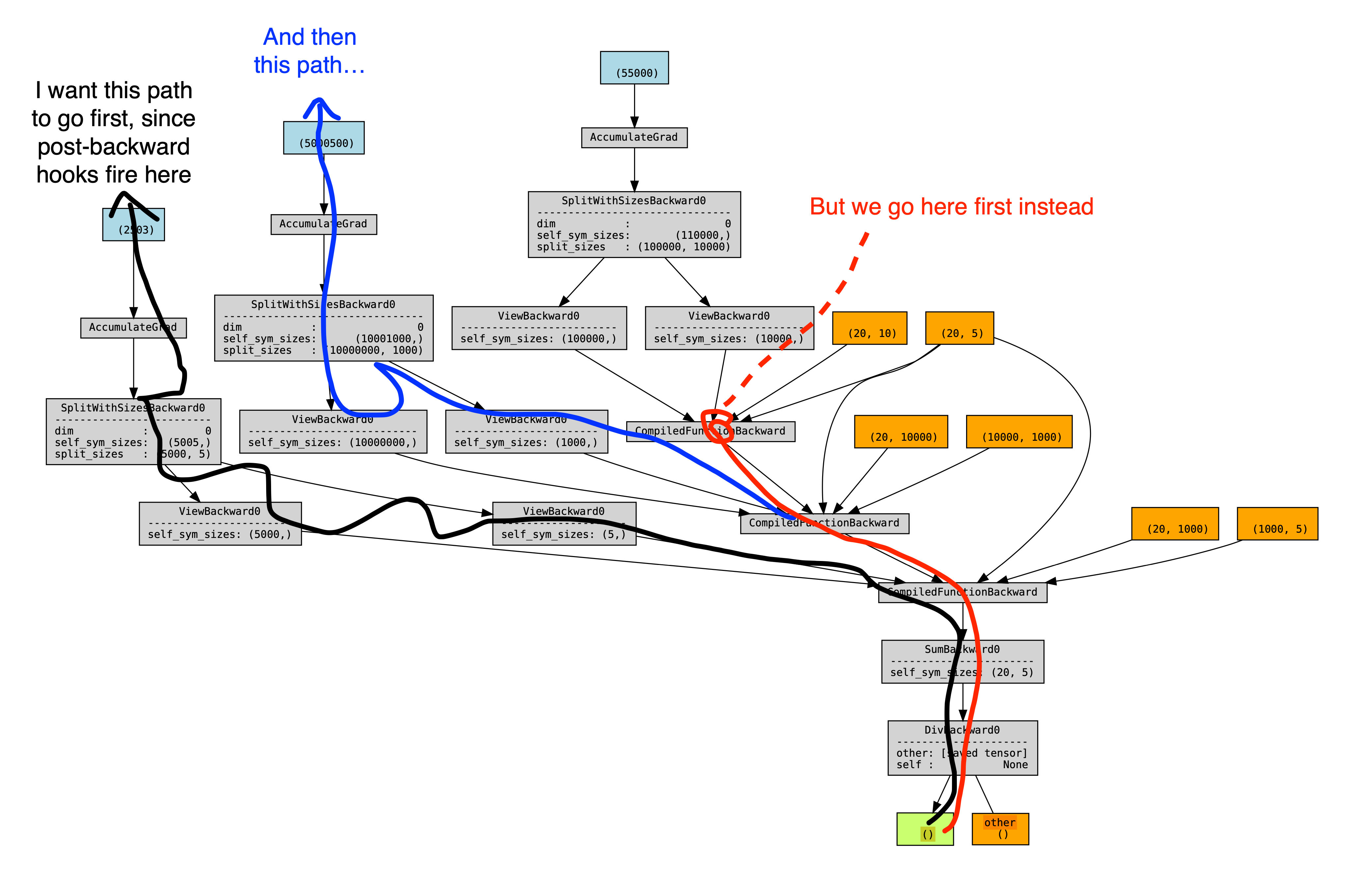
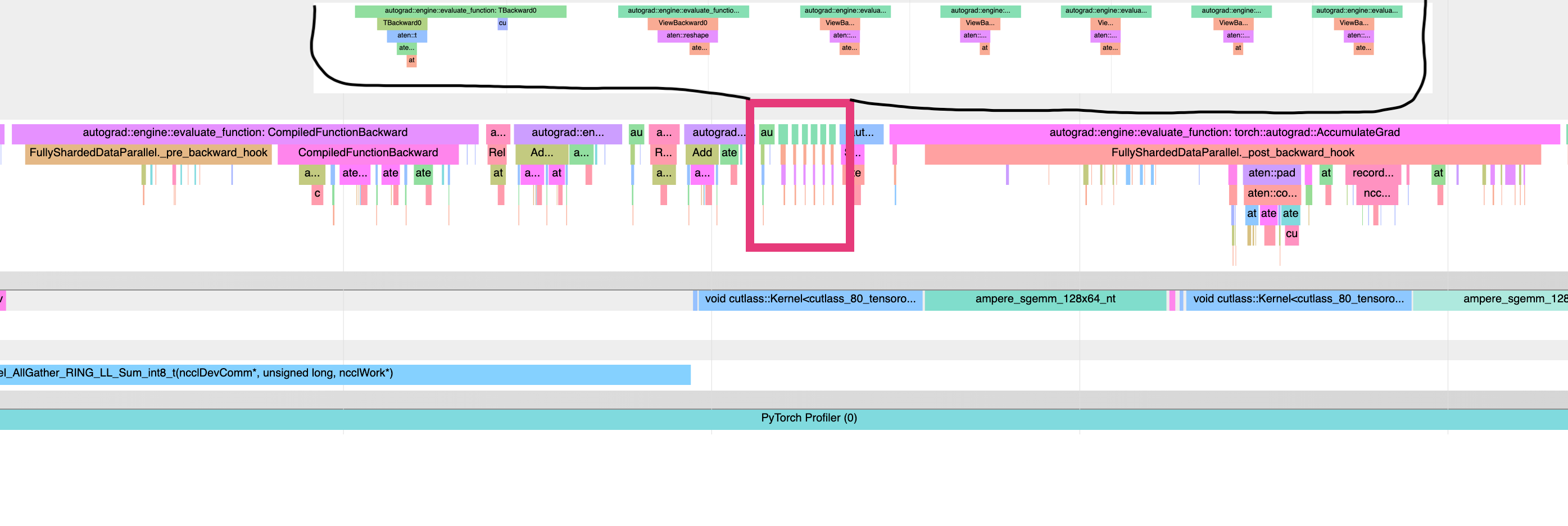
This is a problem, because we want backward hooks to run right after each compiled-backward, but autograd executes those hooks in an order mirroring their execution order during forward.  Since we are forever using the views created during steps (1, 3, ..  N), which all happen before the steps (A, B, ...),  this means that all the hooks will happen after all the compiled backwards.  An illustration of the problem - a torchviz graph showing the 2 possible orderings of autograd, and a profile showing the view-backwards ops happening after all the compiled backwards, and before all the backward hooks.

<img width="2069" alt="image" src="https://user-images.githubusercontent.com/4984825/202828002-32dbbd15-8fc3-4281-93e9-227ab5e32683.png">
<img width="2069" alt="image" src="https://user-images.githubusercontent.com/4984825/202828632-33e40729-9a7f-4e68-9ce1-571e3a8dd2dd.png">

A solution is to make dynamo not specialize on these nn modules.  It is worth pointing out that this nn.module specialization is de-facto failing, as we are modifying .parameters and this bypasses dynamo's __setattr__ monkeypatch, which should have automatically kicked us out to Unspecialized and forced a recompile.

After unspecializing, the new views (created during steps A,  C, ...) are actually _used_ at runtime by the module, making their creation order interleaved, making autograd execute their backwards interleaved.

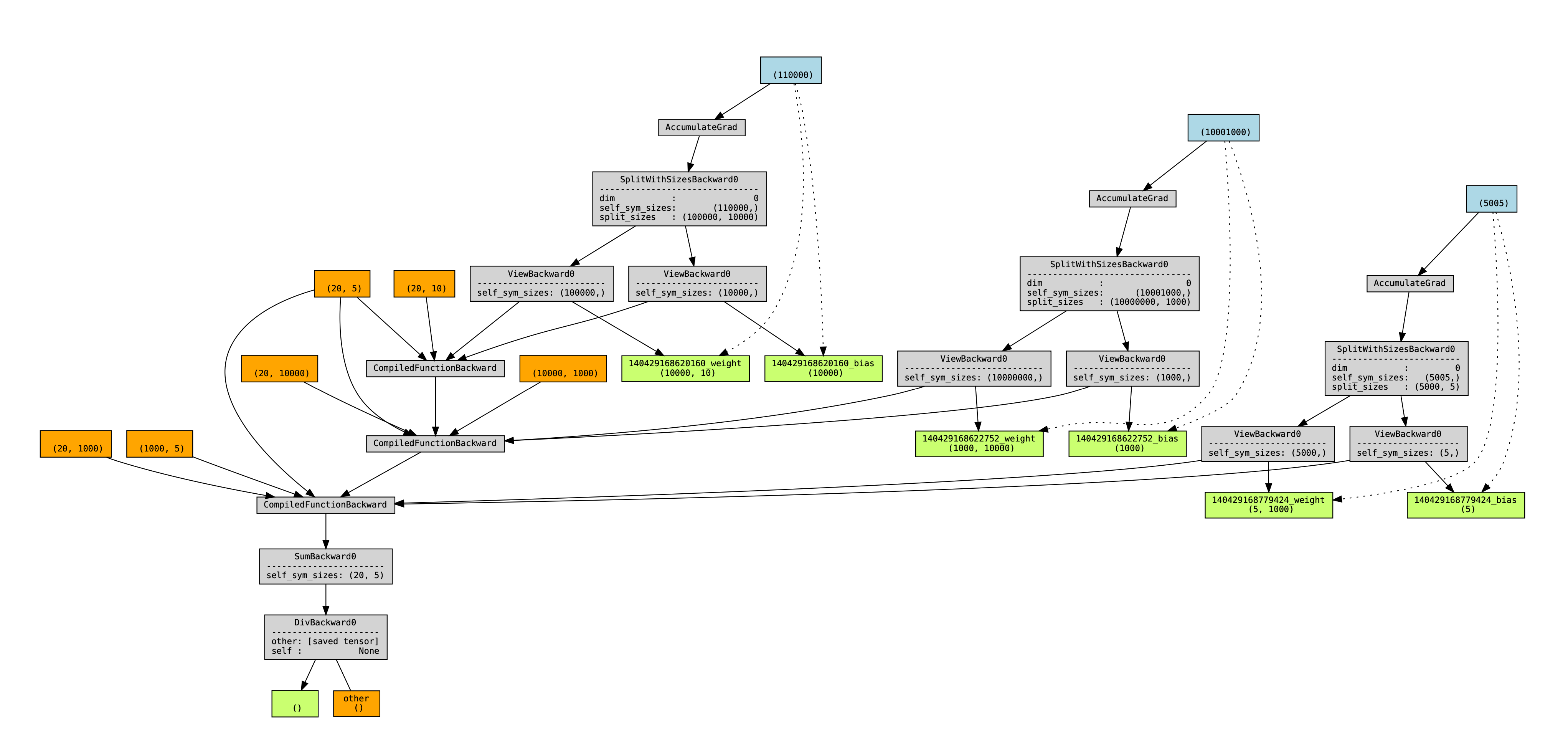
The new torchviz graph (this time with names added for the view tensors):
<img width="2043" alt="image" src="https://user-images.githubusercontent.com/4984825/202828480-d30005ba-0d20-45d8-b647-30b7ff5e91d3.png">

And a new profile showing the interleaving of compiled backwards and hooks, allowing overlapping of reduce-scatter.
<img width="2293" alt="image" src="https://user-images.githubusercontent.com/4984825/202828533-bb20a041-19b8-499c-b3cf-02808933df47.png">

@jansel @davidberard98 @aazzolini @mrshenli @awgu @ezyang @soumith @voznesenskym @anijain2305

Pull Request resolved: https://github.com/pytorch/pytorch/pull/89330
Approved by: https://github.com/davidberard98
I'm not sure why this never caused problems before.  The error
manifests as `TypeError: 'MyModule' object is not subscriptable`

Signed-off-by: Edward Z. Yang <ezyang@fb.com>

Pull Request resolved: https://github.com/pytorch/pytorch/pull/89625
Approved by: https://github.com/albanD
This is a slight regression: RAdam and Adagrad don't appear to
trace at all under fake tensors.  But I think this is a more accurate
reflection of the current state of affairs.

Along the way fix some problems on the fake tensor path.

Signed-off-by: Edward Z. Yang <ezyang@fb.com>

Pull Request resolved: https://github.com/pytorch/pytorch/pull/89643
Approved by: https://github.com/anjali411
Previously, we hackily wrapped unspecialized integers into
tensors and treated them as tensor inputs.  Sometimes, downstream
operations would not be able to deal with the tensor input.  Now,
we wrap them into SymInt, so more correct overload selection occurs.

Signed-off-by: Edward Z. Yang <ezyang@fb.com>

Pull Request resolved: https://github.com/pytorch/pytorch/pull/89639
Approved by: https://github.com/anjali411
This is a group of bug fixes for [7k github models](https://github.com/pytorch/torchdynamo/issues/1884), it would fix 30+ model tests.
* Support ```tensor.type()```.
* Support ```tensor.get_device()```.
* Support ```torch.nn.functional._Reduction.get_enum```.
* Support ```torch._utils._get_device_index()```.
* Fallback ```tensor.data_ptr()```.
  * ```FakeTensor``` always returns 0
  * For no fake tensor propagation, we ```clone``` the input tensor, which makes no sense to track the original ```data_ptr```. And I don't think this is a very popular API.

Pull Request resolved: https://github.com/pytorch/pytorch/pull/89486
Approved by: https://github.com/jansel
Fix bugs in [7k github models](https://github.com/pytorch/torchdynamo/issues/1884).
* Legacy code still use ```tensor.data```, I think we can use ```tensor.detach``` to rewrite, not sure if there is anything I didn't anticipate.
* Support ```tensor.layout```.

The root cause of these issues are: dynamo wraps unimplemented ```tensor.x``` call into ```GetAttrVariable(TensorVariable, x)```, but this op was not inserted into FX graph. Hence, during the fake tensor propagation, it throws ```KeyError: 'example_value` ```.

For these two popular attributes, Dynamo should support them anyway. However, if dynamo should support ___all___ ```tensor.x``` call and not fallback to ```GetAttrVariable```, I think it's debatable.
If I turn off fake tensor propagation, it works well even not including this fix. So I'm curious if we should improve the fake propagation to cover similar cases. cc @mlazos @soumith @voznesenskym @penguinwu @anijain2305 @EikanWang @jgong5 @Guobing-Chen @chunyuan-w @XiaobingSuper @zhuhaozhe @blzheng @Xia-Weiwen @wenzhe-nrv @jiayisunx @desertfire @jansel @eellison

```
Traceback (most recent call last):
  File "/scratch/ybliang/work/repos/pytorch/torch/_dynamo/convert_frame.py", line 404, in _compile
    out_code = transform_code_object(code, transform)
  File "/scratch/ybliang/work/repos/pytorch/torch/_dynamo/bytecode_transformation.py", line 341, in transform_code_object
    transformations(instructions, code_options)
  File "/scratch/ybliang/work/repos/pytorch/torch/_dynamo/convert_frame.py", line 392, in transform
    tracer.run()
  File "/scratch/ybliang/work/repos/pytorch/torch/_dynamo/symbolic_convert.py", line 1523, in run
    super().run()
  File "/scratch/ybliang/work/repos/pytorch/torch/_dynamo/symbolic_convert.py", line 389, in run
    and self.step()
  File "/scratch/ybliang/work/repos/pytorch/torch/_dynamo/symbolic_convert.py", line 359, in step
    getattr(self, inst.opname)(inst)
  File "/scratch/ybliang/work/repos/pytorch/torch/_dynamo/symbolic_convert.py", line 193, in wrapper
    return inner_fn(self, inst)
  File "/scratch/ybliang/work/repos/pytorch/torch/_dynamo/symbolic_convert.py", line 865, in CALL_FUNCTION_KW
    self.call_function(fn, args, kwargs)
  File "/scratch/ybliang/work/repos/pytorch/torch/_dynamo/symbolic_convert.py", line 301, in call_function
    self.push(fn.call_function(self, args, kwargs))
  File "/scratch/ybliang/work/repos/pytorch/torch/_dynamo/variables/torch.py", line 407, in call_function
    tensor_variable = wrap_fx_proxy(
  File "/scratch/ybliang/work/repos/pytorch/torch/_dynamo/variables/builder.py", line 636, in wrap_fx_proxy
    return wrap_fx_proxy_cls(
  File "/scratch/ybliang/work/repos/pytorch/torch/_dynamo/variables/builder.py", line 676, in wrap_fx_proxy_cls
    example_value = get_fake_value(proxy.node, tx)
  File "/scratch/ybliang/work/repos/pytorch/torch/_dynamo/utils.py", line 1024, in get_fake_value
    args, kwargs = torch.fx.node.map_arg((node.args, node.kwargs), visit)
  File "/scratch/ybliang/work/repos/pytorch/torch/fx/node.py", line 613, in map_arg
    return map_aggregate(a, lambda x: fn(x) if isinstance(x, Node) else x)
  File "/scratch/ybliang/work/repos/pytorch/torch/fx/node.py", line 621, in map_aggregate
    t = tuple(map_aggregate(elem, fn) for elem in a)
  File "/scratch/ybliang/work/repos/pytorch/torch/fx/node.py", line 621, in <genexpr>
    t = tuple(map_aggregate(elem, fn) for elem in a)
  File "/scratch/ybliang/work/repos/pytorch/torch/fx/node.py", line 627, in map_aggregate
    return immutable_dict((k, map_aggregate(v, fn)) for k, v in a.items())
  File "/scratch/ybliang/work/repos/pytorch/torch/fx/node.py", line 627, in <genexpr>
    return immutable_dict((k, map_aggregate(v, fn)) for k, v in a.items())
  File "/scratch/ybliang/work/repos/pytorch/torch/fx/node.py", line 631, in map_aggregate
    return fn(a)
  File "/scratch/ybliang/work/repos/pytorch/torch/fx/node.py", line 613, in <lambda>
    return map_aggregate(a, lambda x: fn(x) if isinstance(x, Node) else x)
  File "/scratch/ybliang/work/repos/pytorch/torch/_dynamo/utils.py", line 1022, in visit
    return n.meta["example_value"]
KeyError: 'example_value\n\nfrom user code:\n   File "./generated/test_BayesWatch_pytorch_prunes.py", line 108, in forward\n    return torch.zeros([x.size()[0], self.channels, x.size()[2] // self.spatial, x.size()[3] // self.spatial], dtype=x.dtype, layout=x.layout, device=x.device)\n\nSet torch._dynamo.config.verbose=True for more information\n\n\nYou can suppress this exception and fall back to eager by setting:\n    torch._dynamo.config.suppress_errors = True\n'

```

Pull Request resolved: https://github.com/pytorch/pytorch/pull/89257
Approved by: https://github.com/jansel
Make mutation faster to speed up tracing optimizers, helps with https://github.com/pytorch/torchdynamo/issues/1803

`replace_all` no longer iterates over the entire variable tracker data structure  every time a mutation is performed

Each variable tracker internally keeps a set of contained mutable variable trackers, to provide a hint to `replace_all`. This is populated with a call to `apply` from `__post_init__` in the base `VariableTracker`

Pull Request resolved: https://github.com/pytorch/pytorch/pull/89170
Approved by: https://github.com/jansel
Fixes error from 7k github models: https://github.com/jansel/pytorch-jit-paritybench/blob/master/generated/test_arashwan_matrixnet.py

Error:
```
AssertionError: torch.* op returned non-Tensor bool call_function <function is_tensor at 0x7fca94d0faf0>

from user code:
   File "/scratch/ybliang/work/repos/pytorch-jit-paritybench/generated/test_arashwan_matrixnet.py", line 749, in scatter
      return scatter_map(inputs)
   File "/scratch/ybliang/work/repos/pytorch-jit-paritybench/generated/test_arashwan_matrixnet.py", line 741, in scatter_map
      assert not torch.is_tensor(obj), 'Tensors not supported in scatter.'
```

Pull Request resolved: https://github.com/pytorch/pytorch/pull/88704
Approved by: https://github.com/jansel
This refactor was prompted by challenges handling mixed int/float
operations in C++.  A previous version of this patch
added overloads for each permutation of int/float and was unwieldy
https://github.com/pytorch/pytorch/pull/87722/  This PR takes a different
approach.

The general outline of the patch is to combine the C++ types SymIntNode
and SymFloatNode into a single type, SymNode.  This is type erased; we
no longer know statically at C++ if we have an int/float and have to test
it with the is_int()/is_float() virtual methods.  This has a number of
knock on effects.

- We no longer have C++ classes to bind to Python.  Instead, we take an
  entirely new approach to our Python API, where we have a SymInt/SymFloat
  class defined entirely in Python, which hold a SymNode (which corresponds
  to the C++ SymNode).  However, SymNode is not pybind11-bound; instead,
  it lives as-is in Python, and is wrapped into C++ SymNode using PythonSymNode
  when it goes into C++.  This implies a userland rename.

  In principle, it is also possible for the canonical implementation of SymNode
  to be written in C++, and then bound to Python with pybind11 (we have
  this code, although it is commented out.)  However, I did not implement
  this as we currently have no C++ implementations of SymNode.

  Because we do return SymInt/SymFloat from C++ bindings, the C++ binding
  code needs to know how to find these classes.  Currently, this is done
  just by manually importing torch and getting the attributes.

- Because SymInt/SymFloat are easy Python wrappers, __sym_dispatch__ now
  takes SymInt/SymFloat, rather than SymNode, bringing it in line with how
  __torch_dispatch__ works.

Some miscellaneous improvements:

- SymInt now has a constructor that takes SymNode.  Note that this
  constructor is ambiguous if you pass in a subclass of SymNode,
  so an explicit downcast is necessary.  This means toSymFloat/toSymInt
  are no more.  This is a mild optimization as it means rvalue reference
  works automatically.

- We uniformly use the caster for c10::SymInt/SymFloat, rather than
  going the long way via the SymIntNode/SymFloatNode.

- Removed some unnecessary toSymInt/toSymFloat calls in normalize_*
  functions, pretty sure this doesn't do anything.

- guard_int is now a free function, since to guard on an int you cannot
  assume the method exists.  A function can handle both int and SymInt
  inputs.

- We clean up the magic method definition code for SymInt/SymFloat/SymNode.
  ONLY the user classes (SymInt/SymFloat) get magic methods; SymNode gets
  plain methods; this is to help avoid confusion between the two types.

Signed-off-by: Edward Z. Yang <ezyang@fb.com>

cc @jansel @mlazos @soumith @voznesenskym @yanboliang @penguinwu @anijain2305
Pull Request resolved: https://github.com/pytorch/pytorch/pull/87817
Approved by: https://github.com/albanD, https://github.com/anjali411
**Introduces symbolic shape guards into dynamo.**

In this PR, we take the existing fake tensor infra and plumbing in dynamo and we start passing a shape_env around. This shape_env does not get plumbed down to middle layers / backend yet - it only collects expressions from frontend invocations at the moment. We then translate these expressions into guards at the point where we take other guards installed throughout dynamo - and add them to check_fn.

Part 1 of https://docs.google.com/document/d/1QJ-M4zfMkD-fjHIqW089RptjLl9EgozZGCceUbvmgfY/edit#

cc @jansel @lezcano @fdrocha @mlazos @soumith @yanboliang @penguinwu @anijain2305
Pull Request resolved: https://github.com/pytorch/pytorch/pull/87570
Approved by: https://github.com/ezyang
Right now, example_value is doing two jobs:
- We use it to propagate metadata (e.g. return type, shapes, etc.)
  throughout the graph
- We use it to satisfy queries for the actual value (e.g. torch.cond,
  `assume_constant_result`)

This is further complicated by the fact that we have two modes, one
where `example_value` is a fake tensor, and one where it is a real
tensor (this is the `fake_tensor_propagation` config flag).

This leads to scenarios where we don't support every combination of
job + mode,
e.g. if `fake_tensor_propagation=False`, `assume_constant_result` is
broken.

This is made worse by the fact that "fake tensor mode" is the default
and is required if you want dynamic shapes to work.

So, this PR introduces a `get_real_value` API that just runs the graph
up to `node` in order to get a concrete value. This API is orthogonal
to
`example_value`, so it doesn't care about `fake_tensor_propagation`.

When `fake_tensor_propagation=True`: `example_value` is a fake tensor,
you must use the `get_real_value` API to get a concrete value. This
will
be the only configuration in the future.

When `fake_tensor_propagation=False`: `example_value` and
`get_real_value` will produce the same value. This is redundant but we
will be removing this config soon.

To support this, I introduce a cache for computed real values, to
memoize the work involved if we're asking for real values a lot.

I attached this state to `OutputGraph` because it seems to be what
historically managed `example_value` lifetimes, but idk.

Pull Request resolved: https://github.com/pytorch/pytorch/pull/87091
Approved by: https://github.com/wconstab