Summary:
Switched to short forms of `splitWithTail` / `splitWithMask` for all tests in `test/cpp/tensorexpr/test_*.cpp` (except test_loopnest.cpp)

Pull Request resolved: https://github.com/pytorch/pytorch/pull/55542

Reviewed By: mrshenli

Differential Revision: D27632033

Pulled By: jbschlosser

fbshipit-source-id: dc2ba134f99bff8951ae61e564cd1daea92c41df
Summary:
Pull Request resolved: https://github.com/pytorch/pytorch/pull/54997

DepTracker was used to automatically pull in dependent computations from
output ones. While it seems quite convenient, it's led to several
architectural issues, which are fixed in this stack.

DepTracker worked on Tensors, which is a pair of Buf and Stmt. However,
Stmt could become stale and there was no way to reliably update the
corresponding tensor. We're now using Bufs and Stmts directly and moving
away from using Tensors to avoid these problems.

Removing DepTracker allowed to unify Loads and FunctionCalls, which
essentially were duplicates of each other.

Test Plan: Imported from OSS

Reviewed By: navahgar

Differential Revision: D27446414

Pulled By: ZolotukhinM

fbshipit-source-id: a2a32749d5b28beed92a601da33d126c0a2cf399
Summary:
Makes two changes in NNC for intermediate buffer allocations:
1. Flattens dimensions of buffers allocated in LoopNest::prepareForCodegen() to match their flattened usages.
2. Adds support for tracking memory dependencies of Alloc/Free to the MemDependencyChecker, which will allow us to check safety of accesses to intermediate buffers (coming in a future diff).

I didn't add any new tests as the mem dependency checker tests already cover it pretty well, particularly the GEMM test.

Pull Request resolved: https://github.com/pytorch/pytorch/pull/49554

Reviewed By: VitalyFedyunin

Differential Revision: D25643133

Pulled By: nickgg

fbshipit-source-id: 66be3054eb36f0a4279d0c36562e63aa2dae371c
Summary:
Pull Request resolved: https://github.com/pytorch/pytorch/pull/48160
We no longer use the custom c++ test infra anyways, so move to pure
gtest.
Fixes#45703
ghstack-source-id: 116977283
Test Plan: `buck test //caffe2/test/cpp/tensorexpr`
Reviewed By: navahgar, nickgg
Differential Revision: D25046618
fbshipit-source-id: da34183d87465f410379048148c28e1623618553
Summary:
Refactors the ReduceOp node to remove the last remaining deferred functionality: completing the interaction between the accumulator buffer and the body. This fixes two issues with reductions:
1. Nodes inside the interaction could not be visited or modified, meaning we could generate bad code when the interaction was complex.
2. The accumulator load was created at expansion time and so could not be modified in some ways (ie. vectorization couldn't act on these loads).

This simplifies reduction logic quite a bit, but theres a bit more involved in the rfactor transform.

Pull Request resolved: https://github.com/pytorch/pytorch/pull/47709

Reviewed By: ZolotukhinM

Differential Revision: D24904220

Pulled By: nickgg

fbshipit-source-id: 159e5fd967d2d1f8697cfa96ce1bb5fc44920a40
Summary:
Adds a helper function to Bounds Inference / Memory Analaysis infrastructure which returns the kind of hazard found between two Stmts (e.g. Blocks or Loops). E.g.
```
for (int i = 0; i < 10; ++i) {
  A[x] = i * 2;
}
for (int j = 0; j < 10; ++j) {
 B[x] = A[x] / 2;
}
```
The two loops have a `ReadAfterWrite` hazard, while in this example:
```
for (int i = 0; i < 10; ++i) {
  A[x] = i * 2;
}
for (int j = 0; j < 10; ++j) {
 A[x] = B[x] / 2;
}
```
The loops have a `WriteAfterWrite` hazard.

This isn't 100% of what we need for loop fusion, for example we don't check the strides of the loop to see if they match.

Pull Request resolved: https://github.com/pytorch/pytorch/pull/47684

Reviewed By: malfet

Differential Revision: D24873587

Pulled By: nickgg

fbshipit-source-id: 991149e5942e769612298ada855687469a219d62
Summary:
Adds a new piece of infrastructure to the NNC fused-kernel generation compiler, which builds a dependency graph of the reads and writes to memory regions in a kernel.
It can be used to generate graphs like this from the GEMM benchmark (not this only represents memory hierarchy not compute hierarchy):
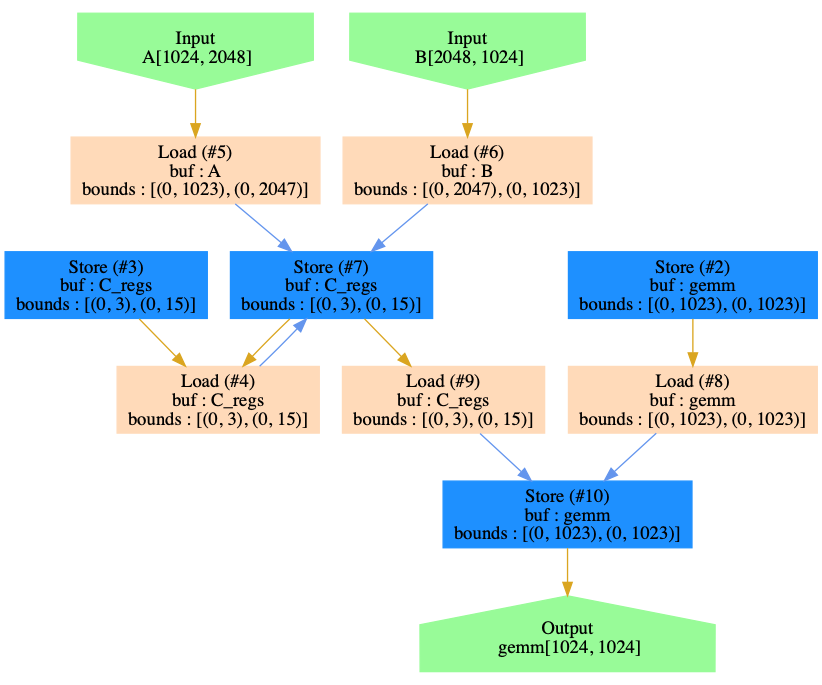
Or to answer questions like this:
```
Tensor* c = Compute(...);
Tensor* d = Compute(...);
LoopNest loop({d});
MemDependencyChecker analyzer;
loop.root_stmt()->accept(analyzer);
if (analyzer.dependsDirectly(loop.getLoopStmtsFor(d)[0], loop.getLoopStmtsFor(c)[0]) {
// do something, maybe computeInline
}
```
Or this:
```
Tensor* d = Compute(...);
LoopNest loop({d});
MemDependencyChecker analyzer(loop.getInputs(), loop.getOutputs());
const Buf* output = d->buf();
for (const Buf* input : inputs) {
if (!analyzer.dependsIndirectly(output, input)) {
// signal that this input is unused
}
}
```
This is a monster of a diff, and I apologize. I've tested it as well as possible for now, but it's not hooked up to anything yet so should not affect any current usages of the NNC fuser.
**How it works:**
Similar to the registerizer, the MemDependencyChecker walks the IR aggregating memory accesses into scopes, then merges those scopes into their parent scope and tracks which writes are responsible for the last write to a particular region of memory, adding dependency links where that region is used.
This relies on a bunch of math on symbolic contiguous regions which I've pulled out into its own file (bounds_overlap.h/cpp). Sometimes this wont be able to infer dependence with 100% accuracy but I think it should always be conservative and occaisionally add false positives but I'm aware of no false negatives.
The hardest part of the analysis is determining when a Load inside a For loop depends on a Store that is lower in the IR from a previous iteration of the loop. This depends on a whole bunch of factors, including whether or not we should consider loop iteration order. The analyzer comes with configuration of this setting. For example this loop:
```
for (int i = 0; i < 10; ++i) {
A[x] = B[x] + 1;
}
```
has no inter loop dependence, since each iteration uses a distinct slice of both A and B. But this one:
```
for (int i = 0; i < 10; ++i) {
A[0] = A[0] + B[x];
}
```
Has a self loop dependence between the Load and the Store of A. This applies to many cases that are not reductions as well. In this example:
```
for (int i =0; i < 10; ++i) {
A[x] = A[x+1] + x;
}
```
Whether or not it has self-loop dependence depends on if we are assuming the execution order is fixed (or whether this loop could later be parallelized). If the read from `A[x+1]` always comes before the write to that same region then it has no dependence.
The analyzer can correctly handle dynamic shapes, but we may need more test coverage of real world usages of dynamic shapes. I unit test some simple and pathological cases, but coverage could be better.
**Next Steps:**
Since the PR was already so big I didn't actually hook it up anywhere, but I had planned on rewriting bounds inference based on the dependency graph. Will do that next.
There are few gaps in this code which could be filled in later if we need it:
* Upgrading the bound math to work with write strides, which will reduce false positive dependencies.
* Better handling of Conditions, reducing false positive dependencies when a range is written in both branches of a Cond.
* Support for AtomicAdd node added in Cuda codegen.
**Testing:**
See new unit tests, I've tried to be verbose about what is being tested. I ran the python tests but there shouldn't be any way for this work to affect them yet.
Pull Request resolved: https://github.com/pytorch/pytorch/pull/46952
Reviewed By: ejguan
Differential Revision: D24730346
Pulled By: nickgg
fbshipit-source-id: 654c67c71e9880495afd3ae0efc142e95d5190df

