This PR fixes several bugs, listed in priority:
1. `load_state_dict` with a nontensor step was incorrect for capturable and fused implementations since we don't create the tensors on the right device in `__setstate__`. This has been fixed.
2. The most recently added capturable implementations forgot the check that all tensors should be on CUDA for eager. We've now added those checks
3. The most recent change in Adamax only adds capturable for foreach but will silently be incorrect for forloop/single-tensor. I've added erroring and modified testing with many many many skips for that. Honestly my preference after this PR has only been further cemented  that we should just do the single tensor and multi tensor capturable implementations together in the future. @mlazos
4. The conditional for adding cuda-supported configs for the optimizer infos was incorrect! So we hadn't been testing capturable! This also stands rectified and was the trigger for this PR in the first place.
5. In a similar way, the conditional for `_get_optim_inputs_including_global_cliquey_kwargs` was incorrect sometimes as well. This has also been corrected.

The following is not a bug, but is just something to make life simpler by not needing to handle Nones: `optim_input_funcs` must now mandatorily take in a `device`, which could be a string or a torch.device.

Details for posterity:
4. Running the test_foreach_matches_forloop test and printing the configs that get printed yields capturable getting included, which is correct.
```
(pytorch-3.10) [janeyx@devgpu023.odn1 ~/local/pytorch (5d50138f)]$ python test/test_optim.py -k test_foreach_matches_forloop_AdamW_cuda
/home/janeyx/.conda/envs/pytorch-3.10/lib/python3.10/site-packages/transformers/utils/generic.py:441: UserWarning: torch.utils._pytree._register_pytree_node is deprecated. Please use torch.utils._pytree.register_pytree_node instead.
  _torch_pytree._register_pytree_node(
/home/janeyx/.conda/envs/pytorch-3.10/lib/python3.10/site-packages/scipy/__init__.py:146: UserWarning: A NumPy version >=1.17.3 and <1.25.0 is required for this version of SciPy (detected version 1.26.0
  warnings.warn(f"A NumPy version >={np_minversion} and <{np_maxversion}"
params=None, kwargs={}, desc=default
params=None, kwargs={'lr': 0.01}, desc=non-default lr
params=None, kwargs={'weight_decay': 0.1}, desc=nonzero weight_decay
params=None, kwargs={'weight_decay': 0.1, 'maximize': True}, desc=maximize
params=None, kwargs={'weight_decay': 0.1, 'amsgrad': True}, desc=amsgrad
params=None, kwargs={'capturable': True}, desc=capturable
params=None, kwargs={'weight_decay': 0.1, 'amsgrad': True, 'capturable': True}, desc=capturable, amsgrad
params=None, kwargs={'lr': tensor(0.0010), 'amsgrad': True, 'capturable': True}, desc=Tensor lr with capturable and amsgrad
.
----------------------------------------------------------------------
Ran 1 test in 19.229s

OK
```
5. Running the test_optimizer_can_be_printed test (which calls `_get_optim_inputs_including_global_cliquey_kwargs`) and printing what gets run is also now correct.
```
/home/janeyx/.conda/envs/pytorch-3.10/lib/python3.10/site-packages/scipy/__init__.py:146: UserWarning: A NumPy version >=1.17.3 and <1.25.0 is required for this version of SciPy (detected version 1.26.0
  warnings.warn(f"A NumPy version >={np_minversion} and <{np_maxversion}"
params=None, kwargs={'differentiable': False}, desc=default
params=None, kwargs={'differentiable': True}, desc=default & differentiable
params=None, kwargs={'lr': 0.01, 'differentiable': False}, desc=non-default lr
params=None, kwargs={'lr': 0.01, 'differentiable': True}, desc=non-default lr & differentiable
params=None, kwargs={'weight_decay': 0.1, 'differentiable': False}, desc=nonzero weight_decay
params=None, kwargs={'weight_decay': 0.1, 'differentiable': True}, desc=nonzero weight_decay & differentiable
params=None, kwargs={'weight_decay': 0.1, 'maximize': True, 'differentiable': False}, desc=maximize
params=None, kwargs={'weight_decay': 0.1, 'maximize': True, 'differentiable': True}, desc=maximize & differentiable
params=None, kwargs={'weight_decay': 0.1, 'amsgrad': True, 'differentiable': False}, desc=amsgrad
params=None, kwargs={'weight_decay': 0.1, 'amsgrad': True, 'differentiable': True}, desc=amsgrad & differentiable
.params=None, kwargs={'foreach': False, 'differentiable': False, 'fused': False}, desc=default
params=None, kwargs={'foreach': True, 'differentiable': False, 'fused': False}, desc=default & foreach
params=None, kwargs={'foreach': False, 'differentiable': True, 'fused': False}, desc=default & differentiable
params=None, kwargs={'foreach': False, 'differentiable': False, 'fused': True}, desc=default & fused
params=None, kwargs={'lr': 0.01, 'foreach': False, 'differentiable': False, 'fused': False}, desc=non-default lr
params=None, kwargs={'lr': 0.01, 'foreach': True, 'differentiable': False, 'fused': False}, desc=non-default lr & foreach
params=None, kwargs={'lr': 0.01, 'foreach': False, 'differentiable': True, 'fused': False}, desc=non-default lr & differentiable
params=None, kwargs={'lr': 0.01, 'foreach': False, 'differentiable': False, 'fused': True}, desc=non-default lr & fused
params=None, kwargs={'weight_decay': 0.1, 'foreach': False, 'differentiable': False, 'fused': False}, desc=nonzero weight_decay
params=None, kwargs={'weight_decay': 0.1, 'foreach': True, 'differentiable': False, 'fused': False}, desc=nonzero weight_decay & foreach
params=None, kwargs={'weight_decay': 0.1, 'foreach': False, 'differentiable': True, 'fused': False}, desc=nonzero weight_decay & differentiable
params=None, kwargs={'weight_decay': 0.1, 'foreach': False, 'differentiable': False, 'fused': True}, desc=nonzero weight_decay & fused
params=None, kwargs={'weight_decay': 0.1, 'maximize': True, 'foreach': False, 'differentiable': False, 'fused': False}, desc=maximize
params=None, kwargs={'weight_decay': 0.1, 'maximize': True, 'foreach': True, 'differentiable': False, 'fused': False}, desc=maximize & foreach
params=None, kwargs={'weight_decay': 0.1, 'maximize': True, 'foreach': False, 'differentiable': True, 'fused': False}, desc=maximize & differentiable
params=None, kwargs={'weight_decay': 0.1, 'maximize': True, 'foreach': False, 'differentiable': False, 'fused': True}, desc=maximize & fused
params=None, kwargs={'weight_decay': 0.1, 'amsgrad': True, 'foreach': False, 'differentiable': False, 'fused': False}, desc=amsgrad
params=None, kwargs={'weight_decay': 0.1, 'amsgrad': True, 'foreach': True, 'differentiable': False, 'fused': False}, desc=amsgrad & foreach
params=None, kwargs={'weight_decay': 0.1, 'amsgrad': True, 'foreach': False, 'differentiable': True, 'fused': False}, desc=amsgrad & differentiable
params=None, kwargs={'weight_decay': 0.1, 'amsgrad': True, 'foreach': False, 'differentiable': False, 'fused': True}, desc=amsgrad & fused
params=None, kwargs={'capturable': True, 'foreach': False, 'differentiable': False, 'fused': False}, desc=capturable
params=None, kwargs={'capturable': True, 'foreach': True, 'differentiable': False, 'fused': False}, desc=capturable & foreach
params=None, kwargs={'capturable': True, 'foreach': False, 'differentiable': True, 'fused': False}, desc=capturable & differentiable
params=None, kwargs={'capturable': True, 'foreach': False, 'differentiable': False, 'fused': True}, desc=capturable & fused
params=None, kwargs={'weight_decay': 0.1, 'amsgrad': True, 'capturable': True, 'foreach': False, 'differentiable': False, 'fused': False}, desc=capturable, amsgrad
params=None, kwargs={'weight_decay': 0.1, 'amsgrad': True, 'capturable': True, 'foreach': True, 'differentiable': False, 'fused': False}, desc=capturable, amsgrad & foreach
params=None, kwargs={'weight_decay': 0.1, 'amsgrad': True, 'capturable': True, 'foreach': False, 'differentiable': True, 'fused': False}, desc=capturable, amsgrad & differentiable
params=None, kwargs={'weight_decay': 0.1, 'amsgrad': True, 'capturable': True, 'foreach': False, 'differentiable': False, 'fused': True}, desc=capturable, amsgrad & fused
params=None, kwargs={'lr': tensor(0.0010), 'amsgrad': True, 'capturable': True, 'foreach': False, 'differentiable': False, 'fused': False}, desc=Tensor lr with capturable and amsgrad
params=None, kwargs={'lr': tensor(0.0010), 'amsgrad': True, 'capturable': True, 'foreach': True, 'differentiable': False, 'fused': False}, desc=Tensor lr with capturable and amsgrad & foreach
params=None, kwargs={'lr': tensor(0.0010), 'amsgrad': True, 'capturable': True, 'foreach': False, 'differentiable': True, 'fused': False}, desc=Tensor lr with capturable and amsgrad & differentiable
params=None, kwargs={'lr': tensor(0.0010), 'amsgrad': True, 'capturable': True, 'foreach': False, 'differentiable': False, 'fused': True}, desc=Tensor lr with capturable and amsgrad & fused
.
----------------------------------------------------------------------
Ran 2 tests in 11.112s

OK
```

Pull Request resolved: https://github.com/pytorch/pytorch/pull/118326
Approved by: https://github.com/mlazos
Should allow for uses cases mentioned in #110940

This would allow scalars to also be float64s in the foreach implementation. The fused implementation would still create a float32 step on Adam and AdamW. This PR also does NOT worry about performance and is mainly for enablement.

Next steps:
- Relax the constraint on fused adam(w) and allow torch.float64 scalars there
- Allow _performant_ mixed dtypes in foreach (a bigger project in itself).

This PR will conflict with my other PRs, I will figure out a landing order

Pull Request resolved: https://github.com/pytorch/pytorch/pull/115841
Approved by: https://github.com/albanD
Fixes#107282
## Overview
- basic design decision was followed as they made on #103881 (tensor operation, test cases, order & position of argument etc.)
- for the algorithm for decoupled weight decay, I referred to [1, 2]
## backwards-incompatible changes
- positional argument `decoupled_weight_decay` is added to:
- `torch.optim.radam`
The existing code which refers to these APIs can be affected.
Note: Positional argument `decoupled_weight_decay` is added to `torch.optim.RAdam`. However, since it was added to the last position and with default value, it is not affected.
## Reference
- [1] [Decoupled Weight Decay Regularization](https://arxiv.org/abs/1711.05101)
- [2] https://github.com/LiyuanLucasLiu/RAdam/blob/master/radam/radam.py#L5-L94
## TODO
- [x] implement tensor operation
- [x] implement test cases
- [x] modify doc-string
- [x] pass unit test code locally `python test/test_optim.py -k test_radam`
Pull Request resolved: https://github.com/pytorch/pytorch/pull/107507
Approved by: https://github.com/janeyx99
This is a reland of https://github.com/pytorch/pytorch/pull/100007 with a build fix for Windows debug builds.
`at::native::ParamsHash` only works on structs with standard layout, but `std::string` isn't one in Visual C++ debug builds, which one can easily verified by running something like:
```cpp
#define _DEBUG
#include <type_traits>
#include <string>
static_assert(std::is_standard_layout_v<std::string>, "Oh noes");
```
If above conditon is not met, instead of printing a static_assert output, VC++ raises a very cryptic compilation errors,  see https://github.com/pytorch/pytorch/pull/100007#discussion_r1227116292 for more detail.

Also, using `std::hash` for string should result in a faster hash function.

(cherry picked from commit 74b7a6c75e)

<!--
copilot:summary
-->
### <samp>🤖 Generated by Copilot at 5914771</samp>

This pull request introduces a new function `_group_tensors_by_device_and_dtype` that can group tensors by their device and dtype, and updates the `foreach` utilities and several optimizers to use this function. The goal is to improve the performance, readability, and compatibility of the code that handles tensors with different properties. The pull request also adds a test case and type annotations for the new function, and some error checks for the `fused` argument in Adam and AdamW.
Pull Request resolved: https://github.com/pytorch/pytorch/pull/103912
Approved by: https://github.com/janeyx99
Big OOP correction continued. Also added a test this time to verify the defaulting was as expected.

The key here is realizing that the grouping for foreach already assumes that the non-param tensorlists follow suit in dtype and device, so it is too narrow to check that _all_ tensors were on CUDA. The main leeway this allowed was state_steps, which are sometimes cpu tensors. Since foreach _can_ handle cpu tensors, this should not introduce breakage.

Pull Request resolved: https://github.com/pytorch/pytorch/pull/95820
Approved by: https://github.com/albanD
Rolling back the default change for Adam and rectifying the docs to reflect that AdamW never defaulted to fused.

Since our fused implementations are relatively newer, let's give them a longer bake-in time before flipping the switch for every user.

Pull Request resolved: https://github.com/pytorch/pytorch/pull/95241
Approved by: https://github.com/ngimel
This allows it so that ONLY when the users don't set anything for foreach or fused do we switch the default and cascades adam so that we default to fused, then foreach, then single-tensor.

To clarify:
* if the user puts True in foreach _only_, it will run the foreach implementation.
* if the user puts True in fused _only_, it will run the fused implementation.
* if the user puts True in foreach AND for fused, it will run the fused implementation.

And:
* if the user puts False in foreach _only_, it will run the single tensor implementation.
* if the user puts False in fused _only_, it will still run the single tensor implementation.
* if the user puts False in foreach AND for fused, it will run the single tensor implementation.

I also didn't trust myself that much with the helper function, so I ran some local asserts on _default_to_fused_or_foreach. The only point left to really test is the type(p) -- torch.Tensor but I think the distributed tests will catch that in CI.
```
cuda_only_fp_list = [
    torch.rand((1, 2), device="cuda", dtype=torch.float32),
    torch.rand((1, 2), device="cuda", dtype=torch.float64),
    torch.rand((1, 2), device="cuda", dtype=torch.float16),
    torch.rand((1, 2), device="cuda", dtype=torch.bfloat16),
]

cuda_only_int_list = [
    torch.randint(1024, (1, 2), device="cuda", dtype=torch.int64),
]

cpu_list = [
    torch.rand((1, 2), device="cpu", dtype=torch.float32),
    torch.rand((1, 2), device="cpu", dtype=torch.float64),
    torch.rand((1, 2), device="cpu", dtype=torch.float16),
]

none_list = [None]

# differentiable should always make it return false for both
assert _default_to_fused_or_foreach([cuda_only_fp_list], True, True) == (False, False)
assert _default_to_fused_or_foreach([cuda_only_fp_list], True, False) == (False, False)

# cpu lists should always make it return false for both
assert _default_to_fused_or_foreach([cuda_only_fp_list, cpu_list], False, True) == (False, False)
assert _default_to_fused_or_foreach([cpu_list], False, True) == (False, False)
assert _default_to_fused_or_foreach([cuda_only_fp_list, cpu_list], False, False) == (False, False)
assert _default_to_fused_or_foreach([cpu_list], False, False) == (False, False)

# has fused triggers correctly
assert _default_to_fused_or_foreach([cuda_only_fp_list], False, True) == (True, False)
assert _default_to_fused_or_foreach([cuda_only_fp_list], False, False) == (False, True)

# ints always goes to foreach
assert _default_to_fused_or_foreach([cuda_only_fp_list, cuda_only_int_list], False, True) == (False, True)
assert _default_to_fused_or_foreach([cuda_only_fp_list, cuda_only_int_list], False, False) == (False, True)

# Nones don't error
assert _default_to_fused_or_foreach([cuda_only_fp_list, none_list], False, True) == (True, False)
assert _default_to_fused_or_foreach([cuda_only_fp_list, cuda_only_int_list, none_list], False, True) == (False, True)
assert _default_to_fused_or_foreach([none_list], False, True) == (True, False)
assert _default_to_fused_or_foreach([none_list], False, False) == (False, True)
```

Pull Request resolved: https://github.com/pytorch/pytorch/pull/93184
Approved by: https://github.com/albanD
@mlazos: skips `item()` calls if compiling with dynamo, by defining a helper function `_get_value` which either returns the result of `.item()` or the scalar cpu tensor if compiling with dynamo. This was done because removing `item()` calls significantly regresses eager perf. Additionally, `_dispatch_sqrt` calls the appropriate sqrt function (math.sqrt, or torch.sqrt).

Fixes https://github.com/pytorch/torchdynamo/issues/1083

This PR will no longer be needed once symint support is default.

This PR closes all remaining graph breaks in the optimizers (!!)

Pull Request resolved: https://github.com/pytorch/pytorch/pull/88173
Approved by: https://github.com/albanD
### Description

Across PyTorch's docstrings, both `callable` and `Callable` for variable types. The Callable should be capitalized as we are referring to the `Callable` type, and not the Python `callable()` function.

### Testing

There shouldn't be any testing required.

Pull Request resolved: https://github.com/pytorch/pytorch/pull/82487
Approved by: https://github.com/albanD
Generator comprehensions with any/all are less verbose and potentially help to save memory/CPU : https://eklitzke.org/generator-comprehensions-and-using-any-and-all-in-python

To make JIT work with this change, I added code to convert GeneratorExp to ListComp. So the whole PR is basically NoOp for JIT, but potentially memory and speed improvement for eager mode.

Also I removed a test from test/jit/test_parametrization.py. The test was bad and had a TODO to actually implement and just tested that UnsupportedNodeError is thrown, and with GeneratorExp support a different error would be thrown.
Pull Request resolved: https://github.com/pytorch/pytorch/pull/78142
Approved by: https://github.com/malfet, https://github.com/albanD
Summary:
Pull Request resolved: https://github.com/pytorch/pytorch/pull/71333

Updated
- Adagrad
- Adamax
- Adam
- AdamW
- RAdam
make multi_tensor functionals take `state_steps: List[Tensor]` instead of taking `states: List[Dict]`
make `state_steps: List[int]s -> state_steps:List[Tensor]` where each is a Singleton tensor so step can be updated within the functional

(NAdam and ASGD) were updated in separate diffs to fold their handling of state into the functionals

Test Plan: Imported from OSS

Reviewed By: anjali411

Differential Revision: D33767872

Pulled By: mikaylagawarecki

fbshipit-source-id: 9baa7cafb6375eab839917df9287c65a437891f2
(cherry picked from commit 831c02b3d0)
Summary:
Fixes : https://github.com/pytorch/pytorch/issues/24892
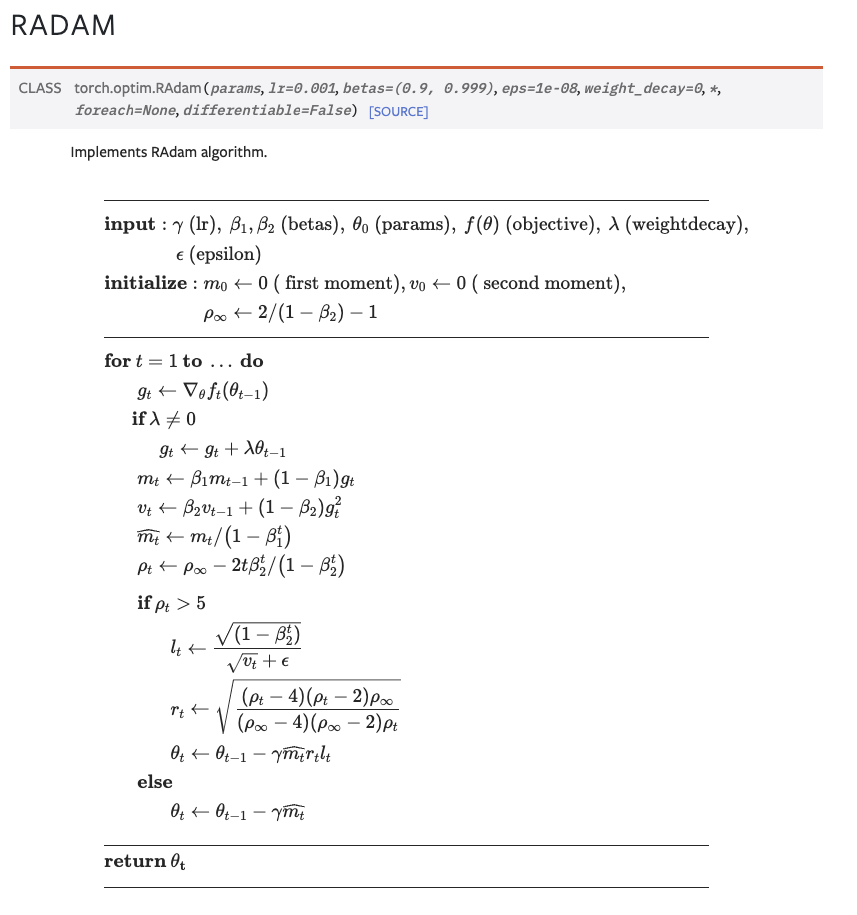
In the paper : https://arxiv.org/pdf/1908.03265.pdf Liyuan Liu et al. suggested a new optimization algorithm with an essence of similar to Adam Algorithm.
It has been discussed in the paper that, without warmup heuristic, in the early stage of adaptive optimization / learning algorithms sometimes we can get undesirable large variance which can slow overall convergence process.
Authors proposed the idea of rectification of variance of adaptive learning rate when it is expected to be high.
Differing from the paper, we selected variance tractability cut-off as 5 instead of 4. This adjustment is common practice, and could be found in the code-repository and also tensorflow swift optim library as well :
2f03dd1970/radam/radam.py (L156)f51ee4618d/Sources/TensorFlow/Optimizers/MomentumBased.swift (L638)
Pull Request resolved: https://github.com/pytorch/pytorch/pull/58968
Reviewed By: vincentqb
Differential Revision: D29310601
Pulled By: iramazanli
fbshipit-source-id: b7bd487f72f1074f266687fd9c0c6be264a748a9
Summary:
Fixes : https://github.com/pytorch/pytorch/issues/24892
In the paper : https://arxiv.org/pdf/1908.03265.pdf Liyuan Liu et al. suggested a new optimization algorithm with an essence of similar to Adam Algorithm.
It has been discussed in the paper that, without warmup heuristic, in the early stage of adaptive optimization / learning algorithms sometimes we can get undesirable large variance which can slow overall convergence process.
Authors proposed the idea of rectification of variance of adaptive learning rate when it is expected to be high.
Differing from the paper, we selected variance tractability cut-off as 5 instead of 4. This adjustment is common practice, and could be found in the code-repository and also tensorflow swift optim library as well :
2f03dd1970/radam/radam.py (L156)f51ee4618d/Sources/TensorFlow/Optimizers/MomentumBased.swift (L638)
Pull Request resolved: https://github.com/pytorch/pytorch/pull/58968
Reviewed By: gchanan
Differential Revision: D29241736
Pulled By: iramazanli
fbshipit-source-id: 288b9b1f3125fdc6c7a7bb23fde1ea5c201c0448