Wrapper for users to insert constraints into model code.

The constraints will not be maintained in the graph after tracing through make_fx so retracing with dynamo/make_fx will not work. This will be supported after torch._assert supported is implemented. Then we can convert the constrain_range calls to torch._asserts.

Pull Request resolved: https://github.com/pytorch/pytorch/pull/98433
Approved by: https://github.com/avikchaudhuri, https://github.com/tugsbayasgalan
Summary:
    Replace _dynamo.config with an object instead of module

    Current usage patterns of setting and reading fields on config will work
    unchanged.

    Only changes needed going forward:
    1. import torch._dynamo.config will not work. However, just doing
       import torch._dynamo is sufficient to access dynamo config
       as torch._dynamo.config.

    2. Files inside of _dynamo folder need to access config via
       from torch._dynamo.config_util import config instead of
       from torch._dynamo import config. Because _dynamo/__init__.py
       imports some of the files so it would be circular import.

Test Plan:

Reviewers:

Subscribers:

Tasks:

Tags:

Fixes #ISSUE_NUMBER

Pull Request resolved: https://github.com/pytorch/pytorch/pull/96455
Approved by: https://github.com/williamwen42
This PR makes basic nnmodule forward hooks work by default, without any overhead.  But it leaves silent correctness issues if users modify/remove their hooks later, thus also emits a warning.

- the usual case is to not use hooks, so avoid guard overhead here
- registering any hook before compile will trigger a warning about hook support
- registering a hook later (or removing one) requires user knowledge and opting in,
  currently this isn't warnable (but maybe we can observe compiled nnmodules to make it
  warnable).

Why skip hook guards by default instead of not tracing __call__/hooks by default?
- avoid having a mode flag that alters dynamo tracing behavior (harder to test both codepaths
  in CI with full coverage)
- the most basic hook usecase (registering a hook before compile, and never removing it)
  will work by default with this PR, while it would require enablement and incur overhead
  in the 'not tracing __call__' proposal.

Pull Request resolved: https://github.com/pytorch/pytorch/pull/98371
Approved by: https://github.com/jansel
This replaces fake_mode_from_tensors but it preferentially looks for
fake_mode in TracingContext and also if there is an active fake mode
on the dispatch stack, before groveling in tensors to find it.

This advances PegasusForCausalLM, which was previously failing because
we generated a graph that had a parameter (non-fake) and a SymInt,
and thus previously we failed to detect the correct fake mode.

Signed-off-by: Edward Z. Yang <ezyang@meta.com>

Pull Request resolved: https://github.com/pytorch/pytorch/pull/98321
Approved by: https://github.com/voznesenskym
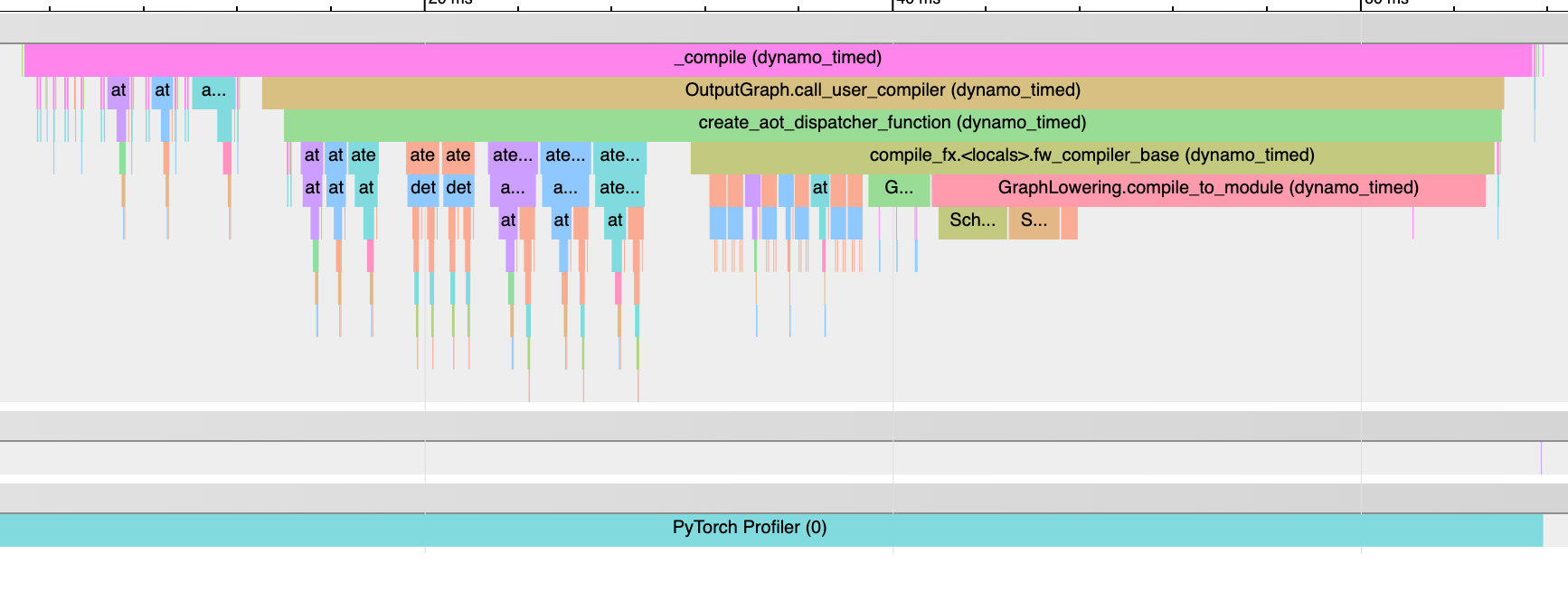
**Summary**: profiler.record_function inserts an event into the chrome trace generated by the pytorch profiler. This PR adds record_function everywhere that @dynamo_timed is annotated.

dynamo_timed and the CLI viewer torch._dynamo.utils.compile_times() are already useful on their own; but for identifying _when_ these get called, it's nice to be able to view in the profiler chrome trace.

Why not just turn on python stack traces in the profiler to get this information? Dynamo compilation is implemented in python and therefore produces a huge amount of events when it records compilation steps. The resulting trace files are often too large to load in chrome://tracing, and they take a long time to generate. Additionally, the stack traces are deep enough that they are often hard to read. This approach produces much more readable traces with lower overhead.

**Tests**:
- Added in test/dynamo/test_profiler.py. Verified in https://github.com/pytorch/pytorch/actions/runs/4559322864/jobs/8043307798?pr=96495 that the tests are actually running.
- Performance run with `ciflow/inductor-perf-compare` shows no noticeable change in compilation time or speedup numbers. Geomean speedup changes from 1.275 -> 1.277. Geomean compilation times change from 54.2s -> 53.8s. That's likely just due to noise. All individual benchmark numbers regressed by no more than 5% between the two runs; and we see improvements of around the same magnitude, suggesting this is, again, just noise. For meta employees, you can see the results in a google sheets here: https://docs.google.com/spreadsheets/d/1Ki69XvcgxcA3ZnqC5n_jav5KiD4u7Wojlad3VTnIdlk/edit?usp=sharing

**Example**:

Run this:

```python
import torch

def gn(x):
    return x.sin().cos()

def fn(x, y):
    return x.sin() * y.cos()

x, y = [torch.rand((2, 2), device='cuda') for _ in range(2)]

# just to clear out any lazy initialization
with torch.profiler.profile() as prof:
    torch.compile(gn)(x)

with torch.profiler.profile() as prof:
    torch.compile(fn)(x, y)

prof.export_chrome_trace("./dynamo_timed_profile.json")
```

and we can see that the resulting trace shows important dynamo steps, even when python tracing is turned off.

<img width="867" alt="Screenshot 2023-03-29 at 7 26 15 PM" src="https://user-images.githubusercontent.com/5067123/228712263-8ae67ab9-1a52-4765-a9c2-7c5cf0abe2f5.png">

Pull Request resolved: https://github.com/pytorch/pytorch/pull/96495
Approved by: https://github.com/ngimel, https://github.com/mlazos
Summary:

Adds NNC-like logging that is configured through an env var `TORCH_COMPILE_LOGS`
Examples:
`TORCH_LOGS="dynamo,guards" python script.py` - prints dynamo logs at level INFO with guards of all functions that are compiled

`TORCH_LOGS="+dynamo,guards,graph" python script.py` - prints dynamo logs at level DEBUG with guards and graphs (in tabular) format of all graphs that are compiled

[More examples with full output](https://gist.github.com/mlazos/b17f474457308ce15e88c91721ac1cce)

Implementation:
The implementation parses the log settings from the environment, finds any components (aot, dynamo, inductor) or other loggable objects (guards, graph, etc.) and generates a log_state object. This object contains all of the enabled artifacts, and a qualified log name -> level mapping. _init_logs then adds handlers to the highest level logs (the registered logs), and sets any artifact loggers to level DEBUG if the artifact is enabled.

Note: set_logs is an alternative for manipulating the log_state, but if the environment contains TORCH_LOGS, the environment settings will be prioritized.

Adding a new log:
To add a new log, a dev should add their log name to torch._logging._registrations (there are examples there already).

Adding a new artifact:
To add a new artifact, a dev should add their artifact name to torch._logging._registrations as well.
Additionally, wherever the artifact is logged, `torch._logging.getArtifactLogger(__name__, <artifact_name>)` should be used instead of the standard logging implementation.

[design doc](https://docs.google.com/document/d/1ZRfTWKa8eaPq1AxaiHrq4ASTPouzzlPiuquSBEJYwS8/edit#)

Pull Request resolved: https://github.com/pytorch/pytorch/pull/94858
Approved by: https://github.com/ezyang
OK, so this PR used to be about reducing the number of constants we specialize on, but it turns out that unspecialization was ~essentially never used (because we still constant specialized way too aggressively) and I ended up having to fix a bunch of issues to actually get tests to pass. So this PR is now "make int unspecialization actually work". As part of this, I have to turn off unspecialization by default, as there are still latent bugs in inductor.

The general strategy is that an unspecialized int is represented as a SymInt. Representing it as a 0d tensor (which is what the code used to do) is untenable: (1) we often need unspecialized ints to participate in size computations, but we have no way of propagating sympy expressions through tensor compute, and (2) a lot of APIs work when passed SymInt, but not when passed a Tensor. However, I continue to represent Numpy scalars as Tensors, as they are rarely used for size computation and they have an explicit dtype, so they are more accurately modeled as 0d tensors.

* I folded in the changes from https://github.com/pytorch/pytorch/pull/95099 as I cannot represent unspecialized ints as SymInts without also turning on dynamic shapes. This also eliminates the necessity for test_unspec.py, as toggling specialization without dynamic shapes doesn't do anything. As dynamic shapes defaults to unspecializing, I just deleted this entirely; for the specialization case, I rely on regular static shape tests to catch it. (Hypothetically, we could also rerun all the tests with dynamic shapes, but WITH int/float specialization, but this seems... not that useful? I mean, I guess export wants it, but I'd kind of like our Source heuristic to improve enough that export doesn't have to toggle this either.)
* Only 0/1 integers get specialized by default now
* A hodgepodge of fixes. I'll comment on the PR about them.

Fixes https://github.com/pytorch/pytorch/issues/95469

Signed-off-by: Edward Z. Yang <ezyang@meta.com>

Pull Request resolved: https://github.com/pytorch/pytorch/pull/95621
Approved by: https://github.com/jansel, https://github.com/Chillee
This PR allows us to reuse the static per tensor decision making we make at fake tensorification time. We can use this to avoid setting up dynamic dim guards later if the tensor was never a candidate.

Pull Request resolved: https://github.com/pytorch/pytorch/pull/95566
Approved by: https://github.com/ezyang
**Summary**: torch.nn.Module implementations previously did not support custom implementations of `__getattr__`; if a torch.nn.Module subclass implemented `__getattr__` and we tried to access an attribute that was expected to be present in `__getattr__`, dynamo would not check `__getattr__` and would error out with an AttributeError. This PR copies the functionality from UserDefinedObjectVariable into torch.nn.Module so that it also supports `__getattr__`

Example of a module which previously would fail:

```python
class MyMod(torch.nn.Module):
		def __init__(self):
				super().__init__()
				self.custom_dict = {"queue": [torch.rand((2, 2)) for _ in range(3)]}
				self.other_attr = torch.rand((2, 2))

		def __getattr__(self, name):
				custom_dict = self.custom_dict
				if name in custom_dict:
						return custom_dict[name]
				return super().__getattr__(name)

		def forward(self, x):
				return x @ self.other_attr + self.queue[-1]
```

Pull Request resolved: https://github.com/pytorch/pytorch/pull/94658
Approved by: https://github.com/yanboliang, https://github.com/jansel
Fixes https://github.com/pytorch/pytorch/issues/93890

We do the following:
1. fix __init__constructor for `AutocastModeVariable` with exisiting `mode` while copying
2. `resume_execution` is made aware of constant args (`target_values`), by storing said args in `ReenterWith`. To propagate between subgraphs (in straightline code), we also store the constant args in the downstream's `code_options["co_consts"]` if not already.

---

Future work:
1. handle instantiating context manager in non-inlineable functions. Simultaneously fix nested grad mode bug.
2. generalize to general `ContextManager`s
3. generalize to variable arguments passed to context manager, with guards around the variable.

---

Actually, if we look at the repro: 74592a43d0/test/dynamo/test_repros.py (L1249), we can see that the method in this PR doesn't work for graph breaks in function calls, in particular, in function calls that don't get inlined.

Why inlining functions with graph breaks is hard:
- When we handle graph breaks, we create a new code object for the remainder of the code. It's hard to imagine doing this when you are inside a function, then we need a frame stack. And we just want to deal with the current frame as a sequence of straight line codes.

Why propagating context manager information is hard:
- If we do not inline the function, the frame does not contain any information about the parent `block_stack` or `co_consts`. So we cannot store it on local objects like the eval frame. It has to be a global object in the output_graph.

---

Anyway, I'm starting to see clearly that dynamo must indeed be optimized for torch use-case. Supporting more general cases tends to run into endless corner-cases and caveats.

One direction that I see as viable to handle function calls which have graph breaks and `has_tensor_in_frame` is stick with not inlining them, while installing a global `ContextManagerManager`, similar to the `CleanupManager` (which cleans up global variables). We can know which context managers are active at any given point, so that we can install their setup/teardown code on those functions and their fragments.
Pull Request resolved: https://github.com/pytorch/pytorch/pull/94137
Approved by: https://github.com/yanboliang
Applies the remaining flake8-comprehension fixes and checks. This changes replace all remaining unnecessary generator expressions with list/dict/set comprehensions which are more succinct, performant, and better supported by our torch.jit compiler. It also removes useless generators such as 'set(a for a in b)`, resolving it into just the set call.

Pull Request resolved: https://github.com/pytorch/pytorch/pull/94676
Approved by: https://github.com/ezyang
I applied some flake8 fixes and enabled checking for them in the linter. I also enabled some checks for my previous comprehensions PR.

This is a follow up to #94323 where I enable the flake8 checkers for the fixes I made and fix a few more of them.

Pull Request resolved: https://github.com/pytorch/pytorch/pull/94601
Approved by: https://github.com/ezyang
Summary:
There are a few races/permission errors in file creation, fixing
OSS:
1. caffe2/torch/_dynamo/utils.py, get_debug_dir: multiple process may conflict on it even it's using us. Adding pid to it
2. caffe2/torch/_dynamo/config.py: may not be a right assumption that we have permission to cwd

Test Plan: sandcastle

Differential Revision: D42905908

Pull Request resolved: https://github.com/pytorch/pytorch/pull/93407
Approved by: https://github.com/soumith, https://github.com/mlazos
Previously, Dynamo faked support for item() when `capture_scalar_outputs` was True by representing it internally as a Tensor. With dynamic shapes, this is no longer necessary; we can represent it directly as a SymInt/SymFloat. Do so. Doing this requires you to use dynamic shapes; in principle we could support scalar outputs WITHOUT dynamic shapes but I won't do this unless someone hollers for it.

Signed-off-by: Edward Z. Yang <ezyang@meta.com>

Differential Revision: [D42885775](https://our.internmc.facebook.com/intern/diff/D42885775)
Pull Request resolved: https://github.com/pytorch/pytorch/pull/93150
Approved by: https://github.com/voznesenskym
for some tensor x, x.type(torch.FloatTensor) will essentially do the same thing as x.to(torch.float). x.type can be called with at least 3 types of inputs:
* a string "torch.FloatTensor"
* a dtype torch.float
* a tensor type torch.FloatTensor

the third option (torch.FloatTensor) fails in fx, because fx cannot trace torch.FloatTensor objects.  So this PR will replace the torch.FloatTensor type with a string "torch.FloatTensor"

Why not fix this in fx? Well, it's possible, but I'm not sure a nice way to do it. We would want to update [torch.fx.node.BaseArgumentTypes](d88bc38b0c/torch/fx/node.py (L17)) to contain torch.FloatTensor etc. We could hard-code a list of tensor types there (the types vary depending on build type, e.g. whether or not cuda tensors are available), but that's not great in case our hardcoded list differs from the actual list registered by python_tensor.cpp. Another option is to dynamically populate the list of types with `Union[tuple(...)])`, and fill the tuple with `torch._tensor_classes` (which is directly populated by python_tensor.cpp), but apparently this breaks most typecheckers.

Pull Request resolved: https://github.com/pytorch/pytorch/pull/93043
Approved by: https://github.com/jansel
The output of Torchbench model `doctr_det_predictor` on CPU is a `numpy ndarray`. When running the accuracy benchmark of this model, the below error is raised: `RuntimeError: unsupported type: ndarray`.
Repro CMD:
```bash
python benchmarks/dynamo/torchbench.py --accuracy --float32 -dcpu  -n50 --inductor  --no-skip --dashboard --only doctr_det_predictor --batch_size 1 --threads 1
```

This PR adds the support to compare `numpy ndarray` in the dynamo utils.

Pull Request resolved: https://github.com/pytorch/pytorch/pull/91870
Approved by: https://github.com/jgong5, https://github.com/Chillee
When we run the node with fake value for tensor.item, it would previously error because the utility method doesn't know how to handle placeholder node. The tensor we are calling item can be input from user will be placeholder in the graph.

Pull Request resolved: https://github.com/pytorch/pytorch/pull/91668
Approved by: https://github.com/voznesenskym
GraphArgs worked fairly well, but it was still missing sources
sometimes.  Now, we maintain an auxiliary data structure which we
MUST populate whenever we fakeify a tensor / allocate a bare SymInt.
This should guarantee once and for all that every symbol is available.
Should fix swin_base_patch4_window7_224.

While I was at it, I moved fakeification utility back to builder
as it was only used at once call site.

Signed-off-by: Edward Z. Yang <ezyang@fb.com>

Pull Request resolved: https://github.com/pytorch/pytorch/pull/90911
Approved by: https://github.com/voznesenskym
Instead of inferring shape mappings from a bunch of data structures that were plumbed in InstructionTranslator, we instead work out mappings by just iterating over the GraphArgs and mapping symbols to arguments as they show up. If multiple argument sizes/strides/offset map to the same symbol, this means they are duck sized, so we also generate extra equality tests that they must be equal. Finally, we generate 0/1 specialization guards. The resulting code is much shorter, and I think also easier to understand.

TODO: Delete all the tensor ref tracking code, it's unnecessary

Signed-off-by: Edward Z. Yang <ezyang@fb.com>

Pull Request resolved: https://github.com/pytorch/pytorch/pull/90528
Approved by: https://github.com/voznesenskym
Wow, I had to sweat so much to get this PR out lol.

This PR enforces the invariant that whenever we allocate SymInts as part of fakeification, the SymInt is associated with a Source, and in fact we store the string source name on SymbolWithSourceName. We use 'sname' as the shorthand for source name, as 'name' is already used by sympy to name symbols.

In order to store source names, we have to plumb source names from Dynamo to PyTorch. This made doing this PR a bit bone crushing, because there are many points in the Dynamo codebase where we are improperly converting intermediate tensors into fake tensors, where there is no source (and there cannot be, because it's a frickin' intermediate tensor). I've fixed all of the really awful cases in earlier PRs in the stack. This PR is just plumbing in source names from places where we do have it.

Signed-off-by: Edward Z. Yang <ezyang@fb.com>

Pull Request resolved: https://github.com/pytorch/pytorch/pull/90295
Approved by: https://github.com/voznesenskym
The old code didn't actually fakeify traceable tensor subclasses at the
time they are added as a GraphArg to the module; now we do, by ignoring
the subclass during fakeification and relying on Dynamo to simulate
the subclass on top.  See comments for more details.

BTW, this codepath is super broken, see filed issues linked on the
inside.

Signed-off-by: Edward Z. Yang <ezyang@fb.com>

Pull Request resolved: https://github.com/pytorch/pytorch/pull/90009
Approved by: https://github.com/wconstab, https://github.com/voznesenskym
In #87741 we added the inference support for dynamo/torchxla integration. Later on in #88449 we attempt to add the training support. That attempt is not smooth because
- we try 2 things together
   1. let dynamo trace the model on xla rather than eager
   2. enable training
- It turns out neither of these two tasks are trivial enough.

Furthermore, item 2 (enable training) depends on item 1 (tracing on xla). We enable training via AOTAutograd. AOTAutograd lift all model parameters/buffers as graph inputs. Without item 1 being done, we would need copy all graph inputs (including model parameters/buffers) from eager device to xla devices. That hurts performance a lot. Have a cache to map eager parameter to XLA parameter does not solve the problem since the update on either will not sync automatically to the other. They will easily go out of sync.

This PR let dynamo trace the model on XLA rather than eager. This is a preparation step to enabling training.

Also, tracing on XLA makes the data movement more efficient. We see 1.5x geomean speedup compared to previous 1.38x.
```
+-------------------------+--------------------+-------------------------+
| Model                   |   XLA (trace once) |   XLA (trace everytime) |
+=========================+====================+=========================+
| resnet18                |            1.38    |                 1.008   |
+-------------------------+--------------------+-------------------------+
| resnet50                |            1.227   |                 0.998   |
+-------------------------+--------------------+-------------------------+
| resnext50_32x4d         |            1.544   |                 1.008   |
+-------------------------+--------------------+-------------------------+
| alexnet                 |            1.085   |                 1.045   |
+-------------------------+--------------------+-------------------------+
| mobilenet_v2            |            2.028   |                 1.013   |
+-------------------------+--------------------+-------------------------+
| mnasnet1_0              |            1.516   |                 0.995   |
+-------------------------+--------------------+-------------------------+
| squeezenet1_1           |            0.868   |                 1.01    |
+-------------------------+--------------------+-------------------------+
| vgg16                   |            1.099   |                 1.008   |
+-------------------------+--------------------+-------------------------+
| BERT_pytorch            |            3.26    |                 1.027   |
+-------------------------+--------------------+-------------------------+
| timm_vision_transformer |            2.182   |                 1.015   |
+-------------------------+--------------------+-------------------------+
| geomean                 |            1.50389 |                 1.01261 |
+-------------------------+--------------------+-------------------------+
```

Example command
```
GPU_NUM_DEVICES=1 python benchmarks/dynamo/torchbench.py --randomize-input --performance --trace-on-xla --only resnet18 --backend=torchxla_trace_once
```

Pull Request resolved: https://github.com/pytorch/pytorch/pull/88904
Approved by: https://github.com/wconstab, https://github.com/JackCaoG, https://github.com/jansel
**Introduces symbolic shape guards into dynamo.**

In this PR, we take the existing fake tensor infra and plumbing in dynamo and we start passing a shape_env around. This shape_env does not get plumbed down to middle layers / backend yet - it only collects expressions from frontend invocations at the moment. We then translate these expressions into guards at the point where we take other guards installed throughout dynamo - and add them to check_fn.

Part 1 of https://docs.google.com/document/d/1QJ-M4zfMkD-fjHIqW089RptjLl9EgozZGCceUbvmgfY/edit#

cc @jansel @lezcano @fdrocha @mlazos @soumith @yanboliang @penguinwu @anijain2305
Pull Request resolved: https://github.com/pytorch/pytorch/pull/87570
Approved by: https://github.com/ezyang