Adds:
```Python
chebyshev_polynomial_t(input, n, *, out=None) -> Tensor
```
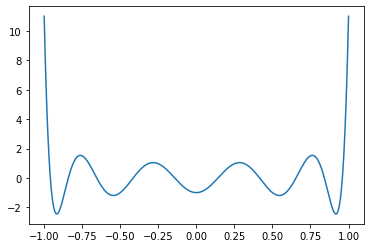
Chebyshev polynomial of the first kind $T_{n}(\text{input})$.
If $n = 0$, $1$ is returned. If $n = 1$, $\text{input}$ is returned. If $n < 6$ or $|\text{input}| > 1$ the recursion:
$$T_{n + 1}(\text{input}) = 2 \times \text{input} \times T_{n}(\text{input}) - T_{n - 1}(\text{input})$$
is evaluated. Otherwise, the explicit trigonometric formula:
$$T_{n}(\text{input}) = \text{cos}(n \times \text{arccos}(x))$$
is evaluated.
## Derivatives
Recommended $k$-derivative formula with respect to $\text{input}$:
$$2^{-1 + k} \times n \times \Gamma(k) \times C_{-k + n}^{k}(\text{input})$$
where $C$ is the Gegenbauer polynomial.
Recommended $k$-derivative formula with respect to $\text{n}$:
$$\text{arccos}(\text{input})^{k} \times \text{cos}(\frac{k \times \pi}{2} + n \times \text{arccos}(\text{input})).$$
## Example
```Python
x = torch.linspace(-1, 1, 256)
matplotlib.pyplot.plot(x, torch.special.chebyshev_polynomial_t(x, 10))
```
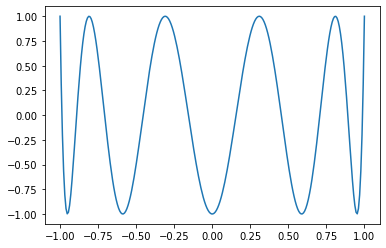
Pull Request resolved: https://github.com/pytorch/pytorch/pull/78196
Approved by: https://github.com/mruberry
Euler beta function:

```Python
torch.special.beta(input, other, *, out=None) → Tensor
```

`reentrant_gamma` and `reentrant_ln_gamma` implementations (using Stirling’s approximation) are provided. I started working on this before I realized we were missing a gamma implementation (despite providing incomplete gamma implementations). Uses the coefficients computed by Steve Moshier to replicate SciPy’s implementation. Likewise, it mimics SciPy’s behavior (instead of the behavior in Cephes).
Pull Request resolved: https://github.com/pytorch/pytorch/pull/78031
Approved by: https://github.com/mruberry
We don't have any coverage for meta tensor correctness for backwards
because torch function mode can only allow us to interpose on
Python torch API calls, but backwards invocations happen from C++.
To make this possible, I add torch_dispatch_meta test which runs the
tests with __torch_dispatch__

While doing this, I needed to generate fresh expected failure / skip
lists for the new test suite, and I discovered that my original
scaffolding for this purpose was woefully insufficient.  So I rewrote
how the test framework worked, and at the same time rewrote the
__torch_function__ code to also use the new logic.  Here's whats
new:

- Expected failure / skip is now done on a per function call basis,
  rather than the entire test.  This means that separate OpInfo
  samples for a function don't affect each other.

- There are now only two lists: expect failure list (where the test
  consistently fails on all runs) and skip list (where the test
  sometimes passes and fails.

- We explicitly notate the dtype that failed.  I considered detecting
  when something failed on all dtypes, but this was complicated and
  listing everything out seemed to be nice and simple.  To keep the
  dtypes short, I introduce a shorthand notation for dtypes.

- Conversion to meta tensors is factored into its own class
  MetaConverter

- To regenerate the expected failure / skip lists, just run with
  PYTORCH_COLLECT_EXPECT and filter on a specific test type
  (test_meta or test_dispatch_meta) for whichever you want to update.

Other misc fixes:

- Fix max_pool1d to work with BFloat16 in all circumstances, by making
  it dispatch and then fixing a minor compile error (constexpr doesn't
  work with BFloat16)

- Add resolve_name for turning random torch API functions into string
  names

- Add push classmethod to the Mode classes, so that you can more easily
  push a mode onto the mode stack

- Add some more skips for missing LAPACK

- Added an API to let you query if there's already a registration for
  a function, added a test to check that we register_meta for all
  decompositions (except detach, that decomp is wrong lol), and then
  update all the necessary sites to make the test pass.

Signed-off-by: Edward Z. Yang <ezyangfb.com>

Pull Request resolved: https://github.com/pytorch/pytorch/pull/77477

Approved by: https://github.com/zou3519
This PR adds `linalg.vander`, the linalg version of `torch.vander`.

We add autograd support and support for batched inputs.

We also take this chance to improve the docs (TODO: Check that they
render correctly!) and add an OpInfo.

**Discussion**: The current default for the `increasing` kwargs is extremely
odd as it is the opposite of the classical definition (see
[wiki](https://en.wikipedia.org/wiki/Vandermonde_matrix)). This is
reflected in the docs, where I explicit both the odd defaults that we
use and the classical definition. See also [this stackoverflow
post](https://stackoverflow.com/a/71758047/5280578), which shows how
people are confused by this defaults.

My take on this would be to correct the default to be `increasing=True`
and document the divergence with NumPy (as we do for other `linalg`
functions) as:

- It is what people expect
- It gives the correct determinant called "the Vandermonde determinant" rather than (-1)^{n-1} times the Vandermonde det (ugh).
- [Minor] It is more efficient (no `flip` needed)
- Since it's under `linalg.vander`, it's strictly not a drop-in replacement for `np.vander`.

We will deprecate `torch.vander` in a PR after this one in this stack
(once we settle on what's the correct default).

Thoughts? mruberry

cc kgryte rgommers as they might have some context for the defaults of
NumPy.

Fixes https://github.com/pytorch/pytorch/issues/60197

Pull Request resolved: https://github.com/pytorch/pytorch/pull/76303

Approved by: https://github.com/albanD, https://github.com/mruberry
This PR adds `linalg.lu_solve`. While doing so, I found a bug in MAGMA
when calling the batched MAGMA backend with trans=True. We work around
that by solving the system solving two triangular systems.

We also update the heuristics for this function, as they were fairly
updated. We found that cuSolver is king, so luckily we do not need to
rely on the buggy backend from magma for this function.

We added tests testing this function left and right. We also added tests
for the different backends. We also activated the tests for AMD, as
those should work as well.

Fixes https://github.com/pytorch/pytorch/issues/61657

Pull Request resolved: https://github.com/pytorch/pytorch/pull/72935

Approved by: https://github.com/IvanYashchuk, https://github.com/mruberry
This PR modifies `lu_unpack` by:
- Using less memory when unpacking `L` and `U`
- Fuse the subtraction by `-1` with `unpack_pivots_stub`
- Define tensors of the correct types to avoid copies
- Port `lu_unpack` to be a strucutred kernel so that its `_out` version
does not incur on extra copies

Then we implement `linalg.lu` as a structured kernel, as we want to
compute its derivative manually. We do so because composing the
derivatives of `torch.lu_factor` and `torch.lu_unpack` would be less efficient.

This new function and `lu_unpack` comes with all the things it can come:
forward and backward ad, decent docs, correctness tests, OpInfo, complex support,
support for metatensors and support for vmap and vmap over the gradients.

I really hope we don't continue adding more features.

This PR also avoids saving some of the tensors that were previously
saved unnecessarily for the backward in `lu_factor_ex_backward` and
`lu_backward` and does some other general improvements here and there
to the forward and backward AD formulae of other related functions.

Pull Request resolved: https://github.com/pytorch/pytorch/pull/67833

Approved by: https://github.com/IvanYashchuk, https://github.com/nikitaved, https://github.com/mruberry
This PR adds `linalg.vander`, the linalg version of `torch.vander`.

We add autograd support and support for batched inputs.

We also take this chance to improve the docs (TODO: Check that they
render correctly!) and add an OpInfo.

**Discussion**: The current default for the `increasing` kwargs is extremely
odd as it is the opposite of the classical definition (see
[wiki](https://en.wikipedia.org/wiki/Vandermonde_matrix)). This is
reflected in the docs, where I explicit both the odd defaults that we
use and the classical definition. See also [this stackoverflow
post](https://stackoverflow.com/a/71758047/5280578), which shows how
people are confused by this defaults.

My take on this would be to correct the default to be `increasing=True`
and document the divergence with NumPy (as we do for other `linalg`
functions) as:

- It is what people expect
- It gives the correct determinant called "the Vandermonde determinant" rather than (-1)^{n-1} times the Vandermonde det (ugh).
- [Minor] It is more efficient (no `flip` needed)
- Since it's under `linalg.vander`, it's strictly not a drop-in replacement for `np.vander`.

We will deprecate `torch.vander` in a PR after this one in this stack
(once we settle on what's the correct default).

Thoughts? mruberry

cc kgryte rgommers as they might have some context for the defaults of
NumPy.

Fixes https://github.com/pytorch/pytorch/issues/60197

Pull Request resolved: https://github.com/pytorch/pytorch/pull/76303

Approved by: https://github.com/albanD
This PR adds a function for computing the LDL decomposition and a function that can solve systems of linear equations using this decomposition. The result of `torch.linalg.ldl_factor_ex` is in a compact form and it's required to use it only through `torch.linalg.ldl_solve`. In the future, we could provide `ldl_unpack` function that transforms the compact representation into explicit matrices.

Fixes https://github.com/pytorch/pytorch/issues/54847.

cc @jianyuh @nikitaved @pearu @mruberry @walterddr @IvanYashchuk @xwang233 @Lezcano
Pull Request resolved: https://github.com/pytorch/pytorch/pull/69828
Approved by: https://github.com/Lezcano, https://github.com/mruberry, https://github.com/albanD
crossref is a new strategy for performing tests when you want
to run a normal PyTorch API call, separately run some variation of
the API call (e.g., same thing but all the arguments are meta tensors)
and then cross-reference the results to see that they are consistent.
Any logic you add to CrossRefMode will get run on *every* PyTorch API
call that is called in the course of PyTorch's test suite.  This can
be a good choice for correctness testing if OpInfo testing is not
exhaustive enough.

For now, the crossref test doesn't do anything except verify that
we can validly push a mode onto the torch function mode stack for all
functions.

Signed-off-by: Edward Z. Yang <ezyangfb.com>

Pull Request resolved: https://github.com/pytorch/pytorch/pull/75988

Approved by: https://github.com/seemethere
I figured these out by unconditionally turning on a no-op torch function
mode on the test suite and then fixing errors as they showed up.  Here's
what I found:

- _parse_to failed internal assert when __torch_function__'ed because it
  claims its name is "to" to the argument parser; added a name override
  so we know how to find the correct name

- Infix operator magic methods on Tensor did not uniformly handle
  __torch_function__ and TypeError to NotImplemented.  Now, we always
  do the __torch_function__ handling in
  _wrap_type_error_to_not_implemented and your implementation of
  __torch_function__ gets its TypeErrors converted to NotImplemented
  (for better or for worse; see
  https://github.com/pytorch/pytorch/issues/75462 )

- A few cases where code was incorrectly testing if a Tensor was
  Tensor-like in the wrong way, now use is_tensor_like (in grad
  and in distributions).  Also update docs for has_torch_function to
  push people to use is_tensor_like.

- is_grads_batched was dropped from grad in handle_torch_function, now
  fixed

- Report that you have a torch function even if torch function is
  disabled if a mode is enabled.  This makes it possible for a mode
  to return NotImplemented, pass to a subclass which does some
  processing and then pass back to the mode even after the subclass
  disables __torch_function__ (so the tensors are treated "as if"
  they are regular Tensors).  This brings the C++ handling behavior
  in line with the Python behavior.

- Make the Python implementation of overloaded types computation match
  the C++ version: when torch function is disabled, there are no
  overloaded types (because they all report they are not overloaded).

Signed-off-by: Edward Z. Yang <ezyangfb.com>

Pull Request resolved: https://github.com/pytorch/pytorch/pull/75484

Approved by: https://github.com/zou3519
Summary:
Pull Request resolved: https://github.com/pytorch/pytorch/pull/74226

Update signature of `scatter_reduce_` to match `scatter_/scatter_add_`

`Tensor.scatter_reduce_(int64 dim, Tensor index, Tensor src, str reduce)`

- Add new reduction options in ScatterGatherKernel.cpp and update `scatter_reduce` to call into the cpu kernel for `scatter.reduce`
- `scatter_reduce` now has the same shape constraints as `scatter_` and `scatter_add_`
- Migrate `test/test_torch.py:test_scatter_reduce` to `test/test_scatter_gather_ops.py`

Test Plan: Imported from OSS

Reviewed By: ngimel

Differential Revision: D35222842

Pulled By: mikaylagawarecki

fbshipit-source-id: 84930add2ad30baf872c495251373313cb7428bd
(cherry picked from commit 1b45139482e22eb0dc8b6aec2a7b25a4b58e31df)
Summary:
Pull Request resolved: https://github.com/pytorch/pytorch/pull/74691

The wrapper just called through to methods on the underlying Tensor.
ghstack-source-id: 152433754

Test Plan: existing tests

Reviewed By: ezyang

Differential Revision: D34689789

fbshipit-source-id: cf53476780cf3ed00a3aa4add441300bfe8e27ce
(cherry picked from commit 5a9e5eb6bc13eb30be6e3c3bc4ac954c92704198)
Summary:
Pull Request resolved: https://github.com/pytorch/pytorch/pull/73999

Seems to be the typical way to detect a flavor of TensorImpl.
ghstack-source-id: 151440167

Test Plan: Existing tests?

Reviewed By: ezyang

Differential Revision: D34665269

fbshipit-source-id: 5081a00928933e0c5252eeddca43bae0b026013d
(cherry picked from commit 7cf62a3f69f158a33c5108f7e96ea4c5520f0f15)
I was working on an explanation of how to call into the "super"
implementation of some given ATen operation inside of __torch_dispatch__
(https://github.com/albanD/subclass_zoo/blob/main/trivial_tensors.py)
and I kept thinking to myself "Why doesn't just calling super() on
__torch_dispatch__ work"?  Well, after this patch, it does!  The idea
is if you don't actually unwrap the input tensors, you can call
super().__torch_dispatch__ to get at the original behavior.

Internally, this is implemented by disabling PythonKey and then
redispatching.  This implementation of disabled_torch_dispatch is
not /quite/ right, and some reasons why are commented in the code.
There is then some extra work I have to do to make sure we recognize
disabled_torch_dispatch as the "default" implementation (so we don't
start slapping PythonKey on all tensors, including base Tensors),
which is modeled the same way as how disabled_torch_function is done.

Signed-off-by: Edward Z. Yang <ezyangfb.com>

Pull Request resolved: https://github.com/pytorch/pytorch/pull/73684

Approved by: albanD
Summary:
Pull Request resolved: https://github.com/pytorch/pytorch/pull/72944

Doesn't make sense to develop it in core right now.
ghstack-source-id: 149456040

Test Plan:
CI

run MHA benchmark in benchmark_transformers.py to make sure it doesn't crash

Reviewed By: zrphercule

Differential Revision: D34283104

fbshipit-source-id: 4f0c7a6bc066f938ceac891320d4cf4c3f8a9cd6
(cherry picked from commit b9df65e97c)
Summary:
Pull Request resolved: https://github.com/pytorch/pytorch/pull/72200

This op should still remain private in release 1.11, add underscore before op name to make it happens

Test Plan: buck run mode/opt -c fbcode.enable_gpu_sections=true pytext/fb/tools:benchmark_transformers -- mha --batch-size=10 --max-sequence-length=16

Reviewed By: bdhirsh

Differential Revision: D33952191

fbshipit-source-id: 3f8525ac9c23bb286f51476342113ebc31b8ed59
(cherry picked from commit 6e41bfa4fc)
Summary:
Pull Request resolved: https://github.com/pytorch/pytorch/pull/70649

As described in https://fb.quip.com/oxpiA1uDBjgP

This implements the first parts of the RFC, and is a rough draft showing the approach. The idea is that for the first cut we can maintain very close (identical I believe in this diff) numerical equivalence to the existing nn.MHA implementation, which is what this diff attempts to do. In subsequent implementations, once we have a working and adopted native self-attention implementation, we could then explore alternative implementations, etc.

The current implementation is similar to existing dedicated implementations such as LightSeq/FasterTransformer/DeepSpeed, and for MHA on both CPUs and GPUs is between 1.2x and 2x faster depending on the setting. It makes some approximations/restrictions (doesn't handle masking in masked softmax, etc), but these shouldn't materially impact performance.

This does the first few items:

* add native_multi_head_attention(...) , native_multi_head_attention_backward(..) to native_functions.yaml
* Implement native_multi_head_attention(..) on GPU, extracting bits and pieces out of LS/DS/FT as appropriate
* Implement native_multi_head_attention(..) on CPU

The backward implementation is still WIP, but the idea would be to:

* Hook these up in derivatives.yaml
Implement native_multi_head_attention_backward(..) on GPU, extracting out bits and pieces out of LS/DS (not FT since it’s inference only)
* Implement native_multi_head_attention_backward(..) on CPU
* In torch.nn.functional.multi_head_attention_forward 23321ba7a3/torch/nn/functional.py (L4953), add some conditionals to check if we are being called in a BERT/ViT-style encoder fashion, and invoke the native function directly.

Test Plan: TODO

Reviewed By: mikekgfb

Differential Revision: D31829981

fbshipit-source-id: c430344d91ba7a5fbee3138e50b3e62efbb33d96
Summary:
Pull Request resolved: https://github.com/pytorch/pytorch/pull/66933

This PR exposes `torch.lu` as `torch.linalg.lu_factor` and
`torch.linalg.lu_factor_ex`.

This PR also adds support for matrices with zero elements both in
the size of the matrix and the batch. Note that this function simply
returns empty tensors of the correct size in this case.

We add a test and an OpInfo for the new function.

This PR also adds documentation for this new function in line of
the documentation in the rest of `torch.linalg`.

Fixes https://github.com/pytorch/pytorch/issues/56590
Fixes https://github.com/pytorch/pytorch/issues/64014

cc jianyuh nikitaved pearu mruberry walterddr IvanYashchuk xwang233 Lezcano

Test Plan: Imported from OSS

Reviewed By: gchanan

Differential Revision: D32834069

Pulled By: mruberry

fbshipit-source-id: 51ef12535fa91d292f419acf83b800b86ee9c7eb
Summary:
Pull Request resolved: https://github.com/pytorch/pytorch/pull/69327

Original commit changeset: d44096d88265

Original Phabricator Diff: D32144240 (668574af4a)

Test Plan:
CI

original diff failed 175 builds in CI

Reviewed By: airboyang, anjali411

Differential Revision: D32809407

fbshipit-source-id: c7c8e69bcee0274992e2d5da901f035332e60071
Summary:
Pull Request resolved: https://github.com/pytorch/pytorch/pull/66933

This PR exposes `torch.lu` as `torch.linalg.lu_factor` and
`torch.linalg.lu_factor_ex`.

This PR also adds support for matrices with zero elements both in
the size of the matrix and the batch. Note that this function simply
returns empty tensors of the correct size in this case.

We add a test and an OpInfo for the new function.

This PR also adds documentation for this new function in line of
the documentation in the rest of `torch.linalg`.

Fixes https://github.com/pytorch/pytorch/issues/56590
Fixes https://github.com/pytorch/pytorch/issues/64014

cc jianyuh nikitaved pearu mruberry walterddr IvanYashchuk xwang233 Lezcano

Test Plan: Imported from OSS

Reviewed By: albanD

Differential Revision: D32521980

Pulled By: mruberry

fbshipit-source-id: 26a49ebd87f8a41472f8cd4e9de4ddfb7f5581fb
Summary:
Pull Request resolved: https://github.com/pytorch/pytorch/pull/63568

This PR adds the first solver with structure to `linalg`. This solver
has an API compatible with that of `linalg.solve` preparing these for a
possible future merge of the APIs. The new API:
- Just returns the solution, rather than the solution and a copy of `A`
- Removes the confusing `transpose` argument and replaces it by a
correct handling of conj and strides within the call
- Adds a `left=True` kwarg. This can be achieved via transposes of the
inputs and the result, but it's exposed for convenience.

This PR also implements a dataflow that minimises the number of copies
needed before calling LAPACK / MAGMA / cuBLAS and takes advantage of the
conjugate and neg bits.

This algorithm is implemented for `solve_triangular` (which, for this, is
the most complex of all the solvers due to the `upper` parameters).
Once more solvers are added, we will factor out this calling algorithm,
so that all of them can take advantage of it.

Given the complexity of this algorithm, we implement some thorough
testing. We also added tests for all the backends, which was not done
before.

We also add forward AD support for `linalg.solve_triangular` and improve the
docs of `linalg.solve_triangular`. We also fix a few issues with those of
`torch.triangular_solve`.

Resolves https://github.com/pytorch/pytorch/issues/54258
Resolves https://github.com/pytorch/pytorch/issues/56327
Resolves https://github.com/pytorch/pytorch/issues/45734

cc jianyuh nikitaved pearu mruberry walterddr IvanYashchuk xwang233 Lezcano

Test Plan: Imported from OSS

Reviewed By: jbschlosser

Differential Revision: D32588230

Pulled By: mruberry

fbshipit-source-id: 69e484849deb9ad7bb992cc97905df29c8915910
Summary:
Adds native_dropout to have a reasonable target for torchscript in auto diff. native_dropout has scale and train as arguments in its signature, this makes native_dropout more consistent with other operators and removes conditionals in the autodiff definition.

cc gmagogsfm

Pull Request resolved: https://github.com/pytorch/pytorch/pull/63937

Reviewed By: mruberry

Differential Revision: D32477657

Pulled By: ngimel

fbshipit-source-id: d37b137a37acafa50990f60c77f5cea2818454e4
Summary:
Pull Request resolved: https://github.com/pytorch/pytorch/pull/63568

This PR adds the first solver with structure to `linalg`. This solver
has an API compatible with that of `linalg.solve` preparing these for a
possible future merge of the APIs. The new API:
- Just returns the solution, rather than the solution and a copy of `A`
- Removes the confusing `transpose` argument and replaces it by a
correct handling of conj and strides within the call
- Adds a `left=True` kwarg. This can be achieved via transposes of the
inputs and the result, but it's exposed for convenience.

This PR also implements a dataflow that minimises the number of copies
needed before calling LAPACK / MAGMA / cuBLAS and takes advantage of the
conjugate and neg bits.

This algorithm is implemented for `solve_triangular` (which, for this, is
the most complex of all the solvers due to the `upper` parameters).
Once more solvers are added, we will factor out this calling algorithm,
so that all of them can take advantage of it.

Given the complexity of this algorithm, we implement some thorough
testing. We also added tests for all the backends, which was not done
before.

We also add forward AD support for `linalg.solve_triangular` and improve the
docs of `linalg.solve_triangular`. We also fix a few issues with those of
`torch.triangular_solve`.

Resolves https://github.com/pytorch/pytorch/issues/54258
Resolves https://github.com/pytorch/pytorch/issues/56327
Resolves https://github.com/pytorch/pytorch/issues/45734

cc jianyuh nikitaved pearu mruberry walterddr IvanYashchuk xwang233 Lezcano

Test Plan: Imported from OSS

Reviewed By: zou3519, JacobSzwejbka

Differential Revision: D32283178

Pulled By: mruberry

fbshipit-source-id: deb672e6e52f58b76536ab4158073927a35e43a8
Summary:
### Create `linalg.cross`

Fixes https://github.com/pytorch/pytorch/issues/62810

As discussed in the corresponding issue, this PR adds `cross` to the `linalg` namespace (**Note**: There is no method variant) which is slightly different in behaviour compared to `torch.cross`.

**Note**: this is NOT an alias as suggested in mruberry's [https://github.com/pytorch/pytorch/issues/62810 comment](https://github.com/pytorch/pytorch/issues/62810#issuecomment-897504372) below
> linalg.cross being consistent with the Python Array API (over NumPy) makes sense because NumPy has no linalg.cross. I also think we can implement linalg.cross without immediately deprecating torch.cross, although we should definitely refer users to linalg.cross. Deprecating torch.cross will require additional review. While it's not used often it is used, and it's unclear if users are relying on its unique behavior or not.

The current default implementation of `torch.cross` is extremely weird and confusing. This has also been reported multiple times previously. (See https://github.com/pytorch/pytorch/issues/17229, https://github.com/pytorch/pytorch/issues/39310, https://github.com/pytorch/pytorch/issues/41850, https://github.com/pytorch/pytorch/issues/50273)

- [x] Add `torch.linalg.cross` with default `dim=-1`
- [x] Add OpInfo and other tests for `torch.linalg.cross`
- [x] Add broadcasting support to `torch.cross` and `torch.linalg.cross`
- [x] Remove out skip from `torch.cross` OpInfo
- [x] Add docs for `torch.linalg.cross`. Improve docs for `torch.cross` mentioning `linalg.cross` and the difference between the two. Also adds a warning to `torch.cross`, that it may change in the future (we might want to deprecate it later)

 ---

### Additional Fixes to `torch.cross`
- [x] Fix Doc for Tensor.cross
- [x] Fix torch.cross in `torch/overridres.py`

While working on `linalg.cross` I noticed these small issues with `torch.cross` itself.

[Tensor.cross docs](https://pytorch.org/docs/stable/generated/torch.Tensor.cross.html) still mentions `dim=-1` default which is actually wrong. It should be `dim=None` after the behaviour was updated in PR https://github.com/pytorch/pytorch/issues/17582 but the documentation for the `method` or `function` variant wasn’t updated. Later PR https://github.com/pytorch/pytorch/issues/41850 updated the documentation for the `function` variant i.e `torch.cross` and also added the following warning about the weird behaviour.
> If `dim` is not given, it defaults to the first dimension found with the size 3. Note that this might be unexpected.

But still, the `Tensor.cross` docs were missed and remained outdated. I’m finally fixing that here. Also fixing `torch/overrides.py` for `torch.cross` as well now, with `dim=None`.

To verify according to the docs the default behaviour of `dim=-1` should raise, you can try the following.

```python
a = torch.randn(3, 4)
b = torch.randn(3, 4)
b.cross(a)  # this works because the implementation finds 3 in the first dimension and the default behaviour as shown in documentation is actually not true.
>>> tensor([[ 0.7171, -1.1059,  0.4162,  1.3026],
        [ 0.4320, -2.1591, -1.1423,  1.2314],
        [-0.6034, -1.6592, -0.8016,  1.6467]])

b.cross(a, dim=-1)  # this raises as expected since the last dimension doesn't have a 3
>>> RuntimeError: dimension -1 does not have size 3
```

Please take a closer look (particularly the autograd part, this is the first time I'm dealing with `derivatives.yaml`). If there is something missing, wrong or needs more explanation, please let me know. Looking forward to the feedback.

cc mruberry Lezcano IvanYashchuk rgommers

Pull Request resolved: https://github.com/pytorch/pytorch/pull/63285

Reviewed By: gchanan

Differential Revision: D32313346

Pulled By: mruberry

fbshipit-source-id: e68c2687c57367274e8ddb7ef28ee92dcd4c9f2c
Summary:
Adds `torch.argwhere` as an alias to `torch.nonzero`

Currently, `torch.nonzero` is actually provides equivalent functionality to `np.argwhere`.

From NumPy docs,
> np.argwhere(a) is almost the same as np.transpose(np.nonzero(a)), but produces a result of the correct shape for a 0D array.

Pull Request resolved: https://github.com/pytorch/pytorch/pull/64257

Reviewed By: qihqi

Differential Revision: D32049884

Pulled By: saketh-are

fbshipit-source-id: 016e49884698daa53b83e384435c3f8f6b5bf6bb
Summary:
Pull Request resolved: https://github.com/pytorch/pytorch/pull/64430

The functionalization pass needs `{view}_scatter` versions of the slice/select/diagonal ops in order to correctly propagate mutations from a view to its base. On top of that, the implementations need to be primitive w.r.t. autograd, because they look something like `...slice().copy_()`, and the functionalization pass can't use views + mutations inside of it's own alias-removal machinery!

I added some basic tests that I tried to base off of existing tests for views (particularly around testing the derivative formulas), but I'm wondering if I should add something more comprehensive.

Also, as_strided fits into this category - the functionalization pass will need an `as_strided_scatter` op that's primitive w.r.t. autograd. I didn't add it for now, because it'll involve duplicating a bunch of logic from the current `as_strided_backward()` function, and also writing a derivative formula that I wasn't sure how to write :)

Test Plan: Imported from OSS

Reviewed By: albanD

Differential Revision: D31942092

Pulled By: bdhirsh

fbshipit-source-id: c702a57c2748a7c771c14e4bcc3e996b48fcc4c8
Summary:
Adds mixed precision autocasting support between fp32/fp16 to torchscript/JIT. More in depth descriptoin can be found at [torch/csrc/jit/JIT-AUTOCAST.md](https://github.com/pytorch/pytorch/pull/63939/files#diff-1f1772aaa508841c5bb58b74ab98f49a1e577612cd9ea5c386c8714a75db830b)

This PR implemented an autocast optimization pass that inserts casting ops per AMP rule (torch/csrc/jit/passes/autocast.cpp), that mimics the behavior of eager autocast. The pass also takes into consideration the context of `torch.cuda.amp.autocast` and only inserts casting ops within the enabled context manager, giving feature parity as with eager amp autocast.

We currently provide JIT AMP autocast as a prototyping feature, so it is default off and could be turned on via `torch._C._jit_set_autocast_mode(True)`

The JIT support for autocast is subject to different constraints compared to the eager mode implementation (mostly related to the fact that TorchScript is statically typed), restriction on the user facing python code is described in doc torch/csrc/jit/JIT-AUTOCAST.md

This is a prototype, there are also implementation limitation that's necessary to keep this PR small and get something functioning quickly on upstream, so we can iterate on designs.

Few limitation/challenge that is not properly resolved in this PR:
1. Autocast inserts cast operation, which would have impact on scalar type of output tensor feeding downstream operations. We are not currently propagating the updated scalar types, this would give issues/wrong results on operations in promotion rules.

2. Backward for autodiff in JIT misses the casting of dgrad to input scalar type, as what autograd does in eager. This forces us to explicitly mark the casting operation for certain operations (e.g. binary ops), otherwise, we might be feeding dgrad with mismatch scalar type to input. This could potentially break gradient function consuming dgrad. (e.g. gemm backwards, which assumes grad_output to be of same scalar type as input')

3. `torch.autocast` api has an optional argument `dtype` which is not currently supported in the JIT autocast and we require a static value.

Credit goes mostly to:
tlemo
kevinstephano

Pull Request resolved: https://github.com/pytorch/pytorch/pull/63939

Reviewed By: navahgar

Differential Revision: D31093381

Pulled By: eellison

fbshipit-source-id: da6e26c668c38b01e296f304507048d6c1794314
Summary:
Adds `torch.argwhere` as an alias to `torch.nonzero`

Currently, `torch.nonzero` is actually provides equivalent functionality to `np.argwhere`.

From NumPy docs,
> np.argwhere(a) is almost the same as np.transpose(np.nonzero(a)), but produces a result of the correct shape for a 0D array.

Pull Request resolved: https://github.com/pytorch/pytorch/pull/64257

Reviewed By: dagitses

Differential Revision: D31474901

Pulled By: saketh-are

fbshipit-source-id: 335327a4986fa327da74e1fb8624cc1e56959c70
Summary:
Pull Request resolved: https://github.com/pytorch/pytorch/pull/62030

Remove dtype tracking from Python Storage interface, remove all the different `<type>Storage` classes except for `ByteStorage`, and update serialization accordingly, while maintaining as much FC/BC as possible

Fixes https://github.com/pytorch/pytorch/issues/47442

* **THE SERIALIZATION FORMAT IS FULLY FC/BC.** We worked very hard to make sure this is the case. We will probably want to break FC at some point to make the serialization structure of tensors make more sense, but not today.
* There is now only a single torch.ByteStorage class. Methods like `Tensor.set_` no longer check that the dtype of storage is appropriate.
* As we no longer know what dtype of a storage is, we've **removed** the size method from Storage, replacing it with nbytes. This is to help catch otherwise silent errors where you confuse number of elements with number of bytes.
* `Storage._new_shared` takes a `nbytes` kwarg and will reject previous positional only calls.  `Storage._new_with_file` and `_set_from_file` require explicit element size arguments.
* It's no longer possible to convert storages to different types using the float/double/etc methods. Instead, do the conversion using a tensor.
* It's no longer possible to allocate a typed storage directly using FloatStorage/DoubleStorage/etc constructors. Instead, construct a tensor and extract its storage. The classes still exist but they are used purely for unpickling.
* The preexisting serialization format stores dtype with storage, and in fact this dtype is used to determine the dtype of the tensor overall.
 To accommodate this case, we introduce a new TypedStorage concept that exists only during unpickling time which is used to temporarily store the dtype so we can construct a tensor. **If you overrode the handling of pickling/unpickling, you MUST add handling for TypedStorage** or your serialization code will degrade to standard file-based serialization.

Original pull request: https://github.com/pytorch/pytorch/pull/59671

Reviewed By: soulitzer, ngimel

Differential Revision: D29466819

Pulled By: ezyang

fbshipit-source-id: 4a14e5d3c2b08e06e558683d97f7378a3180b00e
Summary:
Pull Request resolved: https://github.com/pytorch/pytorch/pull/65621

Add a new attribute to the FusedMovingAvgObsFakeQuantize that controls if the Fake Quant operation should be applied at the output of a particular layer. The motivation is to give the users additional control to control the numerics of the fake_quant operators during training. It defaults to always fake quant the output (True).

Note: We will still observer the tensors as before (only the fake_quant operation is controlled using this flag)

For example
```
input model
x -> fc1 -> fc2 -> non_quantizable_op -> fc3

After fake_quant
x -> fake_quant(x) -> fc1 -> fake_quant(fc1) -> fc2 -> fake_quant(fc2) -> non_quantizable_op -> fake_quant() -> fc3 -> fake_quantize(fc3)

With output_fake_quant disabled at the output of fc2 and fc3 (since their outputs are non-quantizable)
x -> fake_quant(x) -> fc1 -> fake_quant(fc1) -> fc2 -> non_quantizable_op -> fake_quant() -> fc3
```

Test Plan: ./buck-out/gen/caffe2/test/quantization_fx\#binary.par -r test_disable_output_fake_quant

Reviewed By: jerryzh168

Differential Revision: D31174526

fbshipit-source-id: bffe776216d041fb09133a6fb09bfc2c0bb46b89
Summary:
Pull Request resolved: https://github.com/pytorch/pytorch/pull/65340

I thought about a few possible ways of doing this.  The main hazard is
that if I create a CPU tensor that doesn't have any real storage, the
moment I actually try to access the data on the tensor I will segfault.
So I don't want to use _make_subclass on a "cpu meta tensor" because
the CPU meta tensor (with no subclass) is radioactive: printing it
will immediately cause a segfault.  So instead, I have to create
the CPU meta tensor AND subclass all in one go, and that means I need
another function for it.  One downside to doing it this way is
I need another overload for explicit strides, and in general it is
difficult to get the view relationships to all work out properly;
tracked at https://github.com/pytorch/pytorch/issues/65339

Fixes https://github.com/pytorch/pytorch/issues/62972
Fixes https://github.com/pytorch/pytorch/issues/62730

Signed-off-by: Edward Z. Yang <ezyang@fb.com>

Test Plan: Imported from OSS

Reviewed By: albanD

Differential Revision: D31057231

Pulled By: ezyang

fbshipit-source-id: 73522769e093ae8a1bf0c7f7e594659bfb827b28
Summary:
Pull Request resolved: https://github.com/pytorch/pytorch/pull/62671

Very crude first implementation of `torch.nanmean`. The current reduction kernels do not have good support for implementing nan* variants. Rather than implementing new kernels for each nan* operator, I will work on new reduction kernels with support for a `nan_policy` flag and then I will port `nanmean` to use that.

**TODO**

- [x] Fix autograd issue

Test Plan: Imported from OSS

Reviewed By: malfet

Differential Revision: D30515181

Pulled By: heitorschueroff

fbshipit-source-id: 303004ebd7ac9cf963dc4f8e2553eaded5f013f0
Summary:
Pull Request resolved: https://github.com/pytorch/pytorch/pull/64689

This brings it in line with the C++ implementation.

Fixes https://github.com/pytorch/pytorch/issues/64687

Signed-off-by: Edward Z. Yang <ezyang@fb.com>

Test Plan: Imported from OSS

Reviewed By: albanD

Differential Revision: D30816215

Pulled By: ezyang

fbshipit-source-id: ed36af6c35467ae678d9548197efd97c36d38dec
Summary:
Pull Request resolved: https://github.com/pytorch/pytorch/pull/63552

In this PR, we want to exclude these 2 cases in the `Autocast` weight cache usages:

- Using `torch.jit.trace` under the `Autocast`
As report in https://github.com/pytorch/pytorch/issues/50231 and several other discussions, using `torch.jit.trace` under the `Autocast`, the trace process would hit Autocast's weight cache and fails. So we should disable weight cache under the trace process.
- Using `Autocast` with `Grad mode`

  - Usually we are using `Grad mode` for training. Since in the training phase, the weight will change in every step. So we doesn't need to cache the weight.
  - For the recommended `Autocast` training case in the [doc](https://pytorch.org/docs/stable/amp.html), `Autocast` will clear the cache every step leaving the context. We should disable it to save the clear operations.
    ```
    model = Net().cuda()
    optimizer = optim.SGD(model.parameters(), ...)

    for input, target in data:
        optimizer.zero_grad()
        with autocast():
            output = model(input)
            loss = loss_fn(output, target)
        loss.backward()
        optimizer.step()
    ```

Test Plan: Imported from OSS

Reviewed By: mrshenli

Differential Revision: D30644913

Pulled By: ezyang

fbshipit-source-id: ad7bc87372e554e7aa1aa0795e9676871b3974e7
Summary:
Fixes https://github.com/pytorch/pytorch/issues/62811

Add `torch.linalg.matmul` alias to `torch.matmul`. Note that the `linalg.matmul` doesn't have a `method` variant.

Also cleaning up `torch/_torch_docs.py` when formatting is not needed.

cc IvanYashchuk Lezcano mruberry rgommers

Pull Request resolved: https://github.com/pytorch/pytorch/pull/63227

Reviewed By: mrshenli

Differential Revision: D30770235

Pulled By: mruberry

fbshipit-source-id: bfba77dfcbb61fcd44f22ba41bd8d84c21132403
Summary:
Fixes https://github.com/pytorch/pytorch/issues/61767

## Changes

- [x] Add `torch.concat` alias to `torch.cat`
- [x] Add OpInfo for `cat`/`concat`
- [x] Fix `test_out` skips (Use `at::native::resize_output` or `at::native::resize_output_check`)
  - [x] `cat`/`concat`
  - [x] `stack`
  - [x] `hstack`
  - [x] `dstack`
  - [x] `vstack`/`row_stack`
- [x] Remove redundant tests for `cat`/`stack`

~I've not added `cat`/`concat` to OpInfo `op_db` yet, since cat is a little more tricky than other OpInfos (should have a lot of tests) and currently there are no OpInfos for that. I can try to add that in a subsequent PR or maybe here itself, whatever is suggested.~
**Edit**: cat/concat OpInfo has been added.

**Note**: I've added the named tensor support for `concat` alias as well, maybe that's out of spec in `array-api` but it is still useful for consistency in PyTorch.

Thanks to krshrimali for guidance on my first PR :))

cc mruberry rgommers pmeier asmeurer leofang AnirudhDagar asi1024 emcastillo kmaehashi heitorschueroff krshrimali

Pull Request resolved: https://github.com/pytorch/pytorch/pull/62560

Reviewed By: saketh-are

Differential Revision: D30762069

Pulled By: mruberry

fbshipit-source-id: 6985159d1d9756238890488a0ab3ae7699d94337
Summary:
This PR implements the necessary hooks/stubs/enums/etc for complete ONNX Runtime (ORT) Eager Mode integration. The actual extension will live out of tree at https://github.com/pytorch/ort.

We have been [working on this at Microsoft](https://github.com/microsoft/onnxruntime-pytorch/tree/eager-ort/torch_onnxruntime) for the last few months, and are finally ready to contribute the PyTorch core changes upstream (nothing major or exciting, just the usual boilerplate for adding new backends).

The ORT backend will allow us to ferry [almost] all torch ops into granular ONNX kernels that ORT will eagerly execute against any devices it supports (therefore, we only need a single ORT backend from a PyTorch perspective).

Pull Request resolved: https://github.com/pytorch/pytorch/pull/58248

Reviewed By: astaff

Differential Revision: D30344992

Pulled By: albanD

fbshipit-source-id: 69082b32121246340d686e16653626114b7714b2
Summary:
Pull Request resolved: https://github.com/pytorch/pytorch/pull/59077Fixes#58549
`from_buffer` constructs a tensor object from an already allocated buffer through
CPython's buffer protocol. Besides the standard `dtype`, `count`, and `offset` parameters,
this function also accepts:
- `device`: where the buffer lives
- `requires_grad`: should autograd record operations on the new tensor
A new test file _test_buffer_protocol.py_ was created. Currently, only CPU tests were
implemented. That's because neither PyTorch nor Numba implements CPython's buffer
protocol. Therefore, there's no way to create a CUDA buffer with the existing
dependencies (could use PyCUDA for that, though).
At the moment, if `device` differs from the device the buffer actually lives, two things
may happen:
- `RuntimeError`, if `device='cuda'`
- Segmentation fault (not tested -- see above), if `device='cpu'`
Test Plan: Imported from OSS
Reviewed By: jbschlosser
Differential Revision: D29870914
Pulled By: mruberry
fbshipit-source-id: 9fa8611aeffedfe39c9af74558178157a11326bb
Summary:
Pull Request resolved: https://github.com/pytorch/pytorch/pull/61570

Fused operator that computes moving average min/max values (in-place) of the input tensor and fake-quantizes it.
It expects the qmin/qmax values to reflect the range of the quantized tensor (instead of reduce_range)

Motivation for adding this operator is for performance reasons, since moving the computation from python to C++/CUDA can increase the performance of QAT.

Test Plan:
python test/test_quantization.py TestFusedObsFakeQuant

Imported from OSS

Reviewed By: vkuzo

Differential Revision: D29682762

fbshipit-source-id: 28e4c50e77236d6976fe4b326c9a12103ed95840
Summary:
This PR un-reverts https://github.com/pytorch/pytorch/issues/61475 + fixes compilation with MSVC, that does not recognize alternative operator spellings (i.e. using `or` instead of `||` )

Pull Request resolved: https://github.com/pytorch/pytorch/pull/61937

Reviewed By: albanD

Differential Revision: D29805941

Pulled By: malfet

fbshipit-source-id: 01e5963c6717c1b44b260300d87ba0bf57f26ce9
Summary:
Pull Request resolved: https://github.com/pytorch/pytorch/pull/56058

User facing changes:
1. Adds a negative bit and corresponding new API (`is_neg()`,`resolve_neg()`)
2. `tensor.conj().imag` now returns a floating point tensor with neg bit set to 1 instead of a tensor with no notion of negative bit. Note that imag is still a view and all the view properties still hold for imag.

Non user facing changes:
1. Added a new Negative dispatch key and a backend fallback to handle it
2. Updated copy kernel to handle negative bit
3. Merged conjugate and negative bit fallback kernel
4. fixed https://github.com/pytorch/pytorch/issues/60478 (caused due to https://github.com/pytorch/pytorch/pull/54987)

Testing:
1. Added a new OpInfo based test `test_neg_view` (verifies that out-of-place and in-place operations work correctly for all operations when the input is a neg view tensor by checking the result against an actually negated tensor, verifies that autograd returns the same output for both neg view and actually negated tensors as well as it works fine when grad_out is a neg view).
2. Added a new test class containing `test_conj_view`, `test_neg_view`.

Test Plan: Imported from OSS

Reviewed By: soulitzer

Differential Revision: D29636403

fbshipit-source-id: 12214c9dc4806c51850f4a72a109db9527c0ca63
Summary:
Based from https://github.com/pytorch/pytorch/pull/50466

Adds the initial implementation of `torch.cov` similar to `numpy.cov`. For simplicity, we removed support for many parameters in `numpy.cov` that are either redundant such as `bias`, or have simple workarounds such as `y` and `rowvar`.

cc PandaBoi

closes https://github.com/pytorch/pytorch/issues/19037

Pull Request resolved: https://github.com/pytorch/pytorch/pull/58311

Reviewed By: jbschlosser

Differential Revision: D29431651

Pulled By: heitorschueroff

fbshipit-source-id: 167dea880f534934b145ba94291a9d634c25b01b
Summary:
Pull Request resolved: https://github.com/pytorch/pytorch/pull/58059

Add CUDA.used vital sign which is true only if CUDA was "used" which technically means the context was created.

Also adds the following features:
- Force vitals to be written even if vitals are disabled, to enable testing when the env variable is not set from the start of execution
- Add a read_vitals call for python to read existing vital signs.

Test Plan: buck test mode/dbg caffe2/test:torch -- --regex basic_vitals

Reviewed By: xuzhao9

Differential Revision: D28357615

fbshipit-source-id: 681bf9ef63cb1458df9f1c241d301a3ddf1e5252
Summary:
Pull Request resolved: https://github.com/pytorch/pytorch/pull/59760

See https://github.com/pytorch/pytorch/issues/59049

There are some moving parts to this PR, I'll structure this explanation so the straightforward parts go first, and then the less straightforward parts.

**The actual dispatch to Python.** The core logic of dispatch to Python lives in `concrete_dispatch_fn` in `torch/csrc/autograd/python_variable.cpp`. It takes the input IValue stack, scans all the arguments for Tensor arguments, and defers most of the heavy lifting to `handle_torch_function_no_python_arg_parser` which actually does all of the logic for calling out to torch dispatch (in particular, this function handles multiple dispatch situations for you). Because we have a different function name than regular `__torch_function__` handling, `handle_torch_function_no_python_arg_parser` is generalized to accept a magic method name to look for when testing if Tensors have custom handling or not. Unlike `__torch_function__`, by default there is no `__torch_dispatch__` on Tensor classes.

**Maintaining the Python dispatch key.** In order to get to the dispatch to Python logic, we must tag Tensors with the `__torch_dispatch__` magic method with the newly added Python dispatch key (separated from PythonFuncTorch to allow for a transitional period while they migrate to this mechanism). We expose a new private property `_is_python_dispatch` that assists in debugging if a Tensor is participating in Python dispatch or not. We apply the Python dispatch key the first time a PyObject for a Tensor is constructed (THPVariable_NewWithVar), testing if `__torch_dispatch__` exists with  then newly added `check_has_torch_dispatch`.

**Shallow copy and detach.** For the simple examples tested in this PR, most creations of Tensor route through the dispatcher. The exception to this is `shallow_copy_and_detach`, which bypasses the dispatcher and is used when saving tensors for backwards. When a Tensor is Python dispatch, we override the behavior of `shallow_copy_and_detach` to instead directly call into `__torch_dispatch__` to perform a `detach` operation (in the same way it would be invoked if you called `detach` directly). Because this Python call is triggered directly from c10::TensorImpl, it must be indirected through `PyInterpreter::detach`, which is the general mechanism for dynamic dispatching to the Python interpreter associated with a TensorImpl.

**torchdeploy compatibility.** The dispatch to Python logic cannot be directly registered to the dispatcher as it is compiled in the Python library, which will get loaded multiple times per torchdeploy interpreter. Thus, we must employ a two phase process. First, we register a fallback inside a non-Python library (aten/src/ATen/core/PythonFallbackKernel.cpp). Its job is to determine the appropriate PyInterpreter to handle the Python dispatch by going through all of the arguments and finding the first argument that has a PyObject/PyInterpreter. With this PyInterpreter, it makes another dynamic dispatch via "dispatch" which will go to the correct torchdeploy interpreter to handle dispatching to actual Python.

**Testing.** We provide a simple example of a LoggingTensor for testing, which can be used to generate TorchScript-like traces to observe what operations are being called when a Tensor is invoked. Although a LoggingTensor would be better implemented via an is-a relationship rather than a has-a relationship (as is done in the test), we've done it this way to show that arbitrarily complex compositions of tensors inside a tensor work properly.

**Known limitations.**

* We haven't adjusted any operator code, so some patterns may not work (as they lose the Python subclass in an unrecoverable way)
* `__torch_function__` must be explicitly disabled with `_disabled_torch_function_impl` otherwise things don't work quite correctly (in particular, what is being disabled is default subclass preservation behavior.)
* We don't ever populate kwargs, even when an argument is kwarg-only

Signed-off-by: Edward Z. Yang <ezyang@fb.com>

Differential Revision:
D29017912
D29017912

Test Plan: Imported from OSS

Reviewed By: bdhirsh

Pulled By: ezyang

fbshipit-source-id: a67714d9e541d09203a8cfc85345b8967db86238
Summary:
Reference https://github.com/pytorch/pytorch/issues/50345

`zeta` was already present in the codebase to support computation of `polygamma`.

However, `zeta` only had `double(double, double)` signature **for CPU** before the PR (which meant that computation `polygamma` were always upcasted to `double` for zeta part).

With this PR, float computations will take place in float and double in double.

Have also refactored the code and moved the duplicate code from `Math.cuh` to `Math.h`

**Note**: For scipy, q is optional, and if it is `None`, it defaults `1` which corresponds to Reimann-Zeta. However, for `torch.specia.zeta`, I made it mandatory cause for me it feels odd without `q` this is Reimann-Zeta and with `q` it is the general Hurwitz Zeta. I think sticking to just general made more sense as passing `1` for q sounds trivial.

Verify:
* [x] Docs https://14234587-65600975-gh.circle-artifacts.com/0/docs/special.html#torch.special.zeta

Pull Request resolved: https://github.com/pytorch/pytorch/pull/59623

Reviewed By: ngimel

Differential Revision: D29348269

Pulled By: mruberry

fbshipit-source-id: a3f9ebe1f7724dbe66de2b391afb9da1cfc3e4bb
Summary:
Pull Request resolved: https://github.com/pytorch/pytorch/pull/60464

Fixes https://github.com/szagoruyko/pytorchviz/issues/65

An alternate implementation of this PR would be to remove the
__torch_function__ interposition points for these accessors entirely.
In the end, I decided to opt for extra expressivity.  See
torch.overrides for the criterion on how I decided which accessors
should get the nowrap treatment.

Signed-off-by: Edward Z. Yang <ezyang@fb.com>

Test Plan: Imported from OSS

Reviewed By: albanD

Differential Revision: D29302835

Pulled By: ezyang

fbshipit-source-id: fbe0ac4530a6cc9d6759a3fdf5514d4d7b1f7690
Summary:
Pull Request resolved: https://github.com/pytorch/pytorch/pull/60050

It doesn't work to put torch.Tensor.prop.__get__ in the ignored
list.  Now it does.  (Not exercised here, see next diff in stack).

Signed-off-by: Edward Z. Yang <ezyang@fb.com>

Test Plan: Imported from OSS

Reviewed By: zou3519

Differential Revision: D29171464

Pulled By: ezyang

fbshipit-source-id: e7354668b481f9275f2eb5bb3a6228d1815fecea
Summary:
Fixes https://github.com/pytorch/pytorch/issues/3025

## Background

This PR implements a function similar to numpy's [`isin()`](https://numpy.org/doc/stable/reference/generated/numpy.isin.html#numpy.isin).

The op supports integral and floating point types on CPU and CUDA (+ half & bfloat16 for CUDA). Inputs can be one of:
* (Tensor, Tensor)
* (Tensor, Scalar)
* (Scalar, Tensor)

Internally, one of two algorithms is selected based on the number of elements vs. test elements. The heuristic for deciding which algorithm to use is taken from [numpy's implementation](fb215c7696/numpy/lib/arraysetops.py (L575)): if `len(test_elements) < 10 * len(elements) ** 0.145`, then a naive brute-force checking algorithm is used. Otherwise, a stablesort-based algorithm is used.

I've done some preliminary benchmarking to verify this heuristic on a devgpu, and determined for a limited set of tests that a power value of `0.407` instead of `0.145` is a better inflection point. For now, the heuristic has been left to match numpy's, but input is welcome for the best way to select it or whether it should be left the same as numpy's.

Tests are adapted from numpy's [isin and in1d tests](7dcd29aaaf/numpy/lib/tests/test_arraysetops.py).

Note: my locally generated docs look terrible for some reason, so I'm not including the screenshot for them until I figure out why.

Pull Request resolved: https://github.com/pytorch/pytorch/pull/53125

Test Plan:
```
python test/test_ops.py   # Ex: python test/test_ops.py TestOpInfoCPU.test_supported_dtypes_isin_cpu_int32
python test/test_sort_and_select.py   # Ex: python test/test_sort_and_select.py TestSortAndSelectCPU.test_isin_cpu_int32
```

Reviewed By: soulitzer

Differential Revision: D29101165

Pulled By: jbschlosser

fbshipit-source-id: 2dcc38d497b1e843f73f332d837081e819454b4e
Summary:
Based from https://github.com/pytorch/pytorch/pull/50466

Adds the initial implementation of `torch.cov` similar to `numpy.cov`. For simplicity, we removed support for many parameters in `numpy.cov` that are either redundant such as `bias`, or have simple workarounds such as `y` and `rowvar`.

cc PandaBoi

TODO

- [x] Improve documentation

Pull Request resolved: https://github.com/pytorch/pytorch/pull/58311

Reviewed By: mruberry

Differential Revision: D28994140

Pulled By: heitorschueroff

fbshipit-source-id: 1890166c0a9c01e0a536acd91571cd704d632f44
Summary:
Pull Request resolved: https://github.com/pytorch/pytorch/pull/59710

This is the exact same PR as before.
The version that landed was actually outdated compared to the github PR and that's why it failed on master... Sorry for the noise.

Test Plan: Imported from OSS

Reviewed By: zou3519

Differential Revision: D28995764

Pulled By: albanD

fbshipit-source-id: 8f7ae3356a886d45787c5e6ca53a4e7b033e306e
Summary:
Fixes https://github.com/pytorch/pytorch/issues/35379

 - Adds  `retains_grad` attribute backed by cpp as a native function. The python bindings for the function are skipped to be consistent with `is_leaf`.
   - Tried writing it without native function, but the jit test `test_tensor_properties` seems to require that it be a native function (or alternatively maybe it could also work if we manually add a prim implementation?).
 - Python API now uses `retain_grad` implementation from cpp

Pull Request resolved: https://github.com/pytorch/pytorch/pull/59362

Reviewed By: jbschlosser

Differential Revision: D28969298

Pulled By: soulitzer

fbshipit-source-id: 335f2be50b9fb870cd35dc72f7dadd6c8666cc02
Summary:
Pull Request resolved: https://github.com/pytorch/pytorch/pull/54987

Based off of ezyang (https://github.com/pytorch/pytorch/pull/44799) and bdhirsh (https://github.com/pytorch/pytorch/pull/43702) 's prototype:

Here's a summary of the changes in this PR:
This PR adds a new dispatch key called Conjugate. This enables us to make conjugate operation a view and leverage the specialized library functions that fast path with the hermitian operation (conj + transpose).

1. Conjugate operation will now return a view with conj bit (1) for complex tensors and returns self for non-complex tensors as before. This also means `torch.view_as_real` will no longer be a view on conjugated complex tensors and is hence disabled. To fill the gap, we have added `torch.view_as_real_physical` which would return the real tensor agnostic of the conjugate bit on the input complex tensor. The information about conjugation on the old tensor can be obtained by calling `.is_conj()` on the new tensor.
2. NEW API:
    a) `.conj()` -- now returning a view.
    b) `.conj_physical()` -- does the physical conjugate operation. If the conj bit for input was set, you'd get `self.clone()`, else you'll get a new tensor with conjugated value in its memory.
    c) `.conj_physical_()`, and `out=` variant
    d) `.resolve_conj()`  -- materializes the conjugation. returns self if the conj bit is unset, else returns a new tensor with conjugated values and conj bit set to 0.
    e) `.resolve_conj_()` in-place version of (d)
    f) `view_as_real_physical` -- as described in (1), it's functionally same as `view_as_real`, just that it doesn't error out on conjugated tensors.
    g) `view_as_real` -- existing function, but now errors out on conjugated tensors.
3. Conjugate Fallback
    a) Vast majority of PyTorch functions would currently use this fallback when they are called on a conjugated tensor.
    b) This fallback is well equipped to handle the following cases:
        - functional operation e.g., `torch.sin(input)`
        - Mutable inputs and in-place operations e.g., `tensor.add_(2)`
        - out-of-place operation e.g., `torch.sin(input, out=out)`
        - Tensorlist input args
        - NOTE: Meta tensors don't work with conjugate fallback.
4. Autograd
    a) `resolve_conj()` is an identity function w.r.t. autograd
    b) Everything else works as expected.
5. Testing:
    a) All method_tests run with conjugate view tensors.
    b) OpInfo tests that run with conjugate views
        - test_variant_consistency_eager/jit
        - gradcheck, gradgradcheck
        - test_conj_views (that only run for `torch.cfloat` dtype)

NOTE: functions like `empty_like`, `zero_like`, `randn_like`, `clone` don't propagate the conjugate bit.

Follow up work:
1. conjugate view RFC
2. Add neg bit to re-enable view operation on conjugated tensors
3. Update linalg functions to call into specialized functions that fast path with the hermitian operation.

Test Plan: Imported from OSS

Reviewed By: VitalyFedyunin

Differential Revision: D28227315

Pulled By: anjali411

fbshipit-source-id: acab9402b9d6a970c6d512809b627a290c8def5f
Summary:
Adds `is_inference` as a native function w/ manual cpp bindings.
Also changes instances of `is_inference_tensor` to `is_inference` to be consistent with other properties such as `is_complex`.

Pull Request resolved: https://github.com/pytorch/pytorch/pull/58729

Reviewed By: mruberry

Differential Revision: D28874507

Pulled By: soulitzer

fbshipit-source-id: 0fa6bcdc72a4ae444705e2e0f3c416c1b28dadc7
Summary:
Pull Request resolved: https://github.com/pytorch/pytorch/pull/56017Fixes#55686
This patch is seemingly straightforward but some of the changes are very
subtle. For the general algorithmic approach, please first read the
quoted issue. Based on the algorithm, there are some fairly
straightforward changes:
- New boolean on TensorImpl tracking if we own the pyobj or not
- PythonHooks virtual interface for requesting deallocation of pyobj
when TensorImpl is being released and we own its pyobj, and
implementation of the hooks in python_tensor.cpp
- Modification of THPVariable to MaybeOwned its C++ tensor, directly
using swolchok's nice new class
And then, there is python_variable.cpp. Some of the changes follow the
general algorithmic approach:
- THPVariable_NewWithVar is simply adjusted to handle MaybeOwned and
initializes as owend (like before)
- THPVariable_Wrap adds the logic for reverting ownership back to
PyObject when we take out an owning reference to the Python object
- THPVariable_dealloc attempts to resurrect the Python object if
the C++ tensor is live, and otherwise does the same old implementation
as before
- THPVariable_tryResurrect implements the resurrection logic. It is
modeled after CPython code so read the cited logic and see if
it is faithfully replicated
- THPVariable_clear is slightly updated for MaybeOwned and also to
preserve the invariant that if owns_pyobj, then pyobj_ is not null.
This change is slightly dodgy: the previous implementation has a
comment mentioning that the pyobj nulling is required to ensure we
don't try to reuse the dead pyobj. I don't think, in this new world,
this is possible, because the invariant says that the pyobj only
dies if the C++ object is dead too. But I still unset the field
for safety.
And then... there is THPVariableMetaType. colesbury explained in the
issue why this is necessary: when destructing an object in Python, you
start off by running the tp_dealloc of the subclass before moving up
to the parent class (much in the same way C++ destructors work). The
deallocation process for a vanilla Python-defined class does irreparable
harm to the PyObject instance (e.g., the finalizers get run) making it
no longer valid attempt to resurrect later in the tp_dealloc chain.
(BTW, the fact that objects can resurrect but in an invalid state is
one of the reasons why it's so frickin' hard to write correct __del__
implementations). So we need to make sure that we actually override
the tp_dealloc of the bottom most *subclass* of Tensor to make sure
we attempt a resurrection before we start finalizing. To do this,
we need to define a metaclass for Tensor that can override tp_dealloc
whenever we create a new subclass of Tensor. By the way, it was totally
not documented how to create metaclasses in the C++ API, and it took
a good bit of trial error to figure it out (and the answer is now
immortalized in https://stackoverflow.com/q/67077317/23845 -- the things
that I got wrong in earlier versions of the PR included setting
tp_basicsize incorrectly, incorrectly setting Py_TPFLAGS_HAVE_GC on
the metaclass--you want to leave it unset so that it inherits, and
determining that tp_init is what actually gets called when you construct
a class, not tp_call as another not-to-be-named StackOverflow question
suggests).
Aside: Ordinarily, adding a metaclass to a class is a user visible
change, as it means that it is no longer valid to mixin another class
with a different metaclass. However, because _C._TensorBase is a C
extension object, it will typically conflict with most other
metaclasses, so this is not BC breaking.
The desired new behavior of a subclass tp_dealloc is to first test if
we should resurrect, and otherwise do the same old behavior. In an
initial implementation of this patch, I implemented this by saving the
original tp_dealloc (which references subtype_dealloc, the "standard"
dealloc for all Python defined classes) and invoking it. However, this
results in an infinite loop, as it attempts to call the dealloc function
of the base type, but incorrectly chooses subclass type (because it is
not a subtype_dealloc, as we have overridden it; see
b38601d496/Objects/typeobject.c (L1261) )
So, with great reluctance, I must duplicate the behavior of
subtype_dealloc in our implementation. Note that this is not entirely
unheard of in Python binding code; for example, Cython
c25c3ccc4b/Cython/Compiler/ModuleNode.py (L1560)
also does similar things. This logic makes up the bulk of
THPVariable_subclass_dealloc
To review this, you should pull up the CPython copy of subtype_dealloc
b38601d496/Objects/typeobject.c (L1230)
and verify that I have specialized the implementation for our case
appropriately. Among the simplifications I made:
- I assume PyType_IS_GC, because I assume that Tensor subclasses are
only ever done in Python and those classes are always subject to GC.
(BTW, yes! This means I have broken anyone who has extend PyTorch
tensor from C API directly. I'm going to guess no one has actually
done this.)
- I don't bother walking up the type bases to find the parent dealloc;
I know it is always THPVariable_dealloc. Similarly, I can get rid
of some parent type tests based on knowledge of how
THPVariable_dealloc is defined
- The CPython version calls some private APIs which I can't call, so
I use the public PyObject_GC_UnTrack APIs.
- I don't allow the finalizer of a Tensor to change its type (but
more on this shortly)
One alternative I discussed with colesbury was instead of copy pasting
the subtype_dealloc, we could transmute the type of the object that was
dying to turn it into a different object whose tp_dealloc is
subtype_dealloc, so the stock subtype_dealloc would then be applicable.
We decided this would be kind of weird and didn't do it that way.
TODO:
- More code comments
- Figure out how not to increase the size of TensorImpl with the new
bool field
- Add some torture tests for the THPVariable_subclass_dealloc, e.g.,
involving subclasses of Tensors that do strange things with finalizers
- Benchmark the impact of taking the GIL to release C++ side tensors
(e.g., from autograd)
- Benchmark the impact of adding a new metaclass to Tensor (probably
will be done by separating out the metaclass change into its own
change)
- Benchmark the impact of changing THPVariable to conditionally own
Tensor (as opposed to unconditionally owning it, as before)
- Add tests that this actually indeed preserves the Python object
Signed-off-by: Edward Z. Yang <ezyang@fb.com>
Test Plan: Imported from OSS
Reviewed By: albanD
Differential Revision: D27765125
Pulled By: ezyang
fbshipit-source-id: 857f14bdcca2900727412aff4c2e2d7f0af1415a
Summary:
Pull Request resolved: https://github.com/pytorch/pytorch/pull/57386

Here is the PR for what's discussed in the RFC https://github.com/pytorch/pytorch/issues/55374 to enable the autocast for CPU device. Currently, this PR only enable BF16 as the lower precision datatype.

Changes:
1.  Enable new API `torch.cpu.amp.autocast` for autocast on CPU device: include the python API, C++ API, new Dispatchkey etc.
2.  Consolidate the implementation for each cast policy sharing between CPU and GPU devices.
3.  Add the operation lists to corresponding cast policy for cpu autocast.

Test Plan: Imported from OSS

Reviewed By: soulitzer

Differential Revision: D28572219

Pulled By: ezyang

fbshipit-source-id: db3db509973b16a5728ee510b5e1ee716b03a152
Summary:
This adds the methods `Tensor.cfloat()` and `Tensor.cdouble()`.

I was not able to find the tests for `.float()` functions. I'd be happy to add similar tests for these functions  once someone points me to them.

Fixes https://github.com/pytorch/pytorch/issues/56014

Pull Request resolved: https://github.com/pytorch/pytorch/pull/58137

Reviewed By: ejguan

Differential Revision: D28412288

Pulled By: anjali411

fbshipit-source-id: ff3653cb3516bcb3d26a97b9ec3d314f1f42f83d
Summary:
Pull Request resolved: https://github.com/pytorch/pytorch/pull/58039

The new function has the following signature
`inv_ex(Tensor inpit, *, bool check_errors=False) -> (Tensor inverse, Tensor info)`.
When `check_errors=True`, an error is thrown if the matrix is not invertible; `check_errors=False` - responsibility for checking the result is on the user.

`linalg_inv` is implemented using calls to `linalg_inv_ex` now.

Resolves https://github.com/pytorch/pytorch/issues/25095

Test Plan: Imported from OSS

Reviewed By: ngimel

Differential Revision: D28405148

Pulled By: mruberry

fbshipit-source-id: b8563a6c59048cb81e206932eb2f6cf489fd8531
Summary:
Fixes https://github.com/pytorch/pytorch/issues/56608

 - Adds binding to the `c10::InferenceMode` RAII class in `torch._C._autograd.InferenceMode` through pybind. Also binds the `torch.is_inference_mode` function.
 - Adds context manager `torch.inference_mode` to manage an instance of `c10::InferenceMode` (global).  Implemented in `torch.autograd.grad_mode.py` to reuse the `_DecoratorContextManager` class.
 - Adds some tests based on those linked in the issue + several more for just the context manager

Issues/todos (not necessarily for this PR):
- Improve short inference mode description
- Small example
- Improved testing since there is no direct way of checking TLS/dispatch keys
-

Pull Request resolved: https://github.com/pytorch/pytorch/pull/58045

Reviewed By: agolynski

Differential Revision: D28390595

Pulled By: soulitzer

fbshipit-source-id: ae98fa036c6a2cf7f56e0fd4c352ff804904752c
Summary:
Backward methods for `torch.lu` and `torch.lu_solve` require the `torch.lu_unpack` method.
However, while `torch.lu` is a Python wrapper over a native function, so its gradient is implemented via `autograd.Function`,
`torch.lu_solve` is a native function, so it cannot access `torch.lu_unpack` as it is implemented in Python.

Hence this PR presents a native (ATen) `lu_unpack` version. It is also possible to update the gradients for `torch.lu` so that backward+JIT is supported (no JIT for `autograd.Function`) with this function.

~~The interface for this method is different from the original `torch.lu_unpack`, so it is decided to keep it hidden.~~

Pull Request resolved: https://github.com/pytorch/pytorch/pull/46913

Reviewed By: albanD

Differential Revision: D28355725

Pulled By: mruberry

fbshipit-source-id: 281260f3b6e93c15b08b2ba66d5a221314b00e78
Summary:
Backward methods for `torch.lu` and `torch.lu_solve` require the `torch.lu_unpack` method.
However, while `torch.lu` is a Python wrapper over a native function, so its gradient is implemented via `autograd.Function`,
`torch.lu_solve` is a native function, so it cannot access `torch.lu_unpack` as it is implemented in Python.

Hence this PR presents a native (ATen) `lu_unpack` version. It is also possible to update the gradients for `torch.lu` so that backward+JIT is supported (no JIT for `autograd.Function`) with this function.

~~The interface for this method is different from the original `torch.lu_unpack`, so it is decided to keep it hidden.~~

Pull Request resolved: https://github.com/pytorch/pytorch/pull/46913

Reviewed By: astaff

Differential Revision: D28117714

Pulled By: mruberry

fbshipit-source-id: befd33db12ecc147afacac792418b6f4948fa4a4
Summary:
This PR is focused on  the API for `linalg.matrix_norm` and delegates computations to `linalg.norm` for the moment.

The main difference between the norms is when `dim=None`. In this case
- `linalg.norm` will compute a vector norm on the flattened input if `ord=None`, otherwise it requires the input to be either 1D or 2D in order to disambiguate between vector and matrix norm
- `linalg.vector_norm` will flatten the input
- `linalg.matrix_norm` will compute the norm over the last two dimensions, treating the input as batch of matrices

In future PRs, the computations will be moved to `torch.linalg.matrix_norm` and `torch.norm` and `torch.linalg.norm` will delegate computations to either `linalg.vector_norm` or `linalg.matrix_norm` based on the arguments provided.

Pull Request resolved: https://github.com/pytorch/pytorch/pull/57127

Reviewed By: mrshenli

Differential Revision: D28186736

Pulled By: mruberry

fbshipit-source-id: 99ce2da9d1c4df3d9dd82c0a312c9570da5caf25
Summary:
Pull Request resolved: https://github.com/pytorch/pytorch/pull/57180

We have now a separate function for computing only the singular values.
`compute_uv` argument is not needed and it was decided in the
offline discussion to remove it. This is a BC-breaking change but our
linalg module is beta, therefore we can do it without a deprecation
notice.

Test Plan: Imported from OSS

Reviewed By: ngimel

Differential Revision: D28142163

Pulled By: mruberry

fbshipit-source-id: 3fac1fcae414307ad5748c9d5ff50e0aa4e1b853
Summary:
As per discussion here https://github.com/pytorch/pytorch/pull/57127#discussion_r624948215

Note that we cannot remove the optional type from the `dim` parameter because the default is to flatten the input tensor which cannot be easily captured by a value other than `None`

### BC Breaking Note
This PR changes the `ord` parameter of `torch.linalg.vector_norm` so that it no longer accepts `None` arguments. The default behavior of `2` is equivalent to the previous default of `None`.

Pull Request resolved: https://github.com/pytorch/pytorch/pull/57662

Reviewed By: albanD, mruberry

Differential Revision: D28228870

Pulled By: heitorschueroff

fbshipit-source-id: 040fd8055bbe013f64d3c8409bbb4b2c87c99d13
Summary:
The new function has the following signature `cholesky_ex(Tensor input, *, bool check_errors=False) -> (Tensor L, Tensor infos)`. When `check_errors=True`, an error is thrown if the decomposition fails; `check_errors=False` - responsibility for checking the decomposition is on the user.

When `check_errors=False`, we don't have host-device memory transfers for checking the values of the `info` tensor.

Rewrote the internal code for `torch.linalg.cholesky`. Added `cholesky_stub` dispatch. `linalg_cholesky` is implemented using calls to `linalg_cholesky_ex` now.

Resolves https://github.com/pytorch/pytorch/issues/57032.

Ref. https://github.com/pytorch/pytorch/issues/34272, https://github.com/pytorch/pytorch/issues/47608, https://github.com/pytorch/pytorch/issues/47953

Pull Request resolved: https://github.com/pytorch/pytorch/pull/56724

Reviewed By: ngimel

Differential Revision: D27960176

Pulled By: mruberry

fbshipit-source-id: f05f3d5d9b4aa444e41c4eec48ad9a9b6fd5dfa5
Summary:
Fixes https://github.com/pytorch/pytorch/issues/53964. cc albanD almson
## Major changes:
- Overhauled the actual loss calculation so that the shapes are now correct (in functional.py)
- added the missing doc in nn.functional.rst
## Minor changes (in functional.py):
- I removed the previous check on whether input and target were the same shape. This is to allow for broadcasting, say when you have 10 predictions that all have the same target.
- I added some comments to explain each shape check in detail. Let me know if these should be shortened/cut.
Screenshots of updated docs attached.
Let me know what you think, thanks!
## Edit: Description of change of behaviour (affecting BC):
The backwards-compatibility is only affected for the `reduction='none'` mode. This was the source of the bug. For tensors with size (N, D), the old returned loss had size (N), as incorrect summation was happening. It will now have size (N, D) as expected.
### Example
Define input tensors, all with size (2, 3).
`input = torch.tensor([[0., 1., 3.], [2., 4., 0.]], requires_grad=True)`
`target = torch.tensor([[1., 4., 2.], [-1., 2., 3.]])`
`var = 2*torch.ones(size=(2, 3), requires_grad=True)`
Initialise loss with reduction mode 'none'. We expect the returned loss to have the same size as the input tensors, (2, 3).
`loss = torch.nn.GaussianNLLLoss(reduction='none')`
Old behaviour:
`print(loss(input, target, var)) `
`# Gives tensor([3.7897, 6.5397], grad_fn=<MulBackward0>. This has size (2).`
New behaviour:
`print(loss(input, target, var)) `
`# Gives tensor([[0.5966, 2.5966, 0.5966], [2.5966, 1.3466, 2.5966]], grad_fn=<MulBackward0>)`
`# This has the expected size, (2, 3).`
To recover the old behaviour, sum along all dimensions except for the 0th:
`print(loss(input, target, var).sum(dim=1))`
`# Gives tensor([3.7897, 6.5397], grad_fn=<SumBackward1>.`
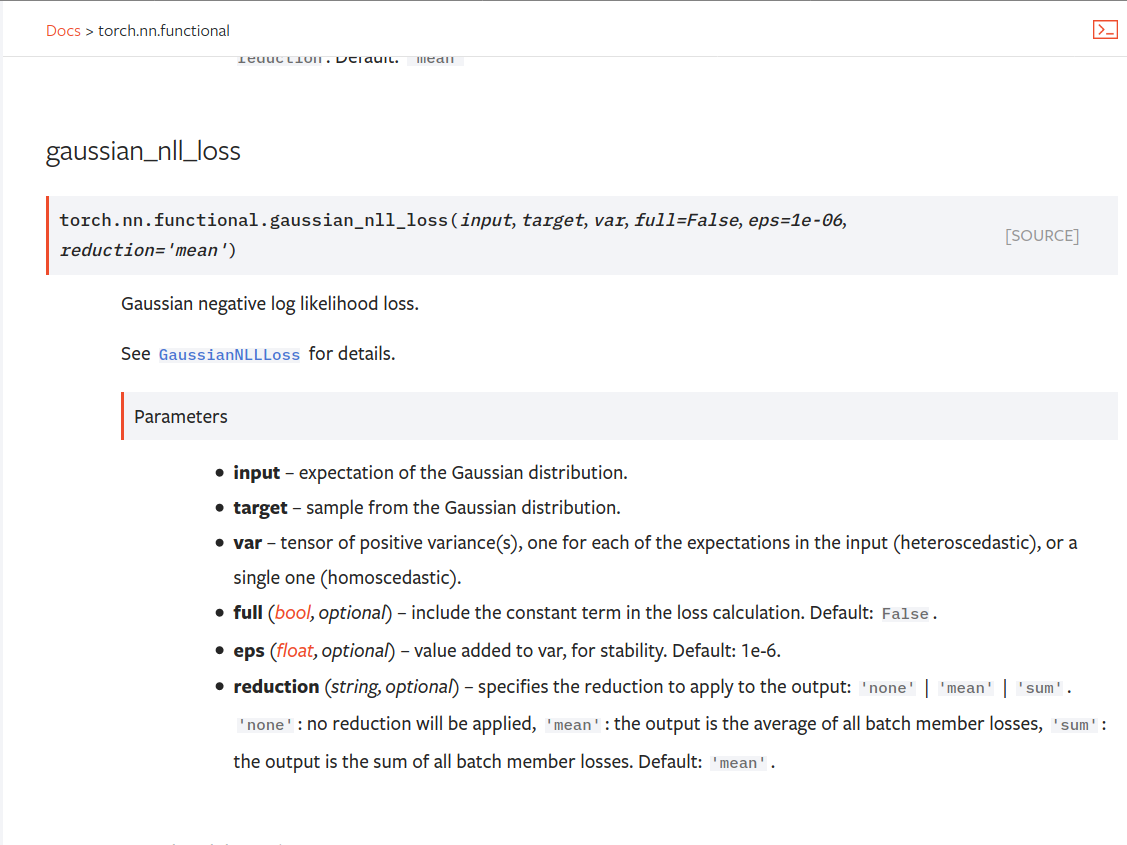
Pull Request resolved: https://github.com/pytorch/pytorch/pull/56469
Reviewed By: jbschlosser, agolynski
Differential Revision: D27894170
Pulled By: albanD
fbshipit-source-id: 197890189c97c22109491c47f469336b5b03a23f
Summary:
Pull Request resolved: https://github.com/pytorch/pytorch/pull/53238

There is a tension for the Vitals design: (1) we want a macro based logging API for C++ and (2) we want a clean python API. Furthermore, we want to this to work with "print on destruction" semantics.

The unfortunate resolution is that there are (2) ways to define vitals:
(1) Use the macros for local use only within C++ - this keeps the semantics people enjoy
(2) For vitals to be used through either C++ or Python, we use a global VitalsAPI object.

Both these go to the same place for the user: printing to stdout as the globals are destructed.

The long history on this diff shows many different ways to try to avoid having 2 different paths... we tried weak pointers & shared pointers, verbose switch cases, etc. Ultimately each ran into an ugly trade-off and this cuts the difference better the alternatives.

Test Plan:
buck test mode/dev caffe2/test:torch -- --regex vital
buck test //caffe2/aten:vitals

Reviewed By: orionr

Differential Revision: D26736443

fbshipit-source-id: ccab464224913edd07c1e8532093f673cdcb789f
Summary:
Reference: https://github.com/pytorch/pytorch/issues/50345

Changes:
* Add `i0e`
* Move some kernels from `UnaryOpsKernel.cu` to `UnarySpecialOpsKernel.cu` to decrease compilation time per file.

Time taken by i0e_vs_scipy tests: around 6.33.s

<details>

<summary>Test Run Log</summary>

```
(pytorch-cuda-dev) kshiteej@qgpu1:~/Pytorch/pytorch_module_special$ pytest test/test_unary_ufuncs.py -k _i0e_vs
======================================================================= test session starts ========================================================================
platform linux -- Python 3.8.6, pytest-6.1.2, py-1.9.0, pluggy-0.13.1
rootdir: /home/kshiteej/Pytorch/pytorch_module_special, configfile: pytest.ini
plugins: hypothesis-5.38.1
collected 8843 items / 8833 deselected / 10 selected

test/test_unary_ufuncs.py ...sss....                                                                                                                         [100%]

========================================================================= warnings summary =========================================================================
../../.conda/envs/pytorch-cuda-dev/lib/python3.8/site-packages/torch/backends/cudnn/__init__.py:73
test/test_unary_ufuncs.py::TestUnaryUfuncsCUDA::test_special_i0e_vs_scipy_cuda_bfloat16
  /home/kshiteej/.conda/envs/pytorch-cuda-dev/lib/python3.8/site-packages/torch/backends/cudnn/__init__.py:73: UserWarning: PyTorch was compiled without cuDNN/MIOpen support. To use cuDNN/MIOpen, rebuild PyTorch making sure the library is visible to the build system.
    warnings.warn(

-- Docs: https://docs.pytest.org/en/stable/warnings.html
===================================================================== short test summary info ======================================================================
SKIPPED [3] test/test_unary_ufuncs.py:1182: not implemented: Could not run 'aten::_copy_from' with arguments from the 'Meta' backend. This could be because the operator doesn't exist for this backend, or was omitted during the selective/custom build process (if using custom build). If you are a Facebook employee using PyTorch on mobile, please visit https://fburl.com/ptmfixes for possible resolutions. 'aten::_copy_from' is only available for these backends: [BackendSelect, Named, InplaceOrView, AutogradOther, AutogradCPU, AutogradCUDA, AutogradXLA, UNKNOWN_TENSOR_TYPE_ID, AutogradMLC, AutogradNestedTensor, AutogradPrivateUse1, AutogradPrivateUse2, AutogradPrivateUse3, Tracer, Autocast, Batched, VmapMode].

BackendSelect: fallthrough registered at ../aten/src/ATen/core/BackendSelectFallbackKernel.cpp:3 [backend fallback]
Named: registered at ../aten/src/ATen/core/NamedRegistrations.cpp:7 [backend fallback]
InplaceOrView: fallthrough registered at ../aten/src/ATen/core/VariableFallbackKernel.cpp:56 [backend fallback]
AutogradOther: registered at ../torch/csrc/autograd/generated/VariableType_4.cpp:8761 [autograd kernel]
AutogradCPU: registered at ../torch/csrc/autograd/generated/VariableType_4.cpp:8761 [autograd kernel]
AutogradCUDA: registered at ../torch/csrc/autograd/generated/VariableType_4.cpp:8761 [autograd kernel]
AutogradXLA: registered at ../torch/csrc/autograd/generated/VariableType_4.cpp:8761 [autograd kernel]
UNKNOWN_TENSOR_TYPE_ID: registered at ../torch/csrc/autograd/generated/VariableType_4.cpp:8761 [autograd kernel]
AutogradMLC: registered at ../torch/csrc/autograd/generated/VariableType_4.cpp:8761 [autograd kernel]
AutogradNestedTensor: registered at ../torch/csrc/autograd/generated/VariableType_4.cpp:8761 [autograd kernel]
AutogradPrivateUse1: registered at ../torch/csrc/autograd/generated/VariableType_4.cpp:8761 [autograd kernel]
AutogradPrivateUse2: registered at ../torch/csrc/autograd/generated/VariableType_4.cpp:8761 [autograd kernel]
AutogradPrivateUse3: registered at ../torch/csrc/autograd/generated/VariableType_4.cpp:8761 [autograd kernel]
Tracer: registered at ../torch/csrc/autograd/generated/TraceType_4.cpp:9348 [kernel]
Autocast: fallthrough registered at ../aten/src/ATen/autocast_mode.cpp:250 [backend fallback]
Batched: registered at ../aten/src/ATen/BatchingRegistrations.cpp:1016 [backend fallback]
VmapMode: fallthrough registered at ../aten/src/ATen/VmapModeRegistrations.cpp:33 [backend fallback]
==================================================== 7 passed, 3 skipped, 8833 deselected, 2 warnings in 6.33s =====================================================
```

</details>

TODO:
* [x] Check rendered docs (https://11743402-65600975-gh.circle-artifacts.com/0/docs/special.html)

Pull Request resolved: https://github.com/pytorch/pytorch/pull/54409

Reviewed By: jbschlosser

Differential Revision: D27760472

Pulled By: mruberry

fbshipit-source-id: bdfbcaa798b00c51dc9513c34626246c8fc10548
Summary:
This PR adds a `padding_idx` parameter to `nn.EmbeddingBag` and `nn.functional.embedding_bag`. As with `nn.Embedding`'s `padding_idx` argument, if an embedding's index is equal to `padding_idx` it is ignored, so it is not included in the reduction.

This PR does not add support for `padding_idx` for quantized or ONNX `EmbeddingBag` for opset10/11 (opset9 is supported). In these cases, an error is thrown if `padding_idx` is provided.

Fixes https://github.com/pytorch/pytorch/issues/3194

Pull Request resolved: https://github.com/pytorch/pytorch/pull/49237

Reviewed By: walterddr, VitalyFedyunin

Differential Revision: D26948258

Pulled By: jbschlosser

fbshipit-source-id: 3ca672f7e768941f3261ab405fc7597c97ce3dfc
Summary:
Reference: https://github.com/pytorch/pytorch/issues/50345

Chages:
* Alias for sigmoid and logit
* Adds out variant for C++ API
* Updates docs to link back to `special` documentation

Pull Request resolved: https://github.com/pytorch/pytorch/pull/54759

Reviewed By: mrshenli

Differential Revision: D27615208

Pulled By: mruberry

fbshipit-source-id: 8bba908d1bea246e4aa9dbadb6951339af353556
Summary:
This PR adds `torch.linalg.eig`, and `torch.linalg.eigvals` for NumPy compatibility.

MAGMA uses a hybrid CPU-GPU algorithm and doesn't have a GPU interface for the non-symmetric eigendecomposition. It means that it forces us to transfer inputs living in GPU memory to CPU first before calling MAGMA, and then transfer results from MAGMA to CPU. That is rather slow for smaller matrices and MAGMA is faster than CPU path only for matrices larger than 3000x3000.
Unfortunately, there is no cuSOLVER function for this operation.

Autograd support for `torch.linalg.eig` will be added in a follow-up PR.

Ref https://github.com/pytorch/pytorch/issues/42666

Pull Request resolved: https://github.com/pytorch/pytorch/pull/52491

Reviewed By: anjali411

Differential Revision: D27563616

Pulled By: mruberry

fbshipit-source-id: b42bb98afcd2ed7625d30bdd71cfc74a7ea57bb5
Summary:
Pull Request resolved: https://github.com/pytorch/pytorch/pull/52859

This reverts commit 92a4ee1cf6.

Added support for bfloat16 for CUDA 11 and removed fast-path for empty input tensors that was affecting autograd graph.

Test Plan: Imported from OSS

Reviewed By: H-Huang

Differential Revision: D27402390

Pulled By: heitorschueroff

fbshipit-source-id: 73c5ccf54f3da3d29eb63c9ed3601e2fe6951034
Summary:
Pull Request resolved: https://github.com/pytorch/pytorch/pull/54702

This fixes subclassing for __iter__ so that it returns an iterator over
subclasses properly instead of Tensor.

Test Plan: Imported from OSS

Reviewed By: H-Huang

Differential Revision: D27352563

Pulled By: ezyang

fbshipit-source-id: 4c195a86c8f2931a6276dc07b1e74ee72002107c
Summary:
Reference: https://github.com/pytorch/pytorch/issues/38349

Wrapper around the existing `torch.gather` with broadcasting logic.

TODO:
* [x] Add Doc entry (see if phrasing can be improved)
* [x] Add OpInfo
* [x] Add test against numpy
* [x] Handle broadcasting behaviour and when dim is not given.

Pull Request resolved: https://github.com/pytorch/pytorch/pull/52833

Reviewed By: malfet

Differential Revision: D27319038

Pulled By: mruberry

fbshipit-source-id: 00f307825f92c679d96e264997aa5509172f5ed1
Summary:
Pull Request resolved: https://github.com/pytorch/pytorch/pull/53727

This is first diff to add native support for segment reduction in PyTorch. It provides similar functionality like torch.scatter or "numpy.ufunc.reduceat".

This diff mainly focuses on API layer to make sure future improvements will not cause backward compatibility issues. Once API is settled, here are next steps I am planning:
- Add support for other major reduction types (e.g. min, sum) for 1D tensor
- Add Cuda support
- Backward support
- Documentation for the op
- Perf optimizations and benchmark util
- Support for multi dimensional tensors (on data and lengths) (not high priority)
- Support for 'indices' (not high priority)

Test Plan: Added unit test

Reviewed By: ngimel

Differential Revision: D26952075

fbshipit-source-id: 8040ec96def3013e7240cf675d499ee424437560
Summary:
This PR adds autograd support for `torch.orgqr`.

Since `torch.orgqr` is one of few functions that expose LAPACK's naming and all other linear algebra routines were renamed a long time ago, I also added a new function with a new name and `torch.orgqr` now is an alias for it.

The new proposed name is `householder_product`. For a matrix `input` and a vector `tau` LAPACK's orgqr operation takes columns of `input` (called Householder vectors or elementary reflectors) scalars of `tau` that together represent Householder matrices and then the product of these matrices is computed. See https://www.netlib.org/lapack/lug/node128.html.
Other linear algebra libraries that I'm aware of do not expose this LAPACK function, so there is some freedom in naming it. It is usually used internally only for QR decomposition, but can be useful for deep learning tasks now when it supports differentiation.

Resolves https://github.com/pytorch/pytorch/issues/50104

Pull Request resolved: https://github.com/pytorch/pytorch/pull/52637

Reviewed By: agolynski

Differential Revision: D27114246

Pulled By: mruberry

fbshipit-source-id: 9ab51efe52aec7c137aa018c7bd486297e4111ce
Summary:
Close https://github.com/pytorch/pytorch/issues/51108
Related https://github.com/pytorch/pytorch/issues/38349

This PR implements the `cpu_kernel_multiple_outputs` to support returning multiple values in a CPU kernel.
```c++
auto iter = at::TensorIteratorConfig()
  .add_output(out1)
  .add_output(out2)
  .add_input(in1)
  .add_input(in2)
  .build();

at::native::cpu_kernel_multiple_outputs(iter,
  [=](float a, float b) -> std::tuple<float, float> {
    float add = a + b;
    float mul = a * b;
    return std::tuple<float, float>(add, mul);
  }
);
```

The `out1` will equal to `torch.add(in1, in2)`, while the result of `out2` will be `torch.mul(in1, in2)`.
It helps developers implement new torch functions that return two tensors more conveniently, such as NumPy-like functions [divmod](https://numpy.org/doc/1.18/reference/generated/numpy.divmod.html?highlight=divmod#numpy.divmod) and [frexp](https://numpy.org/doc/stable/reference/generated/numpy.frexp.html#numpy.frexp).

This PR adds `torch.frexp` function to exercise the new functionality provided by `cpu_kernel_multiple_outputs`.

Pull Request resolved: https://github.com/pytorch/pytorch/pull/51097

Reviewed By: albanD

Differential Revision: D26982619

Pulled By: heitorschueroff

fbshipit-source-id: cb61c7f2c79873ab72ab5a61cbdb9203531ad469
Summary:
Fixes https://github.com/pytorch/pytorch/issues/44378 by providing a wider range of drivers similar to what SciPy is doing.

The supported CPU drivers are `gels, gelsy, gelsd, gelss`.
The CUDA interface has only `gels` implemented but only for overdetermined systems.

The current state of this PR:
- [x] CPU interface
- [x] CUDA interface
- [x] CPU tests
- [x] CUDA tests
- [x] Memory-efficient batch-wise iteration with broadcasting which fixes https://github.com/pytorch/pytorch/issues/49252
- [x] docs

Pull Request resolved: https://github.com/pytorch/pytorch/pull/49093

Reviewed By: albanD

Differential Revision: D26991788

Pulled By: mruberry

fbshipit-source-id: 8af9ada979240b255402f55210c0af1cba6a0a3c
Summary:
Pull Request resolved: https://github.com/pytorch/pytorch/pull/53276

- One of the tests had a syntax error (but the test
  wasn't fine grained enough to catch this; any error
  was a pass)
- Doesn't work on ROCm

Signed-off-by: Edward Z. Yang <ezyang@fb.com>

Differential Revision: D26820048

Test Plan: Imported from OSS

Reviewed By: mruberry

Pulled By: ezyang

fbshipit-source-id: b02c4252d10191c3b1b78f141d008084dc860c45
Summary:
per title
This PR did
- Migrate `apex.parallel.SyncBatchNorm` channels_last to pytorch `torch.nn.SyncBatchNorm`
- Fix a TODO here by fusing `sum`, `div` kernels into backward elementwise kernel
b167402e2e/torch/nn/modules/_functions.py (L76-L95)
Todo
- [x] Discuss a regression introduced in https://github.com/pytorch/pytorch/pull/37133#discussion_r512530389, which is the synchronized copy here
b167402e2e/torch/nn/modules/_functions.py (L32-L34)
**Comment**: This PR uses apex version for the size check. Test passed and I haven't seen anything wrong so far.
- [x] The restriction to use channels_last kernel will be like this
```
inline bool batch_norm_use_channels_last_kernels(const at::Tensor& self) {
return self.is_contiguous(at::MemoryFormat::ChannelsLast) || self.ndimension() == 2;
}
```
I think we can relax that for channels_last_3d as well?
**Comment**: we don't have benchmark for this now, will check this and add functionality later when needed.
- [x] Add test
- [x] Add benchmark
Detailed benchmark is at https://github.com/xwang233/code-snippet/tree/master/syncbn-channels-last
Close https://github.com/pytorch/pytorch/issues/50781
Pull Request resolved: https://github.com/pytorch/pytorch/pull/46906
Reviewed By: albanD
Differential Revision: D26771437
Pulled By: malfet
fbshipit-source-id: d00387044e9d43ac7e6c0e32a2db22c63d1504de
Summary:
Pull Request resolved: https://github.com/pytorch/pytorch/pull/53143
Meta is now an honest to goodness device type, like cpu, so you can use
device='meta' to trigger allocation of meta tensors. This way better
than empty_meta since we now have working API for most factory functions
(they don't necessarily work yet, though, because need to register Meta
versions of those functions.)
Some subtleties:
- I decided to drop the concept of CPU versus CUDA meta tensors; meta
tensors are device agnostic. It's hard to say exactly what the
correct level of abstraction here is, but in this particular case
implementation considerations trump semantic considerations: it
is way easier to have just a meta device, than to have a meta device
AND a cpu device AND a cuda device. This may limit the applicability
of meta tensors for tracing models that do explicit cpu()/cuda()
conversions (unless, perhaps, we make those operations no-ops on meta
tensors).
- I noticed that the DeviceType uppercase strings are kind of weird.
Are they really supposed to be all caps? That's weird.
- I moved the Meta dispatch key to live with the rest of the "device"
dispatch keys.
- I intentionally did NOT add a Backend for Meta. For now, I'm going to
hope meta tensors never exercise any of the Backend conversion code;
even if it does, better to fix the code to just stop converting to and
from Backend.
Signed-off-by: Edward Z. Yang <ezyang@fb.com>
Test Plan: Imported from OSS
Reviewed By: samestep
Differential Revision: D26763552
Pulled By: ezyang
fbshipit-source-id: 14633b6ca738e60b921db66a763155d01795480d
Summary:
Fixes https://github.com/pytorch/pytorch/issues/44378 by providing a wider range of drivers similar to what SciPy is doing.
The supported CPU drivers are `gels, gelsy, gelsd, gelss`.
The CUDA interface has only `gels` implemented but only for overdetermined systems.
The current state of this PR:
- [x] CPU interface
- [x] CUDA interface
- [x] CPU tests
- [x] CUDA tests
- [x] Memory-efficient batch-wise iteration with broadcasting which fixes https://github.com/pytorch/pytorch/issues/49252
- [x] docs
Pull Request resolved: https://github.com/pytorch/pytorch/pull/49093
Reviewed By: H-Huang
Differential Revision: D26723384
Pulled By: mruberry
fbshipit-source-id: c9866a95f14091955cf42de22f4ac9e2da009713
Summary:
Apple recently announced ML Compute, a new framework available in macOS Big Sur, which enables users to accelerate the training of neural networks on Mac hardware. This PR is the first on a series of PRs that will enable the integration with ML Compute. Most of the integration code will live on a separate subrepo named `mlc`.
The integration with `mlc` (ML Compute) will be very similar to that of xla. We rely on registering our ops through:
TORCH_LIBRARY_IMPL(aten, PrivateUse1, m) {
m.impl_UNBOXED(<op_schema_name>, &customized_op_kernel)
...
}
Pull Request resolved: https://github.com/pytorch/pytorch/pull/50634
Reviewed By: malfet
Differential Revision: D26614213
Pulled By: smessmer
fbshipit-source-id: 3b492b346c61cc3950ac880ac01a82fbdddbc07b
Summary:
Pull Request resolved: https://github.com/pytorch/pytorch/pull/51807
Implemented torch.linalg.multi_dot similar to [numpy.linalg.multi_dot](https://numpy.org/doc/stable/reference/generated/numpy.linalg.multi_dot.html).
This function does not support broadcasting or batched inputs at the moment.
**NOTE**
numpy.linalg.multi_dot allows the first and last tensors to have more than 2 dimensions despite their docs stating these must be either 1D or 2D. This PR diverges from NumPy in that it enforces this restriction.
**TODO**
- [ ] Benchmark against NumPy
- [x] Add OpInfo testing
- [x] Remove unnecessary copy for out= argument
Test Plan: Imported from OSS
Reviewed By: nikithamalgifb
Differential Revision: D26375734
Pulled By: heitorschueroff
fbshipit-source-id: 839642692424c4b1783606c76dd5b34455368f0b
Summary:
Pull Request resolved: https://github.com/pytorch/pytorch/pull/51878
`fake_quantize_per_tensor_affine_cachemask` and
`fake_quantize_per_channel_affine_cachemask` are implementation
details of `fake_quantize_per_tensor_affine` and
`fake_quantize_per_channel_affine`, removing the
Python bindings for them since there is no need to
expose them.
Test Plan:
```
python test/test_quantization.py TestFakeQuantize
```
Imported from OSS
Reviewed By: albanD, bugra
Differential Revision: D26314173
fbshipit-source-id: 733c93a3951453e739b6ed46b72fbad2244f6e97
Summary:
Toward fixing https://github.com/pytorch/pytorch/issues/47624
~Step 1: add `TORCH_WARN_MAYBE` which can either warn once or every time in c++, and add a c++ function to toggle the value.
Step 2 will be to expose this to python for tests. Should I continue in this PR or should we take a different approach: add the python level exposure without changing any c++ code and then over a series of PRs change each call site to use the new macro and change the tests to make sure it is being checked?~
Step 1: add a python and c++ toggle to convert TORCH_WARN_ONCE into TORCH_WARN so the warnings can be caught in tests
Step 2: add a python-level decorator to use this toggle in tests
Step 3: (in future PRs): use the decorator to catch the warnings instead of `maybeWarnsRegex`
Pull Request resolved: https://github.com/pytorch/pytorch/pull/48560
Reviewed By: ngimel
Differential Revision: D26171175
Pulled By: mruberry
fbshipit-source-id: d83c18f131d282474a24c50f70a6eee82687158f
Summary:
Pull Request resolved: https://github.com/pytorch/pytorch/pull/51706
Pull Request resolved: https://github.com/pytorch/pytorch/pull/50280
As mentioned in gh-43874, this adds a `rounding_mode={'true', 'trunc', 'floor'}`
argument so `torch.div` can be used as a replacement for `floor_divide` during
the transitional period.
I've included dedicated kernels for truncated and floor division which
aren't strictly necessary for float, but do perform significantly better (~2x) than
doing true division followed by a separate rounding kernel.
Note: I introduce new overloads for `aten::div` instead of just adding a default
`rounding_mode` because various JIT passes rely on the exact operator schema.
Test Plan: Imported from OSS
Reviewed By: ngimel
Differential Revision: D26123271
Pulled By: mruberry
fbshipit-source-id: 51a83717602114597ec9c4d946e35a392eb01d46
Summary:
Implements `np.diff` for single order differences only:
- method and function variants for `diff` and function variant for `diff_out`
- supports out variant, but not in-place since shape changes
- adds OpInfo entry, and test in `test_torch`
- automatic autograd because we are using the `Math` dispatch
_Update: we only support Tensors for prepend and append in this PR. See discussion below and comments for more details._
Currently there is a quirk in the c++ API based on how this is implemented: it is not possible to specify scalar prepend and appends without also specifying all 4 arguments.
That is because the goal is to match NumPy's diff signature of `diff(int n=1, int dim=-1, Union[Scalar, Tensor] prepend=None, Union[Scalar, Tensor] append)=None` where all arguments are optional, positional and in the correct order.
There are a couple blockers. One is c++ ambiguity. This prevents us from simply doing `diff(int n=1, int dim=-1, Scalar? prepend=None, Tensor? append=None)` etc for all combinations of {Tensor, Scalar} x {Tensor, Scalar}.
Why not have append, prepend not have default args and then write out the whole power set of {Tensor, Scalar, omitted} x {Tensor, Scalar, omitted} you might ask. Aside from having to write 18 overloads, this is actually illegal because arguments with defaults must come after arguments without defaults. This would mean having to write `diff(prepend, append, n, dim)` which is not desired. Finally writing out the entire power set of all arguments n, dim, prepend, append is out of the question because that would actually involve 2 * 2 * 3 * 3 = 36 combinations. And if we include the out variant, that would be 72 overloads!
With this in mind, the current way this is implemented is actually to still do `diff(int n=1, int dim=-1, Scalar? prepend=None, Tensor? append=None)`. But also make use of `cpp_no_default_args`. The idea is to only have one of the 4 {Tensor, Scalar} x {Tensor, Scalar} provide default arguments for the c++ api, and add `cpp_no_default_args` for the remaining 3 overloads. With this, Python api works as expected, but some calls such as `diff(prepend=1)` won't work on c++ api.
We can optionally add 18 more overloads that cover the {dim, n, no-args} x {scalar-tensor, tensor-scalar, scalar-scalar} x {out, non-out} cases for c++ api. _[edit: counting is hard - just realized this number is still wrong. We should try to count the cases we do cover instead and subtract that from the total: (2 * 2 * 3 * 3) - (3 + 2^4) = 17. 3 comes from the 3 of 4 combinations of {tensor, scalar}^2 that we declare to be `cpp_no_default_args`, and the one remaining case that has default arguments has covers 2^4 cases. So actual count is 34 additional overloads to support all possible calls]_
_[edit: thanks to https://github.com/pytorch/pytorch/issues/50767 hacky_wrapper is no longer necessary; it is removed in the latest commit]_
hacky_wrapper was also necessary here because `Tensor?` will cause dispatch to look for the `const optional<Tensor>&` schema but also generate a `const Tensor&` declaration in Functions.h. hacky_wrapper allows us to define our function as `const Tensor&` but wraps it in optional for us, so this avoids both the errors while linking and loading.
_[edit: rewrote the above to improve clarity and correct the fact that we actually need 18 more overloads (26 total), not 18 in total to complete the c++ api]_
Pull Request resolved: https://github.com/pytorch/pytorch/pull/50569
Reviewed By: H-Huang
Differential Revision: D26176105
Pulled By: soulitzer
fbshipit-source-id: cd8e77cc2de1117c876cd71c29b312887daca33f
Summary:
Pull Request resolved: https://github.com/pytorch/pytorch/pull/51255
This is the same as #50561, but for per-channel fake_quant.
TODO before land write up better
Memory and performance impact (MobileNetV2): TODO
Performance impact (microbenchmarks): https://gist.github.com/vkuzo/fbe1968d2bbb79b3f6dd776309fbcffc
* forward pass on cpu: 512ms -> 750ms (+46%)
* forward pass on cuda: 99ms -> 128ms (+30%)
* note: the overall performance impact to training jobs should be minimal, because this is used for weights, and relative importance of fq is dominated by fq'ing the activations
* note: we can optimize the perf in a future PR by reading once and writing twice
Test Plan:
```
python test/test_quantization.py TestFakeQuantize.test_forward_per_channel_cachemask_cpu
python test/test_quantization.py TestFakeQuantize.test_forward_per_channel_cachemask_cuda
python test/test_quantization.py TestFakeQuantize.test_backward_per_channel_cachemask_cpu
python test/test_quantization.py TestFakeQuantize.test_backward_per_channel_cachemask_cuda
```
Imported from OSS
Reviewed By: jerryzh168
Differential Revision: D26117721
fbshipit-source-id: 798b59316dff8188a1d0948e69adf9e5509e414c
Summary:
Pull Request resolved: https://github.com/pytorch/pytorch/pull/50561
Not for review yet, a bunch of TODOs need finalizing.
tl;dr; add an alternative implementation of `fake_quantize` which saves
a ask during the forward pass and uses it to calculate the backward.
There are two benefits:
1. the backward function no longer needs the input Tensor, and it can be
gc'ed earlier by autograd. On MobileNetV2, this reduces QAT overhead
by ~15% (TODO: link, and absolute numbers). We add an additional mask Tensor
to pass around, but its size is 4x smaller than the input tensor. A
future optimization would be to pack the mask bitwise and unpack in the
backward.
2. the computation of `qval` can be done only once in the forward and
reused in the backward. No perf change observed, TODO verify with better
matrics.
TODO: describe in more detail
Test Plan:
OSS / torchvision / MobileNetV2
```
python references/classification/train_quantization.py
--print-freq 1
--data-path /data/local/packages/ai-group.imagenet-256-smallest-side/prod/
--output-dir ~/nfs/pytorch_vision_tests/
--backend qnnpack
--epochs 5
TODO paste results here
```
TODO more
Imported from OSS
Reviewed By: ngimel
Differential Revision: D25918519
fbshipit-source-id: ec544ca063f984de0f765bf833f205c99d6c18b6
Summary:
Add a new device type 'XPU' ('xpu' for lower case) to PyTorch. Changes are needed for code related to device model and kernel dispatch, e.g. DeviceType, Backend and DispatchKey etc.
https://github.com/pytorch/pytorch/issues/48246
Pull Request resolved: https://github.com/pytorch/pytorch/pull/49786
Reviewed By: mrshenli
Differential Revision: D25893962
Pulled By: ezyang
fbshipit-source-id: 7ff0a316ee34cf0ed6fc7ead08ecdeb7df4b0052
Summary:
This PR adds `torch.linalg.slogdet`.
Changes compared to the original torch.slogdet:
- Complex input now works as in NumPy
- Added out= variant (allocates temporary and makes a copy for now)
- Updated `slogdet_backward` to work with complex input
Ref. https://github.com/pytorch/pytorch/issues/42666
Pull Request resolved: https://github.com/pytorch/pytorch/pull/49194
Reviewed By: VitalyFedyunin
Differential Revision: D25916959
Pulled By: mruberry
fbshipit-source-id: cf9be8c5c044870200dcce38be48cd0d10e61a48
Summary:
Pull Request resolved: https://github.com/pytorch/pytorch/pull/49502
It broke the OSS CI the last time I landed it, mostly cuda tests and python bindings.
Similar to permute_out, add the out variant of `aten::narrow` (slice in c2) which does an actual copy. `aten::narrow` creates a view, however, an copy is incurred when we call `input.contiguous` in the ops that follow `aten::narrow`, in `concat_add_mul_replacenan_clip`, `casted_batch_one_hot_lengths`, and `batch_box_cox`.
{F351263599}
Test Plan:
Unit test:
```
buck test //caffe2/aten:math_kernel_test
buck test //caffe2/test:sparse -- test_narrow
```
Benchmark with the adindexer model:
```
bs = 1 is neutral
Before:
I1214 21:32:51.919239 3285258 PyTorchPredictorBenchLib.cpp:209] PyTorch run finished. Milliseconds per iter: 0.0886948. Iters per second: 11274.6
After:
I1214 21:32:52.492352 3285277 PyTorchPredictorBenchLib.cpp:209] PyTorch run finished. Milliseconds per iter: 0.0888019. Iters per second: 11261
bs = 20 shows more gains probably because the tensors are bigger and therefore the cost of copying is higher
Before:
I1214 21:20:19.702445 3227229 PyTorchPredictorBenchLib.cpp:209] PyTorch run finished. Milliseconds per iter: 0.527563. Iters per second: 1895.51
After:
I1214 21:20:20.370173 3227307 PyTorchPredictorBenchLib.cpp:209] PyTorch run finished. Milliseconds per iter: 0.508734. Iters per second: 1965.67
```
Reviewed By: ajyu
Differential Revision: D25596290
fbshipit-source-id: da2f5a78a763895f2518c6298778ccc4d569462c
Summary:
This PR adds `torch.linalg.pinv`.
Changes compared to the original `torch.pinverse`:
* New kwarg "hermitian": with `hermitian=True` eigendecomposition is used instead of singular value decomposition.
* `rcond` argument can now be a `Tensor` of appropriate shape to apply matrix-wise clipping of singular values.
* Added `out=` variant (allocates temporary and makes a copy for now)
Ref. https://github.com/pytorch/pytorch/issues/42666
Pull Request resolved: https://github.com/pytorch/pytorch/pull/48399
Reviewed By: zhangguanheng66
Differential Revision: D25869572
Pulled By: mruberry
fbshipit-source-id: 0f330a91d24ba4e4375f648a448b27594e00dead
Summary:
Pull Request resolved: https://github.com/pytorch/pytorch/pull/48965
This PR pulls `__torch_function__` checking entirely into C++, and adds a special `object_has_torch_function` method for ops which only have one arg as this lets us skip tuple construction and unpacking. We can now also do away with the Python side fast bailout for `Tensor` (e.g. `if any(type(t) is not Tensor for t in tensors) and has_torch_function(tensors)`) because they're actually slower than checking with the Python C API.
Test Plan: Existing unit tests. Benchmarks are in #48966
Reviewed By: ezyang
Differential Revision: D25590732
Pulled By: robieta
fbshipit-source-id: 6bd74788f06cdd673f3a2db898143d18c577eb42
Summary:
This PR adds `torch.linalg.inv` for NumPy compatibility.
`linalg_inv_out` uses in-place operations on provided `result` tensor.
I modified `apply_inverse` to accept tensor of Int instead of std::vector, that way we can write a function similar to `linalg_inv_out` but removing the error checks and device memory synchronization.
I fixed `lda` (leading dimension parameter which is max(1, n)) in many places to handle 0x0 matrices correctly.
Zero batch dimensions are also working and tested.
Ref https://github.com/pytorch/pytorch/issues/42666
Pull Request resolved: https://github.com/pytorch/pytorch/pull/48261
Reviewed By: gchanan
Differential Revision: D25849590
Pulled By: mruberry
fbshipit-source-id: cfee6f1daf7daccbe4612ec68f94db328f327651
Summary:
This is related to https://github.com/pytorch/pytorch/issues/42666 .
I am opening this PR to have the opportunity to discuss things.
First, we need to consider the differences between `torch.svd` and `numpy.linalg.svd`:
1. `torch.svd` takes `some=True`, while `numpy.linalg.svd` takes `full_matrices=True`, which is effectively the opposite (and with the opposite default, too!)
2. `torch.svd` returns `(U, S, V)`, while `numpy.linalg.svd` returns `(U, S, VT)` (i.e., V transposed).
3. `torch.svd` always returns a 3-tuple; `numpy.linalg.svd` returns only `S` in case `compute_uv==False`
4. `numpy.linalg.svd` also takes an optional `hermitian=False` argument.
I think that the plan is to eventually deprecate `torch.svd` in favor of `torch.linalg.svd`, so this PR does the following:
1. Rename/adapt the old `svd` C++ functions into `linalg_svd`: in particular, now `linalg_svd` takes `full_matrices` and returns `VT`
2. Re-implement the old C++ interface on top of the new (by negating `full_matrices` and transposing `VT`).
3. The C++ version of `linalg_svd` *always* returns a 3-tuple (we can't do anything else). So, there is a python wrapper which manually calls `torch._C._linalg.linalg_svd` to tweak the return value in case `compute_uv==False`.
Currently, `linalg_svd_backward` is broken because it has not been adapted yet after the `V ==> VT` change, but before continuing and spending more time on it I wanted to make sure that the general approach is fine.
Pull Request resolved: https://github.com/pytorch/pytorch/pull/45562
Reviewed By: H-Huang
Differential Revision: D25803557
Pulled By: mruberry
fbshipit-source-id: 4966f314a0ba2ee391bab5cda4563e16275ce91f
Summary:
I am opening this PR early to have a place to discuss design issues.
The biggest difference between `torch.qr` and `numpy.linalg.qr` is that the former `torch.qr` takes a boolean parameter `some=True`, while the latter takes a string parameter `mode='reduced'` which can be one of the following:
`reduced`
this is completely equivalent to `some=True`, and both are the default.
`complete`
this is completely equivalent to `some=False`.
`r`
this returns only `r` instead of a tuple `(r, q)`. We have already decided that we don't want different return types depending on the parameters, so I propose to return `(r, empty_tensor)` instead. I **think** that in this mode it will be impossible to implement the backward pass, so we should raise an appropriate error in that case.
`raw`
in this mode, it returns `(h, tau)` instead of `(q, r)`. Internally, `h` and `tau` are obtained by calling lapack's `dgeqrf` and are later used to compute the actual values of `(q, r)`. The numpy docs suggest that these might be useful to call other lapack functions, but at the moment none of them is exposed by numpy and I don't know how often it is used in the real world.
I suppose the implementing the backward pass need attention to: the most straightforward solution is to use `(h, tau)` to compute `(q, r)` and then use the normal logic for `qr_backward`, but there might be faster alternatives.
`full`, `f`
alias for `reduced`, deprecated since numpy 1.8.0
`economic`, `e`
similar to `raw but it returns only `h` instead of `(h, tau). Deprecated since numpy 1.8.0
To summarize:
* `reduce`, `complete` and `r` are straightforward to implement.
* `raw` needs a bit of extra care, but I don't know how much high priority it is: since it is used rarely, we might want to not support it right now and maybe implement it in the future?
* I think we should just leave `full` and `economic` out, and possibly add a note to the docs explaining what you need to use instead
/cc mruberry
Pull Request resolved: https://github.com/pytorch/pytorch/pull/47764
Reviewed By: ngimel
Differential Revision: D25708870
Pulled By: mruberry
fbshipit-source-id: c25c70a23a02ec4322430d636542041e766ebe1b
Summary:
This PR adds `torch.linalg.inv` for NumPy compatibility.
`linalg_inv_out` uses in-place operations on provided `result` tensor.
I modified `apply_inverse` to accept tensor of Int instead of std::vector, that way we can write a function similar to `linalg_inv_out` but removing the error checks and device memory synchronization.
I fixed `lda` (leading dimension parameter which is max(1, n)) in many places to handle 0x0 matrices correctly.
Zero batch dimensions are also working and tested.
Ref https://github.com/pytorch/pytorch/issues/42666
Pull Request resolved: https://github.com/pytorch/pytorch/pull/48261
Reviewed By: ngimel
Differential Revision: D25690129
Pulled By: mruberry
fbshipit-source-id: edb2d03721f22168c42ded8458513cb23dfdc712
Summary:
Fixes https://github.com/pytorch/pytorch/issues/49214
**BC-Breaking**
Before this PR, `%=` didn't actually do the operation inplace and returned a new tensor.
After this PR, `%=` operation is actually inplace and the modified input tensor is returned.
Before PR,
```python
>>> import torch
>>> a = torch.tensor([11,12,13])
>>> id(a)
139627966219328
>>> a %= 10
>>> id(a)
139627966219264
```
After PR,
```python
>>> import torch
>>> a = torch.tensor([11,12,13])
>>> id(a)
139804702425280
>>> a %= 10
>>> id(a)
139804702425280
```
Pull Request resolved: https://github.com/pytorch/pytorch/pull/49390
Reviewed By: izdeby
Differential Revision: D25560423
Pulled By: zou3519
fbshipit-source-id: 2b92bfda260582aa4ac22c4025376295e51f854e
Summary:
Related https://github.com/pytorch/pytorch/issues/38349
Implement NumPy-like function `torch.broadcast_to` to broadcast the input tensor to a new shape.
Pull Request resolved: https://github.com/pytorch/pytorch/pull/48997
Reviewed By: anjali411, ngimel
Differential Revision: D25663937
Pulled By: mruberry
fbshipit-source-id: 0415c03f92f02684983f412666d0a44515b99373
Summary:
This PR adds `torch.linalg.solve`.
`linalg_solve_out` uses in-place operations on the provided result tensor.
I modified `apply_solve` to accept tensor of Int instead of std::vector, that way we can write a function similar to `linalg_solve_out` but removing the error checks and device memory synchronization.
In comparison to `torch.solve` this routine accepts 1-dimensional tensors and batches of 1-dim tensors for the right-hand-side term. `torch.solve` requires it to be at least 2-dimensional.
Ref. https://github.com/pytorch/pytorch/issues/42666
Pull Request resolved: https://github.com/pytorch/pytorch/pull/48456
Reviewed By: izdeby
Differential Revision: D25562222
Pulled By: mruberry
fbshipit-source-id: a9355c029e2442c2e448b6309511919631f9e43b
Summary:
This PR is to change the `aten::native_layer_norm` and `aten::native_layer_norm_backward` signature to match `torch.layer_norm` definition. The current definition doesn't provide enough information to the PyTorch JIT to fuse layer_norm during training.
`native_layer_norm(X, gamma, beta, M, N, eps)` =>
`native_layer_norm(input, normalized_shape, weight, bias, eps)`
`native_layer_norm_backward(dY, X, mean, rstd, gamma, M, N, grad_input_mask)` =>
`native_layer_norm_backward(dY, input, normalized_shape, mean, rstd, weight, bias, grad_input_mask)`
Pull Request resolved: https://github.com/pytorch/pytorch/pull/48971
Reviewed By: izdeby
Differential Revision: D25574070
Pulled By: ngimel
fbshipit-source-id: 23e2804295a95bda3f1ca6b41a1e4c5a3d4d31b4