Summary:
Based from https://github.com/pytorch/pytorch/pull/50466

Adds the initial implementation of `torch.cov` similar to `numpy.cov`. For simplicity, we removed support for many parameters in `numpy.cov` that are either redundant such as `bias`, or have simple workarounds such as `y` and `rowvar`.

cc PandaBoi

TODO

- [x] Improve documentation

Pull Request resolved: https://github.com/pytorch/pytorch/pull/58311

Reviewed By: mruberry

Differential Revision: D28994140

Pulled By: heitorschueroff

fbshipit-source-id: 1890166c0a9c01e0a536acd91571cd704d632f44
Summary:
Pull Request resolved: https://github.com/pytorch/pytorch/pull/59833

**Summary**
This commit adds an explanation section to the `torch.package`
documentation. This section clarifies and illuminates various aspects of
the internals of `torch.package` that might be of interest to users.

**Test Plan**
Continuous integration.

Test Plan: Imported from OSS

Reviewed By: Lilyjjo

Differential Revision: D29050626

Pulled By: SplitInfinity

fbshipit-source-id: 78e0cda00f69506ef2dfc52d6df63694b502269e
Summary:
Pull Request resolved: https://github.com/pytorch/pytorch/pull/59503

**Summary**
This commit adds a "how do I..." section to the `torch.package`
documentation. This section contains short guides about how to solve
real-world problems that frequently recur while using `torch.package`.

**Test Plan**
Continuous integration.

<img width="877" alt="Captura de Pantalla 2021-06-04 a la(s) 9 19 54 p  m" src="https://user-images.githubusercontent.com/4392003/120879911-98321380-c57b-11eb-8664-c582c92b7837.png">

Test Plan: Imported from OSS

Reviewed By: Lilyjjo

Differential Revision: D29050629

Pulled By: SplitInfinity

fbshipit-source-id: 2b7800732e0a3c1c947f110c05562aed5174a87f
Summary:
Pull Request resolved: https://github.com/pytorch/pytorch/pull/59491

**Summary**
This commit adds a preamble to the `torch.package` documentation page
that explains briefly what `torch.package` is.

**Test Plan**
Continous integration.

<img width="881" alt="Captura de Pantalla 2021-06-04 a la(s) 3 57 01 p  m" src="https://user-images.githubusercontent.com/4392003/120872203-d535e000-c552-11eb-841d-b38df19bc992.png">

Test Plan: Imported from OSS

Reviewed By: Lilyjjo

Differential Revision: D29050630

Pulled By: SplitInfinity

fbshipit-source-id: 70a3fd43f076751c6ea83be3ead291686c641158
Summary:
Fixes https://github.com/pytorch/pytorch/issues/35379

 - Adds  `retains_grad` attribute backed by cpp as a native function. The python bindings for the function are skipped to be consistent with `is_leaf`.
   - Tried writing it without native function, but the jit test `test_tensor_properties` seems to require that it be a native function (or alternatively maybe it could also work if we manually add a prim implementation?).
 - Python API now uses `retain_grad` implementation from cpp

Pull Request resolved: https://github.com/pytorch/pytorch/pull/59362

Reviewed By: jbschlosser

Differential Revision: D28969298

Pulled By: soulitzer

fbshipit-source-id: 335f2be50b9fb870cd35dc72f7dadd6c8666cc02
Summary:
Pull Request resolved: https://github.com/pytorch/pytorch/pull/58925

Cleans up documentation on natively supported backends.  In particular:
* adds a section title
* deduplicates information about fbgemm/qnnpack
* clarifies what `torch.backends.quantized.engine` does
* adds code samples with default settings for `fbgemm` and `qnnpack`

Test Plan: Imported from OSS

Reviewed By: jerryzh168

Differential Revision: D28681840

Pulled By: vkuzo

fbshipit-source-id: 51a6ab66934f657553351f6c84a638fd5f7b4e12
Summary:
Closes https://github.com/pytorch/pytorch/issues/51455

I think the current implementation is aggregating over the correct dimensions. The shape of `normalized_shape` is only used to determine the dimensions to aggregate over. The actual values of `normalized_shape` are used when `elementwise_affine=True` to initialize the weights and biases.

This PR updates the docstring to clarify how `normalized_shape` is used. Here is a short script comparing the implementations for tensorflow and pytorch:

```python
import torch
import torch.nn as nn

import tensorflow as tf
from tensorflow.keras.layers import LayerNormalization

rng = np.random.RandomState()
x = rng.randn(10, 20, 64, 64).astype(np.float32)
# slightly non-trival
x[:, :10, ...] = x[:, :10, ...] * 10 + 20
x[:, 10:, ...] = x[:, 10:, ...] * 30 - 100

# Tensorflow Layer norm
x_tf = tf.convert_to_tensor(x)
layer_norm_tf = LayerNormalization(axis=[-3, -2, -1], epsilon=1e-5)
output_tf = layer_norm_tf(x_tf)
output_tf_np = output_tf.numpy()

# PyTorch Layer norm
x_torch = torch.as_tensor(x)
layer_norm_torch = nn.LayerNorm([20, 64, 64], elementwise_affine=False)
output_torch = layer_norm_torch(x_torch)
output_torch_np = output_torch.detach().numpy()

# check tensorflow and pytorch
torch.testing.assert_allclose(output_tf_np, output_torch_np)

# manual comutation
manual_output = ((x_torch - x_torch.mean(dim=(-3, -2, -1), keepdims=True)) /
                 (x_torch.var(dim=(-3, -2, -1), keepdims=True, unbiased=False) + 1e-5).sqrt())

torch.testing.assert_allclose(output_torch, manual_output)
```

To get to the layer normalization as shown here:

<img width="157" alt="Screen Shot 2021-05-29 at 2 13 52 PM" src="https://user-images.githubusercontent.com/5402633/120080691-1e37f100-c088-11eb-9060-4f263e4cd093.png">

One needs to pass in `normalized_shape` with shape `x.dim() - 1` with the size of the channels and all spatial dimensions.

Pull Request resolved: https://github.com/pytorch/pytorch/pull/59178

Reviewed By: ejguan

Differential Revision: D28931877

Pulled By: jbschlosser

fbshipit-source-id: 193e05205b9085bb190c221428c96d2ca29f2a70
Summary:
Pull Request resolved: https://github.com/pytorch/pytorch/pull/54987

Based off of ezyang (https://github.com/pytorch/pytorch/pull/44799) and bdhirsh (https://github.com/pytorch/pytorch/pull/43702) 's prototype:

Here's a summary of the changes in this PR:
This PR adds a new dispatch key called Conjugate. This enables us to make conjugate operation a view and leverage the specialized library functions that fast path with the hermitian operation (conj + transpose).

1. Conjugate operation will now return a view with conj bit (1) for complex tensors and returns self for non-complex tensors as before. This also means `torch.view_as_real` will no longer be a view on conjugated complex tensors and is hence disabled. To fill the gap, we have added `torch.view_as_real_physical` which would return the real tensor agnostic of the conjugate bit on the input complex tensor. The information about conjugation on the old tensor can be obtained by calling `.is_conj()` on the new tensor.
2. NEW API:
    a) `.conj()` -- now returning a view.
    b) `.conj_physical()` -- does the physical conjugate operation. If the conj bit for input was set, you'd get `self.clone()`, else you'll get a new tensor with conjugated value in its memory.
    c) `.conj_physical_()`, and `out=` variant
    d) `.resolve_conj()`  -- materializes the conjugation. returns self if the conj bit is unset, else returns a new tensor with conjugated values and conj bit set to 0.
    e) `.resolve_conj_()` in-place version of (d)
    f) `view_as_real_physical` -- as described in (1), it's functionally same as `view_as_real`, just that it doesn't error out on conjugated tensors.
    g) `view_as_real` -- existing function, but now errors out on conjugated tensors.
3. Conjugate Fallback
    a) Vast majority of PyTorch functions would currently use this fallback when they are called on a conjugated tensor.
    b) This fallback is well equipped to handle the following cases:
        - functional operation e.g., `torch.sin(input)`
        - Mutable inputs and in-place operations e.g., `tensor.add_(2)`
        - out-of-place operation e.g., `torch.sin(input, out=out)`
        - Tensorlist input args
        - NOTE: Meta tensors don't work with conjugate fallback.
4. Autograd
    a) `resolve_conj()` is an identity function w.r.t. autograd
    b) Everything else works as expected.
5. Testing:
    a) All method_tests run with conjugate view tensors.
    b) OpInfo tests that run with conjugate views
        - test_variant_consistency_eager/jit
        - gradcheck, gradgradcheck
        - test_conj_views (that only run for `torch.cfloat` dtype)

NOTE: functions like `empty_like`, `zero_like`, `randn_like`, `clone` don't propagate the conjugate bit.

Follow up work:
1. conjugate view RFC
2. Add neg bit to re-enable view operation on conjugated tensors
3. Update linalg functions to call into specialized functions that fast path with the hermitian operation.

Test Plan: Imported from OSS

Reviewed By: VitalyFedyunin

Differential Revision: D28227315

Pulled By: anjali411

fbshipit-source-id: acab9402b9d6a970c6d512809b627a290c8def5f
Summary:
Adds `is_inference` as a native function w/ manual cpp bindings.
Also changes instances of `is_inference_tensor` to `is_inference` to be consistent with other properties such as `is_complex`.

Pull Request resolved: https://github.com/pytorch/pytorch/pull/58729

Reviewed By: mruberry

Differential Revision: D28874507

Pulled By: soulitzer

fbshipit-source-id: 0fa6bcdc72a4ae444705e2e0f3c416c1b28dadc7
Summary:
The `UninitializedBuffer` class was previously left out of `nn.rst`, so it was not included in the generated documentation.

Pull Request resolved: https://github.com/pytorch/pytorch/pull/59021

Reviewed By: anjali411

Differential Revision: D28723044

Pulled By: jbschlosser

fbshipit-source-id: 71e15b0c7fabaf57e8fbdf7fbd09ef2adbdb36ad
Summary:
Adds a note explaining the difference between several often conflated mechanisms in the autograd note
Also adds a link to this note from the docs in `grad_mode` and `nn.module`.

Pull Request resolved: https://github.com/pytorch/pytorch/pull/58513

Reviewed By: gchanan

Differential Revision: D28651129

Pulled By: soulitzer

fbshipit-source-id: af9eb1749b641fc1b632815634eea36bf7979156
Summary:
This PR introduces a helper function named `torch.nn.utils.skip_init()` that accepts a module class object + `args` / `kwargs` and instantiates the module while skipping initialization of parameter / buffer values. See discussion at https://github.com/pytorch/pytorch/issues/29523 for more context. Example usage:

```python
import torch

m = torch.nn.utils.skip_init(torch.nn.Linear, 5, 1)
print(m.weight)

m2 = torch.nn.utils.skip_init(torch.nn.Linear, 5, 1, device='cuda')
print(m2.weight)

m3 = torch.nn.utils.skip_init(torch.nn.Linear, in_features=5, out_features=1)
print(m3.weight)
```
```
Parameter containing:
tensor([[-3.3011e+28,  4.5915e-41, -3.3009e+28,  4.5915e-41,  0.0000e+00]],
       requires_grad=True)
Parameter containing:
tensor([[-2.5339e+27,  4.5915e-41, -2.5367e+27,  4.5915e-41,  0.0000e+00]],
       device='cuda:0', requires_grad=True)
Parameter containing:
tensor([[1.4013e-45, 0.0000e+00, 0.0000e+00, 0.0000e+00, 0.0000e+00]],
       requires_grad=True)
```

Bikeshedding on the name / namespace is welcome, as well as comments on the design itself - just wanted to get something out there for discussion.

Pull Request resolved: https://github.com/pytorch/pytorch/pull/57555

Reviewed By: zou3519

Differential Revision: D28640613

Pulled By: jbschlosser

fbshipit-source-id: 5654f2e5af5530425ab7a9e357b6ba0d807e967f
Summary:
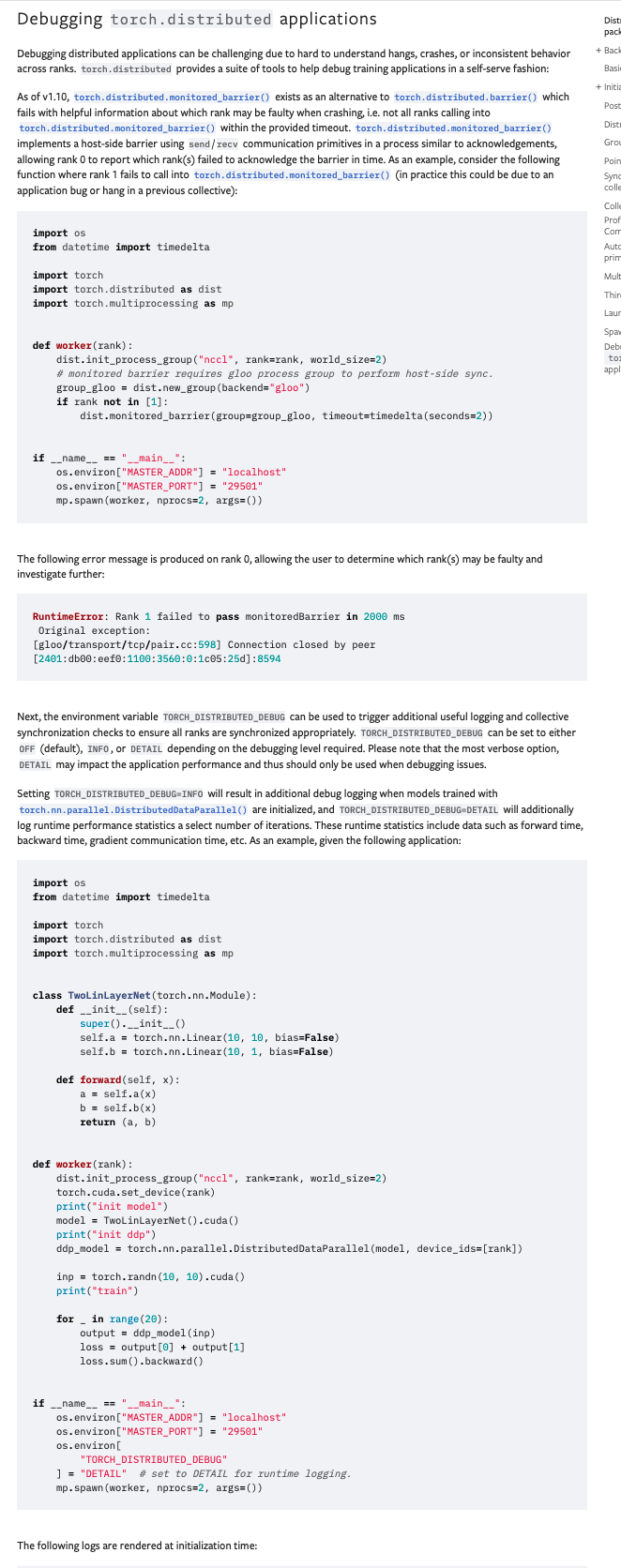
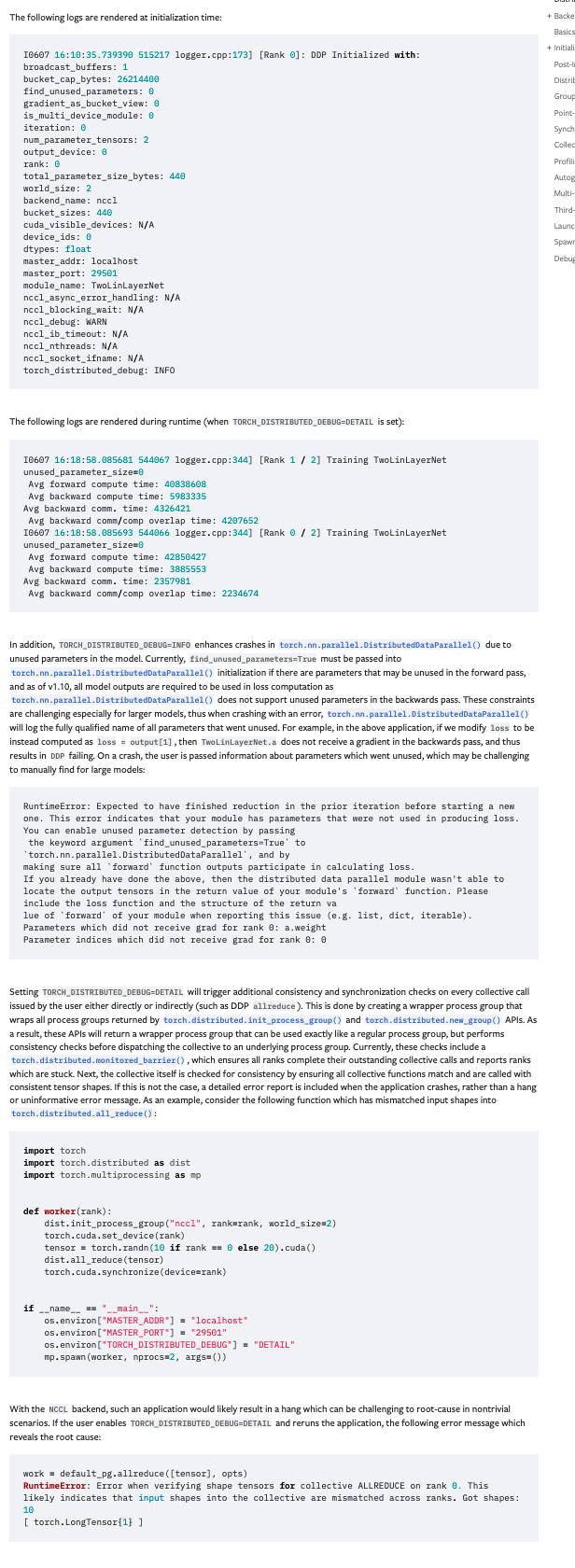
Will not land before the release, but would be good to have this function documented in master for its use in distributed debugability.

Pull Request resolved: https://github.com/pytorch/pytorch/pull/58322

Reviewed By: SciPioneer

Differential Revision: D28595405

Pulled By: rohan-varma

fbshipit-source-id: fb00fa22fbe97a38c396eae98a904d1c4fb636fa
Summary:
Temporary fix for https://github.com/pytorch/pytorch/issues/42218.

Numerically, grid_sampler should be fine in fp32 or fp16. So grid_sampler really belongs on the promote list. But performancewise, native grid_sampler backward kernels use gpuAtomicAdd, which is notoriously slow in fp16. So the simplest functionality fix is to put grid_sampler on the fp32 list.

In https://github.com/pytorch/pytorch/pull/58618 I implement the right long-term fix (refactoring kernels to use fp16-friendly fastAtomicAdd and moving grid_sampler to the promote list). But that's more invasive, and for 1.9 ngimel says this simple temporary fix is preferred.

Pull Request resolved: https://github.com/pytorch/pytorch/pull/58679

Reviewed By: soulitzer

Differential Revision: D28576559

Pulled By: ngimel

fbshipit-source-id: d653003f37eaedcbb3eaac8d7fec26c343acbc07
Summary:
* Fix lots of links.
* Minor improvements for consistency, clarity or grammar.
* Update jit_python_reference to note the limitations on __exit__.
  (Related to https://github.com/pytorch/pytorch/issues/41420).
* Fix a comment in exit_transforms.cpp: removed the word "not" which
  made the comment say the opposite of the truth.

Pull Request resolved: https://github.com/pytorch/pytorch/pull/57991

Reviewed By: malfet

Differential Revision: D28522247

Pulled By: SplitInfinity

fbshipit-source-id: fc63a59d19ea6c89f957c9f7d451be17d1c5fc91
Summary:
Pull Request resolved: https://github.com/pytorch/pytorch/pull/58056

This PR addresses an action item in #3428: disabling search engine
indexing of master documentation. This is desireable because we want to
direct users to our stable documentation (instead of master
documentation) because they are more likely to have a stable version of
PyTorch installed.

Test Plan:
1. run `make html`, check that the noindex tags are there
2. run `make html-stable, check that the noindex tags aren't there

Reviewed By: bdhirsh

Differential Revision: D28490504

Pulled By: zou3519

fbshipit-source-id: 695c944c4962b2bd484dd7a5e298914a37abe787
Summary:
Added a simple section indicating distributed profiling is expected to work similar to other torch operators, and is supported for all communication backends out of the box.

Pull Request resolved: https://github.com/pytorch/pytorch/pull/58286

Reviewed By: bdhirsh

Differential Revision: D28436489

Pulled By: rohan-varma

fbshipit-source-id: ce1905a987c0ede8011e8086a2c30edc777b4a38
Summary:
Adds a new file under `torch/nn/utils/parametrizations.py` which should contain all the parametrization implementations

For spectral_norm we add the `SpectralNorm` module which can be registered using `torch.nn.utils.parametrize.register_parametrization` or using a wrapper: `spectral_norm`, the same API the old implementation provided.

Most of the logic is borrowed from the old implementation:
 - Just like the old implementation, there should be cases when retrieving the weight should perform another power iteration (thus updating the weight) and cases where it shouldn't. For example in eval mode `self.training=True`, we do not perform power iteration.

There are also some differences/difficulties with the new implementation:
 - Using new parametrization functionality as-is there doesn't seem to be a good way to tell whether a 'forward' call was the result of parametrizations are unregistered (and leave_parametrizations=True) or when the injected property's getter was invoked. The issue is that we want perform power iteration in the latter case but not the former, but we don't have this control as-is. So, in this PR I modified the parametrization functionality to change the module to eval mode before triggering their forward call
 - Updates the vectors based on weight on initialization to fix https://github.com/pytorch/pytorch/issues/51800 (this avoids silently update weights in eval mode). This also means that we perform twice any many power iterations by the first forward.
 - right_inverse is just the identity for now, but maybe it should assert that the passed value already satisfies the constraints
 - So far, all the old spectral_norm tests have been cloned, but maybe we don't need so much testing now that the core functionality is already well tested

Pull Request resolved: https://github.com/pytorch/pytorch/pull/57784

Reviewed By: ejguan

Differential Revision: D28413201

Pulled By: soulitzer

fbshipit-source-id: e8f1140f7924ca43ae4244c98b152c3c554668f2
Summary:
Pull Request resolved: https://github.com/pytorch/pytorch/pull/58039

The new function has the following signature
`inv_ex(Tensor inpit, *, bool check_errors=False) -> (Tensor inverse, Tensor info)`.
When `check_errors=True`, an error is thrown if the matrix is not invertible; `check_errors=False` - responsibility for checking the result is on the user.

`linalg_inv` is implemented using calls to `linalg_inv_ex` now.

Resolves https://github.com/pytorch/pytorch/issues/25095

Test Plan: Imported from OSS

Reviewed By: ngimel

Differential Revision: D28405148

Pulled By: mruberry

fbshipit-source-id: b8563a6c59048cb81e206932eb2f6cf489fd8531
Summary:
Fixes https://github.com/pytorch/pytorch/issues/56608

 - Adds binding to the `c10::InferenceMode` RAII class in `torch._C._autograd.InferenceMode` through pybind. Also binds the `torch.is_inference_mode` function.
 - Adds context manager `torch.inference_mode` to manage an instance of `c10::InferenceMode` (global).  Implemented in `torch.autograd.grad_mode.py` to reuse the `_DecoratorContextManager` class.
 - Adds some tests based on those linked in the issue + several more for just the context manager

Issues/todos (not necessarily for this PR):
- Improve short inference mode description
- Small example
- Improved testing since there is no direct way of checking TLS/dispatch keys
-

Pull Request resolved: https://github.com/pytorch/pytorch/pull/58045

Reviewed By: agolynski

Differential Revision: D28390595

Pulled By: soulitzer

fbshipit-source-id: ae98fa036c6a2cf7f56e0fd4c352ff804904752c
Summary:
Pull Request resolved: https://github.com/pytorch/pytorch/pull/58160

This PR updates the Torch Distributed Elastic documentation with references to the new `c10d` backend.
ghstack-source-id: 128783809

Test Plan: Visually verified the correct

Reviewed By: tierex

Differential Revision: D28384996

fbshipit-source-id: a40b0c37989ce67963322565368403e2be5d2592
Summary:
Pull Request resolved: https://github.com/pytorch/pytorch/pull/57341

Require that users be explicit about what they are going to be
interning. There are a lot of changes that are enabled by this. The new
overall scheme is:

PackageExporter maintains a dependency graph. Users can add to it,
either explicitly (by issuing a `save_*` call) or explicitly (through
dependency resolution). Users can also specify what action to take when
PackageExporter encounters a module (deny, intern, mock, extern).

Nothing (except pickles, tho that can be changed with a small amount
of work) is written to the zip archive until we are finalizing the
package. At that point, we consult the dependency graph and write out
the package exactly as it tells us to.

This accomplishes two things:
1. We can gather up *all* packaging errors instead of showing them one at a time.
2. We require that users be explicit about what's going in packages, which is a common request.

Differential Revision: D28114185

Test Plan: Imported from OSS

Reviewed By: SplitInfinity

Pulled By: suo

fbshipit-source-id: fa1abf1c26be42b14c7e7cf3403ecf336ad4fc12
Summary:
Pull Request resolved: https://github.com/pytorch/pytorch/pull/58170

Now comm hook can be supported on MPI and GLOO backends besides NCCL. No longer need these warnings and check.
ghstack-source-id: 128799123

Test Plan: N/A

Reviewed By: agolynski

Differential Revision: D28388861

fbshipit-source-id: f56a7b9f42bfae1e904f58cdeccf7ceefcbb0850
Summary:
Pull Request resolved: https://github.com/pytorch/pytorch/pull/58023

Clearly state that some features of RPC aren't yet compatible with CUDA.
ghstack-source-id: 128688856

Test Plan: None

Reviewed By: agolynski

Differential Revision: D28347605

fbshipit-source-id: e8df9a4696c61a1a05f7d2147be84d41aeeb3b48
Summary:
Pull Request resolved: https://github.com/pytorch/pytorch/pull/50048

To reflect the many changes introduced recently.

In my mind, CUDAFuture should be considered a "private" subclass, which in practice should always be returned as a downcast pointer to an ivalue::Future. Hence, we should document the CUDA behavior in the superclass, even if it's CUDA-agnostic, since that's the interface the users will see also for CUDA-enabled futures.
ghstack-source-id: 128640983

Test Plan: Built locally and looked at them.

Reviewed By: mrshenli

Differential Revision: D25757474

fbshipit-source-id: c6f66ba88fa6c4fc33601f31136422d6cf147203