This PR:
- changes generate_vmap_rule to either be True or False. Previously it
  could be True, False, or not set. This simplifies the implementation a
  bit.
- changes the vmap staticmethod to always be on the autograd.Function
  rather than sometimes defined.
  This is how the other staticmethod (forward, backward, jvp) are
  implemented and allows us to document it.

There are 4 possible states for the autograd.Function w.r.t. to the
above:
- generate_vmap_rule is True, vmap staticmethod overriden. This raises
  an error when used with vmap.
- generate_vmap_rule is False, vmap staticmethod overriden. This is
  valid.
- generate_vmap_rule is True, vmap staticmethod not overriden. This is
  valid.
- generate_vmap_rule is False, vmap staticmethod not overriden. This
  raises an error when used with vmap.

Future:
- setup_context needs the same treatment, but that's a bit tricker to
  implement.

Test Plan:
- new unittest
- existing tests
Pull Request resolved: https://github.com/pytorch/pytorch/pull/91787
Approved by: https://github.com/soulitzer
This PR:
- Updates autograd.Function.forward docs to reflect how you either
  define a forward with ctx or a separate forward and setup_context
- Updates the "Extending Autograd" docs to suggest the usage of
  autograd.Function with separate forward and setup_context. This should
  be the default because there is a low barrier to go from this to
  an autograd.Function that is fully supported by functorch transforms.
- Adds a new "Extending torch.func with autograd.Function" doc that
  explains how to use autograd.Function with torch.func. It also
  explains how to use generate_vmap_rule and how to manually write a
  vmap staticmethod.

While writing this, I noticed that the implementation of
setup_context staticmethod/generate_vmap_rule/vmap staticmethod are a
bit inconsistent with the other method/attributes on autograd.Function:
- https://github.com/pytorch/pytorch/issues/91451
- I'm happy to fix those if we think it is a problem, either in this PR
  or a followup (this PR is getting long, I want some initial docs
  out that I can point early adopters at, and fixing the problems in the
  future isn't really BC-breaking).

Test Plan:
- view docs preview
Pull Request resolved: https://github.com/pytorch/pytorch/pull/91452
Approved by: https://github.com/soulitzer
Essentially the same change as #67946, except that the default is to disallow reduced precision reductions in `BFloat16` GEMMs (for now). If performance is severely regressed, we can change the default, but this option appears to be necessary to pass some `addmm` `BFloat16` tests on H100.

CC @ptrblck @ngimel
Pull Request resolved: https://github.com/pytorch/pytorch/pull/89172
Approved by: https://github.com/ngimel
Fixes#43144
This uses the Backend system added by [82682](https://github.com/pytorch/pytorch/pull/82682) to change allocators dynamically during the code execution. This will allow us to use RMM, use CUDA managed memory for some portions of the code that do not fit in GPU memory. Write static memory allocators to reduce fragmentation while training models and improve interoperability with external DL compilers/libraries.
For example, we could have the following allocator in c++
```c++
#include <sys/types.h>
#include <cuda_runtime_api.h>
#include <iostream>
extern "C" {
void* my_malloc(ssize_t size, int device, cudaStream_t stream) {
void *ptr;
std::cout<<"alloc "<< size<<std::endl;
cudaMalloc(&ptr, size);
return ptr;
}
void my_free(void* ptr) {
std::cout<<"free "<<std::endl;
cudaFree(ptr);
}
}
```
Compile it as a shared library
```
nvcc allocator.cc -o alloc.so -shared --compiler-options '-fPIC'
```
And use it from PyTorch as follows
```python
import torch
# Init caching
# b = torch.zeros(10, device='cuda')
new_alloc = torch.cuda.memory.CUDAPluggableAllocator('alloc.so', 'my_malloc', 'my_free')
old = torch.cuda.memory.get_current_allocator()
torch.cuda.memory.change_current_allocator(new_alloc)
b = torch.zeros(10, device='cuda')
# This will error since the current allocator was already instantiated
torch.cuda.memory.change_current_allocator(old)
```
Things to discuss
- How to test this, needs compiling external code ...
Pull Request resolved: https://github.com/pytorch/pytorch/pull/86786
Approved by: https://github.com/albanD
Summary:
Improved roundup_power2_divisions knob so it allows better control of rouding in the PyTorch CUDA Caching Allocator.

This new version allows setting the number of divisions per power of two interval starting from 1MB and ending at 64GB and above. An example use case is when rouding is desirable for small allocations but there are also very large allocations which are persistent, thus would not benefit from rounding and take up extra space.

Test Plan: Tested locally

Differential Revision: D40103909

Pull Request resolved: https://github.com/pytorch/pytorch/pull/87290
Approved by: https://github.com/zdevito
Fixes#83973 (This is a substitute PR for https://github.com/pytorch/pytorch/pull/85024)
First of all, thanks for your invaluable contributions to PyTorch everyone!
Given how extensively `torch.cuda.is_available` is used in the PyTorch ecosystem, IMHO it's worthwhile to provide downstream libraries/frameworks/users the ability to alter the default behavior of `torch.cuda.is_available` in the context of their PyTorch usage.
I'm confident there are many current and future such use cases which could benefit from leveraging a weakened, NVML-based `torch.cuda.is_available` assessment at a downstream framework's explicit direction (thanks @malfet 81da50a972 !). Though one could always patch out the `torch.cuda.is_available` function with another implementation in a downstream library, I think this environmental variable based configuration option is more convenient and the cost to including the option is quite low.
As discussed in https://github.com/pytorch/pytorch/pull/85024#issuecomment-1261542045, this PR gates new non-default NVML-based CUDA behavior with an environmental variable (PYTORCH_NVML_BASED_CUDA_CHK) that allows a user/framework to invoke non-default, NVML-based `is_available()` assessments if desired.
Thanks again for your work everyone!
@ngimel @malfet @awaelchli
Pull Request resolved: https://github.com/pytorch/pytorch/pull/85951
Approved by: https://github.com/ngimel
Summary:
Added an additional roundup knob( ``roundup_bypass_threshold_mb``) to bypass rounding the requested allocation size, for allocation requests larger than the threshold value (in MB). This can help reduce the memory footprint when making large allocations that are expected to be persistent or have a large lifetime.

Differential Revision: D39868104

Pull Request resolved: https://github.com/pytorch/pytorch/pull/85940
Approved by: https://github.com/zdevito
In preparation of adopting future rocblas library options, it is necessary to track when the backward pass of training is executing.  The scope-based helper class `BackwardPassGuard` is provided to toggle state.
Pull Request resolved: https://github.com/pytorch/pytorch/pull/71881
Approved by: https://github.com/albanD
Summary:
Pull Request resolved: https://github.com/pytorch/pytorch/pull/74261

### Goal
Implement a cheap way to reclaim GPU memory (garbage collection) without incurring GPU sync.

### Why do we need this?
Currently, there are only two ways to reclaim GPU memory block already assigned to a particular stream.

- `release_available_cached_blocks(params)`: Free blocks exceeding the `CachingAllocatorConfig::max_split_size()` until we can satisfy the request.

Issue: If the `max_split_size` is unset (default), this function is a no-op. Even if this is set, the reclamation is quite conservative (e.g., never frees blocks under max_split_size).

- `release_cached_blocks()`: Waits for all the in-flight events and then reclaim blocks.

Issue: 'waiting for all event' is very expensive as it will likely stall all the GPU operations. Many GPU applications without a proper handling of potential GPU throttling would suffer/crash.

### Proposed idea
- If the garbage collection threshold is set, try to reclaim some memory blocks *without* synchronization. It should be safe to do so, as `release_available_cached_blocks` essentially does the same thing (but less aggressively).
- GC is triggered only when we fail to serve a `malloc` request from the block pool. No need to free blocks when the block pool is functioning just fine.
- Prioritize reclaiming blocks that weren't reused for long time. Reclamation stops once the used memory capacity < threshold.
- This code path is totally optional; by default it won't be invoked.

Test Plan:
- Unit tests
- Manually checked that the GPU memory usage stays as indicated by the garbage collector. If not the caching allocator at least tries to keep freeing the blocks.

Reviewed By: jianyuh

Differential Revision: D34482514

fbshipit-source-id: d5eae62ac60b94b0bca851f9d233a092d086e3c2
(cherry picked from commit 05780f1ed4b176f05e765b2411c9eaa2eaeb48b0)
Summary:
Pull Request resolved: https://github.com/pytorch/pytorch/pull/74213

In the current CUDACachingAllocator, the sizes are rounded up in multiple of blocks size of 512, so this works for smaller sizes. However for large sizes, we can have lots of different size blocks in the larger pool. This is problematic when we have variable batch sizes 1001, 1021, 1023 -> all will go to different block size and will create different size of blocks. This will create lots of unused blocks and will waste GPU memory capacity.

This diff adds a rounding approach to allocation size. It rounds up the size to nearest power-of-2 divisions and the power2-division can be changed with env variable setting.

   For example, if we need to round-up  size of1200 and if number of divisions is 4,
   the size 1200 lies between 1024 and 2048 and if we do 4 divisions between
   them, the values are 1024, 1280, 1536, and 1792. So the function will
   return 1280 as the nearest ceiling of power-2 division.

env setting:
   export PYTORCH_CUDA_ALLOC_CONF=roundup_power2_divisions:4
ghstack-source-id: 151446017

Reviewed By: ezyang

Differential Revision: D34868036

fbshipit-source-id: 494785add16e6b37c920dcb5a2b81d4c637b554a
(cherry picked from commit 548454ccacbd8700e7ffd2d762e40b4ba37abbae)
Summary:
It is probably the most user friendly to link to that (lesser known?) feature.

Pull Request resolved: https://github.com/pytorch/pytorch/pull/72584

Reviewed By: soulitzer

Differential Revision: D34173999

Pulled By: albanD

fbshipit-source-id: 99fff7a55412faf54888f8317ab2388f4d7d30e4
(cherry picked from commit 2191ee7657)
Summary:
https://github.com/pytorch/pytorch/issues/67578 disabled reduced precision reductions for FP16 GEMMs. After benchmarking, we've found that this has substantial performance impacts for common GEMM shapes (e.g., those found in popular instantiations of multiheaded-attention) on architectures such as Volta. As these performance regressions may come as a surprise to current users, this PR adds a toggle to disable reduced precision reductions
`torch.backends.cuda.matmul.allow_fp16_reduced_precision_reduction = `
rather than making it the default behavior.

CC ngimel ptrblck
stas00 Note that the behavior after the previous PR can be replicated with
`torch.backends.cuda.matmul.allow_fp16_reduced_precision_reduction = False`

Pull Request resolved: https://github.com/pytorch/pytorch/pull/67946

Reviewed By: zou3519

Differential Revision: D32289896

Pulled By: ngimel

fbshipit-source-id: a1ea2918b77e27a7d9b391e030417802a0174abe
Summary:
Related to https://github.com/pytorch/pytorch/issues/30987. Fix the following task:

- [ ] Remove the use of `.data` in all our internal code:
  - [ ] ...
  - [x] `docs/source/scripts/build_activation_images.py` and `docs/source/notes/extending.rst`

In `docs/source/scripts/build_activation_images.py`, I used `nn.init` because the snippet already assumes `nn` is available (the class inherits from `nn.Module`).

cc albanD

Pull Request resolved: https://github.com/pytorch/pytorch/pull/65358

Reviewed By: malfet

Differential Revision: D31061790

Pulled By: albanD

fbshipit-source-id: be936c2035f0bdd49986351026fe3e932a5b4032
Summary:
Powers have decided this API should be listed as beta.

Pull Request resolved: https://github.com/pytorch/pytorch/pull/65247

Reviewed By: malfet

Differential Revision: D31057940

Pulled By: ngimel

fbshipit-source-id: 137b63cbd2c7409fecdc161a22135619bfc96bfa
Summary:
Puts memory sharing intro under Sharing memory... header, where it should have been all along.

Pull Request resolved: https://github.com/pytorch/pytorch/pull/64996

Reviewed By: mruberry

Differential Revision: D30948619

Pulled By: ngimel

fbshipit-source-id: 5d9dd267b34e9d3fc499d4738377b58a22da1dc2
Summary:
This PR expands the [note on modules](https://pytorch.org/docs/stable/notes/modules.html) with additional info for 1.10.

It adds the following:
* Examples of using hooks
* Examples of using apply()
* Examples for ParameterList / ParameterDict
* register_parameter() / register_buffer() usage
* Discussion of train() / eval() modes
* Distributed training overview / links
* TorchScript overview / links
* Quantization overview / links
* FX overview / links
* Parametrization overview / link to tutorial

Pull Request resolved: https://github.com/pytorch/pytorch/pull/63963

Reviewed By: albanD

Differential Revision: D30606604

Pulled By: jbschlosser

fbshipit-source-id: c1030b19162bcb5fe7364bcdc981a2eb6d6e89b4
Summary:
CUDA_VERSION and HIP_VERSION follow very unrelated versioning schemes, so it does not make sense to use CUDA_VERSION to determine the ROCm path. This note explicitly addresses it.

Pull Request resolved: https://github.com/pytorch/pytorch/pull/62850

Reviewed By: mruberry

Differential Revision: D30547562

Pulled By: malfet

fbshipit-source-id: 02990fa66a88466c2330ab85f446b25b78545150
Summary:
- Adds some code examples for `ctx` methods and make requirements of arguments more clear
- Type annotations for `save_for_backward`, `mark_dirty`, `mark_non_differentiable`, and `set_materialize_grads` (BC-breaking?)
- Refactor `torch.autograd.Function` doc

Pull Request resolved: https://github.com/pytorch/pytorch/pull/60312

Reviewed By: VitalyFedyunin

Differential Revision: D30314961

Pulled By: soulitzer

fbshipit-source-id: a284314b65662e26390417bd2b6b12cd85e68dc8
Summary:
This FAQ has a section for CUDA OOMs where there are lots of don'ts. This limits modeling solution. Deep nets can blow up memory due to output caching during training.
It's a known problem with a known solution: to trade-off compute for memory via checkpointing.
FAQ should mention it.

Pull Request resolved: https://github.com/pytorch/pytorch/pull/62709

Reviewed By: nairbv

Differential Revision: D30103326

Pulled By: ezyang

fbshipit-source-id: 3a8b465a7fbe19aae88f83cc50fe82ebafcb56c9
Summary:
Before https://github.com/pytorch/pytorch/pull/57833, calls to backward() or grad() synced only the calling thread's default stream with autograd leaf streams at the end of backward. This made the following weird pattern safe:
```python
with torch.cuda.stream(s):
    # imagine forward used many streams, so backward leaf nodes may run on many streams
    loss.backward()
# no sync
use grads
```

but a more benign-looking pattern was unsafe:
```python
with torch.cuda.stream(s):
    # imagine forward used a lot of streams, so backward leaf nodes may run on many streams
    loss.backward()
    # backward() syncs the default stream with all the leaf streams, but does not sync s with anything,
    # so counterintuitively (even though we're in the same stream context as backward()!)
    # it is NOT SAFE to use grads here, and there's no easy way to make it safe,
    # unless you manually sync on all the streams you used in forward,
    # or move "use grads" back to default stream outside the context.
    use grads
```
mruberry ngimel and I decided backward() should have the [same user-facing stream semantics as any cuda op](https://pytorch.org/docs/master/notes/cuda.html#stream-semantics-of-backward-passes).** In other words, the weird pattern should be unsafe, and the benign-looking pattern should be safe. Implementationwise, this meant backward() should sync its calling thread's current stream, not default stream, with the leaf streams.

After https://github.com/pytorch/pytorch/pull/57833, backward syncs the calling thread's current stream AND default stream with all leaf streams at the end of backward. The default stream syncs were retained for temporary backward compatibility.

This PR finishes https://github.com/pytorch/pytorch/pull/57833's work by deleting syncs on the default stream.

With this PR, graph-capturing an entire backward() call should be possible (see the [test_graph_grad_scaling diffs](https://github.com/pytorch/pytorch/compare/master...mcarilli:streaming_backwards_remove_default_syncs?expand=1#diff-893b1eea27352f336f4cd832919e48d721e4e90186e63400b8596db6b82e7450R3641-R3642)).

** first paragraph has a formatting error which this PR should also fix.

Pull Request resolved: https://github.com/pytorch/pytorch/pull/60421

Reviewed By: albanD

Differential Revision: D29370344

Pulled By: ngimel

fbshipit-source-id: 3248bc5fb92fc517db0c15c897e5d7250f67d7fe
Summary:
Before https://github.com/pytorch/pytorch/pull/57833, calls to backward() or grad() synced only the calling thread's default stream with autograd leaf streams at the end of backward. This made the following weird pattern safe:
```python
with torch.cuda.stream(s):
    # imagine forward used many streams, so backward leaf nodes may run on many streams
    loss.backward()
# no sync
use grads
```

but a more benign-looking pattern was unsafe:
```python
with torch.cuda.stream(s):
    # imagine forward used a lot of streams, so backward leaf nodes may run on many streams
    loss.backward()
    # backward() syncs the default stream with all the leaf streams, but does not sync s with anything,
    # so counterintuitively (even though we're in the same stream context as backward()!)
    # it is NOT SAFE to use grads here, and there's no easy way to make it safe,
    # unless you manually sync on all the streams you used in forward,
    # or move "use grads" back to default stream outside the context.
    use grads
```
mruberry ngimel and I decided backward() should have the [same user-facing stream semantics as any cuda op](https://pytorch.org/docs/master/notes/cuda.html#stream-semantics-of-backward-passes).** In other words, the weird pattern should be unsafe, and the benign-looking pattern should be safe. Implementationwise, this meant backward() should sync its calling thread's current stream, not default stream, with the leaf streams.

After https://github.com/pytorch/pytorch/pull/57833, backward syncs the calling thread's current stream AND default stream with all leaf streams at the end of backward. The default stream syncs were retained for temporary backward compatibility.

This PR finishes https://github.com/pytorch/pytorch/pull/57833's work by deleting syncs on the default stream.

With this PR, graph-capturing an entire backward() call should be possible (see the [test_graph_grad_scaling diffs](https://github.com/pytorch/pytorch/compare/master...mcarilli:streaming_backwards_remove_default_syncs?expand=1#diff-893b1eea27352f336f4cd832919e48d721e4e90186e63400b8596db6b82e7450R3641-R3642)).

** first paragraph has a formatting error which this PR should also fix.

Pull Request resolved: https://github.com/pytorch/pytorch/pull/60421

Reviewed By: VitalyFedyunin, albanD

Differential Revision: D29342234

Pulled By: ngimel

fbshipit-source-id: 98e6be7fdd8550872f0a78f9a66cb8dfe75abf63
Summary:
Fixes https://github.com/pytorch/pytorch/issues/35901

This change is designed to prevent fragmentation in the Caching Allocator.  Permissive block splitting in the allocator allows very large blocks to be split into many pieces.  Once split too finely it is unlikely all pieces will be 'free' at that same time so the original allocation can never be returned.   Anecdotally, we've seen a model run out of memory failing to alloc a 50 MB block on a 32 GB card while the caching allocator is holding 13 GB of 'split free blocks'

Approach:

- Large blocks above a certain size are designated "oversize".  This limit is currently set 1 decade above large, 200 MB
- Oversize blocks can not be split
- Oversize blocks must closely match the requested size (e.g. a 200 MB request will match an existing 205 MB block, but not a 300 MB block)
- In lieu of splitting oversize blocks there is a mechanism to quickly free a single oversize block (to the system allocator) to allow an appropriate size block to be allocated.  This will be activated under memory pressure and will prevent _release_cached_blocks()_ from triggering

Initial performance tests show this is similar or quicker than the original strategy.  Additional tests are ongoing.

Pull Request resolved: https://github.com/pytorch/pytorch/pull/44742

Reviewed By: zou3519

Differential Revision: D29186394

Pulled By: ezyang

fbshipit-source-id: c88918836db3f51df59de6d1b3e03602ebe306a9
Summary:
Adds a note explaining the difference between several often conflated mechanisms in the autograd note
Also adds a link to this note from the docs in `grad_mode` and `nn.module`.

Pull Request resolved: https://github.com/pytorch/pytorch/pull/58513

Reviewed By: gchanan

Differential Revision: D28651129

Pulled By: soulitzer

fbshipit-source-id: af9eb1749b641fc1b632815634eea36bf7979156
Summary:
You can find the latest rendered version in the `python_doc_build` CI job below, in the artifact tab of that build on circle CI

Pull Request resolved: https://github.com/pytorch/pytorch/pull/55966

Reviewed By: H-Huang

Differential Revision: D28032446

Pulled By: albanD

fbshipit-source-id: 227ad37b03d39894d736c19cae3195b4d56fc62f
Summary:
Pull Request resolved: https://github.com/pytorch/pytorch/pull/56528

Tried to search across internal and external usage of DataLoader. People haven't started to use `generator` for `DataLoader`.

Test Plan: Imported from OSS

Reviewed By: albanD

Differential Revision: D27908487

Pulled By: ejguan

fbshipit-source-id: 14c83ed40d4ba4dc988b121968a78c2732d8eb93
Summary:
Fixes https://github.com/pytorch/pytorch/issues/35901

This change is designed to prevent fragmentation in the Caching Allocator.  Permissive block splitting in the allocator allows very large blocks to be split into many pieces.  Once split too finely it is unlikely all pieces will be 'free' at that same time so the original allocation can never be returned.   Anecdotally, we've seen a model run out of memory failing to alloc a 50 MB block on a 32 GB card while the caching allocator is holding 13 GB of 'split free blocks'

Approach:

- Large blocks above a certain size are designated "oversize".  This limit is currently set 1 decade above large, 200 MB
- Oversize blocks can not be split
- Oversize blocks must closely match the requested size (e.g. a 200 MB request will match an existing 205 MB block, but not a 300 MB block)
- In lieu of splitting oversize blocks there is a mechanism to quickly free a single oversize block (to the system allocator) to allow an appropriate size block to be allocated.  This will be activated under memory pressure and will prevent _release_cached_blocks()_ from triggering

Initial performance tests show this is similar or quicker than the original strategy.  Additional tests are ongoing.

Pull Request resolved: https://github.com/pytorch/pytorch/pull/44742

Reviewed By: ngimel

Differential Revision: D23752058

Pulled By: ezyang

fbshipit-source-id: ccb7c13e3cf8ef2707706726ac9aaac3a5e3d5c8
Summary:
*Context:* https://github.com/pytorch/pytorch/issues/53406 added a lint for trailing whitespace at the ends of lines. However, in order to pass FB-internal lints, that PR also had to normalize the trailing newlines in four of the files it touched. This PR adds an OSS lint to normalize trailing newlines.

The changes to the following files (made in 54847d0adb9be71be4979cead3d9d4c02160e4cd) are the only manually-written parts of this PR:

- `.github/workflows/lint.yml`
- `mypy-strict.ini`
- `tools/README.md`
- `tools/test/test_trailing_newlines.py`
- `tools/trailing_newlines.py`

I would have liked to make this just a shell one-liner like the other three similar lints, but nothing I could find quite fit the bill. Specifically, all the answers I tried from the following Stack Overflow questions were far too slow (at least a minute and a half to run on this entire repository):

- [How to detect file ends in newline?](https://stackoverflow.com/q/38746)
- [How do I find files that do not end with a newline/linefeed?](https://stackoverflow.com/q/4631068)
- [How to list all files in the Git index without newline at end of file](https://stackoverflow.com/q/27624800)
- [Linux - check if there is an empty line at the end of a file [duplicate]](https://stackoverflow.com/q/34943632)
- [git ensure newline at end of each file](https://stackoverflow.com/q/57770972)

To avoid giving false positives during the few days after this PR is merged, we should probably only merge it after https://github.com/pytorch/pytorch/issues/54967.

Pull Request resolved: https://github.com/pytorch/pytorch/pull/54737

Test Plan:
Running the shell script from the "Ensure correct trailing newlines" step in the `quick-checks` job of `.github/workflows/lint.yml` should print no output and exit in a fraction of a second with a status of 0. That was not the case prior to this PR, as shown by this failing GHA workflow run on an earlier draft of this PR:

- https://github.com/pytorch/pytorch/runs/2197446987?check_suite_focus=true

In contrast, this run (after correcting the trailing newlines in this PR) succeeded:

- https://github.com/pytorch/pytorch/pull/54737/checks?check_run_id=2197553241

To unit-test `tools/trailing_newlines.py` itself (this is run as part of our "Test tools" GitHub Actions workflow):
```
python tools/test/test_trailing_newlines.py
```

Reviewed By: malfet

Differential Revision: D27409736

Pulled By: samestep

fbshipit-source-id: 46f565227046b39f68349bbd5633105b2d2e9b19
Summary:
Context: https://github.com/pytorch/pytorch/pull/53299#discussion_r587882857

These are the only hand-written parts of this diff:
- the addition to `.github/workflows/lint.yml`
- the file endings changed in these four files (to appease FB-internal land-blocking lints):
  - `GLOSSARY.md`
  - `aten/src/ATen/core/op_registration/README.md`
  - `scripts/README.md`
  - `torch/csrc/jit/codegen/fuser/README.md`

The rest was generated by running this command (on macOS):
```
git grep -I -l ' $' -- . ':(exclude)**/contrib/**' ':(exclude)third_party' | xargs gsed -i 's/ *$//'
```

I looked over the auto-generated changes and didn't see anything that looked problematic.

Pull Request resolved: https://github.com/pytorch/pytorch/pull/53406

Test Plan:
This run (after adding the lint but before removing existing trailing spaces) failed:
- https://github.com/pytorch/pytorch/runs/2043032377

This run (on the tip of this PR) succeeded:
- https://github.com/pytorch/pytorch/runs/2043296348

Reviewed By: walterddr, seemethere

Differential Revision: D26856620

Pulled By: samestep

fbshipit-source-id: 3f0de7f7c2e4b0f1c089eac9b5085a58dd7e0d97
Summary:
Minor doc fix in clarifying that the input data is rounded not truncated.

CC zasdfgbnm ngimel

Pull Request resolved: https://github.com/pytorch/pytorch/pull/49625

Reviewed By: mruberry

Differential Revision: D25668244

Pulled By: ngimel

fbshipit-source-id: ac97e41e0ca296276544f9e9f85b2cf1790d9985
Summary:
Ref https://github.com/pytorch/pytorch/issues/42175

This removes the 4 deprecated spectral functions: `torch.{fft,rfft,ifft,irfft}`. `torch.fft` is also now imported by by default.

The actual `at::native` functions are still used in `torch.stft` so can't be full removed yet. But will once https://github.com/pytorch/pytorch/issues/47601 has been merged.

Pull Request resolved: https://github.com/pytorch/pytorch/pull/48594

Reviewed By: heitorschueroff

Differential Revision: D25298929

Pulled By: mruberry

fbshipit-source-id: e36737fe8192fcd16f7e6310f8b49de478e63bf0
Summary:
I have been asked several times how to toggle this flag on libtorch. I think it would be good to mention it in the docs.

Pull Request resolved: https://github.com/pytorch/pytorch/pull/47331

Reviewed By: glaringlee

Differential Revision: D24777576

Pulled By: mruberry

fbshipit-source-id: cc2a338c477bb57e0bb74b8960c47fde99665e41
Summary:
Currently, a GraphRoot instance doesn't have an associated stream.  Streaming backward synchronization logic assumes the instance ran on the default stream, and tells consumer ops to sync with the default stream.  If the gradient the GraphRoot instance passes to consumer backward ops was populated on a non-default stream, we have a race condition.

The race condition can exist even if the user doesn't give a manually populated gradient:
```python
with torch.cuda.stream(side_stream):
    # loss.backward() implicitly synthesizes a one-element 1.0 tensor on side_stream
    # GraphRoot passes it to consumers, but consumers first sync on default stream, not side_stream.
    loss.backward()

    # Internally to backward(), streaming-backward logic takes over, stuff executes on the same stream it ran on in forward,
    # and the side_stream context is irrelevant.  GraphRoot's interaction with its first consumer(s) is the spot where
    # the side_stream context causes a problem.
```

This PR fixes the race condition by associating a GraphRoot instance, at construction time, with the current stream(s) on the device(s) of the grads it will pass to consumers. (i think this relies on GraphRoot executing in the main thread, before backward thread(s) fork, because the grads were populated on the main thread.)

The test demonstrates the race condition. It fails reliably without the PR's GraphRoot diffs and passes with the GraphRoot diffs.

With the GraphRoot diffs, manually populating an incoming-gradient arg for `backward` (or `torch.autograd.grad`) and the actual call to `autograd.backward` will have the same stream-semantics relationship as any other pair of ops:
```python
# implicit population is safe
with torch.cuda.stream(side_stream):
    loss.backward()

# explicit population in side stream then backward in side stream is safe
with torch.cuda.stream(side_stream):
    kickoff_grad = torch.ones_like(loss)
    loss.backward(gradient=kickoff_grad)

# explicit population in one stream then backward kickoff in another stream
# is NOT safe, even with this PR's diffs, but that unsafety is consistent with
# stream-semantics relationship of any pair of ops
kickoff_grad = torch.ones_like(loss)
with torch.cuda.stream(side_stream):
    loss.backward(gradient=kickoff_grad)

# Safe, as you'd expect for any pair of ops
kickoff_grad = torch.ones_like(loss)
side_stream.wait_stream(torch.cuda.current_stream())
with torch.cuda.stream(side_stream):
    loss.backward(gradient=kickoff_grad)
```
This PR also adds the last three examples above to cuda docs and references them from autograd docstrings.

Pull Request resolved: https://github.com/pytorch/pytorch/pull/45787

Reviewed By: nairbv

Differential Revision: D24138376

Pulled By: albanD

fbshipit-source-id: bc4cd9390f9f0358633db530b1b09f9c1080d2a3
Summary:
Pull Request resolved: https://github.com/pytorch/pytorch/pull/45294

While tracking down a recent memory corruption bug we found that
cuda-memcheck wasn't finding the bad accesses, and ngimel pointed out that
it's because we use a caching allocator so a lot of "out of bounds" accesses
land in a valid slab.

This PR adds a runtime knob (`PYTORCH_NO_CUDA_MEMORY_CACHING`) that, when set,
bypasses the caching allocator's caching logic so that allocations go straight
to cudaMalloc.  This way, cuda-memcheck will actually work.

Test Plan:
Insert some memory errors and run a test under cuda-memcheck;
observe that cuda-memcheck flags an error where expected.

Specifically I removed the output-masking logic here:
https://github.com/pytorch/pytorch/blob/master/torch/csrc/jit/tensorexpr/cuda_codegen.cpp#L819-L826

And ran:
```
PYTORCH_NO_CUDA_MEMORY_CACHING=1 cuda-memcheck pytest -k test_superslomo test_jit_fuser_te.py
```

Reviewed By: ngimel

Differential Revision: D23964734

Pulled By: bertmaher

fbshipit-source-id: 04efd11e8aff037b9edde80c70585cb820ee6e39
Summary:
Added a new option in AutogradContext to tell autograd to not materialize output grad tensors, that is, don't expand undefined/None tensors into tensors full of zeros before passing them as input to the backward function.

This PR is the second part that closes https://github.com/pytorch/pytorch/issues/41359. The first PR is https://github.com/pytorch/pytorch/pull/41490.

Pull Request resolved: https://github.com/pytorch/pytorch/pull/41821

Reviewed By: albanD

Differential Revision: D22693163

Pulled By: heitorschueroff

fbshipit-source-id: a8d060405a17ab1280a8506a06a2bbd85cb86461
Summary:
According to pytorch/rfcs#3

From the goals in the RFC:

1. Support subclassing `torch.Tensor` in Python (done here)
2. Preserve `torch.Tensor` subclasses when calling `torch` functions on them (done here)
3. Use the PyTorch API with `torch.Tensor`-like objects that are _not_ `torch.Tensor`
   subclasses (done in https://github.com/pytorch/pytorch/issues/30730)
4. Preserve `torch.Tensor` subclasses when calling `torch.Tensor` methods. (done here)
5. Propagating subclass instances correctly also with operators, using
   views/slices/indexing/etc. (done here)
6. Preserve subclass attributes when using methods or views/slices/indexing. (done here)
7. A way to insert code that operates on both functions and methods uniformly
   (so we can write a single function that overrides all operators). (done here)
8. The ability to give external libraries a way to also define
   functions/methods that follow the `__torch_function__` protocol. (will be addressed in a separate PR)

This PR makes the following changes:

1. Adds the `self` argument to the arg parser.
2. Dispatches on `self` as well if `self` is not `nullptr`.
3. Adds a `torch._C.DisableTorchFunction` context manager to disable `__torch_function__`.
4. Adds a `torch::torch_function_enabled()` and `torch._C._torch_function_enabled()` to check the state of `__torch_function__`.
5. Dispatches all `torch._C.TensorBase` and `torch.Tensor` methods via `__torch_function__`.

TODO:

- [x] Sequence Methods
- [x] Docs
- [x] Tests

Closes https://github.com/pytorch/pytorch/issues/28361

Benchmarks in https://github.com/pytorch/pytorch/pull/37091#issuecomment-633657778

Pull Request resolved: https://github.com/pytorch/pytorch/pull/37091

Reviewed By: ngimel

Differential Revision: D22765678

Pulled By: ezyang

fbshipit-source-id: 53f8aa17ddb8b1108c0997f6a7aa13cb5be73de0
Summary:
A small PR fixing some formatting in lcm, gcd, and the serialization note. Adds a note to lcm and gcd explaining behavior that is not always defined.

Pull Request resolved: https://github.com/pytorch/pytorch/pull/41526

Reviewed By: ngimel

Differential Revision: D22569341

Pulled By: mruberry

fbshipit-source-id: 5f5ff98c0831f65e82b991ef444a5cee8e3c8b5a
Summary:
Doc update intended to clarify and expand our current serialization behavior, including explaining the difference between torch.save/torch.load, torch.nn.Module.state_dict/torch.nn.Module.load_state_dict, and torch.jit.save/torch.jit.load. Also explains, for the time, when historic serialized Torchscript behavior is preserved and our recommendation for preserving behavior (using the same PyTorch version to consume a model as produced it).

Pull Request resolved: https://github.com/pytorch/pytorch/pull/41395

Reviewed By: ngimel

Differential Revision: D22560538

Pulled By: mruberry

fbshipit-source-id: dbc2f1bb92ab61ff2eca4888febc21f7dda76ba1
Summary:
some people have been confused by `retain_graph` in the snippet, they thought it was an additional requirement imposed by amp.

Pull Request resolved: https://github.com/pytorch/pytorch/pull/41203

Differential Revision: D22463700

Pulled By: ngimel

fbshipit-source-id: e6fc8871be2bf0ecc1794b1c6f5ea99af922bf7e
Summary:
I ran `make linkcheck` using `sphinx.builders.linkcheck` on the documentation and noticed a few links weren't using HTTPS so I quickly updated them all.

Pull Request resolved: https://github.com/pytorch/pytorch/pull/40878

Differential Revision: D22404647

Pulled By: ngimel

fbshipit-source-id: 9c9756db59197304023fddc28f252314f6cf4af3
Summary:
Currently, a custom autograd function written with
```
torch.cuda.amp.custom_fwd(cast_inputs=dtype)
def forward(ctx, *args):
    ...
```
casts incoming floating-point CUDA tensors to `dtype` unconditionally, regardless of whether the function executes in an autocast-enabled region.  I think I had the wrong idea there.  Autocast-disabled regions should give the user control of input types.  Also, `custom_fwd(cast_inputs=dtype)`-decorated functions' behavior should align with native fp32list/fp16list functions.  C++-side casting wrappers have no effect when autocast is disabled, and  `custom_fwd`'s casting should behave the same way.

The present PR changes `custom_fwd` so it only casts in autocast-enabled regions (also updates custom_fwd to ignore fp64 inputs, like the C++ wrappers).
Pull Request resolved: https://github.com/pytorch/pytorch/pull/36171

Differential Revision: D22179511

Pulled By: ngimel

fbshipit-source-id: 5a93d070179a43206066bce19da0a5a19ecaabbd
Summary:
Removes line mentioning `ProcessGroupRoundRobin` since we don't intend it to be used as a public API just yet. We can add this back when we officially support the API
Pull Request resolved: https://github.com/pytorch/pytorch/pull/40380

Differential Revision: D22165556

Pulled By: rohan-varma

fbshipit-source-id: 24d0477d881dc74f2ff579de61dfd1ced2b09e75
Summary:
Make Linear layer working correct when bias is False
Pull Request resolved: https://github.com/pytorch/pytorch/pull/38002

Differential Revision: D21509679

Pulled By: malfet

fbshipit-source-id: c7077992cf414ecc557b39e5ed1e39ef01c8b347
Summary:
Pull Request resolved: https://github.com/pytorch/pytorch/pull/37548

Moving RecordFunction from torch::autograd::profiler into at namespace

Test Plan:
CI

Imported from OSS

Differential Revision: D21315852

fbshipit-source-id: 4a4dbabf116c162f9aef0da8606590ec3f3847aa
Summary:
Pull Request resolved: https://github.com/pytorch/pytorch/pull/37491

This PR modernizes RecordFunction API and adds thread local callbacks
in addition to the global ones

Changes:
 - support for TLS callbacks, this is going to be the foundation of profiler and other tools
 - modernize interface around simple set of functions (add|remove|has|clear)(Global|ThreadLocal)(Callback) and adding RecordFunctionCallback to easily construct callbacks to be passed
 - we also add `.setShouldRun` into the callback interface to support cases when simple uniform sampling is not enough
 - to properly support add/remove introduce the idea of callback handle returned by add
 - internal implementation still uses SmallVector to store intermediate state (as before) - in this case these are vector of handles of callbacks that were picked to run
 - to speed up runtime we keep these vectors sorted, this way we can quickly enumerate callbacks that need to be run
 - added tests for new functionality

Test Plan:
BUILD_BINARY=1 USE_BLAS=MKL USE_MKLDNN=0 USE_CUDA=0 python setup.py
develop install
./build/bin/test_jit
CI

record_function_benchmark: https://gist.github.com/ilia-cher/f1e094dae47fe23e55e7672ac4dcda2f

Imported from OSS

Differential Revision: D21300448

fbshipit-source-id: 6d55c26dbf20b33d35c3f1604dcc07bb063c8c43
Summary:
xref gh-32838, gh-34032

This is a major refactor of parts of the documentation to split it up using sphinx's `autosummary` feature which will build out `autofuction` and `autoclass` stub files and link to them. The end result is that the top module pages like torch.nn.rst and torch.rst are now more like table-of-contents to the actual single-class or single-function documentations pages.

Along the way, I modified many of the docstrings to eliminate sphinx warnings when building. I think the only thing I changed from a non-documentation perspective is to add names to `__all__` when adding them to `globals()` in `torch.__init__.py`

I do not know the CI system: are the documentation build artifacts available after the build, so reviewers can preview before merging?
Pull Request resolved: https://github.com/pytorch/pytorch/pull/37419

Differential Revision: D21337640

Pulled By: ezyang

fbshipit-source-id: d4ad198780c3ae7a96a9f22651e00ff2d31a0c0f
Summary:
Pull Request resolved: https://github.com/pytorch/pytorch/pull/37382

After adding c10::DispatchKey::Profiler the behavior of RecordFunction
observers is also controlled by the dispatch key,
this PR moves the logic outside of the profiler into the record function

Reviewed By: jamesr66a

Differential Revision: D21268320

fbshipit-source-id: 93207e3b55325d20dcc5b1e8f448ab86933321da
Summary:
Pull Request resolved: https://github.com/pytorch/pytorch/pull/37292

After adding c10::DispatchKey::Profiler the behavior of RecordFunction
observers is also controlled by the dispatch key,
this PR moves the logic outside of the profiler into the record function

Reviewed By: jamesr66a

Differential Revision: D21245094

fbshipit-source-id: 595e41b18206d2ba4cf639cb320f630907868b3f
Summary:
Pull Request resolved: https://github.com/pytorch/pytorch/pull/37195

After adding c10::DispatchKey::Profiler the behavior of RecordFunction
observers is also controlled by the dispatch key,
this PR moves the logic outside of the profiler into the record function

Reviewed By: ngimel

Differential Revision: D21213786

fbshipit-source-id: e618254da74a4f1ce16c51a3869bbd75a4f561ad
Summary:
Several people have asked me about proper Amp usage with gradient accumulation.  In particular, it's [unclear to people](https://github.com/NVIDIA/apex/issues/439#issuecomment-610351482) that you should only call `scaler.unscale_()` (if desired) and `scaler.update()` in iterations where you actually plan to step.  This PR adds a minimal accumulation example.

I built the docs locally and it looks free from sphinx errors, at least.
Pull Request resolved: https://github.com/pytorch/pytorch/pull/36601

Differential Revision: D21082295

Pulled By: ngimel

fbshipit-source-id: b2faa6c02b9f7e1972618a0f1d5360a03f0450ac
Summary:
Full details in task: https://our.intern.facebook.com/intern/tasks/?t=64776265

With pytroch 1.5+ we remove python2 support from PyTorch. All documentation under docs/ and on the pytorch.org website needs to remove Python 2 references.
Pull Request resolved: https://github.com/pytorch/pytorch/pull/36114

Differential Revision: D20901746

Pulled By: jlin27

fbshipit-source-id: 07f8dc8e6fab0b232e5048a63079cab0c433c85f
Summary: This diff fixes the issues with current handling of debug information passed along the execution of the model. (For example, it is possible that multiple calls to the debug guard may override each other)

Test Plan: CI test/cpp/jit

Reviewed By: dzhulgakov

Differential Revision: D20602775

fbshipit-source-id: 4683957954028af81a1a0f1f12b243650230c9bb
Summary:
Pull Request resolved: https://github.com/pytorch/pytorch/pull/34710

Extending RecordFunction API to support new recording scopes (such as TorchScript functions), as well as giving more flexibility to set sampling rate.

Test Plan: unit test (test_misc.cpp/testRecordFunction)

Reviewed By: gdankel, dzhulgakov

Differential Revision: D20158523

fbshipit-source-id: a9e0819d21cc06f4952d92d43246587c36137582
Summary:
## Motivation

This PR upgrades MKL-DNN from v0.20 to DNNL v1.2 and resolves https://github.com/pytorch/pytorch/issues/30300.

DNNL (Deep Neural Network Library) is the new brand of MKL-DNN, which improves performance, quality, and usability over the old version.

This PR focuses on the migration of all existing functionalities, including minor fixes, performance improvement and code clean up. It serves as the cornerstone of our future efforts to accommodate new features like OpenCL support, BF16 training, INT8 inference, etc. and to let the Pytorch community derive more benefits from the Intel Architecture.

<br>

## What's included?

Even DNNL has many breaking changes to the API, we managed to absorb most of them in ideep. This PR contains minimalist changes to the integration code in pytorch. Below is a summary of the changes:

<br>

**General:**

1. Replace op-level allocator with global-registered allocator

```
// before
ideep::sum::compute<AllocForMKLDNN>(scales, {x, y}, z);

// after
ideep::sum::compute(scales, {x, y}, z);
```

The allocator is now being registeted at `aten/src/ATen/native/mkldnn/IDeepRegistration.cpp`. Thereafter all tensors derived from the `cpu_engine` (by default) will use the c10 allocator.

```
RegisterEngineAllocator cpu_alloc(
  ideep::engine::cpu_engine(),
  [](size_t size) {
    return c10::GetAllocator(c10::DeviceType::CPU)->raw_allocate(size);
  },
  [](void* p) {
    c10::GetAllocator(c10::DeviceType::CPU)->raw_deallocate(p);
  }
);
```
------

2. Simplify group convolution

We had such a scenario in convolution where ideep tensor shape mismatched aten tensor: when `groups > 1`, DNNL expects weights tensors to be 5-d with an extra group dimension, e.g. `goihw` instead of `oihw` in 2d conv case.

As shown below, a lot of extra checks came with this difference in shape before. Now we've completely hidden this difference in ideep and all tensors are going to align with pytorch's definition. So we could safely remove these checks from both aten and c2 integration code.

```
// aten/src/ATen/native/mkldnn/Conv.cpp

if (w.ndims() == x.ndims() + 1) {
  AT_ASSERTM(
      groups > 1,
      "Only group _mkldnn_conv2d weights could have been reordered to 5d");
  kernel_size[0] = w.get_dim(0) * w.get_dim(1);
  std::copy_n(
      w.get_dims().cbegin() + 2, x.ndims() - 1, kernel_size.begin() + 1);
} else {
  std::copy_n(w.get_dims().cbegin(), x.ndims(), kernel_size.begin());
}
```

------

3. Enable DNNL built-in cache

Previously, we stored DNNL jitted kernels along with intermediate buffers inside ideep using an LRU cache. Now we are switching to the newly added DNNL built-in cache, and **no longer** caching buffers in order to reduce memory footprint.

This change will be mainly reflected in lower memory usage from memory profiling results. On the code side, we removed couple of lines of `op_key_` that depended on the ideep cache before.

------

4. Use 64-bit integer to denote dimensions

We changed the type of `ideep::dims` from `vector<int32_t>` to `vector<int64_t>`. This renders ideep dims no longer compatible with 32-bit dims used by caffe2. So we use something like `{stride_.begin(), stride_.end()}` to cast parameter `stride_` into a int64 vector.

<br>

**Misc changes in each commit:**

**Commit:** change build options

Some build options were slightly changed, mainly to avoid name collisions with other projects that include DNNL as a subproject. In addition, DNNL built-in cache is enabled by option `DNNL_ENABLE_PRIMITIVE_CACHE`.

Old | New
-- | --
WITH_EXAMPLE | MKLDNN_BUILD_EXAMPLES
WITH_TEST | MKLDNN_BUILD_TESTS
MKLDNN_THREADING | MKLDNN_CPU_RUNTIME
MKLDNN_USE_MKL | N/A (not use MKL anymore)

------

**Commit:** aten reintegration

- aten/src/ATen/native/mkldnn/BinaryOps.cpp

    Implement binary ops using new operation `binary` provided by DNNL

- aten/src/ATen/native/mkldnn/Conv.cpp

    Clean up group convolution checks
    Simplify conv backward integration

- aten/src/ATen/native/mkldnn/MKLDNNConversions.cpp

    Simplify prepacking convolution weights

- test/test_mkldnn.py

    Fixed an issue in conv2d unit test: it didn't check conv results between mkldnn and aten implementation before. Instead, it compared the mkldnn with mkldnn as the default cpu path will also go into mkldnn. Now we use `torch.backends.mkldnn.flags` to fix this issue

- torch/utils/mkldnn.py

    Prepack weight tensor on module `__init__` to achieve better performance significantly

------

**Commit:** caffe2 reintegration

- caffe2/ideep/ideep_utils.h

    Clean up unused type definitions

- caffe2/ideep/operators/adam_op.cc & caffe2/ideep/operators/momentum_sgd_op.cc

   Unify tensor initialization with `ideep::tensor::init`. Obsolete `ideep::tensor::reinit`

- caffe2/ideep/operators/conv_op.cc & caffe2/ideep/operators/quantization/int8_conv_op.cc

    Clean up group convolution checks
    Revamp convolution API

- caffe2/ideep/operators/conv_transpose_op.cc

    Clean up group convolution checks
    Clean up deconv workaround code

------

**Commit:** custom allocator

- Register c10 allocator as mentioned above

<br><br>

## Performance

We tested inference on some common models based on user scenarios, and most performance numbers are either better than or on par with DNNL 0.20.

ratio: new / old | Latency (batch=1 4T) | Throughput (batch=64 56T)
-- | -- | --
pytorch resnet18 | 121.4% | 99.7%
pytorch resnet50 | 123.1% | 106.9%
pytorch resnext101_32x8d | 116.3% | 100.1%
pytorch resnext50_32x4d | 141.9% | 104.4%
pytorch mobilenet_v2 | 163.0% | 105.8%
caffe2 alexnet | 303.0% | 99.2%
caffe2 googlenet-v3 | 101.1% | 99.2%
caffe2 inception-v1 | 102.2% | 101.7%
caffe2 mobilenet-v1 | 356.1% | 253.7%
caffe2 resnet101 | 100.4% | 99.8%
caffe2 resnet152 | 99.8% | 99.8%
caffe2 shufflenet | 141.1% | 69.0% †
caffe2 squeezenet | 98.5% | 99.2%
caffe2 vgg16 | 136.8% | 100.6%
caffe2 googlenet-v3 int8 | 100.0% | 100.7%
caffe2 mobilenet-v1 int8 | 779.2% | 943.0%
caffe2 resnet50 int8 | 99.5% | 95.5%

_Configuration:
Platform: Skylake 8180
Latency Test: 4 threads, warmup 30, iteration 500, batch size 1
Throughput Test: 56 threads, warmup 30, iteration 200, batch size 64_

† Shufflenet is one of the few models that require temp buffers during inference. The performance degradation is an expected issue since we no longer cache any buffer in the ideep. As for the solution, we suggest users opt for caching allocator like **jemalloc** as a drop-in replacement for system allocator in such heavy workloads.
Pull Request resolved: https://github.com/pytorch/pytorch/pull/32422

Test Plan:
Perf results: https://our.intern.facebook.com/intern/fblearner/details/177790608?tab=Experiment%20Results

10% improvement for ResNext with avx512, neutral on avx2

More results: https://fb.quip.com/ob10AL0bCDXW#NNNACAUoHJP

Reviewed By: yinghai

Differential Revision: D20381325

Pulled By: dzhulgakov

fbshipit-source-id: 803b906fd89ed8b723c5fcab55039efe3e4bcb77
Summary:
We should recommend DDP instead of DP. Hope we can also cherry-pick this for 1.5
Pull Request resolved: https://github.com/pytorch/pytorch/pull/35063

Differential Revision: D20549621

Pulled By: ngimel

fbshipit-source-id: 86b1b2134664065cc6070ea4212895f993eaf543
Summary:
Initial integration of eager autocasting, supporting out-of-place ops only for easier review.
Relevant issue/RFC: https://github.com/pytorch/pytorch/issues/25081

In-place ops and ops with user-supplied `out=...` can certainly be supported as well (my initial WIP https://github.com/pytorch/pytorch/pull/29552 handled many) but require substantially more complex special casing in the autocasting backend and tests.  Support for these ops (much of which has already been written) will be broken into later PRs.
Pull Request resolved: https://github.com/pytorch/pytorch/pull/32140

Differential Revision: D20346700

Pulled By: ezyang

fbshipit-source-id: 12d77b3917310186fbddf11c59b2794dc859131f
Summary:
- Update API calls `backward` and `optim.step` now that we require `context_id`
- Add notes to clarify purpose of distributed autograd context (this was a source of confusion in some feedback)
- Add note that details why optimizer requires context_id
- Clearly specify that we don't have SMART mode yet
Pull Request resolved: https://github.com/pytorch/pytorch/pull/34657

Differential Revision: D20427667

Pulled By: rohan-varma

fbshipit-source-id: 5f8a3539ccf648a78e9e9a0dfdfe389c678b1606
Summary:
This is a redo of https://github.com/pytorch/pytorch/pull/33791, which was reverted because it introduced a flaky test. The test was flaky and only flaky on Python3.5 because of dict order randomization.

I've fixed the issue with tests clobbering each other in b539fec and removed the override tests for `torch.nn.functional.tanh` and `torch.nn.functional.sigmoid`, which are deprecated and shouldn't be overridable in e0d7402. I also verified that no more test clobbering is happening.
Pull Request resolved: https://github.com/pytorch/pytorch/pull/34240

Differential Revision: D20252442

Pulled By: cpuhrsch

fbshipit-source-id: 069568e342a41c90e1dc76cbf85ba4aed47f24be
Summary:
Pull Request resolved: https://github.com/pytorch/pytorch/pull/34515

Once upon a time we thought this was necessary. In reality it is not, so
removing it.

For backcompat, our public interface (defined in `api/`) still has
typedefs to the old `script::` names.

There was only one collision: `Pass` as a `Stmt` and `Pass` as a graph
transform. I renamed one of them.

Test Plan: Imported from OSS

Differential Revision: D20353503

Pulled By: suo

fbshipit-source-id: 48bb911ce75120a8c9e0c6fb65262ef775dfba93
Summary:
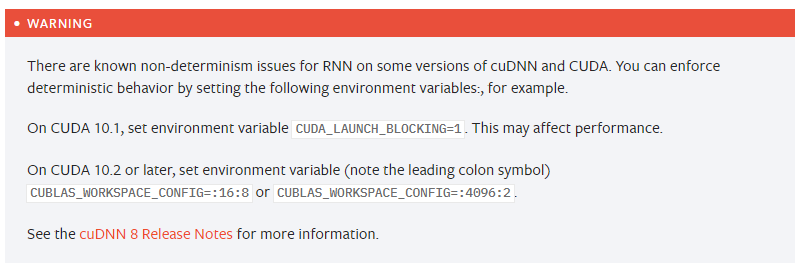
Improves explanation of non-determinism when running on GPUs. Adds info about `torch.nn.BCELoss` operating non-deterministically on GPUs.
Pull Request resolved: https://github.com/pytorch/pytorch/pull/33795

Differential Revision: D20284880

Pulled By: ngimel

fbshipit-source-id: d543959636d261a80c234150304344b19a37ba5d
Summary:
Fixes https://github.com/pytorch/pytorch/issues/33182

This adds private API functions that developers of types that implement `__torch_function__` can use to ensure full coverage of the subset of the PyTorch API that can be overrided.

I've refactored some of the code in the tests into a new `torch._overrides.get_overridable_functions` function. I've also changed `TENSOR_LIKE_TORCH_OVERRIDES` into `torch._overrides.get_testing_overrides` and `IGNORED_TORCH_FUNCTIONS` into `torch._overrides.get_ignored_functions`. Making these two static global variables in the tests into functions should allow rewriting their implementation to construct their return values instead of just statically defining the return value as is done here. Currently that is blocked on not being able to inspect function signatures of compiled kernels in PyTorch (see https://github.com/pytorch/pytorch/issues/28233). See the docs I've added for usage examples of these new functions. I also refactored the existing override tests to make use of these new functions, which should be a good forcing function to make sure they're kept up-to-date.

Finally, while working on this I discovered that `TestTorchFunctionOverrides.test_mean` and `TestTorchFunctionOverrides.test_mm` weren't ever being run because they were getting clobbered by the other dynamically generated override tests. I fixed that by renaming the tests and then fixing the actual test code. I've verified that all the subclassing semantics is correct and that the updated test answers are correct. I'm happy to put the fixes to the existing tests in as a separate pull request if that would be easier to review.

ping cpuhrsch since the feature request originally came from them.
Pull Request resolved: https://github.com/pytorch/pytorch/pull/33791

Differential Revision: D20195053

Pulled By: cpuhrsch

fbshipit-source-id: 1585f4e405f5223932b410eae03a288dc8eb627e
Summary:
Pull Request resolved: https://github.com/pytorch/pytorch/pull/33711Fixed#33480
This makes `dist_autograd.backward` and `dist_optimizer.step` functional by making the user explicitly pass in the `context_id` as opposed to relying on the confusing thread_local context_id.
This diff incorporates these API changes and all places where these functions are called.
More concretely, this code:
```
with dist_autograd.context():
# Forward pass.
dist_autograd.backward([loss.sum()])
dist_optim.step()
```
should now be written as follows:
```
with dist_autograd.context() as context_id:
# Forward pass.
dist_autograd.backward(context_id, [loss.sum()])
dist_optim.step(context_id)
```
Test Plan: Ensuring all existing dist_autograd and dist_optimizer tests pass with the new API. Also added a new test case for input checking.
Differential Revision: D20011710
fbshipit-source-id: 216e12207934a2a79c7223332b97c558d89d4d65
Summary:
Also, windows memory failures responsible for the earlier reversion have been fixed.

This PR (initially) contains 2 commits:
* a revert of the revert
* all changes to implement the original Apex scale update heuristic, squashed into a single commit for easier diff review
Pull Request resolved: https://github.com/pytorch/pytorch/pull/33366

Differential Revision: D20099026

Pulled By: ngimel

fbshipit-source-id: 339b9b6bd5134bf055057492cd1eedb7e4461529
Summary:
This PR implements the gradient scaling API that mruberry, jjsjann123, ngimel, zdevito, gchanan and I have been discussing.  Relevant issue/RFC: https://github.com/pytorch/pytorch/issues/25081.

Volume-wise, this PR is mostly documentation and tests.  The Python API (found entirely in `torch/cuda/amp/amp_scaler.py`) is lightweight .  The exposed functions are intended to make the implementation and control flow of gradient scaling convenient, intuitive, and performant.

The API is probably easiest to digest by looking at the documentation and examples. `docs/source/amp.rst` is the homepage for the Automatic Mixed Precision package.  `docs/source/notes/amp_examples.rst` includes several examples demonstrating common but not-immediately-obvious use cases.  Examples are backed by tests in `test_cuda.py` (and thankfully the tests pass :P).

Two small utility kernels have been added in `native/cuda/AmpKernels.cu` to improve performance and avoid host-device synchronizations wherever possible.

Existing optimizers, both in the wild and in Pytorch core, do not need to change to use the scaling API.

However, the API was also designed to establish a contract between user scripts and optimizers such that writers of _new_ custom optimizers have the control points they need to implement fast, optionally sync-free updates.  User scripts that obey the scaling API can drop such custom optimizers in and reap performance benefits without having to change anything aside from the optimizer constructor itself.  [I know what the contract with custom optimizers should be](35829f24ef/torch/cuda/amp/amp_scaler.py (L179-L184)), but I'm waiting for review on the rest of the API before I go about documenting it (it will be given a dedicated section in `docs/source/notes/amp_examples.rst`.

Currently, the gradient scaling examples do not include the auto-casting API as discussed in https://github.com/pytorch/pytorch/issues/25081.  The gradient scaling API is intended to be orthogonal/modular relative to autocasting.  Without auto-casting the gradient scaling API is fully use-_able_, but not terribly use-_ful_, so it's up to you guys whether you want to wait until auto-casting is ready before merging the scaling API as well.

### Todo
- [ ] How do I get c10 registered status for my two custom kernels?  They're very simple.
Pull Request resolved: https://github.com/pytorch/pytorch/pull/26512

Differential Revision: D19859905

Pulled By: mruberry

fbshipit-source-id: bb8ae6966214718dfee11345db824389e4286923
Summary:
Pull Request resolved: https://github.com/pytorch/pytorch/pull/33083

Added more recommendations, some notes and warning

Test Plan: cd docs ; make html

Differential Revision: D19829133

Pulled By: ilia-cher

fbshipit-source-id: b9fbd89f5875b3ce35cc42ba75a3b44bb132c506
Summary:
"in_features" and "out_features" are not defined. Possibly a typo. They should be "input_features" and "output_features" instead
Pull Request resolved: https://github.com/pytorch/pytorch/pull/31682

Differential Revision: D19251685

Pulled By: zou3519

fbshipit-source-id: ac9e524e792a1853a16e8876d76b908495d8f35e
Summary:
This is a re-do of https://github.com/pytorch/pytorch/issues/27064, which was reverted (b8792c0438). This was landed at the same time as other work that added new operators to the `torch` namespace so the check for whether the `torch` namespace is exhaustively checked for overridability was triggering test failures.

I've temporarily disabled that check and added an explanatory comment that the check will be re-enabled in a future PR that will be merged during a time when the commit velocity on PyTorch is lower.
Pull Request resolved: https://github.com/pytorch/pytorch/pull/30730

Differential Revision: D18813270

Pulled By: ezyang

fbshipit-source-id: 70477c4656dca8fea6e7bc59259555041fcfbf68