Summary: This is a follow-up on https://github.com/pytorch/pytorch/pull/105496. There are several issues with the previous fix,
1) It explicitly does copy for every output at the end of the main function;
2) When an output is ReinterpretView, no as_strided was generated for it;
3) There can be duplicated buffer declarations.

This PR fixes by making sure can_reuse behave consistently between two AOTIndcutor passes, and thus always generate the same set of kernels. It also adds handling of ReinterpretView.

Differential Revision: [D47692214](https://our.internmc.facebook.com/intern/diff/D47692214)
Pull Request resolved: https://github.com/pytorch/pytorch/pull/105773
Approved by: https://github.com/jansel
Summary:
Original PR at https://github.com/pytorch/pytorch/pull/104977. Landing from fbcode instead.

Add an aot_inductor backend (Export+AOTInductor) in the benchmarking harness. Note it is not a dynamo backend.

Moved files from torch/_inductor/aot_inductor_include to torch/csrc/inductor as a more standard way for exposing headers
Created a caching function in benchmarks/dynamo/common.py for compiling, loading and caching the .so file, as a proxy for a pure C++ deployment, but easier for benchmarking.

Differential Revision: D47452591

Pull Request resolved: https://github.com/pytorch/pytorch/pull/105221
Approved by: https://github.com/jansel
Fix cpp wrapper failure on TorchBench model `hf_Reformer` with `randn`:
```
random_rotations = torch.randn(rotations_shape, device=vectors.device, dtype=vectors.dtype)
```

For cpp wrapper, when `kwargs` is not empty, for `OpOverloadPacket` kernel, we need to know the exact overload schema to handle the `kwargs` properly when calling the cpp kernel: including finding the correct order of the kwargs and getting the default value for optional args without provided value when calling the function (`layout` in the above case).

The current support in this PR is conservative and we'll extend the functionality in subsequent PRs.

Pull Request resolved: https://github.com/pytorch/pytorch/pull/104575
Approved by: https://github.com/jgong5, https://github.com/desertfire
This PR combines the C++ code for the AOTInductor's model and interface with Bin Bao's changes to AOTInductor codegen.

It adds a number of AOTInductor C interfaces that can be used by an inference runtime. Under the hood of the interfaces, the model code generated by the AOTInductor's codegen is wrapped into a class, AOTInductorModel, which manages tensors and run the model inference.

On top of AOTInductorModel, we provide one more abstract layer, AOTInductorModelContainer, which allows the user to have multiple inference runs concurrently for the same model.

This PR also adjusts the compilation options for AOT codegen, particularly some fbcode-related changes such as libs to be linked and header-file search paths.

Note that this is the very first version of the AOTInductor model and interface, so many features (e.g. dynamic shape) are incomplete. We will support those missing features in in future PRs.

Pull Request resolved: https://github.com/pytorch/pytorch/pull/104202
Approved by: https://github.com/desertfire
## Description
Fix cpp wrapper for models which have constants in the graph inputs.

Python wrapper directly gets the value inside the wrapper call as a global variable passed when calling:
4081e924a8/torch/_inductor/codecache.py (L757)
The constants value has been saved in `mod.__dict__` in
4081e924a8/torch/_inductor/graph.py (L874-L875)
For cpp wrapper, we need to append constants to the input args, so as to pass this python value to the `inductor_entry_cpp` function explicitly.

### Example
Example of output code for dlrm in TorchBench with this fix:
```py
module = CppWrapperCodeCache.load(cpp_wrapper_src, 'inductor_entry_cpp', 'cfkc6c36t7cggi6mnokrdm5jhesnunjg5xysv3o3x3vaqmzmpe6r', False)

def _wrap_func(f):
    def g(args):
        args_tensor = [arg if isinstance(arg, torch.Tensor) else torch.tensor(arg) for arg in args]
        constants_tensor = [constant0, constant1]
        args_tensor.extend(constants_tensor)

        return f(args_tensor)
    return g
call = _wrap_func(module.inductor_entry_cpp)
```

Pull Request resolved: https://github.com/pytorch/pytorch/pull/103496
Approved by: https://github.com/jgong5, https://github.com/jansel, https://github.com/desertfire
Introduces two higher order operators
* run_and_save_rng_state - Saves the current rng state and then runs the op.
* run_with_rng_state - Runs the op with the rng state supplied as an input

Ideally, we would like to use torch.compile for these operators. But currently the plan is to introduce these operators at the partitioner level, obviating the need to support them fully through the torch.compile stack. To ensure that we have good enough debugging with minifiers, we have ensure that they work with make_fx. In future, we can move on torch.compile.

Pull Request resolved: https://github.com/pytorch/pytorch/pull/102934
Approved by: https://github.com/jansel, https://github.com/zou3519
We previously compare FakeTensor's strides with real tensor's strides. This cause dynamic dimension of FakeTensor being specialized to static int. This may cause a graph specialized for one shape being used by another shape which is wrong.

Use stride hints for the comparison instead.

Pull Request resolved: https://github.com/pytorch/pytorch/pull/103342
Approved by: https://github.com/malfet
The changes in this PR include:
- Support ConvTranspose in cpp wrapper
- Fix cpp wrapper support for aten convolution when bias is `not None`: bias is in `args` instead of `kwargs` when it is `not None`. The change is covered by ConvTranspose dynamic shapes UT since we'll fall back to aten convolution in dynamic shape cases.
- Fix cpp wrapper support for `inf`. This is a UT added in https://github.com/pytorch/pytorch/issues/101865. The cpp wrapper UT is covered in `test_conv2d_unary` of `test_cpp_wrapper.py`. It's in `slowTest` category and seems not captured in the CI of that PR.

I will submit another PR to remove the hard-coded schema in these `ExternKernel`s.

Pull Request resolved: https://github.com/pytorch/pytorch/pull/103308
Approved by: https://github.com/jgong5, https://github.com/desertfire
Fixes#102752
These 3 fallback kernels appear in GoogleFnet because they take complex arguments - i.e., usually they aren't fallback kernels. To support this model, we added support for these 3 ops.
Details:
1. Add these 3 ops to the allowlist. I assume that we eventually want to support all fallback kernels, but for now we just add these 3 ops to the allowlist.
2. Support complex64 in cpp codegen
3. Support List[] arguments and ScalarType arguments in cpp codegen
4. Allow alias_info in schema arguments. In the original PR supporting fallback kernels for cpp wrapper, ops with schemas with non-null alias_info for any of the arguments were disallowed; but I don't think there's any reason we need to disallow these in cpp wrapper code.
Caveats:
* This has not added support for complex32 or complex128
* It only works with static shapes, not dynamic shapes. It seems like the dynamic shapes issue is unrelated to cpp wrapper, since it fails in the test_torchinductor_dynamic_shapes.py test. I checked these `test_fft_.*` tests, which I added in this PR, and verified that they were broken with dynamic shapes before any of the code changes from this PR.
**Test**:
```
benchmarks/dynamo/huggingface.py --inductor --amp --accuracy --inference --device cuda --cpp-wrapper --only GoogleFnet
```
Pull Request resolved: https://github.com/pytorch/pytorch/pull/103183
Approved by: https://github.com/desertfire, https://github.com/jgong5, https://github.com/chunyuan-w
Currently if we have an inplaced buffer that's completely internal to a fused kernel and thus doesn't need to be allocated, we are still allocating it and sending unused argument to a kernel, because our analysis for removing buffers treats it separately (assuming that either original or mutated value are still needed).
This PR extends buffer removal to inplaced buffers that can be removed.

Generated kernel for e.g. ln changes from
```
def triton_(in_out_ptr0, in_out_ptr1, in_ptr0, in_ptr1, in_ptr2, out_ptr0, out_ptr1, xnumel, rnumel, XBLOCK : tl.constexpr):
```
where in_out_ptr0 is unused in the kernel to
```
def triton_(in_out_ptr1, in_ptr0, in_ptr1, in_ptr2, out_ptr0, out_ptr1, xnumel, rnumel, XBLOCK : tl.constexpr):
```
and corresponding allocation/reuse lines in the wrapper are removed.
The `in_out_ptr1` is also mislabeled - it's not `in_out`, it's only written to, but this PR doesn't fix it.

Pull Request resolved: https://github.com/pytorch/pytorch/pull/102289
Approved by: https://github.com/jansel
Fixes cpp wrapper support for kernels that are not exposed in `torch.ops.aten`. The current PR limits the support scope to `repeat_interleave.Tensor` and will submit follow-up PRs for more OPs.

The PR maps the python schema of the kernel to the cpp schema and uses `c10::Dispatcher::singleton().findSchemaOrThrow` to find the corresponding cpp OP.

The current support is limited and will raise `AssertionError` for unsupported cases.
The limitation includes:
- only support kernel that is not alias
- only support kernel the args and returns of which don't have `alias_info`
- only support output args to be a `Tensor`
- only support input args to be `Tensor`, `Optional[int]`, `Optional[float]` and `Optional[bool]`

Pull Request resolved: https://github.com/pytorch/pytorch/pull/100788
Approved by: https://github.com/jgong5, https://github.com/desertfire
Fixes#100314
In dependencies, we should track not only immediately used buffer, but also aliased buffers that point to it, otherwise we can reuse and overwrite the buffer while there are still pending uses.
Pull Request resolved: https://github.com/pytorch/pytorch/pull/100332
Approved by: https://github.com/jansel
This is a two part PR; I can split it if you really want me to.

The first part is a refactor of the after aot repro/minifier scripts to come with a command line interface. I maintain exact BC with the previous interface (so, e.g., you still get a repro.py and a run_minifier.py that do the same thing as before), but each of these scripts also take command line arguments now which you can use to customize what actually happens. Check `run_repro` for full documentation on the arguments.

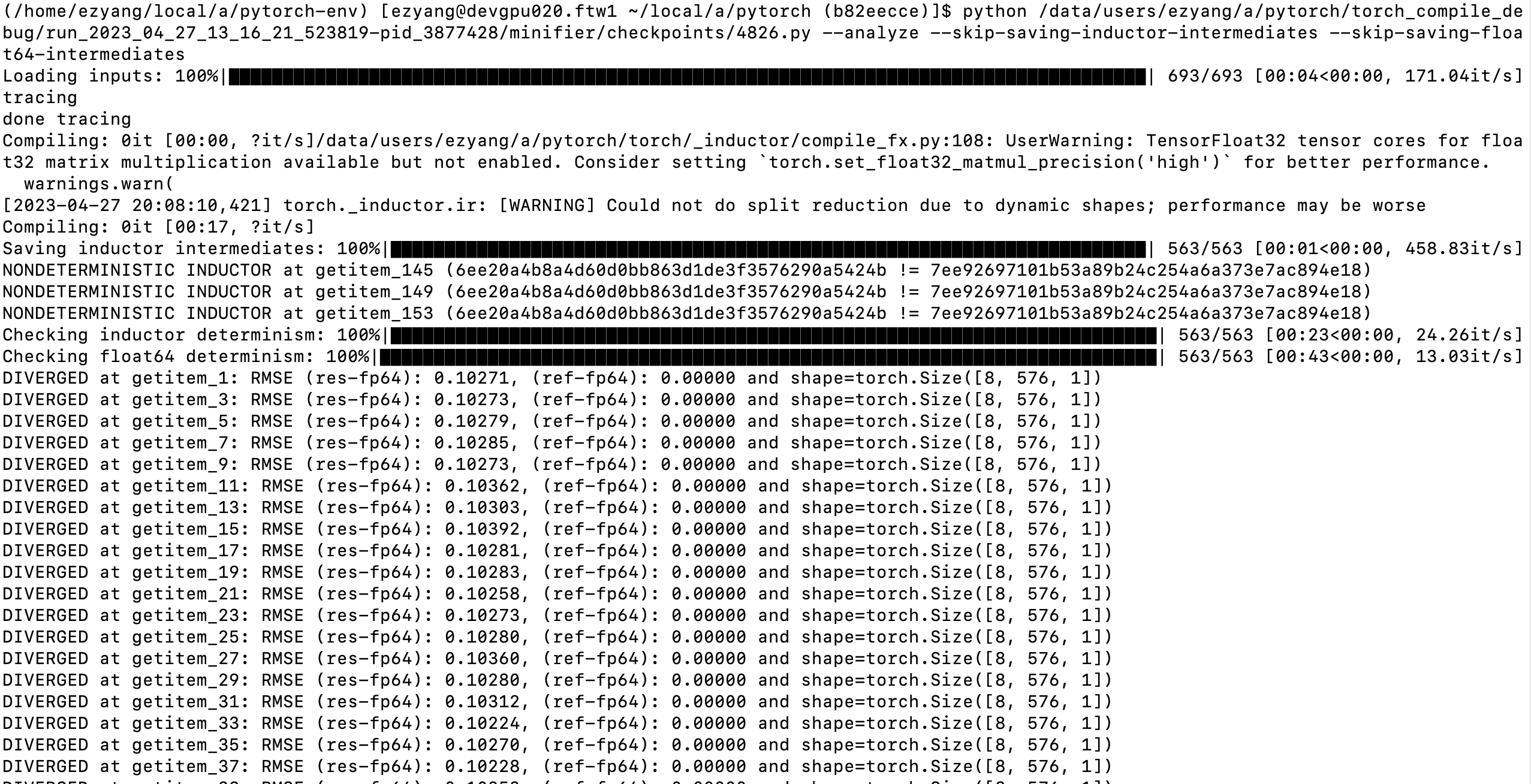
The second part of this is an implementation of `analyze` subcommand on the new CLI for any repro.

<img width="1277" alt="image" src="https://user-images.githubusercontent.com/13564/235045677-8545aab7-5e83-4813-bbec-47783dc60122.png">

This facility is oriented towards accuracy debugging. It does several things:

1. It will run your model twice and check for nondeterminism in inductor/float64, *even* on intermediate inputs (our benchmarking nondeterminism test only checks for nondeterminism on the final output). This makes localizing which operator is nondeterministic easy.
2. It will run your compiled model side-by-side with eager and float64 variants, and then report when things diverge too far from RMSE delta from float64.

Importantly, it does all this without requiring every intermediate to be held in memory (which will cause an OOM on large repros, such as the one I tested this on.)

Some other minor improvements:

* MinifierTestBase now has an easy to comment out spot that you can use to retain the temporary directory; good for debugging
* We print "running minifier" and "running repro" in MinifierTestBase to make it easier to orient where logs are coming from
* same takes a `log_error` optional argument which you can use to reroute the error logs when things mismatch
* counters["inductor"]["intermediate_hooks"] tracks the number of intermediate hooks we've codegen'ed; good for populate the tqdm interface
* torch.fx.interpreter gets an official `boxed_run` interface which uses the boxed arguments calling convention and doesn't retain inputs unnecessarily long
* torch.utils._content_store gets compute_tensor_metadata/read_tensor_metadata helper functions for computing tensor information without serializing it

Signed-off-by: Edward Z. Yang <ezyang@meta.com>

Pull Request resolved: https://github.com/pytorch/pytorch/pull/100226
Approved by: https://github.com/bertmaher, https://github.com/bdhirsh, https://github.com/anijain2305
Currently, we track 'origins' on IR nodes so that we have some idea about what FX IR nodes contributed to any given fused kernel. However, the origins are dumped into an undifferentiated set, so if you have, e.g., multiple outputs, you cannot easily tell which output corresponds to which FX node.

This PR introduce a more precise notion of tracking "origin_node" which says that the contents of this Buffer/Loop node corresponds EXACTLY to the output of a particular FX node; e.g., if you serialized each intermediate when running the generated inductor code, you could compare them with the corresponding intermediates from the original FX graph.

Tracking origin_node in all cases requires quite a bit of effort, so this PR introduces the tracking on a strictly best effort basis. The logic in torch/_inductor/graph.py sets up the associations, but only when it is "obvious" which IR node should get the assignment, and there is work in torch/_inductor/ir.py for propagating this information around as necessary. Like origins, origin_node is not a true dataclass field (as this would break all existing positional arg call sites), instead, it is added post facto via `__post_init__`. At the moment, it is only valid for Buffer/Loop to have an origin_node, but we could imagine relaxing this in the future.

The payoff is in torch/_inductor/codegen/wrapper.py and torch/_inductor/codegen/triton.py where we currently just print the FX node name and the tensor (but a more useful integration will be coming later.)

I also introduce a debugging tool `debug_ir_traceback` which tracks tracebacks of where IRNodes were allocated, to help you understand why a node doesn't have an `origin_node`.

Signed-off-by: Edward Z. Yang <ezyang@meta.com>

Pull Request resolved: https://github.com/pytorch/pytorch/pull/100110
Approved by: https://github.com/voznesenskym