This branch:
1) converts the autograd tape into an FX graph
2) caches that conversion using a "shadow" graph
3) compiles and runs the generated FX graph instead of the normal autograd

What works currently:
1) Caching, capture, and initial integration
2) Backwards hooks
3) Inlining AotAutograd generated subgraphs
4) torch.compiling the generated FX graph
5) Auto-detecting dynamic shapes based on changes

Future work
1) Larger scale testing
1) Boxed calling convention, so memory can be freed incrementally
1) Support hooks on SavedTensor
1) Additional testing by running eager autograd tests under compiled_autograd.enable()

Pull Request resolved: https://github.com/pytorch/pytorch/pull/103822
Approved by: https://github.com/ezyang, https://github.com/albanD
This PR introduces some modifications:
1. We find out some const function parameters that can be passed by reference and add the reference.
2. We find more opportunists of passing by value and change them accordingly.
3. Some use-after-move errors are fixed.

Pull Request resolved: https://github.com/pytorch/pytorch/pull/95942
Approved by: https://github.com/Skylion007
Not only is this change usually shorter and more readable, it also can yield better performance. size() is not always a constant time operation (such as on LinkedLists), but empty() always is.

Pull Request resolved: https://github.com/pytorch/pytorch/pull/93236
Approved by: https://github.com/malfet
How the old retains_grad hooks was implemented:
- retains_grad hooks are stored on the autograd_meta, as entries in a vector
- upon registration, a wrapper hook CppFunctionTensorPreHook is created to wrap that vector, and then that wrapper hook is registered to the grad_fn, i.e., by appending it to a vector of retains_grad hooks on the grad_fn
- upon in-place, for the old grad_fn we set the retains_grad hook to nullptr, so that even though the old grad_fn still references the vector, the vector contains a single nullptr. For the new grad_fn, we create a new wrapper hook around the vector (storing the single retains_grad hook) on autograd_meta.

The new retains_grad hook implementation:
- we store std::function by value, and we store it on the grad_fn rather than the autograd_meta
- a single grad_fn can have multiple outputs, so it can potentially hold multiple retains_grad hooks. We use an unordered_map (previously a vector).
- on in-place we remove the hook from the old grad_fn and put it in the new grad_fn (small implication of this change is that  we we now need to have access to both the old grad_fn and new grad_fn, this isn't a problem)

Other details:
- CppFunctionTensorPreHook took a shared_ptr to vector of std::function. In our new implementation, we add a new wrapper hook CppFunctionSingleTensorPreHook, which takes a single std::function.

Pull Request resolved: https://github.com/pytorch/pytorch/pull/92604
Approved by: https://github.com/albanD
This reverts commit e525f433e1.

Original PR:  #85849
Fixes #ISSUE_NUMBER

In addition to reverting the revert, this PR:
- defines the virtual destructor of FunctionPreHook in the header. Why? Presumably the internal build imports the header from somewhere, but does not have function_hooks.cpp (where the virtual destructor was previously defined) in the same compilation unit.

Pull Request resolved: https://github.com/pytorch/pytorch/pull/92559
Approved by: https://github.com/albanD
Addresses: https://github.com/pytorch/pytorch/issues/35802

Design doc: https://docs.google.com/document/d/19xSib7FFknRQ5f3ptGFUmiOt3BrgXSUlTQH2xMcZJYg/edit#

### Changes in this PR

#### Implementation
- We have now have 3 fields: pre_hooks, retains_grad_hooks, and tensor_pre_hooks so that we can more precisely define their ordering and when they are executed.
- Since retains grad uses an entirely new field, we cannot reuse the old retains grad, logic. We refactor retains grad to call directly into the variable.cpp logic. Other logic in variable.cpp that handle cpp hooks must also be updated.

#### Hooks ordering and execution:
- Defines pre-hooks registered on tensor to run before pre-hooks registered on grad_fn
- Updates pre-hooks registered on tensor to always run, even if they are the inputs= to .grad()
- Post hooks (and pre hooks) can now observe the modifications to gradient by the tensor pre hook

#### Retains grad hooks
- retains grad hooks always execute last, even if there are other tensor pre-hooks registered

#### Unchanged:
- pre_hooks registered to grad_fn aren't expected to execute if they are the inputs= to .grad()

Follow ups:
- simplify retains_grad field to not be a vector, since it always holds a single hook
- potentially merge capture hooks with tensor pre hooks, this would involve some additional refactoring since
- python hooks registered to tensor behavior on in-place is still wrong

Pull Request resolved: https://github.com/pytorch/pytorch/pull/85849
Approved by: https://github.com/albanD
CUDA 12 introduces behavioral changes in `cudaSetDevice`. In the old version it would just set the device to be used for kernel launches and memory allocations without creating a CUDA context. Now, in CUDA 12, every time `cudaSetDevice` is called for the first time it creates a CUDA context. See issue #91122.
The autograd engine iterates over all devices and sets them:
f8b348c1fc/torch/csrc/autograd/engine.cpp (L1399-L1402)f8b348c1fc/torch/csrc/autograd/engine.cpp (L349)
Which causes pollution of CUDA contexts on sibling devices.
This PR introduces a workaround this issue by conditionally setting the device.
Pull Request resolved: https://github.com/pytorch/pytorch/pull/91191
Approved by: https://github.com/ngimel
Not sure, what I was thinking when writing something like:
```
auto foo = std::getenv("BAR");
if (!foo) {
   foo = "baz";
}
```
as `std::getenv` return `char *` (i.e. mutable string), but string literals are immutable. (i.e. `const char *`)

Pull Request resolved: https://github.com/pytorch/pytorch/pull/87949
Approved by: https://github.com/kit1980
In this PR:
- graph_task stores graph roots on construction so that we can later traverse through the graph
- before the nodes are returned, they needed to be converted from raw_ptr to shared_ptr, and this should be OK because the graph is guaranteed to be alive

Pull Request resolved: https://github.com/pytorch/pytorch/pull/87507
Approved by: https://github.com/albanD
Addresses: https://github.com/pytorch/pytorch/issues/83617

This PR a way to query the TLS graph task's exec_info which is a map mapping the Node to a bool indicating whether it will be executed in the current backward pass (as determined by the inputs= argument for .grad of .backward).
- this works with both custom Function nodes and normal codegened nodes
-  to be able to verify whether the pyobject passed is an actual node, we now store pointers to PyTypeObjects into a set on registration.
- error out when .backward without inputs= to avoid silently returning True

Alternatives:
- not sure if it is possible to bind to Python from a raw pointer to Node. At least we wouldn't be able to use existing logic, and the Python object should only hold a weak reference to the Node.
- other solutions to the motivating issue seem to require more extensive modification to the engine

See the issue linked for an example of usage
Pull Request resolved: https://github.com/pytorch/pytorch/pull/84773
Approved by: https://github.com/albanD
### Introduction
<!-- What did you change and why was it needed? -->

Removing unnecessary weight gradient calculation is very important for applications that need high-order derivatives during training. However, this is not supported by the current Autograd engine.

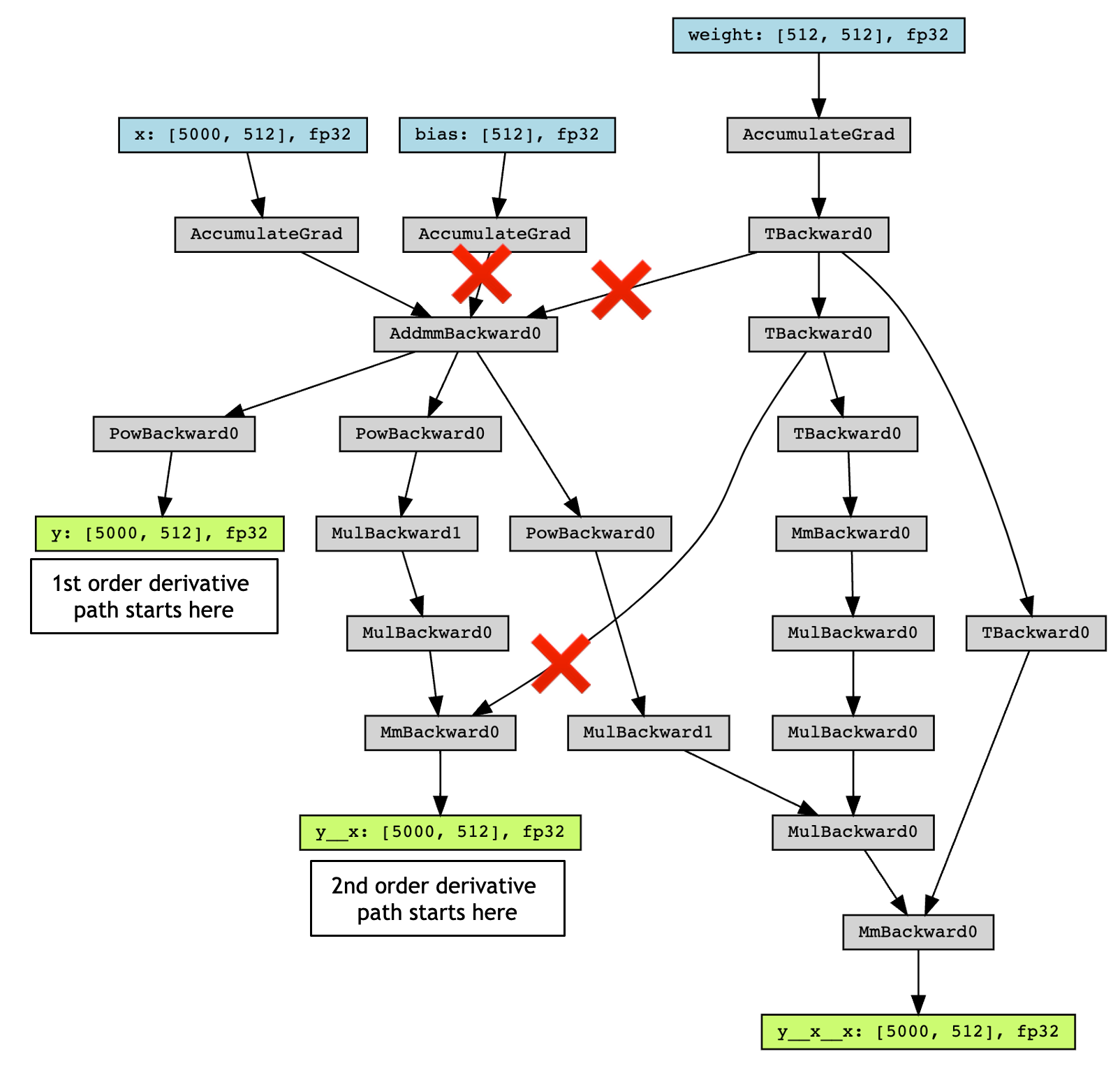
For more detail: The backward function of a `matmul` operator (e.g., `linear` `addmm` `mm`), has two matmuls, one for `input gradient` and another for `weight gradient`. For a typical neural network (nn) with a few linear layers and activation functions, if the user calls `torch.autograd.grad()` to calculate the derivative of the nn output `y` w.r.t the nn input `x`,  only the `input gradient` of the `matmul` operator is needed, and the `weight gradient` is discarded. However, the current PyTorch autograd engine will always calculate the `weight gradient` if `weight` requires gradient (the calculation of the high-order derivative is performed during training).

The figure attached shows the autograd graph of the following code snippet:
```py
y = torch.nn.functional.linear(x, weight, bias)
y = y.pow(2)
# first order derivative
y__x, = torch.autograd.grad(y, x, grad_outputs=grad_outputs, create_graph=True)
# first order derivative
y__x__x, = torch.autograd.grad(y__x, x, grad_outputs=grad_outputs, create_graph=True)
```
The path with ❌ is not needed when calculating derivatives.

<img width="50%" alt="image" src="https://user-images.githubusercontent.com/9999318/182018117-719c5a23-bcc6-4a63-8e8d-1bca3ebda2e3.png">

### Issue
<!-- Link to Issue ticket or RFP -->
Related issue: https://github.com/pytorch/pytorch/issues/56500

### Method
When calling `torch.autograd.grad`, `exec_info_` is created for each GraphTask, which allows filtering paths on the graph that are not needed. However, when the GraphTask calls into the node, the node still does not know whether the edges are needed or not. In the case of matmul, `weight.requires_grad is True` so the weight gradient is always calculated.

Following https://github.com/pytorch/pytorch/issues/56500#issuecomment-825694656, this PR passes the graph task's thread_local `exec_info_` into the node, so it could trim unnecessary edges during `torch.autograd.grad` calls.

### Benchmark
Benchmark script: https://gist.github.com/yueyericardo/24158433a2021c51eeef9c3e2722df99

Benchmark result:
6 hidden layers, batch size 10000, on A100

FP32 result
| hessian benchmark             | FP32 (before) | FP32 (After)      | FP32 (Functorch v0.1.1) |
| ----------------------------- | ------------- | ----------------- | ----------------------- |
| Linear + ReLU (no backward)   | 55.658 ms     | 29.392 ms (1.90X) | 29.547 ms (1.90X)       |
| Linear + ReLU (with backward) | 81.173 ms     | 54.917 ms (1.47X) | 68.988 ms (1.18X)       |

TF32 result
| hessian benchmark             | TF32 (before) | TF32 (after)      | TF32 (Functorch v0.1.1) |
| ----------------------------- | ------------- | ----------------- | ----------------------- |
| Linear + ReLU (no backward)   | 19.801 ms     | 11.259 ms (1.76X) | 10.754 ms (1.84X)       |
| Linear + ReLU (with backward) | 29.167 ms     | 20.466 ms (1.42X) | 22.784 ms (1.28X)       |

For FP32 result, we could get 1.9X speed up for hessian calculation, and 1.47X speed up during training, which is even faster than functorch `vmap(jacfwd(jacrev` implementation. (functorch has performance regression on v0.2.0, https://github.com/pytorch/functorch/issues/989, so we are using v0.1.1 for benchmark)

@zou3519 does functorch also includes similar optimizations during hessian calculation? If not, what do we need to do so the functorch could also benefit from this PR?

### Testing
<!-- How did you test your change? -->

- [x] we need to figure out a way for unittest

### Thanks
Thanks for the great blog: [How Computational Graphs are Executed in PyTorch | PyTorch](https://pytorch.org/blog/how-computational-graphs-are-executed-in-pytorch/)

cc @zasdfgbnm @albanD
Pull Request resolved: https://github.com/pytorch/pytorch/pull/82544
Approved by: https://github.com/soulitzer
In preparation of adopting future rocblas library options, it is necessary to track when the backward pass of training is executing.  The scope-based helper class `BackwardPassGuard` is provided to toggle state.
Pull Request resolved: https://github.com/pytorch/pytorch/pull/71881
Approved by: https://github.com/albanD
Summary:
Pull Request resolved: https://github.com/pytorch/pytorch/pull/76366

caffe2 is not currently being built for XROS.

Test Plan: CI

Reviewed By: kimishpatel

Differential Revision: D35923922

fbshipit-source-id: 260dacadf0bd5b6bab7833a4ce81e896d280b053
(cherry picked from commit 8370b8dd2519d55a79fa8d45e7951ca8dc0b21a8)
This pull request enables accumulating gradients for the CSR tensor.
Functions that work and are tested:
- tensor.abs()
- tensor.neg()
- tensor.conj_physical()
- torch.addmm

`torch.mm` also works, but tests will be added later.

In addition, this PR adds throwing an error when trying to access strides, storage, and contiguity info on a CSR tensor.

`tensor.to_sparse_csr().to_sparse_csr()` was failing and now fixed.
Pull Request resolved: https://github.com/pytorch/pytorch/pull/75435
Approved by: https://github.com/cpuhrsch
Summary:
Pull Request resolved: https://github.com/pytorch/pytorch/pull/72689

Fix https://github.com/pytorch/pytorch/issues/69839

Should we add a private python binding to check if the bad fork guard has been set and add test in CI to make sure that it is never set on our CPU-only CI build? Not sure how flaky that will be out of CI for people that run CPU build on a machine that cuda installed...
EDIT: turns out, we already had such tests in test_multiprocessing. So should be tested and enforced now!

Test Plan: Imported from OSS

Reviewed By: soulitzer

Differential Revision: D34180243

Pulled By: albanD

fbshipit-source-id: 3284db52dcf4568362244b60e3c5657153e64fa4
(cherry picked from commit 6e23f7a33a)
Summary:
Pull Request resolved: https://github.com/pytorch/pytorch/pull/72688

Refactor how we know what to run on the cpu queue.
The Lazy Tensor moved there as it is always present as a device guard and would make the number of devices 1 all the time (forcing the creation of a thread).

FYI wconstab  you most likely don't care about this unless you ever use multiple Lazy device?
This should slightly improve the perf if you run backward with Lazy Tensors as the work will be done in the main thread and not a worker thread.

Test Plan: Imported from OSS

Reviewed By: soulitzer

Differential Revision: D34180245

Pulled By: albanD

fbshipit-source-id: 88c5d5bdd631ad01bf271d720d1eab69aba84fc0
(cherry picked from commit da7e9b902f)
Summary:
Pull Request resolved: https://github.com/pytorch/pytorch/pull/72687

Not sure who would use that. It is not used in the code base as far as I can see. And I don't know of anyone working with the engine directly out of tree. So tentatively removing it.

Test Plan: Imported from OSS

Reviewed By: soulitzer

Differential Revision: D34180244

Pulled By: albanD

fbshipit-source-id: 678ba1c4a1cbd9a0458d33be97664d1e3d1bd86b
(cherry picked from commit 3968ca3a38)
Summary:
As issue https://github.com/pytorch/pytorch/issues/59750 is fixed, this PR is to remove the workaround implemented for it on ROCm.

Enabled hasPrimaryContext() related PyTorch unit tests on ROCm.

cc: amathews-amd, jithunnair-amd

cc jeffdaily sunway513 jithunnair-amd ROCmSupport KyleCZH

Pull Request resolved: https://github.com/pytorch/pytorch/pull/71146

Reviewed By: anjali411

Differential Revision: D33754615

Pulled By: albanD

fbshipit-source-id: b3a5c65a20c6d52d5f2ffc9e6f9628c819329b5d
(cherry picked from commit cfdd12166c)
Summary:
Pull Request resolved: https://github.com/pytorch/pytorch/pull/69041

`TH_CONCAT_{N}` is still being used by THP so I've moved that into
it's own header but all the compiled code is gone.

Test Plan: Imported from OSS

Reviewed By: anjali411

Differential Revision: D32872477

Pulled By: ngimel

fbshipit-source-id: 06c82d8f96dbcee0715be407c61dfc7d7e8be47a
Summary:
Pull Request resolved: https://github.com/pytorch/pytorch/pull/68266
* Use `if...endif` to adjust pyTorch internals towards XROS

Test Plan: CI

Reviewed By: kkosik20

Differential Revision: D32190771

fbshipit-source-id: cce073dea53c2b5681d913321101cd83c6472019