This PR is the first step towards refactors the build for nvfuser in order to have the coegen being a standalone library.

Contents inside this PR:
1. nvfuser code base has been moved to `./nvfuser`, from `./torch/csrc/jit/codegen/cuda/`, except for registration code for integration (interface.h/interface.cpp)
2. splits the build system so nvfuser is generating its own `.so` files. Currently there are:
    - `libnvfuser_codegen.so`, which contains the integration, codegen and runtime system of nvfuser
    - `nvfuser.so`, which is nvfuser's python API via pybind. Python frontend is now exposed via `nvfuser._C.XXX` instead of `torch._C._nvfuser`
3. nvfuser cpp tests is currently being compiled into `nvfuser_tests`
4. cmake is refactored so that:
    - nvfuser now has its own `CMakeLists.txt`, which is under `torch/csrc/jit/codegen/cuda/`.
    - nvfuser backend code is not compiled inside `libtorch_cuda_xxx` any more
    - nvfuser is added as a subdirectory under `./CMakeLists.txt` at the very end after torch is built.
    - since nvfuser has dependency on torch, the registration of nvfuser at runtime is done via dlopen (`at::DynamicLibrary`). This avoids circular dependency in cmake, which will be a nightmare to handle. For details, look at `torch/csrc/jit/codegen/cuda/interface.cpp::LoadingNvfuserLibrary`

Future work that's scoped in following PR:
- Currently since nvfuser codegen has dependency on torch, we need to refactor that out so we can move nvfuser into a submodule and not rely on dlopen to load the library. @malfet
- Since we moved nvfuser into a cmake build, we effectively disabled bazel build for nvfuser. This could impact internal workload at Meta, so we need to put support back. cc'ing @vors

Pull Request resolved: https://github.com/pytorch/pytorch/pull/89621
Approved by: https://github.com/davidberard98
Attempts to fix#92656
BC-breaking! This changes the default of zero_grad in optim and in nn to default set grads to None instead of zero tensors. We are changing the default because there are proven perf wins and existing code has typically not regressed due to this change. (will probably have to flesh out this note more).
Pull Request resolved: https://github.com/pytorch/pytorch/pull/92731
Approved by: https://github.com/ngimel
We have known for a while that we should in principle support SymBool as a separate concept from SymInt and SymFloat ( in particular, every distinct numeric type should get its own API). However, recent work with unbacked SymInts in, e.g., https://github.com/pytorch/pytorch/pull/90985 have made this a priority to implement. The essential problem is that our logic for computing the contiguity of tensors performs branches on the passed in input sizes, and this causes us to require guards when constructing tensors from unbacked SymInts. Morally, this should not be a big deal because, we only really care about the regular (non-channels-last) contiguity of the tensor, which should be guaranteed since most people aren't calling `empty_strided` on the tensor, however, because we store a bool (not a SymBool, prior to this PR it doesn't exist) on TensorImpl, we are forced to *immediately* compute these values, even if the value ends up not being used at all. In particular, even when a user allocates a contiguous tensor, we still must compute channels-last contiguity (as some contiguous tensors are also channels-last contiguous, but others are not.)

This PR implements SymBool, and makes TensorImpl use SymBool to store the contiguity information in ExtraMeta. There are a number of knock on effects, which I now discuss below.

* I introduce a new C++ type SymBool, analogous to SymInt and SymFloat. This type supports logical and, logical or and logical negation. I support the bitwise operations on this class (but not the conventional logic operators) to make it clear that logical operations on SymBool are NOT short-circuiting. I also, for now, do NOT support implicit conversion of SymBool to bool (creating a guard in this case). This does matter too much in practice, as in this PR I did not modify the equality operations (e.g., `==` on SymInt) to return SymBool, so all preexisting implicit guards did not need to be changed. I also introduced symbolic comparison functions `sym_eq`, etc. on SymInt to make it possible to create SymBool. The current implementation of comparison functions makes it unfortunately easy to accidentally introduce guards when you do not mean to (as both `s0 == s1` and `s0.sym_eq(s1)` are valid spellings of equality operation); in the short term, I intend to prevent excess guarding in this situation by unit testing; in the long term making the equality operators return SymBool is probably the correct fix.
* ~~I modify TensorImpl to store SymBool for the `is_contiguous` fields and friends on `ExtraMeta`. In practice, this essentially meant reverting most of the changes from https://github.com/pytorch/pytorch/pull/85936 . In particular, the fields on ExtraMeta are no longer strongly typed; at the time I was particularly concerned about the giant lambda I was using as the setter getting a desynchronized argument order, but now that I have individual setters for each field the only "big list" of boolean arguments is in the constructor of ExtraMeta, which seems like an acceptable risk. The semantics of TensorImpl are now that we guard only when you actually attempt to access the contiguity of the tensor via, e.g., `is_contiguous`. By in large, the contiguity calculation in the implementations now needs to be duplicated (as the boolean version can short circuit, but the SymBool version cannot); you should carefully review the duplicate new implementations. I typically use the `identity` template to disambiguate which version of the function I need, and rely on overloading to allow for implementation sharing. The changes to the `compute_` functions are particularly interesting; for most of the functions, I preserved their original non-symbolic implementation, and then introduce a new symbolic implementation that is branch-less (making use of our new SymBool operations). However, `compute_non_overlapping_and_dense` is special, see next bullet.~~ This appears to cause performance problems, so I am leaving this to an update PR.
* (Update: the Python side pieces for this are still in this PR, but they are not wired up until later PRs.) While the contiguity calculations are relatively easy to write in a branch-free way, `compute_non_overlapping_and_dense` is not: it involves a sort on the strides. While in principle we can still make it go through by using a data oblivious sorting network, this seems like too much complication for a field that is likely never used (because typically, it will be obvious that a tensor is non overlapping and dense, because the tensor is contiguous.) So we take a different approach: instead of trying to trace through the logic computation of non-overlapping and dense, we instead introduce a new opaque operator IsNonOverlappingAndDenseIndicator which represents all of the compute that would have been done here. This function returns an integer 0 if `is_non_overlapping_and_dense` would have returned `False`, and an integer 1 otherwise, for technical reasons (Sympy does not easily allow defining custom functions that return booleans). The function itself only knows how to evaluate itself if all of its arguments are integers; otherwise it is left unevaluated. This means we can always guard on it (as `size_hint` will always be able to evaluate through it), but otherwise its insides are left a black box. We typically do NOT expect this custom function to show up in actual boolean expressions, because we will typically shortcut it due to the tensor being contiguous. It's possible we should apply this treatment to all of the other `compute_` operations, more investigation necessary. As a technical note, because this operator takes a pair of a list of SymInts, we need to support converting `ArrayRef<SymNode>` to Python, and I also unpack the pair of lists into a single list because I don't know if Sympy operations can actually validly take lists of Sympy expressions as inputs. See for example `_make_node_sizes_strides`
* On the Python side, we also introduce a SymBool class, and update SymNode to track bool as a valid pytype. There is some subtlety here: bool is a subclass of int, so one has to be careful about `isinstance` checks (in fact, in most cases I replaced `isinstance(x, int)` with `type(x) is int` for expressly this reason.) Additionally, unlike, C++, I do NOT define bitwise inverse on SymBool, because it does not do the correct thing when run on booleans, e.g., `~True` is `-2`. (For that matter, they don't do the right thing in C++ either, but at least in principle the compiler can warn you about it with `-Wbool-operation`, and so the rule is simple in C++; only use logical operations if the types are statically known to be SymBool). Alas, logical negation is not overrideable, so we have to introduce `sym_not` which must be used in place of `not` whenever a SymBool can turn up. To avoid confusion with `__not__` which may imply that `operators.__not__` might be acceptable to use (it isn't), our magic method is called `__sym_not__`. The other bitwise operators `&` and `|` do the right thing with booleans and are acceptable to use.
* There is some annoyance working with booleans in Sympy. Unlike int and float, booleans live in their own algebra and they support less operations than regular numbers. In particular, `sympy.expand` does not work on them. To get around this, I introduce `safe_expand` which only calls expand on operations which are known to be expandable.

TODO: this PR appears to greatly regress performance of symbolic reasoning. In particular, `python test/functorch/test_aotdispatch.py -k max_pool2d` performs really poorly with these changes. Need to investigate.

Signed-off-by: Edward Z. Yang <ezyang@meta.com>
Pull Request resolved: https://github.com/pytorch/pytorch/pull/92149
Approved by: https://github.com/albanD, https://github.com/Skylion007
Summary: There was a patch to not raise SOFT_ASSERT in debug builds. Update this test to match it.

Test Plan: This test passes after this patch.

Differential Revision: D42270123

Pulled By: aaronenyeshi

Pull Request resolved: https://github.com/pytorch/pytorch/pull/91464
Approved by: https://github.com/robieta
This function is an auxiliary function for `torch.norm`. This particular
overload was not even used or tested. I hope it's not used internally
either. If it is, we can simply drop this PR

Pull Request resolved: https://github.com/pytorch/pytorch/pull/81762
Approved by: https://github.com/ngimel
@bypass-github-export-checks

This change ensures that vulkan event start/end times are correctly synced with their parent CPU times.

This sometimes requires increasing CPU event durations (to fully contain their child events) and delaying CPU event start times (to prevent overlaps), so this should not be used unless Vulkan events are being profiled and it is ok to use this modified timestamp/duration information instead of the the original information.

Differential Revision: [D39893109](https://our.internmc.facebook.com/intern/diff/D39893109/)

**NOTE FOR REVIEWERS**: This PR has internal Meta-specific changes or comments, please review them on [Phabricator](https://our.internmc.facebook.com/intern/diff/D39893109/)!
Pull Request resolved: https://github.com/pytorch/pytorch/pull/90672
Approved by: https://github.com/kimishpatel
Summary:
Pull Request resolved: https://github.com/pytorch/pytorch/pull/88330

### Implementation
Move backend-specific (NCCL, Gloo, etc) collective implementations to corresponding `Backend` class. Update ProcessGroup to support multiple backends and use dispatcher to calls backends based on tensor device type.

### Changes

#### c++ changes (ProcessGroup files, `Ops.cpp`, `init.cpp`)
- Update pybind definitions for new process group base class and new backend class
- Update pybinded backend class with collective definitions to keep BC with Python PG instances (e.g. `dist.ProcessGroupGloo`, `dist.ProcessGroupNCCL`) which are used in tests
- Switch `ProcessGroupGloo`, `ProcessGroupNCCL`, `ProcessGroupMPI`, `ProcessGroupUCC` to derive from the `Backend` class.
- Update CPU/CUDA `Ops.cpp` and `OpsImpl.cpp` to perform this dispatching by querying the backend using the device type
- Update internal dispatched implementation of `barrier` to use a tensor which allows operation to be dispatched.
- Update `allgather` collective to use `TensorList`. For some reason it was using the default implementation of `allgather` rather than dispatching it correctly. I still don't understand why and had originally filed an issue in 85122.

#### python changes (`distributed_c10d.py`, test files)
- Add BackendConfig class to specify the default configurations of backends and `get_backend_config()` API
- `get_backend()` deprecation warning
- `init_process_group` how returns a generic `ProcessGroup` object, it contains a list of backends (the ones stated above) which it will dispatch operations to.
- `new_group` updated to return the same as above
- Update `test_c10d_gloo.py`, Update `DistributedDataParallelTest` to use `init_process_group`, Update `ReducerTest`, update `test_broadcast_coalesced_gloo` to move from PG instance and gloo options
- Update `test_c10d_nccl.py`, Update `DistributedDataParallelTest` to use `init_process_group`
- Specific tests updated: `test_Backend_enum_class`

### Changes missing
- lazy initialization of backends
- support parsing of BackendConfig

### open questions
- Pure Python PG extensions (https://github.com/pytorch/pytorch/pull/66338)

# Example

This is a basic script (using 2 backends within a process group)

```python
# python -m torch.distributed.run --nnodes=1 --nproc_per_node=2 basic_scenario.py
import torch.distributed as dist
import torch
import os

if __name__ == "__main__":
    rank = os.environ.get("RANK")
    # initialize with both gloo and nccl
    dist.init_process_group()
    # with gloo
    dist.all_reduce(torch.tensor([1.0]))
    print(f"Rank {rank} finished")
    # with nccl
    dist.all_reduce(torch.tensor([1.0], device=f"cuda:{rank}"))
```

Test Plan: Imported from OSS

Differential Revision: D42069829

Pulled By: H-Huang

Pull Request resolved: https://github.com/pytorch/pytorch/pull/90997
Approved by: https://github.com/awgu, https://github.com/fduwjj
`JIT_LOG` checks if logging was enabled for that particular file and when it isn't it doesn't output anything. Since the test checks for the size of `test_stream` it fails. I believe forcing the file to have logging enabled to see if the stream is being correctly set during test makes no sense so this patches just forcibly outputs and checks if it worked.

Pull Request resolved: https://github.com/pytorch/pytorch/pull/82722
Approved by: https://github.com/davidberard98
Summary:
Since `c10::ArrayRef` now support `c10::ArrayRef<const T>`, let's restore `ComputePostOrder` to accept `const Node*` again, which is more suitable for the context of the given helpers.

Test Plan:
CI.

Pull Request resolved: https://github.com/pytorch/pytorch/pull/88773
Approved by: https://github.com/JackCaoG
Fixes#81690
TODO:
* [x] C++ Unpickler Fix (locally tested pickled in Python and unpickled in C++)
* [x] C++ Pickler Fix (locally tested pickled in C++ and unpickled in Python)
* [x] Do quant_tensor, sparse_tensor, etc require similar changes? (Sparse and Quant don't need this)
* [x] Add Comments
* [x] How to make sure C++ and Python are in sync? (Functions in `pickler.h` help in getting and setting Tensor Metadata (math-bits for now) on a tensor. They are the only place which should handle this.)
Notes:
Quant Tensor don't support complex dtypes and for float they segfault with `_neg_view` : https://github.com/pytorch/pytorch/issues/88484
Sparse Tensor:
```python
>>> a = torch.tensor([[0, 2.], [3j, 0]]).to_sparse()
>>> a.conj().is_conj()
False
>>> a._neg_view()
Traceback (most recent call last):
File "<stdin>", line 1, in <module>
NotImplementedError: Cannot access storage of SparseTensorImpl
```
Pull Request resolved: https://github.com/pytorch/pytorch/pull/88182
Approved by: https://github.com/ezyang, https://github.com/anjali411
Syncing nvfuser devel branch to upstream master. https://github.com/csarofeen/pytorch/

Codegen changes include:

* codegen improvement:
    i. allow non-root trivial reductions, allow empty/no-op fusion
    ii. fixes vectorization checks and size calculation
    iii. bank conflict handle improvement
    iv. enables transpose scheduler

* misc:
    i. CI tests failure fixes
    ii. cpp tests file clean up
    iii. trivial forwarding supports added in codegen runtime
    iv. added factory methods support in codegen

Commits that's in this PR from the devel branch:

```
7117a7e37ebec372d9e802fdfb8abb7786960f4a patching nvfuser conv cudnn test numerics mismatch (#2048)
65af1a4e7013f070df1ba33701f2d524de79d096 Inserting sync for redundant parallel types is already done at the (#2023)
6ac74d181689c8f135f60bfc1ec139d88941c98c Fix sync map (#2047)
f5bca333355e2c0033523f3402de5b8aac602c00 Bank conflict checker improvements (#2032)
d2ca7e3fd203537946be3f7b435303c60fa7f51e Minor update on cp.async code generation. (#1901)
d36cf61f5570c9c992a748126287c4e7432228e0 Test file cleanup (#2040)
0b8e83f49c2ea9f04a4aad5061c1e7f4268474c6 Allow non-root trivial reductions (#2037)
a2dfe40b27cd3f5c04207596f0a1818fbd5e5439 Fix vectorize size calculation (#2035)
e040676a317fe34ea5875276270c7be88f6eaa56 Use withPredicate to replace setPredicate to maintain Exprs immutable (#2025)
197221b847ad5eb347d7ec1cf2706733aacbf97c removing ci workflow (#2034)
40e2703d00795526e7855860aa00b9ab7160755f Reduction rand like patch (#2031)
bc772661cbdb3b711d8e9854ae9b8b7052e3e4a3 Add utility for checking bank conflict of shared memory (#2029)
ddd1cf7695f3fb172a0e4bcb8e4004573617a037 Add back FusionReductionWithTrivialReduction_CUDA (#2030)
fbd97e5ef15fa0f7573800e6fbb5743463fd9e57 Revert "Cleanup trivial reduction workarounds (#2006)" (#2024)
bca20c1dfb8aa8d881fc7973e7579ce82bc6a894 Cleanup trivial reduction workarounds (#2006)
e4b65850eee1d70084105bb6e1f290651adde23e Trivial forwarding (#1995)
1a0e355b5027ed0df501989194ee8f2be3fdd37a Fix contiguity analysis of predicates to match updated contiguity. (#1991)
a4effa6a5f7066647519dc56e854f4c8a2efd2a7 Enable output allocation cache (#2010)
35440b7953ed8da164a5fb28f87d7fd760ac5e00 Patching bn inference (#2016)
0f9f0b4060dc8ca18dc65779cfd7e0776b6b38e8 Add matmul benchmark (#2007)
45045cd05ea268f510587321dbcc8d7c2977cdab Enable tests previously disabled due to an aliasing bug (#2005)
967aa77d2c8e360c7c01587522eec1c1d377c87e Contiguous indexing for View operations (#1990)
a43cb20f48943595894e345865bc1eabf58a5b48 Make inlining even more modular (#2004)
dc458358c0ac91dfaf4e6655a9b3fc206fc0c897 Test util cleanup (#2003)
3ca21ebe4d213f0070ffdfa4ae5d7f6cb0b8e870 More strict validation (#2000)
a7a7d573310c4707a9f381831d3114210461af01 Fix build problem (#1999)
fc235b064e27921fa9d6dbb9dc7055e5bae1c222 Just fixes comments (#1998)
482386c0509fee6edb2964c5ae72074791f3e43a cleanup (#1997)
4cbe0db6558a82c3097d281eec9c85ad2ea0893a Improve divisible split detection (#1970)
42ccc52bdc18bab0330f4b93ed1399164e2980c9 Minor build fix. (#1996)
fcf8c091f72d46f3055975a35afd06263324ede6 Cleanup of lower_utils.cpp: Isolate out GpuLower usage (#1989)
15f2f6dba8cbf408ec93c344767c1862c30f7ecc Move ConcretizedBroadcastDomains to shared_ptr in GpuLower. (#1988)
8f1c7f52679a3ad6acfd419d28a2f4be4a7d89e2 Minor cleanup lower_unroll.cpp (#1994)
1d9858c80319ca7f0037db7de5f04e47f540d76c Minor cleanup (#1992)
f262d9cab59f41c669f53799c6d4a6b9fc4267eb Add support for uniform RNG (#1986)
eb1dad10c73f855eb1ecb20a8b1f7b6edb0c9ea3 Remove non-const functions, remove GpuLower instance on build, pass in ca_map. (#1987)
634820c5e3586c0fe44132c51179b3155be18072 Add support for some empty fusion (#1981)
eabe8d844ad765ee4973faa4821d451ef71b83c3 Segment self mapping fusions (#1954)
e96aacfd9cf9b3c6d08f120282762489bdf540c8 Enable Transpose operation (#1882)
425dce2777420248e9f08893765b5402644f4161 Add a null scheduler that helps segmenting away no-op schedules (#1835)
306d4a68f127dd1b854b749855e48ba23444ba60 Fix canScheduleCompileTime check of transpose scheduler (#1969)
b1bd32cc1b2ae7bbd44701477bddbcfa6642a9be Minor fix (#1967)
bd93578143c1763c1e00ba613a017f8130a6b989 Enable transpose scheduler (#1927)
b7a206e93b4ac823c791c87f12859cf7af264a4c Move scheduler vectorize utilities into their own file (#1959)
d9420e4ca090489bf210e68e9912bb059b895baf View scheduling (#1928)
c668e13aea0cf21d40f95b48e0163b812712cdf2 Upstream push ci fixes (#1965)
c40202bb40ce955955bb97b12762ef3b6b612997 Fix dump effective bandwidth (#1962)
93505bcbb90a7849bd67090fe5708d867e8909e4 WAR on index mapping when exact and permissive maps differ (#1960)
45e95fd1d3c773ee9b2a21d79624c279d269da9f Allow splitting inner-most ID to create virtual innermost ID in transpose scheduler (#1930)
a3ecb339442131f87842eb56955e4f17c544e99f Improve the comments at the beginning of index_compute.h (#1946)
f7bc3417cc2923a635042cc6cc361b2f344248d6 Remove unused variables (#1955)
df3393adbb5cb0309d091f358cfa98706bd4d313 Some cleanup (#1957)
7d1d7c8724ab5a226fad0f5a80feeac04975a496 TVDomainGuard factory (#1953)
357ba224c0fb41ed3e4e8594d95599c973f4a0ca Fill allocation with nan on tests (#1956)
8eafc54685d406f5ac527bcbacc475fda4492d7a Fix detection of unmappable root domains (#1952)
90a51f282601ba8ebd4c84b9334efd7762a234bc Some indexing cleanups, Add eye support (#1940)
ddc01e4e16428aec92f9c84d698f959b6436a971 Exclude unsupported data types (#1951)
992e17c0688fe690c51b50e81a75803621b7e6aa test the groups the same order as they are merged (#1949)
208262b75d1fed0597a0329d61d57bc8bcd7ff14 Move detection of self mapping IDs to IterDomainGraph from (#1941)
ac4de38c6ee53b366e85fdfe408c3642d32b57df Merge pull request #1945 from csarofeen/master_merge_0828
631094891a96f715d8c9925fb73d41013ca7f2e3 Add full, full_like, zeros, zeros_like, ones, ones_like (#1943)
aab10bce4541204c46b91ff0f0ed9878aec1bfc4 Merge remote-tracking branch 'upstream/viable/strict' into HEAD
4c254c063bb55887b45677e3812357556a7aa80d Fix arange when step is negative (#1942)
89330aa23aa804340b2406ab58899d816e3dc3d2 Tensor factories must set the output shape as its input (#1939)
```

RUN_TORCHBENCH: nvfuser

Differential Revision: [D40869846](https://our.internmc.facebook.com/intern/diff/D40869846)
Pull Request resolved: https://github.com/pytorch/pytorch/pull/87779
Approved by: https://github.com/davidberard98
This refactor was prompted by challenges handling mixed int/float
operations in C++.  A previous version of this patch
added overloads for each permutation of int/float and was unwieldy
https://github.com/pytorch/pytorch/pull/87722/  This PR takes a different
approach.

The general outline of the patch is to combine the C++ types SymIntNode
and SymFloatNode into a single type, SymNode.  This is type erased; we
no longer know statically at C++ if we have an int/float and have to test
it with the is_int()/is_float() virtual methods.  This has a number of
knock on effects.

- We no longer have C++ classes to bind to Python.  Instead, we take an
  entirely new approach to our Python API, where we have a SymInt/SymFloat
  class defined entirely in Python, which hold a SymNode (which corresponds
  to the C++ SymNode).  However, SymNode is not pybind11-bound; instead,
  it lives as-is in Python, and is wrapped into C++ SymNode using PythonSymNode
  when it goes into C++.  This implies a userland rename.

  In principle, it is also possible for the canonical implementation of SymNode
  to be written in C++, and then bound to Python with pybind11 (we have
  this code, although it is commented out.)  However, I did not implement
  this as we currently have no C++ implementations of SymNode.

  Because we do return SymInt/SymFloat from C++ bindings, the C++ binding
  code needs to know how to find these classes.  Currently, this is done
  just by manually importing torch and getting the attributes.

- Because SymInt/SymFloat are easy Python wrappers, __sym_dispatch__ now
  takes SymInt/SymFloat, rather than SymNode, bringing it in line with how
  __torch_dispatch__ works.

Some miscellaneous improvements:

- SymInt now has a constructor that takes SymNode.  Note that this
  constructor is ambiguous if you pass in a subclass of SymNode,
  so an explicit downcast is necessary.  This means toSymFloat/toSymInt
  are no more.  This is a mild optimization as it means rvalue reference
  works automatically.

- We uniformly use the caster for c10::SymInt/SymFloat, rather than
  going the long way via the SymIntNode/SymFloatNode.

- Removed some unnecessary toSymInt/toSymFloat calls in normalize_*
  functions, pretty sure this doesn't do anything.

- guard_int is now a free function, since to guard on an int you cannot
  assume the method exists.  A function can handle both int and SymInt
  inputs.

- We clean up the magic method definition code for SymInt/SymFloat/SymNode.
  ONLY the user classes (SymInt/SymFloat) get magic methods; SymNode gets
  plain methods; this is to help avoid confusion between the two types.

Signed-off-by: Edward Z. Yang <ezyang@fb.com>

cc @jansel @mlazos @soumith @voznesenskym @yanboliang @penguinwu @anijain2305
Pull Request resolved: https://github.com/pytorch/pytorch/pull/87817
Approved by: https://github.com/albanD, https://github.com/anjali411
Summary:
reland after fixing windows build failure for OVR.

Notable change:
```
#if defined(FBCODE_CAFFE2) or defined(FB_XPLAT_BUILD)
```
changed to
```#if defined(FBCODE_CAFFE2) || defined(FB_XPLAT_BUILD)
```
Appearently `-DFB_XPLAT_BUILD` wasn't getting picked up in windows if using `or `to connect

Original commit changeset: 7a31fc4b455f

Original Phabricator Diff: D40198461

Test Plan: waitforsandcastle

Reviewed By: davidberard98, cccclai

Differential Revision: D40290932

Pull Request resolved: https://github.com/pytorch/pytorch/pull/87124
Approved by: https://github.com/gmagogsfm
The symbol seems to conflict under some compiler versions, giving
an error like "relocation refers to global symbol which is defined in a
discarded section".  Simple enough to put it in an anonymous namespace,
so why not.

Signed-off-by: Edward Z. Yang <ezyang@fb.com>
Pull Request resolved: https://github.com/pytorch/pytorch/pull/86092
Approved by: https://github.com/Chillee
Headers under torch/csrc/distributed may be referened with relative path, e.g., "<c10d/...>". However, relative path cannot be gracefully handled by Meta internal build when the NCCL PG is hipified to support AMD/RCCL because the "hipified" header files are generated in other directories. Moreover, using absolute path for header inclusion is the state-of-the-art in most components in Pytorch. Thus, this patch refactors all header paths in torch/csrc/distributed to be absolute.

See D39835774 for more details about Meta internal complication.

**How to test**: commit 9e5d199 removes -I./torch/csrc/distributed in compile options. Thus use it to verify we don't miss any relative path use of torch/csrc/distributed headers.
Pull Request resolved: https://github.com/pytorch/pytorch/pull/85780
Approved by: https://github.com/kumpera, https://github.com/huydhn
Headers under torch/csrc/distributed may be referened with relative path, e.g., "<c10d/...>". However, relative path cannot be gracefully handled by Meta internal build when the NCCL PG is hipified to support AMD/RCCL because the "hipified" header files are generated in other directories. Moreover, using absolute path for header inclusion is the state-of-the-art in most components in Pytorch. Thus, this patch refactors all header paths in torch/csrc/distributed to be absolute.

See D39835774 for more details about Meta internal complication.

**How to test**: commit 9e5d199 removes -I./torch/csrc/distributed in compile options. Thus use it to verify we don't miss any relative path use of torch/csrc/distributed headers.
Pull Request resolved: https://github.com/pytorch/pytorch/pull/85780
Approved by: https://github.com/kumpera
The AMP inserts `_autocast_to_reduced_precision` and `_autocast_to_full_precision` automatically. The aten implementation provides a fast path to bypass the conversion if the tensor data type has been the reduced/full precision. But NNC always does the conversion which could bring >5% E2E performance regression.

This PR is to address the performance issue like aten. We will not pull `_autocast_to_reduced_precision` and `_autocast_to_full_precision` into NNC fusion group and fallback to aten to trigger its fast path if the tensor data type has been the reduced/full precision.

Pull Request resolved: https://github.com/pytorch/pytorch/pull/85140
Approved by: https://github.com/frank-wei
Summary: `IValue::toString()` creates a `new c10::intrusive_ptr` (like `std::shared_ptr`) and `->string()` immediately accesses it, creating an atomic reference increment/decrement. We can skip both of these operations by calling `IValue::toStringRef()`.

Test Plan: CI

Reviewed By: jaybean-dev

Differential Revision: D39605242

Pull Request resolved: https://github.com/pytorch/pytorch/pull/85437
Approved by: https://github.com/jfix71
Syncing nvfuser devel branch to upstream master. https://github.com/csarofeen/pytorch/

Codegen changes include:

- codegen improvement:
i. improved view support on pointwise and transpose scheduler
ii. grouped grid welford added for better outer-norm grid persistence in normalization

- misc:
i. new composite ops added: variance_mean , arange,
ii. fixes misaligned address for transpose scheduler
iii. refactor on separation of compilation API from execution API to prepare us for async compilation
iv. double type support on expression evaluator
v. PYTORCH_NVFUSER_DUMP refactor to save PTX and CUBIN

Commits that's in this PR from the devel branch:
```
89330aa23aa804340b2406ab58899d816e3dc3d2 Tensor factories must set the output shape as its input (#1939)
b2fd01ea9346712c6d6f623ca6addbc4888d008e arange support (#1933)
56c00fd3922dad7dfc57351ad7d780f0f2f8e4ed Double support on all expression evaluators (#1937)
371f28223e57fe3f6b5e50a0a45177e6a5c0785c Improve trivial reduction merge support (#1931)
1d0c26790e5647920b40d419d26815bbe310b3a6 Test `rand` in a fusion with zero tensor input (#1932)
0dab160fb2177d178eef3148c6a529e0855009e9 Fix softmax bwd sizes. (#1890)
ef98f360f6d3e3e1cc662ecb65202d88150f128d Fix a bug (#1936)
63132a0c56508c550084b07fb76a3df865102d00 Propagate permissive mapping information into indexing pass (#1929)
b4ac2c88d78078ee4d8b21c4fc51645b5710a282 Map IterationDomains through view operations. (#1919)
c0a187a7619d7cf9dc920294e15461791e8d6d4d do not use deprecated functions (#1935)
88de85e758c5e4afb7b6e746573c0d9a53b4cea7 Upstream cherry pick fixes 0811 (#1934)
b247dcf7c57dc6ac3f7a799b0a6beb7770536a74 Separate kernel compilation API from kernel execution API (#1914)
b34e3b93ee1a8030730c14af3995dd95665af07d Fix `ir_utils::hasBlockSync` + misc fixes in transpose scheduler (#1924)
14a53e6707f43bf760494c238a46386d69830822 Nullary RNGOp (#1892)
3c3c89e638f5172cafb0761f22bacd1fd695eec3 Misc fixes/tuning for transpose scheduler (#1912)
20cf109c8b44d48f61977e35bae94368985144ac Grouped grid welford (#1921)
6cf7eb024c9e53c358cbe56597e117bad56efefd Transpose scheduler small dim sizes better support (#1910)
9341ea9a5bf42f9b14ccad0c94edbc79fc5bb552 Disabled ViewPersistentShmoo sizes that results in NAN (#1922)
057237f66deeea816bb943d802a97c1b7e4414ab Fix CUDA driver error: misaligned address for transpose scheduler  (#1918)
3fb3d80339e4f794767a53eb8fdd61e64cf404a2 Add variance_mean function using Welford (#1907)
98febf6aa3b8c6fe4fdfb2864cda9e5d30089262 Remove DisableOption::UnrollWithRng (#1913)
ee8ef33a5591b534cf587d347af11e48ba7a15d4 Minor fix for the debug interface of using PTX directly (#1917)
6e8f953351f9dabfd1f991d8431cecb6c2ce684d Add PYTORCH_NVFUSER_DUMP options to save PTX and CUBIN (#1916)
5eefa9a72385f6a4b145680a9dcc52d7e8293763 dopt is only available since nvrtc 11.7 (#1915)
2ec8fc711eafc72451eebf0f5e2a98a38bf3f6ef Kill computeAtBetween (#1911)
d0d106a1d9af118d71673173674e875be35d259d Improve view support on pointwise and transpose scheduler (#1906)
e71e1ecefe67219846070590bbed54bbc7416b79 Fix name clash of RNG with shared memory (#1904)
3381793a253689abf224febc73fd3fe2a0dbc921 Fix mutator and sameAs for expanded IterDomain (#1902)
```

RUN_TORCHBENCH: nvfuser

Differential Revision: [D39324552](https://our.internmc.facebook.com/intern/diff/D39324552)
Pull Request resolved: https://github.com/pytorch/pytorch/pull/84626
Approved by: https://github.com/malfet
Summary: Split `quantized_linear_unpacked_weight_v2` into `linear_prepack` and `quantized_linear` so that the prepacking operation may be eliminated by constant folding.

Test Plan:
Fixes a huge regression in an internal model:

```
Before
        89.6141 ms.    99.0923%. fb::quantized_linear_unpacked_weight_v2 (12 nodes)
After
       0.806852 ms.    53.5365%. quantized::linear (12 nodes, out variant)
(prepacking eliminated)
```

Differential Revision: D39622530

Pull Request resolved: https://github.com/pytorch/pytorch/pull/85289
Approved by: https://github.com/davidberard98
This PR does the following:

- Replaces the `FusionOwner` with a `FusionCache` and `FusionInterface`.  The `FusionCache` is a singleton that contains a cache of Fusions based on the `FusionDefinition`.  It replaces the TorchScript graph caching that looked up a Fusion based on a stringified and canonicalized representation of the TorchScript graph with a prefix tree of statements in the `FusionDefinition`.  The `FusionInterface` is an object that represents a Fusion in python.  It can also query the cache based on id.
- The ability to print out a mechanically derived definition, in python, for the user to use when debugging was added.
- Replaces the python `examples` directory with true python tests under `test/test_nvfuser_frontend.py`.
- Adds a set of C++ tests under the `test` directory to verify the `FusionCache`, `FusionDefinition`, and parts of the `RecordFunctor` child classes.
- Adds a README file to explain how to use the Python Frontend

While there are 3,000+ line edits, the bulk of the changes were repetitive line changes to the python bindings for each operation.

An identical PR to #83267 to avoid tooling issues.
Pull Request resolved: https://github.com/pytorch/pytorch/pull/85045
Approved by: https://github.com/davidberard98
### Changes
- Move ProcessGroup::Work into its own class and update all the references to it / header includes.

#### Motivation
In the future PRs we will repurpose ProcessGroup to instead contain a list of Backends (ProcessGroupNCCL/Gloo/UCC) and perform dispatching to them based on tensor type. This change is prevent a circular dependency with ProcessGroup depending on Backend and Backend depending on ProcessGroup::Work.

Differential Revision: [D38839212](https://our.internmc.facebook.com/intern/diff/D38839212)
Pull Request resolved: https://github.com/pytorch/pytorch/pull/83680
Approved by: https://github.com/kwen2501
This PR does the following:

- Replaces the `FusionOwner` with a `FusionCache` and `FusionInterface`.  The `FusionCache` is a singleton that contains a cache of Fusions based on the `FusionDefinition`.  It replaces the TorchScript graph caching that looked up a Fusion based on a stringified and canonicalized representation of the TorchScript graph with a prefix tree of statements in the `FusionDefinition`.  The `FusionInterface` is an object that represents a Fusion in python.  It can also query the cache based on id.
- The ability to print out a mechanically derived definition, in python, for the user to use when debugging was added.
- Replaces the python `examples` directory with true python tests under `test/test_nvfuser_frontend.py`.
- Adds a set of C++ tests under the `test` directory to verify the `FusionCache`, `FusionDefinition`, and parts of the `RecordFunctor` child classes.
- Adds a README file to explain how to use the Python Frontend

While there are 3,000+ line edits, the bulk of the changes were repetitive line changes to the python bindings for each operation.
Pull Request resolved: https://github.com/pytorch/pytorch/pull/83267
Approved by: https://github.com/jjsjann123, https://github.com/davidberard98
Since we separated at::foo and at::foo_symint there is no benefit
to trying to make initializer lists work in both cases.  So we can
get rid of the special different struct.

Signed-off-by: Edward Z. Yang <ezyang@fb.com>
Pull Request resolved: https://github.com/pytorch/pytorch/pull/84837
Approved by: https://github.com/kit1980
Since we separated at::foo and at::foo_symint there is no benefit
to trying to make initializer lists work in both cases.  So we can
get rid of the special different struct.

Signed-off-by: Edward Z. Yang <ezyang@fb.com>
Pull Request resolved: https://github.com/pytorch/pytorch/pull/84837
Approved by: https://github.com/kit1980
Also Back out "Revert D39075159: [acc_tensor] Use SymIntArrayRef for overloaded empty.memory_format's signature"

Original commit changeset: dab4a9dba4fa
Original commit changeset: dcaf16c037a9

Original Phabricator Diff: D38984222
Original Phabricator Diff: D39075159

Also update Metal registrations for C++ registration changes.

Also update NNPI registration to account for tightened schema checking

Differential Revision: [D39084762](https://our.internmc.facebook.com/intern/diff/D39084762/)

**NOTE FOR REVIEWERS**: This PR has internal Facebook specific changes or comments, please review them on [Phabricator](https://our.internmc.facebook.com/intern/diff/D39084762/)!
Pull Request resolved: https://github.com/pytorch/pytorch/pull/84173
Approved by: https://github.com/Krovatkin
Previously, we introduced new SymInt overloads for every function we wanted.  This led to a lot of boilerplate, and also a lot of confusion about how the overloads needed to be implemented.

This PR takes a simpler but more risky approach: just take the original function and changes its ints to SymInts.

This is BC-breaking in the following ways:

* The C++ API for registering implementations for aten operators will change from int64_t to SymInt whenever you make this change. Code generated registrations in PyTorch do not change as codegen handles the translation automatically, but manual registrations will need to follow the change.  Typically, if you now accept a SymInt where you previously only took int64_t, you have to convert it back manually.  This will definitely break XLA, see companion PR https://github.com/pytorch/xla/pull/3914 Note that not all dispatch keys get the automatic translation; all the composite keys and Meta keys are modified to take SymInt directly (because they should handle them directly), and so there are adjustments for this.

This is not BC-breaking in the following ways:

* The user facing C++ API remains compatible.  Even if a function changes from int to SymInt, the default C++ binding still takes only ints.  (e.g., at::empty(IntArrayRef, ...).  To call with SymInts, you must call at::empty_symint instead. This involved adding two more signatures to CppSignatureGroup; in many cases I refactored code to iterate over all signatures in the group instead of hard-coding the two that previously existed.
* This is TorchScript compatible; internally we treat SymInts as ints so there is no change to what happens at runtime in TorchScript. In particular, it's OK to reference an empty schema by its old type (using int types), as long as you're not doing string equality (which you shouldn't be), these parse to the same underyling type.

Structure of the PR:

* The general strategy of this PR is that, even when you write `SymInt` inside `native_functions.yaml`, sometimes, we will treat it *as if* it were an `int`. This idea pervades the codegen changes, where we have a translation from SymInt to c10::SymInt or int64_t, and this is controlled by a symint kwarg which I added and then audited all call sites to decide which I wanted. Here are some of the major places where we pick one or the other:
  * The C++ FunctionSchema representation represents `SymInt` as `int`. There are a few places we do need to know that we actually have a SymInt and we consult `real_type()` to get the real type in this case. In particular:
    * When we do schema validation of C++ operator registration, we must compare against true schema (as the C++ API will provide `c10::SymInt`, and this will only be accepted if the schema is `SymInt`. This is handled with cloneWithRealTypes before we check for schema differences.
    * In `toIValue` argument parsing, we parse against the true schema value. For backwards compatibility reasons, I do still accept ints in many places where Layout/SymInt/etc were expected. (Well, accepting int where SymInt is expected is not BC, it's just the right logic!)
  * In particular, because SymInt never shows up as type() in FunctionSchema, this means that we no longer need a dedicated Tag::SymInt. This is good, because SymInts never show up in mobile anyway.
* Changes to functorch/aten are mostly about tracking changes to the C++ API registration convention. Additionally, since SymInt overloads no longer exist, registrations for SymInt implementations are deleted. In many cases, the old implementations did not properly support SymInts; I did not add any new functionality with this PR, but I did try to annotate with TODOs where this is work to do. Finally, because the signature of `native::` API changed from int to SymInt, I need to find alternative APIs for people who were directly calling these functions to call. Typically, I insert a new dispatch call when perf doesn't matter, or use `at::compositeexplicitautograd` namespace to handle other caes.
* The change to `make_boxed_from_unboxed_functor.h` is so that we accept a plain IntList IValue anywhere a SymIntList is expected; these are read-only arguments so covariant typing is OK.
* I change how unboxing logic works slightly. Previously, we interpret the C++ type for Layout/etc directly as IntType JIT type, which works well because the incoming IValue is tagged as an integer. Now, we interpret the C++ type for Layout as its true type, e.g., LayoutType (change to `jit_type.h`), but then we accept an int IValue for it anyway. This makes it symmetric with SymInt, where we interpret the C++ type as SymIntType, and then accept SymInt and int IValues for it.
* I renamed the `empty.names` overload to `empty_names` to make it less confusing (I kept mixing it up with the real empty overload)
* I deleted the `empty.SymInt` overload, which ended up killing a pile of functions. (This was originally a separate PR but the profiler expect test was giving me grief so I folded it in.)
* I deleted the LazyDynamicOpsTest tests. These were failing after these changes, and I couldn't figure out why they used to be passing: they make use of `narrow_copy` which didn't actually support SymInts; they were immediately converted to ints.
* I bashed LTC into working. The patches made here are not the end of the story. The big problem is that SymInt translates into Value, but what if you have a list of SymInt? This cannot be conveniently represented in the IR today, since variadic Values are not supported. To work around this, I translate SymInt[] into plain int[] (this is fine for tests because LTC dynamic shapes never actually worked); but this will need to be fixed for proper LTC SymInt support. The LTC codegen also looked somewhat questionable; I added comments based on my code reading.

Signed-off-by: Edward Z. Yang <ezyang@fb.com>
Pull Request resolved: https://github.com/pytorch/pytorch/pull/83628
Approved by: https://github.com/albanD, https://github.com/bdhirsh
Previously, we introduced new SymInt overloads for every function we wanted.  This led to a lot of boilerplate, and also a lot of confusion about how the overloads needed to be implemented.

This PR takes a simpler but more risky approach: just take the original function and changes its ints to SymInts.

This is BC-breaking in the following ways:

* The C++ API for registering implementations for aten operators will change from int64_t to SymInt whenever you make this change. Code generated registrations in PyTorch do not change as codegen handles the translation automatically, but manual registrations will need to follow the change.  Typically, if you now accept a SymInt where you previously only took int64_t, you have to convert it back manually.  This will definitely break XLA, see companion PR https://github.com/pytorch/xla/pull/3914 Note that not all dispatch keys get the automatic translation; all the composite keys and Meta keys are modified to take SymInt directly (because they should handle them directly), and so there are adjustments for this.

This is not BC-breaking in the following ways:

* The user facing C++ API remains compatible.  Even if a function changes from int to SymInt, the default C++ binding still takes only ints.  (e.g., at::empty(IntArrayRef, ...).  To call with SymInts, you must call at::empty_symint instead. This involved adding two more signatures to CppSignatureGroup; in many cases I refactored code to iterate over all signatures in the group instead of hard-coding the two that previously existed.
* This is TorchScript compatible; internally we treat SymInts as ints so there is no change to what happens at runtime in TorchScript. In particular, it's OK to reference an empty schema by its old type (using int types), as long as you're not doing string equality (which you shouldn't be), these parse to the same underyling type.

Structure of the PR:

* The general strategy of this PR is that, even when you write `SymInt` inside `native_functions.yaml`, sometimes, we will treat it *as if* it were an `int`. This idea pervades the codegen changes, where we have a translation from SymInt to c10::SymInt or int64_t, and this is controlled by a symint kwarg which I added and then audited all call sites to decide which I wanted. Here are some of the major places where we pick one or the other:
  * The C++ FunctionSchema representation represents `SymInt` as `int`. There are a few places we do need to know that we actually have a SymInt and we consult `real_type()` to get the real type in this case. In particular:
    * When we do schema validation of C++ operator registration, we must compare against true schema (as the C++ API will provide `c10::SymInt`, and this will only be accepted if the schema is `SymInt`. This is handled with cloneWithRealTypes before we check for schema differences.
    * In `toIValue` argument parsing, we parse against the true schema value. For backwards compatibility reasons, I do still accept ints in many places where Layout/SymInt/etc were expected. (Well, accepting int where SymInt is expected is not BC, it's just the right logic!)
  * In particular, because SymInt never shows up as type() in FunctionSchema, this means that we no longer need a dedicated Tag::SymInt. This is good, because SymInts never show up in mobile anyway.
* Changes to functorch/aten are mostly about tracking changes to the C++ API registration convention. Additionally, since SymInt overloads no longer exist, registrations for SymInt implementations are deleted. In many cases, the old implementations did not properly support SymInts; I did not add any new functionality with this PR, but I did try to annotate with TODOs where this is work to do. Finally, because the signature of `native::` API changed from int to SymInt, I need to find alternative APIs for people who were directly calling these functions to call. Typically, I insert a new dispatch call when perf doesn't matter, or use `at::compositeexplicitautograd` namespace to handle other caes.
* The change to `make_boxed_from_unboxed_functor.h` is so that we accept a plain IntList IValue anywhere a SymIntList is expected; these are read-only arguments so covariant typing is OK.
* I change how unboxing logic works slightly. Previously, we interpret the C++ type for Layout/etc directly as IntType JIT type, which works well because the incoming IValue is tagged as an integer. Now, we interpret the C++ type for Layout as its true type, e.g., LayoutType (change to `jit_type.h`), but then we accept an int IValue for it anyway. This makes it symmetric with SymInt, where we interpret the C++ type as SymIntType, and then accept SymInt and int IValues for it.
* I renamed the `empty.names` overload to `empty_names` to make it less confusing (I kept mixing it up with the real empty overload)
* I deleted the `empty.SymInt` overload, which ended up killing a pile of functions. (This was originally a separate PR but the profiler expect test was giving me grief so I folded it in.)
* I deleted the LazyDynamicOpsTest tests. These were failing after these changes, and I couldn't figure out why they used to be passing: they make use of `narrow_copy` which didn't actually support SymInts; they were immediately converted to ints.
* I bashed LTC into working. The patches made here are not the end of the story. The big problem is that SymInt translates into Value, but what if you have a list of SymInt? This cannot be conveniently represented in the IR today, since variadic Values are not supported. To work around this, I translate SymInt[] into plain int[] (this is fine for tests because LTC dynamic shapes never actually worked); but this will need to be fixed for proper LTC SymInt support. The LTC codegen also looked somewhat questionable; I added comments based on my code reading.

Signed-off-by: Edward Z. Yang <ezyang@fb.com>
Pull Request resolved: https://github.com/pytorch/pytorch/pull/83628
Approved by: https://github.com/albanD, https://github.com/bdhirsh
### Introduction
<!-- What did you change and why was it needed? -->

Removing unnecessary weight gradient calculation is very important for applications that need high-order derivatives during training. However, this is not supported by the current Autograd engine.

For more detail: The backward function of a `matmul` operator (e.g., `linear` `addmm` `mm`), has two matmuls, one for `input gradient` and another for `weight gradient`. For a typical neural network (nn) with a few linear layers and activation functions, if the user calls `torch.autograd.grad()` to calculate the derivative of the nn output `y` w.r.t the nn input `x`,  only the `input gradient` of the `matmul` operator is needed, and the `weight gradient` is discarded. However, the current PyTorch autograd engine will always calculate the `weight gradient` if `weight` requires gradient (the calculation of the high-order derivative is performed during training).

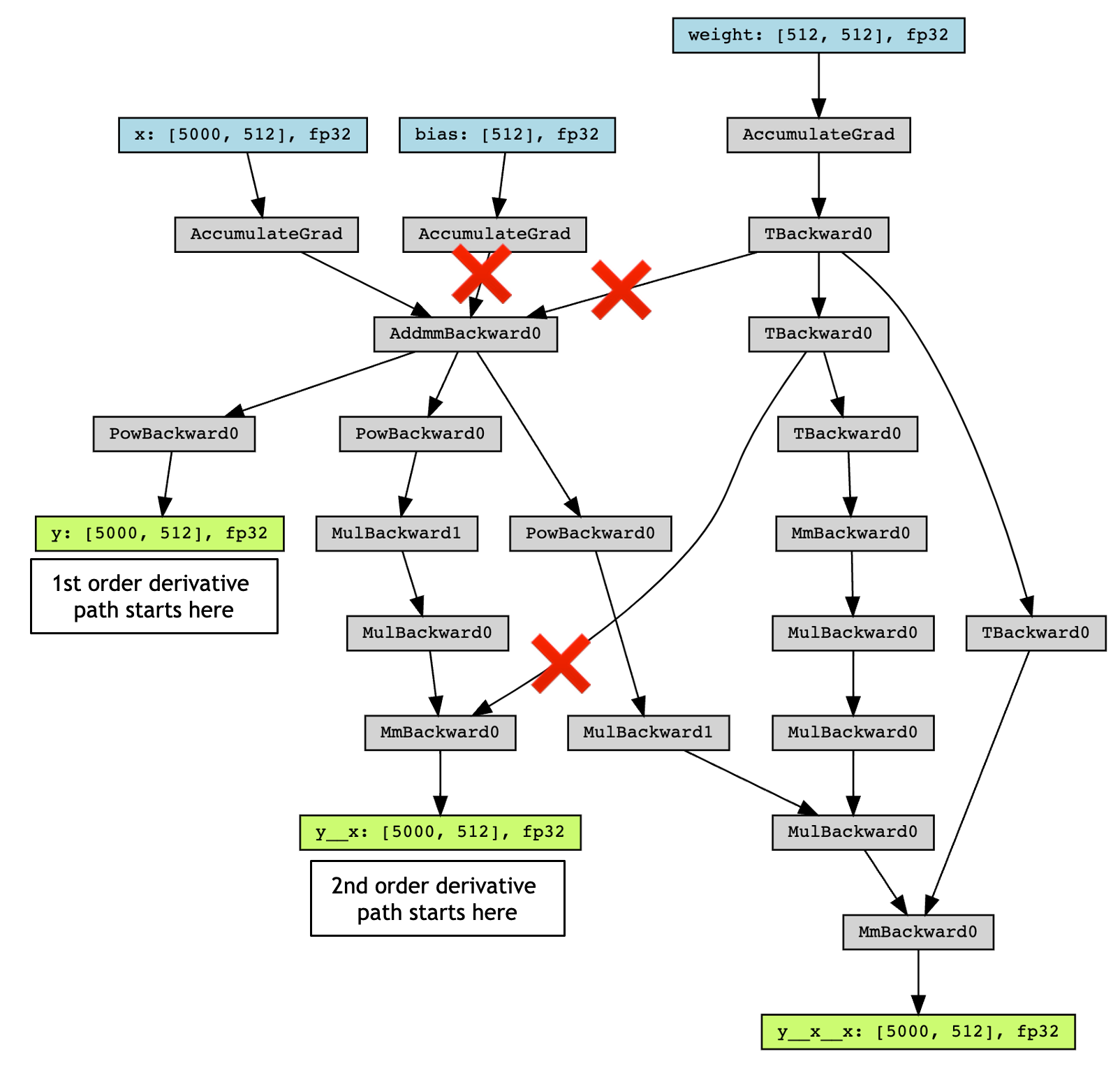
The figure attached shows the autograd graph of the following code snippet:
```py
y = torch.nn.functional.linear(x, weight, bias)
y = y.pow(2)
# first order derivative
y__x, = torch.autograd.grad(y, x, grad_outputs=grad_outputs, create_graph=True)
# first order derivative
y__x__x, = torch.autograd.grad(y__x, x, grad_outputs=grad_outputs, create_graph=True)
```
The path with ❌ is not needed when calculating derivatives.

<img width="50%" alt="image" src="https://user-images.githubusercontent.com/9999318/182018117-719c5a23-bcc6-4a63-8e8d-1bca3ebda2e3.png">

### Issue
<!-- Link to Issue ticket or RFP -->
Related issue: https://github.com/pytorch/pytorch/issues/56500

### Method
When calling `torch.autograd.grad`, `exec_info_` is created for each GraphTask, which allows filtering paths on the graph that are not needed. However, when the GraphTask calls into the node, the node still does not know whether the edges are needed or not. In the case of matmul, `weight.requires_grad is True` so the weight gradient is always calculated.

Following https://github.com/pytorch/pytorch/issues/56500#issuecomment-825694656, this PR passes the graph task's thread_local `exec_info_` into the node, so it could trim unnecessary edges during `torch.autograd.grad` calls.

### Benchmark
Benchmark script: https://gist.github.com/yueyericardo/24158433a2021c51eeef9c3e2722df99

Benchmark result:
6 hidden layers, batch size 10000, on A100

FP32 result
| hessian benchmark             | FP32 (before) | FP32 (After)      | FP32 (Functorch v0.1.1) |
| ----------------------------- | ------------- | ----------------- | ----------------------- |
| Linear + ReLU (no backward)   | 55.658 ms     | 29.392 ms (1.90X) | 29.547 ms (1.90X)       |
| Linear + ReLU (with backward) | 81.173 ms     | 54.917 ms (1.47X) | 68.988 ms (1.18X)       |

TF32 result
| hessian benchmark             | TF32 (before) | TF32 (after)      | TF32 (Functorch v0.1.1) |
| ----------------------------- | ------------- | ----------------- | ----------------------- |
| Linear + ReLU (no backward)   | 19.801 ms     | 11.259 ms (1.76X) | 10.754 ms (1.84X)       |
| Linear + ReLU (with backward) | 29.167 ms     | 20.466 ms (1.42X) | 22.784 ms (1.28X)       |

For FP32 result, we could get 1.9X speed up for hessian calculation, and 1.47X speed up during training, which is even faster than functorch `vmap(jacfwd(jacrev` implementation. (functorch has performance regression on v0.2.0, https://github.com/pytorch/functorch/issues/989, so we are using v0.1.1 for benchmark)

@zou3519 does functorch also includes similar optimizations during hessian calculation? If not, what do we need to do so the functorch could also benefit from this PR?

### Testing
<!-- How did you test your change? -->

- [x] we need to figure out a way for unittest

### Thanks
Thanks for the great blog: [How Computational Graphs are Executed in PyTorch | PyTorch](https://pytorch.org/blog/how-computational-graphs-are-executed-in-pytorch/)

cc @zasdfgbnm @albanD
Pull Request resolved: https://github.com/pytorch/pytorch/pull/82544
Approved by: https://github.com/soulitzer
And use it throughout the CMakeLists and rectify `IF(APPLE)`/`IF(GNU_CXX_VERSION VERSION_GREATER A.B)` and so on

Also, add `target_compile_options_if_supported` and use it in `Dependencies.cmake` as well as in test's `CMakeListst.txt`

Delete `-Wno-unknown-warning-option` to test that conditions indeed working as expected
Pull Request resolved: https://github.com/pytorch/pytorch/pull/82883
Approved by: https://github.com/seemethere
Summary: Implement SOFT_ASSERT that only fails in debug mode, but only trigger a warning log in release mode. This allows us to gracefully handle some of the invariant violation when processing traces that doesn't necessarily need to crash the entire program.

Test Plan: Added SOFT_ASSERT test in containers.cpp

Differential Revision: D38327334

Pull Request resolved: https://github.com/pytorch/pytorch/pull/82689
Approved by: https://github.com/robieta
And use it throughout the CMakeLists and rectify `IF(APPLE)`/`IF(GNU_CXX_VERSION VERSION_GREATER A.B)` and so on

Also, add `target_compile_options_if_supported` and use it in `Dependencies.cmake` as well as in test's `CMakeListst.txt`

Delete `-Wno-unknown-warning-option` to test that conditions indeed working as expected
Pull Request resolved: https://github.com/pytorch/pytorch/pull/82883
Approved by: https://github.com/seemethere
Hide the flatbuffers types and headers from the serialize APIs, and stop using the DEPRECATED functions from flatbuffer_loader.h.

This required creating the new `DetachedBuffer` type to replace/hide `flatbuffers::DetachedBuffer`, a class that owns a span of custom-allocated memory.

This is another step towards hiding the flatbuffers types and headers from the load/serialize APIs.

Differential Revision: [D38292798](https://our.internmc.facebook.com/intern/diff/D38292798/)

**NOTE FOR REVIEWERS**: This PR has internal Facebook specific changes or comments, please review them on [Phabricator](https://our.internmc.facebook.com/intern/diff/D38292798/)!
Pull Request resolved: https://github.com/pytorch/pytorch/pull/82619
Approved by: https://github.com/qihqi
We define specializations for pybind11 defined templates
(in particular, PYBIND11_DECLARE_HOLDER_TYPE) and consequently
it is important that these specializations *always* be #include'd
when making use of pybind11 templates whose behavior depends on
these specializations, otherwise we can cause an ODR violation.

The easiest way to ensure that all the specializations are always
loaded is to designate a header (in this case, torch/csrc/util/pybind.h)
that ensures the specializations are defined, and then add a lint
to ensure this header is included whenever pybind11 headers are
included.

The existing grep linter didn't have enough knobs to do this
conveniently, so I added some features.  I'm open to suggestions
for how to structure the features better.  The main changes:

- Added an --allowlist-pattern flag, which turns off the grep lint
  if some other line exists.  This is used to stop the grep
  lint from complaining about pybind11 includes if the util
  include already exists.

- Added --match-first-only flag, which lets grep only match against
  the first matching line.  This is because, even if there are multiple
  includes that are problematic, I only need to fix one of them.
  We don't /really/ need this, but when I was running lintrunner -a
  to fixup the preexisting codebase it was annoying without this,
  as the lintrunner overall driver fails if there are multiple edits
  on the same file.

I excluded any files that didn't otherwise have a dependency on
torch/ATen, this was mostly caffe2 and the valgrind wrapper compat
bindings.

Note the grep replacement is kind of crappy, but clang-tidy lint
cleaned it up in most cases.

See also https://github.com/pybind/pybind11/issues/4099

Signed-off-by: Edward Z. Yang <ezyang@fb.com>
Pull Request resolved: https://github.com/pytorch/pytorch/pull/82552
Approved by: https://github.com/albanD
Summary:
Originally reverted this diff D37116110 (c9aa74a37f) because

```
> /usr/local/bin/buck build //caffe2/test/cpp/lite_interpreter_runtime/...

BUILD FAILED
The rule //caffe2:backend_interface_libAndroid could not be found.
Please check the spelling and whether it is one of the 1866 targets in /data/users/batanasov/fbsource/fbcode/caffe2/TARGETS. (52107 bytes)
1 similar targets in /data/users/batanasov/fbsource/fbcode/caffe2/TARGETS are:
  //caffe2:backend_interface_lib

This error happened while trying to get dependency '//caffe2:backend_interface_libAndroid' of target '//caffe2/test/cpp/lite_interpreter_runtime:test_mobile_profilerAndroid'
    At //caffe2:backend_interface_libAndroid (ovr_config//platform/linux:x86_64-fbcode)
    At //caffe2/test/cpp/lite_interpreter_runtime:test_mobile_profilerAndroid (ovr_config//platform/linux:x86_64-fbcode)
```

The add test_mobile_profiler was not meant to be built with Android or other mobile platforms, so we are changing the test to a cpp_unittest

Test Plan:
```
buck test //caffe2/test/cpp/lite_interpreter_runtime:test_mobile_profiler
Parsing buck files: finished in 0.9 sec
Creating action graph: finished in 26.5 sec
Downloaded 2/2 artifacts, 1.30 Mbytes, 0.0% cache miss (for updated rules)
Building: finished in 16.5 sec (100%) 18451/18451 jobs, 3/18451 updated
  Total time: 44.0 sec
More details at https://www.internalfb.com/intern/buck/build/8bee82c1-66a9-4fae-805f-e4ef5505d25d
BUILD SUCCEEDED
Tpx test run coordinator for Facebook. See https://fburl.com/tpx for details.
Running with tpx session id: 6904f989-5c17-4c5b-9a4f-ffb643dfcc43
Trace available for this run at /tmp/tpx-20220726-114727.001729-6904f989-5c17-4c5b-9a4f-ffb643dfcc43/trace.log
RemoteExecution session id: reSessionID-6904f989-5c17-4c5b-9a4f-ffb643dfcc43-tpx
Started reporting to test run: https://www.internalfb.com/intern/testinfra/testrun/844425183404951
    ✓ ListingSuccess: caffe2/test/cpp/lite_interpreter_runtime:test_mobile_profiler : 3 tests discovered (17.640)
    ✓ Pass: caffe2/test/cpp/lite_interpreter_runtime:test_mobile_profiler - MobileProfiler.Backend (0.206)
    ✓ Pass: caffe2/test/cpp/lite_interpreter_runtime:test_mobile_profiler - MobileProfiler.BackendMemoryEvents (0.271)
    ✓ Pass: caffe2/test/cpp/lite_interpreter_runtime:test_mobile_profiler - MobileProfiler.ModuleHierarchy (0.268)
Summary
  Pass: 3
  ListingSuccess: 1
Finished test run: https://www.internalfb.com/intern/testinfra/testrun/844425183404951
```

Differential Revision: D38166171

Pull Request resolved: https://github.com/pytorch/pytorch/pull/82243
Approved by: https://github.com/salilsdesai
Done via

```
git grep -l 'SymbolicIntNode' | xargs sed -i 's/SymbolicIntNode/SymIntNodeImpl/g'
```

Reasoning for the change:

* Sym is shorter than Symbolic, and consistent with SymInt
* You usually will deal in shared_ptr<...>, so we're going to
  reserve the shorter name (SymIntNode) for the shared pointer.

But I don't want to update the Python name, so afterwards I ran

```
 git grep -l _C.SymIntNodeImpl | xargs sed -i 's/_C.SymIntNodeImpl/_C.SymIntNode/'
```

and manually fixed up the binding code

Signed-off-by: Edward Z. Yang <ezyang@fb.com>
Pull Request resolved: https://github.com/pytorch/pytorch/pull/82350
Approved by: https://github.com/Krovatkin
- Added backwards compatibility test to ensure that every Op in the old Nondeterministic op list from ir.cpp has the tag nondeterministic_seeded.
**Note that the 3 ops marked "normal" were not actually real op signatures. (ie findOp with dispatcher returned a nullptr). These were changed to normal.Tensor_Tensor, normal.Tensor_float and normal.float_Tensor in the list since that is what matches the rest of their signatures**
Pull Request resolved: https://github.com/pytorch/pytorch/pull/82257
Approved by: https://github.com/davidberard98
- Add is_aliasing method in function schema to be able to indicate if an argument has an alias_set attached to it. This is utilized in the integration with autograd (see next PR)
- Tested in test_schema_info
Pull Request resolved: https://github.com/pytorch/pytorch/pull/82255
Approved by: https://github.com/davidberard98
- Modified is_nondeterministic method in SchemaInfo class to utilize tags.
- Modified isNonDeterministic method in ir.cpp to utilize SchemaInfo when a Node is an aten op.
- Added an assert to ensure that if a node is an aten op kind, it has a schema.
- Tested through verifying that all IR.cpp tests run, and through adding 2 custom determinism checks to test for the special dropout edge case and a general bernoulli case.

Differential Revision: [D38179499](https://our.internmc.facebook.com/intern/diff/D38179499)
Pull Request resolved: https://github.com/pytorch/pytorch/pull/82253
Approved by: https://github.com/davidberard98
- Added backwards compatibility test to ensure that every Op in the old Nondeterministic op list from ir.cpp has the tag nondeterministic_seeded.
**Note that the 3 ops marked "normal" were not actually real op signatures. (ie findOp with dispatcher returned a nullptr). These were changed to normal.Tensor_Tensor, normal.Tensor_float and normal.float_Tensor in the list since that is what matches the rest of their signatures**
Pull Request resolved: https://github.com/pytorch/pytorch/pull/82029
Approved by: https://github.com/davidberard98
- Add is_aliasing method in function schema to be able to indicate if an argument has an alias_set attached to it. This is utilized in the integration with autograd (see next PR)
- Tested in test_schema_info
Pull Request resolved: https://github.com/pytorch/pytorch/pull/81916
Approved by: https://github.com/davidberard98
- Modified is_nondeterministic method in SchemaInfo class to utilize tags.
- Modified isNonDeterministic method in ir.cpp to utilize SchemaInfo when a Node is an aten op.
- Added an assert to ensure that if a node is an aten op kind, it has a schema.
- Tested through verifying that all IR.cpp tests run, and through adding 2 custom determinism checks to test for the special dropout edge case and a general bernoulli case.
Pull Request resolved: https://github.com/pytorch/pytorch/pull/81836
Approved by: https://github.com/davidberard98
- Generalized AnalyzeImpl cases for batchNorm and InstanceNorm in alias_analysis.cpp using schema_info.
- Tested by ensuring all aliasDB special case checks for batchNorm and instanceNorm pass as expected.
Pull Request resolved: https://github.com/pytorch/pytorch/pull/81785
Approved by: https://github.com/davidberard98
- Modify the is_mutable(size_t index) overload to become is_mutable(const SchemaArgument& argument) due to cases where one might want to check the mutability of either input or output arguments.
- Refactored all calls to the function to use this new overload
- Tested through is_mutable() tests in test_schema_info.cpp
Pull Request resolved: https://github.com/pytorch/pytorch/pull/81784
Approved by: https://github.com/davidberard98
- Created may_contain_alias method in SchemaInfo which is a wrapper around FunctionSchema may_contain_alias that also accounts for argument values. This is done using similar logic to AliasDB using an internal understanding of wildcard sets and container object
- Added a multitude of tests for various graph edge cases (inputs aliasing, outputs aliasing, multiple input wildcards, multiple container objects, etc...).
Pull Request resolved: https://github.com/pytorch/pytorch/pull/81444
Approved by: https://github.com/davidberard98
- Create c10::AliasTypeSet type def of vector<TypePtr> to match alias_analysis.cpp formatting and improve readability.
- Move canAliasTypeSetsAlias, mapTypeToAliasTypeSet, getAliasTypeSetContainedTypes, and getCorrectList to public in function_schema.h for use in SchemaInfo class.
**In the future it might be better to find a different home for most of these functions since they don't depend on functionSchema. **
- Created hash function for SchemaArgument
- Add assert to ensure that there is only 1 input and 1 output with each alias set (excluding wildcard)
- Fixed double wildcard input edge case for may_alias. (This is the case where if there is a schema with the form (Tensor(a) a, Tensor(*) b, Tensor(*) c) -> Tensor, and the argument values for 'a' and 'b' cause them to alias, then 'a' may also alias 'c'.
- Added tests for double wildcard case in may_alias, mismatching types in may_alias, and the uniqueness internal assert.
Pull Request resolved: https://github.com/pytorch/pytorch/pull/81439
Approved by: https://github.com/davidberard98
- Created may_contain_alias method in FunctionSchema to publicize more detailed aliasing information about inputs and outputs of a schema. This method returns whether the first argument may contain an alias to the second argument (ie if the first argument is a list[Tensor], it can contain an alias to the second argument of the second argument is Tensor(*)) and vice versa if bidirectional = true.
- Created helper methods are explained more thoroughly in detail in function_schema.h
-Tested may_contain_alias methods for basic functionality, bidirectional functionality, wildcard functionality and dual container functionality in test_schema_info.cpp.
Pull Request resolved: https://github.com/pytorch/pytorch/pull/81352
Approved by: https://github.com/davidberard98, https://github.com/Gamrix
- Added special cases for detach in is_non_deterministic() check and batch_norm and instance_norm in is_mutable() check in SchemaInfo().
- Added tests for the above special cases for detach, batch_norm and instance_norm.
Pull Request resolved: https://github.com/pytorch/pytorch/pull/81007
Approved by: https://github.com/davidberard98
- Added has_side_effects method which returns whether a given op has side effects. Currently this is implemented with a hard-coded list of functions copied from ir.cpp in AliasDB, but this will eventually be implemented by returning with a given schema has the has_side_effects tag.
- Tested in test_schema_info.cpp with both an op with side effects and an op without side effects.
Pull Request resolved: https://github.com/pytorch/pytorch/pull/81002
Approved by: https://github.com/davidberard98
- Added is_non_deterministic which returns whether a given op is non-deterministic. Currently this is implemented with a hard-coded list of non-deterministic functions copied from ir.cpp in AliasDB, but this will eventually be implemented by returning with a given schema has the non_deterministic tag.
- Tested is_non_deterministic method with a deterministic op and a non deterministic op in test_schema_info.cpp

**Note that the case for op "aten::dropout(Tensor input, float p, bool train) -> Tensor" which is deterministic whenever "train=false" is not accounted for in this pr and will be fixed in a later pr. Currently "aten::dropout(Tensor input, float p, bool train) -> Tensor" is always considered nondeterministic.**
Pull Request resolved: https://github.com/pytorch/pytorch/pull/81000
Approved by: https://github.com/davidberard98
- Created may_alias method in SchemaInfo to update the implementation of FunctionSchema::may_alias for aliasing cases due to inputs aliasing.
- Created output_alias_map_ internal variable to check cases where outputs might alias due to inputs aliasing. This variable is updated in generateAliasMap().
- Added tests for various may_alias special cases (input - input, input - output, output - output) due to inputs aliasing causing other arguments to also alias.
Pull Request resolved: https://github.com/pytorch/pytorch/pull/80984
Approved by: https://github.com/davidberard98
- Created addArgumentValue/s methods in SchemaInfo to pass argument values into the subclass. These are used for more accurate mutation, aliasing and determinism checks which include special cases.
- Added input_alias_map_ to keep track of which inputs alias each other. This is updated with the method generateAliasMap.
- Implemented is_mutable methods in SchemaInfo which also give information based on argument values. For instance, if two inputs alias and one is mutable by the schema, then the other will also be mutable.
- Tested Schema Info is_mutable implementation where inputs alias as mentioned above.
Pull Request resolved: https://github.com/pytorch/pytorch/pull/80972
Approved by: https://github.com/davidberard98
- Created may_alias method in FunctionSchema to publicize aliasing information about inputs and outputs of a schema.
- Tested may_alias methods for basic functionality, exceptions, and wildcard functionality.

**Cases where elements of a container alias another argument will be handled with a new may_contain_alias method which will be created in a later pr**
Pull Request resolved: https://github.com/pytorch/pytorch/pull/80918
Approved by: https://github.com/davidberard98
- Added overloads to is_mutable method in FunctionSchema to tell whether an argument at index is mutable or an argument with name is mutable.
- Created SchemaInfo subclass of FunctionSchema with constructors from FunctionSchema and from const char* signature.
- Tested is_mutable method overloads in new test_schema_info.cpp file.

**Note that this pr is used to set up SchemaInfo. Implementation for SchemaInfo will be addressed in later commits**

Differential Revision: [D37651384](https://our.internmc.facebook.com/intern/diff/D37651384)
Pull Request resolved: https://github.com/pytorch/pytorch/pull/80734
Approved by: https://github.com/davidberard98
See this doc: https://docs.google.com/document/d/1KiRdnoj6B4cI3yl017hTbCqcOGO1gWIpUf20sldipHM/edit#

Two issues (1) regarding hooks in general and (2) regarding retains grad hooks are fixed, Python hooks, which rely on a different mechanism are not discussed here:
- Hooks in cpp in general
  - (fixed) new hooks to registered to a newer version of the tensor no longer get applied to grad_fn
    associated with older version of the tensor when the first hook was ever registered
  - (unchanged) hooks registered to the older version of the tensor remain active on
- Retains grad hooks
  - (fixed) now get moved to the latest grad_fn. NB: To the user, retains_grad is not considered hooks
    or expected to behave like hooks (which we consider properties of the grad_fn) vs retains_gradness
    which is a property of the tensor.
- (not in this PR) Python hooks
  - (will fix) same issue as hooks in cpp where new hooks are being applied to grad_fn associated
    with the older version of the tensor
Pull Request resolved: https://github.com/pytorch/pytorch/pull/79996
Approved by: https://github.com/albanD
Summary:
Testing for successful recording of backend events. Testing checks that the trace file successfully adds the memory recording from the backend at execute. The record in the trace file looks like:

```
{
    "ph": "i", "cat": "cpu_instant_event", "s": "t", "name": "[memory]",
    "pid": 847267, "tid": 847267,
    "ts": 1655333276408215,
    "args": {
      "Device Type": 0, "Device Id": -1, "Addr": 108370615407104, "Bytes": 16384, "Total Allocated": 16384, "Total Reserved": 49152
    }
  }
```

Test Plan:
```
buck test //caffe2/test/cpp/lite_interpreter_runtime:test_mobile_profiler
Parsing buck files: finished in 1.6 sec
Creating action graph: finished in 30.9 sec
Downloaded 0/5 artifacts, 0.00 bytes, 100.0% cache miss (for updated rules)
Building: finished in 37.9 sec (100%) 25314/25314 jobs, 5/25314 updated
  Total time: 01:10.5 min
More details at https://www.internalfb.com/intern/buck/build/ef1c4324-13d3-494e-bce7-8004047d5f89
BUILD SUCCEEDED
Tpx test run coordinator for Facebook. See https://fburl.com/tpx for details.
Running with tpx session id: 17f300d4-9a78-4302-9e9e-d7ab79ba1ff0
Trace available for this run at /tmp/tpx-20220615-165413.567757-17f300d4-9a78-4302-9e9e-d7ab79ba1ff0/trace.log
RemoteExecution session id: reSessionID-17f300d4-9a78-4302-9e9e-d7ab79ba1ff0-tpx
Started reporting to test run: https://www.internalfb.com/intern/testinfra/testrun/7881299443250383
    ✓ ListingSuccess: caffe2/test/cpp/lite_interpreter_runtime:test_mobile_profiler : 3 tests discovered (37.049)
    ✓ Pass: caffe2/test/cpp/lite_interpreter_runtime:test_mobile_profiler - MobileProfiler.Backend (0.402)
    ✓ Pass: caffe2/test/cpp/lite_interpreter_runtime:test_mobile_profiler - MobileProfiler.ModuleHierarchy (0.487)
    ✓ Pass: caffe2/test/cpp/lite_interpreter_runtime:test_mobile_profiler - MobileProfiler.BackendMemoryEvents (0.280)
Summary
  Pass: 3
  ListingSuccess: 1
Finished test run: https://www.internalfb.com/intern/testinfra/testrun/7881299443250383
If you need help understanding your runs, please follow the wiki: https://fburl.com/posting_in_tpx_users
```

Differential Revision: D37116110

Pull Request resolved: https://github.com/pytorch/pytorch/pull/80351
Approved by: https://github.com/kimishpatel
Summary:
Remove code dup in import.cpp / export_modules.cpp such that
1. Only one copy of switching logic (detect flatbuffer / is_flatbuffer);
2. Move detection of includeness of flatbuffer to runtime (so no more macros)

This also reverts the dependency of import.cpp -> flatbuffer_loader.cpp to flatbuffer_loader.cpp -> import.cpp.

Differential Revision: D36926217

Pull Request resolved: https://github.com/pytorch/pytorch/pull/79184
Approved by: https://github.com/zhxchen17
Per many C++ code-style guides members(for [example](https://google.github.io/styleguide/cppguide.html#Enumerator_Names) ) members of `enum` should be CamelCased,
and only defines should be ALL_CAPS

Changes `MemOverlap`, `MemOverlapStatus` and `CmpEvalResult` enum values

Also, `YES`, `NO`, `TRUE` and `FALSE` are often system defines

Fixes among other things, current iOS build regression, see, which manifests as follows (see [this](6e90572bb9):
```
/Users/runner/work/pytorch/pytorch/aten/src/ATen/MemoryOverlap.h:19:29: error: expected identifier
enum class MemOverlap { NO, YES, TOO_HARD };
                            ^
/Applications/Xcode_12.4.app/Contents/Developer/Platforms/iPhoneSimulator.platform/Developer/SDKs/iPhoneSimulator14.4.sdk/usr/include/objc/objc.h:89:13: note: expanded from macro 'YES'
#define YES __objc_yes
```

Pull Request resolved: https://github.com/pytorch/pytorch/pull/79772
Approved by: https://github.com/drisspg, https://github.com/kulinseth
Due to implicit conversion shenanigans, having both IntArrayRef
and SymIntArrayRef overloads makes {} ambiguous.  While we could
fix this by making a single unified type that accepts all the overloads
we want, an easier fix was to just push the SymIntArrayRef overload
to its own name.

Signed-off-by: Edward Z. Yang <ezyangfb.com>

Pull Request resolved: https://github.com/pytorch/pytorch/pull/79281

Approved by: https://github.com/suo
Summary:
Names of analogous files in quantized directory (previously snake case) were inconsistent with
their non-quantized filename counterparts (pascal case). This is the first of a series of PRs that changes
all files in quantized (and sub-directories) dir to have pascal case.

`aten/src/ATen/native/quantized/qconv_unpack.cpp` has not been renamed yet
because (for reasons currently unknown) after making the name change, `import torch` produces the below error (`qlinear_unpack.cpp` renaming also seems to fail some phabricator CI tests for similar reasons). We suspect that these may be undefined errors and will revisit naming these files in a future PR.

```
terminate called after throwing an instance of 'c10::Error'
  what():  Type c10::intrusive_ptr<ConvPackedParamsBase<2> > could not be converted to any of the known types.
Exception raised from operator() at ../aten/src/ATen/core/jit_type.h:1735 (most recent call first):
frame #0: c10::Error::Error(c10::SourceLocation, std::__cxx11::basic_string<char, std::char_traits<char>, std::allocator<char> >) + 0x55 (0x7f26745c0c65 in /data/users/dzdang/pytorch/torch/lib/libc10.so)
frame #1: c10::detail::torchCheckFail(char const*, char const*, unsigned int, std::__cxx11::basic_string<char, std::char_traits<char>, std::allocator<char> > const&) + 0xb1 (0x7f26745bdcd1 in /data/users/dzdang/pytorch/torch/lib/libc10.so)
frame #2: <unknown function> + 0x1494e24 (0x7f2663b14e24 in /data/users/dzdang/pytorch/torch/lib/libtorch_cpu.so)
frame #3: <unknown function> + 0xfed0bc (0x7f266366d0bc in /data/users/dzdang/pytorch/torch/lib/libtorch_cpu.so)
frame #4: c10::detail::infer_schema::make_function_schema(std::__cxx11::basic_string<char, std::char_traits<char>, std::allocator<char> >&&, std::__cxx11::basic_string<char, std::char_traits<char>, std::allocator<char> >&&, c10::ArrayRef<c10::detail::infer_schema::ArgumentDef>, c10::ArrayRef<c10::detail::infer_schema::ArgumentDef>) + 0x5a (0x7f266366d71a in /data/users/dzdang/pytorch/torch/lib/libtorch_cpu.so)
frame #5: c10::detail::infer_schema::make_function_schema(c10::ArrayRef<c10::detail::infer_schema::ArgumentDef>, c10::ArrayRef<c10::detail::infer_schema::ArgumentDef>) + 0x7b (0x7f266366e06b in /data/users/dzdang/pytorch/torch/lib/libtorch_cpu.so)
frame #6: <unknown function> + 0x1493f32 (0x7f2663b13f32 in /data/users/dzdang/pytorch/torch/lib/libtorch_cpu.so)
frame #7: <unknown function> + 0xe227dd (0x7f26634a27dd in /data/users/dzdang/pytorch/torch/lib/libtorch_cpu.so)
frame #8: <unknown function> + 0x14e0a (0x7f268c934e0a in /lib64/ld-linux-x86-64.so.2)
..........................truncated.............
```

Test Plan:
```
python test/test_quantization.py
```

Pull Request resolved: https://github.com/pytorch/pytorch/pull/77037

Approved by: https://github.com/jerryzh168
Pull Request resolved: https://github.com/pytorch/pytorch/pull/78563

The profiler assembles a call hierarchy by replaying recorded events. There is an assert to ensure that the events form a well structured tree; however many of the inputs are from external sources and small differences (e.g. recording time in a lower precision) leads to traces which violate that assumption. For now this is acceptable; the post processing can handle resolving these descrepencies. As a result, I am relaxing the assert to only test event types where we expect the framework to be able to enforce these strong structural requirements.

Differential Revision: [D36787787](https://our.internmc.facebook.com/intern/diff/D36787787/)

Approved by: https://github.com/suo
Pull Request resolved: https://github.com/pytorch/pytorch/pull/77926

There is a discrepency between the string representation of C++ FunctionSchema and torchgen.model.FunctionSchema.
The latter will not add parenthesis around the returned types if that a single item,
but the C++ FunctionSchema always add the parenthesis.

Make them consistent so we can convert one type to the other via its string representation and parse method.

Differential Revision: [D36535924](https://our.internmc.facebook.com/intern/diff/D36535924/)

Approved by: https://github.com/bdhirsh
Summary:
Includes following refactor:
1. common loading on operator validation that is dup'd in pickle and
   flatbuffer loader moved to function.h/cpp
2. Allow loading of a function without wiring operator.

This function will be used to implement get_bundled_input and friends
for flatbuffer.

Test Plan: contbuild & OSS CI, see 69fa49f123

Reviewed By: cccclai

Differential Revision: D36348549

Pull Request resolved: https://github.com/pytorch/pytorch/pull/77624
Approved by: https://github.com/cccclai
Since we plan to have a bunch of code that is sensitive to whether or
not a SymInt contains a symbolic shape or not, it seems like a bad idea
to have an implicit constructor.

For example, code like:
```
sizes_and_strides_.stride_at_unchecked(dim) = 0;
```

would sail through, and the `0` would get implicitly promoted to a
SymInt.

This is a tradeoff though: it makes code that handles `SymInt`s more
clunky as `int64_t`s and integer literals need to be explicitly wrapped
in `SymInt` before being used.

Pull Request resolved: https://github.com/pytorch/pytorch/pull/77666

Approved by: https://github.com/ezyang
Analyze the range to determine if a condition cannot be satisfied. Suppose the for-loop body contains `IfThenElse` or `CompareSelect` while the condition of the two statements depends on the for-loop index `Var`. In that case, we will analyze the range to check whether the condition could always be satisfied or not. If the condition is deterministic, simplify the logic.
Pull Request resolved: https://github.com/pytorch/pytorch/pull/76793
Approved by: https://github.com/huiguoo
Summary: Currently OpKind is stored as an object field called op_ for each IR
node, and one usage of op_ is to avoid dynamic_cast in NodeCast when we
need to downcast a base-node pointer into a concrete sub-node pointer.
As a result, we need to construct and pass in an op when downcasting
nodes, and this becomes quite anonnying when we start to implement the
trie-based IR node reusing. More importantly, the op for each subclass
should be unique for that subclass and thus making it a const static field
is a more logical design.

In this PR, we still keep the object-level op_ for easier XLA adoption. As
furture work, we can come back to remove op_, make the op() method
virtual, and get rid of OpKind in all the node constructors.

Pull Request resolved: https://github.com/pytorch/pytorch/pull/76711

Approved by: https://github.com/wconstab, https://github.com/JackCaoG
Summary: TrieCache provides a way to look up an IR node before we
actually create it. If the lookup hits in TrieCache, we reuse the
existing node and move the current pointer in TrieCache to point to that
node; if the lookup misses, we create a new node and insert it into TrieCache.

Pull Request resolved: https://github.com/pytorch/pytorch/pull/76542

Approved by: https://github.com/wconstab, https://github.com/JackCaoG
Next stage of breaking up https://github.com/pytorch/pytorch/pull/74710
IR builder class introduced to decouple the explicit usage of `TsNode` in core lazy tensors.
Requires https://github.com/pytorch/pytorch/pull/75324 to be merged in first.
**Background**
- there are ~ 5 special ops used in lazy core but defined as :public {Backend}Node. (DeviceData, Expand, Scalar...)
- we currently require all nodes derive from {Backend}Node, so that backends can make this assumption safely
- it is hard to have shared 'IR classes' in core/ because they depend on 'Node'
**Motivation**
1. avoid copy-paste of "special" node classes for each backend
2. in general decouple and remove all dependencies that LTC has on the TS backend
**Summary of changes**
- new 'IRBuilder' interface that knows how to make 5 special ops
- move 'special' node classes to `ts_backend/`
- implement TSIRBuilder that makes the special TS Nodes
- new backend interface API to get the IRBuilder
- update core code to call the builder
CC: @wconstab @JackCaoG @henrytwo
Partially Fixes#74628
Pull Request resolved: https://github.com/pytorch/pytorch/pull/75433
Approved by: https://github.com/wconstab
- Allow registering custom decompositions
- Add easier API for invoking decompositions
- Shorten API names (no users yet)

I am doing these as one pr because they are fairly short/simple and because github first does not support ghstack yet.

cc @Chillee @zou3519
Pull Request resolved: https://github.com/pytorch/pytorch/pull/76252
Approved by: https://github.com/davidberard98
This **roughly** corresponds to Goal 3.2 in https://docs.google.com/document/d/1iiLNwR5ohAsw_ymfnOpDsyF6L9RTUaHMpD8YLw-jxEw/edit#

Namely:

It adds the following:

* SymbolicIntNode interface
* LazySymbolicIntNode implementation
* Lazy `narrow_copy` implementation
* Need add support for SymInt in codegen
* Test (below)

```cpp
TEST(LazyDynamicOpsTest, NarrowCopy) {
  auto x = torch::rand({5, 10, 10}).to(kLazy);
  const size_t Y_DIM = 3;
  const size_t X_DIM_INDEX = 2;
  auto y = torch::rand({Y_DIM}).to(kLazy);
  auto ly = torch::lazy::TryGetLtcTensor(y);
  auto dim_node = MakeNode<SizeNode>(ly->GetIrValue(), 0);
  auto lmn = new torch::lazy::SymbolicIntNode(dim_node);
  auto z = x.narrow_copy(X_DIM_INDEX, 0, lmn->toSymInt());
  AllClose(z.cpu(), x.cpu().narrow_copy(X_DIM_INDEX, 0, Y_DIM));
}
```

Pull Request resolved: https://github.com/pytorch/pytorch/pull/75759
Approved by: https://github.com/wconstab
Fixes#75177
Couldn't find any utility method to get directory name in pytorch repo, hence creating a function for that.
Let me know if a new function is not needed.
I also referred [this](https://github.com/pytorch/pytorch/blob/master/c10/test/util/tempfile_test.cpp#L15) for directory check.
Also I am using TORCH_CHECK to show the error. This is highly verbose with the entire stack visible. Is there any alternative for the same so that it is easier to read? This could happen a frequently, so small and concise error would be more helpful here.
Pull Request resolved: https://github.com/pytorch/pytorch/pull/75681
Approved by: https://github.com/albanD
Summary:
The `Buf` uses `std::vector<ExprHandle>` to represent its strides. The `ExprHandle` could be an immediate value or a mathematical expression with variables involved both for the static shape and dynamic shape. So it is hard to directly deduce the channels-last contiguous layout based on the numerical calculation. Hence, the utility functions of this PR are based on the pattern match to check whether the `Buf` is channels-last contiguous.

Pull Request resolved: https://github.com/pytorch/pytorch/pull/75938

Reviewed By: cpuhrsch

Differential Revision: D35724091

Pulled By: ZolotukhinM

fbshipit-source-id: f79ae21749d0aad8601f0434b52df88602ff09bf
(cherry picked from commit 3712bbbe4bea57c5c1abe1eafde4b8778e13e0c4)
Summary:
Next stage of breaking up https://github.com/pytorch/pytorch/pull/74710

Move shape cache implementation to the backend interface. Also, clean up some of the hashing logic in the base node class.

CC: wconstab JackCaoG henrytwo

Partially Fixes https://github.com/pytorch/pytorch/issues/74628

Pull Request resolved: https://github.com/pytorch/pytorch/pull/75324

Reviewed By: anjali411

Differential Revision: D35730823

Pulled By: wconstab

fbshipit-source-id: cf6fa326319b9324e5f422a78817b6fb5bf7e9b8
(cherry picked from commit faec5043df56639e2fd23de2d91ae796e4f3df70)