Summary:
Related: https://github.com/pytorch/pytorch/issues/33090
I just realized that I haven't updated the docs of `torch.eig` when implementing the backward.
Here's the PR updating the docs about the grad of `torch.eig`.

cc albanD

Pull Request resolved: https://github.com/pytorch/pytorch/pull/47598

Reviewed By: heitorschueroff

Differential Revision: D24829373

Pulled By: albanD

fbshipit-source-id: 89963ce66b2933e6c34e2efc93ad0f2c3dd28c68
Summary:
`torch.inverse` now works for complex inputs on GPU.
Test cases with complex matrices are xfailed for now. For example, batched matmul does not work with complex yet.

Ref. https://github.com/pytorch/pytorch/issues/33152

Pull Request resolved: https://github.com/pytorch/pytorch/pull/45034

Reviewed By: zou3519

Differential Revision: D24730264

Pulled By: anjali411

fbshipit-source-id: b9c94ec463012913c117278a884adeee96ea02aa
Summary:
Pull Request resolved: https://github.com/pytorch/pytorch/pull/46758

It's in general helpful to support int32 indices and offsets, especially when such tensors are large and need to be transferred to accelerator backends. Since it may not be very useful to support the combination of int32 indices and int64 offsets, here we enforce that these two must have the same type.

Test Plan: unit tests

Reviewed By: ngimel

Differential Revision: D24470808

fbshipit-source-id: 94b8a1d0b7fc9fe3d128247aa042c04d7c227f0b
Summary:
This PR adds a function for calculating the Kronecker product of tensors.
The implementation is based on `at::tensordot` with permutations and reshape.
Tests pass.

TODO:

- [x] Add more test cases
- [x] Write documentation
- [x] Add entry `common_methods_invokations.py`

Ref. https://github.com/pytorch/pytorch/issues/42666

Pull Request resolved: https://github.com/pytorch/pytorch/pull/45358

Reviewed By: mrshenli

Differential Revision: D24680755

Pulled By: mruberry

fbshipit-source-id: b1f8694589349986c3abfda3dc1971584932b3fa
Summary:
Related https://github.com/pytorch/pytorch/issues/38349

This PR implements `column_stack` as the composite ops of `torch.reshape` and `torch.hstack`, and makes `row_stack` as the alias of `torch.vstack`.

Todo

- [x] docs
- [x] alias pattern for `row_stack`

Pull Request resolved: https://github.com/pytorch/pytorch/pull/46313

Reviewed By: ngimel

Differential Revision: D24585471

Pulled By: mruberry

fbshipit-source-id: 62fc0ffd43d051dc3ecf386a3e9c0b89086c1d1c
Summary:
This PR adds support for complex-valued input for `torch.pinverse`.
Fixed cuda SVD implementation to return singular values with real dtype.

Fixes https://github.com/pytorch/pytorch/issues/45385.

Pull Request resolved: https://github.com/pytorch/pytorch/pull/45819

Reviewed By: heitorschueroff

Differential Revision: D24306539

Pulled By: anjali411

fbshipit-source-id: 2fe19bc630de528e0643132689e1bc5ffeaa162a
Summary:
Pull Request resolved: https://github.com/pytorch/pytorch/pull/45847

Original PR here https://github.com/pytorch/pytorch/pull/45084. Created this one because I was having problems with ghstack.

Test Plan: Imported from OSS

Reviewed By: mruberry

Differential Revision: D24136629

Pulled By: heitorschueroff

fbshipit-source-id: dd7c7540a33f6a19e1ad70ba2479d5de44abbdf9
Summary:
Many of our functions contain same warnings about results reproducibility. Make them use common template.

Pull Request resolved: https://github.com/pytorch/pytorch/pull/45748

Reviewed By: colesbury

Differential Revision: D24089114

Pulled By: ngimel

fbshipit-source-id: e6aa4ce6082f6e0f4ce2713c2bf1864ee1c3712a
Summary:
**BC-breaking note**
For ease of exposition let a_min be the value of the "min" argument to clamp, and a_max be the value of the "max" argument to clamp.
This PR changes the behavior of torch.clamp to always compute min(max(a, a_min), a_max). torch.clamp currently computes this in its vectorized CPU specializations:
78b95b6204/aten/src/ATen/cpu/vec256/vec256_double.h (L304)
but in other places it clamps differently:
78b95b6204/aten/src/ATen/cpu/vec256/vec256_base.h (L624)78b95b6204/aten/src/ATen/native/cuda/UnaryOpsKernel.cu (L160)
These implementations are the same when a_min < a_max, but divergent when a_min > a_max. This divergence is easily triggered:
```
t = torch.arange(200).to(torch.float)
torch.clamp(t, 4, 2)[0]
: tensor(2.)
torch.clamp(t.cuda(), 4, 2)[0]
: tensor(4., device='cuda:0')
torch.clamp(torch.tensor(0), 4, 2)
: tensor(4)
```
This PR makes the behavior consistent with NumPy's clip. C++'s std::clamp's behavior is undefined when a_min > a_max, but Clang's std::clamp will return 10 in this case (although the program, per the above comment, is in error). Python has no standard clamp implementation.
**PR Summary**
Fixes discrepancy between AVX, CUDA, and base vector implementation for clamp, such that all implementations are consistent and use min(max_vec, max(min_vec, x) formula, thus making it equivalent to numpy.clip in all implementations.
The same fix as in https://github.com/pytorch/pytorch/issues/32587 but isolated to the kernel change only, so that the internal team can benchmark.
Pull Request resolved: https://github.com/pytorch/pytorch/pull/43288
Reviewed By: colesbury
Differential Revision: D24079453
Pulled By: mruberry
fbshipit-source-id: 67f30d2f2c86bbd3e87080b32f00e8fb131a53f7
Summary:
This PR makes the deprecation warnings for existing fft functions more prominent and makes the torch.stft deprecation warning consistent with our current deprecation planning.

Pull Request resolved: https://github.com/pytorch/pytorch/pull/45409

Reviewed By: ngimel

Differential Revision: D23974975

Pulled By: mruberry

fbshipit-source-id: b90d8276095122ac3542ab625cb49b991379c1f8
Summary:
Pull Request resolved: https://github.com/pytorch/pytorch/pull/39955

resolves https://github.com/pytorch/pytorch/issues/36323 by adding `torch.sgn` for complex tensors.
`torch.sgn` returns `x/abs(x)` for `x != 0` and returns `0 + 0j` for `x==0`

This PR doesn't test the correctness of the gradients. It will be done as a part of auditing all the ops in future once we decide the autograd behavior (JAX vs TF) and add gradchek.

Test Plan: Imported from OSS

Reviewed By: mruberry

Differential Revision: D23460526

Pulled By: anjali411

fbshipit-source-id: 70fc4e14e4d66196e27cf188e0422a335fc42f92
Summary:
These alias are consistent with NumPy. Note that C++'s naming would be different (std::multiplies and std::divides), and that PyTorch's existing names (mul and div) are consistent with Python's dunders.

This also improves the instructions for adding an alias to clarify that dispatch keys should be removed when copying native_function.yaml entries to create the alias entries.

Pull Request resolved: https://github.com/pytorch/pytorch/pull/44463

Reviewed By: ngimel

Differential Revision: D23670782

Pulled By: mruberry

fbshipit-source-id: 9f1bdf8ff447abc624ff9e9be7ac600f98340ac4
Summary:
Pull Request resolved: https://github.com/pytorch/pytorch/pull/44393

torch.quantile now correctly propagates nan and implemented torch.nanquantile similar to numpy.nanquantile.

Test Plan: Imported from OSS

Reviewed By: albanD

Differential Revision: D23649613

Pulled By: heitorschueroff

fbshipit-source-id: 5201d076745ae1237cedc7631c28cf446be99936
Summary:
This PR:

- updates div to perform true division
- makes torch.true_divide an alias of torch.div

This follows on work in previous PyTorch releases that first deprecated div performing "integer" or "floor" division, then prevented it by throwing a runtime error.

Pull Request resolved: https://github.com/pytorch/pytorch/pull/42907

Reviewed By: ngimel

Differential Revision: D23622114

Pulled By: mruberry

fbshipit-source-id: 414c7e3c1a662a6c3c731ad99cc942507d843927
Summary:
Pull Request resolved: https://github.com/pytorch/pytorch/pull/44562

Add a note that torch.median returns the smaller of the two middle elements for even-sized input and refer user to torch.quantile for the mean of the middle values.

fixes https://github.com/pytorch/pytorch/issues/39520

Test Plan: Imported from OSS

Reviewed By: albanD

Differential Revision: D23657208

Pulled By: heitorschueroff

fbshipit-source-id: 2747aa652d1e7f10229d9299b089295aeae092c2
Summary:
This fixes a `katex` error I was getting trying to build the docs:
```
ParseError: KaTeX parse error: Undefined control sequence: \0 at position 55: …gin{cases}
```

This failure was introduced in https://github.com/pytorch/pytorch/issues/42523.

Pull Request resolved: https://github.com/pytorch/pytorch/pull/44481

Reviewed By: colesbury

Differential Revision: D23627700

Pulled By: mruberry

fbshipit-source-id: 9cc09c687a7d9349da79a0ac87d6c962c9cfbe2d
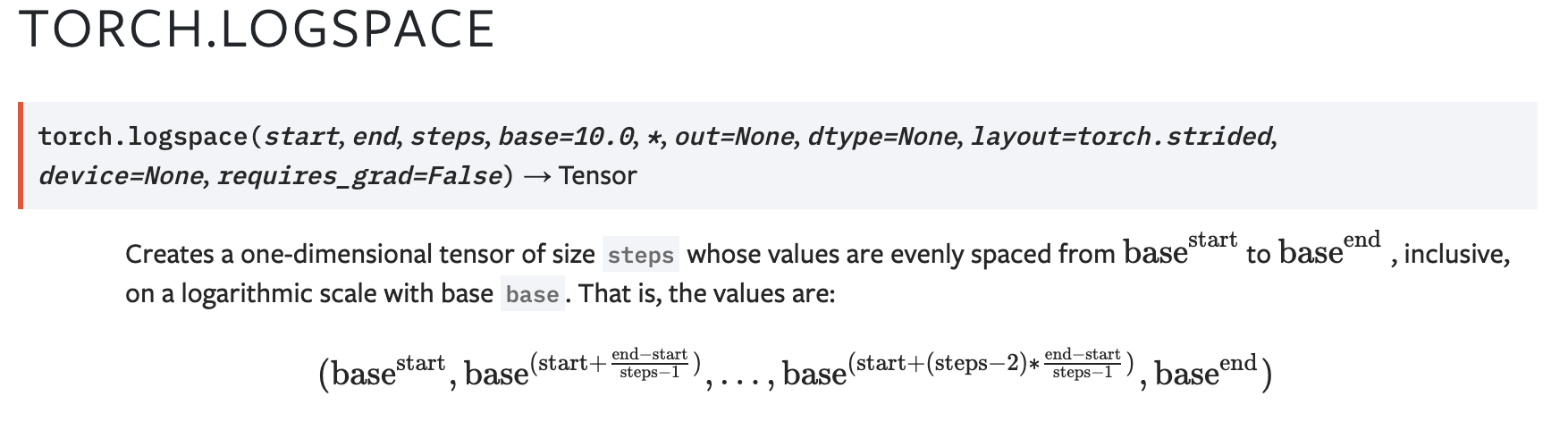
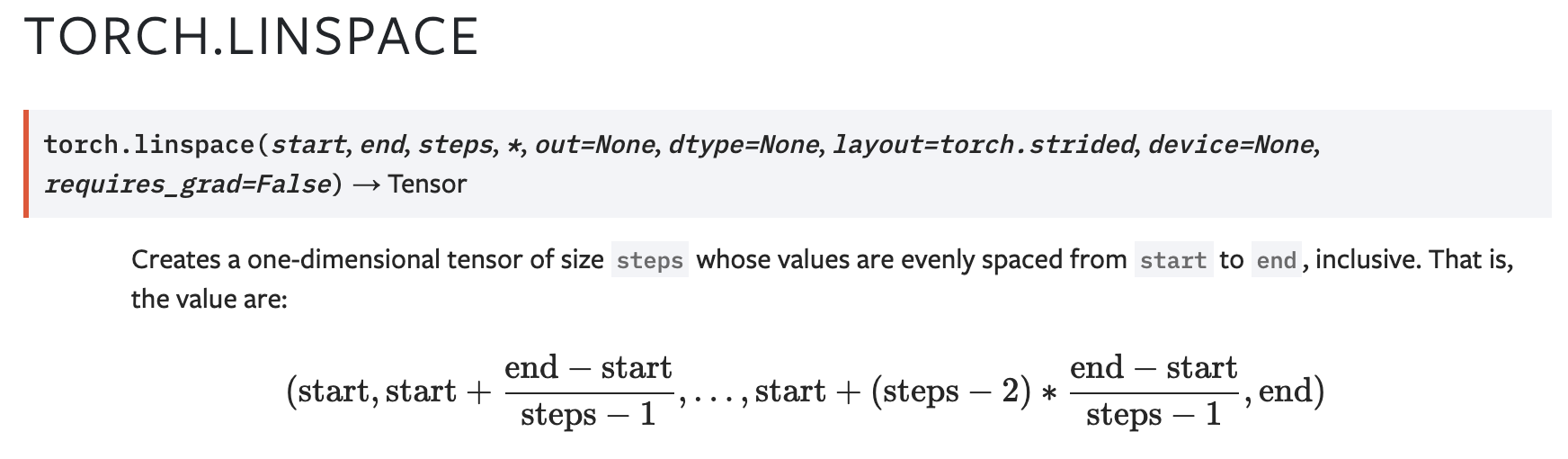
Summary:
**BC-breaking note**

This change is BC-breaking for C++ callers of linspace and logspace if they were providing a steps argument that could not be converted to an optional.

**PR note**

This PR deprecates calling linspace and logspace wihout setting steps explicitly by:

- updating the documentation to warn that not setting steps is deprecated
- warning (once) when linspace and logspace are called without steps being specified

A test for this behavior is added to test_tensor_creation_ops. The warning only appears once per process, however, so the test would pass even if no warning were thrown. Ideally there would be a mechanism to force all warnings, include those from TORCH_WARN_ONCE, to trigger.

Pull Request resolved: https://github.com/pytorch/pytorch/pull/43860

Reviewed By: izdeby

Differential Revision: D23498980

Pulled By: mruberry

fbshipit-source-id: c48d7a58896714d184cb6ff2a48e964243fafc90
Summary:
1) Ports nonzero from THC to ATen
2) replaces most thrust uses with cub, to avoid synchronization and to improve performance. There is still one necessary synchronization point, communicating number of nonzero elements from GPU to CPU
3) slightly changes algorithm, now we first compute the number of nonzeros, and then allocate correct-sized output, instead of allocating full-sized output as was done before, to account for possibly all elements being non-zero
4) unfortunately, since the last transforms are still done with thrust, 2) is slightly beside the point, however it is a step towards a future without thrust
4) hard limits the number of elements in the input tensor to MAX_INT. Previous implementation allocated a Long tensor with the size ndim*nelements, so that would be at least 16 GB for a tensor with MAX_INT elements. It is reasonable to say that larger tensors could not be used anyway.

Benchmarking is done for tensors with approximately half non-zeros
<details><summary>Benchmarking script</summary>
<p>

```
import torch
from torch.utils._benchmark import Timer
from torch.utils._benchmark import Compare
import sys

device = "cuda"
results = []
for numel in (1024 * 128,):#, 1024 * 1024, 1024 * 1024 * 128):
    inp = torch.randint(2, (numel,), device="cuda", dtype=torch.float)
    for ndim in range(2,3):#(1,4):
        if ndim == 1:
            shape = (numel,)
        elif ndim == 2:
            shape = (1024, numel // 1024)
        else:
            shape = (1024, 128, numel // 1024 // 128)
        inp = inp.reshape(shape)
        repeats = 3
        timer = Timer(stmt="torch.nonzero(inp, as_tuple=False)", label="Nonzero", sub_label=f"number of elts {numel}",
        description = f"ndim {ndim}", globals=globals())
        for i in range(repeats):
            results.append(timer.blocked_autorange())
        print(f"\rnumel {numel} ndim {ndim}", end="")
        sys.stdout.flush()

comparison = Compare(results)
comparison.print()
```
</p>
</details>

### Results
Before:
```
[--------------------------- Nonzero ---------------------------]
                                 |  ndim 1  |   ndim 2  |   ndim 3
 1 threads: ------------------------------------------------------
       number of elts 131072     |    55.2  |     71.7  |     90.5
       number of elts 1048576    |   113.2  |    250.7  |    497.0
       number of elts 134217728  |  8353.7  |  23809.2  |  54602.3

 Times are in microseconds (us).
```
After:
```
[-------------------------- Nonzero --------------------------]
                                |  ndim 1  |  ndim 2  |  ndim 3
1 threads: ----------------------------------------------------
      number of elts 131072     |    48.6  |    79.1  |    90.2
      number of elts 1048576    |    64.7  |   134.2  |   161.1
      number of elts 134217728  |  3748.8  |  7881.3  |  9953.7

Times are in microseconds (us).

```
There's a real regression for smallish 2D tensor due to added work of computing number of nonzero elements, however, for other sizes there are significant gains, and there are drastically lower memory requirements. Perf gains would be even larger for tensors with fewer nonzeros.

Pull Request resolved: https://github.com/pytorch/pytorch/pull/44259

Reviewed By: izdeby

Differential Revision: D23581955

Pulled By: ngimel

fbshipit-source-id: 0b99a767fd60d674003d83f0848dc550d7a363dc
Summary:
When var and std are called without args (other than unbiased) they currently call into TH or THC. This PR:

- Removes the THC var_all and std_all functions and updates CUDA var and std to use the ATen reduction
- Fixes var's docs, which listed its arguments in the incorrect order
- Adds new tests comparing var and std with their NumPy counterparts

Performance appears to have improved as a result of this change. I ran experiments on 1D tensors, 1D tensors with every other element viewed ([::2]), 2D tensors and 2D transposed tensors. Some notable datapoints:

- torch.randn((8000, 8000))
  - var measured 0.0022215843200683594s on CUDA before the change
  - var measured 0.0020322799682617188s on CUDA after the change
- torch.randn((8000, 8000)).T
  - var measured .015128850936889648 on CUDA before the change
  - var measured 0.001912832260131836 on CUDA after the change
- torch.randn(8000 ** 2)
  - std measured 0.11031460762023926 on CUDA before the change
  - std measured 0.0017833709716796875 on CUDA after the change

Timings for var and std are, as expected, similar.

On the CPU, however, the performance change from making the analogous update was more complicated, and ngimel and I decided not to remove CPU var_all and std_all. ngimel wrote the following script that showcases how single-threaded CPU inference would suffer from this change:

```
import torch
import numpy as np
from torch.utils._benchmark import Timer
from torch.utils._benchmark import Compare
import sys
base = 8
multiplier = 1

def stdfn(a):
    meanv = a.mean()
    ac = a-meanv
    return torch.sqrt(((ac*ac).sum())/a.numel())

results = []
num_threads=1
for _ in range(7):
    size = base*multiplier
    input = torch.randn(size)

    tasks = [("torch.var(input)", "torch_var"),
             ("torch.var(input, dim=0)", "torch_var0"),
             ("stdfn(input)", "stdfn"),
             ("torch.sum(input, dim=0)", "torch_sum0")
            ]
    timers = [Timer(stmt=stmt, num_threads=num_threads, label="Index", sub_label=f"{size}",
    description=label, globals=globals()) for stmt, label in tasks]
    repeats = 3

    for i, timer in enumerate(timers * repeats):
        results.append(
            timer.blocked_autorange()
        )
        print(f"\r{i + 1} / {len(timers) * repeats}", end="")
        sys.stdout.flush()
    multiplier *=10
print()

comparison = Compare(results)

comparison.print()
```

The TH timings using this script on my devfair are:

```
[------------------------------ Index ------------------------------]
        | torch_var | torch_var0 |  stdfn  | torch_sum0
1 threads: ----------------------------------------------------------
   8    |   16.0  |    5.6  |   40.9 |    5.0
   80    |   15.9  |    6.1  |   41.6 |    4.9
   800   |   16.7  |   12.0  |   42.3 |    5.0
   8000   |   27.2  |   72.7  |   51.5 |    6.2
   80000  |   129.0  |   715.0  |  133.0 |   18.0
   800000  |  1099.8  |  6961.2  |  842.0 |   112.6
   8000000 |  11879.8  |  68948.5  | 20138.4 |  1750.3
```

and the ATen timings are:

```
[------------------------------ Index ------------------------------]
               |  torch_var  |  torch_var0  |   stdfn   |  torch_sum0
1 threads: ----------------------------------------------------------
      8              |       4.3   |       5.4    |     41.4  |       5.4
      80            |       4.9   |       5.7    |     42.6  |       5.4
      800          |      10.7   |      11.7    |     43.3  |       5.5
      8000        |      69.3   |      72.2    |     52.8  |       6.6
      80000      |     679.1   |     676.3    |    129.5  |      18.1
      800000    |    6770.8   |    6728.8    |    819.8  |     109.7
      8000000  |   65928.2   |   65538.7    |  19408.7  |    1699.4
```

which demonstrates that performance is analogous to calling the existing var and std with `dim=0` on a 1D tensor. This would be a significant performance hit. Another simple script shows the performance is mixed when using multiple threads, too:

```
import torch
import time

# Benchmarking var and std, 1D with varying sizes
base = 8
multiplier = 1

op = torch.var
reps = 1000

for _ in range(7):
    size = base * multiplier
    t = torch.randn(size)
    elapsed = 0
    for _ in range(reps):
        start = time.time()
        op(t)
        end = time.time()
        elapsed += end - start
    multiplier *= 10

    print("Size: ", size)
    print("Avg. elapsed time: ", elapsed / reps)
```

```
var cpu TH vs ATen timings

Size:  8
Avg. elapsed time:  1.7853736877441406e-05 vs 4.9788951873779295e-06 (ATen wins)
Size:  80
Avg. elapsed time:  1.7803430557250977e-05 vs 6.156444549560547e-06 (ATen wins)
Size:  800
Avg. elapsed time:  1.8569469451904296e-05 vs 1.2302875518798827e-05 (ATen wins)
Size:  8000
Avg. elapsed time:  2.8756141662597655e-05 vs. 6.97789192199707e-05 (TH wins)
Size:  80000
Avg. elapsed time:  0.00026622867584228516 vs. 0.0002447957992553711 (ATen wins)
Size:  800000
Avg. elapsed time:  0.0010556647777557374 vs 0.00030616092681884767 (ATen wins)
Size:  8000000
Avg. elapsed time:  0.009990205764770508 vs 0.002938544034957886 (ATen wins)

std cpu TH vs ATen timings

Size:  8
Avg. elapsed time:  1.6681909561157225e-05 vs. 4.659652709960938e-06 (ATen wins)
Size:  80
Avg. elapsed time:  1.699185371398926e-05 vs. 5.431413650512695e-06 (ATen wins)
Size:  800
Avg. elapsed time:  1.768803596496582e-05 vs. 1.1279821395874023e-05 (ATen wins)
Size:  8000
Avg. elapsed time:  2.7791500091552735e-05  vs 7.031106948852539e-05 (TH wins)
Size:  80000
Avg. elapsed time:  0.00018650460243225096 vs 0.00024368906021118164 (TH wins)
Size:  800000
Avg. elapsed time:  0.0010522041320800782 vs 0.0003039860725402832 (ATen wins)
Size:  8000000
Avg. elapsed time:  0.009976618766784668 vs. 0.0029211788177490234 (ATen wins)
```

These results show the TH solution still performs better than the ATen solution with default threading for some sizes.

It seems like removing CPU var_all and std_all will require an improvement in ATen reductions. https://github.com/pytorch/pytorch/issues/40570 has been updated with this information.

Pull Request resolved: https://github.com/pytorch/pytorch/pull/43858

Reviewed By: zou3519

Differential Revision: D23498981

Pulled By: mruberry

fbshipit-source-id: 34bee046c4872d11c3f2ffa1b5beee8968b22050
Summary:
This PR adds the following aliaes:

- not_equal for torch.ne
- greater for torch.gt
- greater_equal for torch.ge
- less for torch.lt
- less_equal for torch.le

This aliases are consistent with NumPy's naming for these functions.

Pull Request resolved: https://github.com/pytorch/pytorch/pull/43870

Reviewed By: zou3519

Differential Revision: D23498975

Pulled By: mruberry

fbshipit-source-id: 78560df98c9f7747e804a420c1e53fd1dd225002
Summary:
Pull Request resolved: https://github.com/pytorch/pytorch/pull/43270

`torch.conj` is a very commonly used operator for complex tensors, but it's mathematically a no op for real tensors. Switching to tensorflow gradients for complex tensors (as discussed in #41857) would involve adding `torch.conj()` to the backward definitions for a lot of operators. In order to preserve autograd performance for real tensors and maintain numpy compatibility for `torch.conj`, this PR updates `torch.conj()` which behaves the same for complex tensors but performs a view/returns `self` tensor for tensors of non-complex dtypes. The documentation states that the returned tensor for a real input shouldn't be mutated. We could perhaps return an immutable tensor for this case in future when that functionality is available (zdevito ezyang ).

Test Plan: Imported from OSS

Reviewed By: mruberry

Differential Revision: D23460493

Pulled By: anjali411

fbshipit-source-id: 3b3bf0af55423b77ff2d0e29f5d2c160291ae3d9
Summary:
`torch.range` still hasn't been removed way after version 0.5. This PR fixes the warning message. Alternatively, we can remove `torch.range`.

Pull Request resolved: https://github.com/pytorch/pytorch/pull/43569

Reviewed By: ngimel

Differential Revision: D23408233

Pulled By: mruberry

fbshipit-source-id: 86c4f9f018ea5eddaf80b78a3c54dfa41cfc6fa6