Preferring dash over underscore in command-line options. Add `--command-arg-name` to the argument parser. The old arguments with underscores `--command_arg_name` are kept for backward compatibility.

Both dashes and underscores are used in the PyTorch codebase. Some argument parsers only have dashes or only have underscores in arguments. For example, the `torchrun` utility for distributed training only accepts underscore arguments (e.g., `--master_port`). The dashes are more common in other command-line tools. And it looks to be the default choice in the Python standard library:

`argparse.BooleanOptionalAction`: 4a9dff0e5a/Lib/argparse.py (L893-L895)

```python
class BooleanOptionalAction(Action):
    def __init__(...):
            if option_string.startswith('--'):
                option_string = '--no-' + option_string[2:]
                _option_strings.append(option_string)
```

It adds `--no-argname`, not `--no_argname`. Also typing `_` need to press the shift or the caps-lock key than `-`.

Pull Request resolved: https://github.com/pytorch/pytorch/pull/94505
Approved by: https://github.com/ezyang, https://github.com/seemethere
Changes:

1. `typing_extensions -> typing-extentions` in dependency. Use dash rather than underline to fit the [PEP 503: Normalized Names](https://peps.python.org/pep-0503/#normalized-names) convention.

```python
import re

def normalize(name):
    return re.sub(r"[-_.]+", "-", name).lower()
```

2. Import `Literal`, `Protocal`, and `Final` from standard library as of Python 3.8+
3. Replace `Union[Literal[XXX], Literal[YYY]]` to `Literal[XXX, YYY]`.

Pull Request resolved: https://github.com/pytorch/pytorch/pull/94490
Approved by: https://github.com/ezyang, https://github.com/albanD
The previous sentence seemed to imply that sparse may not always be helpful, ie, your execution time may increase when using sparse. But the docs mentioned otherwise.

A simple re-ordering of two words in the documentation to better align with the contextual sentiment.

Pull Request resolved: https://github.com/pytorch/pytorch/pull/93258
Approved by: https://github.com/cpuhrsch
We want to make TorchRec sharded models TorchScriptable.

TorchRec sharded models uses generic types Awaitable[W] and LazyAwaitable[W] (https://github.com/pytorch/torchrec/blob/main/torchrec/distributed/types.py#L212).
In sharded model those types are used instead of contained type W, having the initialization function that produces object of type W.

At the moment when the first attribute of W is requested - `LazyAwaitable[W]` will call its initialization function (on the same stack), cache the result inside and work transparently as an object of W. So we can think about it as a delayed object initialization.

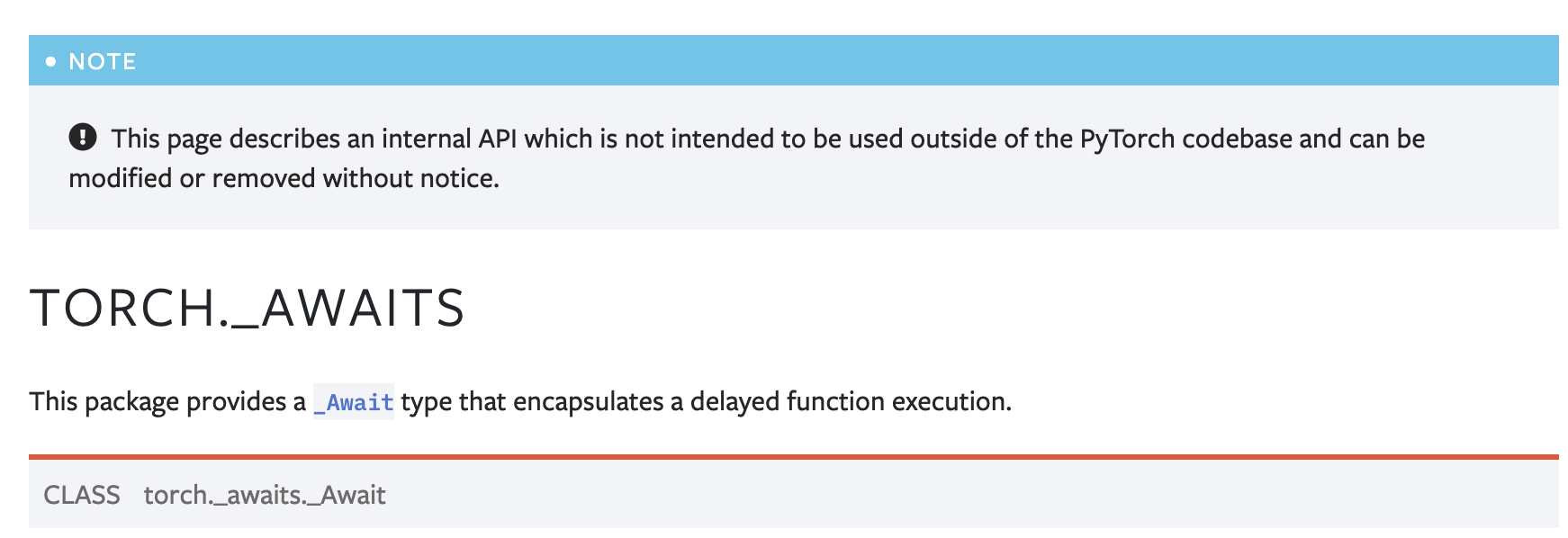
To support this behavior in TorchScript - we propose a new type to TorchScript - `Await`.
In eager mode it works the same as `LazyAwaitable[W]` in TorchRec, being dynamically typed - acting as a type `W` while it is `Await[W]`.

Within torchscript it is `Await[W]` and can be only explicitly converted to W, using special function `torch.jit.awaitable_wait(aw)`.
Creation of this `Await[W]` is done via another special function `torch.jit.awaitable(func, *args)`.

The semantic is close to `torch.jit.Future`, fork, wait and uses the same jit mechanics (inline fork Closures) with the difference that it does not start this function in parallel on fork. It only stores as a lambda inside IValue that will be called on the same thread when `torch.jit.awaitable_wait` is called.

For example (more examples in this PR `test/jit/test_await.py`)
```
      def delayed(z: Tensor) -> Tensor:
          return Tensor * 3

      @torch.jit.script
      def fn(x: Tensor):
          aw: Await[int] = torch.jit._awaitable(delayed, 99)
          a = torch.eye(2)
          b = torch.jit._awaitable_wait(aw)
          return a + b + x
```

Functions semantics:

`_awaitable(func -> Callable[Tuple[...], W], *args, **kwargs) -> Await[W]`

Creates Await object, owns args and kwargs. Once _awaitable_wait calls, executes function func and owns the result of the function. Following _awaitable_wait calls will return this result from the first function call.

`_awaitable_wait(Await[W]) -> W`
Returns either cached result of W if it is not the first _awaitable_wait call to this Await object or calls specified function if the first.

`_awaitable_nowait(W) -> Await[W]`

Creates trivial Await[W] wrapper on specified object To be type complaint for the corner cases.

Differential Revision: [D42502706](https://our.internmc.facebook.com/intern/diff/D42502706)
Pull Request resolved: https://github.com/pytorch/pytorch/pull/90863
Approved by: https://github.com/davidberard98
We have known for a while that we should in principle support SymBool as a separate concept from SymInt and SymFloat ( in particular, every distinct numeric type should get its own API). However, recent work with unbacked SymInts in, e.g., https://github.com/pytorch/pytorch/pull/90985 have made this a priority to implement. The essential problem is that our logic for computing the contiguity of tensors performs branches on the passed in input sizes, and this causes us to require guards when constructing tensors from unbacked SymInts. Morally, this should not be a big deal because, we only really care about the regular (non-channels-last) contiguity of the tensor, which should be guaranteed since most people aren't calling `empty_strided` on the tensor, however, because we store a bool (not a SymBool, prior to this PR it doesn't exist) on TensorImpl, we are forced to *immediately* compute these values, even if the value ends up not being used at all. In particular, even when a user allocates a contiguous tensor, we still must compute channels-last contiguity (as some contiguous tensors are also channels-last contiguous, but others are not.)

This PR implements SymBool, and makes TensorImpl use SymBool to store the contiguity information in ExtraMeta. There are a number of knock on effects, which I now discuss below.

* I introduce a new C++ type SymBool, analogous to SymInt and SymFloat. This type supports logical and, logical or and logical negation. I support the bitwise operations on this class (but not the conventional logic operators) to make it clear that logical operations on SymBool are NOT short-circuiting. I also, for now, do NOT support implicit conversion of SymBool to bool (creating a guard in this case). This does matter too much in practice, as in this PR I did not modify the equality operations (e.g., `==` on SymInt) to return SymBool, so all preexisting implicit guards did not need to be changed. I also introduced symbolic comparison functions `sym_eq`, etc. on SymInt to make it possible to create SymBool. The current implementation of comparison functions makes it unfortunately easy to accidentally introduce guards when you do not mean to (as both `s0 == s1` and `s0.sym_eq(s1)` are valid spellings of equality operation); in the short term, I intend to prevent excess guarding in this situation by unit testing; in the long term making the equality operators return SymBool is probably the correct fix.
* ~~I modify TensorImpl to store SymBool for the `is_contiguous` fields and friends on `ExtraMeta`. In practice, this essentially meant reverting most of the changes from https://github.com/pytorch/pytorch/pull/85936 . In particular, the fields on ExtraMeta are no longer strongly typed; at the time I was particularly concerned about the giant lambda I was using as the setter getting a desynchronized argument order, but now that I have individual setters for each field the only "big list" of boolean arguments is in the constructor of ExtraMeta, which seems like an acceptable risk. The semantics of TensorImpl are now that we guard only when you actually attempt to access the contiguity of the tensor via, e.g., `is_contiguous`. By in large, the contiguity calculation in the implementations now needs to be duplicated (as the boolean version can short circuit, but the SymBool version cannot); you should carefully review the duplicate new implementations. I typically use the `identity` template to disambiguate which version of the function I need, and rely on overloading to allow for implementation sharing. The changes to the `compute_` functions are particularly interesting; for most of the functions, I preserved their original non-symbolic implementation, and then introduce a new symbolic implementation that is branch-less (making use of our new SymBool operations). However, `compute_non_overlapping_and_dense` is special, see next bullet.~~ This appears to cause performance problems, so I am leaving this to an update PR.
* (Update: the Python side pieces for this are still in this PR, but they are not wired up until later PRs.) While the contiguity calculations are relatively easy to write in a branch-free way, `compute_non_overlapping_and_dense` is not: it involves a sort on the strides. While in principle we can still make it go through by using a data oblivious sorting network, this seems like too much complication for a field that is likely never used (because typically, it will be obvious that a tensor is non overlapping and dense, because the tensor is contiguous.) So we take a different approach: instead of trying to trace through the logic computation of non-overlapping and dense, we instead introduce a new opaque operator IsNonOverlappingAndDenseIndicator which represents all of the compute that would have been done here. This function returns an integer 0 if `is_non_overlapping_and_dense` would have returned `False`, and an integer 1 otherwise, for technical reasons (Sympy does not easily allow defining custom functions that return booleans). The function itself only knows how to evaluate itself if all of its arguments are integers; otherwise it is left unevaluated. This means we can always guard on it (as `size_hint` will always be able to evaluate through it), but otherwise its insides are left a black box. We typically do NOT expect this custom function to show up in actual boolean expressions, because we will typically shortcut it due to the tensor being contiguous. It's possible we should apply this treatment to all of the other `compute_` operations, more investigation necessary. As a technical note, because this operator takes a pair of a list of SymInts, we need to support converting `ArrayRef<SymNode>` to Python, and I also unpack the pair of lists into a single list because I don't know if Sympy operations can actually validly take lists of Sympy expressions as inputs. See for example `_make_node_sizes_strides`
* On the Python side, we also introduce a SymBool class, and update SymNode to track bool as a valid pytype. There is some subtlety here: bool is a subclass of int, so one has to be careful about `isinstance` checks (in fact, in most cases I replaced `isinstance(x, int)` with `type(x) is int` for expressly this reason.) Additionally, unlike, C++, I do NOT define bitwise inverse on SymBool, because it does not do the correct thing when run on booleans, e.g., `~True` is `-2`. (For that matter, they don't do the right thing in C++ either, but at least in principle the compiler can warn you about it with `-Wbool-operation`, and so the rule is simple in C++; only use logical operations if the types are statically known to be SymBool). Alas, logical negation is not overrideable, so we have to introduce `sym_not` which must be used in place of `not` whenever a SymBool can turn up. To avoid confusion with `__not__` which may imply that `operators.__not__` might be acceptable to use (it isn't), our magic method is called `__sym_not__`. The other bitwise operators `&` and `|` do the right thing with booleans and are acceptable to use.
* There is some annoyance working with booleans in Sympy. Unlike int and float, booleans live in their own algebra and they support less operations than regular numbers. In particular, `sympy.expand` does not work on them. To get around this, I introduce `safe_expand` which only calls expand on operations which are known to be expandable.

TODO: this PR appears to greatly regress performance of symbolic reasoning. In particular, `python test/functorch/test_aotdispatch.py -k max_pool2d` performs really poorly with these changes. Need to investigate.

Signed-off-by: Edward Z. Yang <ezyang@meta.com>
Pull Request resolved: https://github.com/pytorch/pytorch/pull/92149
Approved by: https://github.com/albanD, https://github.com/Skylion007
It turns out our old max/min implementation didn't do anything, because `__max__` and `__min__` are not actually magic methods in Python. So I give 'em the `sym_` treatment, similar to the other non-overrideable builtins.

NB: I would like to use `sym_max` when computing contiguous strides but this appears to make `python test/functorch/test_aotdispatch.py -v -k test_aot_autograd_symbolic_exhaustive_nn_functional_max_pool2d_cpu_float32` run extremely slowly. Needs investigating.

Signed-off-by: Edward Z. Yang <ezyang@meta.com>

Pull Request resolved: https://github.com/pytorch/pytorch/pull/92107
Approved by: https://github.com/albanD, https://github.com/voznesenskym, https://github.com/Skylion007
This PR:
- registers all of the codegened Nodes to the torch._C._functions module, this is where special nodes like AccumulateGrad are already registered.
- creates a autograd.graph.Node abstract base class that all of the newly registered nodes subclass from. We make the subclassing happen by implementing the ``__subclasshook__`` method
- enables static type checking to work and also enables Sphinx to generate documentation for the Node and its methods
- handles both the custom Function and codegened cases

Pull Request resolved: https://github.com/pytorch/pytorch/pull/91475
Approved by: https://github.com/albanD
This PR:
- changes generate_vmap_rule to either be True or False. Previously it
  could be True, False, or not set. This simplifies the implementation a
  bit.
- changes the vmap staticmethod to always be on the autograd.Function
  rather than sometimes defined.
  This is how the other staticmethod (forward, backward, jvp) are
  implemented and allows us to document it.

There are 4 possible states for the autograd.Function w.r.t. to the
above:
- generate_vmap_rule is True, vmap staticmethod overriden. This raises
  an error when used with vmap.
- generate_vmap_rule is False, vmap staticmethod overriden. This is
  valid.
- generate_vmap_rule is True, vmap staticmethod not overriden. This is
  valid.
- generate_vmap_rule is False, vmap staticmethod not overriden. This
  raises an error when used with vmap.

Future:
- setup_context needs the same treatment, but that's a bit tricker to
  implement.

Test Plan:
- new unittest
- existing tests
Pull Request resolved: https://github.com/pytorch/pytorch/pull/91787
Approved by: https://github.com/soulitzer
This PR is a copy of https://github.com/pytorch/pytorch/pull/90849 that merge was reverted.

The PR adds "check sparse tensor invariants" flag to Context that when enabled will trigger sparse tensor data invariants checks in unsafe methods of constructing sparse COO/CSR/CSC/BSR/BSC tensors. The feature includes the following changes to UI:

`torch.sparse.check_sparse_tensor_invariants` class provides different ways to enable/disable the invariant checking.

`torch.sparse_coo/csr/csc/bsr/bsc/compressed_tensor` functions have a new optional argument `check_invariants` to enable/disable the invariant checks explicitly. When the `check_invariants` argument is specified, the global state of the feature is temporarily overridden.

The PR fixes https://github.com/pytorch/pytorch/issues/90833

Pull Request resolved: https://github.com/pytorch/pytorch/pull/92094
Approved by: https://github.com/cpuhrsch
Summary: This commit moves the API specification section of
the BackendConfig tutorial to the docstrings, which is a more
suitable place for this content. This change also reduces some
duplication. There is no new content added in this change.

Reviewers: jerryzh168, vkuzo

Subscribers: jerryzh168, vkuzo
Pull Request resolved: https://github.com/pytorch/pytorch/pull/91999
Approved by: https://github.com/vkuzo, https://github.com/jerryzh168
This PR adds "check sparse tensor invariants" flag to Context that when enabled will trigger sparse tensor data invariants checks in unsafe methods of constructing sparse COO/CSR/CSC/BSR/BSC tensors. The feature includes the following changes to UI:

- `torch.enable_check_sparse_tensor_invariants` and `torch.is_check_sparse_tensor_invariants_enabled` functions to globally enable/disable the invariant checks and to retrieve the state of the feature, respectively
- `torch.sparse_coo/csr/csc/bsr/bsc/compressed_tensor` functions have a new optional argument `check_invariants` to enable/disable the invariant checks explicitly. When the `check_invariants` argument is specified, the global state of the feature is temporarily overridden.

The PR also fixes https://github.com/pytorch/pytorch/issues/90833

# Main issue

*The following content is outdated after merging the PRs in this ghstack but kept for the record.*

The importance of this feature is that when enabling the invariants checks by default, say, via

<details>

```
$ git diff
diff --git a/torch/__init__.py b/torch/__init__.py
index c8543057c7..19a91d0482 100644
--- a/torch/__init__.py
+++ b/torch/__init__.py
@@ -1239,3 +1239,8 @@ if 'TORCH_CUDA_SANITIZER' in os.environ:

 # Populate magic methods on SymInt and SymFloat
 import torch.fx.experimental.symbolic_shapes
+
+# temporarily enable sparse tensor arguments validation in unsafe
+# constructors:
+
+torch._C._set_check_sparse_tensor_invariants(True)
```

</details>

a massive number of test failures/errors occur in test_sparse_csr.py tests:
```
$ pytest -sv test/test_sparse_csr.py
<snip>
==== 4293 failed, 1557 passed, 237 skipped, 2744 errors in 69.71s (0:01:09) ====
```
that means that we are silently constructing sparse compressed tensors that do not satisfy the sparse tensor invariants. In particular, the following errors are raised:

```
AssertionError: "resize_as_sparse_compressed_tensor_: self and src must have the same layout" does not match "expected values to be a strided and contiguous tensor"

RuntimeError: CUDA error: device-side assert triggered

RuntimeError: `col_indices[..., crow_indices[..., i - 1]:crow_indices[..., i]] for all i = 1, ..., nrows are sorted and distinct along the last dimension values` is not satisfied.

RuntimeError: expected col_indices to be a strided and contiguous tensor

RuntimeError: expected row_indices to be a strided and contiguous tensor

RuntimeError: expected values to be a strided and contiguous tensor

RuntimeError: for_each: failed to synchronize: cudaErrorAssert: device-side assert triggered

RuntimeError: tensor dimensionality must be sum of batch, base, and dense dimensionalities (=0 + 2 + 0) but got 3
```

Pull Request resolved: https://github.com/pytorch/pytorch/pull/90849
Approved by: https://github.com/amjames, https://github.com/cpuhrsch