We had the option but never used cpu_offload as optimizer state_dict offloads the tensors to CPU by default. And this is usually most users want as the tensors are required to be moved to CPU eventually. However, we may want to disable offloading to CPU in some cases, epsecially for the debugging purpose. This PR lets optimizer state_dict read the flag.

Differential Revision: [D48913340](https://our.internmc.facebook.com/intern/diff/D48913340/)
Pull Request resolved: https://github.com/pytorch/pytorch/pull/108434
Approved by: https://github.com/wz337
This PR:
1) Add device_mesh kwarg to FSDP. Remove init_device_mesh() from _runtime_utils.py, as device_mesh would be passed in by user as an kwarg.
2) change use_dtensor flag for state_dict_config and optim_state_dict_config to be private. If device_mesh is used with sharded model/optim state dict, _use_dtensor flag would be set to True and model/optim state dict would return dtensor state_dict. Otherwise, _use_dtensor flag would be set to False and model/optim state dict would return sharded_tensor state_dict.
3) Update _optim_utils.py, _shard_utils.py, and _state_dict_utils.py to add support for HSDP to return 2D DTensor state_dict.

Pull Request resolved: https://github.com/pytorch/pytorch/pull/107533
Approved by: https://github.com/fegin, https://github.com/awgu, https://github.com/wanchaol
This PR:
1) Add device_mesh kwarg to FSDP. Remove init_device_mesh() from _runtime_utils.py, as device_mesh would be passed in by user as an kwarg.
2) change use_dtensor flag for state_dict_config and optim_state_dict_config to be private. If device_mesh is used with sharded model/optim state dict, _use_dtensor flag would be set to True and model/optim state dict would return dtensor state_dict. Otherwise, _use_dtensor flag would be set to False and model/optim state dict would return sharded_tensor state_dict.
3) Update _optim_utils.py, _shard_utils.py, and _state_dict_utils.py to add support for HSDP to return 2D DTensor state_dict.

Pull Request resolved: https://github.com/pytorch/pytorch/pull/107533
Approved by: https://github.com/fegin, https://github.com/awgu, https://github.com/wanchaol
- This PR rewords the `BackwardPrefetch` docs to make the tradeoffs clear in the first sentence of each with more technical details after.
- The only supported `_FSDPPolicy` is `ModuleWrapPolicy` at the time of writing this PR. We may add others in the future such as in my other PR stack. This PR removes `_FSDPPolicy` from the public docs.
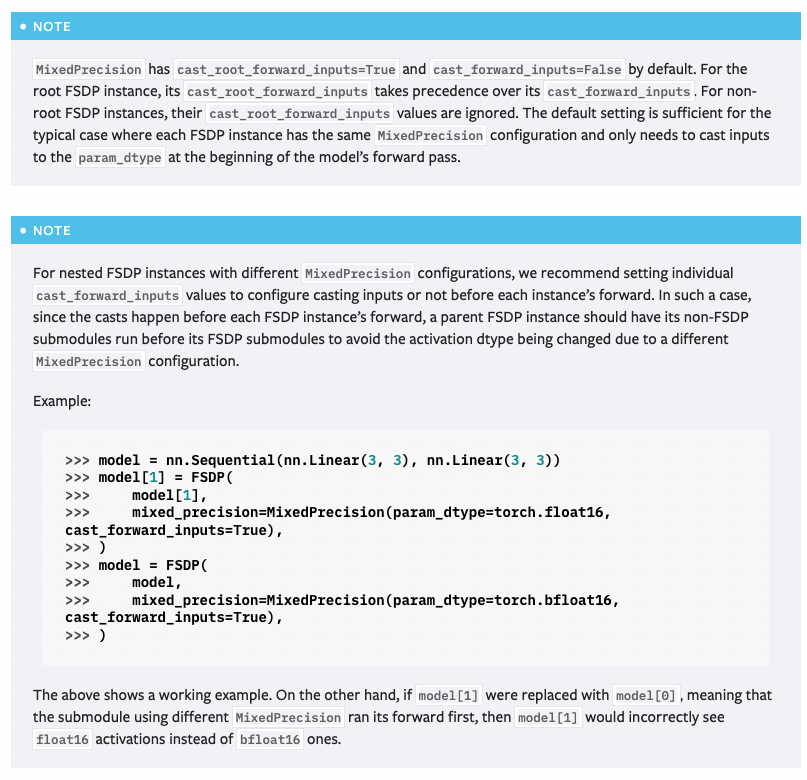
- This provides some more details around `MixedPrecision` such as explaining that layer norm and batch norm accumulate in fp32.

Follow-ups:
- Why do we force batch norm modules to have FSDP applied separately? (E.g. was this because before batch norm kernels did not support fp16/bf16?) Like layer norm, this just means that the affine parameters are in fp32. Both already accumulate in fp32 even with fp16/bf16 inputs.
- Check the `param_init_fn` + `sync_module_states=True` usage.
Pull Request resolved: https://github.com/pytorch/pytorch/pull/105847
Approved by: https://github.com/rohan-varma
The main use case here is that folks would like to ignore layer norm for mixed precision. This can now be enabled with:

```
mp_config = MixedPrecision(
            param_dtype=torch.float16,
            reduce_dtype=torch.float16,
            buffer_dtype=torch.float16,
            _mixed_precision_module_classes_to_ignore=[_BatchNorm, nn.LayerNorm],
        )
```

This is done by classes of types in `_mixed_precision_module_classes_to_ignore` being wrapped in their own FSDP unit with mixed preicsion disabled. This is only enabled for auto wrapping.

We also add module pre and post hooks to cast / downcast inputs to the appropriate full precision.

Differential Revision: [D46079957](https://our.internmc.facebook.com/intern/diff/D46079957/)
Pull Request resolved: https://github.com/pytorch/pytorch/pull/102010
Approved by: https://github.com/awgu
Adds 2 new hybrid sharding strategy to FSDP:
1. HYBRID_SHARD: applies zero-3 style sharding within a node, and data parallel across
2. HYBRID_SHARD_ZERO2: applies zero-2 style sharding within a node, and data parallel across

These are useful for medium sized models and aim to decrease communication volume, tests and benchmarks will be run to understand which workloads are optimal under which sharding strategy.

Hybrid sharding in general works by sharding the model using a process group within a single node, and creating intra-node process groups for replication / data parallelism. The user either needs to pass in a tuple of these process groups, or None, and we generate the process groups appropriately.

** Acknowledgements **
- @awgu 's excellent prototype: 5ad3a16d48
- @liangluofb For ideation, feedback, and initial implementation and experimentation
Pull Request resolved: https://github.com/pytorch/pytorch/pull/89915
Approved by: https://github.com/awgu
- This PR defines a new `api.py` meant to hold the public API for FSDP (minus `FullyShardedDataParallel` itself). This is needed because several of the `_<...>_utils.py` files rely on the public API, and we cannot import from `torch.distributed.fsdp.fully_sharded_data_parallel` without a circular import. Calling the file `api.py` follows the convention used by `ShardedTensor`.
- This PR cleans up the wording in the `BackwardPrefetch`, `ShardingStrategy`, `MixedPrecision`, and `CPUOffload` docstrings.
- This PR adds the aforementioned classes to `fsdp.rst` to have them rendered in public docs.
- To abide by the public bindings contract (`test_public_bindings.py`), the aforementioned classes are removed from `fully_sharded_data_parallel.py`'s `__all__`. This is technically BC breaking if someone uses `from torch.distributed.fsdp.fully_sharded_data_parallel import *`; however, that does not happen in any of our own external or internal code.
Pull Request resolved: https://github.com/pytorch/pytorch/pull/87917
Approved by: https://github.com/mrshenli