Fixes#95796
### Implementation
Adds python implementation for `nn.ZeroPad1d` and `nn.ZeroPad3d` in `torch/nn/modules/padding.py`.
Adds cpp implementation for `nn::ZeroPad1d` and `nn::ZeroPad3d` in the following 3 files, refactored with templates similarly to `nn::ConstantPad`'s implementation: <br>
- `torch/crsc/api/include/torch/nn/modules/padding.h`
- `torch/csrc/api/include/torch/nn/options/padding.h`
- `torch/csrc/api/src/nn/modules/padding.cpp`
Also added relevant definitions in `torch/nn/modules/__init__.py`.
### Testing
Adds the following tests:
- cpp tests of similar length and structure as `ConstantPad` and the existing `ZeroPad2d` impl in `test/cpp/api/modules.cpp`
- cpp API parity tests in `torch/testing/_internal/common_nn.py`
- module init tests in `test/test_module_init.py`
Also added relevant definitions in `test/cpp_api_parity/parity-tracker.md`
Pull Request resolved: https://github.com/pytorch/pytorch/pull/96295
Approved by: https://github.com/soulitzer
Attempts to fix#92656
BC-breaking! This changes the default of zero_grad in optim and in nn to default set grads to None instead of zero tensors. We are changing the default because there are proven perf wins and existing code has typically not regressed due to this change. (will probably have to flesh out this note more).
Pull Request resolved: https://github.com/pytorch/pytorch/pull/92731
Approved by: https://github.com/ngimel
Fixes#81690
TODO:
* [x] C++ Unpickler Fix (locally tested pickled in Python and unpickled in C++)
* [x] C++ Pickler Fix (locally tested pickled in C++ and unpickled in Python)
* [x] Do quant_tensor, sparse_tensor, etc require similar changes? (Sparse and Quant don't need this)
* [x] Add Comments
* [x] How to make sure C++ and Python are in sync? (Functions in `pickler.h` help in getting and setting Tensor Metadata (math-bits for now) on a tensor. They are the only place which should handle this.)
Notes:
Quant Tensor don't support complex dtypes and for float they segfault with `_neg_view` : https://github.com/pytorch/pytorch/issues/88484
Sparse Tensor:
```python
>>> a = torch.tensor([[0, 2.], [3j, 0]]).to_sparse()
>>> a.conj().is_conj()
False
>>> a._neg_view()
Traceback (most recent call last):
File "<stdin>", line 1, in <module>
NotImplementedError: Cannot access storage of SparseTensorImpl
```
Pull Request resolved: https://github.com/pytorch/pytorch/pull/88182
Approved by: https://github.com/ezyang, https://github.com/anjali411
The symbol seems to conflict under some compiler versions, giving
an error like "relocation refers to global symbol which is defined in a
discarded section".  Simple enough to put it in an anonymous namespace,
so why not.

Signed-off-by: Edward Z. Yang <ezyang@fb.com>
Pull Request resolved: https://github.com/pytorch/pytorch/pull/86092
Approved by: https://github.com/Chillee
### Introduction
<!-- What did you change and why was it needed? -->

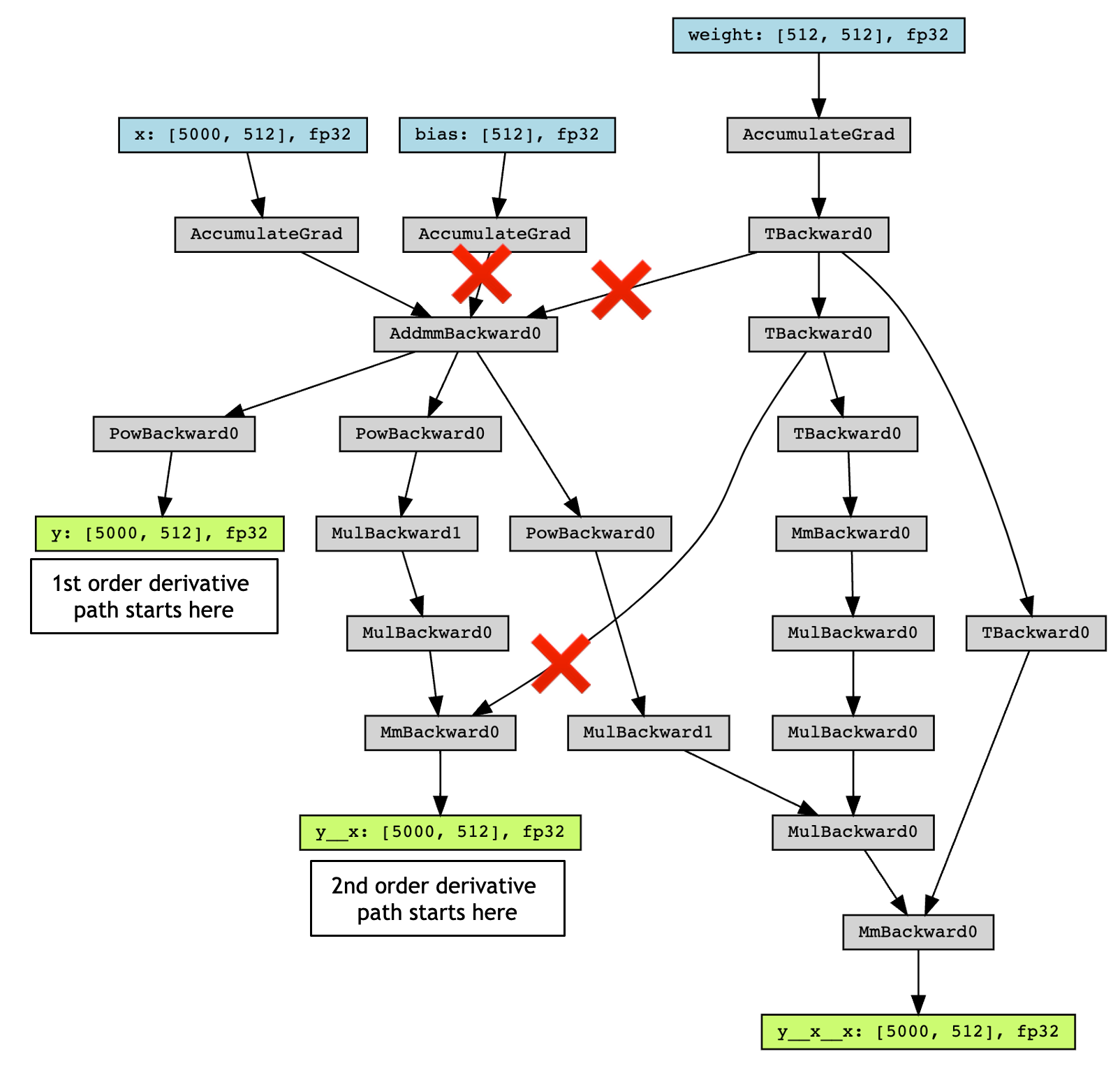
Removing unnecessary weight gradient calculation is very important for applications that need high-order derivatives during training. However, this is not supported by the current Autograd engine.

For more detail: The backward function of a `matmul` operator (e.g., `linear` `addmm` `mm`), has two matmuls, one for `input gradient` and another for `weight gradient`. For a typical neural network (nn) with a few linear layers and activation functions, if the user calls `torch.autograd.grad()` to calculate the derivative of the nn output `y` w.r.t the nn input `x`,  only the `input gradient` of the `matmul` operator is needed, and the `weight gradient` is discarded. However, the current PyTorch autograd engine will always calculate the `weight gradient` if `weight` requires gradient (the calculation of the high-order derivative is performed during training).

The figure attached shows the autograd graph of the following code snippet:
```py
y = torch.nn.functional.linear(x, weight, bias)
y = y.pow(2)
# first order derivative
y__x, = torch.autograd.grad(y, x, grad_outputs=grad_outputs, create_graph=True)
# first order derivative
y__x__x, = torch.autograd.grad(y__x, x, grad_outputs=grad_outputs, create_graph=True)
```
The path with ❌ is not needed when calculating derivatives.

<img width="50%" alt="image" src="https://user-images.githubusercontent.com/9999318/182018117-719c5a23-bcc6-4a63-8e8d-1bca3ebda2e3.png">

### Issue
<!-- Link to Issue ticket or RFP -->
Related issue: https://github.com/pytorch/pytorch/issues/56500

### Method
When calling `torch.autograd.grad`, `exec_info_` is created for each GraphTask, which allows filtering paths on the graph that are not needed. However, when the GraphTask calls into the node, the node still does not know whether the edges are needed or not. In the case of matmul, `weight.requires_grad is True` so the weight gradient is always calculated.

Following https://github.com/pytorch/pytorch/issues/56500#issuecomment-825694656, this PR passes the graph task's thread_local `exec_info_` into the node, so it could trim unnecessary edges during `torch.autograd.grad` calls.

### Benchmark
Benchmark script: https://gist.github.com/yueyericardo/24158433a2021c51eeef9c3e2722df99

Benchmark result:
6 hidden layers, batch size 10000, on A100

FP32 result
| hessian benchmark             | FP32 (before) | FP32 (After)      | FP32 (Functorch v0.1.1) |
| ----------------------------- | ------------- | ----------------- | ----------------------- |
| Linear + ReLU (no backward)   | 55.658 ms     | 29.392 ms (1.90X) | 29.547 ms (1.90X)       |
| Linear + ReLU (with backward) | 81.173 ms     | 54.917 ms (1.47X) | 68.988 ms (1.18X)       |

TF32 result
| hessian benchmark             | TF32 (before) | TF32 (after)      | TF32 (Functorch v0.1.1) |
| ----------------------------- | ------------- | ----------------- | ----------------------- |
| Linear + ReLU (no backward)   | 19.801 ms     | 11.259 ms (1.76X) | 10.754 ms (1.84X)       |
| Linear + ReLU (with backward) | 29.167 ms     | 20.466 ms (1.42X) | 22.784 ms (1.28X)       |

For FP32 result, we could get 1.9X speed up for hessian calculation, and 1.47X speed up during training, which is even faster than functorch `vmap(jacfwd(jacrev` implementation. (functorch has performance regression on v0.2.0, https://github.com/pytorch/functorch/issues/989, so we are using v0.1.1 for benchmark)

@zou3519 does functorch also includes similar optimizations during hessian calculation? If not, what do we need to do so the functorch could also benefit from this PR?

### Testing
<!-- How did you test your change? -->

- [x] we need to figure out a way for unittest

### Thanks
Thanks for the great blog: [How Computational Graphs are Executed in PyTorch | PyTorch](https://pytorch.org/blog/how-computational-graphs-are-executed-in-pytorch/)

cc @zasdfgbnm @albanD
Pull Request resolved: https://github.com/pytorch/pytorch/pull/82544
Approved by: https://github.com/soulitzer
And use it throughout the CMakeLists and rectify `IF(APPLE)`/`IF(GNU_CXX_VERSION VERSION_GREATER A.B)` and so on

Also, add `target_compile_options_if_supported` and use it in `Dependencies.cmake` as well as in test's `CMakeListst.txt`

Delete `-Wno-unknown-warning-option` to test that conditions indeed working as expected
Pull Request resolved: https://github.com/pytorch/pytorch/pull/82883
Approved by: https://github.com/seemethere
And use it throughout the CMakeLists and rectify `IF(APPLE)`/`IF(GNU_CXX_VERSION VERSION_GREATER A.B)` and so on

Also, add `target_compile_options_if_supported` and use it in `Dependencies.cmake` as well as in test's `CMakeListst.txt`

Delete `-Wno-unknown-warning-option` to test that conditions indeed working as expected
Pull Request resolved: https://github.com/pytorch/pytorch/pull/82883
Approved by: https://github.com/seemethere
See this doc: https://docs.google.com/document/d/1KiRdnoj6B4cI3yl017hTbCqcOGO1gWIpUf20sldipHM/edit#

Two issues (1) regarding hooks in general and (2) regarding retains grad hooks are fixed, Python hooks, which rely on a different mechanism are not discussed here:
- Hooks in cpp in general
  - (fixed) new hooks to registered to a newer version of the tensor no longer get applied to grad_fn
    associated with older version of the tensor when the first hook was ever registered
  - (unchanged) hooks registered to the older version of the tensor remain active on
- Retains grad hooks
  - (fixed) now get moved to the latest grad_fn. NB: To the user, retains_grad is not considered hooks
    or expected to behave like hooks (which we consider properties of the grad_fn) vs retains_gradness
    which is a property of the tensor.
- (not in this PR) Python hooks
  - (will fix) same issue as hooks in cpp where new hooks are being applied to grad_fn associated
    with the older version of the tensor
Pull Request resolved: https://github.com/pytorch/pytorch/pull/79996
Approved by: https://github.com/albanD
Summary:
Pull Request resolved: https://github.com/pytorch/pytorch/pull/75244

Original commit changeset: d653a5af662a

Original Phabricator Diff: D35060736 (d9d34922a0)

Test Plan: Model loading test, verified that D35060736 (d9d34922a0) will cause the torch::save => torch::load failure.

Reviewed By: yinghai, jianyuh

Differential Revision: D35387009

fbshipit-source-id: 9d176992d402d57779e2af3d905b3c1538335298
(cherry picked from commit 6c8cc0d3b8a88b15e35702d70e18bbae8aa4628a)
Summary:
There are various possible approaches, but the approach chosen minimizes disruption to source control blame.

Addresses:
```
error: Function _ZN23FunctionalTest_Pad_Test8TestBodyEv is too big to optimize [-Werror,-Wignored-optimization-argument]
```

Test Plan: buck2 build mode/opt caffe2/test/cpp/api:functional

Reviewed By: jamesr66a

Differential Revision: D34027291

fbshipit-source-id: 9dfd771ad56d3d4bc0d41b38b04654c8dae7c006
(cherry picked from commit d43b5a7ed6)