Real dtype input to `torch.istft` has been deprecated since PyTorch
1.8, so it is more than passed its due date to be removed.

BC-breaking message:

`torch.istft` no longer supports input in the form of real tensors
with shape `(..., 2)` to mimic complex tensors. Instead, convert
inputs to a complex tensor first before calling `torch.istft`.
Pull Request resolved: https://github.com/pytorch/pytorch/pull/86628
Approved by: https://github.com/mruberry
This behavior has been deprecated since PyTorch 1.8 but this step of
the deprecation cycle was put on hold in #50102 waiting for JIT
upgraders functionality which doesn't seem to have panned out. I'd say
there has been more than enough of a deprecation period, so we should
just continue.

BC-breaking message:

`torch.stft` takes an optional `return_complex` parameter that
indicates whether the output should be a floating point tensor or a
complex tensor. `return_complex` previously defaulted to `False` for
real input tensors. This PR removes the default and makes
`return_complex` a required argument for real inputs. However, complex
inputs will continue to default to `return_complex=True`.
Pull Request resolved: https://github.com/pytorch/pytorch/pull/86724
Approved by: https://github.com/mruberry, https://github.com/albanD
This achieves the same things as https://github.com/pytorch/pytorch/pull/85908 but using backends instead of kwargs (which breaks torchscript unfortunately). This also does mean we let go of numpy compatibility BUT the wins here are that users can control what opt einsum they wanna do!

The backend allows for..well you should just read the docs:
```
.. attribute::  torch.backends.opteinsum.enabled

    A :class:`bool` that controls whether opt_einsum is enabled (on by default). If so,
    torch.einsum will use opt_einsum (https://optimized-einsum.readthedocs.io/en/stable/path_finding.html)
    to calculate an optimal path of contraction for faster performance.

.. attribute::  torch.backends.opteinsum.strategy

    A :class:`str` that specifies which strategies to try when `torch.backends.opteinsum.enabled` is True.
    By default, torch.einsum will try the "auto" strategy, but the "greedy" and "optimal" strategies are
    also supported. Note that the "optimal" strategy is factorial on the number of inputs as it tries all
    possible paths. See more details in opt_einsum's docs
    (https://optimized-einsum.readthedocs.io/en/stable/path_finding.html).
```

In trying (and failing) to land 85908, I discovered that jit script does NOT actually pull from python's version of einsum (because it cannot support variadic args nor kwargs). Thus I learned that jitted einsum does not subscribe to the new opt_einsum path calculation. Overall, this is fine since jit script is getting deprecated, but where is the best place to document this?

## Test plan:
- added tests to CI
- locally tested that trying to set the strategy to something invalid will error properly
- locally tested that tests will pass even if you don't have opt-einsum
- locally tested that setting the strategy when opt-einsum is not there will also error properly
Pull Request resolved: https://github.com/pytorch/pytorch/pull/86219
Approved by: https://github.com/soulitzer, https://github.com/malfet
Depends on https://github.com/pytorch/pytorch/pull/84890.

This PR adds opt_einsum to CI, enabling path optimization for the multi-input case. It also updates the installation sites to install torch with einsum, but those are mostly to make sure it would work on the user's end (as opt-einsum would have already been installed in the docker or in prior set up steps).

This PR also updates the windows build_pytorch.bat script to use the same bdist_wheel and install commands as on Linux, replacing the `setup.py install` that'll become deprecated.
Pull Request resolved: https://github.com/pytorch/pytorch/pull/85574
Approved by: https://github.com/huydhn, https://github.com/soulitzer
## This PR seeks to:
- [x] add c++ support for an optimize path
- [x] add python opt_einsum path passthrough
- [x] add opt_einsum to OSS requirements, but a soft one
- [x] show benchmark results here
Additional things I've explored + their conclusions:
- **Delaying the summing over dimensions** => added!
- The idea here is to not incur kernel calls to `sum` as we try to early sum out in einsum. Thus, we collect all the dimensions that need to be summed together in one contraction + sum at the end instead of summing as we go. While this optimization didn't feel like it made things faster for the random cases we've selected (they all summed 1 dim per contraction), it is a good principle and would help more common use cases that would reduce multiple dimensions at a time (like `bxy,xyi,xyj->bij`).
- **Caching contract_path based on equation and tensor sizes** => dropped :(
- The benchmarks were strictly worse for all the cases, and, from scanning the use cases, I observed people do not often call einsum on the same equation/tensor order enough for caching to be justified. I do think caching can be effective in the future, but it would require further investigation.
## Not a part of this PR (but are next steps):
- adding opt_einsum package to OSS CI
- adding it to internal CI
- potentially adding a kwarg path argument to the python API -- if the path is given, we wouldn't have to spend time calculating it, but there would be some time lost validating user input.
## Testing:
- Added more tests to CI
## Benchmarking:
**TL;DRs**
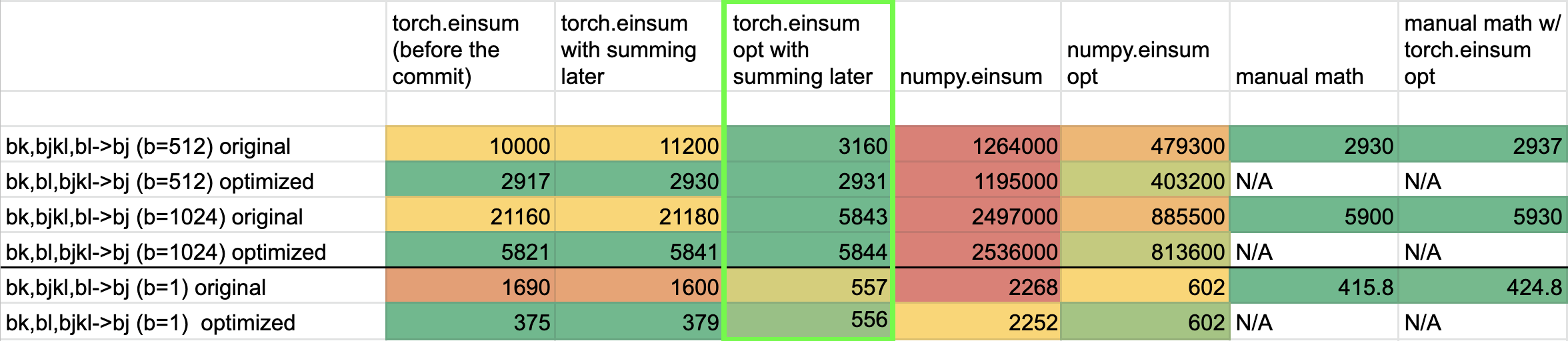
- **torch.einsum with opt_einsum is a definite win for the production case**.
- **torch.einsum with opt_einsum installed is consistently fast, but has an overhead** of needing to find the path. If the path is already found/optimal, it will be slightly slower.
- The einsum overhead decreases for bigger dimensions.
- **torch.einsum without opt_einsum installed is comparable to before this commit**, with occasional slowness potentially due to not reshaping/squeezing as we contract until the end.
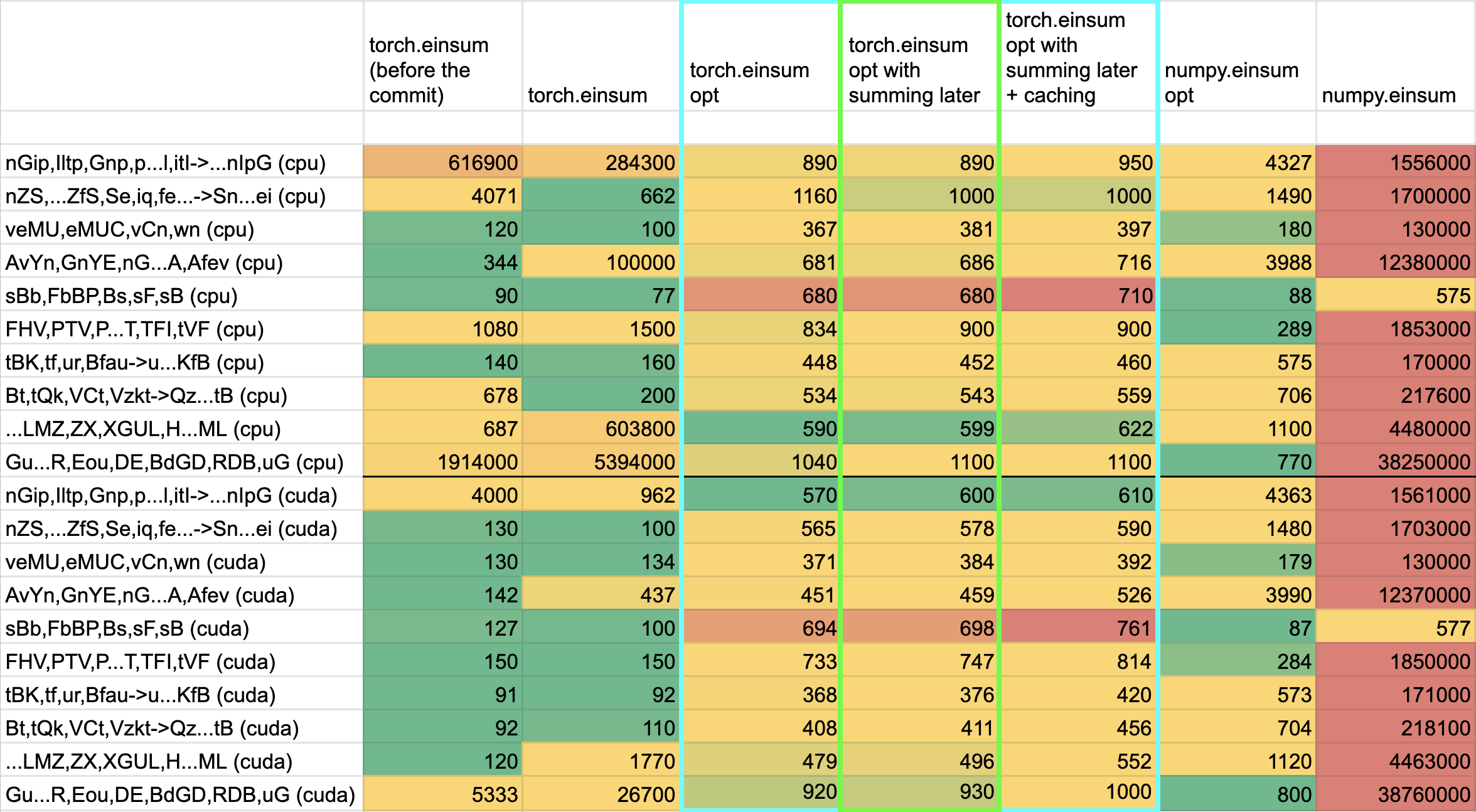
- For many of the random generated cases, the dimensions were too similar and small where an optimal order wasn't that much more optimal than just going left to right. However, in production, dimensions are commonly quite distinct (batch size will be small, but the data will be huge).
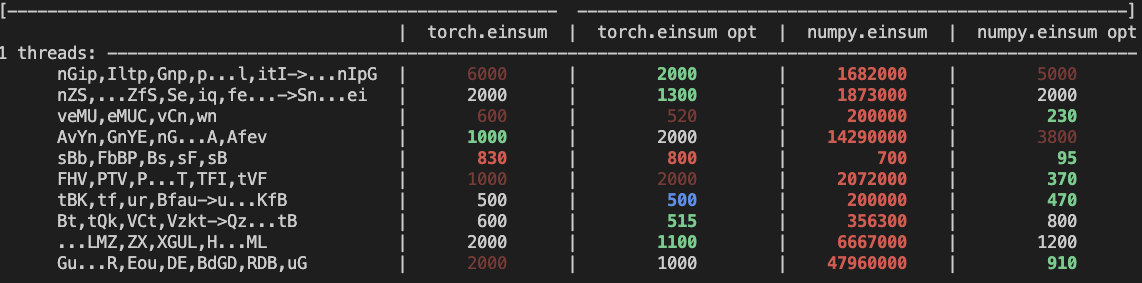
- **torch.einsum opt is comparable (slightly faster overall) compared to numpy.einsum opt for the cpu case**. This is interesting given that torch.einsum currently spends time computing the path, but numpy.einsum takes it as input.
- **torch.einsum opt is significantly faster than numpy.einsum opt for the gpu case**. This is because numpy doesn't take advantage of GPUs.
The following benchmarks were done on an A100 GPU and Linux CPUs. The line in the first chart separates GPU (on top) from CPU, and the line in the second graph separates CPU (on top) and then GPU. Sorry it's flipped 😛 .
Production example (see [colab benchmark](https://colab.research.google.com/drive/1V2s4v1dOOKwRvp5T_DC-PNUosOV9FFJx?authuser=1#scrollTo=WZoQkC8Mdt6I) for more context):
<img width="1176" alt="image" src="https://user-images.githubusercontent.com/31798555/192012636-9a68bfa7-2601-43b1-afeb-b4e0877db6a4.png">
Randomly generated examples (the same ones as in https://github.com/pytorch/pytorch/pull/60191)
<img width="1176" alt="image" src="https://user-images.githubusercontent.com/31798555/192012804-1c639595-b3e6-48c9-a385-ad851c13e1c2.png">
Open below to see old + not super relevant benchmarking results:
<details>
Benchmark results BEFORE this PR (on Linux -- I will update devices so they are consistent later):
<img width="776" alt="image" src="https://user-images.githubusercontent.com/31798555/190807274-18f71fce-556e-47f4-b18c-e0f7d0c0d5aa.png">
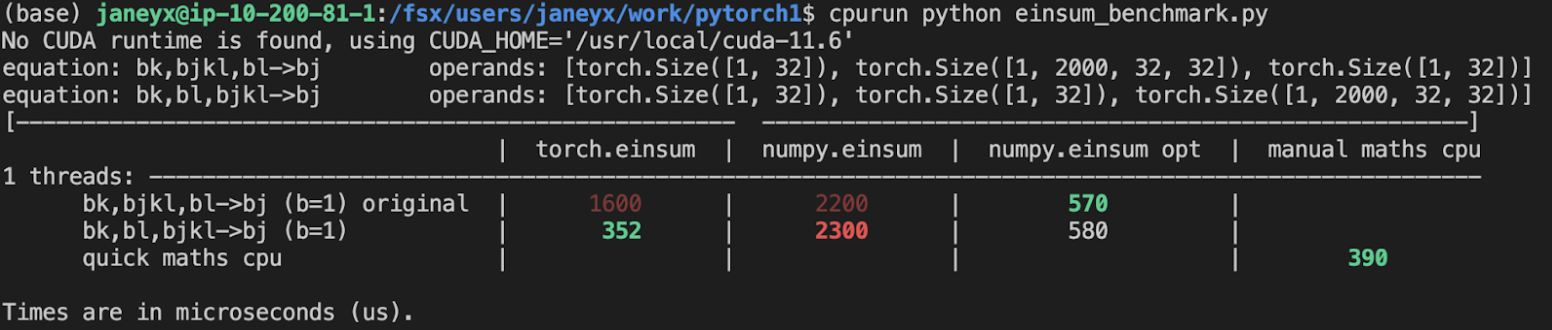
Benchmark results with the code on this PR (on my x86 mac):
For the CPU internal use case --

For the general use case --
It looks like numpy opt still does better in several of these random cases, but torch einsum opt is consistently faster than torch.einsum.
<details>
Pull Request resolved: https://github.com/pytorch/pytorch/pull/84890
Approved by: https://github.com/albanD, https://github.com/soulitzer
`torch.norm` is very odd. Some notable issues are:

- The default value of `"fro"` in `torch.norm` has an odd behaviour when `dim=None`. This is handled in the new dispatch
- The treatment of the `dtype` argument in `torch.norm` was completely wrong. This should fix it
- Some `out=` variants in the previous implementation were also wrong. This should fix those.
- This new dispatch should make some paths much faster. For example, `torch.norm(x)` where `x` is complex.

I'll try to make the changes in these PRs as incremental as possible as this is a tricky one.
Pull Request resolved: https://github.com/pytorch/pytorch/pull/81761
Approved by: https://github.com/ngimel
This is a new version of #15648 based on the latest master branch.

Unlike the previous PR where I fixed a lot of the doctests in addition to integrating xdoctest, I'm going to reduce the scope here. I'm simply going to integrate xdoctest, and then I'm going to mark all of the failing tests as "SKIP". This will let xdoctest run on the dashboards, provide some value, and still let the dashboards pass. I'll leave fixing the doctests themselves to another PR.

In my initial commit, I do the bare minimum to get something running with failing dashboards. The few tests that I marked as skip are causing segfaults. Running xdoctest results in 293 failed, 201 passed tests. The next commits will be to disable those tests. (unfortunately I don't have a tool that will insert the `#xdoctest: +SKIP` directive over every failing test, so I'm going to do this mostly manually.)

Fixes https://github.com/pytorch/pytorch/issues/71105

@ezyang
Pull Request resolved: https://github.com/pytorch/pytorch/pull/82797
Approved by: https://github.com/ezyang
**BC-breaking note**:

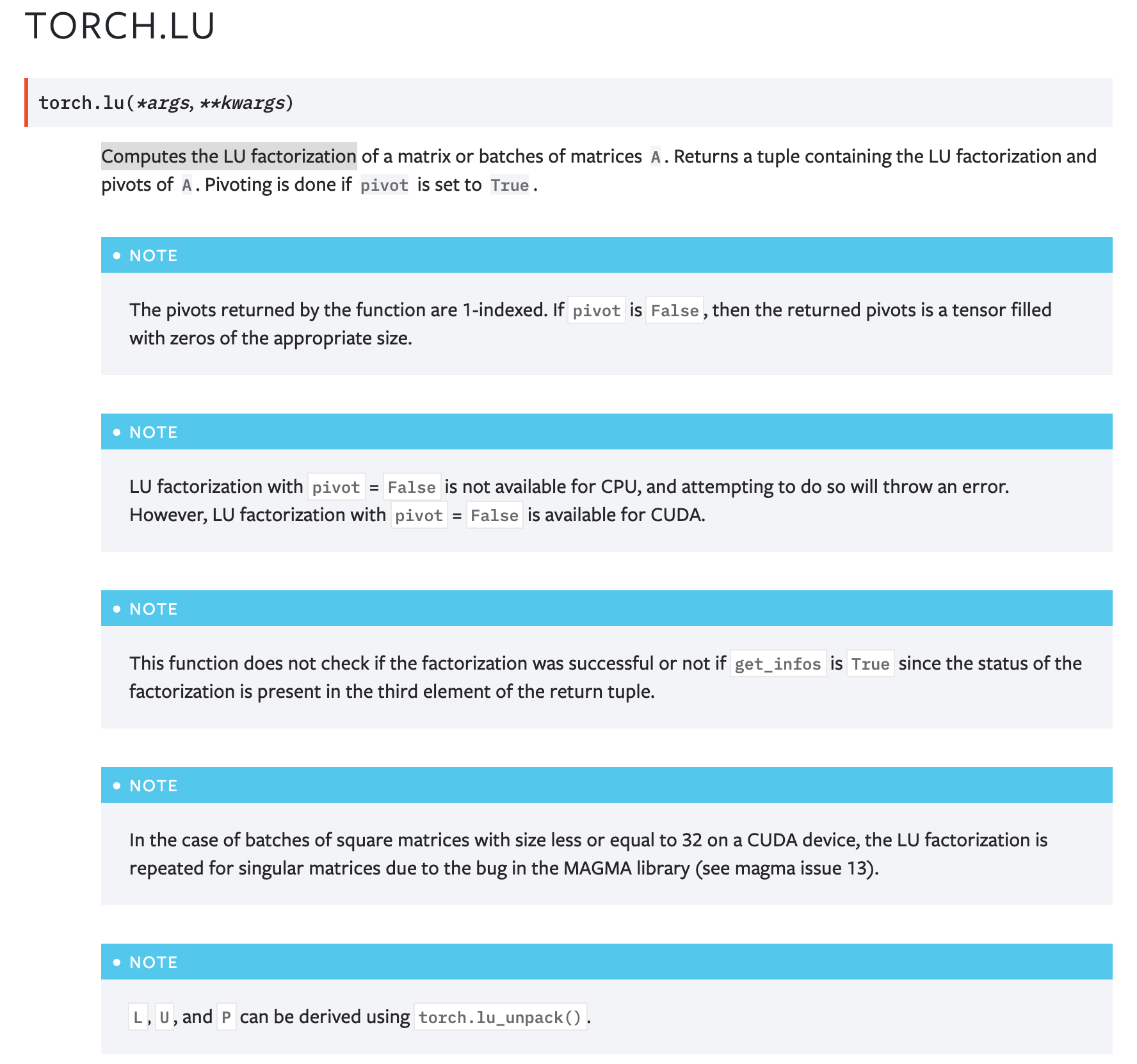
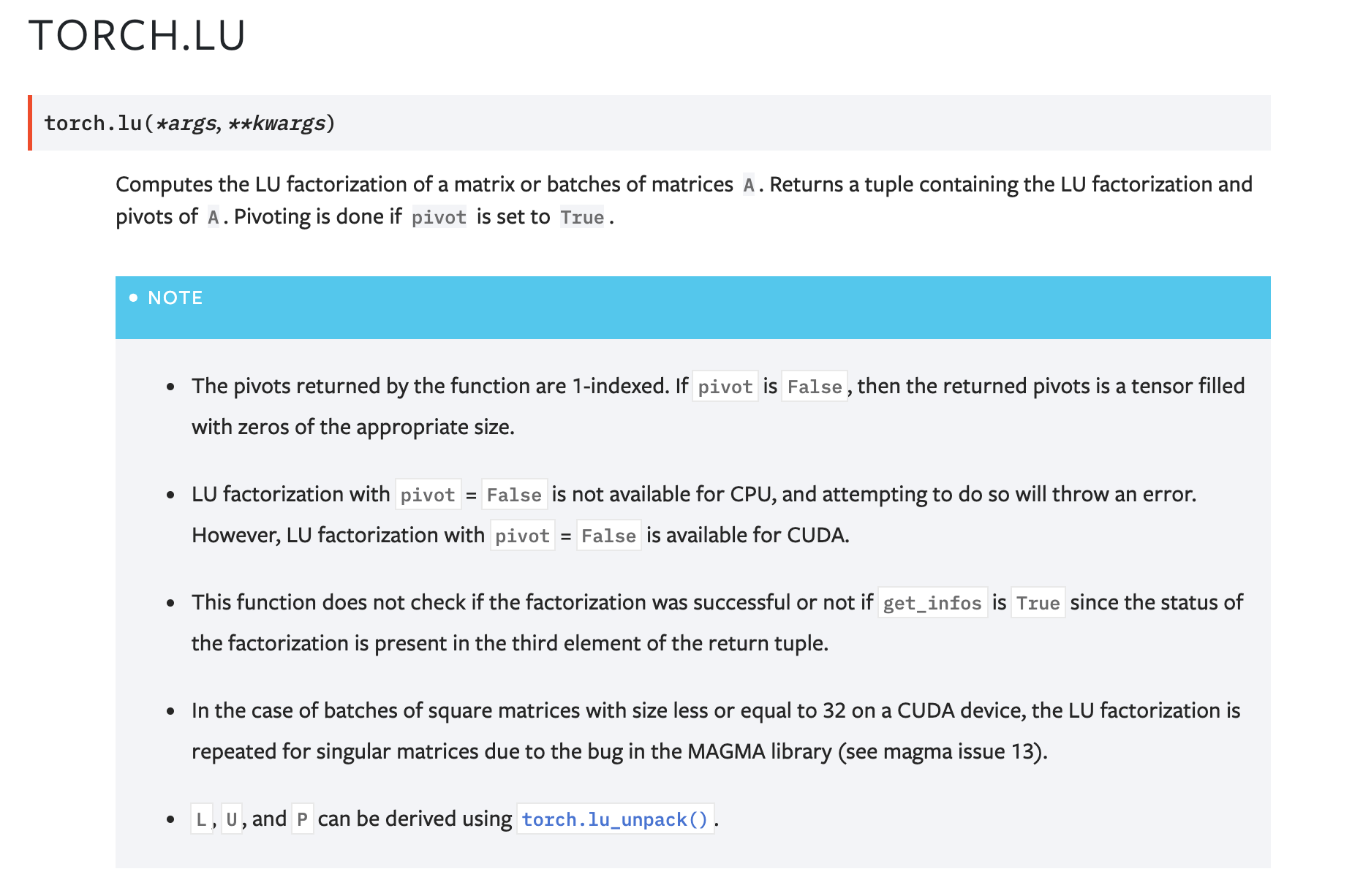
This PR deprecates `torch.lu` in favor of `torch.linalg.lu_factor`.
A upgrade guide is added to the documentation for `torch.lu`.

Note this PR DOES NOT remove `torch.lu`.

Pull Request resolved: https://github.com/pytorch/pytorch/pull/77636

Approved by: https://github.com/malfet
I figured these out by unconditionally turning on a no-op torch function
mode on the test suite and then fixing errors as they showed up.  Here's
what I found:

- _parse_to failed internal assert when __torch_function__'ed because it
  claims its name is "to" to the argument parser; added a name override
  so we know how to find the correct name

- Infix operator magic methods on Tensor did not uniformly handle
  __torch_function__ and TypeError to NotImplemented.  Now, we always
  do the __torch_function__ handling in
  _wrap_type_error_to_not_implemented and your implementation of
  __torch_function__ gets its TypeErrors converted to NotImplemented
  (for better or for worse; see
  https://github.com/pytorch/pytorch/issues/75462 )

- A few cases where code was incorrectly testing if a Tensor was
  Tensor-like in the wrong way, now use is_tensor_like (in grad
  and in distributions).  Also update docs for has_torch_function to
  push people to use is_tensor_like.

- is_grads_batched was dropped from grad in handle_torch_function, now
  fixed

- Report that you have a torch function even if torch function is
  disabled if a mode is enabled.  This makes it possible for a mode
  to return NotImplemented, pass to a subclass which does some
  processing and then pass back to the mode even after the subclass
  disables __torch_function__ (so the tensors are treated "as if"
  they are regular Tensors).  This brings the C++ handling behavior
  in line with the Python behavior.

- Make the Python implementation of overloaded types computation match
  the C++ version: when torch function is disabled, there are no
  overloaded types (because they all report they are not overloaded).

Signed-off-by: Edward Z. Yang <ezyangfb.com>

Pull Request resolved: https://github.com/pytorch/pytorch/pull/75484

Approved by: https://github.com/zou3519
This creates a `histogramdd` operator with overloads matching the `Union`
behaviour used in the functional variant. Moving into C++ is preferred because
it can handle torch function automatically instead of needing to differentiate
between the overloads manually.

This also adds a new return type: `std::tuple<Tensor, std::vector<Tensor>>`. For
which I've updated `wrap` to be completely generic for tuples and removed the
old manual definitions.

Pull Request resolved: https://github.com/pytorch/pytorch/pull/74200

Approved by: https://github.com/ezyang
Summary:
Pull Request resolved: https://github.com/pytorch/pytorch/pull/71993

I've kept the symbol `torch.functional.istft` because it looks like public API,
but it could just as easily be moved to `_torch_docs.py`.

Moving this into its own PR until TorchScript starts recognizing `input`
as a keyword argument.

Test Plan: Imported from OSS

Reviewed By: mrshenli

Differential Revision: D34461399

Pulled By: anjali411

fbshipit-source-id: 3275fb74bef2fa0e030e61f7ee188daf8b5b2acf
(cherry picked from commit 5b4b083de894eba9ab16cea53b77746bcfd0fe32)
Summary:
Pull Request resolved: https://github.com/pytorch/pytorch/pull/72833Closes#72550
The latest version of librosa breaks backward compatibility in two
ways:
- Everything except the input tensor is now keyword-only
- `pad_mode` now defaults to `'constant'` for zero-padding
https://librosa.org/doc/latest/generated/librosa.stft.html
This changes the test to match the old behaior even when using the new
library and updates the documentation to explicitly say that
`torch.stft` doesn't exactly follow the librosa API. This was always
true (`torch.stft` it has new arguments, a different default window
and supports complex input), but it can't hurt to be explicit.
Test Plan: Imported from OSS
Reviewed By: ngimel
Differential Revision: D34386897
Pulled By: mruberry
fbshipit-source-id: 6adc23f48fcb368dacf70602e9197726d6b7e0c1
(cherry picked from commit b5c5ed4196)
Summary:
Pull Request resolved: https://github.com/pytorch/pytorch/pull/66933

This PR exposes `torch.lu` as `torch.linalg.lu_factor` and
`torch.linalg.lu_factor_ex`.

This PR also adds support for matrices with zero elements both in
the size of the matrix and the batch. Note that this function simply
returns empty tensors of the correct size in this case.

We add a test and an OpInfo for the new function.

This PR also adds documentation for this new function in line of
the documentation in the rest of `torch.linalg`.

Fixes https://github.com/pytorch/pytorch/issues/56590
Fixes https://github.com/pytorch/pytorch/issues/64014

cc jianyuh nikitaved pearu mruberry walterddr IvanYashchuk xwang233 Lezcano

Test Plan: Imported from OSS

Reviewed By: gchanan

Differential Revision: D32834069

Pulled By: mruberry

fbshipit-source-id: 51ef12535fa91d292f419acf83b800b86ee9c7eb
Summary:
Pull Request resolved: https://github.com/pytorch/pytorch/pull/66933

This PR exposes `torch.lu` as `torch.linalg.lu_factor` and
`torch.linalg.lu_factor_ex`.

This PR also adds support for matrices with zero elements both in
the size of the matrix and the batch. Note that this function simply
returns empty tensors of the correct size in this case.

We add a test and an OpInfo for the new function.

This PR also adds documentation for this new function in line of
the documentation in the rest of `torch.linalg`.

Fixes https://github.com/pytorch/pytorch/issues/56590
Fixes https://github.com/pytorch/pytorch/issues/64014

cc jianyuh nikitaved pearu mruberry walterddr IvanYashchuk xwang233 Lezcano

Test Plan: Imported from OSS

Reviewed By: albanD

Differential Revision: D32521980

Pulled By: mruberry

fbshipit-source-id: 26a49ebd87f8a41472f8cd4e9de4ddfb7f5581fb
Summary:
Pull Request resolved: https://github.com/pytorch/pytorch/pull/68367

- bmm_test.py was using syntax not allowed in 3.6
- Some suppressions were not placed on the correct line.

With this file,
```
lintrunner --paths-cmd='git grep -Il .'
```
passes successfully.

Test Plan: Imported from OSS

Reviewed By: janeyx99, mrshenli

Differential Revision: D32436644

Pulled By: suo

fbshipit-source-id: ae9300c6593d8564fb326822de157d00f4aaa3c2
Summary:
This is step 3/7 of https://github.com/pytorch/pytorch/issues/50276. It only adds support for the argument but doesn't implement new indexing modes yet.

Pull Request resolved: https://github.com/pytorch/pytorch/pull/62722

Test Plan:
Verified this is not FC breaking by adding logging to both meshgrid
overloads and then called meshgrid twice:

`meshgrid(*tensors)`
  and
`meshgrid(*tensors, indexing='ij')`

This confirmed that the former signature triggered the original native
function and the latter signature triggered the new native function.

Reviewed By: H-Huang

Differential Revision: D30394313

Pulled By: dagitses

fbshipit-source-id: e265cb114d8caae414ee2305dc463b34fdb57fa6
Summary:
Fixes https://github.com/pytorch/pytorch/issues/62793

This is mostly a quick fix. I think the more correct fix could be updating `unique_dim` to `_unique_dim` which could be BC-breaking for C++ users (� maybe). Maybe something else I am missing.

~~Not sure how to add a test for it.~~ Have tested it locally.

We can add a test like following. Tested this locally, it fails currently but passes with the fix.
```python
        def test_wildcard_import(self):
            exec('from torch import *')

```

Pull Request resolved: https://github.com/pytorch/pytorch/pull/63080

Reviewed By: gchanan

Differential Revision: D30738711

Pulled By: zou3519

fbshipit-source-id: b86d0190e45ba0b49fd2cffdcfd2e3a75cc2a35e
Summary:
The PR fixes two issues:
- See https://github.com/pytorch/pytorch/issues/62747 and https://github.com/pytorch/audio/issues/1409. The length mismatch when the given ``length`` parameter is longer than expected. Add padding logic in consistent with librosa.
- See https://github.com/pytorch/pytorch/issues/62323. The current implementations checks if the min value of window_envelop.abs() is greater than zero.  In librosa they normalize the signal on non-zero values by indexing. Like
```
approx_nonzero_indices = ifft_window_sum > util.tiny(ifft_window_sum)
y[approx_nonzero_indices] /= ifft_window_sum[approx_nonzero_indices]
```

Pull Request resolved: https://github.com/pytorch/pytorch/pull/63469

Reviewed By: fmassa

Differential Revision: D30695827

Pulled By: nateanl

fbshipit-source-id: d034e53f0d65b3fd1dbd150c9c5acf3faf25a164
Summary:
torch.norm has a couple documentation issues, like https://github.com/pytorch/pytorch/issues/44552 and https://github.com/pytorch/pytorch/issues/38595, but since it's deprecated this PR simply clarifies that the documentation (and implementation) of torch.norm maybe be incorrect. This should be additional encouragement for users to migrate to torch.linalg.vector_norm and torch.linalg.matrix_norm.

Pull Request resolved: https://github.com/pytorch/pytorch/pull/63310

Reviewed By: ngimel

Differential Revision: D30337997

Pulled By: mruberry

fbshipit-source-id: 0fdcc438f36e4ab29e21e0a64709e4f35a2467ba
Summary:
In one of my previous PRs that rewrite `tensordot` implementation, I mistakenly take empty value of `dims_a` and `dims_b` as illegal values. This turns out to be not true. Empty `dims_a` and `dims_b` are supported, in fact common when `dims` is passed as an integer. This PR removes the unnecessary check.

Fixes https://github.com/pytorch/pytorch/issues/61096

Pull Request resolved: https://github.com/pytorch/pytorch/pull/61331

Reviewed By: eellison

Differential Revision: D29578910

Pulled By: gmagogsfm

fbshipit-source-id: 96e58164491a077ddc7a1d6aa6ccef8c0c9efda2
Summary:
There is a very common error when writing docs: One forgets to write a matching `` ` ``, and something like ``:attr:`x`` is rendered in the docs. This PR fixes most (all?) of these errors (and a few others).

I found these running ``grep -r ">[^#<][^<]*\`"`` on the `docs/build/html/generated` folder. The regex finds an HTML tag that does not start with `#` (as python comments in example code may contain backticks) and that contains a backtick in the rendered HTML.

This regex has not given any false positive in the current codebase, so I am inclined to suggest that we should add this check to the CI. Would this be possible / reasonable / easy to do malfet ?

Pull Request resolved: https://github.com/pytorch/pytorch/pull/60474

Reviewed By: mrshenli

Differential Revision: D29309633

Pulled By: albanD

fbshipit-source-id: 9621e0e9f87590cea060dd084fa367442b6bd046
Summary:
Improved torch.einsum testing and fixed a bug where lower case letters appeared before upper case letters in the sorted order which is inconsistent with NumPy.

Pull Request resolved: https://github.com/pytorch/pytorch/pull/59731

Reviewed By: SplitInfinity, ansley

Differential Revision: D29183078

Pulled By: heitorschueroff

fbshipit-source-id: a33980d273707da2d60a387a2af2fa41527ddb68
Summary:
This PR adds an alternative way of calling `torch.einsum`. Instead of specifying the subscripts as letters in the `equation` parameter, one can now specify the subscripts as a list of integers as in `torch.einsum(operand1, subscripts1, operand2, subscripts2, ..., [subscripts_out])`. This would be equivalent to `torch.einsum('<subscripts1>,<subscripts2>,...,->[<subscript_out>]', operand1, operand2, ...)`

TODO
- [x] Update documentation
- [x] Add more error checking
- [x] Update tests

Pull Request resolved: https://github.com/pytorch/pytorch/pull/56625

Reviewed By: zou3519

Differential Revision: D28062616

Pulled By: heitorschueroff

fbshipit-source-id: ec50ad34f127210696e7c545e4c0675166f127dc
Summary:
Backward methods for `torch.lu` and `torch.lu_solve` require the `torch.lu_unpack` method.
However, while `torch.lu` is a Python wrapper over a native function, so its gradient is implemented via `autograd.Function`,
`torch.lu_solve` is a native function, so it cannot access `torch.lu_unpack` as it is implemented in Python.

Hence this PR presents a native (ATen) `lu_unpack` version. It is also possible to update the gradients for `torch.lu` so that backward+JIT is supported (no JIT for `autograd.Function`) with this function.

~~The interface for this method is different from the original `torch.lu_unpack`, so it is decided to keep it hidden.~~

Pull Request resolved: https://github.com/pytorch/pytorch/pull/46913

Reviewed By: albanD

Differential Revision: D28355725

Pulled By: mruberry

fbshipit-source-id: 281260f3b6e93c15b08b2ba66d5a221314b00e78
Summary:
**BC-breaking note**

This PR updates the deprecation notice for torch.norm to point users to the new torch.linalg.vector_norm and torch.linalg.matrix_norm functions.

Pull Request resolved: https://github.com/pytorch/pytorch/pull/57986

Reviewed By: nikithamalgifb

Differential Revision: D28353625

Pulled By: heitorschueroff

fbshipit-source-id: 5de77d89f0e84945baa5fea91f73918dc7eeafd4
Summary:
This one's easy. I also included a bugfix.

Pull Request resolved: https://github.com/pytorch/pytorch/pull/57735

Reviewed By: bdhirsh

Differential Revision: D28318277

Pulled By: mruberry

fbshipit-source-id: c3c4546a11ba5b555b99ee79b1ce6c0649fa7323
Summary:
Backward methods for `torch.lu` and `torch.lu_solve` require the `torch.lu_unpack` method.
However, while `torch.lu` is a Python wrapper over a native function, so its gradient is implemented via `autograd.Function`,
`torch.lu_solve` is a native function, so it cannot access `torch.lu_unpack` as it is implemented in Python.

Hence this PR presents a native (ATen) `lu_unpack` version. It is also possible to update the gradients for `torch.lu` so that backward+JIT is supported (no JIT for `autograd.Function`) with this function.

~~The interface for this method is different from the original `torch.lu_unpack`, so it is decided to keep it hidden.~~

Pull Request resolved: https://github.com/pytorch/pytorch/pull/46913

Reviewed By: astaff

Differential Revision: D28117714

Pulled By: mruberry

fbshipit-source-id: befd33db12ecc147afacac792418b6f4948fa4a4
Summary:
As this diff shows, currently there are a couple hundred instances of raw `noqa` in the codebase, which just ignore all errors on a given line. That isn't great, so this PR changes all existing instances of that antipattern to qualify the `noqa` with respect to a specific error code, and adds a lint to prevent more of this from happening in the future.

Interestingly, some of the examples the `noqa` lint catches are genuine attempts to qualify the `noqa` with a specific error code, such as these two:
```
test/jit/test_misc.py:27:            print(f"{hello + ' ' + test}, I'm a {test}") # noqa E999
test/jit/test_misc.py:28:            print(f"format blank") # noqa F541
```
However, those are still wrong because they are [missing a colon](https://flake8.pycqa.org/en/3.9.1/user/violations.html#in-line-ignoring-errors), which actually causes the error code to be completely ignored:

- If you change them to anything else, the warnings will still be suppressed.
- If you add the necessary colons then it is revealed that `E261` was also being suppressed, unintentionally:
  ```
  test/jit/test_misc.py:27:57: E261 at least two spaces before inline comment
  test/jit/test_misc.py:28:35: E261 at least two spaces before inline comment
  ```

I did try using [flake8-noqa](https://pypi.org/project/flake8-noqa/) instead of a custom `git grep` lint, but it didn't seem to work. This PR is definitely missing some of the functionality that flake8-noqa is supposed to provide, though, so if someone can figure out how to use it, we should do that instead.

Pull Request resolved: https://github.com/pytorch/pytorch/pull/56272

Test Plan:
CI should pass on the tip of this PR, and we know that the lint works because the following CI run (before this PR was finished) failed:

- https://github.com/pytorch/pytorch/runs/2365189927

Reviewed By: janeyx99

Differential Revision: D27830127

Pulled By: samestep

fbshipit-source-id: d6dcf4f945ebd18cd76c46a07f3b408296864fcb
Summary:
Fixes https://github.com/pytorch/pytorch/issues/54631

I removed the phrase "When `onesided` is the default value `True`". It's not always the default and it's also confusing because it doesn't seem to relate to the bullet points it's introducing. It makes more sense in the sentence before, i.e. these frequencies are included "when the output is onesided". So, I've rewritten it as that meaning and included the correct formula for frequencies.

Pull Request resolved: https://github.com/pytorch/pytorch/pull/54877

Reviewed By: ngimel

Differential Revision: D27562785

Pulled By: mruberry

fbshipit-source-id: d7f36382611e8e176e3370393d1b371d577d46bb
Summary:
As per title.

Numerical stability increased by replacing inverses with solutions to systems of linear triangular equations.

Unblocks computing `torch.det` for FULL-rank inputs of complex dtypes via the LU decomposition once https://github.com/pytorch/pytorch/pull/48125/files is merged:
```
LU, pivots = input.lu()
P, L, U = torch.lu_unpack(LU, pivots)
det_input = P.det() * torch.prod(U.diagonal(0, -1, -2), dim=-1)  # P is not differentiable, so we are fine even if it is complex.
```

Unfortunately, since `lu_backward` is implemented as `autograd.Function`, we cannot support both autograd and scripting at the moment.
The solution would be to move all the lu-related methods to ATen, see https://github.com/pytorch/pytorch/issues/53364.

Resolves https://github.com/pytorch/pytorch/issues/52891
TODOs:
* extend lu_backward for tall/wide matrices of full rank.
* move lu-related functionality to ATen and make it differentiable.
* handle rank-deficient inputs.

Pull Request resolved: https://github.com/pytorch/pytorch/pull/53994

Reviewed By: pbelevich

Differential Revision: D27188529

Pulled By: anjali411

fbshipit-source-id: 8e053b240413dbf074904dce01cd564583d1f064
Summary:
Pull Request resolved: https://github.com/pytorch/pytorch/pull/53424

Fixes https://github.com/pytorch/pytorch/issues/24807 and supersedes the stale https://github.com/pytorch/pytorch/issues/25093 (Cc Microsheep). If you now run the reproduction

```python
import torch

if __name__ == "__main__":
    t = torch.tensor([1, 2, 3], dtype=torch.float64)
```

with `pylint==2.6.0`, you get the following output

```
test_pylint.py:1:0: C0114: Missing module docstring (missing-module-docstring)
test_pylint.py:4:8: E1101: Module 'torch' has no 'tensor' member; maybe 'Tensor'? (no-
member)
test_pylint.py:4:38: E1101: Module 'torch' has no 'float64' member (no-member)
```

Now `pylint` doesn't recognize `torch.tensor` at all, but it is promoted in the stub. Given that it also doesn't recognize `torch.float64`, I think fixing this is out of scope of this PR.

 ---

## TL;DR

This BC-breaking only for users that rely on unintended behavior. Since `torch/__init__.py` loaded `torch/tensor.py` it was populated in `sys.modules`. `torch/__init__.py` then overwrote `torch.tensor` with the actual function. With this `import torch.tensor as tensor` does not fail, but returns the function rather than the module. Users that rely on this import need to change it to `from torch import tensor`.

Reviewed By: zou3519

Differential Revision: D26223815

Pulled By: bdhirsh

fbshipit-source-id: 125b9ff3d276e84a645cd7521e8d6160b1ca1c21
Summary:
This PR addresses [a two-year-old TODO in `test/test_type_hints.py`](12942ea52b/test/test_type_hints.py (L21-L22)) by replacing most of the body of our custom `get_examples_from_docstring` function with [a function from Python's built-in `doctest.DocTestParser` class](https://docs.python.org/3/library/doctest.html#doctest.DocTestParser.get_examples). This mostly made the parser more strict, catching a few errors in existing doctests:

- missing `...` in multiline statements
- missing space after `>>>`
- unmatched closing parenthesis

Also, as shown by [the resulting diff of the untracked `test/generated_type_hints_smoketest.py` file](https://pastebin.com/vC5Wz6M0) (also linked from the test plan below), this introduces a few incidental changes as well:

- standalone comments are no longer preserved
- indentation is now visually correct
- [`example_torch_promote_types`](4da9ceb743/torch/_torch_docs.py (L6753-L6772)) is now present
- an example called `example_torch_tensor___array_priority__` is added, although I can't tell where it comes from
- the last nine lines of code from [`example_torch_tensor_align_as`](5d45140d68/torch/_tensor_docs.py (L386-L431)) are now present
- the previously-misformatted third line from [`example_torch_tensor_stride`](5d45140d68/torch/_tensor_docs.py (L3508-L3532)) is now present

Pull Request resolved: https://github.com/pytorch/pytorch/pull/50596

Test Plan:
Checkout the base commit, typecheck the doctests, and save the generated file:
```
$ python test/test_type_hints.py TestTypeHints.test_doc_examples
$ cp test/generated_type_hints_smoketest.py /tmp
```
Then checkout this PR, do the same thing, and compare:
```
$ python test/test_type_hints.py TestTypeHints.test_doc_examples
$ git diff --no-index {/tmp,test}/generated_type_hints_smoketest.py
```
The test should succeed, and the diff should match [this paste](https://pastebin.com/vC5Wz6M0).

Reviewed By: walterddr

Differential Revision: D25926245

Pulled By: samestep

fbshipit-source-id: 23bc379ff438420e556263c19582dba06d8e42ec
Summary:
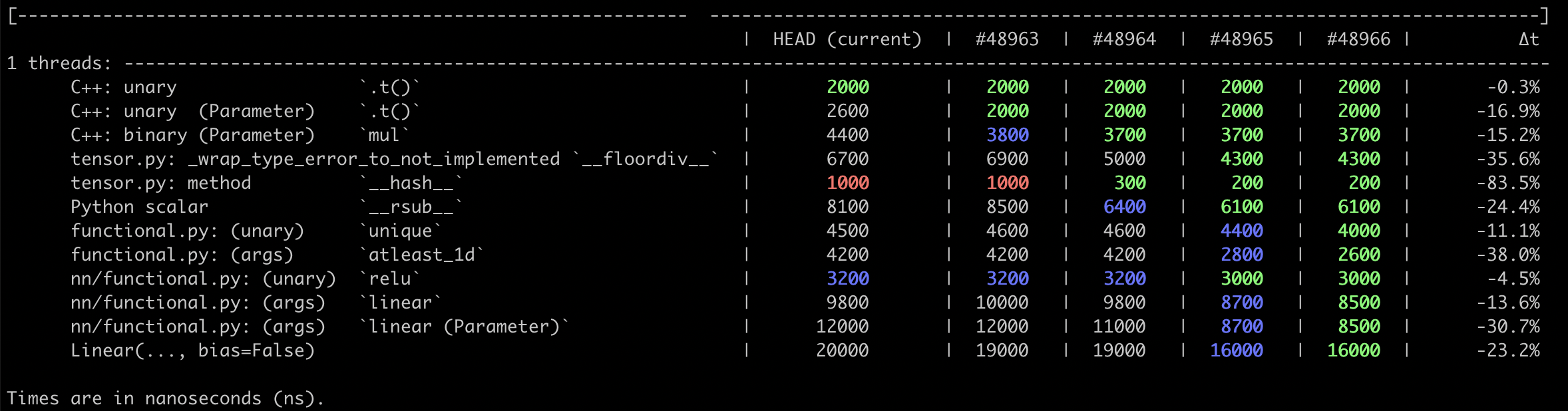
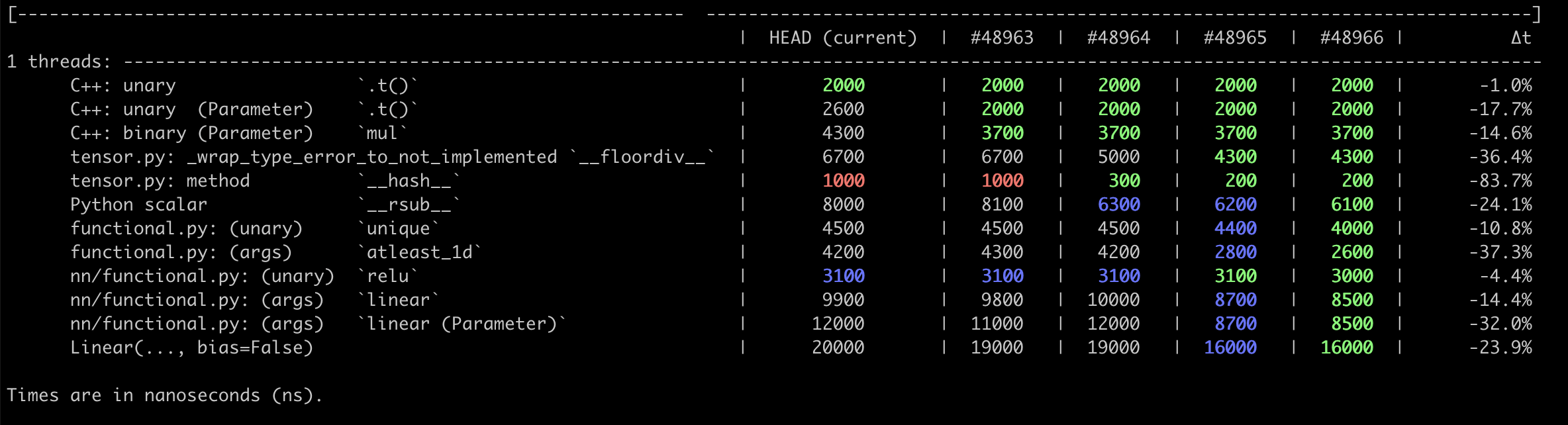
Pull Request resolved: https://github.com/pytorch/pytorch/pull/48965

This PR pulls `__torch_function__` checking entirely into C++, and adds a special `object_has_torch_function` method for ops which only have one arg as this lets us skip tuple construction and unpacking. We can now also do away with the Python side fast bailout for `Tensor` (e.g. `if any(type(t) is not Tensor for t in tensors) and has_torch_function(tensors)`) because they're actually slower than checking with the Python C API.

Test Plan: Existing unit tests. Benchmarks are in #48966

Reviewed By: ezyang

Differential Revision: D25590732

Pulled By: robieta

fbshipit-source-id: 6bd74788f06cdd673f3a2db898143d18c577eb42
Summary:
Pull Request resolved: https://github.com/pytorch/pytorch/pull/49022

**BC-breaking note**:

Previously torch.stft took an optional `return_complex` parameter that indicated whether the output would be a floating point tensor or a complex tensor. By default `return_complex` was False to be consistent with the previous behavior of torch.stft. This PR changes this behavior so `return_complex` is a required argument.

**PR Summary**:

* **#49022 stft: Change require_complex warning to an error**

Test Plan: Imported from OSS

Reviewed By: ngimel

Differential Revision: D25658906

Pulled By: mruberry

fbshipit-source-id: 11932d1102e93f8c7bd3d2d0b2a607fd5036ec5e
Summary:
Pull Request resolved: https://github.com/pytorch/pytorch/pull/49189

This reverts commit d307601365 and fixes the bug with diagonals and ellipsis combined.

Test Plan: Imported from OSS

Reviewed By: glaringlee

Differential Revision: D25540722

Pulled By: heitorschueroff

fbshipit-source-id: 86d0c9a7dcfda600b546457dad102af2ff33e353
Summary:
**BC-breaking note:**

Previously, when given a complex input, `torch.linalg.norm` and `torch.norm` would return a complex output. `torch.linalg.cond` would sometimes return a complex output and sometimes return a real output when given a complex input, depending on its `p` argument. This PR changes this behavior to match `numpy.linalg.norm` and `numpy.linalg.cond`, so that a complex input will result in the downgraded real number type, consistent with NumPy.

**PR Summary:**

The following cases were previously unsupported for complex inputs, and this commit adds support:

- Frobenius norm
- Norm order 2 (vector and matrix)
- CUDA vector norm

Part of https://github.com/pytorch/pytorch/issues/47833

Pull Request resolved: https://github.com/pytorch/pytorch/pull/48284

Reviewed By: H-Huang

Differential Revision: D25420880

Pulled By: mruberry

fbshipit-source-id: 11f6a2f3cad57d66476d30921c3f6ab8f3cd4017
Summary:
Pull Request resolved: https://github.com/pytorch/pytorch/pull/47860
This PR makes torch.einsum compatible with numpy.einsum except for the sublist input option as requested here https://github.com/pytorch/pytorch/issues/21412. It also fixed 2 performance issues linked below and adds a check for reducing to torch.dot instead of torch.bmm which is faster in some cases.
fixes#45854, #37628, #30194, #15671fixes#41467 with benchmark below
```python
import torch
from torch.utils.benchmark import Timer
a = torch.randn(10000, 100, 101, device='cuda')
b = torch.randn(10000, 101, 3, device='cuda')
c = torch.randn(10000, 100, 1, device='cuda')
d = torch.randn(10000, 100, 1, 3, device='cuda')
print(Timer(
stmt='torch.einsum("bij,bjf->bif", a, b)',
globals={'a': a, 'b': b}
).blocked_autorange())
print()
print(Timer(
stmt='torch.einsum("bic,bicf->bif", c, d)',
globals={'c': c, 'd': d}
).blocked_autorange())
```
```
<torch.utils.benchmark.utils.common.Measurement object at 0x7fa37c413850>
torch.einsum("bij,bjf->bif", a, b)
Median: 4.53 ms
IQR: 0.00 ms (4.53 to 4.53)
45 measurements, 1 runs per measurement, 1 thread
<torch.utils.benchmark.utils.common.Measurement object at 0x7fa37c413700>
torch.einsum("bic,bicf->bif", c, d)
Median: 63.86 us
IQR: 1.52 us (63.22 to 64.73)
4 measurements, 1000 runs per measurement, 1 thread
```
fixes#32591 with benchmark below
```python
import torch
from torch.utils.benchmark import Timer
a = torch.rand(1, 1, 16, 2, 16, 2, 16, 2, 2, 2, 2, device="cuda")
b = torch.rand(729, 1, 1, 2, 1, 2, 1, 2, 2, 2, 2, device="cuda")
print(Timer(
stmt='(a * b).sum(dim = (-3, -2, -1))',
globals={'a': a, 'b': b}
).blocked_autorange())
print()
print(Timer(
stmt='torch.einsum("...ijk, ...ijk -> ...", a, b)',
globals={'a': a, 'b': b}
).blocked_autorange())
```
```
<torch.utils.benchmark.utils.common.Measurement object at 0x7efe0de28850>
(a * b).sum(dim = (-3, -2, -1))
Median: 17.86 ms
2 measurements, 10 runs per measurement, 1 thread
<torch.utils.benchmark.utils.common.Measurement object at 0x7efe0de286a0>
torch.einsum("...ijk, ...ijk -> ...", a, b)
Median: 296.11 us
IQR: 1.38 us (295.42 to 296.81)
662 measurements, 1 runs per measurement, 1 thread
```
TODO
- [x] add support for ellipsis broadcasting
- [x] fix corner case issues with sumproduct_pair
- [x] update docs and add more comments
- [x] add tests for error cases
Test Plan: Imported from OSS
Reviewed By: mruberry
Differential Revision: D24923679
Pulled By: heitorschueroff
fbshipit-source-id: 47e48822cd67bbcdadbdfc5ffa25ee8ba4c9620a
Summary:
Fixes https://github.com/pytorch/pytorch/issues/43837

This adds a `torch.broadcast_shapes()` function similar to Pyro's [broadcast_shape()](7c2c22c10d/pyro/distributions/util.py (L151)) and JAX's [lax.broadcast_shapes()](https://jax.readthedocs.io/en/test-docs/_modules/jax/lax/lax.html). This helper is useful e.g. in multivariate distributions that are parameterized by multiple tensors and we want to `torch.broadcast_tensors()` but the parameter tensors have different "event shape" (e.g. mean vectors and covariance matrices). This helper is already heavily used in Pyro's distribution codebase, and we would like to start using it in `torch.distributions`.

- [x] refactor `MultivariateNormal`'s expansion logic to use `torch.broadcast_shapes()`
- [x] add unit tests for `torch.broadcast_shapes()`
- [x] add docs

cc neerajprad

Pull Request resolved: https://github.com/pytorch/pytorch/pull/43935

Reviewed By: bdhirsh

Differential Revision: D25275213

Pulled By: neerajprad

fbshipit-source-id: 1011fdd597d0a7a4ef744ebc359bbb3c3be2aadc
Summary:
Pull Request resolved: https://github.com/pytorch/pytorch/pull/46398
This PR makes torch.einsum compatible with numpy.einsum except for the sublist input option as requested here https://github.com/pytorch/pytorch/issues/21412. It also fixed 2 performance issues linked below and adds a check for reducing to torch.dot instead of torch.bmm which is faster in some cases.
fixes#45854, #37628, #30194, #15671fixes#41467 with benchmark below
```python
import torch
from torch.utils.benchmark import Timer
a = torch.randn(10000, 100, 101, device='cuda')
b = torch.randn(10000, 101, 3, device='cuda')
c = torch.randn(10000, 100, 1, device='cuda')
d = torch.randn(10000, 100, 1, 3, device='cuda')
print(Timer(
stmt='torch.einsum("bij,bjf->bif", a, b)',
globals={'a': a, 'b': b}
).blocked_autorange())
print()
print(Timer(
stmt='torch.einsum("bic,bicf->bif", c, d)',
globals={'c': c, 'd': d}
).blocked_autorange())
```
```
<torch.utils.benchmark.utils.common.Measurement object at 0x7fa37c413850>
torch.einsum("bij,bjf->bif", a, b)
Median: 4.53 ms
IQR: 0.00 ms (4.53 to 4.53)
45 measurements, 1 runs per measurement, 1 thread
<torch.utils.benchmark.utils.common.Measurement object at 0x7fa37c413700>
torch.einsum("bic,bicf->bif", c, d)
Median: 63.86 us
IQR: 1.52 us (63.22 to 64.73)
4 measurements, 1000 runs per measurement, 1 thread
```
fixes#32591 with benchmark below
```python
import torch
from torch.utils.benchmark import Timer
a = torch.rand(1, 1, 16, 2, 16, 2, 16, 2, 2, 2, 2, device="cuda")
b = torch.rand(729, 1, 1, 2, 1, 2, 1, 2, 2, 2, 2, device="cuda")
print(Timer(
stmt='(a * b).sum(dim = (-3, -2, -1))',
globals={'a': a, 'b': b}
).blocked_autorange())
print()
print(Timer(
stmt='torch.einsum("...ijk, ...ijk -> ...", a, b)',
globals={'a': a, 'b': b}
).blocked_autorange())
```
```
<torch.utils.benchmark.utils.common.Measurement object at 0x7efe0de28850>
(a * b).sum(dim = (-3, -2, -1))
Median: 17.86 ms
2 measurements, 10 runs per measurement, 1 thread
<torch.utils.benchmark.utils.common.Measurement object at 0x7efe0de286a0>
torch.einsum("...ijk, ...ijk -> ...", a, b)
Median: 296.11 us
IQR: 1.38 us (295.42 to 296.81)
662 measurements, 1 runs per measurement, 1 thread
```
TODO
- [x] add support for ellipsis broadcasting
- [x] fix corner case issues with sumproduct_pair
- [x] update docs and add more comments
- [x] add tests for error cases
Test Plan: Imported from OSS
Reviewed By: malfet
Differential Revision: D24860367
Pulled By: heitorschueroff
fbshipit-source-id: 31110ee598fd598a43acccf07929b67daee160f9
Summary:
Fixes https://github.com/pytorch/pytorch/issues/40869

Resubmit of https://github.com/pytorch/pytorch/pull/33818.

Adds support for `list()` by desugaring  it to a list comprehension.

Last time I landed this it made one of the tests slow, and got unlanded. I think that's bc the previous PR changed the emission of `list()` on a list input or a str input to a list comprehension, which is the more general way of emitting `list()`, but also a little bit slower. I updated this version to emit to the builtin operators for these two case. Hopefully it can land without being reverted this time...

Pull Request resolved: https://github.com/pytorch/pytorch/pull/42382

Reviewed By: navahgar

Differential Revision: D24767674

Pulled By: eellison

fbshipit-source-id: a1aa3d104499226b28f47c3698386d365809c23c
Summary:
As per title. Limitations: only for batches of squared full-rank matrices.

CC albanD

Pull Request resolved: https://github.com/pytorch/pytorch/pull/46284

Reviewed By: zou3519

Differential Revision: D24448266

Pulled By: albanD

fbshipit-source-id: d98215166268553a648af6bdec5a32ad601b7814
Summary:
* Removes incorrect statement that "the vector norm will be applied to the last dimension".
* More clearly describe each different combination of `p`, `ord`, and input size.
* Moves norm tests from `test/test_torch.py` to `test/test_linalg.py`
* Adds test ensuring that `p='fro'` and `p=2` give same results for mutually valid inputs

Fixes https://github.com/pytorch/pytorch/issues/41388

Pull Request resolved: https://github.com/pytorch/pytorch/pull/42696

Reviewed By: bwasti

Differential Revision: D23876862

Pulled By: mruberry

fbshipit-source-id: 36f33ccb6706d5fe13f6acf3de8ae14d7fbdff85
Summary:
This PR makes the deprecation warnings for existing fft functions more prominent and makes the torch.stft deprecation warning consistent with our current deprecation planning.

Pull Request resolved: https://github.com/pytorch/pytorch/pull/45409

Reviewed By: ngimel

Differential Revision: D23974975

Pulled By: mruberry

fbshipit-source-id: b90d8276095122ac3542ab625cb49b991379c1f8