Moving DTensor to be in the public namespace, to formally add the
documentation page that includes all the public APIs. This includes:

* many path renames and path import fixes
* a dedicated doc page without too much content yet (adding in the next
  PRs)
* To preserve the BC for users still using the `torch.distributed._tensor`,
  I added a shim script to redirect old path calls to the new module

The BC preserving is evidented by the fact that all DTensor tests are still
working without changing the public imports. So it's safe to land the
changes

Pull Request resolved: https://github.com/pytorch/pytorch/pull/133113
Approved by: https://github.com/XilunWu
ghstack dependencies: #133305, #133306
Loss parallel is the last piece of sequence parallelism to enable. It enables efficient distributed cross entropy computation when the input is sharded on the class dimension (in a classification problem with many classes). The implementation is via a context manager `loss_parallel`, after enabling which users can directly use `torch.nn.functional.cross_entropy` or `torch.nn.CrossEntropyLoss` without modifying other parts of their code.
Here are the underlying rationales why we are going through these op replacements:
1. `nn.functional.cross_entropy` is the common method that OSS user is using for things like transformer training, to avoid changing user code, we want user to still use this function for loss calculation if they are already using it.
2. `nn.functional.cross_entropy` boils down into `aten.log_softmax` and `aten.nll_loss_foward/backward`, and DTensor now supports those ops already (#117723#119255#118917#119256). They are doing computation with input *replicated* on the class dimension.
3. However when the input of this loss calculation is **sharded on the class dimension**, to run sharded computation efficiently, we need to run both `aten.log_softmax` and `aten.nll_loss_foward` with multiple all-reduce collectives **in the middle of** those aten ops. This is not possible if we are just overriding these two ops, so we need to have some way to **decompose** these two ops into smaller ops to have collectives run in the middle of these two ops.
4. We explored the existing decompositions (#118950). It seems working, except that `log_softmax_backward` and `nll_loss_backward` combined together in aten are implemented in a inefficient way, which would trigger an additional expensive collective. Recently some user also reported similar issues https://github.com/pytorch/pytorch/issues/119261.
5. Therefore, currently we are doing our own decomposition inside a context manager for sequence parallelism specifically. Once we have a better decomposition in core, we can possibly take that instead of reinventing the wheels here.
Pull Request resolved: https://github.com/pytorch/pytorch/pull/119877
Approved by: https://github.com/wanchaol
Summary:

Rename _device_mesh.py to device_mesh.py, update all callsites, add documentation.
We created stubs for public class and methods in torch.distributed.device_mesh so that torch.distributed.device_mesh can be imported with or without distributed is available().

Original diff reverted: D51629761
Original PR reverted: https://github.com/pytorch/pytorch/pull/115099
Prior to landing, CI signals are all passed. Shipit added the "ci/trunk" label to the PR and DID NOT wait for it and went ahead committing. More context can be found in the reverted PR above.

Test Plan: CI.

Differential Revision: D51861018

Pull Request resolved: https://github.com/pytorch/pytorch/pull/115193
Approved by: https://github.com/fegin
Adds a useful high level wrapper for calling `dist.save/load` with the correct storage readers and writers.

Instead of doing:

```
DCP.save(
    state_dict={...},
    storage_writer=StorageWriter(...)
)

DCP.load(
    state_dict={...},
    storage_reader=StorageReader(...)
)
```

We can now do:

```
checkpointer = Checkpointer(...)

checkpointer.save(state_dict={...})
checkpointer.load(state_dict={...})
```

Pull Request resolved: https://github.com/pytorch/pytorch/pull/114603
Approved by: https://github.com/fegin, https://github.com/wz337
Summary:
Documenting the `Work` object

For a collective (broadcast, all_reduce, etc.) when async_op=True we return a `Work` object to which users can call `.wait()`, `.is_success()`, among other things but this class is not documented

Test Plan: Preview the docs build in OSS

Differential Revision: D51854974

Pull Request resolved: https://github.com/pytorch/pytorch/pull/115172
Approved by: https://github.com/wconstab
Summary:
Rename _device_mesh.py to device_mesh.py, update all callsites, adds documentation.

Original diff reverted: D51629761
Original PR reverted: https://github.com/pytorch/pytorch/pull/114991
It was failing because failing a public module binding tests in MacOS, and this is due to the change in import order for torch/distributed/fsdp/_common_utils.py. Since this original import would still work, we remove the changes in this file.

Test Plan: CI.

Differential Revision: D51825114

Pull Request resolved: https://github.com/pytorch/pytorch/pull/115099
Approved by: https://github.com/wanchaol, https://github.com/fegin
Add non-package python modules to the public API checks.
The original change is to remove the `ispkg` check in this line
https://github.com/pytorch/pytorch/blob/main/docs/source/conf.py#L518

Everything else is to add the appropriate modules to the rst files, make sure every module we provide can be imported (fixed by either making optional dependencies optional or just deleting files that have been un-importable for 3 years), make API that are both modules and functions (like torch.autograd.gradcheck) properly rendered on the docs website without confusion and add every non-documented API to the allow list (~3k of them).

Next steps will be to try and fix these missing docs
Pull Request resolved: https://github.com/pytorch/pytorch/pull/110568
Approved by: https://github.com/zou3519
We have a plethora of error types for various errors raised from c10d. These include `RuntimeError`, `TimeoutError`, `SocketError`, `DistBackendError` etc.

This results in messy code during error handling somewhat like this:
```
if "NCCL" in exception_str:
  ...
if "Timed out initializing process group in store based barrier on rank" in exception_str:
  ...
if "The client socket has timed out after" in exception_str:
  ...
if "Broken pipe" in exception_str:
  ...
if "Connection reset by peer" in exception_str:
  ...
```

To address this issue, in this PR I've ensured added these error types:

1. **DistError** - the base type of all distributed errors
2. **DistBackendError** - this already existed and referred to PG backend errors
3. **DistStoreError** - for errors originating from the store
4. **DistNetworkError** - for general network errors coming from the socket library

Pull Request resolved: https://github.com/pytorch/pytorch/pull/108191
Approved by: https://github.com/H-Huang
We have a plethora of error types for various errors raised from c10d. These include `RuntimeError`, `TimeoutError`, `SocketError`, `DistBackendError` etc.

This results in messy code during error handling somewhat like this:
```
if "NCCL" in exception_str:
  ...
if "Timed out initializing process group in store based barrier on rank" in exception_str:
  ...
if "The client socket has timed out after" in exception_str:
  ...
if "Broken pipe" in exception_str:
  ...
if "Connection reset by peer" in exception_str:
  ...
```

To address this issue, in this PR I've ensured added these error types:

1. **DistError** - the base type of all distributed errors
2. **DistBackendError** - this already existed and referred to PG backend errors
3. **DistStoreError** - for errors originating from the store
4. **DistNetworkError** - for general network errors coming from the socket library
Pull Request resolved: https://github.com/pytorch/pytorch/pull/107651
Approved by: https://github.com/H-Huang
Currently all of the distributed errors are thrown from the `TORCH_CHECK` macro which throws a generic `RuntimeError`. This change introduced a new error type `DistBackendError` which derives from `RuntimeError` to signify there was an error with the backend communication library. This allows for better error handling and analysis at higher levels in the stack. Motivation: https://docs.google.com/document/d/1j6VPOkC6znscliFuiDWMuMV1_fH4Abgdq7TCHMcXai4/edit#heading=h.a9rc38misyx8

Changes:
- introduce new error type
- Update `C10D_NCCL_CHECK`

Sample script to demonstrate new error type

```python
# python -m torch.distributed.run --nproc_per_node=2 <script>.py

import torch
import torch.distributed as dist

if __name__ == "__main__":
    dist.init_process_group("nccl")
    dist.broadcast(torch.tensor([1, 2, 3]).cuda(), 0)
```

Differential Revision: [D40998803](https://our.internmc.facebook.com/intern/diff/D40998803)
Pull Request resolved: https://github.com/pytorch/pytorch/pull/88134
Approved by: https://github.com/rohan-varma
### Deprecation reasons:
- For most users training is on one GPU per process so these APIs are rarely used
- They added one more API dimension
- They can be expressed in a composed manner
- They are not abstracted – specific to GPU
- They caused backend APIs and implementations to have nested `std::vector<std::vector<Tensor>>`, which is hard to read or maintain

Pull Request resolved: https://github.com/pytorch/pytorch/pull/85961
Approved by: https://github.com/XilunWu, https://github.com/H-Huang
### Description
- This PR renames `_all_gather_base` to `all_gather_into_tensor` so that it is clearer in meaning.
- The `all_gather_into_tensor` API differs from the `all_gather` API in the output it accepts -- a single, large tensor instead of a list of tensors.
- This PR also adds deprecation warning to `_all_gather_base`.

### Issue
`_all_gather_base` was implemented in https://github.com/pytorch/pytorch/pull/33924 to avoid unnecessary flattening. There was previous effort (#82639) to merge `_all_gather_base` with the existing `all_gather` API by detecting the parameter type passed in for the output.

There are, however, two "blockers" that make the merge difficult:
(i) The merge leads to backward compatibility break. We would need to change the parameter name `tensor_list` in `all_gather` to a general name `output` that can cover both tensor and tensor list.
(ii) Recently, the `all_gather` API has added uneven tensor support, utilizing the tensor boundaries implied by the list. We are, however, not sure to add such support to the `_all_gather_base` function, because that would require users to pass in additional tensor boundary information.

In view of the above, we decided to productize `_all_gather_base` as a separate function, but with a clearer name.

### Testing
Added tests:
- `test_all_gather_into_cat_tensor_cuda` -- output form as with `torch.cat`. For example:
```
        >>> tensor_in
        tensor([1, 2], device='cuda:0') # Rank 0
        tensor([3, 4], device='cuda:1') # Rank 1
        >>> tensor_out
        tensor([1, 2, 3, 4], device='cuda:0') # Rank 0
        tensor([1, 2, 3, 4], device='cuda:1') # Rank 1
```
- `test_all_gather_into_stack_tensor_cuda` -- output form as with `torch.stack`. For example:
```
        >>> tensor_out2
        tensor([[1, 2],
                [3, 4]], device='cuda:0') # Rank 0
        tensor([[1, 2],
                [3, 4]], device='cuda:1') # Rank 1
```
The output form is determined by the shape of the output tensor passed by the user, no flag used.

Cc @rohan-varma @mrshenli @crcrpar @ptrblck @H-Huang
Pull Request resolved: https://github.com/pytorch/pytorch/pull/85686
Approved by: https://github.com/rohan-varma, https://github.com/crcrpar
Summary:
Pull Request resolved: https://github.com/pytorch/pytorch/pull/74006

updated recommendations about environment variables to use during debug
and performance tuning

Test Plan: `make html`

Reviewed By: rohan-varma

Differential Revision: D34767454

fbshipit-source-id: 08cd58469bf72b58702e50e82020fa19b43b5911
(cherry picked from commit ac7e6630f8043f85d3d16be17c6a8ad1ebb2990c)
Summary:
Working towards https://docs.google.com/document/d/10yx2-4gs0gTMOimVS403MnoAWkqitS8TUHX73PN8EjE/edit?pli=1#

This PR:
- Ensure that all the submodules are listed in a rst file (that ensure they are considered by the coverage tool)
- Remove some long deprecated code that just error out on import
- Remove the allow list altogether to ensure nothing gets added back there

Pull Request resolved: https://github.com/pytorch/pytorch/pull/73983

Reviewed By: anjali411

Differential Revision: D34787908

Pulled By: albanD

fbshipit-source-id: 163ce61e133b12b2f2e1cbe374f979e3d6858db7
(cherry picked from commit c9edfead7a01dc45bfc24eaf7220d2a84ab1f62e)
Summary:
Pull Request resolved: https://github.com/pytorch/pytorch/pull/73361

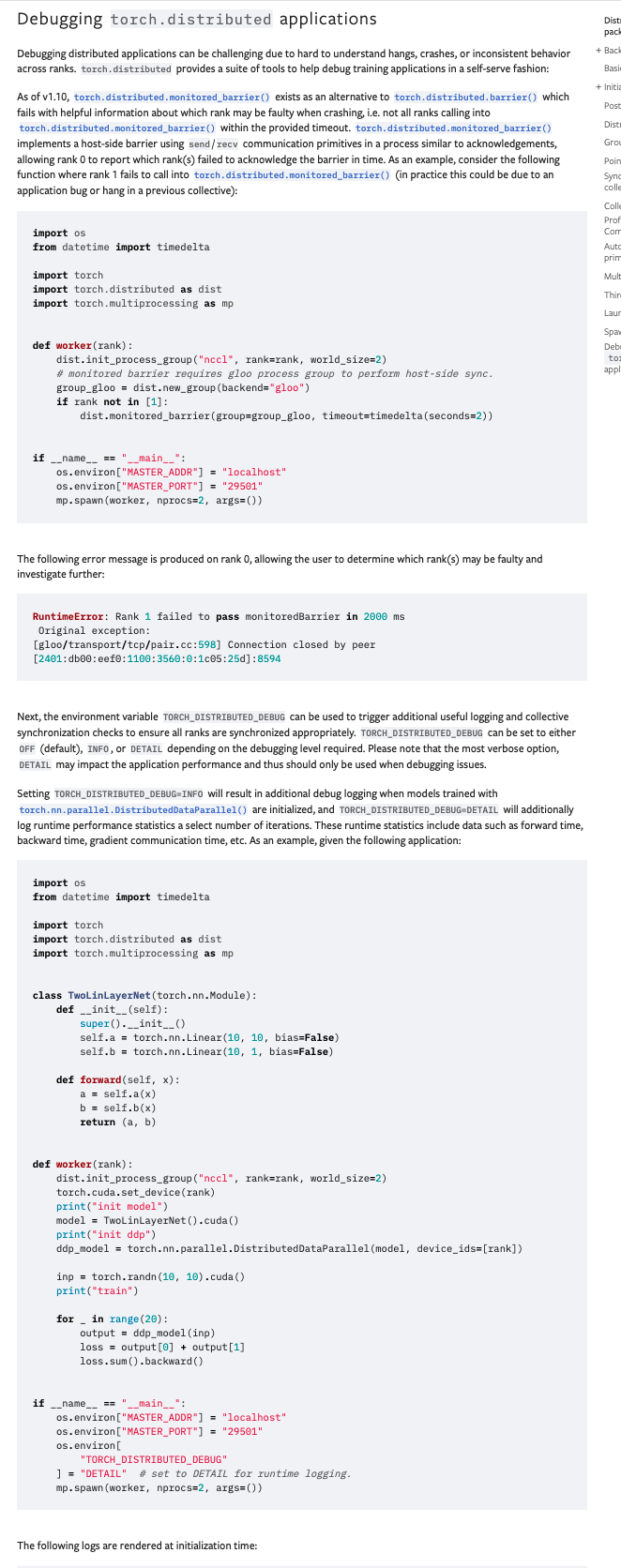
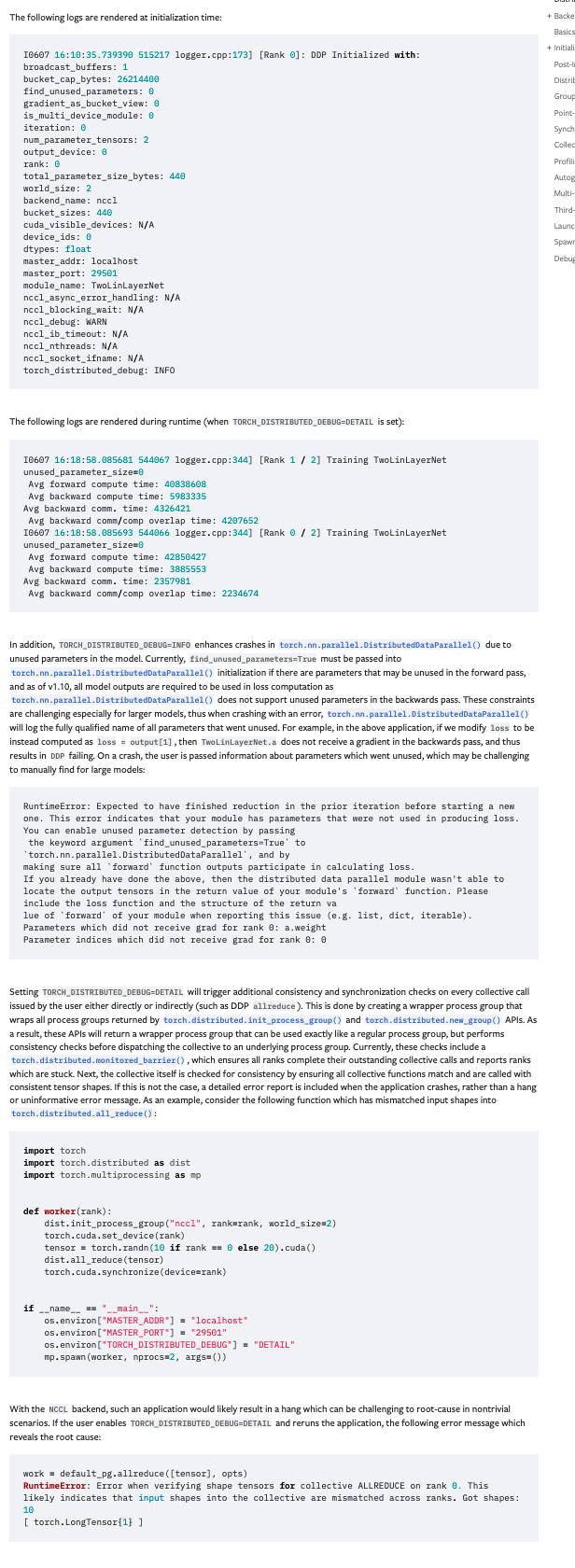
This PR adds the documentation for the newly introduced `TORCH_CPP_LOG_LEVEL` and how it can be used along with `TORCH_DISTRIBUTED_DEBUG` to adjust the log level of c10d.
ghstack-source-id: 149874995

Test Plan: Locally rendered and checked the documentation.

Reviewed By: rohan-varma

Differential Revision: D34452352

fbshipit-source-id: ecb54590f3030ddef9921a7152ca9f7fc9438345
(cherry picked from commit f4c7c6f3b27dbd3006686cf26a6e9e53cd2c8f09)
Summary:
Pull Request resolved: https://github.com/pytorch/pytorch/pull/73166

This PR refactors, cleans up, and optimizes the implementation of `TORCH_DISTRIBUTED_DEBUG`. It also introduces three new user APIs: `get_debug_level()`, `set_debug_level()`, and `set_debug_level_from_env()` to retrieve and modify the debug level after a process has started.
ghstack-source-id: 149778566

Test Plan: Run the existing unit tests.

Reviewed By: rohan-varma

Differential Revision: D34371226

fbshipit-source-id: e18443b411adcbaf39b2ec999178c198052fcd5b
(cherry picked from commit 26d6bb1584b83a0490d8b766482656a5887fa21d)
Summary:
Pull Request resolved: https://github.com/pytorch/pytorch/pull/66745

This PR implement NCCL gather and add gather to ProcessGroupNCCL using nccl send/recv api.

NCCL doesn’t directly provide primitives for gather, so we need to be implemented on top of NCCL’s send/recv API.
1. In ProcessGroupNCCL.cpp, the outputTensors are first flattened, then inputTensors and outputFlattened are passed by the collective class to gather() function in nccl.cpp.
1. In nccl.cpp, gather is implemented using ncclSend/ncclRecv: all the ranks send inputTensor to the root rank, and the root rank uses a for loop to receive these inputTensors.
ghstack-source-id: 147754838

Test Plan:
test_gather_ops
test_gather_checks
test_gather_stress

Reviewed By: pritamdamania87

Differential Revision: D29616361

fbshipit-source-id: b500d9b8e67113194c5cc6575fb0e5d806dc7782
(cherry picked from commit d560ee732e)
Summary:
These APIs are not yet officially released and are still under discussion. Hence, this commit removes those APIs from docs and will add them back when ready.

cc pietern mrshenli pritamdamania87 zhaojuanmao satgera rohan-varma gqchen aazzolini osalpekar jiayisuse SciPioneer H-Huang

Pull Request resolved: https://github.com/pytorch/pytorch/pull/69011

Reviewed By: fduwjj

Differential Revision: D32703124

Pulled By: mrshenli

fbshipit-source-id: ea049fc7ab6b0015d38cc40c5b5daf47803b7ea0
Summary:
Pull Request resolved: https://github.com/pytorch/pytorch/pull/63910

Addresses the current issue that `init_method=tcp://` is not compatible with `torch.distributed.run` and `torch.distributed.launch`. When running with a training script that initializes the process group with `init_method=tcp://localhost:$port` as such:

```
$ python -u -m torch.distributed.run --max_restarts 0 --nproc_per_node 1 --nnodes 1 --master_addr $(hostname) --master_port 6000 ~/tmp/test.py
```

An `Address in use` error is raised since the training script tries to create a TCPStore on port 6000, which is already taken since the elastic agent is already running a TCPStore on that port.

For details see: https://github.com/pytorch/pytorch/issues/63874.

This change does a couple of things:

1. Adds `is_torchelastic_launched()` check function that users can use in the training scripts to see whether the script is launched via torchelastic.
1. Update the `torch.distributed` docs page to include the new `is_torchelastic_launched()` function.
1. Makes `init_method=tcp://` torchelastic compatible by modifying `_tcp_rendezvous_handler` in `torch.distributed.rendezvous` (this is NOT the elastic rendezvous, it is the old rendezvous module which is slotted for deprecation in future releases) to check `is_torchelastic_launched()` AND `torchelastic_use_agent_store()` and if so, only create TCPStore clients (no daemons, not even for rank 0).
1. Adds a bunch of unittests to cover the different code paths

NOTE: the issue mentions that we should fail-fast with an assertion on `init_method!=env://` when `is_torchelastic_launched()` is `True`. There are three registered init_methods in pytorch: env://, tcp://, file://. Since this diff makes tcp:// compatible with torchelastic and I've validated that file is compatible with torchelastic. There is no need to add assertions. I did update the docs to point out that env:// is the RECOMMENDED init_method. We should probably deprecate the other init_methods in the future but this is out of scope for this issue.

Test Plan: Unittests.

Reviewed By: cbalioglu

Differential Revision: D30529984

fbshipit-source-id: 267aea6d4dad73eb14a2680ac921f210ff547cc5
Summary:
Will not land before the release, but would be good to have this function documented in master for its use in distributed debugability.

Pull Request resolved: https://github.com/pytorch/pytorch/pull/58322

Reviewed By: SciPioneer

Differential Revision: D28595405

Pulled By: rohan-varma

fbshipit-source-id: fb00fa22fbe97a38c396eae98a904d1c4fb636fa
Summary:
Added a simple section indicating distributed profiling is expected to work similar to other torch operators, and is supported for all communication backends out of the box.

Pull Request resolved: https://github.com/pytorch/pytorch/pull/58286

Reviewed By: bdhirsh

Differential Revision: D28436489

Pulled By: rohan-varma

fbshipit-source-id: ce1905a987c0ede8011e8086a2c30edc777b4a38