We define a functional version of a C++ torch::autograd::Function. The
functional version reconstructs the ctx object and then calls
backward with it.

Some more details:
- we define how to pack/unpack ctx.saved_data into an IValue. It's a
  Dict[str, IValue], so it wasn't difficult.
- every call to CppNode::apply_with_saved binds a new function to
  Python. This is because we're unable to reuse the a previously bound
  function for reasons (the schema may change depending on what the user
  actually puts into their Dict[str, IValue]).

Test Plan:
- existing tests
Pull Request resolved: https://github.com/pytorch/pytorch/pull/143387
Approved by: https://github.com/jansel, https://github.com/xmfan
ghstack dependencies: #143296, #143304
- Adds support for custom ops backed by c++ custom autograd functions, e.g. fbgemm
- Include files more granularly to avoid namespace pollution and circular imports

limitations:
- requires user to audit their code and opt-in their custom autograd::Function via autograd::Function::is_traceable and maybe additional compiled_args + apply_with_saved implementation. this was the only way I can think of for soundness
- will throw if we can't hash the saved_data i.e. for any non implemented type other than list and dict in at::IValue::hash b0cfa96e82/aten/src/ATen/core/ivalue.cpp (L364)
- can technically silently fail if both the typeid hash and the typeid string name of the custom autograd::Function collide at the same time, and an identical autograd graph containing a different custom autograd::Function, yet that has an identical implementation, is called. this case seems extremely unlikely, and the only alternative to hash collision i can think of is compiling with reflection
- tensors not saved via save_variables are not lifted, and are specialized on TensorImpl*'s hash (treated as a memory address). if needed, we can lift them.

Differential Revision: [D54818488](https://our.internmc.facebook.com/intern/diff/D54818488)
Pull Request resolved: https://github.com/pytorch/pytorch/pull/120681
Approved by: https://github.com/jansel
- Adds support for custom ops backed by c++ custom autograd functions, e.g. fbgemm
- Include files more granularly to avoid namespace pollution and circular imports

limitations:
- requires user to audit their code and opt-in their custom autograd::Function via autograd::Function::is_traceable and maybe additional compiled_args + apply_with_saved implementation. this was the only way I can think of for soundness
- will throw if we can't hash the saved_data i.e. for any non implemented type other than list and dict in at::IValue::hash b0cfa96e82/aten/src/ATen/core/ivalue.cpp (L364)
- can technically silently fail if both the typeid hash and the typeid string name of the custom autograd::Function collide at the same time, and an identical autograd graph containing a different custom autograd::Function, yet that has an identical implementation, is called. this case seems extremely unlikely, and the only alternative to hash collision i can think of is compiling with reflection
- tensors not saved via save_variables are not lifted, and are specialized on TensorImpl*'s hash (treated as a memory address). if needed, we can lift them.

Pull Request resolved: https://github.com/pytorch/pytorch/pull/120681
Approved by: https://github.com/jansel
- Adds support for custom ops backed by c++ custom autograd functions, e.g. fbgemm
- Include files more granularly to avoid namespace pollution and circular imports

limitations:
- requires user to audit their code and opt-in their custom autograd::Function via autograd::Function::is_traceable and maybe additional compiled_args + apply_with_saved implementation. this was the only way I can think of for soundness
- will throw if we can't hash the saved_data i.e. for any non implemented type other than list and dict in at::IValue::hash b0cfa96e82/aten/src/ATen/core/ivalue.cpp (L364)
- can technically silently fail if both the typeid hash and the typeid string name of the custom autograd::Function collide at the same time, and an identical autograd graph containing a different custom autograd::Function, yet that has an identical implementation, is called. this case seems extremely unlikely, and the only alternative to hash collision i can think of is compiling with reflection
- tensors not saved via save_variables are not lifted, and are specialized on TensorImpl*'s hash (treated as a memory address). if needed, we can lift them.

Pull Request resolved: https://github.com/pytorch/pytorch/pull/120681
Approved by: https://github.com/jansel
VariableInfo is used by both `custom_function.h` (in a templated class) and `compiled_autograd.h` (in a class with some templated methods). Another way could have been to make a `compiled_autograd.cpp` and forward declare VariableInfo, but this VariableInfo was also being used in other nodes like PyNode so it felt cleaner to do it this way.

Differential Revision: [D54287007](https://our.internmc.facebook.com/intern/diff/D54287007)
Pull Request resolved: https://github.com/pytorch/pytorch/pull/120732
Approved by: https://github.com/jansel
Fixes https://github.com/pytorch/pytorch/issues/96887

We error out in BOTH the case when graph is created and when it is not created.

Still bc-breaking, but not as severe because we are limiting to the case where someone uses setup_context.

This makes setup_context and non-setup_context versions diverge in their behavior
- With the non-setup_context version, saved variables are assumed to have the grad_fn of the inputs.
- But now with the setup_context version, we produce an error for this case.

Pull Request resolved: https://github.com/pytorch/pytorch/pull/97212
Approved by: https://github.com/zou3519
Fixes https://github.com/pytorch/pytorch/issues/96887

We error out in BOTH the case when graph is created and when it is not created.

Still bc-breaking, but not as severe because we are limiting to the case where someone uses setup_context.

This makes setup_context and non-setup_context versions diverge in their behavior
- With the non-setup_context version, saved variables are assumed to have the grad_fn of the inputs.
- But now with the setup_context version, we produce an error for this case.

Pull Request resolved: https://github.com/pytorch/pytorch/pull/97212
Approved by: https://github.com/zou3519
### Introduction
<!-- What did you change and why was it needed? -->

Removing unnecessary weight gradient calculation is very important for applications that need high-order derivatives during training. However, this is not supported by the current Autograd engine.

For more detail: The backward function of a `matmul` operator (e.g., `linear` `addmm` `mm`), has two matmuls, one for `input gradient` and another for `weight gradient`. For a typical neural network (nn) with a few linear layers and activation functions, if the user calls `torch.autograd.grad()` to calculate the derivative of the nn output `y` w.r.t the nn input `x`,  only the `input gradient` of the `matmul` operator is needed, and the `weight gradient` is discarded. However, the current PyTorch autograd engine will always calculate the `weight gradient` if `weight` requires gradient (the calculation of the high-order derivative is performed during training).

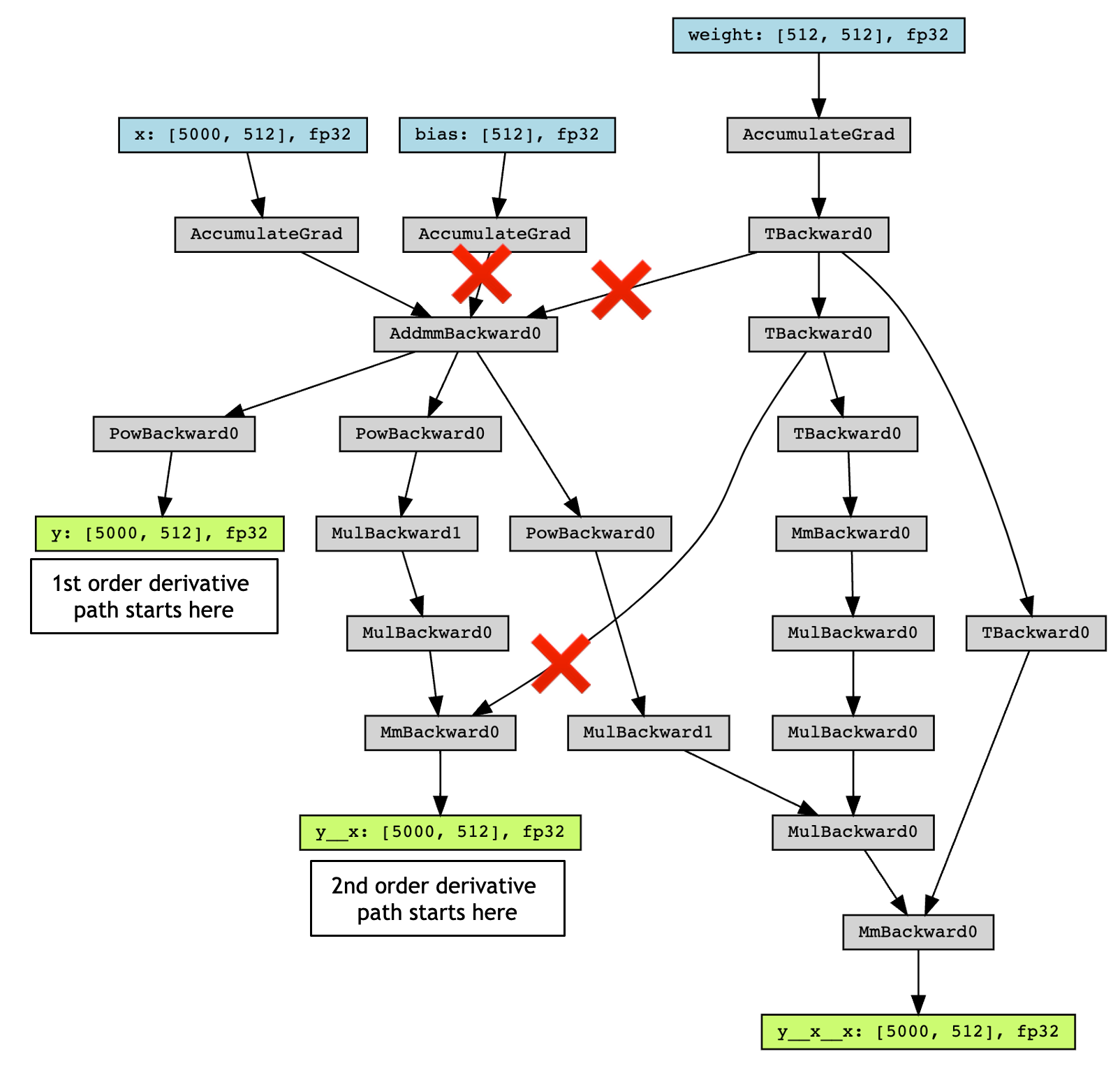
The figure attached shows the autograd graph of the following code snippet:
```py
y = torch.nn.functional.linear(x, weight, bias)
y = y.pow(2)
# first order derivative
y__x, = torch.autograd.grad(y, x, grad_outputs=grad_outputs, create_graph=True)
# first order derivative
y__x__x, = torch.autograd.grad(y__x, x, grad_outputs=grad_outputs, create_graph=True)
```
The path with ❌ is not needed when calculating derivatives.

<img width="50%" alt="image" src="https://user-images.githubusercontent.com/9999318/182018117-719c5a23-bcc6-4a63-8e8d-1bca3ebda2e3.png">

### Issue
<!-- Link to Issue ticket or RFP -->
Related issue: https://github.com/pytorch/pytorch/issues/56500

### Method
When calling `torch.autograd.grad`, `exec_info_` is created for each GraphTask, which allows filtering paths on the graph that are not needed. However, when the GraphTask calls into the node, the node still does not know whether the edges are needed or not. In the case of matmul, `weight.requires_grad is True` so the weight gradient is always calculated.

Following https://github.com/pytorch/pytorch/issues/56500#issuecomment-825694656, this PR passes the graph task's thread_local `exec_info_` into the node, so it could trim unnecessary edges during `torch.autograd.grad` calls.

### Benchmark
Benchmark script: https://gist.github.com/yueyericardo/24158433a2021c51eeef9c3e2722df99

Benchmark result:
6 hidden layers, batch size 10000, on A100

FP32 result
| hessian benchmark             | FP32 (before) | FP32 (After)      | FP32 (Functorch v0.1.1) |
| ----------------------------- | ------------- | ----------------- | ----------------------- |
| Linear + ReLU (no backward)   | 55.658 ms     | 29.392 ms (1.90X) | 29.547 ms (1.90X)       |
| Linear + ReLU (with backward) | 81.173 ms     | 54.917 ms (1.47X) | 68.988 ms (1.18X)       |

TF32 result
| hessian benchmark             | TF32 (before) | TF32 (after)      | TF32 (Functorch v0.1.1) |
| ----------------------------- | ------------- | ----------------- | ----------------------- |
| Linear + ReLU (no backward)   | 19.801 ms     | 11.259 ms (1.76X) | 10.754 ms (1.84X)       |
| Linear + ReLU (with backward) | 29.167 ms     | 20.466 ms (1.42X) | 22.784 ms (1.28X)       |

For FP32 result, we could get 1.9X speed up for hessian calculation, and 1.47X speed up during training, which is even faster than functorch `vmap(jacfwd(jacrev` implementation. (functorch has performance regression on v0.2.0, https://github.com/pytorch/functorch/issues/989, so we are using v0.1.1 for benchmark)

@zou3519 does functorch also includes similar optimizations during hessian calculation? If not, what do we need to do so the functorch could also benefit from this PR?

### Testing
<!-- How did you test your change? -->

- [x] we need to figure out a way for unittest

### Thanks
Thanks for the great blog: [How Computational Graphs are Executed in PyTorch | PyTorch](https://pytorch.org/blog/how-computational-graphs-are-executed-in-pytorch/)

cc @zasdfgbnm @albanD
Pull Request resolved: https://github.com/pytorch/pytorch/pull/82544
Approved by: https://github.com/soulitzer
Summary:
Pull Request resolved: https://github.com/pytorch/pytorch/pull/63612

This makes Tensor inherit from a new class TensorBase, that provides a subset of Tensor that doesn't
directly depend on native_functions.yaml. Code that only includes TensorBase.h with thus not need to
be rebuilt every time someone changes an operator signature.

Making `Tensor` inherit from this class means that `const TensorBase&` parameters will be callable
with an ordinary `Tensor`. I've also made `Tensor` constructible and assignable from `TensorBase` to
minimize friction in code mixing the two types.

To help enforce that `Tensor.h` and `Functions.h` aren't accidentally included, I've added an error
into `Operators.h` if `TORCH_ASSERT_NO_OPERATORS` is defined. We can either set this in the build
system for certain folders, or just define it at the top of any file.

I've also included an example of manually special-casing the commonly used `contiguous` operator.
The inline function's slow path defers to `TensorBase::__dispatch_contiguous` which is defined in
`Tensor.cpp`. I've made it so `OptionalTensorRef` is constructible from `TensorBase`, so I can
materialize a `Tensor` for use in dispatch without actually increasing its refcount.

Test Plan: Imported from OSS

Reviewed By: gchanan

Differential Revision: D30728580

Pulled By: ezyang

fbshipit-source-id: 2cbc8eee08043382ee6904ea8e743b1286921c03
Summary:
This PR suppresses clang-tidy warnings in the codebase (for now) so that we can re-enable clang-tidy checks on master.

I ran this script to add the `NOLINTNEXTLINE` comments (on a devserver):
```bash
python3 setup.py develop

# Uses same script that's run on CI and adds the -j (parallel), -s (add comments), -k (continue if diagnostic errors are found) options
python3 tools/clang_tidy.py \
  -j \
  -s \
  -k \
  -v \
  --paths torch/csrc/ \
  -g"-torch/csrc/jit/passes/onnx/helper.cpp" \
  -g"-torch/csrc/jit/passes/onnx/shape_type_inference.cpp" \
  -g"-torch/csrc/jit/serialization/onnx.cpp" \
  -g"-torch/csrc/jit/serialization/export.cpp" \
  -g"-torch/csrc/jit/serialization/import.cpp" \
  -g"-torch/csrc/jit/serialization/import_legacy.cpp" \
  -g"-torch/csrc/onnx/init.cpp" \
  -g"-torch/csrc/cuda/nccl.*" \
  -g"-torch/csrc/cuda/python_nccl.cpp" \
  -g"-torch/csrc/autograd/FunctionsManual.cpp" \
  -g"-torch/csrc/generic/*.cpp" \
  -g"-torch/csrc/jit/codegen/cuda/runtime/*" \
  -g"-torch/csrc/deploy/interpreter/interpreter.cpp" \
  -g"-torch/csrc/deploy/interpreter/interpreter.h" \
  -g"-torch/csrc/deploy/interpreter/interpreter_impl.h" \
  -g"-torch/csrc/deploy/interpreter/test_main.cpp"
```

Pull Request resolved: https://github.com/pytorch/pytorch/pull/60649

Test Plan: Verified changes by re-running the script (without the `-s` option) and seeing no warnings/errors.

Reviewed By: walterddr, janeyx99

Differential Revision: D29504258

Pulled By: 1ntEgr8

fbshipit-source-id: 78310b30ee8213b73ddb4771ad874665323e7a4e