Previously, minifier testing injected faults by injecting extra code
into the repro scripts, and then ensuring this code got propagated to
all subsequent subprocess calls.  This was not only quite complicated,
but also induced a big slowdown on the minifier, because to inject the
faults, you had to import torch._inductor, which would cause the
compilation threads to immediately get initialized before you even got
to do anything else in the repro script.

This new approach fixes this problem by incorporating the fault
injection into "prod" code.  Essentially, for inductor fault injection
we introduce some new config flags that let you "configure" Inductor to
be buggy; for Dynamo fault injection we just permanently keep the buggy
testing backends registered.  This is MUCH simpler: we only have to
propagate the buggy config (which is something we're already doing),
and it saves the minifier scripts from having to immediately initialize
inductor on entry.

Also, I enable the test for Triton runtime errors, now that tl.assert_device is here.

Signed-off-by: Edward Z. Yang <ezyang@meta.com>

Pull Request resolved: https://github.com/pytorch/pytorch/pull/100357
Approved by: https://github.com/voznesenskym
This is a two part PR; I can split it if you really want me to.

The first part is a refactor of the after aot repro/minifier scripts to come with a command line interface. I maintain exact BC with the previous interface (so, e.g., you still get a repro.py and a run_minifier.py that do the same thing as before), but each of these scripts also take command line arguments now which you can use to customize what actually happens. Check `run_repro` for full documentation on the arguments.

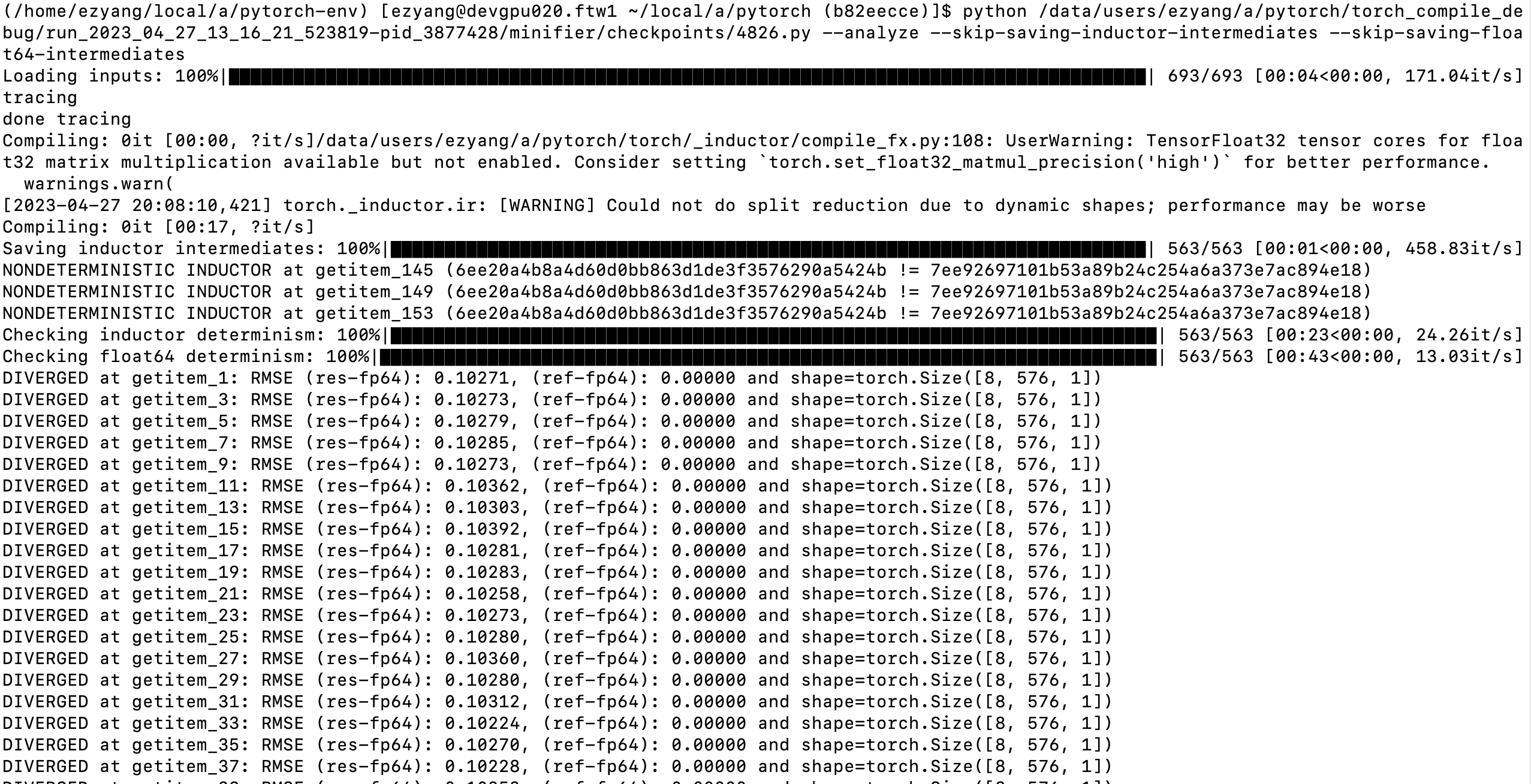
The second part of this is an implementation of `analyze` subcommand on the new CLI for any repro.

<img width="1277" alt="image" src="https://user-images.githubusercontent.com/13564/235045677-8545aab7-5e83-4813-bbec-47783dc60122.png">

This facility is oriented towards accuracy debugging. It does several things:

1. It will run your model twice and check for nondeterminism in inductor/float64, *even* on intermediate inputs (our benchmarking nondeterminism test only checks for nondeterminism on the final output). This makes localizing which operator is nondeterministic easy.
2. It will run your compiled model side-by-side with eager and float64 variants, and then report when things diverge too far from RMSE delta from float64.

Importantly, it does all this without requiring every intermediate to be held in memory (which will cause an OOM on large repros, such as the one I tested this on.)

Some other minor improvements:

* MinifierTestBase now has an easy to comment out spot that you can use to retain the temporary directory; good for debugging
* We print "running minifier" and "running repro" in MinifierTestBase to make it easier to orient where logs are coming from
* same takes a `log_error` optional argument which you can use to reroute the error logs when things mismatch
* counters["inductor"]["intermediate_hooks"] tracks the number of intermediate hooks we've codegen'ed; good for populate the tqdm interface
* torch.fx.interpreter gets an official `boxed_run` interface which uses the boxed arguments calling convention and doesn't retain inputs unnecessarily long
* torch.utils._content_store gets compute_tensor_metadata/read_tensor_metadata helper functions for computing tensor information without serializing it

Signed-off-by: Edward Z. Yang <ezyang@meta.com>

Pull Request resolved: https://github.com/pytorch/pytorch/pull/100226
Approved by: https://github.com/bertmaher, https://github.com/bdhirsh, https://github.com/anijain2305
The new minifier script looks like this:

```
import torch._dynamo.repro.after_aot
reader = torch._dynamo.repro.after_aot.InputReader(save_dir='/tmp/tmpcsngx39e')
buf0 = reader.storage('e2b39c716c0d4efb9fa57375a3902b9dab666893', 16)
t0 = reader.tensor(buf0, (4,))
args = [t0]
mod = make_fx(Repro(), tracing_mode='real')(*args)
```

The real tensor data is stored in the storages folder of the checkpoint dump directory. If you delete this folder / it is otherwise missing, we will transparently fall back to generating random data like before. The tensors are serialized using content store from #99809, which means each storage is content-addressed and we will automatically deduplicate equivalent data (which is useful if you keep dumping out, e.g., your parameters.) We don't use the tensor serialization capability from content store, instead all of the tensor metadata is stored inline inside the repro script (so that everything is in one file if you lose the checkpointed tensors).

We also add a stable_hash option to content store, where we use a slow SHA-1 sum on the data in CPU side to compute a hash that is stable across systems with the same endianness.

Out of rage, I also added support for Dtype.itemsize property access.

Signed-off-by: Edward Z. Yang <ezyang@meta.com>

Pull Request resolved: https://github.com/pytorch/pytorch/pull/99834
Approved by: https://github.com/voznesenskym
This replaces fake_mode_from_tensors but it preferentially looks for
fake_mode in TracingContext and also if there is an active fake mode
on the dispatch stack, before groveling in tensors to find it.

This advances PegasusForCausalLM, which was previously failing because
we generated a graph that had a parameter (non-fake) and a SymInt,
and thus previously we failed to detect the correct fake mode.

Signed-off-by: Edward Z. Yang <ezyang@meta.com>

Pull Request resolved: https://github.com/pytorch/pytorch/pull/98321
Approved by: https://github.com/voznesenskym