Add `TensorImpl::sym_strides`, bind it to python with `torch.ops.aten.sym_strides`, and use it in `ProxyTensor` and `FakeTensor`.

Before, `ProxyTensor` was generating `ProxySymInt`'s for the sizes, but not for the strides. Internally we still represent strides with a `SymIntArrayRef` though, so I ran into some weird issues where sizes were showing up as `ProxySymInt`, but strides were `PySymInt`'s.

Differential Revision: [D38594558](https://our.internmc.facebook.com/intern/diff/D38594558)
Pull Request resolved: https://github.com/pytorch/pytorch/pull/81300
Approved by: https://github.com/ezyang
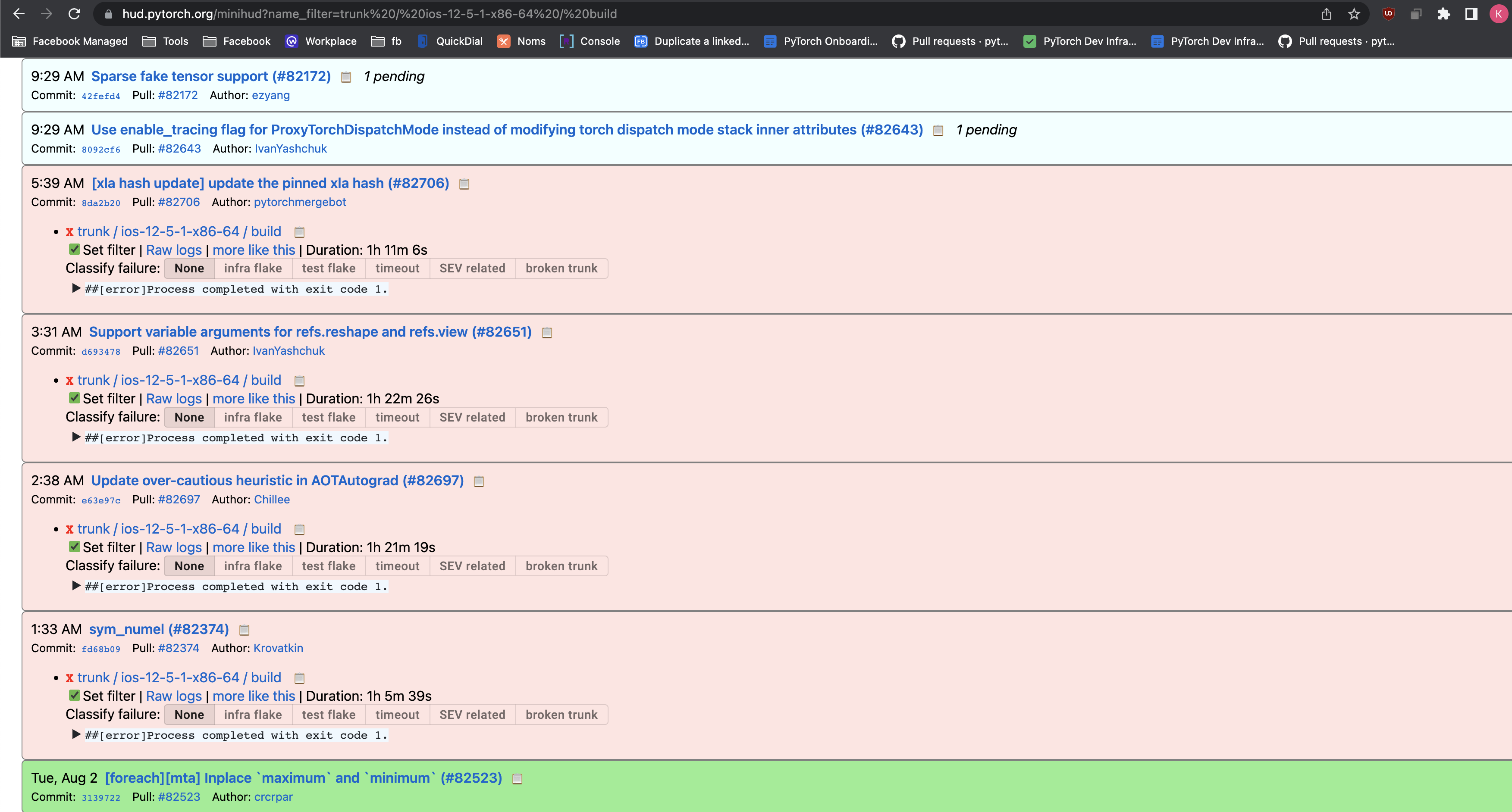
This PR relands sym_numel #82374 and fixes the ios build break in this commit : 8cbd0031c5
which was a type mismatch in an equality.

### Description
<!-- What did you change and why was it needed? -->

### Issue
<!-- Link to Issue ticket or RFP -->

### Testing
<!-- How did you test your change? -->

Pull Request resolved: https://github.com/pytorch/pytorch/pull/82731
Approved by: https://github.com/malfet
Summary:
Pull Request resolved: https://github.com/pytorch/pytorch/pull/71196

`caffe2` headers contain code that can elicit warnings when built with strict compiler flags.  Rather than force downstream/consuming code to weaken their compiler flags, suppress those warnings in the header using `#pragma clang diagnostic` suppressions.

Test Plan: CI Pass

Reviewed By: malfet

Differential Revision: D33536233

fbshipit-source-id: 74404e7a5edaf244f79f7a0addd991a84442a31f
Summary:
Pull Request resolved: https://github.com/pytorch/pytorch/pull/53389

Resize was written to take arguments by value, which was
totally fine if they were ArrayRef or a series of integers, but not so
fine if they're std::vector.
ghstack-source-id: 123212128

Test Plan:
Existing CI should make sure it builds

Inspected assembly for ios_caffe.cc and saw no more vector copy before
calling Resize

Reviewed By: smessmer

Differential Revision: D26852105

fbshipit-source-id: 9c3b9549d50d32923b532bbc60d0246e2c2b5fc7
Summary:
Since caffe2 and torch have been consolidated, CAFFE2_API should be merged with TORCH_API. Addresses a TODO.

Manually edited some references of the removed `CAFFE2_API`:
* `CONTRIBUTING.md`
* `caffe2/proto/CMakeLists.txt`
* `cmake/ProtoBuf.cmake`
* `c10/macros/Export.h`
* `torch/csrc/WindowsTorchApiMacro.h`

Pull Request resolved: https://github.com/pytorch/pytorch/pull/49496

Reviewed By: malfet, samestep

Differential Revision: D25600726

Pulled By: janeyx99

fbshipit-source-id: 7e068d959e397ac183c097d7e9a9afeca5ddd782
Summary:
Pull Request resolved: https://github.com/pytorch/pytorch/pull/44062

Previously, BackendSelect kernels were still written in the legacy way, i.e. they took one TensorOptions argument instead of scattered dtype, layout, device, pin_memory,  and they used hacky_wrapper to be callable. This caused a re-wrapping step. Calling into a BackencSelect kernel required taking the individual scattered arguments, packing them into a TensorOptions, and the kernel itself then gathered them again for redispatch.

Now with this PR, BackendSelect kernels are written in the new way and no hacky_wrapper or rewrapping is needed for them.
ghstack-source-id: 112825789

Test Plan:
vs master: https://www.internalfb.com/intern/fblearner/details/216117032/

vs previous diff: https://www.internalfb.com/intern/fblearner/details/216170194/

Reviewed By: ezyang

Differential Revision: D23484192

fbshipit-source-id: e8fb49c4692404b6b775d18548b990c4cdddbada
Summary:
Pull Request resolved: https://github.com/pytorch/pytorch/pull/41461

capacity is misleading, and we have many wrong uses internally. Let's rename to nbytes to avoid the confusion in future. Ultimately, we could remove this parameter if possible.
So far I haven't seen any case this capacity is necessary.

Test Plan: oss ci

Differential Revision: D22544189

fbshipit-source-id: f310627f2ab8f4ebb294e0dd5eabc380926991eb
Summary:
Pull Request resolved: https://github.com/pytorch/pytorch/pull/37776

* Remove type-specific size tracking in favor of byte size tracking in Storage and StorageImpl
* Changed numel() and set_numel() to nbytes() and set_nbytes()
* Added enum argument to Storage/StorageImpl constructor to indicate new meaning of the size parameter
* Update all callers of the changed API

Part of issue https://github.com/pytorch/pytorch/issues/33950
Pull Request resolved: https://github.com/pytorch/pytorch/pull/37028

Differential Revision: D21171334

Pulled By: ezyang

fbshipit-source-id: 37329a379de9a3a83cc5e9007e455a3e1c2d10b8
Summary:
To speed up compilation time
Pull Request resolved: https://github.com/pytorch/pytorch/pull/34811

Test Plan: CI

Differential Revision: D20476992

Pulled By: malfet

fbshipit-source-id: 922cde93783fbfc04854851d7a05a635d5239792
Summary:
Pull Request resolved: https://github.com/pytorch/pytorch/pull/29653

I didn't remove is_variable from Tensor for BC reasons, but I did
remove as many uses as I could from the codebase.
at::impl::variable_excluded_from_dispatch got moved to TensorBody.h
so that it's more widely accessible.

This diff is NOT semantics preserving.  Here are the major differences:

- In a number of native operator implementations, we tested that arguments
  are not variable.  I replaced these with asserts that variable is
  excluded from dispatch.  I actually don't think these asserts are really
  necessary now (they should certainly be true, but it's hard to get
  it wrong), but I've kept them for old time's sake.  At least, they'll detect
  if you call these functions before you've processed variable (indicating
  a bug in your kernel.)

- There are a number of places where we do a per-tensor test for being a
  variable, for better error reporting when someone commits Tensor/Variable
  confusion.  Although these tests are substantively the same as the
  tests above, in these cases I decided to *delete* the test entirely.
  The reasoning is that in these cases, we didn't really care about
  dispatch (also, see above; I'm not too sure we really need the dispatch
  asserts), we cared about Tensor/Variable confusion.  Since Tensor/Variable
  confusion is impossible now, we don't need the tests.  One of the key
  factors which pushed me one way or another was whether or not a function
  was doing per-tensor validation; if I kept the assert in such functions,
  I'd repeatedly access the TLS.  Even if we want to bring back the asserts,
  they would have to go somewhere else.

  Another similar idiom is the number of places we do !x.defined() ||
  x.is_variable(); I treated this equivalently.

- nuclear_norm's computation of compute_uv is a bit weird, but I think
  it's OK to just delete the is_variable case (I *suspect* that it is
  always the case that self.is_variable(), but it doesn't really matter.)

Signed-off-by: Edward Z. Yang <ezyang@fb.com>

Test Plan: Imported from OSS

Differential Revision: D18496168

Pulled By: ezyang

fbshipit-source-id: 5a1ded931e0c10a6b758ba64a8380d34110e0c3e
Summary:
Pull Request resolved: https://github.com/pytorch/pytorch/pull/28024

We preallocated type ids to align them with ScalarType. At that point, the maximum type id was 10 and we used 11 to specify undefined type id.
However, since then, ScalarType got more additions, 11 isn't undefined anymore, and numbers 11-15 have meaning.
caffe2::TypeIdentifier also got its separate additions, 12 and upwards have meaning that differs from ScalarType.

I'm going with the (CI-tested) assumption that caffe2::TypeIdentifier and ScalarType actually don't need to be aligned
and remove the functionality for preallocated type ids. This simplifies our type ids.
ghstack-source-id: 92051872

Test Plan: unit tests

Differential Revision: D17936165

fbshipit-source-id: 2c9df2b9b3f35b3e319641c96638321ac3433d5c
Summary:
Pull Request resolved: https://github.com/pytorch/pytorch/pull/26509

We preallocated type ids to align them with ScalarType. At that point, the maximum type id was 10 and we used 11 to specify undefined type id, see https://github.com/pytorch/pytorch/pull/10139.
However, since then, ScalarType got more additions, 11 isn't undefined anymore, and numbers 11-15 have meaning.
caffe2::TypeIdentifier also got its separate additions, 12 and upwards have meaning that differs from ScalarType.

I'm going with the (CI-tested) assumption that caffe2::TypeIdentifier and ScalarType actually don't need to be aligned
and remove the functionality for preallocated type ids. This simplifies our type ids.
ghstack-source-id: 91896918

Test Plan: unit tests

Differential Revision: D17490109

fbshipit-source-id: 800c340d9d3556a99f6e3ffc33af14ad68d7cc59
Summary:
Pull Request resolved: https://github.com/pytorch/pytorch/pull/27086

This is a major source of merge conflicts, and AFAICT isn't necessary anymore (it may have been necessary for some mobile build stuff in the past).

This is a commandeer of #25031

Test Plan: Imported from OSS

Reviewed By: ljk53

Differential Revision: D17687345

Pulled By: ezyang

fbshipit-source-id: bf6131af835ed1f9e3c10699c81d4454a240445f
Summary:
Pull Request resolved: https://github.com/pytorch/pytorch/pull/23668

- The eager mode frontend now calls operators who are defined in native_functions.yaml with `use_c10_dispatcher: True` through the c10 dispatcher and not anymore through globalATenDispatch().
- These operators aren't registered with globalAtenDispatch anymore, only on c10 now.
- Backend extensions calling globalATenDispatch().registerOp() to add their own kernels still work, this function will forward the registration to the c10 dispatcher for them.

ghstack-source-id: 90130455

Test Plan: benchmarks at https://docs.google.com/document/d/1gpzKZcFf1JJameY1vKxF7Cloul9s6D8HKIK2_Pp1hFo/edit#

Differential Revision: D16603133

fbshipit-source-id: 991f17b355e9c78c5e86fee4fa381df7ab98ac82
Summary:
As part of the Variable/Tensor merge, we want to be able to pass Variables into Caffe2 without doing extra shallow copy, to improve performance and also allow for in-place mutations in Caffe2 ops. There are a few approaches outlined in https://github.com/pytorch/pytorch/pull/22418, and this PR is the chosen approach.

Specifically, we can have the assumption that we won't be connecting autograd to C2 gradients at any point (as it's too tricky and not that useful). Therefore, we can pass Variable into Caffe2 ops by requiring that all Variables in Caffe2 don't require grad. For code paths in Caffe2 that might potentially track gradients (e.g. `ScriptModuleOp` and `call_caffe2_op_from_c10`), we use the `torch::NoGradGuard` to make sure gradients are not tracked.

This supersedes https://github.com/pytorch/pytorch/pull/22418.
Pull Request resolved: https://github.com/pytorch/pytorch/pull/22473

Differential Revision: D16099042

Pulled By: yf225

fbshipit-source-id: 57efc3c7cfb3048d9abe90e63759acc14ebd2972
Summary:
#19975 was separated by 2 PRs.

This one:

Introduce MemoryFormat argument to the `x.is_contiguous(memory_format=torch.channels_last)` and to the `y = x.contiguous(memory_format=torch.channels_last)` functions.

At this moment both functions just operate with strides and doesn't store any tensor state.

(Original RFC #19092)

-----

Expands functionality of two tensor functions `.is_contiguous` and `.contiguous` (both python and c++ api).

Note: We had several complaints about `.to(memory_format)` function, and decided not to support it.

1.  `.contiguous` now support optional keyword-only argument - `memory_format`, which can be either `torch.contiguous_format` or `torch.channels_last`.

    - Using `torch.contiguous_format` will preserve existing `.contiguous()` behavior.

    - Calling `x.contiguous(memory_format=torch.channels_last)` returns new tensor which maintain same semantical layout (NCHW), but have different memory allocation pattern.

        `x.contiguous(memory_format=torch.channels_last)` expects input tensor to be 3d, 4d or 5d; and fails otherwise.

2. `.is_contiguous` now support optional keyword-only argument - `memory_format`, which can be either `torch.contiguous_format` or `torch.channels_last`.

    - `x.is_contiguous(memory_format=torch.contiguous_format)` preserves same functionality as `x.is_contiguous()` and remains unchanged.

    - `x.is_contiguous(memory_format=torch.channels_last)` returns true if A) input tensor is contiguous in memory AND B) allocated in the memory in NWHC (or similar for 3d,5d) format.

Note: By the end of the phase one `x.is_contiguous(memory_format=torch.channels_last)` will calculate state of the Tensor on every call. This functionality going to be updated later.
Pull Request resolved: https://github.com/pytorch/pytorch/pull/20455

Differential Revision: D15341577

Pulled By: VitalyFedyunin

fbshipit-source-id: bbb6b4159a8a49149110ad321109a3742383185d
Summary:
Pull Request resolved: https://github.com/pytorch/pytorch/pull/19388

The old implementation forced a refcount bump when converting at::Tensor to caffe2::Tensor.
Now, it is possible to move it without a refcount bump.

Reviewed By: dzhulgakov

Differential Revision: D14986815

fbshipit-source-id: 92b4b0a6f323ed38376ffad75f960cad250ecd9b