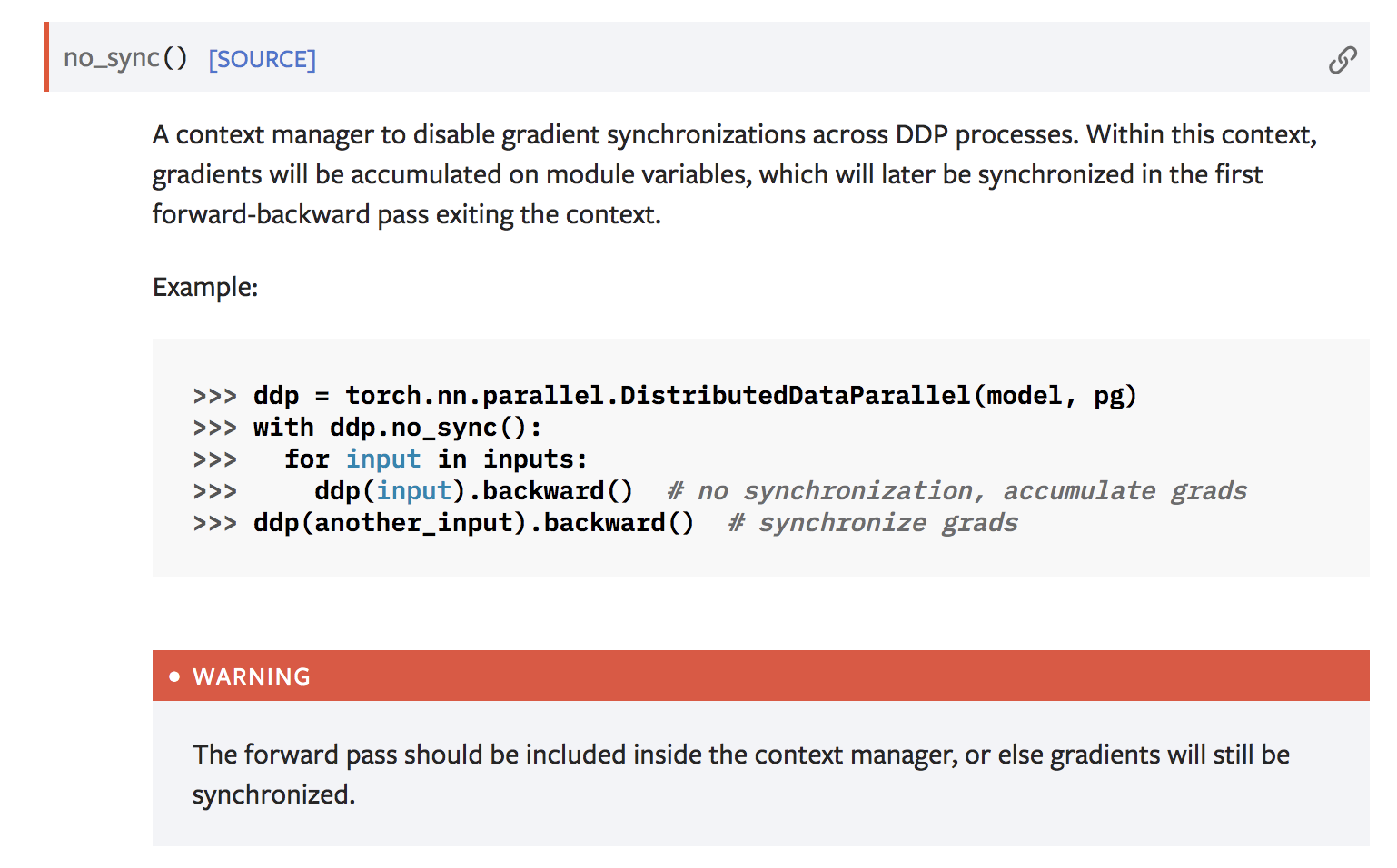
Summary: Enable the functionality of delaying all reduce in DDP to specify the parameters whose all reduce will be hooked to a specific param. This prevents AllReduce blocking All2All in some recommendation models.

Test Plan: GitHub CI.

Pull Request resolved: https://github.com/pytorch/pytorch/pull/96673
Approved by: https://github.com/zhaojuanmao
Implements native mixed precision support for DDP in a similar fashion to how it is enabled for FSDP. The implementation works as follows:

1. In DDP init, we save `_mp_param` and `_fp_param` variables to manage mixed precision parameter usage. In particular, _mp_param will represent the parameter in the reduced precision, while _fp_param will represent the param in regular precision. During forward/backward, we swap back and forth as needed.
2. The root module gets a root pre-forward hook that kicks off copies to the reduced precision for all submodules. An event is recorded for each submodule to allow for waiting, as we run these asynchronously.
3. Each module gets a pre-forward hook that waits on its corresponding event. note that modules might be reused during training, in this case the wait is only done for the first module. After this wait, the module's parameters are in reduced precision.
4. In the pre-forward hook, we register a backward hook on the lower precision parameters in order to run reduced precision allreduce + parameter upcast. We can't rely on the Reducer's constructor setting up these hooks because the gradient is accumulated on the low precision param, so we need to register them ourselves.
5. In the backward pass, when the hook runs, we first run allreduce + divide in the reduced precision. Next, we upcast parameters and gradients back to fp32 asynchronously. We also queue a callback at the end of backward to wait on these upcasts so that the upcast is complete before optim.step() runs.
6. Parameters that don't require grad are also cast since they may be used in computation, they are upcast back in the final autograd callback.
7. DDP Ignored parameters are not touched.

Follow-ups:

1. Unify comm hooks and make it work with apply optimizer in backward
2. implement keep_low_precision_grads,
3. allow BN, LN, or custom units to run in reduced precision,
4. support for cast_forward_inputs
5. Unify certain APIs / helpers with FSDP where possible, such as for _cast_forward_inputs
6. Integrate this with replicate() API.
7. The order in which we kick off copies and wait for them is set by the iteration order of module.modules(), but this might not be how the modules are used in the actual training. In the worst case, the last module in module.modules() could be used first which would result in waiting for all copies unnecessarily. For static graphs, we should record the module execution order and copy / wait in this order.
8. Entirely unused modules probably don't need to be cast.

Differential Revision: [D42515803](https://our.internmc.facebook.com/intern/diff/D42515803/)
Pull Request resolved: https://github.com/pytorch/pytorch/pull/92882
Approved by: https://github.com/zhaojuanmao
Applies the remaining flake8-comprehension fixes and checks. This changes replace all remaining unnecessary generator expressions with list/dict/set comprehensions which are more succinct, performant, and better supported by our torch.jit compiler. It also removes useless generators such as 'set(a for a in b)`, resolving it into just the set call.

Pull Request resolved: https://github.com/pytorch/pytorch/pull/94676
Approved by: https://github.com/ezyang
Applies some more harmless pyupgrades. This one gets rid of deprecated aliases in unit_tests and more upgrades yield for loops into yield from generators which are more performance and propagates more information / exceptions from original generator. This is the modern recommended way of forwarding generators.
Pull Request resolved: https://github.com/pytorch/pytorch/pull/94309
Approved by: https://github.com/albanD
removes this unused var, the overall buffer comm hook feature is also not being used, we should deprecate / remove it as it is still a private API.

Fixes #ISSUE_NUMBER

Pull Request resolved: https://github.com/pytorch/pytorch/pull/93128
Approved by: https://github.com/awgu
Allow _apply_optim_in_backward to work with DDP.

Example:

```
dist.init_process_group("nccl", rank=rank, world_size=2)
    torch.cuda.set_device(rank)
    e = enc().cuda(rank)
    _apply_optimizer_in_backward(
        optimizer_class=torch.optim.SGD,
        params=e.parameters(),
        optimizer_kwargs={"lr": 0.03},
    )
    e = DDP(e, device_ids=[rank])
    inp = torch.randn(1, 10, device=rank)
    e(inp).sum().backward()
```

Constraints:

1. Custom communication hook not yet supported
2. _apply_optim_in_backward needs to be called _before_ wrapping model in DDP.
3. DDP will remove the gradient hooks _apply_optim_in_backward registers, so these gradient hooks will not be fired and cannot be used.
4. All DDP managed parameters have grads set to None by default once optimizer is applied. There is no support for setting only some parameter grads to None, this must be done manually by user (and DDP_OVERLAPPED_OPTIM_SET_GRADS_TO_NONE=0 needs to be set.)

Differential Revision: [D41329694](https://our.internmc.facebook.com/intern/diff/D41329694/)

**NOTE FOR REVIEWERS**: This PR has internal Meta-specific changes or comments, please review them on [Phabricator](https://our.internmc.facebook.com/intern/diff/D41329694/)!
Pull Request resolved: https://github.com/pytorch/pytorch/pull/89194
Approved by: https://github.com/zhaojuanmao
This is a new version of #15648 based on the latest master branch.

Unlike the previous PR where I fixed a lot of the doctests in addition to integrating xdoctest, I'm going to reduce the scope here. I'm simply going to integrate xdoctest, and then I'm going to mark all of the failing tests as "SKIP". This will let xdoctest run on the dashboards, provide some value, and still let the dashboards pass. I'll leave fixing the doctests themselves to another PR.

In my initial commit, I do the bare minimum to get something running with failing dashboards. The few tests that I marked as skip are causing segfaults. Running xdoctest results in 293 failed, 201 passed tests. The next commits will be to disable those tests. (unfortunately I don't have a tool that will insert the `#xdoctest: +SKIP` directive over every failing test, so I'm going to do this mostly manually.)

Fixes https://github.com/pytorch/pytorch/issues/71105

@ezyang
Pull Request resolved: https://github.com/pytorch/pytorch/pull/82797
Approved by: https://github.com/ezyang
### Description

Across PyTorch's docstrings, both `callable` and `Callable` for variable types. The Callable should be capitalized as we are referring to the `Callable` type, and not the Python `callable()` function.

### Testing

There shouldn't be any testing required.

Pull Request resolved: https://github.com/pytorch/pytorch/pull/82487
Approved by: https://github.com/albanD
Pull Request resolved: https://github.com/pytorch/pytorch/pull/75753

As per the design in https://github.com/pytorch/pytorch/issues/72138,
convert DDP parameters to ReplicatedTensor during its forward pass. Concretely,
this is done as follows:

1) Create a separate `_replicated_tensor_module` which is a copy of self.module
without creating copies of the Tensors themselves.
2) Use `_replicated_tensor_module` instead of `self.module` during the forward
pass.
3) Have a context manager `_ddp_replicated_tensor` to enable this, since
certain edge cases can fail where self.module is changed out of band resulting
in discrepancy between self.module and `_replicated_tensor_module`.

Differential Revision: [D35533736](https://our.internmc.facebook.com/intern/diff/D35533736/)

Approved by: https://github.com/wanchaol, https://github.com/rohan-varma
Summary:
Pull Request resolved: https://github.com/pytorch/pytorch/pull/74063

Address the issue https://github.com/pytorch/pytorch/issues/66229 as part of BE effort.

Basically:
1. We remove the stale comment which confuses users.
2. Add more unit tests to test the forward/backward hook working for DDP.
ghstack-source-id: 151463380

Test Plan: CI

Reviewed By: rohan-varma

Differential Revision: D34800830

fbshipit-source-id: 21133209323b2b5eda0dd6472f6309d4fb779b97
(cherry picked from commit b9b165c8305572128395daffafc13fcac8b85e29)
Summary:
Pull Request resolved: https://github.com/pytorch/pytorch/pull/72843

# [Debug Story] Training Hanging and DDP Bucketing

**What are the characteristics of the hanging training instance?**

The model uses TorchRec `PooledEmbeddingArch` and corresponding sharding solution.

The model config difference to trigger this hanging issue is turning on position weighted embedding tables.

A feature processor module, `GroupedPositionWeightedModule`, is constructed on all ranks, but `GroupedPositionWeightedModule.foward(...)` is only [called on subset ranks of the whole world](https://fburl.com/code/yqrmtvli).

**What was the initial manifested error?**

The training was stuck in the first iteration.

**What are useful debugging tools this time?**

After turning off [static_graph in DDP](https://fburl.com/code/4io81p5i), we saw there were sparse feature lengths becoming negative values after all-to-all collectives. Hanging becomes fatal failure.

After turning on [torch.distributed DETAIL debugging mode](https://fburl.com/code/cp8e28mm), we saw 2 trainers sent out mismatched collectives, one doing all-to-all, the other doing all-reduce. So we know the negative values comes from all-to-all being matched with all-reduce. the error had happened ahead, which is the wrong timing of either doing all-reduce or all-to-all.

With more added loggings inside of DDP, it turned out the DDP decided to do all-reduce at different timings across different ranks.

**What is DDP bucketing?**

Once a gradient is ready on a rank, DDP uses all-reduce to synchronize the average of this gradient across all ranks.

Say we have 4 tensor ops. A, B, C, D.

In the most naive version, we could do one synchronization when all gradients in the full backward graph are ready.

The time sequence would be,

* D.grad
* C.grad
* B.grad
* A.grad
* All reduce on [D.grad, C.grad, B.grad, A.grad].

But that would be a huge waste of communication channel bandwidth.

With DDP bucketing, we could put ahead some gradient synchronization batch by batch. The above time sequence now becomes,

* D.grad
* C.grad
* All reduce on [D.grad, C.grad].
* B.grad
* A.grad
* All reduce on [B.grad, A.grad].

With gradient computation overlaps with communication, bucketing technique brings better DDP execution performance.

**What exactly went wrong in this case?**

1. The bucketing doesn’t honor backward graph execution order.
2. There are other collectives comm ops in backward graph.
3. There are unused parameters (i.e unused sub-module) in subset ranks of the whole world.

Using the above example again, we have 4 tensor ops. A, B, C, D.

Say we have 2 trainers,

B is the feature processor module.

B only runs on trainer 0 (both forward and backward), but not on trainer1.

C is the All-to-all (Pooled embeddings distribution).

C sends out all-to-all collective in both its forward and backward pass.

Keep assuming all other ops run on both trainers.

trainer_0 op sequence is,

A, B (feature preproc), C (all-to-all), D | D.grad, C.grad (reverse all-to-all), B.grad (feature proc grads), A.grad

trainer_1 op sequence is,

A, C (all-to-all), D | D.grad, C.grad (reverse all-to-all), A.grad

Even though the correct bucketing should be (same bucketing for both ranks),

* bucket_0, [D.grad, C.grad]
* bucket_1, [B.grad, A.grad]

but because of 1), they end up like,

* bucket_0, [B.grad, D.grad]
* bucket_1, [C.grad, A.grad]

Plus 2) and 3), the time sequence could like,

(check mark represents the gradient is ready)

(bucket is ready to do synchronization if all its enclosing gradients are ready)

* trainer_0
   * t0,
      * D.grad
      * bucket_0, [B.grad, D.grad ✓]
   * t1,
      * **C.grad all-to-all**
      * C.grad ✓
      * bucket_1, [C.grad ✓, A.grad]
   * t2
      * B.grad
      * bucket_0, [B.grad ✓, D.grad ✓] ✓
   * t3
      * All-reduce for bucket_0
   * t4
      * A.grad
      * bucket_1, [C.grad ✓, A.grad ✓] ✓
* trainer_1
   * t0,
      * D.grad
      * bucket_0, [B.grad ✓, D.grad ✓] ✓. (Because B is not used on trainer_1, DDP marks its gradient as ready immediately.)
   * t1,
      * **All-reduce for bucket_0**
   * t2
      * C.grad all-to-all
      * bucket_1, [C.grad ✓, A.grad]
   * t3
      * A.grad
      * bucket_1, [C.grad ✓, A.grad ✓] ✓

This is why trainer_0 all-to-all is matched up with trainer_1 all-reduce.

**What is the solution for fixing DDP?**

Disable DDP bucketing for the first iteration. D34051938

This is because after the first iteration, buckets will be built again based on real backward graph execution order.

So the slow gradient synchronization only affects the first iteration.

Test Plan:
buck build mode/dev-nosan caffe2/test/distributed:distributed_gloo_spawn
BACKEND=gloo WORLD_SIZE=3 buck-out/gen/caffe2/test/distributed/distributed_gloo_spawn\#binary.par -r test_ddp_logging_data_cpu

P484179296

buck build mode/dev-nosan caffe2/test/distributed:distributed_nccl_spawn
BACKEND=nccl WORLD_SIZE=2 buck-out/gen/caffe2/test/distributed/distributed_nccl_spawn\#binary.par -r test_ddp_logging_data_cpu -r test_ddp_get_bucket_sizes
P484177200

Reviewed By: zhaojuanmao

Differential Revision: D34051938

fbshipit-source-id: 0c7f35875687095c3199f19990e73a8349b6e5b9
(cherry picked from commit bb8f11306ea51c2bd3ffd3ab001d62ce369a08ee)
Summary:
Pull Request resolved: https://github.com/pytorch/pytorch/pull/73166

This PR refactors, cleans up, and optimizes the implementation of `TORCH_DISTRIBUTED_DEBUG`. It also introduces three new user APIs: `get_debug_level()`, `set_debug_level()`, and `set_debug_level_from_env()` to retrieve and modify the debug level after a process has started.
ghstack-source-id: 149778566

Test Plan: Run the existing unit tests.

Reviewed By: rohan-varma

Differential Revision: D34371226

fbshipit-source-id: e18443b411adcbaf39b2ec999178c198052fcd5b
(cherry picked from commit 26d6bb1584b83a0490d8b766482656a5887fa21d)
Summary:
Pull Request resolved: https://github.com/pytorch/pytorch/pull/72886

**Test Plan**
Searching for `_schedule_shadow_all_reduce_for_fwd_pass` shows that it is defined but never used.

Test Plan: Imported from OSS

Reviewed By: mrshenli

Differential Revision: D34255651

Pulled By: awgu

fbshipit-source-id: 205a0325c2cdc05e127a183cb86fa2fc2e0db99d
(cherry picked from commit 4492f03a3f)
Summary:
Pull Request resolved: https://github.com/pytorch/pytorch/pull/72456

It is easier to log if static graph is set at construction time now that it is natively supported in DDP constructor, as opposed to waiting for the first iteration to finish. In some failure cases we're seeing the first iteration does not finish and thus we don't have this data which is vaulable to debug.
ghstack-source-id: 148840679

Test Plan: CI

Reviewed By: zhaojuanmao

Differential Revision: D34045204

fbshipit-source-id: 72a187c1ce031db217de4b3ad20a64f2a74995bc
(cherry picked from commit 1d622c88f3)
Summary:
Pull Request resolved: https://github.com/pytorch/pytorch/pull/71608

Per title
ghstack-source-id: 147577178

Test Plan: CI

Reviewed By: cbalioglu

Differential Revision: D33696382

fbshipit-source-id: 5b638d3edf5f03ba476356d61e96ca604de18c8f
(cherry picked from commit 436b547fb0)
Summary:
Pull Request resolved: https://github.com/pytorch/pytorch/pull/71606

Per title
ghstack-source-id: 147577172

Test Plan: CI

Reviewed By: cbalioglu

Differential Revision: D33694037

fbshipit-source-id: a148d5ce6031f0cc20f33785cfe2c27d1fc2d682
(cherry picked from commit ace3261e0c)
Summary:
Pull Request resolved: https://github.com/pytorch/pytorch/pull/71483

claify that peak memory saving should be checked after first iteration when using gradient_as_bucket_view
ghstack-source-id: 147271113

Test Plan: unit test

Reviewed By: rohan-varma

Differential Revision: D33662424

fbshipit-source-id: f760da38e166ae85234e526ddf1526269ea25d42
(cherry picked from commit a40dda20da)
Summary:
Pull Request resolved: https://github.com/pytorch/pytorch/pull/71459

1. add static_graph feature to DDP constructor;
2. still keep _set_static_graph() API, so that existing use cases are not affected, also it can be called internally by DDP constructor
3. four cases are covered:
    static_graph = False, _set_static_graph() is called;
    static_graph = False, _set_static_graph() is not called;
    static_graph = True, _set_static_graph() is not called;
    static_graph = True, _set_static_graph() is called;
ghstack-source-id: 147263797

Test Plan: unit tests

Reviewed By: rohan-varma

Differential Revision: D33646738

fbshipit-source-id: 8c1730591152aab91afce7133d2adf1efd723855
(cherry picked from commit dc246a1129)
Summary:
Pull Request resolved: https://github.com/pytorch/pytorch/pull/68827

Add a note about current checkpoint support with DDP. Note that this
does not include the features enabled with _set_static_graph yet, as it is an
undocumented private API. Once we support static graph as beta feature in OSS
we can add to the note here.
ghstack-source-id: 144285041

Test Plan: CI

Reviewed By: pritamdamania87

Differential Revision: D32624957

fbshipit-source-id: e21d156a1c4744b6e2a807b5b5289ed26701886f
Summary:
`default_collate`, `default_convert`, and `pin_memory` convert sequences into lists. I believe they should keep the original type when possible (e.g., I have a class that inherits from `list`, which comes from a 3rd party library that I can't change, and provides extra functionality).

Note it's easy to do when the type supports an iterable in its creation but it's not always the case (e.g., `range`).

Even though this can be accomplished if using a custom `default_collate`/`default_convert`, 1) this is behavior they should support out-of-the-box IMHO, and 2) `pin_memory` still does it.

cc VitalyFedyunin ejguan NivekT

Pull Request resolved: https://github.com/pytorch/pytorch/pull/68779

Reviewed By: wenleix

Differential Revision: D32651129

Pulled By: ejguan

fbshipit-source-id: 17c390934bacc0e4ead060469cf15dde815550b4
Summary:
Patch bfloat16 support in NCCL, PR https://github.com/pytorch/pytorch/issues/63260 adds bfloat16 support but is
still not complete to enable bfloat16 for allreduce in end-to-end training.

This patch does the followings:
* fix minimum NCCL version from 2.9.7 to 2.10, NCCL adds bf16 support in
  v2.10.3-1 (commit 7e51592)
* update bfloat16 datatype flag in `csrc/cuda/nccl.cpp` so that NCCL
  operations like all reduce can use it
* enable unit tests for bfloat16 datatype if possible

cc pietern mrshenli pritamdamania87 zhaojuanmao satgera rohan-varma gqchen aazzolini osalpekar jiayisuse SciPioneer H-Huang

Pull Request resolved: https://github.com/pytorch/pytorch/pull/67843

Reviewed By: H-Huang

Differential Revision: D32248132

Pulled By: mrshenli

fbshipit-source-id: 081e96e725af3b933dd65ec157c5ad11c6873525
Summary:
Pull Request resolved: https://github.com/pytorch/pytorch/pull/66680

Closes https://github.com/pytorch/pytorch/issues/66215. Tracks models
with sync BN so we can find workflows that use them and target for perf
optimization.
ghstack-source-id: 140875182

Test Plan: CI

Reviewed By: pritamdamania87

Differential Revision: D31679477

fbshipit-source-id: 0e68cd1a7aabbc5b26227895c53d33b8e98bfb8e
Summary:
Pull Request resolved: https://github.com/pytorch/pytorch/pull/66015

Fixes https://github.com/pytorch/pytorch/issues/61982 by clone of
tensors in DDPSink. Only applies once for static_graph and generally for unused
params which already has overhead, so perf hit should not be an issue. Will
verify with benchmark.

Test Plan: CI

Reviewed By: zhaojuanmao

Differential Revision: D31346633

fbshipit-source-id: 5b9245ade628565cffe01731f6a0dcbb6126029b
Summary:
Pull Request resolved: https://github.com/pytorch/pytorch/pull/64515

For performance reasons, we would like to ensure that we can await
user collectives as part of custom buffer reduction in parallel to other work.
As a result, add support to return futures from custom buffer hooks and await
those futures at end of backwards pass.

Also added some docs to clarify how to use these APIs.
ghstack-source-id: 138793803

Test Plan: I

Reviewed By: zhaojuanmao

Differential Revision: D30757761

fbshipit-source-id: e1a2ead9ca850cb345fbee079cf0614e91bece44
Summary:
Pull Request resolved: https://github.com/pytorch/pytorch/pull/65181

This PR changes `state_dict()` during sync to `named_parameters` and `named_buffers` explicitly. the underlying motivation is that, `state_dict()` doesn't necessarily equals to "params + buffers" for all cases, state_dict is used for checkpoint purpose mainly, and params/buffers are used for training, we might have cases that params/buffers be in different forms with state_dict (i.e. state_dict we might want to save in small pieces of tensors while in training we want to concat the tensors together for performance reasons).
ghstack-source-id: 138701159

Test Plan: wait for ci

Reviewed By: divchenko, rohan-varma

Differential Revision: D31007085

fbshipit-source-id: 4e1c4fbc07110163fb9b09b043ef7b4b75150f18
Summary:
Pull Request resolved: https://github.com/pytorch/pytorch/pull/64514

sync_params is a misnomer since we don't actually synchroniz
parameters. While removing this I realized
`self._check_and_sync_module_buffers` does almost everything we need it to, so
just refactored that and made DDP forward call into it.
ghstack-source-id: 138684982

Test Plan: CI

Reviewed By: zhaojuanmao

Differential Revision: D30751231

fbshipit-source-id: add7c684f5c6c71dad9e9597c7759849fa74f47a
Summary:
Pull Request resolved: https://github.com/pytorch/pytorch/pull/64113

Since there is only one model replica per process, `replicas`
can be simplified from `std::vector<std::vector<at::Tensor>>` to
`std::vector<at::Tensor>` in the Reducer class.

Test Plan:
All tests are passing
`pytest test/distributed/test_c10d_gloo.py -vs`

Imported from OSS

Reviewed By: mrshenli

Differential Revision: D30615965

fbshipit-source-id: d2ec809d99b788c200b01411333e7dbad1269b51
Summary:
Pull Request resolved: https://github.com/pytorch/pytorch/pull/64474

No need for a nested list here.
ghstack-source-id: 137526312

Test Plan: CI

Reviewed By: zhaojuanmao

Differential Revision: D30745960

fbshipit-source-id: 66a8f9847e9fe1e02c51b79647e93bf7665cf4d9
Summary:
Pull Request resolved: https://github.com/pytorch/pytorch/pull/64472

Sometimes, user module can reassign tensor buffer, as in:

```
self.buffer = torch.randn(1, 2) # in init
self.buffer += 1 # in forward
```

in this case, `self.modules_buffers` will become outdated and we should
repopulate self.modules_buffers if we need to sync module buffers.

See https://github.com/pytorch/pytorch/issues/63916 for full description of the
issue.
ghstack-source-id: 137526309

Test Plan: CI

Reviewed By: zhaojuanmao

Differential Revision: D30745921

fbshipit-source-id: 25eb1edbf445703a481802e07f3058d38ea6fc64
Summary:
Pull Request resolved: https://github.com/pytorch/pytorch/pull/63260

Add BF16 all-reduce communication hook. Skip if CUDA version < 11 or NCCL version < 2.9.7.

Reviewed By: SciPioneer

Differential Revision: D30238317

fbshipit-source-id: bad35bf7d43f10f1c40997a282b831b61ef592bb
Summary:
Pull Request resolved: https://github.com/pytorch/pytorch/pull/62996

No need to set this because autograd engine already propagates TLS
states.
ghstack-source-id: 135438220

Test Plan: CI

Reviewed By: albanD

Differential Revision: D30202078

fbshipit-source-id: e5e917269a03afd7a6b8e61f28b45cdb71ac3e64
Summary:
Pull Request resolved: https://github.com/pytorch/pytorch/pull/61753

Reland of https://github.com/pytorch/pytorch/pull/57081.
Main difference is that the former diff moved `prepare_for_backward` check into `DDPSink` backward, but that resulted in issues due to potential autograd engine races. The original diff moved `prepare_for_backward` into `DDPSink` as part of a long-term plan to always call it within `DDPSink`.

In particular this doesn't work because `prepare_for_backward` sets `expect_autograd_hooks=true` which enables autograd hooks to fire, but there were several use cases internally where autograd hooks were called before DDPSink called `prepare_for_backward`, resulting in errors/regression.

We instead keep the call to `prepare_for_backward` in the forward pass, but still run outputs through `DDPSink` when find_unused_parameters=True. As a result, outputs that are not used when computing loss have `None` gradients and we don't touch them if they are globally `None`. Note that the hooks still fire with a undefined gradient which is how we avoid the Reducer erroring out with the message that some hooks did not fire.

Added the unittests that were part of the reverted diff.
ghstack-source-id: 135388925

Test Plan: CI

Reviewed By: zhaojuanmao

Differential Revision: D29726179

fbshipit-source-id: 54c8819e0aa72c61554104723a5b9c936501e719
Summary:
Pull Request resolved: https://github.com/pytorch/pytorch/pull/62748

Previously after buckets were rebuilt the first bucket size was always
defaulted to 1MB, this diff allows first bucket to be tuned like the rest of
the bucket sizes can.

Setting `dist._DEFAULT_FIRST_BUCKET_BYTES = 1` results in the following logs as
expected:
I0804 12:31:47.592272 246736 reducer.cpp:1694] 3 buckets rebuilt with size
limits: 1, 1048, 1048 bytes.
ghstack-source-id: 135074696

Test Plan: CI

Reviewed By: SciPioneer, wanchaol

Differential Revision: D30110041

fbshipit-source-id: 96f76bec012de129d1645e7f50e266d4b255ec66
Summary:
Pull Request resolved: https://github.com/pytorch/pytorch/pull/62662

Replaced the methods set_tensor(.) and get_tensor() in the python exposed API from the C++ logic with buffer() and set_buffer(.) to be a cleaner interface.

Reviewed By: SciPioneer

Differential Revision: D30012869

fbshipit-source-id: bd8efab583dd89c96f9aeb3dd48a12073f0b1482
Summary:
**Overview:**
This removes the preceding `_` from `_Join`, `_Joinable`, and `_JoinHook` in preparation for adding the generic join context manager tutorial (see [here](https://github.com/pytorch/tutorials/pull/1610)). This also adds a docs page, which can be linked from the tutorial. [Here](https://github.com/pytorch/pytorch/files/6919475/render.pdf) is a render of the docs page.

Pull Request resolved: https://github.com/pytorch/pytorch/pull/62605

Test Plan:
`DistributedDataParallel.join()`:
```
touch /tmp/barrier && TEMP_DIR="/tmp" BACKEND="nccl" WORLD_SIZE="2" gpurun python test/distributed/test_distributed_fork.py -- TestDistBackendWithFork.test_ddp_uneven_inputs TestDistBackendWithFork.test_ddp_uneven_inputs_stop_iteration_sync_bn TestDistBackendWithFork.test_ddp_grad_div_uneven_inputs TestDistBackendWithFork.test_ddp_uneven_input_join_disable TestDistBackendWithFork.test_ddp_uneven_input_exception
```

`ZeroRedundancyOptimizer`:
```
gpurun4 python test/distributed/optim/test_zero_redundancy_optimizer.py
```
NOTE: DDP overlap tests are failing due to a landing race. See https://github.com/pytorch/pytorch/pull/62592. Once the fix is landed, I will rebase, and tests should be passing.

`Join`:
```
gpurun4 python test/distributed/algorithms/test_join.py
```

Reviewed By: mrshenli

Differential Revision: D30055544

Pulled By: andwgu

fbshipit-source-id: a5ce1f1d9f1904de3bdd4edd0b31b0a612d87026
Summary:
**Overview:**
This adds two approaches to overlapping `DistributedDataParallel.backward()` with `ZeroRedundancyOptimizer.step()` by providing two hook constructors: `hook_with_zero_step()` and `hook_with_zero_step_interleaved()`. The former waits for all backward computation to finish before starting optimizer computation, while the latter launches a partial optimizer computation using the contents of a gradient bucket once that bucket's all-reduce completes. The two approaches each suffer from their own weaknesses, and which one to use depends on the specific hardware configuration.

Both approaches can share changes to `ZeroRedundancyOptimizer`. A user should pass `overlap_with_ddp=True` to `ZeroRedundancyOptimizer`, construct a DDP communication hook using either `hook_with_zero_step()` or `hook_with_zero_step_interleaved()`, and register that communication hook. `ZeroRedundancyOptimizer.step()` should still be called in the training loop, though the optimizer computation and communication will be offloaded to originate from the communication hook. Currently, the first two iterations are vacuous, meaning they do not result in parameter updates and the inputs are ignored. This is required to finalize the DDP bucket strategy and to then initialize the `ZeroRedundancyOptimizer`'s local optimizer based on that bucketing.

Pull Request resolved: https://github.com/pytorch/pytorch/pull/62157

Test Plan:
The existing `ZeroRedundancyOptimizer` tests pass, and new unit tests for both hooks pass:
- ~~`test_ddp_with_zero_step_parity_cpu`~~ (removed for now due to flakiness in CI -- under investigation, could possibly be similar Gloo issue as with `hook_with_zero_step_interleaved()`)
- `test_ddp_with_zero_step_parity_gpu`
- `test_ddp_with_zero_step_interleaved_parity_gpu`

These were tested on the AI AWS cluster.

An analogous `test_ddp_with_zero_step_interleaved_parity_cpu` is missing due to existing bugs with Gloo. See https://github.com/pytorch/pytorch/pull/62302.

Both approaches have been verified using an internal accuracy benchmark.

Reviewed By: mrshenli

Differential Revision: D29971046

Pulled By: andwgu

fbshipit-source-id: a7234c23c7ea253f144a698fd7e3c0fe039de5e8
Summary:
Pull Request resolved: https://github.com/pytorch/pytorch/pull/62457

Specify `Future[torch.Tensor]` as DDP communication hook return type, which should be explicitly a single tensor. The previous API takes a list that has a single tensor.

Note that now the typing info no longer accepts the internal type of `torch._C.Future`, which does not support torchscript and hence cannot support `Future[torch.Tensor]`.
ghstack-source-id: 134771419

Test Plan:
buck test mode/dev-nosan caffe2/test/distributed:c10d -- test_default_ddp_comm_hooks_nccl
buck test mode/dev-nosan caffe2/test/distributed:c10d -- test_ddp_invalid_comm_hook_return_type

Reviewed By: rohan-varma

Differential Revision: D30007390

fbshipit-source-id: 246667c9b575b4c6e617b0a5b373151f1bd81e7f
Summary:
Pull Request resolved: https://github.com/pytorch/pytorch/pull/62232

Logs the bucket sizes in DDP logging so that we know which workflow ran with what bucket size config. Will be used to verify how changing bucket sizes in DDP affects perf.

Based on the test, we can see inconsistency where the "first" bucket size actually is (last before rebuild buckets, first after).
ghstack-source-id: 134663867

Test Plan: CI

Reviewed By: SciPioneer

Differential Revision: D29922299

fbshipit-source-id: 538b331c96e77048164ad130b377433be100a761
Summary:
Pull Request resolved: https://github.com/pytorch/pytorch/pull/62231

`compute_bucket_assignment_by_size` is responsible for setting per-bucket size limits, return this information from the function so that we are aware of size limits for each bucket.

This is currently not being consumed, but will be in the next diff when we log bucket size limits to DDP logging. This will help us run experiments under different bucket size configs and analyze the impact.
ghstack-source-id: 134480575

Test Plan: CI

Reviewed By: mrshenli

Differential Revision: D29919056

fbshipit-source-id: dd5a096fa23d22e5d9dc1602899270a110db4a19
Summary:
Pull Request resolved: https://github.com/pytorch/pytorch/pull/61992

This test previously was not enabled for static graph but to ensure
this feature is supported with DDPSink, enable it for static graph which
currently passes outputs to DDPSink.
ghstack-source-id: 134471406

Test Plan: CI

Reviewed By: zhaojuanmao

Differential Revision: D29830887

fbshipit-source-id: 2d3f750d9eb4289558ed21acccd172d83d9b82cc
Summary:
Pull Request resolved: https://github.com/pytorch/pytorch/pull/61497

Reverts [DDP] Support not all outputs used in loss calculation
ghstack-source-id: 133589153

Test Plan: CI, ping authors to run their workflow on this diff

Reviewed By: zhaojuanmao

Differential Revision: D29642892

fbshipit-source-id: 81a15b9ab3329602f34d3758bb0799005a053d4f
Summary:
Pull Request resolved: https://github.com/pytorch/pytorch/pull/61401

Reverts https://github.com/pytorch/pytorch/pull/59359, which is causing a few internal issues in DDP training. We will evaluate the internal use cases and reland it after reconsidering the design.

Also moves `prepare_for_backward` back into forward pass instead of DDP Sink for `find_unused_parameters`. This ensures that hooks will always fire in the backwards pass, which is behavior that internal training workloads rely on. Calling `prepare_for_backward` in DDPSink autograd function is not the best solution since other autograd threads may have been executing which can cause races.

ghstack-source-id: 133589152

Test Plan: CI

Reviewed By: pritamdamania87

Differential Revision: D29608948

fbshipit-source-id: f060f41cd103573ddff8da50cdbb6c56768dab46
Summary:
**Overview:**
This refactors the computation on non-joined processes relating to the join context manager. The concept was inspired by a comment from pritamdamania.

**Changes:**
This introduces a `_Joinable` abstract base class, which requires a `_join_hook()` method and `_join_device()` and `_join_process_group()` property methods. Any class that we want to be compatible with the generic join context manager should inherit from `_Joinable` and implement `_join_hook()`, `_join_device()`, and `_join_process_group()`. (The `device` and `process_group` information has been moved from `_JoinHook` to `_Joinable`.)

The generic join context manager now takes in a `List[_Joinable]` instead of `List[_JoinHook]`. The motivation for this is that previously, by passing the `_JoinHook`s into the context manager, the class providing a `_JoinHook` can modify the context manager's behavior, but the context manager cannot modify the class's behavior. This is solved by giving the context manager a reference to the class's instance.

This implementation reserves the field `_join_config` in every `_Joinable` to store a `_JoinConfig` instance, which holds all dynamic fields needed from the `_Joinable` for the join context manager: `enable`, `throw_on_early_termination`, and `is_first_joinable`. ("dynamic" here means that for a given `_Joinable` instance, the values for those fields may change across different join context usages.) In particular, these fields are needed to implement a method `notify_join_context()`, which encapsulates the computation performed on non-joined processes relating to the join context manager --- (1) the all-reduce to indicate that the process has not yet joined and (2) the all-reduce to check whether to throw an exception if `throw_on_uneven_inputs=True`. The idea is that every `_Joinable` class only needs to make a call to `notify_join_context()` before its per-iteration collective communications; it is a simple one-line addition.

Only the first `_Joinable` instance passed into the context manager actually performs the collective communications in `notify_join_context()`. In that case, the method returns an async work handle for the initial all-reduce indicating that the process not yet joined. Otherwise, the method returns `None`. This conditional logic is handled internally without additional input from the user.

**New API:**
Now, the example usage would look like:
```
ddp_model = DistributedDataParallel(...)
zero_optim = ZeroRedundancyOptimizer(ddp_model.parameters(), ...)
with _Join([ddp_model, zero_optim]):
    ...
```
Any arguments meant for a join hook (e.g. `divide_by_initial_world_size`) must be specified as keyword arguments. For example:
```
with _Join([ddp_model, zero_optim], divide_by_initial_world_size=False):
    ...
```
They will be forwarded to every `_join_hook()` function via `**kwargs`. This creates a clear separation between the variables needed by the context manager (`enable` and `throw_on_early_termination`) and those needed by the `_Joinable` class (e.g. `divide_by_initial_world_size`).

**Recap:**
After this change, the relevant information to use the generic join context manager looks like the following (omitting prefix `_` from names):
- Suppose we have a class `C` (e.g. `DistributedDataParallel`) that we want to be able to use the `Join` context.
- We make `C` inherit from `Joinable` and implement `join_hook() -> JoinHook`, `join_device()`, and `join_process_group()`.
- To implement `join_hook()`, we define a `CJoinHook` class inheriting from `JoinHook` and implement `main_hook()` and `post_hook()` as needed.
- We locate a place before `C`'s per-iteration collective communications and add a call to `Join.notify_join_context()`.
- We call `Joinable.__init__(self)` in `C`'s constructor.
- The `C.join_config` field will be used internally by the context manager. This does not affect `C`'s serializability.
- Run time arguments for `C`'s join hook can be passed in as keyword arguments to the context manager: `with Join([C()], arg1=..., arg2=...):`.

Pull Request resolved: https://github.com/pytorch/pytorch/pull/61555

Test Plan:
I ran the existing DDP join tests:
```
touch /tmp/barrier && TEMP_DIR="/tmp" BACKEND="nccl" WORLD_SIZE="2" gpurun python test/distributed/test_distributed_fork.py -- TestDistBackendWithFork.test_ddp_uneven_inputs TestDistBackendWithFork.test_ddp_uneven_inputs_stop_iteration_sync_bn TestDistBackendWithFork.test_ddp_grad_div_uneven_inputs TestDistBackendWithFork.test_ddp_uneven_input_join_disable TestDistBackendWithFork.test_ddp_uneven_input_exception
```
I ran the ZeRO join tests:
```
gpurun4 python test/distributed/optim/test_zero_redundancy_optimizer.py TestZeroRedundancyOptimizerDistributed.test_zero_join_gpu TestZeroRedundancyOptimizerDistributed.test_zero_join_cpu
```

Reviewed By: zou3519

Differential Revision: D29690359

Pulled By: andwgu

fbshipit-source-id: 2950f78de755eb5fb13b95b803dd7c705879a9c7
Summary:
Targets https://github.com/pytorch/pytorch/issues/54318.

**Overview:**
DDP offers a `join()` context manager to accommodate training on uneven inputs. This creates a new generic `_Join()` API permitting custom hooks, refactors DDP `join()` to call this generic `_Join()`, and implements a hook for ZeRO. (For now, the generic `_Join()` is implemented as private, but this may change after design discussions are cleared.)

There are two classes introduced: `_JoinHook`, the class defining the customizable join hook, and `_Join`, the generic join context manager.

The `_JoinHook` provides two entry points: `main_hook()`, which is called repeatedly while there exists a non-joined process, and `post_hook()`, which is called once all process have joined with the additional `bool` argument `is_last_joiner`. The class also requires `process_group` and `device` information by defining corresponding abstract property methods. Thus, to implement a join hook, (1) inherit from `_JoinHook`, (2) override `main_hook()` and `post_hook()` as appropriate, and (3) override `process_group()` and `device()` to provide process group and device information to be used by the join context manager implementation for collective communications.

The `_Join` constructor requires `join_hooks: List[_JoinHook]` and optionally `enable: bool = True` and `throw_on_early_termination: bool = False`. A training loop only needs to be wrapped with `with _Join(join_hooks):` (using the appropriate `join_hooks`) to be able to train on uneven inputs without hanging/erroring. The context manager requires a `dist.all_reduce(torch.ones(1))` to be called on every non-joined process each time before it performs its collective communications in order to indicate that the process has not yet joined. It also requires that all `process_group` attributes in the `_JoinHook` objects are the same.

**Notes:**
- The argument `is_last_joiner` to `post_hook()` may be useful for finding an authoritative rank when synchronizing.
- `enable` is a flag that can be set to `False` if the user knows the current training loop will not have uneven inputs. This may be used to disable join-related computation in  the classes providing join hooks.
- `throw_on_early_termination` is a flag that can be set to `True` to notify processes to terminate upon detecting uneven inputs (i.e. upon the first process joining when there exists a non-joined process). Notably, the notification requires an all-reduce, so to prevent hanging/erroring, non-joined process must participate in the all-reduce. The first-joining process raises a `RuntimeError`, and the other processes are expected (but not required) to do the same. This may be used to implement training on uneven inputs in cases that do not conform to the generic join context manager (e.g. `SyncBatchNorm`).
- Classes providing a join hook should do so via a `_join_hook()` method that returns a `_JoinHook` instance with the methods appropriately overridden.
- If there are multiple join hooks, the device specified by the first is used by the join context manager implementation to perform its collective communications.
- If there are multiple join hooks, both the main and post-hooks are iterated in the order in which the `_JoinHook` objects are passed into the context manager constructor.

Pull Request resolved: https://github.com/pytorch/pytorch/pull/60757

Test Plan:
The current implementation preserves backward compatibility by not changing the existing DDP `join()` API at all. To check this, I ran through the uneven input tests (`test_ddp_grad_div_uneven_inputs`, `test_ddp_uneven_inputs_stop_iteration_sync_bn`, `test_ddp_uneven_inputs`, `test_ddp_uneven_input_join_disable`, `test_ddp_uneven_input_exception`) on the AI AWS cluster:
```
touch /tmp/barrier && TEMP_DIR="/tmp" BACKEND="nccl" WORLD_SIZE="2" gpurun python test/distributed/test_distributed_fork.py --
```

Because the existing DDP join logic does not provide correct gradients to the joined processes if `gradient_as_bucket_view=False` and a joined process requires those gradients to correctly update its shard of the parameters in `ZeroRedundancyOptimizer.step()`, DDP and ZeRO are not fully compatible at the moment. To work around this and to test ZeRO's join hook separately, I added a test `_test_zero_join()` (with `test_zero_join_gpu()` and `test_zero_join_cpu()` flavors), which compares DDP with a local optimizer on uneven inputs against ZeRO on uneven inputs with the gradients set manually.

Reviewed By: iramazanli, mrshenli

Differential Revision: D29624636

Pulled By: andwgu

fbshipit-source-id: ec70a290e02518b0d8b683f9fed2126705b896c7
Summary:
Pull Request resolved: https://github.com/pytorch/pytorch/pull/61376

After SPMD is retired, the API of `get_tensors` becomes `get_tensor`. Fix some comments that refer to the obsolete API.

The `allreduce` hook example does not do division inside, which actually is incorrect.
ghstack-source-id: 133174272

Test Plan: N/A

Reviewed By: rohan-varma

Differential Revision: D29596857

fbshipit-source-id: 2046b185225cd6d1d104907b5f9b4009b6e87c99
Summary:
Pull Request resolved: https://github.com/pytorch/pytorch/pull/61020

Makes uneven input support with `join` context manager work with
custom communication hooks. This will ensure that the two features can work
well together. Added relevant unittests to test allreduce and powerSGD hooks.

Instead of calling `allreduce`, the join manager now calls into `_run_reduction_hook` which will automatically run whatever hook is installed.
ghstack-source-id: 132950108

Test Plan: CI

Reviewed By: SciPioneer

Differential Revision: D29480028

fbshipit-source-id: c91dc467a62c5f1e0ec702a2944ae3deb10f93f4
Summary:
Pull Request resolved: https://github.com/pytorch/pytorch/pull/61019

Changes uneven input logic of running allreduce to using `GradBucket` structure. This is to enable support for comm. hook with join in the next diff.
ghstack-source-id: 132950107

Test Plan: ci

Reviewed By: SciPioneer

Differential Revision: D29480027

fbshipit-source-id: 7c42c53653052f71b86a75e14a5fc7ae656433f7
Summary:
Pull Request resolved: https://github.com/pytorch/pytorch/pull/61017

Removes SPMD nested vector logic from this codepath. This is mostly in preparation for the next diffs in this stack which enable support for join with comm. hook.
ghstack-source-id: 132924223

Test Plan: CI

Reviewed By: SciPioneer

Differential Revision: D29477360

fbshipit-source-id: f8132a94b1abfe28586aa78ac47e13a7ce6bb137
Summary:
We recently landed a change to ensure that when running under ``find_unused_parameters=True``, not all module outputs have to be used in loss computation and DDP will work as expected. Mention this update in the documentation and add some additional clarification.

Pull Request resolved: https://github.com/pytorch/pytorch/pull/60275

Reviewed By: SciPioneer

Differential Revision: D29502609

Pulled By: rohan-varma

fbshipit-source-id: ddb3129cff9492018e61813413b30711af212309