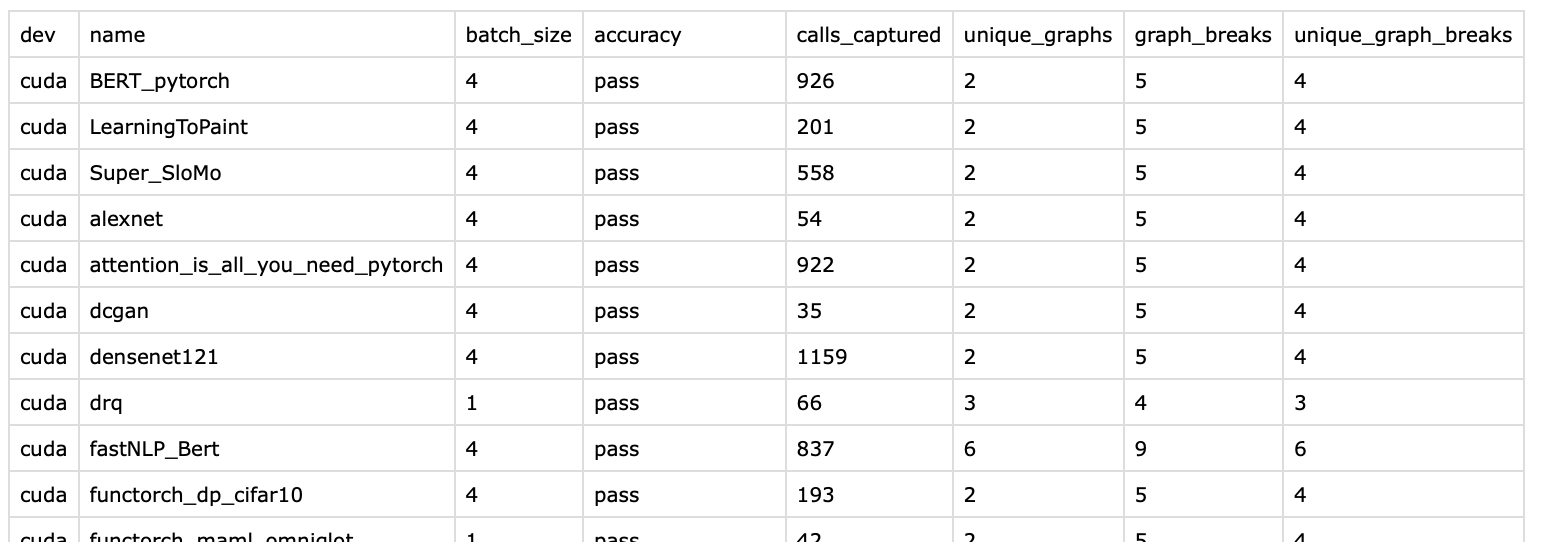
Follow-up to #96245. alexnet, Background_Matting, vision_maskrcnn, and vgg16 all have the same problem; but on float32 they were also failing on the previous day so I missed this. Once the amp jobs became available I could see that these have the same issue (on both float32 and amp).

Pull Request resolved: https://github.com/pytorch/pytorch/pull/96324
Approved by: https://github.com/desertfire
Summary: ciflow/inductor-perf-test-nightly now contains full dashboard
run which takes a very long time. Ed proposed a simplification of the
perf run there, but it is still worth to have a set of fast perf test
which only includes one configuration (--training --amp).
Pull Request resolved: https://github.com/pytorch/pytorch/pull/96166
Approved by: https://github.com/huydhn, https://github.com/weiwangmeta
OK, so this PR used to be about reducing the number of constants we specialize on, but it turns out that unspecialization was ~essentially never used (because we still constant specialized way too aggressively) and I ended up having to fix a bunch of issues to actually get tests to pass. So this PR is now "make int unspecialization actually work". As part of this, I have to turn off unspecialization by default, as there are still latent bugs in inductor.

The general strategy is that an unspecialized int is represented as a SymInt. Representing it as a 0d tensor (which is what the code used to do) is untenable: (1) we often need unspecialized ints to participate in size computations, but we have no way of propagating sympy expressions through tensor compute, and (2) a lot of APIs work when passed SymInt, but not when passed a Tensor. However, I continue to represent Numpy scalars as Tensors, as they are rarely used for size computation and they have an explicit dtype, so they are more accurately modeled as 0d tensors.

* I folded in the changes from https://github.com/pytorch/pytorch/pull/95099 as I cannot represent unspecialized ints as SymInts without also turning on dynamic shapes. This also eliminates the necessity for test_unspec.py, as toggling specialization without dynamic shapes doesn't do anything. As dynamic shapes defaults to unspecializing, I just deleted this entirely; for the specialization case, I rely on regular static shape tests to catch it. (Hypothetically, we could also rerun all the tests with dynamic shapes, but WITH int/float specialization, but this seems... not that useful? I mean, I guess export wants it, but I'd kind of like our Source heuristic to improve enough that export doesn't have to toggle this either.)
* Only 0/1 integers get specialized by default now
* A hodgepodge of fixes. I'll comment on the PR about them.

Fixes https://github.com/pytorch/pytorch/issues/95469

Signed-off-by: Edward Z. Yang <ezyang@meta.com>

Pull Request resolved: https://github.com/pytorch/pytorch/pull/95621
Approved by: https://github.com/jansel, https://github.com/Chillee
Summary: When running the benchmark test with --accuracy, two eager runs
should return the same result. If not, we want to detect it early, but
comparing against fp64_output may hide the non-deterministism in eager.

Pull Request resolved: https://github.com/pytorch/pytorch/pull/95616
Approved by: https://github.com/ZainRizvi
I believe this fixes the AllenaiLongformerBase problem in periodic.

The longer version of the problem is here is we are currently optimistically converting all item() calls into unbacked SymInt/SymFloat, but sometimes this results in a downstream error due to a data-dependent guard. Fallbacks for this case are non-existent; this will just crash the model. This is bad. So we flag guard until we get working fallbacks.

What could these fallbacks look like? One idea I have is to optimistically make data-dependent calls unbacked, but then if it results in a crash, restart Dynamo analysis with the plan of graph breaking when the item() call immediately happened.

Signed-off-by: Edward Z. Yang <ezyang@meta.com>

Pull Request resolved: https://github.com/pytorch/pytorch/pull/94987
Approved by: https://github.com/Skylion007, https://github.com/malfet
```
GuardOnDataDependentSymNode: It appears that you're trying to get a value out of symbolic int/float whose value is data-dependent (and thus we do not know the true value.)  The expression we were trying to evaluate is Eq(i3, -1).  Scroll up to see where each of these data-dependent accesses originally occurred.

While executing %as_strided : [#users=1] = call_method[target=as_strided](args = (%pad,), kwargs = {size: (12, %add, 768, 64), stride: (%getitem, %mul, %getitem_1, %getitem_2)})
Original traceback:
  File "/opt/conda/envs/py_3.10/lib/python3.10/site-packages/transformers/models/longformer/modeling_longformer.py", line 928, in <graph break in _sliding_chunks_matmul_attn_probs_value>
    chunked_value = padded_value.as_strided(size=chunked_value_size, stride=chunked_value_stride)
```

Signed-off-by: Edward Z. Yang <ezyang@meta.com>

Pull Request resolved: https://github.com/pytorch/pytorch/pull/94986
Approved by: https://github.com/albanD
Summary: It looks like setting torch.backends.cudnn.deterministic to
True is not enough for eliminating non-determinism when testing
benchmarks with --accuracy, so let's turn off cudnn completely.
With this change, mobilenet_v3_large does not show random failure on my
local environment. Also take this chance to clean up CI skip lists.

Pull Request resolved: https://github.com/pytorch/pytorch/pull/94363
Approved by: https://github.com/ezyang
Preferring dash over underscore in command-line options. Add `--command-arg-name` to the argument parser. The old arguments with underscores `--command_arg_name` are kept for backward compatibility.

Both dashes and underscores are used in the PyTorch codebase. Some argument parsers only have dashes or only have underscores in arguments. For example, the `torchrun` utility for distributed training only accepts underscore arguments (e.g., `--master_port`). The dashes are more common in other command-line tools. And it looks to be the default choice in the Python standard library:

`argparse.BooleanOptionalAction`: 4a9dff0e5a/Lib/argparse.py (L893-L895)

```python
class BooleanOptionalAction(Action):
    def __init__(...):
            if option_string.startswith('--'):
                option_string = '--no-' + option_string[2:]
                _option_strings.append(option_string)
```

It adds `--no-argname`, not `--no_argname`. Also typing `_` need to press the shift or the caps-lock key than `-`.

Pull Request resolved: https://github.com/pytorch/pytorch/pull/94505
Approved by: https://github.com/ezyang, https://github.com/seemethere
The functorch setting still exists, but now it is no longer necessary:
we infer use of Python dispatcher by checking if the ambient
FakeTensorMode has a ShapeEnv or not.  The setting still exists,
but it is for controlling direct AOTAutograd use now; for PT2,
it's sufficient to use torch._dynamo.config.dynamic_shapes.

Signed-off-by: Edward Z. Yang <ezyang@meta.com>

Pull Request resolved: https://github.com/pytorch/pytorch/pull/94469
Approved by: https://github.com/Chillee, https://github.com/voznesenskym, https://github.com/jansel
Summary: It looks like setting torch.backends.cudnn.deterministic to
True is not enough for eliminating non-determinism when testing
benchmarks with --accuracy, so let's turn off cudnn completely.
With this change, mobilenet_v3_large does not show random failure on my
local environment. Also take this chance to clean up CI skip lists.

Pull Request resolved: https://github.com/pytorch/pytorch/pull/94363
Approved by: https://github.com/ezyang