If an invalid platform is specified when disabling a test with flaky test bot, the CI crashes, skipping all tests that come after it.

This turns it into a console message instead.  Not erroring out here since it'll affect random PRs.  Actual error message should go into the bot that parses the original issue so that it can respond on that issue directly
Pull Request resolved: https://github.com/pytorch/pytorch/pull/86632
Approved by: https://github.com/huydhn
This achieves the same things as https://github.com/pytorch/pytorch/pull/85908 but using backends instead of kwargs (which breaks torchscript unfortunately). This also does mean we let go of numpy compatibility BUT the wins here are that users can control what opt einsum they wanna do!

The backend allows for..well you should just read the docs:
```
.. attribute::  torch.backends.opteinsum.enabled

    A :class:`bool` that controls whether opt_einsum is enabled (on by default). If so,
    torch.einsum will use opt_einsum (https://optimized-einsum.readthedocs.io/en/stable/path_finding.html)
    to calculate an optimal path of contraction for faster performance.

.. attribute::  torch.backends.opteinsum.strategy

    A :class:`str` that specifies which strategies to try when `torch.backends.opteinsum.enabled` is True.
    By default, torch.einsum will try the "auto" strategy, but the "greedy" and "optimal" strategies are
    also supported. Note that the "optimal" strategy is factorial on the number of inputs as it tries all
    possible paths. See more details in opt_einsum's docs
    (https://optimized-einsum.readthedocs.io/en/stable/path_finding.html).
```

In trying (and failing) to land 85908, I discovered that jit script does NOT actually pull from python's version of einsum (because it cannot support variadic args nor kwargs). Thus I learned that jitted einsum does not subscribe to the new opt_einsum path calculation. Overall, this is fine since jit script is getting deprecated, but where is the best place to document this?

## Test plan:
- added tests to CI
- locally tested that trying to set the strategy to something invalid will error properly
- locally tested that tests will pass even if you don't have opt-einsum
- locally tested that setting the strategy when opt-einsum is not there will also error properly
Pull Request resolved: https://github.com/pytorch/pytorch/pull/86219
Approved by: https://github.com/soulitzer, https://github.com/malfet
Fixes#85615
Currently, internal test discovery instantiates an `ArgumentParser` and adds numerous arguments to the internal parser:
f0570354dd/torch/testing/_internal/common_utils.py (L491-L500)
...
In this context, `argparse` will load [system args](b494f5935c/Lib/argparse.py (L1826-L1829)) from any external scripts invoking PyTorch testing (e.g. `vscode`).
The default behavior of `argparse` is to [allow abbreviations](b494f5935c/Lib/argparse.py (L2243-L2251)) of arguments, but when an `ArgumentParser` instance has many arguments and may be invoked in the context of potentially conflicting system args, the `ArgumentParser` should reduce the potential for conflicts by being instantiated with `allow_abbrev` set to `False`.
With the current default configuration, some abbreviations of the `ArgumentParser` long options conflict with system args used by `vscode` to invoke PyTorch test execution:
```bash
python ~/.vscode-server/extensions/ms-python.python-2022.14.0/pythonFiles/get_output_via_markers.py \
~/.vscode-server/extensions/ms-python.python-2022.14.0/pythonFiles/visualstudio_py_testlauncher.py \
--us=./test --up=test_cuda.py --uvInt=2 -ttest_cuda.TestCuda.test_memory_allocation \
--testFile=./test/test_cuda.py
>>>PYTHON-EXEC-OUTPUT
...
visualstudio_py_testlauncher.py: error: argument --use-pytest: ignored explicit argument './test'
```
The full relevant stack:
```
pytorch/test/jit/test_cuda.py, line 11, in <module>\n from torch.testing._internal.jit_utils import JitTestCase\n'\
pytorch/torch/testing/_internal/jit_utils.py, line 18, in <module>\n from torch.testing._internal.common_utils import IS_WINDOWS, \\\n'
pytorch/torch/testing/_internal/common_utils.py, line 518, in <module>\n args, remaining = parser.parse_known_args()\n'
argparse.py, line 1853, in parse_known_args\n namespace, args = self._parse_known_args(args, namespace)\n'
argparse.py, line 2062, in _parse_known_args\n start_index = consume_optional(start_index)\n'
argparse.py, line 1983, in consume_optional\n msg = _(\'ignored explicit argument %r\')\n'
```
The `argparse` [condition](b494f5935c/Lib/argparse.py (L2250)) that generates the error in this case:
```python
print(option_string)
--use-pytest
print(option_prefix)
--us
option_string.startswith(option_prefix)
True
```
It'd be nice if `vscode` didn't use two-letter options 🤦 but PyTorch testing shouldn't depend on such good behavior by invoking wrappers IMHO.
I haven't seen any current dependency on the abbreviated internal PyTorch `ArgumentParser` options so this change should only extend the usability of the (always improving!) PyTorch testing modules.
This simple PR avoids these conflicting options by instantiating the `ArgumentParser` with `allow_abbrev=False`
Thanks to everyone in the community for their continued contributions to this incredibly valuable framework.
Pull Request resolved: https://github.com/pytorch/pytorch/pull/85616
Approved by: https://github.com/clee2000
Fixes#85578
Currently, many test modules customize test loading and discovery via the [load_tests protocol](https://docs.python.org/3/library/unittest.html#load-tests-protocol). The salient custom behavior included (introduced with https://github.com/pytorch/pytorch/pull/13250) is to verify that the script discovering or executing the test is the same script in which the test is defined.
I believe this unnecessarily precludes the use of external tools to discover and execute tests (e.g. the vscode testing extension is widely used and IMHO quite convenient).
This simple PR retains the current restriction by default while offering users the option to disable the aforementioned check if desired by setting an environmental variable.
For example:
1. Setup a test env:
```bash
./tools/nightly.py checkout -b some_test_branch
conda activate pytorch-deps
conda install -c pytorch-nightly numpy expecttest mypy pytest hypothesis astunparse ninja pyyaml cmake cffi typing_extensions future six requests dataclasses -y
```
2. The default test collection behavior discovers 5 matching tests (only tests within `test/jit/test_cuda.py` because it doesn't alter the default `load_test` behavior:
```bash
python ~/.vscode-server/extensions/ms-python.python-2022.14.0/pythonFiles/get_output_via_markers.py \
~/.vscode-server/extensions/ms-python.python-2022.14.0/pythonFiles/testing_tools/unittest_discovery.py \
./test test_cuda.py | grep test_cuda | wc -l
5
```
3. Set the new env variable (in vscode, you would put it in the .env file)
```bash
export PYTORCH_DISABLE_RUNNING_SCRIPT_CHK=1
```
4. All of the desired tests are now discovered and can be executed successfully!
```bash
python ~/.vscode-server/extensions/ms-python.python-2022.14.0/pythonFiles/get_output_via_markers.py \
~/.vscode-server/extensions/ms-python.python-2022.14.0/pythonFiles/testing_tools/unittest_discovery.py \
./test test_cuda.py | grep test_cuda | wc -l
175
```
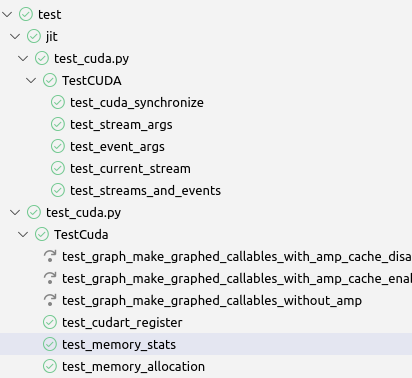
A potentially relevant note, the previous behavior of the custom `load_tests` flattened all the `TestSuite`s in each test module:
4c01c51266/torch/testing/_internal/common_utils.py (L3260-L3262)
I haven't been able to find any code that depends upon this behavior but I think retaining the `TestSuite` structure is preferable from a user perspective and likely safe (`TestSuite`s [can be executed](https://docs.python.org/3/library/unittest.html#load-tests-protocol:~:text=test%20runner%20to-,allow%20it%20to%20be%20run,-as%20any%20other) just like `TestCase`s and this is the structure [recommended](https://docs.python.org/3/library/unittest.html#load-tests-protocol:~:text=provides%20a%20mechanism%20for%20this%3A%20the%20test%20suite) by the standard python documentation).
If necessary, I can change this PR to continue flattening each test module's `TestSuite`s. Since I expect external tools using the `unittest` `discover` API will usually assume discovered `TestSuite`s to retain their structure (e.g. like [vscode](192c3eabd8/pythonFiles/visualstudio_py_testlauncher.py (L336-L349))) retaining the `testsuite` flattening behavior would likely require customization of those external tools for PyTorch though.
Thanks to everyone in the community for the continued contributions to this incredibly valuable framework!
Pull Request resolved: https://github.com/pytorch/pytorch/pull/85584
Approved by: https://github.com/huydhn
run tests in parallel at the test file granularity

runs 3 files in parallel using multiprocessing pool, output goes to a file, which is then printed when the test finishes.  Some tests cannot be run in parallel (usually due to lacking memory), so we run those after.  Sharding is changed to attempt to mask large files with other large files/run them on the same shard.

test_ops* gets a custom handler to run it because it is simply too big (2hrs on windows) and linalg_cholesky fails (I would really like a solution to this if possible, but until then we use the custom handler).

reduces cuda tests by a lot, reduces total windows test time by ~1hr

Ref. https://github.com/pytorch/pytorch/issues/82894
Pull Request resolved: https://github.com/pytorch/pytorch/pull/84961
Approved by: https://github.com/huydhn
Follow up:
- ~Remove non-float dtypes from allow-list for gradients~
- ~Map dtypes to short-hand so there aren't so many lines, i.e. float16 should be f16.~
- ~There were a lot of linting issues that flake8 wouldn't format for me, so I reformatted with black. This makes the diff a little trickier to parse.~

Observations:
- there are entries in the allow-list that weren't there before
- some forward that we previously passing now fail with requires_grad=True
- Because the allow list does not know about variants, a special skip was added for that in the block list

Pull Request resolved: https://github.com/pytorch/pytorch/pull/84242
Approved by: https://github.com/kulinseth, https://github.com/malfet
This reverts commit 1187dedd33.

Reverted https://github.com/pytorch/pytorch/pull/83436 on behalf of https://github.com/huydhn due to The previous change breaks internal builds D38714900 and other OSS tests. The bug has been fixed by this PR. But we decide that it is safer to revert both, merge them into one PR, then reland the fix
This is a new version of #15648 based on the latest master branch.

Unlike the previous PR where I fixed a lot of the doctests in addition to integrating xdoctest, I'm going to reduce the scope here. I'm simply going to integrate xdoctest, and then I'm going to mark all of the failing tests as "SKIP". This will let xdoctest run on the dashboards, provide some value, and still let the dashboards pass. I'll leave fixing the doctests themselves to another PR.

In my initial commit, I do the bare minimum to get something running with failing dashboards. The few tests that I marked as skip are causing segfaults. Running xdoctest results in 293 failed, 201 passed tests. The next commits will be to disable those tests. (unfortunately I don't have a tool that will insert the `#xdoctest: +SKIP` directive over every failing test, so I'm going to do this mostly manually.)

Fixes https://github.com/pytorch/pytorch/issues/71105

@ezyang
Pull Request resolved: https://github.com/pytorch/pytorch/pull/82797
Approved by: https://github.com/ezyang
Summary:
In https://github.com/pytorch/pytorch/pull/71146 that line was changed:
- before, the test would run on CUDA and skip on ROCm
- after, the test would skip on CUDA, skip on old ROCm and run on new ROCm

I believe the intention however was that it would run on CUDA, skip on old ROCm, and run on new ROCm.

Found by sypneiwski.

Test Plan:
eyes

By looking at the logs of the CI once it runs.

Differential Revision: D38582143

Pull Request resolved: https://github.com/pytorch/pytorch/pull/83182
Approved by: https://github.com/albanD, https://github.com/malfet
### Description
<!-- What did you change and why was it needed? -->
The nested_tensor impl for `contiguous` was currently disabled. Prior to the work on nested_tensor transpose. Only contiguous nested tensors could be created from python. However now is possible to create nested tensors that are non contiguous. This  pr links up the existing function used at the c++ level to the python function.

### Tests
Updated Test in `test/test_nestedtensor.py`

### Notes
The inference mode had to be removed for this test. This is because the func `.contiguous` is a composite implicit function. Currently this does not work in inference mode. However: https://github.com/pytorch/pytorch/pull/81838 should fix that issue.

### Why
When writing kernels in Triton for nested tensors I exposed a helper function that returned the "Buffer" tensor to python. Now contiguity can be checked before running any triton kernel. Also a good follow up would be making `nt.contiguous` on non contiguous nested tensors return a contiguous nested tensor.

Pull Request resolved: https://github.com/pytorch/pytorch/pull/82147
Approved by: https://github.com/jbschlosser
### Description
Skip messages can't be found in the logs due to restrictions w/ running in parallel and they take up too much space/required a lot of scrolling if you wanted to look at failure info instead, so tell people that they can still be found in the xml files.

### Testing
Look at the logs to make sure it actually got printed
Pull Request resolved: https://github.com/pytorch/pytorch/pull/82901
Approved by: https://github.com/huydhn
### Description

Across PyTorch's docstrings, both `callable` and `Callable` for variable types. The Callable should be capitalized as we are referring to the `Callable` type, and not the Python `callable()` function.

### Testing

There shouldn't be any testing required.

Pull Request resolved: https://github.com/pytorch/pytorch/pull/82487
Approved by: https://github.com/albanD
### Description
Since the major changes for `_TypedStorage` and `_UntypedStorage` are now complete, they can be renamed to be public.
`TypedStorage._untyped()` is renamed to `TypedStorage.untyped()`.
Documentation for storages is improved as well.
### Issue
Fixes#82436
### Testing
N/A
Pull Request resolved: https://github.com/pytorch/pytorch/pull/82438
Approved by: https://github.com/ezyang
If you still want this in CI, we should have a separate CI only
configuration.  The current config is pretty unfriendly for local
development.

Signed-off-by: Edward Z. Yang <ezyang@fb.com>
Pull Request resolved: https://github.com/pytorch/pytorch/pull/82262
Approved by: https://github.com/clee2000
Currently we have 2 ways of doing the same thing for torch dispatch and function modes:
`with push_torch_dispatch_mode(X)` or `with X.push(...)`
is now the equivalent of doing
`with X()`

This removes the first API (which is older and private so we don't need to go through a deprecation cycle)

There is some risk here that this might land race with a PR that uses the old API but in general it seems like most are using the `with X()` API or `enable_torch_dispatch_mode(X())` which isn't getting removed.

EDIT: left the `with X.push(...)` API since there were ~3 land races with that over the past day or so. But made it give a warning and ask users to use the other API
Pull Request resolved: https://github.com/pytorch/pytorch/pull/78215
Approved by: https://github.com/ezyang
Context: For a while slow gradcheck CI was skipping nearly all tests and this hid the fact that it should've been failing and timing out (10+h runtime for TestGradients). The CI configuration has since been fixed to correct this, revealing the test failures. This PR reenables slow gradcheck CI and makes it pass again.

This PR:
- makes slow and failing tests run in fast gradcheck mode only
- reduce the input size for slow gradcheck only for unary/binary ufuncs (alternatively, skip the test entirely)
- skip entire test files on slow gradcheck runner if they don't use gradcheck (test_ops, test_meta, test_decomp, test_ops_jit)
- reduces the input size for some ops

Follow ups:
1. Investigate slow mode failures https://github.com/pytorch/pytorch/issues/80411
2. See if we can re-enable slow gradcheck tests for some of the slow tests by reducing the sizes of their inputs

The following are failing in slow mode, they are now running in fast mode only.
```
test_fn_fwgrad_bwgrad___rmod___cuda_float64
test_fn_fwgrad_bwgrad_linalg_householder_product_cuda_complex128
test_fn_fwgrad_bwgrad__masked_prod_cuda_complex128
test_fn_fwgrad_bwgrad__masked_prod_cuda_float64
test_fn_fwgrad_bwgrad_linalg_matrix_power_cuda_complex128
test_fn_fwgrad_bwgrad_cat_cuda_complex128
test_fn_fwgrad_bwgrad_linalg_lu_factor_ex_cuda_float64
test_fn_fwgrad_bwgrad_copysign_cuda_float64
test_fn_fwgrad_bwgrad_cholesky_inverse_cuda_complex128
test_fn_fwgrad_bwgrad_float_power_cuda_complex128
test_fn_fwgrad_bwgrad_fmod_cuda_float64
test_fn_fwgrad_bwgrad_float_power_cuda_float64
test_fn_fwgrad_bwgrad_linalg_lu_cuda_float64
test_fn_fwgrad_bwgrad_remainder_cuda_float64
test_fn_fwgrad_bwgrad_repeat_cuda_complex128
test_fn_fwgrad_bwgrad_prod_cuda_complex128
test_fn_fwgrad_bwgrad_slice_scatter_cuda_float64
test_fn_fwgrad_bwgrad_tile_cuda_complex128
test_fn_fwgrad_bwgrad_pow_cuda_float64
test_fn_fwgrad_bwgrad_pow_cuda_complex128
test_fn_fwgrad_bwgrad_fft_*
test_fn_fwgrad_bwgrad_zero__cuda_complex128
test_fn_gradgrad_linalg_lu_factor_cuda_float64
test_fn_grad_div_trunc_rounding_cuda_float64
test_fn_grad_div_floor_rounding_cuda_float64
```

Marks the OpInfos for the following ops that run slowly in slow gradcheck as `fast_gradcheck` only (the left column represents runtime in seconds):
```
0  918.722  test_fn_fwgrad_bwgrad_nn_functional_conv_transpose3d_cuda_float64
1  795.042  test_fn_fwgrad_bwgrad_nn_functional_unfold_cuda_complex128
2  583.63  test_fn_fwgrad_bwgrad_nn_functional_max_pool3d_cuda_float64
3  516.946  test_fn_fwgrad_bwgrad_svd_cuda_complex128
4  503.179  test_fn_fwgrad_bwgrad_linalg_svd_cuda_complex128
5  460.985  test_fn_fwgrad_bwgrad_linalg_lu_cuda_complex128
6  401.04  test_fn_fwgrad_bwgrad_linalg_lstsq_grad_oriented_cuda_complex128
7  353.671  test_fn_fwgrad_bwgrad_nn_functional_max_pool2d_cuda_float64
8  321.903  test_fn_fwgrad_bwgrad_nn_functional_gaussian_nll_loss_cuda_float64
9  307.951  test_fn_fwgrad_bwgrad_stft_cuda_complex128
10  266.104  test_fn_fwgrad_bwgrad_svd_lowrank_cuda_float64
11  221.032  test_fn_fwgrad_bwgrad_istft_cuda_complex128
12  183.741  test_fn_fwgrad_bwgrad_lu_unpack_cuda_complex128
13  132.019  test_fn_fwgrad_bwgrad_nn_functional_unfold_cuda_float64
14  125.343  test_fn_fwgrad_bwgrad_nn_functional_pad_constant_cuda_complex128
15  124.2  test_fn_fwgrad_bwgrad_kron_cuda_complex128
16  123.721  test_fn_fwgrad_bwgrad_pca_lowrank_cuda_float64
17  121.074  test_fn_fwgrad_bwgrad_nn_functional_max_unpool3d_cuda_float64
18  119.387  test_fn_fwgrad_bwgrad_rot90_cuda_complex128
19  112.889  test_fn_fwgrad_bwgrad__masked_normalize_cuda_complex128
20  107.541  test_fn_fwgrad_bwgrad_dist_cuda_complex128
21  106.727  test_fn_fwgrad_bwgrad_diff_cuda_complex128
22  104.588  test_fn_fwgrad_bwgrad__masked_cumprod_cuda_complex128
23  100.135  test_fn_fwgrad_bwgrad_nn_functional_feature_alpha_dropout_with_train_cuda_float64
24  88.359  test_fn_fwgrad_bwgrad_mH_cuda_complex128
25  86.214  test_fn_fwgrad_bwgrad_nn_functional_max_unpool2d_cuda_float64
26  83.037  test_fn_fwgrad_bwgrad_nn_functional_bilinear_cuda_float64
27  79.987  test_fn_fwgrad_bwgrad__masked_cumsum_cuda_complex128
28  77.822  test_fn_fwgrad_bwgrad_diag_embed_cuda_complex128
29  76.256  test_fn_fwgrad_bwgrad_mT_cuda_complex128
30  74.039  test_fn_fwgrad_bwgrad_linalg_lu_solve_cuda_complex128
```
```
0  334.142  test_fn_fwgrad_bwgrad_unfold_cuda_complex128
1  312.791  test_fn_fwgrad_bwgrad_linalg_lu_factor_cuda_complex128
2  121.963  test_fn_fwgrad_bwgrad_nn_functional_max_unpool3d_cuda_float64
3  108.085  test_fn_fwgrad_bwgrad_diff_cuda_complex128
4  89.418  test_fn_fwgrad_bwgrad_nn_functional_max_unpool2d_cuda_float64
5  72.231  test_fn_fwgrad_bwgrad___rdiv___cuda_complex128
6  69.433  test_fn_fwgrad_bwgrad___getitem___cuda_complex128
7  68.582  test_fn_fwgrad_bwgrad_ldexp_cuda_complex128
8  68.572  test_fn_fwgrad_bwgrad_linalg_pinv_cuda_complex128
9  67.585  test_fn_fwgrad_bwgrad_nn_functional_glu_cuda_float64
10  66.567  test_fn_fwgrad_bwgrad_lu_cuda_float64
```
```
0  630.13  test_fn_gradgrad_nn_functional_conv2d_cuda_complex128
1  81.086  test_fn_gradgrad_linalg_solve_triangular_cuda_complex128
2  71.332  test_fn_gradgrad_norm_cuda_complex128
3  64.308  test_fn_gradgrad__masked_std_cuda_complex128
4  59.519  test_fn_gradgrad_div_no_rounding_mode_cuda_complex128
5  58.836  test_fn_gradgrad_nn_functional_adaptive_avg_pool3
```

Reduces the sizes of the inputs for:
- diff
- diag_embed

Pull Request resolved: https://github.com/pytorch/pytorch/pull/80514
Approved by: https://github.com/albanD
This PR uses pytest to run test_ops, test_ops_gradients, and test_ops_jit in parallel in non linux cuda environments to decrease TTS.  I am excluding linux cuda because running in parallel results in errors due to running out of memory

Notes:
* update hypothesis version for compatability with pytest
* use rerun-failures to rerun tests (similar to flaky tests, although these test files generally don't have flaky tests)
  * reruns are denoted by a rerun tag in the xml.  Failed reruns also have the failure tag.  Successes (meaning that the test is flaky) do not have the failure tag.
* see https://docs.google.com/spreadsheets/d/1aO0Rbg3y3ch7ghipt63PG2KNEUppl9a5b18Hmv2CZ4E/edit#gid=602543594 for info on speedup (or slowdown in the case of slow tests)
  * expecting windows tests to decrease by 60 minutes total
* slow test infra is expected to stay the same - verified by running pytest and unittest on the same job and check the number of skipped/run tests
* test reports to s3 changed - add entirely new table to keep track of invoking_file times
Pull Request resolved: https://github.com/pytorch/pytorch/pull/79898
Approved by: https://github.com/malfet, https://github.com/janeyx99

