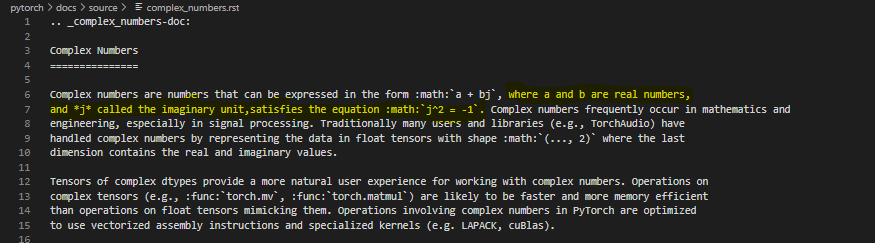
Summary:
The `torch.histogramdd` operator is documented in `torch/functional.py` but does not appear in the generated docs because it is missing from `docs/source/torch.rst`.

Pull Request resolved: https://github.com/pytorch/pytorch/pull/68273

Reviewed By: cpuhrsch

Differential Revision: D32470522

Pulled By: saketh-are

fbshipit-source-id: a23e73ba336415457a30bae568bda80afa4ae3ed
Summary:
### Create `linalg.cross`

Fixes https://github.com/pytorch/pytorch/issues/62810

As discussed in the corresponding issue, this PR adds `cross` to the `linalg` namespace (**Note**: There is no method variant) which is slightly different in behaviour compared to `torch.cross`.

**Note**: this is NOT an alias as suggested in mruberry's [https://github.com/pytorch/pytorch/issues/62810 comment](https://github.com/pytorch/pytorch/issues/62810#issuecomment-897504372) below
> linalg.cross being consistent with the Python Array API (over NumPy) makes sense because NumPy has no linalg.cross. I also think we can implement linalg.cross without immediately deprecating torch.cross, although we should definitely refer users to linalg.cross. Deprecating torch.cross will require additional review. While it's not used often it is used, and it's unclear if users are relying on its unique behavior or not.

The current default implementation of `torch.cross` is extremely weird and confusing. This has also been reported multiple times previously. (See https://github.com/pytorch/pytorch/issues/17229, https://github.com/pytorch/pytorch/issues/39310, https://github.com/pytorch/pytorch/issues/41850, https://github.com/pytorch/pytorch/issues/50273)

- [x] Add `torch.linalg.cross` with default `dim=-1`
- [x] Add OpInfo and other tests for `torch.linalg.cross`
- [x] Add broadcasting support to `torch.cross` and `torch.linalg.cross`
- [x] Remove out skip from `torch.cross` OpInfo
- [x] Add docs for `torch.linalg.cross`. Improve docs for `torch.cross` mentioning `linalg.cross` and the difference between the two. Also adds a warning to `torch.cross`, that it may change in the future (we might want to deprecate it later)

 ---

### Additional Fixes to `torch.cross`
- [x] Fix Doc for Tensor.cross
- [x] Fix torch.cross in `torch/overridres.py`

While working on `linalg.cross` I noticed these small issues with `torch.cross` itself.

[Tensor.cross docs](https://pytorch.org/docs/stable/generated/torch.Tensor.cross.html) still mentions `dim=-1` default which is actually wrong. It should be `dim=None` after the behaviour was updated in PR https://github.com/pytorch/pytorch/issues/17582 but the documentation for the `method` or `function` variant wasn’t updated. Later PR https://github.com/pytorch/pytorch/issues/41850 updated the documentation for the `function` variant i.e `torch.cross` and also added the following warning about the weird behaviour.
> If `dim` is not given, it defaults to the first dimension found with the size 3. Note that this might be unexpected.

But still, the `Tensor.cross` docs were missed and remained outdated. I’m finally fixing that here. Also fixing `torch/overrides.py` for `torch.cross` as well now, with `dim=None`.

To verify according to the docs the default behaviour of `dim=-1` should raise, you can try the following.

```python
a = torch.randn(3, 4)
b = torch.randn(3, 4)
b.cross(a)  # this works because the implementation finds 3 in the first dimension and the default behaviour as shown in documentation is actually not true.
>>> tensor([[ 0.7171, -1.1059,  0.4162,  1.3026],
        [ 0.4320, -2.1591, -1.1423,  1.2314],
        [-0.6034, -1.6592, -0.8016,  1.6467]])

b.cross(a, dim=-1)  # this raises as expected since the last dimension doesn't have a 3
>>> RuntimeError: dimension -1 does not have size 3
```

Please take a closer look (particularly the autograd part, this is the first time I'm dealing with `derivatives.yaml`). If there is something missing, wrong or needs more explanation, please let me know. Looking forward to the feedback.

cc mruberry Lezcano IvanYashchuk rgommers

Pull Request resolved: https://github.com/pytorch/pytorch/pull/63285

Reviewed By: gchanan

Differential Revision: D32313346

Pulled By: mruberry

fbshipit-source-id: e68c2687c57367274e8ddb7ef28ee92dcd4c9f2c
Summary:
https://github.com/pytorch/pytorch/issues/67578 disabled reduced precision reductions for FP16 GEMMs. After benchmarking, we've found that this has substantial performance impacts for common GEMM shapes (e.g., those found in popular instantiations of multiheaded-attention) on architectures such as Volta. As these performance regressions may come as a surprise to current users, this PR adds a toggle to disable reduced precision reductions
`torch.backends.cuda.matmul.allow_fp16_reduced_precision_reduction = `
rather than making it the default behavior.

CC ngimel ptrblck
stas00 Note that the behavior after the previous PR can be replicated with
`torch.backends.cuda.matmul.allow_fp16_reduced_precision_reduction = False`

Pull Request resolved: https://github.com/pytorch/pytorch/pull/67946

Reviewed By: zou3519

Differential Revision: D32289896

Pulled By: ngimel

fbshipit-source-id: a1ea2918b77e27a7d9b391e030417802a0174abe
Summary:
When I run this part of the code on the document with PyTorch version 1.10.0, I found some differences between the output and the document, as follows:

```python
import torch
import torch.fx as fx

class M(torch.nn.Module):
    def forward(self, x, y):
        return x + y

# Create an instance of `M`
m = M()

traced = fx.symbolic_trace(m)
print(traced)
print(traced.graph)
traced.graph.print_tabular()
```

I get the result:

```shell
def forward(self, x, y):
    add = x + y;  x = y = None
    return add

graph():
    %x : [#users=1] = placeholder[target=x]
    %y : [#users=1] = placeholder[target=y]
    %add : [#users=1] = call_function[target=operator.add](args = (%x, %y), kwargs = {})
    return add
opcode         name    target                   args    kwargs
-------------  ------  -----------------------  ------  --------
placeholder    x       x                        ()      {}
placeholder    y       y                        ()      {}
call_function  add     <built-in function add>  (x, y)  {}
output         output  output                   (add,)  {}
```

This pr modified the document。

Pull Request resolved: https://github.com/pytorch/pytorch/pull/68043

Reviewed By: driazati

Differential Revision: D32287178

Pulled By: jamesr66a

fbshipit-source-id: 48ebd0e6c09940be9950cd57ba0c03274a849be5
Summary:
**Summary:** This commit adds the `torch.nn.qat.dynamic.modules.Linear`
module, the dynamic counterpart to `torch.nn.qat.modules.Linear`.
Functionally these are very similar, except the dynamic version
expects a memoryless observer and is converted into a dynamically
quantized module before inference.

Pull Request resolved: https://github.com/pytorch/pytorch/pull/67325

Test Plan:
`python3 test/test_quantization.py TestQuantizationAwareTraining.test_dynamic_qat_linear`

**Reviewers:** Charles David Hernandez, Jerry Zhang

**Subscribers:** Charles David Hernandez, Supriya Rao, Yining Lu

**Tasks:** 99696812

**Tags:** pytorch

Reviewed By: malfet, jerryzh168

Differential Revision: D32178739

Pulled By: andrewor14

fbshipit-source-id: 5051bdd7e06071a011e4e7d9cc7769db8d38fd73
Summary:
Add check to make sure we do not add new submodules without documenting them in an rst file.
This is especially important because our doc coverage only runs for modules that are properly listed.
temporarily removed "torch" from the list to make sure the failure in CI looks as expected. EDIT: fixed now
This is what a CI failure looks like for the top level torch module as an example:

Pull Request resolved: https://github.com/pytorch/pytorch/pull/67440
Reviewed By: jbschlosser
Differential Revision: D32005310
Pulled By: albanD
fbshipit-source-id: 05cb2abc2472ea4f71f7dc5c55d021db32146928
Summary:
Adds `torch.argwhere` as an alias to `torch.nonzero`

Currently, `torch.nonzero` is actually provides equivalent functionality to `np.argwhere`.

From NumPy docs,
> np.argwhere(a) is almost the same as np.transpose(np.nonzero(a)), but produces a result of the correct shape for a 0D array.

Pull Request resolved: https://github.com/pytorch/pytorch/pull/64257

Reviewed By: qihqi

Differential Revision: D32049884

Pulled By: saketh-are

fbshipit-source-id: 016e49884698daa53b83e384435c3f8f6b5bf6bb
Summary:
Pull Request resolved: https://github.com/pytorch/pytorch/pull/67449

Adds a description of what the current custom module API does
and API examples for Eager mode and FX graph mode to the main
PyTorch quantization documentation page.

Test Plan:
```
cd docs
make html
python -m http.server
// check the docs page, it renders correctly
```

Reviewed By: jbschlosser

Differential Revision: D31994641

Pulled By: vkuzo

fbshipit-source-id: d35a62947dd06e71276eb6a0e37950d3cc5abfc1
Summary:
This reduces the chance of a newly added functions to be ignored by mistake.

The only test that this impacts is the coverage test that runs as part of the python doc build. So if that one works, it means that the update to the list here is correct.

Pull Request resolved: https://github.com/pytorch/pytorch/pull/67395

Reviewed By: jbschlosser

Differential Revision: D31991936

Pulled By: albanD

fbshipit-source-id: 5b4ce7764336720827501641311cc36f52d2e516
Summary:
Pull Request resolved: https://github.com/pytorch/pytorch/pull/66143

Delete test_list_remove. There's no point in testing conversion of
this model since TorchScript doesn't support it.

Add a link to an issue tracking test_embedding_bag_dynamic_input.

[ONNX] fix docs (#65379)

Mainly fix the sphinx build by inserting empty before
bulleted lists.

Also some minor improvements:
Remove superfluous descriptions of deprecated and ignored args.
The user doesn't need to know anything other than that they are
deprecated and ignored.

Fix custom_opsets description.

Make indentation of Raises section consistent with Args section.

[ONNX] publicize func for discovering unconvertible ops (#65285)

* [ONNX] Provide public function to discover all unconvertible ATen ops

This can be more productive than finding and fixing a single issue at a
time.

* [ONNX] Reorganize test_utility_funs

Move common functionality into a base class that doesn't define any
tests.

Add a new test for opset-independent tests. This lets us avoid running
the tests repeatedly for each opset.

Use simple inheritance rather than the `type()` built-in. It's more
readable.

* [ONNX] Use TestCase assertions rather than `assert`

This provides better error messages.

* [ONNX] Use double quotes consistently.

[ONNX] Fix code block formatting in doc (#65421)

Test Plan: Imported from OSS

Reviewed By: jansel

Differential Revision: D31424093

fbshipit-source-id: 4ced841cc546db8548dede60b54b07df9bb4e36e
Summary:
Adds `torch.argwhere` as an alias to `torch.nonzero`

Currently, `torch.nonzero` is actually provides equivalent functionality to `np.argwhere`.

From NumPy docs,
> np.argwhere(a) is almost the same as np.transpose(np.nonzero(a)), but produces a result of the correct shape for a 0D array.

Pull Request resolved: https://github.com/pytorch/pytorch/pull/64257

Reviewed By: dagitses

Differential Revision: D31474901

Pulled By: saketh-are

fbshipit-source-id: 335327a4986fa327da74e1fb8624cc1e56959c70
Summary:
Pull Request resolved: https://github.com/pytorch/pytorch/pull/66577

There was a rebase artifact erroneously landed to quantization docs,
this PR removes it.

Test Plan:
CI

Imported from OSS

Reviewed By: soulitzer

Differential Revision: D31651350

fbshipit-source-id: bc254cbb20724e49e1a0ec6eb6d89b28491f9f78
Summary:
Pull Request resolved: https://github.com/pytorch/pytorch/pull/66380

Description:
1. creates doc pages for Eager and FX numeric suites
2. adds a link from main quantization doc to (1)
3. formats docblocks in Eager NS to render well
4. adds example code and docblocks to FX numeric suite

Test Plan:
```
cd docs
make html
python -m http.server
// renders well
```

Reviewed By: jerryzh168

Differential Revision: D31543173

Pulled By: vkuzo

fbshipit-source-id: feb291bcbe92747495f45165f738631fa5cbffbd
Summary:
Pull Request resolved: https://github.com/pytorch/pytorch/pull/66379

Description:

Creates a quantization API reference and fixes all the docblock errors.

This is #66122 to #66210 squashed together

Test Plan:
```
cd docs
make html
python -m http.server
// open webpage, inspect it, looks good
```

Reviewed By: ejguan

Differential Revision: D31543172

Pulled By: vkuzo

fbshipit-source-id: 9131363d6528337e9f100759654d3f34f02142a9
Summary:
Pull Request resolved: https://github.com/pytorch/pytorch/pull/66222

Description:
1. creates doc pages for Eager and FX numeric suites
2. adds a link from main quantization doc to (1)
3. formats docblocks in Eager NS to render well
4. adds example code and docblocks to FX numeric suite

Test Plan:
```
cd docs
make html
python -m http.server
// renders well
```

Reviewed By: jerryzh168

Differential Revision: D31447610

Pulled By: vkuzo

fbshipit-source-id: 441170c4a6c3ddea1e7c7c5cc2f1e1cd5aa65f2f
Summary:
Pull Request resolved: https://github.com/pytorch/pytorch/pull/66210

Description:

Moves the backend section of the quantization page further down,
to ensure that the API description and reference sections are closer
to the top.

Test Plan:
```
cd docs
make html
python -m server.http
// renders well
```

Reviewed By: jerryzh168

Differential Revision: D31447611

Pulled By: vkuzo

fbshipit-source-id: 537b146559bce484588b3c78e6b0cdb4c274e8dd
Summary:
Pull Request resolved: https://github.com/pytorch/pytorch/pull/66201

Description:

This PR switches the quantization API reference to use `autosummary`
for each section.  We define the sections and manually write a list
of modules/functions/methods to include, and sphinx does the rest.
A result is a single page where we have every quantization function
and module with a quick autogenerated blurb, and user can click
through to each of them for a full documentation page.

This mimics how the `torch.nn` and `torch.nn.functional` doc
pages are set up.

In detail, for each section before this PR:
* creates a new section using `autosummary`
* adds all modules/functions/methods which were previously in the manual section
* adds any additional modules/functions/methods which are public facing but not previously documented
* deletes the old manual summary and all links to it

Test Plan:
```
cd docs
make html
python -m http.server
// renders well, links work
```

Reviewed By: jerryzh168

Differential Revision: D31447615

Pulled By: vkuzo

fbshipit-source-id: 09874ad9629f9c00eeab79c406579c6abd974901
Summary:
Pull Request resolved: https://github.com/pytorch/pytorch/pull/66198

Consolidates all API reference material for quantization on a single
page, to reduce duplication of information.

Future PRs will improve the API reference page itself.

Test Plan:
```
cd docs
make html
python -m http.server
// renders well
```

Reviewed By: jerryzh168

Differential Revision: D31447616

Pulled By: vkuzo

fbshipit-source-id: 2f9c4dac2b2fb377568332aef79531d1f784444a
Summary:
Pull Request resolved: https://github.com/pytorch/pytorch/pull/66129

Adds a documentation page for `torch.ao.quantization.QConfig`. It is useful
for this to have a separate page since it shared between Eager and FX graph
mode quantization.

Also, ensures that all important functions and module attributes in this
module have docstrings, so users can discover these without reading the
source code.

Test Plan:
```
cd docs
make html
python -m http.server
// open webpage, inspect it, renders correctly
```

Reviewed By: jerryzh168

Differential Revision: D31447614

Pulled By: vkuzo

fbshipit-source-id: 5d9dd2a4e8647fa17b96cefbaae5299adede619c
Summary:
Pull Request resolved: https://github.com/pytorch/pytorch/pull/66125

Before this PR, the documentation for observers and fake_quants was inlined in the
Eager mode quantization page.  This was hard to discover, especially
since that page is really long, and we now have FX graph mode quantization reusing
all of this code.

This PR moves observers and fake_quants into their own documentation pages. It also
adds docstrings to all user facing module attributes such as the default observers
and fake_quants, so people can discover them from documentation without having
to inspect the source code.

For now, enables autoformatting (which means all public classes, functions, members
with docstrings will get docs).  If we need to exclude something in these files from
docs in the future, we can go back to manual docs.

Test Plan:
```
cd docs
make html
python -m server.http
// inspect docs on localhost, renders correctly
```

Reviewed By: dagitses

Differential Revision: D31447613

Pulled By: vkuzo

fbshipit-source-id: 63b4cf518badfb29ede583a5c2ca823f572c8599
Summary:
Pull Request resolved: https://github.com/pytorch/pytorch/pull/66122

Description:

Adds a documentation page for FX graph mode quantization APIs which
reads from the docstrings in `quantize_fx`, and links it from the main
quantization documentation page.

Also, updates the docstrings in `quantize_fx` to render well with reStructuredText.

Test Plan:
```
cd docs
make html
python -m http.server
// open webpage, inspect it, looks good
```

Reviewed By: dagitses

Differential Revision: D31447612

Pulled By: vkuzo

fbshipit-source-id: 07d0a6137f1537af82dce0a729f9617efaa714a0
Summary:
Pull Request resolved: https://github.com/pytorch/pytorch/pull/65838

closes https://github.com/pytorch/pytorch/pull/65675

The default `--max_restarts` for `torch.distributed.run` was changed to `0` from `3` to make things backwards compatible with `torch.distributed.launch`. Since the default `--max_restarts` used to be greater than `0` we never documented passing `--max_restarts` explicitly in any of our example code.

Test Plan: N/A doc change only

Reviewed By: d4l3k

Differential Revision: D31279544

fbshipit-source-id: 98b31e6a158371bc56907552c5c13958446716f9
Summary:
Pull Request resolved: https://github.com/pytorch/pytorch/pull/64373

* Fix some bad formatting and clarify things in onnx.rst.
* In `export_to_pretty_string`:
    * Add documentation for previously undocumented args.
    * Document that `f` arg is ignored and mark it deprecated.
    * Update tests to stop setting `f`.
    * Warn if `_retain_param_name` is set.
* Use double quotes for string literals in test_operators.py.

Test Plan: Imported from OSS

Reviewed By: ezyang

Differential Revision: D30905271

Pulled By: malfet

fbshipit-source-id: 3627eeabf40b9516c4a83cfab424ce537b36e4b3
Summary:
Related to https://github.com/pytorch/pytorch/issues/30987. Fix the following task:

- [ ] Remove the use of `.data` in all our internal code:
  - [ ] ...
  - [x] `docs/source/scripts/build_activation_images.py` and `docs/source/notes/extending.rst`

In `docs/source/scripts/build_activation_images.py`, I used `nn.init` because the snippet already assumes `nn` is available (the class inherits from `nn.Module`).

cc albanD

Pull Request resolved: https://github.com/pytorch/pytorch/pull/65358

Reviewed By: malfet

Differential Revision: D31061790

Pulled By: albanD

fbshipit-source-id: be936c2035f0bdd49986351026fe3e932a5b4032
Summary:
Powers have decided this API should be listed as beta.

Pull Request resolved: https://github.com/pytorch/pytorch/pull/65247

Reviewed By: malfet

Differential Revision: D31057940

Pulled By: ngimel

fbshipit-source-id: 137b63cbd2c7409fecdc161a22135619bfc96bfa
Summary:
Puts memory sharing intro under Sharing memory... header, where it should have been all along.

Pull Request resolved: https://github.com/pytorch/pytorch/pull/64996

Reviewed By: mruberry

Differential Revision: D30948619

Pulled By: ngimel

fbshipit-source-id: 5d9dd267b34e9d3fc499d4738377b58a22da1dc2
Summary:
Pull Request resolved: https://github.com/pytorch/pytorch/pull/62671

Very crude first implementation of `torch.nanmean`. The current reduction kernels do not have good support for implementing nan* variants. Rather than implementing new kernels for each nan* operator, I will work on new reduction kernels with support for a `nan_policy` flag and then I will port `nanmean` to use that.

**TODO**

- [x] Fix autograd issue

Test Plan: Imported from OSS

Reviewed By: malfet

Differential Revision: D30515181

Pulled By: heitorschueroff

fbshipit-source-id: 303004ebd7ac9cf963dc4f8e2553eaded5f013f0
Summary:
Partially resolves https://github.com/pytorch/vision/issues/4281

In this PR we are proposing a new scheduler --SequentialLR-- which enables list of different schedulers called in different periods of the training process.

The main motivation of this scheduler is recently gained popularity of warming up phase in the training time. It has been shown that having a small steps in initial stages of training can help convergence procedure get faster.

With the help of SequentialLR we mainly enable to call a small constant (or linearly increasing) learning rate followed by actual target learning rate scheduler.

```PyThon
scheduler1 = ConstantLR(optimizer, factor=0.1, total_iters=2)
scheduler2 = ExponentialLR(optimizer, gamma=0.9)
scheduler = SequentialLR(optimizer, schedulers=[scheduler1, scheduler2], milestones=[5])

for epoch in range(100):
    train(...)
    validate(...)
    scheduler.step()
```

which this code snippet will call `ConstantLR` in the first 5 epochs and will follow up with `ExponentialLR` in the following epochs.

This scheduler could be used to provide call of any group of schedulers next to each other. The main consideration we should make is every time we switch to a new scheduler we assume that new scheduler starts from the beginning- zeroth epoch.

We also add Chained Scheduler to `optim.rst` and `lr_scheduler.pyi` files here.

Pull Request resolved: https://github.com/pytorch/pytorch/pull/64037

Reviewed By: albanD

Differential Revision: D30841099

Pulled By: iramazanli

fbshipit-source-id: 94f7d352066ee108eef8cda5f0dcb07f4d371751
Summary:
Fixes https://github.com/pytorch/pytorch/issues/62811

Add `torch.linalg.matmul` alias to `torch.matmul`. Note that the `linalg.matmul` doesn't have a `method` variant.

Also cleaning up `torch/_torch_docs.py` when formatting is not needed.

cc IvanYashchuk Lezcano mruberry rgommers

Pull Request resolved: https://github.com/pytorch/pytorch/pull/63227

Reviewed By: mrshenli

Differential Revision: D30770235

Pulled By: mruberry

fbshipit-source-id: bfba77dfcbb61fcd44f22ba41bd8d84c21132403
Summary:
Partially unblocks https://github.com/pytorch/vision/issues/4281

Previously we have added WarmUp Schedulers to PyTorch Core in the PR : https://github.com/pytorch/pytorch/pull/60836 which had two mode of execution - linear and constant depending on warming up function.

In this PR we are changing this interface to more direct form, as separating linear and constant modes to separate Schedulers. In particular

```Python
scheduler1 = WarmUpLR(optimizer, warmup_factor=0.1, warmup_iters=5, warmup_method="constant")
scheduler2 = WarmUpLR(optimizer, warmup_factor=0.1, warmup_iters=5, warmup_method="linear")
```

will look like

```Python
scheduler1 = ConstantLR(optimizer, warmup_factor=0.1, warmup_iters=5)
scheduler2 = LinearLR(optimizer, warmup_factor=0.1, warmup_iters=5)
```

correspondingly.

Pull Request resolved: https://github.com/pytorch/pytorch/pull/64395

Reviewed By: datumbox

Differential Revision: D30753688

Pulled By: iramazanli

fbshipit-source-id: e47f86d12033f80982ddf1faf5b46873adb4f324
Summary:
Fixes https://github.com/pytorch/pytorch/issues/61767

## Changes

- [x] Add `torch.concat` alias to `torch.cat`
- [x] Add OpInfo for `cat`/`concat`
- [x] Fix `test_out` skips (Use `at::native::resize_output` or `at::native::resize_output_check`)
  - [x] `cat`/`concat`
  - [x] `stack`
  - [x] `hstack`
  - [x] `dstack`
  - [x] `vstack`/`row_stack`
- [x] Remove redundant tests for `cat`/`stack`

~I've not added `cat`/`concat` to OpInfo `op_db` yet, since cat is a little more tricky than other OpInfos (should have a lot of tests) and currently there are no OpInfos for that. I can try to add that in a subsequent PR or maybe here itself, whatever is suggested.~
**Edit**: cat/concat OpInfo has been added.

**Note**: I've added the named tensor support for `concat` alias as well, maybe that's out of spec in `array-api` but it is still useful for consistency in PyTorch.

Thanks to krshrimali for guidance on my first PR :))

cc mruberry rgommers pmeier asmeurer leofang AnirudhDagar asi1024 emcastillo kmaehashi heitorschueroff krshrimali

Pull Request resolved: https://github.com/pytorch/pytorch/pull/62560

Reviewed By: saketh-are

Differential Revision: D30762069

Pulled By: mruberry

fbshipit-source-id: 6985159d1d9756238890488a0ab3ae7699d94337
Summary:
This PR is created to replace https://github.com/pytorch/pytorch/pull/53180 PR stack, which has all the review discussions. Reason for needing a replacement is due to a messy Sandcastle issue.

Pull Request resolved: https://github.com/pytorch/pytorch/pull/64234

Reviewed By: gmagogsfm

Differential Revision: D30656444

Pulled By: ansley

fbshipit-source-id: 77536c8bcc88162e2c72636026ca3c16891d669a
Summary:
Pull Request resolved: https://github.com/pytorch/pytorch/pull/63582

Current quantization docs do not define qconfig and qengine. Added text to define these concepts before they are used.
ghstack-source-id: 137051719

Test Plan: Imported from OSS

Reviewed By: HDCharles

Differential Revision: D30658656

fbshipit-source-id: a45a0fcdf685ca1c3f5c3506337246a430f8f506
Summary:
Implements an orthogonal / unitary parametrisation.

It does passes the tests and I have trained a couple models with this implementation, so I believe it should be somewhat correct. Now, the implementation is very subtle. I'm tagging nikitaved  and IvanYashchuk as reviewers in case they have comments / they see some room for optimisation of the code, in particular of the `forward` function.

Fixes https://github.com/pytorch/pytorch/issues/42243

Pull Request resolved: https://github.com/pytorch/pytorch/pull/62089

Reviewed By: ezyang

Differential Revision: D30639063

Pulled By: albanD

fbshipit-source-id: 988664f333ac7a75ce71ba44c8d77b986dff2fe6
Summary:
This PR expands the [note on modules](https://pytorch.org/docs/stable/notes/modules.html) with additional info for 1.10.

It adds the following:
* Examples of using hooks
* Examples of using apply()
* Examples for ParameterList / ParameterDict
* register_parameter() / register_buffer() usage
* Discussion of train() / eval() modes
* Distributed training overview / links
* TorchScript overview / links
* Quantization overview / links
* FX overview / links
* Parametrization overview / link to tutorial

Pull Request resolved: https://github.com/pytorch/pytorch/pull/63963

Reviewed By: albanD

Differential Revision: D30606604

Pulled By: jbschlosser

fbshipit-source-id: c1030b19162bcb5fe7364bcdc981a2eb6d6e89b4
Summary:
This PR introduces a new `torchrun` entrypoint that simply "points" to `python -m torch.distributed.run`. It is shorter and less error-prone to type and gives a nicer syntax than a rather cryptic `python -m ...` command line. Along with the new entrypoint the documentation is also updated and places where `torch.distributed.run` are mentioned are replaced with `torchrun`.

cc pietern mrshenli pritamdamania87 zhaojuanmao satgera rohan-varma gqchen aazzolini osalpekar jiayisuse agolynski SciPioneer H-Huang mrzzd cbalioglu gcramer23

Pull Request resolved: https://github.com/pytorch/pytorch/pull/64049

Reviewed By: cbalioglu

Differential Revision: D30584041

Pulled By: kiukchung

fbshipit-source-id: d99db3b5d12e7bf9676bab70e680d4b88031ae2d
Summary:
Pull Request resolved: https://github.com/pytorch/pytorch/pull/63910

Addresses the current issue that `init_method=tcp://` is not compatible with `torch.distributed.run` and `torch.distributed.launch`. When running with a training script that initializes the process group with `init_method=tcp://localhost:$port` as such:

```
$ python -u -m torch.distributed.run --max_restarts 0 --nproc_per_node 1 --nnodes 1 --master_addr $(hostname) --master_port 6000 ~/tmp/test.py
```

An `Address in use` error is raised since the training script tries to create a TCPStore on port 6000, which is already taken since the elastic agent is already running a TCPStore on that port.

For details see: https://github.com/pytorch/pytorch/issues/63874.

This change does a couple of things:

1. Adds `is_torchelastic_launched()` check function that users can use in the training scripts to see whether the script is launched via torchelastic.
1. Update the `torch.distributed` docs page to include the new `is_torchelastic_launched()` function.
1. Makes `init_method=tcp://` torchelastic compatible by modifying `_tcp_rendezvous_handler` in `torch.distributed.rendezvous` (this is NOT the elastic rendezvous, it is the old rendezvous module which is slotted for deprecation in future releases) to check `is_torchelastic_launched()` AND `torchelastic_use_agent_store()` and if so, only create TCPStore clients (no daemons, not even for rank 0).
1. Adds a bunch of unittests to cover the different code paths

NOTE: the issue mentions that we should fail-fast with an assertion on `init_method!=env://` when `is_torchelastic_launched()` is `True`. There are three registered init_methods in pytorch: env://, tcp://, file://. Since this diff makes tcp:// compatible with torchelastic and I've validated that file is compatible with torchelastic. There is no need to add assertions. I did update the docs to point out that env:// is the RECOMMENDED init_method. We should probably deprecate the other init_methods in the future but this is out of scope for this issue.

Test Plan: Unittests.

Reviewed By: cbalioglu

Differential Revision: D30529984

fbshipit-source-id: 267aea6d4dad73eb14a2680ac921f210ff547cc5
Summary:
CUDA_VERSION and HIP_VERSION follow very unrelated versioning schemes, so it does not make sense to use CUDA_VERSION to determine the ROCm path. This note explicitly addresses it.

Pull Request resolved: https://github.com/pytorch/pytorch/pull/62850

Reviewed By: mruberry

Differential Revision: D30547562

Pulled By: malfet

fbshipit-source-id: 02990fa66a88466c2330ab85f446b25b78545150
Summary:
Pull Request resolved: https://github.com/pytorch/pytorch/pull/63241
This is a common source of confusion, but it matches the NumPy
behavior.
Fixes#44010Fixes#59526
Test Plan: Imported from OSS
Reviewed By: ejguan
Differential Revision: D30307646
Pulled By: dagitses
fbshipit-source-id: d848140ba267560387d83f3e7acba8c3cdc53d82
Summary:
- Adds some code examples for `ctx` methods and make requirements of arguments more clear
- Type annotations for `save_for_backward`, `mark_dirty`, `mark_non_differentiable`, and `set_materialize_grads` (BC-breaking?)
- Refactor `torch.autograd.Function` doc

Pull Request resolved: https://github.com/pytorch/pytorch/pull/60312

Reviewed By: VitalyFedyunin

Differential Revision: D30314961

Pulled By: soulitzer

fbshipit-source-id: a284314b65662e26390417bd2b6b12cd85e68dc8
Summary:
Pull Request resolved: https://github.com/pytorch/pytorch/pull/63242

These functions are part of the native functions namespace as well as the quantized namespace

Test Plan:
CI

Imported from OSS

Reviewed By: jerryzh168

Differential Revision: D30316430

fbshipit-source-id: cd9c839e5c1a961e3c6944e514c16fbc256a2f0c
Summary:
Pull Request resolved: https://github.com/pytorch/pytorch/pull/63240

Op is exposed via torch.quantized_batch_norm to the end user without any existing documentation

Test Plan:
CI

Imported from OSS

Reviewed By: VitalyFedyunin

Differential Revision: D30316431

fbshipit-source-id: bf2dc8b7b6f497cf73528eaa2bedef9f65029d84
Summary:
Warm up of learning rate scheduling has initially been discussed  by Priya et. al. in the paper: https://arxiv.org/pdf/1706.02677.pdf .

In the section 2.2 of the paper they discussed and proposed idea of warming up learning schedulers in order to prevent big variance / noise in the learning rate. Then idea has been further discussed in the following papers:
  * Akilesh Gotmare et al. https://arxiv.org/abs/1810.13243
  * Bernstein et al  http://proceedings.mlr.press/v80/bernstein18a/bernstein18a.pdf
  * Liyuan Liu et al: https://arxiv.org/pdf/1908.03265.pdf

There are two type of popularly used learning rate warm up ideas
  * Constant warmup  (start with very small constant learning rate)
  * Linear Warmup        ( start with small learning rate and gradually increase)

In this PR we are adding warm up as learning rate scheduler. Note that learning rates are chainable, which means that we can merge warmup scheduler with any other learning rate scheduler to make more sophisticated learning rate scheduler.

## Linear Warmup

Linear Warmup is multiplying learning rate with pre-defined constant - warmup_factor in the first epoch (epoch 0). Then targeting to increase this multiplication constant to one in warmup_iters many epochs. Hence we can derive the formula at i-th step to have multiplication constant equal to:

                    warmup_factor + (1-warmup_factor) * i /  warmup_iters

Moreover, the fraction of this quantity at point i to point i-1 will give us

           1 + (1.0 - warmup_factor) / [warmup_iters*warmup_factor+(i-1)*(1-warmup_factor)]

which is used in get_lr() method in our implementation. Below we provide an example how to use linear warmup scheduler and to give an example to show how does it works.

```python
import torch
from torch.nn import Parameter
from torch.optim import SGD
from torch.optim.lr_scheduler import WarmUpLR

model = [Parameter(torch.randn(2, 2, requires_grad=True))]
optimizer = SGD(model, 0.1)
scheduler = WarmUpLR(optimizer, warmup_factor=0.1, warmup_iters=10, warmup_method="linear")

for epoch in range(15):

    print(epoch, scheduler.get_last_lr()[0])

    optimizer.step()
    scheduler.step()
```

```
0 0.010000000000000002
1 0.019000000000000003
2 0.028000000000000008
3 0.03700000000000001
4 0.04600000000000001
5 0.055000000000000014
6 0.06400000000000002
7 0.07300000000000002
8 0.08200000000000003
9 0.09100000000000004
10 0.10000000000000005
11 0.10000000000000005
12 0.10000000000000005
13 0.10000000000000005
14 0.10000000000000005
```

## Constant Warmup

Constant warmup has straightforward idea, to multiply learning rate by warmup_factor until we reach to epoch warmup_factor, then do nothing for following epochs

```python
import torch
from torch.nn import Parameter
from torch.optim import SGD
from torch.optim.lr_scheduler import WarmUpLR

model = [Parameter(torch.randn(2, 2, requires_grad=True))]
optimizer = SGD(model, 0.1)
scheduler = WarmUpLR(optimizer, warmup_factor=0.1, warmup_iters=5, warmup_method="constant")

for epoch in range(10):

    print(epoch, scheduler.get_last_lr()[0])

    optimizer.step()
    scheduler.step()
```

```
0 0.010000000000000002
1 0.010000000000000002
2 0.010000000000000002
3 0.010000000000000002
4 0.010000000000000002
5 0.10000000000000002
6 0.10000000000000002
7 0.10000000000000002
8 0.10000000000000002
9 0.10000000000000002
```

Pull Request resolved: https://github.com/pytorch/pytorch/pull/60836

Reviewed By: saketh-are

Differential Revision: D29537615

Pulled By: iramazanli

fbshipit-source-id: d910946027acc52663b301f9c56ade686e62cb69
Summary:
This FAQ has a section for CUDA OOMs where there are lots of don'ts. This limits modeling solution. Deep nets can blow up memory due to output caching during training.
It's a known problem with a known solution: to trade-off compute for memory via checkpointing.
FAQ should mention it.

Pull Request resolved: https://github.com/pytorch/pytorch/pull/62709

Reviewed By: nairbv

Differential Revision: D30103326

Pulled By: ezyang

fbshipit-source-id: 3a8b465a7fbe19aae88f83cc50fe82ebafcb56c9
Summary:
Pull Request resolved: https://github.com/pytorch/pytorch/pull/62662

Replaced the methods set_tensor(.) and get_tensor() in the python exposed API from the C++ logic with buffer() and set_buffer(.) to be a cleaner interface.

Reviewed By: SciPioneer

Differential Revision: D30012869

fbshipit-source-id: bd8efab583dd89c96f9aeb3dd48a12073f0b1482
Summary:
**Overview:**
This removes the preceding `_` from `_Join`, `_Joinable`, and `_JoinHook` in preparation for adding the generic join context manager tutorial (see [here](https://github.com/pytorch/tutorials/pull/1610)). This also adds a docs page, which can be linked from the tutorial. [Here](https://github.com/pytorch/pytorch/files/6919475/render.pdf) is a render of the docs page.

Pull Request resolved: https://github.com/pytorch/pytorch/pull/62605

Test Plan:
`DistributedDataParallel.join()`:
```
touch /tmp/barrier && TEMP_DIR="/tmp" BACKEND="nccl" WORLD_SIZE="2" gpurun python test/distributed/test_distributed_fork.py -- TestDistBackendWithFork.test_ddp_uneven_inputs TestDistBackendWithFork.test_ddp_uneven_inputs_stop_iteration_sync_bn TestDistBackendWithFork.test_ddp_grad_div_uneven_inputs TestDistBackendWithFork.test_ddp_uneven_input_join_disable TestDistBackendWithFork.test_ddp_uneven_input_exception
```

`ZeroRedundancyOptimizer`:
```
gpurun4 python test/distributed/optim/test_zero_redundancy_optimizer.py
```
NOTE: DDP overlap tests are failing due to a landing race. See https://github.com/pytorch/pytorch/pull/62592. Once the fix is landed, I will rebase, and tests should be passing.

`Join`:
```
gpurun4 python test/distributed/algorithms/test_join.py
```

Reviewed By: mrshenli

Differential Revision: D30055544

Pulled By: andwgu

fbshipit-source-id: a5ce1f1d9f1904de3bdd4edd0b31b0a612d87026
Summary:
Pull Request resolved: https://github.com/pytorch/pytorch/pull/62592

Reland #62510

`GradBucket` is an important class defined in both C++ and Python, used for PyTorch Distributed Training. We need to rename the following methods for simplicity:
1) get_index -> index
2) is_the_last_bucket_to_allreduce -> is_last,
3) get_per_parameter_tensors -> gradients,
4) get_model_params_for_bucket -> parameters.
ghstack-source-id: 134848352

Test Plan: unit test

Reviewed By: andwgu

Differential Revision: D30049431

fbshipit-source-id: 1bcac331aa30e529b7230e3891bc811c531b0ea9
Summary:
Pull Request resolved: https://github.com/pytorch/pytorch/pull/62510

`GradBucket` is an important class defined in both C++ and Python, used for PyTorch Distributed Training. We need to rename the following methods for simplicity:
1) get_index -> index
2) is_the_last_bucket_to_allreduce -> is_last,
3) get_per_parameter_tensors -> gradients,
4) get_model_params_for_bucket -> parameters.

Test Plan:
Local run comprehensive test with following results:
https://pxl.cl/1Ml8b
For two timeout failure test cases, most likely environment related and fail in my devserver.

Reviewed By: SciPioneer

Differential Revision: D30024161

fbshipit-source-id: 07e6072a2f7b81f731425d9b71f8c8b60d383b0f
Summary:
This creates `torch.cuda.set_warn_on_synchronization()` function that would warn or error when synchronizing operation is performed. We could wrap it in a context manager for ease of use, but it would be a lie, because it sets global, and not thread-local state. Since it's intended for debugging, maybe that's ok though.
As all `torch.cuda.*` functions, it's going through CPython, not pybind, so the argument is converted to long before being passed to c10 function. I'll make python argument a python enum class, but without pybind it'll still have to go thourgh long conversion.

For a test script
```
import torch
torch.cuda.set_warn_on_synchronization(1)
x=torch.randn(10, device="cuda")
x.nonzero()
y=torch.randn((), device="cuda")

if y:
    print("something")
torch.multinomial(x.abs(), 10, replacement=False)
torch.randperm(20000, device="cuda")
ind = torch.randint(10, (3,), device="cuda")
mask = torch.randint(2, (10,), device="cuda", dtype=torch.bool)
val = torch.randn((), device="cuda")
x[mask]=1.
x[mask] = val
torch.cuda.synchronize()
```
the output is
```
/../playground/sync_warn_test.py:4: UserWarning: called a synchronizing operation (Triggered internally at  ../c10/cuda/CUDAFunctions.cpp:145.)
  x.nonzero()
/../playground/sync_warn_test.py:7: UserWarning: called a synchronizing operation (Triggered internally at  ../c10/cuda/CUDAFunctions.cpp:145.)
  if y:
something
/../playground/sync_warn_test.py:9: UserWarning: called a synchronizing operation (Triggered internally at  ../c10/cuda/CUDAFunctions.cpp:145.)
  torch.multinomial(x.abs(), 10, replacement=False)
/../playground/sync_warn_test.py:15: UserWarning: called a synchronizing operation (Triggered internally at  ../c10/cuda/CUDAFunctions.cpp:145.)
  x[mask] = val
```

Pull Request resolved: https://github.com/pytorch/pytorch/pull/62092

Reviewed By: mruberry

Differential Revision: D29968792

Pulled By: ngimel

fbshipit-source-id: cc6f817212c164727ed99ecf6ab050dc29631b9e
Summary:
Sphinx 4.x is out, but it seems that requires many more changes to
adopt. So instead use the latest version of 3.x, which includes
several nice features.

* Add some noindex directives to deal with warnings that would otherwise
  be triggered by this change due to conflicts between the docstrings
  declaring a function and the autodoc extension declaring the
  same function.
* Update distributions.utils.lazy_property to make it look like a
  regular property when sphinx autodoc inspects classes.

Pull Request resolved: https://github.com/pytorch/pytorch/pull/61601

Reviewed By: ejguan

Differential Revision: D29801876

Pulled By: albanD

fbshipit-source-id: 544d2434a15ceb77bff236e934dbd8e4dbd9d160
Summary:
CI built the documentation for the recent 1.9.0rc1 tag, but left the git version in the `version`, so (as of now) going to https://pytorch.org/docs/1.9.0/index.html and looking at the version in the upper-left corner shows "1.9.0a0+git5f0bbb3" not "1.9.0". This PR should change that to cut off everything after and including the "a".

It should be cherry-picked to the release/1.9 branch so that the next rc will override the current documentation with a "cleaner" version.

brianjo

Pull Request resolved: https://github.com/pytorch/pytorch/pull/58486

Reviewed By: zou3519

Differential Revision: D28640476

Pulled By: malfet

fbshipit-source-id: 9fd1063f4a2bc90fa8c1d12666e8c0de3d324b5c
Summary:
Pull Request resolved: https://github.com/pytorch/pytorch/pull/59077Fixes#58549
`from_buffer` constructs a tensor object from an already allocated buffer through
CPython's buffer protocol. Besides the standard `dtype`, `count`, and `offset` parameters,
this function also accepts:
- `device`: where the buffer lives
- `requires_grad`: should autograd record operations on the new tensor
A new test file _test_buffer_protocol.py_ was created. Currently, only CPU tests were
implemented. That's because neither PyTorch nor Numba implements CPython's buffer
protocol. Therefore, there's no way to create a CUDA buffer with the existing
dependencies (could use PyCUDA for that, though).
At the moment, if `device` differs from the device the buffer actually lives, two things
may happen:
- `RuntimeError`, if `device='cuda'`
- Segmentation fault (not tested -- see above), if `device='cpu'`
Test Plan: Imported from OSS
Reviewed By: jbschlosser
Differential Revision: D29870914
Pulled By: mruberry
fbshipit-source-id: 9fa8611aeffedfe39c9af74558178157a11326bb
Summary:
This PR un-reverts https://github.com/pytorch/pytorch/issues/61475 + fixes compilation with MSVC, that does not recognize alternative operator spellings (i.e. using `or` instead of `||` )

Pull Request resolved: https://github.com/pytorch/pytorch/pull/61937

Reviewed By: albanD

Differential Revision: D29805941

Pulled By: malfet

fbshipit-source-id: 01e5963c6717c1b44b260300d87ba0bf57f26ce9
Summary:
Pull Request resolved: https://github.com/pytorch/pytorch/pull/61556

Prior to 1.10.0 `torch.__version__` was stored as a str and so many did
comparisons against `torch.__version__` as if it were a str. In order to not
break them we have TorchVersion which masquerades as a str while also
having the ability to compare against both packaging.version.Version as
well as tuples of values, eg. (1, 2, 1)

Examples:
  Comparing a TorchVersion object to a Version object
```
TorchVersion('1.10.0a') > Version('1.10.0a')
```
  Comparing a TorchVersion object to a Tuple object
```
TorchVersion('1.10.0a') > (1, 2)    # 1.2
TorchVersion('1.10.0a') > (1, 2, 1) # 1.2.1
```

  Comparing a TorchVersion object against a string
```
TorchVersion('1.10.0a') > '1.2'
TorchVersion('1.10.0a') > '1.2.1'
```

Resolves https://github.com/pytorch/pytorch/issues/61540

Signed-off-by: Eli Uriegas <eliuriegas@fb.com>

Test Plan: Imported from OSS

Reviewed By: zou3519

Differential Revision: D29671234

Pulled By: seemethere

fbshipit-source-id: 6044805918723b4aca60bbec4b5aafc1189eaad7
Summary:
Pull Request resolved: https://github.com/pytorch/pytorch/pull/56058

User facing changes:
1. Adds a negative bit and corresponding new API (`is_neg()`,`resolve_neg()`)
2. `tensor.conj().imag` now returns a floating point tensor with neg bit set to 1 instead of a tensor with no notion of negative bit. Note that imag is still a view and all the view properties still hold for imag.

Non user facing changes:
1. Added a new Negative dispatch key and a backend fallback to handle it
2. Updated copy kernel to handle negative bit
3. Merged conjugate and negative bit fallback kernel
4. fixed https://github.com/pytorch/pytorch/issues/60478 (caused due to https://github.com/pytorch/pytorch/pull/54987)

Testing:
1. Added a new OpInfo based test `test_neg_view` (verifies that out-of-place and in-place operations work correctly for all operations when the input is a neg view tensor by checking the result against an actually negated tensor, verifies that autograd returns the same output for both neg view and actually negated tensors as well as it works fine when grad_out is a neg view).
2. Added a new test class containing `test_conj_view`, `test_neg_view`.

Test Plan: Imported from OSS

Reviewed By: soulitzer

Differential Revision: D29636403

fbshipit-source-id: 12214c9dc4806c51850f4a72a109db9527c0ca63
Summary:
Pull Request resolved: https://github.com/pytorch/pytorch/pull/61145

Remove 'verbose' mode from PackageExporter as people have complained that it is not useful.

Test Plan: Imported from OSS

Reviewed By: suo

Differential Revision: D29559681

Pulled By: Lilyjjo

fbshipit-source-id: eadb1a3a25fadc64119334a09bf1fa4b355b1edd
Summary:
Pull Request resolved: https://github.com/pytorch/pytorch/pull/60249

* Add introductory paragraph explaining what ONNX is and what the
  torch.onnx module does.
* In "Tracing vs Scripting" and doc-string for torch.onnx.export(),
  clarify that exporting always happens on ScriptModules and that
  tracing and scripting are the two ways to produce a ScriptModule.
* Remove examples of using Caffe2 to run exported models.
  Caffe2's website says it's deprecated, so it's probably best not to
  encourage people to use it by including it in examples.
* Remove a lot of content that's redundant:
  * The example of how to mix tracing and scripting, and instead
    link to Introduction to TorchScript, which includes very similar
    content.
  * "Type annotations" section. Link to TorchScript docs which explain
    that in more detail.
  * "Using dictionaries to handle Named Arguments as model inputs"
    section. It's redundant with the description of the `args` argument
    to `export()`, which appears on the same page once the HTML
    is generated.
  * Remove the list of supported Tensor indexing patterns. If it's not
    in the list of unsupported patterns, users can assume it's
    supported, so having both is redundant.
  * Remove the list of supported operators and models.
    I think the list of supported operators is not very useful.
    A list of supported model architectures may be useful, but in
    reality it's already very out of date. We should add it back if
    / when we have a system for keeping it up to date.
  * "Operator Export Type" section. It's redundant with the description
    of the `operator_export_type` arg to to `export()`, which appears on
    the same page once the HTML is generated.
  * "Use external data format" section. It's redundant with the
    description of the `use_external_data_format` arg to `export()`.
  * "Training" section.  It's redundant with the
    description of the `training` arg to `export()`.
* Move the content about different operator implementations producing
  different results from the "Limitations" section into the doc for the
  `operator_export_type` arg.
* Document "quantized" -> "caffe2" behavior of
  OperatorExportTypes.ONNX_ATEN_FALLBACK.
* Combing the text about using torch.Tensor.item() and the text about
  using NumPy types into a section titled
  "Avoid NumPy and built-in Python types", since they're both
  fundamentally about the same issue.
* Rename "Write PyTorch model in Torch way" to "Avoiding Pitfalls".
* Lots of minor fixes: spelling, grammar, brevity, fixing links, adding
  links.
* Clarify limitation on input and output types. Phrasing it in terms of
  PyTorch types is much more accessible than in terms of TorchScript
  types. Also clarify what actually happens when dict and str are used
  as inputs and outputs.
* In Supported operators, use torch function and class names and link
  to them. This is more user friendly than using the internal aten
  op names.
* Remove references to VariableType.h, which doesn't appear to contain
  the information that it once did. Instead refer to the generated
  .pyi files.
* Remove the text in the FAQ about appending to lists within loops.
  I think this limitation is no longer present
  (perhaps since https://github.com/pytorch/pytorch/pull/51577).
* Minor fixes to some code I read along the way.
* Explain the current rationale for the weird ::prim_PythonOp op name.

Test Plan: Imported from OSS

Reviewed By: zou3519, ZolotukhinM

Differential Revision: D29494912

Pulled By: SplitInfinity

fbshipit-source-id: 7756c010b2320de0692369289604403d28877719

Co-authored-by: Gary Miguel <garymiguel@microsoft.com>
Summary:
Pull Request resolved: https://github.com/pytorch/pytorch/pull/61294
Pull Request resolved: https://github.com/pytorch/pytorch/pull/60925
* Make `torch.distributed.launch` restarts to 0
* Remove unnecessary `-use_env` warning, move `-use_env` warnings
* Move `-use_env` warnings to `torch.distributed.launch`
* Make default log level WARNING
* Add new doc section around transitioning to `torch.distributed.run`
* Make `torch.distributed.launch` not use error-propagation
* Set default events handler to `null` that does not print events to console
* Add reference from `torch.distributed.launch` to `torch.distributed.run`
* Set correct preexec function that sends SIGTERM to child processes when parent dies
Issues resolved:
https://github.com/pytorch/pytorch/issues/60716https://github.com/pytorch/pytorch/issues/60754
Test Plan:
sandcastle
python -m torch.distributed.launch --nproc_per_node 2 main.py -> uses 0 restarts
python -m torch.distributed.run --nproc_per_node 2 main.py -> uses default for torchelastic, 0 restarts
python -m torch.distributed.launch --nproc_per_node=4 --use_env --no_python main.py -> produces error
python -m torch.distributed.launch --nproc_per_node=4 --use_env main.py -> no warning
python -m torch.distributed.launch --nproc_per_node=4 --no_python main.py ->warning
Output of running torch.distributed.launch without --use_env:
$path/torch/distributed/launch.py:173: FutureWarning: The module torch.distributed.launch is deprecated
and will be removed in future. Use torch.distributed.run.
Note that --use_env is set by default in torch.distributed.run.
If your script expects `--local_rank` argument to be set, please
change it to read from `os.environ('LOCAL_RANK')` instead.
New section:
{F628923078}
{F628974089}
Reviewed By: cbalioglu
Differential Revision: D29559553
fbshipit-source-id: 03ed9ba638bf154354e1530ffc964688431edf6b
Summary:
Trying to run the doctests for the complete documentation hangs if it reaches the examples of `torch.futures`. It turns out to be only syntax errors, which are normally just reported. My guess is that `doctest` probably doesn't work well for failures within async stuff.

Anyway, while debugging this, I fixed the syntax.

Pull Request resolved: https://github.com/pytorch/pytorch/pull/61029

Reviewed By: mruberry

Differential Revision: D29571923

Pulled By: mrshenli

fbshipit-source-id: bb8112be5302c6ec43151590b438b195a8f30a06
Summary:
Pull Request resolved: https://github.com/pytorch/pytorch/pull/60925
* Make `torch.distributed.launch` restarts to 0
* Remove unnecessary `-use_env` warning, move `-use_env` warnings
* Move `-use_env` warnings to `torch.distributed.launch`
* Make default log level WARNING
* Add new doc section around transitioning to `torch.distributed.run`
* Make `torch.distributed.launch` not use error-propagation
* Set default events handler to `null` that does not print events to console
* Add reference from `torch.distributed.launch` to `torch.distributed.run`
* Set correct preexec function that sends SIGTERM to child processes when parent dies
Issues resolved:
https://github.com/pytorch/pytorch/issues/60716https://github.com/pytorch/pytorch/issues/60754
Test Plan:
sandcastle
python -m torch.distributed.launch --nproc_per_node 2 main.py -> uses 0 restarts
python -m torch.distributed.run --nproc_per_node 2 main.py -> uses default for torchelastic, 0 restarts
python -m torch.distributed.launch --nproc_per_node=4 --use_env --no_python main.py -> produces error
python -m torch.distributed.launch --nproc_per_node=4 --use_env main.py -> no warning
python -m torch.distributed.launch --nproc_per_node=4 --no_python main.py ->warning
Output of running torch.distributed.launch without --use_env:
$path/torch/distributed/launch.py:173: FutureWarning: The module torch.distributed.launch is deprecated
and will be removed in future. Use torch.distributed.run.
Note that --use_env is set by default in torch.distributed.run.
If your script expects `--local_rank` argument to be set, please
change it to read from `os.environ('LOCAL_RANK')` instead.
New section:
{F628923078}
{F628974089}
Reviewed By: kiukchung, cbalioglu
Differential Revision: D29413019
fbshipit-source-id: 323bfbad9d0e4aba3b10ddd7a243ca6e48169630
Summary:
Based from https://github.com/pytorch/pytorch/pull/50466

Adds the initial implementation of `torch.cov` similar to `numpy.cov`. For simplicity, we removed support for many parameters in `numpy.cov` that are either redundant such as `bias`, or have simple workarounds such as `y` and `rowvar`.

cc PandaBoi

closes https://github.com/pytorch/pytorch/issues/19037

Pull Request resolved: https://github.com/pytorch/pytorch/pull/58311

Reviewed By: jbschlosser

Differential Revision: D29431651

Pulled By: heitorschueroff

fbshipit-source-id: 167dea880f534934b145ba94291a9d634c25b01b
Summary:
Before https://github.com/pytorch/pytorch/pull/57833, calls to backward() or grad() synced only the calling thread's default stream with autograd leaf streams at the end of backward. This made the following weird pattern safe:
```python
with torch.cuda.stream(s):
    # imagine forward used many streams, so backward leaf nodes may run on many streams
    loss.backward()
# no sync
use grads
```

but a more benign-looking pattern was unsafe:
```python
with torch.cuda.stream(s):
    # imagine forward used a lot of streams, so backward leaf nodes may run on many streams
    loss.backward()
    # backward() syncs the default stream with all the leaf streams, but does not sync s with anything,
    # so counterintuitively (even though we're in the same stream context as backward()!)
    # it is NOT SAFE to use grads here, and there's no easy way to make it safe,
    # unless you manually sync on all the streams you used in forward,
    # or move "use grads" back to default stream outside the context.
    use grads
```
mruberry ngimel and I decided backward() should have the [same user-facing stream semantics as any cuda op](https://pytorch.org/docs/master/notes/cuda.html#stream-semantics-of-backward-passes).** In other words, the weird pattern should be unsafe, and the benign-looking pattern should be safe. Implementationwise, this meant backward() should sync its calling thread's current stream, not default stream, with the leaf streams.

After https://github.com/pytorch/pytorch/pull/57833, backward syncs the calling thread's current stream AND default stream with all leaf streams at the end of backward. The default stream syncs were retained for temporary backward compatibility.

This PR finishes https://github.com/pytorch/pytorch/pull/57833's work by deleting syncs on the default stream.

With this PR, graph-capturing an entire backward() call should be possible (see the [test_graph_grad_scaling diffs](https://github.com/pytorch/pytorch/compare/master...mcarilli:streaming_backwards_remove_default_syncs?expand=1#diff-893b1eea27352f336f4cd832919e48d721e4e90186e63400b8596db6b82e7450R3641-R3642)).

** first paragraph has a formatting error which this PR should also fix.

Pull Request resolved: https://github.com/pytorch/pytorch/pull/60421

Reviewed By: albanD

Differential Revision: D29370344

Pulled By: ngimel

fbshipit-source-id: 3248bc5fb92fc517db0c15c897e5d7250f67d7fe
Summary:
Reference https://github.com/pytorch/pytorch/issues/50345

`zeta` was already present in the codebase to support computation of `polygamma`.

However, `zeta` only had `double(double, double)` signature **for CPU** before the PR (which meant that computation `polygamma` were always upcasted to `double` for zeta part).

With this PR, float computations will take place in float and double in double.

Have also refactored the code and moved the duplicate code from `Math.cuh` to `Math.h`

**Note**: For scipy, q is optional, and if it is `None`, it defaults `1` which corresponds to Reimann-Zeta. However, for `torch.specia.zeta`, I made it mandatory cause for me it feels odd without `q` this is Reimann-Zeta and with `q` it is the general Hurwitz Zeta. I think sticking to just general made more sense as passing `1` for q sounds trivial.

Verify:
* [x] Docs https://14234587-65600975-gh.circle-artifacts.com/0/docs/special.html#torch.special.zeta

Pull Request resolved: https://github.com/pytorch/pytorch/pull/59623

Reviewed By: ngimel

Differential Revision: D29348269

Pulled By: mruberry

fbshipit-source-id: a3f9ebe1f7724dbe66de2b391afb9da1cfc3e4bb
Summary:
Before https://github.com/pytorch/pytorch/pull/57833, calls to backward() or grad() synced only the calling thread's default stream with autograd leaf streams at the end of backward. This made the following weird pattern safe:
```python
with torch.cuda.stream(s):
    # imagine forward used many streams, so backward leaf nodes may run on many streams
    loss.backward()
# no sync
use grads
```

but a more benign-looking pattern was unsafe:
```python
with torch.cuda.stream(s):
    # imagine forward used a lot of streams, so backward leaf nodes may run on many streams
    loss.backward()
    # backward() syncs the default stream with all the leaf streams, but does not sync s with anything,
    # so counterintuitively (even though we're in the same stream context as backward()!)
    # it is NOT SAFE to use grads here, and there's no easy way to make it safe,
    # unless you manually sync on all the streams you used in forward,
    # or move "use grads" back to default stream outside the context.
    use grads
```
mruberry ngimel and I decided backward() should have the [same user-facing stream semantics as any cuda op](https://pytorch.org/docs/master/notes/cuda.html#stream-semantics-of-backward-passes).** In other words, the weird pattern should be unsafe, and the benign-looking pattern should be safe. Implementationwise, this meant backward() should sync its calling thread's current stream, not default stream, with the leaf streams.

After https://github.com/pytorch/pytorch/pull/57833, backward syncs the calling thread's current stream AND default stream with all leaf streams at the end of backward. The default stream syncs were retained for temporary backward compatibility.

This PR finishes https://github.com/pytorch/pytorch/pull/57833's work by deleting syncs on the default stream.

With this PR, graph-capturing an entire backward() call should be possible (see the [test_graph_grad_scaling diffs](https://github.com/pytorch/pytorch/compare/master...mcarilli:streaming_backwards_remove_default_syncs?expand=1#diff-893b1eea27352f336f4cd832919e48d721e4e90186e63400b8596db6b82e7450R3641-R3642)).

** first paragraph has a formatting error which this PR should also fix.

Pull Request resolved: https://github.com/pytorch/pytorch/pull/60421

Reviewed By: VitalyFedyunin, albanD

Differential Revision: D29342234

Pulled By: ngimel

fbshipit-source-id: 98e6be7fdd8550872f0a78f9a66cb8dfe75abf63
Summary:
Fixes : https://github.com/pytorch/pytorch/issues/24892
In the paper : https://arxiv.org/pdf/1908.03265.pdf Liyuan Liu et al. suggested a new optimization algorithm with an essence of similar to Adam Algorithm.
It has been discussed in the paper that, without warmup heuristic, in the early stage of adaptive optimization / learning algorithms sometimes we can get undesirable large variance which can slow overall convergence process.
Authors proposed the idea of rectification of variance of adaptive learning rate when it is expected to be high.
Differing from the paper, we selected variance tractability cut-off as 5 instead of 4. This adjustment is common practice, and could be found in the code-repository and also tensorflow swift optim library as well :
2f03dd1970/radam/radam.py (L156)f51ee4618d/Sources/TensorFlow/Optimizers/MomentumBased.swift (L638)
Pull Request resolved: https://github.com/pytorch/pytorch/pull/58968
Reviewed By: vincentqb
Differential Revision: D29310601
Pulled By: iramazanli
fbshipit-source-id: b7bd487f72f1074f266687fd9c0c6be264a748a9
Summary:
Fixes : https://github.com/pytorch/pytorch/issues/5804

In the paper : https://openreview.net/forum?id=OM0jvwB8jIp57ZJjtNEZ  Timothy Dozat suggested a new optimization algorithm with an essence of combination of NAG and Adam algorithms.

It is known that the idea of momentum can be improved with the Nesterov acceleration in optimization algorithms, and Dozat is investigating to apply this idea to momentum component of Adam algorithm. Author provided experiment evidence in their work to show excellence of the idea.

In this PR we are implementing the proposed algorithm NAdam in the mentioned paper. Author has a preliminary work http://cs229.stanford.edu/proj2015/054_report.pdf  where he shows the decay base constant should be taken as 0.96 which we also followed the same phenomenon here in this implementation similar to Keras. Moreover, implementation / coding practice have been followed similar to Keras in some other places as well:

f9d3868495/tensorflow/python/keras/optimizer_v2/nadam.py

Pull Request resolved: https://github.com/pytorch/pytorch/pull/59009

Reviewed By: gchanan, vincentqb

Differential Revision: D29220375

Pulled By: iramazanli

fbshipit-source-id: 4b4bb4b15f7e16f7527f368bbf4207ed345751aa
Summary:
Fixes : https://github.com/pytorch/pytorch/issues/24892
In the paper : https://arxiv.org/pdf/1908.03265.pdf Liyuan Liu et al. suggested a new optimization algorithm with an essence of similar to Adam Algorithm.
It has been discussed in the paper that, without warmup heuristic, in the early stage of adaptive optimization / learning algorithms sometimes we can get undesirable large variance which can slow overall convergence process.
Authors proposed the idea of rectification of variance of adaptive learning rate when it is expected to be high.
Differing from the paper, we selected variance tractability cut-off as 5 instead of 4. This adjustment is common practice, and could be found in the code-repository and also tensorflow swift optim library as well :
2f03dd1970/radam/radam.py (L156)f51ee4618d/Sources/TensorFlow/Optimizers/MomentumBased.swift (L638)
Pull Request resolved: https://github.com/pytorch/pytorch/pull/58968
Reviewed By: gchanan
Differential Revision: D29241736
Pulled By: iramazanli
fbshipit-source-id: 288b9b1f3125fdc6c7a7bb23fde1ea5c201c0448
Summary:
Fixes https://github.com/pytorch/pytorch/issues/35901

This change is designed to prevent fragmentation in the Caching Allocator.  Permissive block splitting in the allocator allows very large blocks to be split into many pieces.  Once split too finely it is unlikely all pieces will be 'free' at that same time so the original allocation can never be returned.   Anecdotally, we've seen a model run out of memory failing to alloc a 50 MB block on a 32 GB card while the caching allocator is holding 13 GB of 'split free blocks'

Approach:

- Large blocks above a certain size are designated "oversize".  This limit is currently set 1 decade above large, 200 MB
- Oversize blocks can not be split
- Oversize blocks must closely match the requested size (e.g. a 200 MB request will match an existing 205 MB block, but not a 300 MB block)
- In lieu of splitting oversize blocks there is a mechanism to quickly free a single oversize block (to the system allocator) to allow an appropriate size block to be allocated.  This will be activated under memory pressure and will prevent _release_cached_blocks()_ from triggering

Initial performance tests show this is similar or quicker than the original strategy.  Additional tests are ongoing.

Pull Request resolved: https://github.com/pytorch/pytorch/pull/44742

Reviewed By: zou3519

Differential Revision: D29186394

Pulled By: ezyang

fbshipit-source-id: c88918836db3f51df59de6d1b3e03602ebe306a9
Summary:
Fixes https://github.com/pytorch/pytorch/issues/27655

This PR adds a C++ and Python version of ReflectionPad3d with structured kernels. The implementation uses lambdas extensively to better share code from the backward and forward pass.

Pull Request resolved: https://github.com/pytorch/pytorch/pull/59791

Reviewed By: gchanan

Differential Revision: D29242015

Pulled By: jbschlosser

fbshipit-source-id: 18e692d3b49b74082be09f373fc95fb7891e1b56
Summary:
Should close https://github.com/pytorch/pytorch/issues/42218

Numerically, `grid_sampler` is fine in fp16 or fp32, but takes several inputs and expects their dtypes to match, so it belongs on the autocast promote list.

`grid_sampler` currently uses `gpuAtomicAdd`, notoriously slow in fp16 because it calls cuda's atomicAdd __half overload which uses a software compare-and-swap loop internally. To allow good performance if both inputs happen to be FP16, the PR also modifies `grid_sampler_[2,3]d_backward_kernel`s to use `fastAtomicAdd` instead.

Pull Request resolved: https://github.com/pytorch/pytorch/pull/58618

Reviewed By: mruberry

Differential Revision: D29257199

Pulled By: ngimel

fbshipit-source-id: 3cc7505945b480427f2fc1beb36bee80bf3853b3
Summary:
Pull Request resolved: https://github.com/pytorch/pytorch/pull/60113

The tutorial link in the docs was to an fb-only colab.

Test Plan: Imported from OSS

Reviewed By: SplitInfinity

Differential Revision: D29169818

Pulled By: suo

fbshipit-source-id: 374807c234a185bd515b8ffe1300e6cf8d821636
Summary:
Fixes https://github.com/pytorch/pytorch/issues/3025

## Background

This PR implements a function similar to numpy's [`isin()`](https://numpy.org/doc/stable/reference/generated/numpy.isin.html#numpy.isin).

The op supports integral and floating point types on CPU and CUDA (+ half & bfloat16 for CUDA). Inputs can be one of:
* (Tensor, Tensor)
* (Tensor, Scalar)
* (Scalar, Tensor)

Internally, one of two algorithms is selected based on the number of elements vs. test elements. The heuristic for deciding which algorithm to use is taken from [numpy's implementation](fb215c7696/numpy/lib/arraysetops.py (L575)): if `len(test_elements) < 10 * len(elements) ** 0.145`, then a naive brute-force checking algorithm is used. Otherwise, a stablesort-based algorithm is used.

I've done some preliminary benchmarking to verify this heuristic on a devgpu, and determined for a limited set of tests that a power value of `0.407` instead of `0.145` is a better inflection point. For now, the heuristic has been left to match numpy's, but input is welcome for the best way to select it or whether it should be left the same as numpy's.

Tests are adapted from numpy's [isin and in1d tests](7dcd29aaaf/numpy/lib/tests/test_arraysetops.py).

Note: my locally generated docs look terrible for some reason, so I'm not including the screenshot for them until I figure out why.

Pull Request resolved: https://github.com/pytorch/pytorch/pull/53125

Test Plan:
```
python test/test_ops.py   # Ex: python test/test_ops.py TestOpInfoCPU.test_supported_dtypes_isin_cpu_int32
python test/test_sort_and_select.py   # Ex: python test/test_sort_and_select.py TestSortAndSelectCPU.test_isin_cpu_int32
```

Reviewed By: soulitzer

Differential Revision: D29101165

Pulled By: jbschlosser

fbshipit-source-id: 2dcc38d497b1e843f73f332d837081e819454b4e
Summary:
Pull Request resolved: https://github.com/pytorch/pytorch/pull/59959

**Summary**
This commit replaces the warning on the `torch.package` documentation
page about the module not being publicly released (which will no longer
be true as of 1.9) with one that warns about security issues caused by
the use of the `pickle` module.

**Test Plan**
1) Built the docs locally.
2) Continuous integration.

<img width="877" alt="Captura de Pantalla 2021-06-14 a la(s) 11 22 05 a  m" src="https://user-images.githubusercontent.com/4392003/121940300-c98cab00-cd02-11eb-99dc-08e29632079a.png">

Test Plan: Imported from OSS

Reviewed By: suo

Differential Revision: D29108429

Pulled By: SplitInfinity

fbshipit-source-id: 3a0aeac0dc804a31203bc5071efb1c5bd6ef9725
Summary:
Based from https://github.com/pytorch/pytorch/pull/50466

Adds the initial implementation of `torch.cov` similar to `numpy.cov`. For simplicity, we removed support for many parameters in `numpy.cov` that are either redundant such as `bias`, or have simple workarounds such as `y` and `rowvar`.

cc PandaBoi

TODO

- [x] Improve documentation

Pull Request resolved: https://github.com/pytorch/pytorch/pull/58311

Reviewed By: mruberry

Differential Revision: D28994140

Pulled By: heitorschueroff

fbshipit-source-id: 1890166c0a9c01e0a536acd91571cd704d632f44
Summary:
Pull Request resolved: https://github.com/pytorch/pytorch/pull/59833

**Summary**
This commit adds an explanation section to the `torch.package`
documentation. This section clarifies and illuminates various aspects of
the internals of `torch.package` that might be of interest to users.

**Test Plan**
Continuous integration.

Test Plan: Imported from OSS

Reviewed By: Lilyjjo

Differential Revision: D29050626

Pulled By: SplitInfinity

fbshipit-source-id: 78e0cda00f69506ef2dfc52d6df63694b502269e
Summary:
Pull Request resolved: https://github.com/pytorch/pytorch/pull/59503

**Summary**
This commit adds a "how do I..." section to the `torch.package`
documentation. This section contains short guides about how to solve
real-world problems that frequently recur while using `torch.package`.

**Test Plan**
Continuous integration.

<img width="877" alt="Captura de Pantalla 2021-06-04 a la(s) 9 19 54 p  m" src="https://user-images.githubusercontent.com/4392003/120879911-98321380-c57b-11eb-8664-c582c92b7837.png">

Test Plan: Imported from OSS

Reviewed By: Lilyjjo

Differential Revision: D29050629

Pulled By: SplitInfinity

fbshipit-source-id: 2b7800732e0a3c1c947f110c05562aed5174a87f
Summary:
Pull Request resolved: https://github.com/pytorch/pytorch/pull/59491

**Summary**
This commit adds a preamble to the `torch.package` documentation page
that explains briefly what `torch.package` is.

**Test Plan**
Continous integration.

<img width="881" alt="Captura de Pantalla 2021-06-04 a la(s) 3 57 01 p  m" src="https://user-images.githubusercontent.com/4392003/120872203-d535e000-c552-11eb-841d-b38df19bc992.png">

Test Plan: Imported from OSS

Reviewed By: Lilyjjo

Differential Revision: D29050630

Pulled By: SplitInfinity

fbshipit-source-id: 70a3fd43f076751c6ea83be3ead291686c641158
Summary:
Fixes https://github.com/pytorch/pytorch/issues/35379

 - Adds  `retains_grad` attribute backed by cpp as a native function. The python bindings for the function are skipped to be consistent with `is_leaf`.
   - Tried writing it without native function, but the jit test `test_tensor_properties` seems to require that it be a native function (or alternatively maybe it could also work if we manually add a prim implementation?).
 - Python API now uses `retain_grad` implementation from cpp

Pull Request resolved: https://github.com/pytorch/pytorch/pull/59362

Reviewed By: jbschlosser

Differential Revision: D28969298

Pulled By: soulitzer

fbshipit-source-id: 335f2be50b9fb870cd35dc72f7dadd6c8666cc02
Summary:
Pull Request resolved: https://github.com/pytorch/pytorch/pull/58925

Cleans up documentation on natively supported backends.  In particular:
* adds a section title
* deduplicates information about fbgemm/qnnpack
* clarifies what `torch.backends.quantized.engine` does
* adds code samples with default settings for `fbgemm` and `qnnpack`

Test Plan: Imported from OSS

Reviewed By: jerryzh168

Differential Revision: D28681840

Pulled By: vkuzo

fbshipit-source-id: 51a6ab66934f657553351f6c84a638fd5f7b4e12
Summary:
Closes https://github.com/pytorch/pytorch/issues/51455

I think the current implementation is aggregating over the correct dimensions. The shape of `normalized_shape` is only used to determine the dimensions to aggregate over. The actual values of `normalized_shape` are used when `elementwise_affine=True` to initialize the weights and biases.

This PR updates the docstring to clarify how `normalized_shape` is used. Here is a short script comparing the implementations for tensorflow and pytorch:

```python
import torch
import torch.nn as nn

import tensorflow as tf
from tensorflow.keras.layers import LayerNormalization

rng = np.random.RandomState()
x = rng.randn(10, 20, 64, 64).astype(np.float32)
# slightly non-trival
x[:, :10, ...] = x[:, :10, ...] * 10 + 20
x[:, 10:, ...] = x[:, 10:, ...] * 30 - 100

# Tensorflow Layer norm
x_tf = tf.convert_to_tensor(x)
layer_norm_tf = LayerNormalization(axis=[-3, -2, -1], epsilon=1e-5)
output_tf = layer_norm_tf(x_tf)
output_tf_np = output_tf.numpy()

# PyTorch Layer norm
x_torch = torch.as_tensor(x)
layer_norm_torch = nn.LayerNorm([20, 64, 64], elementwise_affine=False)
output_torch = layer_norm_torch(x_torch)
output_torch_np = output_torch.detach().numpy()

# check tensorflow and pytorch
torch.testing.assert_allclose(output_tf_np, output_torch_np)

# manual comutation
manual_output = ((x_torch - x_torch.mean(dim=(-3, -2, -1), keepdims=True)) /
                 (x_torch.var(dim=(-3, -2, -1), keepdims=True, unbiased=False) + 1e-5).sqrt())

torch.testing.assert_allclose(output_torch, manual_output)
```

To get to the layer normalization as shown here:

<img width="157" alt="Screen Shot 2021-05-29 at 2 13 52 PM" src="https://user-images.githubusercontent.com/5402633/120080691-1e37f100-c088-11eb-9060-4f263e4cd093.png">

One needs to pass in `normalized_shape` with shape `x.dim() - 1` with the size of the channels and all spatial dimensions.

Pull Request resolved: https://github.com/pytorch/pytorch/pull/59178

Reviewed By: ejguan

Differential Revision: D28931877

Pulled By: jbschlosser

fbshipit-source-id: 193e05205b9085bb190c221428c96d2ca29f2a70
Summary:
Pull Request resolved: https://github.com/pytorch/pytorch/pull/54987

Based off of ezyang (https://github.com/pytorch/pytorch/pull/44799) and bdhirsh (https://github.com/pytorch/pytorch/pull/43702) 's prototype:

Here's a summary of the changes in this PR:
This PR adds a new dispatch key called Conjugate. This enables us to make conjugate operation a view and leverage the specialized library functions that fast path with the hermitian operation (conj + transpose).

1. Conjugate operation will now return a view with conj bit (1) for complex tensors and returns self for non-complex tensors as before. This also means `torch.view_as_real` will no longer be a view on conjugated complex tensors and is hence disabled. To fill the gap, we have added `torch.view_as_real_physical` which would return the real tensor agnostic of the conjugate bit on the input complex tensor. The information about conjugation on the old tensor can be obtained by calling `.is_conj()` on the new tensor.
2. NEW API:
    a) `.conj()` -- now returning a view.
    b) `.conj_physical()` -- does the physical conjugate operation. If the conj bit for input was set, you'd get `self.clone()`, else you'll get a new tensor with conjugated value in its memory.
    c) `.conj_physical_()`, and `out=` variant
    d) `.resolve_conj()`  -- materializes the conjugation. returns self if the conj bit is unset, else returns a new tensor with conjugated values and conj bit set to 0.
    e) `.resolve_conj_()` in-place version of (d)
    f) `view_as_real_physical` -- as described in (1), it's functionally same as `view_as_real`, just that it doesn't error out on conjugated tensors.
    g) `view_as_real` -- existing function, but now errors out on conjugated tensors.
3. Conjugate Fallback
    a) Vast majority of PyTorch functions would currently use this fallback when they are called on a conjugated tensor.
    b) This fallback is well equipped to handle the following cases:
        - functional operation e.g., `torch.sin(input)`
        - Mutable inputs and in-place operations e.g., `tensor.add_(2)`
        - out-of-place operation e.g., `torch.sin(input, out=out)`
        - Tensorlist input args
        - NOTE: Meta tensors don't work with conjugate fallback.
4. Autograd
    a) `resolve_conj()` is an identity function w.r.t. autograd
    b) Everything else works as expected.
5. Testing:
    a) All method_tests run with conjugate view tensors.
    b) OpInfo tests that run with conjugate views
        - test_variant_consistency_eager/jit
        - gradcheck, gradgradcheck
        - test_conj_views (that only run for `torch.cfloat` dtype)

NOTE: functions like `empty_like`, `zero_like`, `randn_like`, `clone` don't propagate the conjugate bit.

Follow up work:
1. conjugate view RFC
2. Add neg bit to re-enable view operation on conjugated tensors
3. Update linalg functions to call into specialized functions that fast path with the hermitian operation.

Test Plan: Imported from OSS

Reviewed By: VitalyFedyunin

Differential Revision: D28227315

Pulled By: anjali411

fbshipit-source-id: acab9402b9d6a970c6d512809b627a290c8def5f
Summary:
Adds `is_inference` as a native function w/ manual cpp bindings.
Also changes instances of `is_inference_tensor` to `is_inference` to be consistent with other properties such as `is_complex`.

Pull Request resolved: https://github.com/pytorch/pytorch/pull/58729

Reviewed By: mruberry

Differential Revision: D28874507

Pulled By: soulitzer

fbshipit-source-id: 0fa6bcdc72a4ae444705e2e0f3c416c1b28dadc7
Summary:
The `UninitializedBuffer` class was previously left out of `nn.rst`, so it was not included in the generated documentation.

Pull Request resolved: https://github.com/pytorch/pytorch/pull/59021

Reviewed By: anjali411

Differential Revision: D28723044

Pulled By: jbschlosser

fbshipit-source-id: 71e15b0c7fabaf57e8fbdf7fbd09ef2adbdb36ad
Summary:
Adds a note explaining the difference between several often conflated mechanisms in the autograd note
Also adds a link to this note from the docs in `grad_mode` and `nn.module`.

Pull Request resolved: https://github.com/pytorch/pytorch/pull/58513

Reviewed By: gchanan

Differential Revision: D28651129

Pulled By: soulitzer

fbshipit-source-id: af9eb1749b641fc1b632815634eea36bf7979156
Summary:
This PR introduces a helper function named `torch.nn.utils.skip_init()` that accepts a module class object + `args` / `kwargs` and instantiates the module while skipping initialization of parameter / buffer values. See discussion at https://github.com/pytorch/pytorch/issues/29523 for more context. Example usage:

```python
import torch

m = torch.nn.utils.skip_init(torch.nn.Linear, 5, 1)
print(m.weight)

m2 = torch.nn.utils.skip_init(torch.nn.Linear, 5, 1, device='cuda')
print(m2.weight)

m3 = torch.nn.utils.skip_init(torch.nn.Linear, in_features=5, out_features=1)
print(m3.weight)
```
```
Parameter containing:
tensor([[-3.3011e+28,  4.5915e-41, -3.3009e+28,  4.5915e-41,  0.0000e+00]],
       requires_grad=True)
Parameter containing:
tensor([[-2.5339e+27,  4.5915e-41, -2.5367e+27,  4.5915e-41,  0.0000e+00]],
       device='cuda:0', requires_grad=True)
Parameter containing:
tensor([[1.4013e-45, 0.0000e+00, 0.0000e+00, 0.0000e+00, 0.0000e+00]],
       requires_grad=True)
```

Bikeshedding on the name / namespace is welcome, as well as comments on the design itself - just wanted to get something out there for discussion.

Pull Request resolved: https://github.com/pytorch/pytorch/pull/57555

Reviewed By: zou3519

Differential Revision: D28640613

Pulled By: jbschlosser

fbshipit-source-id: 5654f2e5af5530425ab7a9e357b6ba0d807e967f
Summary:
Will not land before the release, but would be good to have this function documented in master for its use in distributed debugability.
Pull Request resolved: https://github.com/pytorch/pytorch/pull/58322
Reviewed By: SciPioneer
Differential Revision: D28595405
Pulled By: rohan-varma
fbshipit-source-id: fb00fa22fbe97a38c396eae98a904d1c4fb636fa
Summary:
Temporary fix for https://github.com/pytorch/pytorch/issues/42218.
Numerically, grid_sampler should be fine in fp32 or fp16. So grid_sampler really belongs on the promote list. But performancewise, native grid_sampler backward kernels use gpuAtomicAdd, which is notoriously slow in fp16. So the simplest functionality fix is to put grid_sampler on the fp32 list.
In https://github.com/pytorch/pytorch/pull/58618 I implement the right long-term fix (refactoring kernels to use fp16-friendly fastAtomicAdd and moving grid_sampler to the promote list). But that's more invasive, and for 1.9 ngimel says this simple temporary fix is preferred.
Pull Request resolved: https://github.com/pytorch/pytorch/pull/58679
Reviewed By: soulitzer
Differential Revision: D28576559
Pulled By: ngimel
fbshipit-source-id: d653003f37eaedcbb3eaac8d7fec26c343acbc07
Summary:
* Fix lots of links.
* Minor improvements for consistency, clarity or grammar.
* Update jit_python_reference to note the limitations on __exit__.
(Related to https://github.com/pytorch/pytorch/issues/41420).
* Fix a comment in exit_transforms.cpp: removed the word "not" which
made the comment say the opposite of the truth.
Pull Request resolved: https://github.com/pytorch/pytorch/pull/57991
Reviewed By: malfet
Differential Revision: D28522247
Pulled By: SplitInfinity
fbshipit-source-id: fc63a59d19ea6c89f957c9f7d451be17d1c5fc91
Summary:
Pull Request resolved: https://github.com/pytorch/pytorch/pull/58056
This PR addresses an action item in #3428: disabling search engine
indexing of master documentation. This is desireable because we want to
direct users to our stable documentation (instead of master
documentation) because they are more likely to have a stable version of
PyTorch installed.
Test Plan:
1. run `make html`, check that the noindex tags are there
2. run `make html-stable, check that the noindex tags aren't there
Reviewed By: bdhirsh
Differential Revision: D28490504
Pulled By: zou3519
fbshipit-source-id: 695c944c4962b2bd484dd7a5e298914a37abe787
Summary:
Added a simple section indicating distributed profiling is expected to work similar to other torch operators, and is supported for all communication backends out of the box.
Pull Request resolved: https://github.com/pytorch/pytorch/pull/58286
Reviewed By: bdhirsh
Differential Revision: D28436489
Pulled By: rohan-varma
fbshipit-source-id: ce1905a987c0ede8011e8086a2c30edc777b4a38
Summary:
Adds a new file under `torch/nn/utils/parametrizations.py` which should contain all the parametrization implementations
For spectral_norm we add the `SpectralNorm` module which can be registered using `torch.nn.utils.parametrize.register_parametrization` or using a wrapper: `spectral_norm`, the same API the old implementation provided.
Most of the logic is borrowed from the old implementation:
- Just like the old implementation, there should be cases when retrieving the weight should perform another power iteration (thus updating the weight) and cases where it shouldn't. For example in eval mode `self.training=True`, we do not perform power iteration.
There are also some differences/difficulties with the new implementation:
- Using new parametrization functionality as-is there doesn't seem to be a good way to tell whether a 'forward' call was the result of parametrizations are unregistered (and leave_parametrizations=True) or when the injected property's getter was invoked. The issue is that we want perform power iteration in the latter case but not the former, but we don't have this control as-is. So, in this PR I modified the parametrization functionality to change the module to eval mode before triggering their forward call
- Updates the vectors based on weight on initialization to fix https://github.com/pytorch/pytorch/issues/51800 (this avoids silently update weights in eval mode). This also means that we perform twice any many power iterations by the first forward.
- right_inverse is just the identity for now, but maybe it should assert that the passed value already satisfies the constraints
- So far, all the old spectral_norm tests have been cloned, but maybe we don't need so much testing now that the core functionality is already well tested
Pull Request resolved: https://github.com/pytorch/pytorch/pull/57784
Reviewed By: ejguan
Differential Revision: D28413201
Pulled By: soulitzer
fbshipit-source-id: e8f1140f7924ca43ae4244c98b152c3c554668f2
Summary:
Pull Request resolved: https://github.com/pytorch/pytorch/pull/58039
The new function has the following signature
`inv_ex(Tensor inpit, *, bool check_errors=False) -> (Tensor inverse, Tensor info)`.
When `check_errors=True`, an error is thrown if the matrix is not invertible; `check_errors=False` - responsibility for checking the result is on the user.
`linalg_inv` is implemented using calls to `linalg_inv_ex` now.
Resolves https://github.com/pytorch/pytorch/issues/25095
Test Plan: Imported from OSS
Reviewed By: ngimel
Differential Revision: D28405148
Pulled By: mruberry
fbshipit-source-id: b8563a6c59048cb81e206932eb2f6cf489fd8531
Summary:
Fixes https://github.com/pytorch/pytorch/issues/56608
- Adds binding to the `c10::InferenceMode` RAII class in `torch._C._autograd.InferenceMode` through pybind. Also binds the `torch.is_inference_mode` function.
- Adds context manager `torch.inference_mode` to manage an instance of `c10::InferenceMode` (global). Implemented in `torch.autograd.grad_mode.py` to reuse the `_DecoratorContextManager` class.
- Adds some tests based on those linked in the issue + several more for just the context manager
Issues/todos (not necessarily for this PR):
- Improve short inference mode description
- Small example
- Improved testing since there is no direct way of checking TLS/dispatch keys
-
Pull Request resolved: https://github.com/pytorch/pytorch/pull/58045
Reviewed By: agolynski
Differential Revision: D28390595
Pulled By: soulitzer
fbshipit-source-id: ae98fa036c6a2cf7f56e0fd4c352ff804904752c
Summary:
Pull Request resolved: https://github.com/pytorch/pytorch/pull/58160
This PR updates the Torch Distributed Elastic documentation with references to the new `c10d` backend.
ghstack-source-id: 128783809
Test Plan: Visually verified the correct
Reviewed By: tierex
Differential Revision: D28384996
fbshipit-source-id: a40b0c37989ce67963322565368403e2be5d2592
Summary:
Pull Request resolved: https://github.com/pytorch/pytorch/pull/57341
Require that users be explicit about what they are going to be
interning. There are a lot of changes that are enabled by this. The new
overall scheme is:
PackageExporter maintains a dependency graph. Users can add to it,
either explicitly (by issuing a `save_*` call) or explicitly (through
dependency resolution). Users can also specify what action to take when
PackageExporter encounters a module (deny, intern, mock, extern).
Nothing (except pickles, tho that can be changed with a small amount
of work) is written to the zip archive until we are finalizing the
package. At that point, we consult the dependency graph and write out
the package exactly as it tells us to.
This accomplishes two things:
1. We can gather up *all* packaging errors instead of showing them one at a time.
2. We require that users be explicit about what's going in packages, which is a common request.
Differential Revision: D28114185
Test Plan: Imported from OSS
Reviewed By: SplitInfinity
Pulled By: suo
fbshipit-source-id: fa1abf1c26be42b14c7e7cf3403ecf336ad4fc12
Summary:
Pull Request resolved: https://github.com/pytorch/pytorch/pull/58170
Now comm hook can be supported on MPI and GLOO backends besides NCCL. No longer need these warnings and check.
ghstack-source-id: 128799123
Test Plan: N/A
Reviewed By: agolynski
Differential Revision: D28388861
fbshipit-source-id: f56a7b9f42bfae1e904f58cdeccf7ceefcbb0850
Summary:
Pull Request resolved: https://github.com/pytorch/pytorch/pull/58023
Clearly state that some features of RPC aren't yet compatible with CUDA.
ghstack-source-id: 128688856
Test Plan: None
Reviewed By: agolynski
Differential Revision: D28347605
fbshipit-source-id: e8df9a4696c61a1a05f7d2147be84d41aeeb3b48
Summary:
Pull Request resolved: https://github.com/pytorch/pytorch/pull/50048
To reflect the many changes introduced recently.
In my mind, CUDAFuture should be considered a "private" subclass, which in practice should always be returned as a downcast pointer to an ivalue::Future. Hence, we should document the CUDA behavior in the superclass, even if it's CUDA-agnostic, since that's the interface the users will see also for CUDA-enabled futures.
ghstack-source-id: 128640983
Test Plan: Built locally and looked at them.
Reviewed By: mrshenli
Differential Revision: D25757474
fbshipit-source-id: c6f66ba88fa6c4fc33601f31136422d6cf147203
Summary:
Pull Request resolved: https://github.com/pytorch/pytorch/pull/57965
The bold effect does not work under quotes, so move it out.
ghstack-source-id: 128570357
Test Plan:
locally view
{F614715259}
Reviewed By: rohan-varma
Differential Revision: D28329694
fbshipit-source-id: 299b427f4c0701ba70c84148f65203a6e2d6ac61
Summary:
This PR is focused on the API for `linalg.matrix_norm` and delegates computations to `linalg.norm` for the moment.
The main difference between the norms is when `dim=None`. In this case
- `linalg.norm` will compute a vector norm on the flattened input if `ord=None`, otherwise it requires the input to be either 1D or 2D in order to disambiguate between vector and matrix norm
- `linalg.vector_norm` will flatten the input
- `linalg.matrix_norm` will compute the norm over the last two dimensions, treating the input as batch of matrices
In future PRs, the computations will be moved to `torch.linalg.matrix_norm` and `torch.norm` and `torch.linalg.norm` will delegate computations to either `linalg.vector_norm` or `linalg.matrix_norm` based on the arguments provided.
Pull Request resolved: https://github.com/pytorch/pytorch/pull/57127
Reviewed By: mrshenli
Differential Revision: D28186736
Pulled By: mruberry
fbshipit-source-id: 99ce2da9d1c4df3d9dd82c0a312c9570da5caf25
Summary:
Redo of https://github.com/pytorch/pytorch/issues/56373 out of stack.
---
To reviewers: **please be nitpicky**. I've read this so often that I probably missed some typos and inconsistencies.
Pull Request resolved: https://github.com/pytorch/pytorch/pull/57247
Reviewed By: albanD
Differential Revision: D28247402
Pulled By: mruberry
fbshipit-source-id: 71142678ee5c82cc8c0ecc1dad6a0b2b9236d3e6
Summary:
Pull Request resolved: https://github.com/pytorch/elastic/pull/148
Pull Request resolved: https://github.com/pytorch/pytorch/pull/56811
Moves docs sphinx `*.rst` files from the torchelastic repository to torch. Note: only moves the rst files the next step is to link it to the main pytorch `index.rst` and write new `examples.rst`
Reviewed By: H-Huang
Differential Revision: D27974751
fbshipit-source-id: 8ff9f242aa32e0326c37da3916ea0633aa068fc5
Summary:
Fixes https://github.com/pytorch/pytorch/issues/54555
It has been discussed in the issue https://github.com/pytorch/pytorch/issues/54555 that {h,v,d}split methods unexpectedly matches argument of single int[] when it is expected to match single argument of int. The same unexpected behavior can happen in other functions/methods which can take both int[] and int? as single argument signatures.
In this PR we solve this problem by giving higher priority to int/int? arguments over int[] while sorting signatures.
We also add methods of {h,v,d}split methods here, which helped us to discover this unexpected behavior.
Pull Request resolved: https://github.com/pytorch/pytorch/pull/57346
Reviewed By: ezyang
Differential Revision: D28121234
Pulled By: iramazanli
fbshipit-source-id: 851cf40b370707be89298177b51ceb4527f4b2d6
Summary:
The new function has the following signature `cholesky_ex(Tensor input, *, bool check_errors=False) -> (Tensor L, Tensor infos)`. When `check_errors=True`, an error is thrown if the decomposition fails; `check_errors=False` - responsibility for checking the decomposition is on the user.
When `check_errors=False`, we don't have host-device memory transfers for checking the values of the `info` tensor.
Rewrote the internal code for `torch.linalg.cholesky`. Added `cholesky_stub` dispatch. `linalg_cholesky` is implemented using calls to `linalg_cholesky_ex` now.
Resolves https://github.com/pytorch/pytorch/issues/57032.
Ref. https://github.com/pytorch/pytorch/issues/34272, https://github.com/pytorch/pytorch/issues/47608, https://github.com/pytorch/pytorch/issues/47953
Pull Request resolved: https://github.com/pytorch/pytorch/pull/56724
Reviewed By: ngimel
Differential Revision: D27960176
Pulled By: mruberry
fbshipit-source-id: f05f3d5d9b4aa444e41c4eec48ad9a9b6fd5dfa5
Summary:
You can find the latest rendered version in the `python_doc_build` CI job below, in the artifact tab of that build on circle CI
Pull Request resolved: https://github.com/pytorch/pytorch/pull/55966
Reviewed By: H-Huang
Differential Revision: D28032446
Pulled By: albanD
fbshipit-source-id: 227ad37b03d39894d736c19cae3195b4d56fc62f
Summary:
This PR tries to make the docs of `torch.linalg` have/be:
- More uniform notation and structure for every function.
- More uniform use of back-quotes and the `:attr:` directive
- More readable for a non-specialised audience through explanations of the form that factorisations take and when would it be beneficial to use what arguments in some solvers.
- More connected among the different functions through the use of the `.. seealso::` directive.
- More information on when do gradients explode / when is a function silently returning a wrong result / when things do not work in general
I tried to follow the structure of "one short description and then the rest" to be able to format the docs like those of `torch.` or `torch.nn`. I did not do that yet, as I am waiting for the green light on this idea:
https://github.com/pytorch/pytorch/issues/54878#issuecomment-816636171
What this PR does not do:
- Clean the documentation of other functions that are not in the `linalg` module (although I started doing this for `torch.svd`, but then I realised that this PR would touch way too many functions).
Fixes https://github.com/pytorch/pytorch/issues/54878
cc mruberry IvanYashchuk
Pull Request resolved: https://github.com/pytorch/pytorch/pull/56265
Reviewed By: H-Huang
Differential Revision: D27993986
Pulled By: mruberry
fbshipit-source-id: adde7b7383387e1213cc0a6644331f0632b7392d
Summary:
No oustanding issue, can create it if needed.
Was looking for that resource and it was moved without fixing the documentation.
Cheers
Pull Request resolved: https://github.com/pytorch/pytorch/pull/56776
Reviewed By: heitorschueroff
Differential Revision: D27967020
Pulled By: ezyang
fbshipit-source-id: a5cd7d554da43a9c9e44966ccd0b0ad9eef2948c
Summary:
In the optimizer documentation, many of the learning rate schedulers [examples](https://pytorch.org/docs/stable/optim.html#how-to-adjust-learning-rate) are provided according to a generic template. In this PR we provide a precise simple use case example to show how to use learning rate schedulers. Moreover, in a followup example we show an example how to chain two schedulers next to each other.
Pull Request resolved: https://github.com/pytorch/pytorch/pull/56705
Reviewed By: ezyang
Differential Revision: D27966704
Pulled By: iramazanli
fbshipit-source-id: f32b2d70d5cad7132335a9b13a2afa3ac3315a13
Summary:
The pre-amble here is misformatted at least and is hard to make sense of: https://pytorch.org/docs/master/quantization.html#prototype-fx-graph-mode-quantization
This PR is trying to make things easier to understand.
As I'm new to this please verify that my modifications remain in line with what may have been meant originally.
Thanks.
Pull Request resolved: https://github.com/pytorch/pytorch/pull/52192
Reviewed By: ailzhang
Differential Revision: D27941730
Pulled By: vkuzo
fbshipit-source-id: 6c4bbf7c87d8fb87ab5d588b690a72045752e47a
Summary:
Pull Request resolved: https://github.com/pytorch/pytorch/pull/56528
Tried to search across internal and external usage of DataLoader. People haven't started to use `generator` for `DataLoader`.
Test Plan: Imported from OSS
Reviewed By: albanD
Differential Revision: D27908487
Pulled By: ejguan
fbshipit-source-id: 14c83ed40d4ba4dc988b121968a78c2732d8eb93
Summary:
Fixes https://github.com/pytorch/pytorch/issues/53964. cc albanD almson
## Major changes:
- Overhauled the actual loss calculation so that the shapes are now correct (in functional.py)
- added the missing doc in nn.functional.rst
## Minor changes (in functional.py):
- I removed the previous check on whether input and target were the same shape. This is to allow for broadcasting, say when you have 10 predictions that all have the same target.
- I added some comments to explain each shape check in detail. Let me know if these should be shortened/cut.
Screenshots of updated docs attached.
Let me know what you think, thanks!
## Edit: Description of change of behaviour (affecting BC):
The backwards-compatibility is only affected for the `reduction='none'` mode. This was the source of the bug. For tensors with size (N, D), the old returned loss had size (N), as incorrect summation was happening. It will now have size (N, D) as expected.
### Example
Define input tensors, all with size (2, 3).
`input = torch.tensor([[0., 1., 3.], [2., 4., 0.]], requires_grad=True)`
`target = torch.tensor([[1., 4., 2.], [-1., 2., 3.]])`
`var = 2*torch.ones(size=(2, 3), requires_grad=True)`
Initialise loss with reduction mode 'none'. We expect the returned loss to have the same size as the input tensors, (2, 3).
`loss = torch.nn.GaussianNLLLoss(reduction='none')`
Old behaviour:
`print(loss(input, target, var)) `
`# Gives tensor([3.7897, 6.5397], grad_fn=<MulBackward0>. This has size (2).`
New behaviour:
`print(loss(input, target, var)) `
`# Gives tensor([[0.5966, 2.5966, 0.5966], [2.5966, 1.3466, 2.5966]], grad_fn=<MulBackward0>)`
`# This has the expected size, (2, 3).`
To recover the old behaviour, sum along all dimensions except for the 0th:
`print(loss(input, target, var).sum(dim=1))`
`# Gives tensor([3.7897, 6.5397], grad_fn=<SumBackward1>.`
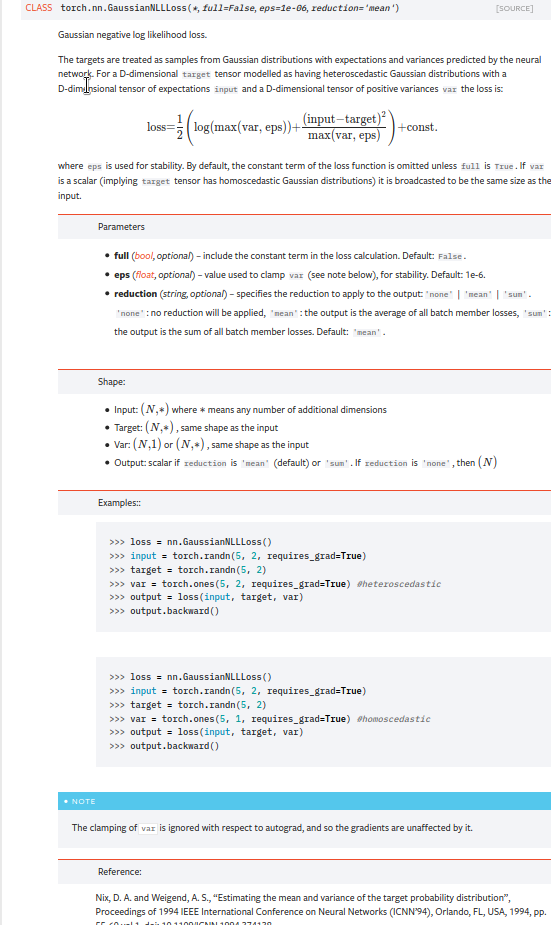
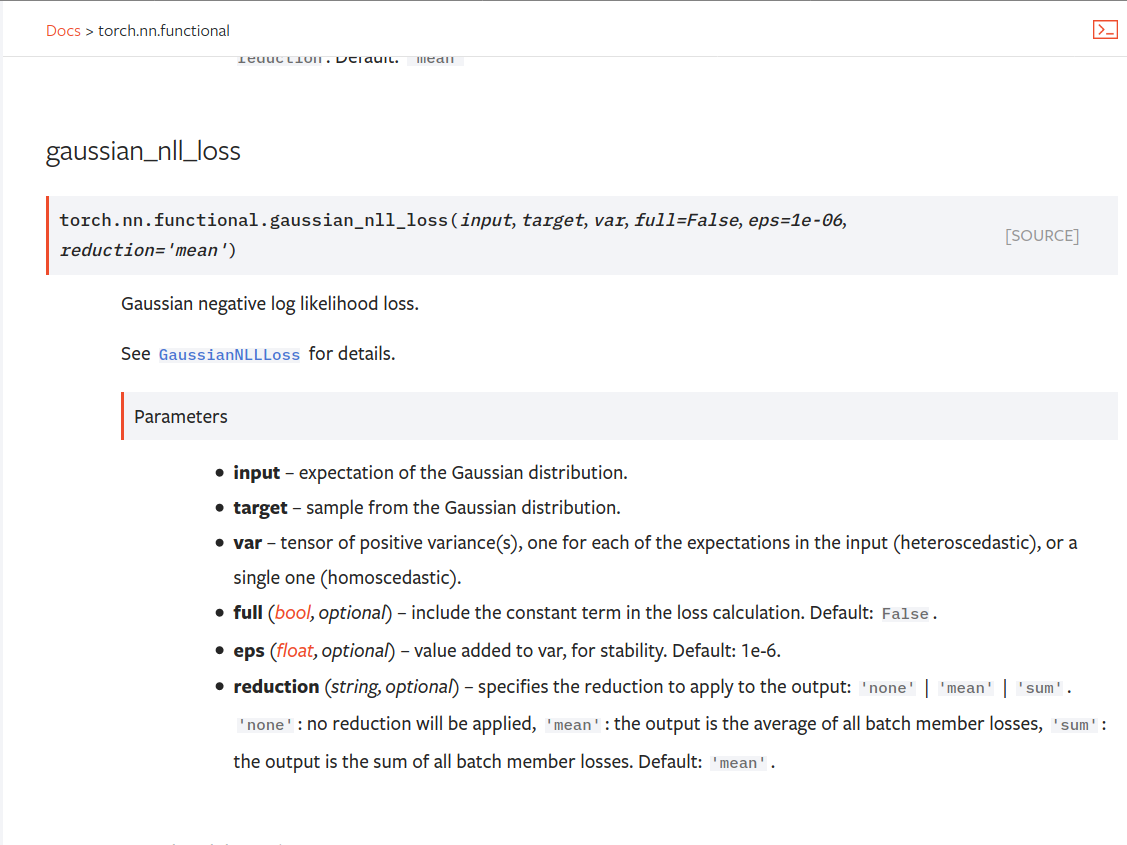
Pull Request resolved: https://github.com/pytorch/pytorch/pull/56469
Reviewed By: jbschlosser, agolynski
Differential Revision: D27894170
Pulled By: albanD
fbshipit-source-id: 197890189c97c22109491c47f469336b5b03a23f
Summary:
Pull Request resolved: https://github.com/pytorch/pytorch/pull/56547
**Summary**
This commit tweaks the docstrings of `PackageExporter` so that they look
nicer on the docs website.
**Test Plan**
Continuous integration.
Test Plan: Imported from OSS
Reviewed By: ailzhang
Differential Revision: D27912965
Pulled By: SplitInfinity
fbshipit-source-id: 38c0a715365b8cfb9eecdd1b38ba525fa226a453