Thanks @awgu for raising this issue and the small repro

From offline discussion with @albanD, in the case where a forward returns multiple outputs with different devices, we'd want to select the ready queue based on the device of the first one. Even though this is somewhat arbitrary, we prefer this over deciding which ready queue to push based on whichever input buffer's we happen to compute last, which can vary depending on more factors and thus be harder to reason about. This is in theory bc-breaking, but it seems unlikely that someone would depend on this behavior.

Pull Request resolved: https://github.com/pytorch/pytorch/pull/135633
Approved by: https://github.com/albanD
This reverts commit e525f433e1.

Original PR:  #85849
Fixes #ISSUE_NUMBER

In addition to reverting the revert, this PR:
- defines the virtual destructor of FunctionPreHook in the header. Why? Presumably the internal build imports the header from somewhere, but does not have function_hooks.cpp (where the virtual destructor was previously defined) in the same compilation unit.

Pull Request resolved: https://github.com/pytorch/pytorch/pull/92559
Approved by: https://github.com/albanD
Addresses: https://github.com/pytorch/pytorch/issues/35802

Design doc: https://docs.google.com/document/d/19xSib7FFknRQ5f3ptGFUmiOt3BrgXSUlTQH2xMcZJYg/edit#

### Changes in this PR

#### Implementation
- We have now have 3 fields: pre_hooks, retains_grad_hooks, and tensor_pre_hooks so that we can more precisely define their ordering and when they are executed.
- Since retains grad uses an entirely new field, we cannot reuse the old retains grad, logic. We refactor retains grad to call directly into the variable.cpp logic. Other logic in variable.cpp that handle cpp hooks must also be updated.

#### Hooks ordering and execution:
- Defines pre-hooks registered on tensor to run before pre-hooks registered on grad_fn
- Updates pre-hooks registered on tensor to always run, even if they are the inputs= to .grad()
- Post hooks (and pre hooks) can now observe the modifications to gradient by the tensor pre hook

#### Retains grad hooks
- retains grad hooks always execute last, even if there are other tensor pre-hooks registered

#### Unchanged:
- pre_hooks registered to grad_fn aren't expected to execute if they are the inputs= to .grad()

Follow ups:
- simplify retains_grad field to not be a vector, since it always holds a single hook
- potentially merge capture hooks with tensor pre hooks, this would involve some additional refactoring since
- python hooks registered to tensor behavior on in-place is still wrong

Pull Request resolved: https://github.com/pytorch/pytorch/pull/85849
Approved by: https://github.com/albanD
### Introduction
<!-- What did you change and why was it needed? -->

Removing unnecessary weight gradient calculation is very important for applications that need high-order derivatives during training. However, this is not supported by the current Autograd engine.

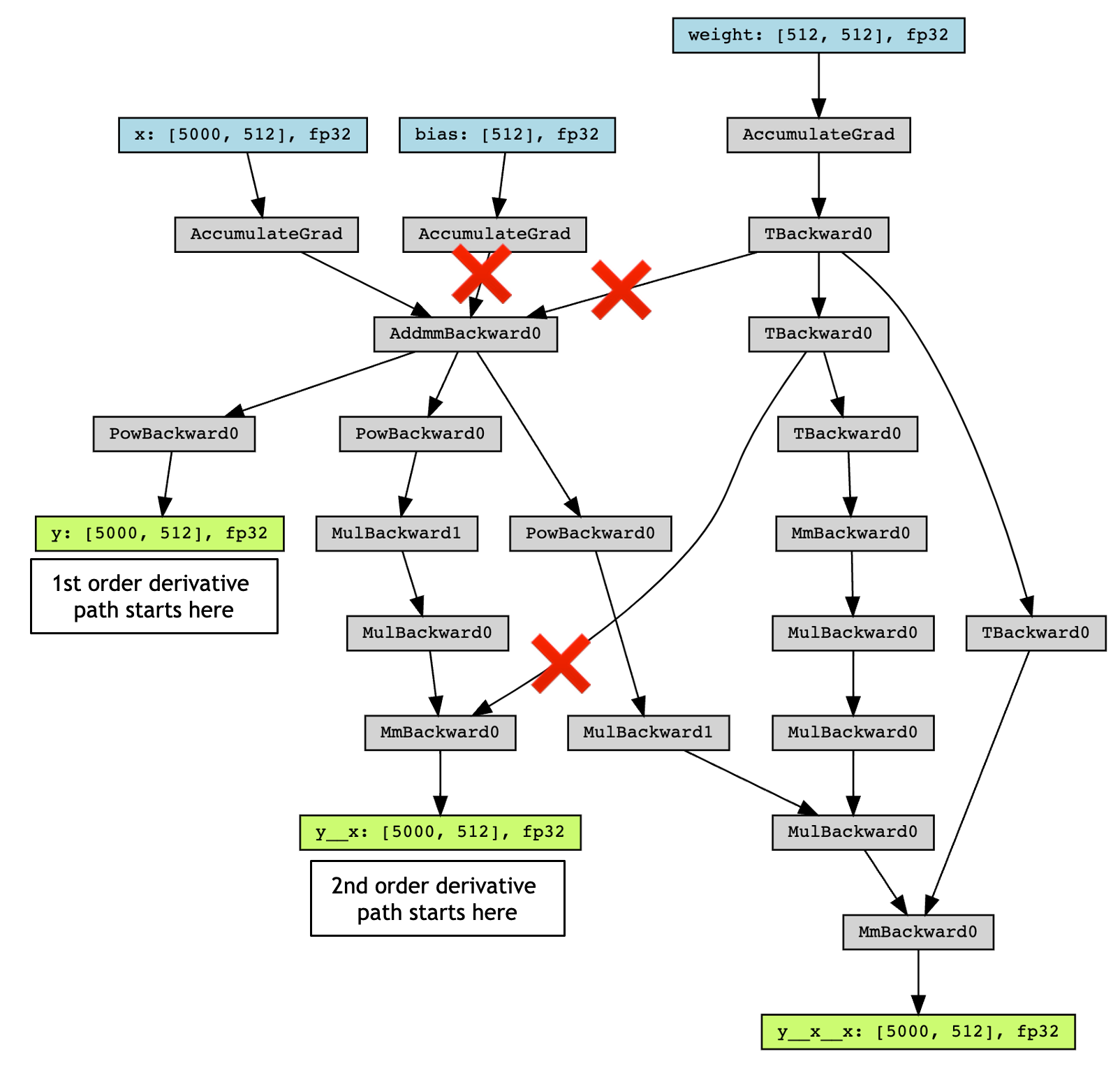
For more detail: The backward function of a `matmul` operator (e.g., `linear` `addmm` `mm`), has two matmuls, one for `input gradient` and another for `weight gradient`. For a typical neural network (nn) with a few linear layers and activation functions, if the user calls `torch.autograd.grad()` to calculate the derivative of the nn output `y` w.r.t the nn input `x`,  only the `input gradient` of the `matmul` operator is needed, and the `weight gradient` is discarded. However, the current PyTorch autograd engine will always calculate the `weight gradient` if `weight` requires gradient (the calculation of the high-order derivative is performed during training).

The figure attached shows the autograd graph of the following code snippet:
```py
y = torch.nn.functional.linear(x, weight, bias)
y = y.pow(2)
# first order derivative
y__x, = torch.autograd.grad(y, x, grad_outputs=grad_outputs, create_graph=True)
# first order derivative
y__x__x, = torch.autograd.grad(y__x, x, grad_outputs=grad_outputs, create_graph=True)
```
The path with ❌ is not needed when calculating derivatives.

<img width="50%" alt="image" src="https://user-images.githubusercontent.com/9999318/182018117-719c5a23-bcc6-4a63-8e8d-1bca3ebda2e3.png">

### Issue
<!-- Link to Issue ticket or RFP -->
Related issue: https://github.com/pytorch/pytorch/issues/56500

### Method
When calling `torch.autograd.grad`, `exec_info_` is created for each GraphTask, which allows filtering paths on the graph that are not needed. However, when the GraphTask calls into the node, the node still does not know whether the edges are needed or not. In the case of matmul, `weight.requires_grad is True` so the weight gradient is always calculated.

Following https://github.com/pytorch/pytorch/issues/56500#issuecomment-825694656, this PR passes the graph task's thread_local `exec_info_` into the node, so it could trim unnecessary edges during `torch.autograd.grad` calls.

### Benchmark
Benchmark script: https://gist.github.com/yueyericardo/24158433a2021c51eeef9c3e2722df99

Benchmark result:
6 hidden layers, batch size 10000, on A100

FP32 result
| hessian benchmark             | FP32 (before) | FP32 (After)      | FP32 (Functorch v0.1.1) |
| ----------------------------- | ------------- | ----------------- | ----------------------- |
| Linear + ReLU (no backward)   | 55.658 ms     | 29.392 ms (1.90X) | 29.547 ms (1.90X)       |
| Linear + ReLU (with backward) | 81.173 ms     | 54.917 ms (1.47X) | 68.988 ms (1.18X)       |

TF32 result
| hessian benchmark             | TF32 (before) | TF32 (after)      | TF32 (Functorch v0.1.1) |
| ----------------------------- | ------------- | ----------------- | ----------------------- |
| Linear + ReLU (no backward)   | 19.801 ms     | 11.259 ms (1.76X) | 10.754 ms (1.84X)       |
| Linear + ReLU (with backward) | 29.167 ms     | 20.466 ms (1.42X) | 22.784 ms (1.28X)       |

For FP32 result, we could get 1.9X speed up for hessian calculation, and 1.47X speed up during training, which is even faster than functorch `vmap(jacfwd(jacrev` implementation. (functorch has performance regression on v0.2.0, https://github.com/pytorch/functorch/issues/989, so we are using v0.1.1 for benchmark)

@zou3519 does functorch also includes similar optimizations during hessian calculation? If not, what do we need to do so the functorch could also benefit from this PR?

### Testing
<!-- How did you test your change? -->

- [x] we need to figure out a way for unittest

### Thanks
Thanks for the great blog: [How Computational Graphs are Executed in PyTorch | PyTorch](https://pytorch.org/blog/how-computational-graphs-are-executed-in-pytorch/)

cc @zasdfgbnm @albanD
Pull Request resolved: https://github.com/pytorch/pytorch/pull/82544
Approved by: https://github.com/soulitzer
Summary:
This PR suppresses clang-tidy warnings in the codebase (for now) so that we can re-enable clang-tidy checks on master.

I ran this script to add the `NOLINTNEXTLINE` comments (on a devserver):
```bash
python3 setup.py develop

# Uses same script that's run on CI and adds the -j (parallel), -s (add comments), -k (continue if diagnostic errors are found) options
python3 tools/clang_tidy.py \
  -j \
  -s \
  -k \
  -v \
  --paths torch/csrc/ \
  -g"-torch/csrc/jit/passes/onnx/helper.cpp" \
  -g"-torch/csrc/jit/passes/onnx/shape_type_inference.cpp" \
  -g"-torch/csrc/jit/serialization/onnx.cpp" \
  -g"-torch/csrc/jit/serialization/export.cpp" \
  -g"-torch/csrc/jit/serialization/import.cpp" \
  -g"-torch/csrc/jit/serialization/import_legacy.cpp" \
  -g"-torch/csrc/onnx/init.cpp" \
  -g"-torch/csrc/cuda/nccl.*" \
  -g"-torch/csrc/cuda/python_nccl.cpp" \
  -g"-torch/csrc/autograd/FunctionsManual.cpp" \
  -g"-torch/csrc/generic/*.cpp" \
  -g"-torch/csrc/jit/codegen/cuda/runtime/*" \
  -g"-torch/csrc/deploy/interpreter/interpreter.cpp" \
  -g"-torch/csrc/deploy/interpreter/interpreter.h" \
  -g"-torch/csrc/deploy/interpreter/interpreter_impl.h" \
  -g"-torch/csrc/deploy/interpreter/test_main.cpp"
```

Pull Request resolved: https://github.com/pytorch/pytorch/pull/60649

Test Plan: Verified changes by re-running the script (without the `-s` option) and seeing no warnings/errors.

Reviewed By: walterddr, janeyx99

Differential Revision: D29504258

Pulled By: 1ntEgr8

fbshipit-source-id: 78310b30ee8213b73ddb4771ad874665323e7a4e
Summary:
This PR addresses issue https://github.com/pytorch/pytorch/issues/7601.

Currently models that use streams explicitly in forward have to do a lot of extra work to make backwards respect those streams. This PR extends the (recently added) input tracing (see TypeAndShape) to record the devices and streams of inputs. The autograd engine then uses this metadata to enact the expected stream parallelism without extra work from the user.

For example, a model with forward declared like (original example courtesy of ngimel):

```
def forward(self,x):
        x0 = x.clone()
        torch._C._cuda_setStream(self.stream1._cdata)
        y0 = self.fc1(x0)
        self.event1.record(stream = torch.cuda.current_stream())

        torch._C._cuda_setStream(self.stream2._cdata)
        y1 = self.fc2(x)
        self.event2.record(stream = torch.cuda.current_stream())
        self.stream2.wait_event(self.event1)
        return y0 + y1
```

currently will backward on a single stream. With this change the kernels will go on the streams they are assigned in forward and both forward and backward will (for appropriate sizes) run the fc1 and fc2 kernels simultaneously.

The crux of this change is, as mentioned, an expansion of the TypeAndShape tracing and a relatively simple change to the autograd engine to use cuda events for stream synchronization. To make this efficient I also added a new AutoGPUAndStream class, exposed getting and setting streams on devices, and removed InputBuffer's AutoGPU (it's now redundant). While making these modifications I also fixed AutoGPU to check before setting the GPU when it's destroyed and to use THCudaCheck instead of its custom error handler. These changes mean that an often excessive cudaSetDevice() is not being called when inputs are added to a buffer.

In addition to allowing users to easily set and use streams that are respected in both forward and backward, this change may encourage modules to do the same and the expanded tracing might allow further optimizations in the autograd engine. (apaszke, for example, now after initial enumeration we know the number of devices that will be used by a graph task, which might help provide a sense of the "level of parallelism" we should expect.)
Pull Request resolved: https://github.com/pytorch/pytorch/pull/8354

Test Plan: Two tests were added specifically for this behavior.

Differential Revision: D17275980

Pulled By: mruberry

fbshipit-source-id: 92bd50ac782ffa973b159fcbbadb7a083802e45d
Summary:
Anywhere we used #include "foo.h", we now say #include <foo.h>
Paths are adjusted to be rooted out of aten/src, torch/lib, or
the root level directory.

I modified CMakeLists.txt by hand to remove TH and THC from
the include paths.

I used the following script to do the canonicalization:

```
  import subprocess
  import re
  import os.path

  files = subprocess.check_output(['git', 'ls-files']).decode('utf-8').rstrip().split('\n')
  for fn in files:
      if not any(fn.endswith(suff) for suff in ['.cu', '.cpp', '.in', '.h', '.hpp', '.cu', '.cuh', '.cc']):
          continue
      if not any(fn.startswith(pref) for pref in ["aten/", "torch/"]):
          continue
      with open(fn, 'r') as f:
          c = f.read()
      def fmt(p):
          return "#include <{}>".format(p)
      def repl(m):
          p = m.group(1)
          if p in ["dlfcn.h", "unistd.h", "nvrtc.h", "cuda.h", "cuda_runtime.h", "cstdint", "cudnn.h", "Python.h", "cusparse.h", "cuda_runtime_api.h", "cuda_fp16.h", "cublas_v2.h", "stdint.h", "curand_kernel.h"]:
              return fmt(p)
          if any(p.startswith(pref) for pref in ["torch/csrc", "c10/", "ATen/", "caffe2/", "TH/", "THC/", "Eigen/", "gtest/", "zdl/", "gloo/", "onnx/", "miopen/"]):
              return fmt(p)
          for root in ["aten/src", "torch/lib", ""]:
              for bad_root in [os.path.dirname(fn), "aten/src/TH", "aten/src/THC", "torch/csrc"]:
                  new_p = os.path.relpath(os.path.join(bad_root, p), root)
                  if not new_p.startswith("../") and (os.path.exists(os.path.join(root, new_p)) or os.path.exists(os.path.join(root, new_p + ".in"))):
                      return fmt(new_p)
          print("ERROR: ", fn, p)
          return m.group(0)
      new_c = re.sub(r'#include "([^"]+)"', repl, c)
      if new_c != c:
          print(fn)
          with open(fn, 'w') as f:
              f.write(new_c)
```

Signed-off-by: Edward Z. Yang <ezyang@fb.com>
Pull Request resolved: https://github.com/pytorch/pytorch/pull/14849

Reviewed By: dzhulgakov

Differential Revision: D13363445

Pulled By: ezyang

fbshipit-source-id: 52361f878a672785f9306c9e9ab2513128092b68
Summary:
More clang tidy cleanups in `torch/csrc`. This time:

1. `hicpp-use-equals-default` recommends `= default` instead of `{}` for constructors/destructors. This is better practice because it expresses the intent better (https://stackoverflow.com/questions/6502828/what-does-default-mean-after-a-class-function-declaration)
2. `readability-inconsistent-declaration-parameter-name` enforces that parameter names in the declaration match parameter names in the definition. This is just generally useful and can prevent confusion and bugs.

Also updated my script a little bit.

apaszke ezyang
Pull Request resolved: https://github.com/pytorch/pytorch/pull/9737

Differential Revision: D9069069

Pulled By: goldsborough

fbshipit-source-id: f7b3f3a4eb4c9fadc30425a153566d3b613a41ae
* Autograd container for trading compute for memory

* add a unit test for checkpoint

* address comments

* address review comments

* adding some docs for the checkpoint api

* more comments

* more comments

* repro bug

* Fix a subtle bug/apply some review comments

* Update checkpoint.py

* Run everything in grad mode

* fix flake and chunk=1

* use imperative backward as per discussion

* remove Variable and also add models and test for models

* Add a simple thread local variable to check for autograd grad mode

* remove models and models test after debugging

* address review comments

* address more comments

* address more comments
This PR adds the possibility to build the C++ parts of autograd and jit, with no dependency on Python.
The goal is to allow taking a PyTorch IR representation (a tree s-expr) and running it with provided inputs.

Prerequisite: build PyTorch so that codegen runs once.
Instructions:

cd tools/cpp_build
bash build_all.sh
This will build libtorchjit and torchjit_test in tools/cpp_build/build/torchjit-build. The latter basically runs the code in test_jit.cpp for now.

While writing the PR, it turned out that a few of Python.h includes were redundant. They were removed here (PyTorch tests still pass on my machine, we'll see CI).

* Introduce Python-free builds of autograd and jit

* Remove NO_PYTHON ifdef in functions/special
Previously the side-effect free grad calculation was performed
using callbacks that could also override the decision to run a
function. However this had a few problems e.g. it forced us to iterate
over pretty much all functions in the graph and drop their buffers.

This patch improves the mechanism, by adding explicit support for this
kind of evaluation in execute(). It's safer, and the algorithm used to
decide which nodes have to be evaluated was replaced with a faster one.
Variable is now a subclass of at::Tensor backed by a VariableImpl* pImpl. The implementation of the ATen functions is defined in the auto-generated VariableType.h/cpp file.

Currently, only functions which fall through to the base type, such as sizes() and isCuda() are implemented. Differentiable ops like add() and mul() will be added in a subsequent PR.
Primary things I had to fix:

- Suppress _XOPEN_SOURCE warnings by ensuring that Python.h is included
  first, because it always unconditionally defines this macro.

- Turn off strict aliasing, because Python 2 doesn't work with strict
  aliasing.

- Workaround setuptools bug, where it's incorrectly passing
  -Wstrict-prototypes to C++ compilers (where this doesn't make
  any sense)

To compile csrc with -Werror, run `CFLAGS="-Werror" python setup.py build_ext`

Signed-off-by: Edward Z. Yang <ezyang@fb.com>