This PR proposes to use std::optional<Generator>& for underlying functions to avoid unnecessary copy and move operations. The torchgen code was changed to generate the new type.

Pull Request resolved: https://github.com/pytorch/pytorch/pull/120076
Approved by: https://github.com/malfet
This PR proposes to use std::optional<Generator>& for underlying functions to avoid unnecessary copy and move operations. The torchgen code was changed to generate the new type.

Pull Request resolved: https://github.com/pytorch/pytorch/pull/120076
Approved by: https://github.com/malfet
This PR proposes to use std::optional<Generator>& for underlying functions to avoid unnecessary copy and move operations. The torchgen code was changed to generate the new type.

Pull Request resolved: https://github.com/pytorch/pytorch/pull/120076
Approved by: https://github.com/malfet
**Summary**: jit.trace usually adds shape information to all the jit::Values in its graph. This is mostly a side effect of how jit tracing is performed, but many users use this behavior for debugging and for better understanding the graph. Previously, CallFunction nodes (inserted by calling jit.script-ed functions) did _not_ have this information attached. This PR attaches this information for the tensor output values.

**Details**:
* First the jit tracer sets a global TracerState object
* Then the jit tracer invokes the python callable that is to be traced
* When the python function gets to a jit.script-ed function, [invokeScriptFunctionFromPython](8693604bc6/torch/csrc/jit/python/pybind_utils.h (L1060)) is called. It inserts a FunctionCall.
* Then after the actual scripted function gets called and we have a concrete output, we attach the concrete output [IValue to the TracerState](8693604bc6/torch/csrc/jit/python/pybind_utils.h (L1001))
* ^^ the setValueTrace call (linked in previous list item) is where this PR makes changes; we revise the jit::Value output of the CallFunction node to use the type of the concrete tensor, which will have actual shapes associated.

**Test**: added a test verifying that shape info appears in the output type for a CallFunction node in a jit-traced graph.

Differential Revision: [D43592880](https://our.internmc.facebook.com/intern/diff/D43592880)
Pull Request resolved: https://github.com/pytorch/pytorch/pull/95544
Approved by: https://github.com/qihqi
As we live in C++17 world

This is a functional no-op, just
- `s/namespace at { namespace native {/namespace at::native {/`
- `s/namespace torch { namespace jit {/namespace torch::jit {/`

Pull Request resolved: https://github.com/pytorch/pytorch/pull/92100
Approved by: https://github.com/izaitsevfb
#75854

A naive attempt at working around the limitations of using a single 64-bit integer to pack `stream_id`, `device_index`, and `device_type`.

Stills needs sanity checks, testing, and minimization of BC-breaking changes.

Currently a Holder for the `StreamData3` struct is used for `IValue` compatibility. While doing this seems to work for `ivalue.h` and `ivalue_inl.h`, this doesn't seem to be naively working for the JIT CUDA stream wrapper? (Something about ambiguous calls if an `intrusive_ptr` to `c10::ivalue::StreamData3Holder` is used as the return type for `pack()`. It turns out that the methods required to access the fields for rematerializing a CUDA Stream are basically already present anyway, so `pack` is simply removed in the wrapper for now and the methods to access the required fields are called directly.

CC @ptrblck

Pull Request resolved: https://github.com/pytorch/pytorch/pull/81596
Approved by: https://github.com/ezyang
This makes it easier to narrow down who is throwing the error,
instead of having to use gdb.

Signed-off-by: Edward Z. Yang <ezyang@fb.com>
Differential Revision: [D42088781](https://our.internmc.facebook.com/intern/diff/D42088781)
Applies various automated fixes that reduces the number of spurious copies in torch, aten, and c10. I also inlined any default dtors that would have made the type trivially destructible.

Follow up to #89000

Pull Request resolved: https://github.com/pytorch/pytorch/pull/90629
Approved by: https://github.com/ezyang
Partially fixes: #66328

This PR:
- adds support for `ITensorList` to the dispatcher for:
  - computing the dispatch key
  - boxing and unboxing `ITensorList`
- modified the codegen for structured kernels:
  - codegen APIs use `ITensorList` instead of `ArrayRef<Tensor>`

**Changes summary:**

- Signature changes due to the different APIs:
  - dispatcher API (e.g. `BatchingRegistrations.cpp`)
  - C++ API (e.g. `TensorShape.cpp`)
- Miscelaneous functions used by codegen'd functions (e.g. `FunctionalTensorWrapper.*`)
- Dispatcher changes for handling `ITensorList` correctly (e.g. `DispatchKeyExtractor.h`)
- Signature changes of `at::cat` due to the need of `const` inside `TensorBody.h`
- Forward declarations of `ITensorList` (e.g. `MethodOperators.h`)
- Codegen changes, special casing structured kernels (e.g. `gen.py`)

**Short description of structured kernels special casing:**

I introduced, mainly, 5 types of changes to the codegen for generating code depending on
whether the kernel is structured or not:

1. Added a `structured_type_override` flag to the `argument_type` function definition of
the affected APIs (mainly the dispatcher and C++ APIs).
  - `api/cpp.py`, `api/dispatcher.py`, `api/native.py`
2. Added a `structured_type_override` member to the signature
classes (e.g. `CppSignature`), since `FunctionSchema` doesn't really know whether the
function is structured or not
  - `api/types.py`
3. Added a `part_of_structured_group` to `NativeFunction` class, which is just a
convenient function to forward to `structured_type_override` wherever needed
  - `model.py`
4. Appropriately changed the rest of the codegen, whenever it used either the signature
classes or the `arguments` function directly
5. Added a check for `const ITensorList&` type wherever there was a check for `TensorList`
Pull Request resolved: https://github.com/pytorch/pytorch/pull/73350
Approved by: https://github.com/bdhirsh
### Introduction
<!-- What did you change and why was it needed? -->

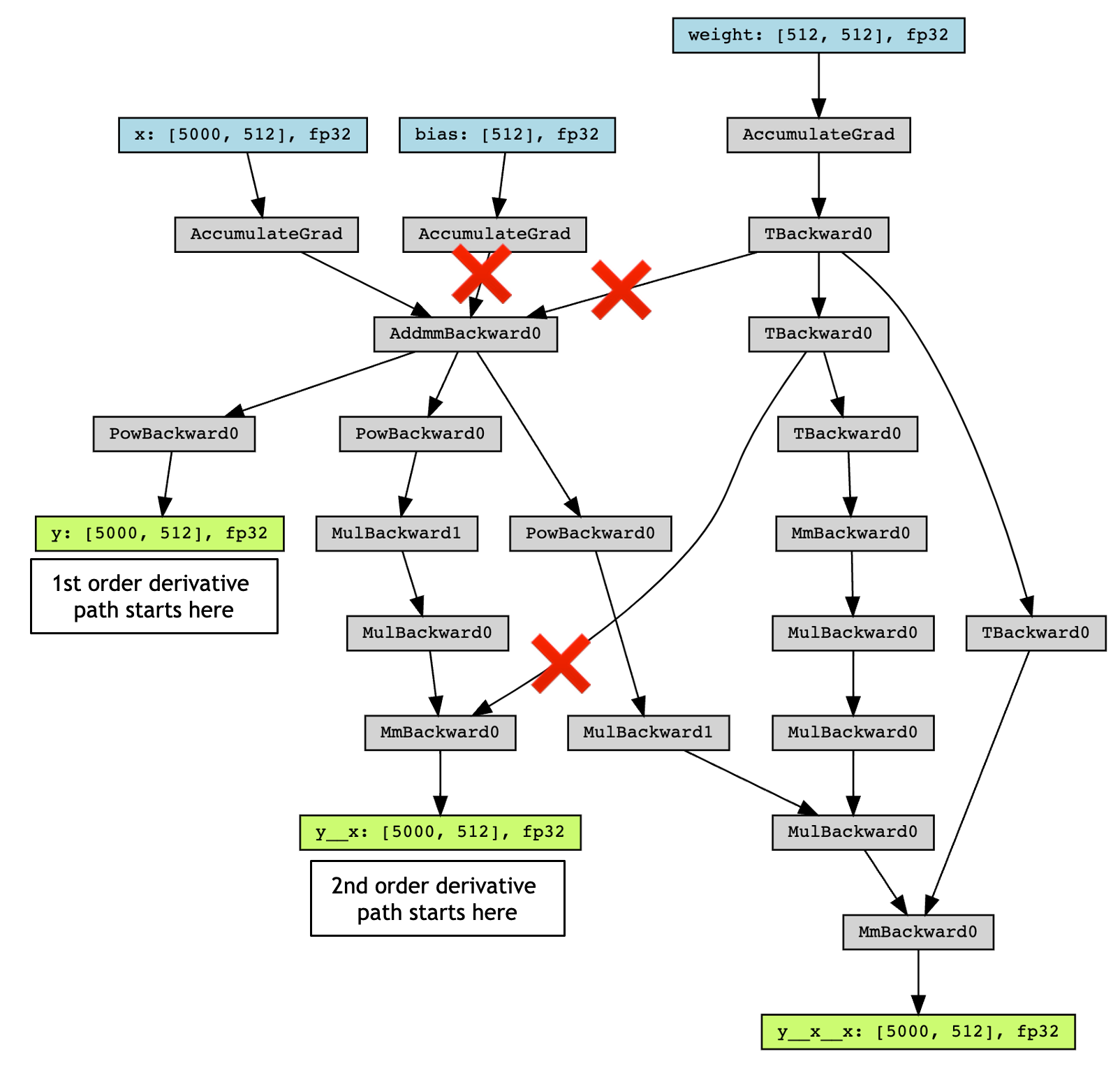
Removing unnecessary weight gradient calculation is very important for applications that need high-order derivatives during training. However, this is not supported by the current Autograd engine.

For more detail: The backward function of a `matmul` operator (e.g., `linear` `addmm` `mm`), has two matmuls, one for `input gradient` and another for `weight gradient`. For a typical neural network (nn) with a few linear layers and activation functions, if the user calls `torch.autograd.grad()` to calculate the derivative of the nn output `y` w.r.t the nn input `x`,  only the `input gradient` of the `matmul` operator is needed, and the `weight gradient` is discarded. However, the current PyTorch autograd engine will always calculate the `weight gradient` if `weight` requires gradient (the calculation of the high-order derivative is performed during training).

The figure attached shows the autograd graph of the following code snippet:
```py
y = torch.nn.functional.linear(x, weight, bias)
y = y.pow(2)
# first order derivative
y__x, = torch.autograd.grad(y, x, grad_outputs=grad_outputs, create_graph=True)
# first order derivative
y__x__x, = torch.autograd.grad(y__x, x, grad_outputs=grad_outputs, create_graph=True)
```
The path with ❌ is not needed when calculating derivatives.

<img width="50%" alt="image" src="https://user-images.githubusercontent.com/9999318/182018117-719c5a23-bcc6-4a63-8e8d-1bca3ebda2e3.png">

### Issue
<!-- Link to Issue ticket or RFP -->
Related issue: https://github.com/pytorch/pytorch/issues/56500

### Method
When calling `torch.autograd.grad`, `exec_info_` is created for each GraphTask, which allows filtering paths on the graph that are not needed. However, when the GraphTask calls into the node, the node still does not know whether the edges are needed or not. In the case of matmul, `weight.requires_grad is True` so the weight gradient is always calculated.

Following https://github.com/pytorch/pytorch/issues/56500#issuecomment-825694656, this PR passes the graph task's thread_local `exec_info_` into the node, so it could trim unnecessary edges during `torch.autograd.grad` calls.

### Benchmark
Benchmark script: https://gist.github.com/yueyericardo/24158433a2021c51eeef9c3e2722df99

Benchmark result:
6 hidden layers, batch size 10000, on A100

FP32 result
| hessian benchmark             | FP32 (before) | FP32 (After)      | FP32 (Functorch v0.1.1) |
| ----------------------------- | ------------- | ----------------- | ----------------------- |
| Linear + ReLU (no backward)   | 55.658 ms     | 29.392 ms (1.90X) | 29.547 ms (1.90X)       |
| Linear + ReLU (with backward) | 81.173 ms     | 54.917 ms (1.47X) | 68.988 ms (1.18X)       |

TF32 result
| hessian benchmark             | TF32 (before) | TF32 (after)      | TF32 (Functorch v0.1.1) |
| ----------------------------- | ------------- | ----------------- | ----------------------- |
| Linear + ReLU (no backward)   | 19.801 ms     | 11.259 ms (1.76X) | 10.754 ms (1.84X)       |
| Linear + ReLU (with backward) | 29.167 ms     | 20.466 ms (1.42X) | 22.784 ms (1.28X)       |

For FP32 result, we could get 1.9X speed up for hessian calculation, and 1.47X speed up during training, which is even faster than functorch `vmap(jacfwd(jacrev` implementation. (functorch has performance regression on v0.2.0, https://github.com/pytorch/functorch/issues/989, so we are using v0.1.1 for benchmark)

@zou3519 does functorch also includes similar optimizations during hessian calculation? If not, what do we need to do so the functorch could also benefit from this PR?

### Testing
<!-- How did you test your change? -->

- [x] we need to figure out a way for unittest

### Thanks
Thanks for the great blog: [How Computational Graphs are Executed in PyTorch | PyTorch](https://pytorch.org/blog/how-computational-graphs-are-executed-in-pytorch/)

cc @zasdfgbnm @albanD
Pull Request resolved: https://github.com/pytorch/pytorch/pull/82544
Approved by: https://github.com/soulitzer
Summary:
This PR introduces `SymInt` type to Pytorch which will be used by LTC and AOTAutograd for tracing size arithmetic and tests.
`SymInt` is a C++ union structure [int64_t, SymbolicIntNode*] that wraps around an int64_t field where the value of the field could be an index into a list of `shared_ptr<SymbolicIntNode>` or a real int.
This PR doesn't add any support for actually tracing symbolic ints. i.e. data_ for now can only contain real ints.

```
Goal 1: just to show we can add a type to PyTorch core. (wraps int) LANDEABLE
Finalize the naming - symint
Want the name to be short
Does invoke “size” - NO
SInt/SymInt/SymbolicInt
SInt could mean signed int
sym_int or symint or SymInt (originally it was “int”; capitalized implies object semantics, whereas lowercase implies value semantics)
JIT schema - symint
C++ - symint
```

See more details here: https://docs.google.com/document/d/1iiLNwR5ohAsw_ymfnOpDsyF6L9RTUaHMpD8 (d843f63f2a)YLw-jxEw

Pull Request resolved: https://github.com/pytorch/pytorch/pull/74861

Reviewed By: qihqi, ngimel

Differential Revision: D35226230

Pulled By: Krovatkin

fbshipit-source-id: 34acf342bd50fcaa4d8d5dd49c2fd6a98823a5b3
(cherry picked from commit 218643f63ef181cabb92d13a6e837eb64f2dda3c)
Summary:
Pull Request resolved: https://github.com/pytorch/pytorch/pull/68691

TraceType is a sharded file, so by only including specific operator
headers, we ensure that changing one (non-method) operator only needs
one shard to be re-compiled.

This also changes all the included autograd and jit headers from
including `ATen/ATen.h` to just including `ATen/core/Tensor.h`.

Test Plan: Imported from OSS

Reviewed By: gchanan

Differential Revision: D33336948

Pulled By: albanD

fbshipit-source-id: 4e40371592b9a5a7e7fcd1d8cecae11ffb873113
Summary:
Pull Request resolved: https://github.com/pytorch/pytorch/pull/64066

I noticed a bunch of time being spent heap-allocating Tuples
in the unpickler. 1-, 2-, and 3-element Tuples are apparently common
enough that they get their own bytecode instructions, so I decided to
try also giving them their own representation. We store up to 3
IValues inline in `Tuple` rather than doing a second heap allocation
for a `std::vector<IValue>`.
ghstack-source-id: 140695395

Test Plan:
Added automated tests for TupleElements.

Pixel 3 before: https://www.internalfb.com/intern/aibench/details/761596366576284
Pixel 3 after: https://www.internalfb.com/intern/aibench/details/591414145082422
We went from 347 ms to 302 ms.

Reviewed By: dhruvbird

Differential Revision: D30592622

fbshipit-source-id: 93625c54c9dca5f765ef6d5c191944179cb281a8
Summary:
Pull Request resolved: https://github.com/pytorch/pytorch/pull/65345

FooType::get() can return a const reference. Inconveniently, converting shared_ptr<FooType> to shared_ptr<Type> requires a copy & refcount bump, so to properly take advantage of this in unshapedType() we need to take a const Type& in isSubtypeOf(), which is good practice anyway -- don't require a shared_ptr if you don't need to take ownership.
ghstack-source-id: 140044165

Test Plan:
CI

perf says c10::unshapedType time decreased from 2.8% to 2.2% during static runtime startup, though I expect this to be generally beneficial.

Reviewed By: hlu1

Differential Revision: D31027361

fbshipit-source-id: 676feb81db9f74ad7b8651d8774f4ecb4cfa6ab8
Summary:
Pull Request resolved: https://github.com/pytorch/pytorch/pull/64065

It is only safe to mutate Tuple elements if you are the sole owner
of the tuple. The most efficient way to do this, then, is
`std::move(*std::move(tupleIValue).toTuple()).elements()` (the
innermost move allows `IValue::toTuple()` to avoid a refcount bump and
the outermost move allows the element vector to be moved out of the
tuple), but many callsites write simply
`tupleIValue.toTuple().elements()`, which incurs many extra refcount
bumps.

ghstack-source-id: 139468088

Test Plan: CI

Reviewed By: ezyang

Differential Revision: D30592621

fbshipit-source-id: e8312de866de09b9ea2a62e5128cbf403ee16f09
Summary:
As GoogleTest `TEST` macro is non-compliant with it as well as `DEFINE_DISPATCH`

All changes but the ones to `.clang-tidy` are generated using following script:
```
for i in `find . -type f -iname "*.c*" -or -iname "*.h"|xargs grep cppcoreguidelines-avoid-non-const-global-variables|cut -f1 -d:|sort|uniq`;  do sed -i "/\/\/ NOLINTNEXTLINE(cppcoreguidelines-avoid-non-const-global-variables)/d" $i; done
```

Pull Request resolved: https://github.com/pytorch/pytorch/pull/62008

Reviewed By: driazati, r-barnes

Differential Revision: D29838584

Pulled By: malfet

fbshipit-source-id: 1b2f8602c945bd4ce50a9bfdd204755556e31d13
Summary:
This is an automatic change generated by the following script:
```
#!/usr/bin/env python3
from subprocess import check_output, check_call
import os

def get_compiled_files_list():
    import json
    with open("build/compile_commands.json") as f:
        data = json.load(f)
    files = [os.path.relpath(node['file']) for node in data]
    for idx, fname in enumerate(files):
        if fname.startswith('build/') and fname.endswith('.DEFAULT.cpp'):
            files[idx] = fname[len('build/'):-len('.DEFAULT.cpp')]
    return files

def run_clang_tidy(fname):
    check_call(["python3", "tools/clang_tidy.py", "-c", "build", "-x", fname,"-s"])
    changes = check_output(["git", "ls-files", "-m"])
    if len(changes) == 0:
        return
    check_call(["git", "commit","--all", "-m", f"NOLINT stubs for {fname}"])

def main():
    git_files = check_output(["git", "ls-files"]).decode("ascii").split("\n")
    compiled_files = get_compiled_files_list()
    for idx, fname in enumerate(git_files):
        if fname not in compiled_files:
            continue
        if fname.startswith("caffe2/contrib/aten/"):
            continue
        print(f"[{idx}/{len(git_files)}] Processing {fname}")
        run_clang_tidy(fname)

if __name__ == "__main__":
    main()
```

Pull Request resolved: https://github.com/pytorch/pytorch/pull/56892

Reviewed By: H-Huang

Differential Revision: D27991944

Pulled By: malfet

fbshipit-source-id: 5415e1eb2c1b34319a4f03024bfaa087007d7179