### Introduction
<!-- What did you change and why was it needed? -->

Removing unnecessary weight gradient calculation is very important for applications that need high-order derivatives during training. However, this is not supported by the current Autograd engine.

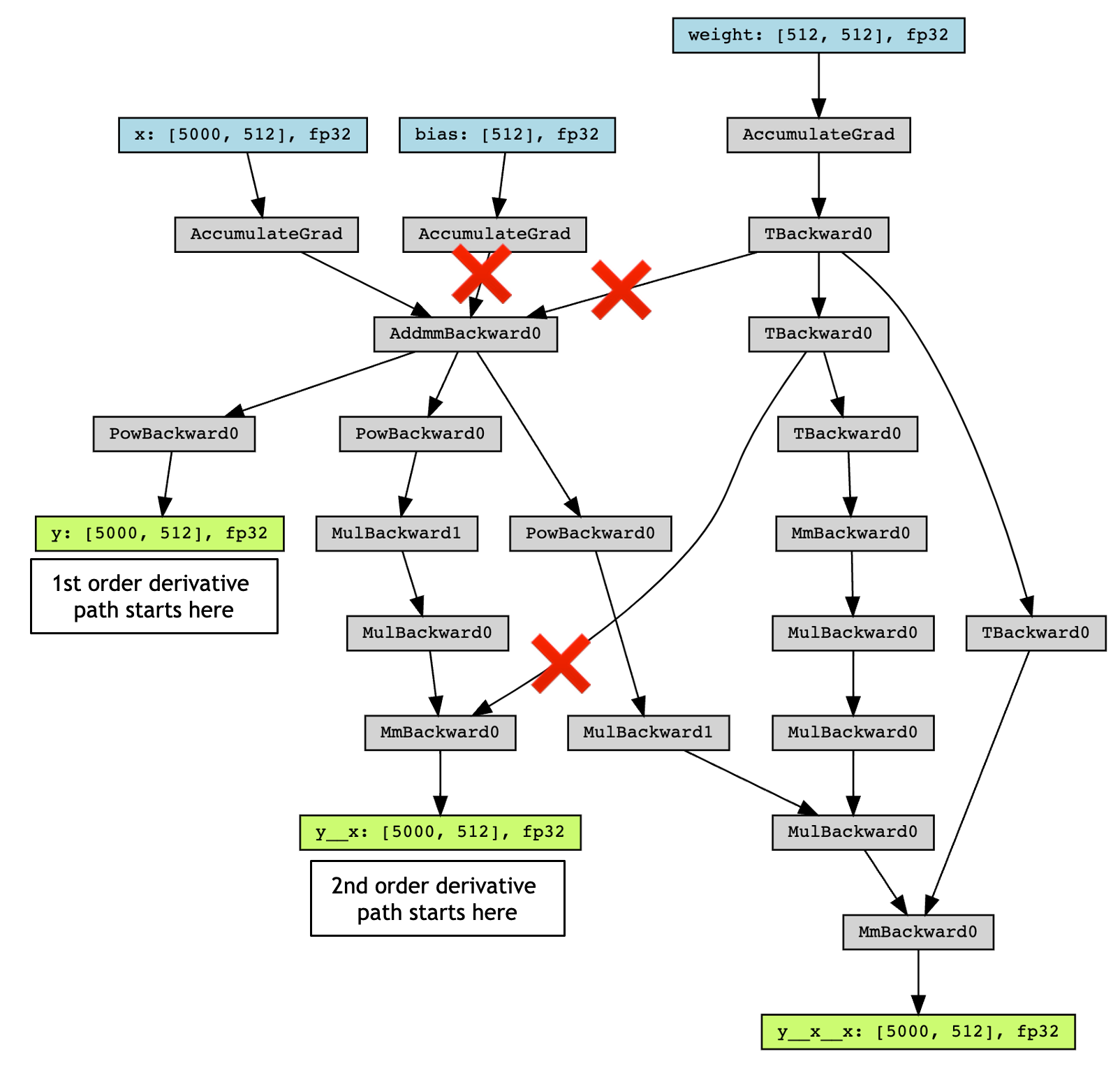
For more detail: The backward function of a `matmul` operator (e.g., `linear` `addmm` `mm`), has two matmuls, one for `input gradient` and another for `weight gradient`. For a typical neural network (nn) with a few linear layers and activation functions, if the user calls `torch.autograd.grad()` to calculate the derivative of the nn output `y` w.r.t the nn input `x`,  only the `input gradient` of the `matmul` operator is needed, and the `weight gradient` is discarded. However, the current PyTorch autograd engine will always calculate the `weight gradient` if `weight` requires gradient (the calculation of the high-order derivative is performed during training).

The figure attached shows the autograd graph of the following code snippet:
```py
y = torch.nn.functional.linear(x, weight, bias)
y = y.pow(2)
# first order derivative
y__x, = torch.autograd.grad(y, x, grad_outputs=grad_outputs, create_graph=True)
# first order derivative
y__x__x, = torch.autograd.grad(y__x, x, grad_outputs=grad_outputs, create_graph=True)
```
The path with ❌ is not needed when calculating derivatives.

<img width="50%" alt="image" src="https://user-images.githubusercontent.com/9999318/182018117-719c5a23-bcc6-4a63-8e8d-1bca3ebda2e3.png">

### Issue
<!-- Link to Issue ticket or RFP -->
Related issue: https://github.com/pytorch/pytorch/issues/56500

### Method
When calling `torch.autograd.grad`, `exec_info_` is created for each GraphTask, which allows filtering paths on the graph that are not needed. However, when the GraphTask calls into the node, the node still does not know whether the edges are needed or not. In the case of matmul, `weight.requires_grad is True` so the weight gradient is always calculated.

Following https://github.com/pytorch/pytorch/issues/56500#issuecomment-825694656, this PR passes the graph task's thread_local `exec_info_` into the node, so it could trim unnecessary edges during `torch.autograd.grad` calls.

### Benchmark
Benchmark script: https://gist.github.com/yueyericardo/24158433a2021c51eeef9c3e2722df99

Benchmark result:
6 hidden layers, batch size 10000, on A100

FP32 result
| hessian benchmark             | FP32 (before) | FP32 (After)      | FP32 (Functorch v0.1.1) |
| ----------------------------- | ------------- | ----------------- | ----------------------- |
| Linear + ReLU (no backward)   | 55.658 ms     | 29.392 ms (1.90X) | 29.547 ms (1.90X)       |
| Linear + ReLU (with backward) | 81.173 ms     | 54.917 ms (1.47X) | 68.988 ms (1.18X)       |

TF32 result
| hessian benchmark             | TF32 (before) | TF32 (after)      | TF32 (Functorch v0.1.1) |
| ----------------------------- | ------------- | ----------------- | ----------------------- |
| Linear + ReLU (no backward)   | 19.801 ms     | 11.259 ms (1.76X) | 10.754 ms (1.84X)       |
| Linear + ReLU (with backward) | 29.167 ms     | 20.466 ms (1.42X) | 22.784 ms (1.28X)       |

For FP32 result, we could get 1.9X speed up for hessian calculation, and 1.47X speed up during training, which is even faster than functorch `vmap(jacfwd(jacrev` implementation. (functorch has performance regression on v0.2.0, https://github.com/pytorch/functorch/issues/989, so we are using v0.1.1 for benchmark)

@zou3519 does functorch also includes similar optimizations during hessian calculation? If not, what do we need to do so the functorch could also benefit from this PR?

### Testing
<!-- How did you test your change? -->

- [x] we need to figure out a way for unittest

### Thanks
Thanks for the great blog: [How Computational Graphs are Executed in PyTorch | PyTorch](https://pytorch.org/blog/how-computational-graphs-are-executed-in-pytorch/)

cc @zasdfgbnm @albanD
Pull Request resolved: https://github.com/pytorch/pytorch/pull/82544
Approved by: https://github.com/soulitzer
See this doc: https://docs.google.com/document/d/1KiRdnoj6B4cI3yl017hTbCqcOGO1gWIpUf20sldipHM/edit#

Two issues (1) regarding hooks in general and (2) regarding retains grad hooks are fixed, Python hooks, which rely on a different mechanism are not discussed here:
- Hooks in cpp in general
  - (fixed) new hooks to registered to a newer version of the tensor no longer get applied to grad_fn
    associated with older version of the tensor when the first hook was ever registered
  - (unchanged) hooks registered to the older version of the tensor remain active on
- Retains grad hooks
  - (fixed) now get moved to the latest grad_fn. NB: To the user, retains_grad is not considered hooks
    or expected to behave like hooks (which we consider properties of the grad_fn) vs retains_gradness
    which is a property of the tensor.
- (not in this PR) Python hooks
  - (will fix) same issue as hooks in cpp where new hooks are being applied to grad_fn associated
    with the older version of the tensor
Pull Request resolved: https://github.com/pytorch/pytorch/pull/79996
Approved by: https://github.com/albanD
Summary:
Pull Request resolved: https://github.com/pytorch/pytorch/pull/67195

Now that `is_nonzero` is part of `at::native` refer https://github.com/pytorch/pytorch/pull/66663, replacing `TensorCompare::is_nonzero` to `at::native::is_nonzero`

ghstack-source-id: 141514416

Test Plan: CI

Reviewed By: larryliu0820

Differential Revision: D31704041

fbshipit-source-id: 36813e5411d0aa2eb2d0442e2a195bbed417b33d
Summary:
Pull Request resolved: https://github.com/pytorch/pytorch/pull/63878

See https://github.com/pytorch/pytorch/issues/64407, https://github.com/pytorch/pytorch/issues/62032 for context:

In this PR:
 - Add boxed kernel by replicating `gen_inplace_or_view`'s logic that is ONLY for use with the Autograd not-implemented kernel
   - Unlike `gen_inplace_or_view` we always pass a view_func to as_view in order to ensure that an "derivative is not implemented" error is raised even if an in-place update is performed on the view. Without the `view_func`, the CopySlice + AsStridedBackward nodes would replace the NotImplemented node.
   - This limitation makes it impossible to use this node for general use
   - view relationship must be between first input (must be tensor) and first output (may be tensor or vec of tensor)
   - do not support non-differentiable views (_values, _indices, view.dtype) - view relationship is always fw and bw differentiable
 - Adds the macro `#define REGISTER_AUTOGRAD_NOT_IMPLEMENTED_FALLBACK(ns, op)` to be the interface for this feature:
   - static initialization can be slowed down(? not measured) if there are many registrations, because each line translates to 2 library calls but the workaround is just to manually use the two functions `AutogradNotImplementedFallback` and `ADInplaceOrViewFallback` and call `m.impl`.
 - Adds testing:
    - for views: view relationship created
      -  performing in-place operation on the view, raises properly
      - trying to create two view relationships is not allowed,
      - single view relationship but not first input/first output should error
      - view relation created properly for tensor vector output
    - for in-place:
      - version count bump
      - triggers rebase_history
      - multiple mutations is okay and also updates version counter
 - TODO (follow up): Update tutorials for adding  third-party operators (and document the above limitations)
 - TODO (follow up): Look at torch-audio/torch-vision and identify places where this can simplify existing code

EDIT: Made it more clear what is introduced in this PR and moved some more contextual stuff into the issue itself

Test Plan: Imported from OSS

Reviewed By: albanD

Differential Revision: D30901714

Pulled By: soulitzer

fbshipit-source-id: 48de14c28be023ff4bd31b7ea5e7cba88aeee04c
Summary:
As GoogleTest `TEST` macro is non-compliant with it as well as `DEFINE_DISPATCH`

All changes but the ones to `.clang-tidy` are generated using following script:
```
for i in `find . -type f -iname "*.c*" -or -iname "*.h"|xargs grep cppcoreguidelines-avoid-non-const-global-variables|cut -f1 -d:|sort|uniq`;  do sed -i "/\/\/ NOLINTNEXTLINE(cppcoreguidelines-avoid-non-const-global-variables)/d" $i; done
```

Pull Request resolved: https://github.com/pytorch/pytorch/pull/62008

Reviewed By: driazati, r-barnes

Differential Revision: D29838584

Pulled By: malfet

fbshipit-source-id: 1b2f8602c945bd4ce50a9bfdd204755556e31d13
Summary:
The grad() function needs to return the updated values, and hence
needs a non-empty inputs to populate.

Pull Request resolved: https://github.com/pytorch/pytorch/pull/52016

Test Plan:
Passes Python and C++ unit tests, and added new tests to catch this behavior.

Fixes https://github.com/pytorch/pytorch/issues/47061

Reviewed By: albanD

Differential Revision: D26406444

Pulled By: dagitses

fbshipit-source-id: 023aeca9a40cd765c5bad6a1a2f8767a33b75a1a
Summary:
Fixes https://github.com/pytorch/pytorch/issues/35379

 - Adds  `retains_grad` attribute backed by cpp as a native function. The python bindings for the function are skipped to be consistent with `is_leaf`.
   - Tried writing it without native function, but the jit test `test_tensor_properties` seems to require that it be a native function (or alternatively maybe it could also work if we manually add a prim implementation?).
 - Python API now uses `retain_grad` implementation from cpp

Pull Request resolved: https://github.com/pytorch/pytorch/pull/59362

Reviewed By: jbschlosser

Differential Revision: D28969298

Pulled By: soulitzer

fbshipit-source-id: 335f2be50b9fb870cd35dc72f7dadd6c8666cc02
Summary:
Fixes https://github.com/pytorch/pytorch/issues/4661
- Add warnings in engine's `execute` function so it can be triggered through both cpp and python codepaths
- Adds an RAII guard version of `c10::Warning::set_warnAlways` and replaces all prior usages of the set_warnAlways with the new one

Pull Request resolved: https://github.com/pytorch/pytorch/pull/59412

Reviewed By: jbschlosser

Differential Revision: D28969294

Pulled By: soulitzer

fbshipit-source-id: b03369c926a3be18ce1cf363b39edd82a14245f0
Summary:
This is an automatic change generated by the following script:
```
#!/usr/bin/env python3
from subprocess import check_output, check_call
import os

def get_compiled_files_list():
    import json
    with open("build/compile_commands.json") as f:
        data = json.load(f)
    files = [os.path.relpath(node['file']) for node in data]
    for idx, fname in enumerate(files):
        if fname.startswith('build/') and fname.endswith('.DEFAULT.cpp'):
            files[idx] = fname[len('build/'):-len('.DEFAULT.cpp')]
    return files

def run_clang_tidy(fname):
    check_call(["python3", "tools/clang_tidy.py", "-c", "build", "-x", fname,"-s"])
    changes = check_output(["git", "ls-files", "-m"])
    if len(changes) == 0:
        return
    check_call(["git", "commit","--all", "-m", f"NOLINT stubs for {fname}"])

def main():
    git_files = check_output(["git", "ls-files"]).decode("ascii").split("\n")
    compiled_files = get_compiled_files_list()
    for idx, fname in enumerate(git_files):
        if fname not in compiled_files:
            continue
        if fname.startswith("caffe2/contrib/aten/"):
            continue
        print(f"[{idx}/{len(git_files)}] Processing {fname}")
        run_clang_tidy(fname)

if __name__ == "__main__":
    main()
```

Pull Request resolved: https://github.com/pytorch/pytorch/pull/56892

Reviewed By: H-Huang

Differential Revision: D27991944

Pulled By: malfet

fbshipit-source-id: 5415e1eb2c1b34319a4f03024bfaa087007d7179
Summary:
Fixes https://github.com/pytorch/pytorch/issues/39784
At the time the issue was filed, there was only issue (1) below.

There are actually now two issues here:
1. We always set all inputs passed in through `inputs` arg as `needed = True` in exec_info. So if we pass in an input that has a grad_fn that is not materialized, we create an entry of exec_info with nullptr as key with `needed = True`. Coincidentally, when we perform simple arithmetic operations, such as "2 * x", one of the next edges of mul is an invalid edge, meaning that its grad_fn is also nullptr. This causes the discovery algorithm to set all grad_fns that have a path to this invalid_edge as `needed = True`.
2. Before the commit that enabled the engine skipped the dummy node, we knew that root node is always needed, i.e., we hardcode `exec_info[&graph_root]=true`. The issue was that this logic wasn't updated after the code was updated to skip the graph root.

To address (1), instead of passing in an invalid edge if an input in `inputs` has no grad_fn, we create a dummy grad_fn. This is done in both python and cpp entry points. The alternative is to add logic for both backward() and grad() cases to check whether the grad_fn is nullptr and set needed=false in that case (the .grad() case would be slightly more complicated than the .backward() case here).

For (2), we perform one final iteration of the discovery algorithm so that we really know whether we need to execute the graph root.

Pull Request resolved: https://github.com/pytorch/pytorch/pull/51940

Reviewed By: VitalyFedyunin

Differential Revision: D26369529

Pulled By: soulitzer

fbshipit-source-id: 14a01ae7988a8de621b967a31564ce1d7a00084e
Summary:
Clear static variable at the end of the test to ensure test passes after re-runs

Pull Request resolved: https://github.com/pytorch/pytorch/pull/49581

Test Plan:
`./bin/test_api "--gtest_filter=CustomAutogradTest.ReentrantPriority" --gtest_repeat=50`
Before the change all subsequent runs of the test failed with
```
../test/cpp/api/autograd.cpp:681: Failure
Expected equality of these values:
  order.size()
    Which is: 310
  10
```

Reviewed By: mrshenli

Differential Revision: D25632374

Pulled By: malfet

fbshipit-source-id: 4814d22b5dff15e1b38a0187e51070771fd58370
Summary:
This is a followup to the C++ anomaly detection mode, implementing the guard.

Pull Request resolved: https://github.com/pytorch/pytorch/pull/47164

Reviewed By: mruberry

Differential Revision: D24682574

Pulled By: albanD

fbshipit-source-id: b2224a56bf6eca0b90b8e10ec049cbcd5af9d108
Summary:
Fixes https://github.com/pytorch/pytorch/issues/46373

As noted in https://github.com/pytorch/pytorch/issues/46373, there needs to be a flag passed into the engine that indicates whether it was executed through the backward api or grad api. Tentatively named the flag `accumulate_grad` since functionally, backward api accumulates grad into .grad while grad api captures the grad and returns it.

Moving changes not necessary to the python api (cpp, torchscript) to a new PR.

Pull Request resolved: https://github.com/pytorch/pytorch/pull/46855

Reviewed By: ngimel

Differential Revision: D24649054

Pulled By: soulitzer

fbshipit-source-id: 6925d5a67d583eeb781fc7cfaec807c410e1fc65
Summary:
Added a new option in AutogradContext to tell autograd to not materialize output grad tensors, that is, don't expand undefined/None tensors into tensors full of zeros before passing them as input to the backward function.

This PR is the second part that closes https://github.com/pytorch/pytorch/issues/41359. The first PR is https://github.com/pytorch/pytorch/pull/41490.

Pull Request resolved: https://github.com/pytorch/pytorch/pull/41821

Reviewed By: albanD

Differential Revision: D22693163

Pulled By: heitorschueroff

fbshipit-source-id: a8d060405a17ab1280a8506a06a2bbd85cb86461
Summary:
Leave undefined tensors / None returned from custom backward functions as undefined/None instead of creating a tensor full of zeros. This change improves performance in some cases.

**This is BC-Breaking:** Custom backward functions that return None will now see it potentially being propagated all the way up to AccumulateGrad nodes. Potential impact is that .grad field of leaf tensors as well as the result of autograd.grad may be undefined/None where it used to be a tensor full of zeros. Also, autograd.grad may raise an error, if so, consider using allow_unused=True ([see doc](https://pytorch.org/docs/stable/autograd.html?highlight=autograd%20grad#torch.autograd.grad)) if it applies to your case.

Pull Request resolved: https://github.com/pytorch/pytorch/pull/41490

Reviewed By: albanD

Differential Revision: D22578241

Pulled By: heitorschueroff

fbshipit-source-id: f4966f4cb520069294f8c5c1691eeea799cc0abe
Summary:
BC-breaking NOTE:

In PyTorch 1.6 bool and integral fill values given to torch.full must set the dtype our out keyword arguments. In prior versions of PyTorch these fill values would return float tensors by default, but in PyTorch 1.7 they will return a bool or long tensor, respectively. The documentation for torch.full has been updated to reflect this.

PR NOTE:

This PR causes torch.full to throw a runtime error when it would have inferred a float dtype by being given a boolean or integer value. A versioned symbol for torch.full is added to preserve the behavior of already serialized Torchscript programs. Existing tests for this behavior being deprecated have been updated to reflect it now being unsupported, and a couple new tests have been added to validate the versioned symbol behavior. The documentation of torch.full has also been updated to reflect this change.
Pull Request resolved: https://github.com/pytorch/pytorch/pull/40364

Differential Revision: D22176640

Pulled By: mruberry

fbshipit-source-id: b20158ebbcb4f6bf269d05a688bcf4f6c853a965
Summary:
Pull Request resolved: https://github.com/pytorch/pytorch/pull/36745

As we hold a mutex for our custom C++ Node, when calling reentrant
backward from custom C++ function, we will cocurrently holding many
mutexes up to MAX_DEPTH. TSAN only allow 65 mutexes at once, otherwise
it will complain. This PR lower the limit according to TSAN.

TSAN Reference: https://github.com/google/sanitizers/issues/950

Test Plan: Imported from OSS

Differential Revision: D21072604

Pulled By: wanchaol

fbshipit-source-id: 99cd1acab41a203d834fa4947f4e6f0ffd2e70f2
Summary:
Pull Request resolved: https://github.com/pytorch/pytorch/pull/34035

Bug for the conditon check in https://github.com/pytorch/pytorch/pull/24342, realized we don't have tests in either
python or cpp to catch this, so added testes for both python and cpp.

Thanks hczhu on capturing it!

Test Plan: Imported from OSS

Differential Revision: D20198837

Pulled By: wanchaol

fbshipit-source-id: 33846a14c0a8e7aac2e8328189d10c38a0d7e6ee
Summary:
Pull Request resolved: https://github.com/pytorch/pytorch/pull/33068

The version counter is already tracked if we use pytorch's functions but not if the user unpack the Tensor and modifies it by hand or with a third party library.

Test Plan: Imported from OSS

Differential Revision: D19791564

Pulled By: albanD

fbshipit-source-id: a73c0f73d8fd0c0e5bf838f14bed54fa66937840
Summary:
Pull Request resolved: https://github.com/pytorch/pytorch/pull/28523

New features:
1. Previously, `torch::tensor({true, false, true})` throws `"tensor_cpu" not implemented for 'Bool'`. After this PR, it produces the correct bool tensor, matching the Python API behavior.
2. Tensors with zero-size dimensions are now supported, e.g. `torch::tensor({{}, {}})` produces a tensor with sizes `{2, 0}`, matching the Python API behavior.

BC-breaking bug fixes:
1. Previously, `torch::tensor({{1}, {2}})` produces a tensor of sizes `{2}`. After this PR, it produces a tensor of sizes `{2, 1}`, matching the Python API behavior.
2. Fixed semantics of `torch::tensor(1.1)`: it now returns a 0-dim tensor instead of a 1-dim tensor, matching the Python API behavior.
3. Previously, when passed a non-dtype `TensorOptions` to the `torch::tensor` constructor, it always produces a tensor of dtype `float`. After this PR, it produces tensor of different dtypes based on the dtype of the braced-init-list, matching the behavior of the no-options case.
```cpp
// Previously:
torch::tensor({1, 2, 3}, torch::TensorOptions(/*non-dtype-options*/)).dtype() -> float
torch::tensor({{1, 2, 3}}, torch::TensorOptions(/*non-dtype-options*/)).dtype() -> float
torch::tensor({1., 2., 3.}, torch::TensorOptions(/*non-dtype-options*/)).dtype() -> float
torch::tensor({{1., 2., 3.}}, torch::TensorOptions(/*non-dtype-options*/)).dtype() -> float

// Now:
torch::tensor({1, 2, 3}, torch::TensorOptions(/*non-dtype-options*/)).dtype() -> int
torch::tensor({{1, 2, 3}}, torch::TensorOptions(/*non-dtype-options*/)).dtype() -> int
torch::tensor({1., 2., 3.}, torch::TensorOptions(/*non-dtype-options*/)).dtype() -> double
torch::tensor({{1., 2., 3.}}, torch::TensorOptions(/*non-dtype-options*/)).dtype() -> double

// As comparison, currently:
torch::tensor({1, 2, 3}).dtype() -> int
torch::tensor({{1, 2, 3}}).dtype() -> int
torch::tensor({1., 2., 3.}).dtype() -> double
torch::tensor({{1., 2., 3.}}).dtype() -> double
```

Notes:
1. From now on, the behavior of `at::tensor(scalar_value)` (which produces a 1-dim tensor) would be different from `torch::tensor(scalar_value)` (which produces a 0-dim tensor). I will fix the behavior of `at::tensor(scalar_value)` in a follow-up PR.
2. From now on, the behavior of `at::tensor({1, 2, 3}, torch::TensorOptions(/*non-dtype-options*/))` (which produces a `float` tensor) would be different from `torch::tensor({1, 2, 3}, torch::TensorOptions(/*non-dtype-options*/))` (which produces a an `int` tensor). I will fix this behavior of `at::tensor` constructor in a follow-up PR.

Context for the changes in this PR:

The motivation comes from fixing the "`torch::tensor({{1}, {2}})` gives tensor of wrong sizes" bug - in order to fix it, I have to move the handling of `at::ArrayRef` and `std::vector` into `InitListTensor` (see below on why we need to do this) and renamed `InitListTensor` to `TensorDataContainer`. After such changes, support for bool values comes out of the box without extra effort, and support for tensors with zero-size dimensions only requires adding a default constructor for `TensorDataContainer`, so I added those two in this PR.

For the semantic change of `torch::tensor(1.1)`, it's actually more effort to preserve the original wrong behavior (i.e. we need to check the sizes of the tensor converted from `TensorDataContainer` and reshape any scalar tensor to a 1-D tensor). I think preserving the original wrong behavior doesn't give us much value, and since the above changes naturally fix the problem, we should just start using the right behavior instead.

For the "constructor with non-dtype options behavior" fix, the code looks simpler and easier to reason about with the fix, so I included it in this PR.

--------

Why we need to move the handling of `at::ArrayRef` and `std::vector` into `TensorDataContainer`:

`torch::tensor({{1}, {2}})` can match this function overload:
`torch::tensor(at::ArrayRef<int> values)`, because `{1}` and `{2}` can be treated as
a list-initialization of an `int` value. However, this will produce a Tensor with sizes `{2}`,
but we actually want a Tensor with sizes `{2, 1}`. In order to avoid matching this function overload,
we removed the function overload and moved the ability to convert `at::ArrayRef<T>`
(and similarly `std::vector<T>`) into `TensorDataContainer`, and since for braced-init-list the
`TensorDataContainer(std::initializer_list<TensorDataContainer>)` constructor is always preferred over all other constructors, it will take the `std::initializer_list` path, and all is good.

Test Plan: Imported from OSS

Differential Revision: D18234625

Pulled By: yf225

fbshipit-source-id: 0f3f6912e82e2117d2103e31b74e7e97baaa8693
Summary:
One of the purposes of the C++ API tests in `test/cpp/api/` should be to check that including `torch/torch.h` is a sufficient prerequisite for using all C++ frontend features. This PR change ensures that.
Pull Request resolved: https://github.com/pytorch/pytorch/pull/27067

Differential Revision: D17856815

Pulled By: yf225

fbshipit-source-id: 49c057bd807b003e4a00f6ba73131d763a0f277a
Summary:
Improve handling of mixed-type tensor operations.

This PR affects the arithmetic (add, sub, mul, and div) operators implemented via TensorIterator (so dense but not sparse tensor ops).

For these operators, we will now promote to reasonable types where possible, following the rules defined in https://github.com/pytorch/pytorch/issues/9515, and error in cases where the cast would require floating point -> integral or non-boolean to boolean downcasts.

The details of the promotion rules are described here:
https://github.com/nairbv/pytorch/blob/promote_types_strict/docs/source/tensor_attributes.rst

Some specific backwards incompatible examples:
* now `int_tensor * float` will result in a float tensor, whereas previously the floating point operand was first cast to an int. Previously `torch.tensor(10) * 1.9` => `tensor(10)` because the 1.9 was downcast to `1`. Now the result will be the more intuitive `tensor(19)`
* Now `int_tensor *= float` will error, since the floating point result of this operation can't be cast into the in-place integral type result.

See more examples/detail in the original issue (https://github.com/pytorch/pytorch/issues/9515), in the above linked tensor_attributes.rst doc, or in the test_type_promotion.py tests added in this PR:
https://github.com/nairbv/pytorch/blob/promote_types_strict/test/test_type_promotion.py
Pull Request resolved: https://github.com/pytorch/pytorch/pull/22273

Reviewed By: gchanan

Differential Revision: D16582230

Pulled By: nairbv

fbshipit-source-id: 4029cca891908cdbf4253e4513c617bba7306cb3
Summary:
Pull Request resolved: https://github.com/pytorch/pytorch/pull/24342

Right now the two APIs that provided in autograd package only have
python bindings and we could not call them either in C++ API or in
TorchScript. This PR make these two APIs available purely in C++ (with
preserving semantics) and can be used in C++ API and TorchScript

Differential Revision: D16923271

fbshipit-source-id: 049d6fbd94cd71ecc08b2716f74d52ac061f861e
Summary:
Pull Request resolved: https://github.com/pytorch/pytorch/pull/24393

Ability to register hook on a variable, similar to python autograd API. register_hook will take a function as argument and create a CppFunctionPreHook similar to PyFunctionPreHook.
It will return the index of the hook which can be passed to remove_hook to disable the hook.

Test Plan: Added tests.

Differential Revision: D16861722

fbshipit-source-id: d08047f932e38c7bde04283a18b2d0311c8ad604
Summary:
Pull Request resolved: https://github.com/pytorch/pytorch/pull/23803

Custom `forward()` can return a `Variable` in case of single outputs instead of returning a `variable_list` of size 1.

Test Plan: Modified tests involving single output forward functions.

Reviewed By: ezyang

Differential Revision: D16673857

Pulled By: ezyang

fbshipit-source-id: c96d9473b48ad99e6736a68d334b333a917498b7
Summary:
Pull Request resolved: https://github.com/pytorch/pytorch/pull/23628

More tests for autograd::Fuction based on python tests from test_autograd.py

Test Plan: Imported from OSS

Differential Revision: D16600992

fbshipit-source-id: 0cb8bfbcff315111dc4936e837ff859d0a1e251d
Summary:
Pull Request resolved: https://github.com/pytorch/pytorch/pull/23618

For example: `save_for_backward({Variable(), x, Variable()})` should be allowed, so that this is consistent with the python API behaviour.

Test Plan: Added a test similar to the python test `test_save_none_for_backward` from test_autograd.py.

Differential Revision: D16589402

fbshipit-source-id: 847544ad8fc10772954d8629ad5a62bfdc1a66c1
Summary:
Pull Request resolved: https://github.com/pytorch/pytorch/pull/23572

### **(The stack from #23020  was moved into this PR)**

Adding API for custom autograd operations, with user defined forward and backward, [like in python](https://pytorch.org/docs/stable/notes/extending.html#extending-torch-autograd).

The custom operation should be a subclass of Function, with static forward and backward functions. `forward()` can accept any arguments similar to the Python API and `backward()` should accept a variable list as an argument.

Both `forward()` and `backward() `accept a AutogradContext* which can be used to share data between them.
Variables can be saved in the context using `save_for_backward()` and other data can be saved in the map `save` in the form of `<std::string, at::IValue>` pairs. Variables saved in forward can be accessed with `get_saved_variables()`.

Example usage:
```
class MyFunction : public Function<MyFunction> {
  public:
  static variable_list forward(AutogradContext *ctx, int n, Variable var) {
     // Save data for backward in context
     ctx->saved_data["n"] = n;
     return {var};
  }

  static variable_list backward(AutogradContext *ctx, variable_list grad_output) {
     // Use data saved in forward
     auto n = ctx->saved_data["n"].toInt();
     return {grad_output[0]*n};
  }
};

```
Then, it can be used with:
```
Variable x;
MyFunction::apply(6, x);
```

Also AutogradContext has methods to mark outputs as non differentiable and mark inputs as dirty similar to the [Python API](ff23a02ac4/torch/autograd/function.py (L26)).

Test Plan: Added tests for the custom autograd function API based on test_autograd.py. Currently only the tests for the basic functionality have been added. More tests will be added later.

Differential Revision: D16583428

fbshipit-source-id: 0bd42f19ce37bcd99d3080d16195ad74d40d0413