Re-landing #68111/#74596
## Description
v0.5 PR of this [RFC](https://github.com/pytorch/pytorch/issues/49444).
On the basis of #50256, the below improvements are included:
* The [v0.5 release branch](https://github.com/oneapi-src/oneDNN/releases/tag/graph-v0.5) of the oneDNN Graph API is used
* The fuser now works with the profiling graph executor. We have inserted type check nodes to guard the profiled tensor properties.
### User API:
The optimization pass is disabled by default. Users could enable it by:
```
torch.jit.enable_onednn_fusion(True)
```
`torch.jit.freeze` should be used after tracing (recommended) or scripting a model.
### Performance:
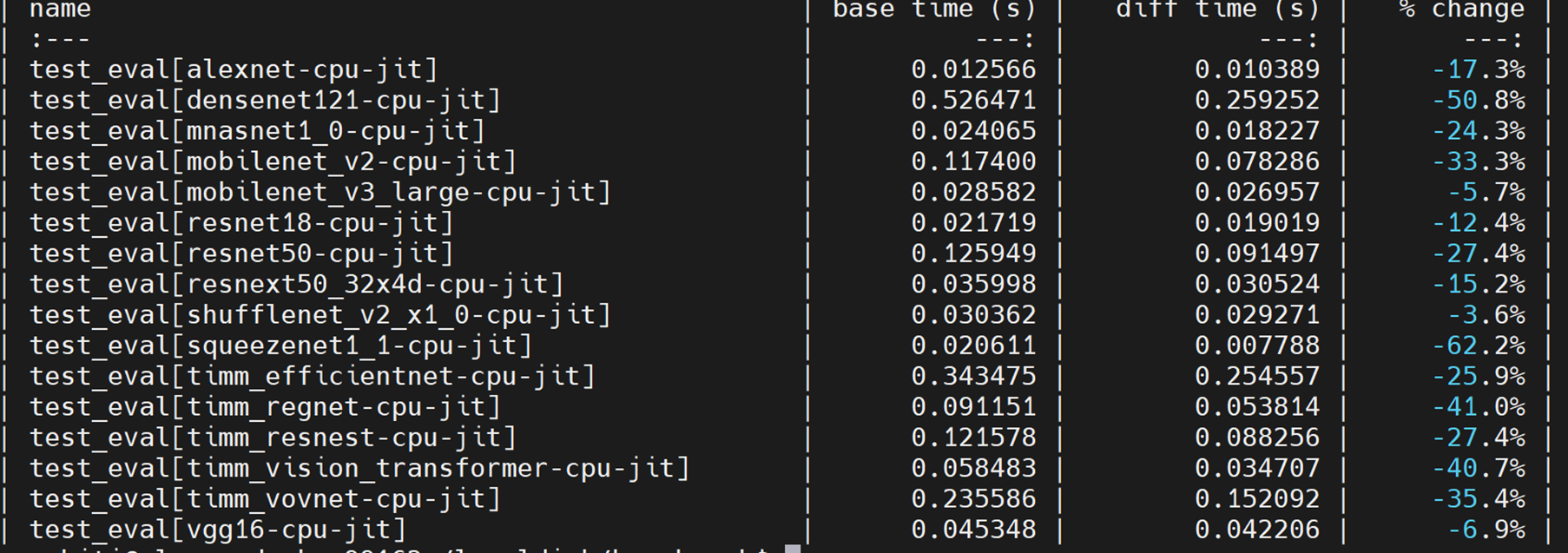
[pytorch/benchmark](https://github.com/pytorch/benchmark) tool is used to compare the performance:
* SkyLake 8180 (1 socket of 28 cores):
* SkyLake 8180 (single thread):
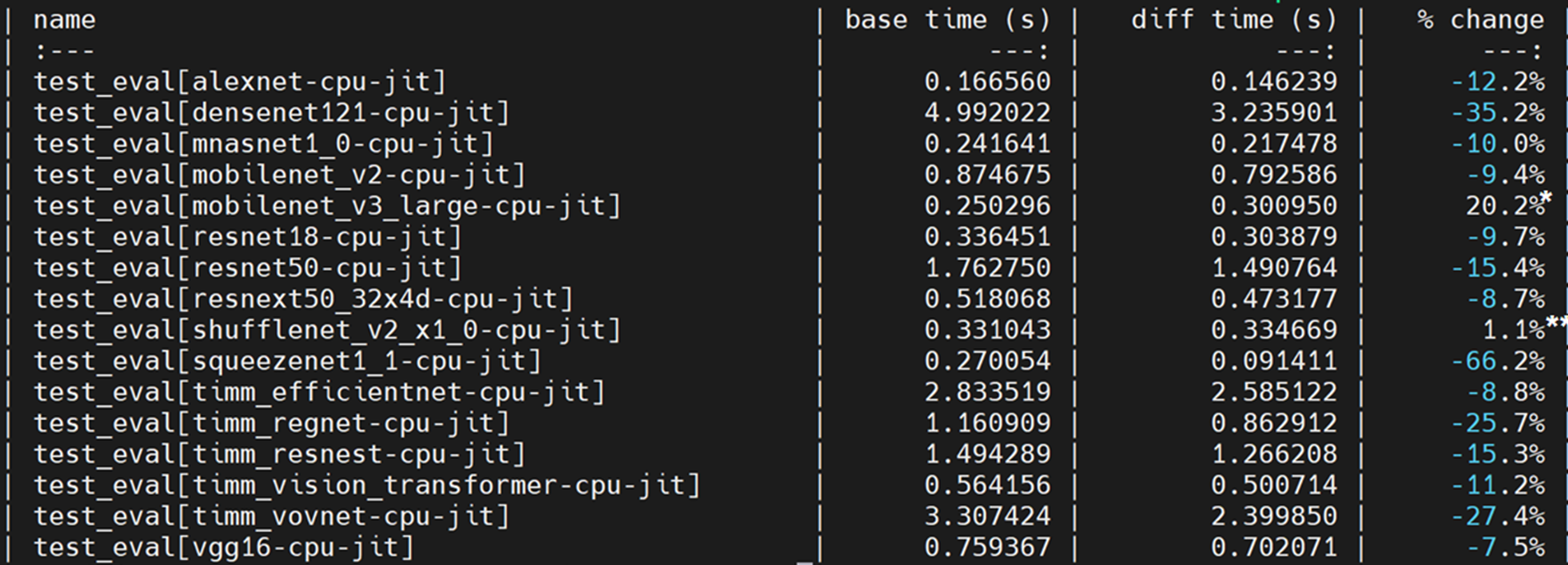
* By mapping hardswish to oneDNN Graph, it’s 8% faster than PyTorch JIT (NNC + OFI)
** We expect performance gain after mapping transpose, contiguous & view to oneDNN graph ops
### Directory structure of the integration code
Fuser-related code is placed under:
```
torch/csrc/jit/codegen/onednn/
```
Optimization pass registration is done in:
```
torch/csrc/jit/passes/onednn_graph_fuser.h
```
CMake for the integration code is in:
```
caffe2/CMakeLists.txt
cmake/public/mkldnn.cmake
cmake/Modules/FindMKLDNN.cmake
```
## Limitations
* In this PR, we only support Pytorch-oneDNN-Graph integration on Linux platform. Support on Windows and MacOS will be enabled as a next step.
* We have only optimized the inference use-case.
Pull Request resolved: https://github.com/pytorch/pytorch/pull/76622
Approved by: https://github.com/eellison
This functionality does not seem to be used
and there are some requests to update dependency.

Add `third_party` to torch_cpu include directories if compiling with
Caffe2 support, as `caffe2/quantization/server/conv_dnnlowp_op.cc` depends on `third_party/fbgemm/src/RefImplementations.h`

Pull Request resolved: https://github.com/pytorch/pytorch/pull/75394
Approved by: https://github.com/janeyx99, https://github.com/seemethere
This was causing the shaders to be incorrectly templated because
both the precision argument and the format argument were being treated
as a single argument by argparse and therefore pasted into shaders
incorrectly. In turn this meant that shaders couldn't be compiled
when the precision or format options were turned on.
Fixes#76195
Pull Request resolved: https://github.com/pytorch/pytorch/pull/76196
Approved by: https://github.com/dagitses
Summary:
Pull Request resolved: https://github.com/pytorch/pytorch/pull/75605

Usecase: Milan models have multiple backends and need to use static dispatch to save on static initialization time and to hit native functions directly from the unboxed APIs.

This change passes in List[BackendIndex] and adds ability to generate code for multiple static backends with 1 or 0 kernels
ghstack-source-id: 154525738

(Note: this ignores all push blocking failures!)

Test Plan:
Builds lite_predictor_flatbuffer with multiple backends

```
buck build --config pt.enable_lightweight_dispatch=1 --config pt.static_dispatch_backend=CPU,QuantizedCPU,CompositeExplicitAutograd //xplat/caffe2/fb/lite_predictor:lite_predictor_flatbuffer
```

Reviewed By: larryliu0820

Differential Revision: D35510644

fbshipit-source-id: f985718ad066f8578b006b4759c4a3bd6caac176
(cherry picked from commit a6999729c8cc26c54b8d5684f6585d6c50d8d913)
Summary:
[Comment](https://github.com/pytorch/pytorch/pull/62445/files#r680132022) claims, it got added for consistency with  top level CMakeLists.txt, but `-Wno-unused-variable` is not mentioned there.

Modify violations in 50+ files that were added in the interim by either removing unused variables, or decorating the code with `C10_UNUSED` if local variable is likely used to extend object lifetime until the end of the block.

Caused preventable revert in https://github.com/pytorch/pytorch/pull/72633#issuecomment-1092300787

Pull Request resolved: https://github.com/pytorch/pytorch/pull/75538

Reviewed By: anjali411

Differential Revision: D35747333

Pulled By: malfet

fbshipit-source-id: 3fc5828e44a4c05ba0e89e92613e6ebbdb260626
(cherry picked from commit c179fba21cfa2a0093fad50ccad5a22dd7cff52c)
Summary:
RCCL is required by two components in hipified Pytorch: (1) gloo and (2) hipified ProcessGroupNCCL.

- For (1) the RCCL dependency is managed in `./third_party/gloo/cmake/Dependencies.cmake` and can be enabled/disabled via `USE_RCCL`.
- For (2) the RCCL dependency is managed via `./cmake/Dependencies.cmake` and can be on/off via `USE_NCCL`.

The additional dependency removed in this commit forced hipified Pytorch to load librccl.so even when USE_RCCL=OFF USE_NCCL=OFF is set, i.e., when using torch_ucc/ucc for AMD GPU mem type. This caused conflicts when we use a non-system default librccl.so (i.e., not in ROCM_PATH) for torch_ucc/ucc.

This commit removes the unnecessary RCCL dependency. This will ensure a cleaner way to use torch_ucc with a user-specified RCCL library.

Test Plan:
## Verify OSS pytorch on an AMD GPU machine (MI100)
```
ROCM_PATH=/opt/rocm-4.5.2
git clone https://github.com/pytorch/pytorch.git
cd pytorch
python3 tools/amd_build/build_amd.py
USE_NCCL=0 USE_RCCL=0 USE_KINETO=0 with-proxy python3 setup.py develop
USE_NCCL=0 USE_RCCL=0 USE_KINETO=0 with-proxy python3 setup.py install
```
log for develop: P492778257
log for install: P492778277

## Verify OSS pytorch + TorchUCC on an AMD GPU machine (MI100)
```
export RCCL_INSTALL_DIR=/opt/rccl-rocm-rel-4.4
git clone https://github.com/facebookresearch/torch_ucc.git
cd torch_ucc
UCX_HOME=$RCCL_INSTALL_DIR UCC_HOME=$RCCL_INSTALL_DIR WITH_CUDA=$ROCM_PATH python setup.py

# run param comm
export HSA_ENABLE_SDMA=0
export LD_LIBRARY_PATH=$RCCL_INSTALL_DIR

cd test
git clone https://github.com/facebookresearch/param
cd ..
/bin/bash ./test/start_test.sh ./test/param/train/comms/pt/comms.py --backend ucc --device cuda --b 4 --e 4M --c 1 --collective all_reduce
```
- log for param comm: P493033836
- Verified librccl.so in `/opt/rccl-rocm-rel-4.4` is used via checking version string in log. "[localbuild]" is added in RCCL source.
```
RCCL version 2.9.9+hip4.4 [localbuild]
```

Differential Revision: D35476911

Pull Request resolved: https://github.com/pytorch/pytorch/pull/75547
Approved by: https://github.com/malfet, https://github.com/jeffdaily
Summary:
This is the very first step for the UCC-NCCL integration. This PR lets `ProcessGroupNCCL` load the `torch_ucc.so` if the user specifies an environmental variable `TORCH_UCC_LIBRARY_PATH`. If this environment variable is not specified by the user, then there will be no visible change.

In the future, we may want to make PyTorch smart enough to automatically detect the `torch_ucc.so` in the user's system, but before doing that, I believe we should first make sure that `ProcessGroupUCC` is very well tested.

Note that in this PR, `ProcessGroupNCCL` just loads the library but will not use it. I am trying to make PRs small, so the usage of `torch_ucc.so` will be submitted in later PRs.

This PR requires the change in https://github.com/facebookresearch/torch_ucc/pull/56, otherwise `torch_ucc.so` can not be successfully loaded. But his PR can be landed separately without waiting for https://github.com/facebookresearch/torch_ucc/pull/56 because, in PyTorch's unit tests, UCC is never used or tested.

cc pietern mrshenli pritamdamania87 zhaojuanmao satgera rohan-varma gqchen aazzolini osalpekar jiayisuse SciPioneer H-Huang

Pull Request resolved: https://github.com/pytorch/pytorch/pull/69552

Reviewed By: mruberry

Differential Revision: D34675212

Pulled By: jiayisuse

fbshipit-source-id: a3d1fb98340dbe3a931af555423863efd381f1ae
(cherry picked from commit 3778b6fabe70c26b5a65e6ddec641d2ef9113cd1)
Summary:
Also enables bazel build to run lazy codegen.  Bazel (oss) build feeds off the same filelists as cmake/buck (build_variables.bzl), so enabling it is easier than keeping it disabled.

Pull Request resolved: https://github.com/pytorch/pytorch/pull/74111

Test Plan: Run CI and verify test_lazy_ops is running via OSS cmake builds

Reviewed By: bdhirsh

Differential Revision: D34772403

fbshipit-source-id: 8a63f58b9536e6ac1be530667932176ef2549496
(cherry picked from commit e807ffb1918853d10b924fdc24f85ee5b1a39021)
Summary:
## Description
Preview4 PR of this [RFC](https://github.com/pytorch/pytorch/issues/49444).
On the basis of https://github.com/pytorch/pytorch/pull/50256, the below improvements are included:
- The [preview4 release branch](https://github.com/oneapi-src/oneDNN/releases/tag/graph-v0.4.1) of the oneDNN Graph API is used
- The fuser now works with the profiling graph executor. We have inserted type check nodes to guard the profiled tensor properties.
### User API:
The optimization pass is disabled by default. Users could enable it by:
```
torch.jit.enable_onednn_fusion(True)
```
### Performance:
[pytorch/benchmark](https://github.com/pytorch/benchmark) tool is used to compare the performance:
- SkyLake 8180 (1 socket of 28 cores):

- SkyLake 8180 (single thread):

\* By mapping hardswish to oneDNN Graph, it’s 8% faster than PyTorch JIT (NNC + OFI)
\** We expect performance gain after mapping transpose, contiguous & view to oneDNN graph ops
### Directory structure of the integration code
Fuser-related code are placed under:
```
torch/csrc/jit/codegen/onednn/
```
Optimization pass registration is done in:
```
torch/csrc/jit/passes/onednn_graph_fuser.h
```
CMake for the integration code is:
```
caffe2/CMakeLists.txt
```
## Limitations
- In this PR, we have only supported the optimization on Linux platform. The support on Windows and MacOS will be enabled as the next step.
- We have only optimized the inference use case.
Pull Request resolved: https://github.com/pytorch/pytorch/pull/68111
Reviewed By: eellison
Differential Revision: D34584878
Pulled By: malfet
fbshipit-source-id: ce817aa8cc9052ee9ed930c9cf66be83449e61a4
(cherry picked from commit cd17683aa7d9c0947df45a1ab53627feff795587)
Per https://github.com/pytorch/pytorch/issues/57744 statically linked CUPTI
causes exception handling to break on certain compiler configurations, likely
because CUPTI comes with incompatible libstdc++ symbols.  Rather than pray that
something reasonable happens, use the safer configuration (dynamic linking) by
default and give a warning if the user inverts the setting.

Signed-off-by: Edward Z. Yang <ezyangfb.com>

Pull Request resolved: https://github.com/pytorch/pytorch/pull/74009

Approved by: https://github.com/malfet
Summary:
RFC: https://github.com/pytorch/rfcs/pull/40

This PR (re)introduces python codegen for unboxing wrappers. Given an entry of `native_functions.yaml` the codegen should be able to generate the corresponding C++ code to convert ivalues from the stack to their proper types. To trigger the codegen, run
```
tools/jit/gen_unboxing.py -d cg/torch/share/ATen
```

Merged changes on CI test. In https://github.com/pytorch/pytorch/issues/71782 I added an e2e test for static dispatch + codegen unboxing. The test exports a mobile model of mobilenetv2, load and run it on a new binary for lite interpreter: `test/mobile/custom_build/lite_predictor.cpp`.

## Lite predictor build specifics

1. Codegen: `gen.py` generates `RegisterCPU.cpp` and `RegisterSchema.cpp`. Now with this PR, once `static_dispatch` mode is enabled, `gen.py` will not generate `TORCH_LIBRARY` API calls in those cpp files, hence avoids interaction with the dispatcher. Once `USE_LIGHTWEIGHT_DISPATCH` is turned on, `cmake/Codegen.cmake` calls `gen_unboxing.py` which generates `UnboxingFunctions.h`, `UnboxingFunctions_[0-4].cpp` and `RegisterCodegenUnboxedKernels_[0-4].cpp`.
2. Build: `USE_LIGHTWEIGHT_DISPATCH` adds generated sources into `all_cpu_cpp` in `aten/src/ATen/CMakeLists.txt`. All other files remain unchanged. In reality all the `Operators_[0-4].cpp` are not necessary but we can rely on linker to strip them off.

## Current CI job test coverage update

Created a new CI job `linux-xenial-py3-clang5-mobile-lightweight-dispatch-build` that enables the following build options:
* `USE_LIGHTWEIGHT_DISPATCH=1`
* `BUILD_LITE_INTERPRETER=1`
* `STATIC_DISPATCH_BACKEND=CPU`

This job triggers `test/mobile/lightweight_dispatch/build.sh` and builds `libtorch`. Then the script runs C++ tests written in `test_lightweight_dispatch.cpp` and `test_codegen_unboxing.cpp`. Recent commits added tests to cover as many C++ argument type as possible: in `build.sh` we installed PyTorch Python API so that we can export test models in `tests_setup.py`. Then we run C++ test binary to run these models on lightweight dispatch enabled runtime.

Pull Request resolved: https://github.com/pytorch/pytorch/pull/69881

Reviewed By: iseeyuan

Differential Revision: D33692299

Pulled By: larryliu0820

fbshipit-source-id: 211e59f2364100703359b4a3d2ab48ca5155a023
(cherry picked from commit 58e1c9a25e3d1b5b656282cf3ac2f548d98d530b)
Summary:
Fixes : https://github.com/pytorch/pytorch/issues/73377

We've migrated to CUDA-11.3 as default toolkit in 1.9, it's time to stop builds (especially considering forward-compatibility guarantee across CUDA-11.x drivers)

Hence we are removing CUDA 11.1 support. We should also cleanup old cuda related code from our builder and pytorch repo making scripts a little more clean.

We have code that references cuda 9.2 , 10.1 , 11.0, 11.1, 11.2 and none of these are currently use

Pull Request resolved: https://github.com/pytorch/pytorch/pull/73514

Reviewed By: janeyx99

Differential Revision: D34551989

Pulled By: atalman

fbshipit-source-id: 9ceaaa9b25ad49689986f4b29a26d20370d9d011
(cherry picked from commit fe109c62daf429e9053c03f6e374568ba23cd041)
Summary:
Pull Request resolved: https://github.com/pytorch/pytorch/pull/73040

This patch fixes a compilation error in PyTorch with ROCm when `NDEBUG` is passed.

## Problem

Forward declaration of `__host__ __device__ __assert_fail()` is used in `c10/macros/Macros.h` for HIP compilation when `NDEBUG` is set  However, HIP has  `__device__ __assert_fail()` in `hip/amd_detail/amd_device_functions.h`, causing a function type error.

This issue does not appear in ROCm CI tests since it happens only when `NDEBUG` is passed.

## Solution

[EDIT] After the discussion on GitHub, we chose to entirely disable `CUDA_KERNEL_ASSERT()` for ROCm.

 ---

To solve this compilation error, this patch disables `CUDA_KERNEL_ASSERT()`, which uses `__assert_fail()` when
1. `c10/macros/Macros.h` is included for `*.hip` (precisely speaking, `__HIP__` or `__HIP_ARCH__` is defined), and
2. `NDEBUG` is passed.

Note that there's no impact on default compilation because, without a special compilation flag, those HIP files are compiled without `-NDEBUG`. And that's why this issue has not been found.

### Justification
[1] We cannot declare one host-and-device function for two separate host and device functions.
```
__device__ int func() {return 0};
__host__ int func() {return 0};
// Compile error (hipcc)
// __device__ __host__ int func();
```
[2] Forward declaration of a correct `__device__` only `__assert_fail()` for `__HIP__` causes the following error:
```
pytorch/c10/util/TypeCast.h:135:7: error: reference to __device__ function '__assert_fail' in __host__ __device__ function
      ERROR_UNSUPPORTED_CAST
      ^
pytorch/c10/util/TypeCast.h:118:32: note: expanded from macro 'ERROR_UNSUPPORTED_CAST'
#define ERROR_UNSUPPORTED_CAST CUDA_KERNEL_ASSERT(false);
                               ^
pytorch/c10/macros/Macros.h:392:5: note: expanded from macro 'CUDA_KERNEL_ASSERT'
    __assert_fail(
```

[3] Maybe there's a way to properly define `__assert_fail()` for HIP + NDEBUG, but this might be too much. Please let me just disable it.

### Technical details

Error
```
pytorch/c10/macros/Macros.h:368:5: error: __host__ __device__ function '__assert_fail' cannot overload __device__ function '__assert_fail'
    __assert_fail(
    ^
/opt/rocm/hip/include/hip/amd_detail/amd_device_functions.h:1173:6: note: previous declaration is here
void __assert_fail(const char *assertion,
```

CUDA definition (9.x) of `__assert_fail()`
```
#elif defined(__GNUC__)
extern __host__ __device__ __cudart_builtin__ void __assert_fail(
  const char *, const char *, unsigned int, const char *)
  __THROW;
```

ROCm definition (the latest version)
```
// 2b59661f3e/include/hip/amd_detail/amd_device_functions.h (L1172-L1177)
extern "C" __device__ __attribute__((noinline)) __attribute__((weak))
void __assert_fail(const char *assertion,
                   const char *file,
                   unsigned int line,
                   const char *function);
```

Test Plan:
CI + reproducer
```
python3 tools/amd_build/build_amd.py
python3 setup.py develop --cmake-only
cmake -DHIP_HIPCC_FLAGS_RELEASE="-DNDEBUG" build
cmake --build build
```

Reviewed By: xw285cornell

Differential Revision: D34310555

fbshipit-source-id: 7542288912590533ced3f20afd2e704b6551991b
(cherry picked from commit 9e52196e36820abe36bf6427cabc7389d3ea6cb5)
Summary:
Pull Request resolved: https://github.com/pytorch/pytorch/pull/65851

Design doc: https://docs.google.com/document/d/12rtlHnPUpaJ-I52Iob3L0WA3rKRr_OY7fXqeCvn2MVY/edit

First read the design doc to understand the user syntax. In this PR, we have converted add to use ufunc codegen; most of the cpp changes are deleting the preexisting implementations of add, and ufunc/add.h are the new implementations in the ufunc format.

The bulk of this PR is in the new codegen machinery. Here's the order to read the files:

* `tools/codegen/model.py`
  * Some self-explanatory utility classes: `ScalarType`, `DTYPE_CLASSES`
  * New classes for representing ufunc entries in `native_functions.yaml`: `UfuncKey` and  `UfuncInnerLoop`, as well as parsing logic for these entries. UfuncKey has some unusual entries (e.g., CPUScalar) that don't show up in the documentation, more on these below).
  * A predicate `is_ufunc_dispatch_key` for testing which dispatch keys should get automatically generated when an operator opts into ufuncs (CPU and CUDA, for now!)
* `tools/codegen/api/types.py`
  * More self-explanatory utility stuff: ScalarTypeToCppMapping mapping ScalarType to CppTypes; Binding.rename for changing the name of a binding (used when we assign constructor variables to member variables inside CUDA functors)
  * New VectorizedCType, representing `at::vec::Vectorized<T>`. This is used inside vectorized CPU codegen.
  * New `scalar_t` and `opmath_t` BaseCppTypes, representing template parameters that we work with when doing codegen inside ufunc kernel loops (e.g., where you previously had Tensor, now you have `scalar_t`)
  * `StructuredImplSignature` represents a `TORCH_IMPL_FUNC` definition, and straightforwardly follows from preexisting `tools.codegen.api.structured`
* `tools/codegen/translate.py` - Yes, we use translate a LOT in this PR. I improved some of the documentation, the only substantive changes are adding two new conversions: given a `scalar_t` or a `const Scalar&`, make it convertible to an `opmath_t`
* `tools/codegen/api/ufunc.py`
  * OK, now we're at the meaty stuff. This file represents the calling conventions of three important concepts in ufunc codegen, which we'll describe shortly. All of these APIs are relatively simple, since there aren't any complicated types by the time you get to kernels.
  * stubs are the DispatchStub trampolines that CPU kernels use to get to their vectorized versions. They drop all Tensor arguments (as they are in TensorIterator) but otherwise match the structured calling convention
  * ufuncs are the inner loop template functions that you wrote in ufunc/add.h which do the actual computation in question. Here, all the Tensors and Scalars have been converted into the computation type (`opmath_t` in CUDA, `scalar_t` in CPU)
  * ufunctors are a CUDA-only concept representing functors that take some of their arguments on a host-side constructor, and the rest in the device-side apply. Once again, Tensors and Scalars are converted into the computation type, `opmath_t`, but for clarity all the functions take `scalar_t` as argument (as this is the type that is most salient at the call site). Because the constructor and apply are code generated separately, `ufunctor_arguments` returns a teeny struct `UfunctorBindings`
* `tools/codegen/dest/ufunc.py` - the workhorse. This gets its own section below.
* `tools/codegen/gen.py` - just calling out to the new dest.ufunc implementation to generate UfuncCPU_add.cpp, UFuncCPUKernel_add.cpp and UfuncCUDA_add.cu files per ufunc operator. Each of these files does what you expect (small file that registers kernel and calls stub; CPU implementation; CUDA implementation). There is a new file manager for UFuncCPUKernel files as these need to get replicated by cmake for vectorization. One little trick to avoid recompilation is we directly replicate code generated forward declarations in these files, to reduce the number of headers we depend on (this is codegen, we're just doing the preprocessors job!)
* I'll talk about build system adjustments below.

OK, let's talk about tools/codegen/dest/ufunc.py. This file can be roughly understood in two halves: one for CPU code generation, and the other for CUDA code generation.

**CPU codegen.** Here's roughly what we want to generate:

```
// in UfuncCPU_add.cpp
using add_fn = void (*)(TensorIteratorBase&, const at::Scalar&);
DECLARE_DISPATCH(add_fn, add_stub);
DEFINE_DISPATCH(add_stub);

TORCH_IMPL_FUNC(ufunc_add_CPU)
(const at::Tensor& self, const at::Tensor& other, const at::Scalar& alpha, const at::Tensor& out) {
  add_stub(device_type(), *this, alpha);
}

// in UfuncCPUKernel_add.cpp
void add_kernel(TensorIteratorBase& iter, const at::Scalar& alpha) {
  at::ScalarType st = iter.common_dtype();
  RECORD_KERNEL_FUNCTION_DTYPE("add_stub", st);
  switch (st) {
    AT_PRIVATE_CASE_TYPE("add_stub", at::ScalarType::Bool, bool, [&]() {
      auto _s_alpha = alpha.to<scalar_t>();
      cpu_kernel(iter, [=](scalar_t self, scalar_t other) {
        return ufunc::add(self, other, _s_alpha);
      });
    })

    AT_PRIVATE_CASE_TYPE(
        "add_stub", at::ScalarType::ComplexFloat, c10::complex<float>, [&]() {
          auto _s_alpha = alpha.to<scalar_t>();
          auto _v_alpha = at::vec::Vectorized<scalar_t>(_s_alpha);
          cpu_kernel_vec(
              iter,
              [=](scalar_t self, scalar_t other) {
                return ufunc::add(self, other, _s_alpha);
              },
              [=](at::vec::Vectorized<scalar_t> self,
                  at::vec::Vectorized<scalar_t> other) {
                return ufunc::add(self, other, _v_alpha);
              });
        })

   ...
```

The most interesting change about the generated code is what previously was an `AT_DISPATCH` macro invocation is now an unrolled loop. This makes it easier to vary behavior per-dtype (you can see in this example that the entry for bool and float differ) without having to add extra condtionals on top.

Otherwise, to generate this code, we have to hop through several successive API changes:

* In TORCH_IMPL_FUNC(ufunc_add_CPU), go from StructuredImplSignature to StubSignature (call the stub). This is normal argument massaging in the classic translate style.
* In add_kernel, go from StubSignature to UfuncSignature. This is nontrivial, because we must do various conversions outside of the inner kernel loop. These conversions are done by hand, setting up the context appropriately, and then the final ufunc call is done using translate. (BTW, I introduce a new convention here, call on a Signature, for code generating a C++ call, and I think we should try to use this convention elsewhere)

The other piece of nontrivial logic is the reindexing by dtype. This reindexing exists because the native_functions.yaml format is indexed by UfuncKey:

```
   Generic: add (AllAndComplex, BFloat16, Half)
   ScalarOnly: add (Bool)
```

but when we do code generation, we case on dtype first, and then we generate a `cpu_kernel` or `cpu_kernel_vec` call. We also don't care about CUDA code generation (which Generic) hits. Do this, we lower these keys into two low level keys, CPUScalar and CPUVector, which represent the CPU scalar and CPU vectorized ufuncs, respectively (Generic maps to CPUScalar and CPUVector, while ScalarOnly maps to CPUScalar only). Reindexing then gives us:

```
    AllAndComplex:
        CPUScalar: add
        CPUVector: add
    Bool:
        CPUScalar: add
    ...
```

which is a good format for code generation, but too wordy to force native_functions.yaml authors to write. Note that when reindexing, it is possible for there to be a conflicting definition for the same dtype; we just define a precedence order and have one override the other, so that it is easy to specialize on a particular dtype if necessary. Also note that because CPUScalar/CPUVector are part of UfuncKey, technically you can manually specify them in native_functions.yaml, although I don't expect this functionality to be used.

**CUDA codegen.** CUDA code generation has many of the same ideas as CPU codegen, but it needs to know about functors, and stubs are handled slightly differently.  Here is what we want to generate:

```
template <typename scalar_t>
struct CUDAFunctorOnSelf_add {
  using opmath_t = at::opmath_type<scalar_t>;
  opmath_t other_;
  opmath_t alpha_;
  CUDAFunctorOnSelf_add(opmath_t other, opmath_t alpha)
      : other_(other), alpha_(alpha) {}
  __device__ scalar_t operator()(scalar_t self) {
    return ufunc::add(static_cast<opmath_t>(self), other_, alpha_);
  }
};

... two more functors ...

void add_kernel(TensorIteratorBase& iter, const at::Scalar & alpha) {
  TensorIteratorBase& iter = *this;
  at::ScalarType st = iter.common_dtype();
  RECORD_KERNEL_FUNCTION_DTYPE("ufunc_add_CUDA", st);
  switch (st) {
    AT_PRIVATE_CASE_TYPE("ufunc_add_CUDA", at::ScalarType::Bool, bool, [&]() {
      using opmath_t = at::opmath_type<scalar_t>;
      if (false) {
      } else if (iter.is_cpu_scalar(1)) {
        CUDAFunctorOnOther_add<scalar_t> ufunctor(
            iter.scalar_value<opmath_t>(1), (alpha).to<opmath_t>());
        iter.remove_operand(1);
        gpu_kernel(iter, ufunctor);
      } else if (iter.is_cpu_scalar(2)) {
        CUDAFunctorOnSelf_add<scalar_t> ufunctor(
            iter.scalar_value<opmath_t>(2), (alpha).to<opmath_t>());
        iter.remove_operand(2);
        gpu_kernel(iter, ufunctor);
      } else {
        gpu_kernel(iter, CUDAFunctor_add<scalar_t>((alpha).to<opmath_t>()));
      }
    })

   ...

REGISTER_DISPATCH(add_stub, &add_kernel);

TORCH_IMPL_FUNC(ufunc_add_CUDA)
(const at::Tensor& self,
 const at::Tensor& other,
 const at::Scalar& alpha,
 const at::Tensor& out) {
  add_kernel(*this, alpha);
}

```

The functor business is the bulk of the complexity. Like CPU, we decompose CUDA implementation into three low-level keys: CUDAFunctor (normal, all CUDA kernels will have this), and CUDAFunctorOnOther/CUDAFunctorOnScalar (these are to support Tensor-Scalar specializations when the Scalar lives on CPU). Both Generic and ScalarOnly provide ufuncs for CUDAFunctor, but for us to also lift these into Tensor-Scalar specializations, the operator itself must be eligible for Tensor-Scalar specialization. At the moment, this is hardcoded to be all binary operators, but in the future we can use tags in native_functions.yaml to disambiguate (or perhaps expand codegen to handle n-ary operators).

The reindexing process not only reassociates ufuncs by dtype, but it also works out if Tensor-Scalar specializations are needed and codegens the ufunctors necessary for the level of specialization here (`compute_ufunc_cuda_functors`). Generating the actual kernel (`compute_ufunc_cuda_dtype_body`) just consists of, for each specialization, constructing the functor and then passing it off to `gpu_kernel`. Most of the hard work is in functor generation, where we take care to make sure `operator()` has the correct input and output types (which `gpu_kernel` uses to arrange for memory accesses to the actual CUDA tensor; if you get these types wrong, your kernel will still work, it will just run very slowly!)

There is one big subtlety with CUDA codegen: this won't work:

```
   Generic: add (AllAndComplex, BFloat16, Half)
   ScalarOnly: add_bool (Bool)
```

This is because, even though there are separate Generic/ScalarOnly entries, we only generate a single functor to cover ALL dtypes in this case, and the functor has the ufunc name hardcoded into it. You'll get an error if you try to do this; to fix it, just make sure the ufunc is named the same consistently throughout. In the code, you see this because after testing for the short circuit case (when a user provided the functor themselves), we squash all the generic entries together and assert their ufunc names are the same. Hypothetically, if we generated a separate functor per dtype, we could support differently named ufuncs but... why would you do that to yourself. (One piece of nastiness is that the native_functions.yaml syntax doesn't stop you from shooting yourself in the foot.)

A brief word about CUDA stubs: technically, they are not necessary, as there is no CPU/CPUKernel style split for CUDA kernels (so, if you look, structured impl actually calls add_kernel directly). However, there is some code that still makes use of CUDA stubs (in particular, I use the stub to conveniently reimplement sub in terms of add), so we still register it. This might be worth frying some more at a later point in time.

**Build system changes.** If you are at FB, you should review these changes in fbcode, as there are several changes in files that are not exported to ShipIt.

The build system changes in this patch are substantively complicated by the fact that I have to implement these changes five times:

* OSS cmake build
* OSS Bazel build
* FB fbcode Buck build
* FB xplat Buck build (selective build)
* FB ovrsource Buck build

Due to technical limitations in the xplat Buck build related to selective build, it is required that you list every ufunc header manually (this is done in tools/build_variables.bzl)

The OSS cmake changes are entirely in cmake/Codegen.cmake there is a new set of files cpu_vec_generated (corresponding to UfuncCPUKernel files) which is wired up in the same way as other files. These files are different because they need to get compiled multiple times under different vectorization settings. I adjust the codegen, slightly refactoring the inner loop into its own function so I can use different base path calculation depending on if the file is traditional (in the native/cpu folder) or generated (new stuff from this diff.

The Bazel/Buck changes are organized around tools/build_variables.bzl, which contain the canonical list of ufunc headers (aten_ufunc_headers), and tools/ufunc_defs.bzl (added to ShipIt export list in D34465699) which defines a number of functions that compute the generated cpu, cpu kernel and cuda files based on the headers list. For convenience, these functions take a genpattern (a string with a {} for interpolation) which can be used to easily reformat the list of formats in target form, which is commonly needed in the build systems.

The split between build_variables.bzl and ufunc_defs.bzl is required because build_variables.bzl is executed by a conventional Python interpreter as part of the OSS cmake, but we require Skylark features to implement the functions in ufunc_defs.bzl (I did some quick Googling but didn't find a lightweight way to run the Skylark interpreter in open source.)

With these new file lists, the rest of the build changes are mostly inserting references to these files wherever necessary; in particular, cpu kernel files have to be worked into the multiple vectorization build flow (intern_build_aten_ops in OSS Bazel). Most of the subtlety relates to selective build. Selective build requires operator files to be copied per overall selective build; as dhruvbird explains to me, glob expansion happens during the action graph phase, but the selective build handling of TEMPLATE_SOURCE_LIST is referencing the target graph. In other words, we can't use a glob to generate deps for another rule, because we need to copy files from wherever (included generated files) to a staging folder so the rules can pick them up.

It can be somewhat confusing to understand which bzl files are associated with which build. Here are the relevant mappings for files I edited:

* Used by everyone - tools/build_tools.bzl, tools/ufunc_defs.bzl
* OSS Bazel - aten.bzl, BUILD.bazel
* FB fbcode Buck - TARGETS
* FB xplat Buck -BUCK, pt_defs.bzl, pt_template_srcs.bzl
* FB ovrsource Buck - ovrsource_defs.bzl, pt_defs.bzl

Note that pt_defs.bzl is used by both xplat and ovrsource. This leads to the "tiresome" handling for enabled backends, as selective build is CPU only, but ovrsource is CPU and CUDA.

BTW, while I was at it, I beefed up fb/build_arvr.sh to also do a CUDA ovrsource build, which was not triggered previously.

Signed-off-by: Edward Z. Yang <ezyang@fb.com>

Test Plan: Imported from OSS

Reviewed By: albanD

Differential Revision: D31306586

Pulled By: ezyang

fbshipit-source-id: 210258ce83f578f79cf91b77bfaeac34945a00c6
(cherry picked from commit d65157b0b894b6701ee062f05a5f57790a06c91c)
Summary:
- Target Sha1: ae108ef49aa5623b896fc93d4298c49d1750d9ba
- Make USE_XNNPACK a dependent option on cmake minimum version 3.12
- Print USE_XNNPACK under cmake options summary, and print the
  availability from collet_env.py
- Skip XNNPACK based tests when XNNPACK is not available
    - Add SkipIfNoXNNPACK wrapper to skip tests
- Update cmake version for xenial-py3.7-gcc5.4 image to 3.12.4
    - This is required for the backwards compatibility test.
      The PyTorch op schema is XNNPACK dependent. See,
      aten/src/ATen/native/xnnpack/RegisterOpContextClass.cpp for
      example. The nightly version is assumed to have USE_XNNPACK=ON,
      so with this change we ensure that the test build can also
      have XNNPACK.
- HACK: skipping test_xnnpack_integration tests on ROCM

Pull Request resolved: https://github.com/pytorch/pytorch/pull/72642

Reviewed By: kimishpatel

Differential Revision: D34456794

Pulled By: digantdesai

fbshipit-source-id: 85dbfe0211de7846d8a84321b14fdb061cd6c037
(cherry picked from commit 6cf48e7b64d6979962d701b5d493998262cc8bfa)
Summary:
Pull Request resolved: https://github.com/pytorch/pytorch/pull/72869

The ordering here doesn't really matter, but in a future patch
I will make a change where vectorized CPU codegen does have to
be here, and moving it ahead of time (with no code changes)
will make the latter diff cleaner.

Signed-off-by: Edward Z. Yang <ezyang@fb.com>

Test Plan: Imported from OSS

Reviewed By: albanD

Differential Revision: D34282229

Pulled By: ezyang

fbshipit-source-id: 3397cb0e062d63cc9853f6248f17c3558013798b
(cherry picked from commit 98c616024969f9df90c7fb09741ed9be7b7a20f1)
Summary:
Pull Request resolved: https://github.com/pytorch/pytorch/pull/72761

By default, the CUPTI_INCLUDE_DIR will pick up cupti.h from /usr/include which is old (from 2017 on AWS), and missing many cupti headers. Use NO_DEFAULT_PATH to avoid that, instead search from the list of locations provided.

Test Plan:
Fixes missing headers error when building on AWS. (Avoids old cupti.h from /usr/include). Instead uses cupti.h from cuda/extras/CUPTI/include.
```
In file included from /scratch/aaronshi/pytorch/third_party/kineto/libkineto/src/CuptiRangeProfilerApi.cpp:13:0:
/scratch/aaronshi/pytorch/third_party/kineto/libkineto/src/CuptiRangeProfilerApi.h:12:10: fatal error: cupti_profiler_target.h: No such file or directory
 #include <cupti_profiler_target.h>
          ^~~~~~~~~~~~~~~~~~~~~~~~~
compilation terminated.
```
and
```
/scratch/aaronshi/pytorch/third_party/kineto/libkineto/src/CuptiRangeProfilerApi.cpp:7:10: fatal error: nvperf_host.h: No such file or directory
 #include <nvperf_host.h>
          ^~~~~~~~~~~~~~~
compilation terminated.
```

Reviewed By: briancoutinho

Differential Revision: D34191123

Pulled By: aaronenyeshi

fbshipit-source-id: d84f80308c9939ba8ed504e667847d136a261453
(cherry picked from commit 33368bd93b)
Summary:
In ROCm 5.0 and later the version of the ROCm platform can be obtained via
an api call vs reading from a flat file.

If the header file /opt/rocm/include/rocm_version.h exists,
LoadHIP.cmake compiles source referencing the api and prints out the
ROCM Versions.

If the file does not exist, LoadHIP.cmake will revert to the previous
approach of looking for the version-dev file.

Fixes #{issue number}

cc jeffdaily sunway513 jithunnair-amd ROCmSupport KyleCZH

Pull Request resolved: https://github.com/pytorch/pytorch/pull/69481

Reviewed By: seemethere, janeyx99

Differential Revision: D34153435

Pulled By: malfet

fbshipit-source-id: f8c0650d27666d2a3cf47d812807798c47210b37
(cherry picked from commit 6cbb4f7a0c)
Summary:
`include_directories` is old-style CMake which adds the include path to every file being compiled. This instead makes `python`, `numpy` and `pybind11` into targets that only `torch_python` and `caffe2_pybind_state` are linked to. So, python libraries can't be accidentally included elsewhere.

Resubmit of https://github.com/pytorch/pytorch/issues/65654, Closes https://github.com/pytorch/pytorch/issues/65828

Pull Request resolved: https://github.com/pytorch/pytorch/pull/69085

Reviewed By: anjali411

Differential Revision: D33776456

Pulled By: malfet

fbshipit-source-id: 018b0f6cd5a4f8c9e36df961deff832bc4afd479
(cherry picked from commit 57063107d6)
Summary:
Remove forcing CUDNN_STATIC when CAFFE2_STATIC_LINK_CUDA is set
Since we are transitioning to using dynamic loading for multiple pytorch dependecies  and CUDNN is the first step in this transition,  hence we want to remove forcing CUDNN to statically load, and instead load it dynamically.

Tested using following workflow:
https://github.com/pytorch/pytorch/actions/runs/1790666862

Pull Request resolved: https://github.com/pytorch/pytorch/pull/72290

Reviewed By: albanD

Differential Revision: D34003793

Pulled By: atalman

fbshipit-source-id: 41bda7ac019a612ee53ceb18d1e372b1bb3cb68e
(cherry picked from commit 4a01940e68)
Summary:
This PR upgrades oneDNN to v2.5.2, and includes some building support for oneDNN v2.5.2.

v2.4 changes:
- Improved performance for future Intel Xeon Scalable processor (code name Sapphire Rapids). The functionality is disabled by default and should be enabled via CPU dispatcher control.
- Improved binary primitive performance for cases when one of the tensors is broadcasted.
- Improved performance of reduction primitive, reorder, shuffle primitives.
- Improved performance of depthwise convolution forward propagation for processors with Intel AVX5-12 support
- Improved performance of forward inner product primitive for the shapes with minibatch equal to 1 for processors with Intel AVX-512 support
- Improved performance of int8 matmul and inner product primitives for processors with Intel AVX2 and Intel DL Boost support

v2.5 changes:
- Improved performance for future Intel Xeon Scalable processors (code name Sapphire Rapids). The functionality is now enabled by default and requires Linux kernel 5.16.
- Improved performance of matmul primitive for processors with Intel AVX-512 support.

v2.5.2 changes:
- Fixed performance regression in binary primitive with broadcast
- Fixed segmentation fault in depthwise convolution primitive for shapes with huge spatial size for processors with Intel AVX-512 support

Pull Request resolved: https://github.com/pytorch/pytorch/pull/71546

Reviewed By: george-qi

Differential Revision: D33827108

Pulled By: VitalyFedyunin

fbshipit-source-id: 8f5a19b331c82af5b0783f081e061e1034a93952
(cherry picked from commit 9705212fe9)
Summary:
Pull Request resolved: https://github.com/pytorch/pytorch/pull/72081

This PR fixes the libstdc++ ABI check in CMake package configuration file (i.e. `TorchConfig.cmake`) The `_GLIBCXX_USE_CXX11_ABI` flag is a property of `libstdc++`, not GNU compiler collection. In its current form C++ libraries built with Clang on Linux fail since the `torch` CMake target propagates `_GLIBCXX_USE_CXX11_ABI` only when used with gcc.
ghstack-source-id: 148056323

Test Plan: Built a dummy C++ library that depends on libtorch with both gcc and clang on Linux

Reviewed By: malfet

Differential Revision: D33899849

fbshipit-source-id: 3e933b2c7a17d1fba086caa8aaec831223760882
(cherry picked from commit 41d18c64c4)
Summary:
Pull Request resolved: https://github.com/pytorch/pytorch/pull/69216

This cleans up 4 pre-processor defines not used by any code:
- HAVE_GCC_GET_CPUID
- USE_GCC_GET_CPUID
- USE_AVX
- USE_AVX2

`cpuid` isn't used in PyTorch any more, we only use `cpuinfo`.
`USE_AVX*` is also not used, instead `HAVE_*_CPU_DEFINITIONS` tells
you which `CPU_CAPABILITY` flags are being compiled.

There is also `fbgemm`'s code path adding `third_party` as an include
path, despite `fbgemm` having a dedicated include directory and a
CMake setup that properly includes it.

Test Plan: Imported from OSS

Reviewed By: albanD

Differential Revision: D33794424

Pulled By: malfet

fbshipit-source-id: 99d504af088818d4a26c2f6ce67ec0d59a5eb703
(cherry picked from commit 2e099d41f0)
Summary:
Pull Request resolved: https://github.com/pytorch/pytorch/pull/69216

Currently `torch_cpu` has command line arguments relating to cuda
libraries e.g. `-DMAGMA_V2`. This happens because
`include_directories` and `add_definitions` indescriminately change
the compile commands of all targets.

Instead creating a proper magma target allows limiting the flags to
just `torch_cuda`.

Test Plan: Imported from OSS

Reviewed By: dagitses

Differential Revision: D33794174

Pulled By: malfet

fbshipit-source-id: 762eabf3b9576bef94e8caa3ed4764c0e2c72b08
(cherry picked from commit f7d127b654)
Summary:
Pull Request resolved: https://github.com/pytorch/pytorch/pull/70201

Included functions:
save_mobile_module -> saves a mobile::Module to flatbuffer
load_mobile_module_from_file -> loads a flatbuffer into mobile::Module
parse_mobile_module -> parses from bytes or deserialized flatbuffer module object

Compared to previous attempts, this diff only adds flatbuffer to cmake target and leaves fbcode/xplat ones unchanged.

Test Plan: unittest

Reviewed By: malfet, gmagogsfm

Differential Revision: D33239362

fbshipit-source-id: b9ca36b83d6af2d78cc50b9eb9e2a6fa7fce0763
Summary:
https://github.com/pytorch/pytorch/issues/66406
implemented z arch 14/15 vector SIMD additions.
so far besides bfloat all other types have their SIMD implementation.

it has 99% coverage and currently passing the local test.
it is concise and the main SIMD file is only one header file
it's using template metaprogramming, mostly. but still, there are a few macrosses left with the intention not to modify PyTorch much
Sleef supports z15

Pull Request resolved: https://github.com/pytorch/pytorch/pull/66407

Reviewed By: mrshenli

Differential Revision: D33370163

Pulled By: malfet

fbshipit-source-id: 0e5a57f31b22a718cd2a9ac59753fb468cdda140
Summary:
Pull Request resolved: https://github.com/pytorch/pytorch/pull/68247

This splits `Functions.h`, `Operators.h`, `NativeFunctions.h` and
`NativeMetaFunctions.h` into seperate headers per operator base name.
With `at::sum` as an example, we can include:
```cpp
<ATen/core/sum.h>         // Like Functions.h
<ATen/core/sum_ops.h>     // Like Operators.h
<ATen/core/sum_native.h>  // Like NativeFunctions.h
<ATen/core/sum_meta.h>    // Like NativeMetaFunctions.h
```

The umbrella headers are still being generated, but all they do is
include from the `ATen/ops' folder.

Further, `TensorBody.h` now only includes the operators that have
method variants. Which means files that only include `Tensor.h` don't
need to be rebuilt when you modify function-only operators. Currently
there are about 680 operators that don't have method variants, so this
is potentially a significant win for incremental builds.

Test Plan: Imported from OSS

Reviewed By: mrshenli

Differential Revision: D32596272

Pulled By: albanD

fbshipit-source-id: 447671b2b6adc1364f66ed9717c896dae25fa272
Summary:
Remove all hardcoded AMD gfx targets

PyTorch build and Magma build will use rocm_agent_enumerator as
backup if PYTORCH_ROCM_ARCH env var is not defined

PyTorch extensions will use same gfx targets as the PyTorch build,
unless PYTORCH_ROCM_ARCH env var is defined

torch.cuda.get_arch_list() now works for ROCm builds

PyTorch CI dockers will continue to be built for gfx900 and gfx906 for now.

PYTORCH_ROCM_ARCH env var can be a space or semicolon separated list of gfx archs eg. "gfx900 gfx906" or "gfx900;gfx906"
cc jeffdaily sunway513 jithunnair-amd ROCmSupport KyleCZH

Pull Request resolved: https://github.com/pytorch/pytorch/pull/61706

Reviewed By: seemethere

Differential Revision: D32735862

Pulled By: malfet

fbshipit-source-id: 3170e445e738e3ce373203e1e4ae99c84e645d7d
Summary:
Pull Request resolved: https://github.com/pytorch/pytorch/pull/69710

Namely no range-loop-analysis (that detect when loop variable can not be const reference

Test Plan: Imported from OSS

Reviewed By: r-barnes

Differential Revision: D32997003

Pulled By: malfet

fbshipit-source-id: dba0e7875e5b667e2cc394c70dd75e2403265918
Summary:
This PR upgrades oneDNN to [v2.3.3](https://github.com/oneapi-src/oneDNN/releases/tag/v2.3.3) and includes [Graph API preview release](https://github.com/oneapi-src/oneDNN/releases/tag/graph-v0.2) in one package.

- oneDNN will be located at `pytorch/third_party/ideep/mkl-dnn/third_party/oneDNN`
- The version of oneDNN will be [v2.3.3](https://github.com/oneapi-src/oneDNN/releases/tag/v2.3.3)
  The main changes on CPU:

  - v2.3
    - Extended primitive cache to improve primitive descriptor creation performance.
    - Improved primitive cache performance in multithreaded configurations.
    - Introduced initial optimizations for bfloat16 compute functionality for future Intel Xeon Scalable processor (code name Sapphire Rapids).
    - Improved performance of binary primitive and binary post-op for cases with broadcast and mixed source and destination formats.
    - Improved performance of reduction primitive
    - Improved performance of depthwise convolution primitive with NHWC activations for training cases
  - v2.3.1
    -  Improved int8 GEMM performance for processors with Intel AVX2 and Intel DL Boost support
    - Fixed integer overflow for inner product implementation on CPUs
    - Fixed out of bounds access in GEMM implementation for Intel SSE 4.1
  - v2.3.2
    - Fixed performance regression in fp32 inner product primitive for processors with Intel AVX512 support
  - v2.3.3
    - Reverted check for memory descriptor stride validity for unit dimensions
    - Fixed memory leak in CPU GEMM implementation

  More changes can be found in https://github.com/oneapi-src/oneDNN/releases.
- The Graph API provides flexible API for aggressive fusion, and the preview2 supports fusion for FP32 inference.  See the [Graph API release branch](https://github.com/oneapi-src/oneDNN/tree/dev-graph-preview2) and [spec](https://spec.oneapi.io/onednn-graph/latest/introduction.html) for more details. A separate PR will be submitted to integrate the oneDNN Graph API to Torchscript graph.

Pull Request resolved: https://github.com/pytorch/pytorch/pull/63748

Reviewed By: albanD

Differential Revision: D32153889

Pulled By: malfet

fbshipit-source-id: 536071168ffe312d452f75d54f34c336ca3778c1
Summary:
Pull Request resolved: https://github.com/pytorch/pytorch/pull/68246

Currently the codegen produces a list of output files at CMake
configuration time and the build system has no way of knowing if the
outputs change. So if that happens, you basically need to delete the
build folder and re-run from scratch.

Instead, this generates the output list every time the code generation
is run and changes the output to be a `.cmake` file that gets included
in the main cmake configuration step. That means the build system
knows to re-run cmake automatically if a new output is added. So, for
example you could change the number of shards that `Operators.cpp` is
split into and it all just works transparently to the user.

Test Plan: Imported from OSS

Reviewed By: zou3519

Differential Revision: D32596268

Pulled By: albanD

fbshipit-source-id: 15e0896aeaead90aed64b9c8fda70cf28fef13a2
Summary:
Pull Request resolved: https://github.com/pytorch/pytorch/pull/69251

This adds some actual documentation for deploy, which is probably useful
since we told everyone it was experimentally available so they will
probably be looking at what the heck it is.

It also wires up various compoenents of the OSS build to actually work
when used from an external project.

Differential Revision:
D32783312
D32783312

Test Plan: Imported from OSS

Reviewed By: wconstab

Pulled By: suo

fbshipit-source-id: c5c0a1e3f80fa273b5a70c13ba81733cb8d2c8f8
Summary:
Pull Request resolved: https://github.com/pytorch/pytorch/pull/67656

Currently, each cpu kernel file is copied into the build folder 3 times to give them different compilation flags. This changes it to instead generate 3 files that `#include` the original file. The biggest difference is that updating a copied file requires `cmake` to re-run, whereas include dependencies are natively handled by `ninja`.

A side benefit is that included files show up directly in the build dependency graph, whereas `cmake` file copies don't.

Test Plan: Imported from OSS

Reviewed By: dagitses

Differential Revision: D32566108

Pulled By: malfet

fbshipit-source-id: ae75368fede37e7ca03be6ade3d4e4a63479440d
Summary:
Pull Request resolved: https://github.com/pytorch/pytorch/pull/68180

Since we've open sourced the tracing-based selective build, we can deprecate the
op-dependency-graph-based selective build and the static analyzer tool that
produces the dependency graph.
ghstack-source-id: 143108377

Test Plan: CIs

Reviewed By: seemethere

Differential Revision: D32358467

fbshipit-source-id: c61523706b85a49361416da2230ec1b035b8b99c
Summary:
Pull Request resolved: https://github.com/pytorch/pytorch/pull/67497

This allows more of the code-generation to happen in parallel, whereas
previously all codegen was serialized.

Test Plan: Imported from OSS

Reviewed By: dagitses, mruberry

Differential Revision: D32027250

Pulled By: albanD

fbshipit-source-id: 6407c4c3e25ad15d542aa73da6ded6a309c8eb6a
Summary:
OpenBLAS recently added support for bfloat16 GEMM, so this change has PyTorch call out to OpenBLAS for that, like it does for single and double precision

Our goal is to try to enable PyTorch to make calls to "sbgemm" in OpenBLAS.

We are prepared (if it is your preference) to add fences to the code to limit this change to the Power architecture,
but our first instinct is that anyone on any architecture that enables access to sbgemm in their OpenBLAS library
should be able to use this code.  (but again, we respect that as we are just starting to modify PyTorch, we respect
your guidance!)

(there is no issue number related to this)

Pull Request resolved: https://github.com/pytorch/pytorch/pull/58831

Reviewed By: albanD

Differential Revision: D29951900

Pulled By: malfet

fbshipit-source-id: 3d0a4a638ac95b2ff2e9f6d08827772e28d397c3
Summary:
This PR is to update PyTorch with the following cub changes:
- Starting cub 1.13.1, cub requires users to define `CUB_NS_QUALIFIER` if `CUB_NS_PREFIX` is also defined. Besides that, a new mechanism `CUB_WRAPPED_NAMESPACE` is added.

And I do the following change to PyTorch:
- Starting CUDA 11.5, define `CUB_WRAPPED_NAMESPACE` globally as an nvcc flag.
- Fix caffe2 failures caused by the above change.
- Add a `aten/src/ATen/cuda/cub_definitions.cuh` that defines helper macros about feature availability.

Pull Request resolved: https://github.com/pytorch/pytorch/pull/66219

Reviewed By: bdhirsh

Differential Revision: D31626931

Pulled By: ngimel

fbshipit-source-id: 97ebf5ef671ade8bf46d0860edc317f22660f26d
Summary:
Pull Request resolved: https://github.com/pytorch/pytorch/pull/65401

Per https://github.com/pytorch/pytorch/issues/57744 statically linked CUPTI
causes exception handling to break on certain compiler configurations, likely
because CUPTI comes with incompatible libstdc++ symbols.  Rather than pray that
something reasonable happens, use the safer configuration (dynamic linking) by
default and give a warning if the user inverts the setting.

Signed-off-by: Edward Z. Yang <ezyang@fb.com>

Test Plan: Imported from OSS

Reviewed By: gdankel

Differential Revision: D31082208

Pulled By: ezyang

fbshipit-source-id: 14f66af920847e158436b5801c43f3124b109b34
Summary:
Pull Request resolved: https://github.com/pytorch/pytorch/pull/62445

PyTorch currently uses the old style of compiling CUDA in CMake which is just a
bunch of scripts in `FindCUDA.cmake`. Newer versions support CUDA natively as
a language just like C++ or C.

Test Plan: Imported from OSS

Reviewed By: ejguan

Differential Revision: D31503350

fbshipit-source-id: 2ee817edc9698531ae1b87eda3ad271ee459fd55
Summary:
Pull Request resolved: https://github.com/pytorch/pytorch/pull/65610

- Replace HIP_PLATFORM_HCC with USE_ROCM
- Dont rely on CUDA_VERSION or HIP_VERSION and use USE_ROCM and ROCM_VERSION.

- In the next PR
   - Will be removing the mapping from CUDA_VERSION to HIP_VERSION and CUDA to HIP in hipify.
   - HIP_PLATFORM_HCC is deprecated, so will add HIP_PLATFORM_AMD to support HIP host code compilation on gcc.

cc jeffdaily sunway513 jithunnair-amd ROCmSupport amathews-amd

Reviewed By: jbschlosser

Differential Revision: D30909053

Pulled By: ezyang

fbshipit-source-id: 224a966ebf1aaec79beccbbd686fdf3d49267e06
Summary:
`include_directories` is old-style CMake which adds the include path to every file being compiled. This instead makes python, numpy and pybind11 into targets that only torch_python and caffe2_pybind_state are linked to. So, python libraries can't be accidentally included elsewhere.

Pull Request resolved: https://github.com/pytorch/pytorch/pull/65654

Reviewed By: gchanan

Differential Revision: D31193205

Pulled By: malfet

fbshipit-source-id: 5c1b554a59d0e441a701a04ebb62f0032d38b208
Summary:
Syncing nvfuser code base from devel branch, Listing a few of our development since last sync:

- Extends support to normalization and reduction kernels.
- Multiple kernel launch for single `CudaFusionGroup`. Hierarchical caching system has been updated to cache graph segmentation.
- profile_ivalue is enabled to convert dynamic scalar into compile time constants, which are required by the codegen. (e.g. reduction axes).

To keep this PR simple and relatively review-free. We stripped most external changes and submitted them as separate PRs, so this gigantic PR is easier to handle.

internal updates are files located in:
1. updates in nvfuser codegen `torch/csrc/jit/coddgen/cuda`
2. added nvfuser specific benchmarks `benchmarks/cpp/nvfuser`
3. nvfuser jit cpp tests `test/cpp/jit/test_gpu.cpp` `test/cpp/jit/test_gpu_shift.cpp` `test/cpp/jit/test_gpu_validator.h`

updates affecting integration:

1. profile_ivalue enabled for nvfuser. related changes are in `torch/csrc/jit/runtime/*`,
2. exposed a few more symbols `aten/src/ATen/core/*` used by codegen

Pull Request resolved: https://github.com/pytorch/pytorch/pull/63745

Reviewed By: saketh-are

Differential Revision: D30752939

Pulled By: malfet

fbshipit-source-id: ce122e80f01bcd3865f5bd3c4dfde660665fd84c
Summary:
The library will no longer link properly on VS 2019 (14.29.30133). To
ensure that engineers building on Windows can use and debug with this
build type, incremental linking needs to be turned off for this build
flag.

Verified that this build type successfully builds, links, and provides
debuggable Python modules on Windows.

Pull Request resolved: https://github.com/pytorch/pytorch/pull/64892

Reviewed By: jbschlosser

Differential Revision: D30902565

Pulled By: malfet

fbshipit-source-id: e5286a4c6f45c7cbe4cdc1b98560129bd386970b
Summary:
Pull Request resolved: https://github.com/pytorch/pytorch/pull/63714

PocketFFT was disabled for CMake < 3.9 but CMake 3.11 is the first version to support `INCLUDE_DIRECTORIES` as a target property. So updating to CMake 3.10 causes the mobile builds to fail. Instead of limiting the CMake support, this just adds the include directory to the entire target,

Test Plan: Imported from OSS

Reviewed By: bdhirsh

Differential Revision: D30498369

Pulled By: malfet

fbshipit-source-id: 83372e29c477c97e7015763b7c29d6d7e456bcef
Summary:
We currently build breakpad from [this fork](https://github.com/driazati/breakpad) to include extra logic to restore signal handlers that were previously present. With some [new additions](https://github.com/google/breakpad/compare/main...driazati:main) this fork now includes a CMake based build, so we can add breakpad as a proper dependency rather than rely on including it in Docker images as a system library which is error prone (we have a bunch of images) and hard to extend to MacOS / Windows. This also includes some changes to the crash handling code to support MacOS / Windows in a similar way to Linux.

```python
import torch

# On Windows this writes crashes to C:\Users\<user>\AppData\pytorch_crashes
# On MacOS/Linux this writes crashes to /tmp/pytorch_crashes
torch.utils._crash_handler.enable_minidumps()

# Easy way to cause a segfault and trigger the handler
torch.bincount(input=torch.tensor([9223372036854775807]))
```

Pull Request resolved: https://github.com/pytorch/pytorch/pull/63186

Reviewed By: malfet, seemethere

Differential Revision: D30318404

Pulled By: driazati

fbshipit-source-id: 0d7daf3701cfaba5451cc529a0730272ab1eb1dc
Summary:
When testing with clang-cl, the flag is added though it is unsupported and that generates a few warnings. Tried a few alternatives like https://cmake.org/cmake/help/latest/module/CheckLinkerFlag.html, but they just don't work.

Pull Request resolved: https://github.com/pytorch/pytorch/pull/62949

Reviewed By: zhouzhuojie, driazati

Differential Revision: D30359206

Pulled By: malfet

fbshipit-source-id: 1bd27ad5772fe6757fa8c3a4bddf904f88d70b7b
Summary:
Using https://github.com/mreineck/pocketfft

Also delete explicit installation of pocketfft during the build as it will be available via submodule

Limit PocketFFT support to cmake-3.10 or newer, as `set_source_files_properties` does not seem to work as expected with cmake-3.5

Partially addresses https://github.com/pytorch/pytorch/issues/62821

Pull Request resolved: https://github.com/pytorch/pytorch/pull/62841

Reviewed By: seemethere

Differential Revision: D30140441

Pulled By: malfet

fbshipit-source-id: d1a1cf1b43375321f5ec5b3d0b538f58082f7825
Summary:
Pull Request resolved: https://github.com/pytorch/pytorch/pull/62419

This diff adds support for cpu only kineto profiler on mobile. Thus
enabling chrome trace generation on mobile. This bring cpp API for
mobile profiling on part with Torchscript.
This is done via:
1. Utilizating debug handle annotations in KinetoEvent.
2. Adding post processing capability, via callbacks, to
KinetoThreadLocalState
3. Creating new RAII stype profiler, KinetoEdgeCPUProfiler, which can be
used in surrounding scope of model execution. This will write chrome
trace to the location specified in profiler constructor.

Test Plan:
MobileProfiler.ModuleHierarchy

Imported from OSS

Reviewed By: raziel

Differential Revision: D29993660

fbshipit-source-id: 0b44f52f9e9c5f5aff81ebbd9273c254c3c03299
Summary:
- HIP_VERSION semantic versioning will change in ROCm4.3. The changes essentially remove the dependency on HIP_VERSION provided in the hip header to keep code compatible with older and newer versions of ROCm.
- TORCH_HIP_VERSION is derived from HIP_VERSION_MAJOR and HIP_VERSION_MINOR

Pull Request resolved: https://github.com/pytorch/pytorch/pull/62786

Reviewed By: bdhirsh

Differential Revision: D30281682

Pulled By: seemethere

fbshipit-source-id: e41e69fb9e13de5ddd1af99ba5bbdcbb7b64b673
Summary:
BLAS library is found by cmake/Dependencies.cmake and then
LAPACK library is found by FindLAPACK.cmake which in turn calls
FindBLAS.cmake. This means that we are searching for BLAS twice
and they might be different things. By setting a few variables,
this can be avoided.

cc seemethere

Pull Request resolved: https://github.com/pytorch/pytorch/pull/49647

Reviewed By: seemethere, ejguan

Differential Revision: D29943680

Pulled By: malfet

fbshipit-source-id: 3cbc350ea645a1a28dd92c19e5ee7f9eecdeff59
Summary:
This PR: (1) enables the use of a system-provided Intel TBB for building PyTorch, (2) removes `tbb:task_scheduler_init` references since it has been removed from TBB a while ago (3) marks the implementation of `_internal_set_num_threads` with a TODO as it requires a revision that fixes its thread allocation logic.

Tested with `test/run_test`; no new tests are introduced since there are no behavioral changes (removal of `tbb::task_scheduler_init` has no impact on the runtime behavior).

Pull Request resolved: https://github.com/pytorch/pytorch/pull/61934

Reviewed By: malfet

Differential Revision: D29805416

Pulled By: cbalioglu

fbshipit-source-id: 22042b428b57b8fede9dfcc83878d679a19561dd
Summary:
Pull Request resolved: https://github.com/pytorch/pytorch/pull/61903
### Remaining Tasks
- [ ] Collate results of benchmarks on two Intel Xeon machines (with & without CUDA, to check if CPU throttling causes issues with GPUs) - make graphs, including Roofline model plots (Intel Advisor can't make them with libgomp, though, but with Intel OpenMP).
### Summary
1. This draft PR produces binaries with with 3 types of ATen kernels - default, AVX2, AVX512 . Using the environment variable `ATEN_AVX512_256=TRUE` also results in 3 types of kernels, but the compiler can use 32 ymm registers for AVX2, instead of the default 16. ATen kernels for `CPU_CAPABILITY_AVX` have been removed.
2. `nansum` is not using AVX512 kernel right now, as it has poorer accuracy for Float16, than does AVX2 or DEFAULT, whose respective accuracies aren't very good either (#59415).
It was more convenient to disable AVX512 dispatch for all dtypes of `nansum` for now.
3. On Windows , ATen Quantized AVX512 kernels are not being used, as quantization tests are flaky. If `--continue-through-failure` is used, then `test_compare_model_outputs_functional_static` fails. But if this test is skipped, `test_compare_model_outputs_conv_static` fails. If both these tests are skipped, then a third one fails. These are hard to debug right now due to not having access to a Windows machine with AVX512 support, so it was more convenient to disable AVX512 dispatch of all ATen Quantized kernels on Windows for now.
4. One test is currently being skipped -
[test_lstm` in `quantization.bc](https://github.com/pytorch/pytorch/issues/59098) - It fails only on Cascade Lake machines, irrespective of the `ATEN_CPU_CAPABILITY` used, because FBGEMM uses `AVX512_VNNI` on machines that support it. The value of `reduce_range` should be used as `False` on such machines.
The list of the changes is at https://gist.github.com/imaginary-person/4b4fda660534f0493bf9573d511a878d.
Credits to ezyang for proposing `AVX512_256` - these use AVX2 intrinsics but benefit from 32 registers, instead of the 16 ymm registers that AVX2 uses.
Credits to limo1996 for the initial proposal, and for optimizing `hsub_pd` & `hadd_pd`, which didn't have direct AVX512 equivalents, and are being used in some kernels. He also refactored `vec/functional.h` to remove duplicated code.
Credits to quickwritereader for helping fix 4 failing complex multiplication & division tests.
### Testing
1. `vec_test_all_types` was modified to test basic AVX512 support, as tests already existed for AVX2.
Only one test had to be modified, as it was hardcoded for AVX2.
2. `pytorch_linux_bionic_py3_8_gcc9_coverage_test1` & `pytorch_linux_bionic_py3_8_gcc9_coverage_test2` are now using `linux.2xlarge` instances, as they support AVX512. They were used for testing AVX512 kernels, as AVX512 kernels are being used by default in both of the CI checks. Windows CI checks had already been using machines with AVX512 support.
### Would the downclocking caused by AVX512 pose an issue?
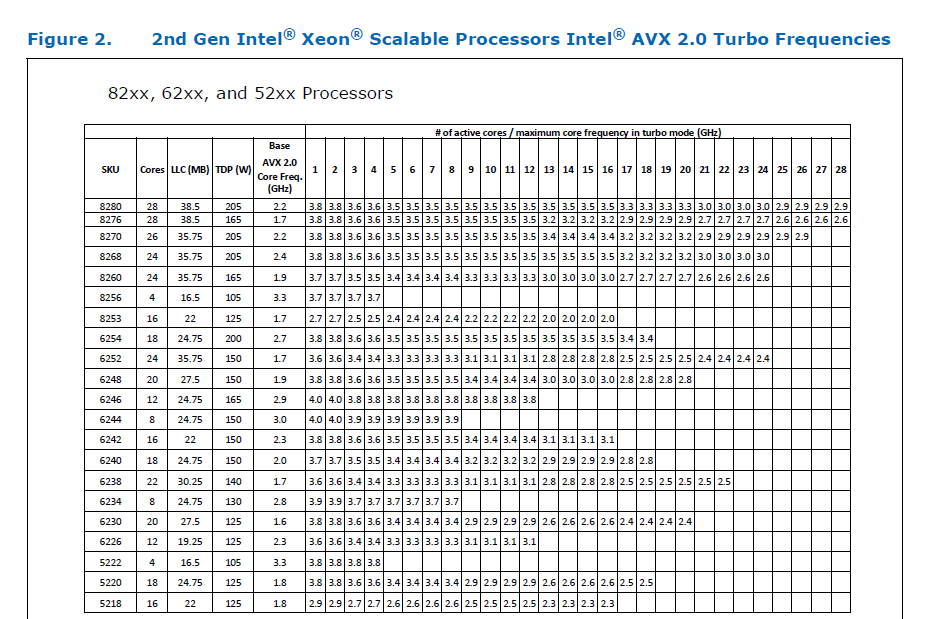
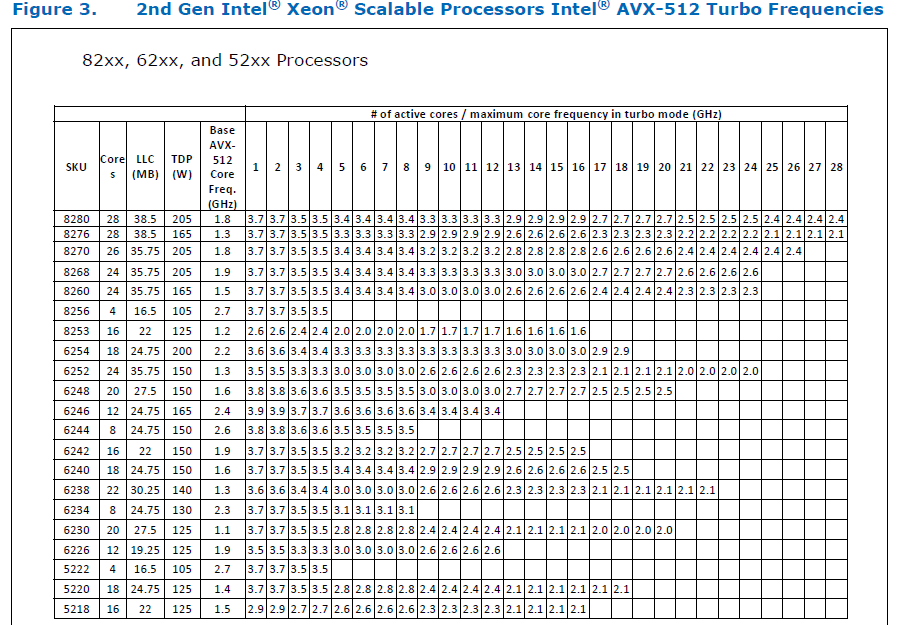
I think it's important to note that AVX2 causes downclocking as well, and the additional downclocking caused by AVX512 may not hamper performance on some Skylake machines & beyond, because of the double vector-size. I think that [this post with verifiable references is a must-read](https://community.intel.com/t5/Software-Tuning-Performance/Unexpected-power-vs-cores-profile-for-MKL-kernels-on-modern-Xeon/m-p/1133869/highlight/true#M6450). Also, AVX512 would _probably not_ hurt performance on a high-end machine, [but measurements are recommended](https://lemire.me/blog/2018/09/07/avx-512-when-and-how-to-use-these-new-instructions/). In case it does, `ATEN_AVX512_256=TRUE` can be used for building PyTorch, as AVX2 can then use 32 ymm registers instead of the default 16. [FBGEMM uses `AVX512_256` only on Xeon D processors](https://github.com/pytorch/FBGEMM/pull/209), which are said to have poor AVX512 performance.
This [official data](https://www.intel.com/content/dam/www/public/us/en/documents/specification-updates/xeon-scalable-spec-update.pdf) is for the Intel Skylake family, and the first link helps understand its significance. Cascade Lake & Ice Lake SP Xeon processors are said to be even better when it comes to AVX512 performance.
Here is the corresponding data for [Cascade Lake](https://cdrdv2.intel.com/v1/dl/getContent/338848) -
The corresponding data isn't publicly available for Intel Xeon SP 3rd gen (Ice Lake SP), but [Intel mentioned that the 3rd gen has frequency improvements pertaining to AVX512](https://newsroom.intel.com/wp-content/uploads/sites/11/2021/04/3rd-Gen-Intel-Xeon-Scalable-Platform-Press-Presentation-281884.pdf). Ice Lake SP machines also have 48 KB L1D caches, so that's another reason for AVX512 performance to be better on them.
### Is PyTorch always faster with AVX512?
No, but then PyTorch is not always faster with AVX2 either. Please refer to #60202. The benefit from vectorization is apparent with with small tensors that fit in caches or in kernels that are more compute heavy. For instance, AVX512 or AVX2 would yield no benefit for adding two 64 MB tensors, but adding two 1 MB tensors would do well with AVX2, and even more so with AVX512.
It seems that memory-bound computations, such as adding two 64 MB tensors can be slow with vectorization (depending upon the number of threads used), as the effects of downclocking can then be observed.
Original pull request: https://github.com/pytorch/pytorch/pull/56992
Reviewed By: soulitzer
Differential Revision: D29266289
Pulled By: ezyang
fbshipit-source-id: 2d5e8d1c2307252f22423bbc14f136c67c3e6184
Summary:
This PR deletes some code in `MiscCheck.cmake` that perform the exact
same functionality as `FindAVX.cmake`.

Pull Request resolved: https://github.com/pytorch/pytorch/pull/61748

Reviewed By: ejguan

Differential Revision: D29791282

Pulled By: malfet

fbshipit-source-id: 6595fd1b61c8ae12b821fad8c9a34892dd52d213
Summary:
Not sure why (maybe from dependencies?) but it can certainly break package lookup upon re-entry of cmake.
So instead of checking whether they are defined, we should check whether there is any meaningful value inside.

Fixes https://github.com/pytorch/pytorch/issues/59887

Pull Request resolved: https://github.com/pytorch/pytorch/pull/61230

Reviewed By: H-Huang

Differential Revision: D29668766

Pulled By: malfet

fbshipit-source-id: 79a59578740c4434327aff4f9a22eba9c4bf48d1
Summary:
This is a PR on build system that provides support for cross compiling on Jetson platforms.

The major change is:

1. Disable try runs for cross compiling in `COMPILER_WORKS`, `BLAS`, and `CUDA`. They will not be able to perform try run on a cross compile setup

Pull Request resolved: https://github.com/pytorch/pytorch/pull/59764

Reviewed By: soulitzer

Differential Revision: D29524363

Pulled By: malfet

fbshipit-source-id: f06d1ad30b704c9a17d77db686c65c0754db07b8
Summary:
This PR bumps the `googletest` version to v1.11.0.

To facilitate this change, `CAFFE2_ASAN_FLAG` and `CAFFE2_TSAN_FLAG` are divided into corresponding compiler and linker variants. This is required because `googletest v1.11.0` sets the `-Werror` flag. The `-pie` flag is a linker flag, and passing it to a compiler invocation results in a `-Wunused-command-line-argument` warning, which in turn will cause `googletest` to fail to build with ASAN.

Fixes https://github.com/pytorch/pytorch/issues/60865

Pull Request resolved: https://github.com/pytorch/pytorch/pull/61395

Reviewed By: iramazanli

Differential Revision: D29620970

Pulled By: 1ntEgr8

fbshipit-source-id: cdb1d3d12e0fff834c2e62971e42c03f8c3fbf1b
Summary:
Needed on platforms, that do not have MKL, such as aarch64 and M1
- Add `AT_POCKETFFT_ENABLED()` to Config.h.in
- Introduce torch._C.has_spectral that is true if PyTorch was compiled with either MKL or PocketFFT
- Modify spectral test to use skipCPUIfNoFFT instead of skipCPUIfNoMKL

Share implementation of `_out` functions as well as fft_fill_with_conjugate_symmetry_stub between MKL and PocketFFT implementations

Fixes https://github.com/pytorch/pytorch/issues/41592

Pull Request resolved: https://github.com/pytorch/pytorch/pull/60976

Reviewed By: walterddr, driazati, janeyx99, samestep

Differential Revision: D29466530

Pulled By: malfet

fbshipit-source-id: ac5edb3d40e7c413267825f92a5e8bc4bb249caf
Summary:
This is only important for builds where cuDNN is linked statically into libtorch_cpu.
Before this PR PyTorch wheels often accidentally contained several partial copies of cudnn_static library.
Splitting the interface into header only (cudnn-public) and library+headers(cudnn-private) prevents those from happening.
Preliminary step towards enabling optional linking whole cudnn_library to workaround issue reported in https://github.com/pytorch/pytorch/issues/50153

Pull Request resolved: https://github.com/pytorch/pytorch/pull/59721

Reviewed By: ngimel

Differential Revision: D29000967

Pulled By: malfet

fbshipit-source-id: f054df92b265e9494076ab16c247427b39da9336
Summary:
Pull Request resolved: https://github.com/pytorch/pytorch/pull/59573

To do mobile selective build, we have several options:
1. static dispatch;
2. dynamic dispatch + static analysis (to create the dependency graph);
3. dynamic dispatch + tracing;

We are developing 3. For open source, we used to only support 1, and
currently we support both 1 and 2.

This file is only used for 2. It was introduced when we deprecated
the static dispatch (1). The motivation was to make sure we have a
low-friction selective build workflow for dynamic dispatch (2).
As the name indicates, it is the *default* dependency graph that users
can try if they don't bother to run the static analyzer themselves.
We have a CI to run the full workflow of 2 on every PR, which creates
the dependency graph on-the-fly instead of using the committed file.

Since the workflow to automatically update the file has been broken
for a while, it started to confuse other pytorch developers as people
are already manually editing it, and it might be broken for some models
already.

We reintroduced the static dispatch recently, so we decide to deprecate
this file now and automatically turn on static dispatch if users run
selective build without providing the static analysis graph.

The tracing-based selective build will be the ultimate solution we'd
like to provide for OSS, but it will take some more effort to polish
and release.

Differential Revision:
D28941020
D28941020

Test Plan: Imported from OSS

Reviewed By: dhruvbird

Pulled By: ljk53

fbshipit-source-id: 9977ab8568e2cc1bdcdecd3d22e29547ef63889e
Summary:
Before that, only dynamically linked OpenBLAS compield with OpenMP could
be found.

Also get rid of hardcoded codepath for libgfortran.a in FindLAPACK.cmake

Only affects aarch64 linux builds

Pull Request resolved: https://github.com/pytorch/pytorch/pull/59428

Reviewed By: agolynski

Differential Revision: D28891314

Pulled By: malfet

fbshipit-source-id: 5af55a14c85ac66551ad2805c5716bbefe8d55b2
Summary:
Pull Request resolved: https://github.com/pytorch/pytorch/pull/57080

ONNX optimizer is removed in ONNX 1.9
This PR removes ONNX optimizer from a C++ code path and uses `try-except` block in Python to keep it compatible with both ONNX-1.8 and 1.9.

Test Plan: Imported from OSS

Reviewed By: heitorschueroff

Differential Revision: D28467330

Pulled By: malfet

fbshipit-source-id: 5e4669dd0537648898e593f9e253da18d6dc7568

Co-authored-by: neginraoof <neginmr@utexas.edu>
Co-authored-by: Nikita Shulga <nshulga@fb.com>
Summary:
Fixes upcoming changes that are part of ROCm 4.2 and affect PyTorch JIT.

- ROCM_VERSION macro must be available to both device and host compilation passes.
- Unifies some of CUDA and HIP differences in the code generated.
  - NAN / POS_INFINITY / NEG_INFINITY
  - Do not hipify `extern __shared__` -> `HIP_DYNAMIC_SHARED()` macro [deprecated]
- Differentiates bf16 codegen for HIP.
- Optionally provides missing macros when using hiprtc precompiled header feature.

Pull Request resolved: https://github.com/pytorch/pytorch/pull/57400

Reviewed By: ejguan

Differential Revision: D28421065

Pulled By: malfet

fbshipit-source-id: 215f476773c61d8b0d9d148a4e5f5d016f863074
Summary:
To make build behaviour aligned with other third_party/ libraries,
introduce `USE_SYSTEM_PYBIND11 (d55b25a633)` build option, which set to OFF by
default, which means PyTorch will be build with bundled pybind11 even if
other version is already installed locally.

Fixes https://github.com/pytorch/pytorch/issues/58750

Pull Request resolved: https://github.com/pytorch/pytorch/pull/58951

Reviewed By: driazati

Differential Revision: D28690411

Pulled By: malfet

fbshipit-source-id: e56b5a8f2a23ee1834b2a6d3807f287149decf8c
Summary:
Library linking order matters during static linking
Not sure whether its a bug or a feature, but if cublas is reference
before CuDNN, it will be partially statically linked into the library,
even if it is not used

Pull Request resolved: https://github.com/pytorch/pytorch/pull/58287

Reviewed By: janeyx99

Differential Revision: D28433165

Pulled By: malfet

fbshipit-source-id: 8dffa0533075126dc383428f838f7d048074205c
Summary:
While trying to build PyTorch with BLIS as the backend library,
we found a build issue due to some missing include files.
This was caused by a missing directory in the search path.
This patch adds that path in FindBLIS.cmake.

Fixes #{issue number}

Pull Request resolved: https://github.com/pytorch/pytorch/pull/58166

Reviewed By: zou3519

Differential Revision: D28640460

Pulled By: malfet

fbshipit-source-id: d0cd3a680718a0a45788c46a502871b88fbadd52
Summary:
Since v1.7, oneDNN (MKL-DNN) has supported the use of Compute Library
for the Arm architeture to provide optimised convolution primitives
on AArch64.

This change enables the use of Compute Library in the PyTorch build.
Following the approach used to enable the use of CBLAS in MKLDNN,
It is enabled by setting the env vars USE_MKLDNN and USE_MKLDNN_ACL.
The location of the Compute Library build must be set useing `ACL_ROOT_DIR`.

This is an extension of the work in https://github.com/pytorch/pytorch/pull/50400
which added support for the oneDNN/MKL-DNN backend on AArch64.

_Note: this assumes that Compute Library has been built and installed at
ACL_ROOT_DIR. Compute library can be downloaded here:
`https://github.com/ARM-software/ComputeLibrary`_

Fixes #{issue number}

Pull Request resolved: https://github.com/pytorch/pytorch/pull/55913

Reviewed By: ailzhang

Differential Revision: D28559516

Pulled By: malfet

fbshipit-source-id: 29d24996097d0a54efc9ab754fb3f0bded290005
Summary:
This PR is step 0 of adding PyTorch convolution bindings using the cuDNN frontend. The cuDNN frontend is the recommended way of using cuDNN v8 API. It is supposed to have faster release cycles, so that, for example, if people find a specific kernel has a bug, they can report it, and that kernel will be blocked in the cuDNN frontend and frameworks could just update that submodule without the need for waiting for a whole cuDNN release.

The work is not complete, and this PR is only step 0.

**What this PR does:**
- Add cudnn-frontend as a submodule.
- Modify cmake to build that submodule.
- Add bindings for convolution forward in `Conv_v8.cpp`, which is disabled by a macro by default.
- Tested manually by enabling the macro and run `test_nn.py`. All tests pass except those mentioned below.

**What this PR doesn't:**
- Only convolution forward, no backward. The backward will use v7 API.
- No 64bit-indexing support for some configuration. This is a known issue of cuDNN, and will be fixed in a later cuDNN version. PyTorch will not implement any workaround for issue, but instead, v8 API should be disabled on problematic cuDNN versions.
- No test beyond PyTorch's unit tests.
  - Not tested for correctness on real models.
  - Not benchmarked for performance.
- Benchmark cache is not thread-safe. (This is marked as `FIXME` in the code, and will be fixed in a follow-up PR)
- cuDNN benchmark is not supported.
- There are failing tests, which will be resolved later:
  ```
  FAILED test/test_nn.py::TestNNDeviceTypeCUDA::test_conv_cudnn_nhwc_cuda_float16 - AssertionError: False is not true : Tensors failed to compare as equal!With rtol=0.001 and atol=1e-05, found 32 element(s) (out of 32) whose difference(s) exceeded the margin of error (in...
  FAILED test/test_nn.py::TestNNDeviceTypeCUDA::test_conv_cudnn_nhwc_cuda_float32 - AssertionError: False is not true : Tensors failed to compare as equal!With rtol=1.3e-06 and atol=1e-05, found 32 element(s) (out of 32) whose difference(s) exceeded the margin of error (...
  FAILED test/test_nn.py::TestNNDeviceTypeCUDA::test_conv_large_cuda - RuntimeError: CUDNN_BACKEND_OPERATION: cudnnFinalize Failed cudnn_status: 9
  FAILED test/test_nn.py::TestNN::test_Conv2d_depthwise_naive_groups_cuda - AssertionError: False is not true : Tensors failed to compare as equal!With rtol=0 and atol=1e-05, found 64 element(s) (out of 64) whose difference(s) exceeded the margin of error (including 0 an...
  FAILED test/test_nn.py::TestNN::test_Conv2d_deterministic_cudnn - RuntimeError: not supported yet
  FAILED test/test_nn.py::TestNN::test_ConvTranspose2d_groups_cuda_fp32 - RuntimeError: cuDNN error: CUDNN_STATUS_BAD_PARAM
  FAILED test/test_nn.py::TestNN::test_ConvTranspose2d_groups_cuda_tf32 - RuntimeError: cuDNN error: CUDNN_STATUS_BAD_PARAM
  ```

Although this is not a complete implementation of cuDNN v8 API binding, I still want to merge this first. This would allow me to do small and incremental work, for the ease of development and review.

Pull Request resolved: https://github.com/pytorch/pytorch/pull/51390

Reviewed By: malfet

Differential Revision: D28513167

Pulled By: ngimel

fbshipit-source-id: 9cc20c9dec5bbbcb1f94ac9e0f59b10c34f62740
Summary:
Expanding support to all builds

Pull Request resolved: https://github.com/pytorch/pytorch/pull/56323

Test Plan: CI

Reviewed By: malfet

Differential Revision: D28171478

Pulled By: ilia-cher

fbshipit-source-id: 16bc752d1be3cbaeda5316f5d8a687ae05a83d22
Summary:
This adds some more compiler warnings ignores for everything that happens on a standard CPU build (CUDA builds still have a bunch of warnings so we can't turn on `-Werror` everywhere yet).
](https://our.intern.facebook.com/intern/diff/28005063/)
Pull Request resolved: https://github.com/pytorch/pytorch/pull/56630

Pulled By: driazati

Reviewed By: malfet

Differential Revision: D28005063

fbshipit-source-id: 541ed415eb0470ddf7e08c22c5eb6da9db26e9a0
Summary:
[distutils](https://docs.python.org/3/library/distutils.html) is on its way out and will be deprecated-on-import for Python 3.10+ and removed in Python 3.12 (see [PEP 632](https://www.python.org/dev/peps/pep-0632/)). There's no reason for us to keep it around since all the functionality we want from it can be found in `setuptools` / `sysconfig`. `setuptools` includes a copy of most of `distutils` (which is fine to use according to the PEP), that it uses under the hood, so this PR also uses that in some places.
Fixes#56527
Pull Request resolved: https://github.com/pytorch/pytorch/pull/57040
Pulled By: driazati
Reviewed By: nikithamalgifb
Differential Revision: D28051356
fbshipit-source-id: 1ca312219032540e755593e50da0c9e23c62d720
Summary:
Revert "Revert D27449031 (2a7df657fe): [pytorch][PR] [ROCm] use hiprtc precompiled header".  Reland PR https://github.com/pytorch/pytorch/issues/54350.

This reverts commit 204ac21bf1.

The original PR was reverted under suspicion that it was causing CI instability, but it was instead due to a hardware failure.

Pull Request resolved: https://github.com/pytorch/pytorch/pull/55965

Reviewed By: jbschlosser

Differential Revision: D27755907

Pulled By: malfet

fbshipit-source-id: 75bf0b9d888df3dee62f00a366b1123757e0474e
Summary:
MAGMA_HOME was previously set for the ubuntu-rocm/Dockerfile.  However, this missed centos builds as well as any builds that do not use the CI image environments.

Pull Request resolved: https://github.com/pytorch/pytorch/pull/54511

Reviewed By: jbschlosser

Differential Revision: D27755983

Pulled By: malfet

fbshipit-source-id: 1ffd2cd100f4221c2bb64e6915fa3372ee1f6247
Summary:
Many model pipelines/workflows don't use MAGMA even though it is included in the build by default. Leaving MAGMA kernels out of the build can save 60+MB of GPU memory when loading `libtorch_cuda.so` (tested on V100, current upstream master).

A current sharp corner of this flag is that toggling it when rebuilding requires `torch/include/THC/THCGeneral.h` to be *manually* deleted by the user, as even running `make clean` or `setup.py` with `--cmake` does not properly regenerate it with the appropriate substitution for `#cmakedefine USE_MAGMA`. Is there a way to force the regeneration of the header during a rebuild?

CC malfet ptrblck

Pull Request resolved: https://github.com/pytorch/pytorch/pull/55994

Reviewed By: mruberry

Differential Revision: D27766287

Pulled By: malfet

fbshipit-source-id: 93deca57befa0febb9c5b7875ecf0015c547d421
Summary:
Pull Request resolved: https://github.com/pytorch/pytorch/pull/55814

I don't really know if the original issue is resolved but let's just
check and see if this passes CI so that we can potentially get some
speed up on our builds

Signed-off-by: Eli Uriegas <eliuriegas@fb.com>

Test Plan: Imported from OSS

Reviewed By: walterddr

Differential Revision: D27715734

Pulled By: seemethere

fbshipit-source-id: a8f90774dfd25b0abf8e57283fe3591a8d8f3c4b
Summary:
HIP's runtime compiler (hiprtc) is adding support for precompiled HIP headers in the ROCm 4.2 release.  Conditionally add support for this feature.  Using this feature will improve the ROCm torch wheel user experience; users will no longer need to install HIP headers separately to use torch JIT features.

The use of this feature is conditionalized on a new ROCM_VERSION macro.

Pull Request resolved: https://github.com/pytorch/pytorch/pull/54350

Reviewed By: H-Huang

Differential Revision: D27449031

Pulled By: malfet

fbshipit-source-id: 81a8d7847a47ce2bb253d1ea58740ef66ed154a3
Summary:
These changes provide the user with an additional option to choose the DNNL+BLIS path for PyTorch.

This assumes BLIS is already downloaded or built from source and the necessary library file is available at the location: $BLIS_HOME/lib/libblis.so and include files are available at: $BLIS_HOME/include/blis/blis.h and $BLIS_HOME/include/blis/cblas.h

Export the below variables to build PyTorch with MKLDNN+BLIS and proceed with the regular installation procedure as below:
$export BLIS_HOME=path-to-BLIS
$export PATH=$BLIS_HOME/include/blis:$PATH LD_LIBRARY_PATH=$BLIS_HOME/lib:$LD_LIBRARY_PATH
$export BLAS=BLIS USE_MKLDNN_CBLAS=ON WITH_BLAS=blis
$python setup.py install

CPU only Dockerfile to build PyTorch with AMD BLIS is available at : docker/cpu-blis/Dockerfile
Example command line to build using the Dockerfile:
sudo DOCKER_BUILDKIT=1 docker build . -t docker-image-repo-name
Example command line to run the built docker container:
sudo docker run --name container-name -it docker-image-repo-name

Fixes #{issue number}

Pull Request resolved: https://github.com/pytorch/pytorch/pull/54953

Reviewed By: glaringlee

Differential Revision: D27466799

Pulled By: malfet

fbshipit-source-id: e03bae9561be3a67429df3b1be95a79005c63050
Summary:
Fixes the build of projects that depend on torch, such as torchaudio.  Otherwise torchaudio will complain that gloo_hip is missing.

Pull Request resolved: https://github.com/pytorch/pytorch/pull/54727

Reviewed By: H-Huang

Differential Revision: D27361513

Pulled By: ezyang

fbshipit-source-id: 714cc2db23e7adf3e89303e941b78c27625b9460
Summary:
*Context:* https://github.com/pytorch/pytorch/issues/53406 added a lint for trailing whitespace at the ends of lines. However, in order to pass FB-internal lints, that PR also had to normalize the trailing newlines in four of the files it touched. This PR adds an OSS lint to normalize trailing newlines.

The changes to the following files (made in 54847d0adb9be71be4979cead3d9d4c02160e4cd) are the only manually-written parts of this PR:

- `.github/workflows/lint.yml`
- `mypy-strict.ini`
- `tools/README.md`
- `tools/test/test_trailing_newlines.py`
- `tools/trailing_newlines.py`

I would have liked to make this just a shell one-liner like the other three similar lints, but nothing I could find quite fit the bill. Specifically, all the answers I tried from the following Stack Overflow questions were far too slow (at least a minute and a half to run on this entire repository):

- [How to detect file ends in newline?](https://stackoverflow.com/q/38746)
- [How do I find files that do not end with a newline/linefeed?](https://stackoverflow.com/q/4631068)
- [How to list all files in the Git index without newline at end of file](https://stackoverflow.com/q/27624800)
- [Linux - check if there is an empty line at the end of a file [duplicate]](https://stackoverflow.com/q/34943632)
- [git ensure newline at end of each file](https://stackoverflow.com/q/57770972)

To avoid giving false positives during the few days after this PR is merged, we should probably only merge it after https://github.com/pytorch/pytorch/issues/54967.

Pull Request resolved: https://github.com/pytorch/pytorch/pull/54737

Test Plan:
Running the shell script from the "Ensure correct trailing newlines" step in the `quick-checks` job of `.github/workflows/lint.yml` should print no output and exit in a fraction of a second with a status of 0. That was not the case prior to this PR, as shown by this failing GHA workflow run on an earlier draft of this PR:

- https://github.com/pytorch/pytorch/runs/2197446987?check_suite_focus=true

In contrast, this run (after correcting the trailing newlines in this PR) succeeded:

- https://github.com/pytorch/pytorch/pull/54737/checks?check_run_id=2197553241

To unit-test `tools/trailing_newlines.py` itself (this is run as part of our "Test tools" GitHub Actions workflow):
```
python tools/test/test_trailing_newlines.py
```

Reviewed By: malfet

Differential Revision: D27409736

Pulled By: samestep

fbshipit-source-id: 46f565227046b39f68349bbd5633105b2d2e9b19
Summary:
This PR is a follow up to https://github.com/pytorch/pytorch/pull/53408.

It only loads hipfft if the version is rocm 4.1 or after and stops loading rocfft. This was done to resolve some issues observed in our internal ci due to conflicts.

Pull Request resolved: https://github.com/pytorch/pytorch/pull/54349

Reviewed By: ezyang

Differential Revision: D27374252

Pulled By: ngimel

fbshipit-source-id: 724e80df5011ea8fabd81739e18ae8a13d3a7ea0
Summary:
https://ccache.dev/ is a compiler cache that speeds up subsequent builds. Auto-detecting ccache ensures that it is used on systems where it is available, greatly improving build times for developers. There is no risk in enabling ccache in practice. Please refer to https://ccache.dev/ for a short summary / motivation

Pull Request resolved: https://github.com/pytorch/pytorch/pull/49389

Reviewed By: ejguan

Differential Revision: D27169957

Pulled By: malfet

fbshipit-source-id: 673b60bbceb0d323901c8a992a75792c6da9b805
Summary:
This PR makes changes to how hipfft is loaded in pytorch. hipfft is packaged in a separate library to rocfft following rocm 4.1.

We check the rocm version and if it is past rocm 4.1 we load hipfft in addition to rocfft.

Pull Request resolved: https://github.com/pytorch/pytorch/pull/53408

Reviewed By: albanD

Differential Revision: D26952702

Pulled By: malfet

fbshipit-source-id: f42be304b587c060816e39d36f5c1a2cdc37bfab
Summary:
Context: https://github.com/pytorch/pytorch/pull/53299#discussion_r587882857

These are the only hand-written parts of this diff:
- the addition to `.github/workflows/lint.yml`
- the file endings changed in these four files (to appease FB-internal land-blocking lints):
  - `GLOSSARY.md`
  - `aten/src/ATen/core/op_registration/README.md`
  - `scripts/README.md`
  - `torch/csrc/jit/codegen/fuser/README.md`

The rest was generated by running this command (on macOS):
```
git grep -I -l ' $' -- . ':(exclude)**/contrib/**' ':(exclude)third_party' | xargs gsed -i 's/ *$//'
```

I looked over the auto-generated changes and didn't see anything that looked problematic.

Pull Request resolved: https://github.com/pytorch/pytorch/pull/53406

Test Plan:
This run (after adding the lint but before removing existing trailing spaces) failed:
- https://github.com/pytorch/pytorch/runs/2043032377

This run (on the tip of this PR) succeeded:
- https://github.com/pytorch/pytorch/runs/2043296348

Reviewed By: walterddr, seemethere

Differential Revision: D26856620

Pulled By: samestep

fbshipit-source-id: 3f0de7f7c2e4b0f1c089eac9b5085a58dd7e0d97
Summary:
Pull Request resolved: https://github.com/pytorch/pytorch/pull/53174

Enable Kineto also in the CPU builds (non-mobile, non-Windows(atm))

Test Plan: CI

Reviewed By: gdankel

Differential Revision: D26776112

Pulled By: ilia-cher

fbshipit-source-id: 8733f65c2993105136c853f2a7b6e497d0fa53bf
Summary:
Fix accidental regression introduced by https://github.com/pytorch/pytorch/issues/47940

`FIND_PACKAGE(OpenBLAS)` does not validate that discovered library can actually be used, while `check_fortran_libraries` does that

Pull Request resolved: https://github.com/pytorch/pytorch/pull/53168

Test Plan: Build PyTorch with static OpenBLAS and check that `torch.svd(torch.ones(3, 3)).S` do not raise an exception

Reviewed By: walterddr

Differential Revision: D26772345

Pulled By: malfet

fbshipit-source-id: 3e4675c176b30dfe4f0490d7d3dfe4f9a4037134
Summary:
Pull Request resolved: https://github.com/pytorch/pytorch/pull/51419
## Summary
1. Add an option `BUILD_LITE_INTERPRETER` in `caffe2/CMakeLists.txt` and set `OFF` as default.
2. Update 'build_android.sh' with an argument to swtich `BUILD_LITE_INTERPRETER`, 'OFF' as default.
3. Add a mini demo app `lite_interpreter_demo` linked with `libtorch` library, which can be used for quick test.
## Test Plan
Built lite interpreter version of libtorch and test with Image Segmentation demo app ([android version](https://github.com/pytorch/android-demo-app/tree/master/ImageSegmentation)/[ios version](https://github.com/pytorch/ios-demo-app/tree/master/ImageSegmentation))
### Android
1. **Prepare model**: Prepare the lite interpreter version of model by run the script below to generate the scripted model `deeplabv3_scripted.pt` and `deeplabv3_scripted.ptl`
```
import torch
model = torch.hub.load('pytorch/vision:v0.7.0', 'deeplabv3_resnet50', pretrained=True)
model.eval()
scripted_module = torch.jit.script(model)
# Export full jit version model (not compatible lite interpreter), leave it here for comparison
scripted_module.save("deeplabv3_scripted.pt")
# Export lite interpreter version model (compatible with lite interpreter)
scripted_module._save_for_lite_interpreter("deeplabv3_scripted.ptl")
```
2. **Build libtorch lite for android**: Build libtorch for android for all 4 android abis (armeabi-v7a, arm64-v8a, x86, x86_64) `BUILD_LITE_INTERPRETER=1 ./scripts/build_pytorch_android.sh`. This pr is tested on Pixel 4 emulator with x86, so use cmd `BUILD_LITE_INTERPRETER=1 ./scripts/build_pytorch_android.sh x86` to specify abi to save built time. After the build finish, it will show the library path:
```
...
BUILD SUCCESSFUL in 55s
134 actionable tasks: 22 executed, 112 up-to-date
+ find /Users/chenlai/pytorch/android -type f -name '*aar'
+ xargs ls -lah
-rw-r--r-- 1 chenlai staff 13M Feb 11 11:48 /Users/chenlai/pytorch/android/pytorch_android/build/outputs/aar/pytorch_android-release.aar
-rw-r--r-- 1 chenlai staff 36K Feb 9 16:45 /Users/chenlai/pytorch/android/pytorch_android_torchvision/build/outputs/aar/pytorch_android_torchvision-release.aar
```
3. **Use the PyTorch Android libraries built from source in the ImageSegmentation app**: Create a folder 'libs' in the path, the path from repository root will be `ImageSegmentation/app/libs`. Copy `pytorch_android-release` to the path `ImageSegmentation/app/libs/pytorch_android-release.aar`. Copy 'pytorch_android_torchvision` (downloaded from [here](https://oss.sonatype.org/#nexus-search;quick~torchvision_android)) to the path `ImageSegmentation/app/libs/pytorch_android_torchvision.aar` Update the `dependencies` part of `ImageSegmentation/app/build.gradle` to
```
dependencies {
implementation 'androidx.appcompat:appcompat:1.2.0'
implementation 'androidx.constraintlayout:constraintlayout:2.0.2'
testImplementation 'junit:junit:4.12'
androidTestImplementation 'androidx.test.ext:junit:1.1.2'
androidTestImplementation 'androidx.test.espresso:espresso-core:3.3.0'
implementation(name:'pytorch_android-release', ext:'aar')
implementation(name:'pytorch_android_torchvision', ext:'aar')
implementation 'com.android.support:appcompat-v7:28.0.0'
implementation 'com.facebook.fbjni:fbjni-java-only:0.0.3'
}
```
Update `allprojects` part in `ImageSegmentation/build.gradle` to
```
allprojects {
repositories {
google()
jcenter()
flatDir {
dirs 'libs'
}
}
}
```
4. **Update model loader api**: Update `ImageSegmentation/app/src/main/java/org/pytorch/imagesegmentation/MainActivity.java` by
4.1 Add new import: `import org.pytorch.LiteModuleLoader;`
4.2 Replace the way to load pytorch lite model
```
// mModule = Module.load(MainActivity.assetFilePath(getApplicationContext(), "deeplabv3_scripted.pt"));
mModule = LiteModuleLoader.load(MainActivity.assetFilePath(getApplicationContext(), "deeplabv3_scripted.ptl"));
```
5. **Test app**: Build and run the ImageSegmentation app in Android Studio,
### iOS
1. **Prepare model**: Same as Android.
2. **Build libtorch lite for ios** `BUILD_PYTORCH_MOBILE=1 IOS_PLATFORM=SIMULATOR BUILD_LITE_INTERPRETER=1 ./scripts/build_ios.sh`
3. **Remove Cocoapods from the project**: run `pod deintegrate`
4. **Link ImageSegmentation demo app with the custom built library**:
Open your project in XCode, go to your project Target’s **Build Phases - Link Binaries With Libraries**, click the **+** sign and add all the library files located in `build_ios/install/lib`. Navigate to the project **Build Settings**, set the value **Header Search Paths** to `build_ios/install/include` and **Library Search Paths** to `build_ios/install/lib`.
In the build settings, search for **other linker flags**. Add a custom linker flag below
```
-all_load
```
Finally, disable bitcode for your target by selecting the Build Settings, searching for Enable Bitcode, and set the value to No.
**
5. Update library and api**
5.1 Update `TorchModule.mm``
To use the custom built libraries the project, replace `#import <LibTorch/LibTorch.h>` (in `TorchModule.mm`) which is needed when using LibTorch via Cocoapods with the code below:
```
//#import <LibTorch/LibTorch.h>
#include "ATen/ATen.h"
#include "caffe2/core/timer.h"
#include "caffe2/utils/string_utils.h"
#include "torch/csrc/autograd/grad_mode.h"
#include "torch/script.h"
#include <torch/csrc/jit/mobile/function.h>
#include <torch/csrc/jit/mobile/import.h>
#include <torch/csrc/jit/mobile/interpreter.h>
#include <torch/csrc/jit/mobile/module.h>
#include <torch/csrc/jit/mobile/observer.h>
```
5.2 Update `ViewController.swift`
```
// if let filePath = Bundle.main.path(forResource:
// "deeplabv3_scripted", ofType: "pt"),
// let module = TorchModule(fileAtPath: filePath) {
// return module
// } else {
// fatalError("Can't find the model file!")
// }
if let filePath = Bundle.main.path(forResource:
"deeplabv3_scripted", ofType: "ptl"),
let module = TorchModule(fileAtPath: filePath) {
return module
} else {
fatalError("Can't find the model file!")
}
```
### Unit test
Add `test/cpp/lite_interpreter`, with one unit test `test_cores.cpp` and a light model `sequence.ptl` to test `_load_for_mobile()`, `bc.find_method()` and `bc.forward()` functions.
### Size:
**With the change:**
Android:
x86: `pytorch_android-release.aar` (**13.8 MB**)
IOS:
`pytorch/build_ios/install/lib` (lib: **66 MB**):
```
(base) chenlai@chenlai-mp lib % ls -lh
total 135016
-rw-r--r-- 1 chenlai staff 3.3M Feb 15 20:45 libXNNPACK.a
-rw-r--r-- 1 chenlai staff 965K Feb 15 20:45 libc10.a
-rw-r--r-- 1 chenlai staff 4.6K Feb 15 20:45 libclog.a
-rw-r--r-- 1 chenlai staff 42K Feb 15 20:45 libcpuinfo.a
-rw-r--r-- 1 chenlai staff 39K Feb 15 20:45 libcpuinfo_internals.a
-rw-r--r-- 1 chenlai staff 1.5M Feb 15 20:45 libeigen_blas.a
-rw-r--r-- 1 chenlai staff 148K Feb 15 20:45 libfmt.a
-rw-r--r-- 1 chenlai staff 44K Feb 15 20:45 libpthreadpool.a
-rw-r--r-- 1 chenlai staff 166K Feb 15 20:45 libpytorch_qnnpack.a
-rw-r--r-- 1 chenlai staff 384B Feb 15 21:19 libtorch.a
-rw-r--r-- 1 chenlai staff **60M** Feb 15 20:47 libtorch_cpu.a
```
`pytorch/build_ios/install`:
```
(base) chenlai@chenlai-mp install % du -sh *
14M include
66M lib
2.8M share
```
**Master (baseline):**
Android:
x86: `pytorch_android-release.aar` (**16.2 MB**)
IOS:
`pytorch/build_ios/install/lib` (lib: **84 MB**):
```
(base) chenlai@chenlai-mp lib % ls -lh
total 172032
-rw-r--r-- 1 chenlai staff 3.3M Feb 17 22:18 libXNNPACK.a
-rw-r--r-- 1 chenlai staff 969K Feb 17 22:18 libc10.a
-rw-r--r-- 1 chenlai staff 4.6K Feb 17 22:18 libclog.a
-rw-r--r-- 1 chenlai staff 42K Feb 17 22:18 libcpuinfo.a
-rw-r--r-- 1 chenlai staff 1.5M Feb 17 22:18 libeigen_blas.a
-rw-r--r-- 1 chenlai staff 44K Feb 17 22:18 libpthreadpool.a
-rw-r--r-- 1 chenlai staff 166K Feb 17 22:18 libpytorch_qnnpack.a
-rw-r--r-- 1 chenlai staff 384B Feb 17 22:19 libtorch.a
-rw-r--r-- 1 chenlai staff 78M Feb 17 22:19 libtorch_cpu.a
```
`pytorch/build_ios/install`:
```
(base) chenlai@chenlai-mp install % du -sh *
14M include
84M lib
2.8M share
```
Test Plan: Imported from OSS
Reviewed By: iseeyuan
Differential Revision: D26518778
Pulled By: cccclai
fbshipit-source-id: 4503ffa1f150ecc309ed39fb0549e8bd046a3f9c
Summary:
Pull Request resolved: https://github.com/pytorch/pytorch/pull/51957

This is a simplified version of #51554.

Compared to #51554, this version only supports statically dispatching to
a specific backend. The benefit is that it skipped the dispatch key
computation logic thus has less framework overhead. The downside is that
if input tensors do not match the specified backend it will throw error
instead of falling back to regular dispatch.

Sample code:
```
Tensor empty(IntArrayRef size, TensorOptions options, c10::optional<MemoryFormat> memory_format) {
    return at::cpu::empty(size, options, memory_format);
}

// aten::conj(Tensor(a) self) -> Tensor(a)
Tensor conj(const Tensor & self) {
    return at::math::conj(self);
}

// aten::conj.out(Tensor self, *, Tensor(a!) out) -> Tensor(a!)
Tensor & conj_out(Tensor & out, const Tensor & self) {
    return at::cpu::conj_out(out, self);
}

// aten::conj.out(Tensor self, *, Tensor(a!) out) -> Tensor(a!)
Tensor & conj_outf(const Tensor & self, Tensor & out) {
    return at::cpu::conj_out(out, self);
}

// aten::_conj(Tensor self) -> Tensor
Tensor _conj(const Tensor & self) {
    return at::defaultbackend::_conj(self);
}
```

For ops without the specific backend dispatch, it will throw error:
```
// aten::_use_cudnn_ctc_loss(Tensor log_probs, Tensor targets, int[] input_lengths, int[] target_lengths, int blank) -> bool
bool _use_cudnn_ctc_loss(const Tensor & log_probs, const Tensor & targets, IntArrayRef input_lengths, IntArrayRef target_lengths, int64_t blank) {
    TORCH_CHECK(false, "Static dispatch does not support _use_cudnn_ctc_loss for CPU.");
}
```

Differential Revision: D26337857

Test Plan: Imported from OSS

Reviewed By: bhosmer

Pulled By: ljk53

fbshipit-source-id: a8e95799115c349de3c09f04a26b01d21a679364
Summary:
Fixes following error during static linking, by enforcing that cudart dependency is put after cublasLt
```
/usr/bin/ld: /usr/local/cuda/lib64/libcublasLt_static.a(libcublasLt_static.a.o): undefined reference to symbol 'cudaStreamWaitEvent@libcudart.so.11.0'
/usr/local/cuda/lib64/libcudart.so: error adding symbols: DSO missing from command line
```

Pull Request resolved: https://github.com/pytorch/pytorch/pull/52509

Reviewed By: janeyx99

Differential Revision: D26547622

Pulled By: malfet

fbshipit-source-id: 4e17f18cf0ab5479a549299faf2583a79fbda4b9
Summary:
When compiling libtorch on macOS there is the option to use the `vecLib` BLAS library from Apple's (Accelerate)[https://developer.apple.com/documentation/accelerate] framework. Recent versions of macOS have changed the location of veclib.h, this change adds the new locations to `FindvecLib.cmake`

To test run the following command:
```
BLAS=vecLib python setup.py install --cmake --cmake-only
```

The choice of BLAS library is confirmed in the output:
```
-- Trying to find preferred BLAS backend of choice: vecLib
-- Found vecLib: /Library/Developer/CommandLineTools/SDKs/MacOSX10.15.sdk/System/Library/Frameworks/Accelerate.framework/Versions/Current/Frameworks/vecLib.framework/Versions/Current/Headers
```

Pull Request resolved: https://github.com/pytorch/pytorch/pull/51288

Reviewed By: jbschlosser

Differential Revision: D26531136

Pulled By: malfet

fbshipit-source-id: ce86807ccbf66973f33b3acb99b7f40cfd182b9b
Summary:
Pull Request resolved: https://github.com/pytorch/pytorch/pull/52184

`auditwheel` inserts first 8 symbols of sha256 checksum of the library before relocating into the wheel package. This change adds logic for computing the same short sha sum and embedding it into LazyNVRTC as alternative name for libnvrt.so

Fixes https://github.com/pytorch/pytorch/issues/52075

Test Plan: Imported from OSS

Reviewed By: seemethere

Differential Revision: D26417403

Pulled By: malfet

fbshipit-source-id: e366dd22e95e219979f6c2fa39acb11585b34c72
Summary:
Necessary to ensure correct link order, especially if libraries are
linked statically. Otherwise, one might run into:
```
/usr/bin/ld: /usr/local/cuda/lib64/libcublasLt_static.a(libcublasLt_static.a.o): undefined reference to symbol 'cudaStreamWaitEvent@libcudart.so.11.0'
/usr/local/cuda/lib64/libcudart.so: error adding symbols: DSO missing from command line
```

Pull Request resolved: https://github.com/pytorch/pytorch/pull/52243

Reviewed By: seemethere, ngimel

Differential Revision: D26437159

Pulled By: malfet

fbshipit-source-id: 33b8bb5040bda10537833f3ad737f535488452ea
Summary:
Fixes https://github.com/pytorch/pytorch/issues/48831.

- CI image is updated to build hipMAGMA from source and set env MAGMA_HOME.
- CMake is updated to separate different requirements for CUDA versus ROCm MAGMA.
- Some unit tests that become enabled with MAGMA are currently skipped for ROCm due to failures.  Fixing these failures will be follow-on work.

Pull Request resolved: https://github.com/pytorch/pytorch/pull/51238

Reviewed By: ngimel

Differential Revision: D26184918

Pulled By: malfet

fbshipit-source-id: ada632f1ae7b413e8cae6543fe931dcd46985821
Summary:
Because of the size of our `libtorch_cuda.so`, linking with other hefty binaries presents a problem where 32bit relocation markers are too small and end up overflowing. This PR attempts to break up `torch_cuda` into `torch_cuda_cu` and `torch_cuda_cpp`.

`torch_cuda_cu`: all the files previously in `Caffe2_GPU_SRCS` that are
* pure `.cu` files in `aten`match
* all the BLAS files
* all the THC files, except for THCAllocator.cpp, THCCachingHostAllocator.cpp and THCGeneral.cpp
* all files in`detail`
* LegacyDefinitions.cpp and LegacyTHFunctionsCUDA.cpp
* Register*CUDA.cpp
* CUDAHooks.cpp
* CUDASolver.cpp
* TensorShapeCUDA.cpp

`torch_cuda_cpp`: all other files in `Caffe2_GPU_SRCS`

Accordingly, TORCH_CUDA_API and TORCH_CUDA_BUILD_MAIN_LIB usages are getting split as well to TORCH_CUDA_CU_API and TORCH_CUDA_CPP_API.

To test this locally, you can run `export BUILD_SPLIT_CUDA=ON && python setup.py develop`. In your `build/lib` folder, you should find binaries for both `torch_cuda_cpp` and `torch_cuda_cu`. To see that the SPLIT_CUDA option was toggled, you can grep the Summary of running cmake and make sure `Split CUDA` is ON.

This build option is tested on CI for CUDA 11.1 builds (linux for now, but windows soon).

Pull Request resolved: https://github.com/pytorch/pytorch/pull/49050

Reviewed By: walterddr

Differential Revision: D26114310

Pulled By: janeyx99

fbshipit-source-id: 0180f2519abb5a9cdde16a6fb7dd3171cff687a6
Summary:
Pull Request resolved: https://github.com/pytorch/pytorch/pull/50760

The SHM transport uses shared-memory-backed ringbuffers to transfer small payloads between processes on the same machine.

It was disabled in v1.6 due to a CMake mishap but we've since realized that it also doesn't work that well in docker and other setups. Enabling it here to see whether CircleCI fails.
ghstack-source-id: 120470890

Test Plan: Exported three times to CircleCI with tests consistently passing

Reviewed By: mrshenli

Differential Revision: D23814828

fbshipit-source-id: f355cb6515776debad536924de4f4d3fbb05a874
Summary:
Pull Request resolved: https://github.com/pytorch/pytorch/pull/50288

torch::deploy will bundle the objects contained in libtorch-python together with frozenpython into a shared library.  Therefore, the libtorch-python objs can't bring with them a dependency on system python.

Buck TARGETS are added throughout the caffe2 tree to make available objects or headers that will be needed by torch::deploy but would have brought unsuitable dependencies if accessed using existing targets.

CMakeLists are modified to separate a torch-python-objs object library which lets torch::deploy compile these objs with the same compile flags as libttorch_python used, but without some of the link-time dependencies such as python.

CudaIPCTypes is moved from libtorch_python to libtorch_cuda because it is really not a python binding, and it statically registers a cuda_ipc_callback which would be duplicated if included in each copy of torch::deploy.

Test Plan: no new functionality, just ensure existing tests continue to pass

Reviewed By: malfet

Differential Revision: D25850785

fbshipit-source-id: b0b81c050cbee04e9de96888f8a09d29238a9db8
Summary:
… library builds, as it is already set in shared library builds from the target that was imported from Caffe2.

This was identified on Windows builds when PyTorch was built in shared Release mode, and a testapp was built with RelWithDebInfo in CMake.
The problem appeared to be that because IMPORTED_LOCATION (in TorchConfig.cmake) and IMPORTED_LOCATION_RELEASE were both set (in Caffe2Targets.cmake), there occurred some confusion in the build as to what was correct. The symptoms are the error:

ninja: error: 'torch-NOTFOUND', needed by 'test_pytorch.exe', missing and no known rule to make it

in a noddy consuming test application.

Fixes https://github.com/pytorch/pytorch/issues/48724

Pull Request resolved: https://github.com/pytorch/pytorch/pull/49173

Reviewed By: malfet

Differential Revision: D25974151

Pulled By: ezyang

fbshipit-source-id: 3454c0d29cbbe7a37608beedaae3efbb624b0479
Summary:
draft enable fast_nvcc.
* cleaned up some non-standard usages
* added fall-back to wrap_nvcc

Pull Request resolved: https://github.com/pytorch/pytorch/pull/49773

Test Plan:
Configuration to enable fast nvcc:
  - install and enable `ccache` but delete `.ccache/` folder before each build.
  - `TORCH_CUDA_ARCH_LIST=6.0;6.1;6.2;7.0;7.5`
  - Toggling `USE_FAST_NVCC=ON/OFF` cmake config and run `cmake --build` to verify the build time.

Initial statistic for a full compilation:
* `cmake --build . -- -j $(nproc)`:
  - fast NVCC
```
        real    48m55.706s
        user    1559m14.218s
        sys     318m41.138s
```
  - normal NVCC:
```
        real    43m38.723s
        user    1470m28.131s
        sys     90m46.879s
```
* `cmake --build . -- -j $(nproc/4)`:
  - fast NVCC:
```
        real    53m44.173s
        user    1130m18.323s
        sys     71m32.385s
```
  - normal  NVCC:
```
        real    81m53.768s
        user    858m45.402s
        sys     61m15.539s
```
* Conclusion: fast NVCC doesn't provide too much gain when compiler is set to use full CPU utilization, in fact it is **even worse** because of the thread switcing.

initial statistic for partial recompile (edit .cu files)

* `cmake --build . -- -j $(nproc)`
  - fast NVCC:
```
[2021-01-13 18:10:24] [ 86%] Building NVCC (Device) object caffe2/CMakeFiles/torch_cuda.dir/__/aten/src/ATen/native/cuda/torch_cuda_generated_BinaryMiscOpsKernels.cu.o
[2021-01-13 18:11:08] [ 86%] Linking CXX shared library ../lib/libtorch_cuda.so
```
  - normal NVCC:
```
[2021-01-13 17:35:40] [ 86%] Building NVCC (Device) object caffe2/CMakeFiles/torch_cuda.dir/__/aten/src/ATen/native/cuda/torch_cuda_generated_BinaryMiscOpsKernels.cu.o
[2021-01-13 17:38:08] [ 86%] Linking CXX shared library ../lib/libtorch_cuda.so
```
* Conclusion: Effective compilation time for single CU file modification reduced from from 2min30sec to only 40sec when compiling multiple architecture. This shows **4X** gain in speed up using fast NVCC -- reaching the theoretical limit of 5X when compiling 5 gencode architecture at the same time.

Follow up PRs:
- should have better fallback mechanism to detect whether a build is supported by fast_nvcc or not instead of dryruning then fail with fallback.
- performance measurement instrumentation to measure what's the total compile time vs the parallel tasks critical path time.
- figure out why `-j $(nproc)` gives significant sys overhead (`sys 318m41.138s` vs `sys 90m46.879s`) over normal nvcc, guess this is context switching, but not exactly sure

Reviewed By: malfet

Differential Revision: D25692758

Pulled By: walterddr

fbshipit-source-id: c244d07b9b71f146e972b6b3682ca792b38c4457
Summary:
Since version 1.6, oneDNN has provided limited support for AArch64 builds.

This minor change is to detect an AArch64 CPU and permit the use of
`USE_MKLDNN` in that case.

Build flags for oneDNN are also modified accordingly.

Note: oneDNN on AArch64, by default, will use oneDNN's reference C++ kernels.
These are not optimised for AArch64, but oneDNN v1.7 onwards provides support
for a limited set of primitives based Arm Compute Library.
See: https://github.com/oneapi-src/oneDNN/pull/795
and: https://github.com/oneapi-src/oneDNN/pull/820
for more details. Support for ACL-based oneDNN primitives in PyTorch
will require some further modification,

Fixes #{issue number}

Pull Request resolved: https://github.com/pytorch/pytorch/pull/50400

Reviewed By: izdeby

Differential Revision: D25886589

Pulled By: malfet

fbshipit-source-id: 2c81277a28ad4528c2d2211381e7c6692d952bc1
Summary:
Fixes https://github.com/pytorch/pytorch/issues/21737

With this fix, TORCH_LIBRARIES variable can provide all nessesary static libraries build from pytorch repo.
User program (if do static build) now can just link with ${TORCH_LIBRARIES} + MKL + cuda runtime.

Pull Request resolved: https://github.com/pytorch/pytorch/pull/49458

Reviewed By: mrshenli

Differential Revision: D25895354

Pulled By: malfet

fbshipit-source-id: 8ff47d14ae1f90036522654d4354256ed5151e5c
Summary:
This PR is a step towards enabling cross compilation from x86_64 to arm64.

The following has been added:
1. When cross compilation is detected, compile a local universal fatfile to use as protoc.
2. For the simple compile check in MiscCheck.cmake, make sure to compile the small snippet as a universal binary in order to run the check.

**Test plan:**

Kick off a minimal build on a mac intel machine with the macOS 11 SDK with this command:
```
CMAKE_OSX_ARCHITECTURES=arm64 USE_MKLDNN=OFF USE_QNNPACK=OFF USE_PYTORCH_QNNPACK=OFF BUILD_TEST=OFF USE_NNPACK=OFF python setup.py install
```
(If you run the above command before this change, or without macOS 11 SDK set up, it will fail.)

Then check the platform of the built binaries using this command:
```
lipo -info build/lib/libfmt.a
```
Output:
- Before this PR, running a regular build via `python setup.py install` (instead of using the flags listed above):
  ```
  Non-fat file: build/lib/libfmt.a is architecture: x86_64
  ```
- Using this PR:
  ```
  Non-fat file: build/lib/libfmt.a is architecture: arm64
  ```

Pull Request resolved: https://github.com/pytorch/pytorch/pull/50243

Reviewed By: malfet

Differential Revision: D25849955

Pulled By: janeyx99

fbshipit-source-id: e9853709a7279916f66aa4c4e054dfecced3adb1
Summary:
Since caffe2 and torch have been consolidated, CAFFE2_API should be merged with TORCH_API. Addresses a TODO.

Manually edited some references of the removed `CAFFE2_API`:
* `CONTRIBUTING.md`
* `caffe2/proto/CMakeLists.txt`
* `cmake/ProtoBuf.cmake`
* `c10/macros/Export.h`
* `torch/csrc/WindowsTorchApiMacro.h`

Pull Request resolved: https://github.com/pytorch/pytorch/pull/49496

Reviewed By: malfet, samestep

Differential Revision: D25600726

Pulled By: janeyx99

fbshipit-source-id: 7e068d959e397ac183c097d7e9a9afeca5ddd782
Summary:
Pull Request resolved: https://github.com/pytorch/pytorch/pull/49201

This unblocks kineto profiler for 1.8 release.
This PR supercedes https://github.com/pytorch/pytorch/pull/48391
Note: this will somewhat increase the size of linux server binaries, bc
we add libkineto.a and libcupti_static.a:
-rw-r--r-- 1 jenkins jenkins 1107502 Dec 10 21:16 build/lib/libkineto.a
-rw-r--r-- 1 root root 13699658 Nov 13  2019 /usr/local/cuda/lib64/libcupti_static.a

Test Plan:
CI
https://github.com/pytorch/pytorch/pull/48391

Imported from OSS

Reviewed By: ngimel

Differential Revision: D25480770

fbshipit-source-id: 037cd774f5547d9918d6055ef5cc952a54e48e4c
Summary:
### Pytorch Vec256 ppc64le support
implemented types:

- double
- float
- int16
- int32
- int64
- qint32
- qint8
- quint8
- complex_float
- complex_double

Notes:
All basic vector operations are implemented:
There are a few problems:
- minimum maximum nan propagation for ppc64le is missing and was not checked
- complex multiplication, division, sqrt, abs are implemented as PyTorch x86. they can overflow and have precision problems than std ones.  That's why they were either excluded or tested in smaller domain range
- precisions of the implemented float math functions

~~Besides, I added CPU_CAPABILITY for power. but as because of  quantization errors for DEFAULT I had to undef and  use vsx for DEFAULT too~~

#### Details
##### Supported math functions

+ plus sign means vectorized, -  minus sign means missing,   (implementation notes are added inside braces)
(notes). Example: -(both ) means it was also missing on x86 side
g( func_name)  means vectorization is using func_name
sleef - redirected to the Sleef
unsupported

function_name | float | double | complex float | complex double
|-- | -- | -- | -- | --|
acos | sleef | sleef | f(asin) | f(asin)
asin | sleef | sleef | +(pytorch impl) | +(pytorch impl)
atan | sleef | sleef | f(log) | f(log)
atan2 | sleef | sleef | unsupported | unsupported
cos | +((ppc64le:avx_mathfun) ) | sleef | -(both) | -(both)
cosh | f(exp)   | -(both) | -(both) |
erf | sleef | sleef | unsupported | unsupported
erfc | sleef | sleef | unsupported | unsupported
erfinv | - (both) | - (both) | unsupported | unsupported
exp | + | sleef | - (x86:f()) | - (x86:f())
expm1 | f(exp)  | sleef | unsupported | unsupported
lgamma | sleef | sleef |   |
log | +  | sleef | -(both) | -(both)
log10 | f(log)  | sleef | f(log) | f(log)
log1p | f(log)  | sleef | unsupported | unsupported
log2 | f(log)  | sleef | f(log) | f(log)
pow | + f(exp)  | sleef | -(both) | -(both)
sin | +((ppc64le:avx_mathfun) ) | sleef | -(both) | -(both)
sinh | f(exp)  | sleef | -(both) | -(both)
tan | sleef | sleef | -(both) | -(both)
tanh | f(exp)  | sleef | -(both) | -(both)
hypot | sleef | sleef | -(both) | -(both)
nextafter | sleef  | sleef | -(both) | -(both)
fmod | sleef | sleef | -(both) | -(both)

[Vec256 Test cases Pr https://github.com/pytorch/pytorch/issues/42685](https://github.com/pytorch/pytorch/pull/42685)
Current list:

- [x] Blends
- [x] Memory: UnAlignedLoadStore
- [x] Arithmetics: Plus,Minu,Multiplication,Division
- [x] Bitwise: BitAnd, BitOr, BitXor
- [x] Comparison: Equal, NotEqual, Greater, Less, GreaterEqual, LessEqual
- [x] MinMax: Minimum, Maximum, ClampMin, ClampMax, Clamp
- [x] SignManipulation: Absolute, Negate
- [x] Interleave: Interleave, DeInterleave
- [x] Rounding: Round, Ceil, Floor, Trunc
- [x] Mask: ZeroMask
- [x] SqrtAndReciprocal: Sqrt, RSqrt, Reciprocal
- [x] Trigonometric: Sin, Cos, Tan
- [x] Hyperbolic: Tanh, Sinh, Cosh
- [x] InverseTrigonometric: Asin, ACos, ATan, ATan2
- [x] Logarithm: Log, Log2, Log10, Log1p
- [x] Exponents: Exp, Expm1
- [x] ErrorFunctions: Erf, Erfc, Erfinv
- [x] Pow: Pow
- [x] LGamma: LGamma
- [x] Quantization: quantize, dequantize, requantize_from_int
- [x] Quantization: widening_subtract, relu, relu6
Missing:
- [ ] Constructors, initializations
- [ ] Conversion , Cast
- [ ] Additional: imag, conj, angle (note: imag and conj only checked for float complex)

#### Notes on tests and testing framework
- some math functions are tested within domain range
- mostly testing framework randomly tests against std implementation within the domain or within the implementation domain for some math functions.
- some functions are tested against the local version. ~~For example, std::round and vector version of round differs. so it was tested against the local version~~
- round was tested against pytorch at::native::round_impl. ~~for double type on **Vsx  vec_round failed  for  (even)+0 .5 values**~~ . it was solved by using vec_rint
- ~~**complex types are not tested**~~  **After enabling complex testing due to precision and domain some of the complex functions failed for vsx and x86 avx as well. I will either test it against local implementation or check within the accepted domain**
- ~~quantizations are not tested~~  Added tests for quantizing, dequantize, requantize_from_int, relu, relu6, widening_subtract functions
- the testing framework should be improved further
- ~~For now `-DBUILD_MOBILE_TEST=ON `will be used for Vec256Test too~~
Vec256 Test cases will be built for each CPU_CAPABILITY

Pull Request resolved: https://github.com/pytorch/pytorch/pull/41541

Reviewed By: zhangguanheng66

Differential Revision: D23922049

Pulled By: VitalyFedyunin

fbshipit-source-id: bca25110afccecbb362cea57c705f3ce02f26098
Summary:
[Refiled version of earlier PR https://github.com/pytorch/pytorch/issues/45451]

This PR revamps the hipify module in PyTorch to overcome a long list of shortcomings in the original implementation. However, these improvements are applied only when using hipify to build PyTorch extensions, not for PyTorch or Caffe2 itself.

Correspondingly, changes are made to cpp_extension.py to match these improvements.

The list of improvements to hipify is as follows:

1. Hipify files in the same directory as the original file, unless there's a "cuda" subdirectory in the original file path, in which case the hipified file will be in the corresponding file path with "hip" subdirectory instead of "cuda".
2. Never hipify the file in-place if changes are introduced due to hipification i.e. always ensure the hipified file either resides in a different folder or has a different filename compared to the original file.
3. Prevent re-hipification of already hipified files. This avoids creation of unnecessary "hip/hip" etc. subdirectories and additional files which have no actual use.
4. Do not write out hipified versions of files if they are identical to the original file. This results in a cleaner output directory, with minimal number of hipified files created.
5. Update header rewrite logic so that it accounts for the previous improvement.
6. Update header rewrite logic so it respects the rules for finding header files depending on whether "" or <> is used.
7. Return a dictionary of mappings of original file paths to hipified file paths from hipify function.
8. Introduce a version for hipify module to allow extensions to contain back-compatible code that targets a specific point in PyTorch where the hipify functionality changed.
9. Update cuda_to_hip_mappings.py to account for the ROCm component subdirectories inside /opt/rocm/include. This also results in cleanup of the Caffe2_HIP_INCLUDE path to remove unnecessary additions to the include path.

The list of changes to cpp_extension.py is as follows:

1. Call hipify when building a CUDAExtension for ROCm.
2. Prune the list of source files to CUDAExtension to include only the hipified versions of any source files in the list (if both original and hipified versions of the source file are in the list)
3. Add subdirectories of /opt/rocm/include to the include path for extensions, so that ROCm headers for subcomponent libraries are found automatically

cc jeffdaily sunway513 ezyang

Pull Request resolved: https://github.com/pytorch/pytorch/pull/48715

Reviewed By: bdhirsh

Differential Revision: D25272824

Pulled By: ezyang

fbshipit-source-id: 8bba68b27e41ca742781e1c4d7b07c6f985f040e
Summary:
Improves support for rocgdb when setting DEBUG=1 and building for ROCm.

Pull Request resolved: https://github.com/pytorch/pytorch/pull/46717

Reviewed By: mrshenli

Differential Revision: D25171544

Pulled By: malfet

fbshipit-source-id: b4699ba2277dcb89f07efb86f7153fae82a80dc3
Summary:
This PR revamps the hipify module in PyTorch to overcome a long list of shortcomings in the original implementation. However, these improvements are applied only when using hipify to build PyTorch extensions, **not for PyTorch or Caffe2 itself**.

Correspondingly, changes are made to `cpp_extension.py` to match these improvements.

The list of improvements to hipify is as follows:

1. Hipify files in the same directory as the original file, unless there's a "cuda" subdirectory in the original file path, in which case the hipified file will be in the corresponding file path with "hip" subdirectory instead of "cuda".
2. Never hipify the file in-place if changes are introduced due to hipification i.e. always ensure the hipified file either resides in a different folder or has a different filename compared to the original file.
3. Prevent re-hipification of already hipified files. This avoids creation of unnecessary "hip/hip" etc. subdirectories and additional files which have no actual use.
4. Do not write out hipified versions of files if they are identical to the original file. This results in a cleaner output directory, with minimal number of hipified files created.
5. Update header rewrite logic so that it accounts for the previous improvement.
6. Update header rewrite logic so it respects the rules for finding header files depending on whether `""` or `<>` is used.
7. Return a dictionary of mappings of original file paths to hipified file paths from `hipify` function.
8. Introduce a version for hipify module to allow extensions to contain back-compatible code that targets a specific point in PyTorch where the hipify functionality changed.
9. Update `cuda_to_hip_mappings.py` to account for the ROCm component subdirectories inside `/opt/rocm/include`. This also results in cleanup of the `Caffe2_HIP_INCLUDE` path to remove unnecessary additions to the include path.

The list of changes to `cpp_extension.py` is as follows:
1. Call `hipify` when building a CUDAExtension for ROCm.
2. Prune the list of source files to CUDAExtension to include only the hipified versions of any source files in the list (if both original and hipified versions of the source file are in the list)
3. Add subdirectories of /opt/rocm/include to the include path for extensions, so that ROCm headers for subcomponent libraries are found automatically

cc jeffdaily sunway513 hgaspar lcskrishna ashishfarmer

Pull Request resolved: https://github.com/pytorch/pytorch/pull/45451

Reviewed By: ezyang

Differential Revision: D24924736

Pulled By: malfet

fbshipit-source-id: 4af42b8ff4f21c3782dedb8719b8f9f86b34bd2d
Summary:
When building libtorch with CUDA installed in some unconventional
location, CMake files rely on some environment variables to set cmake
variable, in particular NVTOOLSEXT_PATH environment variable is used to
set NVTOOLEXT_HOME in cmake/public/cuda.cmake. Later when consuming
such build using the generated cmake finder TorchConfig.cmake, another
convention is used which feels rather inconsistent, relying on a
completly new environment variable NVTOOLEXT_HOME, although the former
way is still in place, cmake/public/cuda.cmake being transitively called
via Caffe2Config.cmake, which is called by TorchConfig.cmake

Fixes https://github.com/pytorch/pytorch/issues/48032

Pull Request resolved: https://github.com/pytorch/pytorch/pull/48012

Reviewed By: gchanan

Differential Revision: D25031260

Pulled By: ezyang

fbshipit-source-id: 0d6ab8ba9f52dd10be418b1a92b0f53c889f3f2d
Summary:
Pull Request resolved: https://github.com/pytorch/pytorch/pull/47635

Add macosx support for metal. The supported os version is 10.13 and above.
ghstack-source-id: 116845318

Test Plan:
1. Sandcastle Tests
2. CircleCI Jobs
3. In the next diff, we'll run the person segmentation model inside a macos app

Reviewed By: dreiss

Differential Revision: D24825088

fbshipit-source-id: 10d7976c953e765599002dc42d7f8d248d7c9846
Summary:
gcc-7.4.x or older fails to compile XNNPACK in debug mode with internal compiler error
Workaround this in a build script by pasing -O1 optimisation flag to XNNPACK if compiled on older compilers

Fixes https://github.com/pytorch/pytorch/issues/47292

Pull Request resolved: https://github.com/pytorch/pytorch/pull/47805

Reviewed By: seemethere

Differential Revision: D24905758

Pulled By: malfet

fbshipit-source-id: 93f4e3b3b5c10b69734627c50e36b2eb544699c8





