Summary:
https://github.com/pytorch/pytorch/issues/29159

Introducing GRADLE_OFFLINE environment variable to use '--offline' gradle argument which will only use local gradle cache without network.

As it is cache and has some expiration logic - before every start of gradle 'touch' files to update last access time.

Deploying new docker images that includes prefetching to gradle cache all android dependencies, commit with update of docker images: df07dd5681

Reenable android gradle jobs on CI (revert of 54e6a7eede)
Pull Request resolved: https://github.com/pytorch/pytorch/pull/29262

Differential Revision: D18455666

Pulled By: IvanKobzarev

fbshipit-source-id: 8fb0b54fd94e13b3144af2e345c6b00b258dcc0f
Summary:
Reason:
To have one-step build for test android application based on the current code state that is ready for profiling with simpleperf, systrace etc. to profile performance inside the application.
## Parameters to control debug symbols stripping
Introducing /CMakeLists parameter `ANDROID_DEBUG_SYMBOLS` to be able not to strip symbols for pytorch (not add linker flag `-s`)
which is checked in `scripts/build_android.sh`
On gradle side stripping happens by default, and to prevent it we have to specify
```
android {
packagingOptions {
doNotStrip "**/*.so"
}
}
```
which is now controlled by new gradle property `nativeLibsDoNotStrip `
## Test_App
`android/test_app` - android app with one MainActivity that does inference in cycle
`android/build_test_app.sh` - script to build libtorch with debug symbols for specified android abis and adds `NDK_DEBUG=1` and `-PnativeLibsDoNotStrip=true` to keep all debug symbols for profiling.
Script assembles all debug flavors:
```
└─ $ find . -type f -name *apk
./test_app/app/build/outputs/apk/mobilenetQuant/debug/test_app-mobilenetQuant-debug.apk
./test_app/app/build/outputs/apk/resnet/debug/test_app-resnet-debug.apk
```
## Different build configurations
Module for inference can be set in `android/test_app/app/build.gradle` as a BuildConfig parameters:
```
productFlavors {
mobilenetQuant {
dimension "model"
applicationIdSuffix ".mobilenetQuant"
buildConfigField ("String", "MODULE_ASSET_NAME", buildConfigProps('MODULE_ASSET_NAME_MOBILENET_QUANT'))
addManifestPlaceholders([APP_NAME: "PyMobileNetQuant"])
buildConfigField ("String", "LOGCAT_TAG", "\"pytorch-mobilenet\"")
}
resnet {
dimension "model"
applicationIdSuffix ".resnet"
buildConfigField ("String", "MODULE_ASSET_NAME", buildConfigProps('MODULE_ASSET_NAME_RESNET18'))
addManifestPlaceholders([APP_NAME: "PyResnet"])
buildConfigField ("String", "LOGCAT_TAG", "\"pytorch-resnet\"")
}
```
In that case we can setup several apps on the same device for comparison, to separate packages `applicationIdSuffix`: 'org.pytorch.testapp.mobilenetQuant' and different application names and logcat tags as `manifestPlaceholder` and another BuildConfig parameter:
```
─ $ adb shell pm list packages | grep pytorch
package:org.pytorch.testapp.mobilenetQuant
package:org.pytorch.testapp.resnet
```
In future we can add another BuildConfig params e.g. single/multi threads and other configuration for profiling.
At the moment 2 flavors - for resnet18 and for mobilenetQuantized
which can be installed on connected device:
```
cd android
```
```
gradle test_app:installMobilenetQuantDebug
```
```
gradle test_app:installResnetDebug
```
## Testing:
```
cd android
sh build_test_app.sh
adb install -r test_app/app/build/outputs/apk/mobilenetQuant/debug/test_app-mobilenetQuant-debug.apk
```
```
cd $ANDROID_NDK
python simpleperf/run_simpleperf_on_device.py record --app org.pytorch.testapp.mobilenetQuant -g --duration 10 -o /data/local/tmp/perf.data
adb pull /data/local/tmp/perf.data
python simpleperf/report_html.py
```
Simpleperf report has all symbols:
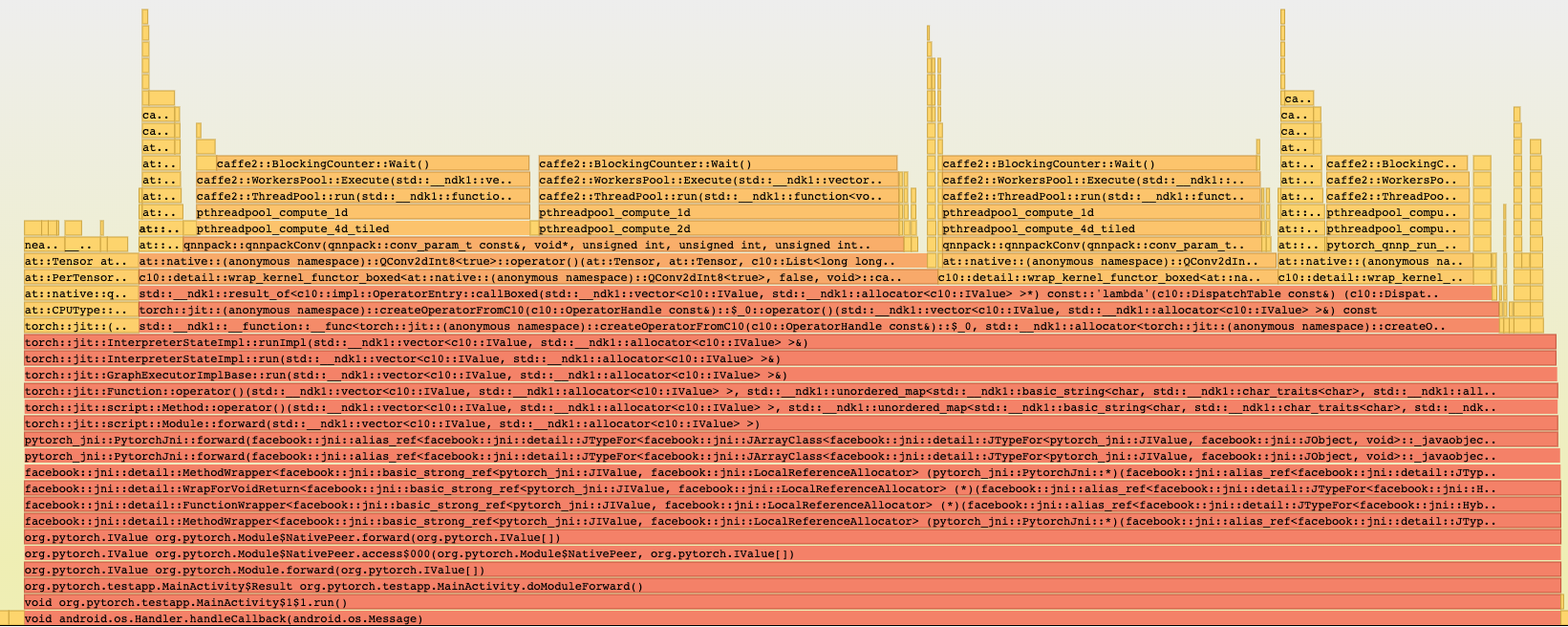
Pull Request resolved: https://github.com/pytorch/pytorch/pull/28406
Differential Revision: D18386622
Pulled By: IvanKobzarev
fbshipit-source-id: 3a751192bbc4bc3c6d7f126b0b55086b4d586e7a

