This PR adds universal support for ndarray methods. After #100839 each `NumpyNdarrayVariable` should wrap a `torch.Tensor`. This PR adds a `numpy_method_wrapper` which converts the `torch.Tensor` to `torch_np.ndarray` and then call the numpy ndarray method. Then we also try to return a `torch.Tensor` (return as-is if the value is not ndarray-like)

Pull Request resolved: https://github.com/pytorch/pytorch/pull/97537
Approved by: https://github.com/ezyang
On calls to `_init_group` rather than tracing through it, extract python values from the arguments, and call the initialization. This avoids having to trace this function which is very slow with large parameters, and also avoids graph breaking on it. This is sound in this case because the state is only initialized once in the eager case. Guards on the state and params are generated explicitly rather than via tracing the initialization.

Caveats:
`_init_group` also gathers various state tensors into lists via mutating list arguments to pass to the functional optimizer implementation. These state tensors exist on the optimizer itself, but we don't know exactly how the gathering is done and which tensors correspond to which attributes of the optimizer module (each optimizer has different states). To rectify this, we keep weak_ptrs to all of the tensors collected in the lists in globals (similar to how parameter keys are stored for dictionaries). These pointers are guaranteed to be alive as long as the optimizer object is alive if the internal state is not interfered with and they are guarded with weakref guards

Pull Request resolved: https://github.com/pytorch/pytorch/pull/102640
Approved by: https://github.com/jansel
Issue: #93684
In previous PRs #95849#99560 we redirect `numpy.*`, `<tensor>.numpy()` calls to `torch_np.*` methods and attributes, by creating `NumpyNdarrayVariable` for those calls.
We need to handle `NumpyNdarrayVariable` when graph break happens.
This PR did 2 things:
1. In `codegen.py` we made sure we can reconstruct the value wrapped by `NumpyNdarrayVariable`, to be `torch_np.ndarray` in the stack whenerver we recompiles the subgraph.
2. In `builder.py` we can wrap the value to be `NumpyNdarrayVariable` and save it as graph input.
-----
Starting from commit 6:
## A new design for supporting numpy in dynamo
In short the core concept doesn't change: we still convert `numpy` API calls to `torch_np` API calls. However, instead of wrapping a `torch_np.ndarray` in `NumpyNdarrayVariable`, the new design wraps a `torch.Tensor`.
The reason for doing this change is because we need to keep `torch.Tensor` everywhere in the captured graph, so that it works well with the backend of dynamo. See discussions in https://github.com/Quansight-Labs/numpy_pytorch_interop/issues/142 for details.
### Flow
This is an example showing how do we think about dynamo working on a simple function:
```python
def f(x: torch.Tensor, y: torch.Tensor):
a, b = x.numpy(), y.numpy()
c = np.add(x, y)
return torch.from_numpy(c)
```
```
+------------+ +------------+
torch.Tensor | |numpy.ndarray| |
-------------- .numpy() --------------| |
| | | | +------------------+
+------------+ | numpy.add |numpy.ndarray| |torch.Tensor
+------------+ | --------------| torch.from_numpy --------------
torch.Tensor | |numpy.ndarray| | | |
-------------- .numpy() --------------| | +------------------+
| | | |
+------------+ +------------+
+------------+ +----------------+
torch.Tensor | |torch.Tensor | |
-------------- .detach() --------------| |
| | | | +----------------+ +------------+
+------------+ | |torch_np.ndarray| |torch.Tensor| |torch.Tensor
| torch_np.add -----------------| util.to_tensor -------------| .detach() --------------
+------------+ | | | | | |
torch.Tensor | |torch.Tensor | | +----------------+ +------------+
-------------- .detach() --------------| |
| | | |
+------------+ | +----------------+ |
| wrapper on torch_np.add |
+--------------------------------------------------------+
```
### Approach
`torch_np` APIs can take both `torch_np.ndarray` as well as `torch.Tensor`. What we need to do is to have a wrapper for these APIs to convert the return value back to `torch.Tensor`. This way only the wrapper is showing up in the captured graph, with `torch.Tensor`s as input and `torch.Tensor` as output.
If we have a graph break or we've traced to the end of the program, we need to inspect all the `NumpyNdarrayVariable` in the stack and convert them back to `numpy.ndarray`, to make sure the compiled version is still behaving the same as the eager version.
### Examples
Here's an example of the graph generated:
```python
def fn(x: np.ndarray, y: np.ndarray):
a = x.real
b = y.real
torch._dynamo.graph_break()
return np.add(a, 1), np.add(b, 1)
```
Graph generated:
```
[2023-05-16 10:31:48,737] torch._dynamo.output_graph.__graph: [DEBUG] TRACED GRAPH
__compiled_fn_0 <eval_with_key>.0 opcode name target args kwargs
------------- -------------- ---------------------------------------------------------- ---------------------- --------
placeholder l_x_ L_x_ () {}
placeholder l_y_ L_y_ () {}
call_function from_numpy <built-in method from_numpy of type object at 0x12b1fdc80> (l_x_,) {}
call_function from_numpy_1 <built-in method from_numpy of type object at 0x12b1fdc80> (l_y_,) {}
call_function attr_wrapper <function attr_wrapper at 0x12e8693a0> (from_numpy, 'real') {}
call_function attr_wrapper_1 <function attr_wrapper at 0x12e8693a0> (from_numpy_1, 'real') {}
output output output ((),) {}
[2023-05-16 10:31:48,908] torch._dynamo.output_graph.__graph: [DEBUG] TRACED GRAPH
__compiled_fn_2 <eval_with_key>.1 opcode name target args kwargs
------------- ------------- ---------------------------------------------------------- ------------------------------- --------
placeholder l_a_ L_a_ () {}
placeholder l_b_ L_b_ () {}
call_function from_numpy <built-in method from_numpy of type object at 0x12b1fdc80> (l_a_,) {}
call_function from_numpy_1 <built-in method from_numpy of type object at 0x12b1fdc80> (l_b_,) {}
call_function wrapped_add <Wrapped function <original add>> (from_numpy, 1) {}
call_function wrapped_add_1 <Wrapped function <original add>> (from_numpy_1, 1) {}
output output output ((wrapped_add, wrapped_add_1),) {}
```
### Changes
* `codegen.py`: reconstruct `numpy.ndarray` from `NumpyNdarrayVariable` by adding bytecode to call `utils.to_numpy_helper()`.
* `output_graph.py`: getting rid of legacy code that does exactly what `codegen.py` does, which only handling return case but not graph break case.
* `utils.py`: added helpers to convert `numpy.ndarray` to `torch.Tensor` and vice versa. Also adding a wrapper class that takes in a function. In `__call__` it calls the function and converts its out to `torch.Tensor` (or a list of it).
* `builder.py`: add method to wrap `numpy.ndarray` graph inputs into `NumpyNdarrayVariable`, by calling `torch.numpy` in the proxy.
* `misc.py`: `numpy` API calls goes into `NumpyVariable` and we find the function with the same name in `torch_np` module, then wrap it with the wrapper defined in `utils.py`.
* `tensor.py`, `torch.py`: proxy `tensor.numpy()` to be `torch.detach()` but wrap it with `NumpyNdarrayVariable`. Similarly, `torch.from_numpy()` -> `torch.detach()` but wrap it with `TensorVariable`. In `NumpyNdarrayVariable`, do the similar `torch_np.ndarray` to `torch.Tensor` wrapping for attributes.
Pull Request resolved: https://github.com/pytorch/pytorch/pull/100839
Approved by: https://github.com/ezyang
Summary:
This PR adds support for folding bn weights into conv for QAT flow, this is equivalent
to the QAT branch of `from_float` in eager mode quantized conv module: https://github.com/pytorch/pytorch/blob/main/torch/ao/nn/quantized/modules/conv.py#L223

Items that needs followup:
* there are some workaround I did because quantize_per_tensor is using float/int args and dynamo does not support these args, need to fix after we change the quantized model representation and also change these args to Tensor

Test Plan: buck2 test @//mode/opt //caffe2/test:quantization_pt2e -- --exact 'caffe2/test:quantization_pt2e - test_convert_qat_conv_bn_fusion (quantization.pt2e.test_quantize_pt2e.TestQuantizePT2E)'

Reviewed By: andrewor14

Differential Revision: D45344281

Pull Request resolved: https://github.com/pytorch/pytorch/pull/100442
Approved by: https://github.com/kimishpatel
This adds a new operator debugprims::load_storage which does the unusual thing of loading a tensor from disk (via ContentStoreReader). This will be used in a later PR to implement delta debugging in the minifier, even when the repro is too big to fit into memory. The way it works is that you specify a name of the tensor you want to load, as well as enough metadata to reconstruct the tensor, if the store isn't available. If there is an active content store, we read and return the tensor from that store; otherwise we use `rand_strided` to create it.

I needed some infra improvements to do this:

* `custom_op` now supports factory functions. Factory functions have to be registered specially via `impl_factory`
* I modified `clone_input` to also support dtype conversion, which I use to change the dtype of a loaded tensor if necessary.
* ContentStore needs to work with a device argument, so we torch.load directly to the correct device. This is for fake tensor support.

Signed-off-by: Edward Z. Yang <ezyang@meta.com>

Pull Request resolved: https://github.com/pytorch/pytorch/pull/100519
Approved by: https://github.com/zou3519, https://github.com/anijain2305
The changes:

* Add config knob `same_two_models_use_fp64` for toggling whether or not to use fp64
* Add a test showing that RMSE is superior to atol/rtol
* Add `--strict-accuracy` options, which allows for testing against integral/boolean accuracy.  Regular accuracy by default now ONLY. There's a test which exercises this, it's a little delicate but I had trouble thinking of a good test otherwise.

Signed-off-by: Edward Z. Yang <ezyang@meta.com>

Pull Request resolved: https://github.com/pytorch/pytorch/pull/100447
Approved by: https://github.com/voznesenskym
This PR splits OutputGraph into two classes:
- SubgraphTracer (handles FX-tracing)
- OutputGraph (handles Dynamo-specific output graph logic, like
tracking graph inputs, compiling the graph, and executing it).

The motivation behind this is in the next PR up in the stack.
TL;DR is: in order to do higher-order operators, we need nested
SubgraphTracer, one for each level of nesting of the higher-order
operators.

I'm happy to flatten the stack into a single PR, but this separate made
it easier for me to test. Lmk if you want the stack flattened.

Test Plan:
- existing tests

Pull Request resolved: https://github.com/pytorch/pytorch/pull/99987
Approved by: https://github.com/anijain2305, https://github.com/voznesenskym
This is a two part PR; I can split it if you really want me to.

The first part is a refactor of the after aot repro/minifier scripts to come with a command line interface. I maintain exact BC with the previous interface (so, e.g., you still get a repro.py and a run_minifier.py that do the same thing as before), but each of these scripts also take command line arguments now which you can use to customize what actually happens. Check `run_repro` for full documentation on the arguments.

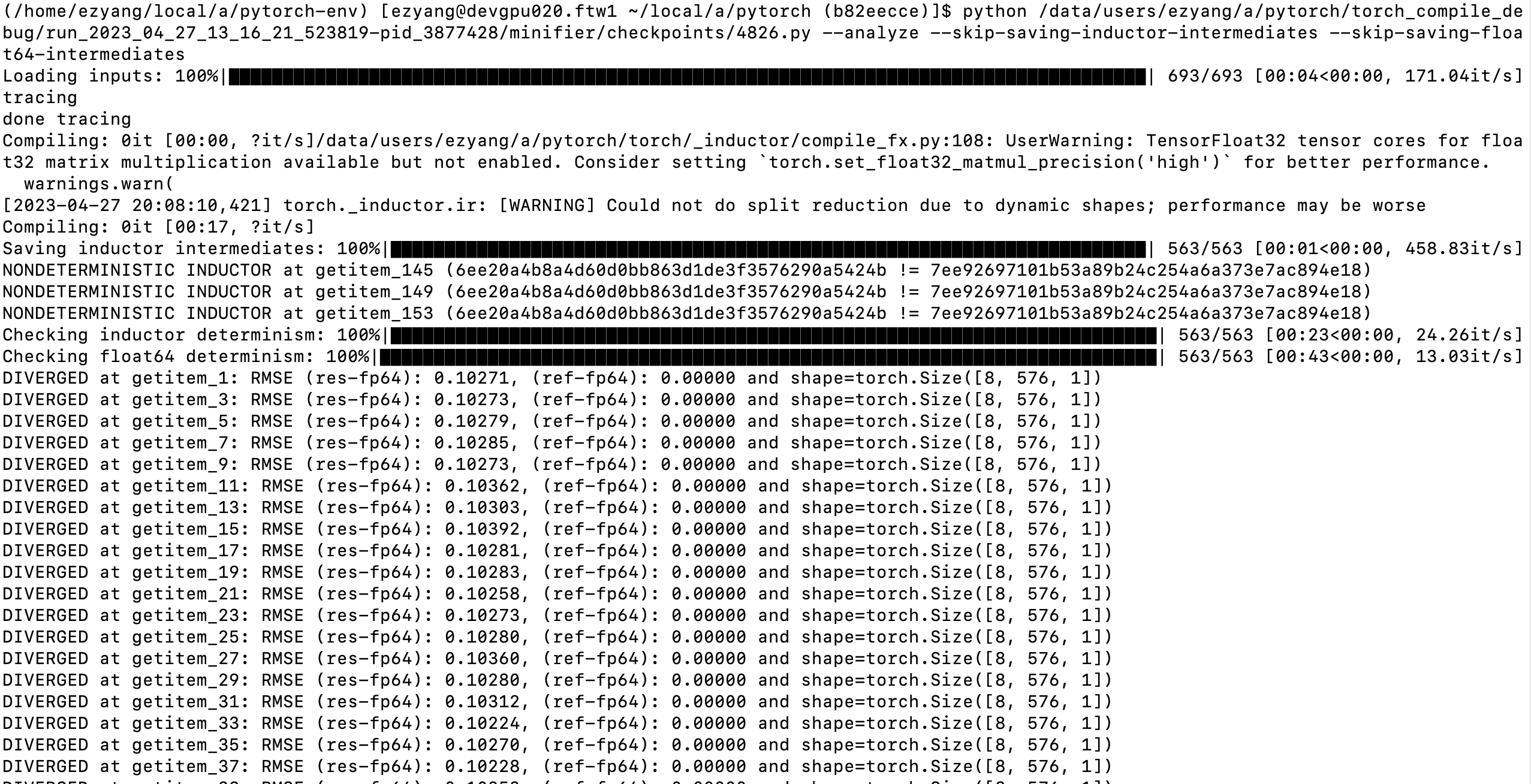
The second part of this is an implementation of `analyze` subcommand on the new CLI for any repro.

<img width="1277" alt="image" src="https://user-images.githubusercontent.com/13564/235045677-8545aab7-5e83-4813-bbec-47783dc60122.png">

This facility is oriented towards accuracy debugging. It does several things:

1. It will run your model twice and check for nondeterminism in inductor/float64, *even* on intermediate inputs (our benchmarking nondeterminism test only checks for nondeterminism on the final output). This makes localizing which operator is nondeterministic easy.
2. It will run your compiled model side-by-side with eager and float64 variants, and then report when things diverge too far from RMSE delta from float64.

Importantly, it does all this without requiring every intermediate to be held in memory (which will cause an OOM on large repros, such as the one I tested this on.)

Some other minor improvements:

* MinifierTestBase now has an easy to comment out spot that you can use to retain the temporary directory; good for debugging
* We print "running minifier" and "running repro" in MinifierTestBase to make it easier to orient where logs are coming from
* same takes a `log_error` optional argument which you can use to reroute the error logs when things mismatch
* counters["inductor"]["intermediate_hooks"] tracks the number of intermediate hooks we've codegen'ed; good for populate the tqdm interface
* torch.fx.interpreter gets an official `boxed_run` interface which uses the boxed arguments calling convention and doesn't retain inputs unnecessarily long
* torch.utils._content_store gets compute_tensor_metadata/read_tensor_metadata helper functions for computing tensor information without serializing it

Signed-off-by: Edward Z. Yang <ezyang@meta.com>

Pull Request resolved: https://github.com/pytorch/pytorch/pull/100226
Approved by: https://github.com/bertmaher, https://github.com/bdhirsh, https://github.com/anijain2305
On top of #95849 this PR is trying to handle the special case when dealing with numpy.

Consider the following example:

```
def f(x: torch.Tensor) -> np.ndarray:
	a = x.numpy()
	return a.T
```
In previous PR this will error out because we translate `a.T` to be a method call on `torch_np.ndarray.T` which is also a `torch_np.ndarray`.

This PR handles this case, by conditionally converting a `torch_np.ndarray` to `np.ndarray` before returning, to match the original behavior.

The compiled version will be:

```
def f(x):
    ___tmp_0 = __compiled_fn_0(x)
    if isinstance(___tmp_0, torch_np.ndarray):
        return ___tmp_0.tensor.numpy()
    else:
        return ___tmp_0
```

Pull Request resolved: https://github.com/pytorch/pytorch/pull/99560
Approved by: https://github.com/jansel, https://github.com/yanboliang
Issue: #93684

# Problem

Reduce graph breaks when dynamo compiles python functions containing numpy functions and ndarray operations.

# Design (as I know it)

* Use torch_np.ndarray(a wrapper of tensor) to back a `VariableTracker`: `NumpyTensorVariable`.
* Translate all attributes and methods calls, on ndarray, to torch_np.ndarray equivalent.

This PR adds `NumpyTensorVariable` and supports:
1.  tensor to ndarray, ndarray to tensor
2. numpy functions such as numpy.meshgrid()
3. ndarray attributes such as `itemsize`, `stride`

Next PR will handle returning `np.ndarray` and add support for ndarray methods
Pull Request resolved: https://github.com/pytorch/pytorch/pull/95849
Approved by: https://github.com/ezyang
Before this PR, if users call ```Conv2d(x)```, dynamo handles it well(no graph break) and puts a ```call_module``` op in the FX graph. However, if users explicitly call ```Conv2d.forward(x)``` in another ```forward``` function, the inlining would be failed(caused graph break). This PR fixed this issue by translating the explicit ```Conv2d.forward(x)``` to ```Conv2d(x)```.

Pull Request resolved: https://github.com/pytorch/pytorch/pull/99015
Approved by: https://github.com/jansel, https://github.com/wconstab
Wrapper for users to insert constraints into model code.

The constraints will not be maintained in the graph after tracing through make_fx so retracing with dynamo/make_fx will not work. This will be supported after torch._assert supported is implemented. Then we can convert the constrain_range calls to torch._asserts.

Pull Request resolved: https://github.com/pytorch/pytorch/pull/98433
Approved by: https://github.com/avikchaudhuri, https://github.com/tugsbayasgalan
Wrapper for users to insert constraints into model code.

The constraints will not be maintained in the graph after tracing through make_fx so retracing with dynamo/make_fx will not work. This will be supported after torch._assert supported is implemented. Then we can convert the constrain_range calls to torch._asserts.

Pull Request resolved: https://github.com/pytorch/pytorch/pull/98433
Approved by: https://github.com/avikchaudhuri, https://github.com/tugsbayasgalan
Summary:
    Replace _dynamo.config with an object instead of module

    Current usage patterns of setting and reading fields on config will work
    unchanged.

    Only changes needed going forward:
    1. import torch._dynamo.config will not work. However, just doing
       import torch._dynamo is sufficient to access dynamo config
       as torch._dynamo.config.

    2. Files inside of _dynamo folder need to access config via
       from torch._dynamo.config_util import config instead of
       from torch._dynamo import config. Because _dynamo/__init__.py
       imports some of the files so it would be circular import.

Test Plan:

Reviewers:

Subscribers:

Tasks:

Tags:

Fixes #ISSUE_NUMBER

Pull Request resolved: https://github.com/pytorch/pytorch/pull/96455
Approved by: https://github.com/williamwen42
This PR makes basic nnmodule forward hooks work by default, without any overhead.  But it leaves silent correctness issues if users modify/remove their hooks later, thus also emits a warning.

- the usual case is to not use hooks, so avoid guard overhead here
- registering any hook before compile will trigger a warning about hook support
- registering a hook later (or removing one) requires user knowledge and opting in,
  currently this isn't warnable (but maybe we can observe compiled nnmodules to make it
  warnable).

Why skip hook guards by default instead of not tracing __call__/hooks by default?
- avoid having a mode flag that alters dynamo tracing behavior (harder to test both codepaths
  in CI with full coverage)
- the most basic hook usecase (registering a hook before compile, and never removing it)
  will work by default with this PR, while it would require enablement and incur overhead
  in the 'not tracing __call__' proposal.

Pull Request resolved: https://github.com/pytorch/pytorch/pull/98371
Approved by: https://github.com/jansel
This replaces fake_mode_from_tensors but it preferentially looks for
fake_mode in TracingContext and also if there is an active fake mode
on the dispatch stack, before groveling in tensors to find it.

This advances PegasusForCausalLM, which was previously failing because
we generated a graph that had a parameter (non-fake) and a SymInt,
and thus previously we failed to detect the correct fake mode.

Signed-off-by: Edward Z. Yang <ezyang@meta.com>

Pull Request resolved: https://github.com/pytorch/pytorch/pull/98321
Approved by: https://github.com/voznesenskym
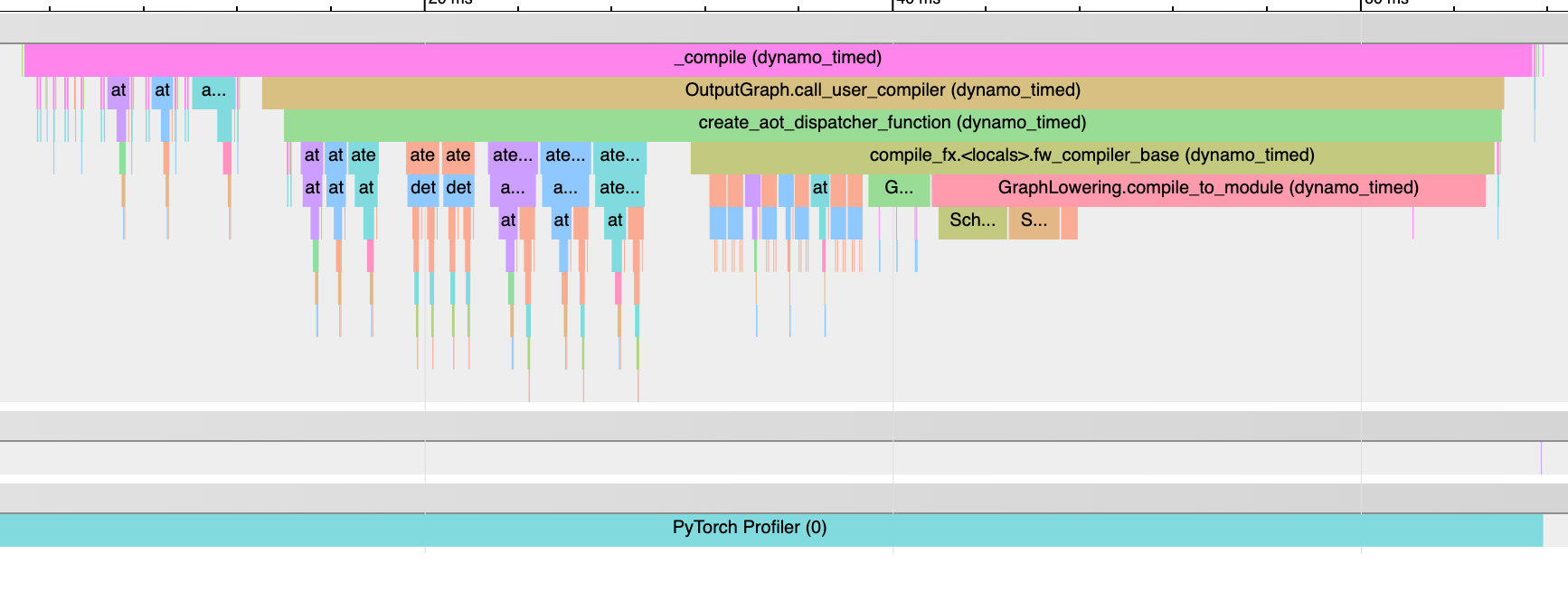
**Summary**: profiler.record_function inserts an event into the chrome trace generated by the pytorch profiler. This PR adds record_function everywhere that @dynamo_timed is annotated.

dynamo_timed and the CLI viewer torch._dynamo.utils.compile_times() are already useful on their own; but for identifying _when_ these get called, it's nice to be able to view in the profiler chrome trace.

Why not just turn on python stack traces in the profiler to get this information? Dynamo compilation is implemented in python and therefore produces a huge amount of events when it records compilation steps. The resulting trace files are often too large to load in chrome://tracing, and they take a long time to generate. Additionally, the stack traces are deep enough that they are often hard to read. This approach produces much more readable traces with lower overhead.

**Tests**:
- Added in test/dynamo/test_profiler.py. Verified in https://github.com/pytorch/pytorch/actions/runs/4559322864/jobs/8043307798?pr=96495 that the tests are actually running.
- Performance run with `ciflow/inductor-perf-compare` shows no noticeable change in compilation time or speedup numbers. Geomean speedup changes from 1.275 -> 1.277. Geomean compilation times change from 54.2s -> 53.8s. That's likely just due to noise. All individual benchmark numbers regressed by no more than 5% between the two runs; and we see improvements of around the same magnitude, suggesting this is, again, just noise. For meta employees, you can see the results in a google sheets here: https://docs.google.com/spreadsheets/d/1Ki69XvcgxcA3ZnqC5n_jav5KiD4u7Wojlad3VTnIdlk/edit?usp=sharing

**Example**:

Run this:

```python
import torch

def gn(x):
    return x.sin().cos()

def fn(x, y):
    return x.sin() * y.cos()

x, y = [torch.rand((2, 2), device='cuda') for _ in range(2)]

# just to clear out any lazy initialization
with torch.profiler.profile() as prof:
    torch.compile(gn)(x)

with torch.profiler.profile() as prof:
    torch.compile(fn)(x, y)

prof.export_chrome_trace("./dynamo_timed_profile.json")
```

and we can see that the resulting trace shows important dynamo steps, even when python tracing is turned off.

<img width="867" alt="Screenshot 2023-03-29 at 7 26 15 PM" src="https://user-images.githubusercontent.com/5067123/228712263-8ae67ab9-1a52-4765-a9c2-7c5cf0abe2f5.png">

Pull Request resolved: https://github.com/pytorch/pytorch/pull/96495
Approved by: https://github.com/ngimel, https://github.com/mlazos