When minifying, the after-aot minifier ignores non-floating values by
default but does check them when running the the initial graph dump step.
This means we may capture a graph that doesn't fail the tester and doesn't have
any meaningful divergence.

For example, the derivative of `elu(x)` depends on `x > 0` so this value is
saved for backwards and so becomes a graph output. However, the difference
between `FLT_MIN` and `0` in `x` is now enough to trigger an accuracy failure.

I fix this by adding a config variable and environment variable to ignore these
non floating point values.

Pull Request resolved: https://github.com/pytorch/pytorch/pull/123006
Approved by: https://github.com/ezyang
ghstack dependencies: #123005
Currently when there is a print/warning in the graph, dynamo graph breaks causing export to fail. However export would like to just skip over these print/warning calls: https://github.com/pytorch/pytorch/issues/113792.

Additionally there's a torch.compile feature request to "reorder prints" so that instead of graph breaking when hitting prints/logging, we can skip over these prints to create larger compiled graphs, and then print the results out after those compiled graphs: https://github.com/pytorch/pytorch/issues/93739. This PR also adds the `reorderable_logging_functions` config for users to register logging functions to be reordered (like `print` or a custom logging function). Printout of the bytecode after reordering the prints looks like the following: P914736600

There are some limitations to the printing right now:
* You can only register logging functions, not methods
* Inputs to the logging functions can only be tensors, constants, and format strings
* Inputs to the logging functions which will later be mutated in-place will not be printed correctly

TODO: Add the following tests
* print function with argument of nested data structure;
* print function with argument of nested data structure being updated inside of compile region (this would test if we handle side effect correctly);
* custom defined logging functions with nn.Module or nn.Module attribute arguments;
* custom defined logging functions with submodule input/output as arguments (we need to handle the mapping and fused-out value);
* custom defined logging functions with tensor argument and mutation inside of the function (TBD: this may increase memory usage);

Pull Request resolved: https://github.com/pytorch/pytorch/pull/116106
Approved by: https://github.com/yanboliang
Currently when there is a print/warning in the graph, dynamo graph breaks causing export to fail. However export would like to just skip over these print/warning calls: https://github.com/pytorch/pytorch/issues/113792.

Additionally there's a torch.compile feature request to "reorder prints" so that instead of graph breaking when hitting prints/logging, we can skip over these prints to create larger compiled graphs, and then print the results out after those compiled graphs: https://github.com/pytorch/pytorch/issues/93739. This PR also adds the `reorderable_logging_functions` config for users to register logging functions to be reordered (like `print` or a custom logging function). Printout of the bytecode after reordering the prints looks like the following: P914736600

There are some limitations to the printing right now:
* You can only register logging functions, not methods
* Inputs to the logging functions can only be tensors, constants, and format strings
* Inputs to the logging functions which will later be mutated in-place will not be printed correctly

TODO: Add the following tests
* print function with argument of nested data structure;
* print function with argument of nested data structure being updated inside of compile region (this would test if we handle side effect correctly);
* custom defined logging functions with nn.Module or nn.Module attribute arguments;
* custom defined logging functions with submodule input/output as arguments (we need to handle the mapping and fused-out value);
* custom defined logging functions with tensor argument and mutation inside of the function (TBD: this may increase memory usage);

Pull Request resolved: https://github.com/pytorch/pytorch/pull/116106
Approved by: https://github.com/yanboliang
Tacotron2 causes massive loop unrolling resulting in very large graphs (26k nodes) which was causing inductor (and tracing itself) to choke.
The unrolling size is controlled by the environment variable TORCHDYNAMO_MAX_LOOP_UNROLL_NODES which defaults to the arbitrary value 5000.
This updates the tacotron2 timings as follows:
eager timing: 3m:23s -> 35s
aot_eager timing: 4m:12s -> 39s
inductor timing: 22m:24s ->1m
For reference the big loop in tacotron2 was this one (model.py[405]):
```
while len(mel_outputs) < decoder_inputs.size(0) - 1:
decoder_input = decoder_inputs[len(mel_outputs)]
mel_output, gate_output, attention_weights = self.decode(decoder_input)
mel_outputs += [mel_output.squeeze(1)]
gate_outputs += [gate_output.squeeze(1)]
alignments += [attention_weights]
```
which gets unrolled and inlined adding about 36 nodes to the graph per iteration.
Fixes#98467
Relates to #102839 which hopefully will result in a better fix.
Pull Request resolved: https://github.com/pytorch/pytorch/pull/120023
Approved by: https://github.com/yanboliang
**Summary**
The reducer of `DistributedDataParallel`  is implemented with C++ and it is not easy to trace the allreduce launched in the reducer. This PR modifies `DistributedDataParallel` to launch one allreduce per gradient when `compiled_autograd` is enabled. The changes allow us to use `compiled_autograd` to trace the allreduce and later be optimized (fused) in the Inductor.

**Key Logic**
1. If `ddp_python_hook` is True, we assume `compiled_autograd` is used. `DistributedDataParallel` registers `compiled_accum_grad_hook` for all parameters.
2. In the first forward() call, if `DistributedDataParallel` is not compiled, all  `compiled_accum_grad_hook` are deregistered. If `DistributedDataParallel` is compiled, all `compiled_accum_grad_hook` will be compiled by `compiled_autograd`.
3.  `compiled_accum_grad_hook` launches an allreduce to reduce the gradient of the parameter.

**Bucketing**
The compiled backward is slow because there is no bucketing for the allreduces. We rely on Inductor to bucket the allreduces.

The bucketing is done in a separate PR.

Differential Revision: [D49428482](https://our.internmc.facebook.com/intern/diff/D49428482/)

Pull Request resolved: https://github.com/pytorch/pytorch/pull/110662
Approved by: https://github.com/wconstab
I feel it's easier to open a new PR rather than iterating on the previous PR (https://github.com/pytorch/pytorch/pull/105257 ) since this is more like a rewrite.

In this PR, instead of changing GraphModule directly which can easily causes BC issue, I create a LazyGraphModule class as Zachary & Jason suggested in comments from the previous PR.

The difference between LazyGraphModule and GraphModule is mainly about how re-compile for the graph module happens. In GraphModule the recompilation happens 'eagerly': constructing a GraphModule will cause the recompilation. While in LazyGraphModule, we just mark the module as needing recompilation. The real recompilation only happens when absolutely required (e.g. call forward method, access the code property etc.). In a lot of cases in torch.compile, the real recompilation eventually is not triggered at all. This can save a few seconds of compilation time.

By default, GraphModule rather than LazyGraphModule is used. `use_lazy_graph_module(True)` context manager can be used to pick LazyGraphModule instead. This has been applied to the torch.compile stack.

Pull Request resolved: https://github.com/pytorch/pytorch/pull/117911
Approved by: https://github.com/jansel
Due to not all tests in the Dynamo shard actually running in CI, we've
started to bitrot on this implementation. Since our plan is to trace
into the functorch implementations instead of construct a HOP
(which is what capture_func_transforms=True does), let's turn off this
config by default.

Test Plan:
- Tests

Pull Request resolved: https://github.com/pytorch/pytorch/pull/115267
Approved by: https://github.com/voznesenskym, https://github.com/guilhermeleobas
`install_config_module` makes a regular module into a ConfigModule with
extra methods defined on it. mypy thinks those extra methods (or module
functions) are undefined since it cannot analyze something so
dynamic. As a workaround, I've created a fake module that defines these
extra functions, which I import into the config modules during type
checking.

As part of this change, I've also added more types to config_utils.py
and enabled typechecking for torch/_dynamo/config.py.
Pull Request resolved: https://github.com/pytorch/pytorch/pull/112130
Approved by: https://github.com/jansel
Attempt number 2 at https://github.com/pytorch/pytorch/issues/108950.

Improves debugging for guard failures/recompilations by:
- only running guard fail reason generation during recompilation, instead of when a guard fails during dynamo cache lookup (so generating guard failure reasons is not on the critical path)
- ~~always reporting all guard failures~~ Reports the first-failing guard failure for each cache entry.

We don't expect a performance hit since the guard fail reasons are only generated at recompile time rather than runtime. Perf benchmark to check this (https://hud.pytorch.org/benchmark/torchbench/inductor_with_cudagraphs?startTime=Fri,%2027%20Oct%202023%2017:42:43%20GMT&stopTime=Fri,%2003%20Nov%202023%2017:42:43%20GMT&granularity=hour&mode=training&dtype=amp&lBranch=gh/williamwen42/62/head&lCommit=f4724f5ffc6d17ceae513a42fc18627be7b85482&rBranch=main&rCommit=29f3d392bf230072e3bffae37b078e770cae1956). We may also need to verify this on benchmarks where guard fails are common.

Sample script:
```python
import torch
def generate_data(b):
    return (
        torch.randn(b, 3, 32, 32).to(torch.float32).cuda(),
        torch.randint(1000, (b,)).cuda(),
    )

from torchvision.models import resnet18
def init_model():
    return resnet18().to(torch.float32).cuda()

model = init_model()
model_opt = torch.compile(model, dynamic=False)

for b in range(16, 32):
    data = generate_data(b)
    model_opt(data[0])
```

Sample logs:
```bash
(/data/users/williamwen/py310-env) [williamwen@devgpu020.odn1 /data/users/williamwen/pytorch (wwen/log-all-guards)]$ python playground5.py
/data/users/williamwen/pytorch/torch/_inductor/compile_fx.py:141: UserWarning: TensorFloat32 tensor cores for float32 matrix multiplication available but not enabled. Consider setting `torch.set_float32_matmul_precision('high')` for better performance.
  warnings.warn(
[2023-11-06 14:50:47,605] torch._dynamo.convert_frame: [WARNING] torch._dynamo hit config.cache_size_limit (8)
[2023-11-06 14:50:47,605] torch._dynamo.convert_frame: [WARNING]    function: 'forward' (/data/users/williamwen/torchvision/torchvision/models/resnet.py:284)
[2023-11-06 14:50:47,605] torch._dynamo.convert_frame: [WARNING]    last reason: tensor 'L['x']' size mismatch at index 0. expected 16, actual 24
[2023-11-06 14:50:47,605] torch._dynamo.convert_frame: [WARNING] To log all recompilation reasons, use TORCH_LOGS="recompiles".
[2023-11-06 14:50:47,605] torch._dynamo.convert_frame: [WARNING] To diagnose recompilation issues, see https://pytorch.org/docs/master/compile/troubleshooting.html.
(/data/users/williamwen/py310-env) [williamwen@devgpu020.odn1 /data/users/williamwen/pytorch (wwen/log-all-guards)]$ TORCH_LOGS="recompiles" python playground5.py
/data/users/williamwen/pytorch/torch/_inductor/compile_fx.py:141: UserWarning: TensorFloat32 tensor cores for float32 matrix multiplication available but not enabled. Consider setting `torch.set_float32_matmul_precision('high')` for better performance.
  warnings.warn(
[2023-11-06 14:53:31,591] torch._dynamo.guards.__recompiles: [DEBUG] Recompiling function forward in /data/users/williamwen/torchvision/torchvision/models/resnet.py:284
[2023-11-06 14:53:31,591] torch._dynamo.guards.__recompiles: [DEBUG]     triggered by the following guard failure(s):
[2023-11-06 14:53:31,591] torch._dynamo.guards.__recompiles: [DEBUG]     - tensor 'L['x']' size mismatch at index 0. expected 16, actual 17
[2023-11-06 14:53:41,333] torch._dynamo.guards.__recompiles: [DEBUG] Recompiling function forward in /data/users/williamwen/torchvision/torchvision/models/resnet.py:284
[2023-11-06 14:53:41,333] torch._dynamo.guards.__recompiles: [DEBUG]     triggered by the following guard failure(s):
[2023-11-06 14:53:41,333] torch._dynamo.guards.__recompiles: [DEBUG]     - tensor 'L['x']' size mismatch at index 0. expected 17, actual 18
[2023-11-06 14:53:41,333] torch._dynamo.guards.__recompiles: [DEBUG]     - tensor 'L['x']' size mismatch at index 0. expected 16, actual 18
[2023-11-06 14:53:50,463] torch._dynamo.guards.__recompiles: [DEBUG] Recompiling function forward in /data/users/williamwen/torchvision/torchvision/models/resnet.py:284
[2023-11-06 14:53:50,463] torch._dynamo.guards.__recompiles: [DEBUG]     triggered by the following guard failure(s):
[2023-11-06 14:53:50,463] torch._dynamo.guards.__recompiles: [DEBUG]     - tensor 'L['x']' size mismatch at index 0. expected 18, actual 19
[2023-11-06 14:53:50,463] torch._dynamo.guards.__recompiles: [DEBUG]     - tensor 'L['x']' size mismatch at index 0. expected 17, actual 19
[2023-11-06 14:53:50,463] torch._dynamo.guards.__recompiles: [DEBUG]     - tensor 'L['x']' size mismatch at index 0. expected 16, actual 19
[2023-11-06 14:53:59,848] torch._dynamo.guards.__recompiles: [DEBUG] Recompiling function forward in /data/users/williamwen/torchvision/torchvision/models/resnet.py:284
[2023-11-06 14:53:59,848] torch._dynamo.guards.__recompiles: [DEBUG]     triggered by the following guard failure(s):
[2023-11-06 14:53:59,848] torch._dynamo.guards.__recompiles: [DEBUG]     - tensor 'L['x']' size mismatch at index 0. expected 19, actual 20
[2023-11-06 14:53:59,848] torch._dynamo.guards.__recompiles: [DEBUG]     - tensor 'L['x']' size mismatch at index 0. expected 18, actual 20
[2023-11-06 14:53:59,848] torch._dynamo.guards.__recompiles: [DEBUG]     - tensor 'L['x']' size mismatch at index 0. expected 17, actual 20
[2023-11-06 14:53:59,848] torch._dynamo.guards.__recompiles: [DEBUG]     - tensor 'L['x']' size mismatch at index 0. expected 16, actual 20
[2023-11-06 14:54:08,549] torch._dynamo.guards.__recompiles: [DEBUG] Recompiling function forward in /data/users/williamwen/torchvision/torchvision/models/resnet.py:284
[2023-11-06 14:54:08,549] torch._dynamo.guards.__recompiles: [DEBUG]     triggered by the following guard failure(s):
[2023-11-06 14:54:08,549] torch._dynamo.guards.__recompiles: [DEBUG]     - tensor 'L['x']' size mismatch at index 0. expected 20, actual 21
[2023-11-06 14:54:08,549] torch._dynamo.guards.__recompiles: [DEBUG]     - tensor 'L['x']' size mismatch at index 0. expected 19, actual 21
[2023-11-06 14:54:08,549] torch._dynamo.guards.__recompiles: [DEBUG]     - tensor 'L['x']' size mismatch at index 0. expected 18, actual 21
[2023-11-06 14:54:08,549] torch._dynamo.guards.__recompiles: [DEBUG]     - tensor 'L['x']' size mismatch at index 0. expected 17, actual 21
[2023-11-06 14:54:08,549] torch._dynamo.guards.__recompiles: [DEBUG]     - tensor 'L['x']' size mismatch at index 0. expected 16, actual 21
[2023-11-06 14:54:17,795] torch._dynamo.guards.__recompiles: [DEBUG] Recompiling function forward in /data/users/williamwen/torchvision/torchvision/models/resnet.py:284
[2023-11-06 14:54:17,795] torch._dynamo.guards.__recompiles: [DEBUG]     triggered by the following guard failure(s):
[2023-11-06 14:54:17,795] torch._dynamo.guards.__recompiles: [DEBUG]     - tensor 'L['x']' size mismatch at index 0. expected 21, actual 22
[2023-11-06 14:54:17,795] torch._dynamo.guards.__recompiles: [DEBUG]     - tensor 'L['x']' size mismatch at index 0. expected 20, actual 22
[2023-11-06 14:54:17,795] torch._dynamo.guards.__recompiles: [DEBUG]     - tensor 'L['x']' size mismatch at index 0. expected 19, actual 22
[2023-11-06 14:54:17,795] torch._dynamo.guards.__recompiles: [DEBUG]     - tensor 'L['x']' size mismatch at index 0. expected 18, actual 22
[2023-11-06 14:54:17,795] torch._dynamo.guards.__recompiles: [DEBUG]     - tensor 'L['x']' size mismatch at index 0. expected 17, actual 22
[2023-11-06 14:54:17,795] torch._dynamo.guards.__recompiles: [DEBUG]     - tensor 'L['x']' size mismatch at index 0. expected 16, actual 22
[2023-11-06 14:54:27,430] torch._dynamo.guards.__recompiles: [DEBUG] Recompiling function forward in /data/users/williamwen/torchvision/torchvision/models/resnet.py:284
[2023-11-06 14:54:27,430] torch._dynamo.guards.__recompiles: [DEBUG]     triggered by the following guard failure(s):
[2023-11-06 14:54:27,430] torch._dynamo.guards.__recompiles: [DEBUG]     - tensor 'L['x']' size mismatch at index 0. expected 22, actual 23
[2023-11-06 14:54:27,430] torch._dynamo.guards.__recompiles: [DEBUG]     - tensor 'L['x']' size mismatch at index 0. expected 21, actual 23
[2023-11-06 14:54:27,430] torch._dynamo.guards.__recompiles: [DEBUG]     - tensor 'L['x']' size mismatch at index 0. expected 20, actual 23
[2023-11-06 14:54:27,430] torch._dynamo.guards.__recompiles: [DEBUG]     - tensor 'L['x']' size mismatch at index 0. expected 19, actual 23
[2023-11-06 14:54:27,430] torch._dynamo.guards.__recompiles: [DEBUG]     - tensor 'L['x']' size mismatch at index 0. expected 18, actual 23
[2023-11-06 14:54:27,430] torch._dynamo.guards.__recompiles: [DEBUG]     - tensor 'L['x']' size mismatch at index 0. expected 17, actual 23
[2023-11-06 14:54:27,430] torch._dynamo.guards.__recompiles: [DEBUG]     - tensor 'L['x']' size mismatch at index 0. expected 16, actual 23
[2023-11-06 14:54:36,744] torch._dynamo.guards.__recompiles: [DEBUG] Recompiling function forward in /data/users/williamwen/torchvision/torchvision/models/resnet.py:284
[2023-11-06 14:54:36,744] torch._dynamo.guards.__recompiles: [DEBUG]     triggered by the following guard failure(s):
[2023-11-06 14:54:36,744] torch._dynamo.guards.__recompiles: [DEBUG]     - tensor 'L['x']' size mismatch at index 0. expected 23, actual 24
[2023-11-06 14:54:36,744] torch._dynamo.guards.__recompiles: [DEBUG]     - tensor 'L['x']' size mismatch at index 0. expected 22, actual 24
[2023-11-06 14:54:36,744] torch._dynamo.guards.__recompiles: [DEBUG]     - tensor 'L['x']' size mismatch at index 0. expected 21, actual 24
[2023-11-06 14:54:36,744] torch._dynamo.guards.__recompiles: [DEBUG]     - tensor 'L['x']' size mismatch at index 0. expected 20, actual 24
[2023-11-06 14:54:36,744] torch._dynamo.guards.__recompiles: [DEBUG]     - tensor 'L['x']' size mismatch at index 0. expected 19, actual 24
[2023-11-06 14:54:36,744] torch._dynamo.guards.__recompiles: [DEBUG]     - tensor 'L['x']' size mismatch at index 0. expected 18, actual 24
[2023-11-06 14:54:36,744] torch._dynamo.guards.__recompiles: [DEBUG]     - tensor 'L['x']' size mismatch at index 0. expected 17, actual 24
[2023-11-06 14:54:36,744] torch._dynamo.guards.__recompiles: [DEBUG]     - tensor 'L['x']' size mismatch at index 0. expected 16, actual 24
[2023-11-06 14:54:36,744] torch._dynamo.convert_frame: [WARNING] torch._dynamo hit config.cache_size_limit (8)
[2023-11-06 14:54:36,744] torch._dynamo.convert_frame: [WARNING]    function: 'forward' (/data/users/williamwen/torchvision/torchvision/models/resnet.py:284)
[2023-11-06 14:54:36,744] torch._dynamo.convert_frame: [WARNING]    last reason: tensor 'L['x']' size mismatch at index 0. expected 16, actual 24
[2023-11-06 14:54:36,744] torch._dynamo.convert_frame: [WARNING] To log all recompilation reasons, use TORCH_LOGS="recompiles".
[2023-11-06 14:54:36,744] torch._dynamo.convert_frame: [WARNING] To diagnose recompilation issues, see https://pytorch.org/docs/master/compile/troubleshooting.html.
[2023-11-06 14:54:45,922] torch._dynamo.guards.__recompiles: [DEBUG] Recompiling function _forward_impl in /data/users/williamwen/torchvision/torchvision/models/resnet.py:266
[2023-11-06 14:54:45,922] torch._dynamo.guards.__recompiles: [DEBUG]     triggered by the following guard failure(s):
[2023-11-06 14:54:45,922] torch._dynamo.guards.__recompiles: [DEBUG]     - tensor 'L['x']' size mismatch at index 0. expected 24, actual 25
[2023-11-06 14:54:54,691] torch._dynamo.guards.__recompiles: [DEBUG] Recompiling function _forward_impl in /data/users/williamwen/torchvision/torchvision/models/resnet.py:266
[2023-11-06 14:54:54,691] torch._dynamo.guards.__recompiles: [DEBUG]     triggered by the following guard failure(s):
[2023-11-06 14:54:54,691] torch._dynamo.guards.__recompiles: [DEBUG]     - tensor 'L['x']' size mismatch at index 0. expected 25, actual 26
[2023-11-06 14:54:54,691] torch._dynamo.guards.__recompiles: [DEBUG]     - tensor 'L['x']' size mismatch at index 0. expected 24, actual 26
[2023-11-06 14:55:03,591] torch._dynamo.guards.__recompiles: [DEBUG] Recompiling function _forward_impl in /data/users/williamwen/torchvision/torchvision/models/resnet.py:266
[2023-11-06 14:55:03,591] torch._dynamo.guards.__recompiles: [DEBUG]     triggered by the following guard failure(s):
[2023-11-06 14:55:03,591] torch._dynamo.guards.__recompiles: [DEBUG]     - tensor 'L['x']' size mismatch at index 0. expected 26, actual 27
[2023-11-06 14:55:03,591] torch._dynamo.guards.__recompiles: [DEBUG]     - tensor 'L['x']' size mismatch at index 0. expected 25, actual 27
[2023-11-06 14:55:03,591] torch._dynamo.guards.__recompiles: [DEBUG]     - tensor 'L['x']' size mismatch at index 0. expected 24, actual 27
[2023-11-06 14:55:12,384] torch._dynamo.guards.__recompiles: [DEBUG] Recompiling function _forward_impl in /data/users/williamwen/torchvision/torchvision/models/resnet.py:266
[2023-11-06 14:55:12,384] torch._dynamo.guards.__recompiles: [DEBUG]     triggered by the following guard failure(s):
[2023-11-06 14:55:12,384] torch._dynamo.guards.__recompiles: [DEBUG]     - tensor 'L['x']' size mismatch at index 0. expected 27, actual 28
[2023-11-06 14:55:12,384] torch._dynamo.guards.__recompiles: [DEBUG]     - tensor 'L['x']' size mismatch at index 0. expected 26, actual 28
[2023-11-06 14:55:12,384] torch._dynamo.guards.__recompiles: [DEBUG]     - tensor 'L['x']' size mismatch at index 0. expected 25, actual 28
[2023-11-06 14:55:12,384] torch._dynamo.guards.__recompiles: [DEBUG]     - tensor 'L['x']' size mismatch at index 0. expected 24, actual 28
[2023-11-06 14:55:21,442] torch._dynamo.guards.__recompiles: [DEBUG] Recompiling function _forward_impl in /data/users/williamwen/torchvision/torchvision/models/resnet.py:266
[2023-11-06 14:55:21,442] torch._dynamo.guards.__recompiles: [DEBUG]     triggered by the following guard failure(s):
[2023-11-06 14:55:21,442] torch._dynamo.guards.__recompiles: [DEBUG]     - tensor 'L['x']' size mismatch at index 0. expected 28, actual 29
[2023-11-06 14:55:21,442] torch._dynamo.guards.__recompiles: [DEBUG]     - tensor 'L['x']' size mismatch at index 0. expected 27, actual 29
[2023-11-06 14:55:21,442] torch._dynamo.guards.__recompiles: [DEBUG]     - tensor 'L['x']' size mismatch at index 0. expected 26, actual 29
[2023-11-06 14:55:21,442] torch._dynamo.guards.__recompiles: [DEBUG]     - tensor 'L['x']' size mismatch at index 0. expected 25, actual 29
[2023-11-06 14:55:21,442] torch._dynamo.guards.__recompiles: [DEBUG]     - tensor 'L['x']' size mismatch at index 0. expected 24, actual 29
[2023-11-06 14:55:30,315] torch._dynamo.guards.__recompiles: [DEBUG] Recompiling function _forward_impl in /data/users/williamwen/torchvision/torchvision/models/resnet.py:266
[2023-11-06 14:55:30,315] torch._dynamo.guards.__recompiles: [DEBUG]     triggered by the following guard failure(s):
[2023-11-06 14:55:30,315] torch._dynamo.guards.__recompiles: [DEBUG]     - tensor 'L['x']' size mismatch at index 0. expected 29, actual 30
[2023-11-06 14:55:30,315] torch._dynamo.guards.__recompiles: [DEBUG]     - tensor 'L['x']' size mismatch at index 0. expected 28, actual 30
[2023-11-06 14:55:30,315] torch._dynamo.guards.__recompiles: [DEBUG]     - tensor 'L['x']' size mismatch at index 0. expected 27, actual 30
[2023-11-06 14:55:30,315] torch._dynamo.guards.__recompiles: [DEBUG]     - tensor 'L['x']' size mismatch at index 0. expected 26, actual 30
[2023-11-06 14:55:30,315] torch._dynamo.guards.__recompiles: [DEBUG]     - tensor 'L['x']' size mismatch at index 0. expected 25, actual 30
[2023-11-06 14:55:30,315] torch._dynamo.guards.__recompiles: [DEBUG]     - tensor 'L['x']' size mismatch at index 0. expected 24, actual 30
[2023-11-06 14:55:39,839] torch._dynamo.guards.__recompiles: [DEBUG] Recompiling function _forward_impl in /data/users/williamwen/torchvision/torchvision/models/resnet.py:266
[2023-11-06 14:55:39,839] torch._dynamo.guards.__recompiles: [DEBUG]     triggered by the following guard failure(s):
[2023-11-06 14:55:39,839] torch._dynamo.guards.__recompiles: [DEBUG]     - tensor 'L['x']' size mismatch at index 0. expected 30, actual 31
[2023-11-06 14:55:39,839] torch._dynamo.guards.__recompiles: [DEBUG]     - tensor 'L['x']' size mismatch at index 0. expected 29, actual 31
[2023-11-06 14:55:39,839] torch._dynamo.guards.__recompiles: [DEBUG]     - tensor 'L['x']' size mismatch at index 0. expected 28, actual 31
[2023-11-06 14:55:39,839] torch._dynamo.guards.__recompiles: [DEBUG]     - tensor 'L['x']' size mismatch at index 0. expected 27, actual 31
[2023-11-06 14:55:39,839] torch._dynamo.guards.__recompiles: [DEBUG]     - tensor 'L['x']' size mismatch at index 0. expected 26, actual 31
[2023-11-06 14:55:39,839] torch._dynamo.guards.__recompiles: [DEBUG]     - tensor 'L['x']' size mismatch at index 0. expected 25, actual 31
[2023-11-06 14:55:39,839] torch._dynamo.guards.__recompiles: [DEBUG]     - tensor 'L['x']' size mismatch at index 0. expected 24, actual 31
```

Pull Request resolved: https://github.com/pytorch/pytorch/pull/110325
Approved by: https://github.com/ezyang, https://github.com/jon-chuang
This PR:
- adds the pt2 compliant tag. This tag specifies that the operator works
  with the PT2 compilation APIs. A custom op author should test their
  ops with opcheck if they choose to add this tag.
- adds a config for Dynamo to allow only pt2 compliant ops into the
  graph and graph break on all other OpOverload/OpOverloadPacket.

Bikeshedding help wanted on the name of the tag. It should be easily
grep-able so we can set up rules for it.

Test Plan:
- new tests

Reviewers:

Subscribers:

Tasks:

Tags:

Pull Request resolved: https://github.com/pytorch/pytorch/pull/111933
Approved by: https://github.com/ezyang
ghstack dependencies: #111912, #111915, #111948
`is_allowed` is a tricky bit of functionality - it sits early up in builder and is used to drive the creation of TorchVariable (more notes here, meta only https://fb.workplace.com/groups/pytorch.dev/permalink/1393563781222098/)

If we are tracing distributed in full, we want to route certain calls in distributed to NOT PASS is_allowed (this does not, confusingly, mean that they are not allowed, lol, but rather that we dont want them to become TorchVariable), others, we are fine with preserving.

Pull Request resolved: https://github.com/pytorch/pytorch/pull/110894
Approved by: https://github.com/ezyang
Summary: The runtime assertions inserted in the `torch._export.export` by the `_AddRuntimeAssertionsForInlineConstraintsPass` lead to errors in AOT Inductor like #109884. In `torch._export.aot_compile` export and AOT compilation are run consecutively which would lead to the above issue if any assertions are inserted.

In this PR, we're adding a new parameter / flag to `torch._export.aot_compile`, `remove_runtime_assertions`, to remove the assertions inserted during export before AOT compilation. The flag is set to `False` for BC.

Additionally, we remove the flag `add_runtime_assertions_for_inline_constraints` recently added to `torch._dynamo.config`, as it can lead to undesirable `torch._export` behavior and is 's no longer required for the AOT Inductor testing purposes.

Test Plan: CI

Reviewers:

Subscribers:

Tasks:

Tags:

Pull Request resolved: https://github.com/pytorch/pytorch/pull/110710
Approved by: https://github.com/zhxchen17, https://github.com/chenyang78
Summary: with the grid computed in terms of unbacked `SymInt`s, it can happen that the grid is zero size. This causes CUDA error on `cuLaunchKernel` in the AOT Inductor codegen.

In this PR, when the grid contains unbacked `SymInt`s, a check is added around the `launchKernel` in the AOT Inductor's C++ wrapper codegen to make sure that the grid is not zero-size.

Pull Request resolved: https://github.com/pytorch/pytorch/pull/110312
Approved by: https://github.com/chenyang78
This flag is requested by @Chillee who is seeing recompilations with simple gpt experiments. We are observing recompilations because `_parameters` ordered dict keeps changing from run to run, and its unclear why that is happening.

Pull Request resolved: https://github.com/pytorch/pytorch/pull/110039
Approved by: https://github.com/Chillee
ghstack dependencies: #110023
Pull Request resolved: https://github.com/pytorch/pytorch/pull/105489

NOTE: this PR is tagged "not user facing", because it's not ready to be announced externally yet.

This PR implements torch.compile + selective activation checkpoint (SAC) integration, by using `TagActivationCheckpoint` (same backend as torch.compile + full activation checkpoint integration).

TorchDispatchMode based implementation cannot support including inplace ops in the checkpointed region at the moment (the reason for this needs investigation), and there is also no way to ban them (because TorchDispatchMode now only sees "after-functionalization" ops, so can't detect if an op is in-place). Hence we hide torch.compile + SAC behind a flag (`torch._dynamo.config._experimental_support_context_fn_in_torch_utils_checkpoint`) and will only use it internally for cases that are known to not have in-place ops. This state won't last too long, because in-place op will at least be able to be detected after Brian's mode reordering and related functionalization changes.
So next steps after this PR:
1. Wait for Brian's mode reordering and related functionalization changes to land, and then try to enable the "inplace ops" unit test for torch.compile + selective activation checkpoint (if it doesn't work, investigate why).
2. Unify selective- and full-checkpoint under TorchDispatchMode based implementation.

Differential Revision: D47497145

Pull Request resolved: https://github.com/pytorch/pytorch/pull/105489
Approved by: https://github.com/anijain2305
Summary:

The basic concept behind this diff is to modify Dynamo's tracing behavior when it encounters a KeyedJaggedTensor that is synced (aka has `_length_per_key` and `_offset_per_key` populated). These fields are lists of integers; ordinarily, Dynamo will optimistically try to specialize on integers, however, for KJTs, we know that these integers will definitely vary from run-to-run. Furthermore, ordinarily, we would also specialize these integers if they are 0/1, but we will frequently expect features in KJTs to be 0/1.

The fix is to detect KJTs and treat these integers as *unbacked integers*. This is NOT a universally sound optimization: when treating these integers as unbacked, we never report them as equal to zero or one. In return, we always generate graphs that generalize no matter the length of values on features. This is enough to trace through APS sparse arch, torchrec_dlrm and some small split-cat examples.

The special integer behavior is triggered by a dynamically scoped `force_unspec_int_unbacked_size_like` variable on TracingContext, which we trigger when we wrap a KJT. There probably are other ways to do this, but this was simple and worked.

Test Plan:
```
buck2 test mode/dev-nosan //pytorch/benchmark/fb/test_gpu:run_test_gpu
```

from aakhundov

1. first build feed_lower_benchmark:
```
buck2 build --show-output mode/opt -c python.package_style=inplace -c fbcode.enable_gpu_sections=true -c fbcode.platform=platform010 -c fbcode.split-dwarf=true hpc/new/models/feed/benchmark:feed_lower_benchmark
```
2. then run the lowering of the model with it:
```
TORCHINDUCTOR_MAX_AUTOTUNE=1 TORCHINDUCTOR_UNIQUE_KERNEL_NAMES=1 TORCH_LOGS="output_code,graph_code" TORCH_COMPILE_DEBUG=1 ../buck-out/v2/gen/fbcode/79c6b019ee0f9469/hpc/new/models/feed/benchmark/__feed_lower_benchmark__/feed_lower_benchmark.par --load=manifold://ig_inference_model/tree/user/facebook/fblearner/predictor/960999465/60/gpu_lowering/input.predictor --skip-trt --skip-ait --sync-mode=0 --enable-aot-inductor --lower-presets="ig_stories" --gpu-trace
```
cf https://docs.google.com/document/d/1yD30xYrdmM8r2HTdmXnZTg0-MHVexfVrAa0294m1AUE/edit?pli=1#heading=h.qiv3fp7e6zg0

From torchrec: https://www.internalfb.com/intern/wiki/Torchrec/Development/Testing_production_models/

From ge0405
baseline (without your diff): f477293168
your diff: f477292363

```
buck2 test //caffe2/test/dynamo:test_dynamo_torchrec
buck2 run 'fbcode//mode/opt' fbcode//pytorch/benchmark/fb/test_gpu:run_test_gpu -- 'pytorch.benchmark.fb.test_gpu.test_gpu.TestBenchmarkFbGpu.test_train_blue_reels_vdd_v3_inductor_speedup'
```

Differential Revision: D49236757

Pull Request resolved: https://github.com/pytorch/pytorch/pull/109216
Approved by: https://github.com/voznesenskym
**Motivation:**
We try to make torch.cond use torch.compile automatically so that we could error out when there is side-effects in the branches and correctly handle the closures.

Before this PR, we have a warning if we don't turn on a config raise_on_backend_change (turning it on gives us an error) for the following code:
```python
def foo()

# Inside torch.cond, we'd like to do something like
torch.compile(foo, backend="eager", fullgraph=True)(...)
...
# Users may then call torch.compile somewhere else.
# Dynamo will use the cached code of foo for "eager" backend
# but we expect dynamo to recompile with "inductor" backend.
torch.compile(foo, backend="inductor")(...)
```

This PR adds a BACKEND_MATCH guard. Effectively, it implements a per-backend cache. In the above example, the cached code for "eager" won't work for "inductor" due to guard check failures and the second torch.compile will do a re-compilation. In the future, it might be useful to have something like a configuration guard that guards against dynamo configuration changes across different compiles (e.g. compile a function with fullgraph=False then compile it again with fullgraph=True).

**Implementation:**
1. We add a guarded_backend_cache and check the most_recent_backend against the backend associated with cached code. We also remove the raise_on_backend_change flag.

Note: More lines are printed for debug log due to newly added context manager and guard adds .

**Test Plan:**
Removed original tests that raise on different backend and add a new test to test whether the BACKEND_MATCH guard can guard against backend change.

Pull Request resolved: https://github.com/pytorch/pytorch/pull/107337
Approved by: https://github.com/jansel
Fix several issues with `torch._numpy.random` functions on eager

1. actually return scalars when `size is None`
2. fix dispatch with USE_NUMPY_STREAM
3. make tnp.random functions composable: make numpy functions receive numpy arguments, not `tnp.ndarray`s
4. fix random.shuffle for e.g. lists

The main need for this gymnastics is due to `np.random` functions returning an ndarray or python scalar depending on the `size` argument. We decided a while ago to replicate this behavior in `tnp.random` and not elsewhere where we always return 0D arrays instead.

Pull Request resolved: https://github.com/pytorch/pytorch/pull/108944
Approved by: https://github.com/lezcano
This PR introduces record and replay functionality for `ShapeEnv` instances. In short,
throughout the execution of a program, we record events (e.g. function calls that modify
its state) so that, in the future, we are able to reproduce any intermediary state of the
instance.

In summary, this PR introduces the following changes (they mostly belong to
_symbolic_shapes.py_ unless otherwise stated):

- Create `ShapeEnvEvent` class for recording function calls + arguments
- Create `record_shapeenv_event` decorator and decorate every function that changes the
  state of a `ShapeEnv`: it creates an appropriate event and add it to the available
  ShapeEnv instance (sometimes it has to extract from `SymTypes`).
- Create `SymNode.with_shape_env` convenient function for replacing `ShapeEnv` references
- Wraps `ShapeEnv` initialization method: so that we also save the exact way a `ShapeEnv`
  was constructed, i.e. arguments
- Introduces a way to compare two `ShapeEnv` instances, defining a concept of state for
  that class. In short, the state of `ShapeEnv` is every variable that may change the
  execution flow
- Create `check_shape_env_recorded_events` dynamo configuration for enabling the check for
  equality the state of `ShapeEnv` with another one that was constructed by replaying all
  the recorded events. This check takes place inside `produce_guards`
- Create `replay_shape_env_events` function for replaying given events. It assumes the
  first event is `ShapeEnv` initialization function

Pull Request resolved: https://github.com/pytorch/pytorch/pull/107989
Approved by: https://github.com/ezyang
**Motivation:**
We try to make torch.cond use torch.compile automatically so that we could error out when there is side-effects in the branches and correctly handle the closures.

Before this PR, we have a warning if we don't turn on a config raise_on_backend_change (turning it on gives us an error) for the following code:
```python
def foo()

# Inside torch.cond, we'd like to do something like
torch.compile(foo, backend="eager", fullgraph=True)(...)
...
# Users may then call torch.compile somewhere else.
# Dynamo will use the cached code of foo for "eager" backend
# but we expect dynamo to recompile with "inductor" backend.
torch.compile(foo, backend="inductor")(...)
```

This PR adds a BACKEND_MATCH guard. Effectively, it implements a per-backend cache. In the above example, the cached code for "eager" won't work for "inductor" due to guard check failures and the second torch.compile will do a re-compilation. In the future, it might be useful to have something like a configuration guard that guards against dynamo configuration changes across different compiles (e.g. compile a function with fullgraph=False then compile it again with fullgraph=True).

**Implementation:**
1. We add a guarded_backend_cache and check the most_recent_backend against the backend associated with cached code. We also remove the raise_on_backend_change flag.

2. Then newly added context manager and guard adds more lines for debug log so we change the uppper limit from 50 to 55.

**Test Plan:**
Removed original tests that raise on different backend and add a new test to test whether the BACKEND_MATCH guard can guard against backend change.

Pull Request resolved: https://github.com/pytorch/pytorch/pull/107337
Approved by: https://github.com/jansel
**This PR is a 99% copy paste of Sam Gross** (@colesbury) work at https://github.com/pytorch/pytorch/pull/100642. Copied from there

--------
The NN_MODULE guard now subsumes guards on Module attributes. The check_fn will fail if the module attributes are changed (such as Module.training), parameters, submodules, and buffers are added or removed, and if fields are changed on the type itself.

This gives up specificity in the guard check -- if any field is changed the check_fn fails -- for faster overall checks.

-----

Pull Request resolved: https://github.com/pytorch/pytorch/pull/108528
Approved by: https://github.com/ezyang
This PR wraps `InstructionTranslator` run with a try-catch block so as to run the
translation validation (TV) if it ends up raising an error.

In this context, we run TV so as to catch simplification errors. These may turn
`ShapeEnv.divisible` and `ShapeEnv.replacements` incorrect.

For example: #101173 describes a SymPy simplification bug that doesn't reach TV, since
it's run only in the end of the tracing.

Pull Request resolved: https://github.com/pytorch/pytorch/pull/106645
Approved by: https://github.com/ezyang
RFC: https://github.com/pytorch/rfcs/pull/54
First commit is the contents of https://github.com/Quansight-Labs/numpy_pytorch_interop/

We have already been using this in core for the last few months as a external dependency. This PR pulls all these into core.

In the next commits, I do a number of things in this order
- Fix a few small issues
- Make the tests that this PR adds pass
- Bend backwards until lintrunner passes
- Remove the optional dependency on `torch_np` and simply rely on the upstreamed code
- Fix a number dynamo tests that were passing before (they were not tasting anything I think) and are not passing now.

Missing from this PR (but not blocking):
- Have a flag that deactivates tracing NumPy functions and simply breaks. There used to be one but after the merge stopped working and I removed it. @lezcano to investigate.
- https://github.com/pytorch/pytorch/pull/106431#issuecomment-1667079543. @voznesenskym to submit a fix after we merge.

All the tests in `tests/torch_np` take about 75s to run.

This was a work by @ev-br, @rgommers @honno and I. I did not create this PR via ghstack (which would have been convenient) as this is a collaboration, and ghstack doesn't allow for shared contributions.

Pull Request resolved: https://github.com/pytorch/pytorch/pull/106211
Approved by: https://github.com/ezyang
This PR adds a new configuration that enables shapes of torch.nn.Parameter to be treated as dynamic in order to avoid extensive recompilation when Paramters are used instead of Tensor.

This features addresses part of issue #105279

Pull Request resolved: https://github.com/pytorch/pytorch/pull/105855
Approved by: https://github.com/ezyang
D47969512 was the original diff to revert this, but the diff train doesn't work well, so I have to split it into two part: this OSS PR and another separate diff to revert the fbcode change.

Pull Request resolved: https://github.com/pytorch/pytorch/pull/106562
Approved by: https://github.com/angelayi
Summary:
We are working toward full model compilation, where when compilation error happens, we just fall back to eager mode rather than error out.
But at the same time, we should fix these issues if they are bugs. We will:
* 1/ log warnings in OSS;
* 2/ log warnings and write them into Scuba in fbcode;

to prevent us from ignoring these issues.

Test Plan: Manual test

Differential Revision: D47506314

Pull Request resolved: https://github.com/pytorch/pytorch/pull/105307
Approved by: https://github.com/jansel
Fixes: #105143

In summary, the changes are:

- Check if Z3 is installed when the module is loaded
- Naming consistently as "translation validation" (not "validator")
- Skipping tests if Z3 is not installed

Pull Request resolved: https://github.com/pytorch/pytorch/pull/105168
Approved by: https://github.com/ezyang
As of now, translation validation runs to its completion. However, Z3 is time
consuming. PR #104464, for example, disables translation validation for a few benchmarks.

Instead, this PR introduces a timeout for translation validation. In that case, Z3 will
return `unknown`, since it wasn't able to prove or disprove the assertions. Then, we log
it as a warning, but don't stop execution.

Here's a summary of the changes:

- Added an environment variable for turning translation validation on and off
- Added an environment variable for setting the translation validation timeout
- Possibly reverts the changes in #104464
- ~~Move from "QF_NRA" to "QF_NIRA" logic~~
    - ~~It makes more sense, given the nature of the problems~~
    - "QF_NRA" seems to solve more instances of _dynamo/test_dynamic_shapes.py_

Pull Request resolved: https://github.com/pytorch/pytorch/pull/104654
Approved by: https://github.com/ezyang
Some notes:

* I now manually turn off `_generate` jobs from running with cudagraphs, as it is unrealistic to expect to cudagraph autoregressive generation up to max sequence length, this would imply compiling the entire unrolled sequence generation. Concretely, cm3leon_generate was timing out post this change, likely due to the compile time slowdown of dynamic shapes ON TOP OF accidentally unrolling all the loops
* A few torch._dynamo.reset tactically inserted to force recompiles on tests that expected it
* expectedFailureAutomaticDynamic flip into patching automatic_dynamic_shapes=False

Signed-off-by: Edward Z. Yang <ezyang@meta.com>

Pull Request resolved: https://github.com/pytorch/pytorch/pull/103623
Approved by: https://github.com/voznesenskym
This PR introduces a translation validator for dynamo guards. In summary, it verifies
whether the guards issued as Python code are sound, w.r.t the initial guards.

The main changes in this PR are:

- Create an FX graph for dynamic shapes
- Translate "the original" guards from the FX graph to Z3
- Check if the guards produced by `produce_guards` are sound w.r.t. the ones from the FX graph

gh-stack version of the PR #101146.

Pull Request resolved: https://github.com/pytorch/pytorch/pull/102563
Approved by: https://github.com/ezyang
Summary:
    Replace _dynamo.config with an object instead of module

    Current usage patterns of setting and reading fields on config will work
    unchanged.

    Only changes needed going forward:
    1. import torch._dynamo.config will not work. However, just doing
       import torch._dynamo is sufficient to access dynamo config
       as torch._dynamo.config.

    2. Files inside of _dynamo folder need to access config via
       from torch._dynamo.config_util import config instead of
       from torch._dynamo import config. Because _dynamo/__init__.py
       imports some of the files so it would be circular import.

Test Plan:

Reviewers:

Subscribers:

Tasks:

Tags:

Fixes #ISSUE_NUMBER

Pull Request resolved: https://github.com/pytorch/pytorch/pull/96455
Approved by: https://github.com/jansel
This PR adds support for tracing autograd.Function with grad.

A few important bullet points outlining our approach:

1) Our goal is to verify soundness in order to add a call_function to the autograd.Function's `apply` to the graph.
2) We achieve (1) by either verifying soundness or rejecting soundness, by ensuring that both forward and backward of the autograd.Function are sound.
3) For the forward, if we verify soundness, we install its guards into the graph.
4) For the backward, if we verify soundness, we throw it out. However, backwards soundness verification is more onerous, and has a config driven set of banned attrs and methods for tensors.

1-4 above are achieved by turning the forward and backward into UserDefinedFunctionVariables, and inlining through them, relying on dynamo's soundness detection. If we graph break in these, we raise and treat them as unsound. As noted above, backwards is stricter yet.

For the tracing, the safety comes from dynamo's HigherOrderOperator system. That system ensures that not only do we trace soundly, but that no new variables are lifted into inputs during the tracing, and that the forward and backwards are entirely self contained.

Whenever we reject a function as unsound, we restore back, as usual.

Due to some limitations in the lifting logic, we have an escape hatch we implemented for tensors that are known in forward, but cross into backwards through save_tensors (save) /saved_tensors (load). We escape hatch here to avoid having the known saved tensors coming from forward end up being accidentally treated as lifted variables (and rejected). This is sound, but a little hacky feeling.

Additionally, due to some limitations in fx node removal, combined with how we produce subgraphs for the traces installed from HigherOrderOperators, we had to improve our node removal logic. In the event of a restore, we remove the old nodes from the graph, as usual in dynamo. However, because the references to these nodes may exist in subgraphs, we traverse any nodes users and remove them first if and only if they are in another graph. This is always sound, because removal should only be downstream of restoration at this point.

Pull Request resolved: https://github.com/pytorch/pytorch/pull/99483
Approved by: https://github.com/zou3519
The changes:

* Add config knob `same_two_models_use_fp64` for toggling whether or not to use fp64
* Add a test showing that RMSE is superior to atol/rtol
* Add `--strict-accuracy` options, which allows for testing against integral/boolean accuracy.  Regular accuracy by default now ONLY. There's a test which exercises this, it's a little delicate but I had trouble thinking of a good test otherwise.

Signed-off-by: Edward Z. Yang <ezyang@meta.com>

Pull Request resolved: https://github.com/pytorch/pytorch/pull/100447
Approved by: https://github.com/voznesenskym
Summary:
This diff is reverting D45387167
D45387167: Basic dynamo support for traceable collectives (#94440) by wconstab has been identified to be causing the following test or build failures (internal)

If you believe this diff has been generated in error you may Commandeer and Abandon it.

Test Plan: NA

Reviewed By: s4ayub

Differential Revision: D45448312

Pull Request resolved: https://github.com/pytorch/pytorch/pull/100424
Approved by: https://github.com/rohan-varma, https://github.com/kumpera
Issue: #93684

# Problem

Reduce graph breaks when dynamo compiles python functions containing numpy functions and ndarray operations.

# Design (as I know it)

* Use torch_np.ndarray(a wrapper of tensor) to back a `VariableTracker`: `NumpyTensorVariable`.
* Translate all attributes and methods calls, on ndarray, to torch_np.ndarray equivalent.

This PR adds `NumpyTensorVariable` and supports:
1.  tensor to ndarray, ndarray to tensor
2. numpy functions such as numpy.meshgrid()
3. ndarray attributes such as `itemsize`, `stride`

Next PR will handle returning `np.ndarray` and add support for ndarray methods
Pull Request resolved: https://github.com/pytorch/pytorch/pull/95849
Approved by: https://github.com/ezyang
Make traceable collectives work with torchdynamo,
bypassing problems with tracing the AsyncTensor subclass.

Accept a suboptimal solution for now, and optimize it later.
For now, wait happens immediately, which generally forces an early sync.

Later, find a way either in dynamo or AOT stack to handle
AsyncCollectiveTensor to get the wait in the optimal place.

Note on implementation:
- Dynamo traces 'user-level' fc apis that are designed to behave differently
  in eager vs compiled.  In eager, there will be work-obj registration and
  a wrapper subclass will insert a 'wait' call at the appropriate time.
  In compile/trace mode, wait will be immetiately called, and work obj
  registration is required to be handled by the compile backend at runtime.
- Dynamo needs to trace into some of the helper functions in the 'user-level'
  api, such as '_expand_group' which is essentially a constant transformation.

Pull Request resolved: https://github.com/pytorch/pytorch/pull/94440
Approved by: https://github.com/kumpera
The design of export API expects constraints to be specified on dynamic dimensions, while assuming all other dimensions are static by default. However a user who wishes to export a model may not be fully familiar with the code to plan what to specify.

This diff provides support for discovering constraints to specify. The basic idea is to take the set of generated shape guards and convert them into appropriate constraints. However, we usually generate a LOT of shape guards, and there is often a LOT of redundancy in them. Thus, we also need to simplify the guards so that our suggested constraints are concise yet capture the information content in the guards.

The algorithm for simplification uses `sympy` under the hood, but very surgically to avoid any risk of blowing up. See comments inline for a full description. Briefly,
1. We consider only univariate inequalities, and among them, solve for equalities first.
2. We substitute these exact solutions to convert multivariate inequalities progressively into univariate.
3. Remaining univariate inequalities are solved using `sympy.solvers.inequalities.reduce_inequalities`.
4. As pre-processing, we also eliminate all `//` and `%` operations to generate a set of linear congruence guards, and solve these using `sympy.ntheory.modular.solve_congruence`.

The results are quite dramatic. For example, an internal model produced several hundreds of guards with `dynamic_shapes=True`, which were pretty much inscrutable for humans. The summary contains around 30 dimensions that were specialized and 3 constraints on dynamic dimensions. The output format looks like this:
```
The following dimensions have been specialized and CANNOT be dynamic.
NOTE: Specializations will happen by default with `assume_static_by_default=True`.
	L['foo']['bar'].size()[0] == 4
        ...
	L['baz']['qux'].size()[3] == 96

The following dimensions CAN be dynamic.
You can use the following code to specify the constraints they must satisfy:
constraints=[
	dynamic_dim(L['blah']['bleh'], 1) == dynamic_dim(L['blah']['bloh'], 1),
        ...,
	2 <= dynamic_dim(L['blah']['bloh'], 1),
]
```

Differential Revision: [D44731747](https://our.internmc.facebook.com/intern/diff/D44731747/)

Pull Request resolved: https://github.com/pytorch/pytorch/pull/98463
Approved by: https://github.com/voznesenskym, https://github.com/ezyang
Months ago, in order to get dynamic shapes working through to Dynamo backends, we changed the calling convention to pass fake tensors rather than real tensors as example inputs to backends. The motivation at the time was, well, backends shouldn't really be peeking at the real tensors when they are doing compilation, and so it would make more sense to hide the real tensors from backends. But there were a bunch of problems:

* This interacted poorly with our accuracy minifier design: accuracy minifier needs access to the real inputs in order to run the model and figure out what happens!
* The TensorRT backend required real inputs and we never figured out how to fix it.
* In practice, all the backends needed to detect if they were passed real tensors, and fakeify them anyway (certainly AOTAutograd does this)
* Parameters and inputs are treated non-uniformly: parameters had to be passed as real tensors, because CUDA graphs requires knowing what the actual tensors are

Furthermore, there were some more problems discovered after the fact:

* Backends may want to optimize on aspects of tensors which you cannot tell without having real tensors; e.g., alignment of the data pointer

So, this PR decides that changing the calling convention was a bad idea, and switches back to passing real tensors. There is a problem though: AOTAutograd will perform fakeification, which means that in practice backends are still going to end up with fake tensors in the end anyway. I want to change this, but this will require some work with bdhirsh's upcoming AOTAutograd export refactor.

Signed-off-by: Edward Z. Yang <ezyang@meta.com>

Pull Request resolved: https://github.com/pytorch/pytorch/pull/99320
Approved by: https://github.com/voznesenskym
Months ago, in order to get dynamic shapes working through to Dynamo backends, we changed the calling convention to pass fake tensors rather than real tensors as example inputs to backends. The motivation at the time was, well, backends shouldn't really be peeking at the real tensors when they are doing compilation, and so it would make more sense to hide the real tensors from backends. But there were a bunch of problems:

* This interacted poorly with our accuracy minifier design: accuracy minifier needs access to the real inputs in order to run the model and figure out what happens!
* The TensorRT backend required real inputs and we never figured out how to fix it.
* In practice, all the backends needed to detect if they were passed real tensors, and fakeify them anyway (certainly AOTAutograd does this)
* Parameters and inputs are treated non-uniformly: parameters had to be passed as real tensors, because CUDA graphs requires knowing what the actual tensors are

Furthermore, there were some more problems discovered after the fact:

* Backends may want to optimize on aspects of tensors which you cannot tell without having real tensors; e.g., alignment of the data pointer

So, this PR decides that changing the calling convention was a bad idea, and switches back to passing real tensors. There is a problem though: AOTAutograd will perform fakeification, which means that in practice backends are still going to end up with fake tensors in the end anyway. I want to change this, but this will require some work with bdhirsh's upcoming AOTAutograd export refactor.

Signed-off-by: Edward Z. Yang <ezyang@meta.com>

Pull Request resolved: https://github.com/pytorch/pytorch/pull/99320
Approved by: https://github.com/voznesenskym
Billing of changes:
* Get rid of `print_guards`; instead, you control this with `TORCH_LOGS=torch.fx.experimental.symbolic_shapes`, debug logging toggles stack traces
* Don't incorrectly report the tracing context frame when we're compiling; we just don't have this info anymore! (TODO: use the saved frames instead). This is via a new TracingContext.clear_frame context manager
* Add TracingContext.extract_stack() which gives you the tracing context stack.
* Add ShapeEnvLoggingAdapter to report which ShapeEnv any given operation is from (this is helpful for debugging situations when there are too many ShapeEnvs floating around)
* Tweak create_symbol log message to also report Source
* Add a debug log whenever duck sizing occurs
* Report an excerpt of both the user and system backtrace whenever a guard is added in INFO mode. I found this is a good balance of "where did the guard come from" without full backtrace verbosity.

Example log output with the new output:

```
[2023-04-12 08:25:49,003] torch.fx.experimental.symbolic_shapes: [INFO] 0: create_env
[2023-04-12 08:25:49,021] torch.fx.experimental.symbolic_shapes: [INFO] 0: create_symbol s0 = 32 for L['x'].size()[0]
[2023-04-12 08:25:50,154] torch.fx.experimental.symbolic_shapes: [INFO] 0: evaluate_expr s0 < 128 [guard added] at w.py:11 in forward2 (_dynamo/variables/tensor.py:476 in evaluate_expr)
[2023-04-12 08:25:52,057] torch.fx.experimental.symbolic_shapes: [INFO] 0: evaluate_expr Eq(Mod(s0, 16), 0) [guard added] (_inductor/codegen/triton.py:77 in is_aligned)
```

from running

```
import torch
import torch._dynamo

def f(x, y):
    return x + y

def forward(x, y):
    return forward2(x, y)

def forward2(x, y):
    if x.size(0) < 128:
        x = x * 2
    else:
        x = x * 3
    r = f(x, y)
    r = r * y
    return r

def woof():
    fn_compiled = torch.compile(forward, dynamic=True)
    x = torch.randn(32, device='cuda')
    y = torch.randn(32, device='cuda')
    print(fn_compiled(x, y))

woof()
```

(To induce the Triton guard, I synthetically reverted https://github.com/pytorch/pytorch/pull/98471)

Signed-off-by: Edward Z. Yang <ezyang@meta.com>

Pull Request resolved: https://github.com/pytorch/pytorch/pull/98941
Approved by: https://github.com/wconstab
Summary:
    Replace _dynamo.config with an object instead of module

    Current usage patterns of setting and reading fields on config will work
    unchanged.

    Only changes needed going forward:
    1. import torch._dynamo.config will not work. However, just doing
       import torch._dynamo is sufficient to access dynamo config
       as torch._dynamo.config.

    2. Files inside of _dynamo folder need to access config via
       from torch._dynamo.config_util import config instead of
       from torch._dynamo import config. Because _dynamo/__init__.py
       imports some of the files so it would be circular import.

Test Plan:

Reviewers:

Subscribers:

Tasks:

Tags:

Fixes #ISSUE_NUMBER

Pull Request resolved: https://github.com/pytorch/pytorch/pull/96455
Approved by: https://github.com/williamwen42
This PR makes basic nnmodule forward hooks work by default, without any overhead.  But it leaves silent correctness issues if users modify/remove their hooks later, thus also emits a warning.

- the usual case is to not use hooks, so avoid guard overhead here
- registering any hook before compile will trigger a warning about hook support
- registering a hook later (or removing one) requires user knowledge and opting in,
  currently this isn't warnable (but maybe we can observe compiled nnmodules to make it
  warnable).

Why skip hook guards by default instead of not tracing __call__/hooks by default?
- avoid having a mode flag that alters dynamo tracing behavior (harder to test both codepaths
  in CI with full coverage)
- the most basic hook usecase (registering a hook before compile, and never removing it)
  will work by default with this PR, while it would require enablement and incur overhead
  in the 'not tracing __call__' proposal.

Pull Request resolved: https://github.com/pytorch/pytorch/pull/98371
Approved by: https://github.com/jansel
Symbolic shapes compile time on full CI with inductor is horribly long (even though our aot_eager local runs seemed to suggest that the added latency was only 10s per model.) To patch over the problem for now, run the benchmark suite with dynamic batch only.  This should absolve a lot of sins.

Signed-off-by: Edward Z. Yang <ezyang@meta.com>

Pull Request resolved: https://github.com/pytorch/pytorch/pull/97912
Approved by: https://github.com/janeyx99, https://github.com/desertfire
This lets users that are sure they won't use hooks avoid overhead
related to dynamo guards on (assumedly) empty hook dicts on all
nn modules.

Only enable this flag if you are sure you won't change hook-behavior
after compiling.  It is ok to register a hook and then compile, if
you promise never to remove/alter the hook.  It is also ok to
not register a hook and compile, if you never register a hook later.

Note- this is not the best we can do, and hopefully in the future
we can avoid the need for this option following some of these paths
- make guards fast enough to not be an issue when guarding on hook
  dicts
- make a mode where dynamo actually skips tracing __call__ so
  hooks are consistently ignored by compiled programs
- use nnmodule versioning so hook changes can be guarded without
  explicit hook dict guards

Pull Request resolved: https://github.com/pytorch/pytorch/pull/97830
Approved by: https://github.com/jansel
Summary:

Adds NNC-like logging that is configured through an env var `TORCH_COMPILE_LOGS`
Examples:
`TORCH_LOGS="dynamo,guards" python script.py` - prints dynamo logs at level INFO with guards of all functions that are compiled

`TORCH_LOGS="+dynamo,guards,graph" python script.py` - prints dynamo logs at level DEBUG with guards and graphs (in tabular) format of all graphs that are compiled

[More examples with full output](https://gist.github.com/mlazos/b17f474457308ce15e88c91721ac1cce)

Implementation:
The implementation parses the log settings from the environment, finds any components (aot, dynamo, inductor) or other loggable objects (guards, graph, etc.) and generates a log_state object. This object contains all of the enabled artifacts, and a qualified log name -> level mapping. _init_logs then adds handlers to the highest level logs (the registered logs), and sets any artifact loggers to level DEBUG if the artifact is enabled.

Note: set_logs is an alternative for manipulating the log_state, but if the environment contains TORCH_LOGS, the environment settings will be prioritized.

Adding a new log:
To add a new log, a dev should add their log name to torch._logging._registrations (there are examples there already).

Adding a new artifact:
To add a new artifact, a dev should add their artifact name to torch._logging._registrations as well.
Additionally, wherever the artifact is logged, `torch._logging.getArtifactLogger(__name__, <artifact_name>)` should be used instead of the standard logging implementation.

[design doc](https://docs.google.com/document/d/1ZRfTWKa8eaPq1AxaiHrq4ASTPouzzlPiuquSBEJYwS8/edit#)

Pull Request resolved: https://github.com/pytorch/pytorch/pull/94858
Approved by: https://github.com/ezyang
Summary: Makes the debug dir location configurable with TORCH_COMPILE_DEBUG_DIR env var

Test Plan: TORCH_COMPILE_DEBUG_DIR=”.” buck2 run mode/dev-nosan //caffe2/test/inductor:minifier_smoke

Reviewed By: bertmaher

Differential Revision: D43639955

Pull Request resolved: https://github.com/pytorch/pytorch/pull/96089
Approved by: https://github.com/bertmaher
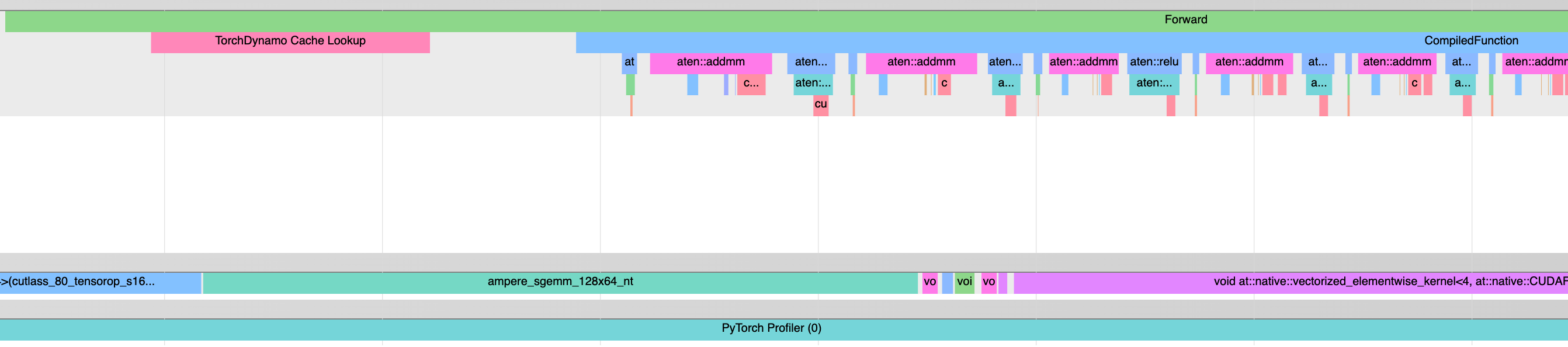
Adds a profiler start and end callback to dynamo's C eval_frame impl, which can be used to profile a region providing a name for visualization.  Currently only hooks up one usage to profile cache lookup (primarily covering guards and linear search through  linked list).

Example profile taken from toy model:
`python benchmarks/dynamo/distributed.py --toy_model --profile --dynamo aot_eager`
<img width="1342" alt="image" src="https://user-images.githubusercontent.com/4984825/223225931-b2f6c5a7-505a-4c90-9a03-34982f6dc033.png">

Planning to measure overhead in CI, and probably can't afford to check this in enabled by default.  Will have to evaluate UX options such as `config.profile_dynamo_cache = True` or some other way.

Pull Request resolved: https://github.com/pytorch/pytorch/pull/96119
Approved by: https://github.com/jansel
OK, so this PR used to be about reducing the number of constants we specialize on, but it turns out that unspecialization was ~essentially never used (because we still constant specialized way too aggressively) and I ended up having to fix a bunch of issues to actually get tests to pass. So this PR is now "make int unspecialization actually work". As part of this, I have to turn off unspecialization by default, as there are still latent bugs in inductor.

The general strategy is that an unspecialized int is represented as a SymInt. Representing it as a 0d tensor (which is what the code used to do) is untenable: (1) we often need unspecialized ints to participate in size computations, but we have no way of propagating sympy expressions through tensor compute, and (2) a lot of APIs work when passed SymInt, but not when passed a Tensor. However, I continue to represent Numpy scalars as Tensors, as they are rarely used for size computation and they have an explicit dtype, so they are more accurately modeled as 0d tensors.

* I folded in the changes from https://github.com/pytorch/pytorch/pull/95099 as I cannot represent unspecialized ints as SymInts without also turning on dynamic shapes. This also eliminates the necessity for test_unspec.py, as toggling specialization without dynamic shapes doesn't do anything. As dynamic shapes defaults to unspecializing, I just deleted this entirely; for the specialization case, I rely on regular static shape tests to catch it. (Hypothetically, we could also rerun all the tests with dynamic shapes, but WITH int/float specialization, but this seems... not that useful? I mean, I guess export wants it, but I'd kind of like our Source heuristic to improve enough that export doesn't have to toggle this either.)
* Only 0/1 integers get specialized by default now
* A hodgepodge of fixes. I'll comment on the PR about them.

Fixes https://github.com/pytorch/pytorch/issues/95469

Signed-off-by: Edward Z. Yang <ezyang@meta.com>

Pull Request resolved: https://github.com/pytorch/pytorch/pull/95621
Approved by: https://github.com/jansel, https://github.com/Chillee
This takes the strategy described in https://docs.google.com/document/d/1lFRYAJo5nrfxRhwIzGnfi2pbLpU6T4ytSRSuLJ5qebI/edit#

It is essentially https://github.com/pytorch/pytorch/pull/95222 but squashed and with changes that are unnecessary given that we assume nonzero returns > 1.

What's in the PR:

* nonzero now supports meta propagation. When `capture_dynamic_output_shape_ops`, it will return a tensor with an unbacked SymInt representing the size in question.
* The unbacked SymInt is UNSOUNDLY assumed to be not equal to 0/1. We will still error if you guard otherwise.
* PrimTorch pointwise operators are updated to use empty_permuted, to avoid guarding on unbacked SymInt from empty_strided (tested in `test_dynamic_pointwise_scalar`)
* Convolution is updated to skip backend selection if batch is unbacked, to avoid guarding on unbacked SymInt (tested in `test_unbacked_batch_resnet`)
* I kept the helper utilities like `definitely_true` for working with possibly unbacked SymInts. They're not used right now but maybe someone will find them useful.
* Added `constrain_unify` to let you specify two unbacked SymInts must have the same value

Signed-off-by: Edward Z. Yang <ezyang@meta.com>

Pull Request resolved: https://github.com/pytorch/pytorch/pull/95387
Approved by: https://github.com/voznesenskym
Summary:
There are a few races/permission errors in file creation, fixing
OSS:
1. caffe2/torch/_dynamo/utils.py, get_debug_dir: multiple process may conflict on it even it's using us. Adding pid to it
2. caffe2/torch/_dynamo/config.py: may not be a right assumption that we have permission to cwd

Test Plan: sandcastle

Differential Revision: D42905908

Pull Request resolved: https://github.com/pytorch/pytorch/pull/93407
Approved by: https://github.com/soumith, https://github.com/mlazos
Previously, Dynamo faked support for item() when `capture_scalar_outputs` was True by representing it internally as a Tensor. With dynamic shapes, this is no longer necessary; we can represent it directly as a SymInt/SymFloat. Do so. Doing this requires you to use dynamic shapes; in principle we could support scalar outputs WITHOUT dynamic shapes but I won't do this unless someone hollers for it.

Signed-off-by: Edward Z. Yang <ezyang@meta.com>

Differential Revision: [D42885775](https://our.internmc.facebook.com/intern/diff/D42885775)
Pull Request resolved: https://github.com/pytorch/pytorch/pull/93150
Approved by: https://github.com/voznesenskym
@mlazos: skips `item()` calls if compiling with dynamo, by defining a helper function `_get_value` which either returns the result of `.item()` or the scalar cpu tensor if compiling with dynamo. This was done because removing `item()` calls significantly regresses eager perf. Additionally, `_dispatch_sqrt` calls the appropriate sqrt function (math.sqrt, or torch.sqrt).

Fixes https://github.com/pytorch/torchdynamo/issues/1083

This PR will no longer be needed once symint support is default.

This PR closes all remaining graph breaks in the optimizers (!!)

Pull Request resolved: https://github.com/pytorch/pytorch/pull/88173
Approved by: https://github.com/albanD
- Adds `log_level` to aot's config
- Outputs log to `<graph_name>_<log_level>.log` in aot_torchinductor subfolder of the debug directory
- Modifies the Inductor debug context to use the graph name when naming the folder instead of the os pid
- Adds `TORCH_COMPILE_DEBUG` flag to enable it, (as well as separate dynamo and inductor logs)

Pull Request resolved: https://github.com/pytorch/pytorch/pull/88987
Approved by: https://github.com/Chillee
The old code didn't actually fakeify traceable tensor subclasses at the
time they are added as a GraphArg to the module; now we do, by ignoring
the subclass during fakeification and relying on Dynamo to simulate
the subclass on top.  See comments for more details.

BTW, this codepath is super broken, see filed issues linked on the
inside.

Signed-off-by: Edward Z. Yang <ezyang@fb.com>

Pull Request resolved: https://github.com/pytorch/pytorch/pull/90009
Approved by: https://github.com/wconstab, https://github.com/voznesenskym
Performance benchmarks on 6 popular models from 1-64 GPUs compiled with
torchinductor show performance gains or parity with eager, and showed
regressions without DDPOptimizer.  *Note: resnet50 with small batch size shows a regression with optimizer, in part due to failing to compile one subgraph due to input mutation, which will be fixed.
(hf_Bert, hf_T5_large, hf_T5, hf_GPT2_large, timm_vision_transformer, resnet50)

Correctness checks are implemented in CI (test_dynamo_distributed.py),
via single-gpu benchmark scripts iterating over many models
(benchmarks/dynamo/torchbench.py/timm_models.py/huggingface.py),
and via (multi-gpu benchmark scripts in torchbench)[https://github.com/pytorch/benchmark/tree/main/userbenchmark/ddp_experiments].

Pull Request resolved: https://github.com/pytorch/pytorch/pull/88523
Approved by: https://github.com/davidberard98
I noticed that a lot of bugs are being suppressed by torchdynamo's default
error suppression, and worse yet, there's no way to unsuppress them.  After
discussion with voz and soumith, we decided that we will unify error suppression
into a single option (suppress_errors) and default suppression to False.

If your model used to work and no longer works, try TORCHDYNAMO_SUPPRESS_ERRORS=1
to bring back the old suppression behavior.

Signed-off-by: Edward Z. Yang <ezyang@fb.com>

cc @jansel @lezcano @fdrocha @mlazos @soumith @voznesenskym @yanboliang
Pull Request resolved: https://github.com/pytorch/pytorch/pull/87440
Approved by: https://github.com/voznesenskym, https://github.com/albanD