Executorch currently uses functorch.functionalize API, as a result we have to invoke make_fx twice (one for filtering out autograd related stuff (happens in torchdynamo.export(aten=True) and one for tracing the functionalized version of the graph). The previous PR changes the make_fx behaviour to pass in fake tensors used in dynamo. But as Executorch invokes the second make_fx directly, we need to have access to fake tensors that dynamo used. We cannot call torchdynamo.export again in the second round because we don't have a way to functionalize inside dynamo at the moment. Hence I added this attribute in dynamo for now. Once we move to AOTAutograd functionalization, we don't have to deal with this anymore and I will remove this.

Differential Revision: [D43994692](https://our.internmc.facebook.com/intern/diff/D43994692)
Pull Request resolved: https://github.com/pytorch/pytorch/pull/96561
Approved by: https://github.com/zhxchen17, https://github.com/voznesenskym
The purpose of this API is to execute a few large components of work:

1) Refactor all the internals of plumbing dynamic dimension information after dynamo to be stateless
2) Decouple allocation controls around dynamic dimensions from verification
3) For (2), for allocation, create an enum that dictates whether we are in DUCK (default today), STATIC (aka assume_static_default in the past), or DYNAMIC (aka user constrained, do not duck shape)
4) For (2), for verification, we separate out the list of dynamic ranges entirely from allocation. This means shape_env does not tracking for what we verify on, and instead, it is the callers job to invoke produce_guards() with the various things they want verified, specifically, with the valid ranges. We do use constrain ranges to refine value ranges when doing analysis.
5) We have decided, therefore, as an extension of (4) to double down on "late" checks versus "eager" checks, primarily because the mechanisms for gathering what actually matters happens during guards, and should be a purview of the caller seeking guards, not the shape env. However, for dynamo, these structures are essentially one and the same.

Pull Request resolved: https://github.com/pytorch/pytorch/pull/96699
Approved by: https://github.com/avikchaudhuri, https://github.com/ezyang
`inspect.getfullargspec` does not properly handle functions/methods wrapped by functools.wraps(). As a result, it gets an empty list of `args` in FullArgSpec.

This PR rewrites the logic using `inspect.signature`, which handles functools.wraps() correctly.

Pull Request resolved: https://github.com/pytorch/pytorch/pull/96557
Approved by: https://github.com/jansel
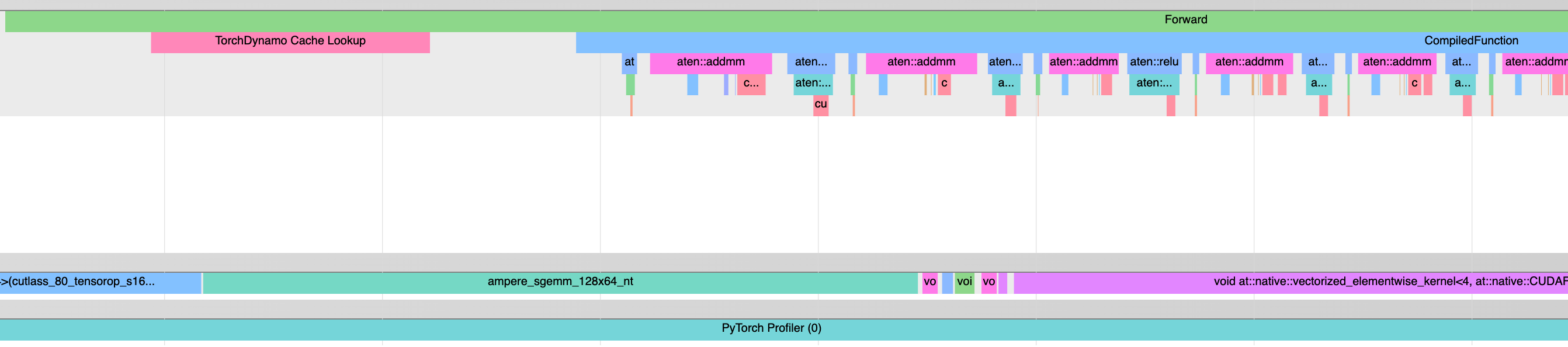
Adds a profiler start and end callback to dynamo's C eval_frame impl, which can be used to profile a region providing a name for visualization.  Currently only hooks up one usage to profile cache lookup (primarily covering guards and linear search through  linked list).

Example profile taken from toy model:
`python benchmarks/dynamo/distributed.py --toy_model --profile --dynamo aot_eager`
<img width="1342" alt="image" src="https://user-images.githubusercontent.com/4984825/223225931-b2f6c5a7-505a-4c90-9a03-34982f6dc033.png">

Planning to measure overhead in CI, and probably can't afford to check this in enabled by default.  Will have to evaluate UX options such as `config.profile_dynamo_cache = True` or some other way.

Pull Request resolved: https://github.com/pytorch/pytorch/pull/96119
Approved by: https://github.com/jansel
OK, so this PR used to be about reducing the number of constants we specialize on, but it turns out that unspecialization was ~essentially never used (because we still constant specialized way too aggressively) and I ended up having to fix a bunch of issues to actually get tests to pass. So this PR is now "make int unspecialization actually work". As part of this, I have to turn off unspecialization by default, as there are still latent bugs in inductor.

The general strategy is that an unspecialized int is represented as a SymInt. Representing it as a 0d tensor (which is what the code used to do) is untenable: (1) we often need unspecialized ints to participate in size computations, but we have no way of propagating sympy expressions through tensor compute, and (2) a lot of APIs work when passed SymInt, but not when passed a Tensor. However, I continue to represent Numpy scalars as Tensors, as they are rarely used for size computation and they have an explicit dtype, so they are more accurately modeled as 0d tensors.

* I folded in the changes from https://github.com/pytorch/pytorch/pull/95099 as I cannot represent unspecialized ints as SymInts without also turning on dynamic shapes. This also eliminates the necessity for test_unspec.py, as toggling specialization without dynamic shapes doesn't do anything. As dynamic shapes defaults to unspecializing, I just deleted this entirely; for the specialization case, I rely on regular static shape tests to catch it. (Hypothetically, we could also rerun all the tests with dynamic shapes, but WITH int/float specialization, but this seems... not that useful? I mean, I guess export wants it, but I'd kind of like our Source heuristic to improve enough that export doesn't have to toggle this either.)
* Only 0/1 integers get specialized by default now
* A hodgepodge of fixes. I'll comment on the PR about them.

Fixes https://github.com/pytorch/pytorch/issues/95469

Signed-off-by: Edward Z. Yang <ezyang@meta.com>

Pull Request resolved: https://github.com/pytorch/pytorch/pull/95621
Approved by: https://github.com/jansel, https://github.com/Chillee
This is WIP PR for adding torch.export API in OSS. Couple of points:
- I intentionally named it as experimental_export so that ppl don't get confused thinking this is our official API
- We don't plan to use AOTAutograd backend just yet. The reason we have it here is because the functionalization AOTAutograd uses is what we need for export (handling of param/buffer mutation etc). In the near future, I will extract the functionalization part and use it on top of make_fx. What we have right now is merely a placeholder.
- The reason we want to do it now is because we want to have some minimal tests running in OSS so that we can catch regressions earlier.

Pull Request resolved: https://github.com/pytorch/pytorch/pull/95070
Approved by: https://github.com/gmagogsfm, https://github.com/zhxchen17
Tweak dynamo behavior in 2 places when calling nn.Modules,
to route the call to __call__  instead of .forward(), since
__call__ is the codepath that eager users hit and will dispatch
to hooks correctly.
 (1) inside NNModuleVariable.call_function, which covers the common case
     of calling a module from code dynamo is already tracing
 (2) at the OptimizedModule layer, which is the entrypoint
     into a top-level nn.Module dynamo is about to compile

This exposes a new bug: NNModuleVariable used to special-case calling
module.forward() (which is a method) as a UserFunctionVariable with an extra
'self' arg.  After tracing into module.__call__, there is no longer a special
case for the eventual call into .forward, and it gets wrapped in a
UserDefinedObjectVariable following standard behavior of ._wrap().  UDOV can't be
called, so this broke some tests.

- Fix: add a new special case in _wrap() that treats methods as a UserDefinedMethod
  instead of UserDefinedObjectVariable.  Now, the forward method can be called.

Also, fix NNModuleVar.call_method routing forward back to __call__

Pull Request resolved: https://github.com/pytorch/pytorch/pull/92125
Approved by: https://github.com/ezyang, https://github.com/jansel, https://github.com/voznesenskym
Summary: We don't care about params/buffers being mutated in dynamo export, so it is safe to always convert them to faketensor

Test Plan: CI

Differential Revision: D42353789

Pull Request resolved: https://github.com/pytorch/pytorch/pull/91742
Approved by: https://github.com/qihqi