**Summary**: jit.trace usually adds shape information to all the jit::Values in its graph. This is mostly a side effect of how jit tracing is performed, but many users use this behavior for debugging and for better understanding the graph. Previously, CallFunction nodes (inserted by calling jit.script-ed functions) did _not_ have this information attached. This PR attaches this information for the tensor output values.

**Details**:
* First the jit tracer sets a global TracerState object
* Then the jit tracer invokes the python callable that is to be traced
* When the python function gets to a jit.script-ed function, [invokeScriptFunctionFromPython](8693604bc6/torch/csrc/jit/python/pybind_utils.h (L1060)) is called. It inserts a FunctionCall.
* Then after the actual scripted function gets called and we have a concrete output, we attach the concrete output [IValue to the TracerState](8693604bc6/torch/csrc/jit/python/pybind_utils.h (L1001))
* ^^ the setValueTrace call (linked in previous list item) is where this PR makes changes; we revise the jit::Value output of the CallFunction node to use the type of the concrete tensor, which will have actual shapes associated.

**Test**: added a test verifying that shape info appears in the output type for a CallFunction node in a jit-traced graph.

Differential Revision: [D43592880](https://our.internmc.facebook.com/intern/diff/D43592880)
Pull Request resolved: https://github.com/pytorch/pytorch/pull/95544
Approved by: https://github.com/qihqi
Hi!

I've been fuzzing different pytorch modules, and found a few crashes.

Proposed checks fixes multiple segmentation faults and heap buffer overflows that was found during fuzzing pytorch with [sydr-fuzz](https://github.com/ispras/oss-sydr-fuzz/tree/master/projects/pytorch).

### Crash files ###
1) Heap buffer overflow that leads to crash
[crash-842314913bf1820ec19cddfbb7400ffdbb756920.zip](https://github.com/pytorch/pytorch/files/9461316/crash-842314913bf1820ec19cddfbb7400ffdbb756920.zip)

```
  "AsanReport": [
    "==3751==ERROR: AddressSanitizer: heap-buffer-overflow on address 0x619000033478 at pc 0x0000005f9bc3 bp 0x7fffffff1eb0 sp 0x7fffffff1ea8\n",
    "READ of size 4 at 0x619000033478 thread T0\n",
    "[Detaching after fork from child process 3762]\n",
    "    #0 0x5f9bc2 in c10::IValue::IValue(c10::IValue&&) /pytorch_fuzz/aten/src/ATen/core/ivalue.h:192:43\n",
    "    #1 0x9ecd0a7 in torch::jit::pop(std::vector<c10::IValue, std::allocator<c10::IValue> >&) /pytorch_fuzz/aten/src/ATen/core/stack.h:102:12\n",
    "    #2 0x9ecd0a7 in torch::jit::Unpickler::readInstruction() /pytorch_fuzz/torch/csrc/jit/serialization/unpickler.cpp:380:17\n",
    "    #3 0x9ecafc7 in torch::jit::Unpickler::run() /pytorch_fuzz/torch/csrc/jit/serialization/unpickler.cpp:226:27\n",
    "    #4 0x9ecac62 in torch::jit::Unpickler::parse_ivalue() /pytorch_fuzz/torch/csrc/jit/serialization/unpickler.cpp:183:3\n",
    "    #5 0x9e45996 in torch::jit::unpickle(std::function<unsigned long (char*, unsigned long)>, std::function<c10::StrongTypePtr (c10::QualifiedName const&)>, c10::ArrayRef<at::Tensor>, c10::Type::SingletonOrSharedTypePtr<c10::Type> (*)(std::__cxx11::basic_string<char, std::char_traits<char>, std::allocator<char> > const&)) /pytorch_fuzz/torch/csrc/jit/serialization/pickle.cpp:127:20\n",
    "    #6 0x9e4626d in torch::jit::unpickle(char const*, unsigned long, std::function<c10::StrongTypePtr (c10::QualifiedName const&)>, c10::ArrayRef<at::Tensor>, c10::Type::SingletonOrSharedTypePtr<c10::Type> (*)(std::__cxx11::basic_string<char, std::char_traits<char>, std::allocator<char> > const&)) /pytorch_fuzz/torch/csrc/jit/serialization/pickle.cpp:137:10\n",
```

2) Segmentation fault
[crash-e690c58718e88921350562f0b4d9180938145d77.zip](https://github.com/pytorch/pytorch/files/9461331/crash-e690c58718e88921350562f0b4d9180938145d77.zip)

```
 "AsanReport": [
    "==3744==ERROR: AddressSanitizer: SEGV on unknown address (pc 0x000009122754 bp 0x7fffffff5290 sp 0x7fffffff5270 T0)\n",
    "==3744==The signal is caused by a READ memory access.\n",
    "==3744==Hint: this fault was caused by a dereference of a high value address (see register values below).  Disassemble the provided pc to learn which register was used.\n",
    "[Detaching after fork from child process 3763]\n",
    "    #0 0x9122754 in c10::intrusive_ptr<torch::jit::Tree, c10::detail::intrusive_target_default_null_type<torch::jit::Tree> >::retain_() /pytorch_fuzz/c10/util/intrusive_ptr.h:269:54\n",
    "    #1 0x9127929 in c10::intrusive_ptr<torch::jit::Tree, c10::detail::intrusive_target_default_null_type<torch::jit::Tree> >::intrusive_ptr(c10::intrusive_ptr<torch::jit::Tree, c10::detail::intrusive_target_default_null_type<torch::jit::Tree> > const&) /pytorch_fuzz/c10/util/intrusive_ptr.h:352:5\n",
    "    #2 0x9127929 in torch::jit::Expr::Expr(c10::intrusive_ptr<torch::jit::Tree, c10::detail::intrusive_target_default_null_type<torch::jit::Tree> > const&) /pytorch_fuzz/torch/csrc/jit/frontend/tree_views.h:269:49\n",
    "    #3 0x91b1bbb in torch::jit::Maybe<torch::jit::Expr>::get() const /pytorch_fuzz/torch/csrc/jit/frontend/tree_views.h:211:12\n",
    "    #4 0x92a8f74 in torch::jit::ScriptTypeParser::parseClassConstant(torch::jit::Assign const&) /pytorch_fuzz/torch/csrc/jit/frontend/script_type_parser.cpp:461:41\n",
    "    #5 0x9e1c09b in torch::jit::SourceImporterImpl::importClass(c10::QualifiedName const&, torch::jit::ClassDef const&, bool) /pytorch_fuzz/torch/csrc/jit/serialization/import_source.cpp:549:34\n",
    "    #6 0x9e13f00 in torch::jit::SourceImporterImpl::importNamedType(std::__cxx11::basic_string<char, std::char_traits<char>, std::allocator<char> > const&, torch::jit::ClassDef const&) /pytorch_fuzz/torch/csrc/jit/serialization/import_source.cpp:288:5\n",
    "    #7 0x9e11fbc in torch::jit::SourceImporterImpl::findNamedType(c10::QualifiedName const&) /pytorch_fuzz/torch/csrc/jit/serialization/import_source.cpp:140:5\n",
```

3) Unhandled out of bounds access in a vector
[crash-ccd524e7ba19a37982dd91e0d6fc06bb26dd0b10.zip](https://github.com/pytorch/pytorch/files/9461367/crash-ccd524e7ba19a37982dd91e0d6fc06bb26dd0b10.zip)

```
  "AsanReport": [
    "==3792== ERROR: libFuzzer: deadly signal\n",
    "[Detaching after fork from child process 3809]\n",
    "    #0 0x59cc11 in __sanitizer_print_stack_trace /llvm-project/compiler-rt/lib/asan/asan_stack.cpp:87:3\n",
    "    #1 0x511547 in fuzzer::PrintStackTrace() /llvm-project/compiler-rt/lib/fuzzer/FuzzerUtil.cpp:210:5\n",
    "    #2 0x4f7753 in fuzzer::Fuzzer::CrashCallback() /llvm-project/compiler-rt/lib/fuzzer/FuzzerLoop.cpp:233:3\n",
    "    #3 0x7ffff7c6741f  (/lib/x86_64-linux-gnu/libpthread.so.0+0x1441f)\n",
    "    #4 0x7ffff7a8700a in __libc_signal_restore_set /build/glibc-SzIz7B/glibc-2.31/signal/../sysdeps/unix/sysv/linux/internal-signals.h:86:3\n",
    "    #5 0x7ffff7a8700a in raise /build/glibc-SzIz7B/glibc-2.31/signal/../sysdeps/unix/sysv/linux/raise.c:48:3\n",
    "    #6 0x7ffff7a66858 in abort /build/glibc-SzIz7B/glibc-2.31/stdlib/abort.c:79:7\n",
    "    #7 0x7ffff7e73910  (/lib/x86_64-linux-gnu/libstdc++.so.6+0x9e910)\n",
    "    #8 0x7ffff7e7f38b  (/lib/x86_64-linux-gnu/libstdc++.so.6+0xaa38b)\n",
    "    #9 0x7ffff7e7f3f6 in std::terminate() (/lib/x86_64-linux-gnu/libstdc++.so.6+0xaa3f6)\n",
    "    #10 0x7ffff7e7f6a8 in __cxa_throw (/lib/x86_64-linux-gnu/libstdc++.so.6+0xaa6a8)\n",
    "    #11 0x7ffff7e763aa  (/lib/x86_64-linux-gnu/libstdc++.so.6+0xa13aa)\n",
    "    #12 0x6aeedf in std::vector<c10::IValue, std::allocator<c10::IValue> >::_M_range_check(unsigned long) const /usr/bin/../lib/gcc/x86_64-linux-gnu/10/../../../../include/c++/10/bits/stl_vector.h:1073:4\n",
    "    #13 0x9ecd66c in torch::jit::Unpickler::readInstruction() /pytorch_fuzz/torch/csrc/jit/serialization/unpickler.cpp\n",
    "    #14 0x9ecafc7 in torch::jit::Unpickler::run() /pytorch_fuzz/torch/csrc/jit/serialization/unpickler.cpp:226:27\n",
    "    #15 0x9ecac62 in torch::jit::Unpickler::parse_ivalue() /pytorch_fuzz/torch/csrc/jit/serialization/unpickler.cpp:183:3\n",
```

Some other crashes found by fuzzer:
[crash-0cab888cbd1e9fea92ab6ddeadf40b958b87d62b.zip](https://github.com/pytorch/pytorch/files/9461406/crash-0cab888cbd1e9fea92ab6ddeadf40b958b87d62b.zip)
[crash-04c9ba8e3b0f15028fd0fb0ed014fd352e182a1d.zip](https://github.com/pytorch/pytorch/files/9461407/crash-04c9ba8e3b0f15028fd0fb0ed014fd352e182a1d.zip)
[crash-422ad8c3a3472980ba751f4c7f79cf2b53e49927.zip](https://github.com/pytorch/pytorch/files/9461408/crash-422ad8c3a3472980ba751f4c7f79cf2b53e49927.zip)

### How to reproduce ###

1. To reproduce the crashes, use provided docker: [Dockerfile](https://github.com/ispras/oss-sydr-fuzz/blob/master/projects/pytorch/Dockerfile)

2. Build the container: `docker build -t oss-sydr-fuzz-pytorch-reproduce .`

3. Copy crash file to the current directory

4. Run the container: `` docker run --privileged --network host -v `pwd`:/homedir --rm -it oss-sydr-fuzz-pytorch-reproduce /bin/bash ``

5. And execute fuzz-targets with provided crash-files.

After execution completes you will see ASAN reports.
Pull Request resolved: https://github.com/pytorch/pytorch/pull/94815
Approved by: https://github.com/davidberard98
Hi!

I've been fuzzing different pytorch modules, and found a few crashes.

Specifically, I'm talking about `schema_type_parser.cpp` and `irparser.cpp`. Inside these files, different standard conversion functions are used (such as `stoll`, `stoi`, `stod`, `stoull`). However, default `std` exceptions, such as `std::out_of_range`, `std::invalid_argument`, are not handled.

Some of the crash-files:

1. [crash-493db74c3426e79b2bf0ffa75bb924503cb9acdc.zip](https://github.com/pytorch/pytorch/files/10237616/crash-493db74c3426e79b2bf0ffa75bb924503cb9acdc.zip) - crash source: schema_type_parser.cpp:272

2. [crash-67bb5d34ca48235687cc056e2cdeb2476b8f4aa5.zip](https://github.com/pytorch/pytorch/files/10237618/crash-67bb5d34ca48235687cc056e2cdeb2476b8f4aa5.zip) - crash source: schema_type_parser.cpp:240

3. [crash-0157bca5c41bffe112aa01f3b0f2099ca4bcc62f.zip](https://github.com/pytorch/pytorch/files/10307970/crash-0157bca5c41bffe112aa01f3b0f2099ca4bcc62f.zip) - crash source: schema_type_parser.cpp:179

4. [crash-430da923e56adb9569362efa7fa779921371b710.zip](https://github.com/pytorch/pytorch/files/10307972/crash-430da923e56adb9569362efa7fa779921371b710.zip) - crash source: schema_type_parser.cpp:196

The provided patch adds exception handlers for `std::invalid_argument` and `std::out_of_range`, to rethrow these exceptions with `ErrorReport`.

### How to reproduce

1. To reproduce the crash, use provided docker: [Dockerfile](https://github.com/ispras/oss-sydr-fuzz/blob/master/projects/pytorch/Dockerfile)

2. Build the container: `docker build -t oss-sydr-fuzz-pytorch-reproduce .`

3. Copy crash file to the current directory

5. Run the container: ``docker run --privileged --network host -v `pwd`:/homedir --rm -it oss-sydr-fuzz-pytorch-reproduce /bin/bash``

6. And execute the binary: `/irparser_fuzz /homedir/crash-67bb5d34ca48235687cc056e2cdeb2476b8f4aa5`

After execution completes you will see this error message:

```txt
terminate called after throwing an instance of 'std::out_of_range'
  what():  stoll
```

And this stacktrace:

```asan
==9626== ERROR: libFuzzer: deadly signal
    #0 0x5b4cf1 in __sanitizer_print_stack_trace /llvm-project/compiler-rt/lib/asan/asan_stack.cpp:87:3
    #1 0x529627 in fuzzer::PrintStackTrace() /llvm-project/compiler-rt/lib/fuzzer/FuzzerUtil.cpp:210:5
    #2 0x50f833 in fuzzer::Fuzzer::CrashCallback() /llvm-project/compiler-rt/lib/fuzzer/FuzzerLoop.cpp:233:3
    #3 0x7ffff7c3741f  (/lib/x86_64-linux-gnu/libpthread.so.0+0x1441f)
    #4 0x7ffff7a5700a in raise (/lib/x86_64-linux-gnu/libc.so.6+0x4300a)
    #5 0x7ffff7a36858 in abort (/lib/x86_64-linux-gnu/libc.so.6+0x22858)
    #6 0x7ffff7e74910  (/lib/x86_64-linux-gnu/libstdc++.so.6+0x9e910)
    #7 0x7ffff7e8038b  (/lib/x86_64-linux-gnu/libstdc++.so.6+0xaa38b)
    #8 0x7ffff7e803f6 in std::terminate() (/lib/x86_64-linux-gnu/libstdc++.so.6+0xaa3f6)
    #9 0x7ffff7e806a8 in __cxa_throw (/lib/x86_64-linux-gnu/libstdc++.so.6+0xaa6a8)
    #10 0x7ffff7e7737d in std::__throw_out_of_range(char const*) (/lib/x86_64-linux-gnu/libstdc++.so.6+0xa137d)
    #11 0xbd0579 in long long __gnu_cxx::__stoa<long long, long long, char, int>(long long (*)(char const*, char**, int), char const*, char const*, unsigned long*, int) /usr/bin/../lib/gcc/x86_64-linux-gnu/10/../../../../include/c++/10/ext/string_conversions.h:86:2
    #12 0xc10f9c in std::__cxx11::stoll(std::__cxx11::basic_string<char, std::char_traits<char>, std::allocator<char> > const&, unsigned long*, int) /usr/bin/../lib/gcc/x86_64-linux-gnu/10/../../../../include/c++/10/bits/basic_string.h:6572:12
    #13 0xc10f9c in torch::jit::SchemaTypeParser::parseRefinedTensor()::$_2::operator()() const::'lambda'()::operator()() const /pytorch_fuzz/torch/csrc/jit/frontend/schema_type_parser.cpp:240:25
    #14 0xc10f9c in void c10::function_ref<void ()>::callback_fn<torch::jit::SchemaTypeParser::parseRefinedTensor()::$_2::operator()() const::'lambda'()>(long) /pytorch_fuzz/c10/util/FunctionRef.h:43:12
    #15 0xbfbb27 in torch::jit::SchemaTypeParser::parseList(int, int, int, c10::function_ref<void ()>) /pytorch_fuzz/torch/csrc/jit/frontend/schema_type_parser.cpp:424:7
    #16 0xc0ef24 in torch::jit::SchemaTypeParser::parseRefinedTensor()::$_2::operator()() const /pytorch_fuzz/torch/csrc/jit/frontend/schema_type_parser.cpp:236:9
    #17 0xc0ef24 in void c10::function_ref<void ()>::callback_fn<torch::jit::SchemaTypeParser::parseRefinedTensor()::$_2>(long) /pytorch_fuzz/c10/util/FunctionRef.h:43:12
    #18 0xbfbb27 in torch::jit::SchemaTypeParser::parseList(int, int, int, c10::function_ref<void ()>) /pytorch_fuzz/torch/csrc/jit/frontend/schema_type_parser.cpp:424:7
    #19 0xbff590 in torch::jit::SchemaTypeParser::parseRefinedTensor() /pytorch_fuzz/torch/csrc/jit/frontend/schema_type_parser.cpp:209:3
    #20 0xc02992 in torch::jit::SchemaTypeParser::parseType() /pytorch_fuzz/torch/csrc/jit/frontend/schema_type_parser.cpp:362:13
    #21 0x9445642 in torch::jit::IRParser::parseVarWithType(bool) /pytorch_fuzz/torch/csrc/jit/ir/irparser.cpp:111:35
    #22 0x944ff4c in torch::jit::IRParser::parseOperatorOutputs(std::vector<torch::jit::VarWithType, std::allocator<torch::jit::VarWithType> >*)::$_0::operator()() const /pytorch_fuzz/torch/csrc/jit/ir/irparser.cpp:138:21
    #23 0x944ff4c in void std::__invoke_impl<void, torch::jit::IRParser::parseOperatorOutputs(std::vector<torch::jit::VarWithType, std::allocator<torch::jit::VarWithType> >*)::$_0&>(std::__invoke_other, torch::jit::IRParser::parseOperatorOutputs(std::vector<torch::jit::VarWithType, std::allocator<torch::jit::VarWithType> >*)::$_0&) /usr/bin/../lib/gcc/x86_64-linux-gnu/10/../../../../include/c++/10/bits/invoke.h:60:14
    #24 0x94463a7 in torch::jit::IRParser::parseList(int, int, int, std::function<void ()> const&) /pytorch_fuzz/torch/csrc/jit/ir/irparser.cpp:498:7
    #25 0x94460a5 in torch::jit::IRParser::parseOperatorOutputs(std::vector<torch::jit::VarWithType, std::allocator<torch::jit::VarWithType> >*) /pytorch_fuzz/torch/csrc/jit/ir/irparser.cpp:137:3
    #26 0x944c1ce in torch::jit::IRParser::parseOperator(torch::jit::Block*) /pytorch_fuzz/torch/csrc/jit/ir/irparser.cpp:384:3
    #27 0x944bf56 in torch::jit::IRParser::parseOperatorsList(torch::jit::Block*) /pytorch_fuzz/torch/csrc/jit/ir/irparser.cpp:362:5
    #28 0x9444f5f in torch::jit::IRParser::parse() /pytorch_fuzz/torch/csrc/jit/ir/irparser.cpp:482:3
    #29 0x94448df in torch::jit::parseIR(std::__cxx11::basic_string<char, std::char_traits<char>, std::allocator<char> > const&, torch::jit::Graph*, std::unordered_map<std::__cxx11::basic_string<char, std::char_traits<char>, std::allocator<char> >, torch::jit::Value*, std::hash<std::__cxx11::basic_string<char, std::char_traits<char>, std::allocator<char> > >, std::equal_to<std::__cxx11::basic_string<char, std::char_traits<char>, std::allocator<char> > >, std::allocator<std::pair<std::__cxx11::basic_string<char, std::char_traits<char>, std::allocator<char> > const, torch::jit::Value*> > >&) /pytorch_fuzz/torch/csrc/jit/ir/irparser.cpp:94:5
    #30 0x944526e in torch::jit::parseIR(std::__cxx11::basic_string<char, std::char_traits<char>, std::allocator<char> > const&, torch::jit::Graph*) /pytorch_fuzz/torch/csrc/jit/ir/irparser.cpp:99:3
    #31 0x5e3ebd in LLVMFuzzerTestOneInput /irparser_fuzz.cc:43:5
    #32 0x510d61 in fuzzer::Fuzzer::ExecuteCallback(unsigned char const*, unsigned long) /llvm-project/compiler-rt/lib/fuzzer/FuzzerLoop.cpp:611:15
    #33 0x4fac7c in fuzzer::RunOneTest(fuzzer::Fuzzer*, char const*, unsigned long) /llvm-project/compiler-rt/lib/fuzzer/FuzzerDriver.cpp:324:6
    #34 0x5009cb in fuzzer::FuzzerDriver(int*, char***, int (*)(unsigned char const*, unsigned long)) /llvm-project/compiler-rt/lib/fuzzer/FuzzerDriver.cpp:860:9
    #35 0x529f62 in main /llvm-project/compiler-rt/lib/fuzzer/FuzzerMain.cpp:20:10
    #36 0x7ffff7a38082 in __libc_start_main (/lib/x86_64-linux-gnu/libc.so.6+0x24082)
    #37 0x4f559d in _start (/irparser_fuzz+0x4f559d)

```

Following these steps with the remaining crashes will give you almost the same results.
Pull Request resolved: https://github.com/pytorch/pytorch/pull/94295
Approved by: https://github.com/davidberard98
We want to make TorchRec sharded models TorchScriptable.

TorchRec sharded models uses generic types Awaitable[W] and LazyAwaitable[W] (https://github.com/pytorch/torchrec/blob/main/torchrec/distributed/types.py#L212).
In sharded model those types are used instead of contained type W, having the initialization function that produces object of type W.

At the moment when the first attribute of W is requested - `LazyAwaitable[W]` will call its initialization function (on the same stack), cache the result inside and work transparently as an object of W. So we can think about it as a delayed object initialization.

To support this behavior in TorchScript - we propose a new type to TorchScript - `Await`.
In eager mode it works the same as `LazyAwaitable[W]` in TorchRec, being dynamically typed - acting as a type `W` while it is `Await[W]`.

Within torchscript it is `Await[W]` and can be only explicitly converted to W, using special function `torch.jit.awaitable_wait(aw)`.
Creation of this `Await[W]` is done via another special function `torch.jit.awaitable(func, *args)`.

The semantic is close to `torch.jit.Future`, fork, wait and uses the same jit mechanics (inline fork Closures) with the difference that it does not start this function in parallel on fork. It only stores as a lambda inside IValue that will be called on the same thread when `torch.jit.awaitable_wait` is called.

For example (more examples in this PR `test/jit/test_await.py`)
```
      def delayed(z: Tensor) -> Tensor:
          return Tensor * 3

      @torch.jit.script
      def fn(x: Tensor):
          aw: Await[int] = torch.jit._awaitable(delayed, 99)
          a = torch.eye(2)
          b = torch.jit._awaitable_wait(aw)
          return a + b + x
```

Functions semantics:

`_awaitable(func -> Callable[Tuple[...], W], *args, **kwargs) -> Await[W]`

Creates Await object, owns args and kwargs. Once _awaitable_wait calls, executes function func and owns the result of the function. Following _awaitable_wait calls will return this result from the first function call.

`_awaitable_wait(Await[W]) -> W`
Returns either cached result of W if it is not the first _awaitable_wait call to this Await object or calls specified function if the first.

`_awaitable_nowait(W) -> Await[W]`

Creates trivial Await[W] wrapper on specified object To be type complaint for the corner cases.

Differential Revision: [D42502706](https://our.internmc.facebook.com/intern/diff/D42502706)
Pull Request resolved: https://github.com/pytorch/pytorch/pull/90863
Approved by: https://github.com/davidberard98
Not only is this change usually shorter and more readable, it also can yield better performance. size() is not always a constant time operation (such as on LinkedLists), but empty() always is.

Pull Request resolved: https://github.com/pytorch/pytorch/pull/93236
Approved by: https://github.com/malfet
As we live in C++17 world

This is a functional no-op, just
- `s/namespace at { namespace native {/namespace at::native {/`
- `s/namespace torch { namespace jit {/namespace torch::jit {/`

Pull Request resolved: https://github.com/pytorch/pytorch/pull/92100
Approved by: https://github.com/izaitsevfb
#75854

A naive attempt at working around the limitations of using a single 64-bit integer to pack `stream_id`, `device_index`, and `device_type`.

Stills needs sanity checks, testing, and minimization of BC-breaking changes.

Currently a Holder for the `StreamData3` struct is used for `IValue` compatibility. While doing this seems to work for `ivalue.h` and `ivalue_inl.h`, this doesn't seem to be naively working for the JIT CUDA stream wrapper? (Something about ambiguous calls if an `intrusive_ptr` to `c10::ivalue::StreamData3Holder` is used as the return type for `pack()`. It turns out that the methods required to access the fields for rematerializing a CUDA Stream are basically already present anyway, so `pack` is simply removed in the wrapper for now and the methods to access the required fields are called directly.

CC @ptrblck

Pull Request resolved: https://github.com/pytorch/pytorch/pull/81596
Approved by: https://github.com/ezyang
Applies so more fixes to headers that may have been missed before for performance optimization.cc @jgong5 @mingfeima @XiaobingSuper @sanchitintel @ashokei @jingxu10 @EikanWang @ezyang since this more in the series of the clang-tidy fixup

This is PR fixes 3 main issues:
1. Use emplacement more in headers
1. Avoid unnecessary copies and use const ref when possible
1. Default any special functions when possible to make them potentially trivial and more readable.
1. There is also one change in this PR that tries to prevent unnecessary math promotion, the rest of these changes are in another PR
Pull Request resolved: https://github.com/pytorch/pytorch/pull/91445
Approved by: https://github.com/ezyang
Apply clang-tidy check modernize-use-emplace. This is slightly more efficient by using an inplace constructor and is the recommended style in parts of the codebase covered by clang-tidy. This just manually applies the check to rest of the codebase. Pinging @ezyang as this is related to my other PRs he reviewed like #89000

Pull Request resolved: https://github.com/pytorch/pytorch/pull/91077
Approved by: https://github.com/ezyang
This makes it easier to narrow down who is throwing the error,
instead of having to use gdb.

Signed-off-by: Edward Z. Yang <ezyang@fb.com>
Differential Revision: [D42088781](https://our.internmc.facebook.com/intern/diff/D42088781)
Applies various automated fixes that reduces the number of spurious copies in torch, aten, and c10. I also inlined any default dtors that would have made the type trivially destructible.

Follow up to #89000

Pull Request resolved: https://github.com/pytorch/pytorch/pull/90629
Approved by: https://github.com/ezyang
Introduce `_eval_no_call` method, that evaluates statement only if it
does not contain any calls(done by examining the bytecode), thus preventing command injection exploit

Added simple unit test to check for that
`torch.jit.annotations.get_signature` would not result in calling random
code.

Although, this code path exists for Python-2 compatibility, and perhaps
should be simply removed.

Fixes https://github.com/pytorch/pytorch/issues/88868

Pull Request resolved: https://github.com/pytorch/pytorch/pull/89189
Approved by: https://github.com/suo
Partially fixes: #66328

This PR:
- adds support for `ITensorList` to the dispatcher for:
  - computing the dispatch key
  - boxing and unboxing `ITensorList`
- modified the codegen for structured kernels:
  - codegen APIs use `ITensorList` instead of `ArrayRef<Tensor>`

**Changes summary:**

- Signature changes due to the different APIs:
  - dispatcher API (e.g. `BatchingRegistrations.cpp`)
  - C++ API (e.g. `TensorShape.cpp`)
- Miscelaneous functions used by codegen'd functions (e.g. `FunctionalTensorWrapper.*`)
- Dispatcher changes for handling `ITensorList` correctly (e.g. `DispatchKeyExtractor.h`)
- Signature changes of `at::cat` due to the need of `const` inside `TensorBody.h`
- Forward declarations of `ITensorList` (e.g. `MethodOperators.h`)
- Codegen changes, special casing structured kernels (e.g. `gen.py`)

**Short description of structured kernels special casing:**

I introduced, mainly, 5 types of changes to the codegen for generating code depending on
whether the kernel is structured or not:

1. Added a `structured_type_override` flag to the `argument_type` function definition of
the affected APIs (mainly the dispatcher and C++ APIs).
  - `api/cpp.py`, `api/dispatcher.py`, `api/native.py`
2. Added a `structured_type_override` member to the signature
classes (e.g. `CppSignature`), since `FunctionSchema` doesn't really know whether the
function is structured or not
  - `api/types.py`
3. Added a `part_of_structured_group` to `NativeFunction` class, which is just a
convenient function to forward to `structured_type_override` wherever needed
  - `model.py`
4. Appropriately changed the rest of the codegen, whenever it used either the signature
classes or the `arguments` function directly
5. Added a check for `const ITensorList&` type wherever there was a check for `TensorList`
Pull Request resolved: https://github.com/pytorch/pytorch/pull/73350
Approved by: https://github.com/bdhirsh
Also Back out "Revert D39075159: [acc_tensor] Use SymIntArrayRef for overloaded empty.memory_format's signature"

Original commit changeset: dab4a9dba4fa
Original commit changeset: dcaf16c037a9

Original Phabricator Diff: D38984222
Original Phabricator Diff: D39075159

Also update Metal registrations for C++ registration changes.

Also update NNPI registration to account for tightened schema checking

Differential Revision: [D39084762](https://our.internmc.facebook.com/intern/diff/D39084762/)

**NOTE FOR REVIEWERS**: This PR has internal Facebook specific changes or comments, please review them on [Phabricator](https://our.internmc.facebook.com/intern/diff/D39084762/)!
Pull Request resolved: https://github.com/pytorch/pytorch/pull/84173
Approved by: https://github.com/Krovatkin
Previously, we introduced new SymInt overloads for every function we wanted.  This led to a lot of boilerplate, and also a lot of confusion about how the overloads needed to be implemented.

This PR takes a simpler but more risky approach: just take the original function and changes its ints to SymInts.

This is BC-breaking in the following ways:

* The C++ API for registering implementations for aten operators will change from int64_t to SymInt whenever you make this change. Code generated registrations in PyTorch do not change as codegen handles the translation automatically, but manual registrations will need to follow the change.  Typically, if you now accept a SymInt where you previously only took int64_t, you have to convert it back manually.  This will definitely break XLA, see companion PR https://github.com/pytorch/xla/pull/3914 Note that not all dispatch keys get the automatic translation; all the composite keys and Meta keys are modified to take SymInt directly (because they should handle them directly), and so there are adjustments for this.

This is not BC-breaking in the following ways:

* The user facing C++ API remains compatible.  Even if a function changes from int to SymInt, the default C++ binding still takes only ints.  (e.g., at::empty(IntArrayRef, ...).  To call with SymInts, you must call at::empty_symint instead. This involved adding two more signatures to CppSignatureGroup; in many cases I refactored code to iterate over all signatures in the group instead of hard-coding the two that previously existed.
* This is TorchScript compatible; internally we treat SymInts as ints so there is no change to what happens at runtime in TorchScript. In particular, it's OK to reference an empty schema by its old type (using int types), as long as you're not doing string equality (which you shouldn't be), these parse to the same underyling type.

Structure of the PR:

* The general strategy of this PR is that, even when you write `SymInt` inside `native_functions.yaml`, sometimes, we will treat it *as if* it were an `int`. This idea pervades the codegen changes, where we have a translation from SymInt to c10::SymInt or int64_t, and this is controlled by a symint kwarg which I added and then audited all call sites to decide which I wanted. Here are some of the major places where we pick one or the other:
  * The C++ FunctionSchema representation represents `SymInt` as `int`. There are a few places we do need to know that we actually have a SymInt and we consult `real_type()` to get the real type in this case. In particular:
    * When we do schema validation of C++ operator registration, we must compare against true schema (as the C++ API will provide `c10::SymInt`, and this will only be accepted if the schema is `SymInt`. This is handled with cloneWithRealTypes before we check for schema differences.
    * In `toIValue` argument parsing, we parse against the true schema value. For backwards compatibility reasons, I do still accept ints in many places where Layout/SymInt/etc were expected. (Well, accepting int where SymInt is expected is not BC, it's just the right logic!)
  * In particular, because SymInt never shows up as type() in FunctionSchema, this means that we no longer need a dedicated Tag::SymInt. This is good, because SymInts never show up in mobile anyway.
* Changes to functorch/aten are mostly about tracking changes to the C++ API registration convention. Additionally, since SymInt overloads no longer exist, registrations for SymInt implementations are deleted. In many cases, the old implementations did not properly support SymInts; I did not add any new functionality with this PR, but I did try to annotate with TODOs where this is work to do. Finally, because the signature of `native::` API changed from int to SymInt, I need to find alternative APIs for people who were directly calling these functions to call. Typically, I insert a new dispatch call when perf doesn't matter, or use `at::compositeexplicitautograd` namespace to handle other caes.
* The change to `make_boxed_from_unboxed_functor.h` is so that we accept a plain IntList IValue anywhere a SymIntList is expected; these are read-only arguments so covariant typing is OK.
* I change how unboxing logic works slightly. Previously, we interpret the C++ type for Layout/etc directly as IntType JIT type, which works well because the incoming IValue is tagged as an integer. Now, we interpret the C++ type for Layout as its true type, e.g., LayoutType (change to `jit_type.h`), but then we accept an int IValue for it anyway. This makes it symmetric with SymInt, where we interpret the C++ type as SymIntType, and then accept SymInt and int IValues for it.
* I renamed the `empty.names` overload to `empty_names` to make it less confusing (I kept mixing it up with the real empty overload)
* I deleted the `empty.SymInt` overload, which ended up killing a pile of functions. (This was originally a separate PR but the profiler expect test was giving me grief so I folded it in.)
* I deleted the LazyDynamicOpsTest tests. These were failing after these changes, and I couldn't figure out why they used to be passing: they make use of `narrow_copy` which didn't actually support SymInts; they were immediately converted to ints.
* I bashed LTC into working. The patches made here are not the end of the story. The big problem is that SymInt translates into Value, but what if you have a list of SymInt? This cannot be conveniently represented in the IR today, since variadic Values are not supported. To work around this, I translate SymInt[] into plain int[] (this is fine for tests because LTC dynamic shapes never actually worked); but this will need to be fixed for proper LTC SymInt support. The LTC codegen also looked somewhat questionable; I added comments based on my code reading.

Signed-off-by: Edward Z. Yang <ezyang@fb.com>
Pull Request resolved: https://github.com/pytorch/pytorch/pull/83628
Approved by: https://github.com/albanD, https://github.com/bdhirsh
Previously, we introduced new SymInt overloads for every function we wanted.  This led to a lot of boilerplate, and also a lot of confusion about how the overloads needed to be implemented.

This PR takes a simpler but more risky approach: just take the original function and changes its ints to SymInts.

This is BC-breaking in the following ways:

* The C++ API for registering implementations for aten operators will change from int64_t to SymInt whenever you make this change. Code generated registrations in PyTorch do not change as codegen handles the translation automatically, but manual registrations will need to follow the change.  Typically, if you now accept a SymInt where you previously only took int64_t, you have to convert it back manually.  This will definitely break XLA, see companion PR https://github.com/pytorch/xla/pull/3914 Note that not all dispatch keys get the automatic translation; all the composite keys and Meta keys are modified to take SymInt directly (because they should handle them directly), and so there are adjustments for this.

This is not BC-breaking in the following ways:

* The user facing C++ API remains compatible.  Even if a function changes from int to SymInt, the default C++ binding still takes only ints.  (e.g., at::empty(IntArrayRef, ...).  To call with SymInts, you must call at::empty_symint instead. This involved adding two more signatures to CppSignatureGroup; in many cases I refactored code to iterate over all signatures in the group instead of hard-coding the two that previously existed.
* This is TorchScript compatible; internally we treat SymInts as ints so there is no change to what happens at runtime in TorchScript. In particular, it's OK to reference an empty schema by its old type (using int types), as long as you're not doing string equality (which you shouldn't be), these parse to the same underyling type.

Structure of the PR:

* The general strategy of this PR is that, even when you write `SymInt` inside `native_functions.yaml`, sometimes, we will treat it *as if* it were an `int`. This idea pervades the codegen changes, where we have a translation from SymInt to c10::SymInt or int64_t, and this is controlled by a symint kwarg which I added and then audited all call sites to decide which I wanted. Here are some of the major places where we pick one or the other:
  * The C++ FunctionSchema representation represents `SymInt` as `int`. There are a few places we do need to know that we actually have a SymInt and we consult `real_type()` to get the real type in this case. In particular:
    * When we do schema validation of C++ operator registration, we must compare against true schema (as the C++ API will provide `c10::SymInt`, and this will only be accepted if the schema is `SymInt`. This is handled with cloneWithRealTypes before we check for schema differences.
    * In `toIValue` argument parsing, we parse against the true schema value. For backwards compatibility reasons, I do still accept ints in many places where Layout/SymInt/etc were expected. (Well, accepting int where SymInt is expected is not BC, it's just the right logic!)
  * In particular, because SymInt never shows up as type() in FunctionSchema, this means that we no longer need a dedicated Tag::SymInt. This is good, because SymInts never show up in mobile anyway.
* Changes to functorch/aten are mostly about tracking changes to the C++ API registration convention. Additionally, since SymInt overloads no longer exist, registrations for SymInt implementations are deleted. In many cases, the old implementations did not properly support SymInts; I did not add any new functionality with this PR, but I did try to annotate with TODOs where this is work to do. Finally, because the signature of `native::` API changed from int to SymInt, I need to find alternative APIs for people who were directly calling these functions to call. Typically, I insert a new dispatch call when perf doesn't matter, or use `at::compositeexplicitautograd` namespace to handle other caes.
* The change to `make_boxed_from_unboxed_functor.h` is so that we accept a plain IntList IValue anywhere a SymIntList is expected; these are read-only arguments so covariant typing is OK.
* I change how unboxing logic works slightly. Previously, we interpret the C++ type for Layout/etc directly as IntType JIT type, which works well because the incoming IValue is tagged as an integer. Now, we interpret the C++ type for Layout as its true type, e.g., LayoutType (change to `jit_type.h`), but then we accept an int IValue for it anyway. This makes it symmetric with SymInt, where we interpret the C++ type as SymIntType, and then accept SymInt and int IValues for it.
* I renamed the `empty.names` overload to `empty_names` to make it less confusing (I kept mixing it up with the real empty overload)
* I deleted the `empty.SymInt` overload, which ended up killing a pile of functions. (This was originally a separate PR but the profiler expect test was giving me grief so I folded it in.)
* I deleted the LazyDynamicOpsTest tests. These were failing after these changes, and I couldn't figure out why they used to be passing: they make use of `narrow_copy` which didn't actually support SymInts; they were immediately converted to ints.
* I bashed LTC into working. The patches made here are not the end of the story. The big problem is that SymInt translates into Value, but what if you have a list of SymInt? This cannot be conveniently represented in the IR today, since variadic Values are not supported. To work around this, I translate SymInt[] into plain int[] (this is fine for tests because LTC dynamic shapes never actually worked); but this will need to be fixed for proper LTC SymInt support. The LTC codegen also looked somewhat questionable; I added comments based on my code reading.

Signed-off-by: Edward Z. Yang <ezyang@fb.com>
Pull Request resolved: https://github.com/pytorch/pytorch/pull/83628
Approved by: https://github.com/albanD, https://github.com/bdhirsh
### Introduction
<!-- What did you change and why was it needed? -->

Removing unnecessary weight gradient calculation is very important for applications that need high-order derivatives during training. However, this is not supported by the current Autograd engine.

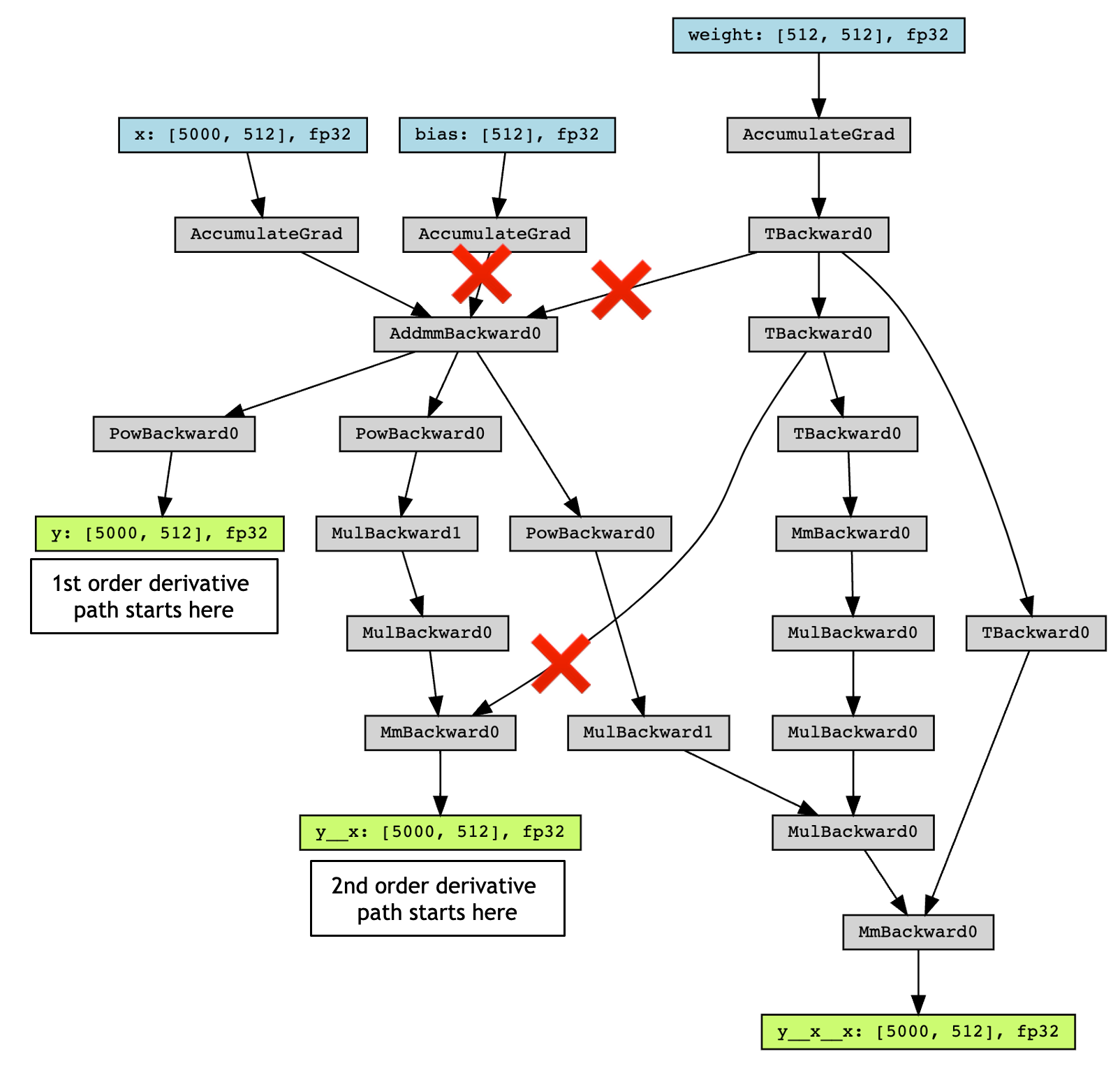
For more detail: The backward function of a `matmul` operator (e.g., `linear` `addmm` `mm`), has two matmuls, one for `input gradient` and another for `weight gradient`. For a typical neural network (nn) with a few linear layers and activation functions, if the user calls `torch.autograd.grad()` to calculate the derivative of the nn output `y` w.r.t the nn input `x`,  only the `input gradient` of the `matmul` operator is needed, and the `weight gradient` is discarded. However, the current PyTorch autograd engine will always calculate the `weight gradient` if `weight` requires gradient (the calculation of the high-order derivative is performed during training).

The figure attached shows the autograd graph of the following code snippet:
```py
y = torch.nn.functional.linear(x, weight, bias)
y = y.pow(2)
# first order derivative
y__x, = torch.autograd.grad(y, x, grad_outputs=grad_outputs, create_graph=True)
# first order derivative
y__x__x, = torch.autograd.grad(y__x, x, grad_outputs=grad_outputs, create_graph=True)
```
The path with ❌ is not needed when calculating derivatives.

<img width="50%" alt="image" src="https://user-images.githubusercontent.com/9999318/182018117-719c5a23-bcc6-4a63-8e8d-1bca3ebda2e3.png">

### Issue
<!-- Link to Issue ticket or RFP -->
Related issue: https://github.com/pytorch/pytorch/issues/56500

### Method
When calling `torch.autograd.grad`, `exec_info_` is created for each GraphTask, which allows filtering paths on the graph that are not needed. However, when the GraphTask calls into the node, the node still does not know whether the edges are needed or not. In the case of matmul, `weight.requires_grad is True` so the weight gradient is always calculated.

Following https://github.com/pytorch/pytorch/issues/56500#issuecomment-825694656, this PR passes the graph task's thread_local `exec_info_` into the node, so it could trim unnecessary edges during `torch.autograd.grad` calls.

### Benchmark
Benchmark script: https://gist.github.com/yueyericardo/24158433a2021c51eeef9c3e2722df99

Benchmark result:
6 hidden layers, batch size 10000, on A100

FP32 result
| hessian benchmark             | FP32 (before) | FP32 (After)      | FP32 (Functorch v0.1.1) |
| ----------------------------- | ------------- | ----------------- | ----------------------- |
| Linear + ReLU (no backward)   | 55.658 ms     | 29.392 ms (1.90X) | 29.547 ms (1.90X)       |
| Linear + ReLU (with backward) | 81.173 ms     | 54.917 ms (1.47X) | 68.988 ms (1.18X)       |

TF32 result
| hessian benchmark             | TF32 (before) | TF32 (after)      | TF32 (Functorch v0.1.1) |
| ----------------------------- | ------------- | ----------------- | ----------------------- |
| Linear + ReLU (no backward)   | 19.801 ms     | 11.259 ms (1.76X) | 10.754 ms (1.84X)       |
| Linear + ReLU (with backward) | 29.167 ms     | 20.466 ms (1.42X) | 22.784 ms (1.28X)       |

For FP32 result, we could get 1.9X speed up for hessian calculation, and 1.47X speed up during training, which is even faster than functorch `vmap(jacfwd(jacrev` implementation. (functorch has performance regression on v0.2.0, https://github.com/pytorch/functorch/issues/989, so we are using v0.1.1 for benchmark)

@zou3519 does functorch also includes similar optimizations during hessian calculation? If not, what do we need to do so the functorch could also benefit from this PR?

### Testing
<!-- How did you test your change? -->

- [x] we need to figure out a way for unittest

### Thanks
Thanks for the great blog: [How Computational Graphs are Executed in PyTorch | PyTorch](https://pytorch.org/blog/how-computational-graphs-are-executed-in-pytorch/)

cc @zasdfgbnm @albanD
Pull Request resolved: https://github.com/pytorch/pytorch/pull/82544
Approved by: https://github.com/soulitzer