Summary:
Also add docs for get_backend, Backend, and reduce_op
fixes#11803
cc The controller you requested could not be found. pietern apaszke
Pull Request resolved: https://github.com/pytorch/pytorch/pull/11830
Differential Revision: D9927991
Pulled By: SsnL
fbshipit-source-id: a2ffb70826241ba84264f36f2cb173e00b19af48
Summary:
This PR performs a renaming of the function `potrf` responsible for the Cholesky
decomposition on positive definite matrices to `cholesky` as NumPy and TF do.

Billing of changes
- make potrf cname for cholesky in Declarations.cwrap
- modify the function names in ATen/core
- modify the function names in Python frontend
- issue warnings when potrf is called to notify users of the change

Reviewed By: soumith

Differential Revision: D10528361

Pulled By: zou3519

fbshipit-source-id: 19d9bcf8ffb38def698ae5acf30743884dda0d88
Summary:
[Edit: after applied colesbury 's suggestions]
* Hub module enable users to share code + pretrained weights through github repos.
Example usage:
```
hub_model = hub.load(
     'ailzhang/vision:hub', # repo_owner/repo_name:branch
     'wrapper1', # entrypoint
      1234, # args for callable [not applicable to resnet18]
      pretrained=True) # kwargs for callable
```
* Protocol on repo owner side: example https://github.com/ailzhang/vision/tree/hub
     * The "published" models should be at least in a branch/tag. It can't be a random commit.
     * Repo owner should have the following field defined in `hubconf.py`
        * function/entrypoint with function signature `def wrapper1(pretrained=False, *args, **kwargs):`
        * `pretrained` allows users to load pretrained weights from repo owner.
        * `args` and `kwargs` are passed to the callable `resnet18`, repo owner should clearly specify their help message in the docstring

```
def wrapper1(pretrained=False, *args, **kwargs):
    """
    pretrained (bool): a recommended kwargs for all entrypoints
    args & kwargs are arguments for the function
    """
    from torchvision.models.resnet import resnet18
    model = resnet18(*args, **kwargs)
    checkpoint = 'https://download.pytorch.org/models/resnet18-5c106cde.pth'
    if pretrained:
        model.load_state_dict(model_zoo.load_url(checkpoint, progress=False))
    return model
```
* Hub_dir
    * `hub_dir` specifies where the intermediate files/folders will be saved. By default this is `~/.torch/hub`.
    * Users can change it by either setting the environment variable `TORCH_HUB_DIR` or calling `hub.set_dir(PATH_TO_HUB_DIR)`.
    * By default, we don't cleanup files after loading so that users can use cache next time.

* Cache logic :
    * We used the cache by default if it exists in `hub_dir`.
    * Users can force a fresh reload by calling `hub.load(..., force_reload=True)`.
Pull Request resolved: https://github.com/pytorch/pytorch/pull/12228

Differential Revision: D10511470

Pulled By: ailzhang

fbshipit-source-id: 12ac27f01d33653f06b2483655546492f82cce38
Summary:
Here is my stab at ```dense.to_sparse```
Pull Request resolved: https://github.com/pytorch/pytorch/pull/12171

Differential Revision: D10859078

Pulled By: weiyangfb

fbshipit-source-id: 5df72f72ba4f8f10e283402ff7731fd535682664
Summary:
include atomicAdd commentary as this is less well known

There is some discussion in #12207

Unfortunately, I cannot seem to get the ..include working in `_tensor_docs.py` and `_torch_docs.py`. I could use a hint for that.
Pull Request resolved: https://github.com/pytorch/pytorch/pull/12217

Differential Revision: D10419739

Pulled By: SsnL

fbshipit-source-id: eecd04fb7486bd9c6ee64cd34859d61a0a97ec4e
Summary:
This PR gets rid of unnecessary copy of weight gradients in cudnn rnn. Also removes unnecessary check for  input size when deciding whether to use persistent rnn, and adds doc string explaining when persistent rnn can be used. cc ezyang
Pull Request resolved: https://github.com/pytorch/pytorch/pull/12600

Differential Revision: D10359981

Pulled By: soumith

fbshipit-source-id: 0fce11b527d543fabf21e6e9213fb2879853d7fb
Summary:
- This was one of the few functions left out from the list of functions in
  NumPy's `linalg` module
- `multi_mm` is particularly useful for DL research, for quick analysis of
  deep linear networks
- Added tests and doc string
Pull Request resolved: https://github.com/pytorch/pytorch/pull/12380

Differential Revision: D10357136

Pulled By: SsnL

fbshipit-source-id: 52b44fa18d6409bdeb76cbbb164fe4e88224458e
Summary:
- fix https://github.com/pytorch/pytorch/issues/12120
- add `torch.argsort`, `torch.pdist`, `broadcast_tensors` to *.rst files
- add parameter dim to `torch.unique` doc
- fix table and args for `torch.norm`
- test plan: make html and check docs in browser

gchanan
Pull Request resolved: https://github.com/pytorch/pytorch/pull/12126

Differential Revision: D10087006

Pulled By: weiyangfb

fbshipit-source-id: 25f65c43d14e02140d0da988d8742c7ade3d8cc9
Summary:
goldsborough Modify the docs to match the changes made in #4999
Pull Request resolved: https://github.com/pytorch/pytorch/pull/12158

Differential Revision: D10103964

Pulled By: SsnL

fbshipit-source-id: 1b8692da86aca1a52e8d2e6cea76a5ad1f71e058
Summary:
Couple questions:

1) I used the log1p implementation in #8969 as a guide especially for testing.  I'm not sure what the ```skipIfROCM``` annotation is for, so unsure if i need it for my test.

2) I implemented the branching logic in the narrow function itself; is this the right place to do so?  I noticed that there a number of places where sparse-specific logic is handled with just an if statement in this file.  Or should I implement a separate dispatch in native_functions.yml as in the log1p?

And of course, happy to make any any other updates/changes that I may have missed as well.  This is my first PR to the project.
Pull Request resolved: https://github.com/pytorch/pytorch/pull/11342

Differential Revision: D9978430

Pulled By: weiyangfb

fbshipit-source-id: e73dc20302ab58925afb19e609e31f4a38c634ad
Summary:
Deleted this section by mistake in last PR.
Pull Request resolved: https://github.com/pytorch/pytorch/pull/11938

Reviewed By: SsnL

Differential Revision: D9993258

Pulled By: brianjo

fbshipit-source-id: 2552178cebd005a1105a22930c4d128c67247378
Summary:
A couple fixes I deem necessary to the TorchScript C++ API after writing the tutorial:

1. When I was creating the custom op API, I created `torch/op.h` as the one-stop header for creating custom ops. I now notice that there is no good header for the TorchScript C++ story altogether, i.e. when you just want to load a script module in C++ without any custom ops necessarily. The `torch/op.h` header suits that purpose just as well of course, but I think we should rename it to `torch/script.h`, which seems like a great name for this feature.

2. The current API for the CMake we provided was that we defined a bunch of variables like `TORCH_LIBRARY_DIRS` and `TORCH_INCLUDES` and then expected users to add those variables to their targets. We also had a CMake function that did that for you automatically. I now realized a much smarter way of doing this is to create an `IMPORTED` target for the libtorch library in CMake, and then add all this stuff to the link interface of that target. Then all downstream users have to do is `target_link_libraries(my_target torch)` and they get all the proper includes, libraries and compiler flags added to their target. This means we can get rid of the CMake function and all that stuff. orionr  AFAIK this is a much, much better way of doing all of this, no?

3. Since we distribute libtorch with `D_GLIBCXX_USE_CXX11_ABI=0`, dependent libraries must set this flag too. I now add this to the interface compile options of this imported target.

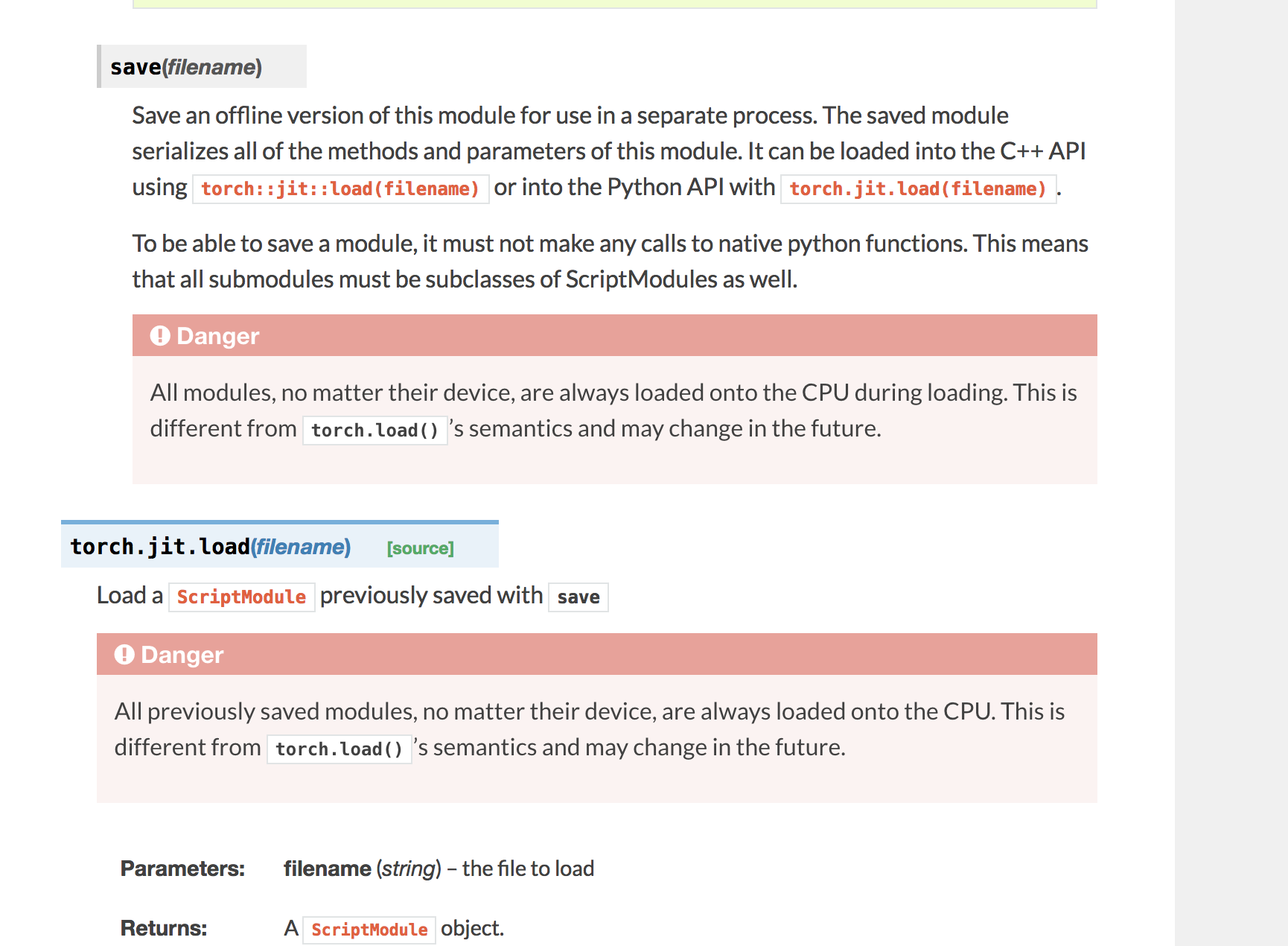
4. Fixes to JIT docs.

These could likely be 4 different PRs but given the release I wouldn't mind landing them all asap.

zdevito dzhulgakov soumith
Pull Request resolved: https://github.com/pytorch/pytorch/pull/11682

Differential Revision: D9839431

Pulled By: goldsborough

fbshipit-source-id: fdc47b95f83f22d53e1995aa683e09613b4bfe65
Summary:
This adds a Note on making experiments reproducible.

It also adds Instructions for building the Documentation to `README.md`. Please ping if I missed any requirements.

I'm not sure what to do about the submodule changes. Please advise.
Pull Request resolved: https://github.com/pytorch/pytorch/pull/11329

Differential Revision: D9784939

Pulled By: ezyang

fbshipit-source-id: 5c5acbe343d1fffb15bdcb84c6d8d925c2ffcc5e
Summary:
Ping ezyang
This addresses your comment in #114. Strangely, when running the doc build (`make html`) none of my changes are actually showing, could you point out what I'm doing wrong?

Once #11329 is merged it might make sense to link to the reproducibility note everywhere.
Pull Request resolved: https://github.com/pytorch/pytorch/pull/11434

Differential Revision: D9751208

Pulled By: ezyang

fbshipit-source-id: cc672472449564ff099323c39603e8ff2b2d35c9
Summary:
I'm 80% sure that this fixes the math bug. But I can't repro locally so I don't know.
Pull Request resolved: https://github.com/pytorch/pytorch/pull/11472

Differential Revision: D9755328

Pulled By: SsnL

fbshipit-source-id: 130be664d3c6ceee3c0c166c1a86fc9ec3b79d74
Summary:
vishwakftw Your patch needed some updates because the default native function dispatches changed from `[function, method]` to `[function]`. The CI was run before that change happened so it still shows green, but the internal test caught it.

I did some changes when rebasing and updating so I didn't just force push to your branch. Let's see if this passes CI and internal test. If it does, let me know if you want me to force push to your branch or use this PR instead.

Note to reviewers: patch was already approved at #10068 .

cc yf225
Pull Request resolved: https://github.com/pytorch/pytorch/pull/11421

Differential Revision: D9733407

Pulled By: SsnL

fbshipit-source-id: cf2ed293bb9942dcc5158934ff4def2f63252599
Summary:
In addition to documentation, this cleans up a few error message formats.
It also adds infra to find which operators are supported by the JIT automatically, which is then used in the generation of the docs.

The wording and formatting of the docs is not yet polished, but having this will allow our document writers to make faster progress.

Followup PRs will polish the docs and fix formatting issues.
Pull Request resolved: https://github.com/pytorch/pytorch/pull/11357

Differential Revision: D9721277

Pulled By: zdevito

fbshipit-source-id: 153a0d5be1efb314511bcfc0cec48643d78ea48b
Summary:
This PR cleans up the `at::Tensor` class by removing all methods that start with an underscore in favor of functions in the `at::` namespace. This greatly cleans up the `Tensor` class and makes it clearer what is the public and non-public API.

For this I changed `native_functions.yaml` and `Declarations.cwrap` to make all underscore methods `variant: function` (or add such a statement to begin with), and then fixed all code locations using the underscore methods.

ezyang colesbury gchanan
Pull Request resolved: https://github.com/pytorch/pytorch/pull/11152

Differential Revision: D9683607

Pulled By: goldsborough

fbshipit-source-id: 97f869f788fa56639c05a439e2a33be49f10f543
Summary:
Since we don't need `torch.autograd.Variable` anymore, I removed `torch.autograd.Variable` from `onnx.rst`.
Pull Request resolved: https://github.com/pytorch/pytorch/pull/10810

Differential Revision: D9500960

Pulled By: zou3519

fbshipit-source-id: 1bc820734c96a8c7cb5d804e6d51a95018db8e7f
Summary:
The CPU and CUDA variants are a direct transposition of Graves et al.'s description of the algorithm with the
modification that is is in log space.
The there also is a binding for the (much faster) CuDNN implementation.
This could eventually fix#3420
I still need to add tests (TestNN seems much more elaborate than the other testing) and fix the bugs than invariably turn up during the testing. Also, I want to add some more code comments.
I could use feedback on all sorts of things, including:
- Type handling (cuda vs. cpu for the int tensors, dtype for the int tensors)
- Input convention. I use log probs because that is what the gradients are for.
- Launch parameters for the kernels
- Errors and obmissions and anything else I'm not even aware of.
Thank you for looking!
In terms of performance it looks like it is superficially comparable to WarpCTC (and thus, but I have not systematically investigated this).
I have read CuDNN is much faster than implementations because it does *not* use log-space, but also the gathering step is much much faster (but I avoided trying tricky things, it seems to contribute to warpctc's fragility). I might think some more which existing torch function (scatter or index..) I could learn from for that step.
Average timings for the kernels from nvprof for some size:
```
CuDNN:
60.464us compute_alphas_and_betas
16.755us compute_grads_deterministic
Cuda:
121.06us ctc_loss_backward_collect_gpu_kernel (= grads)
109.88us ctc_loss_gpu_kernel (= alphas)
98.517us ctc_loss_backward_betas_gpu_kernel (= betas)
WarpCTC:
299.74us compute_betas_and_grad_kernel
66.977us compute_alpha_kernel
```
Of course, I still have the (silly) outer blocks loop rather than computing consecutive `s` in each thread which I might change, and there are a few other things where one could look for better implementations.
Finally, it might not be unreasonable to start with these implementations, as the performance of the loss has to be seen in the context of the entire training computation, so this would likely dilute the relative speedup considerably.
My performance measuring testing script:
```
import timeit
import sys
import torch
num_labels = 10
target_length = 30
input_length = 50
eps = 1e-5
BLANK = 0#num_labels
batch_size = 16
torch.manual_seed(5)
activations = torch.randn(input_length, batch_size, num_labels + 1)
log_probs = torch.log_softmax(activations, 2)
probs = torch.exp(log_probs)
targets = torch.randint(1, num_labels+1, (batch_size * target_length,), dtype=torch.long)
targets_2d = targets.view(batch_size, target_length)
target_lengths = torch.tensor(batch_size*[target_length])
input_lengths = torch.tensor(batch_size*[input_length])
activations = log_probs.detach()
def time_cuda_ctc_loss(grout, *args):
torch.cuda.synchronize()
culo, culog_alpha = torch._ctc_loss(*args)
g, = torch.autograd.grad(culo, args[0], grout)
torch.cuda.synchronize()
def time_cudnn_ctc_loss(groupt, *args):
torch.cuda.synchronize()
culo, cugra= torch._cudnn_ctc_loss(*args)
g, = torch.autograd.grad(culo, args[0], grout)
torch.cuda.synchronize()
def time_warp_ctc_loss(grout, *args):
torch.cuda.synchronize()
culo = warpctc.ctc_loss(*args, blank_label=BLANK, size_average=False, length_average=False, reduce=False)
g, = torch.autograd.grad(culo, args[0], grout)
torch.cuda.synchronize()
if sys.argv[1] == 'cuda':
lpcu = log_probs.float().cuda().detach().requires_grad_()
args = [lpcu, targets_2d.cuda(), input_lengths.cuda(), target_lengths.cuda(), BLANK]
grout = lpcu.new_ones((batch_size,))
torch.cuda.synchronize()
print(timeit.repeat("time_cuda_ctc_loss(grout, *args)", number=1000, globals=globals()))
elif sys.argv[1] == 'cudnn':
lpcu = log_probs.float().cuda().detach().requires_grad_()
args = [lpcu, targets.int(), input_lengths.int(), target_lengths.int(), BLANK, True]
grout = lpcu.new_ones((batch_size,))
torch.cuda.synchronize()
print(timeit.repeat("time_cudnn_ctc_loss(grout, *args)", number=1000, globals=globals()))
elif sys.argv[1] == 'warpctc':
import warpctc
activations = activations.cuda().detach().requires_grad_()
args = [activations, input_lengths.int(), targets.int(), target_lengths.int()]
grout = activations.new_ones((batch_size,), device='cpu')
torch.cuda.synchronize()
print(timeit.repeat("time_warp_ctc_loss(grout, *args)", number=1000, globals=globals()))
```
I'll also link to a notebook that I used for writing up the algorithm in simple form and then test the against implementations against it.
Pull Request resolved: https://github.com/pytorch/pytorch/pull/9628
Differential Revision: D8952453
Pulled By: ezyang
fbshipit-source-id: 18e073f40c2d01a7c96c1cdd41f6c70a06e35860