Summary:
Fix formatting: change "Frequently Asked Questions" into an RST header, which is clickable and one get a URL of the FAQ section
Pull Request resolved: https://github.com/pytorch/pytorch/pull/36438

Differential Revision: D21106180

Pulled By: mruberry

fbshipit-source-id: 370dafd1883bd57285b478cf2faa14ae2f86e3ba
Summary:
Several people have asked me about proper Amp usage with gradient accumulation.  In particular, it's [unclear to people](https://github.com/NVIDIA/apex/issues/439#issuecomment-610351482) that you should only call `scaler.unscale_()` (if desired) and `scaler.update()` in iterations where you actually plan to step.  This PR adds a minimal accumulation example.

I built the docs locally and it looks free from sphinx errors, at least.
Pull Request resolved: https://github.com/pytorch/pytorch/pull/36601

Differential Revision: D21082295

Pulled By: ngimel

fbshipit-source-id: b2faa6c02b9f7e1972618a0f1d5360a03f0450ac
Summary:
Pull Request resolved: https://github.com/pytorch/pytorch/pull/36678

Updated the docs to explicitly indicate that RRef control messages are
idempotent and retried upon failure.
ghstack-source-id: 102225791

Test Plan: build bot

Differential Revision: D20828041

fbshipit-source-id: ca4d71c65a453664c16c32134c47637a966b1a19
Summary:
Full details in task: https://our.intern.facebook.com/intern/tasks/?t=64776265

With pytroch 1.5+ we remove python2 support from PyTorch. All documentation under docs/ and on the pytorch.org website needs to remove Python 2 references.
Pull Request resolved: https://github.com/pytorch/pytorch/pull/36114

Differential Revision: D20901746

Pulled By: jlin27

fbshipit-source-id: 07f8dc8e6fab0b232e5048a63079cab0c433c85f
Summary:
Some more cleanup now that we no longer support python2 or 3.5 on master and eventually PyTorch 1.6 release.
Pull Request resolved: https://github.com/pytorch/pytorch/pull/35677

Differential Revision: D20838097

Pulled By: orionr

fbshipit-source-id: 95d553a1e8769f3baa395e0bc6d4ce7cd93236e9
Summary:
The original behavior of pytorch c10d only supports built-in c10d backends, such as
nccl/gloo/mpi. This patch is used to extend the c10d capability to support dynamically
loading 3rd party communication libraries which are derived from ProcessGroup base class.

related RFC is in: https://github.com/pytorch/pytorch/issues/27955

Through this way, user just need specify a 3rd party c10d backend name when invoking
torch.distributed.init_process_group(). The proposed logic will try to load corresponding
c10d backend cpp extension automatically. as for how to develop a new 3rd party c10d backend
through cpp extension, pls refer to test/cpp_extensions/cpp_c10d_extension.cpp
Pull Request resolved: https://github.com/pytorch/pytorch/pull/28068

Differential Revision: D19174838

Pulled By: agolynski

fbshipit-source-id: 3409a504a43ce7260e6f9d1207c00e87471fac62
Summary: This diff fixes the issues with current handling of debug information passed along the execution of the model. (For example, it is possible that multiple calls to the debug guard may override each other)

Test Plan: CI test/cpp/jit

Reviewed By: dzhulgakov

Differential Revision: D20602775

fbshipit-source-id: 4683957954028af81a1a0f1f12b243650230c9bb
Summary:
Pull Request resolved: https://github.com/pytorch/pytorch/pull/34710

Extending RecordFunction API to support new recording scopes (such as TorchScript functions), as well as giving more flexibility to set sampling rate.

Test Plan: unit test (test_misc.cpp/testRecordFunction)

Reviewed By: gdankel, dzhulgakov

Differential Revision: D20158523

fbshipit-source-id: a9e0819d21cc06f4952d92d43246587c36137582
Summary:
The current implementations of torch.real and torch.imag are not NumPy compatible. In particular:

- torch.real on a real tensor does not return the real tensor, like contiguous
- torch.real on a complex tensor does not return a real-valued view of the real part
- torch.imag on a complex tensor does not return a real-valued view of the imaginary part
- torch.Tensor.real and torch.Tensor.imag exist as methods, but in NumPy they are writable attributes

This PR makes the functions NumPy compatible by removing the method variants and out kwarg, restricting them to work on only real tensors, and updating the behavior of torch.real to return its input. New tests are added to test_torch.py to verify the behavior, a couple existing complex tests are skipped, and the documentation is updated to reflect the change.
Pull Request resolved: https://github.com/pytorch/pytorch/pull/35560

Differential Revision: D20714568

Pulled By: mruberry

fbshipit-source-id: 5dd092f45757b620c8426c829dd15ee997246a26
Summary:
## Motivation

This PR upgrades MKL-DNN from v0.20 to DNNL v1.2 and resolves https://github.com/pytorch/pytorch/issues/30300.

DNNL (Deep Neural Network Library) is the new brand of MKL-DNN, which improves performance, quality, and usability over the old version.

This PR focuses on the migration of all existing functionalities, including minor fixes, performance improvement and code clean up. It serves as the cornerstone of our future efforts to accommodate new features like OpenCL support, BF16 training, INT8 inference, etc. and to let the Pytorch community derive more benefits from the Intel Architecture.

<br>

## What's included?

Even DNNL has many breaking changes to the API, we managed to absorb most of them in ideep. This PR contains minimalist changes to the integration code in pytorch. Below is a summary of the changes:

<br>

**General:**

1. Replace op-level allocator with global-registered allocator

```
// before
ideep::sum::compute<AllocForMKLDNN>(scales, {x, y}, z);

// after
ideep::sum::compute(scales, {x, y}, z);
```

The allocator is now being registeted at `aten/src/ATen/native/mkldnn/IDeepRegistration.cpp`. Thereafter all tensors derived from the `cpu_engine` (by default) will use the c10 allocator.

```
RegisterEngineAllocator cpu_alloc(
  ideep::engine::cpu_engine(),
  [](size_t size) {
    return c10::GetAllocator(c10::DeviceType::CPU)->raw_allocate(size);
  },
  [](void* p) {
    c10::GetAllocator(c10::DeviceType::CPU)->raw_deallocate(p);
  }
);
```
------

2. Simplify group convolution

We had such a scenario in convolution where ideep tensor shape mismatched aten tensor: when `groups > 1`, DNNL expects weights tensors to be 5-d with an extra group dimension, e.g. `goihw` instead of `oihw` in 2d conv case.

As shown below, a lot of extra checks came with this difference in shape before. Now we've completely hidden this difference in ideep and all tensors are going to align with pytorch's definition. So we could safely remove these checks from both aten and c2 integration code.

```
// aten/src/ATen/native/mkldnn/Conv.cpp

if (w.ndims() == x.ndims() + 1) {
  AT_ASSERTM(
      groups > 1,
      "Only group _mkldnn_conv2d weights could have been reordered to 5d");
  kernel_size[0] = w.get_dim(0) * w.get_dim(1);
  std::copy_n(
      w.get_dims().cbegin() + 2, x.ndims() - 1, kernel_size.begin() + 1);
} else {
  std::copy_n(w.get_dims().cbegin(), x.ndims(), kernel_size.begin());
}
```

------

3. Enable DNNL built-in cache

Previously, we stored DNNL jitted kernels along with intermediate buffers inside ideep using an LRU cache. Now we are switching to the newly added DNNL built-in cache, and **no longer** caching buffers in order to reduce memory footprint.

This change will be mainly reflected in lower memory usage from memory profiling results. On the code side, we removed couple of lines of `op_key_` that depended on the ideep cache before.

------

4. Use 64-bit integer to denote dimensions

We changed the type of `ideep::dims` from `vector<int32_t>` to `vector<int64_t>`. This renders ideep dims no longer compatible with 32-bit dims used by caffe2. So we use something like `{stride_.begin(), stride_.end()}` to cast parameter `stride_` into a int64 vector.

<br>

**Misc changes in each commit:**

**Commit:** change build options

Some build options were slightly changed, mainly to avoid name collisions with other projects that include DNNL as a subproject. In addition, DNNL built-in cache is enabled by option `DNNL_ENABLE_PRIMITIVE_CACHE`.

Old | New
-- | --
WITH_EXAMPLE | MKLDNN_BUILD_EXAMPLES
WITH_TEST | MKLDNN_BUILD_TESTS
MKLDNN_THREADING | MKLDNN_CPU_RUNTIME
MKLDNN_USE_MKL | N/A (not use MKL anymore)

------

**Commit:** aten reintegration

- aten/src/ATen/native/mkldnn/BinaryOps.cpp

    Implement binary ops using new operation `binary` provided by DNNL

- aten/src/ATen/native/mkldnn/Conv.cpp

    Clean up group convolution checks
    Simplify conv backward integration

- aten/src/ATen/native/mkldnn/MKLDNNConversions.cpp

    Simplify prepacking convolution weights

- test/test_mkldnn.py

    Fixed an issue in conv2d unit test: it didn't check conv results between mkldnn and aten implementation before. Instead, it compared the mkldnn with mkldnn as the default cpu path will also go into mkldnn. Now we use `torch.backends.mkldnn.flags` to fix this issue

- torch/utils/mkldnn.py

    Prepack weight tensor on module `__init__` to achieve better performance significantly

------

**Commit:** caffe2 reintegration

- caffe2/ideep/ideep_utils.h

    Clean up unused type definitions

- caffe2/ideep/operators/adam_op.cc & caffe2/ideep/operators/momentum_sgd_op.cc

   Unify tensor initialization with `ideep::tensor::init`. Obsolete `ideep::tensor::reinit`

- caffe2/ideep/operators/conv_op.cc & caffe2/ideep/operators/quantization/int8_conv_op.cc

    Clean up group convolution checks
    Revamp convolution API

- caffe2/ideep/operators/conv_transpose_op.cc

    Clean up group convolution checks
    Clean up deconv workaround code

------

**Commit:** custom allocator

- Register c10 allocator as mentioned above

<br><br>

## Performance

We tested inference on some common models based on user scenarios, and most performance numbers are either better than or on par with DNNL 0.20.

ratio: new / old | Latency (batch=1 4T) | Throughput (batch=64 56T)
-- | -- | --
pytorch resnet18 | 121.4% | 99.7%
pytorch resnet50 | 123.1% | 106.9%
pytorch resnext101_32x8d | 116.3% | 100.1%
pytorch resnext50_32x4d | 141.9% | 104.4%
pytorch mobilenet_v2 | 163.0% | 105.8%
caffe2 alexnet | 303.0% | 99.2%
caffe2 googlenet-v3 | 101.1% | 99.2%
caffe2 inception-v1 | 102.2% | 101.7%
caffe2 mobilenet-v1 | 356.1% | 253.7%
caffe2 resnet101 | 100.4% | 99.8%
caffe2 resnet152 | 99.8% | 99.8%
caffe2 shufflenet | 141.1% | 69.0% †
caffe2 squeezenet | 98.5% | 99.2%
caffe2 vgg16 | 136.8% | 100.6%
caffe2 googlenet-v3 int8 | 100.0% | 100.7%
caffe2 mobilenet-v1 int8 | 779.2% | 943.0%
caffe2 resnet50 int8 | 99.5% | 95.5%

_Configuration:
Platform: Skylake 8180
Latency Test: 4 threads, warmup 30, iteration 500, batch size 1
Throughput Test: 56 threads, warmup 30, iteration 200, batch size 64_

† Shufflenet is one of the few models that require temp buffers during inference. The performance degradation is an expected issue since we no longer cache any buffer in the ideep. As for the solution, we suggest users opt for caching allocator like **jemalloc** as a drop-in replacement for system allocator in such heavy workloads.
Pull Request resolved: https://github.com/pytorch/pytorch/pull/32422

Test Plan:
Perf results: https://our.intern.facebook.com/intern/fblearner/details/177790608?tab=Experiment%20Results

10% improvement for ResNext with avx512, neutral on avx2

More results: https://fb.quip.com/ob10AL0bCDXW#NNNACAUoHJP

Reviewed By: yinghai

Differential Revision: D20381325

Pulled By: dzhulgakov

fbshipit-source-id: 803b906fd89ed8b723c5fcab55039efe3e4bcb77
Summary:
Adding ops to the list based on our discussion. :D
Pull Request resolved: https://github.com/pytorch/pytorch/pull/35399

Differential Revision: D20651393

Pulled By: ailzhang

fbshipit-source-id: 8cf9026d10c0d74117953dbb68ebc2f537be956a
Summary:
I don't know why reduce_scatter collective operation is not documented so I add it to the document.
Pull Request resolved: https://github.com/pytorch/pytorch/pull/35274

Differential Revision: D20645850

Pulled By: mrshenli

fbshipit-source-id: 0a4458bff1a4e15a4593dd4dcc25e4e0f6e2265d
Summary:
Per title. See related https://github.com/pytorch/pytorch/pull/34570.

In PyTorch 1.7 the plan is for torch.div and Python's division operator to perform "true" division, like Python 3, JAX, and NumPy. To facilitate this change, this PR expands true_divide to be a method so it can cover all of torch.div's use cases.

New true_divide tests are added to test_torch.py, test_type_promotion.py, and test_sparse.py.
Pull Request resolved: https://github.com/pytorch/pytorch/pull/34794

Differential Revision: D20545507

Pulled By: mruberry

fbshipit-source-id: 55286f819716c8823d1930441a69008560ac2bd5
Summary:
Pull Request resolved: https://github.com/pytorch/pytorch/pull/34348

We need this function to do swap dequantize for prim::ListConstruct since
the output of prim::ListConstruct is a list of Tensors

Test Plan:
.

Imported from OSS

Differential Revision: D20504454

fbshipit-source-id: e6155e37da98e2219a6f79737cd46fe32a509c9f
Summary:
We should recommend DDP instead of DP. Hope we can also cherry-pick this for 1.5
Pull Request resolved: https://github.com/pytorch/pytorch/pull/35063

Differential Revision: D20549621

Pulled By: ngimel

fbshipit-source-id: 86b1b2134664065cc6070ea4212895f993eaf543
Summary:
(Updated per review feedback)

`torch.floor_divide` is currently a function that can operate on two tensors or a tensor and a scalar (scalar x scalar floor division is handled natively by Python and the JIT has a builtin function for it). This PR updates it to:

- have an out variant: `floor_divide(x, y, out=z)`
- be a method on a tensor: `x.floor_divide(y)`
- have an in-place variant: `x.floor_divide_(y)`
- work with sparse tensors

Tests are added to test_sparse.py and test_torch.py for these new behaviors.

In addition, this PR:

- cleans up the existing sparse division and true_division code and improves their error message
- adds testing of sparse true_division to test_sparse.py
- extends existing floor_divide testing in test_torch to run on CUDA, too, not just the CPU

Unfortunately, making floor_divide a method requires breaking backwards compatibility, and floor_divide has been added to the BC whitelist since this is international. The BC issue is that the first parameter name to torch.floor_divide is changing from input to self. If you previously called torch.floor_divide with keyword arguments, e.g. torch.floor_divide(input=x, other=y), you will need to update to torch.floor_divide(self=x, other=y), or the more common torch.floor_divide(x, y).

The intent of this PR is to allow floor_divide to be substituted for division (torch.div, /) wherever division was previously used. In 1.6 we expect torch.div to perform true_division, and floor_divide is how users can continue to perform integer division with tensors.

There are two potential follow-up issues suggested by this PR:

- the test framework might benefit from additional tensor construction classes, like one to create dividends and divisors for multiple dtypes
- the test framework might benefit from a universal function test class. while methods have reasonable coverage as part of test_torch.py's TestTensorOp tests, function coverage is spotty. Universal functions are similar enough it should be possible to generate tests for them.
Pull Request resolved: https://github.com/pytorch/pytorch/pull/34552

Differential Revision: D20509850

Pulled By: mruberry

fbshipit-source-id: 2cd3c828aad67191c77f2ed8470411e246f604f8
Summary:
Initial integration of eager autocasting, supporting out-of-place ops only for easier review.
Relevant issue/RFC: https://github.com/pytorch/pytorch/issues/25081

In-place ops and ops with user-supplied `out=...` can certainly be supported as well (my initial WIP https://github.com/pytorch/pytorch/pull/29552 handled many) but require substantially more complex special casing in the autocasting backend and tests.  Support for these ops (much of which has already been written) will be broken into later PRs.
Pull Request resolved: https://github.com/pytorch/pytorch/pull/32140

Differential Revision: D20346700

Pulled By: ezyang

fbshipit-source-id: 12d77b3917310186fbddf11c59b2794dc859131f
Summary:
(Updated per review feedback)

`torch.floor_divide` is currently a function that can operate on two tensors or a tensor and a scalar (scalar x scalar floor division is handled natively by Python and the JIT has a builtin function for it). This PR updates it to:

- have an out variant: `floor_divide(x, y, out=z)`
- be a method on a tensor: `x.floor_divide(y)`
- have an in-place variant: `x.floor_divide_(y)`
- work with sparse tensors

Tests are added to test_sparse.py and test_torch.py for these new behaviors.

In addition, this PR:

- cleans up the existing sparse division and true_division code and improves their error message
- adds testing of sparse true_division to test_sparse.py
- extends existing floor_divide testing in test_torch to run on CUDA, too, not just the CPU

Unfortunately, making floor_divide a method requires breaking backwards compatibility, and floor_divide has been added to the BC whitelist since this is international. The BC issue is that the first parameter name to torch.floor_divide is changing from input to self. If you previously called torch.floor_divide with keyword arguments, e.g. torch.floor_divide(input=x, other=y), you will need to update to torch.floor_divide(self=x, other=y), or the more common torch.floor_divide(x, y).

The intent of this PR is to allow floor_divide to be substituted for division (torch.div, /) wherever division was previously used. In 1.6 we expect torch.div to perform true_division, and floor_divide is how users can continue to perform integer division with tensors.

There are two potential follow-up issues suggested by this PR:

- the test framework might benefit from additional tensor construction classes, like one to create dividends and divisors for multiple dtypes
- the test framework might benefit from a universal function test class. while methods have reasonable coverage as part of test_torch.py's TestTensorOp tests, function coverage is spotty. Universal functions are similar enough it should be possible to generate tests for them.
Pull Request resolved: https://github.com/pytorch/pytorch/pull/34552

Differential Revision: D20497453

Pulled By: mruberry

fbshipit-source-id: ac326f2007d8894f730d1278fef84d63bcb07b5d
Summary:
- Update API calls `backward` and `optim.step` now that we require `context_id`
- Add notes to clarify purpose of distributed autograd context (this was a source of confusion in some feedback)
- Add note that details why optimizer requires context_id
- Clearly specify that we don't have SMART mode yet
Pull Request resolved: https://github.com/pytorch/pytorch/pull/34657

Differential Revision: D20427667

Pulled By: rohan-varma

fbshipit-source-id: 5f8a3539ccf648a78e9e9a0dfdfe389c678b1606
Summary:
This is a redo of https://github.com/pytorch/pytorch/pull/33791, which was reverted because it introduced a flaky test. The test was flaky and only flaky on Python3.5 because of dict order randomization.

I've fixed the issue with tests clobbering each other in b539fec and removed the override tests for `torch.nn.functional.tanh` and `torch.nn.functional.sigmoid`, which are deprecated and shouldn't be overridable in e0d7402. I also verified that no more test clobbering is happening.
Pull Request resolved: https://github.com/pytorch/pytorch/pull/34240

Differential Revision: D20252442

Pulled By: cpuhrsch

fbshipit-source-id: 069568e342a41c90e1dc76cbf85ba4aed47f24be
Summary:
Pull Request resolved: https://github.com/pytorch/pytorch/pull/34515

Once upon a time we thought this was necessary. In reality it is not, so
removing it.

For backcompat, our public interface (defined in `api/`) still has
typedefs to the old `script::` names.

There was only one collision: `Pass` as a `Stmt` and `Pass` as a graph
transform. I renamed one of them.

Test Plan: Imported from OSS

Differential Revision: D20353503

Pulled By: suo

fbshipit-source-id: 48bb911ce75120a8c9e0c6fb65262ef775dfba93
Summary:
This PR implements the following linear algebra algorithms for low-rank matrices:
- [x] Approximate `A` as `Q Q^H A` - using Algorithm 4.4 from [Halko et al, 2009](http://arxiv.org/abs/0909.4061).
  + exposed as `torch.lowrank.get_approximate_basis(A, q, niter=2, M=None) -> Q`
  + [x] dense matrices
  + [x] batches of dense matrices
  + [x] sparse matrices
  + [x] documentation
- [x] SVD - using Algorithm 5.1 from [Halko et al, 2009](http://arxiv.org/abs/0909.4061).
  + uses `torch.lowrank.get_approximate_basis`
  + exposed as `torch.svd_lowrank(A, q=6, niter=2, M=None) -> (U, S, V)`
  + [x] dense matrices
  + [x] batches of dense matrices
  + [x] sparse matrices
  + [x] documentation
- [x] PCA - using `torch.svd_lowrank`
  + uses `torch.svd_lowrank`
  + exposed as `torch.pca_lowrank(A, center=True, q=None, niter=2) -> (U, S, V)`
  + [x] dense matrices
  + [x] batches of dense matrices
  + [x] sparse matrices, uses non-centered sparse matrix algorithm
  + [x] documentation
- [x] generalized eigenvalue solver using the original LOBPCG algorithm [Knyazev, 2001](https://epubs.siam.org/doi/abs/10.1137/S1064827500366124)
  + exposed as `torch.lobpcg(A, B=None, k=1, method="basic", ...)`
  + [x] dense matrices
  + [x] batches of dense matrices
  + [x] sparse matrices
  + [x] documentation
- [x] generalized eigenvalue solver using robust LOBPCG with orthogonal basis selection [Stathopoulos, 2002](https://epubs.siam.org/doi/10.1137/S1064827500370883)
  + exposed as `torch.lobpcg(A, B=None, k=1, method="ortho", ...)`
  + [x] dense matrices
  + [x] batches of dense matrices
  + [x] sparse matrices
  + [x] documentation
- [x] generalized eigenvalue solver using the robust and efficient LOBPCG Algorithm 8 from [Duersch et al, 2018](https://epubs.siam.org/doi/abs/10.1137/17M1129830) that switches to orthogonal basis selection automatically
  + the "ortho" method improves iterations so rapidly that in the current test cases it does not make sense to use the basic iterations at all. If users will have matrices for which basic iterations could improve convergence then the `tracker` argument allows breaking the iteration process at user choice so that the user can switch to the orthogonal basis selection if needed. In conclusion, there is no need to implement Algorithm 8 at this point.
- [x] benchmarks
  + [x] `torch.svd` vs `torch.svd_lowrank`, see notebook [Low-rank SVD](https://github.com/Quansight/pearu-sandbox/blob/master/pytorch/Low-rank%20SVD.ipynb). In conclusion, the low-rank SVD is going to be useful only for large sparse matrices where the full-rank SVD will fail due to memory limitations.
  + [x] `torch.lobpcg` vs `scipy.sparse.linalg.lobpcg`, see notebook [LOBPCG - pytorch vs scipy](https://github.com/Quansight/pearu-sandbox/blob/master/pytorch/LOBPCG%20-%20pytorch%20vs%20scipy.ipynb). In conculsion, both implementations give the same results (up to numerical errors from different methods), scipy lobpcg implementation is generally faster.
  + [x] On very small tolerance cases, `torch.lobpcg` is more robust than `scipy.sparse.linalg.lobpcg` (see `test_lobpcg_scipy` results)

Resolves https://github.com/pytorch/pytorch/issues/8049.
Pull Request resolved: https://github.com/pytorch/pytorch/pull/29488

Differential Revision: D20193196

Pulled By: vincentqb

fbshipit-source-id: 78a4879912424595e6ea95a95e483a37487a907e
Summary:
See NumPy's division documentation here: https://numpy.org/doc/1.18/reference/generated/numpy.divide.html#numpy.divide.

True division is the same as PyTorch's default division except when both inputs are integer or bool tensors. In the latter case the inputs are (conceptually) cast to the default floating type before the division is performed.

The function is implemented for dense and sparse tensors and supports exporting to ONNX from PyTorch's eager mode or JIT traces. The function is inherently incompatible with exporting to ONNX via JIT script, and is another datapoint suggesting we should deprecate exporting scripted graphs to ONNX.

Tests are added for the type promotion, named tensor, and ONNX export behavior.
Pull Request resolved: https://github.com/pytorch/pytorch/pull/34236

Reviewed By: houseroad

Differential Revision: D20334087

Pulled By: mruberry

fbshipit-source-id: 83d00d886f46f713215d7d9e02ffd043164c57f1
Summary:
Improves explanation of non-determinism when running on GPUs. Adds info about `torch.nn.BCELoss` operating non-deterministically on GPUs.
Pull Request resolved: https://github.com/pytorch/pytorch/pull/33795

Differential Revision: D20284880

Pulled By: ngimel

fbshipit-source-id: d543959636d261a80c234150304344b19a37ba5d
Summary:
When docs are built, conf.py points to a _templates-stable/layout.html that does not exist.
Adding this file here so future stable docs will build with Google Analytics tags and without the unstable able that is in _templates/layout.html
Pull Request resolved: https://github.com/pytorch/pytorch/pull/33770

Differential Revision: D20164895

Pulled By: jlin27

fbshipit-source-id: 5fca9f9b825b1484dab52e2b2d91f92ae6372371
Summary:
Pull Request resolved: https://github.com/pytorch/pytorch/pull/34081
Before this commit, applications have to do the following to configure
number of threads in ProcessGroup RPC backend:
```
op = ProcessGroupRpcBackendOptions()
op.rpc_timeout = rpc_timeout
op.init_method = init_method
op.num_send_recv_threads = 32
init_rpc(...., rpc_backend_options=op)
```
After this commit, it can be simplified to:
```
init_rpc(...., rpc_backend_options=ProcessGroupRpcBackendOptions(num_send_recv_threads=32))
```
Fixes#34075
Test Plan: Imported from OSS
Differential Revision: D20227344
Pulled By: mrshenli
fbshipit-source-id: def4318e987179b8c8ecca44d7ff935702c8a6e7
Summary:
Fixes https://github.com/pytorch/pytorch/issues/33182

This adds private API functions that developers of types that implement `__torch_function__` can use to ensure full coverage of the subset of the PyTorch API that can be overrided.

I've refactored some of the code in the tests into a new `torch._overrides.get_overridable_functions` function. I've also changed `TENSOR_LIKE_TORCH_OVERRIDES` into `torch._overrides.get_testing_overrides` and `IGNORED_TORCH_FUNCTIONS` into `torch._overrides.get_ignored_functions`. Making these two static global variables in the tests into functions should allow rewriting their implementation to construct their return values instead of just statically defining the return value as is done here. Currently that is blocked on not being able to inspect function signatures of compiled kernels in PyTorch (see https://github.com/pytorch/pytorch/issues/28233). See the docs I've added for usage examples of these new functions. I also refactored the existing override tests to make use of these new functions, which should be a good forcing function to make sure they're kept up-to-date.

Finally, while working on this I discovered that `TestTorchFunctionOverrides.test_mean` and `TestTorchFunctionOverrides.test_mm` weren't ever being run because they were getting clobbered by the other dynamically generated override tests. I fixed that by renaming the tests and then fixing the actual test code. I've verified that all the subclassing semantics is correct and that the updated test answers are correct. I'm happy to put the fixes to the existing tests in as a separate pull request if that would be easier to review.

ping cpuhrsch since the feature request originally came from them.
Pull Request resolved: https://github.com/pytorch/pytorch/pull/33791

Differential Revision: D20195053

Pulled By: cpuhrsch

fbshipit-source-id: 1585f4e405f5223932b410eae03a288dc8eb627e
Summary:
Pull Request resolved: https://github.com/pytorch/pytorch/pull/33705

The fact that there were two overloads appears to be a historical
artifact that dates back to when goldsborough originally added these
bindings in the first place.  If TensorOptions is made optional,
then you only need one overload, not two, as they are exactly redundant
with each other.  When MemoryFormat was added, it was made a little
harder to do this, as the C++ syntax at::empty_like(t, memory_format) would
not work if you collapsed the overload; but now it works because TensorOptions
supports MemoryFormat.

The upshot is, I can get rid of all the overloads and just have one overload.
Amazingly, this change is backwards compatible, as the test attests.  While
I was at it, I also deleted the overload name from the functions entirely.

Signed-off-by: Edward Z. Yang <ezyang@fb.com>

Test Plan: Imported from OSS

Differential Revision: D20073355

Pulled By: bhosmer

fbshipit-source-id: c6a8908213b32ccf6737ea864d135e2cce34f56b
Summary:
This PR comes from discussion with albanD in https://fb.quip.com/npBHAXaPfnbu. Main goal is to clarify view ops with general outplace/inplace ops and remind users about the difference.
For reference this information is only available in code which is internal and hard to find. Also changes to this list actually affect users so we think it's better to expose it as public information. It's also helpful for new backend like XLA when implementing PyTorch ops. 19bbb4fccb/tools/autograd/gen_autograd.py (L32-L68)
Please feel free to comment!
Pull Request resolved: https://github.com/pytorch/pytorch/pull/32560

Differential Revision: D20161069

Pulled By: ailzhang

fbshipit-source-id: b5f1fd4353fe7594a427784db288aeb5a37dc521
Summary:
Pull Request resolved: https://github.com/pytorch/pytorch/pull/33711Fixed#33480
This makes `dist_autograd.backward` and `dist_optimizer.step` functional by making the user explicitly pass in the `context_id` as opposed to relying on the confusing thread_local context_id.
This diff incorporates these API changes and all places where these functions are called.
More concretely, this code:
```
with dist_autograd.context():
# Forward pass.
dist_autograd.backward([loss.sum()])
dist_optim.step()
```
should now be written as follows:
```
with dist_autograd.context() as context_id:
# Forward pass.
dist_autograd.backward(context_id, [loss.sum()])
dist_optim.step(context_id)
```
Test Plan: Ensuring all existing dist_autograd and dist_optimizer tests pass with the new API. Also added a new test case for input checking.
Differential Revision: D20011710
fbshipit-source-id: 216e12207934a2a79c7223332b97c558d89d4d65
Summary:
Also, windows memory failures responsible for the earlier reversion have been fixed.

This PR (initially) contains 2 commits:
* a revert of the revert
* all changes to implement the original Apex scale update heuristic, squashed into a single commit for easier diff review
Pull Request resolved: https://github.com/pytorch/pytorch/pull/33366

Differential Revision: D20099026

Pulled By: ngimel

fbshipit-source-id: 339b9b6bd5134bf055057492cd1eedb7e4461529
Summary:
Addressing issue https://github.com/pytorch/pytorch/issues/18125
This implements a mixture distributions, where all components are from the same distribution family. Right now the implementation supports the ```mean, variance, sample, log_prob``` methods.

cc: fritzo and neerajprad

- [x] add import and `__all__` string in `torch/distributions/__init__.py`
- [x] register docs in docs/source/distributions.rst

### Tests
(all tests live in tests/distributions.py)
- [x] add an `Example(MixtureSameFamily, [...])` to the `EXAMPLES` list,
     populating `[...]` with three examples:
     one with `Normal`, one with `Categorical`, and one with `MultivariateNormal`
     (to exercise, `FloatTensor`, `LongTensor`, and nontrivial `event_dim`)
- [x] add a `test_mixture_same_family_shape()` to `TestDistributions`. It would be good to test this with both `Normal` and `MultivariateNormal`
- [x] add a `test_mixture_same_family_log_prob()` to `TestDistributions`.
- [x] add a `test_mixture_same_family_sample()` to `TestDistributions`.
- [x] add a `test_mixture_same_family_shape()` to `TestDistributionShapes`

### Triaged for follup-up PR?
- support batch shape
- implement `.expand()`
- implement `kl_divergence()` in torch/distributions/kl.py
Pull Request resolved: https://github.com/pytorch/pytorch/pull/22742

Differential Revision: D19899726

Pulled By: ezyang

fbshipit-source-id: 9c816e83a2ef104fe3ea3117c95680b51c7a2fa4
Summary:
This PR implements the gradient scaling API that mruberry, jjsjann123, ngimel, zdevito, gchanan and I have been discussing.  Relevant issue/RFC: https://github.com/pytorch/pytorch/issues/25081.

Volume-wise, this PR is mostly documentation and tests.  The Python API (found entirely in `torch/cuda/amp/amp_scaler.py`) is lightweight .  The exposed functions are intended to make the implementation and control flow of gradient scaling convenient, intuitive, and performant.

The API is probably easiest to digest by looking at the documentation and examples. `docs/source/amp.rst` is the homepage for the Automatic Mixed Precision package.  `docs/source/notes/amp_examples.rst` includes several examples demonstrating common but not-immediately-obvious use cases.  Examples are backed by tests in `test_cuda.py` (and thankfully the tests pass :P).

Two small utility kernels have been added in `native/cuda/AmpKernels.cu` to improve performance and avoid host-device synchronizations wherever possible.

Existing optimizers, both in the wild and in Pytorch core, do not need to change to use the scaling API.

However, the API was also designed to establish a contract between user scripts and optimizers such that writers of _new_ custom optimizers have the control points they need to implement fast, optionally sync-free updates.  User scripts that obey the scaling API can drop such custom optimizers in and reap performance benefits without having to change anything aside from the optimizer constructor itself.  [I know what the contract with custom optimizers should be](35829f24ef/torch/cuda/amp/amp_scaler.py (L179-L184)), but I'm waiting for review on the rest of the API before I go about documenting it (it will be given a dedicated section in `docs/source/notes/amp_examples.rst`.

Currently, the gradient scaling examples do not include the auto-casting API as discussed in https://github.com/pytorch/pytorch/issues/25081.  The gradient scaling API is intended to be orthogonal/modular relative to autocasting.  Without auto-casting the gradient scaling API is fully use-_able_, but not terribly use-_ful_, so it's up to you guys whether you want to wait until auto-casting is ready before merging the scaling API as well.

### Todo
- [ ] How do I get c10 registered status for my two custom kernels?  They're very simple.
Pull Request resolved: https://github.com/pytorch/pytorch/pull/26512

Differential Revision: D19859905

Pulled By: mruberry

fbshipit-source-id: bb8ae6966214718dfee11345db824389e4286923
Summary:
Pull Request resolved: https://github.com/pytorch/pytorch/pull/33083

Added more recommendations, some notes and warning

Test Plan: cd docs ; make html

Differential Revision: D19829133

Pulled By: ilia-cher

fbshipit-source-id: b9fbd89f5875b3ce35cc42ba75a3b44bb132c506
Summary:
* New ops supported for exporting.
* Updates on support for tensor indexing and dynamic list of tensors.
* lara-hdr, spandantiwari Should we also include updates on torchvision support in this page?

cc houseroad, neginraoof Please review if I have missed anything.
Pull Request resolved: https://github.com/pytorch/pytorch/pull/32805

Reviewed By: hl475

Differential Revision: D19635699

Pulled By: houseroad

fbshipit-source-id: b6be4fce641f852dcbceed20b4433f4037d8024a
Summary:
"in_features" and "out_features" are not defined. Possibly a typo. They should be "input_features" and "output_features" instead
Pull Request resolved: https://github.com/pytorch/pytorch/pull/31682

Differential Revision: D19251685

Pulled By: zou3519

fbshipit-source-id: ac9e524e792a1853a16e8876d76b908495d8f35e
Summary:
Add a section for unsupported ops, and modules. Automatically generate the properties and attributes that aren't bound, and for ops that have semantic mismatches set up tests so the docs stay up to date.
Pull Request resolved: https://github.com/pytorch/pytorch/pull/31329

Differential Revision: D19164472

Pulled By: eellison

fbshipit-source-id: 46290bb8a64d9de928cfb1eda5ff4558c3799c88
Summary:
Pull Request resolved: https://github.com/pytorch/pytorch/pull/31069

Just to clarify that they are still experimental.

Test Plan: Imported from OSS

Differential Revision: D18920496

Pulled By: suo

fbshipit-source-id: d2f3014592a01a21f7fc60a4ce46dd0bfe5e19e9
Summary:
Pull Request resolved: https://github.com/pytorch/pytorch/pull/31068

Let's get it out of the early parts now that the recursive API has been
around for a while

Test Plan: Imported from OSS

Differential Revision: D18920498

Pulled By: suo

fbshipit-source-id: 6f4389739dd9e7e5f3014811b452249cc21d88e7
Summary:
Adds `torch.floor_divide` following the numpy's `floor_divide` api. I only implemented the out-of-place version, I can add the inplace version if requested.

Also fixes  https://github.com/pytorch/pytorch/issues/27512
Pull Request resolved: https://github.com/pytorch/pytorch/pull/30493

Differential Revision: D18896211

Pulled By: eellison

fbshipit-source-id: ee401c96ab23a62fc114ed3bb9791b8ec150ecbd
Summary:
This is a re-do of https://github.com/pytorch/pytorch/issues/27064, which was reverted (b8792c0438). This was landed at the same time as other work that added new operators to the `torch` namespace so the check for whether the `torch` namespace is exhaustively checked for overridability was triggering test failures.

I've temporarily disabled that check and added an explanatory comment that the check will be re-enabled in a future PR that will be merged during a time when the commit velocity on PyTorch is lower.
Pull Request resolved: https://github.com/pytorch/pytorch/pull/30730

Differential Revision: D18813270

Pulled By: ezyang

fbshipit-source-id: 70477c4656dca8fea6e7bc59259555041fcfbf68
Summary:
Pull Request resolved: https://github.com/pytorch/pytorch/pull/30467

Introduce function jit.export_opnames(module), which returns a list of all operator names used in the module and its submodules. One usage is to have mobile custom build to link only operators in the returned list to save the mobile size.

Example:
import torch
m = torch.jit.load("example.pt")
print(torch.jit.export_opnames(m))

The outputs are in alphabetical order:
['aten::_convolution', 'aten::add.Tensor', 'aten::add_.Tensor', 'aten::addmm', 'aten::append.Tensor', 'aten::cat', 'aten::dropout', 'aten::embedding', 'aten::matmul', 'aten::max.dim', 'aten::mul.Tensor', 'aten::permute', 'aten::relu', 'aten::t', 'aten::tanh', 'prim::ListConstruct', 'prim::TupleConstruct', 'prim::TupleUnpack']

Test Plan: Imported from OSS

Differential Revision: D18801619

Pulled By: iseeyuan

fbshipit-source-id: f9b198d3e82b095daf704ee595d8026ad889bb13
Summary:
With the CI failure caused in 8bbafa0b32 fixed (incorrect return type of the lambdas in CUDA kernels)
Pull Request resolved: https://github.com/pytorch/pytorch/pull/30521

Differential Revision: D18770151

Pulled By: ailzhang

fbshipit-source-id: 02f0fe1d5718c34d24da6dbb5884ee8b247ce39a
Summary:
Pull Request resolved: https://github.com/pytorch/pytorch/pull/30491

Our RPC API docs presents the APIs well but misses a general
introduction to the APIs. Readers might be a little lost the first
time landing this page. This commits reorganizes the APIs into
four components from user's perspective, RPC, RRef, dist autograd,
and dist optimizer. It also adds an intro to each and briefly
discribes why we provide those.

Test Plan: Imported from OSS

Differential Revision: D18723294

Pulled By: mrshenli

fbshipit-source-id: 4aced4ab537b070aa780aaaf9724659fd47cb3cb
Summary:
Pull Request resolved: https://github.com/pytorch/pytorch/pull/30330

This is now possible due to previous changes made in `gloo` and `ProcessGroupGloo`. We `abort` the listener thread that is waiting for a message, and join all other threads. The API is changed so that the previous `wait_all_workers` does not destroy the agent, and this is now done in a new `shutdown` method. All callsites are updated appropriately.

ghstack-source-id: 94673884
ghstack-source-id: 94673884

Test Plan: Unit tests pass.

Reviewed By: mrshenli

Differential Revision: D18661775

fbshipit-source-id: 5aaa7c14603e18253394224994f6cd43234301c2
Summary:
This adds a listing of the parts of the `typing` module that are unsupported

This is also a first pass decisions on features are 'unlikely to be implemented' vs 'not implemented' so they're open to discussion
](https://our.intern.facebook.com/intern/diff/18665628/)
Pull Request resolved: https://github.com/pytorch/pytorch/pull/30344

Pulled By: driazati

Differential Revision: D18665628

fbshipit-source-id: 22b8ebbde23df03839306cdb4344ca18a44f2c29
Summary:
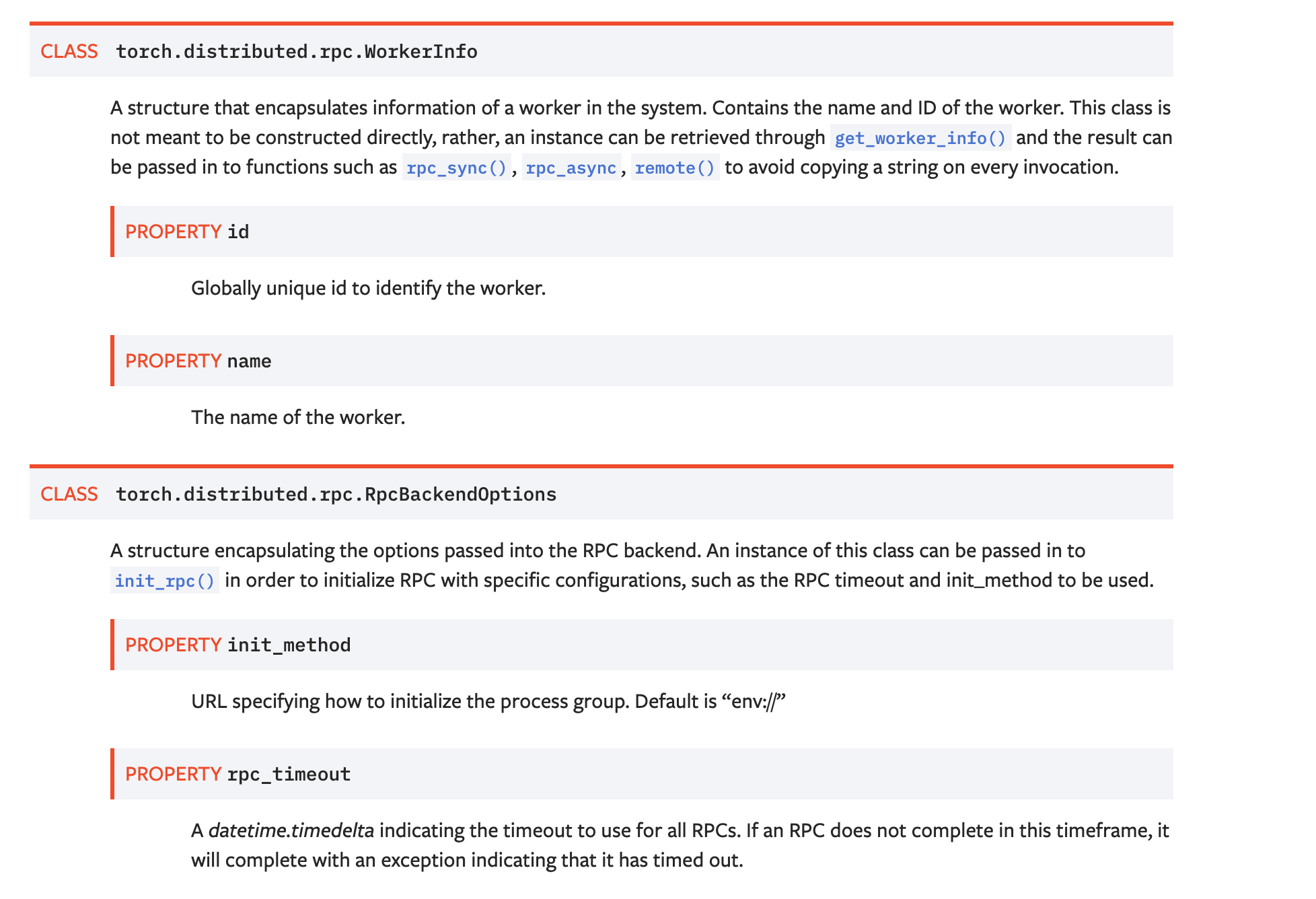
Pull Request resolved: https://github.com/pytorch/pytorch/pull/30208

Adds default arg for init_method so users don't have to pass this in,
and moves it to `RpcBackendOptions` struct. Removes `init_method` arg from rpc.init_rpc. Also fixes some docs.
ghstack-source-id: 94500475

Test Plan: Unit tests pass.

Reviewed By: mrshenli

Differential Revision: D18630074

fbshipit-source-id: 04b7dd7ec96f4c4da311b71d250233f1f262135a
Summary:
Pull Request resolved: https://github.com/pytorch/pytorch/pull/30020
This is now possible due to previous changes made in `gloo` and `ProcessGroupGloo`. We `abort` the listener thread that is waiting for a message, and join all other threads. The destructor calls this same `localShutdown` method, but we ensure this is not called multiple times.

ghstack-source-id: 94415336

Test Plan: Unit tests pass.

Differential Revision: D5578006

fbshipit-source-id: 6258879fb44c9fca97fdfad64468c1488c16ac02
Summary:
Pull Request resolved: https://github.com/pytorch/pytorch/pull/30240

Get rid of the following warning when build docs:

```
/Users/shenli/Project/pytorch/docs/source/notes/rref.rst:184: WARNING: Error in "code" directive:
maximum 1 argument(s) allowed, 6 supplied.

.. code::
  import torch
  import torch.distributed.rpc as rpc

  # on worker A
  rref = rpc.remote('B', torch.add, args=(torch.ones(2), 1))
  # say the rref has RRefId 100 and ForkId 1
  rref.to_here()
```

Test Plan: Imported from OSS

Differential Revision: D18640016

Pulled By: mrshenli

fbshipit-source-id: d527827f01183411d4b4c73e0a976bdd7fccbf49
Summary:
Pull Request resolved: https://github.com/pytorch/pytorch/pull/30052

Some of the examples provided in `rpc/api.py` were not updated along
with the code changes, this PR updates them. Also removes the
`dist.ProcessGroup` information since `init_rpc` now initializes a default
process group.
ghstack-source-id: 94273004

Test Plan: Unit tests pass

Differential Revision: D18582596

fbshipit-source-id: a637683f0221f9600f7e50b74e9f7e5a1d331d8f
Summary:
Pull Request resolved: https://github.com/pytorch/pytorch/pull/30066

This commit adds design reasoning and walks through four scenarios
for RRef.

Test Plan: Imported from OSS

Reviewed By: rohan-varma

Differential Revision: D18595094

Pulled By: mrshenli

fbshipit-source-id: 134102901ce515a44a2e7cd013b62143a6158120
Summary:
Pull Request resolved: https://github.com/pytorch/pytorch/pull/30050

Renames this API to wait_all_workers as discussed.
ghstack-source-id: 94273005

Test Plan: Unit tests pass

Differential Revision: D18581466

fbshipit-source-id: 4ff5d5fb2d528f17252d5b5f30c3047d2efb92bf
Summary:
Pull Request resolved: https://github.com/pytorch/pytorch/pull/30160

The path torch.distributed.rpc.api is an implementation detail, which
should not be used by applications to import RPC APIs. Instead, all
RPC APIs are exposed directly as torch.distributed.rpc.*. This
commit makes the API doc consistent with the above expectation.

Test Plan: Imported from OSS

Differential Revision: D18616359

Pulled By: mrshenli

fbshipit-source-id: 8207f7d36c24cf55af737c03a27fd1896c231641
Summary:
Pull Request resolved: https://github.com/pytorch/pytorch/pull/29762

Rename this API as discussed, since it's use cases extend beyond only
model parallelism.
ghstack-source-id: 94020627

Test Plan: Unit tests pass

Differential Revision: D18491743

fbshipit-source-id: d07676bb14f072c64da0ce99ee818bcc582efc57
Summary:
Small fixes to rpc docs:
- mark as experimental and subject to change
- Reference the distributed autograd design document in pytorch notes page.
Pull Request resolved: https://github.com/pytorch/pytorch/pull/29857

Differential Revision: D18526252

Pulled By: rohan-varma

fbshipit-source-id: e09757fa60a9f8fe9c76a868a418a1cd1c300eae
Summary:
Pull Request resolved: https://github.com/pytorch/pytorch/pull/29927

With the docs page now up, we can update the links in the design doc
to point to the docs page.
ghstack-source-id: 94055423

Test Plan: waitforbuildbot

Differential Revision: D18541878

fbshipit-source-id: f44702d9a8296ccc0a5d58d56c3b6dc8a822b520