I need this for later. This roughly returns all the OpOverloads
for an OpOverloadPacket in the order that the OpOverloadPacket decides
to resolve them in.

Test Plan:
- wait for CI
Pull Request resolved: https://github.com/pytorch/pytorch/pull/112198
Approved by: https://github.com/ezyang
We want to make TorchRec sharded models TorchScriptable.

TorchRec sharded models uses generic types Awaitable[W] and LazyAwaitable[W] (https://github.com/pytorch/torchrec/blob/main/torchrec/distributed/types.py#L212).
In sharded model those types are used instead of contained type W, having the initialization function that produces object of type W.

At the moment when the first attribute of W is requested - `LazyAwaitable[W]` will call its initialization function (on the same stack), cache the result inside and work transparently as an object of W. So we can think about it as a delayed object initialization.

To support this behavior in TorchScript - we propose a new type to TorchScript - `Await`.
In eager mode it works the same as `LazyAwaitable[W]` in TorchRec, being dynamically typed - acting as a type `W` while it is `Await[W]`.

Within torchscript it is `Await[W]` and can be only explicitly converted to W, using special function `torch.jit.awaitable_wait(aw)`.
Creation of this `Await[W]` is done via another special function `torch.jit.awaitable(func, *args)`.

The semantic is close to `torch.jit.Future`, fork, wait and uses the same jit mechanics (inline fork Closures) with the difference that it does not start this function in parallel on fork. It only stores as a lambda inside IValue that will be called on the same thread when `torch.jit.awaitable_wait` is called.

For example (more examples in this PR `test/jit/test_await.py`)
```
      def delayed(z: Tensor) -> Tensor:
          return Tensor * 3

      @torch.jit.script
      def fn(x: Tensor):
          aw: Await[int] = torch.jit._awaitable(delayed, 99)
          a = torch.eye(2)
          b = torch.jit._awaitable_wait(aw)
          return a + b + x
```

Functions semantics:

`_awaitable(func -> Callable[Tuple[...], W], *args, **kwargs) -> Await[W]`

Creates Await object, owns args and kwargs. Once _awaitable_wait calls, executes function func and owns the result of the function. Following _awaitable_wait calls will return this result from the first function call.

`_awaitable_wait(Await[W]) -> W`
Returns either cached result of W if it is not the first _awaitable_wait call to this Await object or calls specified function if the first.

`_awaitable_nowait(W) -> Await[W]`

Creates trivial Await[W] wrapper on specified object To be type complaint for the corner cases.

Differential Revision: [D42502706](https://our.internmc.facebook.com/intern/diff/D42502706)
Pull Request resolved: https://github.com/pytorch/pytorch/pull/90863
Approved by: https://github.com/davidberard98
Re-landing #68111/#74596
## Description
v0.5 PR of this [RFC](https://github.com/pytorch/pytorch/issues/49444).
On the basis of #50256, the below improvements are included:
* The [v0.5 release branch](https://github.com/oneapi-src/oneDNN/releases/tag/graph-v0.5) of the oneDNN Graph API is used
* The fuser now works with the profiling graph executor. We have inserted type check nodes to guard the profiled tensor properties.
### User API:
The optimization pass is disabled by default. Users could enable it by:
```
torch.jit.enable_onednn_fusion(True)
```
`torch.jit.freeze` should be used after tracing (recommended) or scripting a model.
### Performance:
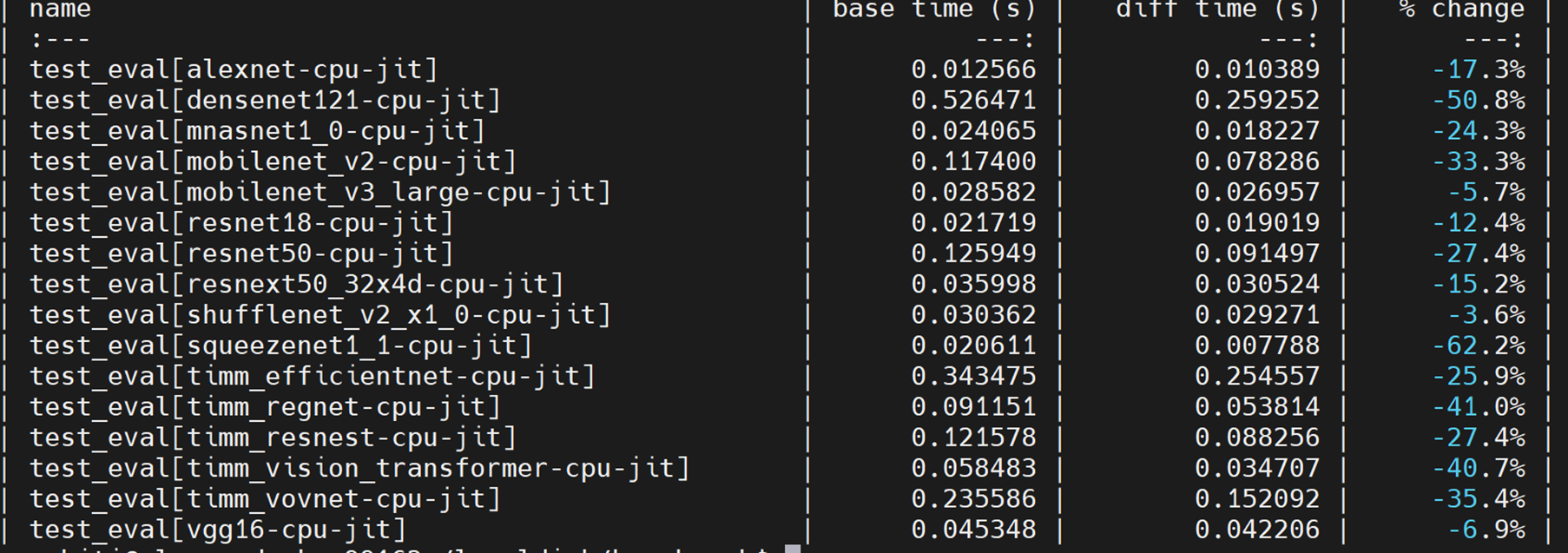
[pytorch/benchmark](https://github.com/pytorch/benchmark) tool is used to compare the performance:
* SkyLake 8180 (1 socket of 28 cores):
* SkyLake 8180 (single thread):
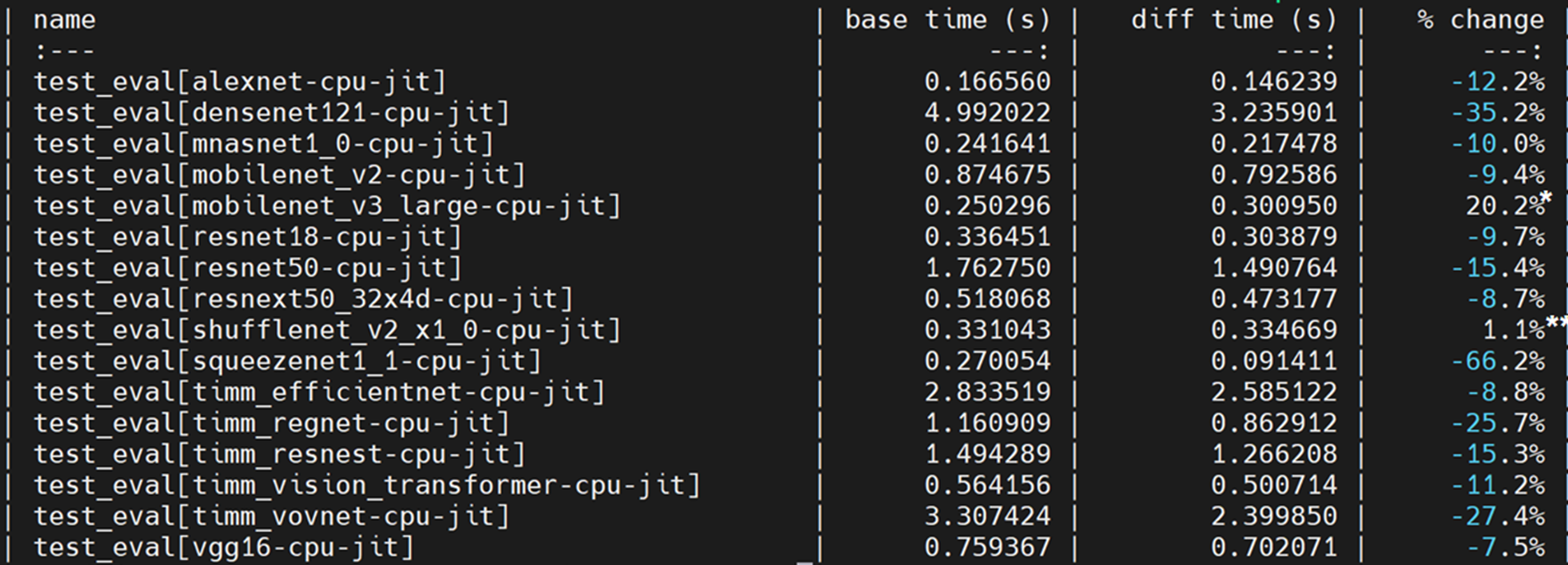
* By mapping hardswish to oneDNN Graph, it’s 8% faster than PyTorch JIT (NNC + OFI)
** We expect performance gain after mapping transpose, contiguous & view to oneDNN graph ops
### Directory structure of the integration code
Fuser-related code is placed under:
```
torch/csrc/jit/codegen/onednn/
```
Optimization pass registration is done in:
```
torch/csrc/jit/passes/onednn_graph_fuser.h
```
CMake for the integration code is in:
```
caffe2/CMakeLists.txt
cmake/public/mkldnn.cmake
cmake/Modules/FindMKLDNN.cmake
```
## Limitations
* In this PR, we only support Pytorch-oneDNN-Graph integration on Linux platform. Support on Windows and MacOS will be enabled as a next step.
* We have only optimized the inference use-case.
Pull Request resolved: https://github.com/pytorch/pytorch/pull/76622
Approved by: https://github.com/eellison
Summary:
## Description
Preview4 PR of this [RFC](https://github.com/pytorch/pytorch/issues/49444).
On the basis of https://github.com/pytorch/pytorch/pull/50256, the below improvements are included:
- The [preview4 release branch](https://github.com/oneapi-src/oneDNN/releases/tag/graph-v0.4.1) of the oneDNN Graph API is used
- The fuser now works with the profiling graph executor. We have inserted type check nodes to guard the profiled tensor properties.
### User API:
The optimization pass is disabled by default. Users could enable it by:
```
torch.jit.enable_onednn_fusion(True)
```
### Performance:
[pytorch/benchmark](https://github.com/pytorch/benchmark) tool is used to compare the performance:
- SkyLake 8180 (1 socket of 28 cores):

- SkyLake 8180 (single thread):

\* By mapping hardswish to oneDNN Graph, it’s 8% faster than PyTorch JIT (NNC + OFI)
\** We expect performance gain after mapping transpose, contiguous & view to oneDNN graph ops
### Directory structure of the integration code
Fuser-related code are placed under:
```
torch/csrc/jit/codegen/onednn/
```
Optimization pass registration is done in:
```
torch/csrc/jit/passes/onednn_graph_fuser.h
```
CMake for the integration code is:
```
caffe2/CMakeLists.txt
```
## Limitations
- In this PR, we have only supported the optimization on Linux platform. The support on Windows and MacOS will be enabled as the next step.
- We have only optimized the inference use case.
Pull Request resolved: https://github.com/pytorch/pytorch/pull/68111
Reviewed By: eellison
Differential Revision: D34584878
Pulled By: malfet
fbshipit-source-id: ce817aa8cc9052ee9ed930c9cf66be83449e61a4
(cherry picked from commit cd17683aa7d9c0947df45a1ab53627feff795587)
Summary:
Pull Request resolved: https://github.com/pytorch/pytorch/pull/70871

We had previously handled reusing memory in the optimized kernel execution path, but not yet handled it if we hit the unoptimized fallback.

Test Plan: Imported from OSS

Reviewed By: ngimel

Differential Revision: D33458652

Pulled By: eellison

fbshipit-source-id: 4eb62181ed02c95813a99638f5e2d0f9347b5c08
Summary:
Pull Request resolved: https://github.com/pytorch/pytorch/pull/69476

This diff adds a new op, `TensorExprDynamicGroup`, that composes all the logic behind running a dynamic shaped fused node. This includes a guard instruction that checks for conditions, a conditional that calls the fused node or the fallback graph depending on the guard.
ghstack-source-id: 146107006

Test Plan:
```
buck test mode/dev-nosan //caffe2/test/cpp/jit:jit
```

Reviewed By: eellison

Differential Revision: D32320082

fbshipit-source-id: 2bd1a43391ca559837d78ddb892d931abe9ebb73
Summary:
Pull Request resolved: https://github.com/pytorch/pytorch/pull/69406

Most files that include `interned_strings.h` don't actually depend on
anything generated from `FORALL_NS_SYMBOLS` yet because they're in a
single file you need to recompile whenever a new symbol is added. Here
I move the class definition into a separate file so this doesn't
happen.

Test Plan: Imported from OSS

Reviewed By: zou3519

Differential Revision: D32923637

Pulled By: albanD

fbshipit-source-id: 6e488cbfcfe2c041a99d9ff22e167dbddf3f46d7
Summary:
Pull Request resolved: https://github.com/pytorch/pytorch/pull/64336

Currently AliasDB rejects any user-defined ops with `AliasAnalysisKind::CONSERVATIVE` if they do not have a special treatment for alias analysis. For example, the following alias schema gets rejects:

```
  m.def(torch::schema(
      "namescope::my_op(...) -> ...",
      c10::AliasAnalysisKind::CONSERVATIVE));
```

This rejection condition is contradictory: AliasDB can handle ops with `CONSERVATIVE` in a general way without any special casing at https://fburl.com/diffusion/op5u72sk calling https://fburl.com/diffusion/h3aws5dd which seems very appropriate to be conservative for alias analysis.

This change corrects the rejection condition to be satisfied for ops *with* special casing but have `CONSERVATIVE`, since they both cannot be used simultaneously.

Test Plan:
Confirmed that
```
  m.def(torch::schema(
      "namescope::my_op(...) -> ...",
      c10::AliasAnalysisKind::CONSERVATIVE));
```
gets accepted and `my_op`'s all inputs and outputs are put to point to wildcard(*) by AliasDB.

Reviewed By: eellison

Differential Revision: D30690121

fbshipit-source-id: 431cc1a84edd5227f52b44a0fd85d5eb16f3c288
Summary:
Pull Request resolved: https://github.com/pytorch/pytorch/pull/51600

Looking for notes on implementation first, will post more notes on benchmarks and overall thoughts/implementation and solicit more input soon.

Test Plan: Imported from OSS

Reviewed By: navahgar

Differential Revision: D26696702

Pulled By: eellison

fbshipit-source-id: cd612f093fe3859e42fb0b77560ebd1b44fccff7
Summary:
Pull Request resolved: https://github.com/pytorch/pytorch/pull/51483

This PR moves the conv weights of a frozen model to MKLDNN, and AOT reorders the weights. When the weights are already in MKLDNN, just computing a single conv by converting the input and output from/to mkldnn provides large speedups. I benchmark'd the results of the top 200 shapes in predictor [here](https://www.internalfb.com/phabricator/paste/view/P171537938), as well as verified that it sped up popular models in torchvision.

Test Plan: Imported from OSS

Reviewed By: navahgar

Differential Revision: D26696703

Pulled By: eellison

fbshipit-source-id: 0b4441bee4f6e0890a4540fbca3bb5e58b8c5adf
Summary:
Pull Request resolved: https://github.com/pytorch/pytorch/pull/47665

Re-enabled the pass to remove outputs from fusion that is only used by aten::size;
Added size computation for reduction op via new operator prim::ReductionSizes;

Test Plan: Imported from OSS

Reviewed By: navahgar, jamesr66a

Differential Revision: D25254675

Pulled By: Krovatkin

fbshipit-source-id: e9a057b0287ed0ac93b415647fd8e5e836ba9856
Summary:
Pull Request resolved: https://github.com/pytorch/pytorch/pull/46686

I was trying to page this code back in after a while and some things
stuck out as unnecessarily confusing.

1. Improve documentation of closures and fork stuff to be more accurate
to how we use them today.
2. Change `prim::LocalVariableScope` to `prim::ListComprehension`. It is
only ever used for a list comprehensions, and in general the nodes
emitted by `ir_emitter` should correspond to concrete operations or
language features rather than semantic constraints.
3. Change the somewhat mysterious "inputs" and "attributes" argument
names throughout the codebase to be the more obvious "args" and "kwargs"
that they generally represent (I think "inputs" and "attributes" come
from the AST naming).

Test Plan: Imported from OSS

Reviewed By: navahgar, jamesr66a

Differential Revision: D24464197

Pulled By: suo

fbshipit-source-id: 1f4b1475b58b5690a0b204e705caceff969533b4
Summary:
1. Added CudaFusionGuard as the custom TypeCheck for nvfuser; enabled dynamic shape support with profiling executor;
2. dropped support for legacy fuser;
3. re-enabled nvfuser tests;
4. added registration for profiling record to allow profiling on user specified nodes.

Pull Request resolved: https://github.com/pytorch/pytorch/pull/46452

Reviewed By: zou3519, anjali411

Differential Revision: D24364642

Pulled By: ngimel

fbshipit-source-id: daf53a9a6b6636e1ede420a3a6d0397d4a8b450b
Summary:
Pull Request resolved: https://github.com/pytorch/pytorch/pull/44442

I noticed lock contention on startup as lookupByLiteral() was
calling registerPendingOperators() - some calls were holding the
lock for 10+ ms, as operators were being registered.

canonicalSchemaString() was using ostreamstring, which isn't typically
particularly fast (partly because of c++ spec locale requirements).
If we repalce with regular c++ string appends, it's somewhat faster
(which isn't hard when comparing with stringstream; albeit a bit
more codegen)

Over the first minute or so, this cuts out 1.4 seconds under the
OperatorRegistry lock (as part of registerPendingOperators) in the
first couple minutes of run time (mostly front-loaded) when running
sync sgd.

As an example, before:
   registerPendingOperators 12688 usec for 2449 operators
After:
   registerPendingOperators 6853 usec for 2449 operators
ghstack-source-id: 111862971

Test Plan: buck test mode/dev-nosan caffe2/test/cpp/...

Reviewed By: ailzhang

Differential Revision: D23614515

fbshipit-source-id: e712f9dac5bca0b1876e11fb8f0850402f03873a
Summary:
Pull Request resolved: https://github.com/pytorch/pytorch/pull/43043

This add the support for rpc_sync in TorchScript in a way similar to
rpc_async

Test Plan: Imported from OSS

Reviewed By: mrshenli

Differential Revision: D23252039

Pulled By: wanchaol

fbshipit-source-id: 8a05329cb8a24079b2863178b73087d47273914c
Summary:
Pull Request resolved: https://github.com/pytorch/pytorch/pull/43635

Intern the symbol, no functional changes. Aliasing need to be looked at but this should be done in a separate PR; this PR is just changing the symbol.

Test Plan: Imported from OSS

Reviewed By: bertmaher

Differential Revision: D23358806

Pulled By: eellison

fbshipit-source-id: f18bcd142a0daf514136f019ae607e4c3f45d9f8
Summary:
This PR adds API to package unoptimized/fallback blocks as function calls. It's mainly meant to be used by TensorExpressionsFuser and SpecializeAutogradZero passes as both specialize the original graph but would also like to provide a fallback path in case the assumptions under which the graph was specialized do not hold for some inputs.

Pull Request resolved: https://github.com/pytorch/pytorch/pull/43274

Reviewed By: malfet

Differential Revision: D23406961

Pulled By: Krovatkin

fbshipit-source-id: ef21fc9ad886953461b09418d02c75c58375490c
Summary:
Pull Request resolved: https://github.com/pytorch/pytorch/pull/43633

In the backward graph, _grad_sum_to_size is inserted whenever a possibly broadcasting op is called:"
`"aten::_grad_sum_to_size(Tensor(a) self, int[]? size) -> Tensor(a)"`
 If a broadcast occurred, a sum is called, otherwise the second input is None and it is a no-op. Most of the time, it's a no-op (in the fast RNNs benchmark > 90% of the time).

We can get rid of this op by profiling the optionality of the second input. I added `prim::profile_optional` to do this, which counts the number of times it saw a None value and the number of times it saw a value present. When specializing the backward graph, we insert checks for values we profiled as None, and in the optimized block can remove the grad_sum_to_size calls that use those values.

In the future we may revisit this when NNC supports reductions and we want to replace grad_sum_to_size with sums as well, but I think this is worth landing now.

Test Plan: Imported from OSS

Reviewed By: bwasti, ZolotukhinM

Differential Revision: D23358809

Pulled By: eellison

fbshipit-source-id: a30a148ca581370789d57ba082d23cbf7ef2cd4d
Summary: Enforce duplicate op name check on mobile

Test Plan: run full/lite predictor

Reviewed By: iseeyuan

Differential Revision: D22639758

fbshipit-source-id: 2993c4bc1b14c833b273183f4f343ffad62121b3
Summary:
Pull Request resolved: https://github.com/pytorch/pytorch/pull/41214

Same as D21032976, add check for duplicated op name in JIT

Test Plan:
run full JIT predictor
also
buck test pytorch-playground

Reviewed By: smessmer

Differential Revision: D22467871

fbshipit-source-id: 9b7a40a217e6c63cca44cad54f9f657b8b207a45
Summary:
**Summary**
This commit adds support for with statements to PyTorch JIT. Each
of the with items in a with statement is represented in the JIT IR
as a pair of `prim::Enter` and `prim::Exit` nodes that call the
`__enter__` and `__exit__` methods defined on the context manager objects
returned by the expressions in the with item.

**Testing**
This commit adds unit tests for with statements with named with items,
nameless with items, and with statements that encounter exceptions.
```
$ python test/test_jit.py TestWith.test_with_as
Fail to import hypothesis in common_utils, tests are not derandomized
.
----------------------------------------------------------------------
Ran 1 test in 0.430s

OK
```

```
$ python test/test_jit.py TestWith.test_with_no_as
Fail to import hypothesis in common_utils, tests are not derandomized
.
----------------------------------------------------------------------
Ran 1 test in 0.264s

OK
```

```
$ python test/test_jit.py TestWith.test_with_exceptions
Fail to import hypothesis in common_utils, tests are not derandomized
Couldn't download test skip set, leaving all tests enabled...
.
----------------------------------------------------------------------
Ran 1 test in 1.053s

OK
```
Pull Request resolved: https://github.com/pytorch/pytorch/pull/34705

Differential Revision: D22095945

Pulled By: SplitInfinity

fbshipit-source-id: f661565a834786725259b8ea014b4d7532f9419d
Summary:
Use std::list instead of std::vector to avoid iterating over list of registered listeners
Also, fix formatting

Pull Request resolved: https://github.com/pytorch/pytorch/pull/35486

Differential Revision: D20677764

Pulled By: malfet

fbshipit-source-id: d2a545454a29a12bbbf4aa62d9f8c4029a109e6c
Summary:
Pull Request resolved: https://github.com/pytorch/pytorch/pull/35115

This commit runs the newly added tools/clang_format.py on the JIT
codebase and includes all of the formatting changes thus produced.

Testing:
Ran the script, CI.

Test Plan: Imported from OSS

Reviewed By: eellison

Differential Revision: D20568523

Pulled By: SplitInfinity

fbshipit-source-id: e09bdb982ccf090eecfb7c7b461b8d0681eef82b
Summary:
Pull Request resolved: https://github.com/pytorch/pytorch/pull/33020

This is a pass to create functional blocks. The other PRs in the stack help avoid some of the limitations that are are often found in graphs. It's possible that this would work well with a graph that is frozen. Follow up work items that will help this pass:

- We don't currently have any capacity in alias analysis to tell whether a Value that came from the wildcard set "re-escapes" back into the wildcard set.
- More comments on the semantics of the graph and correctness conditions
- We could consider using dynamic dag if the perf of this is a limitation.
- potential make Functional Graphs Functional Blocks instead, so that we do not repeatedly copy constants, also to make IR read easier.

Test Plan: Imported from OSS

Differential Revision: D20603188

Pulled By: eellison

fbshipit-source-id: 6822a6e65f4cc2676f8f6445fe8aa1cb858ebeeb
Summary:
Pull Request resolved: https://github.com/pytorch/pytorch/pull/34515

Once upon a time we thought this was necessary. In reality it is not, so
removing it.

For backcompat, our public interface (defined in `api/`) still has
typedefs to the old `script::` names.

There was only one collision: `Pass` as a `Stmt` and `Pass` as a graph
transform. I renamed one of them.

Test Plan: Imported from OSS

Differential Revision: D20353503

Pulled By: suo

fbshipit-source-id: 48bb911ce75120a8c9e0c6fb65262ef775dfba93
Summary:
Separating CUDA fuser from CPU fuser.

1. New node in IR - prim::CudaFusionGroup:
   This enables the cuda fuser to co-exist along side the old fuser. Allows us
   to incrementally build and expand cuda fuser.

2. copied FuseGraph optimization passes to CudaFuserGraph:
   We will re-factor & reuse Chunk/Concat in the old fuser logic, which is
   handled in the optimization pass at this moment. Unfortunately many code in
   the pass is tightly binded with the legacy fuser, which makes code sharing
   difficult.
   The CudaFusionGraph will support only a subset of operations comparing to
   legacy fuser (CUDA only). It is registered as a custom pass post fusion via
     ```torch._C._jit_register_cuda_fuser()```
   To have it in effect, you should also turn off fusion on GPU via
     ```torch._C._jit_override_can_fuse_on_gpu(False)```

3. We don't have codegen in this PR yet (WIP). Currently we just fall back to
   the old fuser.
Pull Request resolved: https://github.com/pytorch/pytorch/pull/33527

Differential Revision: D20171598

Pulled By: ZolotukhinM

fbshipit-source-id: 9a3c0f06f46da7eaa80ae7551c04869f5b03ef71
Summary:
Pull Request resolved: https://github.com/pytorch/pytorch/pull/33329

# Use case

```
torch.jit.script
def send_rpc_async(dst_worker_name, user_callable_qual_name, tensor):
    # type: (str, str, Tensor) -> None
    rpc._rpc_async_torchscript(
        dst_worker_name, user_callable_qual_name, args=(tensor,)
    )
```

# Problem

```
torch.jit.frontend.NotSupportedError: keyword-arg expansion is not supported:
  File "/data/users/shihaoxu/fbsource/fbcode/buck-out/dev/gen/caffe2/test/distributed/rpc/rpc_spawn#binary,link-tree/torch/distributed/rpc/api.py", line 722
    args = args if args else ()
    kwargs = kwargs if kwargs else {}
    fut = _invoke_rpc_torchscript(to, qualified_name, *args, **kwargs)
                                                               ~~~~~~ <--- HERE
    return fut
```

# Solution

Register `rpc.rpc_async(..)` as a JIT operator to handle variable-length argument list.

# Plan

This PR is the required changes to make `rpc.rpc_async(..)` a JIT prim operator, which can dynamically handle different number of arguments.

- Register "prim::rpc_async" as a `Symbol` in "interned_string.h"
- Add a if branch in "python_sugared_value.cpp" `toSugarValue(py::object, ..)` entry utility function to set up how JIT frontend convert `torch.distributed.rpc.rpc_async(..)` Python function (Python object) into a `SpecialFormValue` (IR SugaredValue).
- Add a switch case for "prim::rpc_aynsc" Symbol in "ir_emitter.cpp" and `emitApplySpecialForm(..)` to set up how JIT compiler provides inputs to the "prim::rpc_aynsc" Operator.
- Register "prim::rpc_async" as a `jit::Operator` and provide implementation in "register_distributed_ops.cpp".

Notice, since the distributed module is an optional part when building PyTorch. The code to be added in this PR should be wrapped within preprocessing maco.
```
#ifdef USE_DISTRIBUTED
new code here
#endif
```

Test Plan:
Items that need to be confirmed in the test cases

https://fb.quip.com/DCvdA9ZLjeO0

```
buck test mode/dev-nosan //caffe2/test/distributed/rpc/jit:rpc_fork

buck build mode/dev-nosan //caffe2/test/distributed/rpc/jit:rpc_fork  \
\
&& buck-out/gen/caffe2/test/distributed/rpc/jit/rpc_fork\#binary.par -r test_call_python_function_remotely_from_script_not_supported
```

```
buck test mode/dev-nosan //caffe2/test/distributed/rpc/jit:rpc_spawn
```

```
buck test mode/dev-nosan //caffe2/caffe2/python/operator_test:layer_norm_op_test-2.7 -- test_layer_norm_op_jit
```

Differential Revision: D5738300

fbshipit-source-id: a4604fe762e00be062dc8232ca9790df31fb2074
Summary:
**Summary**
This commit adds an implementation of `Tensor.tolist()` to the JIT interpreter.

**Testing**
This commit adds several unit tests that test that this function works correctly for
0D, 1D, 2D and 3D tensors of type `float`, `int` and `bool`.

```
(base) meghanl-mbp:pytorch meghanl$ python test/test_jit.py TestList.test_to_list -v
Fail to import hypothesis in common_utils, tests are not derandomized
test_to_list (jit.test_list_dict.TestList)
Unit tests for Tensor.tolist() function. ... ok

----------------------------------------------------------------------
Ran 1 test in 0.329s

OK
```
Pull Request resolved: https://github.com/pytorch/pytorch/pull/33472

Differential Revision: D20109738

Pulled By: SplitInfinity

fbshipit-source-id: a6e3fee5e3201d5e1f0c4ca45048488ae2bf5e33
Summary:
Pull Request resolved: https://github.com/pytorch/pytorch/pull/33806

as title

Test Plan: Imported from OSS

Differential Revision: D20122117

Pulled By: suo

fbshipit-source-id: 209d29ed2c873181140c9fb5cdc305c200ce4008


