This PR is on the way to getting compiled autograd's initial capture to
stop specializing on Tensor metadata.

This PR changes compiled autograd's initial capture to proxy an opaque
(w.r.t. Dynamo) function into the graph for all built-in codegen'ed
autograd nodes and validate_outputs.

We changed each codegen'ed apply_with_saved (e.g.
MulBackward0::apply_with_saved) to call into Python to proxy a function
(compiled_autograd.ops.MulBackward0) into the graph. Then, we use the
node's InputMetadata to "guess" at the properties of the output Tensors
to create some new FakeTensors.

Some details:
- MulBackward0::apply_with_saved lives in libtorch_cpu, but needs to be
  call to Python via libtorch_python. There is an indirection
  (PyCompilerInterface) to do this.
- MulBackward0::apply_with_saved passes a C++ function to Python. To make
  our lives easier, every codegen'ed apply_with_saved passes a C++
  function with the same signature
  `(variable_list, ivalue_list) -> variable_list`.
- We define how to pack arbitrary C++ types into IValue via a helper
  IValuePacker struct and codegen functional variants of each builtin
  C++ autograd node (e.g. MulBackward0_apply_functional_ivalue).

MulBackward0 before this PR:
https://gist.github.com/zou3519/a80381d5fa38e970e413fcd91b0530de

MulBackward0 after this PR:
https://gist.github.com/zou3519/0c2eee8b3d8d96232b51ef430b53c5b0

Test Plan:
- existing tests
Pull Request resolved: https://github.com/pytorch/pytorch/pull/143296
Approved by: https://github.com/jansel
Static variables in C++11 is guaranteed to be initialised exactly once, as mentioned [here](https://en.cppreference.com/w/cpp/language/storage_duration)
```
If multiple threads attempt to initialize the same static local variable concurrently,
the initialization occurs exactly once
(similar behavior can be obtained for arbitrary functions with std::call_once.
Usual implementations of this feature use variants
of the double-checked locking pattern,
which reduces runtime overhead for already-initialized local statics
 to a single non-atomic boolean comparison.
```
Given that static c10::once_flag is used before, why not just use the associated function to initialised the related static variables? That is the motivation behind this PR.

Pull Request resolved: https://github.com/pytorch/pytorch/pull/143255
Approved by: https://github.com/albanD
This branch:
1) converts the autograd tape into an FX graph
2) caches that conversion using a "shadow" graph
3) compiles and runs the generated FX graph instead of the normal autograd

What works currently:
1) Caching, capture, and initial integration
2) Backwards hooks
3) Inlining AotAutograd generated subgraphs
4) torch.compiling the generated FX graph
5) Auto-detecting dynamic shapes based on changes

Future work
1) Larger scale testing
1) Boxed calling convention, so memory can be freed incrementally
1) Support hooks on SavedTensor
1) Additional testing by running eager autograd tests under compiled_autograd.enable()

Pull Request resolved: https://github.com/pytorch/pytorch/pull/103822
Approved by: https://github.com/ezyang, https://github.com/albanD
### Introduction
<!-- What did you change and why was it needed? -->

Removing unnecessary weight gradient calculation is very important for applications that need high-order derivatives during training. However, this is not supported by the current Autograd engine.

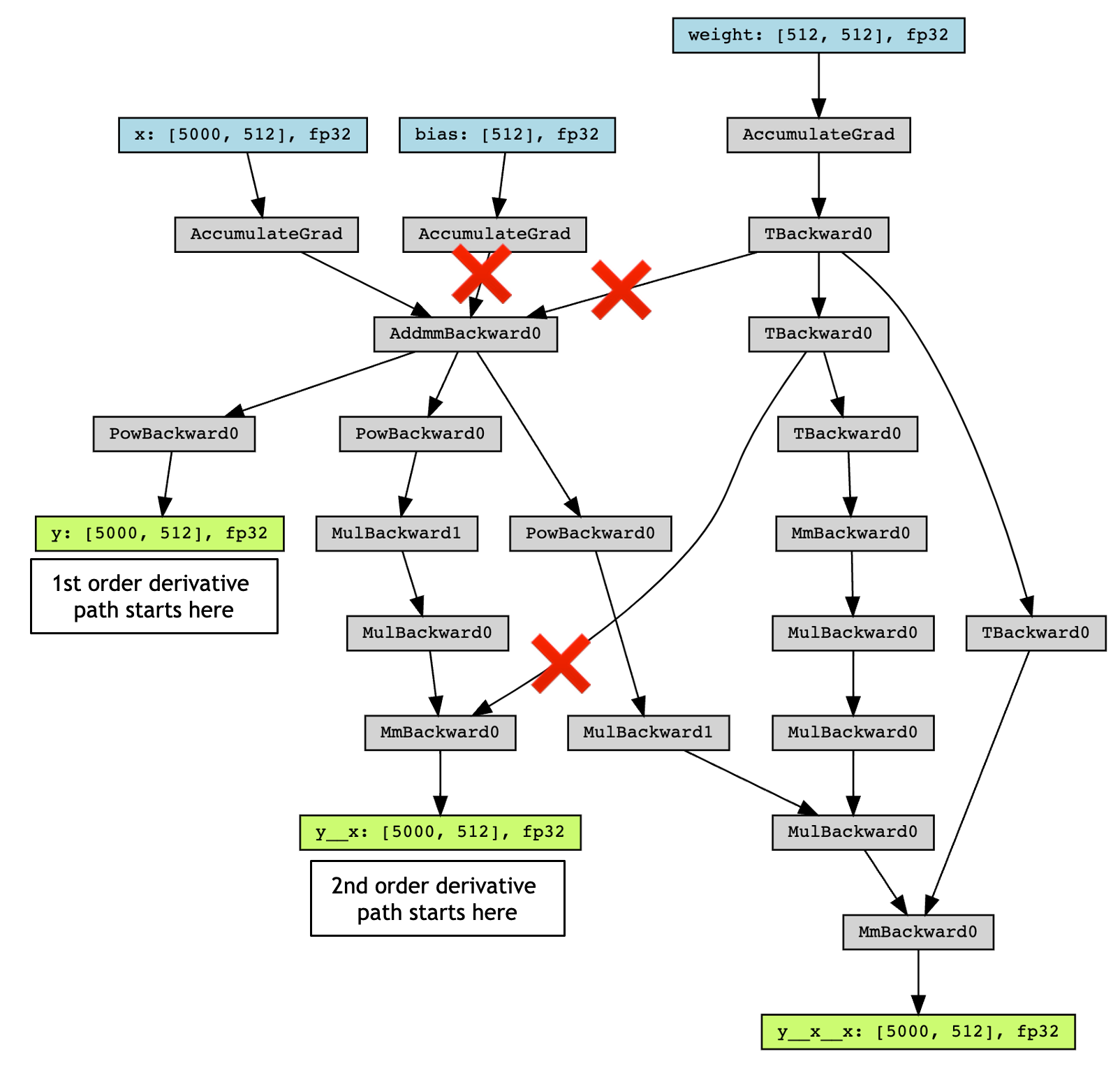
For more detail: The backward function of a `matmul` operator (e.g., `linear` `addmm` `mm`), has two matmuls, one for `input gradient` and another for `weight gradient`. For a typical neural network (nn) with a few linear layers and activation functions, if the user calls `torch.autograd.grad()` to calculate the derivative of the nn output `y` w.r.t the nn input `x`,  only the `input gradient` of the `matmul` operator is needed, and the `weight gradient` is discarded. However, the current PyTorch autograd engine will always calculate the `weight gradient` if `weight` requires gradient (the calculation of the high-order derivative is performed during training).

The figure attached shows the autograd graph of the following code snippet:
```py
y = torch.nn.functional.linear(x, weight, bias)
y = y.pow(2)
# first order derivative
y__x, = torch.autograd.grad(y, x, grad_outputs=grad_outputs, create_graph=True)
# first order derivative
y__x__x, = torch.autograd.grad(y__x, x, grad_outputs=grad_outputs, create_graph=True)
```
The path with ❌ is not needed when calculating derivatives.

<img width="50%" alt="image" src="https://user-images.githubusercontent.com/9999318/182018117-719c5a23-bcc6-4a63-8e8d-1bca3ebda2e3.png">

### Issue
<!-- Link to Issue ticket or RFP -->
Related issue: https://github.com/pytorch/pytorch/issues/56500

### Method
When calling `torch.autograd.grad`, `exec_info_` is created for each GraphTask, which allows filtering paths on the graph that are not needed. However, when the GraphTask calls into the node, the node still does not know whether the edges are needed or not. In the case of matmul, `weight.requires_grad is True` so the weight gradient is always calculated.

Following https://github.com/pytorch/pytorch/issues/56500#issuecomment-825694656, this PR passes the graph task's thread_local `exec_info_` into the node, so it could trim unnecessary edges during `torch.autograd.grad` calls.

### Benchmark
Benchmark script: https://gist.github.com/yueyericardo/24158433a2021c51eeef9c3e2722df99

Benchmark result:
6 hidden layers, batch size 10000, on A100

FP32 result
| hessian benchmark             | FP32 (before) | FP32 (After)      | FP32 (Functorch v0.1.1) |
| ----------------------------- | ------------- | ----------------- | ----------------------- |
| Linear + ReLU (no backward)   | 55.658 ms     | 29.392 ms (1.90X) | 29.547 ms (1.90X)       |
| Linear + ReLU (with backward) | 81.173 ms     | 54.917 ms (1.47X) | 68.988 ms (1.18X)       |

TF32 result
| hessian benchmark             | TF32 (before) | TF32 (after)      | TF32 (Functorch v0.1.1) |
| ----------------------------- | ------------- | ----------------- | ----------------------- |
| Linear + ReLU (no backward)   | 19.801 ms     | 11.259 ms (1.76X) | 10.754 ms (1.84X)       |
| Linear + ReLU (with backward) | 29.167 ms     | 20.466 ms (1.42X) | 22.784 ms (1.28X)       |

For FP32 result, we could get 1.9X speed up for hessian calculation, and 1.47X speed up during training, which is even faster than functorch `vmap(jacfwd(jacrev` implementation. (functorch has performance regression on v0.2.0, https://github.com/pytorch/functorch/issues/989, so we are using v0.1.1 for benchmark)

@zou3519 does functorch also includes similar optimizations during hessian calculation? If not, what do we need to do so the functorch could also benefit from this PR?

### Testing
<!-- How did you test your change? -->

- [x] we need to figure out a way for unittest

### Thanks
Thanks for the great blog: [How Computational Graphs are Executed in PyTorch | PyTorch](https://pytorch.org/blog/how-computational-graphs-are-executed-in-pytorch/)

cc @zasdfgbnm @albanD
Pull Request resolved: https://github.com/pytorch/pytorch/pull/82544
Approved by: https://github.com/soulitzer
Summary:
Pull Request resolved: https://github.com/pytorch/pytorch/pull/72687

Not sure who would use that. It is not used in the code base as far as I can see. And I don't know of anyone working with the engine directly out of tree. So tentatively removing it.

Test Plan: Imported from OSS

Reviewed By: soulitzer

Differential Revision: D34180244

Pulled By: albanD

fbshipit-source-id: 678ba1c4a1cbd9a0458d33be97664d1e3d1bd86b
(cherry picked from commit 3968ca3a38)
Summary:
Follow up to https://github.com/pytorch/pytorch/issues/68095

This also changes the files from the ATen folder to include c10's `Export.h` instead since they can't ever be exporting `TORCH_PYTHON_API`.

cc pietern mrshenli pritamdamania87 zhaojuanmao satgera rohan-varma gqchen aazzolini osalpekar jiayisuse SciPioneer H-Huang

Pull Request resolved: https://github.com/pytorch/pytorch/pull/69585

Reviewed By: mrshenli

Differential Revision: D32958594

Pulled By: albanD

fbshipit-source-id: 1ec7ef63764573fa2b486928955e3a1172150061
Summary:
Fixes https://github.com/pytorch/pytorch/issues/50209

This adds a new warning handler that stores all warnings in a shared
queue, which can be "replayed" at a later time and, crucially, on
another thread. Then, I use this inside the autograd engine to ensure
that warnings are processed by the handler registered on the main
thread.

For testing, I also add an operator that always warns in the backward
pass and test that the warning is a normal Python warning.

cc ezyang albanD zou3519 gqchen pearu nikitaved soulitzer Lezcano Varal7

Pull Request resolved: https://github.com/pytorch/pytorch/pull/66235

Reviewed By: ejguan

Differential Revision: D31505413

Pulled By: albanD

fbshipit-source-id: 1a7f60b038f55c20591c0748b9e86735b3fec2f9
Summary:
Pull Request resolved: https://github.com/pytorch/pytorch/pull/63116

This PR removes the special flag to disable grad mode tracking on the ThreadLocalState and replaces it with an explicit setter that users can use.
This allows to reduce complexity of ThreadLocalState.

Test Plan: Imported from OSS

Reviewed By: ngimel

Differential Revision: D30388098

Pulled By: albanD

fbshipit-source-id: 85641b3d711179fb78ff6a41ed077548dc821a2f
Summary:
Pull Request resolved: https://github.com/pytorch/pytorch/pull/62563

Expose a pair of functions to Python users: torch.autograd.graph.set_saved_tensors_default_hooks(pack, unpack) and torch.autograd.graph.reset_saved_tensors_default_hooks().
These functions control the hooks applied to saved tensors: all tensors saved in that context will be packed using the pack function, then unpacked accordingly when needed.

Currently, this works by simply calling register_hooks (cf #60975) directly at the end of the constructor of a SavedVariable. This could be optimized further by not performing the copy before registering default hooks, but this would require a small refactor. Edit: the refactor is done in #61927.

A current limitation is that if users create tensors in this context, they will not be able to register additional hooks on the saved tensor.

For instance, to perform something like #28997, one could define a pack function that saves to disk whenever the tensor size is too big and returns a filename, then unpack simply reads the content of the file and outputs a tensor, e.g.:

```
def pack(x):
    name = os.path.join(tmp_dir, str(uuid.uuid4()))
    torch.save(x, name)
    return name

def unpack(name):
    return torch.load(name)
```

Relanding previous PR: https://github.com/pytorch/pytorch/pull/61834

Original PR led to timeout error in: https://www.internalfb.com/mast/job/yuguo-release_canary_offline_training-inlinecvrp_a-canary_offline_train_28a7ecfc

Now passing: https://www.internalfb.com/mast/job/quach-release_canary_offline_training-inlinecvrp_a-canary_offline_train_9bb57e98

The difference with the new version is we don't need to acquire the GIL when calling `PyDefaultSavedVariableHooks::get_hooks`.

Test Plan: Imported from OSS

Reviewed By: iramazanli

Differential Revision: D30045405

Pulled By: Varal7

fbshipit-source-id: 7f6c07af3a56fe8835d5edcc815c15ea4fb4e332
Summary:
Pull Request resolved: https://github.com/pytorch/pytorch/pull/61834

Expose a pair of functions to Python users: torch.autograd.graph.set_saved_tensors_default_hooks(pack, unpack) and torch.autograd.graph.reset_saved_tensors_default_hooks().
These functions control the hooks applied to saved tensors: all tensors saved in that context will be packed using the pack function, then unpacked accordingly when needed.

Currently, this works by simply calling register_hooks (cf #60975) directly at the end of the constructor of a SavedVariable. This could be optimized further by not performing the copy before registering default hooks, but this would require a small refactor. Edit: the refactor is done in #61927.

A current limitation is that if users create tensors in this context, they will not be able to register additional hooks on the saved tensor.

For instance, to perform something like #28997, one could define a pack function that saves to disk whenever the tensor size is too big and returns a filename, then unpack simply reads the content of the file and outputs a tensor, e.g.:

```
def pack(x):
    name = os.path.join(tmp_dir, str(uuid.uuid4()))
    torch.save(x, name)
    return name

def unpack(name):
    return torch.load(name)
```

Test Plan: Imported from OSS

Reviewed By: zou3519

Differential Revision: D29792193

Pulled By: Varal7

fbshipit-source-id: 33e931230ef59faa3ec8b5d11ef7c05539bce77c
Summary:
This PR suppresses clang-tidy warnings in the codebase (for now) so that we can re-enable clang-tidy checks on master.

I ran this script to add the `NOLINTNEXTLINE` comments (on a devserver):
```bash
python3 setup.py develop

# Uses same script that's run on CI and adds the -j (parallel), -s (add comments), -k (continue if diagnostic errors are found) options
python3 tools/clang_tidy.py \
  -j \
  -s \
  -k \
  -v \
  --paths torch/csrc/ \
  -g"-torch/csrc/jit/passes/onnx/helper.cpp" \
  -g"-torch/csrc/jit/passes/onnx/shape_type_inference.cpp" \
  -g"-torch/csrc/jit/serialization/onnx.cpp" \
  -g"-torch/csrc/jit/serialization/export.cpp" \
  -g"-torch/csrc/jit/serialization/import.cpp" \
  -g"-torch/csrc/jit/serialization/import_legacy.cpp" \
  -g"-torch/csrc/onnx/init.cpp" \
  -g"-torch/csrc/cuda/nccl.*" \
  -g"-torch/csrc/cuda/python_nccl.cpp" \
  -g"-torch/csrc/autograd/FunctionsManual.cpp" \
  -g"-torch/csrc/generic/*.cpp" \
  -g"-torch/csrc/jit/codegen/cuda/runtime/*" \
  -g"-torch/csrc/deploy/interpreter/interpreter.cpp" \
  -g"-torch/csrc/deploy/interpreter/interpreter.h" \
  -g"-torch/csrc/deploy/interpreter/interpreter_impl.h" \
  -g"-torch/csrc/deploy/interpreter/test_main.cpp"
```

Pull Request resolved: https://github.com/pytorch/pytorch/pull/60649

Test Plan: Verified changes by re-running the script (without the `-s` option) and seeing no warnings/errors.

Reviewed By: walterddr, janeyx99

Differential Revision: D29504258

Pulled By: 1ntEgr8

fbshipit-source-id: 78310b30ee8213b73ddb4771ad874665323e7a4e
Summary:
Before https://github.com/pytorch/pytorch/pull/57833, calls to backward() or grad() synced only the calling thread's default stream with autograd leaf streams at the end of backward. This made the following weird pattern safe:
```python
with torch.cuda.stream(s):
    # imagine forward used many streams, so backward leaf nodes may run on many streams
    loss.backward()
# no sync
use grads
```

but a more benign-looking pattern was unsafe:
```python
with torch.cuda.stream(s):
    # imagine forward used a lot of streams, so backward leaf nodes may run on many streams
    loss.backward()
    # backward() syncs the default stream with all the leaf streams, but does not sync s with anything,
    # so counterintuitively (even though we're in the same stream context as backward()!)
    # it is NOT SAFE to use grads here, and there's no easy way to make it safe,
    # unless you manually sync on all the streams you used in forward,
    # or move "use grads" back to default stream outside the context.
    use grads
```
mruberry ngimel and I decided backward() should have the [same user-facing stream semantics as any cuda op](https://pytorch.org/docs/master/notes/cuda.html#stream-semantics-of-backward-passes).** In other words, the weird pattern should be unsafe, and the benign-looking pattern should be safe. Implementationwise, this meant backward() should sync its calling thread's current stream, not default stream, with the leaf streams.

After https://github.com/pytorch/pytorch/pull/57833, backward syncs the calling thread's current stream AND default stream with all leaf streams at the end of backward. The default stream syncs were retained for temporary backward compatibility.

This PR finishes https://github.com/pytorch/pytorch/pull/57833's work by deleting syncs on the default stream.

With this PR, graph-capturing an entire backward() call should be possible (see the [test_graph_grad_scaling diffs](https://github.com/pytorch/pytorch/compare/master...mcarilli:streaming_backwards_remove_default_syncs?expand=1#diff-893b1eea27352f336f4cd832919e48d721e4e90186e63400b8596db6b82e7450R3641-R3642)).

** first paragraph has a formatting error which this PR should also fix.

Pull Request resolved: https://github.com/pytorch/pytorch/pull/60421

Reviewed By: albanD

Differential Revision: D29370344

Pulled By: ngimel

fbshipit-source-id: 3248bc5fb92fc517db0c15c897e5d7250f67d7fe
Summary:
Before https://github.com/pytorch/pytorch/pull/57833, calls to backward() or grad() synced only the calling thread's default stream with autograd leaf streams at the end of backward. This made the following weird pattern safe:
```python
with torch.cuda.stream(s):
    # imagine forward used many streams, so backward leaf nodes may run on many streams
    loss.backward()
# no sync
use grads
```

but a more benign-looking pattern was unsafe:
```python
with torch.cuda.stream(s):
    # imagine forward used a lot of streams, so backward leaf nodes may run on many streams
    loss.backward()
    # backward() syncs the default stream with all the leaf streams, but does not sync s with anything,
    # so counterintuitively (even though we're in the same stream context as backward()!)
    # it is NOT SAFE to use grads here, and there's no easy way to make it safe,
    # unless you manually sync on all the streams you used in forward,
    # or move "use grads" back to default stream outside the context.
    use grads
```
mruberry ngimel and I decided backward() should have the [same user-facing stream semantics as any cuda op](https://pytorch.org/docs/master/notes/cuda.html#stream-semantics-of-backward-passes).** In other words, the weird pattern should be unsafe, and the benign-looking pattern should be safe. Implementationwise, this meant backward() should sync its calling thread's current stream, not default stream, with the leaf streams.

After https://github.com/pytorch/pytorch/pull/57833, backward syncs the calling thread's current stream AND default stream with all leaf streams at the end of backward. The default stream syncs were retained for temporary backward compatibility.

This PR finishes https://github.com/pytorch/pytorch/pull/57833's work by deleting syncs on the default stream.

With this PR, graph-capturing an entire backward() call should be possible (see the [test_graph_grad_scaling diffs](https://github.com/pytorch/pytorch/compare/master...mcarilli:streaming_backwards_remove_default_syncs?expand=1#diff-893b1eea27352f336f4cd832919e48d721e4e90186e63400b8596db6b82e7450R3641-R3642)).

** first paragraph has a formatting error which this PR should also fix.

Pull Request resolved: https://github.com/pytorch/pytorch/pull/60421

Reviewed By: VitalyFedyunin, albanD

Differential Revision: D29342234

Pulled By: ngimel

fbshipit-source-id: 98e6be7fdd8550872f0a78f9a66cb8dfe75abf63
Summary:
Pull Request resolved: https://github.com/pytorch/pytorch/pull/58420

In https://github.com/pytorch/pytorch/pull/57636 I migrated most uses of Future to an intrusive_ptr. I thought I had all of them but I missed a couple. These are the remaining ones. (The next PR will make it impossible to add new usages of shared_ptr).
ghstack-source-id: 129567071

Test Plan: CI

Reviewed By: mrshenli

Differential Revision: D28477285

fbshipit-source-id: 75008276baa59e26b450e942c009ec7e78f89b13
Summary:
This is an automatic change generated by the following script:
```
#!/usr/bin/env python3
from subprocess import check_output, check_call
import os

def get_compiled_files_list():
    import json
    with open("build/compile_commands.json") as f:
        data = json.load(f)
    files = [os.path.relpath(node['file']) for node in data]
    for idx, fname in enumerate(files):
        if fname.startswith('build/') and fname.endswith('.DEFAULT.cpp'):
            files[idx] = fname[len('build/'):-len('.DEFAULT.cpp')]
    return files

def run_clang_tidy(fname):
    check_call(["python3", "tools/clang_tidy.py", "-c", "build", "-x", fname,"-s"])
    changes = check_output(["git", "ls-files", "-m"])
    if len(changes) == 0:
        return
    check_call(["git", "commit","--all", "-m", f"NOLINT stubs for {fname}"])

def main():
    git_files = check_output(["git", "ls-files"]).decode("ascii").split("\n")
    compiled_files = get_compiled_files_list()
    for idx, fname in enumerate(git_files):
        if fname not in compiled_files:
            continue
        if fname.startswith("caffe2/contrib/aten/"):
            continue
        print(f"[{idx}/{len(git_files)}] Processing {fname}")
        run_clang_tidy(fname)

if __name__ == "__main__":
    main()
```

Pull Request resolved: https://github.com/pytorch/pytorch/pull/56892

Reviewed By: H-Huang

Differential Revision: D27991944

Pulled By: malfet

fbshipit-source-id: 5415e1eb2c1b34319a4f03024bfaa087007d7179
Summary:
Pull Request resolved: https://github.com/pytorch/pytorch/pull/56808

For information about data-race-on-vptr in general, see https://www.internalfb.com/intern/wiki/TSAN/Common_Concurrency_Mistakes/Stopping_a_Thread_in_Destructor/

Engine::~Engine() was previously tasked with stopping the threads. This causes a data race on the object's vptr when PythonEngine is being destructed. This fixes the data race by making ~PythonEngine trigger the thread stopping before going down to the base class's destructor.

Test Plan:
Many tests are affected, but here's one example:

buck test mode/dev-tsan -c fbcode.tsan_strict_mode=true //oculus/research/orcoptics/deep_learning/srg_nn/tests:test_grating_net -- 'test_train (oculus.research.orcoptics.deep_learning.srg_nn.tests.test_grating_net.TestGratingNet)' --run-disabled

Reviewed By: walterddr, albanD

Differential Revision: D27972384

fbshipit-source-id: 8b70fec8d9326497c591a2777b355ea590a85082
Summary:
Fixes https://github.com/pytorch/pytorch/issues/12635

This change will help us speed up autograd's discovery algorithm in cases where we use `.grad` and we try to "unroll" the training loop. For example the example in the issue and also https://github.com/pytorch/pytorch/pull/52180#issuecomment-783400832 observe an unbounded multiple of speed-up.

We do this by adding a new sequence_nr-type numbering: for each node, we maintain the length of the longest path from it to any leaf node. How does this help us speed up discovery (dfs)? Previously the bottleneck was that the dfs that computes which nodes need to be executed always explored every node. With this change, before we run dfs, we first compute the mininum seq_nr among all the nodes passed as the `inputs`. If let this be some number N, intuitively this means that dfs should stay at least N units away from any leaf node. So, if we find ourselves too close to any leaf node, we should stop our search early.

Edit:
After some discussion offline, the plan is:
 - make old sequence_nr a construct of the profiler. This means we can avoid accessing thread local state in cases where the profiler is disabled. Note that we cannot replace sequence_nr as-is because profiler's use-case requires that thread-id + sequence_nr can uniquely identify a given node in order for downstream users/programs to correlate nodes from backward and forward passes. This means we must maintain two sequence_nr's and that we have an extra field in Node.
 - In a future PR, we can potentially remove sequence_nr entirely from the profiler as well, but we avoid doing it now because we haven't measured, and its a larger effort because we'd have to mess around with the dispatcher and profiler

Testing with this [code](https://gist.github.com/kyunghyuncho/5fb9991ce1233f909051854a84b7148e), we see that runtime no longer increases as we iterate.

Before:
```
100: Time taken: 0.47s, loss: 1.1e+06
200: Time taken: 0.064s, loss: 6.5e+05
300: Time taken: 0.088s, loss: 4.4e+05
400: Time taken: 0.1s, loss: 3.2e+05
500: Time taken: 0.12s, loss: 2.5e+05
600: Time taken: 0.15s, loss: 2e+05
700: Time taken: 0.18s, loss: 1.7e+05
800: Time taken: 0.2s, loss: 1.4e+05
900: Time taken: 0.22s, loss: 1.2e+05
1000: Time taken: 0.24s, loss: 1.1e+05
1100: Time taken: 0.27s, loss: 9.3e+04
1200: Time taken: 0.3s, loss: 8.3e+04
1300: Time taken: 0.34s, loss: 7.4e+04
1400: Time taken: 0.36s, loss: 6.7e+04
1500: Time taken: 0.38s, loss: 6.1e+04
1600: Time taken: 0.4s, loss: 5.6e+04
1700: Time taken: 0.42s, loss: 5.1e+04
1800: Time taken: 0.44s, loss: 4.7e+04
1900: Time taken: 0.47s, loss: 4.4e+04
2000: Time taken: 0.5s, loss: 4.1e+04
```
After:
```
100: Time taken: 0.49s, loss: 1.2e+06
200: Time taken: 0.031s, loss: 6.9e+05
300: Time taken: 0.031s, loss: 4.6e+05
400: Time taken: 0.031s, loss: 3.3e+05
500: Time taken: 0.031s, loss: 2.6e+05
600: Time taken: 0.031s, loss: 2.1e+05
700: Time taken: 0.031s, loss: 1.7e+05
800: Time taken: 0.031s, loss: 1.4e+05
900: Time taken: 0.031s, loss: 1.2e+05
1000: Time taken: 0.031s, loss: 1.1e+05
1100: Time taken: 0.031s, loss: 9.6e+04
1200: Time taken: 0.031s, loss: 8.6e+04
1300: Time taken: 0.031s, loss: 7.7e+04
1400: Time taken: 0.031s, loss: 7e+04
1500: Time taken: 0.031s, loss: 6.3e+04
1600: Time taken: 0.031s, loss: 5.8e+04
1700: Time taken: 0.031s, loss: 5.3e+04
1800: Time taken: 0.031s, loss: 4.9e+04
1900: Time taken: 0.031s, loss: 4.5e+04
2000: Time taken: 0.032s, loss: 4.2e+04

```
Testing w/ small graph to check for regression:
```
import torch
from torch.utils.benchmark import Timer

setup="""
a = torch.rand((2, 2), requires_grad=True)
b = torch.rand((2, 2), requires_grad=True)
gradient = torch.ones(2, 2)
"""

stmt="""
torch.autograd.grad(a*b, [a, b], gradient)
"""

timer = Timer(stmt, setup)

print(timer.timeit(10000))
print(timer.collect_callgrind(100))
```
Result: there doesn't seem to be any significant regression
```
Time before: 12.74 us
Time after: 13.12 us
Instruction count before:
                           All          Noisy symbols removed
    Instructions:      8078960                    8000882
    Baseline:             4226                       3838
Instruction count after:
                           All          Noisy symbols removed
    Instructions:      8091846                    8017940
    Baseline:             4336                       3838
100 runs per measurement, 1 thread
```

Pull Request resolved: https://github.com/pytorch/pytorch/pull/52180

Reviewed By: gchanan, zhangguanheng66

Differential Revision: D26794387

Pulled By: soulitzer

fbshipit-source-id: c00d387a29f151109c33dc6f1b56a8f275cdec58
Summary:
Fixes https://github.com/pytorch/pytorch/issues/46373

As noted in https://github.com/pytorch/pytorch/issues/46373, there needs to be a flag passed into the engine that indicates whether it was executed through the backward api or grad api. Tentatively named the flag `accumulate_grad` since functionally, backward api accumulates grad into .grad while grad api captures the grad and returns it.

Moving changes not necessary to the python api (cpp, torchscript) to a new PR.

Pull Request resolved: https://github.com/pytorch/pytorch/pull/46855

Reviewed By: ngimel

Differential Revision: D24649054

Pulled By: soulitzer

fbshipit-source-id: 6925d5a67d583eeb781fc7cfaec807c410e1fc65
Summary:
Pull Request resolved: https://github.com/pytorch/pytorch/pull/43684

This PR attempts to address #42560 by capturing the appropriate
exception_ptr in the autograd engine and passing it over to the Future.

As part of this change, there is a significant change the Future API where we
now only accept an exception_ptr as part of setError.

For the example in #42560, the exception trace would now look like:

```
> Traceback (most recent call last):
>   File "test_autograd.py", line 6914, in test_preserve_backtrace
>     Foo.apply(t).sum().backward()
>   File "torch/tensor.py", line 214, in backward
>     torch.autograd.backward(self, gradient, retain_graph, create_graph)
>   File "torch/autograd/__init__.py", line 127, in backward
>     allow_unreachable=True)  # allow_unreachable flag
>   File "torch/autograd/function.py", line 87, in apply
>     return self._forward_cls.backward(self, *args)
>   File "test_autograd.py", line 6910, in backward
>     raise ValueError("something")
> ValueError: something
```
ghstack-source-id: 111109637

Test Plan: waitforbuildbot

Reviewed By: albanD

Differential Revision: D23365408

fbshipit-source-id: 1470c4776ec8053ea92a6ee1663460a3bae6edc5
Summary:
Pull Request resolved: https://github.com/pytorch/pytorch/pull/43676

This is one part of https://github.com/pytorch/pytorch/issues/41574 to
ensure we consolidate everything around ivalue::Future.

I've removed the use of torch/csrc/utils/future.h from the autograd engines and
used ivalue::Future instead.
ghstack-source-id: 110895545

Test Plan: waitforbuildbot.

Reviewed By: albanD

Differential Revision: D23362415

fbshipit-source-id: aa109b3f8acf0814d59fc5264a85a8c27ef4bdb6
Summary:
Pull Request resolved: https://github.com/pytorch/pytorch/pull/42511

DistEngine currently only has a single thread to execute GPU to CPU
continuations as part of the backward pass. This would be a significant
performance bottleneck in cases where we have such continuations and would like
to execute these using all CPU cores.

To alleviate this in this PR, we have the single thread in DistEngine only
dequeue work from the global queue, but then hand off execution of that work to
the c10 threadpool where we call "execute_graph_task_until_ready_queue_empty".

For more context please see:
https://github.com/pytorch/pytorch/issues/40255#issuecomment-663298062.
ghstack-source-id: 109997718

Test Plan: waitforbuildbot

Reviewed By: albanD

Differential Revision: D22917579

fbshipit-source-id: c634b6c97f3051f071fd7b994333e6ecb8c54155
Summary:
Pull Request resolved: https://github.com/pytorch/pytorch/pull/40312

As part of https://github.com/pytorch/pytorch/issues/40255, we
realized that GPU support for distributed autograd was broken as part of our
multithreaded autograd change.

To fix this in the short term for 1.6, this PR includes the following changes:

1) Long lived CPU thread in DistEngine to execute GPU->CPU continuations in the
autograd graph.
2) The long lived CPU thread has its own ready_queue and this queue is used for
all GraphTasks created by DistEngine.
3) In thread_main(), the CPU thread cannot exit once the GraphTask is done
processing because of the new CPU thread added in 1).
4) To resolve this, thread_main() now has a parameter `device_thread` instead
of `reentrant_thread`. When device_thread is True, we expect this to be a long
lived device thread that does not exit.
5) When device_thread is False, thread_main is expected to run a GraphTask and
return once done.
ghstack-source-id: 106391329

Test Plan: waitforbuildbot

Differential Revision: D22146183

fbshipit-source-id: dd146b7a95f55db75f6767889b7255e9d62d5825
Summary:
## Why doesn’t DDP work under dist_autograd?
DDP follows the steps below
1. [DDP Python constructor](8d6a8d2b3f/torch/nn/parallel/distributed.py (L389-L393)) (on a module) creates a [C++ Reducer](https://github.com/pytorch/pytorch/blob/master/torch/csrc/distributed/c10d/reducer.cpp), which holds references to all parameters (or variables in C++ code).
2. The reducer installs a post hook on each model parameter.
3. The backward run starts and triggers the post hooks installed above.
4. The post hook of a parameter simply marks the parameter ready for all-reduce.
5. Once all parameters in a bucket are ready, an all-reduce process starts by reading variable `.grad` and writes to variable `.grad`.

But under dist_autograd, `.grad` of a variable is not populated at all. Instead, grads are in a global map in distributed context from variables to their grads.

## Solution of this PR
The distributed engine to set a thread_local variable in a backward run indicating we're running in distributed mode. DDP reducer can then appropriately use `.grad` or the distributed context based on the thread local. More precisely, the thread local is set before calling the post hooks installed by the DDP reducer so that DDP post hooks can retrieve this thread local.
Pull Request resolved: https://github.com/pytorch/pytorch/pull/37998

Test Plan:
```
python test/distributed/test_ddp_under_dist_autograd.py
```

FB repo
```
buck test caffe2/test/distributed/...
```

DDP accuracy benchmark workflow run

```
flow-cli canary pytorch.benchmark.accuracy_comparison.workflow --parameters-json '{"node_world_size": 4, "dist_backend": "nccl"}' --run-as-secure-group fblearner_flow --entitlement gpu_prod
```

f196173157

Reviewed By: pritamdamania87

Differential Revision: D21513795

Pulled By: hczhu

fbshipit-source-id: fe21e68ecdc9274182db4d4bb5a1e2d68ef927a2
Summary:
If Engine is created shortly before application exits, then non-reentrant thread might not have a chance to spawn which would result in an infinite wait in `Engine::~Engine()`
Prevent this by actually waiting for threads to spawn before returning from `Engine::start_device_threads()`
Make sure that thread count is incremented before GIL is acquired in PythonThread
Pull Request resolved: https://github.com/pytorch/pytorch/pull/39194

Differential Revision: D21789219

Pulled By: malfet

fbshipit-source-id: d9b5e74d5ddeb2474b575af2e4f33d022efcfe53