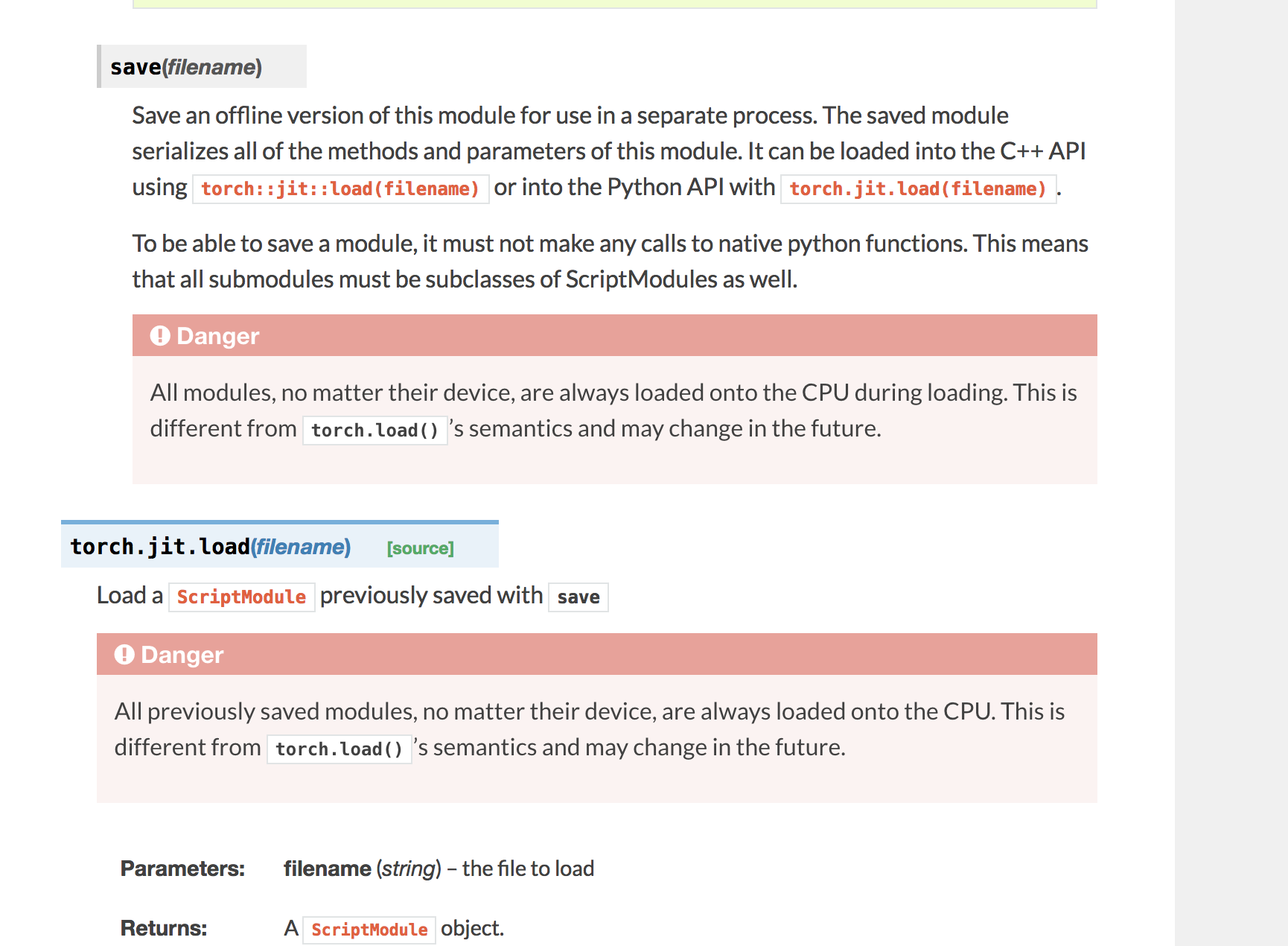
Summary:
goldsborough Modify the docs to match the changes made in #4999
Pull Request resolved: https://github.com/pytorch/pytorch/pull/12158

Differential Revision: D10103964

Pulled By: SsnL

fbshipit-source-id: 1b8692da86aca1a52e8d2e6cea76a5ad1f71e058
Summary:
Couple questions:

1) I used the log1p implementation in #8969 as a guide especially for testing.  I'm not sure what the ```skipIfROCM``` annotation is for, so unsure if i need it for my test.

2) I implemented the branching logic in the narrow function itself; is this the right place to do so?  I noticed that there a number of places where sparse-specific logic is handled with just an if statement in this file.  Or should I implement a separate dispatch in native_functions.yml as in the log1p?

And of course, happy to make any any other updates/changes that I may have missed as well.  This is my first PR to the project.
Pull Request resolved: https://github.com/pytorch/pytorch/pull/11342

Differential Revision: D9978430

Pulled By: weiyangfb

fbshipit-source-id: e73dc20302ab58925afb19e609e31f4a38c634ad
Summary:
Deleted this section by mistake in last PR.
Pull Request resolved: https://github.com/pytorch/pytorch/pull/11938

Reviewed By: SsnL

Differential Revision: D9993258

Pulled By: brianjo

fbshipit-source-id: 2552178cebd005a1105a22930c4d128c67247378
Summary:
A couple fixes I deem necessary to the TorchScript C++ API after writing the tutorial:

1. When I was creating the custom op API, I created `torch/op.h` as the one-stop header for creating custom ops. I now notice that there is no good header for the TorchScript C++ story altogether, i.e. when you just want to load a script module in C++ without any custom ops necessarily. The `torch/op.h` header suits that purpose just as well of course, but I think we should rename it to `torch/script.h`, which seems like a great name for this feature.

2. The current API for the CMake we provided was that we defined a bunch of variables like `TORCH_LIBRARY_DIRS` and `TORCH_INCLUDES` and then expected users to add those variables to their targets. We also had a CMake function that did that for you automatically. I now realized a much smarter way of doing this is to create an `IMPORTED` target for the libtorch library in CMake, and then add all this stuff to the link interface of that target. Then all downstream users have to do is `target_link_libraries(my_target torch)` and they get all the proper includes, libraries and compiler flags added to their target. This means we can get rid of the CMake function and all that stuff. orionr  AFAIK this is a much, much better way of doing all of this, no?

3. Since we distribute libtorch with `D_GLIBCXX_USE_CXX11_ABI=0`, dependent libraries must set this flag too. I now add this to the interface compile options of this imported target.

4. Fixes to JIT docs.

These could likely be 4 different PRs but given the release I wouldn't mind landing them all asap.

zdevito dzhulgakov soumith
Pull Request resolved: https://github.com/pytorch/pytorch/pull/11682

Differential Revision: D9839431

Pulled By: goldsborough

fbshipit-source-id: fdc47b95f83f22d53e1995aa683e09613b4bfe65
Summary:
This adds a Note on making experiments reproducible.

It also adds Instructions for building the Documentation to `README.md`. Please ping if I missed any requirements.

I'm not sure what to do about the submodule changes. Please advise.
Pull Request resolved: https://github.com/pytorch/pytorch/pull/11329

Differential Revision: D9784939

Pulled By: ezyang

fbshipit-source-id: 5c5acbe343d1fffb15bdcb84c6d8d925c2ffcc5e
Summary:
Ping ezyang
This addresses your comment in #114. Strangely, when running the doc build (`make html`) none of my changes are actually showing, could you point out what I'm doing wrong?

Once #11329 is merged it might make sense to link to the reproducibility note everywhere.
Pull Request resolved: https://github.com/pytorch/pytorch/pull/11434

Differential Revision: D9751208

Pulled By: ezyang

fbshipit-source-id: cc672472449564ff099323c39603e8ff2b2d35c9
Summary:
I'm 80% sure that this fixes the math bug. But I can't repro locally so I don't know.
Pull Request resolved: https://github.com/pytorch/pytorch/pull/11472

Differential Revision: D9755328

Pulled By: SsnL

fbshipit-source-id: 130be664d3c6ceee3c0c166c1a86fc9ec3b79d74
Summary:
vishwakftw Your patch needed some updates because the default native function dispatches changed from `[function, method]` to `[function]`. The CI was run before that change happened so it still shows green, but the internal test caught it.

I did some changes when rebasing and updating so I didn't just force push to your branch. Let's see if this passes CI and internal test. If it does, let me know if you want me to force push to your branch or use this PR instead.

Note to reviewers: patch was already approved at #10068 .

cc yf225
Pull Request resolved: https://github.com/pytorch/pytorch/pull/11421

Differential Revision: D9733407

Pulled By: SsnL

fbshipit-source-id: cf2ed293bb9942dcc5158934ff4def2f63252599
Summary:
In addition to documentation, this cleans up a few error message formats.
It also adds infra to find which operators are supported by the JIT automatically, which is then used in the generation of the docs.

The wording and formatting of the docs is not yet polished, but having this will allow our document writers to make faster progress.

Followup PRs will polish the docs and fix formatting issues.
Pull Request resolved: https://github.com/pytorch/pytorch/pull/11357

Differential Revision: D9721277

Pulled By: zdevito

fbshipit-source-id: 153a0d5be1efb314511bcfc0cec48643d78ea48b
Summary:
This PR cleans up the `at::Tensor` class by removing all methods that start with an underscore in favor of functions in the `at::` namespace. This greatly cleans up the `Tensor` class and makes it clearer what is the public and non-public API.

For this I changed `native_functions.yaml` and `Declarations.cwrap` to make all underscore methods `variant: function` (or add such a statement to begin with), and then fixed all code locations using the underscore methods.

ezyang colesbury gchanan
Pull Request resolved: https://github.com/pytorch/pytorch/pull/11152

Differential Revision: D9683607

Pulled By: goldsborough

fbshipit-source-id: 97f869f788fa56639c05a439e2a33be49f10f543
Summary:
Since we don't need `torch.autograd.Variable` anymore, I removed `torch.autograd.Variable` from `onnx.rst`.
Pull Request resolved: https://github.com/pytorch/pytorch/pull/10810

Differential Revision: D9500960

Pulled By: zou3519

fbshipit-source-id: 1bc820734c96a8c7cb5d804e6d51a95018db8e7f
Summary:
The CPU and CUDA variants are a direct transposition of Graves et al.'s description of the algorithm with the
modification that is is in log space.
The there also is a binding for the (much faster) CuDNN implementation.
This could eventually fix#3420
I still need to add tests (TestNN seems much more elaborate than the other testing) and fix the bugs than invariably turn up during the testing. Also, I want to add some more code comments.
I could use feedback on all sorts of things, including:
- Type handling (cuda vs. cpu for the int tensors, dtype for the int tensors)
- Input convention. I use log probs because that is what the gradients are for.
- Launch parameters for the kernels
- Errors and obmissions and anything else I'm not even aware of.
Thank you for looking!
In terms of performance it looks like it is superficially comparable to WarpCTC (and thus, but I have not systematically investigated this).
I have read CuDNN is much faster than implementations because it does *not* use log-space, but also the gathering step is much much faster (but I avoided trying tricky things, it seems to contribute to warpctc's fragility). I might think some more which existing torch function (scatter or index..) I could learn from for that step.
Average timings for the kernels from nvprof for some size:
```
CuDNN:
60.464us compute_alphas_and_betas
16.755us compute_grads_deterministic
Cuda:
121.06us ctc_loss_backward_collect_gpu_kernel (= grads)
109.88us ctc_loss_gpu_kernel (= alphas)
98.517us ctc_loss_backward_betas_gpu_kernel (= betas)
WarpCTC:
299.74us compute_betas_and_grad_kernel
66.977us compute_alpha_kernel
```
Of course, I still have the (silly) outer blocks loop rather than computing consecutive `s` in each thread which I might change, and there are a few other things where one could look for better implementations.
Finally, it might not be unreasonable to start with these implementations, as the performance of the loss has to be seen in the context of the entire training computation, so this would likely dilute the relative speedup considerably.
My performance measuring testing script:
```
import timeit
import sys
import torch
num_labels = 10
target_length = 30
input_length = 50
eps = 1e-5
BLANK = 0#num_labels
batch_size = 16
torch.manual_seed(5)
activations = torch.randn(input_length, batch_size, num_labels + 1)
log_probs = torch.log_softmax(activations, 2)
probs = torch.exp(log_probs)
targets = torch.randint(1, num_labels+1, (batch_size * target_length,), dtype=torch.long)
targets_2d = targets.view(batch_size, target_length)
target_lengths = torch.tensor(batch_size*[target_length])
input_lengths = torch.tensor(batch_size*[input_length])
activations = log_probs.detach()
def time_cuda_ctc_loss(grout, *args):
torch.cuda.synchronize()
culo, culog_alpha = torch._ctc_loss(*args)
g, = torch.autograd.grad(culo, args[0], grout)
torch.cuda.synchronize()
def time_cudnn_ctc_loss(groupt, *args):
torch.cuda.synchronize()
culo, cugra= torch._cudnn_ctc_loss(*args)
g, = torch.autograd.grad(culo, args[0], grout)
torch.cuda.synchronize()
def time_warp_ctc_loss(grout, *args):
torch.cuda.synchronize()
culo = warpctc.ctc_loss(*args, blank_label=BLANK, size_average=False, length_average=False, reduce=False)
g, = torch.autograd.grad(culo, args[0], grout)
torch.cuda.synchronize()
if sys.argv[1] == 'cuda':
lpcu = log_probs.float().cuda().detach().requires_grad_()
args = [lpcu, targets_2d.cuda(), input_lengths.cuda(), target_lengths.cuda(), BLANK]
grout = lpcu.new_ones((batch_size,))
torch.cuda.synchronize()
print(timeit.repeat("time_cuda_ctc_loss(grout, *args)", number=1000, globals=globals()))
elif sys.argv[1] == 'cudnn':
lpcu = log_probs.float().cuda().detach().requires_grad_()
args = [lpcu, targets.int(), input_lengths.int(), target_lengths.int(), BLANK, True]
grout = lpcu.new_ones((batch_size,))
torch.cuda.synchronize()
print(timeit.repeat("time_cudnn_ctc_loss(grout, *args)", number=1000, globals=globals()))
elif sys.argv[1] == 'warpctc':
import warpctc
activations = activations.cuda().detach().requires_grad_()
args = [activations, input_lengths.int(), targets.int(), target_lengths.int()]
grout = activations.new_ones((batch_size,), device='cpu')
torch.cuda.synchronize()
print(timeit.repeat("time_warp_ctc_loss(grout, *args)", number=1000, globals=globals()))
```
I'll also link to a notebook that I used for writing up the algorithm in simple form and then test the against implementations against it.
Pull Request resolved: https://github.com/pytorch/pytorch/pull/9628
Differential Revision: D8952453
Pulled By: ezyang
fbshipit-source-id: 18e073f40c2d01a7c96c1cdd41f6c70a06e35860
Summary:
This implements the two-parameter Weibull distribution, with scale $\lambda$ and shape $k$ parameters as described on [Wikipedia](https://en.wikipedia.org/wiki/Weibull_distribution).

**Details**
- We implement as a transformed exponential distribution, as described [here](https://en.wikipedia.org/wiki/Weibull_distribution#Related_distributions).
- The `weibull_min` variance function in scipy does not yet support a vector of distributions, so our unit test uses a scalar distribution instead of a vector.

Example of the bug:

```
>>> sp.stats.expon(np.array([0.5, 1, 2])).var() # fine
array([1., 1., 1.])
>>> sp.stats.weibull_min(c=np.array([0.5, 1, 2])).var() # buggy
Traceback (most recent call last):
  File "<stdin>", line 1, in <module>
  File "/usr/local/lib/python3.7/site-packages/scipy/stats/_distn_infrastructure.py", line 490, in var
    return self.dist.var(*self.args, **self.kwds)
  File "/usr/local/lib/python3.7/site-packages/scipy/stats/_distn_infrastructure.py", line 1242, in var
    res = self.stats(*args, **kwds)
  File "/usr/local/lib/python3.7/site-packages/scipy/stats/_distn_infrastructure.py", line 1038, in stats
    if np.isinf(mu):
ValueError: The truth value of an array with more than one element is ambiguous. Use a.any() or a.all()
```
Pull Request resolved: https://github.com/pytorch/pytorch/pull/9454

Differential Revision: D8863574

Pulled By: SsnL

fbshipit-source-id: 1ad3e175b469eee2b6af98e7b379ea170d3d9787
Summary:
This pull request implements low rank multivariate normal distribution where the covariance matrix has the from `W @ W.T + D`. Here D is a diagonal matrix, W has shape n x m where m << n. It used "matrix determinant lemma" and "Woodbury matrix identity" to save computational cost.

During the way, I also revise MultivariateNormal distribution a bit. Here are other changes:
+ `torch.trtrs` works with cuda tensor. So I tried to use it instead of `torch.inverse`.
+ Use `torch.matmul` instead of `torch.bmm` in `_batch_mv`. The former is faster and simpler.
+ Use `torch.diagonal` for `_batch_diag`
+ Reimplement `_batch_mahalanobis` based on `_batch_trtrs_lower`.
+ Use trtrs to compute term2 of KL.
+ `variance` relies on `scale_tril` instead of `covariance_matrix`

TODO:
- [x] Resolve the fail at `_gradcheck_log_prob`
- [x] Add test for KL

cc fritzo stepelu apaszke
Pull Request resolved: https://github.com/pytorch/pytorch/pull/8635

Differential Revision: D8951893

Pulled By: ezyang

fbshipit-source-id: 488ee3db6071150c33a1fb6624f3cfd9b52760c3
Summary:
fixes#4176 cc vishwakftw
I didn't do `:math:` and `\neg` because I am using double ticks so they render more similarly with `:attr:`.
Pull Request resolved: https://github.com/pytorch/pytorch/pull/9630
Differential Revision: D8933022
Pulled By: SsnL
fbshipit-source-id: 31d8551f415b624c2ff66b25d886f20789846508
Summary:
dlpacks deserve documentation. :)

I wonder whether it might make sense to merge the various small torch.utils pages (and include a link for the larger ones, e.g. data) to enhance the structure in the docs.
Pull Request resolved: https://github.com/pytorch/pytorch/pull/9343

Differential Revision: D8801227

Pulled By: soumith

fbshipit-source-id: 2980d271971743b86f052bec5a2cb4d146a90d9b
Summary:
Commits:
1. In extension doc, get rid of all references of `Variable` s (Closes#6947 )
+ also add minor improvements
+ also added a section with links to cpp extension :) goldsborough
+ removed mentions of `autograd.Function.requires_grad` as it's not used anywhere and hardcoded to `return_Py_True`.
2. Fix several sphinx warnings
3. Change `*` in equations in `module/conv.py` to `\times`
4. Fix docs for `Fold` and `Unfold`.
+ Added better shape check for `Fold` (it previously may give bogus result when there are not enough blocks). Added test for the checks.
5. Fix doc saying `trtrs` not available for CUDA (#9247 )
Pull Request resolved: https://github.com/pytorch/pytorch/pull/9239
Reviewed By: soumith
Differential Revision: D8762492
Pulled By: SsnL
fbshipit-source-id: 13cd91128981a94493d5efdf250c40465f84346a
Summary:
This PR addresses #5823.

* fix docstring: upsample doesn't support LongTensor

* Enable float scale up & down sampling for linear/bilinear/trilinear modes. (following SsnL 's commit)

* Enable float scale up & down sampling for nearest mode. Note that our implementation is slightly different from TF that there's actually no "align_corners" concept in this mode.

* Add a new interpolate function API to replace upsample. Add deprecate warning for upsample.

* Add an area mode which is essentially Adaptive_average_pooling into resize_image.

* Add test cases for interpolate in test_nn.py

* Add a few comments to help understand *linear interpolation code.

* There is only "*cubic" mode missing in resize_images API which is pretty useful in practice. And it's labeled as hackamonth here #1552. I discussed with SsnL that we probably want to implement all new ops in ATen instead of THNN/THCUNN. Depending on the priority, I could either put it in my queue or leave it for a HAMer.

* After the change, the files named as *Upsampling*.c works for both up/down sampling. I could rename the files if needed.

Differential Revision: D8729635

Pulled By: ailzhang

fbshipit-source-id: a98dc5e1f587fce17606b5764db695366a6bb56b
Summary:
Closes#9147
Added a test to prevent regression in test_torch
Added entries in docs
cc ezyang weiyangfb
Closes https://github.com/pytorch/pytorch/pull/9156
Differential Revision: D8732095
Pulled By: soumith
fbshipit-source-id: 7a6892853cfc0ccb0142b4fd25015818849adf61
* docs: enable redirect link to work for each specific page
* docs: add canonical_url for search engines
closes#7222
* docs: update redirect link to canonical_url
* Implement adaptive softmax

* fix test for python 2

* add return_logprob flag

* add a test for cross-entropy path

* address review comments

* Fix docs

* pytorch 0.4 fixes

* address review comments

* don't use no_grad when computing log-probs

* add predict method

* add test for predict

* change methods order

* get rid of hardcoded int values

* Add an optional bias term to the head of AdaptiveSoftmax
* Implement torch.as_tensor, similar to numpy.asarray.
torch.as_tensor behaves like torch.tensor except it avoids copies if possible; so also somewhat like tensor.new but without the size overloads.
I didn't add a requires_grad field, because we haven't decided on the semantics such as as_param.

* Remove requires_grad for doc.
* initial commit for spectral norm

* fix comment

* edit rst

* fix doc

* remove redundant empty line

* fix nit mistakes in doc

* replace l2normalize with F.normalize

* fix chained `by`

* fix docs

fix typos
add comments related to power iteration and epsilon
update link to the paper
make some comments specific

* fix typo
Adds ability to JIT compile C++ extensions from strings
>>> from torch.utils.cpp_extension import load_inline
>>> source = '''
at::Tensor sin_add(at::Tensor x, at::Tensor y) {
return x.sin() + y.sin();
}
'''
>>> module = load_inline(name='inline_extension', cpp_sources=source, functions='sin_add')
Fixes#7012
* Inline JIT C++ Extensions
* jit_compile_sources -> jit_compile
* Split up test into CUDA and non-CUDA parts
* Documentation fixes
* Implement prologue and epilogue generation
* Remove extra newline
* Only create the CUDA source file when cuda_sources is passed
* More factory functions

Changes:
- Added the remaining factory and factory-like functions
- Better argument reuse via string templates
- Link under torch.rst's Creation Ops to the randomized creation ops

* Add double tick around False

* fix flake8

* Fix False

* Clarify comment: hopefully it is clearer now
* start at generic trilinear
* Implement einsum (fixes#1889)
This provides a simple implementation of einsum. It is built on
top of the work for computing bilinear (#6110).
It uses a naive left-to-right resolution at the moment.
Autograd is able to differentiate by itself.
The obvious unsupported feature is taking diagonals (einsum('ii->i',(a,)).
* add tests and docs
* fix flake8
* clean diff
* rebase on current master to resolve conflicting String wrapping
* clean up after rebase
* better commentary in einsum and sumproduct_pair
* don't say fixme if it's fixed and rename num_outputs to num_output_dims
* adapt python wrapper to use std::string instead of String to avoid typedef at::String
* typos and some vector to array conversion
* fix accidental python<->python3 change
* really fix bad rebase
* Codemod to update our codebase to 0.4 standard

* Update some of the test scri[ts

* remove Variable in test_clip_grad_value

* fix _symbolic_override_wrapper_maker
Changes:
- Deleted docs for old constructor. Add link to new `torch.tensor` ctor
- Add docs for `torch.tensor`
- Add some info on dtypes to the top of `tensors.rst`.
Introducing two updates.

1. Add param to He initialization scheme in torch.nn.init
Problem solved:
The function calculate_gain can take an argument to specify the type of non-linearity used. However, it wasn't possible to pass this argument directly to the He / Kaiming weight initialization function.

2. Add util to clip gradient value in torch.nn.utils.clip_grad
Problem solved:
DL libraries typically provide users with easy access to functions for clipping the gradients both using the norm and a fixed value. However, the utils clip_grad.py only had a function to clip the gradient norm.

* add param to He initialization scheme in torch.nn.init

* add util to clip gradient value in torch/nn/utils/clip_grad.py

* update doc in torch.nn.utils.clip_grad

* update and add test for torch.nn.utils.clip_grad

* update function signature in torch.nn.utils.clip_grad to match suffix_ convention

* ensure backward compatibility in torch.nn.utils.clip_grad

* remove DeprecationWarning in torch.nn.utils.clip_grad

* extend test and implementation of torch.nn.utils.clip_grad

* update test and implementation torch.nn.utils.clip_grad
* Add device docs; match constructor parameter names with attribute names.

* Use double quotes for strings.

* Update printing.

* Separate device ordinal-only construction into a separate note.

* Use current device.
* Split set_default_tensor_type(dtype) into set_default_dtype(dtype).

* Fix flake8.

The difference between this one and set_default_tensor_type is that it only sets scalar type what determines the type + device of a tensor returned from a factory function with defaults is the default tensor type + the current device (if the default tensor type is cuda). This just changes the scalar type of the default tensor type.

We do eventually want to deprecate set_default_tensor_type; it is not clear how to do that in a sensible and backwards compatible way.
* added randint function in ATEN yaml as well as Tensorfactories.cpp

* corrected randint

* randint with overloading complete,getting tuple of ints behaviour though

* done randintlike and randint_out

Left : adding docs and test, and remove the bug on size = (5)

* Removed my error messages, ThRandomTensor will handle all exceptions

* added docs and tests, corrected a mistake

Tested with manual seeds in some test cases as well. Seems fine to me (check documentation though)

* corrected indentation to spaces, and improved sizes argument description

* made documentation argument description shorter

* added whitespace after ',' in torch docs

* addes spaces in documentation

* added more tests (including bounds and overloading features)

* added whitespaces in test_torch

* removed trailing whitespaces

* removed whitespace from a blank line

* removed positive requirement from docs. Added dtype argument and gave eg

* made randint over randn in all files

* changed to data type for dtype in docs for randint

* added autofunction entry for randint in torch.rst
* change irfft signal_sizes arg to be the last

* add docs for fft, ifft, rfft, irfft; update doc for stft

* fix typo in window function docs

* improve gradcheck error message

* implement backward of fft, ifft, rfft, irfft

* add grad tests for fft, ifft, rfft, irfft

* fix nits and typos from #6118

* address comments
* Autograd container for trading compute for memory

* add a unit test for checkpoint

* address comments

* address review comments

* adding some docs for the checkpoint api

* more comments

* more comments

* repro bug

* Fix a subtle bug/apply some review comments

* Update checkpoint.py

* Run everything in grad mode

* fix flake and chunk=1

* use imperative backward as per discussion

* remove Variable and also add models and test for models

* Add a simple thread local variable to check for autograd grad mode

* remove models and models test after debugging

* address review comments

* address more comments

* address more comments
Part of #5738. Warns users that they're not viewing the latest stable
release docs.

We should remember to delete this when cutting out 0.4.0 release docs. (we'd just delete the div in pytorch.github.io)
Fixes#6312.
Changed bottleneck's arg parser to user argparse.REMAINDER. This lets
the user specify args as `python -m torch.utils.bottleneck script.py
[args]` (previously, a -- was needed after `bottleneck` and before
`script.py`).
* Implemented log2 and log10

* Re-add incorrectly removed files

* Fix minor bugs

* Fix log1p docs

* Add a try-except for python2 math module in log2 test

* Revert changes made to aten/doc/*

* Fix docstring errors

* Fix windows build
* Add max_values and argmax convenience functions to ATen

* Add documentation for torch.argmax/argmin and skip max_values

* Add tests for argmax/argmin

* Dont default the dim argument

* Use dim=0 in test_torch.py for argmax tests

* Implement argmin()  and argmax() without dim

* Call .contiguous() before .view(-1)
This PR enables users to print extra information of their subclassed nn.Module.
Now I simply insert the user-defined string at the ending of module name, which should be discussed in this PR.

Before this PR, users should redefine the __repr__ and copy&paste the source code from Module.

* Add support for extra information on Module

* Rewrite the repr method of Module

* Fix flake8

* Change the __repr__ to get_extra_repr in Linear

* Fix extra new-line for empty line

* Add test for __repr__ method

* Fix bug of block string indent

* Add indent for multi-line repr test.

* Address review comments

* Update tutorial for creating nn.Module

* Fix flake8, add extra_repr of bilinear

* Refactor DropoutNd

* Change to extra_repr in some Modules

* Fix flake8

* Refactor padding modules

* Refactor pooling module

* Fix typo

* Change to extra_repr

* Fix bug for GroupNorm

* Fix bug for LayerNorm
* Deprecate ctx.saved_variables via python warning.

Advises replacing saved_variables with saved_tensors.
Also replaces all instances of ctx.saved_variables with ctx.saved_tensors in the
codebase.

Test by running:
```
import torch
from torch.autograd import Function

class MyFunction(Function):
    @staticmethod
    def forward(ctx, tensor1, tensor2):
        ctx.save_for_backward(tensor1, tensor2)
        return tensor1 + tensor2

    @staticmethod
    def backward(ctx, grad_output):
        var1, var2 = ctx.saved_variables
        return (grad_output, grad_output)

x = torch.randn((3, 3), requires_grad=True)
y = torch.randn((3, 3), requires_grad=True)
model = MyFunction()
model.apply(x, y).sum().backward()
```
and assert the warning shows up.

* Address comments

* Add deprecation test for saved_variables
* Implement torch.util.bottleneck

This is a tool that is intended to be used as initial exploratory
debugging of bottlenecks in user scripts. Run it with

    python -m torch.utils.bottleneck /path/to/source/script.py

* Refactor and address comments

* Fix tests

* Allow passing of args to the profiled script

* Replace Variable
* Implement torch.reshape and Tensor.reshape

This implements reshape which has similar semantics to numpy.reshape. It
will return a view of the source tensor if possible. Otherwise, it
returns a copy.

* Remove in-place reshape_ that was an alias for resize_

* Update documentation
* Improvize documentation
1. Add formula for erf, erfinv
2. Make exp, expm1 similar to log, log1p
3. Symbol change in ge, le, ne, isnan

* Fix minor nit in the docstring

* More doc improvements
1. Added some formulae
2. Complete scanning till "Other Operations" in Tensor docs

* Add more changes
1. Modify all torch.Tensor wherever required

* Fix Conv docs
1. Fix minor nits in the references for LAPACK routines

* Improve Pooling docs
1. Fix lint error

* Improve docs for RNN, Normalization and Padding
1. Fix flake8 error for pooling

* Final fixes for torch.nn.* docs.
1. Improve Loss Function documentation
2. Improve Vision Layers documentation

* Fix lint error

* Improve docstrings in torch.nn.init

* Fix lint error

* Fix minor error in torch.nn.init.sparse

* Fix Activation and Utils Docs
1. Fix Math Errors
2. Add explicit clean to Makefile in docs to prevent running graph generation script
while cleaning
3. Fix utils docs

* Make PYCMD a Makefile argument, clear up prints in the build_activation_images.py

* Fix batch norm doc error
Questions/possible future works:
How to template-ize to extend support beyond LongTensor?
How to check if autograd works (and if not, how to add explicit gradient)?
CUDA support?
Testing command:
DEBUG=1 NO_CUDA=1 MACOSX_DEPLOYMENT_TARGET=10.9 CC=clang CXX=clang++ python setup.py build && DEBUG=1 NO_CUDA=1 MACOSX_DEPLOYMENT_TARGET=10.9 CC=clang CXX=clang++ python setup.py develop && python3 test/test_torch.py
Partially fixes#2031
* Initial commit for unique op
* Working unique with test
* Make inverse indices shape conform to input
* flake8 whitespace removal
* address review comment nits
* Expose fn and add docs. Explicitly declare no gradients
* Trial generic dispatch implementation
* Add tests for generics
* flake8 whitespace
* Add basic CUDA error throwing and templateize set
* Explicit contiguous and AT_DISPATCH_ALL_TYPES return
* Remove extraneous numpy conversion
* Refactor out .data calls
* Refactored to variable return length API with wrapper fn as opposed to returning a 0-length tensor, per off-line reviewer comments
* Remove A
* Don't use hidden torch._unique() in test
* Fix documentations
* at::maybe_data_ptr and Check.h => TensorUtils.h

* THNN support for optional BN running_*

* ATen support for optional BN running_*

* Python nn.* support for optional BN running_*; Improve IN and BN doc

* Add tests for IN and BN new option

* Layer Norm

* Fix LRN doc

* functional interface for LN and IN

* Layer norm tests

* fix BN double backward returning undefined tensors

* fix jit test using wrong dim inputs for BN

* add/improve BN, IN and LN GPU tests with half type

* Udpate docs to be consistent with Conv notation
Fix onnx
Clarified onnx symbokic wrapper

* fix typo

* Address comments
* Add a FAQ, for now just 'out of memory' advice.

Signed-off-by: Edward Z. Yang <ezyang@fb.com>

* Updates based on comments.

Signed-off-by: Edward Z. Yang <ezyang@fb.com>

* minor copyedit
* Fix LaTex rendering in CosineAnnealingLR

Backslashes were interpreted by Python as escapes in the string, so \frac
turned into frac, which is not a valid LaTex command.
This could be fixed with double backslashes, but the easiest solution is to
just use a raw (r) docstring.

* Fix sphinx warnings for LRN doc headings

* Move LRN docstring from __init__ to class level

The docstring was not rendered by sphinx at
http://pytorch.org/docs/master/nn.html#torch.nn.LocalResponseNorm
because it was in the constructor.

* Remove superfluous backticks from LRN formula
* Add a small paragraph for pathwise estimator

* Add differentiability as well

* Add small snippet and clear some grammatical errors

* Update documentation to reflect has_rsample

* Add a fix for ExponentialFamily docs

* Update __init__.py
* ONNX: export sum, prod, sqrt improve log_softmax and fix a typo in doc.

Signed-off-by: HE, Tao <sighingnow@gmail.com>

* Add new exported op to doc.

Signed-off-by: HE, Tao <sighingnow@gmail.com>

* Double quotes.

Signed-off-by: HE, Tao <sighingnow@gmail.com>

* Update trace log of log_softmax.

Signed-off-by: HE, Tao <sighingnow@gmail.com>

* Improve export when dim is None and axes_i should be a list of ints.

Signed-off-by: HE, Tao <sighingnow@gmail.com>

* Fix prod when no dim given.

Signed-off-by: HE, Tao <sighingnow@gmail.com>

* Update line ends in test expected file.

Signed-off-by: HE, Tao <sighingnow@gmail.com>
For example, this splits threshold into threshold(), which is now
never in-place, and threshold_() which is always in-place.

This simplifies the in-place vs. non-in-place logic in
gen_variable_type.py, which was bug-prone.
* Add torch.take and Tensor.put_

These are similar to numpy.take and numpy.put. The take function allows
you to linearly index into a tensor without viewing it as a 1D tensor
first. The output has the same shape as the indices. The put function
copies value into a tensor also using linear indices.
This removes the StochasticFunctions for bernoulli, multinomial, and
normal and replaces them with classes in the torch.distributions
package. Each distribution supports the differentiable log_prob function
that returns the log of the pdf/pmf of the samples.

The current StochasticFunction implementation has a few problems: it can
be painful to use when there are multiple stochastic outputs which need
to be back-propagated through. It also requires that we store grad_fns
on Variables that have requires_grad=False in order to find stochastic
nodes.
This adds the PyTorch API user documentation for Toffee.
To make the example work, I also converted all "inplace"
ops to export out-of-place in Toffee.

Signed-off-by: Edward Z. Yang <ezyang@fb.com>
- BC BREAKING: export now also takes a mandatory file-ish argument, specifying
  the file to export the protobuf to.  I rewrote the tests to use BytesIO to
  get out the string so they could parse it again.

- BC BREAKING: export no longer returns the tensors that were computed.  To
  get these, use the internal _export function.

- Multiple inputs to models are now supported by passing a tuple to input.
  (Old API of a single Variable still works.)

- Keyword arguments to models are now supported via kwargs keyword arg.

- Renamed embed_params to export_params, and it now defaults to True.

- Toffee tests now live in their own test_toffee.py file.  I had to
  rename a pile of expect files for this.

- Removed defunct torch.toffee imports from autograd to solve module import
  cycle.

- Helper function _with_file_like to abstract over opening file-ish arguments,
  taken from torch.save()

Signed-off-by: Edward Z. Yang <ezyang@fb.com>
Basically, it's easy to confuse the dimensions of the index tensor.
This adds some more text which should hopefully clarify the situation.
Fixes#2416.
Signed-off-by: Edward Z. Yang <ezyang@fb.com>